NetWORK: How is
the Internet
enabling change in
the post-pandemic
workplace?
Evidence and Themes from Exploratory
Research
William Dutton and Patricia Esteve-González
Oxford’s Global Cybersecurity Capacity
Centre (GCSCC)
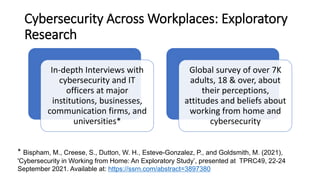
Cybersecurity Across Workplaces: Exploratory
Research
In-depth Interviews with
cybersecurity and IT
officers at major
institutions, businesses,
communication firms, and
universities*
Global survey of over 7K
adults, 18 & over, about
their perceptions,
attitudes and beliefs about
working from home and
cybersecurity
* Bispham, M., Creese, S., Dutton, W. H., Esteve-Gonzalez, P., and Goldsmith, M. (2021),
'Cybersecurity in Working from Home: An Exploratory Study’, presented at TPRC49, 22-24
September 2021. Available at: https://ssrn.com/abstract=3897380
The Changing Nature of Work: Post-Pandemic
Exploratory Survey of the Impact of the Pandemic on Work and Cybersecurity
Global Centre for Cybersecurity Capacity Building (GCSC), University of Oxford in
collaboration with GrapeData
GrapeData: “Pioneers in developing … market research platform with global coverage”
An exploratory online global survey of adults [in the field presently]
Survey on
Cybersecurity
across Workplaces
• An Exploratory Research Project
• William Dutton, Patricia Esteve-González, Ioannis
Agrafiotis, Sadie Creese, and Michael Goldsmith
• Global Cybersecurity Capacity Centre (GCSCC)
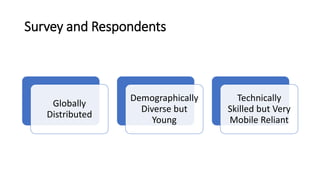
Survey and Respondents
Globally
Distributed
Demographically
Diverse but
Young
Technically
Skilled but Very
Mobile Reliant
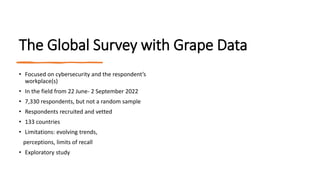
The Global Survey with Grape Data
• Focused on cybersecurity and the respondent’s
workplace(s)
• In the field from 22 June- 2 September 2022
• 7,330 respondents, but not a random sample
• Respondents recruited and vetted
• 133 countries
• Limitations: evolving trends,
perceptions, limits of recall
• Exploratory study
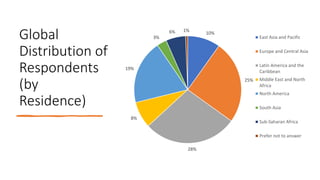
Global
Distribution of
Respondents
(by
Residence)
10%
25%
28%
8%
19%
3%
6% 1%
East Asia and Pacific
Europe and Central Asia
Latin America and the
Caribbean
Middle East and North
Africa
North America
South Asia
Sub-Saharan Africa
Prefer not to answer
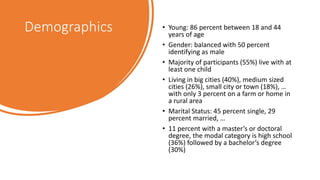
Demographics • Young: 86 percent between 18 and 44
years of age
• Gender: balanced with 50 percent
identifying as male
• Majority of participants (55%) live with at
least one child
• Living in big cities (40%), medium sized
cities (26%), small city or town (18%), …
with only 3 percent on a farm or home in
a rural area
• Marital Status: 45 percent single, 29
percent married, …
• 11 percent with a master’s or doctoral
degree, the modal category is high school
(36%) followed by a bachelor’s degree
(30%)
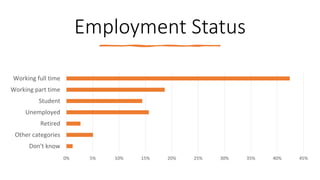
Employment Status
0% 5% 10% 15% 20% 25% 30% 35% 40% 45%
Don't know
Other categories
Retired
Unemployed
Student
Working part time
Working full time
Internet Access
• Access to Internet at Home: 47% broadband sub; 70% smartphone
• Devices: Mainly smartphone, followed by laptop
• 43% of participants use smartphone as the only way to access Internet at home
• 87% of participants have at least one desktop or laptop computer at home
• 48 percent say they are skilled online, using the internet independently and people come
to them for help on how to use it
• The pandemic did not lead most (58%) to adopt new software or apps
• About half (47%) use the internet “almost constantly”, with another 46 percent using it
“many times a day”
• 70 percent have a reliable connection at home, with 21 percent saying they have
“occasional problems connecting at home”
• 70 percent of those with connection at home describe it as “fast enough to do things I do
online”
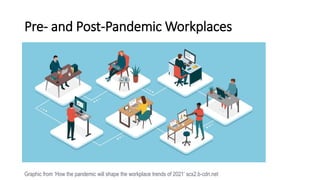
Pre- and Post-Pandemic Workplaces
Graphic from ‘How the pandemic will shape the workplace trends of 2021’ scx2.b-cdn.net
Controversy Surrounding the Workplace
Elon Musk:
come into work,
or …
“pretend to work
somewhere
else”
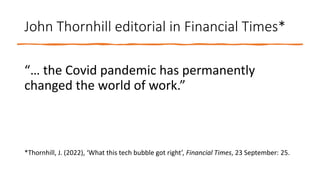
John Thornhill editorial in Financial Times*
“… the Covid pandemic has permanently
changed the world of work.”
*Thornhill, J. (2022), ‘What this tech bubble got right’, Financial Times, 23 September: 25.
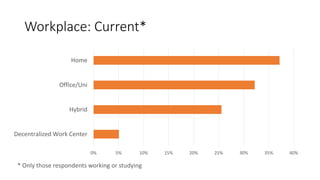
Workplace: Current*
0% 5% 10% 15% 20% 25% 30% 35% 40%
Decentralized Work Center
Hybrid
Office/Uni
Home
* Only those respondents working or studying
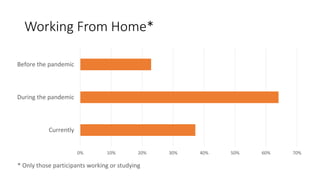
Working From Home*
0% 10% 20% 30% 40% 50% 60% 70%
Currently
During the pandemic
Before the pandemic
* Only those participants working or studying
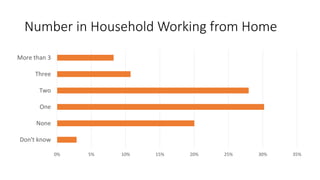
Number in Household Working from Home
0% 5% 10% 15% 20% 25% 30% 35%
Don't know
None
One
Two
Three
More than 3
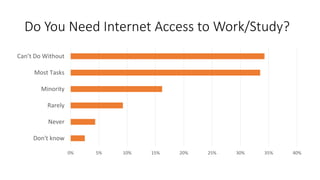
Do You Need Internet Access to Work/Study?
0% 5% 10% 15% 20% 25% 30% 35% 40%
Don't know
Never
Rarely
Minority
Most Tasks
Can’t Do Without
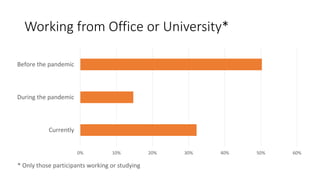
Working from Office or University*
0% 10% 20% 30% 40% 50% 60%
Currently
During the pandemic
Before the pandemic
* Only those participants working or studying
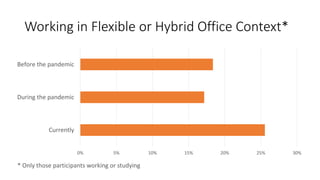
Working in Flexible or Hybrid Office Context*
0% 5% 10% 15% 20% 25% 30%
Currently
During the pandemic
Before the pandemic
* Only those participants working or studying
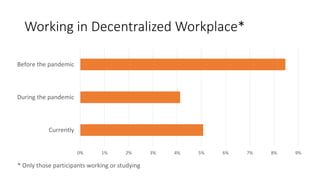
Working in Decentralized Workplace*
0% 1% 2% 3% 4% 5% 6% 7% 8% 9%
Currently
During the pandemic
Before the pandemic
* Only those participants working or studying
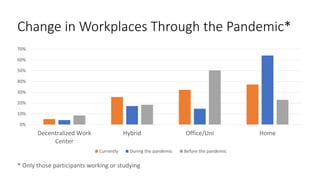
Change in Workplaces Through the Pandemic*
0%
10%
20%
30%
40%
50%
60%
70%
Decentralized Work
Center
Hybrid Office/Uni Home
Currently During the pandemic Before the pandemic
* Only those participants working or studying
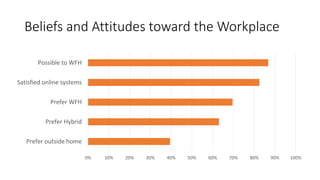
Beliefs and Attitudes toward the Workplace
0% 10% 20% 30% 40% 50% 60% 70% 80% 90% 100%
Prefer outside home
Prefer Hybrid
Prefer WFH
Satisfied online systems
Possible to WFH
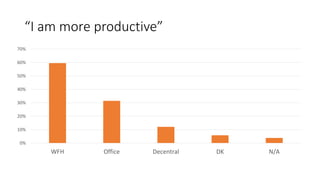
“I am more productive”
0%
10%
20%
30%
40%
50%
60%
70%
WFH Office Decentral DK N/A
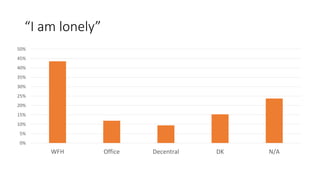
“I am lonely”
0%
5%
10%
15%
20%
25%
30%
35%
40%
45%
50%
WFH Office Decentral DK N/A
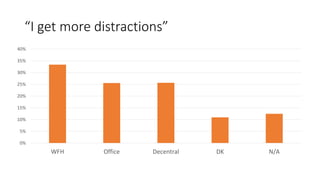
“I get more distractions”
0%
5%
10%
15%
20%
25%
30%
35%
40%
WFH Office Decentral DK N/A
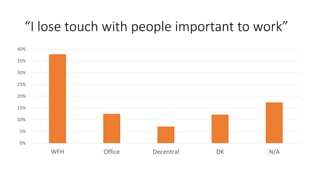
“I lose touch with people important to work”
0%
5%
10%
15%
20%
25%
30%
35%
40%
WFH Office Decentral DK N/A
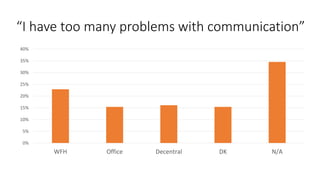
“I have too many problems with communication”
0%
5%
10%
15%
20%
25%
30%
35%
40%
WFH Office Decentral DK N/A
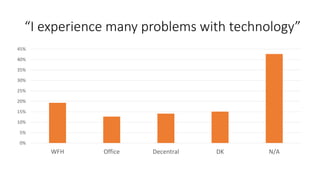
“I experience many problems with technology”
0%
5%
10%
15%
20%
25%
30%
35%
40%
45%
WFH Office Decentral DK N/A
Cybersecurity Across Workplaces
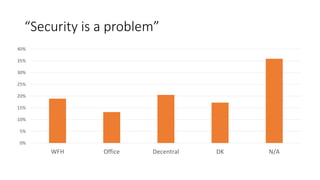
“Security is a problem”
0%
5%
10%
15%
20%
25%
30%
35%
40%
WFH Office Decentral DK N/A
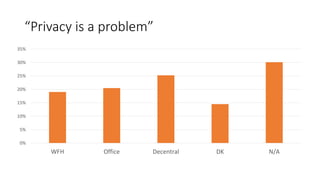
“Privacy is a problem”
0%
5%
10%
15%
20%
25%
30%
35%
WFH Office Decentral DK N/A
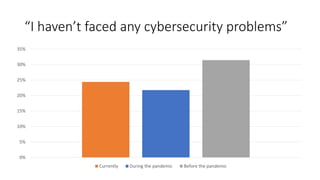
“I haven’t faced any cybersecurity problems”
0%
5%
10%
15%
20%
25%
30%
35%
Currently During the pandemic Before the pandemic
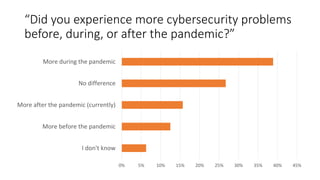
“Did you experience more cybersecurity problems
before, during, or after the pandemic?”
0% 5% 10% 15% 20% 25% 30% 35% 40% 45%
I don't know
More before the pandemic
More after the pandemic (currently)
No difference
More during the pandemic
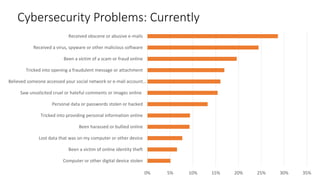
Cybersecurity Problems: Currently
0% 5% 10% 15% 20% 25% 30% 35%
Computer or other digital device stolen
Been a victim of online identity theft
Lost data that was on my computer or other device
Been harassed or bullied online
Tricked into providing personal information online
Personal data or passwords stolen or hacked
Saw unsolicited cruel or hateful comments or images online
Believed someone accessed your social network or e-mail account…
Tricked into opening a fraudulent message or attachment
Been a victim of a scam or fraud online
Received a virus, spyware or other malicious software
Received obscene or abusive e-mails
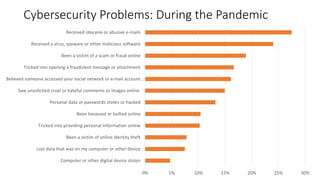
Cybersecurity Problems: During the Pandemic
0% 5% 10% 15% 20% 25% 30%
Computer or other digital device stolen
Lost data that was on my computer or other device
Been a victim of online identity theft
Tricked into providing personal information online
Been harassed or bullied online
Personal data or passwords stolen or hacked
Saw unsolicited cruel or hateful comments or images online
Believed someone accessed your social network or e-mail account…
Tricked into opening a fraudulent message or attachment
Been a victim of a scam or fraud online
Received a virus, spyware or other malicious software
Received obscene or abusive e-mails
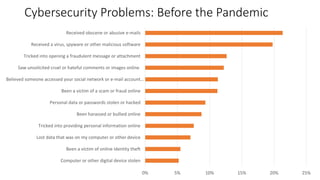
Cybersecurity Problems: Before the Pandemic
0% 5% 10% 15% 20% 25%
Computer or other digital device stolen
Been a victim of online identity theft
Lost data that was on my computer or other device
Tricked into providing personal information online
Been harassed or bullied online
Personal data or passwords stolen or hacked
Been a victim of a scam or fraud online
Believed someone accessed your social network or e-mail account…
Saw unsolicited cruel or hateful comments or images online
Tricked into opening a fraudulent message or attachment
Received a virus, spyware or other malicious software
Received obscene or abusive e-mails
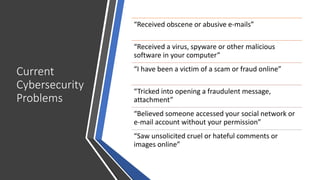
Current
Cybersecurity
Problems
“Received obscene or abusive e-mails”
“Received a virus, spyware or other malicious
software in your computer”
“I have been a victim of a scam or fraud online”
“Tricked into opening a fraudulent message,
attachment”
“Believed someone accessed your social network or
e-mail account without your permission”
“Saw unsolicited cruel or hateful comments or
images online”
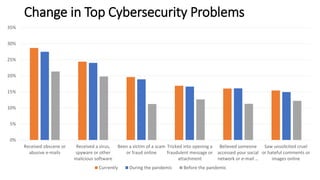
Change in Top Cybersecurity Problems
0%
5%
10%
15%
20%
25%
30%
35%
Received obscene or
abusive e-mails
Received a virus,
spyware or other
malicious software
Been a victim of a scam
or fraud online
Tricked into opening a
fraudulent message or
attachment
Believed someone
accessed your social
network or e-mail …
Saw unsolicited cruel
or hateful comments or
images online
Currently During the pandemic Before the pandemic
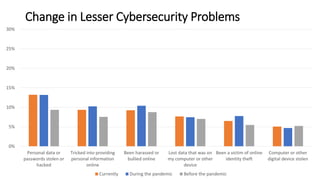
Change in Lesser Cybersecurity Problems
0%
5%
10%
15%
20%
25%
30%
Personal data or
passwords stolen or
hacked
Tricked into providing
personal information
online
Been harassed or
bullied online
Lost data that was on
my computer or other
device
Been a victim of online
identity theft
Computer or other
digital device stolen
Currently During the pandemic Before the pandemic
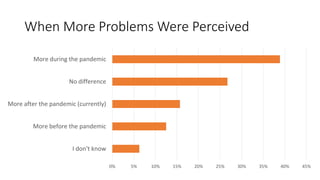
When More Problems Were Perceived
0% 5% 10% 15% 20% 25% 30% 35% 40% 45%
I don't know
More before the pandemic
More after the pandemic (currently)
No difference
More during the pandemic
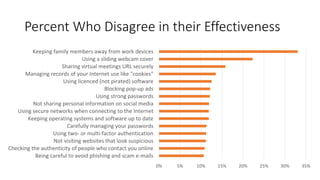
Percent Who Disagree in their Effectiveness
0% 5% 10% 15% 20% 25% 30% 35%
Being careful to avoid phishing and scam e-mails
Checking the authenticity of people who contact you online
Not visiting websites that look suspicious
Using two- or multi-factor authentication
Carefully managing your passwords
Keeping operating systems and software up to date
Using secure networks when connecting to the Internet
Not sharing personal information on social media
Using strong passwords
Blocking pop-up ads
Using licenced (not pirated) software
Managing records of your Internet use like "cookies"
Sharing virtual meetings URL securely
Using a sliding webcam cover
Keeping family members away from work devices
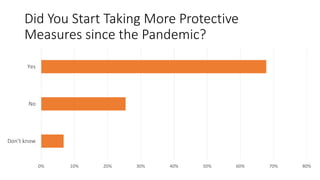
Did You Start Taking More Protective
Measures since the Pandemic?
0% 10% 20% 30% 40% 50% 60% 70% 80%
Don’t know
No
Yes
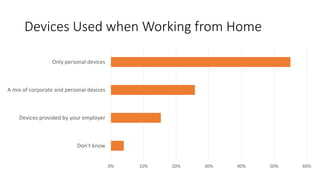
Devices Used when Working from Home
0% 10% 20% 30% 40% 50% 60%
Don’t know
Devices provided by your employer
A mix of corporate and personal devices
Only personal devices
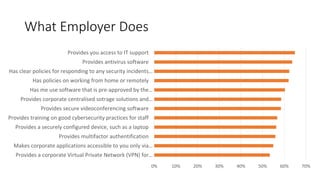
What Employer Does
0% 10% 20% 30% 40% 50% 60% 70%
Provides a corporate Virtual Private Network (VPN) for…
Makes corporate applications accessible to you only via…
Provides multifactor authentification
Provides a securely configured device, such as a laptop
Provides training on good cybersecurity practices for staff
Provides secure videoconferencing software
Provides corporate centralised sotrage solutions and…
Has me use software that is pre-approved by the…
Has policies on working from home or remotely
Has clear policies for responding to any security incidents…
Provides antivirus software
Provides you access to IT support
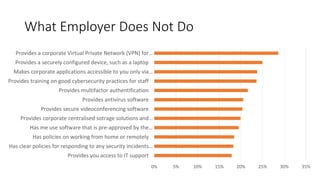
What Employer Does Not Do
0% 5% 10% 15% 20% 25% 30% 35%
Provides you access to IT support
Has clear policies for responding to any security incidents…
Has policies on working from home or remotely
Has me use software that is pre-approved by the…
Provides corporate centralised sotrage solutions and…
Provides secure videoconferencing software
Provides antivirus software
Provides multifactor authentification
Provides training on good cybersecurity practices for staff
Makes corporate applications accessible to you only via…
Provides a securely configured device, such as a laptop
Provides a corporate Virtual Private Network (VPN) for…
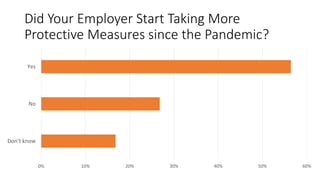
Did Your Employer Start Taking More
Protective Measures since the Pandemic?
0% 10% 20% 30% 40% 50% 60%
Don’t know
No
Yes
Organizational
Perspectives
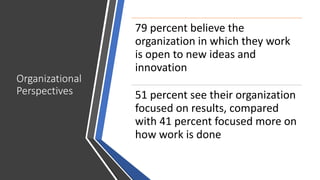
79 percent believe the
organization in which they work
is open to new ideas and
innovation
51 percent see their organization
focused on results, compared
with 41 percent focused more on
how work is done
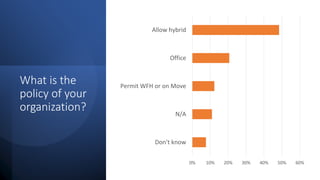
What is the
policy of your
organization?
0% 10% 20% 30% 40% 50% 60%
Don't know
N/A
Permit WFH or on Move
Office
Allow hybrid
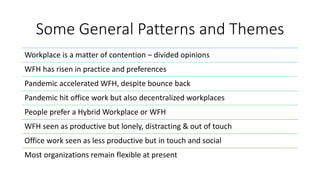
Some General Patterns and Themes
Workplace is a matter of contention – divided opinions
WFH has risen in practice and preferences
Pandemic accelerated WFH, despite bounce back
Pandemic hit office work but also decentralized workplaces
People prefer a Hybrid Workplace or WFH
WFH seen as productive but lonely, distracting & out of touch
Office work seen as less productive but in touch and social
Most organizations remain flexible at present
THANK YOU:
Questions or
Comments?
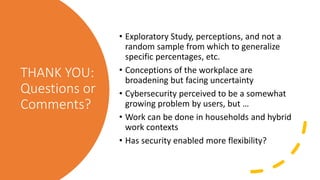
• Exploratory Study, perceptions, and not a
random sample from which to generalize
specific percentages, etc.
• Conceptions of the workplace are
broadening but facing uncertainty
• Cybersecurity perceived to be a somewhat
growing problem by users, but …
• Work can be done in households and hybrid
work contexts
• Has security enabled more flexibility?

25SEP2022 WFH Slides.pptx

  • 1.
    NetWORK: How is theInternet enabling change in the post-pandemic workplace? Evidence and Themes from Exploratory Research William Dutton and Patricia Esteve-González Oxford’s Global Cybersecurity Capacity Centre (GCSCC)
  • 2.
    Cybersecurity Across Workplaces:Exploratory Research In-depth Interviews with cybersecurity and IT officers at major institutions, businesses, communication firms, and universities* Global survey of over 7K adults, 18 & over, about their perceptions, attitudes and beliefs about working from home and cybersecurity * Bispham, M., Creese, S., Dutton, W. H., Esteve-Gonzalez, P., and Goldsmith, M. (2021), 'Cybersecurity in Working from Home: An Exploratory Study’, presented at TPRC49, 22-24 September 2021. Available at: https://ssrn.com/abstract=3897380
  • 3.
    The Changing Natureof Work: Post-Pandemic Exploratory Survey of the Impact of the Pandemic on Work and Cybersecurity Global Centre for Cybersecurity Capacity Building (GCSC), University of Oxford in collaboration with GrapeData GrapeData: “Pioneers in developing … market research platform with global coverage” An exploratory online global survey of adults [in the field presently]
  • 4.
    Survey on Cybersecurity across Workplaces •An Exploratory Research Project • William Dutton, Patricia Esteve-González, Ioannis Agrafiotis, Sadie Creese, and Michael Goldsmith • Global Cybersecurity Capacity Centre (GCSCC)
  • 5.
    Survey and Respondents Globally Distributed Demographically Diversebut Young Technically Skilled but Very Mobile Reliant
  • 6.
    The Global Surveywith Grape Data • Focused on cybersecurity and the respondent’s workplace(s) • In the field from 22 June- 2 September 2022 • 7,330 respondents, but not a random sample • Respondents recruited and vetted • 133 countries • Limitations: evolving trends, perceptions, limits of recall • Exploratory study
  • 7.
    Global Distribution of Respondents (by Residence) 10% 25% 28% 8% 19% 3% 6% 1% EastAsia and Pacific Europe and Central Asia Latin America and the Caribbean Middle East and North Africa North America South Asia Sub-Saharan Africa Prefer not to answer
  • 8.
    Demographics • Young:86 percent between 18 and 44 years of age • Gender: balanced with 50 percent identifying as male • Majority of participants (55%) live with at least one child • Living in big cities (40%), medium sized cities (26%), small city or town (18%), … with only 3 percent on a farm or home in a rural area • Marital Status: 45 percent single, 29 percent married, … • 11 percent with a master’s or doctoral degree, the modal category is high school (36%) followed by a bachelor’s degree (30%)
  • 9.
    Employment Status 0% 5%10% 15% 20% 25% 30% 35% 40% 45% Don't know Other categories Retired Unemployed Student Working part time Working full time
  • 10.
    Internet Access • Accessto Internet at Home: 47% broadband sub; 70% smartphone • Devices: Mainly smartphone, followed by laptop • 43% of participants use smartphone as the only way to access Internet at home • 87% of participants have at least one desktop or laptop computer at home • 48 percent say they are skilled online, using the internet independently and people come to them for help on how to use it • The pandemic did not lead most (58%) to adopt new software or apps • About half (47%) use the internet “almost constantly”, with another 46 percent using it “many times a day” • 70 percent have a reliable connection at home, with 21 percent saying they have “occasional problems connecting at home” • 70 percent of those with connection at home describe it as “fast enough to do things I do online”
  • 11.
    Pre- and Post-PandemicWorkplaces Graphic from ‘How the pandemic will shape the workplace trends of 2021’ scx2.b-cdn.net
  • 12.
    Controversy Surrounding theWorkplace Elon Musk: come into work, or … “pretend to work somewhere else”
  • 13.
    John Thornhill editorialin Financial Times* “… the Covid pandemic has permanently changed the world of work.” *Thornhill, J. (2022), ‘What this tech bubble got right’, Financial Times, 23 September: 25.
  • 14.
    Workplace: Current* 0% 5%10% 15% 20% 25% 30% 35% 40% Decentralized Work Center Hybrid Office/Uni Home * Only those respondents working or studying
  • 15.
    Working From Home* 0%10% 20% 30% 40% 50% 60% 70% Currently During the pandemic Before the pandemic * Only those participants working or studying
  • 16.
    Number in HouseholdWorking from Home 0% 5% 10% 15% 20% 25% 30% 35% Don't know None One Two Three More than 3
  • 17.
    Do You NeedInternet Access to Work/Study? 0% 5% 10% 15% 20% 25% 30% 35% 40% Don't know Never Rarely Minority Most Tasks Can’t Do Without
  • 18.
    Working from Officeor University* 0% 10% 20% 30% 40% 50% 60% Currently During the pandemic Before the pandemic * Only those participants working or studying
  • 19.
    Working in Flexibleor Hybrid Office Context* 0% 5% 10% 15% 20% 25% 30% Currently During the pandemic Before the pandemic * Only those participants working or studying
  • 20.
    Working in DecentralizedWorkplace* 0% 1% 2% 3% 4% 5% 6% 7% 8% 9% Currently During the pandemic Before the pandemic * Only those participants working or studying
  • 21.
    Change in WorkplacesThrough the Pandemic* 0% 10% 20% 30% 40% 50% 60% 70% Decentralized Work Center Hybrid Office/Uni Home Currently During the pandemic Before the pandemic * Only those participants working or studying
  • 22.
    Beliefs and Attitudestoward the Workplace 0% 10% 20% 30% 40% 50% 60% 70% 80% 90% 100% Prefer outside home Prefer Hybrid Prefer WFH Satisfied online systems Possible to WFH
  • 23.
    “I am moreproductive” 0% 10% 20% 30% 40% 50% 60% 70% WFH Office Decentral DK N/A
  • 24.
  • 25.
    “I get moredistractions” 0% 5% 10% 15% 20% 25% 30% 35% 40% WFH Office Decentral DK N/A
  • 26.
    “I lose touchwith people important to work” 0% 5% 10% 15% 20% 25% 30% 35% 40% WFH Office Decentral DK N/A
  • 27.
    “I have toomany problems with communication” 0% 5% 10% 15% 20% 25% 30% 35% 40% WFH Office Decentral DK N/A
  • 28.
    “I experience manyproblems with technology” 0% 5% 10% 15% 20% 25% 30% 35% 40% 45% WFH Office Decentral DK N/A
  • 29.
  • 30.
    “Security is aproblem” 0% 5% 10% 15% 20% 25% 30% 35% 40% WFH Office Decentral DK N/A
  • 31.
    “Privacy is aproblem” 0% 5% 10% 15% 20% 25% 30% 35% WFH Office Decentral DK N/A
  • 32.
    “I haven’t facedany cybersecurity problems” 0% 5% 10% 15% 20% 25% 30% 35% Currently During the pandemic Before the pandemic
  • 33.
    “Did you experiencemore cybersecurity problems before, during, or after the pandemic?” 0% 5% 10% 15% 20% 25% 30% 35% 40% 45% I don't know More before the pandemic More after the pandemic (currently) No difference More during the pandemic
  • 34.
    Cybersecurity Problems: Currently 0%5% 10% 15% 20% 25% 30% 35% Computer or other digital device stolen Been a victim of online identity theft Lost data that was on my computer or other device Been harassed or bullied online Tricked into providing personal information online Personal data or passwords stolen or hacked Saw unsolicited cruel or hateful comments or images online Believed someone accessed your social network or e-mail account… Tricked into opening a fraudulent message or attachment Been a victim of a scam or fraud online Received a virus, spyware or other malicious software Received obscene or abusive e-mails
  • 35.
    Cybersecurity Problems: Duringthe Pandemic 0% 5% 10% 15% 20% 25% 30% Computer or other digital device stolen Lost data that was on my computer or other device Been a victim of online identity theft Tricked into providing personal information online Been harassed or bullied online Personal data or passwords stolen or hacked Saw unsolicited cruel or hateful comments or images online Believed someone accessed your social network or e-mail account… Tricked into opening a fraudulent message or attachment Been a victim of a scam or fraud online Received a virus, spyware or other malicious software Received obscene or abusive e-mails
  • 36.
    Cybersecurity Problems: Beforethe Pandemic 0% 5% 10% 15% 20% 25% Computer or other digital device stolen Been a victim of online identity theft Lost data that was on my computer or other device Tricked into providing personal information online Been harassed or bullied online Personal data or passwords stolen or hacked Been a victim of a scam or fraud online Believed someone accessed your social network or e-mail account… Saw unsolicited cruel or hateful comments or images online Tricked into opening a fraudulent message or attachment Received a virus, spyware or other malicious software Received obscene or abusive e-mails
  • 37.
    Current Cybersecurity Problems “Received obscene orabusive e-mails” “Received a virus, spyware or other malicious software in your computer” “I have been a victim of a scam or fraud online” “Tricked into opening a fraudulent message, attachment” “Believed someone accessed your social network or e-mail account without your permission” “Saw unsolicited cruel or hateful comments or images online”
  • 38.
    Change in TopCybersecurity Problems 0% 5% 10% 15% 20% 25% 30% 35% Received obscene or abusive e-mails Received a virus, spyware or other malicious software Been a victim of a scam or fraud online Tricked into opening a fraudulent message or attachment Believed someone accessed your social network or e-mail … Saw unsolicited cruel or hateful comments or images online Currently During the pandemic Before the pandemic
  • 39.
    Change in LesserCybersecurity Problems 0% 5% 10% 15% 20% 25% 30% Personal data or passwords stolen or hacked Tricked into providing personal information online Been harassed or bullied online Lost data that was on my computer or other device Been a victim of online identity theft Computer or other digital device stolen Currently During the pandemic Before the pandemic
  • 40.
    When More ProblemsWere Perceived 0% 5% 10% 15% 20% 25% 30% 35% 40% 45% I don't know More before the pandemic More after the pandemic (currently) No difference More during the pandemic
  • 41.
    Percent Who Disagreein their Effectiveness 0% 5% 10% 15% 20% 25% 30% 35% Being careful to avoid phishing and scam e-mails Checking the authenticity of people who contact you online Not visiting websites that look suspicious Using two- or multi-factor authentication Carefully managing your passwords Keeping operating systems and software up to date Using secure networks when connecting to the Internet Not sharing personal information on social media Using strong passwords Blocking pop-up ads Using licenced (not pirated) software Managing records of your Internet use like "cookies" Sharing virtual meetings URL securely Using a sliding webcam cover Keeping family members away from work devices
  • 42.
    Did You StartTaking More Protective Measures since the Pandemic? 0% 10% 20% 30% 40% 50% 60% 70% 80% Don’t know No Yes
  • 43.
    Devices Used whenWorking from Home 0% 10% 20% 30% 40% 50% 60% Don’t know Devices provided by your employer A mix of corporate and personal devices Only personal devices
  • 44.
    What Employer Does 0%10% 20% 30% 40% 50% 60% 70% Provides a corporate Virtual Private Network (VPN) for… Makes corporate applications accessible to you only via… Provides multifactor authentification Provides a securely configured device, such as a laptop Provides training on good cybersecurity practices for staff Provides secure videoconferencing software Provides corporate centralised sotrage solutions and… Has me use software that is pre-approved by the… Has policies on working from home or remotely Has clear policies for responding to any security incidents… Provides antivirus software Provides you access to IT support
  • 45.
    What Employer DoesNot Do 0% 5% 10% 15% 20% 25% 30% 35% Provides you access to IT support Has clear policies for responding to any security incidents… Has policies on working from home or remotely Has me use software that is pre-approved by the… Provides corporate centralised sotrage solutions and… Provides secure videoconferencing software Provides antivirus software Provides multifactor authentification Provides training on good cybersecurity practices for staff Makes corporate applications accessible to you only via… Provides a securely configured device, such as a laptop Provides a corporate Virtual Private Network (VPN) for…
  • 46.
    Did Your EmployerStart Taking More Protective Measures since the Pandemic? 0% 10% 20% 30% 40% 50% 60% Don’t know No Yes
  • 47.
    Organizational Perspectives 79 percent believethe organization in which they work is open to new ideas and innovation 51 percent see their organization focused on results, compared with 41 percent focused more on how work is done
  • 48.
    What is the policyof your organization? 0% 10% 20% 30% 40% 50% 60% Don't know N/A Permit WFH or on Move Office Allow hybrid
  • 49.
    Some General Patternsand Themes Workplace is a matter of contention – divided opinions WFH has risen in practice and preferences Pandemic accelerated WFH, despite bounce back Pandemic hit office work but also decentralized workplaces People prefer a Hybrid Workplace or WFH WFH seen as productive but lonely, distracting & out of touch Office work seen as less productive but in touch and social Most organizations remain flexible at present
  • 50.
    THANK YOU: Questions or Comments? •Exploratory Study, perceptions, and not a random sample from which to generalize specific percentages, etc. • Conceptions of the workplace are broadening but facing uncertainty • Cybersecurity perceived to be a somewhat growing problem by users, but … • Work can be done in households and hybrid work contexts • Has security enabled more flexibility?