











SEOSearch Engine OptimizationThe What, Why, and How
ContentsWhat is SEO?Why Search MattersHow Search Engines WorkSEO ProcessSEO MetricsQ&A
What is SEO?
What is SEO?Search Engine Optimization, or, SEO, is the active practice of optimizing a web site by improving technical, structural, on-page, and off-page elements to increase the traffic the site receives from search engines.
What is SEO?Search Engine Optimization is the process of strategic placement of targeted keywords in an effort to maximize search engine ranking placement (SERP). The purpose of SEO is to ensure a Web site is properly indexed by the search engines. SEO is an evolutionary process of continual updates in an effort to achieve maximum result placement.Search Engines are the second most popular Internet activity, and quickly gaining ground on the number one activity, e-mail.Consumers trust Search Engines, seeing them as fair, unbiased providers of information beyond all other research tools.
Why Does Search Matter?
Why Does Search Matter?TrafficVisibilityTrust
Why Search Matters: TrafficUnless you have brand recognition or a large budget, search is the most cost effective medium to drive traffic to a websiteSome of our clients see between 60% and 70% of their total traffic come from searchOthers are much lower, with only 5%
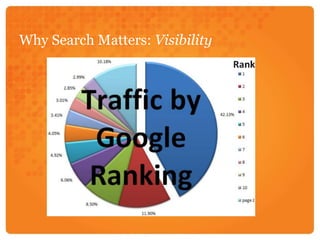
Why Search Matters: VisibilityTop 3 listings on search engine results pgs account for approximately 63% of all clicksFirst place result gets 4 times the amount of traffic of the secondEverybody wants to be #1
Why Search Matters: Visibility
Why Search Matters: TrustPeople trust search enginesThey believe search results show relevant, factual information80% use search engines to gather information on a product or service prior to purchasing online78% use search engines to compare prices online76% use search engines to gather information on a product or service prior to purchasing in-storeSource: MediaPost, 2010
How Search Engines Work
How Search Engines WorkSearch engines use “spiders” (aka. Robots, Bots, Crawlers), which are basically automated Web surfers. Spiders systematically browse the Web, indexing the contents on each page they visit. Spiders follow hyperlinks in their pursuit of information.
How Search Engines WorkContent must create thematic relevancy, which not only relies on a comprehensive site architecture but also robust, well-written content.Spiders store a copy of everything they find in the Search Engine Index, or database of web content.Search Engines query the index and apply a unique, complex algorithm to deliver the most relevant results to each user query.
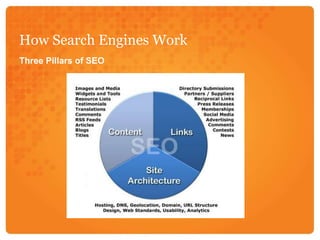
How Search Engines WorkThree Pillars of SEOContent – On-Page assets like copy, images & videoSite Architecture – Domain, Hosting, URL, Navigation, Page Hierarchy, Design, UsabilityLinks – Internal & External
How Search Engines WorkThree Pillars of SEO
How Search Engines WorkThree Pillars of SEO: ContentCopy is relevant to searchers intentAccurate title tags, H1 tags, and META descriptionsImages are search-friendly, following proper naming conventions and utilizing ALT attributesFlash and other non-readable media formats like audio and video are transcribed
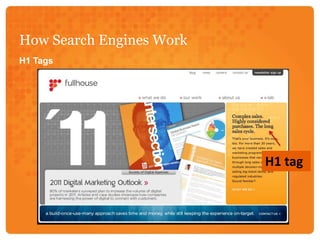
How Search Engines WorkH1 TagsH1 tag
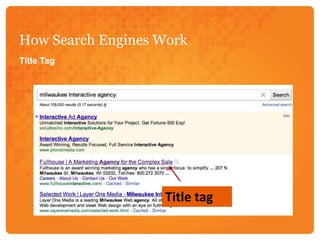
How Search Engines WorkTitle TagTitle tag
How Search Engines WorkThree Pillars of SEO: Site ArchitectureNavigation is properly labeled and easy to useHierarchy is flat, meaning there aren’t 8 levels of directories presentURLs are easy to understand, contain keywords when appropriate, and are consistent
How Search Engines WorkThree Pillars of SEO: LinksSearch engines view a link as a “vote of confidence”The higher quantity (and quality) number of links a page relevant to the query has, the more likely it will rankIndustry sentiment puts the importance of links in relation to all SEO ranking elements at 60%
Our SEO Process
Fullhouse SEO ProcessSEO Audit & RecommendationsKeyword ResearchContent ReorganizationKeyword MappingImplementation & Link BuildingReporting & Analysis
Fullhouse SEO ProcessAlways starts with an audit
Our SEO ProcessStarting with an audit allows us to know what we need to spend extra time onKeyword research is client & industry specificReorganize content for maximum search visibilityMap keywords to new and existing pagesImplement recommendations & build linksReport on metrics that matter
Metrics That Matter
Metrics That MatterQuantitative metrics like number of unique visitors, percentage of traffic coming from search, and % of return visitors are useless without a way to measure behaviorQualitative metrics like bounce rate, time on site, and average pageviews per visitor provide a better overall picture of web traffic performanceWe can easily dismiss a traffic source that only drives 10% of total visits, but if that same source also produces 70% of all conversions then we need to pay attention
Metrics That MatterVisits by non-paid keywords, filtered for branded, trademarked, and copyrighted terms show us how visible a page is in search enginesVisits, time spend on page, and bounce ratesegmented by entry pages gives us a better understanding of how qualified our search visitors areNumber of conversions or goal completions give us a good look at how likely search traffic is willing to convert
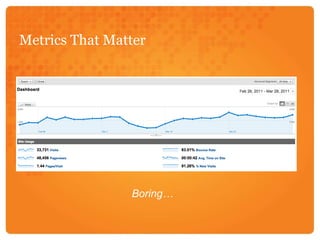
Metrics That MatterBoring…
Metrics That MatterThat’s what I’m talking about!
Metrics That MatterBottom LineMake sure your metrics have meaning!
Questions?
Thank You!

Search Engine Optimization

  • 1.
  • 2.
    ContentsWhat is SEO?WhySearch MattersHow Search Engines WorkSEO ProcessSEO MetricsQ&A
  • 3.
  • 4.
    What is SEO?SearchEngine Optimization, or, SEO, is the active practice of optimizing a web site by improving technical, structural, on-page, and off-page elements to increase the traffic the site receives from search engines.
  • 5.
    What is SEO?SearchEngine Optimization is the process of strategic placement of targeted keywords in an effort to maximize search engine ranking placement (SERP). The purpose of SEO is to ensure a Web site is properly indexed by the search engines. SEO is an evolutionary process of continual updates in an effort to achieve maximum result placement.Search Engines are the second most popular Internet activity, and quickly gaining ground on the number one activity, e-mail.Consumers trust Search Engines, seeing them as fair, unbiased providers of information beyond all other research tools.
  • 6.
  • 7.
    Why Does SearchMatter?TrafficVisibilityTrust
  • 8.
    Why Search Matters:TrafficUnless you have brand recognition or a large budget, search is the most cost effective medium to drive traffic to a websiteSome of our clients see between 60% and 70% of their total traffic come from searchOthers are much lower, with only 5%
  • 9.
    Why Search Matters:VisibilityTop 3 listings on search engine results pgs account for approximately 63% of all clicksFirst place result gets 4 times the amount of traffic of the secondEverybody wants to be #1
  • 10.
  • 11.
  • 12.
    Why Search Matters:TrustPeople trust search enginesThey believe search results show relevant, factual information80% use search engines to gather information on a product or service prior to purchasing online78% use search engines to compare prices online76% use search engines to gather information on a product or service prior to purchasing in-storeSource: MediaPost, 2010
  • 13.
  • 14.
    How Search EnginesWorkSearch engines use “spiders” (aka. Robots, Bots, Crawlers), which are basically automated Web surfers. Spiders systematically browse the Web, indexing the contents on each page they visit. Spiders follow hyperlinks in their pursuit of information.
  • 15.
    How Search EnginesWorkContent must create thematic relevancy, which not only relies on a comprehensive site architecture but also robust, well-written content.Spiders store a copy of everything they find in the Search Engine Index, or database of web content.Search Engines query the index and apply a unique, complex algorithm to deliver the most relevant results to each user query.
  • 16.
    How Search EnginesWorkThree Pillars of SEOContent – On-Page assets like copy, images & videoSite Architecture – Domain, Hosting, URL, Navigation, Page Hierarchy, Design, UsabilityLinks – Internal & External
  • 17.
    How Search EnginesWorkThree Pillars of SEO
  • 18.
    How Search EnginesWorkThree Pillars of SEO: ContentCopy is relevant to searchers intentAccurate title tags, H1 tags, and META descriptionsImages are search-friendly, following proper naming conventions and utilizing ALT attributesFlash and other non-readable media formats like audio and video are transcribed
  • 19.
    How Search EnginesWorkH1 TagsH1 tag
  • 20.
    How Search EnginesWorkTitle TagTitle tag
  • 21.
    How Search EnginesWorkThree Pillars of SEO: Site ArchitectureNavigation is properly labeled and easy to useHierarchy is flat, meaning there aren’t 8 levels of directories presentURLs are easy to understand, contain keywords when appropriate, and are consistent
  • 22.
    How Search EnginesWorkThree Pillars of SEO: LinksSearch engines view a link as a “vote of confidence”The higher quantity (and quality) number of links a page relevant to the query has, the more likely it will rankIndustry sentiment puts the importance of links in relation to all SEO ranking elements at 60%
  • 23.
  • 24.
    Fullhouse SEO ProcessSEOAudit & RecommendationsKeyword ResearchContent ReorganizationKeyword MappingImplementation & Link BuildingReporting & Analysis
  • 25.
    Fullhouse SEO ProcessAlwaysstarts with an audit
  • 26.
    Our SEO ProcessStartingwith an audit allows us to know what we need to spend extra time onKeyword research is client & industry specificReorganize content for maximum search visibilityMap keywords to new and existing pagesImplement recommendations & build linksReport on metrics that matter
  • 27.
  • 28.
    Metrics That MatterQuantitativemetrics like number of unique visitors, percentage of traffic coming from search, and % of return visitors are useless without a way to measure behaviorQualitative metrics like bounce rate, time on site, and average pageviews per visitor provide a better overall picture of web traffic performanceWe can easily dismiss a traffic source that only drives 10% of total visits, but if that same source also produces 70% of all conversions then we need to pay attention
  • 29.
    Metrics That MatterVisitsby non-paid keywords, filtered for branded, trademarked, and copyrighted terms show us how visible a page is in search enginesVisits, time spend on page, and bounce ratesegmented by entry pages gives us a better understanding of how qualified our search visitors areNumber of conversions or goal completions give us a good look at how likely search traffic is willing to convert
  • 30.
  • 31.
    Metrics That MatterThat’swhat I’m talking about!
  • 32.
    Metrics That MatterBottomLineMake sure your metrics have meaning!
  • 33.
  • 34.

Editor's Notes

  • #8 Add stats on consumer and decision-maker usage of search engines to make buying decisions