MaltepeUniversity
Faculty of Engineering
& Natural Sciences
Software Engineering Department
PROJECT TITLE
SE 401 CAPSTONE PROJECT REPORT
Project Team: -------------------------
Project Advisor(s): ………………..
İSTANBUL, 2013
PREFACE
The scope of the project and its aim are briefly described, in no more than 150 words. This
section is optional.
ACKNOWLEDGMENTS
People or organizations that support or contribute to the project are acknowledged here in no
more than one page. This section isoptional but it is a good practice to write.
ABSTRACT
The project should be summarized in no more than one page.
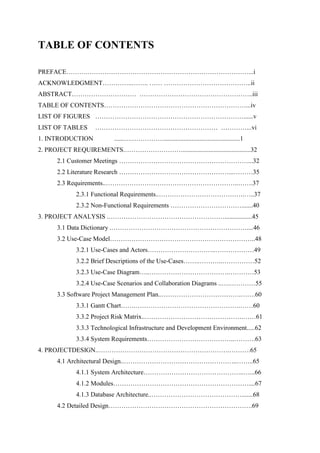
TABLE OF CONTENTS
PREFACE……….…………………………………………………………………...i
ACKNOWLEDGMENT…………..…….. …… …………………………………..ii
ABSTRACT………………………… ……………………………………………..iii
TABLE OF CONTENTS…………………………………………………………...iv
LIST OF FIGURES ……………………………………………………………......v
LIST OF TABLES ………………………………………………… …………...vi
1. INTRODUCTION ......….……………...............................................1
2. PROJECT REQUIREMENTS.………………………..........................................32
2.1 Customer Meetings ……………………………………………………...32
2.2 Literature Research ……………………………………………...………35
2.3 Requirements..……………………………………………………..…….37
2.3.1 Functional Requirements..………………………………….…..37
2.3.2 Non-Functional Requirements …………………………….......40
3. PROJECT ANALYSIS .……………………………………………….................45
3.1 Data Dictionary .………………………………………………………....46
3.2 Use-Case Model…………………………………………………………..48
3.2.1 Use-Cases and Actors…………………………..………………49
3.2.2 Brief Descriptions of the Use-Cases……..………..……………52
3.2.3 Use-Case Diagram…..……………………………….…………53
3.2.4 Use-Case Scenarios and Collaboration Diagrams ..….…………55
3.3 Software Project Management Plan..……………………………….…….60
3.3.1 Gantt Chart…….………………………………………….……60
3.3.2 Project Risk Matrix..……………………………………….……61
3.3.3 Technological Infrastructure and Development Environment.....62
3.3.4 System Requirements…………………………………..……….63
4. PROJECTDESIGN..…………………………………………………….……….65
4.1 Architectural Design..……………………………………………..……..65
4.1.1 System Architecture………………………………………..…...66
4.1.2 Modules………………………………………………………....67
4.1.3 Database Architecture..…………………………………….......68
4.2 Detailed Design………………………………………………………….69
4.2.1 Class Designs.………………………………………….....…70
5. CONCLUSION………………………………………………………………....75
REFERENCES………..……………………………………………………….....77
APPENDIX……………………………………………………………………….80
APPENDIX A. Contract Document.……………………………………..80
APPENDIXB. Version History………………………………………..…85
APPENDIXC.Other Appendices Required……………………………...86
LIST OF FIGURES
List of the figures used in the documentmust be given in order of page numbers.
Figure 1.1 Image of User Interface ..…………………………..........................................8
Figure 1.2 System Architectre………..………………………........................................13
Figure 1.3 UML Diagram…..………………………………………………....................25
LIST OF TABLES
List of the tables used in the document must be given in order of page numbers.
Table 1.1 Market Share Distribution ……………………………......................................12
Table 1.2 Risk Matrix… ……………..………………………...........................................23
Table 1.3 Task Schedule.……………………………………………………......................45
1. INTRODUCTION
This chapter is expected to introduce the project in a general manner.
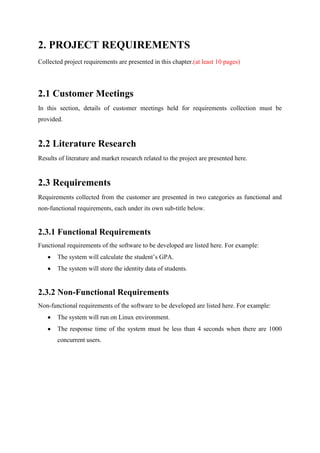
2. PROJECT REQUIREMENTS
Collected project requirements are presented in this chapter.(at least 10 pages)
2.1 Customer Meetings
In this section, details of customer meetings held for requirements collection must be
provided.
2.2 Literature Research
Results of literature and market research related to the project are presented here.
2.3 Requirements
Requirements collected from the customer are presented in two categories as functional and
non-functional requirements, each under its own sub-title below.
2.3.1 Functional Requirements
Functional requirements of the software to be developed are listed here. For example:
The system will calculate the student’s GPA.
The system will store the identity data of students.
2.3.2 Non-Functional Requirements
Non-functional requirements of the software to be developed are listed here. For example:
The system will run on Linux environment.
The response time of the system must be less than 4 seconds when there are 1000
concurrent users.
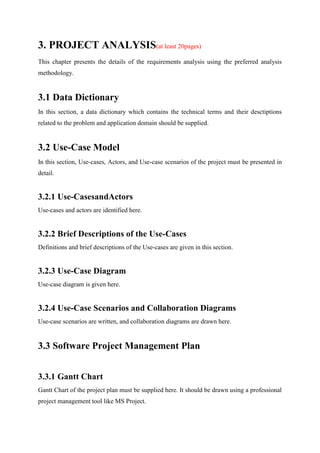
3. PROJECT ANALYSIS(at least 20pages)
This chapter presents the details of the requirements analysis using the preferred analysis
methodology.
3.1 Data Dictionary
In this section, a data dictionary which contains the technical terms and their desctiptions
related to the problem and application domain should be supplied.
3.2 Use-Case Model
In this section, Use-cases, Actors, and Use-case scenarios of the project must be presented in
detail.
3.2.1 Use-CasesandActors
Use-cases and actors are identified here.
3.2.2 Brief Descriptions of the Use-Cases
Definitions and brief descriptions of the Use-cases are given in this section.
3.2.3 Use-Case Diagram
Use-case diagram is given here.
3.2.4 Use-Case Scenarios and Collaboration Diagrams
Use-case scenarios are written, and collaboration diagrams are drawn here.
3.3 Software Project Management Plan
3.3.1 Gantt Chart
Gantt Chart of the project plan must be supplied here. It should be drawn using a professional
project management tool like MS Project.
3.3.2 Project Risk Matrix
Project Risk Matrix must be created and risk items should be explained in detail with their
risk reduction and contingency plans.
3.3.3 Technological Infrastructure and Development Environment
Technological infrastructure like program development tools (e.g. IDE, language, etc),
database management system, design and drawing tools, CASE tools, and so on should be
identified and briefly explained.
3.3.4 System Requirements
Any hardware and software platforms that the developed system will run on should be
identified and briefly explained here. For example, Linux Operating System, Android 4.1
platform, Java Virtual Machine, etc.
4.PROJECT DESIGN(at least 20 pages)
Project design in all levels must be provided in this chapter.
4.1 Architectural Design
4.1.1 System Architecture
System architecture is presented using figures, diagrams, and textual explanations here.
4.1.2 Modules
Project modules are identified, and initial class diagrams are given in this section.
4.1.3 Database Architecture
Database design is provided using both
E/R diagrams,
Relational database diagrams.
4.2 Detailed Design
Major modules that constitute the whole system are divided into individual classes, and the
relationships between these classes are identified here.
4.2.1 Class Designs
Detailed class designs must be presented using appropriate techniques like UML Class
Diagrams, UML Object Diagrams, Sequence Diagrams, CRC Cards, tabular views, and so on.
5. CONCLUSION
In this final chapter, the work done about the project so far is summarized, current state of the
project is evaluated, and finally directions for future work are presented.
REFERENCES
Each and every resource (including web pages) cited in the document MUST appear in this
section. References in the document must be numbered in the form of [x] (number of the
reference inside brackets), in the order of appearance in the document. This practice must not
be ignored, and this section must not be omitted. Below are several examples on how to cite
different types of resources:
[1] Aydın, A. andAslan, B., "Title of the Paper", Name of the journaı, Volume No., page
numbers, year published.
[2] Aydın, A. (Editors if any), Title of the Book, Name of the publisher,City published,year
published.
[3] Aydın, A. andAslan, B., "Title of the proceeding", Name of the symposium or conference,
year published, page numbers.
[4] Title of the web page, URL, date last accessed.
APPENDIX
APPENDIX A. Contract Document
Contract document should be presented in this section if there is any.
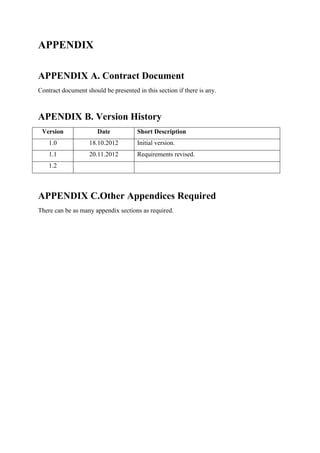
APENDIX B. Version History
Version Date Short Description
1.0 18.10.2012 Initial version.
1.1 20.11.2012 Requirements revised.
1.2
APPENDIX C.Other Appendices Required
There can be as many appendix sections as required.

Se401 capstone project_reporttemplat

  • 1.
    MaltepeUniversity Faculty of Engineering &Natural Sciences Software Engineering Department PROJECT TITLE SE 401 CAPSTONE PROJECT REPORT Project Team: ------------------------- Project Advisor(s): ……………….. İSTANBUL, 2013
  • 2.
    PREFACE The scope ofthe project and its aim are briefly described, in no more than 150 words. This section is optional.
  • 3.
    ACKNOWLEDGMENTS People or organizationsthat support or contribute to the project are acknowledged here in no more than one page. This section isoptional but it is a good practice to write.
  • 4.
    ABSTRACT The project shouldbe summarized in no more than one page.
  • 5.
    TABLE OF CONTENTS PREFACE……….…………………………………………………………………...i ACKNOWLEDGMENT…………..……..…… …………………………………..ii ABSTRACT………………………… ……………………………………………..iii TABLE OF CONTENTS…………………………………………………………...iv LIST OF FIGURES ……………………………………………………………......v LIST OF TABLES ………………………………………………… …………...vi 1. INTRODUCTION ......….……………...............................................1 2. PROJECT REQUIREMENTS.………………………..........................................32 2.1 Customer Meetings ……………………………………………………...32 2.2 Literature Research ……………………………………………...………35 2.3 Requirements..……………………………………………………..…….37 2.3.1 Functional Requirements..………………………………….…..37 2.3.2 Non-Functional Requirements …………………………….......40 3. PROJECT ANALYSIS .……………………………………………….................45 3.1 Data Dictionary .………………………………………………………....46 3.2 Use-Case Model…………………………………………………………..48 3.2.1 Use-Cases and Actors…………………………..………………49 3.2.2 Brief Descriptions of the Use-Cases……..………..……………52 3.2.3 Use-Case Diagram…..……………………………….…………53 3.2.4 Use-Case Scenarios and Collaboration Diagrams ..….…………55 3.3 Software Project Management Plan..……………………………….…….60 3.3.1 Gantt Chart…….………………………………………….……60 3.3.2 Project Risk Matrix..……………………………………….……61 3.3.3 Technological Infrastructure and Development Environment.....62 3.3.4 System Requirements…………………………………..……….63 4. PROJECTDESIGN..…………………………………………………….……….65 4.1 Architectural Design..……………………………………………..……..65 4.1.1 System Architecture………………………………………..…...66 4.1.2 Modules………………………………………………………....67 4.1.3 Database Architecture..…………………………………….......68 4.2 Detailed Design………………………………………………………….69
  • 6.
    4.2.1 Class Designs.………………………………………….....…70 5.CONCLUSION………………………………………………………………....75 REFERENCES………..……………………………………………………….....77 APPENDIX……………………………………………………………………….80 APPENDIX A. Contract Document.……………………………………..80 APPENDIXB. Version History………………………………………..…85 APPENDIXC.Other Appendices Required……………………………...86
  • 7.
    LIST OF FIGURES Listof the figures used in the documentmust be given in order of page numbers. Figure 1.1 Image of User Interface ..…………………………..........................................8 Figure 1.2 System Architectre………..………………………........................................13 Figure 1.3 UML Diagram…..………………………………………………....................25
  • 8.
    LIST OF TABLES Listof the tables used in the document must be given in order of page numbers. Table 1.1 Market Share Distribution ……………………………......................................12 Table 1.2 Risk Matrix… ……………..………………………...........................................23 Table 1.3 Task Schedule.……………………………………………………......................45
  • 9.
    1. INTRODUCTION This chapteris expected to introduce the project in a general manner.
  • 10.
    2. PROJECT REQUIREMENTS Collectedproject requirements are presented in this chapter.(at least 10 pages) 2.1 Customer Meetings In this section, details of customer meetings held for requirements collection must be provided. 2.2 Literature Research Results of literature and market research related to the project are presented here. 2.3 Requirements Requirements collected from the customer are presented in two categories as functional and non-functional requirements, each under its own sub-title below. 2.3.1 Functional Requirements Functional requirements of the software to be developed are listed here. For example: The system will calculate the student’s GPA. The system will store the identity data of students. 2.3.2 Non-Functional Requirements Non-functional requirements of the software to be developed are listed here. For example: The system will run on Linux environment. The response time of the system must be less than 4 seconds when there are 1000 concurrent users.
  • 11.
    3. PROJECT ANALYSIS(atleast 20pages) This chapter presents the details of the requirements analysis using the preferred analysis methodology. 3.1 Data Dictionary In this section, a data dictionary which contains the technical terms and their desctiptions related to the problem and application domain should be supplied. 3.2 Use-Case Model In this section, Use-cases, Actors, and Use-case scenarios of the project must be presented in detail. 3.2.1 Use-CasesandActors Use-cases and actors are identified here. 3.2.2 Brief Descriptions of the Use-Cases Definitions and brief descriptions of the Use-cases are given in this section. 3.2.3 Use-Case Diagram Use-case diagram is given here. 3.2.4 Use-Case Scenarios and Collaboration Diagrams Use-case scenarios are written, and collaboration diagrams are drawn here. 3.3 Software Project Management Plan 3.3.1 Gantt Chart Gantt Chart of the project plan must be supplied here. It should be drawn using a professional project management tool like MS Project.
  • 12.
    3.3.2 Project RiskMatrix Project Risk Matrix must be created and risk items should be explained in detail with their risk reduction and contingency plans. 3.3.3 Technological Infrastructure and Development Environment Technological infrastructure like program development tools (e.g. IDE, language, etc), database management system, design and drawing tools, CASE tools, and so on should be identified and briefly explained. 3.3.4 System Requirements Any hardware and software platforms that the developed system will run on should be identified and briefly explained here. For example, Linux Operating System, Android 4.1 platform, Java Virtual Machine, etc.
  • 13.
    4.PROJECT DESIGN(at least20 pages) Project design in all levels must be provided in this chapter. 4.1 Architectural Design 4.1.1 System Architecture System architecture is presented using figures, diagrams, and textual explanations here. 4.1.2 Modules Project modules are identified, and initial class diagrams are given in this section. 4.1.3 Database Architecture Database design is provided using both E/R diagrams, Relational database diagrams. 4.2 Detailed Design Major modules that constitute the whole system are divided into individual classes, and the relationships between these classes are identified here. 4.2.1 Class Designs Detailed class designs must be presented using appropriate techniques like UML Class Diagrams, UML Object Diagrams, Sequence Diagrams, CRC Cards, tabular views, and so on.
  • 14.
    5. CONCLUSION In thisfinal chapter, the work done about the project so far is summarized, current state of the project is evaluated, and finally directions for future work are presented.
  • 15.
    REFERENCES Each and everyresource (including web pages) cited in the document MUST appear in this section. References in the document must be numbered in the form of [x] (number of the reference inside brackets), in the order of appearance in the document. This practice must not be ignored, and this section must not be omitted. Below are several examples on how to cite different types of resources: [1] Aydın, A. andAslan, B., "Title of the Paper", Name of the journaı, Volume No., page numbers, year published. [2] Aydın, A. (Editors if any), Title of the Book, Name of the publisher,City published,year published. [3] Aydın, A. andAslan, B., "Title of the proceeding", Name of the symposium or conference, year published, page numbers. [4] Title of the web page, URL, date last accessed.
  • 16.
    APPENDIX APPENDIX A. ContractDocument Contract document should be presented in this section if there is any. APENDIX B. Version History Version Date Short Description 1.0 18.10.2012 Initial version. 1.1 20.11.2012 Requirements revised. 1.2 APPENDIX C.Other Appendices Required There can be as many appendix sections as required.