CAN YOU RECALL THE DIFFERENCE BETWEEN VOCAL
MUSIC AND INSTRUMENTAL MUSIC?
Vocal music is music made
specifically for voices. It may be
performed with or without
instruments while Instrumental
music is made solely for instruments.
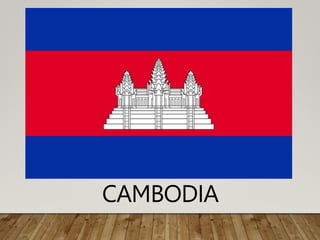
CAMBODIA
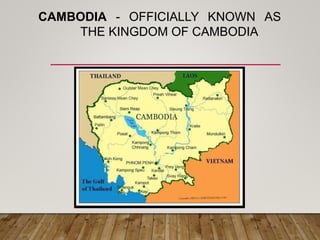
CAMBODIA - OFFICIALLY KNOWN AS
THE KINGDOM OF CAMBODIA
CAMBODIA
• one of the most beautiful countries in
Southeast Asia.
• It is also known as Kâmpŭchéa. It was the
center of the Khmer (Cambodian) kingdom of
Angkor, a great empire that dominated
Southeast Asia for 600 years.
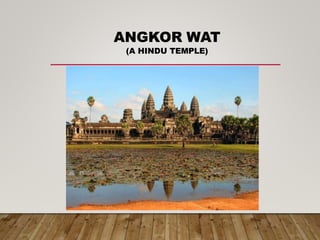
ANGKOR WAT
(A HINDU TEMPLE)
CAMBODIA
• Art music is highly influenced by ancient forms as well as
Hindu forms.
• Cambodian court music is roughly similar to that of Java,
Indonesia. They feature choruses with large orchestras based
on struck keys and gongs.
• Cambodian people also absorbed and adopted Indian, Chinese,
European, and other cultures to suit their own traditions and
tastes that resulted in a distinct Cambodian culture.
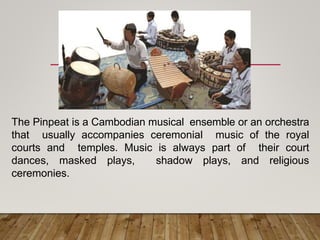
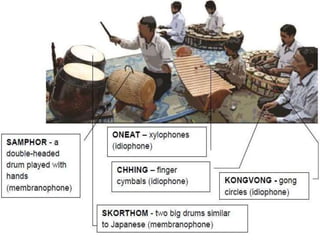
The Pinpeat is a Cambodian musical ensemble or an orchestra
that usually accompanies ceremonial music of the royal
courts and temples. Music is always part of their court
dances, masked plays, shadow plays, and religious
ceremonies.
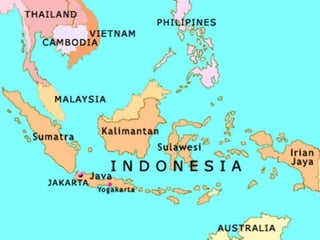
INDONESIA
• Indonesia is an archipelago in
Southeast Asia comprising
approximately 17,500 islands.
• With over 238 million people, Indonesia is
the world's fourth most populous country
and is the fourth biggest nation of the world.
INDONESIA
• Through interaction with other cultures such as
Indian, Arabic, Chinese and European, a wide
range of musical styles has been developed.
• Today the contemporary music of
Indonesia is popular not only in the
region but also in the neighbouring
countries.
INDONESIA
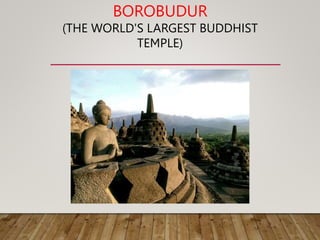
BOROBUDUR
(THE WORLD'S LARGEST BUDDHIST
TEMPLE)
INDONESIA
Jakarta - is the capital and
largest city of Indonesia,
and one of the most
populous urban
agglomerations in the
world.
There are two basic kinds of Indonesian music
scale:
• Slendro – five (5) equidistant
tones in octave
• Pelog – heptatonic (7) tone
scale with semi tone
INDONESIA
Both vocal and instrumental music in Indonesia use
slendro and peloq scales.
•Polyphonic stratification kind of melody is a result of hocket/Interlock.
•Interlocking is a common technique used in gong ensembles.
INDONESIA
Irama
(is an Indonesian term for tempo)
The Gamelan or Gamelan orchestra is the most
popular form of music in Indonesia. There are many
types of Gamelan but the most famous are Javanese
and Balinese Gamelan. It contains a variety of
instruments such as metallophones, xylophones,
kendang and gongs; bamboo flutes, bowed and
plucked strings.
INDONESIA
Vocal music is used as ornamentation of the Gamelan.
It is as important as gamelan.
Pesindhen is a female soloist singer who sings with a
Gamelan
Gerong refers to the unison male chorus that sings with the
gamelan
INDONESIA
Karawitan is the term for every kind
of gamelan music in Java
Gamelan orchestras are used to
accompany dances, songs, and
Wayang Kulit; are believed to
possess supernatural powers;
INDONESIA
Gamelan orchestras
- consider their instruments sacred, therefore stepping
over the instrument is a sign of disrespect;
- musicians bow before playing the instruments to show
respect.
INDONESIA
A gamelan is an orchestra made up of a set of
instruments from Java and Bali, Indonesia.
In learning gamelan music, unlike western orchestral
music, a musician will learn more than just one
instrument. In order to understand gamelan, it is
necessary to know what each instrument provides
to the whole.
INDONESIA
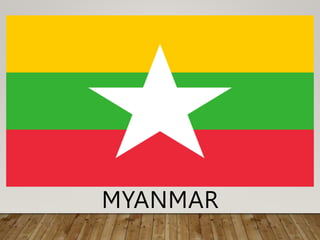
MYANMAR
Myanmar was known as Burma until 1989.
The music of Myanmar has similarities with
many other musical traditions in the region,
including Chinese music and Thai music,
probably because its longest land border is
shared with China.
MYANMAR
MYANMAR
The capital of Myanmar, Yangon
(Rangoon) is known for the most
famous stupa in the country, the
Shwedagon Pagoda, along with a
temple complex around it.
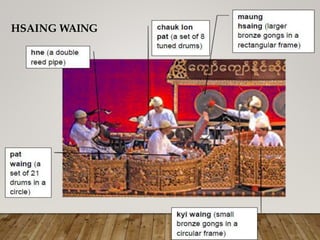
The Hsaing Waing is Myanmar’s traditional
folk music ensemble. It is made up mainly of
different gongs and drums as well as other
instruments depending on the nature of the
performance.
MYANMAR
Myanmar’s musical instruments are
categorized into 2 types, the loud
sounding and soft sounding.
The loud sounding instruments are
performed in open-air ensembles at
ceremonies and festivals. Most of the
Hsaing Waing instruments belong to the
loud sounding category.
MYANMAR
HSAING WAING
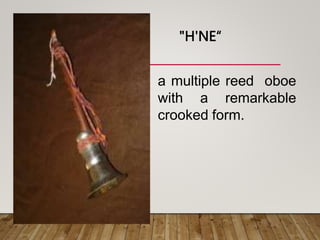
"H'NE“
a multiple reed oboe
with a remarkable
crooked form.
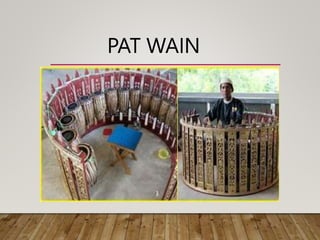
PAT WAIN
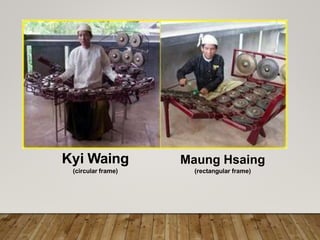
Kyi Waing
(circular frame)
Maung Hsaing
(rectangular frame)
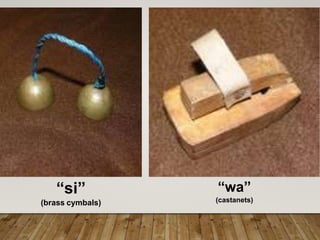
“si”
(brass cymbals)
“wa”
(castanets)
For more formal and classical performances that are
performed indoors, the ensemble may be accompanied by
the saung gauk the national instrument of (13-string angular
harp with soft sound) Myanmar, the pattala (Burmese
xylophone), or the piano and violin, both introduced during
colonial rule.
MYANMAR
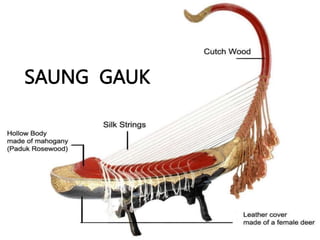
SAUNG GAUK
The body of the saung gauk is
made of padauk, the famous
Myanmar mahogany, the flat bar
is made of cutch wood, it is
covered with the leather of a
female deer and the strings are
made of silk.
MYANMAR
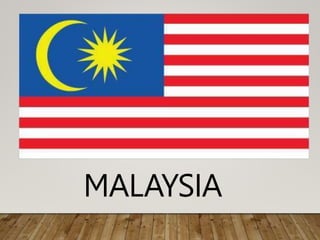
MALAYSIA
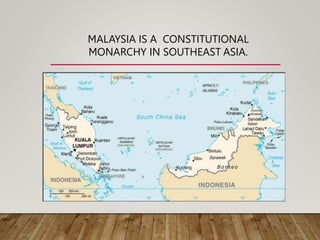
MALAYSIA IS A CONSTITUTIONAL
MONARCHY IN SOUTHEAST ASIA.
Malaysia is divided into 2 regions:
West Malaysia – also known as Peninsular
Malaysia.
East Malaysia – consists of 13 states and 3
federal territories.
MALAYSIA
The country is multi-ethnic and multi-
cultural, which plays a large role in
developing their culture.
The constitution declares Islam, the
state religion while protecting freedom of
religion.
MALAYSIA
Multi-racial groups that influenced Malaysia’s music genre:
• Malay
• Chinese
• Indian
• Iban
• Dayak
• Kadazandusun
• Eurasians
MALAYSIA
Kuala Lumpur
is the federal capital and
most populous city in
Malaysia.
MALAYSIA
MALAYSIA
The music of Malaysia may be categorized into 2 types:
Classical and Folk music emerged during the pre-colonial period and
still exists in the form of vocal, dance, and theatrical music.
Syncretic or Acculturated music developed during the post-Portuguese
period (16th century).
Musical instruments of Malaysia are greatly associated with their
culture and roots. Due to colonization, the stages of development of
Malaysian instruments are great. They share some common
features with Indian musical instruments. After the colonization of
Malaysia by the British, the musical development was influenced by
Western music.
MALAYSIA
Musical Ensemble
and
Types of
Performances
in Malaysia
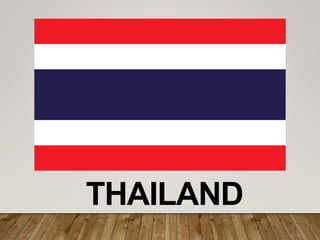
THAILAND
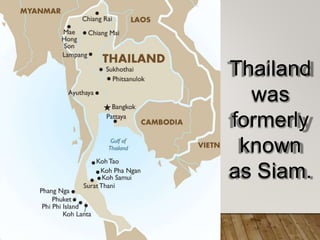
Thailand
was
formerly
known
as Siam.
Thailand is known for being the sole nation in
Southeast Asia that has never been ruled by a
Western power.
It is for this reason that the country is also called
“Muang Thai”, which means “Land of the Free”.
THAILAND
History and geography indicates that Thai music is a conglomeration
of Asian influences. Its musical principles and elements are basically
derived from Chinese music, while its musical instruments are
inspired from the Indian and Indonesian strings and gong- chimes.
The Thais combined and adapted these to their culture and created
their own unique music.
THAILAND
Bangkok
is the capital and the most populous city of
Thailand.
It is known in Thai as Krung Thep Maha
Nakhon or simply Krung Thep.
THAILAND
Music is theoretically based on the five-tone or seven-tone
scale system. It is not only confined to the royal courts but is
also used extensively in dance, theatre, and in ceremonies.
Thai folk music consists of simple songs with simple melodic
lines. Its main focus in singing is the articulation of the text
rather than the style or technique of execution.
Songs of Thailand have inherently poetic lyrics which allow a
singer or performer to easily define the melodic lines. It
provides the singer the opportunity to improvise song text to
suit the given occasion.
THAILAND
THAILAND
Thailand has three primary instrumental ensembles that are similar to the other ensembles in
SoutheastAsia.
Piphat
It is a mid-sized orchestra that is performed in either outdoor style with hard mallets or indoor
style with padded mallets. This ensemble has different types but the highly ornate one is
traditionally associated with funerals and cremation ceremonies.
Khrueang Sai
It is an orchestra that combines some of the percussion and wind instruments of the Piphat
with an expanded string section. This group is primarily used for indoor performances and for
the accompaniment of stick-puppet theater.
Mahori
This ensemble is traditionally played by women in the courts of Central Thailand and
Cambodia. Because of this, instruments for this ensemble are historically smaller. However,
regular-sized instruments are used today.
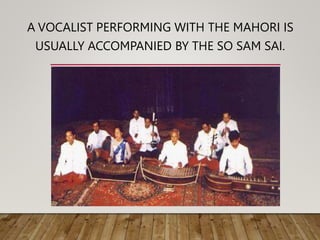
A VOCALIST PERFORMING WITH THE MAHORI IS
USUALLY ACCOMPANIED BY THE SO SAM SAI.
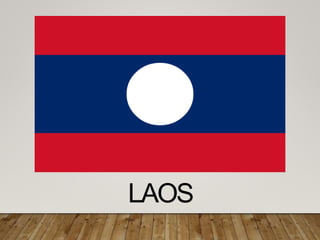
LAOS
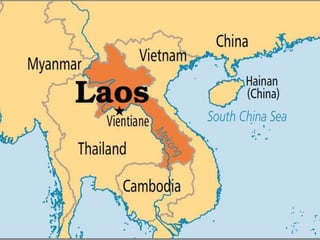
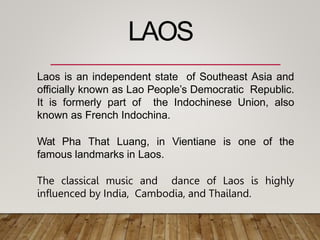
Laos is an independent state of Southeast Asia and
officially known as Lao People’s Democratic Republic.
It is formerly part of the Indochinese Union, also
known as French Indochina.
Wat Pha That Luang, in Vientiane is one of the
famous landmarks in Laos.
The classical music and dance of Laos is highly
influenced by India, Cambodia, and Thailand.
LAOS
The royal entourage of Lao kings traditionally
included musicians, and a typical orchestra
improvised songs with sets of tuned gongs,
xylophones, a bamboo flute, and other wind
instruments.
LAOS
LAOS
The Lao orchestra can be divided into two categories:
Sep Nyai - This is similar to the Piphat of Thailand with instruments that are strictly
percussive but also integrates the use of an oboe.
Sep Noi – This is also known as the Mahori of Thailand. However, it incorporates the
use of several Khene which is a large bamboo mouth organ and is the most
popular folk music instrument of Laos.
Traditional music, called Mor Lam, is largely based around the khene.
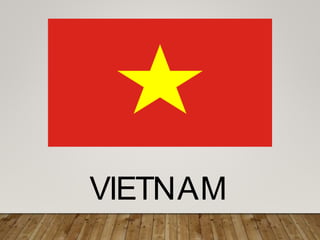
VIETNAM
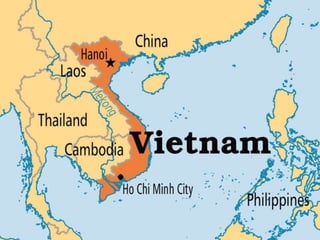
Vietnam is officially known as the Socialist
Republic of Vietnam. This country is located
on the eastern coast of the Indochinese
Peninsula.
VIETNAM
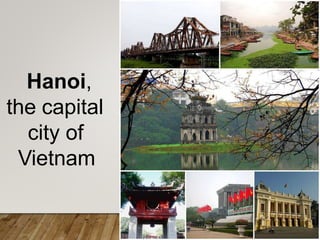
Hanoi,
the capital
city of
Vietnam
Vietnamese music (nhạc Việt Nam) refers to the
ethnic music that originated from the "Kinh" people
of Vietnam. This term is also used to address the
music of any of the numerous ethnic minorities
including the Montagnard, Degar, Tay, Cham, and
others.
VIETNAM
Vietnamese music shows signs of Indian influences, noticeable in
improvisation preludes of chamber music (known as rao in the South and
dao in the north) as well as usage of onomatopoeia in drum playing.
Vietnamese traditional music can be separated into a few major
categories, divided predominantly by the way in which were used in the
people's cultural lives.
VIETNAM
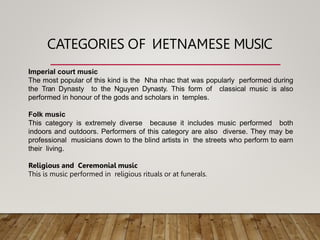
CATEGORIES OF VIETNAMESE MUSIC
Imperial court music
The most popular of this kind is the Nha nhac that was popularly performed during
the Tran Dynasty to the Nguyen Dynasty. This form of classical music is also
performed in honour of the gods and scholars in temples.
Folk music
This category is extremely diverse because it includes music performed both
indoors and outdoors. Performers of this category are also diverse. They may be
professional musicians down to the blind artists in the streets who perform to earn
their living.
Religious and Ceremonial music
This is music performed in religious rituals or at funerals.
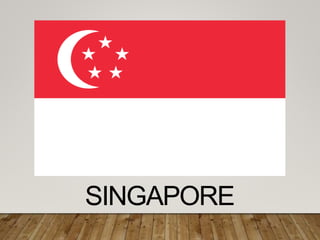
SINGAPORE
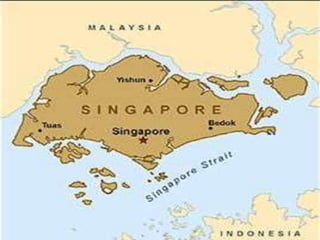
The Republic of Singapore is an independent republic in Southeast Asia,
comprised of one main island and about 50 small adjacent islands off the
southern tip of the Malay Peninsula.
About three-fourths of the people of Singapore, known as Singaporeans,
are Chinese, but there are significant Malay and Indian minorities.
Singapore’s cultural life reflects its colonization by the British Empire and
its diverse population. Being the melting pot of different cultures in Asia,
folk music of this country reflects the culture and traditions of specific
groups.
SINGAPORE
MERLION
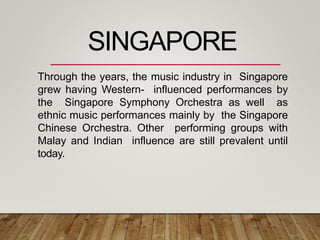
Through the years, the music industry in Singapore
grew having Western- influenced performances by
the Singapore Symphony Orchestra as well as
ethnic music performances mainly by the Singapore
Chinese Orchestra. Other performing groups with
Malay and Indian influence are still prevalent until
today.
SINGAPORE
THE
END

SE Asian Arts.pptx

  • 4.
    CAN YOU RECALLTHE DIFFERENCE BETWEEN VOCAL MUSIC AND INSTRUMENTAL MUSIC? Vocal music is music made specifically for voices. It may be performed with or without instruments while Instrumental music is made solely for instruments.
  • 5.
  • 6.
    CAMBODIA - OFFICIALLYKNOWN AS THE KINGDOM OF CAMBODIA
  • 7.
    CAMBODIA • one ofthe most beautiful countries in Southeast Asia. • It is also known as Kâmpŭchéa. It was the center of the Khmer (Cambodian) kingdom of Angkor, a great empire that dominated Southeast Asia for 600 years.
  • 8.
  • 9.
    CAMBODIA • Art musicis highly influenced by ancient forms as well as Hindu forms. • Cambodian court music is roughly similar to that of Java, Indonesia. They feature choruses with large orchestras based on struck keys and gongs. • Cambodian people also absorbed and adopted Indian, Chinese, European, and other cultures to suit their own traditions and tastes that resulted in a distinct Cambodian culture.
  • 10.
    The Pinpeat isa Cambodian musical ensemble or an orchestra that usually accompanies ceremonial music of the royal courts and temples. Music is always part of their court dances, masked plays, shadow plays, and religious ceremonies.
  • 12.
  • 14.
    • Indonesia isan archipelago in Southeast Asia comprising approximately 17,500 islands. • With over 238 million people, Indonesia is the world's fourth most populous country and is the fourth biggest nation of the world. INDONESIA
  • 15.
    • Through interactionwith other cultures such as Indian, Arabic, Chinese and European, a wide range of musical styles has been developed. • Today the contemporary music of Indonesia is popular not only in the region but also in the neighbouring countries. INDONESIA
  • 16.
  • 17.
    INDONESIA Jakarta - isthe capital and largest city of Indonesia, and one of the most populous urban agglomerations in the world.
  • 18.
    There are twobasic kinds of Indonesian music scale: • Slendro – five (5) equidistant tones in octave • Pelog – heptatonic (7) tone scale with semi tone INDONESIA
  • 19.
    Both vocal andinstrumental music in Indonesia use slendro and peloq scales. •Polyphonic stratification kind of melody is a result of hocket/Interlock. •Interlocking is a common technique used in gong ensembles. INDONESIA Irama (is an Indonesian term for tempo)
  • 20.
    The Gamelan orGamelan orchestra is the most popular form of music in Indonesia. There are many types of Gamelan but the most famous are Javanese and Balinese Gamelan. It contains a variety of instruments such as metallophones, xylophones, kendang and gongs; bamboo flutes, bowed and plucked strings. INDONESIA
  • 21.
    Vocal music isused as ornamentation of the Gamelan. It is as important as gamelan. Pesindhen is a female soloist singer who sings with a Gamelan Gerong refers to the unison male chorus that sings with the gamelan INDONESIA
  • 22.
    Karawitan is theterm for every kind of gamelan music in Java Gamelan orchestras are used to accompany dances, songs, and Wayang Kulit; are believed to possess supernatural powers; INDONESIA
  • 23.
    Gamelan orchestras - considertheir instruments sacred, therefore stepping over the instrument is a sign of disrespect; - musicians bow before playing the instruments to show respect. INDONESIA
  • 24.
    A gamelan isan orchestra made up of a set of instruments from Java and Bali, Indonesia. In learning gamelan music, unlike western orchestral music, a musician will learn more than just one instrument. In order to understand gamelan, it is necessary to know what each instrument provides to the whole. INDONESIA
  • 25.
  • 26.
    Myanmar was knownas Burma until 1989. The music of Myanmar has similarities with many other musical traditions in the region, including Chinese music and Thai music, probably because its longest land border is shared with China. MYANMAR
  • 27.
    MYANMAR The capital ofMyanmar, Yangon (Rangoon) is known for the most famous stupa in the country, the Shwedagon Pagoda, along with a temple complex around it.
  • 28.
    The Hsaing Waingis Myanmar’s traditional folk music ensemble. It is made up mainly of different gongs and drums as well as other instruments depending on the nature of the performance. MYANMAR
  • 29.
    Myanmar’s musical instrumentsare categorized into 2 types, the loud sounding and soft sounding. The loud sounding instruments are performed in open-air ensembles at ceremonies and festivals. Most of the Hsaing Waing instruments belong to the loud sounding category. MYANMAR
  • 30.
  • 31.
    "H'NE“ a multiple reedoboe with a remarkable crooked form.
  • 32.
  • 33.
    Kyi Waing (circular frame) MaungHsaing (rectangular frame)
  • 34.
  • 35.
    For more formaland classical performances that are performed indoors, the ensemble may be accompanied by the saung gauk the national instrument of (13-string angular harp with soft sound) Myanmar, the pattala (Burmese xylophone), or the piano and violin, both introduced during colonial rule. MYANMAR
  • 36.
  • 37.
    The body ofthe saung gauk is made of padauk, the famous Myanmar mahogany, the flat bar is made of cutch wood, it is covered with the leather of a female deer and the strings are made of silk. MYANMAR
  • 38.
  • 39.
    MALAYSIA IS ACONSTITUTIONAL MONARCHY IN SOUTHEAST ASIA.
  • 40.
    Malaysia is dividedinto 2 regions: West Malaysia – also known as Peninsular Malaysia. East Malaysia – consists of 13 states and 3 federal territories. MALAYSIA
  • 41.
    The country ismulti-ethnic and multi- cultural, which plays a large role in developing their culture. The constitution declares Islam, the state religion while protecting freedom of religion. MALAYSIA
  • 42.
    Multi-racial groups thatinfluenced Malaysia’s music genre: • Malay • Chinese • Indian • Iban • Dayak • Kadazandusun • Eurasians MALAYSIA
  • 43.
    Kuala Lumpur is thefederal capital and most populous city in Malaysia. MALAYSIA
  • 44.
    MALAYSIA The music ofMalaysia may be categorized into 2 types: Classical and Folk music emerged during the pre-colonial period and still exists in the form of vocal, dance, and theatrical music. Syncretic or Acculturated music developed during the post-Portuguese period (16th century).
  • 45.
    Musical instruments ofMalaysia are greatly associated with their culture and roots. Due to colonization, the stages of development of Malaysian instruments are great. They share some common features with Indian musical instruments. After the colonization of Malaysia by the British, the musical development was influenced by Western music. MALAYSIA
  • 46.
  • 47.
  • 48.
  • 49.
    Thailand is knownfor being the sole nation in Southeast Asia that has never been ruled by a Western power. It is for this reason that the country is also called “Muang Thai”, which means “Land of the Free”. THAILAND
  • 50.
    History and geographyindicates that Thai music is a conglomeration of Asian influences. Its musical principles and elements are basically derived from Chinese music, while its musical instruments are inspired from the Indian and Indonesian strings and gong- chimes. The Thais combined and adapted these to their culture and created their own unique music. THAILAND
  • 51.
    Bangkok is the capitaland the most populous city of Thailand. It is known in Thai as Krung Thep Maha Nakhon or simply Krung Thep. THAILAND
  • 52.
    Music is theoreticallybased on the five-tone or seven-tone scale system. It is not only confined to the royal courts but is also used extensively in dance, theatre, and in ceremonies. Thai folk music consists of simple songs with simple melodic lines. Its main focus in singing is the articulation of the text rather than the style or technique of execution. Songs of Thailand have inherently poetic lyrics which allow a singer or performer to easily define the melodic lines. It provides the singer the opportunity to improvise song text to suit the given occasion. THAILAND
  • 53.
    THAILAND Thailand has threeprimary instrumental ensembles that are similar to the other ensembles in SoutheastAsia. Piphat It is a mid-sized orchestra that is performed in either outdoor style with hard mallets or indoor style with padded mallets. This ensemble has different types but the highly ornate one is traditionally associated with funerals and cremation ceremonies. Khrueang Sai It is an orchestra that combines some of the percussion and wind instruments of the Piphat with an expanded string section. This group is primarily used for indoor performances and for the accompaniment of stick-puppet theater. Mahori This ensemble is traditionally played by women in the courts of Central Thailand and Cambodia. Because of this, instruments for this ensemble are historically smaller. However, regular-sized instruments are used today.
  • 54.
    A VOCALIST PERFORMINGWITH THE MAHORI IS USUALLY ACCOMPANIED BY THE SO SAM SAI.
  • 55.
  • 57.
    Laos is anindependent state of Southeast Asia and officially known as Lao People’s Democratic Republic. It is formerly part of the Indochinese Union, also known as French Indochina. Wat Pha That Luang, in Vientiane is one of the famous landmarks in Laos. The classical music and dance of Laos is highly influenced by India, Cambodia, and Thailand. LAOS
  • 58.
    The royal entourageof Lao kings traditionally included musicians, and a typical orchestra improvised songs with sets of tuned gongs, xylophones, a bamboo flute, and other wind instruments. LAOS
  • 59.
    LAOS The Lao orchestracan be divided into two categories: Sep Nyai - This is similar to the Piphat of Thailand with instruments that are strictly percussive but also integrates the use of an oboe. Sep Noi – This is also known as the Mahori of Thailand. However, it incorporates the use of several Khene which is a large bamboo mouth organ and is the most popular folk music instrument of Laos. Traditional music, called Mor Lam, is largely based around the khene.
  • 60.
  • 61.
    Vietnam is officiallyknown as the Socialist Republic of Vietnam. This country is located on the eastern coast of the Indochinese Peninsula. VIETNAM
  • 63.
  • 64.
    Vietnamese music (nhạcViệt Nam) refers to the ethnic music that originated from the "Kinh" people of Vietnam. This term is also used to address the music of any of the numerous ethnic minorities including the Montagnard, Degar, Tay, Cham, and others. VIETNAM
  • 65.
    Vietnamese music showssigns of Indian influences, noticeable in improvisation preludes of chamber music (known as rao in the South and dao in the north) as well as usage of onomatopoeia in drum playing. Vietnamese traditional music can be separated into a few major categories, divided predominantly by the way in which were used in the people's cultural lives. VIETNAM
  • 66.
    CATEGORIES OF VIETNAMESEMUSIC Imperial court music The most popular of this kind is the Nha nhac that was popularly performed during the Tran Dynasty to the Nguyen Dynasty. This form of classical music is also performed in honour of the gods and scholars in temples. Folk music This category is extremely diverse because it includes music performed both indoors and outdoors. Performers of this category are also diverse. They may be professional musicians down to the blind artists in the streets who perform to earn their living. Religious and Ceremonial music This is music performed in religious rituals or at funerals.
  • 67.
  • 69.
    The Republic ofSingapore is an independent republic in Southeast Asia, comprised of one main island and about 50 small adjacent islands off the southern tip of the Malay Peninsula. About three-fourths of the people of Singapore, known as Singaporeans, are Chinese, but there are significant Malay and Indian minorities. Singapore’s cultural life reflects its colonization by the British Empire and its diverse population. Being the melting pot of different cultures in Asia, folk music of this country reflects the culture and traditions of specific groups. SINGAPORE
  • 70.
  • 71.
    Through the years,the music industry in Singapore grew having Western- influenced performances by the Singapore Symphony Orchestra as well as ethnic music performances mainly by the Singapore Chinese Orchestra. Other performing groups with Malay and Indian influence are still prevalent until today. SINGAPORE
  • 72.