WWW.SPECTRALENGINES.COM
Hydrocarbon measurement is a
critical quality attribute in many
smart industry processes
There is a high demand for the total composition of
hydrocarbon gas mixtures in energy, power plants, natural gas
and biogas industries. Natural gas production is expected to
become the second-largest source of energy in the world by
2035. With growing demand, the industry needs innovative
solutions to efficiently process gas reserves and capture
valuable natural gas liquids. In biogas production, the energy
is produced from organic waste, and biogas can be used for
energy production in similar ways as natural gas. Both energy
production concepts are growing, thanks to the increasing need
for new energy sources to replace the use of fossil fuels and
nuclear power in the longer run.
Hydrocarbons are critical compounds in various applications in
energy industries. Composition analysis of C1–C5 alkane gases
is important in applications of natural gas production, LNG
stations, power plants and in many other oil & gas industry
applications.
Advanced process control technologies providing fast and
accurate feed and product analysis are critical in optimizing
efficiency and payback in various processing stages. In power
generation applications, on-line and fast sensors are required
to ensure optimum combustion efficiency and acceptable
emission levels. In LNG transport applications, fast and easy-to-
use analyzers are desired to ensure quality at transfer points.
Today very expensive Gas Chromatographs (GS) or Fourier
Transform Infrared (FTIR) measurement systems are mainly used
for gas quality monitoring. Unfortunately, both technologies are
quite expensive, bulky and relatively slow. Another approach is
to use fixed wavelength systems, such as Non-Dispersive Infrared
(NDIR). NDIR sensors are cheap but unfortunately they cannot
separate differences from each other and the drift of sensors
makes them quite unreliable for process quality monitoring.
Spectral Engines’ solutions for
hydrocarbon analysis
Spectral Engines NIR sensors offer a cost-efficient way to
monitor hydrocarbon concentrations in many oil & gas or energy
industry applications. NIR technology is very fast and offers
high sensitivity for low concentrations but also good selectivity
to distinguish different alkanes. NIR technology is significantly
cheaper than GCs of FTIRs. Spectral Engines sensors are also
very compact and they enable the building of very small sensor
systems for industrial hydrocarbon measurement.
Benefits of Spectral Engines sensors:
•	 Rapid and non-destructive analysis
•	 Measurement without sample preparation
•	 Cost-effective solutions for the energy industry
SMART INDUSTRY
APPLICATION NOTE
SPECTRAL ENGINES OY | Kutomotie 16, 00380 Helsinki, FINLAND
sales@spectralengines.com | +358 50 409 0204 | WWW.SPECTRALENGINES.COM
FOR MORE INFORMATION:
Matti Tammi, Application Expert, Spectral Engines
Matti.Tammi@spectralengines.com
+358 44 5281027
USE CASES OF HYDROCARBON MEASUREMENTS
New cost-efficient gas measurement
technology for LNG applications
The LNG industry has generally focused on large baseload
plants on land for many years. However, in recent years, smaller
plants have received considerable investments including
Floating Liquefied Natural Gas (FLNG) plants. In these plants,
simple, low-cost and maintenance-free on-line analysis is
key due to CAPEX/OPEX tradeoff shifts. In addition, some of
these plants are built in areas where access is limited, making
complex analyzer system support cost prohibitive.
There are multiple measurement points through the supply
chain where gas composition and calorific value are sought,
including gas pre-treatment facilities, export and import LNG
locations, storage tank quality assessments, and vaporization/
condensing facilities. The feedstock natural gas for the
liquefaction plants may have different chemical compositions,
yielding different calorific value of the output LNG. The
decision to remove the heavier hydrocarbons depends on the
market for by-products (such as butane or propane) at the site
of the liquefaction.	
Conclusion
Spectral Engines has developed a new, affordable and fast NIR
sensor platform for hydrocarbon measurements. Sensors are
less expensive than existing GCs and FTIR instruments. Thanks
to their compact size and modular structure, Spectral Engines
sensors are easy to integrate with commercial gas cells and
optimize the sensitivity of the applications.
Hydrocarbon sensors increase the quality of
biogas production
The role of biogas production has been growing significantly
in recent decades. Biogas is a renewable energy resource and
it can be produced from various raw materials such as plant
materials, agricultural, municipal or food waste. The main
components of biogas are methane (CH4) and carbon dioxide
(CO2), but there may be low concentrations of also hydrogen
sulfide(H2S), moisture and siloxanes.
Biogas production is a continuous process and it is a very
clean fuel that does not create any greenhouse gas emissions.
The challenge concerning biogas production is that it is very
fragmented. Also the quality of raw material and energy varies
a lot because of limited process control equipment. Methane
and carbon dioxide measurements would help operators
to better understand their production and also enable
controlling the quality of energy. What’s more, the price point
of Spectral Engines’ hydrocarbon sensor is much less than
existing GCs or FTIR systems, which makes it possible to use
them also in smaller biogas production plants without the
need of sample preparations or any special maintenance.
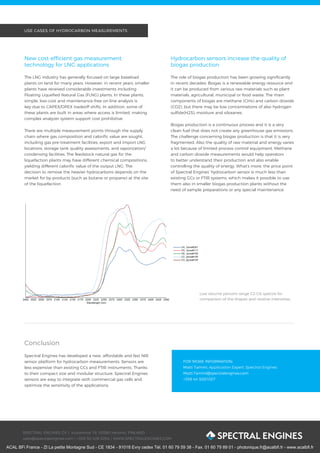
Low volume percent range C2–C6 spectra for
comparison of the shapes and relative intensities.
ACAL BFi France - ZI La petite Montagne Sud - CE 1834 - 91018 Evry cedex Tél. 01 60 79 59 38 - Fax. 01 60 79 89 01 - photonique.fr@acalbfi.fr - www.acalbfi.fr

Se application notes_smartindustry_hydrocarbon

  • 1.
    WWW.SPECTRALENGINES.COM Hydrocarbon measurement isa critical quality attribute in many smart industry processes There is a high demand for the total composition of hydrocarbon gas mixtures in energy, power plants, natural gas and biogas industries. Natural gas production is expected to become the second-largest source of energy in the world by 2035. With growing demand, the industry needs innovative solutions to efficiently process gas reserves and capture valuable natural gas liquids. In biogas production, the energy is produced from organic waste, and biogas can be used for energy production in similar ways as natural gas. Both energy production concepts are growing, thanks to the increasing need for new energy sources to replace the use of fossil fuels and nuclear power in the longer run. Hydrocarbons are critical compounds in various applications in energy industries. Composition analysis of C1–C5 alkane gases is important in applications of natural gas production, LNG stations, power plants and in many other oil & gas industry applications. Advanced process control technologies providing fast and accurate feed and product analysis are critical in optimizing efficiency and payback in various processing stages. In power generation applications, on-line and fast sensors are required to ensure optimum combustion efficiency and acceptable emission levels. In LNG transport applications, fast and easy-to- use analyzers are desired to ensure quality at transfer points. Today very expensive Gas Chromatographs (GS) or Fourier Transform Infrared (FTIR) measurement systems are mainly used for gas quality monitoring. Unfortunately, both technologies are quite expensive, bulky and relatively slow. Another approach is to use fixed wavelength systems, such as Non-Dispersive Infrared (NDIR). NDIR sensors are cheap but unfortunately they cannot separate differences from each other and the drift of sensors makes them quite unreliable for process quality monitoring. Spectral Engines’ solutions for hydrocarbon analysis Spectral Engines NIR sensors offer a cost-efficient way to monitor hydrocarbon concentrations in many oil & gas or energy industry applications. NIR technology is very fast and offers high sensitivity for low concentrations but also good selectivity to distinguish different alkanes. NIR technology is significantly cheaper than GCs of FTIRs. Spectral Engines sensors are also very compact and they enable the building of very small sensor systems for industrial hydrocarbon measurement. Benefits of Spectral Engines sensors: • Rapid and non-destructive analysis • Measurement without sample preparation • Cost-effective solutions for the energy industry SMART INDUSTRY APPLICATION NOTE
  • 2.
    SPECTRAL ENGINES OY| Kutomotie 16, 00380 Helsinki, FINLAND sales@spectralengines.com | +358 50 409 0204 | WWW.SPECTRALENGINES.COM FOR MORE INFORMATION: Matti Tammi, Application Expert, Spectral Engines Matti.Tammi@spectralengines.com +358 44 5281027 USE CASES OF HYDROCARBON MEASUREMENTS New cost-efficient gas measurement technology for LNG applications The LNG industry has generally focused on large baseload plants on land for many years. However, in recent years, smaller plants have received considerable investments including Floating Liquefied Natural Gas (FLNG) plants. In these plants, simple, low-cost and maintenance-free on-line analysis is key due to CAPEX/OPEX tradeoff shifts. In addition, some of these plants are built in areas where access is limited, making complex analyzer system support cost prohibitive. There are multiple measurement points through the supply chain where gas composition and calorific value are sought, including gas pre-treatment facilities, export and import LNG locations, storage tank quality assessments, and vaporization/ condensing facilities. The feedstock natural gas for the liquefaction plants may have different chemical compositions, yielding different calorific value of the output LNG. The decision to remove the heavier hydrocarbons depends on the market for by-products (such as butane or propane) at the site of the liquefaction. Conclusion Spectral Engines has developed a new, affordable and fast NIR sensor platform for hydrocarbon measurements. Sensors are less expensive than existing GCs and FTIR instruments. Thanks to their compact size and modular structure, Spectral Engines sensors are easy to integrate with commercial gas cells and optimize the sensitivity of the applications. Hydrocarbon sensors increase the quality of biogas production The role of biogas production has been growing significantly in recent decades. Biogas is a renewable energy resource and it can be produced from various raw materials such as plant materials, agricultural, municipal or food waste. The main components of biogas are methane (CH4) and carbon dioxide (CO2), but there may be low concentrations of also hydrogen sulfide(H2S), moisture and siloxanes. Biogas production is a continuous process and it is a very clean fuel that does not create any greenhouse gas emissions. The challenge concerning biogas production is that it is very fragmented. Also the quality of raw material and energy varies a lot because of limited process control equipment. Methane and carbon dioxide measurements would help operators to better understand their production and also enable controlling the quality of energy. What’s more, the price point of Spectral Engines’ hydrocarbon sensor is much less than existing GCs or FTIR systems, which makes it possible to use them also in smaller biogas production plants without the need of sample preparations or any special maintenance. Low volume percent range C2–C6 spectra for comparison of the shapes and relative intensities. ACAL BFi France - ZI La petite Montagne Sud - CE 1834 - 91018 Evry cedex Tél. 01 60 79 59 38 - Fax. 01 60 79 89 01 - photonique.fr@acalbfi.fr - www.acalbfi.fr