   standards are needed as GIS users attempt
    to integrate operations with other
    hardware, GISs and data sources
   challenge is to get industry, government
    and users to implement and promote use of
    standards
   many standards are set simply through
    common use, major attempts to develop
    national and international standards
   portability of applications
   data networks
   common environments
   cost of program development
S TANDARDS ORGANIZATIONS
   American National Standards Institute
   Digital Cartographic Data Standards Task Force
   Federal Coordinating Committee on Digital
    Cartography – Standards Working Group
   Institute of Electrical Electronics Engineers
   International Standards Organization
   Open Software Foundation
   Getting the Map into the Computer
    Objectives

    Maps and their attributes find their way
    into GIS from existing data sources, from
    converting paper maps or images into
    digits, and from field measurement. How
    data capture takes place has a major
    impact on data structure, and therefore
    use of the data in the GIS
T YPES OF STANDARDS
   networking standards – critical to allow
    communications between remote computers
   database query standards – SQL is emerging as the
    standard
   data exchange standards – governments/private
    companies recognize need to exchange data
    between different agencies/groups
       several common data exchange formats currently in
        use:
D ATA       EXCHANGE
FORMATS
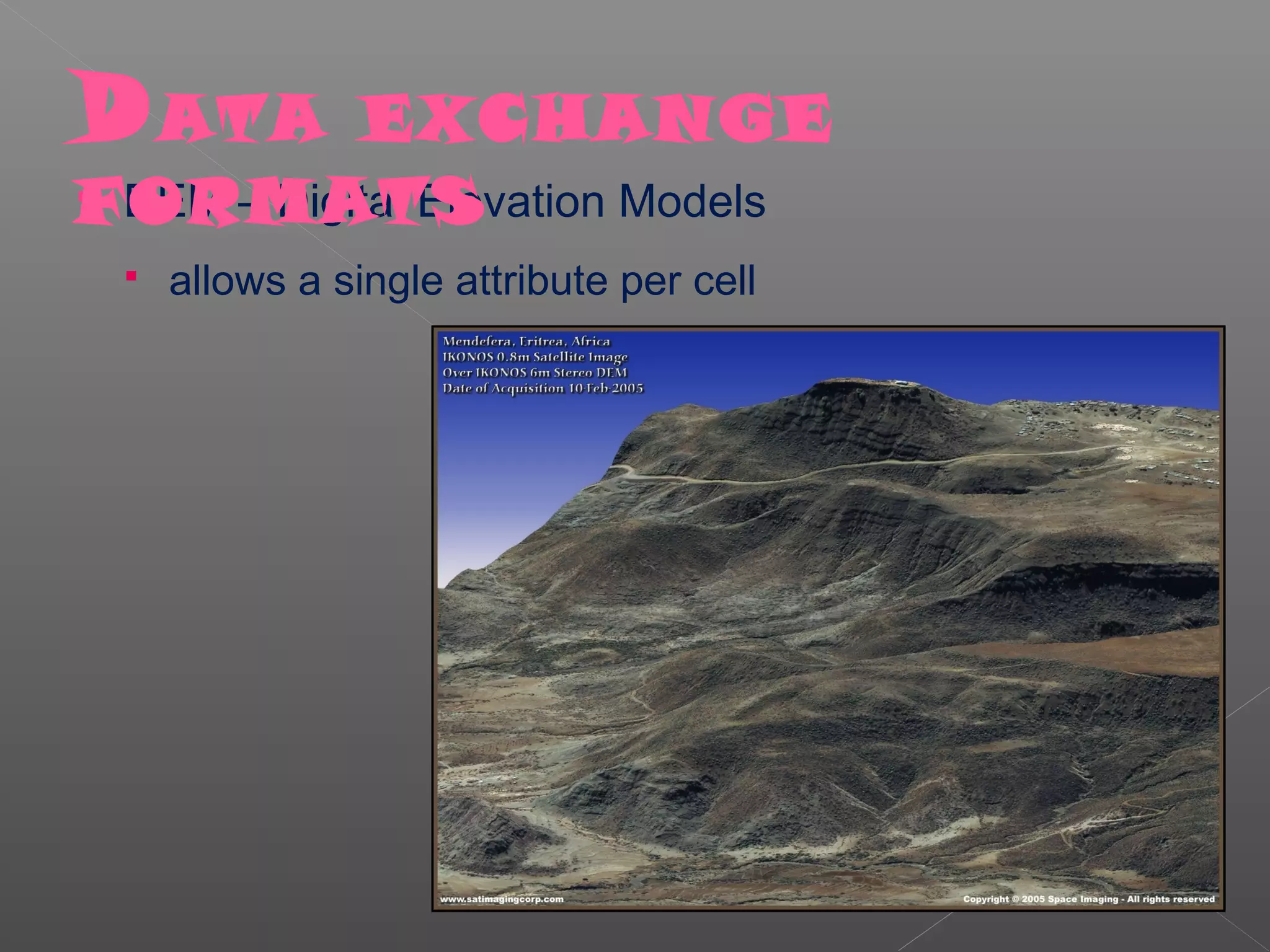
 DEM – Digital Elevation Models

     allows a single attribute per cell
DATA EXCHANGE FORMATS
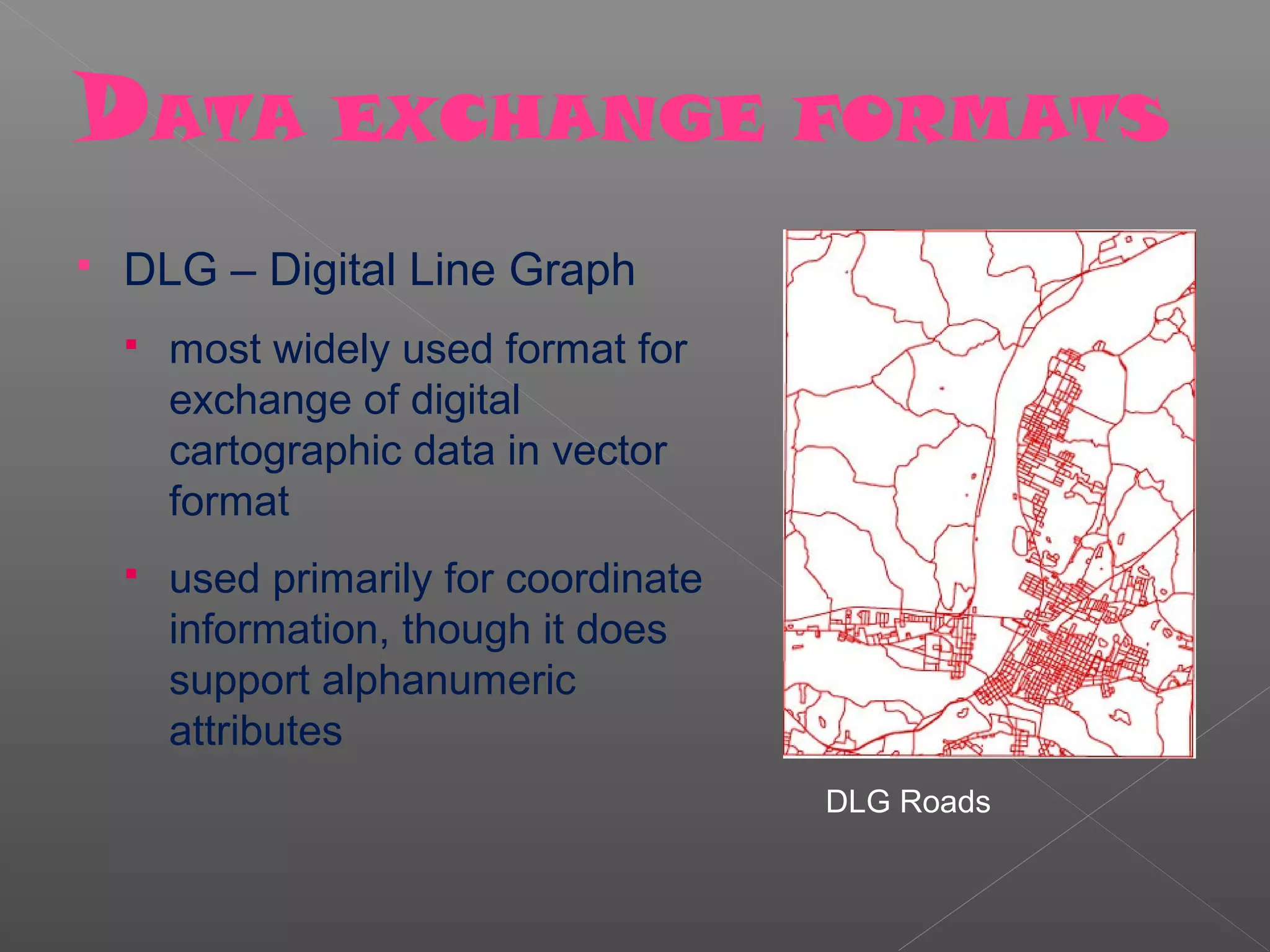
   DLG – Digital Line Graph
       most widely used format for
        exchange of digital
        cartographic data in vector
        format
       used primarily for coordinate
        information, though it does
        support alphanumeric
        attributes
                                        DLG Roads
D ATA       EXCHANGE
FORMATS
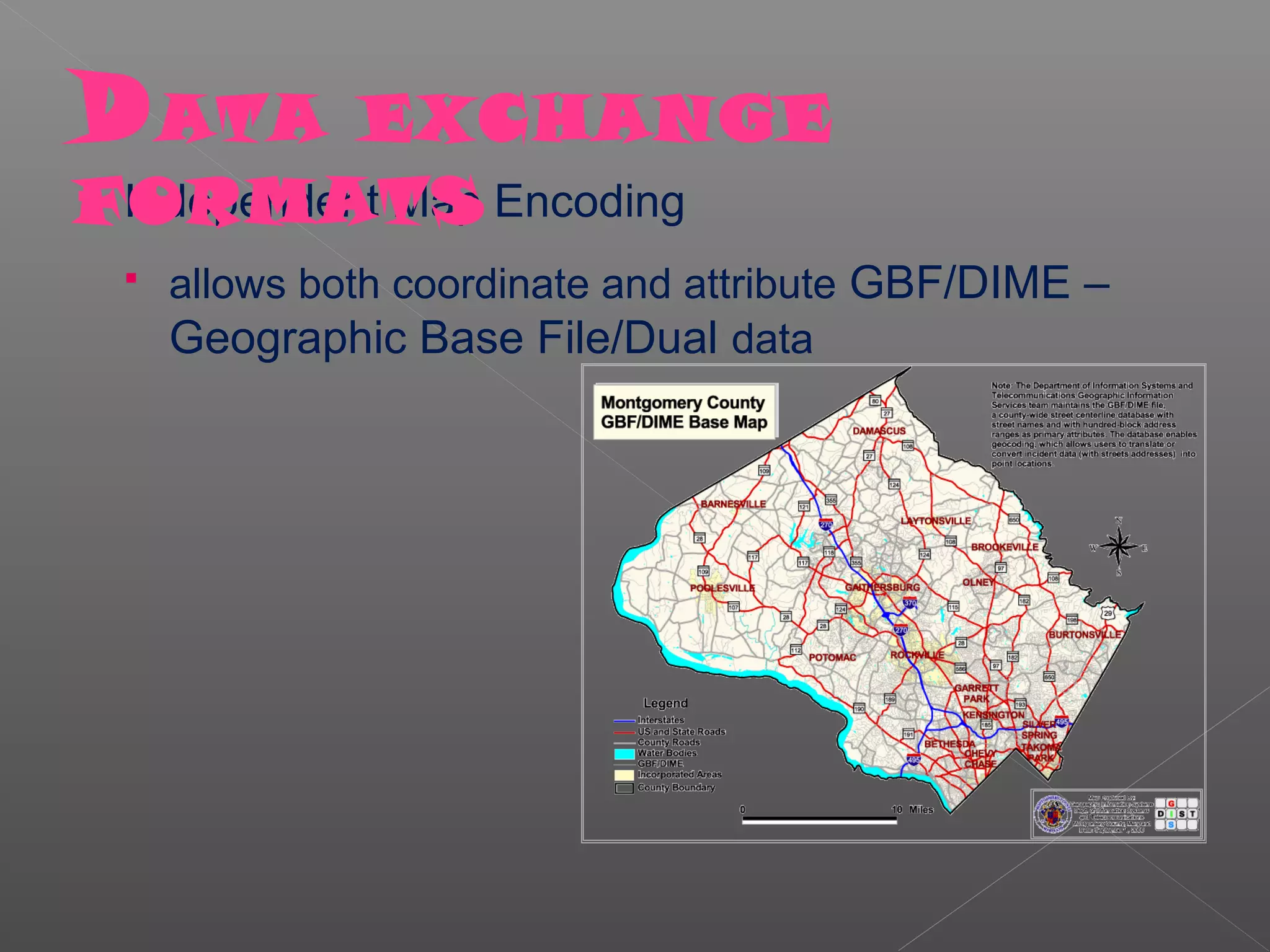
 Independent Map Encoding

    allows both coordinate and attribute GBF/DIME –
     Geographic Base File/Dual data
D ATA        EXCHANGE
FORMATS
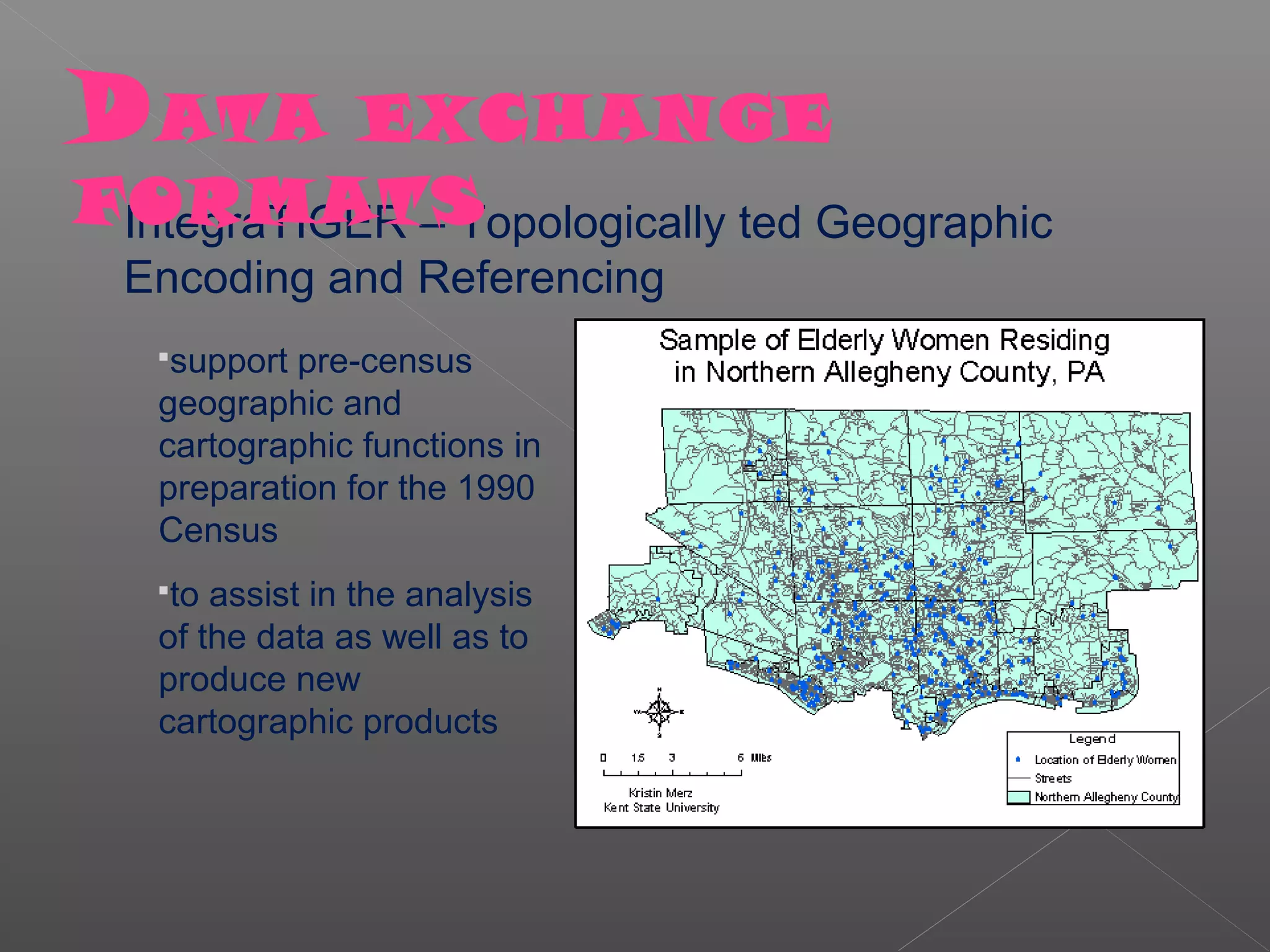
 IntegraTIGER – Topologically ted Geographic
  Encoding and Referencing
   support pre-census
   geographic and
   cartographic functions in
   preparation for the 1990
   Census
   to assist in the analysis
   of the data as well as to
   produce new
   cartographic products
D ATA           EXCHANGE
FORMATS
 SIF – Standard Interchange Format (Intergraph)

       popular data exchange format for many GIS packages
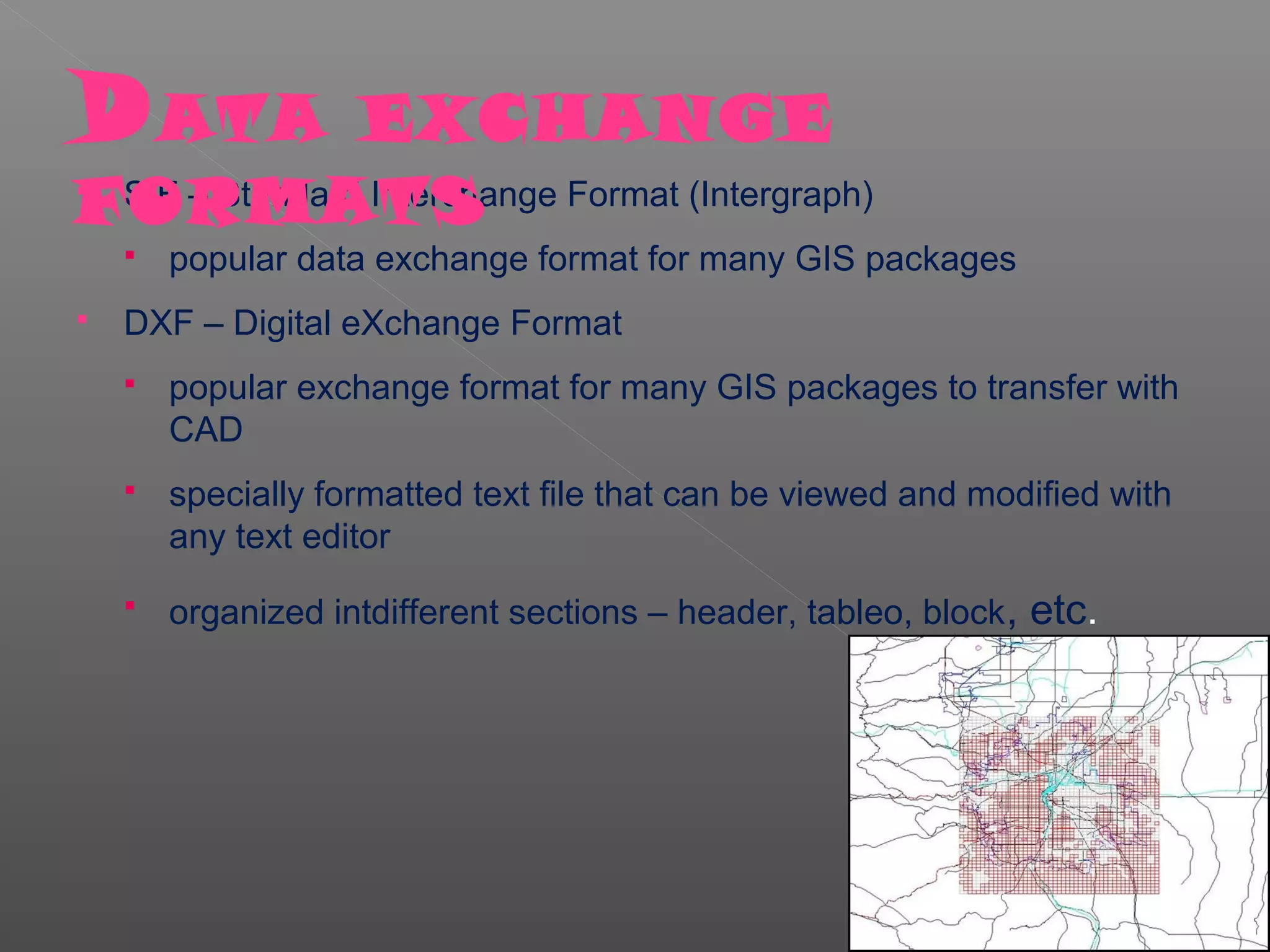
   DXF – Digital eXchange Format
       popular exchange format for many GIS packages to transfer with
        CAD
       specially formatted text file that can be viewed and modified with
        any text editor
       organized intdifferent sections – header, tableo, block , etc.
IMPLEMENTING STANDARDS
   Start-up Costs
       implementation of standard can incur substantial costs
        (money and time)
       major short-term costs related to user training and
        reprogramming software
   Management Support
       needs to recognize the positive impacts of standards
        on productivity and system costs (plus commitment of
        short-term costs)
IMPLEMENTING STANDARDS
   Technical Tradeoffs
       tradeoffs between functionality and performance
       standards provide for broad functionality
           adopting standard operating system provides access to large
            library of existing applications
       standards do not allow fine tuning to specific hardware
       some de facto standards are neither efficient nor the
        best available
IMPLEMENTING STANDARDS
   Potential for Security Risks
       wide availability of common operating systems allow
        for misuse and exploitation
           spread of computer viruses depends on common operating
            systems

   Innovation
       broadly accepted standards make it very difficult to
        introduce innovations
S TANDARDS
                                             majority of standards
                                              effort in GIS to date
                                              has concerned data
                                              formats
       missing – standard of data models that would provide
        standard ways of representing geographic phenomena
           should there be standard resolutions for DEM?
           should there be standards of vertical accuracy?
       missing – standards of data accuracy for GIS
           map accuracy standards deal only with cartographic features
S TANDARDS
   data may be written into standard format for
    transfer, but it may still be virtually meaningless
    without extensive documentation
   standards would provide GIS user with
    expectations about the reliability of the database
    as a window on the world
       rather than on source documents, on
        transferred databases
Maria Jorelyn T.
Laguilles
BSOA-4B

Jorelyn report in it....hehe

  • 2.
    standards are needed as GIS users attempt to integrate operations with other hardware, GISs and data sources  challenge is to get industry, government and users to implement and promote use of standards  many standards are set simply through common use, major attempts to develop national and international standards
  • 3.
    portability of applications  data networks  common environments  cost of program development
  • 4.
    S TANDARDS ORGANIZATIONS  American National Standards Institute  Digital Cartographic Data Standards Task Force  Federal Coordinating Committee on Digital Cartography – Standards Working Group  Institute of Electrical Electronics Engineers  International Standards Organization  Open Software Foundation
  • 5.
    Getting the Map into the Computer Objectives  Maps and their attributes find their way into GIS from existing data sources, from converting paper maps or images into digits, and from field measurement. How data capture takes place has a major impact on data structure, and therefore use of the data in the GIS
  • 6.
    T YPES OFSTANDARDS  networking standards – critical to allow communications between remote computers  database query standards – SQL is emerging as the standard  data exchange standards – governments/private companies recognize need to exchange data between different agencies/groups  several common data exchange formats currently in use:
  • 7.
    D ATA EXCHANGE FORMATS  DEM – Digital Elevation Models  allows a single attribute per cell
  • 8.
    DATA EXCHANGE FORMATS  DLG – Digital Line Graph  most widely used format for exchange of digital cartographic data in vector format  used primarily for coordinate information, though it does support alphanumeric attributes DLG Roads
  • 9.
    D ATA EXCHANGE FORMATS  Independent Map Encoding  allows both coordinate and attribute GBF/DIME – Geographic Base File/Dual data
  • 10.
    D ATA EXCHANGE FORMATS  IntegraTIGER – Topologically ted Geographic Encoding and Referencing support pre-census geographic and cartographic functions in preparation for the 1990 Census to assist in the analysis of the data as well as to produce new cartographic products
  • 11.
    D ATA EXCHANGE FORMATS  SIF – Standard Interchange Format (Intergraph)  popular data exchange format for many GIS packages  DXF – Digital eXchange Format  popular exchange format for many GIS packages to transfer with CAD  specially formatted text file that can be viewed and modified with any text editor  organized intdifferent sections – header, tableo, block , etc.
  • 12.
    IMPLEMENTING STANDARDS  Start-up Costs  implementation of standard can incur substantial costs (money and time)  major short-term costs related to user training and reprogramming software  Management Support  needs to recognize the positive impacts of standards on productivity and system costs (plus commitment of short-term costs)
  • 13.
    IMPLEMENTING STANDARDS  Technical Tradeoffs  tradeoffs between functionality and performance  standards provide for broad functionality  adopting standard operating system provides access to large library of existing applications  standards do not allow fine tuning to specific hardware  some de facto standards are neither efficient nor the best available
  • 14.
    IMPLEMENTING STANDARDS  Potential for Security Risks  wide availability of common operating systems allow for misuse and exploitation  spread of computer viruses depends on common operating systems  Innovation  broadly accepted standards make it very difficult to introduce innovations
  • 15.
    S TANDARDS  majority of standards effort in GIS to date has concerned data formats  missing – standard of data models that would provide standard ways of representing geographic phenomena  should there be standard resolutions for DEM?  should there be standards of vertical accuracy?  missing – standards of data accuracy for GIS  map accuracy standards deal only with cartographic features
  • 16.
    S TANDARDS  data may be written into standard format for transfer, but it may still be virtually meaningless without extensive documentation  standards would provide GIS user with expectations about the reliability of the database as a window on the world  rather than on source documents, on transferred databases
  • 17.