

A New Way
to Talk About
THE SOCIAL
DETERMINANTS
OF HEALTH


VU LN ER A B L E P O P U L AT IONS PORT FOLIO
TABLE OF CONTENTS


  FOREWORD          WHY WE NEED A BETTER WAY to Talk About
                    THE SOCIAL DETERMINANTS OF HEALTH
                    by Jane Isaacs Lowe, Ph.D.
                    page ii


  CHAPTER
                    Peeling THE ONION
    1               How We Found a Better Way to Talk About the Social Determinants of Health
                    page 1


  CHAPTER
                    Choosing WORDS
    2               Best Practices in the Language and Framing of Social Determinants of Health
                    page 4


                    Finding ONE FACT TO FIGHT FICTION
  CHAPTER


    3               The Use of Data and Information to Support—Not Make—Your Case
                    page 9


  APPENDIX          Thinking IN PICTURES

    A
                    The Deep Metaphors That Drive How Politicians See Health Disparities
                    by Elizabeth Carger
                    page 13


  APPENDIX          Changing OUR FRAME OF MIND

    B
                    The Role of the Mind, Brain and Emotion in Developing Messages
                    by Drew Westen, Ph.D.
                    page 21


                                                                   V U L N ER A B L E P O P U L AT I O N S P O RT F OL I O   i
FOREWORD                 WHY WE NEED A BETTER WAY to Talk About
                              THE SOCIAL DETERMINANTS OF HEALTH
                              by Jane Isaacs Lowe, Ph.D.


                              When the Robert Wood Johnson Foundation went through
                              a restructuring in 2003, it organized all the programs that
                              worked at the community level to advance health into a
                              new programming group called the Vulnerable Populations
                              Portfolio. The newly created portfolio included a vast array
                              of programs focused on areas as disparate as long-term care,
                              school-based health and chronic homelessness. The members
                              of the team struggled to find a meaningful connection among
                              the programs that could help them discern a strategy for
                              managing the current groups of programs and making future
                              funding decisions.


ii    R OB ER T WOOD J OH NSON F OUN DAT ION
What emerged from that analysis was an             Health starts where we live,
                                                       learn, work and play.
understanding that the programs and projects
were united in that they each worked within the
context of the social determinants of health. And
while social determinants were well established in
                                                           We tweaked it and refined it a little, and
academic circles and have been the subject of
                                                       what we ended up with was simple: Health starts
considerable study, we quickly discovered that
                                                       where we live, learn, work and play. We started
the concept didn’t work on the ground. The
                                                       to see the messages picked up everywhere, but
grantees—most of whom were dealing with
                                                       most importantly in media accounts of our
real challenges at the community level, didn’t
                                                       programs and in academic literature.
necessarily resonate with this frame. For some
                                                           While the new framework did well in its
it was so patently obvious that it became a
                                                       “road test,” we are an institution that prides itself
truism. And as unsuccessful as the concept was
                                                       on evaluation and measurement of the ideas we
for existing grantees, it made even less sense
                                                       put forward. So we decided to test the messages
to organizations that approached the team for
                                                       more rigorously—to make sure we were getting
funding who hadn’t worked with us before.
                                                       it right—but also that we hadn’t missed an
    As the team struggled to find a way to translate
                                                       opportunity to make it better. So we engaged
the topic so that it made sense to our colleagues
                                                       Drew Westen, Ph.D., of Westen Strategies and
and people in the field, the Foundation was
                                                       author of The Political Brain to help us fine-tune
developing a commission focused on the social
                                                       the messages, and build on our earlier research.
determinants of health— specifically focusing
                                                       Dr. Westen worked closely with our own
on why some Americans are so much healthier
                                                       communications staff to conduct the research
than others and why Americans overall aren’t as
                                                       that’s reflected here.
healthy as they could be.
                                                           This work has helped us communicate more
    This work gave us an opportunity to find a new
                                                       effectively, and there’s no reason to keep what
frame for talking about the social determinants
                                                       we’ve learned to ourselves. We hope that this
of health. Not just for people working in the field,
                                                       research and the way we’ve applied it is helpful
but for policy-makers. We had to talk about the
                                                       to you. Please use it freely, but let us know if
topic in a way that people could understand, that
                                                       you do. We’d love to continue to build on what
was meaningful, and that didn’t align the topic
                                                       follows here.
with any existing political perspective or agenda.
    By working with a talented group of
communicators, including Linda Loranger of
Burness Communications, Allison Rosen of
Chandler Chicco, Bob McKinnon of
YELLOWBRICKROAD and Elizabeth Carger of                Jane Isaacs Lowe, Ph.D.
Olson Zaltman Associates, we were able to arrive       Team Director
at a frame that described the social determinants      Vulnerable Populations Portfolio
of health plainly, without political overtone. As
we started using this new way of talking not only
for the commission, but also for the work in the
portfolio, we gained significant traction.


                                                                                             V U L N ER A B L E P O P U L AT I O N S P O RT F OL I O   III
Peeling THE ONION
    CHAPTER


     1                      How We Found a Better Way to Talk About the Social Determinants of Health


                            It turns out that trying to figure out how to say something simply
                            can be a complicated process.

                            Each of us has developed our own set of beliefs and values.
                            As we listen and learn new concepts, we try to fit what we hear
                            into these existing frames. And because many of our beliefs are
                            so deeply held, it means that even the most seemingly innocuous
                            terms can be laden with meaning.


1   R OB ER T WOOD J OH NSON F OUN DAT ION
How we assign meaning to what we hear is largely dependent on the context
in which we hear it. And this context is something that even the most self-aware
person can have a difficult time expressing. So as we developed messages and
tested their reception, we benefited from advanced market research techniques
developed and used by Olson Zaltman Associates and Westen Strategies to
get at these deeper-level insights. This guide is informed by an iterative research
and message development process that includes three steps:


         Determine How Policy-Makers                     Develop Messages That We                               Strengthen the Messages
  1      See the World of Health                 2       Can Road Test                                3         With Testing

In late 2006, as the Robert Wood Johnson       This research informed the commission’s             To validate and strengthen the Vulnerable
Foundation was establishing the Commission     message strategy, and we also applied               Populations messages, we engaged
to Build a Healthier America, the Foundation   their findings to how we framed the work            in a partnership with Westen Strategies,
commissioned Olson Zaltman Associates          of the Foundation’s Vulnerable Populations          a public opinion messaging research
(OZA), a Boston-based market research          Portfolio, which is deeply invested in finding      firm. Together we developed a study built
firm, to help us gain a “deep understanding    solutions to address the impact of social           on the messages we were already using
of people’s thoughts and feelings about        factors on those most vulnerable among              to understand which language resonated
health differences across populations in       us. This messaging was successfully road            with our priority audiences. We also wanted
the United States.” The insights from this     tested with media and policy-makers                 to know whether differences existed in
research provided a framework for talking      in 2008 and 2009. Our core message                  certain political segments’ receptivity to
about the diverse issues addressed by          emphasized “new pathways for improved               our messages. Westen Strategies enlisted
the Commission, with social determinants       health that recognize the integral relationship     Public Opinion Strategies to conduct
of health chief among them. Specifically,      between our health and where and how                various stages of the research and ensure
OZA’s work showed how people with              we live, learn, work and play.” We looked           that the end product would be informed
different political perspectives see health    to our grantees and the communications              by a range of political perspectives. This
differently. More importantly, the research    experts who work with them to provide               study went into the field in the summer
identified ways to frame our messages          valuable input that strengthened our                of 2009.
about health differences that would            messages and ensured that we avoided
resonate across the political spectrum.        language that would fall flat on the front
Working closely with OZA, we had the           lines. Collaboration and a constant
opportunity to dig deeper into how people      feedback loop were a critical part of the
see this issue, and then layer additional      process at every stage.
forms of research over their findings to get
a more robust and precise understanding
of how people see health. (Elizabeth Carger
of OZA has written a highly detailed
chapter on their work in this area, which
is included as an appendix in this guide.)


                                                                                                 V U L N ER A B L E P O P U L AT I O N S P O RT F OL I O   2
The first phase of this research was a series of   In the final phase of the research, Westen Strategies
focus groups held in multiple cities and grouped      took that learning one step further by exposing
by male and female swing voters in Ohio, Blacks       these messages to more than 1,700 registered voters
and Hispanics in Houston and opinion leaders in       and capturing their conscious and unconscious
Washington, D.C.. It was conducted by Public          reactions. Dr. Westen details this research process
Opinion Strategies (POS). With the feedback we        and what we learned from it in an appendix at
got from this process, we refined the messages.       the end of this guide.
POS tested the refined messages in a quantitative
Internet survey of 1,000 registered voters.


   From start to finish, this research represents         We’ve shared what we learned in settings small
responses from more than 3,000 Americans              and large—including conferences sponsored by
across the country over four years—using              the Centers for Disease Control and Prevention
both traditional research methods and new,            and Grantmakers in Health—and the response
sophisticated market research techniques—to           has been consistent: “This is great, but how can
answer one primary question:                          I learn more?”
                                                          This summary is our response to that question.
How do we find a common language that will            In the following pages, you will find both an
expand Americans’ views about what it means           overview of what we learned—which words, phrases
to be healthy—to include not just where health        and framing work and why—but also a detailed
ends but also where it starts?                        description of the methodology and what we
                                                      discovered in chapters graciously authored by
    If we can answer this question, we can pave
                                                      Elizabeth Carger and Dr. Westen, whose work
the way for more solutions that address this
                                                      was critical to our understanding of how Americans
critical link between our health and where we
                                                      perceive this issue.
live, learn, work and play.


3      R OB ER T WOOD J OH NSON F OUN DAT ION
Choosing WORDS
CHAPTER


 2        Best Practices in the Language and Framing of Social Determinants of Health


          There is no silver bullet, no single word or fact that will suddenly
          transform how people think about health. It is an intensely
          personal issue that carries with it complex beliefs, conflicted values
          and a deeply divided electorate about what leads to better health.

          Instead, in this research, we studied numerous long-form messages
          and shorter statements that could offer a proxy for the phrase
          “social determinants of health.” We uncovered a series of lessons,
          best practices, recommended language and watch-outs that can
          support better and more persuasive messages.


                                                               V U L N ER A B L E P O P U L AT I O N S P O RT F OL I O   4
SEVEN LESSONS:


      1                                       3                                          6
     Traditional phrasing of social           Use one strong and compelling fact—        Mix traditionally conservative
     determinant language consistently        a surprising point that arouses            values with traditionally
     tested poorly in every phase of          interest, attention and emotion—for        progressive values. Every phase
     research. Phrases like “social           maximum impact. Loading messages           of research showed that while
     determinants of health” and              down with more than one or two facts       some phrasing appealed to one
     “social factors” failed to engage        tends to depress responses to them.        political perspective over another,
     the audience, even when we                                                          progressives had a tendency to
     added more context. However, the                                                    be more open to conservative
     concept behind social determinants
     of health does resonate with our
                                              4                                          frames. Generally, however, we
                                                                                         need to be aware of these different
     audiences, as evidenced by our                                                      worldviews and communicate
                                              Identify the problem, but offer
     pre- and post-testing of people’s                                                   using language that puts us on
                                              potential solutions. Respondents,
     attitudes after their exposure to                                                   common ground. For example,
                                              particularly opinion leaders, prefer
     our messages.                                                                       combining the notion of personal
                                              messages that include some kind
                                                                                         responsibility, which is wholly
                                              of direction—either an example of
                                                                                         embraced by conservatives with
                                              the kind of action that would address
     2                                        the problem or a set of principles
                                                                                         a message about opportunities,
                                                                                         language that also appeals to
                                              that can guide us to where we need
                                                                                         progressives, will appeal to a
     Priming audiences about the              to be.
                                                                                         broader audience.
     connection with messages they
     already believe makes the concept
     more credible. Messages that             5                                          7
     incorporate the importance of
     available quality health care with       Incorporate the role of personal           Focus broadly on how social
     the need to address the social           responsibility. The importance of all      determinants affect all Americans
     factors that affect health were          Americans having equal opportunity to
     more convincing than those that                                                     (versus a specific ethnic group
                                              make choices that lead to good health
     did not discuss medical care             resonated with participants across the     or socioeconomic class). This
     at all. When messages are                political spectrum. Incorporating this     research showed that Americans
     presented in colloquial, values-         point made respondents more receptive      believe in equal opportunity to
     driven, emotionally compelling           to the idea that society also has a role   health, but describing actual
     language, they are more                  to play in ensuring that healthy choices   disparities consistently evokes
     effective. Academic language,            are universally available.                 negative reactions. Messages
     including “social determinants,”                                                    that described disparities based
     did not resonate with audiences                                                     on race or ethnicity fared poorly
     the way language like “health                                                       with every audience except Black
     starts in our homes, schools and                                                    respondents. Furthermore, some
     communities” did.                                                                   focus group participants expressed
                                                                                         concern that focusing on one
                                                                                         ethnic group reinforced negative
                                                                                         racial stereotypes.


5    R OB ER T WOOD J OH NSON F OUN DAT ION
BREAKING IT DOWN:


Below you’ll find one long-form message that was developed, revised,
tested and revised again based on what the research showed us.                   WHY THIS WORKED:
It was consistently the most persuasive message among all groups,             •	 Audiences flat out didn’t believe the
regardless of their political perspective. While we are not necessarily          statement, “America is not among the top
recommending that you use this in its entirety, it is helpful to understand      25 countries in life expectancy,” and they
why the phrase worked.                                                           responded negatively to any message
                                                                                 that led with that statement. However,
                                                                                 when we start off with something most
                                                                                 Americans already believe, “Americans
                                                                                 lead the world in medical research and
  America leads the world in medical research and                                medical care,” they are more likely to
  medical care, and for all we spend on health                                   believe everything that follows.
  care, we should be the healthiest people on Earth.                          •	 Words like “insured or “uninsured” are
  Yet on some of the most important indicators,                                  politically loaded. But the phrase “ensure
  like how long we live, we’re not even in the top 25,                           everyone can afford to see a doctor when
  behind countries like Bosnia and Jordan. It’s time                             they are sick” doesn’t touch existing
                                                                                 political hot buttons.
  for America to lead again on health, and that
  means taking three steps. The first is to ensure                            •	 Framing our message in the context of
                                                                                 accepted beliefs like the importance
  that everyone can afford to see a doctor when                                  of access to care or prevention helps our
  they’re sick. The second is to build preventive                                message fit into the broader thinking of
  care like screening for cancer and heart disease                               what it takes to be healthy.
  into every health care plan and make it available                           •	 The inclusion of specific solutions increased
  to people who otherwise won’t or can’t go in for                               acceptance of the core message.
  it, in malls and other public places, where it’s easy                       •	 Illustrating with examples like “playgrounds
  to stop for a test. The third is to stop thinking                              and parks” and “in the air we breathe and
                                                                                 water we drink,” makes the concept of
  of health as something we get at the doctor’s
                                                                                 social factors more tangible.
  office but instead as something that starts in our
                                                                              •	 In the statement, “Scientists have found,”
  families, in our schools and workplaces, in our
                                                                                 other options were tested with more
  playgrounds and parks, and in the air we breathe                               specificity, such as “Scientists at the
  and the water we drink. The more you see the                                   Centers for Disease Control and at
  problem of health this way, the more opportunities                             universities around the country have
                                                                                 shown that the conditions in which
  you have to improve it. Scientists have found that                             people live and work have more than
  the conditions in which we live and work have an                               five times the effect on our health
  enormous impact on our health, long before we                                  than all the errors doctors and hospitals
  ever see a doctor. It’s time we expand the way                                 make combined.” Presenting the fact
                                                                                 in a more colloquial, relatable way,
  we think about health to include how to keep it,                               stripped of the academic support, is
  not just how to get it back.                                                   more effective than a longer statement.


                                                                                       V U L N ER A B L E P O P U L AT I O N S P O RT F OL I O   6
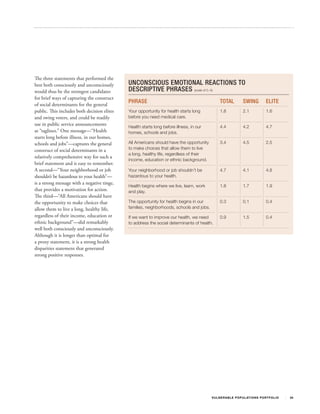
SIX WAYS TO TALK ABOUT SOCIAL DETERMINANTS OF HEALTH:


    Our hope in this research was to find a tidy proxy that could replace “the social determinants of health” as the leading
    descriptor for this area of work. While our testing showed that this phrase doesn’t work for any of our audiences,
    we still don’t have that neat replacement. But what you’ll find here is a list of phrases that—in context—helped people
    understand the concept more clearly. These are the precise phrases that we tested and that scored well.


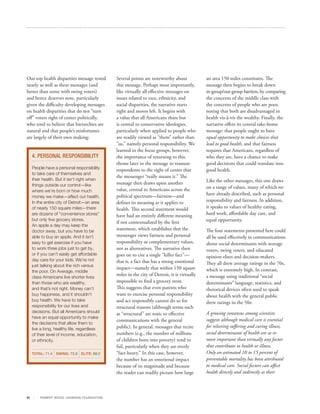
      1       Health starts—long before illness—in our homes,
                                                                                          WHY THESE WORK:
              schools and jobs.
                                                                                       •	 The proxy statements use colloquial,
      2       All Americans should have the opportunity to make                           values-driven language and relatable
              the choices that allow them to live a long, healthy                         lifestyle references that engage
                                                                                          audiences.
              life, regardless of their income, education or ethnic
              background.                                                              •	 These statements all focus on the
                                                                                          solution versus the problem.
      3       Your neighborhood or job shouldn’t be hazardous                          •	 Some of the statements implicitly
              to your health.                                                             acknowledge the notion of personal
                                                                                          responsibility.
      4       Your opportunity for health starts long before
              you need medical care.

      5       Health begins where we live, learn, work and play.

      6       The opportunity for health begins in our families,
              neighborhoods, schools and jobs.


    A GLOSSARY OF “OTHER TERMS”

    The terms that people often use to describe health disparities     People with a more liberal perspective on this issue often
    can get in the way of others accepting the idea of social          describe health disparities as an injustice, whereas more
    determinants of health and who they are most likely to affect.     conservative people never use this phrase. Though it was
    One of the things we learned from OZA’s research is that           never commented on directly in the OZA health disparities
    people with more conservative views tend to have negative          research, we suspect that the idea of health differences
    reactions to the goal of equal levels of health for everyone.      being unjust would not resonate with conservative audiences
    As such, below are some phrases we suggest avoiding.               because it may activate the same response as inequality.
                                                                       This would include the following type of language, which
    •	 Any variation of equal,         •	 Leveling the playing field
                                                                       you should also avoid:
       equality or equalizing          •	 Creating balance
                                                                       •	 Unjust/injustice             •	 Immoral
                                                                       •	 Outrage                      •	 Unconscionable


7      R OB ER T WOOD J OH NSON F OUN DAT ION
A GLOSSARY OF “OTHER TERMS” (continued)


Below is an evolving list of terms that describe the groups most profoundly affected by this issue. These descriptions are not
only technically accurate but more representative of how we relate to each other as human beings and fellow Americans.
These phrases have not been tested, but are reflective of the insights we gained from the research.


  Vulnerable Populations                     •	 Disappointing (as in Americans          The elderly population and
                                                should be able to do better, not        their families, nursing homes
  •	 Too many Americans don’t have              let people fall through the cracks)
     the same opportunities to be as
                                                                                        and elder care
     healthy as others                       •	 It’s time we made it possible for
                                                all Americans to afford to see a        •	 Our aging parents and
  •	 Americans who face significant             doctor, but it’s also time we made         grandparents
     barriers to better health                  it less likely that they need to        •	 Our elders
  •	 People whose circumstances                                                         •	 Elders
     have made them vulnerable to            Poverty
     poor health                                                                        •	 Caring for people as they age
                                             •	 Families who can’t afford the
  •	 All Americans should have the
                                                basics in life                          Refugees and immigrants
     opportunity to make the choices
     that allow them to live a long,         •	 Americans who struggle financially      including children
     healthy life, regardless of their       •	 Americans struggling to get by          •	 People seeking a new home
     income, education, or ethnic                                                          in America
     background
                                             Low-income workers                         •	 Children caught between
  •	 Our opportunities to better health      and families                                  two worlds
     begin where we live, learn, work
     and play                                •	 People who work for a living and        •	 From undocumented immigrants
                                                still can’t pay their rent                 to productive, tax-paying
  •	 People’s health is significantly                                                      American citizens
     affected by their homes, jobs           •	 Hard-working Americans who
     and schools                                have gotten squeezed out of the
                                                middle class in tough times             Youth and teens
  Health Disparities                         •	 Families whose dreams are               •	 The years of opportunity
                                                being foreclosed                           and danger
  •	 Raising the bar for everyone
                                                                                        •	 Teenagers: They aren’t just
  •	 Setting a fair and adequate             Violence in general, as well                  young adults
     baseline of care for all                as gangs and intimate
  •	 Lifting everyone up                     partner violence                           Mental health or illness,
  •	 Giving everyone a chance to live                                                   including young people
                                             •	 Unsafe streets
     a healthy life
                                             •	 The epidemic of violence                •	 It’s just as dangerous and
  •	 Unfair                                                                                debilitating as any other
                                             •	 Street violence
  •	 Not right                                                                             chronic disease
                                             •	 Intergenerational cycle of violence
                                                and abuse
                                             •	 Teen dating violence and abuse


                                                                                         V U L N ER A B L E P O P U L AT I O N S P O RT F OL I O   8
Finding ONE FACT TO FIGHT FICTION
    CHAPTER


     3                      The Use of Data and Information to Support—Not Make—Your Case


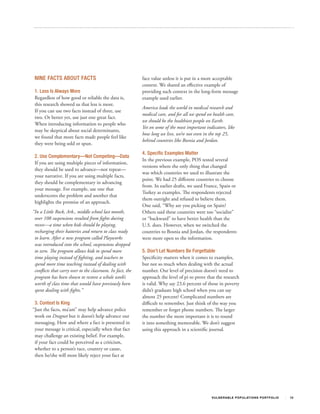
                            As communicators, we can’t do our work without making
                            use of the facts that are the foundation of our work.
                            They establish the prevalence of an issue; communicate its
                            effect in both economic and human terms; and communicate
                            responsibly about the effectiveness of an approach or
                            intervention. Funders and policy-makers place increasing
                            value on sound evaluation and research to guide their
                            investments and decision-making.

                            RWJF relies exclusively on objective data sources, but over
                            the course of this project, we were sometimes astonished
                            by how people responded to specific data points that we
                            used to support our messages. So much so that we thought
                            it would be worthwhile to share some of those lessons here.


9   R OB ER T WOOD J OH NSON F OUN DAT ION
NINE FACTS ABOUT FACTS                                     face value unless it is put in a more acceptable
                                                            context. We shared an effective example of
 1. Less Is Always More                                     providing such context in the long-form message
 Regardless of how good or reliable the data is,            example used earlier.
 this research showed us that less is more.
                                                            America leads the world in medical research and
 If you can use two facts instead of three, use
                                                            medical care, and for all we spend on health care,
 two. Or better yet, use just one great fact.
                                                            we should be the healthiest people on Earth.
 When introducing information to people who
                                                            Yet on some of the most important indicators, like
 may be skeptical about social determinants,
                                                            how long we live, we’re not even in the top 25,
 we found that more facts made people feel like
                                                            behind countries like Bosnia and Jordan.
 they were being sold or spun.
                                                            4. Specific Examples Matter
 2. Use Complementary—Not Competing—Data
                                                            In the previous example, POS tested several
 If you are using multiple pieces of information,
                                                            versions where the only thing that changed
 they should be used to advance—not repeat—
                                                            was which countries we used to illustrate the
 your narrative. If you are using multiple facts,
                                                            point. We had 25 different countries to choose
 they should be complementary in advancing
                                                            from. In earlier drafts, we used France, Spain or
 your message. For example, use one that
                                                            Turkey as examples. The respondents rejected
 underscores the problem and another that
                                                            them outright and refused to believe them.
 highlights the promise of an approach.
                                                            One said, “Why are you picking on Spain?
“In a Little Rock, Ark., middle school last month,          Others said these countries were too “socialist”
 over 108 suspensions resulted from fights during           or “backward” to have better health than the
 recess—a time when kids should be playing,                 U.S. does. However, when we switched the
 recharging their batteries and return to class ready       countries to Bosnia and Jordan, the respondents
 to learn. After a new program called Playworks             were more open to the information.
 was introduced into the school, suspensions dropped
 to zero. The program allows kids to spend more             5. Don’t Let Numbers Be Forgettable
 time playing instead of fighting, and teachers to          Specificity matters when it comes to examples,
 spend more time teaching instead of dealing with           but not so much when dealing with the actual
 conflicts that carry over to the classroom. In fact, the   number. Our level of precision doesn’t need to
 program has been shown to restore a whole week’s           approach the level of pi to prove that the research
 worth of class time that would have previously been        is valid. Why say 23.6 percent of those in poverty
 spent dealing with fights.”                                didn’t graduate high school when you can say
                                                            almost 25 percent? Complicated numbers are
 3. Context Is King                                         difficult to remember. Just think of the way you
“Just the facts, ma’am” may help advance police             remember or forget phone numbers. The larger
 work on Dragnet but it doesn’t help advance our            the number the more important it is to round
 messaging. How and where a fact is presented in            it into something memorable. We don’t suggest
 your message is critical, especially when that fact        using this approach in a scientific journal.
 may challenge an existing belief. For example,
 if your fact could be perceived as a criticism,
 whether to a person’s race, country or cause,
 then he/she will most likely reject your fact at


                                                                                                 V U L N ER A B L E P O P U L AT I O N S P O RT F OL I O   10
6. Break Down Big Numbers                               The numbers we work with can be both
 Speaking of big numbers, unless they are put
 into some kind of context, they can lose their          mind-boggling and mind-numbing. It is
 meaning and intended impact. Recently,
 the founder of TED, Richard Saul Wurman,
                                                         our job to break them down in a way that
 illustrated this point when trying to put               is both comprehensive and meaningful.
“a trillion” into perspective.
“Imagine a very wealthy couple who had a lot of          a person who lives in a certain zip code in
 cash in reserve. I mean a lot. Well, one day 30 years   Connecticut and someone who lives in North
 ago, they decided to start a small business. And it     Dakota, respondents cried foul, thinking we
 was an awful business plan. So every day, for the       cherry-picked the data and that this was an
 last 30 years, their business lost a million dollars    extreme example. On the other hand, when
 every single day. To show you how much a trillion       we told people that there was a life expectancy
 dollars is, they would have to lose a million           difference of seven years between someone
 dollars a day for another 2,700 years to lose           who graduated from college versus those who
 a trillion dollars.”                                    didn’t graduate high school, people responded
    The numbers we work with can be both                 differently, and those differences were often
 mind-boggling and mind-numbing. It is our               associated with very different life circumstances.
 job to break them down in a way that is both            So for those participants who had graduated
 comprehensible and meaningful. Reporting that           college and were more conservative, they actually
 health insurance legislation costs a trillion dollars   believed the data but amazingly didn’t think that
 (over 10 years) is an accurate estimate but creates     seven years of life was that much of a difference.
 a completely different meaning than telling             Conversely, those who were not college graduates
 someone that the cost of reform breaks down             rejected the idea that education played any role
 to $3 a day for every American.                         in how long someone might live.


 7. The Value in a Number Is in Its Values               9. Overall Messaging Rules Still Apply
 Numbers can represent both a value and our              Finally, we need to realize that facts aren’t a
 values. You can say that half of all parents in         separate part of our message but an essential
 poor neighborhoods don’t feel safe letting their        ingredient to telling our story. They benefit
 children play on the streets. Or you can try and        from the same lessons we’ve shared earlier in
 create a picture of what it must be like to feel        this report.
 trapped in your own home, unable to move                   There is no shortage of good data that
 because of your job or income, not able to give         supports the idea that our health starts long
 your kids the most basic opportunities to play          before illness—in our homes, schools and jobs.
 outside or run free, but instead fear that they         But there is still a long way to go to make sure
 could get caught up with the wrong crowd or             that we are using it to maximum effect. To
 struck down by a stray bullet, like the neighbor’s      this end, we have begun to aggregate these
 kid next door.                                          sources and refine these messages online at
                                                         http//sites.google.com/factsthatfightfiction.
 8. Imagine Why Someone Might Cry Foul?                  We invite you to visit this site, add your own
 Some of the most important lessons from the             compelling data and comment on how you’ve
 research involved life expectancy data. For             been able to successfully use great information
 example, when we stated that there was up to            to make good things happen.
 a 25-year difference in life expectancy between


 11     R OB ER T WOOD J OH NSON F OUN DAT ION
APPENDICES
Thinking          IN PICTURES
     APPENDIX


      A                       The Deep Metaphors That Drive How Politicians See Health Disparities
                              by Elizabeth Carger


                              The following document is a summary of the report “Thoughts
                              and Feelings About Health Differences Across Populations in the
                              United States,” which was delivered to the Robert Wood Johnson
                              Foundation in the summer of 2007. It reflects the findings from
                              interviews conducted in Washington, D.C., with 31 congressional
                              staffers and health experts who were affiliated in some way with
                              either the Democratic or Republican Parties. This report will
                              outline the Democratic view of social determinants of health,
                              then the Republican view, and then summarize implications for
                              communication strategies and common ground between the parties.

                              Throughout the report we detail the deep metaphor frames that
                              Democrats and Republicans hold. For those unfamiliar with the
                              concept of a deep metaphor, they can be described as basic filters.
                              These are frames that shape everything we hear, think, say and
                              do. They operate largely below awareness and for this reason are
                              especially powerful as they normally escape conscious attention.
                              A given group of people or stakeholder community will typically
                              share the same few deep metaphors on a topic. Knowing what
                              their deep metaphors are has important implications for
                              communications strategy.


13    R OB ER T WOOD J OH NSON F OUN DAT ION
The Democratic                               privilege by virtue of birth,” and goes on     affected by social determinants of
Frames for Social                            to discuss how unequal levels of health        health. Broadly, containers keep
                                             based solely on the zip code in which          things in and keep things out; they are
Determinants of Health                       a person was born contradicts this             physical, psychological, or social places.
and Health Disparities                       foundational principle of American society.    Containers can protect us or trap us;
Across Populations                           The second level on which the deep
                                                                                            they can be open or closed, positive
                                                                                            or negative.
                                             metaphor system operates is that
SYSTEM                                       Democrats view poor levels of health           For Democrats, low‐income communities
The deep metaphor of system forms            as emerging from a complex and                 are isolated and self‐contained on all
the fundamental underpinning for the         interrelated system of social, cultural,       three levels—physical, psychological,
Democratic view of social determinants       economic, and biological factors.              and social. They are physically isolated
of health. Broadly, the system-deep          One Democrat states, “It’s all tied            in locations that lack resources
metaphor refers to the unification and       together—housing, health care, energy,         necessary to live a healthy life such
organization of separate entities into       food.” Consequently, changing any one          as easily accessible doctors’ offices,
a whole. The unity of a system means         factor, such as access to insurance, is        grocery stores with fresh foods, and
that the parts are interdependent; these     not going to fix the problem of health         places to exercise safely. One Democrat
connected parts often operate in a           disparities. There are numerous social         says “it’s like living within your own
predictable and recurrent pattern with       determinants that we must address              little world…the reality for poor
certain results.                             simultaneously and comprehensively             people is never leaving their culture
                                             in order to overcome the system of             of poverty.” On a psychological level
For Democrats in particular, the             interrelated factors that results in poor      this “culture of poverty” traps them
system frame operates on two levels.         levels of health, in certain communities.      in a mentality that they can never
First, American society as a whole           Because this frame of a complex system         get ahead, they are unable to take
is a complex system that unifies all         permeates the Democratic view of               advantage of the opportunities in
citizens. As such, all individuals, from     health they often feel the need to discuss     broader society. Democrats describe
the poorest person in the Bronx to           a multitude of issues and factors              the poor as “a self‐contained group
the wealthiest person in Manhattan,          simultaneously, quickly moving from            at the bottom of the pyramid with
are interdependent, even if this is not      one cause to another cause. This               high unemployment, low job status.”
readily apparent. When poor levels of        makes their discussions seem complex           Solving health-related problems seems
health exist in some communities it          and, at times, muddled. Even though            particularly hopeless. The poor have
eventually affects everyone and weakens      comprehensively addressing all social          watched grandparents and parents
the entire system that is America.           determinants of health makes perfect           die of diabetes-related complications
What holds this American system              sense to individuals operating in the          or heart disease and it has become
together is a foundation of rights such      world of public health and policy who          almost an expected life outcome. There
as freedom, opportunity, and equality.       hold the same system frame, it may be          exists a psychological and cultural
For Democrats, health is itself a right;     cumbersome and frustrating to those            barrier to reaching out to the medical
all Americans have the right to health       who hold a different frame, as we will         community. A common Democratic
care and the right to lead a healthy life.   see with the Republican world-view.            manifestation of the container frame
One Democrat states, “Health care is a                                                      involves barriers. They bring images
right, it’s so fundamental to being able     CONTAINER                                      of blockades and “significant barriers
to have a healthy lifestyle. [What makes     Where the deep metaphor system                 related to health care [exist between the
it a right are] the values of society, of    underpins the Democratic view of               Latino community/African-American
federal government.” Another states          American society and health-related            community and White folks.”]
that “one of the real founding principles    issues, the deep metaphor container
[of America] was the notion of absence of    frames the way they view communities


                                                                                           V U L N ER A B L E P O P U L AT I O N S P O RT F OL I O   14
Finally, on a social level, the poor are        that they are hard to separate at times)
left out of the larger social system            are a reflection of extreme imbalance in
that Democrats see as underpinning              American society between the “haves”
America. This is particularly troubling         and the “have nots.” For Democrats, a
for Democrats as part of their                  situation where “it would take this chief
fundamental view of society is that             executive two hours to earn enough to
everyone is interconnected, so having           fund a community kitchen for three
some groups left out of this system is          years” is morally wrong —“Something
not only morally wrong, it weakens              is wrong there, it’s out of balance.”
the overall view of America as a well           This is an important touch point
functioning system of inclusion. One            for Democrats. As we will see later,
Democrat states, “Individuals at the            Republicans have a more optimistic
bottom of society’s rungs, economically,        view of Americans’ health status,
socially, etc., they’re the ones who            whereas Democrats are angered by this
get left out when it comes to access            profound social imbalance, “It makes
to affordable, quality health care.             me very angry…it’s unjust and unfair
…we leave a sixth of Americans outside          and profoundly disturbing.” “[I feel]
the system…we as a society have a               really angry, I mean really angry…I
responsibility, an obligation, and it’s         didn’t realize how angry I was about
in our best interests to bring them in.”        that until you asked me.” Or, in the
Consider the digital collage that one           collage below, “This woman who’s
Democrat created, which exemplifies             screaming [represents that] she’s angry
the way low‐income communities trap             that these problems existed for so long.”
individuals in “containers” that separate                                                    Fig. 1 Collage created by a Democrat to
them from the larger social system, as          The second way that the balance-deep
                                                                                            show the separation of poor communities from
represented by the well‐dressed white           metaphor frames how Democrats view          wealthy White society.

students at the bottom of the image             issues related to health disparities is
                                                                                              Fig. 2 Collage created by a Democrat
(see Figure 1).                                 in their discussion of remedies and         highlighting anger over persistent social
                                                outcomes. Democrats seek equality—          imbalance with regards to health levels.

BALANCE                                         balanced distribution of resources, the
The balance-deep metaphor encompasses           same health care treatment for everyone,
ideas of equilibrium, adjusting,                and (ideally) equal outcomes in that all
maintaining or offsetting forces, and           communities would have roughly the
things being as they should. Balance            same levels of health. The language of
themes can structure peoples’ thinking          equality has been a cornerstone of
about social, moral, psychological              Democratic discussions of a multitude
and emotional domains. Democrats                of social issues, from health disparities
predominantly express the negative side         to employment to education. Statements
of balance. Having an interconnected            like, “Equality assumes that we are
social system while simultaneously              all going to end up at the same level.
tolerating pockets of isolated, self-           Equity to me presumes a fair and
contained, impoverished citizens leaves         even distribution of resources” pepper
Democrats with a profound sense                 the Democratic discussion of social
of imbalance. Health disparities and            determinants of health. Critically, this
wealth disparities (issues that are so          is not the language that is effective
deeply interconnected for Democrats


15     R OB ER T WOOD J OH NSON F OUN DAT ION
for Republicans, as we will see below.       “A long, windy road. There needs to be
However, it is important to understand        constant movement, a journey—it’s not
that this frame of equality—as expressed      where you’re going, it’s the fact that
by the desire for balance in terms of         you’re moving…We’re a very different
access, treatment, and outcome—is             population than we were a hundred
a cornerstone of how Democrats                years ago; the person laying out that
construct solutions to health disparities     road a hundred years ago—they had no
across American populations.                  idea what society was going to look
                                              like.” This long‐term journey frame
                                              makes Republicans more hesitant to
The Republican                                institutionalize programs to address
                                              social determinants of health, particularly
Frames for Social                             in a federal government that is slow
Determinants of Health                        to adapt to unforeseen, yet inevitable
and Health Disparities                        changes over time.
Across Populations                           Another important ramification of
                                             this much longer and linear journey
                                             frame as compared to the Democratic
JOURNEY
                                             system frame is that Republicans are
Where system forms the fundamental
                                             fundamentally more optimistic about
lens through which Democrats view
                                             where we are today in terms of the
society and health, the deep metaphor
                                             health of the American population.
journey is the predominant frame
                                             Where the Democrats expressed
through which Republicans view
                                             extreme anger over perceived social
American society and health issues.
                                             imbalances, Republicans state, “Look
Broadly, journey often frames our
                                             back to where the world was 80 years
discussion of life itself. Journeys can be
                                             ago, 90 years ago. The average life
fraught with challenge or can be smooth
                                             expectancy was middle age. …I’m
sailing; they can be direct or divergent.
                                             not going to die before I’m 55, where
Some journeys are unpredictable,
                                             100 years ago I couldn’t say that. It’s
where others focus on a series of steps
                                             collective improvement that goes full
that, if followed, will take you to a
                                             spectrum.” They also tend to compare
predetermined place or goal.
                                             us to other countries to show how much
The type of journey that a group             farther along we are on our American
describes can yield much insight into        journey overall, and our health journey
how they view a given topic. For             in particular. “The African lady with
Republicans, American society as a           the bundle on her head symbolizes that
whole is on a long, unpredictable            ours is a society that has come so much
health journey through time. They use        farther than that. …We have forgotten
metaphors of winding paths and stress        where our health system was 20 years
the importance of adaptability in the        ago. We don’t have the perspective…it’s
face of an unknown future direction.         a little unrealistic to think that because
One Republican states:                       we are short of perfection, that the
                                             system is somehow deeply flawed.”


                                                                                            V U L N ER A B L E P O P U L AT I O N S P O RT F OL I O   16
The difference in base level of optimism
versus anger between the Republicans
and Democrats could be a real source of
tension between the two groups when it
comes to discussing social determinants
of health. Understanding these basic
differences in emotional response to the
issue could help anticipate touch points
in a conversation where communication
might break down.

Much as they see America and health
care as a whole on a journey through
time, Republicans see individuals as
on their own health journeys. Echoing
the common theme of “individual
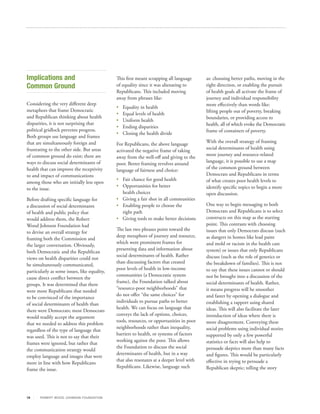
                                                  Fig. 3 Collage created by a Republican to show different choices along the journey of health and how
responsibility,” Republicans view poor          they lead to either positive or negative life outcomes.
health as arising from bad choices along
one’s path and the inability to overcome
obstacles to health that one encounters         would lead him to a lower path, which                  The second Republican expression of
along the way. Rather than employing            is disadvantage. Or the baby could take                resource highlights an important aspect
the Democratic frame of externally‐             the upper path where they don’t have                   of this deep metaphor. Physical resources
imposed barriers that trap communities          a care about anything.” Thus, where                    are finite; we use up natural resources,
in poverty and low levels of health,            Democrats view American society and                    we spend money, we consume food.
Republicans frame poor levels of health         the causes of low levels of health in                  Replenishing a resource takes time and
in terms of a failure to give individuals       certain populations as interconnected                  effort, and some resources can never be
in a community “a road map of how               systems, Republicans view both as                      replaced. For Republicans, American
to achieve [health].” However, in the           unpredictable journeys.                                society has a finite amount of resources,
same line of thought they feel they                                                                    both monetary and service‐related.
must acknowledge that “…some of                 RESOURCE                                               We need to be realistic that every person
these differences we create because…            While Republicans focus on personal                    cannot have everything; we simply do
we lead ourselves to places.” In other          responsibility for choices made                        not have enough to go around equally.
words, Republicans feel it is important         along one’s health journey, they also                  One Republican states, “because of this
to give individuals the opportunity and         acknowledge that people living in                      world of scarce resources, there’s always
the tools to make good choices in their         low‐income communities may lack                        rationing…balancing out how you’re
health journey, but at the same time            the means and ability to choose the                    going to ration things with how much
we must acknowledge that they will              right path toward health. This is                      redistribution you want.” Another says,
also make their own, sometimes bad,             an activation of the resource-deep                     “If we had unlimited resources, it’d be
choices. The following collage portrays         metaphor. Resources are essential to our               great to say that everybody deserves and
the common Republican theme of                  survival. They can be physical—such                    can have access to Cadillac health care,
a divergent path that individuals               as a tool, person, or an organization,                 but we don’t.”
encounter in their health journey. This         or intangible—such as a skill, a
Republican states, “We start down the           body of knowledge, or a network of                     Because of American’s limited resources,
road…as the baby progresses, there              relationships. Resources act as agents                 Republicans focus more intensely on
are two paths that he could take. One           enabling us to achieve important goals.                getting the most “bang for the buck,”


17     R OB ER T WOOD J OH NSON F OUN DAT ION
meaning that they want to be certain        “[Democrats] would be just as happy            the government and what is expected
that they infuse resources into the most    bringing the high end down as you              of the individual. Neither one of these
critical programs and services that         would bringing the low end up…I care           entities should bear the sole burden
demonstrate effectiveness in helping        about bringing the low end up and              of raising levels of health in poor
individuals in low‐income communities       the fact that this reduces disparities         communities. “Government makes
make better health choices. Where           is great, but it’s not the disparity that      decisions…and there has to be some
Democrats tend to see resources going       worries me, it’s the low end people not        balancing of altruistic motivation to
into a system where they circulate          doing well.” As illustrated very clearly       redistribute and efficiency,” meaning
through different communities and           by this participant, Republicans are           that we should infuse resources
programs without necessarily being          concerned about social determinants of         into the best places, but we should
exhausted, Republicans see a zero‐sum       health and low levels of health in poor        expect individuals to take personal
game. If you pour all of your resources     communities, but they immediately              responsibility in using them.
into low‐income communities, there          object to any plan that uses the
is less for the rest of America, and you    language of equality or creating equal
simultaneously have not guaranteed          levels of health because it activates the
that you actually help that community       deep metaphors of limited resources
because you did not necessarily pinpoint    and creating balance by taking things
the most strategic uses of those funds      away from the “haves” to give to the
and services.                               “have nots.”

BALANCE                                     Another important expression of
The final deep metaphor that frames         balance for Republicans is their
the issue of social determinants of         conviction that it is unrealistic to expect
health for Republicans is balance,          that everyone is going to have the same
but it is expressed in a very different     levels of health. In a free society where
way than the Democratic framing of          individuals make their own choices
social imbalance. Where Democrats           (again, relating back to the journey
see equality as both a solution (giving     theme), it is natural that there will be
everyone equal services and access) and     differences in individual’s health. We
a desired outcome (equal levels of health   should, however, establish a minimum
across all communities), the language       acceptable level, providing enough
and ideas around equality are extremely     resources that people are able to achieve
off‐putting to Republicans. They            health goals they set for themselves. A
understand equality quite differently       Republican states, “There [are] bound
than Democrats. While Democrats             to be differences in health outcomes,
see equality as raising the bottom so       there are good reasons why some people
everyone is at the same level (lifting      should be healthier than others. As long
people out of the entrapping holes of       as we are willing to live in a society
poverty), Republicans view equality         where people are different and given
as more of a scale where you have to        different levels of income, [we] will have
take things away from the people who        to have different levels.”
are well‐off in order to give them to
                                            Finally, Republicans frame the best
the poor. This frame directly relates to
                                            solution to health disparities as a
the zero‐sum view of resources held by
                                            balance between what is provided by
Republicans. One Republican states,


                                                                                          V U L N ER A B L E P O P U L AT I O N S P O RT F OL I O   18
Implications and                                This first meant scrapping all language      as: choosing better paths, moving in the
Common Ground                                   of equality since it was alienating to       right direction, or enabling the pursuit
                                                Republicans. This included moving            of health goals all activate the frame of
                                                away from phrases like:                      journey and individual responsibility
Considering the very different deep                                                          more effectively than words like:
                                                •	   Equality in health
metaphors that frame Democratic                                                              lifting people out of poverty, breaking
                                                •	   Equal levels of health
and Republican thinking about health                                                         boundaries, or providing access to
                                                •	   Uniform health
disparities, it is not surprising that                                                       health, all of which evoke the Democratic
                                                •	   Ending disparities
political gridlock prevents progress.                                                        frame of containers of poverty.
                                                •	   Closing the health divide
Both groups use language and frames
that are simultaneously foreign and                                                          With the overall strategy of framing
                                                For Republicans, the above language
frustrating to the other side. But areas                                                     social determinants of health using
                                                activated the negative frame of taking
of common ground do exist; there are                                                         more journey and resource-related
                                                away from the well-off and giving to the
ways to discuss social determinants of                                                       language, it is possible to use a map
                                                poor. Better framing revolves around
health that can improve the receptivity                                                      of the common ground between
                                                language of fairness and choice:
to and impact of communications                                                              Democrats and Republicans in terms
                                                •	 Fair chance for good health               of what creates poor health levels to
among those who are initially less open
                                                •	 Opportunities for better                  identify specific topics to begin a more
to the issue.
                                                   health choices                            open discussion.
Before drafting specific language for           •	 Giving a fair shot in all communities
a discussion of social determinants             •	 Enabling people to choose the             One way to begin messaging to both
of health and public policy that                   right path                                Democrats and Republicans is to select
would address them, the Robert                  •	 Giving tools to make better decisions     constructs on this map as the starting
Wood Johnson Foundation had                                                                  point. This contrasts with choosing
                                                The last two phrases point toward the        issues that only Democrats discuss (such
to devise an overall strategy for
                                                deep metaphors of journey and resource,      as dangers in homes like lead paint
framing both the Commission and
                                                which were prominent frames for              and mold or racism in the health care
the larger conversation. Obviously,
                                                presenting data and information about        system) or issues that only Republicans
both Democratic and the Republican
                                                social determinants of health. Rather        discuss (such as the role of genetics or
views on health disparities could not
                                                than discussing factors that created         the breakdown of families). This is not
be simultaneously communicated,
                                                poor levels of health in low‐income          to say that these issues cannot or should
particularly as some issues, like equality,
                                                communities (a Democratic system             not be brought into a discussion of the
cause direct conflict between the
                                                frame), the Foundation talked about          social determinants of health. Rather,
groups. It was determined that there
                                                “resource‐poor neighborhoods” that           it means progress will be smoother
were more Republicans that needed
                                                do not offer “the same choices” for          and faster by opening a dialogue and
to be convinced of the importance
                                                individuals to pursue paths to better        establishing a rapport using shared
of social determinants of health than
                                                health. We can focus on language that        ideas. This will also facilitate the later
there were Democrats; most Democrats
                                                conveys the lack of options, choices,        introduction of ideas where there is
would readily accept the argument
                                                tools, resources, or opportunities in poor   more disagreement. Conveying these
that we needed to address this problem
                                                neighborhoods rather than inequality,        social problems using individual stories
regardless of the type of language that
                                                barriers to health, or systems of factors    supported by only a few powerful
was used. This is not to say that their
                                                working against the poor. This allows        statistics or facts will also help to
frames were ignored, but rather that
                                                the Foundation to discuss the social         persuade skeptics more than many facts
the communication strategy would
                                                determinants of health, but in a way         and figures. This would be particularly
employ language and images that were
                                                that also resonates at a deeper level with   effective in trying to persuade a
more in line with how Republicans
                                                Republicans. Likewise, language such         Republican skeptic; telling the story
frame the issue.


19     R OB ER T WOOD J OH NSON F OUN DAT ION
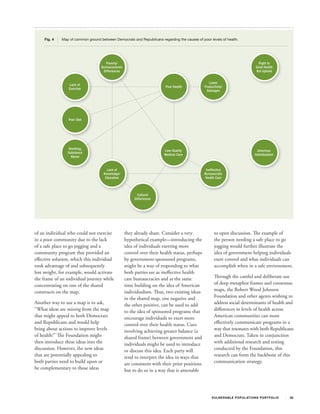
Fig. 4   Map of common ground between Democrats and Republicans regarding the causes of poor levels of health.


                                       Poverty/                                                                                            Right to
                                    Socioeconomic                                                                                        Good Health
                                     Differences                                                                                         Not Upheld


                                                                                                   Lower
                  Lack of
                                                                         Poor Health            Productivity/
                  Exercise
                                                                                                  Damages


                 Poor Diet


                 Smoking,
                                                                         Low-Quality                                                      American
                 Substance
                                                                         Medical Care                                                   Individualism
                   Abuse


                                        Lack of                                                  Ineffective
                                      Knowledge/                                                Bureaucratic
                                       Education                                                Health Care


                                                           Cultural
                                                         Differences


of an individual who could not exercise             they already share. Consider a very                to open discussion. The example of
in a poor community due to the lack                 hypothetical example—introducing the               the person needing a safe place to go
of a safe place to go jogging and a                 idea of individuals exerting more                  jogging would further illustrate the
community program that provided an                  control over their health status, perhaps          idea of government helping individuals
effective solution, which this individual           by government-sponsored programs,                  exert control and what individuals can
took advantage of and subsequently                  might be a way of responding to what               accomplish when in a safe environment.
lost weight, for example, would activate            both parties see as ineffective health
the frame of an individual journey while            care bureaucracies and at the same                 Through the careful and deliberate use
concentrating on one of the shared                  time building on the idea of American              of deep metaphor frames and consensus
constructs on the map.                              individualism. Thus, two existing ideas            maps, the Robert Wood Johnson
                                                    in the shared map, one negative and                Foundation and other agents wishing to
Another way to use a map is to ask,                 the other positive, can be used to add             address social determinants of health and
“What ideas are missing from the map                to the idea of sponsored programs that             differences in levels of health across
that might appeal to both Democrats                 encourage individuals to exert more                American communities can more
and Republicans and would help                      control over their health status. Cues             effectively communicate programs in a
bring about actions to improve levels               involving achieving greater balance (a             way that resonates with both Republicans
of health?” The Foundation might                    shared frame) between government and               and Democrats. Taken in conjunction
then introduce these ideas into the                 individuals might be used to introduce             with additional research and testing
discussion. However, the new ideas                  or discuss this idea. Each party will              conducted by the Foundation, this
that are potentially appealing to                   tend to interpret the idea in ways that            research can form the backbone of this
both parties need to build upon or                  are consistent with their prior positions          communication strategy.
be complementary to those ideas                     but to do so in a way that is amenable


                                                                                                     V U L N ER A B L E P O P U L AT I O N S P O RT F OL I O   20
Changing           OUR FRAME OF MIND
     APPENDIX


      B                       The Role of the Mind, Brain and Emotion in Developing Messages
                              by Drew Westen, Ph.D.


                              Messages That Move Decision-Makers and Everyday Citizens

                              The goal of this research was to develop messages and language
                              designed to convey the idea of social determinants of health in
                              a way that would be convincing to decision-makers and opinion
                              leaders (often referred to in public opinion research as “decision
                              elites” or “opinion elites”) as well as to the constituencies they
                              represent. Thus, we wanted to identify language meaningful
                              to both, the kinds of people who make or implement policy
                              decisions related to health (across silos, whether in public health,
                              transportation, environmental protection, or elsewhere) and to
                              average American voters, whose attitudes they ultimately have
                              to shape or reflect.

                              What became clear over the course of this project was that
                              the concept of social determinants of health includes two
                              components—one more descriptive about the context for
                              health or illness (the idea that where we live, learn, work and
                              play influences our health) and one regarding disparities in
                              health based on race, ethnicity, or class that raises questions
                              about the fairness of those disparities. Translating these two
                              components into effective messages requires different kinds
                              of messages, with the first encountering less resistance when
                              people are exposed to the ideas but still changing the way
                              they naturally think about health (as something they get at
                              the doctor’s office or hospital) and the second requiring
                              efforts to activate people’s values.


21    R OB ER T WOOD J OH NSON F OUN DAT ION
GOALS                                          matters and why both decision elites     neighborhood would today bring to
The goal of this multi-phase project           and ordinary citizens should care        mind populist sentiments about the
was to translate the concept of social         about it;                                recklessness of big business and the
determinants (and ultimately calls for      •	 To identify words and phrases            failure of government after Americans
action that stem from it) that might           that resonate with both decision         have confronted two of the biggest
otherwise sound bland or unintelligible        elites and ordinary citizens and         crises in generations, the financial
to the lay ear—even the educated ear—          to identify words, phrases, and          meltdown that has still left nearly
into compelling, motivating messages           concepts to avoid that render them       10 percent of Americans out of work
that not only create concern about the         less likely to understand or care        and the BP offshore oil spill that is
way things are but create hope that            about social determinants or health      decimating the Gulf Coast in ways we
problems related to social determinants        disparities; and                         have not even begun to understand.
are solvable (e.g., that something can      •	 To develop a small number of proxy       On the other hand, mentions of poverty
be done about disparities that lead to         statements, “catch phrases,” or          immediately evoke victim blaming and
shorter, less productive, less healthy         “taglines” that capture the complex      largely unconscious prejudices, as the
lives for millions of people based on          construct of social determinants         average American associates poverty
factors that are arbitrary or outside          in a way that is understandable          with people of color. Finding ways to
their control).                                and resonant to people other than        speak of the impact of poverty on health
                                               experts in public health.                without activating those networks—or
The problem we faced was that the                                                       activating countervailing networks
language of university researchers,         THE APPROACH                                related to the middle class and middle
think tanks, and nonprofits tends to        The approach to messaging or                class concerns—thus becomes essential
be very different from the language of      “marketing” social determinants             in messaging on health disparities if
decision-makers, let alone the language     we took is rooted in contemporary           the goal is to influence not only public
of the kitchen table, where everyday        neuroscience and in both a scientific       opinion but public policy.
people discuss ideas and values and pass    and clinical understanding of the
on attitudes to the next generation. To     unconscious networks of associations—       From this standpoint, effective efforts
accomplish goals influenced by data         the interconnected sets of thoughts,        to get people to think more broadly
from public health or other relevant        feelings, images, metaphors, and            about social determinants (and to
scientific research requires translation    emotions—that are active in the             feel something other than contempt,
of the language of science into the         brains of persuadable audiences             anger, or unease toward people who
language of policy-makers—and,              as they read, watch, or listen to           are rendered vulnerable by virtue
ultimately, the language of everyday        information about social determinants       of the factors that produce health
people, whose support is essential to       of health. Introducing the notion,          disparities) requires an understanding
convince decision-makers that they can      for example, that income level affects      of the multiple, often conflicting
and should act on the available science,    health immediately activates a host         neural networks active when people
particularly where it bears on what they    of associations, positive and negative,     process messages, which can generate
perceive as moral questions (e.g., health   that affect the persuasiveness of the       ambivalence or indifference. Changing
disparities).                               message. On the one hand, Americans         people’s attitudes requires activating
                                            value fairness, and the idea that wealth    some networks, deactivating others, and
Thus, we undertook this research with                                                   linking networks that are not currently
                                            translates into health runs afoul of a
three primary aims in mind:                                                             or adequately linked in their minds
                                            firmly entrenched value. Similarly,
•	 To develop a small set of values-        messages that convey, in a visual and       (e.g., that health is the flipside of disease
   based, emotionally compelling            especially a visceral way, the idea of      and hence deserves more significant
   narratives about why the social          toxic fumes or chemicals affecting          attention, or that health does not begin
   context (and associated disparities)     the health of kids in a particular          at the doctor’s office or the hospital).


                                                                                       V U L N ER A B L E P O P U L AT I O N S P O RT F OL I O   22
Although people are aware of some               represents the assessment of what is; the   health (to see its broader context)
of their attitudes in these regards,            latter represents the assessment of what    and health disparities but also to how
many of these attitudes are not only            could be, or the art of the possible.       they responded unconsciously, using
conflicting but unconscious (e.g., both                                                     cutting-edge technologies that allow
concern and contempt for people                 The approach we took to accomplish          us to identify the activity of neural
who are vulnerable or less fortunate,           our goal reflects this basic distinction.   networks and “gut-level” emotional
which may be triggered by different             In the first phase of the research, we      responses in large samples without
or sometimes precisely the same cues).          undertook qualitative (focus group)         directly measuring brain activity.
This has multiple ramifications. It             and quantitative (survey) assessments
means that we have to attend closely            of public opinion (focus groups and a       The project was led by Drew Westen,
to the connotations—and particularly            telephone survey) when presented with       Ph.D., of Westen Strategies, but
emotional connotations—of the                   the concept of social determinants, with    represented a collaboration with
language we use. It also means that             an eye to learning how we might change      Ann Christiano at the Robert Wood
optimal testing of messages cannot              it. Whereas the focus groups attempted      Johnson Foundation, who took an
rely exclusively on conscious measures          first to understand the extent to which     active role shaping the project at every
of people’s attitudes. We need to               both everyday people and decision elites    phase of the research; Public Opinion
complement traditional survey research          understand or spontaneously recognize       Strategies, which conducted the focus
with technologies that measure the level        social determinants of health and then      groups and baseline survey in the first
of activation of particular networks            tested messages designed to change their    phase of the project (assessing public
and associations to different phrases           attitudes toward both social influences     opinion); and Joel Weinberger, Ph.D.
designed to address the same concept            and disparities, the telephone survey       of Implicit Strategies, who worked with
(in this case, social determinants              aimed at measuring baseline public          us on the measurement of unconscious
of health).                                     opinion on the causes of health, illness,   responses to the top proxy statements
                                                and disparities without trying to change    for social determinants (terms that can
Central to this approach is also the            them (understanding “what is”).             be used to describe it with opinion elites
view that changing public opinion                                                           and the lay public) identified through
requires not just presentation of facts         In the second phase, we use quantitative    multiple rounds of testing.
but narratives that “tell the story” of         methods (online surveys and
how someone or something got that               experimental methods) to see how            METHODOLOGY
way and what can be done about it.              much we could “move the needle”             We conducted six focus groups
Effective communication uses language           of both opinion elites and everyday         (two with swing voters in Columbus,
in the vernacular of target audiences           citizens, focusing on what might be         Ohio; two with Latino and Black
that is clear, evocative, and readily           called “swing voters” on issues related     voters, in Houston, Texas; and two
remembered and retold, making use               to social determinants—people without       with “opinion elites” in Bethesda,
of the “story structure” to which our           much knowledge of social determinants       Md.) and a baseline survey in July and
brains evolved to respond.                      and without strong political leanings       August of 2009. We defined swing
                                                that would render them outside the          voters in all phases of the research as
Finally, central to the approach we took        likely realm of the persuadable. In         people who had voted for at least some
was the distinction between public              this second phase, we used online           Democrats and Republicans over the
opinion research—the measurement                technologies that allowed us to assess      last few years or considered themselves
of where the public stands prior to             not only how representative samples of      political Independents (roughly a third
efforts to influence their attitudes—           registered voters consciously responded     of the sample, and reflecting closely the
and messaging research designed to              to messages aimed at getting them           population norms). We defined opinion
change public opinion. The former               to think and feel differently about         elites in the focus groups as educated


23     R OB ER T WOOD J OH NSON F OUN DAT ION
voters who worked in Washington, D.C.,        direction or another to indicate their       we compared the “gut reactions” or
mostly in government, who held                moment-to-moment responses to                unconscious emotional responses
management positions, and empirically         messages presented in audio rather than      generated by the top proxy statements
for the remaining stages of the research      text form). Respondents also rated           for “social determinants” after a large
based on high levels of educational           multiple potential proxy statements for      sample of respondents had heard the
attainment, occupation (management,           social determinants of health (phrases       top narratives designed to “move the
small business owners, government,            designed to capture the essence of           needle” on social determinants.
etc.), sources from which they derived        the phenomenon they had just been
their news, and income level. The             reading about) to identify those
Phase 1 baseline survey consisted of          they found most compelling and               How Americans
1,000 registered voters, with an              reflective of what they had just read.
oversample of opinion elites, leading         Messages were presented in random
                                                                                           Spontaneously Think
to a sample comprising approximately          order across respondents.                    About Health and How
one third decision elites (largely matching                                                to Change Their Minds:
                                              The second study not only re-tested
the sample in partisan affiliation),
                                              conscious responses to the top messages      Qualitative Findings
one third swing voters, and one third
non-swing/non-decision elites (partisan       revised based on the highlighter             From Focus Groups
non-elite voters).                            results (indicating sections of each
                                              message that respondents found
                                                                                           We undertook the focus groups to get
In Phase 2 (message testing and               compelling or uncompelling) but also
                                                                                           a sense of how Americans naturally
refinement), we conducted two studies.        used new market research methods
                                                                                           think about social determinants and
Both collected data from samples of           to assess unconscious responses
                                                                                           to test some initial messages aimed at
voters online, obtained from panel            messages and proxy statements. To
                                                                                           changing their minds. The purpose of
companies that provide paid respondents       measure the potential effectiveness of
                                                                                           the focus groups was not to produce
for market testing, weighted to match         different phrases designed to capture
                                                                                           enduring knowledge, given the limited
the demographics of a random national         the concept of social determinants
                                                                                           general data from six groups of 8–10
sample of registered voters and not           of health, conscious tests that ask
                                                                                           people each. Rather, the goal was to
only measured.                                respondents what they think or feel
                                                                                           inform the next stages of the research.
                                              about the phrases can only be part
The first study assessed 1,000 registered                                                  Thus, we will not emphasize the
                                              of an integrated testing strategy.
voters using online quantitative polling                                                   findings, although we will bullet some
                                              This is because people lack access
to compare the effectiveness of messages                                                   of the most suggestive findings here:
                                              to their unconscious networks, and
refined from the focus groups aimed at        when asked how they think or feel,           •	 When asked what influences people’s
moving persuadable voters and decision        they make their best guesses. These             health, only a small fraction of
elites to think and feel differently about    responses which may or may not stem             respondents in the groups naturally
both social influences on health and          from their unconscious associations,            thought of social determinants.
health disparities and a “highlighting        particularly emotional associations. This       However, when prompted with
tool” to allow respondents to indicate,       is particularly a problem on messages           examples (e.g., social class, education,
within messages, which parts of messages      in which race or ethnicity is an issue          neighborhood), respondents readily
moved them positively (highlighted            (notably disparity messages), where             recognized them as causes of health
in green) or negatively (highlighted          two decades of psychological and                and illness.
in red). In this way, we could refine         neuroscientific research have shown          •	 Respondents across these groups
the messages for the final stage of           that conscious and unconscious (often           respond strongly to messages about
research (much like online dial-testing,      called explicit and implicit) attitudes         social determinants of health when
where respondents move a dial one             tend to diverge substantially. Thus,            they were values-based and emotion-


                                                                                          V U L N ER A B L E P O P U L AT I O N S P O RT F OL I O   24
laden but not when presented in                 urban children born into poverty)            their own health as good or excellent
   language perceived as more academic             with “that’s not true.” Respondents          relative to fair or poor (42% to 21%).
   (e.g., the language of public health            preferred messages that focused more         Voters who reported fair or poor health
   experts). Failure to speak to core              broadly on how a problem affects all         included, not surprisingly, Medicare
   American values uniformly depressed             Americans rather than on one group           recipients, those with incomes under
   people’s response to narratives                 or another.                                  $20,000, people with high school
   designed to move them toward                                                                 educations or less, older voters, and
   recognizing the importance of social         These findings proved particularly              those without insurance.
   context or the need to act on disparities.   important in designing messages
•	 As in every other domain we have                                                             Perhaps the most instructive answer
                                                in Phase 2 of the project. Next,
   studied, voters were more responsive                                                         that came from the baseline survey was
                                                however, we turn to the findings
   to messages that included at least                                                           voters’ response to the following forced-
                                                of the baseline survey.
   one “killer fact”—a surprising fact                                                          choice question: “Select which one
   that arouses interest, attention and                                                         comes closest to your own view, even
                                                                                                if neither is exactly right: ‘being healthy
   emotion—than those that focused              Attitudes Toward                                is something I have control over,’
   only on abstractions. However,
   loading messages down with more
                                                Health, its Context, and                        or ‘being healthy is something beyond
   than one or two facts tended to              Disparities: Baseline                           my control.’ ” By an 84 percent–
                                                                                                16 percent margin, Americans tend to
   depress responses.                           Polling                                         view their health as something largely
•	 An important lesson of the focus
   groups was that respondents,                                                                 under their control—and for which
   particularly opinion elites, strongly        The baseline survey explored voters’            they have to take—and expect others
   preferred messages that included             attitudes toward health and its social          to take—personal responsibility. This
   some kind of action item or                  determinants. The demographics were             is consistent with American culture and
   prescription. In other words, they           representative of the voting population         with previous research conducted for
   wanted a description not only of             (e.g., women constituted 52% of the             the Foundation over the last few years.
   what the problem is but either               sample; people aged 35–43 constituted           It is also an important theme to address
   an example of the kind of action             44%; 39% had completed college;                 in messages that appeal to Americans
   we could take to fix it or a set of          77% reported themselves having                  on social determinants, particularly
   principles for going from where we           health insurance; and a slightly higher         messages about health disparities,
   are now to where we need to be.              percentage considered themselves                which Americans readily attribute to
   Without a solution, they would               Democrats rather than Republicans;              a lack of responsible behavior, even
   frequently respond by saying that            with 26% considering themselves                 when presented with data suggesting
   they saw the problem, but they               “Independents”). When asked to rate             otherwise. This is also consistent with
   couldn’t see the solution.                   their top concerns, 48 percent said             what social psychologists have called
• Messages that referred to disparities         “the economy and jobs;” nothing                 the “just world hypothesis,” a tendency
   based on race or ethnicity fared             else came close, including health at            of people (at least in the West) to
   poorly with all but Black respondents.       14 percent. (The survey was completed           want to believe that people get what
   White swing voters, like middle              just before the debates overheated              they deserve (that the world is just
   class Latino voters, did not want            over health care reform, with talk              rather than morally capricious) and
   to hear about how people of a                of a “government takeover” and                  hence, to blame people for their own
   particular color or ethnicity were           “death panels.”)                                victimization or misfortunate, whether
   suffering, and they roundly rejected                                                         or not they had any genuine role in
                                                Among all voters (the focus of the statistics   contributing to it.
   even relatively obvious “facts”              cited below, unless noted otherwise),
   (e.g., the high percentage of Black          by a 2:1 margin, respondents described


25     R OB ER T WOOD J OH NSON F OUN DAT ION
These numbers are in part dependent                 expressing agreement with the following                   increase in respondents who believe the
upon how healthy people are or                      statement: “There is more to good health                  following five factors could influence
consider themselves to be. Among those              than health care. A number of things                      health: income level, education level, job
with self-reported very good or excellent           affect people’s health that people do not                 or work environment, neighborhood,
health, 96 percent believed that people’s           often think of as health care concerns, like              and pollution. These data thus suggested
health is under their control. For those            where they live and work, the quality of                  that Americans do not “naturally”
who report their health to be fair to               their neighborhoods, how rich or poor they                contextualize health socially, but when
poor, the number drops to 62 percent—               are, their level of education, or their race              presented with effective efforts to
still a majority, even among those whose            or ethnicity. These social factors have a                 influence them, they not only “move” in
health was often impacted by genetics               greater impact and influence on a person’s                their beliefs but move substantially.
or adversity, but not as strong a majority.         health than the medical care they receive.”
These numbers are graphically illustrated
                                                    Even here, however, respondents were
below. The left-hand column shows
                                                    likely to emphasize factors over which
                                                                                                              Messages That Move
those in self-reported good health,
whereas the right-hand column shows                 people have control, with three of the                    Voters
those in worse health.                              top five influences they saw on health
                                                                                                              We conducted two rounds of message
                                                                                                              testing online using large national
  Fig. 1      Good Health vs. Poor Health                                                                     samples weighted by demographics
                                                                                                              to be representative of the population
                                                                                                              of registered voters. The first study
       4%                          2%                                   14%                 12%
       Somewhat                    Strongly                             Strongly            Strongly          presented 1,000 respondents with
       Beyond Control              Beyond Control                       Have Control        Beyond Control
                                                                                                              seven messages and nine proxy
                                                                                                              statements to get at the concept of
                                                                                                              social determinants, with one message
                                                                                                              designed to describe social determinants
                                                                                                              in a more traditional way (relatively
              55%             39%                          48%                                                dispassionate, factual, but written in
              Strongly        Somewhat                    Somewhat
                                                                                                              lay language) and one proxy statement
            Have Control     Have Control                Have Control         26%
                                                                             Somewhat                         using the term “social determinants”
                                                                           Beyond Control                     itself. The other messages were designed
                                                                                                              to be more values-driven and evocative,
                                                                                                              building on both the theoretical
                                                                                                              approach underlying this research—
                                                                                                              attempting to “work with” rather than
Despite the widely held belief in                   being diet, exercise, and smoking,                        against the way our brains naturally
personal control over health, when                  and the others were factors that could                    work. This was accomplished by using a
“primed” with the idea that social                  be attributed to external causes, poor                    strong narrative structure, attempting to
factors can have a substantial                      personal decisions, or both (stress and                   be emotionally evocative and involving,
impact on health, the majority of                   lack of access to health care).                           and focusing on the values that could
voters—virtually identical across all                                                                         bring voters on board. This approach
three groups (all voters, swing voters,             After seeing messaging on social                          was helpful particularly with disparities
opinion elites)—recognized the                      determinants, however, beliefs                            messages, using what we had learned in
importance of social determinants,                  substantially shifted, with a 31 percent                  the focus groups and baseline survey.


                                                                                                             V U L N ER A B L E P O P U L AT I O N S P O RT F OL I O   26
The second study (which sampled 1,726           Messages that moved voters shared a particular structure:
voters) measured conscious responses
to the top four messages identified in
the first study, revised based on the
                                                  THE STRUCTURE OF EFFECTIVE MESSAGES ON
data from the highlighter tool (largely
                                                  SOCIAL DETERMINANTS
altering or deleting material voters              STEP 1: Connect with voters                    STEP 3: End with a principled solution
indicating that they did not find                 with an aspirational statement,                or example that illustrates how the
compelling). This study measured both             a compelling metaphor, or an                   problem can be addressed in a
conscious and unconscious responses               otherwise emotionally compelling,              way that inspires hope, “bookends”
to the top six proxy statements after             attention-grabbing statement.                  the initial statement in a way that
                                                                                                 maximizes its memorability, or offers
respondents had first heard all four              STEP 2: Describe the problem                   a metaphor that “sticks.”
narrative messages.                               in a way that is concrete, visual,
                                                  and evocative.
In both studies, voters rated narrative
messages on a 0 –100 scale traditionally
used by pollsters, in which a rating
of 70 –80 or above suggests a “high               MESSAGE                              CONVINCING (mean score) INTENSITY (80 –100)
emotional intensity” message (i.e.,               Leads the world                      68                        42%
one that moves people, and is likely to
move them to action), and a rating of             Starts where health starts           66                        43%
51–100 represents agreement with the              Social by nature                     66                        42%
message. In both studies, we used more
                                                  How we see a problem                 64                        37%
conservative thresholds of 80 –100 as
indicative of high emotional intensity            Personal responsibility              62                        35%
and 60 –100 as indicating agreement
                                                  Same opportunity                     61                        33%
with the message. In the first study, we
asked respondents to indicate their first-        Social disparities                   57                        29%
and second-choice proxy statements                Social determinants                  56                        27%
that captured for them the concepts
they had read about in the messages.
In the second study, after hearing and
rating the top four messages revised            In the initial study, as seen in the table       four focused on the social context and
from the prior stage of online testing,         above, six messages received scores              one (labeled in shorthand as “Personal
respondents saw one of the six proxy            in the 60s, of which three not only              responsibility”) focused on disparities,
statements (300 in each experimental            received ratings in the mid to high 60s          which was the harder “sell,” particularly
condition) and rated it on the same             but were also rated with high emotional          to conservative voters, who were more
0 –100 scale as the messages and then           intensity (80 –100) by over 40 percent           likely to blame people for their position
completed two tasks aimed at assessing          of voters, a metric frequently used as a         on the totem pole. The traditional
their unconscious responses to it,              threshold for messages likely to move            “social determinants” public health
described below.                                people to act. Of the top five messages,         message fared relatively poorly.


27     R OB ER T WOOD J OH NSON F OUN DAT ION
Although various subgroups diverged           As can be seen from the highlighted                           be able to see a doctor, and that health
slightly in their evaluations of the          words and concepts, voters strongly                           should include prevention. The message
different messages (e.g., not surprisingly,   resonated with the notion of American                         also convinced respondents that health
Blacks were more convinced by messages        leadership and the need to restore it.                        starts in our families, schools and workplaces
about social disparities), all groups         Within that context, they resonated most                      (a common-language translation of
tended to rank-order the messages             strongly to the idea that everyone should                     “social determinants of health.”
similarly, including swing voters and
opinion elites. As in the focus groups,
opinion elites tended to respond first
as people and second as elites—that is,          LEADS THE WORLD
the same values-driven, emotionally
compelling language that moved other
                                                 America leads the world in medical research and medical care, and
voters also moved them most. They
did not need to see the “fine print” on          for all we spend on health care, we should be the healthiest people
policies any more than other voters,             on Earth. Yet on some of the most important indicators, like how long
but they did want the “gist” or examples         we live, we’re not even in the top 25, behind countries like Bosnia and
of solutions.                                    Jordan. It’s time for America to lead again on health, and that means
The highlighter tool allowed us to see           taking three steps. The first is to ensure that everyone can afford to
what resonated or turned off voters and          see a doctor when they’re sick. The second is to build preventive care
hence to revise the narratives between           like screening for cancer and heart disease into every health care plan
the initial online survey and the
                                                 and make it available to people who otherwise won’t or can’t go in
final one. Below is an example of the
information provided by aggregating              for it, in malls and other public places, where it’s easy to stop for a
what respondents highlighted across              test. The third is to stop thinking of health as something we get in
hundreds of voters in the online survey,         hospitals and doctors’ offices but instead as something that starts in
showing the language that appealed to            our families, in our schools and workplaces, in our playgrounds and
them most. The darkest green indicates
                                                 parks, and in the air we breathe and the water we drink. The more you
language most frequently highlighted,
and lighter green shows language that            see the problem of health this way, the more opportunities you have
still appealed to respondents but with           to improve it. Scientists at the Centers for Disease Control and at
lower frequency. (Red highlighting for           universities around the country have shown that the conditions in which
each message provided a similar window           people live and work have more than five times the effect on our health
into language that voters did not
                                                 than all the errors doctors and hospitals make combined. It’s time we
find compelling. For example, voters
tended not to resonate with references           expand the way we think about health to include how to keep it, not
to particular scientific organizations           just how to get it back.
such as the CDC; they were content to
know that “scientists” had uncovered a
particular fact.)                                   Key
                                                 The darkest green indicates language most frequently highlighted, and lighter green shows language that still
                                                 appealed to respondents but with lower frequency.


                                                                                                          V U L N ER A B L E P O P U L AT I O N S P O RT F OL I O   28
We report here the top three social                As can be seen from the numbers below
determinants messages, revised based               the message, this narrative strongly          2. START WHERE
on the highlighter tool, as tested in the          resonated with all voters as well as with     HEALTH STARTS
final online survey. We also report the            swings and opinion elites. A central          It’s time we made it possible for
top social disparities message. As can             principle of messaging that applied           all Americans to afford to see a
be seen from the ratings at the bottom             in this research as in other domains          doctor, but it’s also time we made it
of each, the revisions were successful,            is that Americans have an aversion            less likely that they need to. Where
driving the ratings up roughly ten                 to messages that start negative.              people live, learn, work and play
points per message, into the 70s, which            Thus, in the focus groups, a version          has an enormous impact whether
indicates that respondents found them              of this message that started with how         they stay well in the first place.
                                                                                                 Health starts in strong, loving
extremely convincing.                              Americans have fallen behind proved
                                                                                                 families and in neighborhoods
                                                   much weaker than this version, which          with sidewalks safe for walking
                                                   reminded Americans that we have the           and grocery stores with fresh
     1. LEADS THE WORLD                            best medical research and health care         vegetables. Health starts in jobs
     America leads the world in medical            for those who can get it, and began           we can get to without hours of
     research and medical care, and for all        the message on an aspirational note.          commuting and in work places free
     we spend on health care, we should            It then spoke to the problem, with a          of unnecessary hazards. Health
     be the healthiest people on Earth.                                                          starts in schools that educate our
                                                   stark contrast with Bosnia and Jordan,
     Yet on some of the most important                                                           children for the jobs of the 21st
                                                   two countries Americans would never           century so they can compete in
     indicators, like how long we live,
     we’re not even in the top 25, behind
                                                   see as competitors. Given that these          the world economy, that feed them
     countries like Bosnia and Jordan.             messages were tested in the midst of          healthy meals rather than junk
     It’s time for America to lead again           the debate over health care, and our          foods, and that send them home
     on health, and that means taking              goal was to focus people’s attention on       safe at the end of the day. And
     three steps. The first is to ensure that      factors that precede getting medical          health starts in having the time and
     everyone can afford to see a doctor                                                         financial resources to play at the
     when they’re sick. The second is to
                                                   attention, we emphasized three steps
                                                                                                 end of a hard day’s work, because
     build preventive care like screening          to putting America back on top in             unrelieved stress takes its toll on
     for cancer and heart disease into             health. We began with health care and         our hearts and immune systems.
     every health care plan and make it            prevention but then moved quickly             As we work on fixing health care in
     available to people who otherwise             to social determinants. The language          America, we need to start where
     won’t or can’t go in for it, in malls
                                                   throughout is the language of the             health starts, not just where it ends.
     and other public places, where it’s
     easy to stop for a test. The third is to      “kitchen table”—the kind of language
                                                   everyday people would use in talking          TOTAL: 74.1 SWING: 75.5 ELITE: 72.7
     stop thinking of health as something
     we get at the doctor’s office but             about health and illness.
     instead as something that starts
     in our families, in our schools and           What is notable about this message          This second message also begins with an
     workplaces, in our playgrounds and            is the combination of values that
     parks, and in the air we breathe and
                                                                                               aspirational statement—about ensuring
                                                   drives the positive response to it.         that every American can see a doctor—
     the water we drink. The more you
     see the problem of health this way,
                                                   The primary one is American leadership      but ends with a surprising twist that
     the more opportunities you have to            and nationalism—values not typically        draws voters in, that we also make it less
     improve it. Scientists have found that        associated with health policy. The          likely that they need to. This message
     the conditions in which we live and           message also emphasizes the values
     work have an enormous impact on
                                                                                               draws on language already used by the
                                                   of environmental protection, families,      Robert Wood Johnson Foundation to
     our health, long before we ever see a
     doctor. It’s time we expand the way
                                                   and acting proactively to prevent           describe social determinants—“where
     we think about health to include how          a problem (problem-solving and              we live, learn, work and play,” and then
     to keep it, not just how to get it back.      pragmatism) before it starts.               uses a rhetorical device (repeating the

     TOTAL: 78.2   SWING: 77.4 ELITE: 79.0


29        R OB ER T WOOD J OH NSON F OUN DAT ION
same structure in a series of statements,    tends to drive down its ratings. People
each beginning with “Health starts…”)        can generally read, hear, and follow               3. SOCIAL BY NATURE
to expand on the meaning of that             three examples or themes in a message,             We are social by nature, and when
language. It closes with a memorable         but beyond that, they find the message             the ties that bind begin to unravel,
phrase, namely that “we need to start        incoherent or difficult to remember.               so does our health. Health begins
where health starts, not where it ends,”     It begins to lose the narrative structure          at home in our families, with a
that has the property marketers describe     essential to an effective message. The             loving relationship between parents
as “stickiness”—that is, characterized by    message then inoculates against a                  and their children, where kids can
the tendency to “stick” in people’s minds.   concern we heard in focus groups—                  expect to be safe, nurtured and
                                                                                                protected. Health begins with
                                             that it was too utopian, that no single
This message draws on a number of                                                               healthy communities, with safe
                                             institution can solve the problem alone—           streets, freedom from violence, and
values as well, some of which are and        and returns to its core theme with a               parks where kids can play. Health
others of which are not traditionally        final, memorable statement that                    begins with a good education,
associated with public health. These         “bookends” the opening statement with              where children learn not only how
include the values of strong families,       a touch of irony and humor that brings             to read, write, and prepare for
community, workplace safety, education,      the message close to personal experience.          fulfilling, prosperous life, but how
competition in the global economy,                                                              to treat each other with dignity and
nutrition, security, and hard work.          Like the other messages, this one draws            respect. And health begins with
                                             on a mix of values, some of which are              safe jobs and fair wage, where
The third top message takes a very           familiar to public health and some of
                                                                                                people derive a sense personal
different tack, emphasizing the                                                                 satisfaction from their work and
                                             which draw associative links to other              connection to their co-workers.
social nature of social determinants,        domains and hence increase its power:              No institution alone can restore
juxtaposing the colloquial phrase, “ties     families, communities, nurturance,                 a healthy America that nurtures
that bind,” with a complex idea: that        safety, prosperity, dignity, respect, safe         families and communities. That
we are biologically predisposed to           work, fair wages, business, religion               will require leadership, and a
require certain social conditions to         and leadership. One of the central                 partnership of business, government,
optimize our health. Like the former         characteristics of good messages is that           and civic and religious institutions.
message, this one makes use of the                                                              We can’t eradicate illness, but
                                             they activate multiple values, not simply          we can foster health. And health
rhetorical device of structural repetition   one (good health). In so doing, they               begins with healthy relationships,
(“Health begins…”). Also like the            activate the positive feelings associated          healthy communities, and healthy
former statement, and central to             with each of those values unconsciously,           jobs, which protect us from the
a strong, memorable message,                 which has an impact that is sometimes              stress of everyday life. That’s one
it does not overuse the device. Any          additive and sometimes multiplicative.             prescription that doesn’t require
message that includes more than                                                                 a co-pay.
three principles, three examples, or
three structurally similar sentences                                                            TOTAL: 73.9 SWING: 73.6                 ELITE: 74.2


                                                                                          V U L N ER A B L E P O P U L AT I O N S P O RT F OL I O     30
Our top health disparities message tested         Several points are noteworthy about             an area 150 miles constitutes. The
nearly as well as these messages (and             this message. Perhaps most importantly,         message then begins to break down
better than some with swing voters)               like virtually all effective messages on        in-group/out-group barriers, by comparing
and hence deserves note, particularly             issues related to race, ethnicity, and          the concerns of the middle class with
given the difficulty developing messages          social disparities, the narrative starts        the concerns of people who are poor,
on health disparities that do not “turn           right and moves left. It begins with            noting that both are disadvantaged in
off” voters right of center politically,          a value that all Americans share but            health vis-à-vis the wealthy. Finally, the
who tend to believe that hierarchies are          is central to conservative ideologies,          narrative offers its central take-home
natural and that people’s misfortunes             particularly when applied to people who         message: that people ought to have
are largely of their own making:                  are readily viewed as “them” rather than        equal opportunity to make choices that
                                                  “us,” namely personal responsibility. We        lead to good health, and that fairness
                                                  learned in the focus groups, however,           requires that Americans, regardless of
     4. PERSONAL RESPONSIBILITY                   the importance of returning to this             who they are, have a chance to make
                                                  theme later in the message to reassure          good decisions that could translate into
     People have a personal responsibility        respondents to the right of center that         good health.
     to take care of themselves and
                                                  the messenger “really means it.” The
     their health. But it isn’t right when                                                        Like the other messages, this one draws
     things outside our control—like              message then draws upon another
                                                  value, central to Americans across the          on a range of values, many of which we
     where we’re born or how much
                                                  political spectrum—fairness—and                 have already described, such as personal
     money we make—affect our health.
     In the entire city of Detroit—an area        defines its meaning as it applies to            responsibility and fairness. In addition,
     of nearly 150 square miles—there             health. This second statement would             it speaks to values of healthy eating,
     are dozens of “convenience stores”           have had an entirely different meaning          hard work, affordable day care, and
     but only five grocery stores.
                                                  if not contextualized by the first              equal opportunity.
     An apple a day may keep the
     doctor away, but you have to be
                                                  statement, which establishes that the           The four statements presented here could
     able to buy an apple. And it isn’t           messenger views fairness and personal           all be used effectively in communications
     easy to get exercise if you have             responsibility as complementary values,         about social determinants with average
     to work three jobs just to get by,           not as alternatives. The narrative then         voters, swing voters, and educated
     or if you can’t easily get affordable        goes on to cite a single “killer fact”—         opinion elites and decision-makers.
     day care for your kids. We’re not            that is, a fact that has a strong emotional
     just talking about the rich versus
                                                                                                  They all drew average ratings in the 70s,
                                                  impact—namely that within 150 square            which is extremely high. In contrast,
     the poor. On Average, middle
     class Americans live shorter lives
                                                  miles in the city of Detroit, it is virtually   a message using traditional “social
     than those who are wealthy,                  impossible to find a grocery store.             determinants” language, statistics, and
     and that’s not right. Money can’t            This suggests that even parents who             rhetorical devices often used to speak
     buy happiness, and it shouldn’t              want to exercise personal responsibility        about health with the general public
     buy health. We have to take                  and act responsibly cannot do so for            drew ratings in the 50s:
     responsibility for our lives and             structural reasons (although terms such
     decisions. But all Americans should          as “structural” are toxic to effective          A growing consensus among scientists
     have an equal opportunity to make
                                                  communications with the general                 suggests although medical care is essential
     the decisions that allow them to
     live a long, healthy life, regardless        public). In general, messages that recite       for relieving suffering and curing illness,
     of their level of income, education,         numbers (e.g., the number of millions           social determinants of health are as or
     or ethnicity.                                of children born into poverty) tend to          more important than virtually any factor
                                                  fail, particularly when they are overly         that contributes to health or illness.
     TOTAL: 71.4   SWING: 73.9 ELITE: 69.0        “fact-heavy.” In this case, however,            Only an estimated 10 to 15 percent of
                                                  the number has an emotional impact              preventable mortality has been attributed
                                                  because of its magnitude and because            to medical care. Social factors can affect
                                                  the reader can readily picture how large        health directly and indirectly as their


31       R OB ER T WOOD J OH NSON F OUN DAT ION
effects accumulate across individuals’         Proxy Statements for
lifetimes and across generations, leading      Social Determinants:
to vicious cycles between social factors and
health. A person’s health and likelihood
                                               Conscious and
of becoming sick and dying prematurely         Unconscious Responses
are greatly influenced by powerful social
factors such as education and income and
                                               We were interested not only in
the quality of neighborhood environments.
                                               effective narratives to describe social
Fortunately, many social factors can be
                                               determinants but also in proxy
influenced by policies and programs.
                                               statements for the concept—ways of
Building a healthier America requires
                                               describing “social determinants of
individuals to make healthy choices and
                                               health” that do not sound so distant,
a societal commitment to remove the                                                          Fig. 2 Participants saw this image during the
                                               cold, and abstract. Thus, in the first
obstacles preventing too many Americans                                                    final phase of message testing.
                                               online study we measured people’s
from making those choices. This will
                                               conscious responses to nine potential
take a commitment from every sector—
                                               proxies (including the term “social         we asked participants to fixate their eyes
government, business and foundations—
                                               determinants” itself, as a baseline for     on an X in the middle of their computer
to promote opportunities for Americans
                                               comparison), and we tested the top six      screen and told them immediately
to live healthy and productive lives.
                                               in the second online study for both         following it they would see an image
Note that this message is very similar         their conscious and unconscious appeal.     of a family, about whom they would
in substance to the messages that were         Respondents rated the proxy statements      answer some questions.
more effective: It makes the same points       for the extent to which they captured
                                               the “gist” of the messages they had been    We presented these stimuli three times.
in its opening sentence that health
                                               hearing in a way that was compelling        However, each time, between the image
begins long before people seek health
                                               to them.                                    of the X and the image of a family of
care, that social factors are essential
                                                                                           ambiguous social class, ethnicity, and
influences on health, and that the
                                               To assess their unconscious responses       race (below), we presented the proxy
quality of neighborhoods and factors
                                               to the proxy statements, we used a          statement, but this time at 30–50
such as income and ethnicity can have a
                                               procedure that is being increasingly        milliseconds—slow enough for the
substantial effect on health and illness.
                                               used in corporate marketing for             brain to process (particularly since they
However, it does so in a language that,
                                               testing ads and taglines, namely an         had read it before) but too quickly
while written for a lay audience, is
                                               unconscious priming procedure. For          for them to be aware that they had
not the language of the kitchen table.
                                               this procedure, all respondents first       even seen anything. This is called an
Further, the language of “policies and
                                               heard the four narratives described         unconscious prime. They then rated
programs” is far less effective than
                                               above (our top three narratives and         the family on 10 positive and negative
the language of values, from which
                                               our top disparities narrative), to          statements (e.g., “This family looks
those policies and programs are
                                               familiarize them with the concept of        healthy,” “This looks like a family
ultimately derived. This message, like
                                               social determinants in language we          that can look forward to long lives,”
the successful messages, also speaks to
                                               knew was compelling. They then saw          “I get the feeling this family lives in a
solutions, but it does so in a way that
                                               one of the six top proxy statements         dangerous neighborhood”). Although
sounds bureaucratic, even though it
                                               (or the traditional social determinants     they believed they were rating the
speaks directly to individuals making
                                               statement, once again as a baseline;        family, over five decades of research
healthy choices, and it uses words such
                                               the traditional statement had received      have documented that unconscious
as “sector” that are abstract and distant
                                               the lowest ratings in the first round       primes can have a substantial impact
to the average person.
                                               of testing). Following a test of their      on ratings of consciously perceived
                                               associations to the proxy statements,       stimuli, particularly when the stimuli
                                                                                           are ambiguous.


                                                                                          V U L N ER A B L E P O P U L AT I O N S P O RT F OL I O   32
The conscious ratings in both rounds of
     CONSCIOUS RATINGS OF DESCRIPTIVE PHRASES                                research were highly similar, as shown
     PHRASE                                          TOTAL   SWING   ELITE   in the accompanying table. Five messages
                                                                             performed extremely well, with ratings
     Your opportunity for health starts long         81.7    82.0    81.5    in the mid to high 70s and 80s on a
     before you need medical care.
                                                                             0–100 scale. Two messages performed
     Health starts long before illness, in our       81.5    81.2    81.8    comparatively poorly. One was somewhat
     homes, schools and jobs.                                                “clunky,” defining social determinants in
                                                                             terms of four components, although this
     All Americans should have the opportunity       81.2    81.5    80.9
                                                                             statement still received an average rating
     to make choices that allow them to live
     a long, healthy life, regardless of their                               of approximately 70. The only message
     income, education or ethnic background.                                 to receive a rating below 70 was the
                                                                             traditional social determinants statement.
     Your neighborhood or job shouldn’t be           76.3    76.7    76.0
     hazardous to your health.                                               The table on the left shows how the same
                                                                             proxy statements fared unconsciously,
     Health begins where we live, learn, work        75.1    76.0    74.4
                                                                             with the data transformed to a 0–5
     and play.
                                                                             scale for ease of interpretation, with
     The opportunity for health begins in our        70.0    69.5    70.5    0 representing relatively low positive
     families, neighborhoods, schools and jobs.                              emotional response and 5 representing
     If we want to improve our health, we need       63.0    62.6    63.3
                                                                             strong positive response.
     to address the social determinants of health.
                                                                             As can be seen, with the exception of the
                                                                             first statement, which received high
                                                                             conscious ratings but generated a
                                                                             mediocre response unconsciously (relative
                                                                             to the other top proxy statements),
                                                                             the statements performed similarly
                                                                             consciously and unconsciously, with the
                                                                             two statements that performed worst
                                                                             consciously also doing so unconsciously.


33        R OB ER T WOOD J OH NSON F OUN DAT ION
The three statements that performed the
best both consciously and unconsciously      UNCONSCIOUS EMOTIONAL REACTIONS TO
would thus be the strongest candidates       DESCRIPTIVE PHRASES (scale of 0 –5)
for brief ways of capturing the construct
                                             PHRASE                                             TOTAL              SWING              ELITE
of social determinants for the general
public. This includes both decision elites   Your opportunity for health starts long            1.8                2.1                1.6
and swing voters, and could be readily       before you need medical care.
use in public service announcements
                                             Health starts long before illness, in our          4.4                4.2                4.7
as “taglines.” One message—“Health           homes, schools and jobs.
starts long before illness, in our homes,
schools and jobs”—captures the general       All Americans should have the opportunity          3.4                4.5                2.5
construct of social determinants in a        to make choices that allow them to live
                                             a long, healthy life, regardless of their
relatively comprehensive way for such a
                                             income, education or ethnic background.
brief statement and is easy to remember.
A second—“Your neighborhood or job           Your neighborhood or job shouldn’t be              4.7                4.1                4.8
shouldn’t be hazardous to your health”—      hazardous to your health.
is a strong message with a negative tinge,
                                             Health begins where we live, learn, work           1.8                1.7                1.9
that provides a motivation for action.       and play.
The third—“All Americans should have
the opportunity to make choices that         The opportunity for health begins in our           0.3                0.1                0.4
allow them to live a long, healthy life,     families, neighborhoods, schools and jobs.
regardless of their income, education or     If we want to improve our health, we need          0.9                1.5                0.4
ethnic background”—did remarkably            to address the social determinants of health.
well both consciously and unconsciously.
Although it is longer than optimal for
a proxy statement, it is a strong health
disparities statement that generated
strong positive responses.


                                                                                          V U L N ER A B L E P O P U L AT I O N S P O RT F OL I O   34
Conclusions

The data reported here are only a beginning, but they represent a comprehensive
effort at identifying ways of talking with the general public, including swing voters
and opinion elites, about social determinants of health. The main “take-home points”
include the following:


     KEYS TO EFFECTIVE MESSAGING ON SOCIAL DETERMINANTS

     •	 Americans, including opinion
        	                                          overly academic. Messages that
        elites, do not spontaneously               sway Americans describe both
        consider social influences on              facts and policy prescriptions at
        health. They tend to think about           a moderate level of specificity–
        health and illness in medical              that is, at the level of principles
        terms, as something that starts at         or examples, not specific policy
        the doctor’s office, the hospital, or      prescriptions or 10-point plans.
        the pharmacy. They recognize the
                                                •	 Americans consciously believe
        impact of health care on health,
                                                   in equal opportunity to health,
        and spontaneously recognize the
                                                   but messages that describe
        importance of prevention, but
                                                   disparities evoke negative
        they do not tend to think of social
                                                   reactions unless written carefully
        factors that impact health.
                                                   to avoid victim-blaming and
     •	 They do, however, recognize                to emphasize the importance
        social factors and see their               of people exercising personal
        importance when primed.                    responsibility. Messages about
        Raising awareness of social                disparities trigger unconscious
        factors is not difficult, although         prejudice unless carefully
        people more readily recognize              constructed to redefine “them”
        voluntary behaviors that cause             as “us.”
        illness (e.g., smoking, overeating)
                                                •	 Messages that mix traditionally
        than arbitrary or social factors
                                                   conservative values (e.g., the
        (e.g., race, ethnicity, income).
                                                   value of small business) with
     •	 Americans, including elites, do            traditional progressive values
        not resonate with the language             (e.g., equal opportunity) tend
        of “social determinants of                 to fare better in speaking to
        health,” but they do resonate              health disparities. Starting right
        with the core construct. When              and moving left is important in
        presented with the compelling              connecting with conservative
        narratives, Americans recognize            Americans, who tend to believe
        the importance of both the social          that hierarchies are natural
        context and health disparities.            and reflect poor choices, bad
                                                   judgement or bad behavior.
     •	 Messages that sway Americans,
        including elites, are values-
        based and emotion-laden, not


35     R OB ER T WOOD J OH NSON F OUN DAT ION
VULNERABLE POPULATIONS PORTFOLIO


   Health begins where we live, learn, work and play. The Vulnerable Populations Portfolio looks
   at factors outside of the medical care system that impact how healthy—or unhealthy—we are.
   We create new opportunities for better health by investing in health where it starts—in our homes,
   schools and jobs.


                LI VE              LEARN                 WOR K                 PLA Y


   For more information about the Robert Wood Johnson Foundation’s Vulnerable Populations
   Portfolio, please go to www.rwjf.org/vulnerablepopulations.


www.rwjf.org

© 2010 Robert Wood Johnson Foundation

Content from this report may be reproduced without prior permission provided the
following attribution is noted: “Copyright 2010 Robert Wood Johnson Foundation”


Design: Ideas On Purpose, New York, NY / ideasonpurpose.com


                                                                                                        V U L N ER A B L E P O P U L AT I O N S P O RT F OL I O   36
VU LN ER A B L E P O P U L AT IONS PORT FOLIO
                                                V U L N ER A B L E P O P U L AT I O N S P O RT F OL I O   37

Sdh 2010

  • 1.
    A New Way toTalk About THE SOCIAL DETERMINANTS OF HEALTH VU LN ER A B L E P O P U L AT IONS PORT FOLIO
  • 3.
    TABLE OF CONTENTS FOREWORD WHY WE NEED A BETTER WAY to Talk About THE SOCIAL DETERMINANTS OF HEALTH by Jane Isaacs Lowe, Ph.D. page ii CHAPTER Peeling THE ONION 1 How We Found a Better Way to Talk About the Social Determinants of Health page 1 CHAPTER Choosing WORDS 2 Best Practices in the Language and Framing of Social Determinants of Health page 4 Finding ONE FACT TO FIGHT FICTION CHAPTER 3 The Use of Data and Information to Support—Not Make—Your Case page 9 APPENDIX Thinking IN PICTURES A The Deep Metaphors That Drive How Politicians See Health Disparities by Elizabeth Carger page 13 APPENDIX Changing OUR FRAME OF MIND B The Role of the Mind, Brain and Emotion in Developing Messages by Drew Westen, Ph.D. page 21 V U L N ER A B L E P O P U L AT I O N S P O RT F OL I O i
  • 4.
    FOREWORD WHY WE NEED A BETTER WAY to Talk About THE SOCIAL DETERMINANTS OF HEALTH by Jane Isaacs Lowe, Ph.D. When the Robert Wood Johnson Foundation went through a restructuring in 2003, it organized all the programs that worked at the community level to advance health into a new programming group called the Vulnerable Populations Portfolio. The newly created portfolio included a vast array of programs focused on areas as disparate as long-term care, school-based health and chronic homelessness. The members of the team struggled to find a meaningful connection among the programs that could help them discern a strategy for managing the current groups of programs and making future funding decisions. ii R OB ER T WOOD J OH NSON F OUN DAT ION
  • 5.
    What emerged fromthat analysis was an Health starts where we live, learn, work and play. understanding that the programs and projects were united in that they each worked within the context of the social determinants of health. And while social determinants were well established in We tweaked it and refined it a little, and academic circles and have been the subject of what we ended up with was simple: Health starts considerable study, we quickly discovered that where we live, learn, work and play. We started the concept didn’t work on the ground. The to see the messages picked up everywhere, but grantees—most of whom were dealing with most importantly in media accounts of our real challenges at the community level, didn’t programs and in academic literature. necessarily resonate with this frame. For some While the new framework did well in its it was so patently obvious that it became a “road test,” we are an institution that prides itself truism. And as unsuccessful as the concept was on evaluation and measurement of the ideas we for existing grantees, it made even less sense put forward. So we decided to test the messages to organizations that approached the team for more rigorously—to make sure we were getting funding who hadn’t worked with us before. it right—but also that we hadn’t missed an As the team struggled to find a way to translate opportunity to make it better. So we engaged the topic so that it made sense to our colleagues Drew Westen, Ph.D., of Westen Strategies and and people in the field, the Foundation was author of The Political Brain to help us fine-tune developing a commission focused on the social the messages, and build on our earlier research. determinants of health— specifically focusing Dr. Westen worked closely with our own on why some Americans are so much healthier communications staff to conduct the research than others and why Americans overall aren’t as that’s reflected here. healthy as they could be. This work has helped us communicate more This work gave us an opportunity to find a new effectively, and there’s no reason to keep what frame for talking about the social determinants we’ve learned to ourselves. We hope that this of health. Not just for people working in the field, research and the way we’ve applied it is helpful but for policy-makers. We had to talk about the to you. Please use it freely, but let us know if topic in a way that people could understand, that you do. We’d love to continue to build on what was meaningful, and that didn’t align the topic follows here. with any existing political perspective or agenda. By working with a talented group of communicators, including Linda Loranger of Burness Communications, Allison Rosen of Chandler Chicco, Bob McKinnon of YELLOWBRICKROAD and Elizabeth Carger of Jane Isaacs Lowe, Ph.D. Olson Zaltman Associates, we were able to arrive Team Director at a frame that described the social determinants Vulnerable Populations Portfolio of health plainly, without political overtone. As we started using this new way of talking not only for the commission, but also for the work in the portfolio, we gained significant traction. V U L N ER A B L E P O P U L AT I O N S P O RT F OL I O III
  • 6.
    Peeling THE ONION CHAPTER 1 How We Found a Better Way to Talk About the Social Determinants of Health It turns out that trying to figure out how to say something simply can be a complicated process. Each of us has developed our own set of beliefs and values. As we listen and learn new concepts, we try to fit what we hear into these existing frames. And because many of our beliefs are so deeply held, it means that even the most seemingly innocuous terms can be laden with meaning. 1 R OB ER T WOOD J OH NSON F OUN DAT ION
  • 7.
    How we assignmeaning to what we hear is largely dependent on the context in which we hear it. And this context is something that even the most self-aware person can have a difficult time expressing. So as we developed messages and tested their reception, we benefited from advanced market research techniques developed and used by Olson Zaltman Associates and Westen Strategies to get at these deeper-level insights. This guide is informed by an iterative research and message development process that includes three steps: Determine How Policy-Makers Develop Messages That We Strengthen the Messages 1 See the World of Health 2 Can Road Test 3 With Testing In late 2006, as the Robert Wood Johnson This research informed the commission’s To validate and strengthen the Vulnerable Foundation was establishing the Commission message strategy, and we also applied Populations messages, we engaged to Build a Healthier America, the Foundation their findings to how we framed the work in a partnership with Westen Strategies, commissioned Olson Zaltman Associates of the Foundation’s Vulnerable Populations a public opinion messaging research (OZA), a Boston-based market research Portfolio, which is deeply invested in finding firm. Together we developed a study built firm, to help us gain a “deep understanding solutions to address the impact of social on the messages we were already using of people’s thoughts and feelings about factors on those most vulnerable among to understand which language resonated health differences across populations in us. This messaging was successfully road with our priority audiences. We also wanted the United States.” The insights from this tested with media and policy-makers to know whether differences existed in research provided a framework for talking in 2008 and 2009. Our core message certain political segments’ receptivity to about the diverse issues addressed by emphasized “new pathways for improved our messages. Westen Strategies enlisted the Commission, with social determinants health that recognize the integral relationship Public Opinion Strategies to conduct of health chief among them. Specifically, between our health and where and how various stages of the research and ensure OZA’s work showed how people with we live, learn, work and play.” We looked that the end product would be informed different political perspectives see health to our grantees and the communications by a range of political perspectives. This differently. More importantly, the research experts who work with them to provide study went into the field in the summer identified ways to frame our messages valuable input that strengthened our of 2009. about health differences that would messages and ensured that we avoided resonate across the political spectrum. language that would fall flat on the front Working closely with OZA, we had the lines. Collaboration and a constant opportunity to dig deeper into how people feedback loop were a critical part of the see this issue, and then layer additional process at every stage. forms of research over their findings to get a more robust and precise understanding of how people see health. (Elizabeth Carger of OZA has written a highly detailed chapter on their work in this area, which is included as an appendix in this guide.) V U L N ER A B L E P O P U L AT I O N S P O RT F OL I O 2
  • 8.
    The first phaseof this research was a series of In the final phase of the research, Westen Strategies focus groups held in multiple cities and grouped took that learning one step further by exposing by male and female swing voters in Ohio, Blacks these messages to more than 1,700 registered voters and Hispanics in Houston and opinion leaders in and capturing their conscious and unconscious Washington, D.C.. It was conducted by Public reactions. Dr. Westen details this research process Opinion Strategies (POS). With the feedback we and what we learned from it in an appendix at got from this process, we refined the messages. the end of this guide. POS tested the refined messages in a quantitative Internet survey of 1,000 registered voters. From start to finish, this research represents We’ve shared what we learned in settings small responses from more than 3,000 Americans and large—including conferences sponsored by across the country over four years—using the Centers for Disease Control and Prevention both traditional research methods and new, and Grantmakers in Health—and the response sophisticated market research techniques—to has been consistent: “This is great, but how can answer one primary question: I learn more?” This summary is our response to that question. How do we find a common language that will In the following pages, you will find both an expand Americans’ views about what it means overview of what we learned—which words, phrases to be healthy—to include not just where health and framing work and why—but also a detailed ends but also where it starts? description of the methodology and what we discovered in chapters graciously authored by If we can answer this question, we can pave Elizabeth Carger and Dr. Westen, whose work the way for more solutions that address this was critical to our understanding of how Americans critical link between our health and where we perceive this issue. live, learn, work and play. 3 R OB ER T WOOD J OH NSON F OUN DAT ION
  • 9.
    Choosing WORDS CHAPTER 2 Best Practices in the Language and Framing of Social Determinants of Health There is no silver bullet, no single word or fact that will suddenly transform how people think about health. It is an intensely personal issue that carries with it complex beliefs, conflicted values and a deeply divided electorate about what leads to better health. Instead, in this research, we studied numerous long-form messages and shorter statements that could offer a proxy for the phrase “social determinants of health.” We uncovered a series of lessons, best practices, recommended language and watch-outs that can support better and more persuasive messages. V U L N ER A B L E P O P U L AT I O N S P O RT F OL I O 4
  • 10.
    SEVEN LESSONS: 1 3 6 Traditional phrasing of social Use one strong and compelling fact— Mix traditionally conservative determinant language consistently a surprising point that arouses values with traditionally tested poorly in every phase of interest, attention and emotion—for progressive values. Every phase research. Phrases like “social maximum impact. Loading messages of research showed that while determinants of health” and down with more than one or two facts some phrasing appealed to one “social factors” failed to engage tends to depress responses to them. political perspective over another, the audience, even when we progressives had a tendency to added more context. However, the be more open to conservative concept behind social determinants of health does resonate with our 4 frames. Generally, however, we need to be aware of these different audiences, as evidenced by our worldviews and communicate Identify the problem, but offer pre- and post-testing of people’s using language that puts us on potential solutions. Respondents, attitudes after their exposure to common ground. For example, particularly opinion leaders, prefer our messages. combining the notion of personal messages that include some kind responsibility, which is wholly of direction—either an example of embraced by conservatives with the kind of action that would address 2 the problem or a set of principles a message about opportunities, language that also appeals to that can guide us to where we need progressives, will appeal to a Priming audiences about the to be. broader audience. connection with messages they already believe makes the concept more credible. Messages that 5 7 incorporate the importance of available quality health care with Incorporate the role of personal Focus broadly on how social the need to address the social responsibility. The importance of all determinants affect all Americans factors that affect health were Americans having equal opportunity to more convincing than those that (versus a specific ethnic group make choices that lead to good health did not discuss medical care resonated with participants across the or socioeconomic class). This at all. When messages are political spectrum. Incorporating this research showed that Americans presented in colloquial, values- point made respondents more receptive believe in equal opportunity to driven, emotionally compelling to the idea that society also has a role health, but describing actual language, they are more to play in ensuring that healthy choices disparities consistently evokes effective. Academic language, are universally available. negative reactions. Messages including “social determinants,” that described disparities based did not resonate with audiences on race or ethnicity fared poorly the way language like “health with every audience except Black starts in our homes, schools and respondents. Furthermore, some communities” did. focus group participants expressed concern that focusing on one ethnic group reinforced negative racial stereotypes. 5 R OB ER T WOOD J OH NSON F OUN DAT ION
  • 11.
    BREAKING IT DOWN: Belowyou’ll find one long-form message that was developed, revised, tested and revised again based on what the research showed us. WHY THIS WORKED: It was consistently the most persuasive message among all groups, • Audiences flat out didn’t believe the regardless of their political perspective. While we are not necessarily statement, “America is not among the top recommending that you use this in its entirety, it is helpful to understand 25 countries in life expectancy,” and they why the phrase worked. responded negatively to any message that led with that statement. However, when we start off with something most Americans already believe, “Americans lead the world in medical research and America leads the world in medical research and medical care,” they are more likely to medical care, and for all we spend on health believe everything that follows. care, we should be the healthiest people on Earth. • Words like “insured or “uninsured” are Yet on some of the most important indicators, politically loaded. But the phrase “ensure like how long we live, we’re not even in the top 25, everyone can afford to see a doctor when behind countries like Bosnia and Jordan. It’s time they are sick” doesn’t touch existing political hot buttons. for America to lead again on health, and that means taking three steps. The first is to ensure • Framing our message in the context of accepted beliefs like the importance that everyone can afford to see a doctor when of access to care or prevention helps our they’re sick. The second is to build preventive message fit into the broader thinking of care like screening for cancer and heart disease what it takes to be healthy. into every health care plan and make it available • The inclusion of specific solutions increased to people who otherwise won’t or can’t go in for acceptance of the core message. it, in malls and other public places, where it’s easy • Illustrating with examples like “playgrounds to stop for a test. The third is to stop thinking and parks” and “in the air we breathe and water we drink,” makes the concept of of health as something we get at the doctor’s social factors more tangible. office but instead as something that starts in our • In the statement, “Scientists have found,” families, in our schools and workplaces, in our other options were tested with more playgrounds and parks, and in the air we breathe specificity, such as “Scientists at the and the water we drink. The more you see the Centers for Disease Control and at problem of health this way, the more opportunities universities around the country have shown that the conditions in which you have to improve it. Scientists have found that people live and work have more than the conditions in which we live and work have an five times the effect on our health enormous impact on our health, long before we than all the errors doctors and hospitals ever see a doctor. It’s time we expand the way make combined.” Presenting the fact in a more colloquial, relatable way, we think about health to include how to keep it, stripped of the academic support, is not just how to get it back. more effective than a longer statement. V U L N ER A B L E P O P U L AT I O N S P O RT F OL I O 6
  • 12.
    SIX WAYS TOTALK ABOUT SOCIAL DETERMINANTS OF HEALTH: Our hope in this research was to find a tidy proxy that could replace “the social determinants of health” as the leading descriptor for this area of work. While our testing showed that this phrase doesn’t work for any of our audiences, we still don’t have that neat replacement. But what you’ll find here is a list of phrases that—in context—helped people understand the concept more clearly. These are the precise phrases that we tested and that scored well. 1 Health starts—long before illness—in our homes, WHY THESE WORK: schools and jobs. • The proxy statements use colloquial, 2 All Americans should have the opportunity to make values-driven language and relatable the choices that allow them to live a long, healthy lifestyle references that engage audiences. life, regardless of their income, education or ethnic background. • These statements all focus on the solution versus the problem. 3 Your neighborhood or job shouldn’t be hazardous • Some of the statements implicitly to your health. acknowledge the notion of personal responsibility. 4 Your opportunity for health starts long before you need medical care. 5 Health begins where we live, learn, work and play. 6 The opportunity for health begins in our families, neighborhoods, schools and jobs. A GLOSSARY OF “OTHER TERMS” The terms that people often use to describe health disparities People with a more liberal perspective on this issue often can get in the way of others accepting the idea of social describe health disparities as an injustice, whereas more determinants of health and who they are most likely to affect. conservative people never use this phrase. Though it was One of the things we learned from OZA’s research is that never commented on directly in the OZA health disparities people with more conservative views tend to have negative research, we suspect that the idea of health differences reactions to the goal of equal levels of health for everyone. being unjust would not resonate with conservative audiences As such, below are some phrases we suggest avoiding. because it may activate the same response as inequality. This would include the following type of language, which • Any variation of equal, • Leveling the playing field you should also avoid: equality or equalizing • Creating balance • Unjust/injustice • Immoral • Outrage • Unconscionable 7 R OB ER T WOOD J OH NSON F OUN DAT ION
  • 13.
    A GLOSSARY OF“OTHER TERMS” (continued) Below is an evolving list of terms that describe the groups most profoundly affected by this issue. These descriptions are not only technically accurate but more representative of how we relate to each other as human beings and fellow Americans. These phrases have not been tested, but are reflective of the insights we gained from the research. Vulnerable Populations • Disappointing (as in Americans The elderly population and should be able to do better, not their families, nursing homes • Too many Americans don’t have let people fall through the cracks) the same opportunities to be as and elder care healthy as others • It’s time we made it possible for all Americans to afford to see a • Our aging parents and • Americans who face significant doctor, but it’s also time we made grandparents barriers to better health it less likely that they need to • Our elders • People whose circumstances • Elders have made them vulnerable to Poverty poor health • Caring for people as they age • Families who can’t afford the • All Americans should have the basics in life Refugees and immigrants opportunity to make the choices that allow them to live a long, • Americans who struggle financially including children healthy life, regardless of their • Americans struggling to get by • People seeking a new home income, education, or ethnic in America background Low-income workers • Children caught between • Our opportunities to better health and families two worlds begin where we live, learn, work and play • People who work for a living and • From undocumented immigrants still can’t pay their rent to productive, tax-paying • People’s health is significantly American citizens affected by their homes, jobs • Hard-working Americans who and schools have gotten squeezed out of the middle class in tough times Youth and teens Health Disparities • Families whose dreams are • The years of opportunity being foreclosed and danger • Raising the bar for everyone • Teenagers: They aren’t just • Setting a fair and adequate Violence in general, as well young adults baseline of care for all as gangs and intimate • Lifting everyone up partner violence Mental health or illness, • Giving everyone a chance to live including young people • Unsafe streets a healthy life • The epidemic of violence • It’s just as dangerous and • Unfair debilitating as any other • Street violence • Not right chronic disease • Intergenerational cycle of violence and abuse • Teen dating violence and abuse V U L N ER A B L E P O P U L AT I O N S P O RT F OL I O 8
  • 14.
    Finding ONE FACTTO FIGHT FICTION CHAPTER 3 The Use of Data and Information to Support—Not Make—Your Case As communicators, we can’t do our work without making use of the facts that are the foundation of our work. They establish the prevalence of an issue; communicate its effect in both economic and human terms; and communicate responsibly about the effectiveness of an approach or intervention. Funders and policy-makers place increasing value on sound evaluation and research to guide their investments and decision-making. RWJF relies exclusively on objective data sources, but over the course of this project, we were sometimes astonished by how people responded to specific data points that we used to support our messages. So much so that we thought it would be worthwhile to share some of those lessons here. 9 R OB ER T WOOD J OH NSON F OUN DAT ION
  • 15.
    NINE FACTS ABOUTFACTS face value unless it is put in a more acceptable context. We shared an effective example of 1. Less Is Always More providing such context in the long-form message Regardless of how good or reliable the data is, example used earlier. this research showed us that less is more. America leads the world in medical research and If you can use two facts instead of three, use medical care, and for all we spend on health care, two. Or better yet, use just one great fact. we should be the healthiest people on Earth. When introducing information to people who Yet on some of the most important indicators, like may be skeptical about social determinants, how long we live, we’re not even in the top 25, we found that more facts made people feel like behind countries like Bosnia and Jordan. they were being sold or spun. 4. Specific Examples Matter 2. Use Complementary—Not Competing—Data In the previous example, POS tested several If you are using multiple pieces of information, versions where the only thing that changed they should be used to advance—not repeat— was which countries we used to illustrate the your narrative. If you are using multiple facts, point. We had 25 different countries to choose they should be complementary in advancing from. In earlier drafts, we used France, Spain or your message. For example, use one that Turkey as examples. The respondents rejected underscores the problem and another that them outright and refused to believe them. highlights the promise of an approach. One said, “Why are you picking on Spain? “In a Little Rock, Ark., middle school last month, Others said these countries were too “socialist” over 108 suspensions resulted from fights during or “backward” to have better health than the recess—a time when kids should be playing, U.S. does. However, when we switched the recharging their batteries and return to class ready countries to Bosnia and Jordan, the respondents to learn. After a new program called Playworks were more open to the information. was introduced into the school, suspensions dropped to zero. The program allows kids to spend more 5. Don’t Let Numbers Be Forgettable time playing instead of fighting, and teachers to Specificity matters when it comes to examples, spend more time teaching instead of dealing with but not so much when dealing with the actual conflicts that carry over to the classroom. In fact, the number. Our level of precision doesn’t need to program has been shown to restore a whole week’s approach the level of pi to prove that the research worth of class time that would have previously been is valid. Why say 23.6 percent of those in poverty spent dealing with fights.” didn’t graduate high school when you can say almost 25 percent? Complicated numbers are 3. Context Is King difficult to remember. Just think of the way you “Just the facts, ma’am” may help advance police remember or forget phone numbers. The larger work on Dragnet but it doesn’t help advance our the number the more important it is to round messaging. How and where a fact is presented in it into something memorable. We don’t suggest your message is critical, especially when that fact using this approach in a scientific journal. may challenge an existing belief. For example, if your fact could be perceived as a criticism, whether to a person’s race, country or cause, then he/she will most likely reject your fact at V U L N ER A B L E P O P U L AT I O N S P O RT F OL I O 10
  • 16.
    6. Break DownBig Numbers The numbers we work with can be both Speaking of big numbers, unless they are put into some kind of context, they can lose their mind-boggling and mind-numbing. It is meaning and intended impact. Recently, the founder of TED, Richard Saul Wurman, our job to break them down in a way that illustrated this point when trying to put is both comprehensive and meaningful. “a trillion” into perspective. “Imagine a very wealthy couple who had a lot of a person who lives in a certain zip code in cash in reserve. I mean a lot. Well, one day 30 years Connecticut and someone who lives in North ago, they decided to start a small business. And it Dakota, respondents cried foul, thinking we was an awful business plan. So every day, for the cherry-picked the data and that this was an last 30 years, their business lost a million dollars extreme example. On the other hand, when every single day. To show you how much a trillion we told people that there was a life expectancy dollars is, they would have to lose a million difference of seven years between someone dollars a day for another 2,700 years to lose who graduated from college versus those who a trillion dollars.” didn’t graduate high school, people responded The numbers we work with can be both differently, and those differences were often mind-boggling and mind-numbing. It is our associated with very different life circumstances. job to break them down in a way that is both So for those participants who had graduated comprehensible and meaningful. Reporting that college and were more conservative, they actually health insurance legislation costs a trillion dollars believed the data but amazingly didn’t think that (over 10 years) is an accurate estimate but creates seven years of life was that much of a difference. a completely different meaning than telling Conversely, those who were not college graduates someone that the cost of reform breaks down rejected the idea that education played any role to $3 a day for every American. in how long someone might live. 7. The Value in a Number Is in Its Values 9. Overall Messaging Rules Still Apply Numbers can represent both a value and our Finally, we need to realize that facts aren’t a values. You can say that half of all parents in separate part of our message but an essential poor neighborhoods don’t feel safe letting their ingredient to telling our story. They benefit children play on the streets. Or you can try and from the same lessons we’ve shared earlier in create a picture of what it must be like to feel this report. trapped in your own home, unable to move There is no shortage of good data that because of your job or income, not able to give supports the idea that our health starts long your kids the most basic opportunities to play before illness—in our homes, schools and jobs. outside or run free, but instead fear that they But there is still a long way to go to make sure could get caught up with the wrong crowd or that we are using it to maximum effect. To struck down by a stray bullet, like the neighbor’s this end, we have begun to aggregate these kid next door. sources and refine these messages online at http//sites.google.com/factsthatfightfiction. 8. Imagine Why Someone Might Cry Foul? We invite you to visit this site, add your own Some of the most important lessons from the compelling data and comment on how you’ve research involved life expectancy data. For been able to successfully use great information example, when we stated that there was up to to make good things happen. a 25-year difference in life expectancy between 11 R OB ER T WOOD J OH NSON F OUN DAT ION
  • 17.
  • 18.
    Thinking IN PICTURES APPENDIX A The Deep Metaphors That Drive How Politicians See Health Disparities by Elizabeth Carger The following document is a summary of the report “Thoughts and Feelings About Health Differences Across Populations in the United States,” which was delivered to the Robert Wood Johnson Foundation in the summer of 2007. It reflects the findings from interviews conducted in Washington, D.C., with 31 congressional staffers and health experts who were affiliated in some way with either the Democratic or Republican Parties. This report will outline the Democratic view of social determinants of health, then the Republican view, and then summarize implications for communication strategies and common ground between the parties. Throughout the report we detail the deep metaphor frames that Democrats and Republicans hold. For those unfamiliar with the concept of a deep metaphor, they can be described as basic filters. These are frames that shape everything we hear, think, say and do. They operate largely below awareness and for this reason are especially powerful as they normally escape conscious attention. A given group of people or stakeholder community will typically share the same few deep metaphors on a topic. Knowing what their deep metaphors are has important implications for communications strategy. 13 R OB ER T WOOD J OH NSON F OUN DAT ION
  • 19.
    The Democratic privilege by virtue of birth,” and goes on affected by social determinants of Frames for Social to discuss how unequal levels of health health. Broadly, containers keep based solely on the zip code in which things in and keep things out; they are Determinants of Health a person was born contradicts this physical, psychological, or social places. and Health Disparities foundational principle of American society. Containers can protect us or trap us; Across Populations The second level on which the deep they can be open or closed, positive or negative. metaphor system operates is that SYSTEM Democrats view poor levels of health For Democrats, low‐income communities The deep metaphor of system forms as emerging from a complex and are isolated and self‐contained on all the fundamental underpinning for the interrelated system of social, cultural, three levels—physical, psychological, Democratic view of social determinants economic, and biological factors. and social. They are physically isolated of health. Broadly, the system-deep One Democrat states, “It’s all tied in locations that lack resources metaphor refers to the unification and together—housing, health care, energy, necessary to live a healthy life such organization of separate entities into food.” Consequently, changing any one as easily accessible doctors’ offices, a whole. The unity of a system means factor, such as access to insurance, is grocery stores with fresh foods, and that the parts are interdependent; these not going to fix the problem of health places to exercise safely. One Democrat connected parts often operate in a disparities. There are numerous social says “it’s like living within your own predictable and recurrent pattern with determinants that we must address little world…the reality for poor certain results. simultaneously and comprehensively people is never leaving their culture in order to overcome the system of of poverty.” On a psychological level For Democrats in particular, the interrelated factors that results in poor this “culture of poverty” traps them system frame operates on two levels. levels of health, in certain communities. in a mentality that they can never First, American society as a whole Because this frame of a complex system get ahead, they are unable to take is a complex system that unifies all permeates the Democratic view of advantage of the opportunities in citizens. As such, all individuals, from health they often feel the need to discuss broader society. Democrats describe the poorest person in the Bronx to a multitude of issues and factors the poor as “a self‐contained group the wealthiest person in Manhattan, simultaneously, quickly moving from at the bottom of the pyramid with are interdependent, even if this is not one cause to another cause. This high unemployment, low job status.” readily apparent. When poor levels of makes their discussions seem complex Solving health-related problems seems health exist in some communities it and, at times, muddled. Even though particularly hopeless. The poor have eventually affects everyone and weakens comprehensively addressing all social watched grandparents and parents the entire system that is America. determinants of health makes perfect die of diabetes-related complications What holds this American system sense to individuals operating in the or heart disease and it has become together is a foundation of rights such world of public health and policy who almost an expected life outcome. There as freedom, opportunity, and equality. hold the same system frame, it may be exists a psychological and cultural For Democrats, health is itself a right; cumbersome and frustrating to those barrier to reaching out to the medical all Americans have the right to health who hold a different frame, as we will community. A common Democratic care and the right to lead a healthy life. see with the Republican world-view. manifestation of the container frame One Democrat states, “Health care is a involves barriers. They bring images right, it’s so fundamental to being able CONTAINER of blockades and “significant barriers to have a healthy lifestyle. [What makes Where the deep metaphor system related to health care [exist between the it a right are] the values of society, of underpins the Democratic view of Latino community/African-American federal government.” Another states American society and health-related community and White folks.”] that “one of the real founding principles issues, the deep metaphor container [of America] was the notion of absence of frames the way they view communities V U L N ER A B L E P O P U L AT I O N S P O RT F OL I O 14
  • 20.
    Finally, on asocial level, the poor are that they are hard to separate at times) left out of the larger social system are a reflection of extreme imbalance in that Democrats see as underpinning American society between the “haves” America. This is particularly troubling and the “have nots.” For Democrats, a for Democrats as part of their situation where “it would take this chief fundamental view of society is that executive two hours to earn enough to everyone is interconnected, so having fund a community kitchen for three some groups left out of this system is years” is morally wrong —“Something not only morally wrong, it weakens is wrong there, it’s out of balance.” the overall view of America as a well This is an important touch point functioning system of inclusion. One for Democrats. As we will see later, Democrat states, “Individuals at the Republicans have a more optimistic bottom of society’s rungs, economically, view of Americans’ health status, socially, etc., they’re the ones who whereas Democrats are angered by this get left out when it comes to access profound social imbalance, “It makes to affordable, quality health care. me very angry…it’s unjust and unfair …we leave a sixth of Americans outside and profoundly disturbing.” “[I feel] the system…we as a society have a really angry, I mean really angry…I responsibility, an obligation, and it’s didn’t realize how angry I was about in our best interests to bring them in.” that until you asked me.” Or, in the Consider the digital collage that one collage below, “This woman who’s Democrat created, which exemplifies screaming [represents that] she’s angry the way low‐income communities trap that these problems existed for so long.” individuals in “containers” that separate Fig. 1 Collage created by a Democrat to them from the larger social system, as The second way that the balance-deep show the separation of poor communities from represented by the well‐dressed white metaphor frames how Democrats view wealthy White society. students at the bottom of the image issues related to health disparities is Fig. 2 Collage created by a Democrat (see Figure 1). in their discussion of remedies and highlighting anger over persistent social outcomes. Democrats seek equality— imbalance with regards to health levels. BALANCE balanced distribution of resources, the The balance-deep metaphor encompasses same health care treatment for everyone, ideas of equilibrium, adjusting, and (ideally) equal outcomes in that all maintaining or offsetting forces, and communities would have roughly the things being as they should. Balance same levels of health. The language of themes can structure peoples’ thinking equality has been a cornerstone of about social, moral, psychological Democratic discussions of a multitude and emotional domains. Democrats of social issues, from health disparities predominantly express the negative side to employment to education. Statements of balance. Having an interconnected like, “Equality assumes that we are social system while simultaneously all going to end up at the same level. tolerating pockets of isolated, self- Equity to me presumes a fair and contained, impoverished citizens leaves even distribution of resources” pepper Democrats with a profound sense the Democratic discussion of social of imbalance. Health disparities and determinants of health. Critically, this wealth disparities (issues that are so is not the language that is effective deeply interconnected for Democrats 15 R OB ER T WOOD J OH NSON F OUN DAT ION
  • 21.
    for Republicans, aswe will see below. “A long, windy road. There needs to be However, it is important to understand constant movement, a journey—it’s not that this frame of equality—as expressed where you’re going, it’s the fact that by the desire for balance in terms of you’re moving…We’re a very different access, treatment, and outcome—is population than we were a hundred a cornerstone of how Democrats years ago; the person laying out that construct solutions to health disparities road a hundred years ago—they had no across American populations. idea what society was going to look like.” This long‐term journey frame makes Republicans more hesitant to The Republican institutionalize programs to address social determinants of health, particularly Frames for Social in a federal government that is slow Determinants of Health to adapt to unforeseen, yet inevitable and Health Disparities changes over time. Across Populations Another important ramification of this much longer and linear journey frame as compared to the Democratic JOURNEY system frame is that Republicans are Where system forms the fundamental fundamentally more optimistic about lens through which Democrats view where we are today in terms of the society and health, the deep metaphor health of the American population. journey is the predominant frame Where the Democrats expressed through which Republicans view extreme anger over perceived social American society and health issues. imbalances, Republicans state, “Look Broadly, journey often frames our back to where the world was 80 years discussion of life itself. Journeys can be ago, 90 years ago. The average life fraught with challenge or can be smooth expectancy was middle age. …I’m sailing; they can be direct or divergent. not going to die before I’m 55, where Some journeys are unpredictable, 100 years ago I couldn’t say that. It’s where others focus on a series of steps collective improvement that goes full that, if followed, will take you to a spectrum.” They also tend to compare predetermined place or goal. us to other countries to show how much The type of journey that a group farther along we are on our American describes can yield much insight into journey overall, and our health journey how they view a given topic. For in particular. “The African lady with Republicans, American society as a the bundle on her head symbolizes that whole is on a long, unpredictable ours is a society that has come so much health journey through time. They use farther than that. …We have forgotten metaphors of winding paths and stress where our health system was 20 years the importance of adaptability in the ago. We don’t have the perspective…it’s face of an unknown future direction. a little unrealistic to think that because One Republican states: we are short of perfection, that the system is somehow deeply flawed.” V U L N ER A B L E P O P U L AT I O N S P O RT F OL I O 16
  • 22.
    The difference inbase level of optimism versus anger between the Republicans and Democrats could be a real source of tension between the two groups when it comes to discussing social determinants of health. Understanding these basic differences in emotional response to the issue could help anticipate touch points in a conversation where communication might break down. Much as they see America and health care as a whole on a journey through time, Republicans see individuals as on their own health journeys. Echoing the common theme of “individual Fig. 3 Collage created by a Republican to show different choices along the journey of health and how responsibility,” Republicans view poor they lead to either positive or negative life outcomes. health as arising from bad choices along one’s path and the inability to overcome obstacles to health that one encounters would lead him to a lower path, which The second Republican expression of along the way. Rather than employing is disadvantage. Or the baby could take resource highlights an important aspect the Democratic frame of externally‐ the upper path where they don’t have of this deep metaphor. Physical resources imposed barriers that trap communities a care about anything.” Thus, where are finite; we use up natural resources, in poverty and low levels of health, Democrats view American society and we spend money, we consume food. Republicans frame poor levels of health the causes of low levels of health in Replenishing a resource takes time and in terms of a failure to give individuals certain populations as interconnected effort, and some resources can never be in a community “a road map of how systems, Republicans view both as replaced. For Republicans, American to achieve [health].” However, in the unpredictable journeys. society has a finite amount of resources, same line of thought they feel they both monetary and service‐related. must acknowledge that “…some of RESOURCE We need to be realistic that every person these differences we create because… While Republicans focus on personal cannot have everything; we simply do we lead ourselves to places.” In other responsibility for choices made not have enough to go around equally. words, Republicans feel it is important along one’s health journey, they also One Republican states, “because of this to give individuals the opportunity and acknowledge that people living in world of scarce resources, there’s always the tools to make good choices in their low‐income communities may lack rationing…balancing out how you’re health journey, but at the same time the means and ability to choose the going to ration things with how much we must acknowledge that they will right path toward health. This is redistribution you want.” Another says, also make their own, sometimes bad, an activation of the resource-deep “If we had unlimited resources, it’d be choices. The following collage portrays metaphor. Resources are essential to our great to say that everybody deserves and the common Republican theme of survival. They can be physical—such can have access to Cadillac health care, a divergent path that individuals as a tool, person, or an organization, but we don’t.” encounter in their health journey. This or intangible—such as a skill, a Republican states, “We start down the body of knowledge, or a network of Because of American’s limited resources, road…as the baby progresses, there relationships. Resources act as agents Republicans focus more intensely on are two paths that he could take. One enabling us to achieve important goals. getting the most “bang for the buck,” 17 R OB ER T WOOD J OH NSON F OUN DAT ION
  • 23.
    meaning that theywant to be certain “[Democrats] would be just as happy the government and what is expected that they infuse resources into the most bringing the high end down as you of the individual. Neither one of these critical programs and services that would bringing the low end up…I care entities should bear the sole burden demonstrate effectiveness in helping about bringing the low end up and of raising levels of health in poor individuals in low‐income communities the fact that this reduces disparities communities. “Government makes make better health choices. Where is great, but it’s not the disparity that decisions…and there has to be some Democrats tend to see resources going worries me, it’s the low end people not balancing of altruistic motivation to into a system where they circulate doing well.” As illustrated very clearly redistribute and efficiency,” meaning through different communities and by this participant, Republicans are that we should infuse resources programs without necessarily being concerned about social determinants of into the best places, but we should exhausted, Republicans see a zero‐sum health and low levels of health in poor expect individuals to take personal game. If you pour all of your resources communities, but they immediately responsibility in using them. into low‐income communities, there object to any plan that uses the is less for the rest of America, and you language of equality or creating equal simultaneously have not guaranteed levels of health because it activates the that you actually help that community deep metaphors of limited resources because you did not necessarily pinpoint and creating balance by taking things the most strategic uses of those funds away from the “haves” to give to the and services. “have nots.” BALANCE Another important expression of The final deep metaphor that frames balance for Republicans is their the issue of social determinants of conviction that it is unrealistic to expect health for Republicans is balance, that everyone is going to have the same but it is expressed in a very different levels of health. In a free society where way than the Democratic framing of individuals make their own choices social imbalance. Where Democrats (again, relating back to the journey see equality as both a solution (giving theme), it is natural that there will be everyone equal services and access) and differences in individual’s health. We a desired outcome (equal levels of health should, however, establish a minimum across all communities), the language acceptable level, providing enough and ideas around equality are extremely resources that people are able to achieve off‐putting to Republicans. They health goals they set for themselves. A understand equality quite differently Republican states, “There [are] bound than Democrats. While Democrats to be differences in health outcomes, see equality as raising the bottom so there are good reasons why some people everyone is at the same level (lifting should be healthier than others. As long people out of the entrapping holes of as we are willing to live in a society poverty), Republicans view equality where people are different and given as more of a scale where you have to different levels of income, [we] will have take things away from the people who to have different levels.” are well‐off in order to give them to Finally, Republicans frame the best the poor. This frame directly relates to solution to health disparities as a the zero‐sum view of resources held by balance between what is provided by Republicans. One Republican states, V U L N ER A B L E P O P U L AT I O N S P O RT F OL I O 18
  • 24.
    Implications and This first meant scrapping all language as: choosing better paths, moving in the Common Ground of equality since it was alienating to right direction, or enabling the pursuit Republicans. This included moving of health goals all activate the frame of away from phrases like: journey and individual responsibility Considering the very different deep more effectively than words like: • Equality in health metaphors that frame Democratic lifting people out of poverty, breaking • Equal levels of health and Republican thinking about health boundaries, or providing access to • Uniform health disparities, it is not surprising that health, all of which evoke the Democratic • Ending disparities political gridlock prevents progress. frame of containers of poverty. • Closing the health divide Both groups use language and frames that are simultaneously foreign and With the overall strategy of framing For Republicans, the above language frustrating to the other side. But areas social determinants of health using activated the negative frame of taking of common ground do exist; there are more journey and resource-related away from the well-off and giving to the ways to discuss social determinants of language, it is possible to use a map poor. Better framing revolves around health that can improve the receptivity of the common ground between language of fairness and choice: to and impact of communications Democrats and Republicans in terms • Fair chance for good health of what creates poor health levels to among those who are initially less open • Opportunities for better identify specific topics to begin a more to the issue. health choices open discussion. Before drafting specific language for • Giving a fair shot in all communities a discussion of social determinants • Enabling people to choose the One way to begin messaging to both of health and public policy that right path Democrats and Republicans is to select would address them, the Robert • Giving tools to make better decisions constructs on this map as the starting Wood Johnson Foundation had point. This contrasts with choosing The last two phrases point toward the issues that only Democrats discuss (such to devise an overall strategy for deep metaphors of journey and resource, as dangers in homes like lead paint framing both the Commission and which were prominent frames for and mold or racism in the health care the larger conversation. Obviously, presenting data and information about system) or issues that only Republicans both Democratic and the Republican social determinants of health. Rather discuss (such as the role of genetics or views on health disparities could not than discussing factors that created the breakdown of families). This is not be simultaneously communicated, poor levels of health in low‐income to say that these issues cannot or should particularly as some issues, like equality, communities (a Democratic system not be brought into a discussion of the cause direct conflict between the frame), the Foundation talked about social determinants of health. Rather, groups. It was determined that there “resource‐poor neighborhoods” that it means progress will be smoother were more Republicans that needed do not offer “the same choices” for and faster by opening a dialogue and to be convinced of the importance individuals to pursue paths to better establishing a rapport using shared of social determinants of health than health. We can focus on language that ideas. This will also facilitate the later there were Democrats; most Democrats conveys the lack of options, choices, introduction of ideas where there is would readily accept the argument tools, resources, or opportunities in poor more disagreement. Conveying these that we needed to address this problem neighborhoods rather than inequality, social problems using individual stories regardless of the type of language that barriers to health, or systems of factors supported by only a few powerful was used. This is not to say that their working against the poor. This allows statistics or facts will also help to frames were ignored, but rather that the Foundation to discuss the social persuade skeptics more than many facts the communication strategy would determinants of health, but in a way and figures. This would be particularly employ language and images that were that also resonates at a deeper level with effective in trying to persuade a more in line with how Republicans Republicans. Likewise, language such Republican skeptic; telling the story frame the issue. 19 R OB ER T WOOD J OH NSON F OUN DAT ION
  • 25.
    Fig. 4 Map of common ground between Democrats and Republicans regarding the causes of poor levels of health. Poverty/ Right to Socioeconomic Good Health Differences Not Upheld Lower Lack of Poor Health Productivity/ Exercise Damages Poor Diet Smoking, Low-Quality American Substance Medical Care Individualism Abuse Lack of Ineffective Knowledge/ Bureaucratic Education Health Care Cultural Differences of an individual who could not exercise they already share. Consider a very to open discussion. The example of in a poor community due to the lack hypothetical example—introducing the the person needing a safe place to go of a safe place to go jogging and a idea of individuals exerting more jogging would further illustrate the community program that provided an control over their health status, perhaps idea of government helping individuals effective solution, which this individual by government-sponsored programs, exert control and what individuals can took advantage of and subsequently might be a way of responding to what accomplish when in a safe environment. lost weight, for example, would activate both parties see as ineffective health the frame of an individual journey while care bureaucracies and at the same Through the careful and deliberate use concentrating on one of the shared time building on the idea of American of deep metaphor frames and consensus constructs on the map. individualism. Thus, two existing ideas maps, the Robert Wood Johnson in the shared map, one negative and Foundation and other agents wishing to Another way to use a map is to ask, the other positive, can be used to add address social determinants of health and “What ideas are missing from the map to the idea of sponsored programs that differences in levels of health across that might appeal to both Democrats encourage individuals to exert more American communities can more and Republicans and would help control over their health status. Cues effectively communicate programs in a bring about actions to improve levels involving achieving greater balance (a way that resonates with both Republicans of health?” The Foundation might shared frame) between government and and Democrats. Taken in conjunction then introduce these ideas into the individuals might be used to introduce with additional research and testing discussion. However, the new ideas or discuss this idea. Each party will conducted by the Foundation, this that are potentially appealing to tend to interpret the idea in ways that research can form the backbone of this both parties need to build upon or are consistent with their prior positions communication strategy. be complementary to those ideas but to do so in a way that is amenable V U L N ER A B L E P O P U L AT I O N S P O RT F OL I O 20
  • 26.
    Changing OUR FRAME OF MIND APPENDIX B The Role of the Mind, Brain and Emotion in Developing Messages by Drew Westen, Ph.D. Messages That Move Decision-Makers and Everyday Citizens The goal of this research was to develop messages and language designed to convey the idea of social determinants of health in a way that would be convincing to decision-makers and opinion leaders (often referred to in public opinion research as “decision elites” or “opinion elites”) as well as to the constituencies they represent. Thus, we wanted to identify language meaningful to both, the kinds of people who make or implement policy decisions related to health (across silos, whether in public health, transportation, environmental protection, or elsewhere) and to average American voters, whose attitudes they ultimately have to shape or reflect. What became clear over the course of this project was that the concept of social determinants of health includes two components—one more descriptive about the context for health or illness (the idea that where we live, learn, work and play influences our health) and one regarding disparities in health based on race, ethnicity, or class that raises questions about the fairness of those disparities. Translating these two components into effective messages requires different kinds of messages, with the first encountering less resistance when people are exposed to the ideas but still changing the way they naturally think about health (as something they get at the doctor’s office or hospital) and the second requiring efforts to activate people’s values. 21 R OB ER T WOOD J OH NSON F OUN DAT ION
  • 27.
    GOALS matters and why both decision elites neighborhood would today bring to The goal of this multi-phase project and ordinary citizens should care mind populist sentiments about the was to translate the concept of social about it; recklessness of big business and the determinants (and ultimately calls for • To identify words and phrases failure of government after Americans action that stem from it) that might that resonate with both decision have confronted two of the biggest otherwise sound bland or unintelligible elites and ordinary citizens and crises in generations, the financial to the lay ear—even the educated ear— to identify words, phrases, and meltdown that has still left nearly into compelling, motivating messages concepts to avoid that render them 10 percent of Americans out of work that not only create concern about the less likely to understand or care and the BP offshore oil spill that is way things are but create hope that about social determinants or health decimating the Gulf Coast in ways we problems related to social determinants disparities; and have not even begun to understand. are solvable (e.g., that something can • To develop a small number of proxy On the other hand, mentions of poverty be done about disparities that lead to statements, “catch phrases,” or immediately evoke victim blaming and shorter, less productive, less healthy “taglines” that capture the complex largely unconscious prejudices, as the lives for millions of people based on construct of social determinants average American associates poverty factors that are arbitrary or outside in a way that is understandable with people of color. Finding ways to their control). and resonant to people other than speak of the impact of poverty on health experts in public health. without activating those networks—or The problem we faced was that the activating countervailing networks language of university researchers, THE APPROACH related to the middle class and middle think tanks, and nonprofits tends to The approach to messaging or class concerns—thus becomes essential be very different from the language of “marketing” social determinants in messaging on health disparities if decision-makers, let alone the language we took is rooted in contemporary the goal is to influence not only public of the kitchen table, where everyday neuroscience and in both a scientific opinion but public policy. people discuss ideas and values and pass and clinical understanding of the on attitudes to the next generation. To unconscious networks of associations— From this standpoint, effective efforts accomplish goals influenced by data the interconnected sets of thoughts, to get people to think more broadly from public health or other relevant feelings, images, metaphors, and about social determinants (and to scientific research requires translation emotions—that are active in the feel something other than contempt, of the language of science into the brains of persuadable audiences anger, or unease toward people who language of policy-makers—and, as they read, watch, or listen to are rendered vulnerable by virtue ultimately, the language of everyday information about social determinants of the factors that produce health people, whose support is essential to of health. Introducing the notion, disparities) requires an understanding convince decision-makers that they can for example, that income level affects of the multiple, often conflicting and should act on the available science, health immediately activates a host neural networks active when people particularly where it bears on what they of associations, positive and negative, process messages, which can generate perceive as moral questions (e.g., health that affect the persuasiveness of the ambivalence or indifference. Changing disparities). message. On the one hand, Americans people’s attitudes requires activating value fairness, and the idea that wealth some networks, deactivating others, and Thus, we undertook this research with linking networks that are not currently translates into health runs afoul of a three primary aims in mind: or adequately linked in their minds firmly entrenched value. Similarly, • To develop a small set of values- messages that convey, in a visual and (e.g., that health is the flipside of disease based, emotionally compelling especially a visceral way, the idea of and hence deserves more significant narratives about why the social toxic fumes or chemicals affecting attention, or that health does not begin context (and associated disparities) the health of kids in a particular at the doctor’s office or the hospital). V U L N ER A B L E P O P U L AT I O N S P O RT F OL I O 22
  • 28.
    Although people areaware of some represents the assessment of what is; the health (to see its broader context) of their attitudes in these regards, latter represents the assessment of what and health disparities but also to how many of these attitudes are not only could be, or the art of the possible. they responded unconsciously, using conflicting but unconscious (e.g., both cutting-edge technologies that allow concern and contempt for people The approach we took to accomplish us to identify the activity of neural who are vulnerable or less fortunate, our goal reflects this basic distinction. networks and “gut-level” emotional which may be triggered by different In the first phase of the research, we responses in large samples without or sometimes precisely the same cues). undertook qualitative (focus group) directly measuring brain activity. This has multiple ramifications. It and quantitative (survey) assessments means that we have to attend closely of public opinion (focus groups and a The project was led by Drew Westen, to the connotations—and particularly telephone survey) when presented with Ph.D., of Westen Strategies, but emotional connotations—of the the concept of social determinants, with represented a collaboration with language we use. It also means that an eye to learning how we might change Ann Christiano at the Robert Wood optimal testing of messages cannot it. Whereas the focus groups attempted Johnson Foundation, who took an rely exclusively on conscious measures first to understand the extent to which active role shaping the project at every of people’s attitudes. We need to both everyday people and decision elites phase of the research; Public Opinion complement traditional survey research understand or spontaneously recognize Strategies, which conducted the focus with technologies that measure the level social determinants of health and then groups and baseline survey in the first of activation of particular networks tested messages designed to change their phase of the project (assessing public and associations to different phrases attitudes toward both social influences opinion); and Joel Weinberger, Ph.D. designed to address the same concept and disparities, the telephone survey of Implicit Strategies, who worked with (in this case, social determinants aimed at measuring baseline public us on the measurement of unconscious of health). opinion on the causes of health, illness, responses to the top proxy statements and disparities without trying to change for social determinants (terms that can Central to this approach is also the them (understanding “what is”). be used to describe it with opinion elites view that changing public opinion and the lay public) identified through requires not just presentation of facts In the second phase, we use quantitative multiple rounds of testing. but narratives that “tell the story” of methods (online surveys and how someone or something got that experimental methods) to see how METHODOLOGY way and what can be done about it. much we could “move the needle” We conducted six focus groups Effective communication uses language of both opinion elites and everyday (two with swing voters in Columbus, in the vernacular of target audiences citizens, focusing on what might be Ohio; two with Latino and Black that is clear, evocative, and readily called “swing voters” on issues related voters, in Houston, Texas; and two remembered and retold, making use to social determinants—people without with “opinion elites” in Bethesda, of the “story structure” to which our much knowledge of social determinants Md.) and a baseline survey in July and brains evolved to respond. and without strong political leanings August of 2009. We defined swing that would render them outside the voters in all phases of the research as Finally, central to the approach we took likely realm of the persuadable. In people who had voted for at least some was the distinction between public this second phase, we used online Democrats and Republicans over the opinion research—the measurement technologies that allowed us to assess last few years or considered themselves of where the public stands prior to not only how representative samples of political Independents (roughly a third efforts to influence their attitudes— registered voters consciously responded of the sample, and reflecting closely the and messaging research designed to to messages aimed at getting them population norms). We defined opinion change public opinion. The former to think and feel differently about elites in the focus groups as educated 23 R OB ER T WOOD J OH NSON F OUN DAT ION
  • 29.
    voters who workedin Washington, D.C., direction or another to indicate their we compared the “gut reactions” or mostly in government, who held moment-to-moment responses to unconscious emotional responses management positions, and empirically messages presented in audio rather than generated by the top proxy statements for the remaining stages of the research text form). Respondents also rated for “social determinants” after a large based on high levels of educational multiple potential proxy statements for sample of respondents had heard the attainment, occupation (management, social determinants of health (phrases top narratives designed to “move the small business owners, government, designed to capture the essence of needle” on social determinants. etc.), sources from which they derived the phenomenon they had just been their news, and income level. The reading about) to identify those Phase 1 baseline survey consisted of they found most compelling and How Americans 1,000 registered voters, with an reflective of what they had just read. oversample of opinion elites, leading Messages were presented in random Spontaneously Think to a sample comprising approximately order across respondents. About Health and How one third decision elites (largely matching to Change Their Minds: The second study not only re-tested the sample in partisan affiliation), conscious responses to the top messages Qualitative Findings one third swing voters, and one third non-swing/non-decision elites (partisan revised based on the highlighter From Focus Groups non-elite voters). results (indicating sections of each message that respondents found We undertook the focus groups to get In Phase 2 (message testing and compelling or uncompelling) but also a sense of how Americans naturally refinement), we conducted two studies. used new market research methods think about social determinants and Both collected data from samples of to assess unconscious responses to test some initial messages aimed at voters online, obtained from panel messages and proxy statements. To changing their minds. The purpose of companies that provide paid respondents measure the potential effectiveness of the focus groups was not to produce for market testing, weighted to match different phrases designed to capture enduring knowledge, given the limited the demographics of a random national the concept of social determinants general data from six groups of 8–10 sample of registered voters and not of health, conscious tests that ask people each. Rather, the goal was to only measured. respondents what they think or feel inform the next stages of the research. about the phrases can only be part The first study assessed 1,000 registered Thus, we will not emphasize the of an integrated testing strategy. voters using online quantitative polling findings, although we will bullet some This is because people lack access to compare the effectiveness of messages of the most suggestive findings here: to their unconscious networks, and refined from the focus groups aimed at when asked how they think or feel, • When asked what influences people’s moving persuadable voters and decision they make their best guesses. These health, only a small fraction of elites to think and feel differently about responses which may or may not stem respondents in the groups naturally both social influences on health and from their unconscious associations, thought of social determinants. health disparities and a “highlighting particularly emotional associations. This However, when prompted with tool” to allow respondents to indicate, is particularly a problem on messages examples (e.g., social class, education, within messages, which parts of messages in which race or ethnicity is an issue neighborhood), respondents readily moved them positively (highlighted (notably disparity messages), where recognized them as causes of health in green) or negatively (highlighted two decades of psychological and and illness. in red). In this way, we could refine neuroscientific research have shown • Respondents across these groups the messages for the final stage of that conscious and unconscious (often respond strongly to messages about research (much like online dial-testing, called explicit and implicit) attitudes social determinants of health when where respondents move a dial one tend to diverge substantially. Thus, they were values-based and emotion- V U L N ER A B L E P O P U L AT I O N S P O RT F OL I O 24
  • 30.
    laden but notwhen presented in urban children born into poverty) their own health as good or excellent language perceived as more academic with “that’s not true.” Respondents relative to fair or poor (42% to 21%). (e.g., the language of public health preferred messages that focused more Voters who reported fair or poor health experts). Failure to speak to core broadly on how a problem affects all included, not surprisingly, Medicare American values uniformly depressed Americans rather than on one group recipients, those with incomes under people’s response to narratives or another. $20,000, people with high school designed to move them toward educations or less, older voters, and recognizing the importance of social These findings proved particularly those without insurance. context or the need to act on disparities. important in designing messages • As in every other domain we have Perhaps the most instructive answer in Phase 2 of the project. Next, studied, voters were more responsive that came from the baseline survey was however, we turn to the findings to messages that included at least voters’ response to the following forced- of the baseline survey. one “killer fact”—a surprising fact choice question: “Select which one that arouses interest, attention and comes closest to your own view, even if neither is exactly right: ‘being healthy emotion—than those that focused Attitudes Toward is something I have control over,’ only on abstractions. However, loading messages down with more Health, its Context, and or ‘being healthy is something beyond than one or two facts tended to Disparities: Baseline my control.’ ” By an 84 percent– 16 percent margin, Americans tend to depress responses. Polling view their health as something largely • An important lesson of the focus groups was that respondents, under their control—and for which particularly opinion elites, strongly The baseline survey explored voters’ they have to take—and expect others preferred messages that included attitudes toward health and its social to take—personal responsibility. This some kind of action item or determinants. The demographics were is consistent with American culture and prescription. In other words, they representative of the voting population with previous research conducted for wanted a description not only of (e.g., women constituted 52% of the the Foundation over the last few years. what the problem is but either sample; people aged 35–43 constituted It is also an important theme to address an example of the kind of action 44%; 39% had completed college; in messages that appeal to Americans we could take to fix it or a set of 77% reported themselves having on social determinants, particularly principles for going from where we health insurance; and a slightly higher messages about health disparities, are now to where we need to be. percentage considered themselves which Americans readily attribute to Without a solution, they would Democrats rather than Republicans; a lack of responsible behavior, even frequently respond by saying that with 26% considering themselves when presented with data suggesting they saw the problem, but they “Independents”). When asked to rate otherwise. This is also consistent with couldn’t see the solution. their top concerns, 48 percent said what social psychologists have called • Messages that referred to disparities “the economy and jobs;” nothing the “just world hypothesis,” a tendency based on race or ethnicity fared else came close, including health at of people (at least in the West) to poorly with all but Black respondents. 14 percent. (The survey was completed want to believe that people get what White swing voters, like middle just before the debates overheated they deserve (that the world is just class Latino voters, did not want over health care reform, with talk rather than morally capricious) and to hear about how people of a of a “government takeover” and hence, to blame people for their own particular color or ethnicity were “death panels.”) victimization or misfortunate, whether suffering, and they roundly rejected or not they had any genuine role in Among all voters (the focus of the statistics contributing to it. even relatively obvious “facts” cited below, unless noted otherwise), (e.g., the high percentage of Black by a 2:1 margin, respondents described 25 R OB ER T WOOD J OH NSON F OUN DAT ION
  • 31.
    These numbers arein part dependent expressing agreement with the following increase in respondents who believe the upon how healthy people are or statement: “There is more to good health following five factors could influence consider themselves to be. Among those than health care. A number of things health: income level, education level, job with self-reported very good or excellent affect people’s health that people do not or work environment, neighborhood, health, 96 percent believed that people’s often think of as health care concerns, like and pollution. These data thus suggested health is under their control. For those where they live and work, the quality of that Americans do not “naturally” who report their health to be fair to their neighborhoods, how rich or poor they contextualize health socially, but when poor, the number drops to 62 percent— are, their level of education, or their race presented with effective efforts to still a majority, even among those whose or ethnicity. These social factors have a influence them, they not only “move” in health was often impacted by genetics greater impact and influence on a person’s their beliefs but move substantially. or adversity, but not as strong a majority. health than the medical care they receive.” These numbers are graphically illustrated Even here, however, respondents were below. The left-hand column shows likely to emphasize factors over which Messages That Move those in self-reported good health, whereas the right-hand column shows people have control, with three of the Voters those in worse health. top five influences they saw on health We conducted two rounds of message testing online using large national Fig. 1 Good Health vs. Poor Health samples weighted by demographics to be representative of the population of registered voters. The first study 4% 2% 14% 12% Somewhat Strongly Strongly Strongly presented 1,000 respondents with Beyond Control Beyond Control Have Control Beyond Control seven messages and nine proxy statements to get at the concept of social determinants, with one message designed to describe social determinants in a more traditional way (relatively 55% 39% 48% dispassionate, factual, but written in Strongly Somewhat Somewhat lay language) and one proxy statement Have Control Have Control Have Control 26% Somewhat using the term “social determinants” Beyond Control itself. The other messages were designed to be more values-driven and evocative, building on both the theoretical approach underlying this research— attempting to “work with” rather than Despite the widely held belief in being diet, exercise, and smoking, against the way our brains naturally personal control over health, when and the others were factors that could work. This was accomplished by using a “primed” with the idea that social be attributed to external causes, poor strong narrative structure, attempting to factors can have a substantial personal decisions, or both (stress and be emotionally evocative and involving, impact on health, the majority of lack of access to health care). and focusing on the values that could voters—virtually identical across all bring voters on board. This approach three groups (all voters, swing voters, After seeing messaging on social was helpful particularly with disparities opinion elites)—recognized the determinants, however, beliefs messages, using what we had learned in importance of social determinants, substantially shifted, with a 31 percent the focus groups and baseline survey. V U L N ER A B L E P O P U L AT I O N S P O RT F OL I O 26
  • 32.
    The second study(which sampled 1,726 Messages that moved voters shared a particular structure: voters) measured conscious responses to the top four messages identified in the first study, revised based on the THE STRUCTURE OF EFFECTIVE MESSAGES ON data from the highlighter tool (largely SOCIAL DETERMINANTS altering or deleting material voters STEP 1: Connect with voters STEP 3: End with a principled solution indicating that they did not find with an aspirational statement, or example that illustrates how the compelling). This study measured both a compelling metaphor, or an problem can be addressed in a conscious and unconscious responses otherwise emotionally compelling, way that inspires hope, “bookends” to the top six proxy statements after attention-grabbing statement. the initial statement in a way that maximizes its memorability, or offers respondents had first heard all four STEP 2: Describe the problem a metaphor that “sticks.” narrative messages. in a way that is concrete, visual, and evocative. In both studies, voters rated narrative messages on a 0 –100 scale traditionally used by pollsters, in which a rating of 70 –80 or above suggests a “high MESSAGE CONVINCING (mean score) INTENSITY (80 –100) emotional intensity” message (i.e., Leads the world 68 42% one that moves people, and is likely to move them to action), and a rating of Starts where health starts 66 43% 51–100 represents agreement with the Social by nature 66 42% message. In both studies, we used more How we see a problem 64 37% conservative thresholds of 80 –100 as indicative of high emotional intensity Personal responsibility 62 35% and 60 –100 as indicating agreement Same opportunity 61 33% with the message. In the first study, we asked respondents to indicate their first- Social disparities 57 29% and second-choice proxy statements Social determinants 56 27% that captured for them the concepts they had read about in the messages. In the second study, after hearing and rating the top four messages revised In the initial study, as seen in the table four focused on the social context and from the prior stage of online testing, above, six messages received scores one (labeled in shorthand as “Personal respondents saw one of the six proxy in the 60s, of which three not only responsibility”) focused on disparities, statements (300 in each experimental received ratings in the mid to high 60s which was the harder “sell,” particularly condition) and rated it on the same but were also rated with high emotional to conservative voters, who were more 0 –100 scale as the messages and then intensity (80 –100) by over 40 percent likely to blame people for their position completed two tasks aimed at assessing of voters, a metric frequently used as a on the totem pole. The traditional their unconscious responses to it, threshold for messages likely to move “social determinants” public health described below. people to act. Of the top five messages, message fared relatively poorly. 27 R OB ER T WOOD J OH NSON F OUN DAT ION
  • 33.
    Although various subgroupsdiverged As can be seen from the highlighted be able to see a doctor, and that health slightly in their evaluations of the words and concepts, voters strongly should include prevention. The message different messages (e.g., not surprisingly, resonated with the notion of American also convinced respondents that health Blacks were more convinced by messages leadership and the need to restore it. starts in our families, schools and workplaces about social disparities), all groups Within that context, they resonated most (a common-language translation of tended to rank-order the messages strongly to the idea that everyone should “social determinants of health.” similarly, including swing voters and opinion elites. As in the focus groups, opinion elites tended to respond first as people and second as elites—that is, LEADS THE WORLD the same values-driven, emotionally compelling language that moved other America leads the world in medical research and medical care, and voters also moved them most. They did not need to see the “fine print” on for all we spend on health care, we should be the healthiest people policies any more than other voters, on Earth. Yet on some of the most important indicators, like how long but they did want the “gist” or examples we live, we’re not even in the top 25, behind countries like Bosnia and of solutions. Jordan. It’s time for America to lead again on health, and that means The highlighter tool allowed us to see taking three steps. The first is to ensure that everyone can afford to what resonated or turned off voters and see a doctor when they’re sick. The second is to build preventive care hence to revise the narratives between like screening for cancer and heart disease into every health care plan the initial online survey and the and make it available to people who otherwise won’t or can’t go in final one. Below is an example of the information provided by aggregating for it, in malls and other public places, where it’s easy to stop for a what respondents highlighted across test. The third is to stop thinking of health as something we get in hundreds of voters in the online survey, hospitals and doctors’ offices but instead as something that starts in showing the language that appealed to our families, in our schools and workplaces, in our playgrounds and them most. The darkest green indicates parks, and in the air we breathe and the water we drink. The more you language most frequently highlighted, and lighter green shows language that see the problem of health this way, the more opportunities you have still appealed to respondents but with to improve it. Scientists at the Centers for Disease Control and at lower frequency. (Red highlighting for universities around the country have shown that the conditions in which each message provided a similar window people live and work have more than five times the effect on our health into language that voters did not than all the errors doctors and hospitals make combined. It’s time we find compelling. For example, voters tended not to resonate with references expand the way we think about health to include how to keep it, not to particular scientific organizations just how to get it back. such as the CDC; they were content to know that “scientists” had uncovered a particular fact.) Key The darkest green indicates language most frequently highlighted, and lighter green shows language that still appealed to respondents but with lower frequency. V U L N ER A B L E P O P U L AT I O N S P O RT F OL I O 28
  • 34.
    We report herethe top three social As can be seen from the numbers below determinants messages, revised based the message, this narrative strongly 2. START WHERE on the highlighter tool, as tested in the resonated with all voters as well as with HEALTH STARTS final online survey. We also report the swings and opinion elites. A central It’s time we made it possible for top social disparities message. As can principle of messaging that applied all Americans to afford to see a be seen from the ratings at the bottom in this research as in other domains doctor, but it’s also time we made it of each, the revisions were successful, is that Americans have an aversion less likely that they need to. Where driving the ratings up roughly ten to messages that start negative. people live, learn, work and play points per message, into the 70s, which Thus, in the focus groups, a version has an enormous impact whether indicates that respondents found them of this message that started with how they stay well in the first place. Health starts in strong, loving extremely convincing. Americans have fallen behind proved families and in neighborhoods much weaker than this version, which with sidewalks safe for walking reminded Americans that we have the and grocery stores with fresh 1. LEADS THE WORLD best medical research and health care vegetables. Health starts in jobs America leads the world in medical for those who can get it, and began we can get to without hours of research and medical care, and for all the message on an aspirational note. commuting and in work places free we spend on health care, we should It then spoke to the problem, with a of unnecessary hazards. Health be the healthiest people on Earth. starts in schools that educate our stark contrast with Bosnia and Jordan, Yet on some of the most important children for the jobs of the 21st two countries Americans would never century so they can compete in indicators, like how long we live, we’re not even in the top 25, behind see as competitors. Given that these the world economy, that feed them countries like Bosnia and Jordan. messages were tested in the midst of healthy meals rather than junk It’s time for America to lead again the debate over health care, and our foods, and that send them home on health, and that means taking goal was to focus people’s attention on safe at the end of the day. And three steps. The first is to ensure that factors that precede getting medical health starts in having the time and everyone can afford to see a doctor financial resources to play at the when they’re sick. The second is to attention, we emphasized three steps end of a hard day’s work, because build preventive care like screening to putting America back on top in unrelieved stress takes its toll on for cancer and heart disease into health. We began with health care and our hearts and immune systems. every health care plan and make it prevention but then moved quickly As we work on fixing health care in available to people who otherwise to social determinants. The language America, we need to start where won’t or can’t go in for it, in malls throughout is the language of the health starts, not just where it ends. and other public places, where it’s easy to stop for a test. The third is to “kitchen table”—the kind of language everyday people would use in talking TOTAL: 74.1 SWING: 75.5 ELITE: 72.7 stop thinking of health as something we get at the doctor’s office but about health and illness. instead as something that starts in our families, in our schools and What is notable about this message This second message also begins with an workplaces, in our playgrounds and is the combination of values that parks, and in the air we breathe and aspirational statement—about ensuring drives the positive response to it. that every American can see a doctor— the water we drink. The more you see the problem of health this way, The primary one is American leadership but ends with a surprising twist that the more opportunities you have to and nationalism—values not typically draws voters in, that we also make it less improve it. Scientists have found that associated with health policy. The likely that they need to. This message the conditions in which we live and message also emphasizes the values work have an enormous impact on draws on language already used by the of environmental protection, families, Robert Wood Johnson Foundation to our health, long before we ever see a doctor. It’s time we expand the way and acting proactively to prevent describe social determinants—“where we think about health to include how a problem (problem-solving and we live, learn, work and play,” and then to keep it, not just how to get it back. pragmatism) before it starts. uses a rhetorical device (repeating the TOTAL: 78.2 SWING: 77.4 ELITE: 79.0 29 R OB ER T WOOD J OH NSON F OUN DAT ION
  • 35.
    same structure ina series of statements, tends to drive down its ratings. People each beginning with “Health starts…”) can generally read, hear, and follow 3. SOCIAL BY NATURE to expand on the meaning of that three examples or themes in a message, We are social by nature, and when language. It closes with a memorable but beyond that, they find the message the ties that bind begin to unravel, phrase, namely that “we need to start incoherent or difficult to remember. so does our health. Health begins where health starts, not where it ends,” It begins to lose the narrative structure at home in our families, with a that has the property marketers describe essential to an effective message. The loving relationship between parents as “stickiness”—that is, characterized by message then inoculates against a and their children, where kids can the tendency to “stick” in people’s minds. concern we heard in focus groups— expect to be safe, nurtured and protected. Health begins with that it was too utopian, that no single This message draws on a number of healthy communities, with safe institution can solve the problem alone— streets, freedom from violence, and values as well, some of which are and and returns to its core theme with a parks where kids can play. Health others of which are not traditionally final, memorable statement that begins with a good education, associated with public health. These “bookends” the opening statement with where children learn not only how include the values of strong families, a touch of irony and humor that brings to read, write, and prepare for community, workplace safety, education, the message close to personal experience. fulfilling, prosperous life, but how competition in the global economy, to treat each other with dignity and nutrition, security, and hard work. Like the other messages, this one draws respect. And health begins with on a mix of values, some of which are safe jobs and fair wage, where The third top message takes a very familiar to public health and some of people derive a sense personal different tack, emphasizing the satisfaction from their work and which draw associative links to other connection to their co-workers. social nature of social determinants, domains and hence increase its power: No institution alone can restore juxtaposing the colloquial phrase, “ties families, communities, nurturance, a healthy America that nurtures that bind,” with a complex idea: that safety, prosperity, dignity, respect, safe families and communities. That we are biologically predisposed to work, fair wages, business, religion will require leadership, and a require certain social conditions to and leadership. One of the central partnership of business, government, optimize our health. Like the former characteristics of good messages is that and civic and religious institutions. message, this one makes use of the We can’t eradicate illness, but they activate multiple values, not simply we can foster health. And health rhetorical device of structural repetition one (good health). In so doing, they begins with healthy relationships, (“Health begins…”). Also like the activate the positive feelings associated healthy communities, and healthy former statement, and central to with each of those values unconsciously, jobs, which protect us from the a strong, memorable message, which has an impact that is sometimes stress of everyday life. That’s one it does not overuse the device. Any additive and sometimes multiplicative. prescription that doesn’t require message that includes more than a co-pay. three principles, three examples, or three structurally similar sentences TOTAL: 73.9 SWING: 73.6 ELITE: 74.2 V U L N ER A B L E P O P U L AT I O N S P O RT F OL I O 30
  • 36.
    Our top healthdisparities message tested Several points are noteworthy about an area 150 miles constitutes. The nearly as well as these messages (and this message. Perhaps most importantly, message then begins to break down better than some with swing voters) like virtually all effective messages on in-group/out-group barriers, by comparing and hence deserves note, particularly issues related to race, ethnicity, and the concerns of the middle class with given the difficulty developing messages social disparities, the narrative starts the concerns of people who are poor, on health disparities that do not “turn right and moves left. It begins with noting that both are disadvantaged in off” voters right of center politically, a value that all Americans share but health vis-à-vis the wealthy. Finally, the who tend to believe that hierarchies are is central to conservative ideologies, narrative offers its central take-home natural and that people’s misfortunes particularly when applied to people who message: that people ought to have are largely of their own making: are readily viewed as “them” rather than equal opportunity to make choices that “us,” namely personal responsibility. We lead to good health, and that fairness learned in the focus groups, however, requires that Americans, regardless of 4. PERSONAL RESPONSIBILITY the importance of returning to this who they are, have a chance to make theme later in the message to reassure good decisions that could translate into People have a personal responsibility respondents to the right of center that good health. to take care of themselves and the messenger “really means it.” The their health. But it isn’t right when Like the other messages, this one draws things outside our control—like message then draws upon another value, central to Americans across the on a range of values, many of which we where we’re born or how much political spectrum—fairness—and have already described, such as personal money we make—affect our health. In the entire city of Detroit—an area defines its meaning as it applies to responsibility and fairness. In addition, of nearly 150 square miles—there health. This second statement would it speaks to values of healthy eating, are dozens of “convenience stores” have had an entirely different meaning hard work, affordable day care, and but only five grocery stores. if not contextualized by the first equal opportunity. An apple a day may keep the doctor away, but you have to be statement, which establishes that the The four statements presented here could able to buy an apple. And it isn’t messenger views fairness and personal all be used effectively in communications easy to get exercise if you have responsibility as complementary values, about social determinants with average to work three jobs just to get by, not as alternatives. The narrative then voters, swing voters, and educated or if you can’t easily get affordable goes on to cite a single “killer fact”— opinion elites and decision-makers. day care for your kids. We’re not that is, a fact that has a strong emotional just talking about the rich versus They all drew average ratings in the 70s, impact—namely that within 150 square which is extremely high. In contrast, the poor. On Average, middle class Americans live shorter lives miles in the city of Detroit, it is virtually a message using traditional “social than those who are wealthy, impossible to find a grocery store. determinants” language, statistics, and and that’s not right. Money can’t This suggests that even parents who rhetorical devices often used to speak buy happiness, and it shouldn’t want to exercise personal responsibility about health with the general public buy health. We have to take and act responsibly cannot do so for drew ratings in the 50s: responsibility for our lives and structural reasons (although terms such decisions. But all Americans should as “structural” are toxic to effective A growing consensus among scientists have an equal opportunity to make communications with the general suggests although medical care is essential the decisions that allow them to live a long, healthy life, regardless public). In general, messages that recite for relieving suffering and curing illness, of their level of income, education, numbers (e.g., the number of millions social determinants of health are as or or ethnicity. of children born into poverty) tend to more important than virtually any factor fail, particularly when they are overly that contributes to health or illness. TOTAL: 71.4 SWING: 73.9 ELITE: 69.0 “fact-heavy.” In this case, however, Only an estimated 10 to 15 percent of the number has an emotional impact preventable mortality has been attributed because of its magnitude and because to medical care. Social factors can affect the reader can readily picture how large health directly and indirectly as their 31 R OB ER T WOOD J OH NSON F OUN DAT ION
  • 37.
    effects accumulate acrossindividuals’ Proxy Statements for lifetimes and across generations, leading Social Determinants: to vicious cycles between social factors and health. A person’s health and likelihood Conscious and of becoming sick and dying prematurely Unconscious Responses are greatly influenced by powerful social factors such as education and income and We were interested not only in the quality of neighborhood environments. effective narratives to describe social Fortunately, many social factors can be determinants but also in proxy influenced by policies and programs. statements for the concept—ways of Building a healthier America requires describing “social determinants of individuals to make healthy choices and health” that do not sound so distant, a societal commitment to remove the Fig. 2 Participants saw this image during the cold, and abstract. Thus, in the first obstacles preventing too many Americans final phase of message testing. online study we measured people’s from making those choices. This will conscious responses to nine potential take a commitment from every sector— proxies (including the term “social we asked participants to fixate their eyes government, business and foundations— determinants” itself, as a baseline for on an X in the middle of their computer to promote opportunities for Americans comparison), and we tested the top six screen and told them immediately to live healthy and productive lives. in the second online study for both following it they would see an image Note that this message is very similar their conscious and unconscious appeal. of a family, about whom they would in substance to the messages that were Respondents rated the proxy statements answer some questions. more effective: It makes the same points for the extent to which they captured the “gist” of the messages they had been We presented these stimuli three times. in its opening sentence that health hearing in a way that was compelling However, each time, between the image begins long before people seek health to them. of the X and the image of a family of care, that social factors are essential ambiguous social class, ethnicity, and influences on health, and that the To assess their unconscious responses race (below), we presented the proxy quality of neighborhoods and factors to the proxy statements, we used a statement, but this time at 30–50 such as income and ethnicity can have a procedure that is being increasingly milliseconds—slow enough for the substantial effect on health and illness. used in corporate marketing for brain to process (particularly since they However, it does so in a language that, testing ads and taglines, namely an had read it before) but too quickly while written for a lay audience, is unconscious priming procedure. For for them to be aware that they had not the language of the kitchen table. this procedure, all respondents first even seen anything. This is called an Further, the language of “policies and heard the four narratives described unconscious prime. They then rated programs” is far less effective than above (our top three narratives and the family on 10 positive and negative the language of values, from which our top disparities narrative), to statements (e.g., “This family looks those policies and programs are familiarize them with the concept of healthy,” “This looks like a family ultimately derived. This message, like social determinants in language we that can look forward to long lives,” the successful messages, also speaks to knew was compelling. They then saw “I get the feeling this family lives in a solutions, but it does so in a way that one of the six top proxy statements dangerous neighborhood”). Although sounds bureaucratic, even though it (or the traditional social determinants they believed they were rating the speaks directly to individuals making statement, once again as a baseline; family, over five decades of research healthy choices, and it uses words such the traditional statement had received have documented that unconscious as “sector” that are abstract and distant the lowest ratings in the first round primes can have a substantial impact to the average person. of testing). Following a test of their on ratings of consciously perceived associations to the proxy statements, stimuli, particularly when the stimuli are ambiguous. V U L N ER A B L E P O P U L AT I O N S P O RT F OL I O 32
  • 38.
    The conscious ratingsin both rounds of CONSCIOUS RATINGS OF DESCRIPTIVE PHRASES research were highly similar, as shown PHRASE TOTAL SWING ELITE in the accompanying table. Five messages performed extremely well, with ratings Your opportunity for health starts long 81.7 82.0 81.5 in the mid to high 70s and 80s on a before you need medical care. 0–100 scale. Two messages performed Health starts long before illness, in our 81.5 81.2 81.8 comparatively poorly. One was somewhat homes, schools and jobs. “clunky,” defining social determinants in terms of four components, although this All Americans should have the opportunity 81.2 81.5 80.9 statement still received an average rating to make choices that allow them to live a long, healthy life, regardless of their of approximately 70. The only message income, education or ethnic background. to receive a rating below 70 was the traditional social determinants statement. Your neighborhood or job shouldn’t be 76.3 76.7 76.0 hazardous to your health. The table on the left shows how the same proxy statements fared unconsciously, Health begins where we live, learn, work 75.1 76.0 74.4 with the data transformed to a 0–5 and play. scale for ease of interpretation, with The opportunity for health begins in our 70.0 69.5 70.5 0 representing relatively low positive families, neighborhoods, schools and jobs. emotional response and 5 representing If we want to improve our health, we need 63.0 62.6 63.3 strong positive response. to address the social determinants of health. As can be seen, with the exception of the first statement, which received high conscious ratings but generated a mediocre response unconsciously (relative to the other top proxy statements), the statements performed similarly consciously and unconsciously, with the two statements that performed worst consciously also doing so unconsciously. 33 R OB ER T WOOD J OH NSON F OUN DAT ION
  • 39.
    The three statementsthat performed the best both consciously and unconsciously UNCONSCIOUS EMOTIONAL REACTIONS TO would thus be the strongest candidates DESCRIPTIVE PHRASES (scale of 0 –5) for brief ways of capturing the construct PHRASE TOTAL SWING ELITE of social determinants for the general public. This includes both decision elites Your opportunity for health starts long 1.8 2.1 1.6 and swing voters, and could be readily before you need medical care. use in public service announcements Health starts long before illness, in our 4.4 4.2 4.7 as “taglines.” One message—“Health homes, schools and jobs. starts long before illness, in our homes, schools and jobs”—captures the general All Americans should have the opportunity 3.4 4.5 2.5 construct of social determinants in a to make choices that allow them to live a long, healthy life, regardless of their relatively comprehensive way for such a income, education or ethnic background. brief statement and is easy to remember. A second—“Your neighborhood or job Your neighborhood or job shouldn’t be 4.7 4.1 4.8 shouldn’t be hazardous to your health”— hazardous to your health. is a strong message with a negative tinge, Health begins where we live, learn, work 1.8 1.7 1.9 that provides a motivation for action. and play. The third—“All Americans should have the opportunity to make choices that The opportunity for health begins in our 0.3 0.1 0.4 allow them to live a long, healthy life, families, neighborhoods, schools and jobs. regardless of their income, education or If we want to improve our health, we need 0.9 1.5 0.4 ethnic background”—did remarkably to address the social determinants of health. well both consciously and unconsciously. Although it is longer than optimal for a proxy statement, it is a strong health disparities statement that generated strong positive responses. V U L N ER A B L E P O P U L AT I O N S P O RT F OL I O 34
  • 40.
    Conclusions The data reportedhere are only a beginning, but they represent a comprehensive effort at identifying ways of talking with the general public, including swing voters and opinion elites, about social determinants of health. The main “take-home points” include the following: KEYS TO EFFECTIVE MESSAGING ON SOCIAL DETERMINANTS • Americans, including opinion overly academic. Messages that elites, do not spontaneously sway Americans describe both consider social influences on facts and policy prescriptions at health. They tend to think about a moderate level of specificity– health and illness in medical that is, at the level of principles terms, as something that starts at or examples, not specific policy the doctor’s office, the hospital, or prescriptions or 10-point plans. the pharmacy. They recognize the • Americans consciously believe impact of health care on health, in equal opportunity to health, and spontaneously recognize the but messages that describe importance of prevention, but disparities evoke negative they do not tend to think of social reactions unless written carefully factors that impact health. to avoid victim-blaming and • They do, however, recognize to emphasize the importance social factors and see their of people exercising personal importance when primed. responsibility. Messages about Raising awareness of social disparities trigger unconscious factors is not difficult, although prejudice unless carefully people more readily recognize constructed to redefine “them” voluntary behaviors that cause as “us.” illness (e.g., smoking, overeating) • Messages that mix traditionally than arbitrary or social factors conservative values (e.g., the (e.g., race, ethnicity, income). value of small business) with • Americans, including elites, do traditional progressive values not resonate with the language (e.g., equal opportunity) tend of “social determinants of to fare better in speaking to health,” but they do resonate health disparities. Starting right with the core construct. When and moving left is important in presented with the compelling connecting with conservative narratives, Americans recognize Americans, who tend to believe the importance of both the social that hierarchies are natural context and health disparities. and reflect poor choices, bad judgement or bad behavior. • Messages that sway Americans, including elites, are values- based and emotion-laden, not 35 R OB ER T WOOD J OH NSON F OUN DAT ION
  • 41.
    VULNERABLE POPULATIONS PORTFOLIO Health begins where we live, learn, work and play. The Vulnerable Populations Portfolio looks at factors outside of the medical care system that impact how healthy—or unhealthy—we are. We create new opportunities for better health by investing in health where it starts—in our homes, schools and jobs. LI VE LEARN WOR K PLA Y For more information about the Robert Wood Johnson Foundation’s Vulnerable Populations Portfolio, please go to www.rwjf.org/vulnerablepopulations. www.rwjf.org © 2010 Robert Wood Johnson Foundation Content from this report may be reproduced without prior permission provided the following attribution is noted: “Copyright 2010 Robert Wood Johnson Foundation” Design: Ideas On Purpose, New York, NY / ideasonpurpose.com V U L N ER A B L E P O P U L AT I O N S P O RT F OL I O 36
  • 42.
    VU LN ERA B L E P O P U L AT IONS PORT FOLIO V U L N ER A B L E P O P U L AT I O N S P O RT F OL I O 37