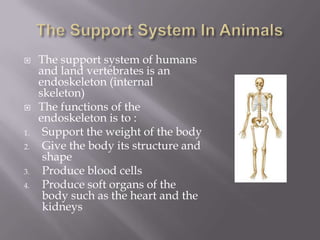
 The support system of humans
and land vertebrates is an
endoskeleton (internal
skeleton)
 The functions of the
endoskeleton is to :
1. Support the weight of the body
2. Give the body its structure and
shape
3. Produce blood cells
4. Produce soft organs of the
body such as the heart and the
kidneys
 Land vertebrates are also
supported by endoskeletons
 The land vertebrates ‘
endoskelton :
1. Give them shape
2. Support their weight
3. Protect their soft tissues and
organs of the body
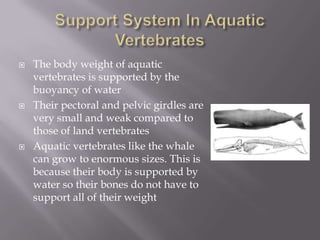
 The body weight of aquatic
vertebrates is supported by the
buoyancy of water
 Their pectoral and pelvic girdles are
very small and weak compared to
those of land vertebrates
 Aquatic vertebrates like the whale
can grow to enormous sizes. This is
because their body is supported by
water so their bones do not have to
support all of their weight
Support
System In Land
Invertebrates
Exoskeleton
(external
skeleton)
Hydrostatic
skeleton (fluid-
filled skeleton)
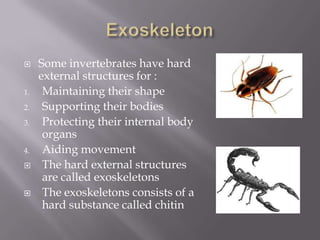
 Some invertebrates have hard
external structures for :
1. Maintaining their shape
2. Supporting their bodies
3. Protecting their internal body
organs
4. Aiding movement
 The hard external structures
are called exoskeletons
 The exoskeletons consists of a
hard substance called chitin
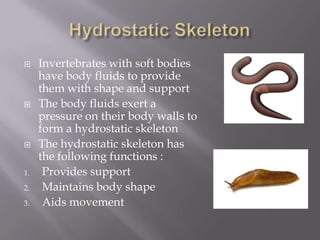
 Invertebrates with soft bodies
have body fluids to provide
them with shape and support
 The body fluids exert a
pressure on their body walls to
form a hydrostatic skeleton
 The hydrostatic skeleton has
the following functions :
1. Provides support
2. Maintains body shape
3. Aids movement
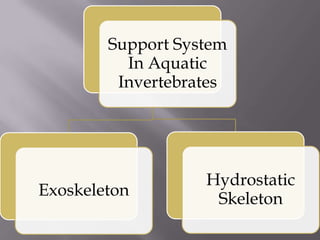
Support System
In Aquatic
Invertebrates
Exoskeleton
Hydrostatic
Skeleton
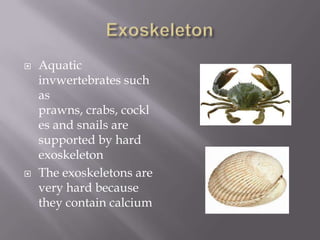
 Aquatic
invwertebrates such
as
prawns, crabs, cockl
es and snails are
supported by hard
exoskeleton
 The exoskeletons are
very hard because
they contain calcium
 Aquatic invertebrates
such as the starfish
and the jellyfish are
supported by a
hydrostatic skeleton
 The fluid pressure in
their bodies gives
them support and
shape
Support
System in
Plants
Support
System in
Land Plants
Support
System in
Aquatic Plants
 There are 2 types of support system of land
plants, which are :
1. Woody plants
2. Non-woody plants (herbaceous plants)
 Woody plants are supported by woody tissue.
Woody tissue is hard and provides the shape
and strength of the stem to hold itself erect
 Woody plants are also supported by special
structures such as thorns, buttress roots or
clasping roots
WOODY TISSUE THORNS
 Woody tissues enables
the plants to grow tall
and erect in order to
obtain sunlight
 Plants such as the
rattan, rose and
bougainvillea have thorns
to help them climb and
obtain support by clinging
onto other plants
BUTTRESS ROOTS CLASPING ROOTS
 Plants such as the
casuarina tree have
buttress roots to give
them additional support
 Plants such as the
money plant have
clasping roots to help
them climb on other
plants for support and
to obtain sunlight
Support System
In Herbaceous
Plants
Turgor
Pressure
Special
Structures
 Herbaceous plants such
as balsam, mustard and
water convolvulus are
supported by turgor
pressure
 The water in the cells
presses against the cell
walls and keeps the stem
hard and erect
 Herbaceous plants will
wilt if there is
insufficient water
PROP (ADVENTITIOUS)
ROOTS TENDRILS
 Plants such as corn and
sugar cane have prop
(adventitious) roots to
provide additional
support for plants
 Plants such as bitter gourd
and cucumber plants have
tendrils that twine around
the stems of other plants
in order to climb and
grow upwards
 Water provides support to
the aquatic plants such as
water lily, hydrilla, water
hyacinth and duckweed
 Aquatic plants have lots of
air sacs in their stems and
leaves that make them
light and buoyant (able to
float) or suspend in the
water
Sc..support system

Sc..support system

  • 2.
     The supportsystem of humans and land vertebrates is an endoskeleton (internal skeleton)  The functions of the endoskeleton is to : 1. Support the weight of the body 2. Give the body its structure and shape 3. Produce blood cells 4. Produce soft organs of the body such as the heart and the kidneys
  • 3.
     Land vertebratesare also supported by endoskeletons  The land vertebrates ‘ endoskelton : 1. Give them shape 2. Support their weight 3. Protect their soft tissues and organs of the body
  • 4.
     The bodyweight of aquatic vertebrates is supported by the buoyancy of water  Their pectoral and pelvic girdles are very small and weak compared to those of land vertebrates  Aquatic vertebrates like the whale can grow to enormous sizes. This is because their body is supported by water so their bones do not have to support all of their weight
  • 5.
  • 6.
     Some invertebrateshave hard external structures for : 1. Maintaining their shape 2. Supporting their bodies 3. Protecting their internal body organs 4. Aiding movement  The hard external structures are called exoskeletons  The exoskeletons consists of a hard substance called chitin
  • 7.
     Invertebrates withsoft bodies have body fluids to provide them with shape and support  The body fluids exert a pressure on their body walls to form a hydrostatic skeleton  The hydrostatic skeleton has the following functions : 1. Provides support 2. Maintains body shape 3. Aids movement
  • 8.
  • 9.
     Aquatic invwertebrates such as prawns,crabs, cockl es and snails are supported by hard exoskeleton  The exoskeletons are very hard because they contain calcium
  • 10.
     Aquatic invertebrates suchas the starfish and the jellyfish are supported by a hydrostatic skeleton  The fluid pressure in their bodies gives them support and shape
  • 11.
    Support System in Plants Support System in LandPlants Support System in Aquatic Plants
  • 12.
     There are2 types of support system of land plants, which are : 1. Woody plants 2. Non-woody plants (herbaceous plants)  Woody plants are supported by woody tissue. Woody tissue is hard and provides the shape and strength of the stem to hold itself erect  Woody plants are also supported by special structures such as thorns, buttress roots or clasping roots
  • 13.
    WOODY TISSUE THORNS Woody tissues enables the plants to grow tall and erect in order to obtain sunlight  Plants such as the rattan, rose and bougainvillea have thorns to help them climb and obtain support by clinging onto other plants
  • 14.
    BUTTRESS ROOTS CLASPINGROOTS  Plants such as the casuarina tree have buttress roots to give them additional support  Plants such as the money plant have clasping roots to help them climb on other plants for support and to obtain sunlight
  • 15.
  • 16.
     Herbaceous plantssuch as balsam, mustard and water convolvulus are supported by turgor pressure  The water in the cells presses against the cell walls and keeps the stem hard and erect  Herbaceous plants will wilt if there is insufficient water
  • 17.
    PROP (ADVENTITIOUS) ROOTS TENDRILS Plants such as corn and sugar cane have prop (adventitious) roots to provide additional support for plants  Plants such as bitter gourd and cucumber plants have tendrils that twine around the stems of other plants in order to climb and grow upwards
  • 18.
     Water providessupport to the aquatic plants such as water lily, hydrilla, water hyacinth and duckweed  Aquatic plants have lots of air sacs in their stems and leaves that make them light and buoyant (able to float) or suspend in the water