SCSCB/WHMSI
Caribbean
Waterbird
Census
Project
 Page
1


ORGANIZATION OF AMERICAN STATES/ WESTERN HEMISPHERE
MIGRATORY SPECIES INITIATIVE PROJECT
Increasing Capacity for Caribbean Wetlands Conservation: A
Training Workshop for Monitoring, Education and Conservation
FINAL REPORT ON
SCSCB Caribbean Waterbird Census
(CWC) Training Workshop
22 - 25 February 2010
Negril, Jamaica
Date:
17
March
2010

Prepared
by:
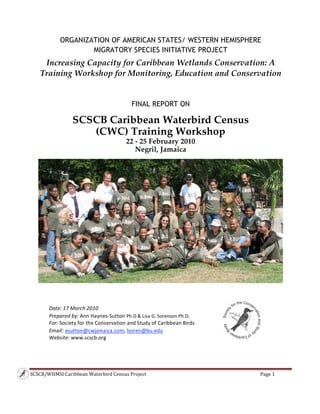
Ann
Haynes‐Sutton
Ph.D
&
Lisa
G.
Sorenson
Ph.D.

For:
Society
for
the
Conservation
and
Study
of
Caribbean
Birds

Email:
asutton@cwjamaica.com,
lsoren@bu.edu

Website:
www.scscb.org

SCSCB/WHMSI
Caribbean
Waterbird
Census
Project
 Page
2


TABLE
OF
CONTENTS

Background ..........................................................................................................................................3
Project
goal
and
objectives ..................................................................................................................3
Outputs
and
indicators
of
success
for
CWC
project..............................................................................3
CWC
Workshop ....................................................................................................................................4
Objectives.........................................................................................................................................................................................................4
Project
core
team .........................................................................................................................................................................................4
Project
partners,
funding
and
support...............................................................................................................................................5
Capacity
Building
Strategy......................................................................................................................................................................6
Workshop
format
and
agenda ...............................................................................................................................................................6
Training
materials.......................................................................................................................................................................................7
Online
learning
products
and
services ...............................................................................................................................................8
Participants.....................................................................................................................................................................................................8
Assessment
of
the
workshop
by
participants ..................................................................................................................................9
Lessons
learned ..........................................................................................................................................................................................10
Funding
for
next
steps.............................................................................................................................................................................11
Deliverables
developed
under
project .............................................................................................................................................11
Next
steps......................................................................................................................................................................................................12
Conclusion.....................................................................................................................................................................................................12
Appendix
1:
Agenda
for
workshop
(22‐25
February
2010)...................................................................................................13
Appendix
2:
International
presenters
and
facilitators..............................................................................................................17
Appendix
3:
Workshop
evaluation
report.......................................................................................................................................19
Appendix
4:
CWC
small
grant
proposal
guidelines.....................................................................................................................35
Appendix
5:
List
of
workshop
materials
provided
to
each
participant............................................................................42
Appendix
6:
Workshop
evaluation
form...........................................................................................................................................43
Appendix
7:
Label
for
folder
cover
for
workshop
materials..................................................................................................46
Appendix
8:
Certificate
of
participation............................................................................................................................................47
Appendix
9:
CWC
workshop
summary
report
and
photos .....................................................................................................48


SCSCB/WHMSI
Caribbean
Waterbird
Census
Project
 Page
3


BACKGROUND

The
project
“Increasing
capacity
for
Caribbean
wetlands
conservation:
A
training
workshop
for

monitoring,
education
and
conservation”
was
funded
by
OAS/WHMSI
and
implemented
between

November
2009
and
March
2010
by
the
Society
for
the
Conservation
of
Caribbean
Birds
(SCSCB).

PROJECT
GOAL
AND
OBJECTIVES

Goal:
To
strengthen
conservation
for
migratory
species
in
the
Caribbean
through
the
development
of
a

cadre
of
persons
trained
in
the
development,
promotion
and
implementation
of
a
region‐wide

waterbird
and
habitat
monitoring
program.

Objectives:

• To
increase
capacity
for
implementation
of
the
Caribbean
Waterbird
Census
(CWC)
that
was

conceived
at
the
WHMSI
Training
Workshop
in
Nassau,
Bahamas
in
2009
(Haynes‐Sutton
and

Sorenson
2009)
and
related
monitoring,
education
and
management
activities,
based
on
an

agreed
capacity‐building
strategy.


• Host
a
regional
workshop
to
train
Caribbean
trainers
in
the
application
of
the
CWC

methodology,
and
to
educate
them
in
the
use
of
SCSCB’s
education
and
outreach
materials.


• Design
materials
to
support
the
implementation
of
the
CWC.

• Promote
the
implementation
of
the
SPAW
Protocol
and
the
Ramsar
Convention.

OUTPUTS
AND
INDICATORS
OF
SUCCESS
FOR
CWC
PROJECT

Project
outputs
and
indicators
of
success
are
listed
in
Table
1
below.

Table
1:
Summary
of
project
outputs
and
indicators
of
success

ACTIVITY
HEADING 
OUTPUTS INDICATORS
OF
SUCCESS
Adaptation
of
existing
Capacity

Building
Strategy
for
wetlands

monitoring
and
management
Wetlands
Capacity
Building

Strategy
‐
Capacity
Building
Strategy
developed
Development
of
materials ‐
Caribbean
Waterbird

Census
manual
&
protocols

‐
Presentations
and
other

supporting
materials
‐
Manual
and
protocols
produced

‐
21
PowerPoint
presentations/modules

developed
for
workshop

‐
Supporting
materials
for
SPAW
and
Ramsar

disseminated
(including
CDs,
brochures,

stickers,
and
presentations)
Dissemination
of
materials

online
Resources
on

ConserveOnline
‐
CWC
Manual,
presentations
and
supporting

materials
posted

Workshop
 Workshop
held
22‐25
 ‐
Total
no.
of
participants
=
22
(initial
target
was

SCSCB/WHMSI
Caribbean
Waterbird
Census
Project
 Page
4


ACTIVITY
HEADING 
OUTPUTS INDICATORS
OF
SUCCESS
February
2010
in
Negril,

Jamaica
10)
from
16
Caribbean
countries/islands

‐
Special
interest
groups
represented
at

workshop
including
decision‐makers,
protected

area
managers,
scientists,
educators,
volunteers

all
of
which
are
potential
national
coordinators,

site
coordinators
and
site
monitors

‐
A
variety
of
modules
were
prepared:
21

presentations/sessions
were
included
in
the

workshop

‐
Evaluation
report
showed
very
high
levels
of

satisfaction
with
the
workshop

‐
Workshop
report
produced
Project
development
for

funding
Develop
project
for
funding,

i.e.
USFWS
Neotropical

Migratory
Bird
Conservation

Act
(NMBCA)
Fund
Project
proposal
submitted
to
NMBCA

November
2009
and
short‐listed
for
funding
CWC
WORKSHOP


OBJECTIVES

The
objectives
of
the
CWC
workshop
were
to:

1)
Provide
persons
from
across
the
Caribbean
with
equipment,
materials,
training
and
skills
in

waterbird
and
wetland
monitoring
protocols,
so
that
they
can:

• Design
and
implement
a
long‐term
waterbird
monitoring
program
in
their
own
country
(or

improve/expand
programs
that
are
in
place)

• Participate
in
the
Caribbean
Waterbird
Census

• Train
and
mentor
others

• Form
the
basis
of
a
regional
monitoring
network.

2)
Promote
the
implementation
of
the
Ramsar
Convention
and
the
SPAW
Protocol.


PROJECT
CORE
TEAM

The
core
team
included
Lisa
Sorenson
(SCSCB),
Ann
Sutton
(SCSCB),
Jeff
Gerbracht
(Cornell

Laboratory
of
Ornithology),
Ken
Kriese
(USFWS),
and
Frank
Rivera‐Milan
(USFWS)
–
see
Appendix
2.


SCSCB/WHMSI
Caribbean
Waterbird
Census
Project
 Page
5


PROJECT
PARTNERS,
FUNDING
AND
SUPPORT

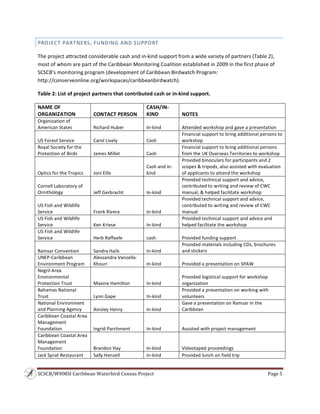
The
project
attracted
considerable
cash
and
in‐kind
support
from
a
wide
variety
of
partners
(Table
2),

most
of
whom
are
part
of
the
Caribbean
Monitoring
Coalition
established
in
2009
in
the
first
phase
of

SCSCB’s
monitoring
program
(development
of
Caribbean
Birdwatch
Program:

http://conserveonline.org/workspaces/caribbeanbirdwatch).


Table
2:
List
of
project
partners
that
contributed
cash
or
in‐kind
support.

NAME
OF

ORGANIZATION CONTACT
PERSON
CASH/IN‐
KIND NOTES
Organization
of

American
States Richard
Huber In‐kind Attended
workshop
and
gave
a
presentation
US
Forest
Service Carol
Lively Cash
Financial
support
to
bring
additional
persons
to

workshop
Royal
Society
for
the

Protection
of
Birds James
Millet Cash
Financial
support
to
bring
additional
persons

from
the
UK
Overseas
Territories
to
workshop
Optics
for
the
Tropics Joni
Ellis
Cash
and
in‐
kind
Provided
binoculars
for
participants
and
2

scopes
&
tripods,
also
assisted
with
evaluation

of
applicants
to
attend
the
workshop
Cornell
Laboratory
of

Ornithology Jeff
Gerbracht In‐kind
Provided
technical
support
and
advice,

contributed
to
writing
and
review
of
CWC

manual,
&
helped
facilitate
workshop
US
Fish
and
Wildlife

Service Frank
Rivera In‐kind
Provided
technical
support
and
advice,

contributed
to
writing
and
review
of
CWC

manual
US
Fish
and
Wildlife

Service Ken
Kriese In‐kind
Provided
technical
support
and
advice
and

helped
facilitate
the
workshop
US
Fish
and
Wildlife

Service
 Herb
Raffaele
 cash
 Provided
funding
support

Ramsar
Convention Sandra
Hails In‐kind
Provided
materials
including
CDs,
brochures

and
stickers
UNEP‐Caribbean

Environment
Program
Alessandra
Vanzella‐
Khouri In‐kind Provided
a
presentation
on
SPAW
Negril
Area

Environmental

Protection
Trust Maxine
Hamilton In‐kind
Provided
logistical
support
for
workshop

organization
Bahamas
National

Trust Lynn
Gape In‐kind
Provided
a
presentation
on
working
with

volunteers
National
Environment

and
Planning
Agency Ainsley
Henry In‐kind
Gave
a
presentation
on
Ramsar
in
the

Caribbean
Caribbean
Coastal
Area

Management

Foundation Ingrid
Parchment In‐kind Assisted
with
project
management
Caribbean
Coastal
Area

Management

Foundation Brandon
Hay In‐kind Videotaped
proceedings
Jack
Sprat
Restaurant Sally
Henzell In‐kind Provided
lunch
on
field
trip
SCSCB/WHMSI
Caribbean
Waterbird
Census
Project
 Page
6


Irie
Safari
Boat
Tours Lloyd
Linton In‐kind
Provided
boat
trip
on
Black
River
as
part
of

field
trip
Waterbird
Council
of

the
Americas
Jennifer
Wheeler,
Jim

Kushlan,
Kathy

Parsons,
Franci

Cuthbert
 In‐kind Provided
technical
advice
Wetlands
International
Taej
Mundkur,
Daniel

Blanco,
Arne

Lesterhuis In‐kind Provided
technical
advice
WildlifeCounts.com Aaron
Suring Cash Provided
discount
on
Wildlife
COUNT
program
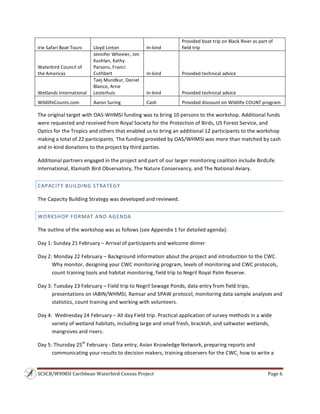
The
original
target
with
OAS‐WHMSI
funding
was
to
bring
10
persons
to
the
workshop.
Additional
funds

were
requested
and
received
from
Royal
Society
for
the
Protection
of
Birds,
US
Forest
Service,
and

Optics
for
the
Tropics
and
others
that
enabled
us
to
bring
an
additional
12
participants
to
the
workshop

making
a
total
of
22
participants.
The
funding
provided
by
OAS/WHMSI
was
more
than
matched
by
cash

and
in‐kind
donations
to
the
project
by
third
parties.

Additional
partners
engaged
in
the
project
and
part
of
our
larger
monitoring
coalition
include
BirdLife

International,
Klamath
Bird
Observatory,
The
Nature
Conservancy,
and
The
National
Aviary.


CAPACITY
BUILDING
STRATEGY


The
Capacity
Building
Strategy
was
developed
and
reviewed.

WORKSHOP
FORMAT
AND
AGENDA

The
outline
of
the
workshop
was
as
follows
(see
Appendix
1
for
detailed
agenda):

Day
1:
Sunday
21
February
–
Arrival
of
participants
and
welcome
dinner

Day
2:
Monday
22
February
–
Background
information
about
the
project
and
introduction
to
the
CWC.

Why
monitor,
designing
your
CWC
monitoring
program,
levels
of
monitoring
and
CWC
protocols,

count
training
tools
and
habitat
monitoring,
field
trip
to
Negril
Royal
Palm
Reserve.

Day
3:
Tuesday
23
February
–
Field
trip
to
Negril
Sewage
Ponds,
data
entry
from
field
trips,

presentations
on
IABIN/WHMSI,
Ramsar
and
SPAW
protocol,
monitoring
data
sample
analyses
and

statistics,
count
training
and
working
with
volunteers.

Day
4:

Wednesday
24
February
–
All
day
Field
trip.
Practical
application
of
survey
methods
in
a
wide

variety
of
wetland
habitats,
including
large
and
small
fresh,
brackish,
and
saltwater
wetlands,

mangroves
and
rivers.

Day
5:
Thursday
25th

February
‐
Data
entry,
Avian
Knowledge
Network,
preparing
reports
and

communicating
your
results
to
decision
makers,
training
observers
for
the
CWC,
how
to
write
a

SCSCB/WHMSI
Caribbean
Waterbird
Census
Project
 Page
7


grant
proposal,
and
project
proposal
writing
for
Small
Grants
for
the
CWC.
Farewell
dinner
and

presentation
of
awards
and
certificates.

TRAINING
MATERIALS

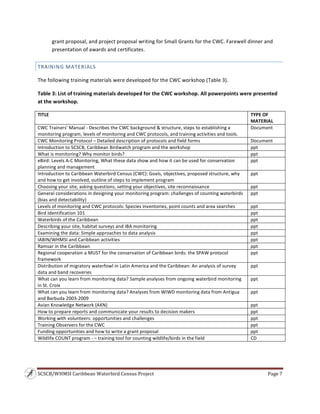
The
following
training
materials
were
developed
for
the
CWC
workshop
(Table
3).

Table
3:
List
of
training
materials
developed
for
the
CWC
workshop.
All
powerpoints
were
presented

at
the
workshop.

TITLE TYPE
OF

MATERIAL
CWC
Trainers’
Manual
‐
Describes
the
CWC
background
&
structure,
steps
to
establishing
a

monitoring
program,
levels
of
monitoring
and
CWC
protocols,
and
training
activities
and
tools.
Document
CWC
Monitoring
Protocol
–
Detailed
description
of
protocols
and
field
forms Document
Introduction
to
SCSCB,
Caribbean
Birdwatch
program
and
the
workshop ppt
What
is
monitoring?
Why
monitor
birds? ppt
eBird:
Levels
A‐C
Monitoring,
What
these
data
show
and
how
it
can
be
used
for
conservation

planning
and
management
ppt
Introduction
to
Caribbean
Waterbird
Census
(CWC):
Goals,
objectives,
proposed
structure,
why

and
how
to
get
involved,
outline
of
steps
to
implement
program
ppt
Choosing
your
site,
asking
questions,
setting
your
objectives,
site
reconnaissance ppt

General
considerations
in
designing
your
monitoring
program:
challenges
of
counting
waterbirds

(bias
and
detectability)
ppt
Levels
of
monitoring
and
CWC
protocols:
Species
inventories,
point
counts
and
area
searches ppt
Bird
Identification
101
 ppt

Waterbirds
of
the
Caribbean
 ppt

Describing
your
site,
habitat
surveys
and
IBA
monitoring
 ppt

Examining
the
data:
Simple
approaches
to
data
analysis
 ppt

IABIN/WHMSI
and
Caribbean
activities
 ppt

Ramsar
in
the
Caribbean
 ppt

Regional
cooperation
a
MUST
for
the
conservation
of
Caribbean
birds:
the
SPAW
protocol

framework

ppt

Distribution
of
migratory
waterfowl
in
Latin
America
and
the
Caribbean:
An
analysis
of
survey

data
and
band
recoveries

ppt

What
can
you
learn
from
monitoring
data?
Sample
analyses
from
ongoing
waterbird
monitoring

in
St.
Croix
ppt

What
can
you
learn
from
monitoring
data?
Analyses
from
WIWD
monitoring
data
from
Antigua

and
Barbuda
2003‐2009
ppt

Avian
Knowledge
Network
(AKN) ppt

How
to
prepare
reports
and
communicate
your
results
to
decision
makers ppt

Working
with
volunteers:
opportunities
and
challenges
 ppt

Training
Observers
for
the
CWC
 ppt

Funding
opportunities
and
how
to
write
a
grant
proposal ppt

Wildlife
COUNT
program
‐
–
training
tool
for
counting
wildlife/birds
in
the
field CD

SCSCB/WHMSI
Caribbean
Waterbird
Census
Project
 Page
8


ONLINE
LEARNING
PRODUCTS
AND
SERVICES

A
new
public
ConserveOnline
site
–
Caribbean
Waterbird
Census
was
established
and
revised
final

versions
of
all
materials
are
being
added
to
the
site.
A
Yahoo
e‐group
Carib‐Waterbird‐Census‐Network

(http://pets.groups.yahoo.com/group/Carib‐Waterbird‐Census‐Network/)
was
also
established
as
a

place
to
share
follow‐up
information
and
news
about
the
CWC.
Some
of
the
presentations
were

recorded
on
video
and
it
is
our
intention
to
make
these
available
electronically
as
soon
as
possible
either

on
the
website
for
download
or
on
CD,
depending
on
the
size
of
the
final
products.

PARTICIPANTS

Notices
about
the
workshop
were
posted
on‐line
on
SCSCB’s
Yahoo
e‐group
(BirdsCaribbean),
website

(www.scscb.org),
and
several
other
e‐groups.
As
a
result,
38
applications
were
received
from
21

countries/islands.
Criteria
for
evaluating
applications
were
developed
and
a
volunteer
assisted
with
the

review
process.
Based
on
this
process
23
persons
were
invited
to
attend;
22
persons
from
16

countries/islands
across
the
Caribbean
accepted
the
invitation
and
were
able
to
attend
the
workshop.

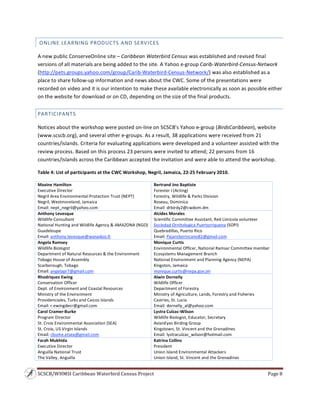
Table
4:
List
of
participants
at
the
CWC
Workshop,
Negril,
Jamaica,
22‐25
February
2010.

Maxine
Hamilton

Executive
Director

Negril
Area
Environmental
Protection
Trust
(NEPT)

Negril,
Westmoreland,
Jamaica

Email:
nept_negril@yahoo.com
Bertrand
Jno
Baptiste

Forester
I
(Acting)

Forestry,
Wildlife
&
Parks
Division

Roseau,
Dominica

Email:
drbirdy2@cwdom.dm
Anthony
Levesque

Wildlife
Consultant

National
Hunting
and
Wildlife
Agency
&
AMAZONA
(NGO)

Guadeloupe

Email:
anthony.levesque@wanadoo.fr

Alcides
Morales

Scientific
Committee
Assistant,
Red
Limicola
volunteer

Sociedad
Ornitologica
Puertorriquena
(SOPI)

Quebradillas,
Puerto
Rico

Email:
Pajaroborincano82@gmail.com
Angela
Ramsey

Wildlife
Biologist

Department
of
Natural
Resources
&
the
Environment

Tobago
House
of
Assembly

Scarborough,
Tobago

Email:
angelapr7@gmail.com
Monique
Curtis

Environmental
Officer,
National
Ramsar
Committee
member

Ecosystems
Management
Branch

National
Environment
and
Planning
Agency
(NEPA)

Kingston,
Jamaica

monique.curtis@nepa.gov.jm
Rhodriquez
Ewing

Conservation
Officer

Dept.
of
Environment
and
Coastal
Resources

Ministry
of
the
Environment

Providenciales,
Turks
and
Caicos
Islands

Email:
r.ewingdecr@gmail.com
Alwin
Dornelly

Wildlife
Officer

Department
of
Forestry

Ministry
of
Agriculture,
Lands,
Forestry
and
Fisheries

Castries,
St.
Lucia

Email:
dornelly_al@yahoo.com
Carol
Cramer‐Burke

Program
Director

St.
Croix
Environmental
Association
(SEA)

St.
Croix,
US
Virgin
Islands

Email:
cburke.atsea@gmail.com
Lystra
Culzac‐Wilson

Wildlife
Biologist,
Educator,
Secretary

AvianEyes
Birding
Group

Kingstown,
St.
Vincent
and
the
Grenadines

Email:
lystraculzac_wilson@hotmail.com
Farah
Mukhida

Executive
Director

Anguilla
National
Trust

The
Valley,
Anguilla

Katrina
Collins

President

Union
Island
Environmental
Attackers

Union
Island,
St.
Vincent
and
the
Grenadines

SCSCB/WHMSI
Caribbean
Waterbird
Census
Project
 Page
9


Email:
antpam@anguillanet.com Email:
environmentalattackers@yahoo.com

Predensa
Moore

IBA
Monitoring
and
Surveying
Coordinator

Bahamas
National
Trust
(BNT)

Nassau,
Bahamas

Email:
pmoore@bnt.bs
Susan
Zaluski

Director

Jost
Van
Dykes
Preservation
Society

Great
Harbour,
Jost
Van
Dyke,
British
Virgin
Islands

Email:
susan@jvdps.org
Andrea
Otto

Volunteer,
schoolteacher

Environmental
Awareness
Group
(EAG)

St.
Johns,
Antigua

Email:
andreasheres@gmail.com

Kate
Wallace

Board
member,
Educator,
Bird
Tour
Guide

Sociedad
Ornitológica
de
la
Hisaniola
(SOH)

Santo
Domingo,
Dominican
Republic

Email:
katetody@gmail.com
Jonathan
Sayao

Education
Officer

Turks
and
Caicos
National
Trust

Providenciales,
Turks
and
Caicos
Islands

Email:
jeksayao@yahoo.com
Andrea
Donaldson

Coordinator

National
Environment
and
Planning
Agency
(NEPA)

Kingston,
Jamaica

Email:
Adonaldson@nepa.gov.jm
Melissa
Dentch

Peace
Corps
Volunteer

Negril
Area
Environmental
Protection
Trust
(NEPT)

Negril,
Westmoreland,
Jamaica

Email:
mdentch@gmail.com

Lisa
Yntema

Volunteer
Wetland
Monitor

St.
Croix,
US
Virgin
Islands

Email:
ldyntema@gmail.com
Antonio
Rodríguez
Suárez
1


Assistant
Professor,
Ecology
Bird
Group

Faculty
of
Biology

University
of
Havana,
Cuba

Email:
arguez@fbio.uh.cu
Brandon
Hay

Consultant

C‐CAM
(Caribbean
Coastal
Area
Management)
Foundation

Kingston,
Jamaica

Email:
brandonhay@cwjamaica.com
ASSESSMENT
OF
THE
WORKSHOP
BY
PARTICIPANTS

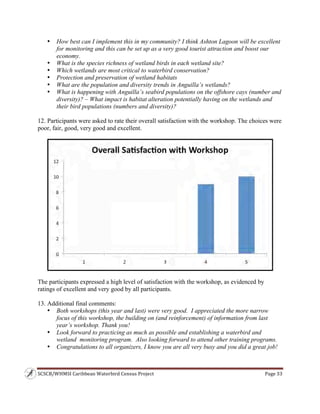
The
participants
expressed
a
high
level
of
satisfaction
with
the
workshop
(see
Workshop
Evaluation
Report,

Appendix
2).
Comments
included
.
.
.

• Thank
you
for
the
opportunity
given
to
us
to
participate
in
the
workshop.
The
workshop
was
very

informative
and
practical
in
terms
of
material
presented
and
the
field
exercises.
We
have
certainly

benefited
from
the
workshop
and
will
transfer
this
to
others
in
the
Agency.

• Look
forward
to
practicing
as
much
as
possible
and
establishing
a
waterbird
and
wetland
monitoring

program.
Also
looking
forward
to
attend
other
training
programs.

• Enjoyed
and
appreciated
the
availability
of
presenters
to
further
discuss
and
clarify
some
issues.

• Both
workshops
(this
year
and
last)
were
very
good.
I
appreciated
the
more
narrow
focus
of
this
workshop,

the
building
on
(and
reinforcement)
of
information
from
last
year’s
workshop.
Thank
you!

• I
appreciated
the
facilitators’
generosity
with
their
time,
helpfulness
and
willingness
to
answer
all

questions
(with
a
sense
of
humor
too).


1

Funded
by
a
private
donor.

SCSCB/WHMSI
Caribbean
Waterbird
Census
Project
 Page
10


• SCSCB
workshops
continue
not
to
fail
to
meet
my
expectations
and
that’s
a
great
thing.

• Working
alone,
it
can
be
really
frustrating
to
not
have
others
with
experience
to
bounce
ideas
off
of.

It
is

so
useful/
worthwhile
to
have
the
opportunity
in
workshops
like
this
to
network
with
both
peers
in
the

Caribbean
and
other
specialists/experts.


• I
will
initiate
a
waterbird
monitoring
program
by
tapping
volunteers
and
community
involvement.
I
will

share
knowledge
and
skills
acquired
to
increase
public
awareness
and
heighten
the
community’s
interest

in
birds
and
wetlands
and
in
the
environment
in
general.

• The
workshop
was
one
of
the
best
I’ve
ever
attended.

• Presenters
were
outstanding
in
meeting
the
needs
of
a
very
diverse
audience!
Thank
you
so
much
for
this

opportunity!

LESSONS
LEARNED

One
of
the
most
important
things
we
learned
from
the
workshop,
associated
discussions,
review

exercises,
and
feedback
on
the
workshop
evaluations
was
that
there
is
a
huge
demand
for
the
type
of

basic
modular
approach
to
waterbird
and
wetland
monitoring
that
we
are
developing.
Not
only
the

participants
but
also
the
Waterbird
Council
expressed
interest
in
our
protocols.
The
latter
is
looking

forward
to
adapting
our
approach
for
use
in
Central
and
South
America.
Participants
uniformly

expressed
their
appreciation
for
and
value
of
the
training
they
received
in
increasing
their
capacity
to

manage
and
conserve
wetlands.
All
asked
for
follow‐up
workshops
to
further
develop
and
enhance
their

skills,
especially
in
the
areas
of
data
analysis
and
statistics,
writing
reports
and
technical
papers
for

publication,
preparing
funding
proposals,
and
communicating
results
to
decision
makers.

Developing
the
protocols
for
the
CWC
program
proved
to
be
extremely
challenging.
We
wanted
to
offer

protocols
that
could
be
implemented
by
volunteers
with
basic
knowledge
and
training,
but
at
the
same

time
were
rigorous
enough
to
be
useful
to
science
and
adaptive
management
of
waterbirds
and

wetlands.
We
consulted
with
monitoring
experts
as
well
as
those
that
were
well
familiar
with
the

realities
of
capacity
in
the
region
and
came
up
with
a
hierarchical
and
flexible
approach
to
monitoring

(employing
levels
of
monitoring)
that
enables
the
user
to
choose
the
protocol
and
extent
of

participation
in
the
program
that
is
best
suited
to
their
objectives,
available
resources
and
capacity.
The

basic
CWC
protocols
(Level
2
–
area
search
and
point
count)
include
measures
of
detection
probability,

which
are
essential
for
accounting
for
bias
in
monitoring.
Ample
time
was
needed
(much
more
than

expected)
to
consult
with
experts,
prepare
the
manual
and
protocols,
and
review
and
revise
materials.

Practical
lessons
learned
include:
a)
ship
materials
many
weeks
in
advance
of
the
workshop
in
order
to

compensate
for
the
vagaries
of
the
postal
service
system,
e.g.,
one
package
went
to
Poland
and
the
UK

before
being
delivered
weeks
later
in
Jamaica,
one
crucial
package
(binoculars
for
all
participants)
did

not
arrive
in
time;
thankfully,
other
binoculars
were
available
for
loan
to
participants
for
their
use
during

the
workshop.
b)
extend
the
workshop
by
one
day
to
allow
more
time
in
the
field
for
participants
to

practice
count
techniques,
bird
identification,
and
habitat
assessment.
It
would
probably
be
helpful
to

SCSCB/WHMSI
Caribbean
Waterbird
Census
Project
 Page
11


split
into
smaller
groups
based
on
levels
of
knowledge
and
field
experience
(e.g.,
beginner,
intermediate,

and
advanced),
allowing
facilitators
to
better
focus
on
needs
of
individuals
in
each
group.

FUNDING
FOR
NEXT
STEPS

A
proposal
Promoting
Wetland
Bird
Conservation
through
the
Caribbean
Waterbird
Census
was

submitted
to
the
Neotropical
Migratory
Bird
Conservation
Act
for
funding
in
November
2009.
The

proposal
includes
funding
to
award
10
or
more
Small
Grants
of
up
to
$5,000
each
for
CWC
monitoring

projects.
This
project
has
been
short‐listed;
we
expect
to
hear
whether
funding
has
been
received
in

April
2010,
with
funds
available
for
disbursement
for
Small
Grants
in
June
2010.
On
the
final
day
of
the

workshop
participants
were
invited
to
begin
to
develop
proposals
to
apply
for
this
funding.
Detailed

guidelines
have
been
developed
and
circulated
to
all
participants
(Appendix
3).

DELIVERABLES
DEVELOPED
UNDER
PROJECT

The
deliverables
developed
under
the
project
have
been/will
be
sent
separately
or
are
included
as
part

of
this
report.
They
include
the
following:

• List
of
project
partners
and
co‐financing
‐
cash
and
in‐kind
contributions
(Table
2)

• List
of
participants
(Table
4)

• Workshop
agenda
(Appendix
1)

• List
of
International
Presenters
and
Facilitators
(Appendix
2)

• Workshop
evaluation
report
(Appendix
3)

• List
of
materials
provided
in
workshop
packages
(Appendix
5)

• Workshop
evaluation
sheet
(Appendix
6)

• Workshop
summary
report
and
photos
(Appendix
9)

• Capacity
Building
Strategy
for
enhancing
Caribbean
capacity
for
wetlands
monitoring,

management
and
education

• Caribbean
Waterbirds
Census
Manual

• Project
proposal
for
Neotropical
Migratory
Bird
Conservation
Act
Fund

• Three
progress
reports

• Final
project/workshop
report

• Financial
report

SCSCB/WHMSI
Caribbean
Waterbird
Census
Project
 Page
12


NEXT
STEPS

The
next
steps
will
include:

• Implementing
the
CWC
with
our
first
group
of
trainees.
With
luck
this
will
start
with
pilot
funding
from
the

Neotropical
Migratory
Bird
Conservation
Act
which
will
lead
to
the
identification
of
additional
funds.

Assessment
of
the
effectiveness
of
the
pilot
projects
will
enable
us
further
to
refine
the
protocols
and

manual.

• Identification
of
further
needs
for
training
in
bird
monitoring
techniques
in
the
Caribbean
region.

• Providing
continued
skills‐building
training
workshops
and
support
for
our
partners
(follow‐up

workshops
on
data
analysis
and
statistics,
writing
reports
and
publishing
results,
community

outreach
and
education,
and
communicating
with
decision
makers).

• Working
with
the
Waterbird
Council
and
Wetlands
International
to
adapt
the
protocols
and
approach
for

use
in
Central
and
Southern
America.

CONCLUSION

The
workshop
was
well
attended,
well
supported
and
enthusiastically
received,
indicating
the
demand
for
such

training.
Its
contribution
to
conservation
will
be
measured
in
the
long
term
as
SCSCB
continues
to
develop
its

relationship
with
the
participants
and
others
that
join
the
program
and
as
we
work
with
our
partners
to
help
them

to
develop
and
sustain
their
waterbird
and
wetland
monitoring
programs.

SCSCB/WHMSI
Caribbean
Waterbird
Census
Project
 Page
13


APPENDIX
1:
AGENDA
FOR
WORKSHOP
(22‐25
FEBRUARY
2010)

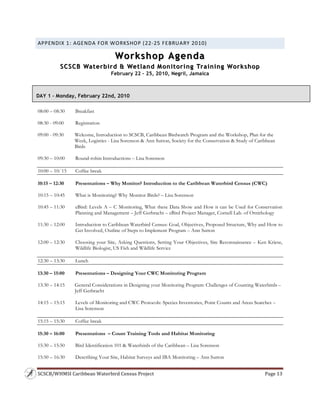
Workshop AgendaWorkshop Agenda
SCSCB Waterbird & Wetland Monitoring Training WorkshopSCSCB Waterbird & Wetland Monitoring Training Workshop
February 22 – 25, 2010, Negril, Jamaica


08:00 – 08:30 Breakfast
08:30 - 09:00 Registration
09:00 - 09:30 Welcome, Introduction to SCSCB, Caribbean Birdwatch Program and the Workshop, Plan for the
Week, Logistics - Lisa Sorenson & Ann Sutton, Society for the Conservation & Study of Caribbean
Birds
09:30 – 10:00 Round-robin Introductions – Lisa Sorenson
10:00 – 10:`15 Coffee break
10:15 – 12:30 Presentations – Why Monitor? Introduction to the Caribbean Waterbird Census (CWC)
10:15 – 10:45 What is Monitoring? Why Monitor Birds? – Lisa Sorenson
10:45 – 11:30 eBird: Levels A – C Monitoring, What these Data Show and How it can be Used for Conservation
Planning and Management – Jeff Gerbracht – eBird Project Manager, Cornell Lab. of Ornithology
11:30 – 12:00 Introduction to Caribbean Waterbird Census: Goal, Objectives, Proposed Structure, Why and How to
Get Involved, Outline of Steps to Implement Program – Ann Sutton
12:00 – 12:30 Choosing your Site, Asking Questions, Setting Your Objectives, Site Reconnaissance – Ken Kriese,
Wildlife Biologist, US Fish and Wildlife Service
12:30 – 13:30 Lunch
13:30 – 15:00 Presentations – Designing Your CWC Monitoring Program
13:30 – 14:15 General Considerations in Designing your Monitoring Program: Challenges of Counting Waterbirds –
Jeff Gerbracht
14:15 – 15:15 Levels of Monitoring and CWC Protocols: Species Inventories, Point Counts and Areas Searches –
Lisa Sorenson
15:15 – 15:30 Coffee break
15:30 – 16:00 Presentations – Count Training Tools and Habitat Monitoring
15:30 – 15:50 Bird Identification 101 & Waterbirds of the Caribbean – Lisa Sorenson
15:50 – 16:30 Describing Your Site, Habitat Surveys and IBA Monitoring – Ann Sutton
DAY 1 – Monday, February 22nd, 2010
SCSCB/WHMSI
Caribbean
Waterbird
Census
Project
 Page
14


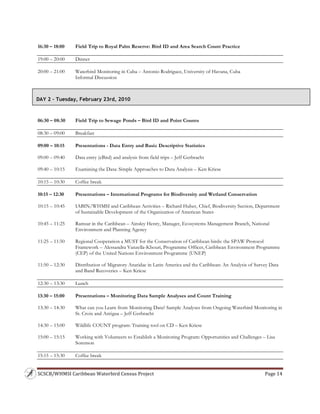
16:30 – 18:00 Field Trip to Royal Palm Reserve: Bird ID and Area Search Count Practice
19:00 – 20:00 Dinner
20:00 – 21:00 Waterbird Monitoring in Cuba – Antonio Rodriguez, University of Havana, Cuba
Informal Discussion
06:30 – 08:30 Field Trip to Sewage Ponds – Bird ID and Point Counts
08:30 – 09:00 Breakfast
09:00 – 10:15 Presentations - Data Entry and Basic Descriptive Statistics
09:00 – 09:40 Data entry (eBird) and analysis from field trips – Jeff Gerbracht
09:40 – 10:15 Examining the Data: Simple Approaches to Data Analysis – Ken Kriese
10:15 – 10:30 Coffee break
10:15 – 12:30 Presentations – International Programs for Biodiversity and Wetland Conservation
10:15 – 10:45 IABIN/WHMSI and Caribbean Activities – Richard Huber, Chief, Biodiversity Section, Department
of Sustainable Development of the Organization of American States
10:45 – 11:25 Ramsar in the Caribbean – Ainsley Henry, Manager, Ecosystems Management Branch, National
Environment and Planning Agency
11:25 – 11:50 Regional Cooperation a MUST for the Conservation of Caribbean birds: the SPAW Protocol
Framework – Alessandra Vanzella-Khouri, Programme Officer, Caribbean Environment Programme
(CEP) of the United Nations Environment Programme (UNEP)
11:50 – 12:30 Distribution of Migratory Anatidae in Latin America and the Caribbean: An Analysis of Survey Data
and Band Recoveries – Ken Kriese
12:30 – 13:30 Lunch
13:30 – 15:00 Presentations – Monitoring Data Sample Analyses and Count Training
13:30 – 14:30 What can you Learn from Monitoring Data? Sample Analyses from Ongoing Waterbird Monitoring in
St. Croix and Antigua – Jeff Gerbracht
14:30 – 15:00 Wildlife COUNT program: Training tool on CD – Ken Kriese
15:00 – 15:15 Working with Volunteers to Establish a Monitoring Program: Opportunities and Challenges – Lisa
Sorenson
15:15 – 15:30 Coffee break
DAY 2 – Tuesday, February 23rd, 2010
SCSCB/WHMSI
Caribbean
Waterbird
Census
Project
 Page
15


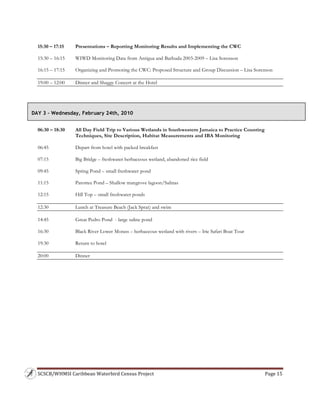
15:30 – 17:15 Presentations – Reporting Monitoring Results and Implementing the CWC
15:30 – 16:15 WIWD Monitoring Data from Antigua and Barbuda 2003-2009 – Lisa Sorenson
16:15 – 17:15 Organizing and Promoting the CWC: Proposed Structure and Group Discussion – Lisa Sorenson
19:00 – 12:00 Dinner and Shaggy Concert at the Hotel
06:30 – 18:30 All Day Field Trip to Various Wetlands in Southwestern Jamaica to Practice Counting
Techniques, Site Description, Habitat Measurements and IBA Monitoring
06:45 Depart from hotel with packed breakfast
07:15 Big Bridge – freshwater herbaceous wetland, abandoned rice field
09:45 Spring Pond – small freshwater pond
11:15 Parottee Pond – Shallow mangrove lagoon/Salinas
12:15 Hill Top – small freshwater ponds
12:30 Lunch at Treasure Beach (Jack Sprat) and swim
14:45 Great Pedro Pond - large saline pond
16:30 Black River Lower Morass – herbaceous wetland with rivers – Irie Safari Boat Tour
19:30 Return to hotel
20:00 Dinner
DAY 3 – Wednesday, February 24th, 2010
SCSCB/WHMSI
Caribbean
Waterbird
Census
Project
 Page
16


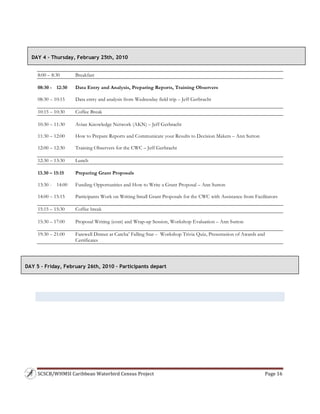
8:00 – 8:30 Breakfast
08:30 - 12:30 Data Entry and Analysis, Preparing Reports, Training Observers
08:30 – 10:15 Data entry and analysis from Wednesday field trip – Jeff Gerbracht
10:15 – 10:30 Coffee Break
10:30 – 11:30 Avian Knowledge Network (AKN) – Jeff Gerbracht
11:30 – 12:00 How to Prepare Reports and Communicate your Results to Decision Makers – Ann Sutton
12:00 – 12:30 Training Observers for the CWC – Jeff Gerbracht
12:30 – 13:30 Lunch
13.30 – 15:15 Preparing Grant Proposals
13:30 - 14:00 Funding Opportunities and How to Write a Grant Proposal – Ann Sutton
14:00 – 15:15 Participants Work on Writing Small Grant Proposals for the CWC with Assistance from Facilitators
15:15 – 15:30 Coffee break
15:30 – 17:00 Proposal Writing (cont) and Wrap-up Session, Workshop Evaluation – Ann Sutton
19:30 – 21:00 Farewell Dinner at Catcha’ Falling Star – Workshop Trivia Quiz, Presentation of Awards and
Certificates
DAY 4 – Thursday, February 25th, 2010
DAY 5 – Friday, February 26th, 2010 – Participants depart
SCSCB/WHMSI
Caribbean
Waterbird
Census
Project
 Page
17


APPENDIX
2:
INTERNATIONAL
PRESENTERS
AND
FACILITATORS

INTERNATIONAL PRESENTERS AND FACILITATORS
Jeff Gerbracht, eBird Project Manager, Cornell Laboratory of Ornithology. Jeff’s professional career has
focused on project management and computer programming. His lifelong interest in ornithology and
conservation led him to leave American Airlines and join the Cornell Lab of Ornithology as an application
developer in 2001. Jeff has developed several interactive GIS, data entry and analysis applications for the Lab,
including eBird, the Land Bird Monitoring Program and a Breeding Bird Atlas application. Jeff currently
manages the continued development of eBird and Trail Tracker and is developing Neotropical Birds, a
project creating online species accounts for all Neotropical bird species not presently covered by the Birds of
North America. (Email: jag73@cornell.edu, URL: www.ebird.org, www.neotropical.birds.cornell.edu)
Ann Haynes-Sutton, Ph.D., is a Conservation Ecologist who has lived and worked in central Jamaica for 30
years. Her main focal areas are wetlands, birds, conservation education, and management of protected areas.
For her Ph.D. she studied and applied conservation of Jamaican seabirds on offshore cays. A member of the
executive of the Society for Conservation and Study of Caribbean Birds for many years, she is Co-chair
of the Monitoring and Seabirds Working Groups. She is currently consulting/volunteering with several
NGOs, including working on a project to manage, interpret and develop ecotourism in a wetland in the
Portland Bight Protected Area in southern Jamaica. In her spare time Ann manages a private nature reserve
and leads bird tours. She recently published A Photographic Guide to the Birds of Jamaica. (Email:
asutton@cwjamaica.com, URL: www.scscb.org).
Ainsley Henry, an environmental biologist by training, is the Manager of the Ecosystems Management Branch
at the National Environment and Planning Agency, Jamaica’s primary environmental management and
regulatory agency. He is also Jamaica’s representative to the Ramsar Convention and acts as the Regional
Representative on the Standing Committee of that Convention. He is also a member of the Board of
Directors for the Ramsar Regional Training Centre for the Western Hemisphere (CREHO). Having worked
for 13 plus years in the field he has been associated with many aspects of environmental management: he has
served on the council for the Jamaica Institute of Environmental Professionals, represented Jamaica at
meetings of the International Coral Reef Initiative and other MEA meetings and conferences. The
Ecosystems Management Branch conducts assessments and monitoring of the natural resources of Jamaica
and also is responsible for the formulation of policies, strategies and plans for the sustainable use of these
resources. Currently a member of the National Ramsar Committee and as the Regional representative to
Ramsar he has co-authored and piloted a new Caribbean Regional Initiative for the implementation of the
convention throughout the Americas. As a member of the Jamaica Coral Reef Monitoring Network he has
contributed to the GCRMN “Status of Coral Reefs of the World” publications and was instrumental in the
designation of two of Jamaica’s three Ramsar Sites (Wetlands of International Importance) the Palisadoes-
Port Royal Protected Area and Ramsar Site and the Portland Bight Protected Area. (Email:
ahenry@nepa.gov.jm).
Richard Huber is the Chief of the Biodiversity Section for the Department of Sustainable Development of
the Organization of American States. For the GS/OAS he is coordinating the “Building the Inter-
American Biodiversity Information Network (IABIN)”, and the “Western Hemisphere Migratory Species
Initiative” (WHMSI). He has 10 years with the World Bank where he worked in the environmental social
impact of loans and task managed several Environmental Management and Protected Areas projects and 17
years with the OAS where he has worked in sustainable development of the Americas Hemisphere. He will
talk on several OAS Caribbean initiatives highlighting win-win institutional, legislative, policy, and
participatory frameworks for sustainable development. Best practice case studies will be presented on
SCSCB/WHMSI
Caribbean
Waterbird
Census
Project
 Page
18


biodiversity informatics and payments for environmental services programs throughout the Americas.
(Email: Rhuber@oas.org, URL: www.oas.org/dsd/Working%20Documents/Bioandpay.htm
Ken Kriese, Ph.D. is a Wildlife Biologist for the U.S. Fish and Wildlife Service (USFWS). Ken has 15+ years of
experience working on waterbird and wetland conservation issues in the Western Hemisphere. For the
USFWS, he is currently the national coordinator for the U.S. Joint Venture System, a group of conservation
entities that consist of private- and public-sector partners working together to conserve North American
migratory birds and their essential habitats. Previous work has included managing the Small Grants program
of the USFWS North American Wetland Conservation Act, and as a Regional Biologist with Ducks
Unlimited, Inc’s Latin America and Caribbean Program where he coordinated waterbird survey efforts in 10
countries and worked on wetland conservation projects in Costa Rica, Trinidad and Tobago, and the
Dominican Republic. His doctoral work focused on the breeding ecology and conservation of the Orinoco
Goose in the Venezuelan llanos. Ken continues to work on wetland conservation issues throughout North
America and other conservation efforts in Latin America and the Caribbean. (Email: ken_kriese@fws.gov or
neochen@yahoo.com, URL: www.fws.gov/birdhabitat/JointVentures/index.shtm)
Lisa G. Sorenson, Ph.D. President, Society for the Conservation and Study of Caribbean Birds (SCSCB),
Project Coordinator of the West Indian Whistling-Duck (WIWD) and Wetlands Conservation Project,
Adjunct Assistant Professor, Boston University. Twenty-six years experience working in the Caribbean,
including four years of field research on the breeding ecology of White-cheeked Pintails in the Bahamas, field
research on West Indian Whistling-Ducks (WIWD) on Long Island, Bahamas, environmental impact
assessment work, project planning, and conservation education and training. She has also conducted research
assessing the potential consequences of global warming on wetlands and waterfowl in both breeding and
wintering areas of North America. Currently Dr. Sorenson is leading/coordinating a region-wide outreach
and environmental education program and delivering training workshops on the importance and value of
local wetlands and their birdlife. (Email: LSoren@bu.edu, URL: www.scscb.org; www.whistlingduck.org).
Alessandra Vanzella-Khouri is a Colombian marine microbiologist. For the last twenty years she has been
working on coastal and marine environmental issues in Latin America and the Caribbean and currently as
Programme Officer for the Caribbean Environment Programme (CEP) of the United Nations
Environment Programme (UNEP) in Kingston, Jamaica. Through her projects and activities she promotes
and coordinates activities with governments and organisations in the Wider Caribbean on biodiversity
conservation, sustainable use of coastal and marine resources, marine protected areas, conservation of
threatened and endangered species and other related issues. She also functions as the responsible officer
within the UNEP-CEP Secretariat from the regional biodiversity treaty on Specially Protected Areas and
Wildlife for the Wider Caribbean (SPAW Protocol) and serves in a number of committees of regional
environmental initiatives and projects. (Email: avk@cep.unep.org, URL: www.cep.unep.org).
SCSCB/WHMSI
Caribbean
Waterbird
Census
Project
 Page
19


APPENDIX
3:
WORKSHOP
EVALUATION
REPORT

SCSCB Waterbird and Wetland Monitoring Training Workshop (Feb. 22-25, 2010)
Workshop Evaluation Report
Methodology of the Evaluation
Evaluation forms were completed at the end of the workshop by 19 of the 21 participants.
Participants were asked to assess how well the workshop objectives were met and to rate the
quality of the workshop activities, their personal outcomes, and the facilitators. They assessed
the various areas in each category on a scale from 1 to 5, with 1 being the lowest score and 5 the
highest (1 ~ poor, 2 ~ satisfactory, 3 ~ good, 4 ~ very good, 5 ~ excellent). If participants did not
attend a particular presentation or activity, they were asked to leave the question blank. Several
open-response questions were also on the form.
Evaluation Form Questions and Results
1. Participants were asked to rate their satisfaction with the following aspects of workshop
organization and design:
a) Workshop venue (Negril Escape)
b) Hotel accommodation
c) Meals & coffee breaks
d) Transportation
e) Pre-workshop information
f) Equipment & materials received
g) Amount of time allotted to PowerPoint presentations, time in the field, discussions
SCSCB/WHMSI
Caribbean
Waterbird
Census
Project
 Page
20


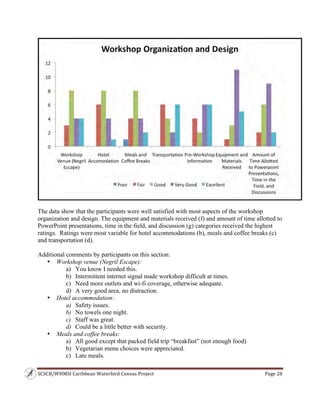
The data show that the participants were well satisfied with most aspects of the workshop
organization and design. The equipment and materials received (f) and amount of time allotted to
PowerPoint presentations, time in the field, and discussion (g) categories received the highest
ratings. Ratings were most variable for hotel accommodations (b), meals and coffee breaks (c)
and transportation (d).
Additional comments by participants on this section:
• Workshop venue (Negril Escape):
a) You know I needed this.
b) Intermittent internet signal made workshop difficult at times.
c) Need more outlets and wi-fi coverage, otherwise adequate.
d) A very good area, no distraction.
• Hotel accommodation:
a) Safety issues.
b) No towels one night.
c) Staff was great.
d) Could be a little better with security.
• Meals and coffee breaks:
a) All good except that packed field trip “breakfast” (not enough food)
b) Vegetarian menu choices were appreciated.
c) Late meals.
SCSCB/WHMSI
Caribbean
Waterbird
Census
Project
 Page
21


d) Good vegetarian options!
e) Late coffee.
f) Food was never on time.
• Transportation:
a) Might be poor.
b) Driver was great, bus was clean; slow arrival at destinations hampered the field
day.
c) Long bus rides on all day field trips. Smaller vehicles (more) might have been
better.
• Pre-workshop information:
a) Would be useful to see agenda beforehand.
b) Needed it sooner.
c) Would have been nice to have agenda prior to arrival at workshop.
d) Informative and material is very, very good.
• Equipment and materials received:
a) Wildlife counts, Raffaele field guide + clipboard are really nice.
b) Materials were helpful; binoculars did not arrive.
• Amount of time allotted to PowerPoint presentations, time in the field, and discussions:
a) It was a lot to cover in four days; better focus on practicing methods in field
would be good.
b) Hard- a lot of things to fit in a little time. Would be nice to schedule in an extra
15 minutes for each section, didn’t always feel like there was enough time but a
challenge to schedule.
c) Some PowerPoint presentations could have been a bit longer with more
information. During the field trips when on the smaller sites we could resume
earlier and move on to the next one.
d) Never quite enough time!
e) A lot packed into the time. Very informative.
f) The planned field trip was ambitious but all presentations were good.
g) I think there should be more time in the field.
2. Participants were asked to rate their satisfaction with the facilitation team. Did they:
a) Provide good background information and were they knowledgeable of the issues?
b) Give adequate answers to questions?
c) Use interactive methods?
d) Use sufficient supporting materials?
e) Do a good job facilitating discussion of the issues?
e) Motivate participants to use what was learned during the sessions?
SCSCB/WHMSI
Caribbean
Waterbird
Census
Project
 Page
22


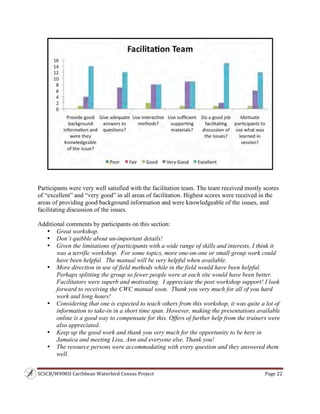
Participants were very well satisfied with the facilitation team. The team received mostly scores
of “excellent” and “very good” in all areas of facilitation. Highest scores were received in the
areas of providing good background information and were knowledgeable of the issues, and
facilitating discussion of the issues.
Additional comments by participants on this section:
• Great workshop.
• Don’t quibble about un-important details!
• Given the limitations of participants with a wide range of skills and interests, I think it
was a terrific workshop. For some topics, more one-on-one or small group work could
have been helpful. The manual will be very helpful when available.
• More direction in use of field methods while in the field would have been helpful.
Perhaps splitting the group so fewer people were at each site would have been better.
Facilitators were superb and motivating. I appreciate the post workshop support! I look
forward to receiving the CWC manual soon. Thank you very much for all of you hard
work and long hours!
• Considering that one is expected to teach others from this workshop, it was quite a lot of
information to take-in in a short time span. However, making the presentations available
online is a good way to compensate for this. Offers of further help from the trainers were
also appreciated.
• Keep up the good work and thank you very much for the opportunity to be here in
Jamaica and meeting Lisa, Ann and everyone else. Thank you!
• The resource persons were accommodating with every question and they answered them
well.
SCSCB/WHMSI
Caribbean
Waterbird
Census
Project
 Page
23


• SCSCB workshops continue not to fail to meet my expectations and that’s a great thing.
Presentations were overall excellent and main limitations were time constraints.
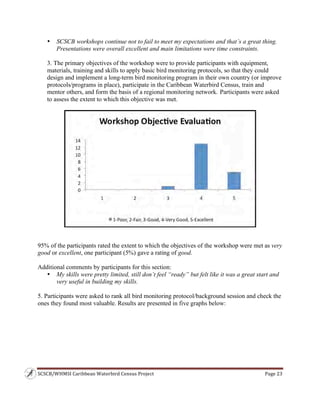
3. The primary objectives of the workshop were to provide participants with equipment,
materials, training and skills to apply basic bird monitoring protocols, so that they could
design and implement a long-term bird monitoring program in their own country (or improve
protocols/programs in place), participate in the Caribbean Waterbird Census, train and
mentor others, and form the basis of a regional monitoring network. Participants were asked
to assess the extent to which this objective was met.
95% of the participants rated the extent to which the objectives of the workshop were met as very
good or excellent, one participant (5%) gave a rating of good.
Additional comments by participants for this section:
• My skills were pretty limited, still don’t feel “ready” but felt like it was a great start and
very useful in building my skills.
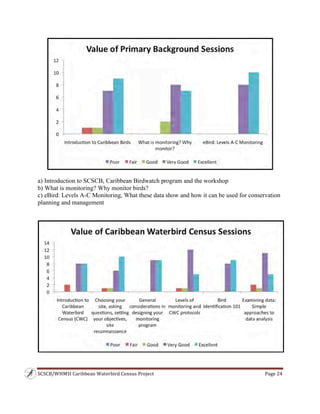
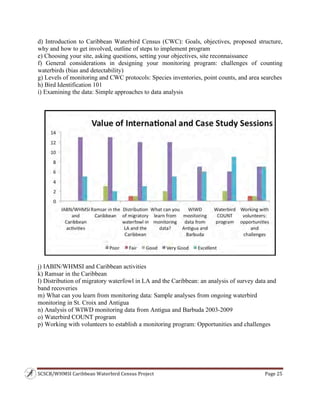
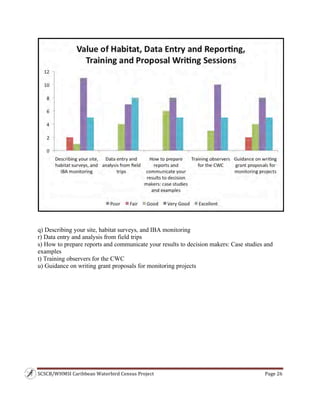
5. Participants were asked to rank all bird monitoring protocol/background session and check the
ones they found most valuable. Results are presented in five graphs below:
SCSCB/WHMSI
Caribbean
Waterbird
Census
Project
 Page
24


a) Introduction to SCSCB, Caribbean Birdwatch program and the workshop
b) What is monitoring? Why monitor birds?
c) eBird: Levels A-C Monitoring, What these data show and how it can be used for conservation
planning and management
SCSCB/WHMSI
Caribbean
Waterbird
Census
Project
 Page
25


d) Introduction to Caribbean Waterbird Census (CWC): Goals, objectives, proposed structure,
why and how to get involved, outline of steps to implement program
e) Choosing your site, asking questions, setting your objectives, site reconnaissance
f) General considerations in designing your monitoring program: challenges of counting
waterbirds (bias and detectability)
g) Levels of monitoring and CWC protocols: Species inventories, point counts, and area searches
h) Bird Identification 101
i) Examining the data: Simple approaches to data analysis
j) IABIN/WHMSI and Caribbean activities
k) Ramsar in the Caribbean
l) Distribution of migratory waterfowl in LA and the Caribbean: an analysis of survey data and
band recoveries
m) What can you learn from monitoring data: Sample analyses from ongoing waterbird
monitoring in St. Croix and Antigua
n) Analysis of WIWD monitoring data from Antigua and Barbuda 2003-2009
o) Waterbird COUNT program
p) Working with volunteers to establish a monitoring program: Opportunities and challenges
SCSCB/WHMSI
Caribbean
Waterbird
Census
Project
 Page
26


q) Describing your site, habitat surveys, and IBA monitoring
r) Data entry and analysis from field trips
s) How to prepare reports and communicate your results to decision makers: Case studies and
examples
t) Training observers for the CWC
u) Guidance on writing grant proposals for monitoring projects
SCSCB/WHMSI
Caribbean
Waterbird
Census
Project
 Page
27


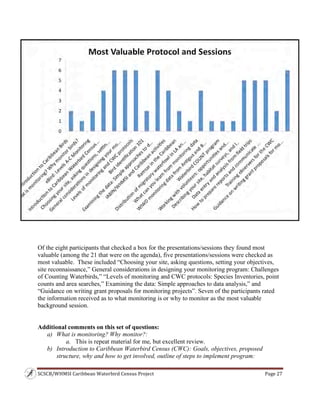
Of the eight participants that checked a box for the presentations/sessions they found most
valuable (among the 21 that were on the agenda), five presentations/sessions were checked as
most valuable. These included “Choosing your site, asking questions, setting your objectives,
site reconnaissance,” General considerations in designing your monitoring program: Challenges
of Counting Waterbirds,” “Levels of monitoring and CWC protocols: Species Inventories, point
counts and area searches,” Examining the data: Simple approaches to data analysis,” and
“Guidance on writing grant proposals for monitoring projects”. Seven of the participants rated
the information received as to what monitoring is or why to monitor as the most valuable
background session.
Additional comments on this set of questions:
a) What is monitoring? Why monitor?:
a. This is repeat material for me, but excellent review.
b) Introduction to Caribbean Waterbird Census (CWC): Goals, objectives, proposed
structure, why and how to get involved, outline of steps to implement program:
SCSCB/WHMSI
Caribbean
Waterbird
Census
Project
 Page
28


a. Better if protocols were complete.
c) Levels of monitoring and CWC protocols: Species inventories, point counts, and area
searches:
a. As above, better if protocols complete.
b. Good information but a little confusing.
d) Bird Identification 101:
a. Fun!
b. 
e) Examining the data: Simple approaches to data analysis:
a. I needed more time on this.
b. This was fun. I like statistics but was rusty, would like a review.
c.  Me not you.
d. Not enough time was devoted to this subject.
e. Lose the bikini clad woman (Floyd)
f) IABIN/WHMSI and Caribbean activities:
a. Very interesting, good reference to resources.
b. That was great. As a non-birder, or new to birding, it was nice to see it brought
back to big picture.
g) Ramsar in the Caribbean:
a. Good information but probably not helpful in my country/situation
h) Distribution of migratory waterfowl in LA and the Caribbean: an analysis of survey data
and band recoveries:
a. Fascinating in spite of collection method.
i) What can you learn from monitoring data? Sample analyses from ongoing waterbird
monitoring in St. Croix and Antigua:
a. I will use eBird!
b. Some interesting and curious assumptions.
j) WIWD monitoring data from Antigua and Barbuda 2003-2009:
a. Great demonstration of conservation through monitoring and outreach.
b. Encouraging to see the data and how it was analyzed.
c. Really nice to hear a success story! Inspiring.
k) Waterbird COUNT program:
a. Great program and a skill I need to develop.
b. Fun and will be very helpful in improving my skills.
l) Working with volunteers: opportunities and challenges:
a. Repeat information for me, but very good review.
m) Describing your site, habitat surveys and IBA monitoring:
a. Helpful.
n) Data entry and analysis from field trips:
a. Not enough time for this but great to go through it again.
b.  Getting better.
o) How to prepare reports and communicate your results to decision makers: case studies
and examples:
a. Helpful. A bit rushed.
b. Very informative.
SCSCB/WHMSI
Caribbean
Waterbird
Census
Project
 Page
29


p) Training observers for the CWC:
a. A bit too brief!
q) Guidance on writing grant proposals for monitoring projects:
a. Good presentation- ran out of time.
6. Participants were asked what three aspects of the workshop they valued most? (e.g.,
background presentations, sessions on CWC methodology, statistics, data entry and analysis,
opportunity to get guidance and advice from facilitators, networking opportunities, field trips to
practice bird ID and monitoring protocols, proposal writing session, etc.).
• Introduction to Caribbean Waterbird Census (CWC)/ CWC methodology (14)
• Field trips (12)
• Data entry and analysis (7)
• Guidance and advice (6)
• Monitoring (3)
• Background presentations (3)
• Statistics, data entry, and analysis (3)
• Shaggy concert (2)
• Proposal writing session (2)
• Networking opportunities and writing session.
• Data analysis/ survey protocols
• Great exposure for me in bird ID to build skills.
• Field practice activities (area seraches and point counts)
• Report preparations and communication to decision makers.
• Issues relating to monitoring, why monitor birds, etc.
• I appreciated the facilitators’ generosity with their time, helpfulness and willingness to
answer all questions (with a sense of humor too).
• Presentations about studies in the Caribbean (Cuba, St. Croix, Antigua).
• Working alone, it can be really frustrating to not have others with experience to bounce
ideas off of. It is so useful/ worthwhile to have the opportunity to network with both peers
in the Caribbean and other specialists/expert in workshops like this.
7. Participants were asked what the 2 or 3 most important things (key points or concepts) that
they learned during the week:
• Data entry and analysis (2)
• Monitoring waterbirds via point count and area search. (2)
• Learning about CWC protocol.
• Understanding some weakness in my current monitoring methods.
• Further understanding of statistics.
• Proposal for writing projects (funding).
• Counts methods in the field.
• Keys for identifying birds in the field.
• Error detectability and measurement.
• Bird monitoring/ methodology.
• To have a defined goal for why you want to monitor waterbirds at any given site.
SCSCB/WHMSI
Caribbean
Waterbird
Census
Project
 Page
30


• Importance of standardization.
• Do a thorough site inventory before you monitor.
• How to use eBird!
• How to monitor waterbirds with the selected methodology.
• Use the tools to help implement CWC in Bahamas.
• Train volunteers and colleagues.
• Share with education department BNT for wider outreach and education.
• Monitoring.
• Detection Probability
• The counting methodologies.
• Proposal writing.
• How to use protocols, where applicable.
• Statistics and data entry.
• Habitat assessment.
• Learning about measuring detectability and the fact that this can be used for population
assessment.
• That the words ‘Binomial Poisson Distribution’ are a real English term.
• I learned we have many species but the main things still with me are how to enter data
and how to conduct monitoring.
• Strategies to communicate to decision makers and politicians successfully.
• The importance of standardization of survey methods.
• Data analysis and what it can tell us and the new questions it raises.
• The importance of wetland bird protection.
• Conducting habitat assessments.
• Yes, I can!
8. Participants were asked how they will use what they learned this week:
• Will prepare to and carry out CWC on St. Croix and IBAs. Hopefully will begin
analyzing data.
• To attempt to establish wetland bird monitoring program in my country.
• Assist in the Agency Monitoring Program.
• To seek to learn and observe the wetland birds and document data of any sort.
• To share with colleagues, the various bits learnt during four days.
• To continue improving our national waterbird network.
• To develop the CWC in Cuba.
• Start implementing the CWC in at least in one site.
• To improve my field work and share data.
• Implement a monitoring program at IBA/NP sites in some islands.
• To initiate a monitoring program in my country.
• Get going on a waterbird moniotoring project with my helpers.
• Design and implement CWC program on my islands.
• I will initiate a bird monitoring program by tapping volunteers and community
involvement. I will share knowledge and skills acquired to increase public awareness
and heighten the community’s interest in birds and wetlands and in the environment in
general.
SCSCB/WHMSI
Caribbean
Waterbird
Census
Project
 Page
31


• Introduce to and train other members of the group in the CWC methodology.
• Use methodology to improve data collection and analysis.
• I will go back to the notes and the book I received and go out and see if I can know any
birds back home and then pass on the information to my members because I am very new
to this.
• I will train my staff, then others
• By implementing CWC in my country.
• To assist the habitat manager with the mapping of all wetlands in the Turks and Caicos
Islands.
• Adapt existing protocol in terms of how data is recorded (categories of information) and
train volunteers.
• Conduct formal habitat assessments and train volunteers.
9. Participants were asked what they thought was missing or how future workshops could be
improved:
• Smaller groups when practicing field methods.
• Early morning coffee!
• More time to practice in the field from use of equipment (e.g. range finder and GPS, or
even spotting scopes) to count methodologies.
• More sessions or PowerPoints related with monitoring methodology.
• (For me…) Have a longer break for lunch (15-30 minutes more) because it’s difficult to
concentrate in the PM without a nap. 
• More time.
• Good internet access.
• More in-depth session on statistics.
• Limit sessions to 6:00 pm (to improve).
• More sharing- TIME!
• More information in proposal writing and actual bird identification, especially in the
field.
• How to prepare reports in more detail, examples would help.
• Maybe it would help if there will be a workshop for the “basic” and “advanced” birders.
• To improve- travel times were somewhat demanding and took away from the actual
workshop activities/ experience.
• I think there should be some ice breakers, so that the mind can stay fresh.
• Generally it was very well organized, a little compact… but good.
• Possibly extend the duration and always try to plan around a favorite artist in concert.
• Better focus in field practice (this is as much a failure of participants as presenters). A
post-workshop field trip for birding might help people focus on work during workshop.
• Ship equipment ahead of time (mail service can be unpredictable).
• Seabird monitoring (large nesting populations) - developing monitoring protocol.
10. Participants were asked what the 2 most important topics/ questions related to monitoring
that they would like to see addressed in future training workshops or in the development of
SCSCB’s monitoring program:
• A sound bank for wetland birds monitoring and identification (2)
SCSCB/WHMSI
Caribbean
Waterbird
Census
Project
 Page
32


• Statistical analysis (2)
• Seabird monitoring (2)
• Data entry and analysis (2)
• Bird banding and associated (aging, sexing…) training.
• Improved communications.
• How to monitor breeding waterbirds?
• More on how to analyze data from specific protocols
• More time for practicing the counts (point count and area search)
• Survey methods
• Site selection in DR will be a huge challenge. What will we target? Species? Threats?
• Map making, GPS use, and site assessment
• Proposal writing
• Additional training on data assessment: statistics
• How to calculate detection probability
• More detailed site assessments (practice)
• Working with volunteers: opportunities and challenges
• More on methodology, data entry and analysis, and statistics
• Mist-netting
• CWC for the Caribbean
• Developing management plans for IBAs.
• I would like to learn more about statistics but even in French it’s difficult so imagine in
English for me …
11. Participants were asked when they go back to their island, what specific questions they
would like to use bird monitoring to answer:
• Number of migratory birds at primary wetlands
• To attempt to obtain population counts for wetland birds, within all wetlands in my
country
• How waterbird populations change over time
• Are the sites we are monitoring maintaining healthy bird populations?
• Are we currently using the correct monitoring methods?
• Which site in Grenada has the most diversity and richness for birds?
• Bird population trends in sites
• Diversity of bird species over time
• Detection of trends in species recorded
• Responses of species to habitat changes
• Leads in to wetland protection as an unheard of concept
• What birds do we have on the islands?
• What is the abundance and distribution, seasonally and over the course of a day?
• How are extraneous actions affecting birds?
• What species are present on the wetland areas, their abundance/ population, and how to
monitor them
• Presence/ absence of species, particularly IBA category birds
• How development/ man-induced activities impact on population trends
SCSCB/WHMSI
Caribbean
Waterbird
Census
Project
 Page
33


• How best can I implement this in my community? I think Ashton Lagoon will be excellent
for monitoring and this can be set up as a very good tourist attraction and boost our
economy.
• What is the species richness of wetland birds in each wetland site?
• Which wetlands are most critical to waterbird conservation?
• Protection and preservation of wetland habitats
• What are the population and diversity trends in Anguilla’s wetlands?
• What is happening with Anguilla’s seabird populations on the offshore cays (number and
diversity)? – What impact is habitat alteration potentially having on the wetlands and
their bird populations (numbers and diversity)?
12. Participants were asked to rate their overall satisfaction with the workshop. The choices were
poor, fair, good, very good and excellent.
The participants expressed a high level of satisfaction with the workshop, as evidenced by
ratings of excellent and very good by all participants.
13. Additional final comments:
• Both workshops (this year and last) were very good. I appreciated the more narrow
focus of this workshop, the building on (and reinforcement) of information from last
year’s workshop. Thank you!
• Look forward to practicing as much as possible and establishing a waterbird and
wetland monitoring program. Also looking forward to attend other training programs.
• Congratulations to all organizers, I know you are all very busy and you did a great job!
SCSCB/WHMSI
Caribbean
Waterbird
Census
Project
 Page
34


• Workshop sessions should not continue past dinnertime. Sessions should end at 6:00 pm
at the latest.
• Thank you very much. I always enjoy learning with you all. These are indeed times well
spent. Thanks again.
• Enjoyed and appreciated the availability of presenters to further discuss and clarify some
issues.
• I found it to be very interesting but because I am rather new to birds, more time in the
field and the workshop should be longer, five days instead of four days.
• Presenters were outstanding in meeting the needs of a very diverse audience! Thank you
so much for this opportunity!
• This was really great. Was I funded by RSPB? I’d like to send them a letter of thanks.
Also, for new birders, my office is next to a salt pond and I try to spend 10-15 minutes, 1
or 2 times a day just photographing and then trying to ID birds. This has been a very
helpful exercise that I would suggest to new birders.
• Thank you for the opportunity given to us to participate in the workshop. The workshop
was very informative and practical in terms of material presented and the field
exercises. We have certainly benefited from the workshop and will transfer this to others
in the Agency.
• The workshop was one of the best I’ve ever attended.
SCSCB/WHMSI
Caribbean
Waterbird
Census
Project
 Page
35


APPENDIX
4:
CWC
SMALL
GRANT
PROPOSAL
GUIDELINES

CARIBBEAN
WATERBIRD
CENSUS

(CWC)
SMALL
GRANT
PROGRAMME

SCSCB
Project:
Promoting
Wetland
Bird
Conservation


Through
the
Caribbean
Waterbird
Census
(CWC)

Proposal
Format
and
Guidelines


Background
to
the
Project2


The
Caribbean
Waterbird
Plan3

identified
major
gaps
in
information
about
the
status
and

distribution
of
wetland
species,
the
lack
of
management
or
conservation
programmes
for

threatened
species
and
wetlands
of
international
importance,
the
general
need
to
increase

capacity
to
implement
monitoring
and
conservation
programs,
and
the
urgent
need
to
promote

environmental
awareness
of
the
importance
of
wetlands
in
countries
of
the
region,
especially
in

light
of
the
increasing
vulnerability
of
coastal
mangrove
and
wetland
habitats
from
climate

change
impacts
(e.g.,

sea
level
rise,
increased
storms
and
droughts)
and
the
destruction
of

these
critical
habitats
for
development.
The
Caribbean
is
also
under
represented
in
regional

initiatives
including
the
Ramsar
Convention,
Specially
Protected
Areas
and
Wildlife
(SPAW)

Protocol
of
the
Cartagena
Convention,
Western
Hemisphere
Shorebird
Reserve
(WHSRN)
and

the
Western
Hemisphere
Migratory
Species
Initiative
(WHMSI).
These
issues
have
been
further

highlighted
in
the
completion
of
national
waterbird
reports4

and
analysis
of
Important
Bird

Areas
(IBAs)
in
the
Caribbean5
.
The
current
project
aims
to
address
some
of
these
gaps
and

needs
through
capacity
building
training
workshops
and
development
of
the
Caribbean

Waterbird
Census
(CWC)6
.


Our
overall
project
goal
is
to
increase
support
for
waterbird
and
wetland
conservation
in
the

Caribbean
region
by
promoting
monitoring
of
waterbirds
and
their
habitats
as
a
means
to

improve
science‐based
conservation
planning
and
adaptive
management
of
birds.


Our
specific
objectives
are
to
implement
the
CWC
through:
a)
development
of
methodology

(standard
protocols)
to
monitor
waterbirds
and
wetlands
and
a
CWC
trainers’
manual,
b)

enhancing
the
capacity
of
partner
organizations,
agencies
and
individuals
to
participate
in
the


2

Excerpted
from
SCSCB
proposal
Promoting
wetland
bird
conservation
through
the
Caribbean
Waterbird
Census

submitted
to
the
USFWS
Neotropical
Migratory
Bird
Conservation
Act
(NMBCA)
funding
program,
Nov.
2009.

3

SCSCB.
2004.
Draft
Caribbean
Waterbirds
Plan
2003‐8.
SCSCB
report,
available
on
www.scscb.org.

4

http://www.birdlife.org/action/science/species/waterbirds/downloads.html

5

BirdLife
International.
2008.
Important
Bird
Areas
in
the
Caribbean:
Key
sites
for
conservation.
Cambridge,
UK:

BirdLife
International.
(BirdLife
Conservation
Series
No.
15).

6

The
Caribbean
Waterbird
Census
is
part
of
SCSCB’s
new
regional
bird
monitoring
programme
Caribbean

Birdwatch
–
training
workshops
and
standard
protocols
to
monitor
landbirds,
seabirds,
shorebird
and
waterbirds

and
their
habitat.

SCSCB/WHMSI
Caribbean
Waterbird
Census
Project
 Page
36


program
through
a
skills‐building
(‘train‐the‐trainers’)
workshop
(February
2010),
and
c)
offer
a

CWC
Small
Grants
Programme
to
assist
partners
in
implementing
the
CWC
at
high
priority
sites.

Participants
are
encouraged
to
share
results
and
conservation
recommendations
through
local

and
national
workshops.
We
will
establish
a
regional
database
(including
eBird
Caribbean)
to

share
results
of
monitoring.


CWC
Small
Grants
Programme

SCSCB
hopes
that
we
will
receive
a
grant
from
the
USFWS
Neotropical
Migratory
Bird

Conservation
Act
(NMBCA)
Fund
for
a
proposal
Promoting
wetland
bird
conservation
through

the
Caribbean
Waterbird
Census7
.
As
follow‐up
to
our
recent
Waterbird
and
Wetland

Monitoring
Training
Workshop
in
Negril,
JA
(Feb.
2010)8

where
22
participants
were
trained
in

CWC
methodology,
the
proposal
requests
funding
to
award
10
or
more
Small
Grants
of
up
to

$5,000
each9
.
The
purpose
of
the
Small
Grants
program
is
to
help
you
advance
your
waterbird

and
wetland
monitoring
efforts
and
implement
the
Caribbean
Waterbird
Census
in
at
least
one

important
wetland
site
in
your
country
(e.g.,
IBA,
Ramsar
site,
national
park
or
protected
area).

If
you
are
not
currently
doing
any
monitoring,
we
hope
that
this
funding
program
will
help
you

get
started.
If
you
are
already
doing
some
kind
of
monitoring,
our
aim
is
to
help
you
expand
and

improve
your
program,
for
example
by
monitoring
your
site(s)
more
frequently,
adding
one
or

more
important
sites
to
your
program,
and/or
improving
your
monitoring
methodology
(e.g.,
by

adding
a
measure
of
detection
probability)
and
associated
activities
and
outcomes
(e.g.,
writing

reports
and
sharing
results
with
natural
resources
managers
and
decision
makers,
holding
a

national
wetland
bird
conservation
workshop,
etc.).
If
the
proposal
is
approved
we
expect
that

the
funds
would
be
available
in
June
2010.


Eligible
Activities
for
the
Small
Grant
Programme:
Each
Small
Grant
proposal
should
include

plans
for
three
or
more
of
the
following
activities:

1)
monitoring
training
workshop
for
field
persons,

2)
implementation
of
field
surveys
in
one
or
more
sites
of
high
importance
for
wetland

birds,
especially
species
of
conservation
concern10
;


7

We’ve
received
notice
that
the
proposal
was
favorably
reviewed
but
final
approval
is
pending.

8

The
training
workshop
and
materials
development
were
funded
by
the
Organization
of
American
States/Western

Hemisphere
Migratory
Species
Initiative,
US
Forest
Service
and
Royal
Society
for
the
Protection
of
Birds
with
in‐
kind
help
and
support
from
many
partners
and
organizations,
including
Cornell
Lab
of
Ornithology,
Optics
for
the

Tropics,
Wetlands
International,
Klamath
Bird
Observatory,
BirdLife
International
and
others.

9

Additional
funds
for
this
Small
Grant
Programme
are
pending
from
SPAW‐RAC.

10

Caribbean
wetlands
provide
essential
stop‐over
and
wintering
habitat
for
more
than
126
aquatic
and
terrestrial

neotropical
migrant
species.
Twenty‐six
(17%)
of
these
are
included
in
the
USFWS
list
of
Birds
of
Conservation

Concern
(http://www.fws.gov/birdhabitat/Grants/NMBCA/BirdList.shtm),
including
wetland
species
such
as
Brown

Pelican,
Reddish
Egret,
Solitary
Sandpiper,
Lesser
Yellowlegs,
Whimbrel,
Red
Knot,
Short‐billed
Dowitcher
and

Least
Tern,
and
terrestrial
species
such
as
the
White‐crowned
Pigeon,
Yellow‐billed
Cuckoo,
Prairie
Warbler
and

SCSCB/WHMSI
Caribbean
Waterbird
Census
Project
 Page
37


3)
data
entry,
analysis
and
storage;

4)
production
of
wetland
bird
conservation
reports
for
all
wetlands
surveyed;

5)
community
education
workshop
in
each
wetland
surveyed;

6)
national
wetland
bird
conservation
workshop
at
which
the
results
and
proposals
for

conservation
action
will
be
discussed,
and

7)
publication
of
the
results
(e.g.
in
the
Journal
of
Caribbean
Ornithology).


The
activities
that
you
propose
will
depend
on
your
questions/objectives,
your
capacity
(time,

resources,
etc.)
and
whether
you
are
just
beginning
a
monitoring
program
or
have
already
been

collecting
monitoring
data.


1. Monitoring
training
workshop
for
field
persons.
To
train
staff
or
local
volunteers
in
the

monitoring
methodology
you
will
use
(how
to
conduct
the
count
and
record
the
data).

The
workshop
should
contain
“classroom”
and
field
components
in
order
to
teach

monitoring
methods
(e.g.,
area
search,
point
counts)
and
key
concepts
such
as
bias,

detectability
and
the
importance
of
standardization.
If
your
trainees
are
not
skilled

birders,
it
will
be
important
to
spend
a
lot
of
time
covering
waterbird
identification
using

powerpoints
and
through
many
practice
sessions
in
the
field.
Unskilled
birders
should

work
as
field
assistants
(data
recorders)
until
they
are
able
to
accurately
identify
most

waterbirds.
All
powerpoints
from
our
recent
workshop
in
Negril
will
be
available
for
use

in
your
own
training
workshops.

2. Implementation
of
field
surveys
in
one
or
more
sites
of
high
importance
for
wetland

birds,
especially
species
of
conservation
concern.
Briefly
describe
what
site(s)
you
will

monitor
and
the
level
of
monitoring
(1,
2,
3,
or
4)
and
methods
you
will
use
(area
search

or
point
count,
and
how
you
will
measure
detectability)11
.
Also
mention
what
habitat

covariates
you
will
measure
(e.g.,
water
depth,
salinity,
vegetation,
etc.).
We
request

that
at
a
minimum,
all
monitoring
programs
participate
in
the
Caribbean
Waterbird

Census
by
conducting
surveys
at
one
or
more
sites
in
January.

3. Data
entry,
analysis
and
storage.
Basic
monitoring
data
may
be
stored
in
eBird

Caribbean,
we
will
provide
a
spreadsheet
for
data
collection
that
includes
the
necessary

headings
and
cells
for
more
detailed
data
(repeated
counts,
time
intervals,
distance

sampling)
as
well
as
examples
of
descriptive
statistics
and
modeling.

4. Production
of
waterbird
conservation
reports
for
all
wetlands
surveyed.
The
results
of

your
monitoring
efforts
must
be
shared
in
order
for
them
to
be
applied
to
conservation

and
management.
To
begin,
simple
reports
can
be
prepared
that
describe
what
species


Prothonotary
Warbler.
They
also
provide
breeding
habitat
for
many
resident
species
including
several
globally

threatened
birds
such
as
the
West
Indian
Whistling‐Duck
which
has
been
the
flagship
species
for
SCSCB’s
wetland

conservation
efforts
(http://www.eco‐index.org/search/results.cfm?projectID=979).

11

Refer
to
the
powerpoint
(Levels
of
Monitoring)
and
CWC
Trainers’
Manual
and
protocols
for
a
description
of
the

different
levels
of
monitoring
and
methods
to
assess
detection
probability.

SCSCB/WHMSI
Caribbean
Waterbird
Census
Project
 Page
38


are
using
the
site
and
their
relative
numbers,
by
season/time
of
year.
For
decision

makers
a
one‐page
report
with
lots
of
graphics
is
appropriate.
Over
time,
you
will
be

able
to
describe
and
test
hypotheses
to
analyze
trends—changes
in
numbers
of
birds
in

relation
to
changes
in
environmental/habitat
variables
that
you
measure.
Reports

should
be
shared
with
natural
resource
managers,
local
communities
and
decision

makers.

5. Community
outreach
and
education
in
each
wetland
surveyed.
One
of
our
goals
is
to

increase
awareness
and
willingness
to
take
action
to
conserve
wetlands
of
importance

to
migratory
and
resident
waterbirds.
Target
audiences
include
decision
makers,
natural

resource
and
wildlife
managers,
community
leaders,
educators,
and
the
general
public,

especially
youth.
Activities
may
include:
a)
providing
information
to
governments
about

the
status
of
birds
in
the
wetland
you
survey,
b)
distributing
materials
promoting
the

CWC,
Ramsar
Convention
and
SPAW
Protocol,
c)
holding
a
local
workshop
to
educate

community
members
about
the
importance
of
key
local
wetlands
and
the
birds
that
use

them,
and
engage
them
to
participate
as
volunteers
in
the
CWC,
and
encourage
people

to
develop
and
implement
actions
to
address
any
issues
that
may
be
identified,
and
d)

promoting
the
celebration
of
World
Wetlands
Day
and
International
Migratory
Bird
Day

(IMBD)
and
Caribbean
Endemic
Bird
Festivals
(with
a
waterbird‐wetland
activity).

6. National
wetland
bird
conservation
workshop
at
which
the
results
and
proposals
for

conservation
action
will
be
discussed.
Organize
a
forum
or
workshop
to
present
results

of
your
monitoring
and
propose
(or
evaluate
the
effects
of)
conservation
and

management
actions,
such
as
the
identification
of
new
Ramsar
sites,
IBAs,
or
protected

areas,
reducing
threats
from
pollution,
invasive
species,
or
development,
managing

water
levels,
etc.

7. Publication
of
the
results
of
your
monitoring
in
scientific
journals
(e.g.,
Journal
of

Caribbean
Ornithology).
Although
basic
statistics
and
examples
of
analysis
of
monitoring

data
were
presented
in
the
Jamaica
workshops,
we
hope
to
offer
a
workshop
in
the

future
that
focuses
on
statistical
analysis
and
writing
of
scientific
papers.
We
also
hope

to
offer
a
“mentor”
program
to
help
you
with
analysis
of
your
data
and
writing
up
the

results
for
publication.


SCSCB/WHMSI
Caribbean
Waterbird
Census
Project
 Page
39


PROPOSAL
FORMAT

Please
follow
the
format
below
in
writing
your
monitoring
proposal.
The
proposal
should
not
be

more
than
2
to
3
pages
in
length
total.


PART
1.
INFORMATION
ON
APPLICANT

Name:

Title:

Organization:

Address:

Email:

Phone:

Experience
Managing
Similar
Projects
(describe
briefly,
2‐3
sentences,
a
short
CV
may
be

attached):


PART
2.
DESCRIPTION
OF
YOUR
PROPOSED
MONITORING
OBJECTIVES
AND
ACTIVITIES


GOAL
‐
Why
you
are
proposing
this
monitoring
project
–
the
big
picture,
your
dream


OBJECTIVES
–
What
question(s)
do
you
want
to
answer
or
what
do
you
want
to
achieve
through

the
monitoring
project
and
this
funding
opportunity?
Make
sure
your
objectives
are
SMART

(specific,
measurable,
achievable,
relevant,
time‐bound)


ACTIVITIES
‐
What
exactly
do
you
plan
to
do
to
meet
your
objectives
(who,
what,
when,
where,

how).
Refer
to
the
list
of
Eligible
Activities
above
and
describe
these
briefly.


EXPECTED
BENEFITS/OUTCOMES
–
List
these
briefly
(e.g.,
numbers
of
wetland
monitors
trained,

wetland
sites
and
surveys
completed,
partners
that
have
joined
your
monitoring
efforts,

participants
in
community
workshops,
reports
prepared
and
presented
at
national
meetings
or

workshops,
conservation
or
management
actions
proposed
or
adopted,
etc.)


PART
3.
BUDGET

Set
up
a
simple
budget
table
that
lists
each
item
that
needs
funding
under
each
proposed

activity
or
heading.
You
may
request
up
to
$5,000
in
funding.
Estimate
the
total
cost
of
the

activity
and
whether
you
can
offer
or
expect
to
find
match
funding
for
the
activity.
See
the

example
below
of
how
a
budget
table
might
be
filled
in
(your
items
and
costs
will
vary

depending
on
your
plans
and
resources!).
If
you
need
binoculars
or
spotting
scopes/tripods
for

your
program,
we
can
assist
by
purchasing
these
items
at
half‐price
for
you.


SCSCB/WHMSI
Caribbean
Waterbird
Census
Project
 Page
40


SAMPLE
PROJECT
BUDGET
FORM


ACTIVITY
OR
HEADING
 SCSCB

SMALL

GRANT

IN‐KIND

OR
CASH

MATCH

TOTAL

1.
CWC
Training
Workshop
for
Field
Monitors
and
Assistants


Venue
(2
days
@$50/day)
 
 100
 100

Professional
fees,
stipend
or
salaries
(1
person
x
5
days

@$150/day)

500
 250
 750

Workshop
materials
‐
field
guides,
copies
of
protocols
and

data
sheets,
clipboards,
field
notebooks
–
($30/person
x
6)

150
 30
 180

Workshop
refreshments
(7
persons
x
2
days
@$15/person)
 210
 
 210

Accommodation
(3
persons
x
2
nights
@$100/night)
 600
 
 600

Sub‐total
 1,460
 380
 1,840


2.
Field
Surveys

‐
Monitor
3
sites
3
times
per
year,
3
counts

per
season
($50
gas
to
survey
3
sites)


Travel/transportation
‐
$50/survey
x
3
surveys/year
x
3

counts
per
season

250
 200
 450

Fees,
stipends
for
survey
team
leaders
(9
surveys
x
2
persons

x
$100)

800
 800
 1,600

Sub‐total
 1,050
 1,000
 2,050


3.
Equipment


Binoculars
–
6
pairs
8
x
40
a@
$100/pair
(discounted
price)
 400
 200
 600

Rangefinder
–
1
@$400
each
 400
 
 400

GPS
–
1
@$300
 
 300
 300

Spotting
scope
and
tripod
(2
at
$300)
 600
 
 600

pH,
salinity
and
temperature
meter
 150
 
 150

Sub‐total
 1,550
 500
 2,050


4.
Community
Education
Meeting


Venue
(1
day
@$50/day)
 
 50
 50

Refreshments
(30
persons
x
$5/person)
 150
 
 150

Consulting
fees
for
team
leader
(1
person
x
1
day
x
$150/day)
 150
 
 150

Sub‐total
 300
 50
 350


5.
Stakeholders
Presentation
Meeting


Venue
(1
day
@$50/day)
 
 50
 50

Refreshments
(30
persons
x
$5/person)
 150
 
 150

Consulting
fees
for
team
leader
(1
person
x
1
day
x
$150/day)
 150
 
 150

Sub‐total
 300
 50
 350

Administrative
Overheads
 300
 200
 500

TOTAL
 4,960
 2,180
 7,140

SCSCB/WHMSI
Caribbean
Waterbird
Census
Project
 Page
41


BUDGET
NOTES:
Briefly
describe
the
source(s)
of
in‐kind
or
cash
match;
provide
rationale
for

any
unusual
items
requested
in
the
budget.
Examples
of
in‐kind
match:
If
you
work
for
an
NGO

or
agency
and
will
be
participating
in
the
CWC
(delivering
workshops,
monitoring
wetlands,

writing
reports,
etc.)
as
part
of
your
job
or
you
are
volunteering
your
time,
this
can
be
included

as
in‐kind
match.
If
your
employer
can
offer
support,
such
as
a
vehicle
or
gas
to
travel,
use
of

equipment
or
a
workshop
venue,
this
can
also
be
included
as
in‐kind
match.
If
you
are
able
to

leverage
the
funds
in
this
proposal
to
raise
funds
from
another
source,
note
this
as
cash
match.


Criteria
Upon
Which
Proposals
Will
be
Rated

• Your
objectives
and
activities:
Are
they
SMART?
(specific,
measurable,
achievable,

relevant,
time‐bound)

• Does
your
plan
include
monitoring
of
important
sites?

• Will
your
monitoring
plan
engage
partners
(NGos,
governmental
agencies,
institutions)

and
community
members
to
become
involved
in
the
CWC?
• Will
your
plan
raise
awareness
of
conservation
and
management
issues
related
to

wetlands
and
waterbirds
and
what
can
be
done
to
address
these
issues?

• Is
your
budget
realistic
and
reasonable?
Have
you
made
an
effort
to
leverage
these

funds
to
raise
funds
from
other
sources?

• Does
the
applicant
have
sufficient
experience
and
organizational
skills
needed
to

complete
the
activities
outlined
in
the
proposal?

SCSCB/WHMSI
Caribbean
Waterbird
Census
Project
 Page
42


APPENDIX
5:
LIST
OF
WORKSHOP
MATERIALS
PROVIDED
TO
EACH
PARTICIPANT


Pre‐workshop
materials

• Application
form

• Letter
of
invitation

• Information
for
participants

• What
to
bring

Workshop
materials

• Folder

• Workshop
Agenda

• International
Presenters
and
Facilitators

• Area
search
and
point
count
protocols
and
notes

• Google
Earth
maps
of
wetlands
surveyed
on
field
trips

• Wildlife
COUNT
program
(on
CD)

• Certificate
of
participation

Field
data
forms

• Area
search

• Point
count

• IBA
threat
assessment

Field
equipment

• 1
pair
binoculars
(shipped
separately)
 

• Clipboard

• pencil

• Reusable
nylon
bag
(ChicoBag)
with
WHMSI
logo
 

Books

• Raffaele
et
al.
2003.
Birds
of
the
West
Indies.
Princeton
Field
Guides,
Princeton,
New
Jersey)
 

SCSCB
field
identification
cards


• Wetland
Birds
of
the
Caribbean

• Seabirds
of
the
Caribbean

• Resident
and
Migratory
Ducks
of
the
West
Indies

T‐shirts

• International
Migratory
Bird
Day
2010

Other
materials
and
supplies

• OAS‐WHMSI
brochure
(English
&
Spanish)

• Waterbirds
Council
for
the
Americas
brochure
–
Fostering
Waterbird
Conservation
(English
and
Spanish)

• Ramsar
brochures,
stickers
and
3
CDs
(World
Wetlands
Day
2010:
Caring
for
Wetlands,
Ramsar

Handbooks
for
the
Wise
Use
of
Wetlands,
3
rd

edition,
2007,
Wetlands:
Keeping
Our
Planet
Alive
and
Well)

• Cornell
Lab
of
Ornithology
and
eBird
brochures

• Negril,
Jamaica
map

SCSCB/WHMSI
Caribbean
Waterbird
Census
Project
 Page
43


APPENDIX
6:
WORKSHOP
EVALUATION
FORM

Your name (optional): ________________________
Place an “X” in the box that best represents your opinion, where 1 = Poor, 2 = Fair, 3 = Good, 4 =
Very good, 5 = Excellent
1. Workshop organization and design
How do you rate: 1 2 3 4 5 Comments
Workshop venue
Hotel accommodation
Meals and coffee breaks
Transportation
Pre-workshop information
Equipment and materials received
Amount of time allotted to
powerpoint presentations, time in
the field, and discussions
2. Facilitation Team
Did they: 1 2 3 4 5
Provide good background information and were they knowledgeable of the issues?
Give adequate answers to questions?
Use interactive methods?
Use sufficient supporting materials?
Do a good job facilitating discussion of the issues?
Motivate participants to use what was learned in sessions?
Additional comments:
3. The primary objectives of the workshop were to provide you with equipment, materials, training
and skills in waterbird monitoring protocols, so that you can design and implement a long-term bird
monitoring programme in your own country (or improve protocols/programs in place), participate in
SCSCB/WHMSI
Caribbean
Waterbird
Census
Project
 Page
44


the Caribbean Waterbird Census, train and mentor others, and form the basis of a regional
monitoring network. To what extent was this objective met?
Excellent _____ Very good _____ Good _____ Fair _____ Poor _____
4. Rank all bird monitoring protocol/background sessions and check the ones you found most
valuable.
1 2 3 4 5
___ Introduction to SCSCB, Caribbean Birdwatch program and the
workshop (Lisa)
___ What is monitoring? Why monitor birds? (Lisa)
Comment:
___ eBird: Levels A-C Monitoring, What these data show and how it can
be used for conservation planning and management (Jeff)
Comment:
___ Introduction to Caribbean Waterbird Census (CWC): Goals,
objectives, proposed structure, why and how to get involved, outline of
steps to implement program (Ann)
Comment:
___ Choosing your site, asking questions, setting your objectives, site
reconnaissance (Ken)
Comment:
___ General considerations in designing your monitoring program:
challenges of counting waterbirds (bias and detectability) (Jeff)
Comment:
___ Levels of monitoring and CWC protocols: Species inventories, point
counts and area searches (Ann)
Comment:
___ Bird Identification 101 (Lisa)
Comment:
___ Examining the data: Simple approaches to data analysis (Ken)
Comment:
___ IABIN/WHMSI and Caribbean activities (Richard Huber)
Comment:
___ Ramsar in the Caribbean (Ainsley Henry)
Comment:
___ Distribution of migratory waterfowl in LA and the Caribbean: an
analysis of survey data and band recoveries (Ken)
Comment:
___ What can you learn from monitoring data? Sample analyses from
ongoing waterbird monitoring in St. Croix and Antigua (Jeff)
Comment:
SCSCB/WHMSI
Caribbean
Waterbird
Census
Project
 Page
45


___ WIWD monitoring data from Antigua & Barbuda 2003-2009 (Lisa)
Comment:
___ Waterbird COUNT program (Ken)
Comment:
___ Working with volunteers: opportunities and challenges (Lisa)
Comment:
5. What 3 aspects of the workshop did you value the most? (e.g., background presentations,
sessions on CWC methodology, statistics, data entry and analysis, opportunity to get guidance and
advice from facilitators, networking opportunities, field trips to practice bird ID and monitoring
protocols, proposal writing session, etc.).
a.
b.
c.
6. What are the 2 or 3 most important things (key points or concepts) you learned this week?
7. How will you use what you learned this week?
8. What do you think was missing or how can we improve future workshops?


9. What are the 2 most important topics/questions related to monitoring that you would like to see
addressed in future training workshops or in the development of SCSCB’s monitoring program?
10. When you go back to your island, what specific questions would you like to use bird monitoring to
answer?
11. Overall, how would you rate your satisfaction with the workshop?
Excellent _____ Very good _____ Good _____ Fair _____ Poor _____
Additional comments:
SCSCB/WHMSI
Caribbean
Waterbird
Census
Project
 Page
46


APPENDIX
7:
LABEL
FOR
FOLDER
COVER
FOR
WORKSHOP
MATERIALS


SCSCB/WHMSI
Caribbean
Waterbird
Census
Project
 Page
47


APPENDIX
8:
CERTIFICATE
OF
PARTICIPATION


SCSCB/WHMSI
Caribbean
Waterbird
Census
Project
 Page
48


APPENDIX
9:
CWC
WORKSHOP
SUMMARY
REPORT
AND
PHOTOS

SOCIETY
FOR
THE
CONSERVATION
AND
STUDY
OF
CARIBBEAN
BIRDS

WESTERN
HEMISPHERE
MIGRATORY
SPECIES
INITIATIVE
PROJECT

Increasing Capacity for Caribbean Wetlands Conservation: A Training Workshop for
Monitoring, Education and Conservation
CARIBBEAN
WATERBIRD
CENSUS
(CWC)
TRAINING
WORKSHOP

22
‐
25
February
2010
–
Summary
Report

SCSCB
is
working
towards
establishing
the
Caribbean
Waterbird
Census
(CWC)12
,
a
region‐wide
waterbird

and
wetland
monitoring
program13
.
The
overall
goal
of
the
program
is
to
increase
support
for
waterbird

and
wetland
conservation
in
the
insular
Caribbean
by
promoting
monitoring
as
a
means
to
improve
science‐
based
conservation
planning
and
adaptive
management
of
birds.

The
objectives
of
the
CWC
are
to:

• Promote
inventories,
surveys
and
censuses
of
waterbirds
and
their
habitats
in
all
Caribbean

countries

• Encourage
broad‐based
participation
in
waterbird
counts
including
NGOs,
governmental
agencies,

institutions,
communities
and
volunteers

• Ensure
that
as
many
internationally
and
nationally
important
wetland
sites
as
possible
are

conserved
and
monitored

• Increase
awareness
of
conservation
issues
related
to
wetlands
and
waterbirds
and
what
can
be

done
to
address
these
issues.


Twenty‐two
participants
from
16
Caribbean
islands
took
part
in
the
SCSCB’s
four‐day
CWC
Training

Workshop
in
Negril,
Jamaica
22
‐25
February.
The
purpose
of
the
workshop
was
to
provide
persons
from

across
the
Caribbean
with
equipment,
materials,
training
and
skills
in
waterbird
and
wetland
monitoring

protocols
so
that
they
can
design
and
implement
their
own
monitoring
program
(or
improve/expand

programs
that
are
in
place),
participate
in
CWC
annual
counts,
train
and
mentor
others,
and
form
the
basis

of
a
regional
waterbird
monitoring
network.
Participants
were
prospective
national
and
site
coordinators

for
the
CWC.
They
included
executive
directors
of
NGOs
in
charge
of
protected
areas,
ornithologists,
and

conservation
biologists
employed
to
governments
and
NGOs,
protected
area
managers
and
volunteers,
all

of
whom
share
a
common
interest
in
learning
monitoring
methodologies
to
more
effectively
conserve
and

manage
migrant
and
resident
waterbirds
and
their
habitats.


The
six
facilitators
and
presenters
included
Richard
Huber
(OAS),
Jeff
Gerbracht
(Cornell
Laboratory
of

Ornithology,
NY),
Ken
Kriese
(USFWS
Washington,
DC),
Ainsley
Henry
(National
Environment
and
Planning

Agency,
Jamaica
and
Ramsar),
Ann
Haynes‐Sutton
(Monitoring
Coordinator,
SCSCB,
Jamaica)
and
Lisa


12

The
CWC
arose
from
discussions
at
the
SCSCB’s
previous
monitoring
training
workshop
“Long‐term
Bird
Monitoring
in
the

Caribbean
–
Why,
What,
Where
and
How?”
which
took
place
in
Nassau,
Bahamas
in
February
2009.
It
is
a
part
of
a
regional
bird

monitoring
program
called
Caribbean
Birdwatch.
For
more
information:
http://conserveonline.org/workspaces/caribbeanbirdwatch

13

The
Caribbean
region
will
join
Wetland
International’s
global
program
of
wetland
bird
monitoring,
with
data
from
the
Caribbean

filling
a
major
gap
in
the
coverage
of
the
International/Neotropical
Waterbird
Census.
It
can
be
used
to
promote
site
conservation,

assess
impacts
of
climate
change
and
other
threats,
and
design
programs
to
protect,
manage
and
restore
wetlands.

SCSCB/WHMSI
Caribbean
Waterbird
Census
Project
 Page
49


Sorenson
(President,
SCSCB,
Boston).


The
workshop
provided
training
in
implementing
the
CWC,
including
how
to
design
and
implement
surveys,

levels
of
monitoring
and
CWC
protocols14
,
waterbird
identification,
count
training
tools
and
habitat

monitoring,
field
sessions
to
practice
survey
methods,
data
entry
and
analysis,
and
presenting
results
to

decision‐makers.
Participants
were
also
guided
in
the
development
of
projects
and
preparation
of

proposals
to
implement
monitoring
on
their
islands.
SCSCB
has
applied
for
funding
for
a
small‐grant

program
to
support
these
applications
and
if
it
is
successful
will
be
able
to
distribute
funds
for
up
to
ten

projects.


The
participants
expressed
a
high
level
of
satisfaction
with
the
workshop
and
committed
to
share
their

experiences,
train
others
in
their
islands,
and
participate
in
the
CWC.
To
facilitate
this
process
all
the

materials
from
the
workshop
(including
presentations
and
a
CWC
Trainers
Manual)
will
be
placed
on
a

ConserveOnline
website
where
they
will
be
available
for
download.
SCSCB
hopes
to
offer
additional
training

workshops
and
welcomes
participation
by
all
countries
in
the
CWC.


The
workshop
was
the
main
output
of
a
project
called
“Increasing
Capacity
For
Caribbean
Wetlands

Conservation:
A
Training
Workshop
For
Monitoring,
Education
And
Conservation”
which
is
being
funded
by

the
Organization
of
American
States
through
the
Western
Hemisphere
Migratory
Species
Initiative

(WHMSI).
Additional
funding
and
support
were
provided
by
the
Royal
Society
for
the
Protection
of
Birds,
US

Forest
Service,
Optics
for
the
Tropics,
Cornell
Laboratory
of
Ornithology,
US
Fish
and
Wildlife
Service,
Negril

Area
Environmental
Protection
Trust,
and
others.
An
additional
output
from
the
project
is
a
regional

capacity
building
strategy
for
implementation
of
the
CWC,
that
includes
plans
for
long‐term
sustainability

such
as
encouraging
agencies
to
institutionalize
monitoring,
providing
continued
skills‐building
training
and

support
for
our
partners,
setting
up
a
regional
data
repository,
assisting
with
procuring
appropriate

equipment
and
funding,
and
application
of
the
program
to
other
regions.
SCSCB
is
working
with
our

monitoring
coalition,
established
to
support
the
previous
workshop
in
Nassau,
Bahamas
in
February
2009,

to
implement
the
strategy.


14

The
CWC
offers
a
hierarchical
and
flexible
approach
to
monitoring
(employing
levels
of
monitoring)
that
enables
the
user
to

choose
the
protocol
and
extent
of
participation
in
the
program
that
is
best
suited
to
their
objectives,
available
resources
and

capacity.
The
basic
CWC
protocols
(Level
2
–
area
search
and
point
count)
include
measures
of
detection
probability,
which
are

essential
for
accounting
for
bias
in
monitoring.

SCSCB/WHMSI
Caribbean
Waterbird
Census
Project
 Page
50


Participants
at
the
SCSCB
CWC
Monitoring
Training
Workshop,
February
22
‐
25,
2010,
Negril,
Jamaica


Participants
listen
attentively
to
the
morning’s
training
presentations
about
monitoring.


SCSCB/WHMSI
Caribbean
Waterbird
Census
Project
 Page
51


First
day’s
field
trip
to
the
Negril
Royal
Palm
Reserve:
Jonathan
Sayao
(Turks
and
Caicos),
Predensa

Moore
(Bahamas)
and
Rhodriquez
Ewing
(Turks
and
Caicos)
practice
the
area
search
count
method.


Ann
Sutton
leads
a
discussion
with
participants
about
how
to
count
the
birds
at
Big
Bridge
ponds.


SCSCB/WHMSI
Caribbean
Waterbird
Census
Project
 Page
52


Practice
point
count
at
Spring
Pond
–
freshwater
wetland
loaded
with
Common
Moorhens,
also

American
Coots,
Lesser
Yellowlegs,
Least
Grebes,
Pied‐billed
Grebes,
Masked
Ducks
(!),
and
more.


Great
Pedro
Pond:
winter
home
to
762
Blue‐winged
Teal
and
many
other
waterbirds.

Angela
Ramsey
(Tobago)
&
Anthony
Levesque
(Guadeloupe)
count
them
all.

SCSCB/WHMSI
Caribbean
Waterbird
Census
Project
 Page
53


Farewell
Dinner
at
Catcha’
Falling
Star:
Workshop
trivia
quiz,
awards
and
presentation

of
certificates
to
all
participants.
Maxine
Hamilton
(Jamaica)
and
Lisa
Sorenson
(Boston).

Scscb whmsi-final-cwc-workshop-report-17-march-2010