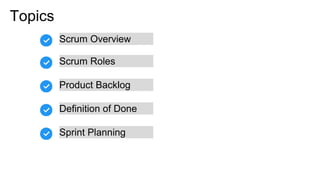
Topics
Scrum Overview
Scrum Roles
Product Backlog
Definition of Done
Sprint Planning
Scrum Overview
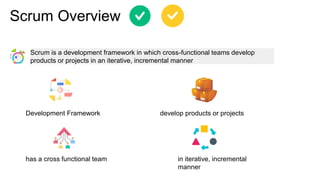
Scrum is a development framework in which cross-functional teams develop
products or projects in an iterative, incremental manner
Development Framework
has a cross functional team
develop products or projects
in iterative, incremental
manner
Sprints
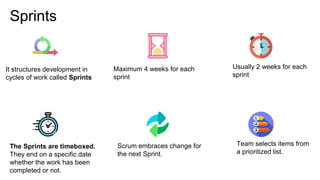
It structures development in
cycles of work called Sprints
Maximum 4 weeks for each
sprint
Usually 2 weeks for each
sprint
The Sprints are timeboxed.
They end on a specific date
whether the work has been
completed or not.
Scrum embraces change for
the next Sprint.
Team selects items from
a prioritized list.
Scrum Roles
Product Owner
The Team
Scrum Master
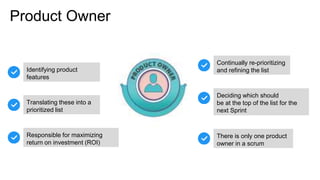
Product Owner
Identifying product
features
Translating these into a
prioritized list
Deciding which should
be at the top of the list for the
next Sprint
Continually re-prioritizing
and refining the list
Responsible for maximizing
return on investment (ROI)
There is only one product
owner in a scrum
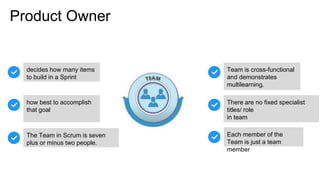
Product Owner
decides how many items
to build in a Sprint
how best to accomplish
that goal
There are no fixed specialist
titles/ role
in team
Team is cross-functional
and demonstrates
multilearning.
The Team in Scrum is seven
plus or minus two people.
Each member of the
Team is just a team
member
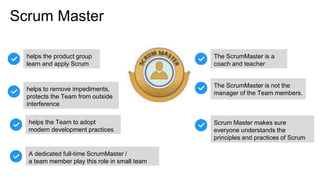
Scrum Master
helps the product group
learn and apply Scrum
helps to remove impediments,
protects the Team from outside
interference
The ScrumMaster is not the
manager of the Team members.
The ScrumMaster is a
coach and teacher
helps the Team to adopt
modern development practices
Scrum Master makes sure
everyone understands the
principles and practices of Scrum
A dedicated full-time ScrumMaster /
a team member play this role in small team
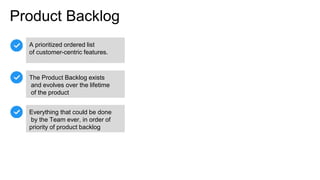
Product Backlog
A prioritized ordered list
of customer-centric features.
The Product Backlog exists
and evolves over the lifetime
of the product
Everything that could be done
by the Team ever, in order of
priority of product backlog
Product Backlog
A prioritized ordered list
of customer-centric features.
The Product Backlog exists
and evolves over the lifetime
of the product
Everything that could be done
by the Team ever, in order of
priority of product backlog
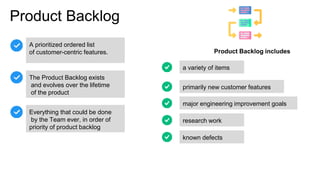
Product Backlog includes
a variety of items
primarily new customer features
major engineering improvement goals
research work
known defects
DEEP
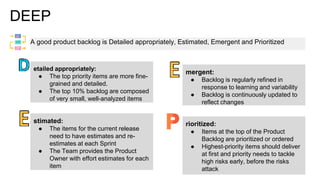
A good product backlog is Detailed appropriately, Estimated, Emergent and Prioritized
etailed appropriately:
● The top priority items are more fine-
grained and detailed.
● The top 10% backlog are composed
of very small, well-analyzed items
stimated:
● The items for the current release
need to have estimates and re-
estimates at each Sprint
● The Team provides the Product
Owner with effort estimates for each
item
mergent:
● Backlog is regularly refined in
response to learning and variability
● Backlog is continuously updated to
reflect changes
rioritized:
● Items at the top of the Product
Backlog are prioritized or ordered
● Highest-priority items should deliver
at first and priority needs to tackle
high risks early, before the risks
attack
Effort Estimation
A common technique is to estimate in terms of relative size
Factoring in effort, complexity, and uncertainty are using as a
relative size, a unit of “story points” or simply “points”.
Larger items are broken into smaller items during the Sprint
Planning Meeting so effort estimates are also broken.
Do not describe every possible detail of an item, just make clear
what is necessary for it to be understood.
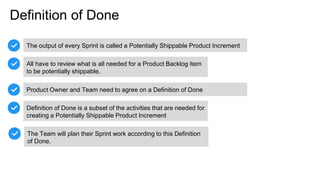
Definition of Done
The output of every Sprint is called a Potentially Shippable Product Increment
All have to review what is all needed for a Product Backlog item
to be potentially shippable.
Product Owner and Team need to agree on a Definition of Done
Definition of Done is a subset of the activities that are needed for
creating a Potentially Shippable Product Increment
The Team will plan their Sprint work according to this Definition
of Done.
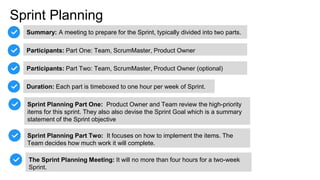
Sprint Planning
Summary: A meeting to prepare for the Sprint, typically divided into two parts.
Participants: Part One: Team, ScrumMaster, Product Owner
Participants: Part Two: Team, ScrumMaster, Product Owner (optional)
Duration: Each part is timeboxed to one hour per week of Sprint.
Sprint Planning Part One: Product Owner and Team review the high-priority
items for this sprint. They also also devise the Sprint Goal which is a summary
statement of the Sprint objective
Sprint Planning Part Two: It focuses on how to implement the items. The
Team decides how much work it will complete.
The Sprint Planning Meeting: It will no more than four hours for a two-week
Sprint.

Scrum & Sprint Planning.pptx

  • 2.
    Topics Scrum Overview Scrum Roles ProductBacklog Definition of Done Sprint Planning
  • 3.
    Scrum Overview Scrum isa development framework in which cross-functional teams develop products or projects in an iterative, incremental manner Development Framework has a cross functional team develop products or projects in iterative, incremental manner
  • 4.
    Sprints It structures developmentin cycles of work called Sprints Maximum 4 weeks for each sprint Usually 2 weeks for each sprint The Sprints are timeboxed. They end on a specific date whether the work has been completed or not. Scrum embraces change for the next Sprint. Team selects items from a prioritized list.
  • 5.
  • 6.
    Product Owner Identifying product features Translatingthese into a prioritized list Deciding which should be at the top of the list for the next Sprint Continually re-prioritizing and refining the list Responsible for maximizing return on investment (ROI) There is only one product owner in a scrum
  • 7.
    Product Owner decides howmany items to build in a Sprint how best to accomplish that goal There are no fixed specialist titles/ role in team Team is cross-functional and demonstrates multilearning. The Team in Scrum is seven plus or minus two people. Each member of the Team is just a team member
  • 8.
    Scrum Master helps theproduct group learn and apply Scrum helps to remove impediments, protects the Team from outside interference The ScrumMaster is not the manager of the Team members. The ScrumMaster is a coach and teacher helps the Team to adopt modern development practices Scrum Master makes sure everyone understands the principles and practices of Scrum A dedicated full-time ScrumMaster / a team member play this role in small team
  • 9.
    Product Backlog A prioritizedordered list of customer-centric features. The Product Backlog exists and evolves over the lifetime of the product Everything that could be done by the Team ever, in order of priority of product backlog
  • 10.
    Product Backlog A prioritizedordered list of customer-centric features. The Product Backlog exists and evolves over the lifetime of the product Everything that could be done by the Team ever, in order of priority of product backlog Product Backlog includes a variety of items primarily new customer features major engineering improvement goals research work known defects
  • 11.
    DEEP A good productbacklog is Detailed appropriately, Estimated, Emergent and Prioritized etailed appropriately: ● The top priority items are more fine- grained and detailed. ● The top 10% backlog are composed of very small, well-analyzed items stimated: ● The items for the current release need to have estimates and re- estimates at each Sprint ● The Team provides the Product Owner with effort estimates for each item mergent: ● Backlog is regularly refined in response to learning and variability ● Backlog is continuously updated to reflect changes rioritized: ● Items at the top of the Product Backlog are prioritized or ordered ● Highest-priority items should deliver at first and priority needs to tackle high risks early, before the risks attack
  • 12.
    Effort Estimation A commontechnique is to estimate in terms of relative size Factoring in effort, complexity, and uncertainty are using as a relative size, a unit of “story points” or simply “points”. Larger items are broken into smaller items during the Sprint Planning Meeting so effort estimates are also broken. Do not describe every possible detail of an item, just make clear what is necessary for it to be understood.
  • 13.
    Definition of Done Theoutput of every Sprint is called a Potentially Shippable Product Increment All have to review what is all needed for a Product Backlog item to be potentially shippable. Product Owner and Team need to agree on a Definition of Done Definition of Done is a subset of the activities that are needed for creating a Potentially Shippable Product Increment The Team will plan their Sprint work according to this Definition of Done.
  • 14.
    Sprint Planning Summary: Ameeting to prepare for the Sprint, typically divided into two parts. Participants: Part One: Team, ScrumMaster, Product Owner Participants: Part Two: Team, ScrumMaster, Product Owner (optional) Duration: Each part is timeboxed to one hour per week of Sprint. Sprint Planning Part One: Product Owner and Team review the high-priority items for this sprint. They also also devise the Sprint Goal which is a summary statement of the Sprint objective Sprint Planning Part Two: It focuses on how to implement the items. The Team decides how much work it will complete. The Sprint Planning Meeting: It will no more than four hours for a two-week Sprint.