



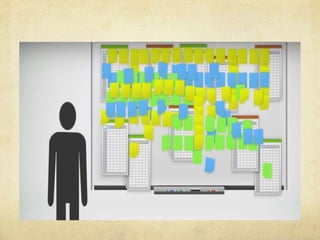
Scrum
Rama Reddy
Project Engineer
Agenda
Waterfall Model and Agile Model
Roles in Scrum
Cycle of Scrum
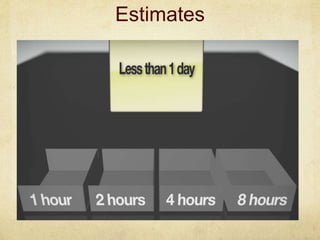
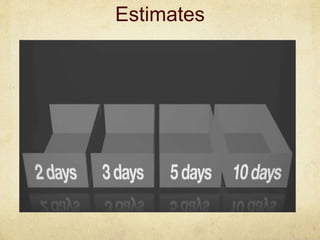
Estimates
Scrum meeting
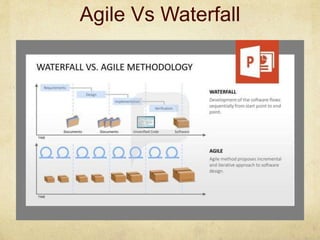
Water Fall Model
Water Fall Model
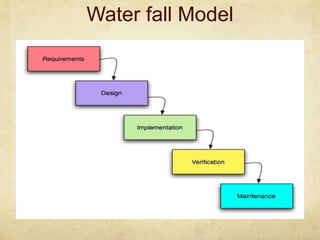
The waterfall model is a sequential(non-iterative) design
process, used in software development processes, in
which progress is seen as flowing steadily
downwards(like a waterfall) through the phases of
conception,initiation,analysis,design,construction,initiati
on,analysis,design,construction,testing,production/imple
mentation and maintenance.
Water fall Model
Agile
Agile software development is based on an incremental,
iterative approach. Instead of in-depth planning at the
beginning of the project, Agile methodologies are open
to changing requirements over time and encourages
constant feedback from the end users. Cross-functional
teams work on iterations of a product over a period of
time, and this work is organized into a backlog that is
prioritized based on business or customer value. The
goal of each iteration is to produce a working product.
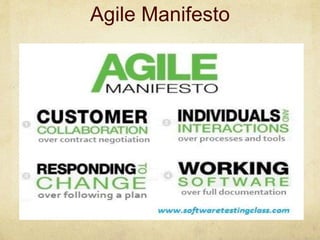
Agile Manifesto
12 Principles of Agile
Our highest priority is to satisfy the customer through
early and continuous delivery of valuable software.
Welcome changing requirements, even late in
development. Agile processes harness change for the
customer’s competitive advantage.
Deliver working software frequently, from a couple of
weeks to a couple of months, with preference to the
shorter timescale.
Business people and developers must work together
daily throughout the project.
Build projects around motivated individuals. Give them
the environment and support they need, and trust them
to get the job done.
12 Principles of Agile
The most efficient and effective method of conveying
information to and within a development team is face-to-
face conversation.
Working software is the primary measure of progress.
Agile processes promote sustainable development. The
sponsors, developers, and users should be able to
maintain a constant pace indefinitely.
Continuous attention to technical excellence and good
design enhances agility.
Simplicity -- the art of maximizing the amount of work
not done -- is essential.
12 Principles of Agile
The best architectures, requirements, and designs
emerge from self-organizing teams.
At regular intervals, the team reflects on how to become
more effective, then tunes and adjusts its behaviour
accordingly.
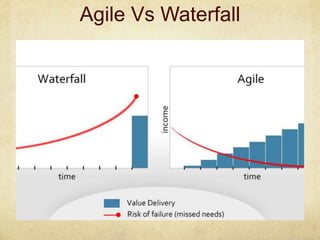
Agile Vs Waterfall
Agile Vs Waterfall
Agile VS Scrum
Agile VS Scrum
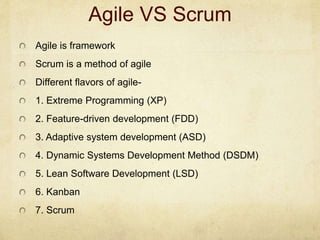
Agile is framework
Scrum is a method of agile
Different flavors of agile-
1. Extreme Programming (XP)
2. Feature-driven development (FDD)
3. Adaptive system development (ASD)
4. Dynamic Systems Development Method (DSDM)
5. Lean Software Development (LSD)
6. Kanban
7. Scrum
Roles in Scrum
Process of Scrum
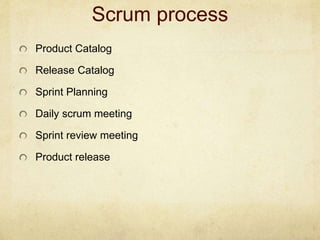
Scrum process
Product Catalog
Release Catalog
Sprint Planning
Daily scrum meeting
Sprint review meeting
Product release
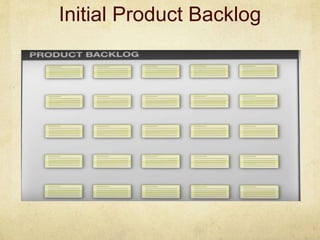
Initial Product Backlog
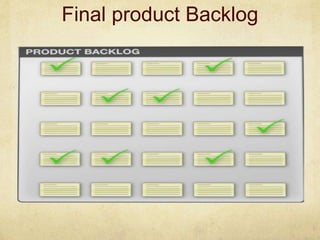
Product Backlog
Product Owner makes sure that the right and necessary
users stories, features goes into the Product Backlog
Final product Backlog
Product Catalog
Who plays the Product Owner role in your project ?
Product Catalog in your Project?
Scrum Master
Smooth Progress of the Project
Whether all the team are accompanied with work
Set up meeting ,monitors the work done and facilitates
the release done
Scrum Master
Who is the Scrum master in your Project?
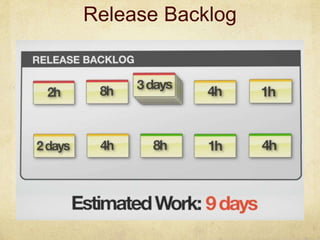
Release Backlog/Release
Planning
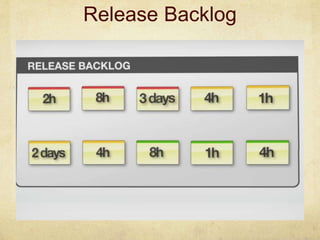
Scrum Master along with product owner identifies which
need to be taken for a particular release based on the
priority and make it to release backlog.
Once they decide the list they have the estimate to complete
each task
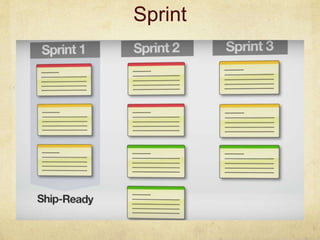
Split the task into sprints.
Total of estimate of all tasks in the release backlog is sprint
duration
Release Backlog
Release Backlog
Sprint 0
Sprint 0
It can be defined as pre step to the first sprint. Activities
like setting development environment, preparing
backlog etc needs to be done before starting of the first
sprint and can be treated as Sprint zero.
Sprint
Sprint
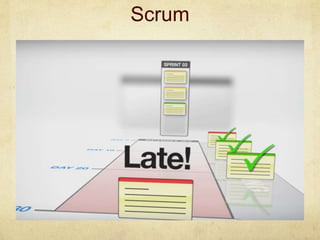
Scrum
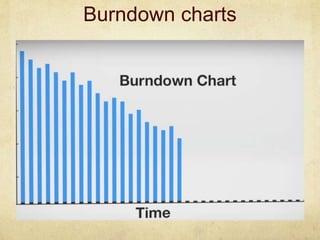
Burndown charts
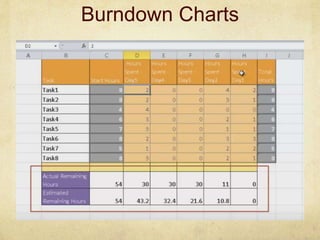
Burndown Charts
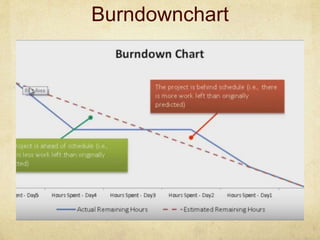
Burndownchart
Burndown Charts
Link for creating burndown chart in Excel
https://www.youtube.com/watch?v=gjU5vA8m1Jo
Advantages
Dynamic Release Estimate
Dynamic Sprint Estimate
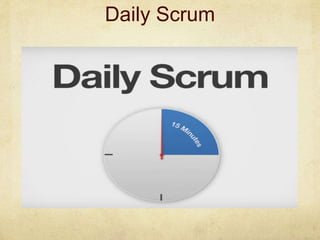
Daily Scrum
Daily Scrum
What I have done yesterday
Any obstacles
What I will do today
Sprint Feedback Meeting
Release Planning in our
project
What is release backlog in your project?
How are estimates calculated in your project?
Length of the sprint in your project?
Is daily scrum conducted in your project ?
Burndown charts is being prepared?
Sprint feedback meeting is conducted?
Spikes
Spike is a time-boxed piece of work who's goal it is to
answer a difficult technical question So that the
developers can properly illuminate a User
Story or Epic. By illuminate I mean; the ability to
estimate those User Stories or break down Epics into
estimated User Stories. There should be no other real
purpose. Even if the spike is about making a broad
architectural decision, that decision should have been
required because there were multiple user stories that
would depend on that decision. The result of a Spike is
deeper understanding and estimates. The physical
manifestations of a Spike is usually some whiteboard
diagrams, a page on your wiki, or even some simple
throw away code to test a hypothesis
Spikes
Any spikes done in your project?
Estimates
Estimates
Tools
Tools
Review
Product Backlog
Release Backlog
Sprints
Scrum meeting
Sprint Feed Back meeting
Next Sprint
Thank You
Ram Reddy
Project Engineer

Scrum Framework in Agile

  • 1.
  • 3.
    Agenda Waterfall Model andAgile Model Roles in Scrum Cycle of Scrum Estimates Scrum meeting
  • 4.
  • 5.
    Water Fall Model Thewaterfall model is a sequential(non-iterative) design process, used in software development processes, in which progress is seen as flowing steadily downwards(like a waterfall) through the phases of conception,initiation,analysis,design,construction,initiati on,analysis,design,construction,testing,production/imple mentation and maintenance.
  • 6.
  • 8.
    Agile Agile software developmentis based on an incremental, iterative approach. Instead of in-depth planning at the beginning of the project, Agile methodologies are open to changing requirements over time and encourages constant feedback from the end users. Cross-functional teams work on iterations of a product over a period of time, and this work is organized into a backlog that is prioritized based on business or customer value. The goal of each iteration is to produce a working product.
  • 9.
  • 10.
    12 Principles ofAgile Our highest priority is to satisfy the customer through early and continuous delivery of valuable software. Welcome changing requirements, even late in development. Agile processes harness change for the customer’s competitive advantage. Deliver working software frequently, from a couple of weeks to a couple of months, with preference to the shorter timescale. Business people and developers must work together daily throughout the project. Build projects around motivated individuals. Give them the environment and support they need, and trust them to get the job done.
  • 11.
    12 Principles ofAgile The most efficient and effective method of conveying information to and within a development team is face-to- face conversation. Working software is the primary measure of progress. Agile processes promote sustainable development. The sponsors, developers, and users should be able to maintain a constant pace indefinitely. Continuous attention to technical excellence and good design enhances agility. Simplicity -- the art of maximizing the amount of work not done -- is essential.
  • 12.
    12 Principles ofAgile The best architectures, requirements, and designs emerge from self-organizing teams. At regular intervals, the team reflects on how to become more effective, then tunes and adjusts its behaviour accordingly.
  • 13.
  • 14.
  • 15.
  • 16.
    Agile VS Scrum Agileis framework Scrum is a method of agile Different flavors of agile- 1. Extreme Programming (XP) 2. Feature-driven development (FDD) 3. Adaptive system development (ASD) 4. Dynamic Systems Development Method (DSDM) 5. Lean Software Development (LSD) 6. Kanban 7. Scrum
  • 17.
  • 21.
  • 22.
    Scrum process Product Catalog ReleaseCatalog Sprint Planning Daily scrum meeting Sprint review meeting Product release
  • 23.
  • 24.
    Product Backlog Product Ownermakes sure that the right and necessary users stories, features goes into the Product Backlog
  • 25.
  • 26.
    Product Catalog Who playsthe Product Owner role in your project ? Product Catalog in your Project?
  • 27.
    Scrum Master Smooth Progressof the Project Whether all the team are accompanied with work Set up meeting ,monitors the work done and facilitates the release done
  • 28.
    Scrum Master Who isthe Scrum master in your Project?
  • 29.
    Release Backlog/Release Planning Scrum Masteralong with product owner identifies which need to be taken for a particular release based on the priority and make it to release backlog. Once they decide the list they have the estimate to complete each task Split the task into sprints. Total of estimate of all tasks in the release backlog is sprint duration
  • 30.
  • 31.
  • 32.
  • 33.
    Sprint 0 It canbe defined as pre step to the first sprint. Activities like setting development environment, preparing backlog etc needs to be done before starting of the first sprint and can be treated as Sprint zero.
  • 34.
  • 35.
  • 36.
  • 37.
  • 38.
  • 39.
  • 40.
    Burndown Charts Link forcreating burndown chart in Excel https://www.youtube.com/watch?v=gjU5vA8m1Jo
  • 41.
  • 42.
  • 43.
    Daily Scrum What Ihave done yesterday Any obstacles What I will do today
  • 44.
  • 45.
    Release Planning inour project What is release backlog in your project? How are estimates calculated in your project? Length of the sprint in your project? Is daily scrum conducted in your project ? Burndown charts is being prepared? Sprint feedback meeting is conducted?
  • 46.
    Spikes Spike is atime-boxed piece of work who's goal it is to answer a difficult technical question So that the developers can properly illuminate a User Story or Epic. By illuminate I mean; the ability to estimate those User Stories or break down Epics into estimated User Stories. There should be no other real purpose. Even if the spike is about making a broad architectural decision, that decision should have been required because there were multiple user stories that would depend on that decision. The result of a Spike is deeper understanding and estimates. The physical manifestations of a Spike is usually some whiteboard diagrams, a page on your wiki, or even some simple throw away code to test a hypothesis
  • 47.
    Spikes Any spikes donein your project?
  • 48.
  • 49.
  • 50.
  • 51.
  • 53.
    Review Product Backlog Release Backlog Sprints Scrummeeting Sprint Feed Back meeting Next Sprint
  • 54.

Editor's Notes

  • #2 The below and following notes on the template slides are to guide you only. In your final presentation, you may delete these notes and add relevant notes if any. Title slide: Title – should not exceed beyond 3 lines, font size 30-34, Arial Headings (Font size for the title of the PPT can vary between 30-34, Arial Headings, Bold depending on the amount of text, however should not be smaller than 30 font size) Name should not exceed beyond 1 line, Designation; font size to remain at 18, Arial Headings Please keep the title slide simple, just the logo, title and name and designation to appear. No other graphic elements or any design, photograph, image can be added to this slide, alignment to remain the same
  • #4 Agenda slide Heading – Agenda - Font size 30, Arial Headings Agenda points to be in Arial Body (font size 28) Please restrict this slide with just 5 agenda points. If you have more than 5 points on the agenda slide please add another slide. If you have only 3 then you can use just one slide and delete the other 2 points.
  • #18 Section breaker slide Used for a section heading. You may add a sub heading not exceeding one line also here Section heading – Arial Headings, bold, 34 font size, should not exceed beyond 1 line Sub Head – Arial Headings, normal, 18 font size, should not exceed beyond 1 line
  • #22 Section breaker slide with customer logo Section heading – Arial Headings, 34, Bold Sub head – Arial Headings, 18, normal Used for a section heading. You may add a sub heading not exceeding one line also here Section heading – Arial Headings, bold, 34 font size, should not exceed beyond 1 line Sub Head – Arial Headings, normal, 18 font size, should not exceed beyond 1 line
  • #23 Content Slide: This is usually the most frequently used slide in every presentation. Use this slide for Text heavy slides. Text can only be used in bullet points Title Heading – font size 30, Arial Heading Slide Content – Should not reduce beyond Arial body font 16 If you need to use sub bullets please use the indent buttons located next to the bullets buttons in the tool bar and this will automatically provide you with the second, third, fourth & fifth level bullet styles and font sizes Please note you can also press the tab key to create the different levels of bulleted content
  • #55 The below and following notes on the template slides are to guide you only. In your final presentation, you may delete these notes and add relevant notes if any. Title slide: Title – should not exceed beyond 3 lines, font size 30-34, Arial Headings (Font size for the title of the PPT can vary between 30-34, Arial Headings, Bold depending on the amount of text, however should not be smaller than 30 font size) Name should not exceed beyond 1 line, Designation; font size to remain at 18, Arial Headings Please keep the title slide simple, just the logo, title and name and designation to appear. No other graphic elements or any design, photograph, image can be added to this slide, alignment to remain the same