SCRUM	
  &	
  XP	
  –	
  
Methodologies	
  &	
  Prac7ces	
  
Robert	
  Feldt,	
  2012-­‐03-­‐19	
  
Agile	
  Dev	
  Processes,	
  Chalmers	


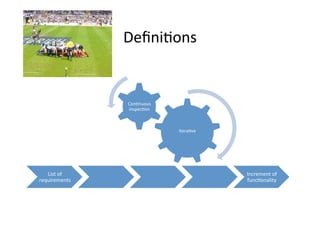
Defini7ons	
  
List	
  of	
  
requirements	
  
Increment	
  of	
  
func7onality	
  
Itera7ve	
  
Con7nuous	
  
inspec7on	
  
Why	
  Scrum?	
  
[Rising2000]	
  
History	
  of	
  SCRUM	
  
• 1986	
  -­‐	
  Hirotaka	
  Takeuchi	
  and	
  Ikujiro	
  Nonaka	
  described	
  a	
  new	
  
holis7c	
  approach	
  that	
  increases	
  speed	
  and	
  flexibility	
  in	
  commercial	
  
new	
  product	
  development	
  
• 1991	
  -­‐	
  DeGrace	
  and	
  Stahl	
  referred	
  to	
  this	
  approach	
  as	
  SCRUM,	
  a	
  
rugby	
  term	
  men7oned	
  in	
  the	
  ar7cle	
  by	
  Takeuchi	
  and	
  Nonaka	
  
• Early	
  1990s,	
  Ken	
  Schwaber	
  used	
  an	
  approach	
  that	
  led	
  to	
  Scrum	
  at	
  
his	
  company,	
  Advanced	
  Development	
  Methods	
  
• At	
  the	
  same	
  7me,	
  Jeff	
  Sutherland,	
  John	
  Scumniotales,	
  and	
  Jeff	
  
McKenna	
  developed	
  a	
  similar	
  approach	
  at	
  Easel	
  Corpora7on	
  and	
  
were	
  the	
  first	
  to	
  call	
  it	
  Scrum	
  
• 1995	
  Sutherland	
  and	
  Schwaber	
  jointly	
  presented	
  a	
  paper	
  describing	
  
Scrum	
  at	
  OOPSLA	
  '95	
  in	
  Aus7n,	
  TX,	
  its	
  first	
  public	
  appearance	
  
• 2001,	
  Schwaber	
  teamed	
  up	
  with	
  Mike	
  Beedle	
  to	
  describe	
  the	
  
method	
  in	
  the	
  book	
  Agile	
  Soeware	
  Development	
  with	
  Scrum.	
  
Defined	
  Process	
  Control	
  vs.	
  Empirical	
  
Process	
  Control	
  
• Laying	
  out	
  a	
  process	
  that	
  repeatedly	
  will	
  
produce	
  acceptable	
  quality	
  output	
  is	
  called	
  
defined	
  process	
  control	
  
• When	
  defined	
  process	
  control	
  cannot	
  be	
  
achieved	
  because	
  of	
  the	
  complexity	
  of	
  the	
  
intermediate	
  ac7vi7es,	
  something	
  called	
  
empirical	
  process	
  control	
  has	
  to	
  be	
  employed	


• Defined	
  Process	
  control	
  (“non-­‐agile”)	
  
	
   -­‐ Planning	
  heavy	
  
-­‐ Assumes	
  (more)	
  sta7c	
  environment	
  
-­‐ Longer	
  itera7ons	
  
-­‐ Change	
  Management	
  intensive	
  
-­‐ Typical	
  pre-­‐study	
  heavy	
  
-­‐ Assumes	
  good	
  es7ma7ons	
  (and	
  as	
  we	
  know…	
  es7ma7ons	
  are	
  
nego7a7ons)…	
  
-­‐ Process	
  and	
  Management	
  	
  Control	
  over	
  Actual	
  work	
  (oeen	
  
seen	
  as	
  bureaucra7c)	
  
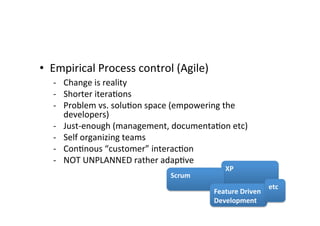
• Empirical	
  Process	
  control	
  (Agile)	
  
	
   -­‐ Change	
  is	
  reality	
  
-­‐ Shorter	
  itera7ons	
  
-­‐ Problem	
  vs.	
  solu7on	
  space	
  (empowering	
  the	
  
developers)	
  
-­‐ Just-­‐enough	
  (management,	
  documenta7on	
  etc)	
  
-­‐ Self	
  organizing	
  teams	
  
-­‐ Con7nous	
  “customer”	
  interac7on	
  
-­‐ NOT	
  UNPLANNED	
  rather	
  adap7ve	
  
	
   XP	
  
Scrum	
  
Feature	
  Driven	
  
Development	
  
etc	
  
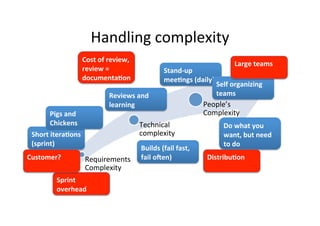
Handling	
  complexity	
  
Requirements	
  
Complexity	
  
Technical	
  
complexity	
  
People’s	
  
Complexity	
  
Short	
  itera5ons	
  
(sprint)	
  
Pigs	
  and	
  
Chickens	
  
Stand-­‐up	
  
mee5ngs	
  (daily)	
  
Self	
  organizing	
  
teams	
  
Builds	
  (fail	
  fast,	
  
fail	
  oCen)	
  
Reviews	
  and	
  
learning	
  
Do	
  what	
  you	
  
want,	
  but	
  need	
  
to	
  do	
  
Sprint	
  
overhead	
  
Cost	
  of	
  review,	
  
review	
  =	
  
documenta5on	
  
Large	
  teams	
  
Distribu5on	
  
Customer?	
  
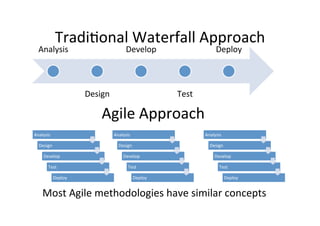
Tradi7onal	
  Waterfall	
  Approach	
  
Analysis	
  
Design	
  
Develop	
  
Test	
  
Deploy	
  
Agile	
  Approach	
  
Analysis	
  
Design	
  
Develop	
  
Test	
  
Deploy	
  
Analysis	
  
Design	
  
Develop	
  
Test	
  
Deploy	
  
Analysis	
  
Design	
  
Develop	
  
Test	
  
Deploy	
  
Most	
  Agile	
  methodologies	
  have	
  similar	
  concepts	
  
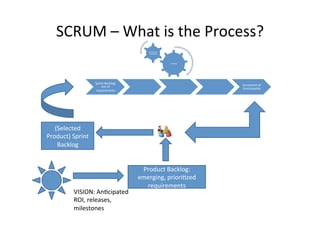
SCRUM	
  –	
  What	
  is	
  the	
  Process?	
  
Sprint	
  Backlog:	
  
List	
  of	
  
requirements	
  
Increment	
  of	
  
func7onality	
  
Itera7ve	
  
Con7nuous	
  
inspec7on	
  
VISION:	
  An7cipated	
  
ROI,	
  releases,	
  
milestones	
  
Product	
  Backlog:	
  
emerging,	
  priori7zed	
  
requirements	
  
(Selected	
  
Product)	
  Sprint	
  
Backlog	
  
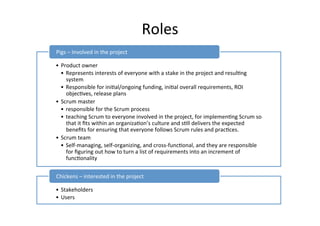
Roles	
  
• Product	
  owner	
  
• Represents	
  interests	
  of	
  everyone	
  with	
  a	
  stake	
  in	
  the	
  project	
  and	
  resul7ng	
  
system	
  
• Responsible	
  for	
  ini7al/ongoing	
  funding,	
  ini7al	
  overall	
  requirements,	
  ROI	
  
objec7ves,	
  release	
  plans	
  
• Scrum	
  master	
  
• responsible	
  for	
  the	
  Scrum	
  process	
  	
  
• teaching	
  Scrum	
  to	
  everyone	
  involved	
  in	
  the	
  project,	
  for	
  implemen7ng	
  Scrum	
  so	
  
that	
  it	
  fits	
  within	
  an	
  organiza7on’s	
  culture	
  and	
  s7ll	
  delivers	
  the	
  expected	
  
benefits	
  for	
  ensuring	
  that	
  everyone	
  follows	
  Scrum	
  rules	
  and	
  prac7ces.	
  
• Scrum	
  team	
  
• Self-­‐managing,	
  self-­‐organizing,	
  and	
  cross-­‐func7onal,	
  and	
  they	
  are	
  responsible	
  
for	
  figuring	
  out	
  how	
  to	
  turn	
  a	
  list	
  of	
  requirements	
  into	
  an	
  increment	
  of	
  
func7onality	
  
Pigs	
  –	
  Involved	
  in	
  the	
  project	
  
• Stakeholders	
  
• Users	
  
Chickens	
  –	
  interested	
  in	
  the	
  project	
  
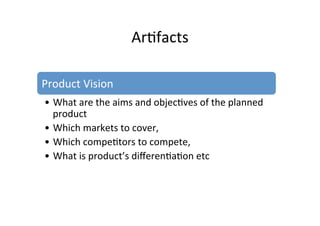
Ar7facts	
  
Product	
  Vision	
  
• What	
  are	
  the	
  aims	
  and	
  objec7ves	
  of	
  the	
  planned	
  
product	
  
• Which	
  markets	
  to	
  cover,	
  
• Which	
  compe7tors	
  to	
  compete,	
  
• What	
  is	
  product’s	
  differen7a7on	
  etc	
  
Ar7facts	
  (Cont…)	
  
Product	
  Backlog	
  
• Defini5on:	
  The	
  requirements	
  for	
  the	
  system	
  or	
  product	
  being	
  
developed	
  by	
  the	
  project(s)	
  are	
  listed	
  in	
  the	
  Product	
  Backlog.	
  
Responsible:	
  Product	
  Owner	
  for	
  the	
  contents,	
  priori7za7on,	
  and	
  
availability	
  of	
  the	
  Product	
  Backlog.	
  	
  
• Proper5es:	


• Never	
  complete	
  	
  
• Merely	
  an	
  ini7al	
  es7mate	
  of	
  the	
  requirements	
  
• Evolves	
  as	
  the	
  product	
  and	
  the	
  environment	
  in	
  which	
  it	
  will	
  be	
  
used	
  evolves	
  
• Dynamic	
  -­‐	
  	
  management	
  constantly	
  changes	
  it	
  to	
  iden7fy	
  what	
  
the	
  product	
  needs	
  to	
  be	
  appropriate,	
  compe77ve,	
  and	
  useful.	
  	
  
• Exists	
  as	
  long	
  as	
  a	
  product	
  exists	
  
Ar7facts	
  (Cont…)	
  
Sprint	
  Backlog	
  
• Defini5on:	
  defines	
  the	
  work,	
  or	
  tasks,	
  that	
  a	
  Team	
  defines	
  for	
  
turning	
  the	
  Product	
  Backlog	
  it	
  selected	
  for	
  that	
  Sprint	
  into	
  an	
  
increment	
  of	
  poten7ally	
  shippable	
  product	
  func7onality	
  
• Responsible:	
  The	
  Team	
  compiles	
  an	
  ini7al	
  list	
  of	
  these	
  tasks	
  in	
  
the	
  second	
  part	
  of	
  the	
  Sprint	
  planning	
  mee7ng	
  
• Proper5es:	


• Should	
  contain	
  tasks	
  such	
  that	
  each	
  task	
  takes	
  roughly	
  4	
  to	
  16	
  
hours	
  to	
  finish	
  
• Tasks	
  longer	
  than	
  4	
  to	
  16	
  hours	
  are	
  considered	
  mere	
  
placeholders	
  for	
  tasks	
  that	
  haven’t	
  yet	
  been	
  appropriately	
  
defined	
  
• Only	
  the	
  Team	
  can	
  change	
  it	
  
• Highly	
  visible,	
  real	
  7me	
  picture	
  of	
  the	
  current	
  Sprint	
  
Ar7facts	
  (Cont…)	
  
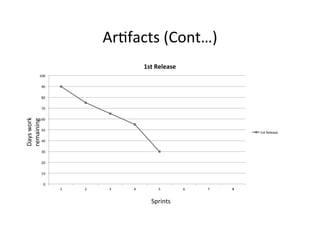
Burndown	
  Chart	
  
• Defini5on:	
  shows	
  the	
  amount	
  of	
  work	
  remaining	
  across	
  7me	
  
• Responsible:	
  The	
  Team	
  compiles	
  an	
  ini7al	
  list	
  of	
  these	
  tasks	
  in	
  
the	
  second	
  part	
  of	
  the	
  Sprint	
  planning	
  mee7ng	
  
• Proper5es:	


• Excellent	
  way	
  of	
  visualizing	
  the	
  correla7on	
  between	
  the	
  
amount	
  of	
  work	
  remaining	
  at	
  any	
  point	
  in	
  7me	
  and	
  the	
  
progress	
  of	
  the	
  project	
  Team(s)	
  in	
  reducing	
  this	
  work	
  
• Allows	
  to	
  “what	
  if”	
  the	
  project	
  by	
  adding	
  and	
  removing	
  
func7onality	
  from	
  the	
  release	
  to	
  get	
  a	
  more	
  acceptable	
  date	
  
or	
  extend	
  the	
  date	
  to	
  include	
  more	
  func7onality	
  
• Only	
  the	
  Team	
  can	
  change	
  it	
  
• Highly	
  visible,	
  real	
  7me	
  picture	
  of	
  the	
  current	
  Sprint	
  
Ar7facts	
  (Cont…)	
  
0	
  
10	
  
20	
  
30	
  
40	
  
50	
  
60	
  
70	
  
80	
  
90	
  
100	
  
1	
   2	
   3	
   4	
   5	
   6	
   7	
   8	
  
1st	
  Release	
  
1st	
  Release	
  
Days	
  
w
ork	
  
remaining	
  
Sprints	
  
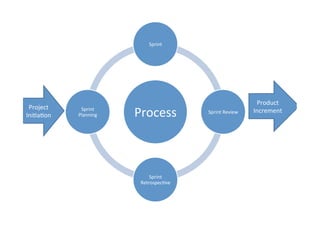
Process	
  
Sprint	
  
Sprint	
  Review	
  
Sprint	
  
Retrospec7ve	
  
Sprint	
  
Planning	
  
Project	
  
Ini7a7on	
  
Product	
  
Increment	
  
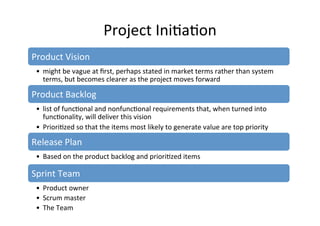
Project	
  Ini7a7on	
  
Product	
  Vision	
  
• might	
  be	
  vague	
  at	
  first,	
  perhaps	
  stated	
  in	
  market	
  terms	
  rather	
  than	
  system	
  
terms,	
  but	
  becomes	
  clearer	
  as	
  the	
  project	
  moves	
  forward	
  
Product	
  Backlog	
  
• list	
  of	
  func7onal	
  and	
  nonfunc7onal	
  requirements	
  that,	
  when	
  turned	
  into	
  
func7onality,	
  will	
  deliver	
  this	
  vision	
  
• Priori7zed	
  so	
  that	
  the	
  items	
  most	
  likely	
  to	
  generate	
  value	
  are	
  top	
  priority	
  
Release	
  Plan	
  
• Based	
  on	
  the	
  product	
  backlog	
  and	
  priori7zed	
  items	
  	
  
Sprint	
  Team	
  	
  
• Product	
  owner	
  
• Scrum	
  master	
  
• The	
  Team	
  
Project	
  Ini7a7on	
  (Cont…)	
  
Team	
  Forma7on	
  
• Introduc7ons	
  and	
  backgrounds	
  
• Team	
  name	
  
• Team	
  room	
  and	
  daily	
  Scrum	
  7me/place	
  
• Development	
  process	
  for	
  making	
  product	
  backlog	
  done	
  
• Defini7on	
  of	
  “Done”	
  for	
  product	
  and	
  Sprint	
  Backlog	
  items	
  
• Rules	
  of	
  development	
  
• Rules	
  of	
  e7quete,	
  and	
  	
  
• Training	
  in	
  conflict	
  resolu7on	
  
Sprint	
  Planning	
  Mee7ng	
  –	
  Part	
  1	
  
Purpose:	
  Commit	
  to	
  Product	
  Backlog	
  for	
  the	
  next	
  Sprint	
  
Steps	
  
• Calculate	
  The	
  Team	
  capacity.	
  Every	
  resource	
  is	
  100%	
  
allocated	
  less	
  10%	
  for	
  forward	
  looking	
  Product	
  Backlog	
  
analysis	
  and	
  10%	
  for	
  severity	
  1	
  issues	
  
• Commit	
  to	
  Product	
  Owner	
  as	
  much	
  backlog	
  as	
  the	
  Team	
  
believes	
  it	
  can	
  turn	
  into	
  a	
  “Done”	
  increment	
  in	
  the	
  Sprint	
  	
  
Sprint	
  Planning	
  Mee7ng	
  –	
  Part	
  2	
  
Purpose:	
  the	
  Team	
  plans	
  out	
  the	
  Sprint	
  
Steps	
  
• Self	
  managing	
  teams	
  requiring	
  a	
  tenta7ve	
  plan	
  to	
  start	
  the	
  
Sprint	
  
• Tasks	
  that	
  compose	
  this	
  plan	
  are	
  placed	
  in	
  a	
  Sprint	
  Backlog	
  
Sprint	
  
Daily	
  Scrum:	
  the	
  team	
  gets	
  together	
  for	
  a	
  15-­‐minute	
  
mee7ng	
  
Each	
  member	
  answers	
  
• What	
  have	
  you	
  done	
  on	
  this	
  project	
  since	
  the	
  last	
  Daily	
  Scrum	
  mee7ng?	
  	
  
• What	
  do	
  you	
  plan	
  on	
  doing	
  on	
  this	
  project	
  between	
  now	
  and	
  the	
  next	
  
Daily	
  Scrum	
  mee7ng?	
  	
  
• What	
  impediments	
  stand	
  in	
  the	
  way	
  of	
  you	
  mee7ng	
  your	
  commitments	
  to	
  
this	
  Sprint	
  and	
  this	
  project	
  
Do	
  not	
  forget	
  
• It	
  is	
  the	
  inspect	
  and	
  adapt	
  process	
  control	
  for	
  the	
  Team	
  
• The	
  3	
  ques7ons	
  provide	
  the	
  informa7on	
  the	
  Team	
  needs	
  (inspect)	
  to	
  
adjust	
  its	
  work	
  to	
  meet	
  its	
  commitments	
  
Sprint	
  (cont…)	
  
What	
  does	
  it	
  mean	
  when	
  a	
  team	
  member	
  
says	
  “done”	
  
• Code	
  adheres	
  to	
  the	
  standard	
  
• Is	
  clean	
  
• Has	
  been	
  refactored	
  
• Has	
  been	
  unit	
  tested	
  
• Has	
  been	
  checked	
  in	
  
• Has	
  been	
  built	
  
• Has	
  had	
  a	
  suite	
  of	
  unit	
  tests	
  applied	
  to	
  it	
  
Sprint	
  Review	
  
Purpose	
  
• Team	
  presents	
  what	
  was	
  developed	
  during	
  the	
  
Sprint	
  to	
  the	
  Product	
  Owner	
  and	
  any	
  other	
  
stakeholders	
  who	
  want	
  to	
  atend	
  
• 	
  Collabora7ve	
  work	
  session	
  to	
  inspect	
  and	
  adapt:	
  
the	
  most	
  current	
  Product	
  Backlog	
  and	
  the	
  
func7onality	
  increment	
  are	
  for	
  inspec7on,	
  the	
  
adapta7on	
  is	
  the	
  modified	
  Product	
  Backlog	
  
SCRUM	
  means	
  Visibility	
  
• Visibility	
  of	
  Progress,	
  Process	
  and	
  Sociology	
  
• Daily	
  SCRUM:	
  to	
  feel	
  the	
  tone,	
  avtude,	
  and	
  
progress	
  of	
  a	
  Sprint	
  
• Sprint	
  review	
  mee7ng:	
  monthly	
  insight	
  into	
  
whether	
  the	
  project	
  is	
  crea7ng	
  valuable	
  
func7onality,	
  as	
  well	
  as	
  the	
  quality	
  and	
  
capabili7es	
  of	
  that	
  func7onality	
  
• Product	
  Backlog:	
  details	
  a	
  project’s	
  requirements	
  
and	
  lists	
  them	
  in	
  order	
  of	
  priority	
  
• Formal	
  reports:	
  end	
  of	
  each	
  Sprint,	
  sta7c	
  
snapshot	
  of	
  the	
  project’s	
  progress	
  
Scrum	
  Retrospec7ve	
  
Purpose	
  
• Scrum	
  master	
  encourages	
  the	
  Team	
  to	
  revise,	
  
within	
  the	
  Scrum	
  process	
  framework	
  and	
  
prac7ces,	
  its	
  development	
  process	
  to	
  make	
  it	
  
more	
  effec7ve	
  and	
  enjoyable	
  for	
  the	
  next	
  Sprint	
  
Do	
  not	
  forget	
  
• Should	
  be	
  7me-­‐boxed	
  to	
  1-­‐3	
  hours	
  
• While	
  discussing	
  issues	
  the	
  Team	
  figures	
  out	
  
itself	
  how	
  to	
  address	
  the	
  issues	
  
Scrum	
  Team	
  Leader	
  comments	
  
[Rising2000]	
  
Scrum	
  Effects	
  
Scrum	
  Effects	
  
eXtreme Programming
• Introduced by Ward Cunningham, Kent Beck,
and Ron Jeffries.
• XP is what it says, an extreme way of
developing software.
– If a practice is good, then do it all the time.
– If a practice causes problems with project agility,
then don’t do it.
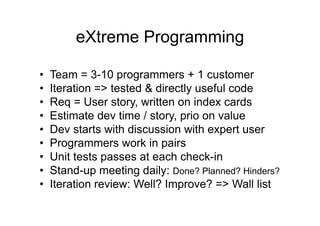
eXtreme Programming
• Team = 3-10 programmers + 1 customer
• Iteration => tested & directly useful code
• Req = User story, written on index cards
• Estimate dev time / story, prio on value
• Dev starts with discussion with expert user
• Programmers work in pairs
• Unit tests passes at each check-in
• Stand-up meeting daily: Done? Planned? Hinders?
• Iteration review: Well? Improve? => Wall list
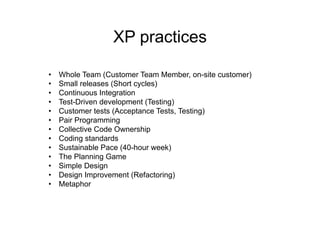
XP practices
• Whole Team (Customer Team Member, on-site customer)
• Small releases (Short cycles)
• Continuous Integration
• Test-Driven development (Testing)
• Customer tests (Acceptance Tests, Testing)
• Pair Programming
• Collective Code Ownership
• Coding standards
• Sustainable Pace (40-hour week)
• The Planning Game
• Simple Design
• Design Improvement (Refactoring)
• Metaphor
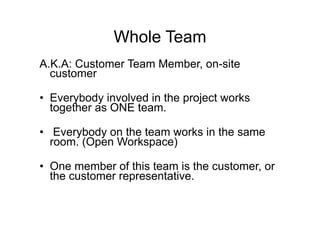
Whole Team
A.K.A: Customer Team Member, on-site
customer
• Everybody involved in the project works
together as ONE team.
• Everybody on the team works in the same
room. (Open Workspace)
• One member of this team is the customer, or
the customer representative.
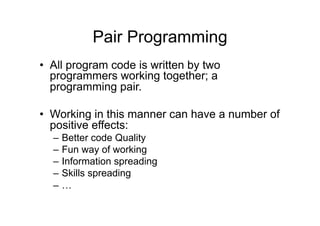
Pair Programming
• All program code is written by two
programmers working together; a
programming pair.
• Working in this manner can have a number of
positive effects:
– Better code Quality
– Fun way of working
– Information spreading
– Skills spreading
– …
Test-Driven development
A.K.A: Unit tests, Testing
• No single line of code is ever written,
without first writing a test that tests it.
• All tests are written in a test framework like
JUnit so they become fully automated.
Customer tests
A.K.A: Acceptance Tests, Testing
• The customer (or the one representing the
customer) writes tests that verifies that the
program fulfills his/her needs
Continuous Integration
• Daily build
– A working new version of the complete
software is released internally every night.
• Continuous build
– A new version of the complete software is
build as soon as some functionality is added,
removed or modified.
Collective Code Ownership
• All programmers are responsible for all code.
• You can change any code you like, and the
minute you check in your code somebody
else can change it.
• You should not take pride in and
responsibility for the quality of the code you
written yourself but rather for the complete
program.
Sustainable Pace
A.K.A: 40-hour week
• Work pace should be constant throughout
the project and at such a level that people
do not drain their energy reserves.
• Overtime is not allowed two weeks in a
row.
Simple design
• Never have a more complex design than is
needed for the current state of the
implementation.
• Make design decisions when you have to,
not up front.
Design Improvement
A.K.A: Refactoring
• Always try to find ways of improving the design
• Since design is not made up front it needs
constant attention in order to not end up with a
program looking like a snake pit.
• Strive for minimal, simple, comprehensive code.
Metaphor
• Try to find one or a few metaphors for your
program.
• The metaphors should aid in
communicating design decisions and
intends.
• The most well known software metaphor is
the desktop metaphor.
Coding standards
• In order to have a code base that is
readable and understandable by
everybody the team should use the same
coding style.
Small releases
A.K.A: Short cycles
• The software is frequently released and deployed to the customer.
• The time for each release is planned ahead and are never allowed
to slip. The functionality delivered with the release can however be
changed right up to the end.
• A typical XP project has a new release every 3 months.
• Each release is then divided into 1-2 week iterations.
Extra material
Sprint(Cont…)	
  
What	
  is	
  required	
  ?	
  
•Source	
  control	
  
•Con7nuous	
  integra7on	
  
•Unit	
  tes7ng	
  
•Feature	
  tes7ng	
  
Product	
  Backlog	
  Maintenance	
  
Agile	
  at	
  ICST	
  
Outline	
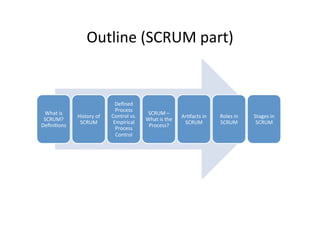
  (SCRUM	
  part)	
  
What	
  is	
  
SCRUM?	
  
Defini7ons	
  
History	
  of	
  
SCRUM	
  
Defined	
  
Process	
  
Control	
  vs.	
  
Empirical	
  
Process	
  
Control	
  
SCRUM	
  –	
  
What	
  is	
  the	
  
Process?	
  
Ar7facts	
  in	
  
SCRUM	
  
Roles	
  in	
  
SCRUM	
  
Stages	
  in	
  
SCRUM	
  
Ar7facts	
  (Cont…)	
  
Impediments	
  List	
  
• Defini5on:	
  shows	
  the	
  hurdles	
  in	
  day	
  to	
  day	
  
SCRUM	
  team	
  work	
  
• Responsible:	
  The	
  Team	
  compiles	
  and	
  maintains	
  
the	
  list	
  of	
  impediments	
  and	
  how	
  to	
  remove	
  them	
  
• Proper5es:	


• Highly	
  visible,	
  real	
  7me	
  picture	
  of	
  the	
  issues	
  
faced	
  by	
  the	
  SCRUM	
  teams	
  
• Impediments	
  brought	
  into	
  light	
  daily	
  
• The	
  Team	
  itself	
  decides	
  how	
  to	
  solve	
  them	
  
Velocity	
  of	
  SCRUM	
  Team	
  
• Velocity	
  is	
  a	
  measurement	
  of	
  how	
  much	
  the	
  
team	
  gets	
  done	
  in	
  an	
  itera7on	
  
• Velocity	
  is	
  what	
  actually	
  got	
  done	
  in	
  the	
  last	
  
itera7on	
  not	
  what	
  is	
  planned	
  
• Can	
  be	
  calculated	
  at	
  the	
  end	
  of	
  each	
  Sprint	
  
with	
  the	
  features	
  implemented	
  vs.	
  features	
  
planned	
  
Ar7facts	
  (Cont…)	
  
Increment	
  of	
  Poten7ally	
  Shippable	
  Product	
  
Func7onality	
  
• Defini5on:	
  Scrum	
  requires	
  Teams	
  to	
  build	
  an	
  increment	
  of	
  
product	
  func7onality	
  every	
  Sprint	
  
• Responsible:	
  The	
  Team	
  
• Proper5es:	


• Must	
  be	
  poten7ally	
  shippable	
  
• consist	
  of	
  thoroughly	
  tested,	
  well-­‐structured,	
  and	
  well-­‐writen	
  
code	
  that	
  has	
  been	
  built	
  into	
  an	
  executable	
  and	
  that	
  the	
  user	
  
opera7on	
  of	
  the	
  func7onality	
  is	
  documented,	
  either	
  in	
  Help	
  
files	
  or	
  in	
  user	
  documenta7on	
  
• Only	
  the	
  Team	
  can	
  change	
  it	
  
• Highly	
  visible,	
  real	
  7me	
  picture	
  of	
  the	
  current	
  Sprint	
  
Tricks	
  of	
  the	
  Trade	
  
Consensus	
  on	
  “Done”	
  
• Teach	
  SCRUM	
  team	
  to	
  manage	
  itself	
  
• Understand	
  all	
  aspects	
  of	
  what	
  the	
  team	
  is	
  doing	
  and	
  
frequently	
  correlate	
  its	
  ac7vi7es	
  in	
  order	
  to	
  deliver	
  a	
  
completed	
  set	
  of	
  func7onality	
  
• To	
  manage	
  itself,	
  a	
  team	
  must	
  have	
  a	
  plan	
  and	
  report	
  
against	
  that	
  plan	
  
• Tes7ng	
  is	
  not	
  someone	
  else’s	
  problem,	
  it’s	
  the	
  SCRUM	
  
team	
  problem	
  
• Separately	
  delineate	
  tes7ng	
  ac7vi7es	
  in	
  the	
  Sprint	
  
Backlog	
  un7l	
  the	
  team	
  understands	
  the	
  meaning	
  of	
  
the	
  word	
  “Done”	


SCRUM and XP Methodologies and Practices

  • 1.
    SCRUM  &  XP  –   Methodologies  &  Prac7ces   Robert  Feldt,  2012-­‐03-­‐19   Agile  Dev  Processes,  Chalmers    
  • 2.
    Defini7ons   List  of   requirements   Increment  of   func7onality   Itera7ve   Con7nuous   inspec7on  
  • 3.
  • 4.
    History  of  SCRUM   • 1986  -­‐  Hirotaka  Takeuchi  and  Ikujiro  Nonaka  described  a  new   holis7c  approach  that  increases  speed  and  flexibility  in  commercial   new  product  development   • 1991  -­‐  DeGrace  and  Stahl  referred  to  this  approach  as  SCRUM,  a   rugby  term  men7oned  in  the  ar7cle  by  Takeuchi  and  Nonaka   • Early  1990s,  Ken  Schwaber  used  an  approach  that  led  to  Scrum  at   his  company,  Advanced  Development  Methods   • At  the  same  7me,  Jeff  Sutherland,  John  Scumniotales,  and  Jeff   McKenna  developed  a  similar  approach  at  Easel  Corpora7on  and   were  the  first  to  call  it  Scrum   • 1995  Sutherland  and  Schwaber  jointly  presented  a  paper  describing   Scrum  at  OOPSLA  '95  in  Aus7n,  TX,  its  first  public  appearance   • 2001,  Schwaber  teamed  up  with  Mike  Beedle  to  describe  the   method  in  the  book  Agile  Soeware  Development  with  Scrum.  
  • 5.
    Defined  Process  Control  vs.  Empirical   Process  Control   • Laying  out  a  process  that  repeatedly  will   produce  acceptable  quality  output  is  called   defined  process  control   • When  defined  process  control  cannot  be   achieved  because  of  the  complexity  of  the   intermediate  ac7vi7es,  something  called   empirical  process  control  has  to  be  employed      
  • 6.
    • Defined  Process  control  (“non-­‐agile”)     -­‐ Planning  heavy   -­‐ Assumes  (more)  sta7c  environment   -­‐ Longer  itera7ons   -­‐ Change  Management  intensive   -­‐ Typical  pre-­‐study  heavy   -­‐ Assumes  good  es7ma7ons  (and  as  we  know…  es7ma7ons  are   nego7a7ons)…   -­‐ Process  and  Management    Control  over  Actual  work  (oeen   seen  as  bureaucra7c)  
  • 7.
    • Empirical  Process  control  (Agile)     -­‐ Change  is  reality   -­‐ Shorter  itera7ons   -­‐ Problem  vs.  solu7on  space  (empowering  the   developers)   -­‐ Just-­‐enough  (management,  documenta7on  etc)   -­‐ Self  organizing  teams   -­‐ Con7nous  “customer”  interac7on   -­‐ NOT  UNPLANNED  rather  adap7ve     XP   Scrum   Feature  Driven   Development   etc  
  • 8.
    Handling  complexity   Requirements   Complexity   Technical   complexity   People’s   Complexity   Short  itera5ons   (sprint)   Pigs  and   Chickens   Stand-­‐up   mee5ngs  (daily)   Self  organizing   teams   Builds  (fail  fast,   fail  oCen)   Reviews  and   learning   Do  what  you   want,  but  need   to  do   Sprint   overhead   Cost  of  review,   review  =   documenta5on   Large  teams   Distribu5on   Customer?  
  • 9.
    Tradi7onal  Waterfall  Approach   Analysis   Design   Develop   Test   Deploy   Agile  Approach   Analysis   Design   Develop   Test   Deploy   Analysis   Design   Develop   Test   Deploy   Analysis   Design   Develop   Test   Deploy   Most  Agile  methodologies  have  similar  concepts  
  • 10.
    SCRUM  –  What  is  the  Process?   Sprint  Backlog:   List  of   requirements   Increment  of   func7onality   Itera7ve   Con7nuous   inspec7on   VISION:  An7cipated   ROI,  releases,   milestones   Product  Backlog:   emerging,  priori7zed   requirements   (Selected   Product)  Sprint   Backlog  
  • 11.
    Roles   • Product  owner   • Represents  interests  of  everyone  with  a  stake  in  the  project  and  resul7ng   system   • Responsible  for  ini7al/ongoing  funding,  ini7al  overall  requirements,  ROI   objec7ves,  release  plans   • Scrum  master   • responsible  for  the  Scrum  process     • teaching  Scrum  to  everyone  involved  in  the  project,  for  implemen7ng  Scrum  so   that  it  fits  within  an  organiza7on’s  culture  and  s7ll  delivers  the  expected   benefits  for  ensuring  that  everyone  follows  Scrum  rules  and  prac7ces.   • Scrum  team   • Self-­‐managing,  self-­‐organizing,  and  cross-­‐func7onal,  and  they  are  responsible   for  figuring  out  how  to  turn  a  list  of  requirements  into  an  increment  of   func7onality   Pigs  –  Involved  in  the  project   • Stakeholders   • Users   Chickens  –  interested  in  the  project  
  • 12.
    Ar7facts   Product  Vision   • What  are  the  aims  and  objec7ves  of  the  planned   product   • Which  markets  to  cover,   • Which  compe7tors  to  compete,   • What  is  product’s  differen7a7on  etc  
  • 13.
    Ar7facts  (Cont…)   Product  Backlog   • Defini5on:  The  requirements  for  the  system  or  product  being   developed  by  the  project(s)  are  listed  in  the  Product  Backlog.   Responsible:  Product  Owner  for  the  contents,  priori7za7on,  and   availability  of  the  Product  Backlog.     • Proper5es:       • Never  complete     • Merely  an  ini7al  es7mate  of  the  requirements   • Evolves  as  the  product  and  the  environment  in  which  it  will  be   used  evolves   • Dynamic  -­‐    management  constantly  changes  it  to  iden7fy  what   the  product  needs  to  be  appropriate,  compe77ve,  and  useful.     • Exists  as  long  as  a  product  exists  
  • 14.
    Ar7facts  (Cont…)   Sprint  Backlog   • Defini5on:  defines  the  work,  or  tasks,  that  a  Team  defines  for   turning  the  Product  Backlog  it  selected  for  that  Sprint  into  an   increment  of  poten7ally  shippable  product  func7onality   • Responsible:  The  Team  compiles  an  ini7al  list  of  these  tasks  in   the  second  part  of  the  Sprint  planning  mee7ng   • Proper5es:       • Should  contain  tasks  such  that  each  task  takes  roughly  4  to  16   hours  to  finish   • Tasks  longer  than  4  to  16  hours  are  considered  mere   placeholders  for  tasks  that  haven’t  yet  been  appropriately   defined   • Only  the  Team  can  change  it   • Highly  visible,  real  7me  picture  of  the  current  Sprint  
  • 15.
    Ar7facts  (Cont…)   Burndown  Chart   • Defini5on:  shows  the  amount  of  work  remaining  across  7me   • Responsible:  The  Team  compiles  an  ini7al  list  of  these  tasks  in   the  second  part  of  the  Sprint  planning  mee7ng   • Proper5es:       • Excellent  way  of  visualizing  the  correla7on  between  the   amount  of  work  remaining  at  any  point  in  7me  and  the   progress  of  the  project  Team(s)  in  reducing  this  work   • Allows  to  “what  if”  the  project  by  adding  and  removing   func7onality  from  the  release  to  get  a  more  acceptable  date   or  extend  the  date  to  include  more  func7onality   • Only  the  Team  can  change  it   • Highly  visible,  real  7me  picture  of  the  current  Sprint  
  • 16.
    Ar7facts  (Cont…)   0   10   20   30   40   50   60   70   80   90   100   1   2   3   4   5   6   7   8   1st  Release   1st  Release   Days   w ork   remaining   Sprints  
  • 17.
    Process   Sprint   Sprint  Review   Sprint   Retrospec7ve   Sprint   Planning   Project   Ini7a7on   Product   Increment  
  • 18.
    Project  Ini7a7on   Product  Vision   • might  be  vague  at  first,  perhaps  stated  in  market  terms  rather  than  system   terms,  but  becomes  clearer  as  the  project  moves  forward   Product  Backlog   • list  of  func7onal  and  nonfunc7onal  requirements  that,  when  turned  into   func7onality,  will  deliver  this  vision   • Priori7zed  so  that  the  items  most  likely  to  generate  value  are  top  priority   Release  Plan   • Based  on  the  product  backlog  and  priori7zed  items     Sprint  Team     • Product  owner   • Scrum  master   • The  Team  
  • 19.
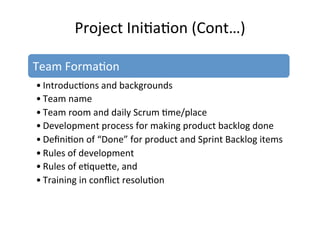
    Project  Ini7a7on  (Cont…)   Team  Forma7on   • Introduc7ons  and  backgrounds   • Team  name   • Team  room  and  daily  Scrum  7me/place   • Development  process  for  making  product  backlog  done   • Defini7on  of  “Done”  for  product  and  Sprint  Backlog  items   • Rules  of  development   • Rules  of  e7quete,  and     • Training  in  conflict  resolu7on  
  • 20.
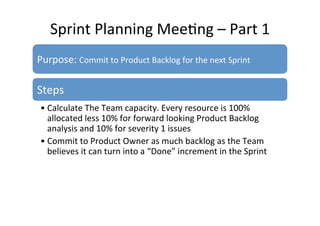
    Sprint  Planning  Mee7ng  –  Part  1   Purpose:  Commit  to  Product  Backlog  for  the  next  Sprint   Steps   • Calculate  The  Team  capacity.  Every  resource  is  100%   allocated  less  10%  for  forward  looking  Product  Backlog   analysis  and  10%  for  severity  1  issues   • Commit  to  Product  Owner  as  much  backlog  as  the  Team   believes  it  can  turn  into  a  “Done”  increment  in  the  Sprint    
  • 21.
    Sprint  Planning  Mee7ng  –  Part  2   Purpose:  the  Team  plans  out  the  Sprint   Steps   • Self  managing  teams  requiring  a  tenta7ve  plan  to  start  the   Sprint   • Tasks  that  compose  this  plan  are  placed  in  a  Sprint  Backlog  
  • 22.
    Sprint   Daily  Scrum:  the  team  gets  together  for  a  15-­‐minute   mee7ng   Each  member  answers   • What  have  you  done  on  this  project  since  the  last  Daily  Scrum  mee7ng?     • What  do  you  plan  on  doing  on  this  project  between  now  and  the  next   Daily  Scrum  mee7ng?     • What  impediments  stand  in  the  way  of  you  mee7ng  your  commitments  to   this  Sprint  and  this  project   Do  not  forget   • It  is  the  inspect  and  adapt  process  control  for  the  Team   • The  3  ques7ons  provide  the  informa7on  the  Team  needs  (inspect)  to   adjust  its  work  to  meet  its  commitments  
  • 23.
    Sprint  (cont…)   What  does  it  mean  when  a  team  member   says  “done”   • Code  adheres  to  the  standard   • Is  clean   • Has  been  refactored   • Has  been  unit  tested   • Has  been  checked  in   • Has  been  built   • Has  had  a  suite  of  unit  tests  applied  to  it  
  • 24.
    Sprint  Review   Purpose   • Team  presents  what  was  developed  during  the   Sprint  to  the  Product  Owner  and  any  other   stakeholders  who  want  to  atend   •  Collabora7ve  work  session  to  inspect  and  adapt:   the  most  current  Product  Backlog  and  the   func7onality  increment  are  for  inspec7on,  the   adapta7on  is  the  modified  Product  Backlog  
  • 25.
    SCRUM  means  Visibility   • Visibility  of  Progress,  Process  and  Sociology   • Daily  SCRUM:  to  feel  the  tone,  avtude,  and   progress  of  a  Sprint   • Sprint  review  mee7ng:  monthly  insight  into   whether  the  project  is  crea7ng  valuable   func7onality,  as  well  as  the  quality  and   capabili7es  of  that  func7onality   • Product  Backlog:  details  a  project’s  requirements   and  lists  them  in  order  of  priority   • Formal  reports:  end  of  each  Sprint,  sta7c   snapshot  of  the  project’s  progress  
  • 26.
    Scrum  Retrospec7ve   Purpose   • Scrum  master  encourages  the  Team  to  revise,   within  the  Scrum  process  framework  and   prac7ces,  its  development  process  to  make  it   more  effec7ve  and  enjoyable  for  the  next  Sprint   Do  not  forget   • Should  be  7me-­‐boxed  to  1-­‐3  hours   • While  discussing  issues  the  Team  figures  out   itself  how  to  address  the  issues  
  • 27.
    Scrum  Team  Leader  comments   [Rising2000]  
  • 28.
  • 29.
  • 30.
    eXtreme Programming • Introducedby Ward Cunningham, Kent Beck, and Ron Jeffries. • XP is what it says, an extreme way of developing software. – If a practice is good, then do it all the time. – If a practice causes problems with project agility, then don’t do it.
  • 31.
    eXtreme Programming • Team= 3-10 programmers + 1 customer • Iteration => tested & directly useful code • Req = User story, written on index cards • Estimate dev time / story, prio on value • Dev starts with discussion with expert user • Programmers work in pairs • Unit tests passes at each check-in • Stand-up meeting daily: Done? Planned? Hinders? • Iteration review: Well? Improve? => Wall list
  • 32.
    XP practices • WholeTeam (Customer Team Member, on-site customer) • Small releases (Short cycles) • Continuous Integration • Test-Driven development (Testing) • Customer tests (Acceptance Tests, Testing) • Pair Programming • Collective Code Ownership • Coding standards • Sustainable Pace (40-hour week) • The Planning Game • Simple Design • Design Improvement (Refactoring) • Metaphor
  • 33.
    Whole Team A.K.A: CustomerTeam Member, on-site customer • Everybody involved in the project works together as ONE team. • Everybody on the team works in the same room. (Open Workspace) • One member of this team is the customer, or the customer representative.
  • 34.
    Pair Programming • Allprogram code is written by two programmers working together; a programming pair. • Working in this manner can have a number of positive effects: – Better code Quality – Fun way of working – Information spreading – Skills spreading – …
  • 35.
    Test-Driven development A.K.A: Unittests, Testing • No single line of code is ever written, without first writing a test that tests it. • All tests are written in a test framework like JUnit so they become fully automated.
  • 36.
    Customer tests A.K.A: AcceptanceTests, Testing • The customer (or the one representing the customer) writes tests that verifies that the program fulfills his/her needs
  • 37.
    Continuous Integration • Dailybuild – A working new version of the complete software is released internally every night. • Continuous build – A new version of the complete software is build as soon as some functionality is added, removed or modified.
  • 38.
    Collective Code Ownership •All programmers are responsible for all code. • You can change any code you like, and the minute you check in your code somebody else can change it. • You should not take pride in and responsibility for the quality of the code you written yourself but rather for the complete program.
  • 39.
    Sustainable Pace A.K.A: 40-hourweek • Work pace should be constant throughout the project and at such a level that people do not drain their energy reserves. • Overtime is not allowed two weeks in a row.
  • 40.
    Simple design • Neverhave a more complex design than is needed for the current state of the implementation. • Make design decisions when you have to, not up front.
  • 41.
    Design Improvement A.K.A: Refactoring •Always try to find ways of improving the design • Since design is not made up front it needs constant attention in order to not end up with a program looking like a snake pit. • Strive for minimal, simple, comprehensive code.
  • 42.
    Metaphor • Try tofind one or a few metaphors for your program. • The metaphors should aid in communicating design decisions and intends. • The most well known software metaphor is the desktop metaphor.
  • 43.
    Coding standards • Inorder to have a code base that is readable and understandable by everybody the team should use the same coding style.
  • 44.
    Small releases A.K.A: Shortcycles • The software is frequently released and deployed to the customer. • The time for each release is planned ahead and are never allowed to slip. The functionality delivered with the release can however be changed right up to the end. • A typical XP project has a new release every 3 months. • Each release is then divided into 1-2 week iterations.
  • 45.
  • 46.
    Sprint(Cont…)   What  is  required  ?   •Source  control   •Con7nuous  integra7on   •Unit  tes7ng   •Feature  tes7ng   Product  Backlog  Maintenance  
  • 47.
  • 53.
    Outline  (SCRUM  part)   What  is   SCRUM?   Defini7ons   History  of   SCRUM   Defined   Process   Control  vs.   Empirical   Process   Control   SCRUM  –   What  is  the   Process?   Ar7facts  in   SCRUM   Roles  in   SCRUM   Stages  in   SCRUM  
  • 54.
    Ar7facts  (Cont…)   Impediments  List   • Defini5on:  shows  the  hurdles  in  day  to  day   SCRUM  team  work   • Responsible:  The  Team  compiles  and  maintains   the  list  of  impediments  and  how  to  remove  them   • Proper5es:       • Highly  visible,  real  7me  picture  of  the  issues   faced  by  the  SCRUM  teams   • Impediments  brought  into  light  daily   • The  Team  itself  decides  how  to  solve  them  
  • 55.
    Velocity  of  SCRUM  Team   • Velocity  is  a  measurement  of  how  much  the   team  gets  done  in  an  itera7on   • Velocity  is  what  actually  got  done  in  the  last   itera7on  not  what  is  planned   • Can  be  calculated  at  the  end  of  each  Sprint   with  the  features  implemented  vs.  features   planned  
  • 56.
    Ar7facts  (Cont…)   Increment  of  Poten7ally  Shippable  Product   Func7onality   • Defini5on:  Scrum  requires  Teams  to  build  an  increment  of   product  func7onality  every  Sprint   • Responsible:  The  Team   • Proper5es:       • Must  be  poten7ally  shippable   • consist  of  thoroughly  tested,  well-­‐structured,  and  well-­‐writen   code  that  has  been  built  into  an  executable  and  that  the  user   opera7on  of  the  func7onality  is  documented,  either  in  Help   files  or  in  user  documenta7on   • Only  the  Team  can  change  it   • Highly  visible,  real  7me  picture  of  the  current  Sprint  
  • 57.
    Tricks  of  the  Trade   Consensus  on  “Done”   • Teach  SCRUM  team  to  manage  itself   • Understand  all  aspects  of  what  the  team  is  doing  and   frequently  correlate  its  ac7vi7es  in  order  to  deliver  a   completed  set  of  func7onality   • To  manage  itself,  a  team  must  have  a  plan  and  report   against  that  plan   • Tes7ng  is  not  someone  else’s  problem,  it’s  the  SCRUM   team  problem   • Separately  delineate  tes7ng  ac7vi7es  in  the  Sprint   Backlog  un7l  the  team  understands  the  meaning  of   the  word  “Done”