Scripting 101
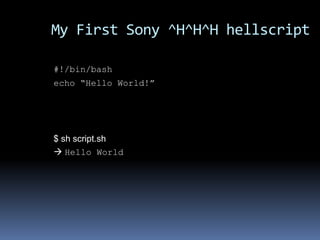
My First Sony ^H^H^H hellscript

#!/bin/bash
echo “Hello World!”


$ sh script.sh
 Hello World
Output redirection
There are 3 file descriptors:               Examples:
   stdin, stdout and stderr.
                                            1.    ls -l > ls-l.txt
Basically you can:                          2.   grep da * 2> grep-errors.txt
    redirect stdout to a file              3.   grep da * 1>&2
    redirect stderr to a file              4.   grep * 2>&1
    redirect stdout to a stderr            5.   rm -f $(find / -name core) &>
                                                 /dev/null
    redirect stderr to a stdout
    redirect stderr and stdout to a file
    redirect stderr and stdout to
     stdout
    redirect stderr and stdout to stderr

1 'represents' stdout and 2 stderr.
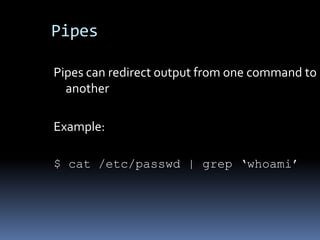
Pipes

Pipes can redirect output from one command to
  another

Example:

$ cat /etc/passwd | grep „whoami‟
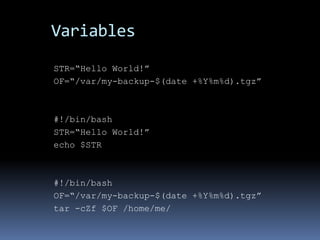
Variables
STR=“Hello World!”
OF=“/var/my-backup-$(date +%Y%m%d).tgz”


#!/bin/bash
STR=“Hello World!”
echo $STR


#!/bin/bash
OF=“/var/my-backup-$(date +%Y%m%d).tgz”
tar -cZf $OF /home/me/
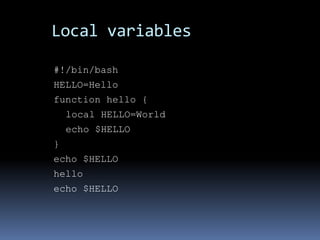
Local variables

#!/bin/bash
HELLO=Hello
function hello {
    local HELLO=World
    echo $HELLO
}
echo $HELLO
hello
echo $HELLO
Conditions
if [expression];                    Examples:
then
    code if 'expression' is true.   #!/bin/bash
                                    if [ "foo" = "foo" ]; then
fi                                       echo “expression
                                         evaluated as true”
                                    fi


                                    #!/bin/bash
if … then                           T1="foo"
else                                T2="bar"
                                    if [ "$T1" = "$T2" ]; then
elseif                                   echo “expression
                                         evaluated as true”
                                    else
                                           echo “expression
                                           evaluated as false”
                                    fi
Loops

3 kinds of loops   Examples:

                   #!/bin/bash
 for loop         for i in `seq 1 10`; do
                     echo $i
 while loop       Done
 until loop
                   #!/bin/bash
                   COUNTER=0
                   while [ $COUNTER -lt 10 ]; do
                     echo “The counter is “ $COUNTER
                     let COUNTER=COUNTER+1
                   done
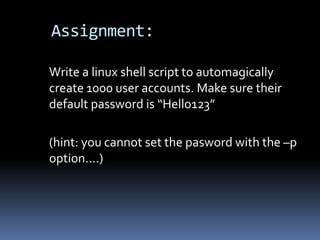
Assignment:

Write a linux shell script to automagically
create 1000 user accounts. Make sure their
default password is “Hello123”

(hint: you cannot set the pasword with the –p
option….)
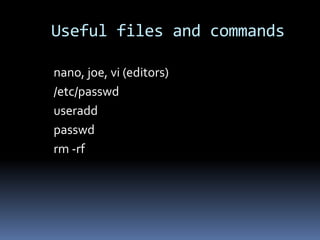
Useful files and commands

nano, joe, vi (editors)
/etc/passwd
useradd
passwd
rm -rf

Scripting 101

  • 1.
  • 2.
    My First Sony^H^H^H hellscript #!/bin/bash echo “Hello World!” $ sh script.sh  Hello World
  • 3.
    Output redirection There are3 file descriptors: Examples: stdin, stdout and stderr. 1. ls -l > ls-l.txt Basically you can: 2. grep da * 2> grep-errors.txt  redirect stdout to a file 3. grep da * 1>&2  redirect stderr to a file 4. grep * 2>&1  redirect stdout to a stderr 5. rm -f $(find / -name core) &> /dev/null  redirect stderr to a stdout  redirect stderr and stdout to a file  redirect stderr and stdout to stdout  redirect stderr and stdout to stderr 1 'represents' stdout and 2 stderr.
  • 4.
    Pipes Pipes can redirectoutput from one command to another Example: $ cat /etc/passwd | grep „whoami‟
  • 5.
    Variables STR=“Hello World!” OF=“/var/my-backup-$(date +%Y%m%d).tgz” #!/bin/bash STR=“HelloWorld!” echo $STR #!/bin/bash OF=“/var/my-backup-$(date +%Y%m%d).tgz” tar -cZf $OF /home/me/
  • 6.
    Local variables #!/bin/bash HELLO=Hello function hello{ local HELLO=World echo $HELLO } echo $HELLO hello echo $HELLO
  • 7.
    Conditions if [expression]; Examples: then code if 'expression' is true. #!/bin/bash if [ "foo" = "foo" ]; then fi echo “expression evaluated as true” fi #!/bin/bash if … then T1="foo" else T2="bar" if [ "$T1" = "$T2" ]; then elseif echo “expression evaluated as true” else echo “expression evaluated as false” fi
  • 8.
    Loops 3 kinds ofloops Examples: #!/bin/bash  for loop for i in `seq 1 10`; do echo $i  while loop Done  until loop #!/bin/bash COUNTER=0 while [ $COUNTER -lt 10 ]; do echo “The counter is “ $COUNTER let COUNTER=COUNTER+1 done
  • 9.
    Assignment: Write a linuxshell script to automagically create 1000 user accounts. Make sure their default password is “Hello123” (hint: you cannot set the pasword with the –p option….)
  • 10.
    Useful files andcommands nano, joe, vi (editors) /etc/passwd useradd passwd rm -rf