javaScript/jQuery
API for ScriptDB
Google Apps ScriptDB from a webapp
what is this API for?
● Allow maintenance and query Google Apps
Script ScriptDB directly from a client webapp
● Share data in real time between Google
Docs, webapps and Excel (using VBA API
for Excel)
● a free noSQL database for javascript
webapps and Excel
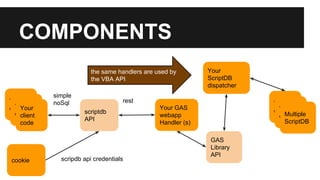
COMPONENTS
the same handlers are used by
the VBA API

Your
Your
Your
code
code
client
code

cookie

simple
noSql

Your
ScriptDB
dispatcher

rest
scriptdb
API

scripdb api credentials

Your
Your
code
Multiple
code
ScriptDB

Your GAS
webapp
Handler (s)
GAS
Library
API
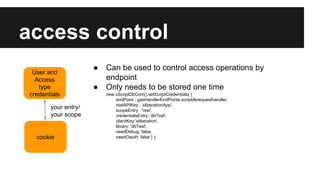
access control
User and
Access
type
credentials
your entry/
your scope

cookie

●
●

Can be used to control access operations by
endpoint
Only needs to be stored one time
new cScriptDbCom().setScriptCredentials( {
endPoint : gasHandlerEndPoints.scriptdbrequesthandler,
restAPIKey : 'xliberationApp',
scopeEntry : 'rest',
credentialsEntry: 'dbTest',
clientKey:'xliberation',
library: 'dbTest',
needDebug: false,
needOauth: false } );
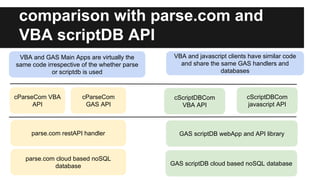
comparison with parse.com and
VBA scriptDB API
VBA and GAS Main Apps are virtually the
same code irrespective of the whether parse
or scriptdb is used

VBA and javascript clients have similar code
and share the same GAS handlers and
databases

cParseCom VBA
API

cScriptDBCom
VBA API

cParseCom
GAS API

cScriptDBCom
javascript API

parse.com restAPI handler

GAS scriptDB webApp and API library

parse.com cloud based noSQL
database

GAS scriptDB cloud based noSQL database
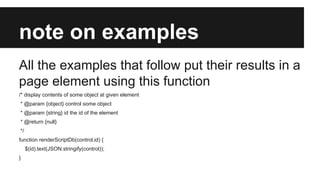
note on examples
All the examples that follow put their results in a
page element using this function
/* display contents of some object at given element
* @param {object} control some object
* @param {string} id the id of the element
* @return {null}
*/
function renderScriptDb(control,id) {
$(id).text(JSON.stringify(control));
}
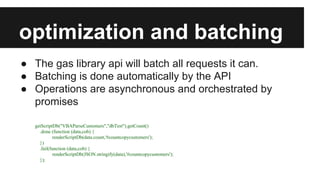
optimization and batching
● The gas library api will batch all requests it can.
● Batching is done automatically by the API
● Operations are asynchronous and orchestrated by
promises
getScriptDb("VBAParseCustomers","dbTest").getCount()
.done (function (data,cob) {
renderScriptDb(data.count,'#countcopycustomers');
})
.fail(function (data,cob) {
renderScriptDb(JSON.stringify(data),'#countcopycustomers');
});
example - create object (s)
Data is stored in silos within one or more ScriptDb
one object
dbTarget.createObject(data)
.done ( function(data) { .. do something good .. })
.fail ( function (error) { .. do something bad.. });

multiple objects
db.createObjects([some objects...])
.done( function (data) {...it worked..})
.fail( function (error) {...it failed..});
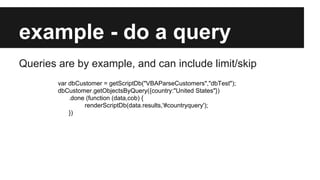
example - do a query
Queries are by example, and can include limit/skip
var dbCustomer = getScriptDb("VBAParseCustomers","dbTest");
dbCustomer.getObjectsByQuery({country:"United States"})
.done (function (data,cob) {
renderScriptDb(data.results,'#countryquery');
})
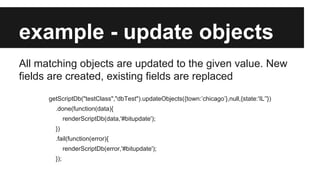
example - update objects
All matching objects are updated to the given value. New
fields are created, existing fields are replaced
getScriptDb("testClass","dbTest").updateObjects({town:’chicago’},null,{state:'IL’'})
.done(function(data){
renderScriptDb(data,'#bitupdate');
})
.fail(function(error){
renderScriptDb(error,'#bitupdate');
});
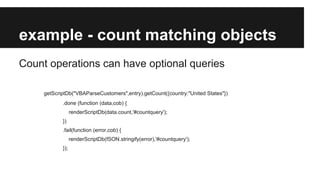
example - count matching objects
Count operations can have optional queries
getScriptDb("VBAParseCustomers",entry).getCount({country:"United States"})
.done (function (data,cob) {
renderScriptDb(data.count,'#countquery');
})
.fail(function (error,cob) {
renderScriptDb(fSON.stringify(error),'#countquery');
});
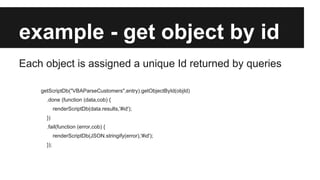
example - get object by id
Each object is assigned a unique Id returned by queries
getScriptDb("VBAParseCustomers",entry).getObjectById(objId)
.done (function (data,cob) {
renderScriptDb(data.results,'#id');
})
.fail(function (error,cob) {
renderScriptDb(JSON.stringify(error),'#id');
});
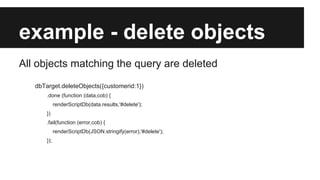
example - delete objects
All objects matching the query are deleted
dbTarget.deleteObjects({customerid:1})
.done (function (data,cob) {
renderScriptDb(data.results,'#delete');
})
.fail(function (error,cob) {
renderScriptDb(JSON.stringify(error),'#delete');
});
limits and skipping
Queries are subject to limits, so you can work multiple passes for big queries using skip/limit. A recursive convenience
method is provided to use, and show you how to do it (eg. db.getAllMatchingQueries({state:’IL’}) will take care of this
automatically as below - but watch out for memory usage)
self.getAllMatchingQueries = function (queryJob, queryParameters,list, defer) {
list = list || [];
defer = defer || $.Deferred();
var jobSkip = {skip:list.length};
self.getObjectsByQuery (queryJob, self.mergeParameters(queryParameters, jobSkip))
.done (function (data,defers) {
if (!data.results.length) {
defer.resolve(list);
}
else {
for (var i = 0 ; i < data.results.length; i++) {
list.push(data.results[i]);
}
self.getAllMatchingQueries(queryJob,queryParameters,list,defer);
}
})
.fail (function (error,defers){
defer.reject (error);
});
return defer.promise();
};

this is
automatically
handled for update
and delete
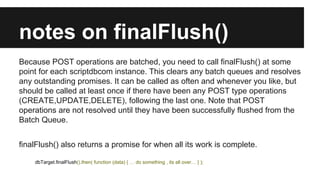
notes on finalFlush()
Because POST operations are batched, you need to call finalFlush() at some
point for each scriptdbcom instance. This clears any batch queues and resolves
any outstanding promises. It can be called as often and whenever you like, but
should be called at least once if there have been any POST type operations
(CREATE,UPDATE,DELETE), following the last one. Note that POST
operations are not resolved until they have been successfully flushed from the
Batch Queue.
finalFlush() also returns a promise for when all its work is complete.
dbTarget.finalFlush().then( function (data) { … do something , its all over… } );
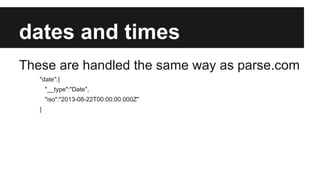
dates and times
These are handled the same way as parse.com
"date":{
"__type":"Date",
"iso":"2013-08-22T00:00:00.000Z"
}
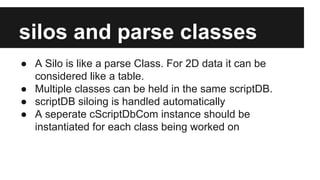
silos and parse classes
● A Silo is like a parse Class. For 2D data it can be
considered like a table.
● Multiple classes can be held in the same scriptDB.
● scriptDB siloing is handled automatically
● A seperate cScriptDbCom instance should be
instantiated for each class being worked on
multiple scriptDB
● The scriptDB dispatcher handled which actual scriptDB
to write to.
● Multiple DBs can be used by referencing multiple
libraries in the scriptDB dispatcher.
● Library names will be signalled to the dispatcher if they
are in the setup for this entry
restricting operations
You may want to allow a different kind of access to certain users.
●

provide a different URL or use the app keys to signal some restricted access , and include something like this in
the doGet() and doPost() functions

var whatsAllowed = ['query','count','getbyid'];
●

setting that configuration up under a different entry
new cScriptDbCom().setScriptCredentials( {
endPoint : gasHandlerEndPoints.scriptdbrequesthandler,
restAPIKey : 'xliberationApp',
scopeEntry : 'rest',
credentialsEntry: 'dbTest',
clientKey:'xliberation',
library: 'dbTest',
needDebug: false,
needOauth: false } );
accessing from other apps
● The scriptDB GAS handler API can be
accessed using any rest query mechanism.
● The VBA API and javaScript just manages
the conversation with the scriptDB GAS
handler
● Examples of other languages will be on
Excel Liberation at a later date.
public facing scriptdb
OAuth2 support is not yet released for the JavaScript
version (it is with the VBA one). This is because Google
Apps Script doesn’t yet support CORS (cross origin
resource sharing) for javaScript clients.
A temporary workaround for access control is described
here.
further detail
All this code is downloadable or copyable from
Google Apps Script Libraries.
For more information see Excel Liberation

JavaScript client API for Google Apps Script API primer

  • 1.
    javaScript/jQuery API for ScriptDB GoogleApps ScriptDB from a webapp
  • 2.
    what is thisAPI for? ● Allow maintenance and query Google Apps Script ScriptDB directly from a client webapp ● Share data in real time between Google Docs, webapps and Excel (using VBA API for Excel) ● a free noSQL database for javascript webapps and Excel
  • 3.
    COMPONENTS the same handlersare used by the VBA API Your Your Your code code client code cookie simple noSql Your ScriptDB dispatcher rest scriptdb API scripdb api credentials Your Your code Multiple code ScriptDB Your GAS webapp Handler (s) GAS Library API
  • 4.
    access control User and Access type credentials yourentry/ your scope cookie ● ● Can be used to control access operations by endpoint Only needs to be stored one time new cScriptDbCom().setScriptCredentials( { endPoint : gasHandlerEndPoints.scriptdbrequesthandler, restAPIKey : 'xliberationApp', scopeEntry : 'rest', credentialsEntry: 'dbTest', clientKey:'xliberation', library: 'dbTest', needDebug: false, needOauth: false } );
  • 5.
    comparison with parse.comand VBA scriptDB API VBA and GAS Main Apps are virtually the same code irrespective of the whether parse or scriptdb is used VBA and javascript clients have similar code and share the same GAS handlers and databases cParseCom VBA API cScriptDBCom VBA API cParseCom GAS API cScriptDBCom javascript API parse.com restAPI handler GAS scriptDB webApp and API library parse.com cloud based noSQL database GAS scriptDB cloud based noSQL database
  • 6.
    note on examples Allthe examples that follow put their results in a page element using this function /* display contents of some object at given element * @param {object} control some object * @param {string} id the id of the element * @return {null} */ function renderScriptDb(control,id) { $(id).text(JSON.stringify(control)); }
  • 7.
    optimization and batching ●The gas library api will batch all requests it can. ● Batching is done automatically by the API ● Operations are asynchronous and orchestrated by promises getScriptDb("VBAParseCustomers","dbTest").getCount() .done (function (data,cob) { renderScriptDb(data.count,'#countcopycustomers'); }) .fail(function (data,cob) { renderScriptDb(JSON.stringify(data),'#countcopycustomers'); });
  • 8.
    example - createobject (s) Data is stored in silos within one or more ScriptDb one object dbTarget.createObject(data) .done ( function(data) { .. do something good .. }) .fail ( function (error) { .. do something bad.. }); multiple objects db.createObjects([some objects...]) .done( function (data) {...it worked..}) .fail( function (error) {...it failed..});
  • 9.
    example - doa query Queries are by example, and can include limit/skip var dbCustomer = getScriptDb("VBAParseCustomers","dbTest"); dbCustomer.getObjectsByQuery({country:"United States"}) .done (function (data,cob) { renderScriptDb(data.results,'#countryquery'); })
  • 10.
    example - updateobjects All matching objects are updated to the given value. New fields are created, existing fields are replaced getScriptDb("testClass","dbTest").updateObjects({town:’chicago’},null,{state:'IL’'}) .done(function(data){ renderScriptDb(data,'#bitupdate'); }) .fail(function(error){ renderScriptDb(error,'#bitupdate'); });
  • 11.
    example - countmatching objects Count operations can have optional queries getScriptDb("VBAParseCustomers",entry).getCount({country:"United States"}) .done (function (data,cob) { renderScriptDb(data.count,'#countquery'); }) .fail(function (error,cob) { renderScriptDb(fSON.stringify(error),'#countquery'); });
  • 12.
    example - getobject by id Each object is assigned a unique Id returned by queries getScriptDb("VBAParseCustomers",entry).getObjectById(objId) .done (function (data,cob) { renderScriptDb(data.results,'#id'); }) .fail(function (error,cob) { renderScriptDb(JSON.stringify(error),'#id'); });
  • 13.
    example - deleteobjects All objects matching the query are deleted dbTarget.deleteObjects({customerid:1}) .done (function (data,cob) { renderScriptDb(data.results,'#delete'); }) .fail(function (error,cob) { renderScriptDb(JSON.stringify(error),'#delete'); });
  • 14.
    limits and skipping Queriesare subject to limits, so you can work multiple passes for big queries using skip/limit. A recursive convenience method is provided to use, and show you how to do it (eg. db.getAllMatchingQueries({state:’IL’}) will take care of this automatically as below - but watch out for memory usage) self.getAllMatchingQueries = function (queryJob, queryParameters,list, defer) { list = list || []; defer = defer || $.Deferred(); var jobSkip = {skip:list.length}; self.getObjectsByQuery (queryJob, self.mergeParameters(queryParameters, jobSkip)) .done (function (data,defers) { if (!data.results.length) { defer.resolve(list); } else { for (var i = 0 ; i < data.results.length; i++) { list.push(data.results[i]); } self.getAllMatchingQueries(queryJob,queryParameters,list,defer); } }) .fail (function (error,defers){ defer.reject (error); }); return defer.promise(); }; this is automatically handled for update and delete
  • 15.
    notes on finalFlush() BecausePOST operations are batched, you need to call finalFlush() at some point for each scriptdbcom instance. This clears any batch queues and resolves any outstanding promises. It can be called as often and whenever you like, but should be called at least once if there have been any POST type operations (CREATE,UPDATE,DELETE), following the last one. Note that POST operations are not resolved until they have been successfully flushed from the Batch Queue. finalFlush() also returns a promise for when all its work is complete. dbTarget.finalFlush().then( function (data) { … do something , its all over… } );
  • 16.
    dates and times Theseare handled the same way as parse.com "date":{ "__type":"Date", "iso":"2013-08-22T00:00:00.000Z" }
  • 17.
    silos and parseclasses ● A Silo is like a parse Class. For 2D data it can be considered like a table. ● Multiple classes can be held in the same scriptDB. ● scriptDB siloing is handled automatically ● A seperate cScriptDbCom instance should be instantiated for each class being worked on
  • 18.
    multiple scriptDB ● ThescriptDB dispatcher handled which actual scriptDB to write to. ● Multiple DBs can be used by referencing multiple libraries in the scriptDB dispatcher. ● Library names will be signalled to the dispatcher if they are in the setup for this entry
  • 19.
    restricting operations You maywant to allow a different kind of access to certain users. ● provide a different URL or use the app keys to signal some restricted access , and include something like this in the doGet() and doPost() functions var whatsAllowed = ['query','count','getbyid']; ● setting that configuration up under a different entry new cScriptDbCom().setScriptCredentials( { endPoint : gasHandlerEndPoints.scriptdbrequesthandler, restAPIKey : 'xliberationApp', scopeEntry : 'rest', credentialsEntry: 'dbTest', clientKey:'xliberation', library: 'dbTest', needDebug: false, needOauth: false } );
  • 20.
    accessing from otherapps ● The scriptDB GAS handler API can be accessed using any rest query mechanism. ● The VBA API and javaScript just manages the conversation with the scriptDB GAS handler ● Examples of other languages will be on Excel Liberation at a later date.
  • 21.
    public facing scriptdb OAuth2support is not yet released for the JavaScript version (it is with the VBA one). This is because Google Apps Script doesn’t yet support CORS (cross origin resource sharing) for javaScript clients. A temporary workaround for access control is described here.
  • 22.
    further detail All thiscode is downloadable or copyable from Google Apps Script Libraries. For more information see Excel Liberation