Climate Change in Scotland: targets, policies and assessment Liam Kelly Climate Change Division
Introduction Climate Change (Scotland) Bill Mitigation: delivering the 80% target Carbon assessment
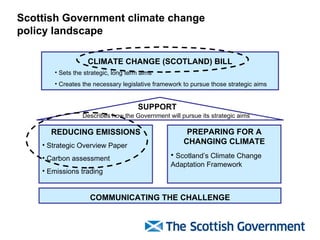
Scottish Government climate change policy landscape CLIMATE CHANGE (SCOTLAND) BILL Sets the strategic, long term aims Creates the necessary legislative framework to pursue those strategic aims   SUPPORT Describes how the Government will pursue its strategic aims REDUCING EMISSIONS Strategic Overview Paper Carbon assessment Emissions trading PREPARING FOR A CHANGING CLIMATE Scotland’s Climate Change Adaptation Framework COMMUNICATING THE CHALLENGE
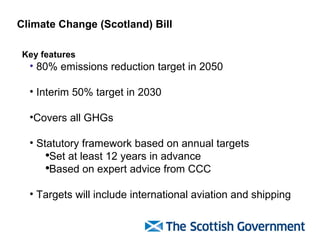
Climate Change (Scotland) Bill 80% emissions reduction target in 2050 Interim 50% target in 2030 Covers all GHGs Statutory framework based on annual targets Set at least 12 years in advance Based on expert advice from CCC Targets will include international aviation and shipping Key features
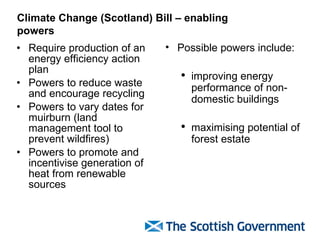
Require production of an energy efficiency action plan Powers to reduce waste and encourage recycling Powers to vary dates for muirburn (land management tool to prevent wildfires) Powers to promote and incentivise generation of heat from renewable sources Climate Change (Scotland) Bill – enabling powers Possible powers include:  improving energy performance of non-domestic buildings maximising potential of forest estate
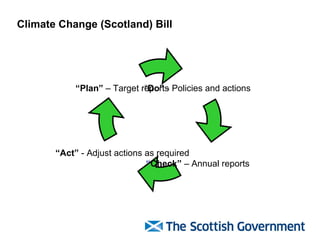
Climate Change (Scotland) Bill “ Do”  - Policies and actions “ Check”  – Annual reports “ Act”  - Adjust actions as required “ Plan”  – Target reports
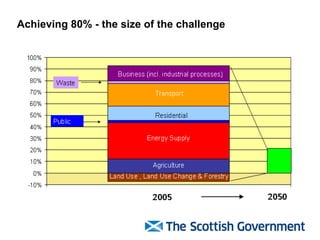
Achieving 80% - the size of the challenge
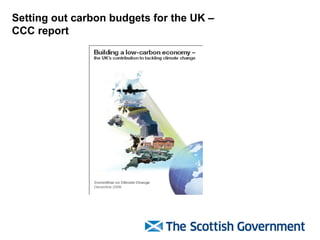
Setting out carbon budgets for the UK – CCC report
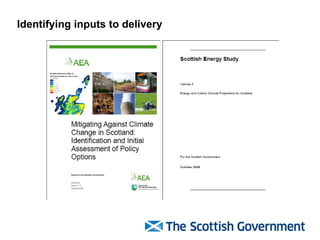
Identifying inputs to delivery
Assumes delivery of existing and planned policies Improved vehicle technologies and “smarter choices” CCS for energy generation and industry Increased forest area Renewable heat Building energy efficiency Inputs to the delivery work
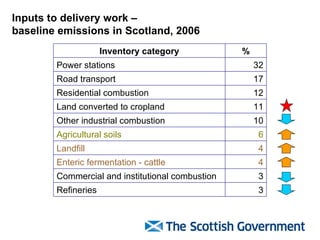
Inputs to delivery work – baseline emissions in Scotland, 2006 Inventory category % Power stations 32 Road transport 17 Residential combustion 12 Land converted to cropland 11 Other industrial combustion 10 Agricultural soils 6 Landfill 4 Enteric fermentation - cattle 4 Commercial and institutional combustion 3 Refineries 3
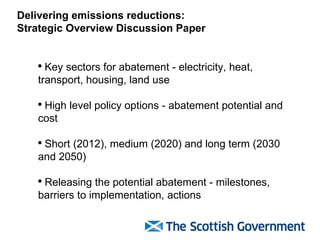
Delivering emissions reductions: Strategic Overview Discussion Paper Key sectors for abatement - electricity, heat, transport, housing, land use High level policy options - abatement potential and cost Short (2012), medium (2020) and long term (2030 and 2050) Releasing the potential abatement - milestones, barriers to implementation, actions
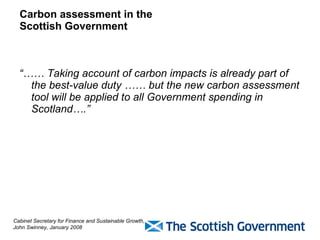
Carbon assessment in the  Scottish Government “……  Taking account of carbon impacts is already part of the best-value duty …… but the new carbon assessment tool will be applied to all Government spending in Scotland….” Cabinet Secretary for Finance and Sustainable Growth, John Swinney, January 2008
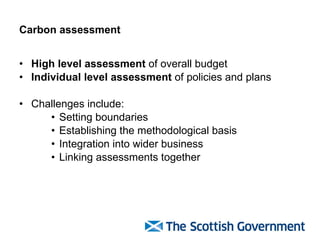
Carbon assessment High level assessment  of overall budget Individual level assessment  of policies and plans Challenges include: Setting boundaries Establishing the methodological basis  Integration into wider business Linking assessments together
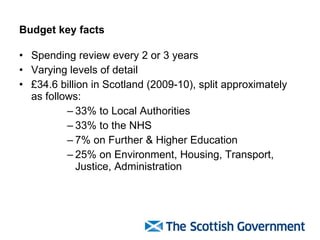
Budget key facts Spending review every 2 or 3 years Varying levels of detail £34.6 billion in Scotland (2009-10), split approximately as follows: 33% to Local Authorities  33% to the NHS  7% on Further & Higher Education 25% on Environment, Housing, Transport, Justice, Administration
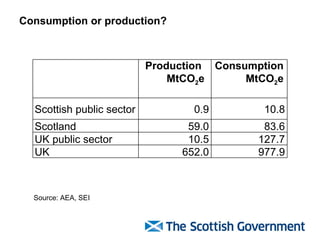
Consumption or production? Source: AEA, SEI Production  MtCO 2 e Consumption MtCO 2 e Scottish public sector 0.9 10.8 Scotland 59.0 83.6 UK public sector 10.5 127.7 UK 652.0 977.9
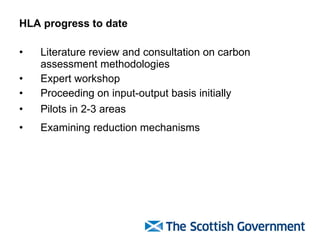
HLA progress to date Literature review and consultation on carbon assessment methodologies Expert workshop Proceeding on input-output basis initially Pilots in 2-3 areas  Examining reduction mechanisms
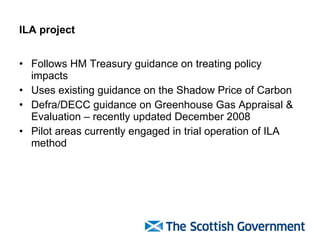
ILA project Follows HM Treasury guidance on treating policy impacts Uses existing guidance on the Shadow Price of Carbon  Defra/DECC guidance on Greenhouse Gas Appraisal & Evaluation – recently updated December 2008 Pilot areas currently engaged in trial operation of ILA method
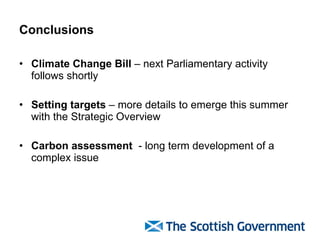
Conclusions Climate Change Bill  – next Parliamentary activity follows shortly Setting targets  – more details to emerge this summer with the Strategic Overview Carbon assessment  - long term development of a complex issue

Scottish Government Drivers | Liam Kelly

  • 1.
    Climate Change inScotland: targets, policies and assessment Liam Kelly Climate Change Division
  • 2.
    Introduction Climate Change(Scotland) Bill Mitigation: delivering the 80% target Carbon assessment
  • 3.
    Scottish Government climatechange policy landscape CLIMATE CHANGE (SCOTLAND) BILL Sets the strategic, long term aims Creates the necessary legislative framework to pursue those strategic aims SUPPORT Describes how the Government will pursue its strategic aims REDUCING EMISSIONS Strategic Overview Paper Carbon assessment Emissions trading PREPARING FOR A CHANGING CLIMATE Scotland’s Climate Change Adaptation Framework COMMUNICATING THE CHALLENGE
  • 4.
    Climate Change (Scotland)Bill 80% emissions reduction target in 2050 Interim 50% target in 2030 Covers all GHGs Statutory framework based on annual targets Set at least 12 years in advance Based on expert advice from CCC Targets will include international aviation and shipping Key features
  • 5.
    Require production ofan energy efficiency action plan Powers to reduce waste and encourage recycling Powers to vary dates for muirburn (land management tool to prevent wildfires) Powers to promote and incentivise generation of heat from renewable sources Climate Change (Scotland) Bill – enabling powers Possible powers include: improving energy performance of non-domestic buildings maximising potential of forest estate
  • 6.
    Climate Change (Scotland)Bill “ Do” - Policies and actions “ Check” – Annual reports “ Act” - Adjust actions as required “ Plan” – Target reports
  • 7.
    Achieving 80% -the size of the challenge
  • 8.
    Setting out carbonbudgets for the UK – CCC report
  • 9.
  • 10.
    Assumes delivery ofexisting and planned policies Improved vehicle technologies and “smarter choices” CCS for energy generation and industry Increased forest area Renewable heat Building energy efficiency Inputs to the delivery work
  • 11.
    Inputs to deliverywork – baseline emissions in Scotland, 2006 Inventory category % Power stations 32 Road transport 17 Residential combustion 12 Land converted to cropland 11 Other industrial combustion 10 Agricultural soils 6 Landfill 4 Enteric fermentation - cattle 4 Commercial and institutional combustion 3 Refineries 3
  • 12.
    Delivering emissions reductions:Strategic Overview Discussion Paper Key sectors for abatement - electricity, heat, transport, housing, land use High level policy options - abatement potential and cost Short (2012), medium (2020) and long term (2030 and 2050) Releasing the potential abatement - milestones, barriers to implementation, actions
  • 13.
    Carbon assessment inthe Scottish Government “…… Taking account of carbon impacts is already part of the best-value duty …… but the new carbon assessment tool will be applied to all Government spending in Scotland….” Cabinet Secretary for Finance and Sustainable Growth, John Swinney, January 2008
  • 14.
    Carbon assessment Highlevel assessment of overall budget Individual level assessment of policies and plans Challenges include: Setting boundaries Establishing the methodological basis Integration into wider business Linking assessments together
  • 15.
    Budget key factsSpending review every 2 or 3 years Varying levels of detail £34.6 billion in Scotland (2009-10), split approximately as follows: 33% to Local Authorities 33% to the NHS 7% on Further & Higher Education 25% on Environment, Housing, Transport, Justice, Administration
  • 16.
    Consumption or production?Source: AEA, SEI Production MtCO 2 e Consumption MtCO 2 e Scottish public sector 0.9 10.8 Scotland 59.0 83.6 UK public sector 10.5 127.7 UK 652.0 977.9
  • 17.
    HLA progress todate Literature review and consultation on carbon assessment methodologies Expert workshop Proceeding on input-output basis initially Pilots in 2-3 areas Examining reduction mechanisms
  • 18.
    ILA project FollowsHM Treasury guidance on treating policy impacts Uses existing guidance on the Shadow Price of Carbon Defra/DECC guidance on Greenhouse Gas Appraisal & Evaluation – recently updated December 2008 Pilot areas currently engaged in trial operation of ILA method
  • 19.
    Conclusions Climate ChangeBill – next Parliamentary activity follows shortly Setting targets – more details to emerge this summer with the Strategic Overview Carbon assessment - long term development of a complex issue

Editor's Notes

  • #8 To explain that the public sector figure may look small but it only represents its direct emissions as reported in the disaggregated GHG Inventory.