This work is supported by a National Science Foundation (NSF) collaboration between the
Directorates for Education and Human Resources (EHR) and Geosciences (GEO) under grant DUE - 1125331
Scope of InTeGrate-developed
Modules and Courses
Anne Egger
Original goal
… to develop curricula that will dramatically increase geoscience
literacy of all undergraduate students, including the large majority
that do not major in the geosciences, those who are historically
under-represented in the geosciences, and future K-12 teachers,
such that they are better positioned to make sustainable decisions
in their lives and as part of the broader society.
Target audiences
• Introductory geoscience
• Interdisciplinary courses (both intro and advanced)
• Geoscience for non-geoscience science majors
• Teacher preparation courses
• And beyond…
Materials will be designed to:
1. Develop geoscience literacy in a broad array
of students;
2. Emphasize the process of science; and
3. Build interdisciplinary problem-solving skills
that connect Earth science with economic,
societal and policy issues throughout the
curriculum.
Alignment with literacy documents
Alignment with grand challenges
Alignment
with NGSS
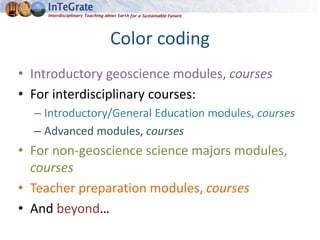
Color coding
• Introductory geoscience modules, courses
• For interdisciplinary courses:
– Introductory/General Education modules, courses
– Advanced modules, courses
• For non-geoscience science majors modules,
courses
• Teacher preparation modules, courses
• And beyond…
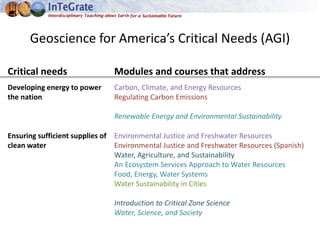
Geoscience for America’s Critical Needs (AGI)
Critical needs Modules and courses that address
Developing energy to power
the nation
Carbon, Climate, and Energy Resources
Regulating Carbon Emissions
Renewable Energy and Environmental Sustainability
Ensuring sufficient supplies of
clean water
Environmental Justice and Freshwater Resources
Environmental Justice and Freshwater Resources (Spanish)
Water, Agriculture, and Sustainability
An Ecosystem Services Approach to Water Resources
Food, Energy, Water Systems
Water Sustainability in Cities
Introduction to Critical Zone Science
Water, Science, and Society
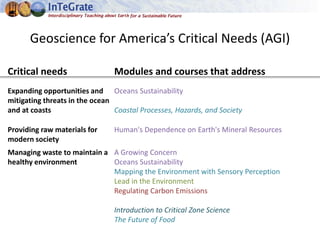
Geoscience for America’s Critical Needs (AGI)
Critical needs Modules and courses that address
Expanding opportunities and
mitigating threats in the ocean
and at coasts
Oceans Sustainability
Coastal Processes, Hazards, and Society
Providing raw materials for
modern society
Human's Dependence on Earth's Mineral Resources
Managing waste to maintain a
healthy environment
A Growing Concern
Oceans Sustainability
Mapping the Environment with Sensory Perception
Lead in the Environment
Regulating Carbon Emissions
Introduction to Critical Zone Science
The Future of Food
Geoscience for America’s Critical Needs (AGI)
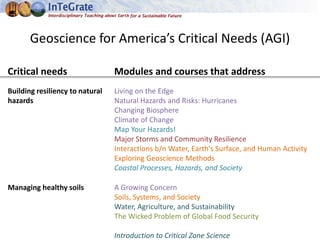
Critical needs Modules and courses that address
Building resiliency to natural
hazards
Living on the Edge
Natural Hazards and Risks: Hurricanes
Changing Biosphere
Climate of Change
Map Your Hazards!
Major Storms and Community Resilience
Interactions b/n Water, Earth's Surface, and Human Activity
Exploring Geoscience Methods
Coastal Processes, Hazards, and Society
Managing healthy soils A Growing Concern
Soils, Systems, and Society
Water, Agriculture, and Sustainability
The Wicked Problem of Global Food Security
Introduction to Critical Zone Science
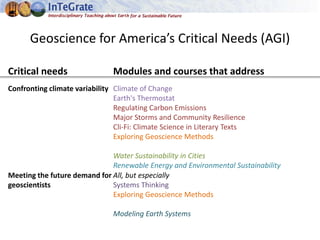
Critical needs Modules and courses that address
Confronting climate variability Climate of Change
Earth's Thermostat
Regulating Carbon Emissions
Major Storms and Community Resilience
Cli-Fi: Climate Science in Literary Texts
Exploring Geoscience Methods
Water Sustainability in Cities
Renewable Energy and Environmental Sustainability
Meeting the future demand for
geoscientists
All, but especially
Systems Thinking
Exploring Geoscience Methods
Modeling Earth Systems
Geoscience for America’s Critical Needs (AGI)
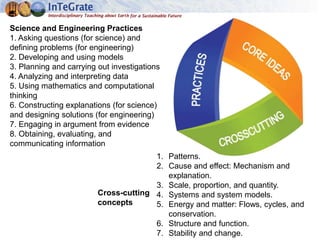
Science and Engineering Practices
1. Asking questions (for science) and
defining problems (for engineering)
2. Developing and using models
3. Planning and carrying out investigations
4. Analyzing and interpreting data
5. Using mathematics and computational
thinking
6. Constructing explanations (for science)
and designing solutions (for engineering)
7. Engaging in argument from evidence
8. Obtaining, evaluating, and
communicating information
1. Patterns.
2. Cause and effect: Mechanism and
explanation.
3. Scale, proportion, and quantity.
4. Systems and system models.
5. Energy and matter: Flows, cycles, and
conservation.
6. Structure and function.
7. Stability and change.
Cross-cutting
concepts
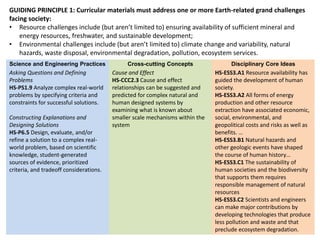
GUIDING PRINCIPLE 1: Curricular materials must address one or more Earth-related grand challenges
facing society:
• Resource challenges include (but aren’t limited to) ensuring availability of sufficient mineral and
energy resources, freshwater, and sustainable development;
• Environmental challenges include (but aren’t limited to) climate change and variability, natural
hazards, waste disposal, environmental degradation, pollution, ecosystem services.
Science and Engineering Practices Cross-cutting Concepts Disciplinary Core Ideas
Asking Questions and Defining
Problems
HS-PS1.9 Analyze complex real-world
problems by specifying criteria and
constraints for successful solutions.
Constructing Explanations and
Designing Solutions
HS-P6.5 Design, evaluate, and/or
refine a solution to a complex real-
world problem, based on scientific
knowledge, student-generated
sources of evidence, prioritized
criteria, and tradeoff considerations.
Cause and Effect
HS-CCC2.3 Cause and effect
relationships can be suggested and
predicted for complex natural and
human designed systems by
examining what is known about
smaller scale mechanisms within the
system
HS-ESS3.A1 Resource availability has
guided the development of human
society.
HS-ESS3.A2 All forms of energy
production and other resource
extraction have associated economic,
social, environmental, and
geopolitical costs and risks as well as
benefits. …
HS-ESS3.B1 Natural hazards and
other geologic events have shaped
the course of human history…
HS-ESS3.C1 The sustainability of
human societies and the biodiversity
that supports them requires
responsible management of natural
resources
HS-ESS3.C2 Scientists and engineers
can make major contributions by
developing technologies that produce
less pollution and waste and that
preclude ecosystem degradation.
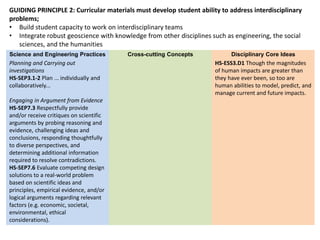
GUIDING PRINCIPLE 2: Curricular materials must develop student ability to address interdisciplinary
problems;
• Build student capacity to work on interdisciplinary teams
• Integrate robust geoscience with knowledge from other disciplines such as engineering, the social
sciences, and the humanities
Science and Engineering Practices Cross-cutting Concepts Disciplinary Core Ideas
Planning and Carrying out
investigations
HS-SEP3.1-2 Plan ... individually and
collaboratively...
Engaging in Argument from Evidence
HS-SEP7.3 Respectfully provide
and/or receive critiques on scientific
arguments by probing reasoning and
evidence, challenging ideas and
conclusions, responding thoughtfully
to diverse perspectives, and
determining additional information
required to resolve contradictions.
HS-SEP7.6 Evaluate competing design
solutions to a real-world problem
based on scientific ideas and
principles, empirical evidence, and/or
logical arguments regarding relevant
factors (e.g. economic, societal,
environmental, ethical
considerations).
HS-ESS3.D1 Though the magnitudes
of human impacts are greater than
they have ever been, so too are
human abilities to model, predict, and
manage current and future impacts.
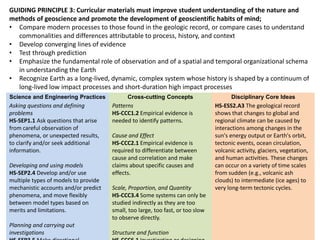
GUIDING PRINCIPLE 3: Curricular materials must improve student understanding of the nature and
methods of geoscience and promote the development of geoscientific habits of mind;
• Compare modern processes to those found in the geologic record, or compare cases to understand
commonalities and differences attributable to process, history, and context
• Develop converging lines of evidence
• Test through prediction
• Emphasize the fundamental role of observation and of a spatial and temporal organizational schema
in understanding the Earth
• Recognize Earth as a long-lived, dynamic, complex system whose history is shaped by a continuum of
long-lived low impact processes and short-duration high impact processes
Science and Engineering Practices Cross-cutting Concepts Disciplinary Core Ideas
Asking questions and defining
problems
HS-SEP1.1 Ask questions that arise
from careful observation of
phenomena, or unexpected results,
to clarify and/or seek additional
information.
Developing and using models
HS-SEP2.4 Develop and/or use
multiple types of models to provide
mechanistic accounts and/or predict
phenomena, and move flexibly
between model types based on
merits and limitations.
Planning and carrying out
investigations
Patterns
HS-CCC1.2 Empirical evidence is
needed to identify patterns.
Cause and Effect
HS-CCC2.1 Empirical evidence is
required to differentiate between
cause and correlation and make
claims about specific causes and
effects.
Scale, Proportion, and Quantity
HS-CCC3.4 Some systems can only be
studied indirectly as they are too
small, too large, too fast, or too slow
to observe directly.
Structure and function
HS-ESS2.A3 The geological record
shows that changes to global and
regional climate can be caused by
interactions among changes in the
sun's energy output or Earth's orbit,
tectonic events, ocean circulation,
volcanic activity, glaciers, vegetation,
and human activities. These changes
can occur on a variety of time scales
from sudden (e.g., volcanic ash
clouds) to intermediate (ice ages) to
very long-term tectonic cycles.
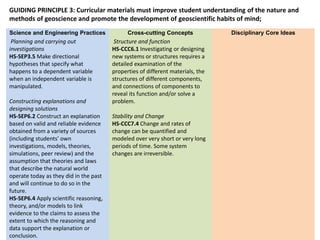
GUIDING PRINCIPLE 3: Curricular materials must improve student understanding of the nature and
methods of geoscience and promote the development of geoscientific habits of mind;
Science and Engineering Practices Cross-cutting Concepts Disciplinary Core Ideas
Planning and carrying out
investigations
HS-SEP3.5 Make directional
hypotheses that specify what
happens to a dependent variable
when an independent variable is
manipulated.
Constructing explanations and
designing solutions
HS-SEP6.2 Construct an explanation
based on valid and reliable evidence
obtained from a variety of sources
(including students' own
investigations, models, theories,
simulations, peer review) and the
assumption that theories and laws
that describe the natural world
operate today as they did in the past
and will continue to do so in the
future.
HS-SEP6.4 Apply scientific reasoning,
theory, and/or models to link
evidence to the claims to assess the
extent to which the reasoning and
data support the explanation or
conclusion.
Structure and function
HS-CCC6.1 Investigating or designing
new systems or structures requires a
detailed examination of the
properties of different materials, the
structures of different components,
and connections of components to
reveal its function and/or solve a
problem.
Stability and Change
HS-CCC7.4 Change and rates of
change can be quantified and
modeled over very short or very long
periods of time. Some system
changes are irreversible.
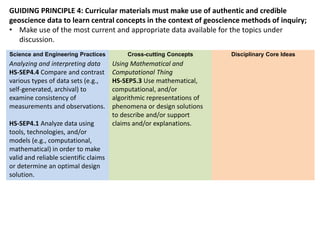
GUIDING PRINCIPLE 4: Curricular materials must make use of authentic and credible
geoscience data to learn central concepts in the context of geoscience methods of inquiry;
• Make use of the most current and appropriate data available for the topics under
discussion.
Science and Engineering Practices Cross-cutting Concepts Disciplinary Core Ideas
Analyzing and interpreting data
HS-SEP4.4 Compare and contrast
various types of data sets (e.g.,
self-generated, archival) to
examine consistency of
measurements and observations.
HS-SEP4.1 Analyze data using
tools, technologies, and/or
models (e.g., computational,
mathematical) in order to make
valid and reliable scientific claims
or determine an optimal design
solution.
Using Mathematical and
Computational Thing
HS-SEP5.3 Use mathematical,
computational, and/or
algorithmic representations of
phenomena or design solutions
to describe and/or support
claims and/or explanations.
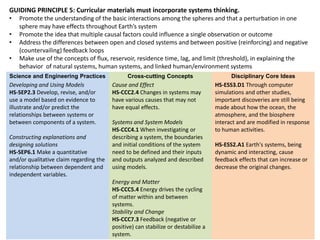
GUIDING PRINCIPLE 5: Curricular materials must incorporate systems thinking.
• Promote the understanding of the basic interactions among the spheres and that a perturbation in one
sphere may have effects throughout Earth’s system
• Promote the idea that multiple causal factors could influence a single observation or outcome
• Address the differences between open and closed systems and between positive (reinforcing) and negative
(countervailing) feedback loops
• Make use of the concepts of flux, reservoir, residence time, lag, and limit (threshold), in explaining the
behavior of natural systems, human systems, and linked human/environment systems
Science and Engineering Practices Cross-cutting Concepts Disciplinary Core Ideas
Developing and Using Models
HS-SEP2.3 Develop, revise, and/or
use a model based on evidence to
illustrate and/or predict the
relationships between systems or
between components of a system.
Constructing explanations and
designing solutions
HS-SEP6.1 Make a quantitative
and/or qualitative claim regarding the
relationship between dependent and
independent variables.
Cause and Effect
HS-CCC2.4 Changes in systems may
have various causes that may not
have equal effects.
Systems and System Models
HS-CCC4.1 When investigating or
describing a system, the boundaries
and initial conditions of the system
need to be defined and their inputs
and outputs analyzed and described
using models.
Energy and Matter
HS-CCC5.4 Energy drives the cycling
of matter within and between
systems.
Stability and Change
HS-CCC7.3 Feedback (negative or
positive) can stabilize or destabilize a
system.
HS-ESS3.D1 Through computer
simulations and other studies,
important discoveries are still being
made about how the ocean, the
atmosphere, and the biosphere
interact and are modified in response
to human activities.
HS-ESS2.A1 Earth's systems, being
dynamic and interacting, cause
feedback effects that can increase or
decrease the original changes.

Scope of InTeGrate materials

  • 1.
    This work issupported by a National Science Foundation (NSF) collaboration between the Directorates for Education and Human Resources (EHR) and Geosciences (GEO) under grant DUE - 1125331 Scope of InTeGrate-developed Modules and Courses Anne Egger
  • 2.
    Original goal … todevelop curricula that will dramatically increase geoscience literacy of all undergraduate students, including the large majority that do not major in the geosciences, those who are historically under-represented in the geosciences, and future K-12 teachers, such that they are better positioned to make sustainable decisions in their lives and as part of the broader society. Target audiences • Introductory geoscience • Interdisciplinary courses (both intro and advanced) • Geoscience for non-geoscience science majors • Teacher preparation courses • And beyond…
  • 3.
    Materials will bedesigned to: 1. Develop geoscience literacy in a broad array of students; 2. Emphasize the process of science; and 3. Build interdisciplinary problem-solving skills that connect Earth science with economic, societal and policy issues throughout the curriculum. Alignment with literacy documents Alignment with grand challenges Alignment with NGSS
  • 5.
    Color coding • Introductorygeoscience modules, courses • For interdisciplinary courses: – Introductory/General Education modules, courses – Advanced modules, courses • For non-geoscience science majors modules, courses • Teacher preparation modules, courses • And beyond…
  • 6.
    Geoscience for America’sCritical Needs (AGI) Critical needs Modules and courses that address Developing energy to power the nation Carbon, Climate, and Energy Resources Regulating Carbon Emissions Renewable Energy and Environmental Sustainability Ensuring sufficient supplies of clean water Environmental Justice and Freshwater Resources Environmental Justice and Freshwater Resources (Spanish) Water, Agriculture, and Sustainability An Ecosystem Services Approach to Water Resources Food, Energy, Water Systems Water Sustainability in Cities Introduction to Critical Zone Science Water, Science, and Society
  • 7.
    Geoscience for America’sCritical Needs (AGI) Critical needs Modules and courses that address Expanding opportunities and mitigating threats in the ocean and at coasts Oceans Sustainability Coastal Processes, Hazards, and Society Providing raw materials for modern society Human's Dependence on Earth's Mineral Resources Managing waste to maintain a healthy environment A Growing Concern Oceans Sustainability Mapping the Environment with Sensory Perception Lead in the Environment Regulating Carbon Emissions Introduction to Critical Zone Science The Future of Food
  • 8.
    Geoscience for America’sCritical Needs (AGI) Critical needs Modules and courses that address Building resiliency to natural hazards Living on the Edge Natural Hazards and Risks: Hurricanes Changing Biosphere Climate of Change Map Your Hazards! Major Storms and Community Resilience Interactions b/n Water, Earth's Surface, and Human Activity Exploring Geoscience Methods Coastal Processes, Hazards, and Society Managing healthy soils A Growing Concern Soils, Systems, and Society Water, Agriculture, and Sustainability The Wicked Problem of Global Food Security Introduction to Critical Zone Science
  • 9.
    Critical needs Modulesand courses that address Confronting climate variability Climate of Change Earth's Thermostat Regulating Carbon Emissions Major Storms and Community Resilience Cli-Fi: Climate Science in Literary Texts Exploring Geoscience Methods Water Sustainability in Cities Renewable Energy and Environmental Sustainability Meeting the future demand for geoscientists All, but especially Systems Thinking Exploring Geoscience Methods Modeling Earth Systems Geoscience for America’s Critical Needs (AGI)
  • 10.
    Science and EngineeringPractices 1. Asking questions (for science) and defining problems (for engineering) 2. Developing and using models 3. Planning and carrying out investigations 4. Analyzing and interpreting data 5. Using mathematics and computational thinking 6. Constructing explanations (for science) and designing solutions (for engineering) 7. Engaging in argument from evidence 8. Obtaining, evaluating, and communicating information 1. Patterns. 2. Cause and effect: Mechanism and explanation. 3. Scale, proportion, and quantity. 4. Systems and system models. 5. Energy and matter: Flows, cycles, and conservation. 6. Structure and function. 7. Stability and change. Cross-cutting concepts
  • 11.
    GUIDING PRINCIPLE 1:Curricular materials must address one or more Earth-related grand challenges facing society: • Resource challenges include (but aren’t limited to) ensuring availability of sufficient mineral and energy resources, freshwater, and sustainable development; • Environmental challenges include (but aren’t limited to) climate change and variability, natural hazards, waste disposal, environmental degradation, pollution, ecosystem services. Science and Engineering Practices Cross-cutting Concepts Disciplinary Core Ideas Asking Questions and Defining Problems HS-PS1.9 Analyze complex real-world problems by specifying criteria and constraints for successful solutions. Constructing Explanations and Designing Solutions HS-P6.5 Design, evaluate, and/or refine a solution to a complex real- world problem, based on scientific knowledge, student-generated sources of evidence, prioritized criteria, and tradeoff considerations. Cause and Effect HS-CCC2.3 Cause and effect relationships can be suggested and predicted for complex natural and human designed systems by examining what is known about smaller scale mechanisms within the system HS-ESS3.A1 Resource availability has guided the development of human society. HS-ESS3.A2 All forms of energy production and other resource extraction have associated economic, social, environmental, and geopolitical costs and risks as well as benefits. … HS-ESS3.B1 Natural hazards and other geologic events have shaped the course of human history… HS-ESS3.C1 The sustainability of human societies and the biodiversity that supports them requires responsible management of natural resources HS-ESS3.C2 Scientists and engineers can make major contributions by developing technologies that produce less pollution and waste and that preclude ecosystem degradation.
  • 12.
    GUIDING PRINCIPLE 2:Curricular materials must develop student ability to address interdisciplinary problems; • Build student capacity to work on interdisciplinary teams • Integrate robust geoscience with knowledge from other disciplines such as engineering, the social sciences, and the humanities Science and Engineering Practices Cross-cutting Concepts Disciplinary Core Ideas Planning and Carrying out investigations HS-SEP3.1-2 Plan ... individually and collaboratively... Engaging in Argument from Evidence HS-SEP7.3 Respectfully provide and/or receive critiques on scientific arguments by probing reasoning and evidence, challenging ideas and conclusions, responding thoughtfully to diverse perspectives, and determining additional information required to resolve contradictions. HS-SEP7.6 Evaluate competing design solutions to a real-world problem based on scientific ideas and principles, empirical evidence, and/or logical arguments regarding relevant factors (e.g. economic, societal, environmental, ethical considerations). HS-ESS3.D1 Though the magnitudes of human impacts are greater than they have ever been, so too are human abilities to model, predict, and manage current and future impacts.
  • 13.
    GUIDING PRINCIPLE 3:Curricular materials must improve student understanding of the nature and methods of geoscience and promote the development of geoscientific habits of mind; • Compare modern processes to those found in the geologic record, or compare cases to understand commonalities and differences attributable to process, history, and context • Develop converging lines of evidence • Test through prediction • Emphasize the fundamental role of observation and of a spatial and temporal organizational schema in understanding the Earth • Recognize Earth as a long-lived, dynamic, complex system whose history is shaped by a continuum of long-lived low impact processes and short-duration high impact processes Science and Engineering Practices Cross-cutting Concepts Disciplinary Core Ideas Asking questions and defining problems HS-SEP1.1 Ask questions that arise from careful observation of phenomena, or unexpected results, to clarify and/or seek additional information. Developing and using models HS-SEP2.4 Develop and/or use multiple types of models to provide mechanistic accounts and/or predict phenomena, and move flexibly between model types based on merits and limitations. Planning and carrying out investigations Patterns HS-CCC1.2 Empirical evidence is needed to identify patterns. Cause and Effect HS-CCC2.1 Empirical evidence is required to differentiate between cause and correlation and make claims about specific causes and effects. Scale, Proportion, and Quantity HS-CCC3.4 Some systems can only be studied indirectly as they are too small, too large, too fast, or too slow to observe directly. Structure and function HS-ESS2.A3 The geological record shows that changes to global and regional climate can be caused by interactions among changes in the sun's energy output or Earth's orbit, tectonic events, ocean circulation, volcanic activity, glaciers, vegetation, and human activities. These changes can occur on a variety of time scales from sudden (e.g., volcanic ash clouds) to intermediate (ice ages) to very long-term tectonic cycles.
  • 14.
    GUIDING PRINCIPLE 3:Curricular materials must improve student understanding of the nature and methods of geoscience and promote the development of geoscientific habits of mind; Science and Engineering Practices Cross-cutting Concepts Disciplinary Core Ideas Planning and carrying out investigations HS-SEP3.5 Make directional hypotheses that specify what happens to a dependent variable when an independent variable is manipulated. Constructing explanations and designing solutions HS-SEP6.2 Construct an explanation based on valid and reliable evidence obtained from a variety of sources (including students' own investigations, models, theories, simulations, peer review) and the assumption that theories and laws that describe the natural world operate today as they did in the past and will continue to do so in the future. HS-SEP6.4 Apply scientific reasoning, theory, and/or models to link evidence to the claims to assess the extent to which the reasoning and data support the explanation or conclusion. Structure and function HS-CCC6.1 Investigating or designing new systems or structures requires a detailed examination of the properties of different materials, the structures of different components, and connections of components to reveal its function and/or solve a problem. Stability and Change HS-CCC7.4 Change and rates of change can be quantified and modeled over very short or very long periods of time. Some system changes are irreversible.
  • 15.
    GUIDING PRINCIPLE 4:Curricular materials must make use of authentic and credible geoscience data to learn central concepts in the context of geoscience methods of inquiry; • Make use of the most current and appropriate data available for the topics under discussion. Science and Engineering Practices Cross-cutting Concepts Disciplinary Core Ideas Analyzing and interpreting data HS-SEP4.4 Compare and contrast various types of data sets (e.g., self-generated, archival) to examine consistency of measurements and observations. HS-SEP4.1 Analyze data using tools, technologies, and/or models (e.g., computational, mathematical) in order to make valid and reliable scientific claims or determine an optimal design solution. Using Mathematical and Computational Thing HS-SEP5.3 Use mathematical, computational, and/or algorithmic representations of phenomena or design solutions to describe and/or support claims and/or explanations.
  • 16.
    GUIDING PRINCIPLE 5:Curricular materials must incorporate systems thinking. • Promote the understanding of the basic interactions among the spheres and that a perturbation in one sphere may have effects throughout Earth’s system • Promote the idea that multiple causal factors could influence a single observation or outcome • Address the differences between open and closed systems and between positive (reinforcing) and negative (countervailing) feedback loops • Make use of the concepts of flux, reservoir, residence time, lag, and limit (threshold), in explaining the behavior of natural systems, human systems, and linked human/environment systems Science and Engineering Practices Cross-cutting Concepts Disciplinary Core Ideas Developing and Using Models HS-SEP2.3 Develop, revise, and/or use a model based on evidence to illustrate and/or predict the relationships between systems or between components of a system. Constructing explanations and designing solutions HS-SEP6.1 Make a quantitative and/or qualitative claim regarding the relationship between dependent and independent variables. Cause and Effect HS-CCC2.4 Changes in systems may have various causes that may not have equal effects. Systems and System Models HS-CCC4.1 When investigating or describing a system, the boundaries and initial conditions of the system need to be defined and their inputs and outputs analyzed and described using models. Energy and Matter HS-CCC5.4 Energy drives the cycling of matter within and between systems. Stability and Change HS-CCC7.3 Feedback (negative or positive) can stabilize or destabilize a system. HS-ESS3.D1 Through computer simulations and other studies, important discoveries are still being made about how the ocean, the atmosphere, and the biosphere interact and are modified in response to human activities. HS-ESS2.A1 Earth's systems, being dynamic and interacting, cause feedback effects that can increase or decrease the original changes.

Editor's Notes

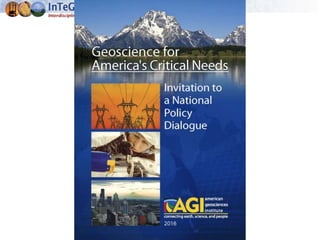
  • #5 There are many “grand challenge” documents, but this document in particular from AGI focuses on grand challenges where Earth science plays a significant role. So we’ll show how well the InTeGrate materials cover these critical needs.
  • #6 The color coding in the following slides addresses the “broad array of students” and “across the curriculum” parts of the materials. We’l go through grand challenges first, then NGSS.
  • #11 The NGSS are designed for K-12, but they do a nice job of articulating the process of science, especially through the Science and Engineering Practices and the Cross-cutting concepts. We are still in the process of tagging individual modules and activities with the more detailed standards, but we’ll show an overview of how the guiding principles of the design rubric align with the three dimensions of the NGSS.