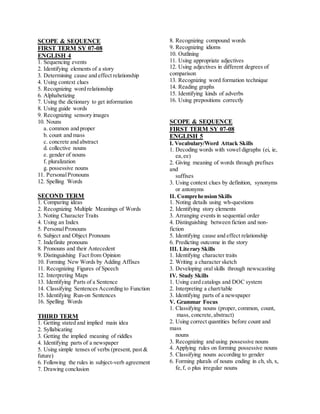
SCOPE & SEQUENCE
FIRST TERM SY 07-08
ENGLISH 4
1. Sequencing events
2. Identifying elements of a story
3. Determining cause and effect relationship
4. Using context clues
5. Recognizing word relationship
6. Alphabetizing
7. Using the dictionary to get information
8. Using guide words
9. Recognizing sensory images
10. Nouns
a. common and proper
b. count and mass
c. concrete and abstract
d. collective nouns
e. gender of nouns
f. pluralization
g. possessive nouns
11. PersonalPronouns
12. Spelling Words
SECOND TERM
1. Comparing ideas
2. Recognizing Multiple Meanings of Words
3. Noting Character Traits
4. Using an Index
5. PersonalPronouns
6. Subject and Object Pronouns
7. Indefinite pronouns
8. Pronouns and their Antecedent
9. Distinguishing Fact from Opinion
10. Forming New Words by Adding Affixes
11. Recognizing Figures of Speech
12. Interpreting Maps
13. Identifying Parts of a Sentence
14. Classifying Sentences According to Function
15. Identifying Run-on Sentences
16. Spelling Words
THIRD TERM
1. Getting stated and implied main idea
2. Syllabicating
3. Getting the implied meaning of riddles
4. Identifying parts of a newspaper
5. Using simple tenses of verbs (present, past &
future)
6. Following the rules in subject-verb agreement
7. Drawing conclusion
8. Recognizing compound words
9. Recognizing idioms
10. Outlining
11. Using appropriate adjectives
12. Using adjectives in different degrees of
comparison
13. Recognizing word formation technique
14. Reading graphs
15. Identifying kinds of adverbs
16. Using prepositions correctly
SCOPE & SEQUENCE
FIRST TERM SY 07-08
ENGLISH 5
I. Vocabulary/Word Attack Skills
1. Decoding words with vowel digraphs (ei, ie,
ea,ee)
2. Giving meaning of words through prefixes
and
suffixes
3. Using context clues by definition, synonyms
or antonyms
II. Comprehension Skills
1. Noting details using wh-questions
2. Identifying story elements
3. Arranging events in sequential order
4. Distinguishing between fiction and non-
fiction
5. Identifying cause and effect relationship
6. Predicting outcome in the story
III. Literary Skills
1. Identifying character traits
2. Writing a character sketch
3. Developing oral skills through newscasting
IV. Study Skills
1. Using card catalogs and DOC system
2. Interpreting a chart/table
3. Identifying parts of a newspaper
V. Grammar Focus
1. Classifying nouns (proper, common, count,
mass, concrete,abstract)
2. Using correct quantities before count and
mass
nouns
3. Recognizing and using possessive nouns
4. Applying rules on forming possessive nouns
5. Classifying nouns according to gender
6. Forming plurals of nouns ending in ch, sh, x,
fe,f, o plus irregular nouns
VI. Writing
1. Observing correct capitalization and
punctuation marks
2. Writing news report
VII. Spelling
1. Spelling words with vowel digraphs (ei, ie, ea,
ee)
2. Spelling derived words
SECOND TERM
I. Vocabulary Skills
1. Giving synonyms and antonyms of words
using a
thesaurus
2. Identifying words with multiple meanings
3. Distinguishing between homophones and
homographs
II. Comprehension Skills
1. Getting the main idea from a given selection
2. Identifying the key sentence from a paragraph
3. Giving appropriate title to a given selection,
poem or paragraph
III. Literary Appreciation Skills
1. Identifying words that appeal to the senses
2. Recognizing figures of speech (simile,
metaphor,
personification, alliteration and hyperbole)
IV. Study Skills
1. Identifying parts of a book
2. Distinguishing between table of contents and
index
3. Writing bibliographies
V. Spelling
1. Words with /f/ sound (ff, ph, gh)
2. Words with /k/ sound (ch, k, que, wk, lk)
3. Words with silent letters (pn, kn, gh, lk, lf)
VI. Grammar
1. Using demonstrative pronouns correctly
2. Distinguishing between demonstrative
pronouns and
demonstrative adjectives.
3. Differentiating helping verbs from linking
verbs
4. Using correct form of simple tenses
5. Using correct subject-verb agreement
6. Transforming sentences from active voice to
passive
voice and vice versa
VII. Writing
1. Poetry writing using different figures of
speech
2. Paragraph writing using verbs correctly
VII. Oral Production
1. Reader’s Theater
THIRD TERM
I. Vocabulary Skills
1. Identifying meaning of compound words
2. Recognizing relationships of words through
analogy
3. Identifying meaning of words using a
dictionary
4. Syllabicating words correctly
5. Identifying stresses and unstressed syllables in
words
II. Comprehension Skills
1. Making inferences based on selection read
2. Drawing conclusions from the selection read
3. Differentiating fact from opinion
4. Identifying the author’s purpose
III. Literary Appreciation Skills
1. Identifying the tone and mood in a selection
read
2. Identifying meaning of idiomatic expressions
3. Identifying implied meaning of riddles
IV. Study Skills
1. Identifying functions of a dictionary
2. Using guide words to get information
3. Locating information using glossary
4. Locating information using ads
5. Identifying different kinds of maps
6. Getting information from a map
V. Spelling
1. Words with soft and hard /th/
2. Words with schwa sound /ə/
3. Words with consonant clusters (spr, str, scr)
VI. Grammar
1. Identifying adjectives in sentences
2. Forming adjectives by using prefixes and
suffixes
3. Using simple and compound adjectives in
sentences
4. Forming comparison of adjectives
5. Differentiating adjectives from adverbs
6. Recognizing different prepositions in
sentences
7. Using prepositions/prepositional phrases in
sentences
VII. Writing
1. Comparison and contrast composition
VIII. OralProduction
1. Advertising and selling of environment-
friendly
products
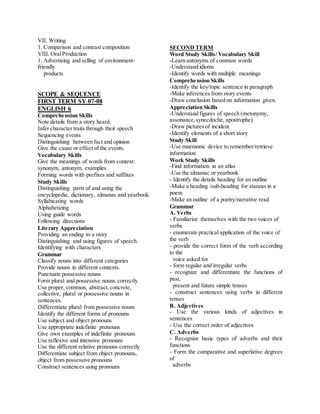
SCOPE & SEQUENCE
FIRST TERM SY 07-08
ENGLISH 6
Comprehension Skills
Note details from a story heard.
Infer character traits through their speech
Sequencing events
Distinguishing between fact and opinion
Give the cause or effect of the events.
Vocabulary Skills
Give the meanings of words from context:
synonym, antonym, examples
Forming words with prefixes and suffixes
Study Skills
Distinguishing parts of and using the
encyclopedia, dictionary, almanac and yearbook
Syllabicating words
Alphabetizing
Using guide words
Following directions
Literary Appreciation
Providing an ending to a story
Distinguishing and using figures of speech.
Identifying with characters
Grammar
Classify nouns into different categories
Provide nouns in different contexts.
Punctuate possessive nouns
Form plural and possessive nouns correctly
Use proper, common, abstract,concrete,
collective, plural or possessive nouns in
sentences.
Differentiate plural from possessive nouns
Identify the different forms of pronouns
Use subject and object pronouns
Use appropriate indefinite pronouns
Give own examples of indefinite pronouns
Use reflexive and intensive pronouns
Use the different relative pronouns correctly
Differentiate subject from object pronouns,
object from possessive pronouns
Construct sentences using pronouns
SECOND TERM
Word Study Skills/ Vocabulary Skill
-Learn antonyms of common words
-Understand idioms
-Identify words with multiple meanings
Comprehension Skills
-Identify the key/topic sentence in paragraph
-Make inferences from story events
-Draw conclusion based on information given.
Appreciation Skills
-Understand figures of speech (metonymy,
assonance,synecdoche, apostrophe)
-Draw pictures of incident
-Identify elements of a short story
Study Skill
-Use mnemonic device to remember/retrieve
information
Work Study Skills
-Find information in an atlas
-Use the almanac or yearbook
- Identify the details heading for an outline
-Make a heading /sub-heading for stanzas in a
poem
-Make an outline of a poetry/narrative read
Grammar
A. Verbs
- Familiarize themselves with the two voices of
verbs
- enumerate practical application of the voice of
the verb
- provide the correct form of the verb according
to the
voice asked for
- form regular and irregular verbs
- recognize and differentiate the functions of
past,
present and future simple tenses
- construct sentences using verbs in different
tenses
B. Adjectives
- Use the various kinds of adjectives in
sentences
- Use the correct order of adjectives
C. Adverbs
- Recognize basic types of adverbs and their
functions
- Form the comparative and superlative degrees
of
adverbs
D. Spell words lifted from texts read, other
subject areas,
rules in spelling discussed.
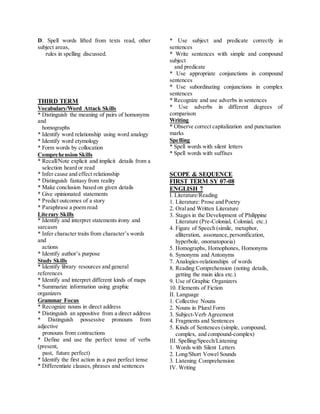
THIRD TERM
Vocabulary/Word Attack Skills
* Distinguish the meaning of pairs of homonyms
and
homographs
* Identify word relationship using word analogy
* Identify word etymology
* Form words by collocation
Comprehension Skills
* Recall/Note explicit and implicit details from a
selection heard or read
* Infer cause and effect relationship
* Distinguish fantasy from reality
* Make conclusion based on given details
* Give opinionated statements
* Predict outcomes of a story
* Paraphrase a poem read
Literary Skills
* Identify and interpret statements irony and
sarcasm
* Infer character traits from character’s words
and
actions
* Identify author’s purpose
Study Skills
* Identify library resources and general
references
* Identify and interpret different kinds of maps
* Summarize information using graphic
organizers
Grammar Focus
* Recognize nouns in direct address
* Distinguish an appositive from a direct address
* Distinguish possessive pronouns from
adjective
pronouns from contractions
* Define and use the perfect tense of verbs
(present,
past, future perfect)
* Identify the first action in a past perfect tense
* Differentiate clauses, phrases and sentences
* Use subject and predicate correctly in
sentences
* Write sentences with simple and compound
subject
and predicate
* Use appropriate conjunctions in compound
sentences
* Use subordinating conjunctions in complex
sentences
* Recognize and use adverbs in sentences
* Use adverbs in different degrees of
comparison
Writing
* Observe correct capitalization and punctuation
marks
Spelling
* Spell words with silent letters
* Spell words with suffixes
SCOPE & SEQUENCE
FIRST TERM SY 07-08
ENGLISH 7
I. Literature/Reading
1. Literature: Prose and Poetry
2. Oraland Written Literature
3. Stages in the Development of Philippine
Literature (Pre-Colonial, Colonial, etc.)
4. Figure of Speech (simile, metaphor,
alliteration, assonance,personification,
hyperbole, onomatopoeia)
5. Homographs, Homophones, Homonyms
6. Synonyms and Antonyms
7. Analogies-relationships of words
8. Reading Comprehension (noting details,
getting the main idea etc.)
9. Use of Graphic Organizers
10. Elements of Fiction
II. Language
1. Collective Nouns
2. Nouns in Plural Form
3. Subject-Verb Agreement
4. Fragments and Sentences
5. Kinds of Sentences (simple, compound,
complex, and compound-complex)
III. Spelling/Speech/Listening
1. Words with Silent Letters
2. Long/Short Vowel Sounds
3. Listening Comprehension
IV. Writing
1. Descriptive paragraph
2. Narrative paragraph
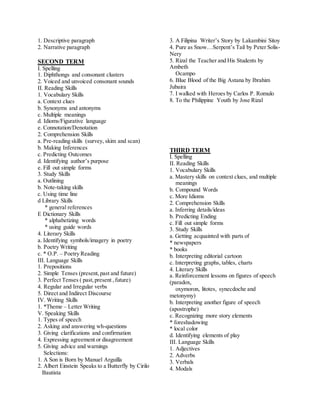
SECOND TERM
I. Spelling
1. Diphthongs and consonant clusters
2. Voiced and unvoiced consonant sounds
II. Reading Skills
1. Vocabulary Skills
a. Context clues
b. Synonyms and antonyms
c. Multiple meanings
d. Idioms/Figurative language
e. Connotation/Denotation
2. Comprehension Skills
a. Pre-reading skills (survey, skim and scan)
b. Making Inferences
c. Predicting Outcomes
d. Identifying author’s purpose
e. Fill out simple forms
3. Study Skills
a. Outlining
b. Note-taking skills
c. Using time line
d Library Skills
* general references
E Dictionary Skills
* alphabetizing words
* using guide words
4. Literary Skills
a. Identifying symbols/imagery in poetry
b. Poetry Writing
c. * O.P. – Poetry Reading
III. Language Skills
1. Prepositions
2. Simple Tenses (present,past and future)
3. Perfect Tenses ( past,present ,future)
4. Regular and Irregular verbs
5. Direct and Indirect Discourse
IV. Writing Skills
1. *Theme – Letter Writing
V. Speaking Skills
1. Types of speech
2. Asking and answering wh-questions
3. Giving clarifications and confirmation
4. Expressing agreement or disagreement
5. Giving advice and warnings
Selections:
1. A Son is Born by Manuel Arguilla
2. Albert Einstein Speaks to a Butterfly by Cirilo
Bautista
3. A Filipina Writer’s Story by Lakambini Sitoy
4. Pure as Snow…Serpent’s Tail by Peter Solis-
Nery
5. Rizal the Teacher and His Students by
Ambeth
Ocampo
6. Blue Blood of the Big Astana by Ibrahim
Jubaira
7. I walked with Heroes by Carlos P. Romulo
8. To the Philippine Youth by Jose Rizal
THIRD TERM
I. Spelling
II. Reading Skills
1. Vocabulary Skills
a. Mastery skills on context clues, and multiple
meanings
b. Compound Words
c. More Idioms
2. Comprehension Skills
a. Inferring details/ideas
b. Predicting Ending
c. Fill out simple forms
3. Study Skills
a. Getting acquainted with parts of
* newspapers
* books
b. Interpreting editorial cartoon
c. Interpreting graphs, tables, charts
4. Literary Skills
a. Reinforcement lessons on figures of speech
(paradox,
oxymoron, litotes, synecdoche and
metonymy)
b. Interpreting another figure of speech
(apostrophe)
c. Recognizing more story elements
* foreshadowing
* local color
d. Identifying elements of play
III. Language Skills
1. Adjectives
2. Adverbs
3. Verbals
4. Modals
5. Active and Passive Voice
IV. Writing Skills
1. Using transitional devices
2. Improving sentences
a. Avoiding run-ons
b. Avoiding dangling modifiers
3. *Theme – Letter to the editor
*O.P. – Debate or Play Presentation

Scope in english

  • 1.
    SCOPE & SEQUENCE FIRSTTERM SY 07-08 ENGLISH 4 1. Sequencing events 2. Identifying elements of a story 3. Determining cause and effect relationship 4. Using context clues 5. Recognizing word relationship 6. Alphabetizing 7. Using the dictionary to get information 8. Using guide words 9. Recognizing sensory images 10. Nouns a. common and proper b. count and mass c. concrete and abstract d. collective nouns e. gender of nouns f. pluralization g. possessive nouns 11. PersonalPronouns 12. Spelling Words SECOND TERM 1. Comparing ideas 2. Recognizing Multiple Meanings of Words 3. Noting Character Traits 4. Using an Index 5. PersonalPronouns 6. Subject and Object Pronouns 7. Indefinite pronouns 8. Pronouns and their Antecedent 9. Distinguishing Fact from Opinion 10. Forming New Words by Adding Affixes 11. Recognizing Figures of Speech 12. Interpreting Maps 13. Identifying Parts of a Sentence 14. Classifying Sentences According to Function 15. Identifying Run-on Sentences 16. Spelling Words THIRD TERM 1. Getting stated and implied main idea 2. Syllabicating 3. Getting the implied meaning of riddles 4. Identifying parts of a newspaper 5. Using simple tenses of verbs (present, past & future) 6. Following the rules in subject-verb agreement 7. Drawing conclusion 8. Recognizing compound words 9. Recognizing idioms 10. Outlining 11. Using appropriate adjectives 12. Using adjectives in different degrees of comparison 13. Recognizing word formation technique 14. Reading graphs 15. Identifying kinds of adverbs 16. Using prepositions correctly SCOPE & SEQUENCE FIRST TERM SY 07-08 ENGLISH 5 I. Vocabulary/Word Attack Skills 1. Decoding words with vowel digraphs (ei, ie, ea,ee) 2. Giving meaning of words through prefixes and suffixes 3. Using context clues by definition, synonyms or antonyms II. Comprehension Skills 1. Noting details using wh-questions 2. Identifying story elements 3. Arranging events in sequential order 4. Distinguishing between fiction and non- fiction 5. Identifying cause and effect relationship 6. Predicting outcome in the story III. Literary Skills 1. Identifying character traits 2. Writing a character sketch 3. Developing oral skills through newscasting IV. Study Skills 1. Using card catalogs and DOC system 2. Interpreting a chart/table 3. Identifying parts of a newspaper V. Grammar Focus 1. Classifying nouns (proper, common, count, mass, concrete,abstract) 2. Using correct quantities before count and mass nouns 3. Recognizing and using possessive nouns 4. Applying rules on forming possessive nouns 5. Classifying nouns according to gender 6. Forming plurals of nouns ending in ch, sh, x, fe,f, o plus irregular nouns
  • 2.
    VI. Writing 1. Observingcorrect capitalization and punctuation marks 2. Writing news report VII. Spelling 1. Spelling words with vowel digraphs (ei, ie, ea, ee) 2. Spelling derived words SECOND TERM I. Vocabulary Skills 1. Giving synonyms and antonyms of words using a thesaurus 2. Identifying words with multiple meanings 3. Distinguishing between homophones and homographs II. Comprehension Skills 1. Getting the main idea from a given selection 2. Identifying the key sentence from a paragraph 3. Giving appropriate title to a given selection, poem or paragraph III. Literary Appreciation Skills 1. Identifying words that appeal to the senses 2. Recognizing figures of speech (simile, metaphor, personification, alliteration and hyperbole) IV. Study Skills 1. Identifying parts of a book 2. Distinguishing between table of contents and index 3. Writing bibliographies V. Spelling 1. Words with /f/ sound (ff, ph, gh) 2. Words with /k/ sound (ch, k, que, wk, lk) 3. Words with silent letters (pn, kn, gh, lk, lf) VI. Grammar 1. Using demonstrative pronouns correctly 2. Distinguishing between demonstrative pronouns and demonstrative adjectives. 3. Differentiating helping verbs from linking verbs 4. Using correct form of simple tenses 5. Using correct subject-verb agreement 6. Transforming sentences from active voice to passive voice and vice versa VII. Writing 1. Poetry writing using different figures of speech 2. Paragraph writing using verbs correctly VII. Oral Production 1. Reader’s Theater THIRD TERM I. Vocabulary Skills 1. Identifying meaning of compound words 2. Recognizing relationships of words through analogy 3. Identifying meaning of words using a dictionary 4. Syllabicating words correctly 5. Identifying stresses and unstressed syllables in words II. Comprehension Skills 1. Making inferences based on selection read 2. Drawing conclusions from the selection read 3. Differentiating fact from opinion 4. Identifying the author’s purpose III. Literary Appreciation Skills 1. Identifying the tone and mood in a selection read 2. Identifying meaning of idiomatic expressions 3. Identifying implied meaning of riddles IV. Study Skills 1. Identifying functions of a dictionary 2. Using guide words to get information 3. Locating information using glossary 4. Locating information using ads 5. Identifying different kinds of maps 6. Getting information from a map V. Spelling 1. Words with soft and hard /th/ 2. Words with schwa sound /ə/ 3. Words with consonant clusters (spr, str, scr) VI. Grammar 1. Identifying adjectives in sentences 2. Forming adjectives by using prefixes and suffixes 3. Using simple and compound adjectives in sentences 4. Forming comparison of adjectives 5. Differentiating adjectives from adverbs 6. Recognizing different prepositions in sentences 7. Using prepositions/prepositional phrases in sentences
  • 3.
    VII. Writing 1. Comparisonand contrast composition VIII. OralProduction 1. Advertising and selling of environment- friendly products SCOPE & SEQUENCE FIRST TERM SY 07-08 ENGLISH 6 Comprehension Skills Note details from a story heard. Infer character traits through their speech Sequencing events Distinguishing between fact and opinion Give the cause or effect of the events. Vocabulary Skills Give the meanings of words from context: synonym, antonym, examples Forming words with prefixes and suffixes Study Skills Distinguishing parts of and using the encyclopedia, dictionary, almanac and yearbook Syllabicating words Alphabetizing Using guide words Following directions Literary Appreciation Providing an ending to a story Distinguishing and using figures of speech. Identifying with characters Grammar Classify nouns into different categories Provide nouns in different contexts. Punctuate possessive nouns Form plural and possessive nouns correctly Use proper, common, abstract,concrete, collective, plural or possessive nouns in sentences. Differentiate plural from possessive nouns Identify the different forms of pronouns Use subject and object pronouns Use appropriate indefinite pronouns Give own examples of indefinite pronouns Use reflexive and intensive pronouns Use the different relative pronouns correctly Differentiate subject from object pronouns, object from possessive pronouns Construct sentences using pronouns SECOND TERM Word Study Skills/ Vocabulary Skill -Learn antonyms of common words -Understand idioms -Identify words with multiple meanings Comprehension Skills -Identify the key/topic sentence in paragraph -Make inferences from story events -Draw conclusion based on information given. Appreciation Skills -Understand figures of speech (metonymy, assonance,synecdoche, apostrophe) -Draw pictures of incident -Identify elements of a short story Study Skill -Use mnemonic device to remember/retrieve information Work Study Skills -Find information in an atlas -Use the almanac or yearbook - Identify the details heading for an outline -Make a heading /sub-heading for stanzas in a poem -Make an outline of a poetry/narrative read Grammar A. Verbs - Familiarize themselves with the two voices of verbs - enumerate practical application of the voice of the verb - provide the correct form of the verb according to the voice asked for - form regular and irregular verbs - recognize and differentiate the functions of past, present and future simple tenses - construct sentences using verbs in different tenses B. Adjectives - Use the various kinds of adjectives in sentences - Use the correct order of adjectives C. Adverbs - Recognize basic types of adverbs and their functions - Form the comparative and superlative degrees of adverbs
  • 4.
    D. Spell wordslifted from texts read, other subject areas, rules in spelling discussed. THIRD TERM Vocabulary/Word Attack Skills * Distinguish the meaning of pairs of homonyms and homographs * Identify word relationship using word analogy * Identify word etymology * Form words by collocation Comprehension Skills * Recall/Note explicit and implicit details from a selection heard or read * Infer cause and effect relationship * Distinguish fantasy from reality * Make conclusion based on given details * Give opinionated statements * Predict outcomes of a story * Paraphrase a poem read Literary Skills * Identify and interpret statements irony and sarcasm * Infer character traits from character’s words and actions * Identify author’s purpose Study Skills * Identify library resources and general references * Identify and interpret different kinds of maps * Summarize information using graphic organizers Grammar Focus * Recognize nouns in direct address * Distinguish an appositive from a direct address * Distinguish possessive pronouns from adjective pronouns from contractions * Define and use the perfect tense of verbs (present, past, future perfect) * Identify the first action in a past perfect tense * Differentiate clauses, phrases and sentences * Use subject and predicate correctly in sentences * Write sentences with simple and compound subject and predicate * Use appropriate conjunctions in compound sentences * Use subordinating conjunctions in complex sentences * Recognize and use adverbs in sentences * Use adverbs in different degrees of comparison Writing * Observe correct capitalization and punctuation marks Spelling * Spell words with silent letters * Spell words with suffixes SCOPE & SEQUENCE FIRST TERM SY 07-08 ENGLISH 7 I. Literature/Reading 1. Literature: Prose and Poetry 2. Oraland Written Literature 3. Stages in the Development of Philippine Literature (Pre-Colonial, Colonial, etc.) 4. Figure of Speech (simile, metaphor, alliteration, assonance,personification, hyperbole, onomatopoeia) 5. Homographs, Homophones, Homonyms 6. Synonyms and Antonyms 7. Analogies-relationships of words 8. Reading Comprehension (noting details, getting the main idea etc.) 9. Use of Graphic Organizers 10. Elements of Fiction II. Language 1. Collective Nouns 2. Nouns in Plural Form 3. Subject-Verb Agreement 4. Fragments and Sentences 5. Kinds of Sentences (simple, compound, complex, and compound-complex) III. Spelling/Speech/Listening 1. Words with Silent Letters 2. Long/Short Vowel Sounds 3. Listening Comprehension IV. Writing
  • 5.
    1. Descriptive paragraph 2.Narrative paragraph SECOND TERM I. Spelling 1. Diphthongs and consonant clusters 2. Voiced and unvoiced consonant sounds II. Reading Skills 1. Vocabulary Skills a. Context clues b. Synonyms and antonyms c. Multiple meanings d. Idioms/Figurative language e. Connotation/Denotation 2. Comprehension Skills a. Pre-reading skills (survey, skim and scan) b. Making Inferences c. Predicting Outcomes d. Identifying author’s purpose e. Fill out simple forms 3. Study Skills a. Outlining b. Note-taking skills c. Using time line d Library Skills * general references E Dictionary Skills * alphabetizing words * using guide words 4. Literary Skills a. Identifying symbols/imagery in poetry b. Poetry Writing c. * O.P. – Poetry Reading III. Language Skills 1. Prepositions 2. Simple Tenses (present,past and future) 3. Perfect Tenses ( past,present ,future) 4. Regular and Irregular verbs 5. Direct and Indirect Discourse IV. Writing Skills 1. *Theme – Letter Writing V. Speaking Skills 1. Types of speech 2. Asking and answering wh-questions 3. Giving clarifications and confirmation 4. Expressing agreement or disagreement 5. Giving advice and warnings Selections: 1. A Son is Born by Manuel Arguilla 2. Albert Einstein Speaks to a Butterfly by Cirilo Bautista 3. A Filipina Writer’s Story by Lakambini Sitoy 4. Pure as Snow…Serpent’s Tail by Peter Solis- Nery 5. Rizal the Teacher and His Students by Ambeth Ocampo 6. Blue Blood of the Big Astana by Ibrahim Jubaira 7. I walked with Heroes by Carlos P. Romulo 8. To the Philippine Youth by Jose Rizal THIRD TERM I. Spelling II. Reading Skills 1. Vocabulary Skills a. Mastery skills on context clues, and multiple meanings b. Compound Words c. More Idioms 2. Comprehension Skills a. Inferring details/ideas b. Predicting Ending c. Fill out simple forms 3. Study Skills a. Getting acquainted with parts of * newspapers * books b. Interpreting editorial cartoon c. Interpreting graphs, tables, charts 4. Literary Skills a. Reinforcement lessons on figures of speech (paradox, oxymoron, litotes, synecdoche and metonymy) b. Interpreting another figure of speech (apostrophe) c. Recognizing more story elements * foreshadowing * local color d. Identifying elements of play III. Language Skills 1. Adjectives 2. Adverbs 3. Verbals 4. Modals
  • 6.
    5. Active andPassive Voice IV. Writing Skills 1. Using transitional devices 2. Improving sentences a. Avoiding run-ons b. Avoiding dangling modifiers 3. *Theme – Letter to the editor *O.P. – Debate or Play Presentation