SCIMEC Programme: Rationale / Content / Shape


1.0 Common Ground: Documentation + Archives + Museums.


Whether one is talking about: Museums, Archives or Documentation, the base of all three is
Data. They effectively lie along a continuum:

Your Pathway          Documentation                Archives                Museums

Continuum             Recording                    Arranging               Presenting ......


Why is this so?
Because there is but one end objective to all of this: LEARNING.


What is the answer to the question:
‘Why do we document, archive and have museums?’
Ans. TO LEARN.


And what is the purpose and the effect of this learning?
Ans: CHANGE of ourselves and our environment: which is why the human race has
developed and evolved and dominated its environment ... we are built to be hungry for
learning. I might paraphrase Mr Darwin loosely, and suggest that the power behind Natural
Selection is LEARNING: those that learn and develop / adapt as a result survive!.


YOU, in your chosen careers, are to become part of this process.

YOU are producers, recorders, organisers, presenters and guardians of the:

                    BUILDING-BLOCKS of LEARNING

Perhaps you haven’t seen yourselves that way before.... but think about it for a minute....
you will play your part in the University of Life whether you are working with world-experts,
academics, school-teachers, students or tourist visitors.

And talking of Universities....here’s my old one: Bournemouth University (England):-
Discere Mutari
                                                             Est
                                                             To Learn is to Change

                                                            Bournemouth University Crest


Illustrations.

Let me just give you a little example or two that connect data to learning...

45 years ago, the BBC was just starting to use video-tape, but it was desperately expensive.
They tried it out and made a recording of an early chat-show where a couple of local
reporters were interviewing four unknown youngsters from the North of England who had
just made their first record. As they were so expensive at the time, the videos were kept
safe....so safe, in fact, that they were ‘lost’ until this year when someone had the shock of
his life: he put the tape on, and the youngsters just happened to be called John, Paul, George
and Ringo....otherwise known as: The Beatles. For historians and sociologists trying to
understand the 60s culture, the media and the development and evolution of popular music,
the video has been a revelation. Clearly the more we understand about our past and how we
got here, the better equipped we are to deal with today and the future.

Even more obscure and ancient archives can also shed light on important matters. Recently
a historian laboriously looking through records of Elizabethan England (Elizabeth 1st..... 17th
Century) found mention of a certain Mr William Shakespeare, giving his address in
London (which was not known before), details of his involvement in a court case and some
critical information about the family with whom he was staying as a guest which leads
certain scholars to think they can now deduce the identity of his ‘Dark Lady’ mistress. All
from a ‘boring’ court record. Some of the most mundane and ordinary data can become
vital insights even hundreds of years after the fact! Sometimes it is only years after that we
can see the significance of such things.
2.0 So, if you are all involved in the process of learning - what exactly IS learning?


Learning is essentially the willingness to seek out and make sense of information by applying
our intellectual capacities for analysis and evaluation such that this information is understood
and becomes valuable knowledge by means of which we can transform both ourselves and
our environment. If you like: the information is the kindling wood, our interest and
intellectual capacity the spark that ignites the fire, and learning the heat, light and beauty
that results with the power to transform dark into light.

Q. What, then are the components involved?

A. A human with an interest and an inquiring mind PLUS (at a very minimum) data.


NB. Clearly a teacher is NOT always required..... but as you will see below, if the interest of
the individual is not matched by sufficient learning capability and the gulf between the raw
data and learning is particularly wide, then the inclusion of an agent (such as a teacher) in the
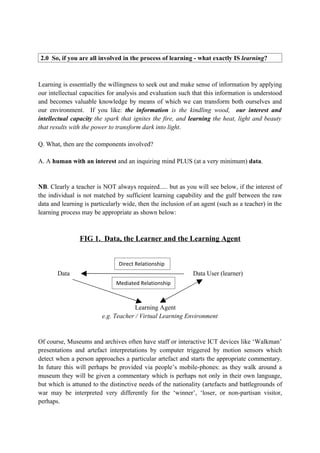
learning process may be appropriate as shown below:


                FIG 1. Data, the Learner and the Learning Agent


                                Direct Relationship
       Data                                                  Data User (learner)
                               Mediated Relationship


                                      Learning Agent
                         e.g. Teacher / Virtual Learning Environment


Of course, Museums and archives often have staff or interactive ICT devices like ‘Walkman’
presentations and artefact interpretations by computer triggered by motion sensors which
detect when a person approaches a particular artefact and starts the appropriate commentary.
In future this will perhaps be provided via people’s mobile-phones: as they walk around a
museum they will be given a commentary which is perhaps not only in their own language,
but which is attuned to the distinctive needs of the nationality (artefacts and battlegrounds of
war may be interpreted very differently for the ‘winner’, ‘loser, or non-partisan visitor,
perhaps.
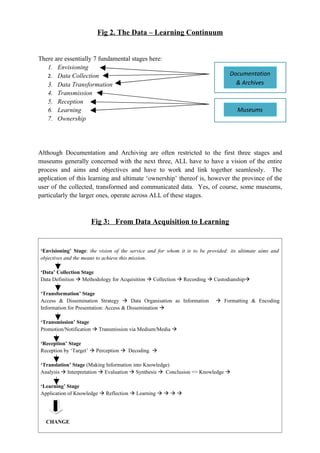
Fig 2. The Data – Learning Continuum


There are essentially 7 fundamental stages here:
   1. Envisioning
   2. Data Collection                                                            Documentation
   3. Data Transformation                                                          & Archives
   4. Transmission
   5. Reception
   6. Learning                                                                       Museums
   7. Ownership


Although Documentation and Archiving are often restricted to the first three stages and
museums generally concerned with the next three, ALL have to have a vision of the entire
process and aims and objectives and have to work and link together seamlessly. The
application of this learning and ultimate ‘ownership’ thereof is, however the province of the
user of the collected, transformed and communicated data. Yes, of course, some museums,
particularly the larger ones, operate across ALL of these stages.


                     Fig 3: From Data Acquisition to Learning


‘Envisioning’ Stage: the vision of the service and for whom it is to be provided: its ultimate aims and
objectives and the means to achieve this mission.

‘Data’ Collection Stage
Data Definition  Methodology for Acquisition  Collection  Recording  Custodianship

‘Transformation’ Stage
Access & Dissemination Strategy  Data Organisation as Information          Formatting & Encoding
Information for Presentation: Access & Dissemination 

‘Transmission’ Stage
Promotion/Notification  Transmission via Medium/Media 

‘Reception’ Stage
Reception by ‘Target’  Perception  Decoding 

‘Translation’ Stage (Making Information into Knowledge)
Analysis  Interpretation  Evaluation  Synthesis  Conclusion => Knowledge 

‘Learning’ Stage
Application of Knowledge  Reflection  Learning    


   CHANGE
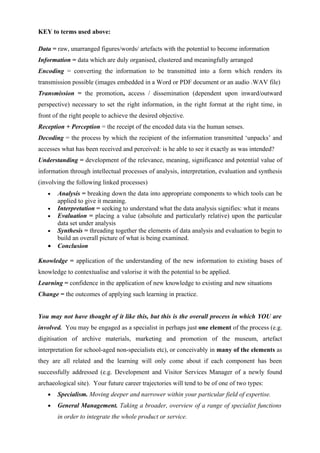
KEY to terms used above:

Data = raw, unarranged figures/words/ artefacts with the potential to become information
Information = data which are duly organised, clustered and meaningfully arranged
Encoding = converting the information to be transmitted into a form which renders its
transmission possible (images embedded in a Word or PDF document or an audio .WAV file)
Transmission = the promotion, access / dissemination (dependent upon inward/outward
perspective) necessary to set the right information, in the right format at the right time, in
front of the right people to achieve the desired objective.
Reception + Perception = the receipt of the encoded data via the human senses.
Decoding = the process by which the recipient of the information transmitted ‘unpacks’ and
accesses what has been received and perceived: is he able to see it exactly as was intended?
Understanding = development of the relevance, meaning, significance and potential value of
information through intellectual processes of analysis, interpretation, evaluation and synthesis
(involving the following linked processes)
   •   Analysis = breaking down the data into appropriate components to which tools can be
       applied to give it meaning.
   •   Interpretation = seeking to understand what the data analysis signifies: what it means
   •   Evaluation = placing a value (absolute and particularly relative) upon the particular
       data set under analysis
   •   Synthesis = threading together the elements of data analysis and evaluation to begin to
       build an overall picture of what is being examined.
   •   Conclusion

Knowledge = application of the understanding of the new information to existing bases of
knowledge to contextualise and valorise it with the potential to be applied.
Learning = confidence in the application of new knowledge to existing and new situations
Change = the outcomes of applying such learning in practice.


You may not have thought of it like this, but this is the overall process in which YOU are
involved. You may be engaged as a specialist in perhaps just one element of the process (e.g.
digitisation of archive materials, marketing and promotion of the museum, artefact
interpretation for school-aged non-specialists etc), or conceivably in many of the elements as
they are all related and the learning will only come about if each component has been
successfully addressed (e.g. Development and Visitor Services Manager of a newly found
archaeological site). Your future career trajectories will tend to be of one of two types:
   •   Specialism. Moving deeper and narrower within your particular field of expertise.
   •   General Management. Taking a broader, overview of a range of specialist functions
       in order to integrate the whole product or service.
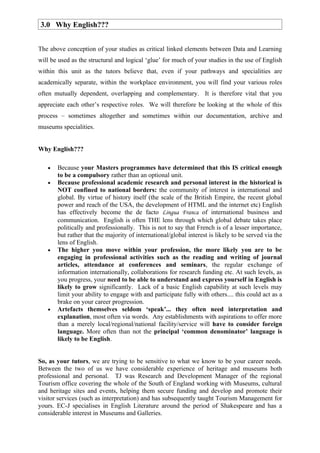
3.0 Why English???


The above conception of your studies as critical linked elements between Data and Learning
will be used as the structural and logical ‘glue’ for much of your studies in the use of English
within this unit as the tutors believe that, even if your pathways and specialities are
academically separate, within the workplace environment, you will find your various roles
often mutually dependent, overlapping and complementary. It is therefore vital that you
appreciate each other’s respective roles. We will therefore be looking at the whole of this
process – sometimes altogether and sometimes within our documentation, archive and
museums specialities.


Why English???

   •   Because your Masters programmes have determined that this IS critical enough
       to be a compulsory rather than an optional unit.
   •   Because professional academic research and personal interest in the historical is
       NOT confined to national borders: the community of interest is international and
       global. By virtue of history itself (the scale of the British Empire, the recent global
       power and reach of the USA, the development of HTML and the internet etc) English
       has effectively become the de facto Lingua Franca of international business and
       communication. English is often THE lens through which global debate takes place
       politically and professionally. This is not to say that French is of a lesser importance,
       but rather that the majority of international/global interest is likely to be served via the
       lens of English.
   •   The higher you move within your profession, the more likely you are to be
       engaging in professional activities such as the reading and writing of journal
       articles, attendance at conferences and seminars, the regular exchange of
       information internationally, collaborations for research funding etc. At such levels, as
       you progress, your need to be able to understand and express yourself in English is
       likely to grow significantly. Lack of a basic English capability at such levels may
       limit your ability to engage with and participate fully with others.... this could act as a
       brake on your career progression.
   •   Artefacts themselves seldom ‘speak’... they often need interpretation and
       explanation, most often via words. Any establishments with aspirations to offer more
       than a merely local/regional/national facility/service will have to consider foreign
       language. More often than not the principal ‘common denominator’ language is
       likely to be English.


So, as your tutors, we are trying to be sensitive to what we know to be your career needs.
Between the two of us we have considerable experience of heritage and museums both
professional and personal. TJ was Research and Development Manager of the regional
Tourism office covering the whole of the South of England working with Museums, cultural
and heritage sites and events, helping them secure funding and develop and promote their
visitor services (such as interpretation) and has subsequently taught Tourism Management for
yours. EC-J specialises in English Literature around the period of Shakespeare and has a
considerable interest in Museums and Galleries.
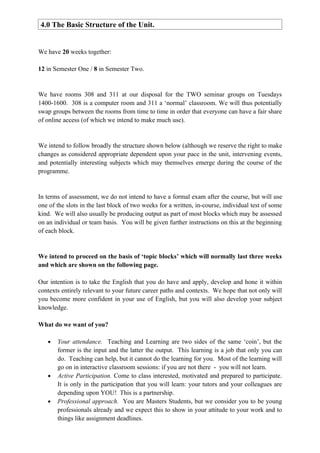
4.0 The Basic Structure of the Unit.


We have 20 weeks together:

12 in Semester One / 8 in Semester Two.


We have rooms 308 and 311 at our disposal for the TWO seminar groups on Tuesdays
1400-1600. 308 is a computer room and 311 a ‘normal’ classroom. We will thus potentially
swap groups between the rooms from time to time in order that everyone can have a fair share
of online access (of which we intend to make much use).


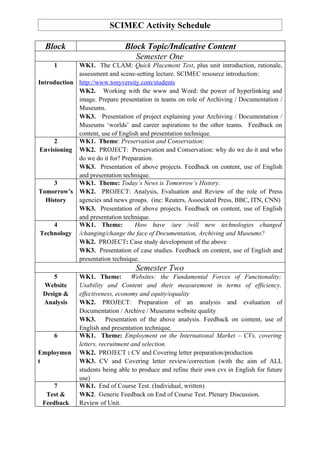
We intend to follow broadly the structure shown below (although we reserve the right to make
changes as considered appropriate dependent upon your pace in the unit, intervening events,
and potentially interesting subjects which may themselves emerge during the course of the
programme.


In terms of assessment, we do not intend to have a formal exam after the course, but will use
one of the slots in the last block of two weeks for a written, in-course, individual test of some
kind. We will also usually be producing output as part of most blocks which may be assessed
on an individual or team basis. You will be given further instructions on this at the beginning
of each block.


We intend to proceed on the basis of ‘topic blocks’ which will normally last three weeks
and which are shown on the following page.

Our intention is to take the English that you do have and apply, develop and hone it within
contexts entirely relevant to your future career paths and contexts. We hope that not only will
you become more confident in your use of English, but you will also develop your subject
knowledge.

What do we want of you?

   •   Your attendance. Teaching and Learning are two sides of the same ‘coin’, but the
       former is the input and the latter the output. This learning is a job that only you can
       do. Teaching can help, but it cannot do the learning for you. Most of the learning will
       go on in interactive classroom sessions: if you are not there - you will not learn.
   •   Active Participation. Come to class interested, motivated and prepared to participate.
       It is only in the participation that you will learn: your tutors and your colleagues are
       depending upon YOU! This is a partnership.
   •   Professional approach. You are Masters Students, but we consider you to be young
       professionals already and we expect this to show in your attitude to your work and to
       things like assignment deadlines.
SCIMEC Activity Schedule

  Block                        Block Topic/Indicative Content
                                  Semester One
     1       WK1. The CLAM: Quick Placement Test, plus unit introduction, rationale,
             assessment and scene-setting lecture. SCIMEC resource introduction:
Introduction http://www.tonyversity.com/students
             WK2. Working with the www and Word: the power of hyperlinking and
             image. Prepare presentation in teams on role of Archiving / Documentation /
             Museums.
             WK3. Presentation of project explaining your Archiving / Documentation /
             Museums ‘worlds’ and career aspirations to the other teams. Feedback on
             content, use of English and presentation technique.
      2      WK1. Theme: Preservation and Conservation:
 Envisioning WK2. PROJECT: Preservation and Conservation: why do we do it and who
             do we do it for? Preparation.
             WK3. Presentation of above projects. Feedback on content, use of English
             and presentation technique.
      3      WK1. Theme: Today’s News is Tomorrow’s History.
Tomorrow’s WK2. PROJECT: Analysis, Evaluation and Review of the role of Press
   History   agencies and news groups. (inc: Reuters, Associated Press, BBC, ITN, CNN)
             WK3. Presentation of above projects. Feedback on content, use of English
             and presentation technique.
      4      WK1. Theme:           How have /are /will new technologies changed
 Technology /changing/change the face of Documentation, Archiving and Museums?
             WK2. PROJECT: Case study development of the above
             WK3. Presentation of case studies. Feedback on content, use of English and
             presentation technique.
                                   Semester Two
     5        WK1. Theme: Websites: the Fundamental Forces of Functionality;
 Website      Usability and Content and their measurement in terms of efficiency,
 Design &     effectiveness, economy and equity/equality
 Analysis     WK2. PROJECT: Preparation of an analysis and evaluation of
              Documentation / Archive / Museums website quality
              WK3. Presentation of the above analysis. Feedback on content, use of
              English and presentation technique.
     6        WK1. Theme: Employment on the International Market – CVs, covering
              letters, recruitment and selection.
Employmen     WK2. PROJECT : CV and Covering letter preparation/production
t             WK3. CV and Covering letter review/correction (with the aim of ALL
              students being able to produce and refine their own cvs in English for future
              use)
     7        WK1. End of Course Test. (Individual, written)
  Test &      WK2. Generic Feedback on End of Course Test. Plenary Discussion.
 Feedback     Review of Unit.

Scimec Concept

  • 1.
    SCIMEC Programme: Rationale/ Content / Shape 1.0 Common Ground: Documentation + Archives + Museums. Whether one is talking about: Museums, Archives or Documentation, the base of all three is Data. They effectively lie along a continuum: Your Pathway Documentation  Archives  Museums Continuum Recording  Arranging  Presenting ...... Why is this so? Because there is but one end objective to all of this: LEARNING. What is the answer to the question: ‘Why do we document, archive and have museums?’ Ans. TO LEARN. And what is the purpose and the effect of this learning? Ans: CHANGE of ourselves and our environment: which is why the human race has developed and evolved and dominated its environment ... we are built to be hungry for learning. I might paraphrase Mr Darwin loosely, and suggest that the power behind Natural Selection is LEARNING: those that learn and develop / adapt as a result survive!. YOU, in your chosen careers, are to become part of this process. YOU are producers, recorders, organisers, presenters and guardians of the: BUILDING-BLOCKS of LEARNING Perhaps you haven’t seen yourselves that way before.... but think about it for a minute.... you will play your part in the University of Life whether you are working with world-experts, academics, school-teachers, students or tourist visitors. And talking of Universities....here’s my old one: Bournemouth University (England):-
  • 2.
    Discere Mutari Est To Learn is to Change Bournemouth University Crest Illustrations. Let me just give you a little example or two that connect data to learning... 45 years ago, the BBC was just starting to use video-tape, but it was desperately expensive. They tried it out and made a recording of an early chat-show where a couple of local reporters were interviewing four unknown youngsters from the North of England who had just made their first record. As they were so expensive at the time, the videos were kept safe....so safe, in fact, that they were ‘lost’ until this year when someone had the shock of his life: he put the tape on, and the youngsters just happened to be called John, Paul, George and Ringo....otherwise known as: The Beatles. For historians and sociologists trying to understand the 60s culture, the media and the development and evolution of popular music, the video has been a revelation. Clearly the more we understand about our past and how we got here, the better equipped we are to deal with today and the future. Even more obscure and ancient archives can also shed light on important matters. Recently a historian laboriously looking through records of Elizabethan England (Elizabeth 1st..... 17th Century) found mention of a certain Mr William Shakespeare, giving his address in London (which was not known before), details of his involvement in a court case and some critical information about the family with whom he was staying as a guest which leads certain scholars to think they can now deduce the identity of his ‘Dark Lady’ mistress. All from a ‘boring’ court record. Some of the most mundane and ordinary data can become vital insights even hundreds of years after the fact! Sometimes it is only years after that we can see the significance of such things.
  • 3.
    2.0 So, ifyou are all involved in the process of learning - what exactly IS learning? Learning is essentially the willingness to seek out and make sense of information by applying our intellectual capacities for analysis and evaluation such that this information is understood and becomes valuable knowledge by means of which we can transform both ourselves and our environment. If you like: the information is the kindling wood, our interest and intellectual capacity the spark that ignites the fire, and learning the heat, light and beauty that results with the power to transform dark into light. Q. What, then are the components involved? A. A human with an interest and an inquiring mind PLUS (at a very minimum) data. NB. Clearly a teacher is NOT always required..... but as you will see below, if the interest of the individual is not matched by sufficient learning capability and the gulf between the raw data and learning is particularly wide, then the inclusion of an agent (such as a teacher) in the learning process may be appropriate as shown below: FIG 1. Data, the Learner and the Learning Agent Direct Relationship Data Data User (learner) Mediated Relationship Learning Agent e.g. Teacher / Virtual Learning Environment Of course, Museums and archives often have staff or interactive ICT devices like ‘Walkman’ presentations and artefact interpretations by computer triggered by motion sensors which detect when a person approaches a particular artefact and starts the appropriate commentary. In future this will perhaps be provided via people’s mobile-phones: as they walk around a museum they will be given a commentary which is perhaps not only in their own language, but which is attuned to the distinctive needs of the nationality (artefacts and battlegrounds of war may be interpreted very differently for the ‘winner’, ‘loser, or non-partisan visitor, perhaps.
  • 4.
    Fig 2. TheData – Learning Continuum There are essentially 7 fundamental stages here: 1. Envisioning 2. Data Collection Documentation 3. Data Transformation & Archives 4. Transmission 5. Reception 6. Learning Museums 7. Ownership Although Documentation and Archiving are often restricted to the first three stages and museums generally concerned with the next three, ALL have to have a vision of the entire process and aims and objectives and have to work and link together seamlessly. The application of this learning and ultimate ‘ownership’ thereof is, however the province of the user of the collected, transformed and communicated data. Yes, of course, some museums, particularly the larger ones, operate across ALL of these stages. Fig 3: From Data Acquisition to Learning ‘Envisioning’ Stage: the vision of the service and for whom it is to be provided: its ultimate aims and objectives and the means to achieve this mission. ‘Data’ Collection Stage Data Definition  Methodology for Acquisition  Collection  Recording  Custodianship ‘Transformation’ Stage Access & Dissemination Strategy  Data Organisation as Information  Formatting & Encoding Information for Presentation: Access & Dissemination  ‘Transmission’ Stage Promotion/Notification  Transmission via Medium/Media  ‘Reception’ Stage Reception by ‘Target’  Perception  Decoding  ‘Translation’ Stage (Making Information into Knowledge) Analysis  Interpretation  Evaluation  Synthesis  Conclusion => Knowledge  ‘Learning’ Stage Application of Knowledge  Reflection  Learning     CHANGE
  • 5.
    KEY to termsused above: Data = raw, unarranged figures/words/ artefacts with the potential to become information Information = data which are duly organised, clustered and meaningfully arranged Encoding = converting the information to be transmitted into a form which renders its transmission possible (images embedded in a Word or PDF document or an audio .WAV file) Transmission = the promotion, access / dissemination (dependent upon inward/outward perspective) necessary to set the right information, in the right format at the right time, in front of the right people to achieve the desired objective. Reception + Perception = the receipt of the encoded data via the human senses. Decoding = the process by which the recipient of the information transmitted ‘unpacks’ and accesses what has been received and perceived: is he able to see it exactly as was intended? Understanding = development of the relevance, meaning, significance and potential value of information through intellectual processes of analysis, interpretation, evaluation and synthesis (involving the following linked processes) • Analysis = breaking down the data into appropriate components to which tools can be applied to give it meaning. • Interpretation = seeking to understand what the data analysis signifies: what it means • Evaluation = placing a value (absolute and particularly relative) upon the particular data set under analysis • Synthesis = threading together the elements of data analysis and evaluation to begin to build an overall picture of what is being examined. • Conclusion Knowledge = application of the understanding of the new information to existing bases of knowledge to contextualise and valorise it with the potential to be applied. Learning = confidence in the application of new knowledge to existing and new situations Change = the outcomes of applying such learning in practice. You may not have thought of it like this, but this is the overall process in which YOU are involved. You may be engaged as a specialist in perhaps just one element of the process (e.g. digitisation of archive materials, marketing and promotion of the museum, artefact interpretation for school-aged non-specialists etc), or conceivably in many of the elements as they are all related and the learning will only come about if each component has been successfully addressed (e.g. Development and Visitor Services Manager of a newly found archaeological site). Your future career trajectories will tend to be of one of two types: • Specialism. Moving deeper and narrower within your particular field of expertise. • General Management. Taking a broader, overview of a range of specialist functions in order to integrate the whole product or service.
  • 6.
    3.0 Why English??? Theabove conception of your studies as critical linked elements between Data and Learning will be used as the structural and logical ‘glue’ for much of your studies in the use of English within this unit as the tutors believe that, even if your pathways and specialities are academically separate, within the workplace environment, you will find your various roles often mutually dependent, overlapping and complementary. It is therefore vital that you appreciate each other’s respective roles. We will therefore be looking at the whole of this process – sometimes altogether and sometimes within our documentation, archive and museums specialities. Why English??? • Because your Masters programmes have determined that this IS critical enough to be a compulsory rather than an optional unit. • Because professional academic research and personal interest in the historical is NOT confined to national borders: the community of interest is international and global. By virtue of history itself (the scale of the British Empire, the recent global power and reach of the USA, the development of HTML and the internet etc) English has effectively become the de facto Lingua Franca of international business and communication. English is often THE lens through which global debate takes place politically and professionally. This is not to say that French is of a lesser importance, but rather that the majority of international/global interest is likely to be served via the lens of English. • The higher you move within your profession, the more likely you are to be engaging in professional activities such as the reading and writing of journal articles, attendance at conferences and seminars, the regular exchange of information internationally, collaborations for research funding etc. At such levels, as you progress, your need to be able to understand and express yourself in English is likely to grow significantly. Lack of a basic English capability at such levels may limit your ability to engage with and participate fully with others.... this could act as a brake on your career progression. • Artefacts themselves seldom ‘speak’... they often need interpretation and explanation, most often via words. Any establishments with aspirations to offer more than a merely local/regional/national facility/service will have to consider foreign language. More often than not the principal ‘common denominator’ language is likely to be English. So, as your tutors, we are trying to be sensitive to what we know to be your career needs. Between the two of us we have considerable experience of heritage and museums both professional and personal. TJ was Research and Development Manager of the regional Tourism office covering the whole of the South of England working with Museums, cultural and heritage sites and events, helping them secure funding and develop and promote their visitor services (such as interpretation) and has subsequently taught Tourism Management for yours. EC-J specialises in English Literature around the period of Shakespeare and has a considerable interest in Museums and Galleries.
  • 7.
    4.0 The BasicStructure of the Unit. We have 20 weeks together: 12 in Semester One / 8 in Semester Two. We have rooms 308 and 311 at our disposal for the TWO seminar groups on Tuesdays 1400-1600. 308 is a computer room and 311 a ‘normal’ classroom. We will thus potentially swap groups between the rooms from time to time in order that everyone can have a fair share of online access (of which we intend to make much use). We intend to follow broadly the structure shown below (although we reserve the right to make changes as considered appropriate dependent upon your pace in the unit, intervening events, and potentially interesting subjects which may themselves emerge during the course of the programme. In terms of assessment, we do not intend to have a formal exam after the course, but will use one of the slots in the last block of two weeks for a written, in-course, individual test of some kind. We will also usually be producing output as part of most blocks which may be assessed on an individual or team basis. You will be given further instructions on this at the beginning of each block. We intend to proceed on the basis of ‘topic blocks’ which will normally last three weeks and which are shown on the following page. Our intention is to take the English that you do have and apply, develop and hone it within contexts entirely relevant to your future career paths and contexts. We hope that not only will you become more confident in your use of English, but you will also develop your subject knowledge. What do we want of you? • Your attendance. Teaching and Learning are two sides of the same ‘coin’, but the former is the input and the latter the output. This learning is a job that only you can do. Teaching can help, but it cannot do the learning for you. Most of the learning will go on in interactive classroom sessions: if you are not there - you will not learn. • Active Participation. Come to class interested, motivated and prepared to participate. It is only in the participation that you will learn: your tutors and your colleagues are depending upon YOU! This is a partnership. • Professional approach. You are Masters Students, but we consider you to be young professionals already and we expect this to show in your attitude to your work and to things like assignment deadlines.
  • 8.
    SCIMEC Activity Schedule Block Block Topic/Indicative Content Semester One 1 WK1. The CLAM: Quick Placement Test, plus unit introduction, rationale, assessment and scene-setting lecture. SCIMEC resource introduction: Introduction http://www.tonyversity.com/students WK2. Working with the www and Word: the power of hyperlinking and image. Prepare presentation in teams on role of Archiving / Documentation / Museums. WK3. Presentation of project explaining your Archiving / Documentation / Museums ‘worlds’ and career aspirations to the other teams. Feedback on content, use of English and presentation technique. 2 WK1. Theme: Preservation and Conservation: Envisioning WK2. PROJECT: Preservation and Conservation: why do we do it and who do we do it for? Preparation. WK3. Presentation of above projects. Feedback on content, use of English and presentation technique. 3 WK1. Theme: Today’s News is Tomorrow’s History. Tomorrow’s WK2. PROJECT: Analysis, Evaluation and Review of the role of Press History agencies and news groups. (inc: Reuters, Associated Press, BBC, ITN, CNN) WK3. Presentation of above projects. Feedback on content, use of English and presentation technique. 4 WK1. Theme: How have /are /will new technologies changed Technology /changing/change the face of Documentation, Archiving and Museums? WK2. PROJECT: Case study development of the above WK3. Presentation of case studies. Feedback on content, use of English and presentation technique. Semester Two 5 WK1. Theme: Websites: the Fundamental Forces of Functionality; Website Usability and Content and their measurement in terms of efficiency, Design & effectiveness, economy and equity/equality Analysis WK2. PROJECT: Preparation of an analysis and evaluation of Documentation / Archive / Museums website quality WK3. Presentation of the above analysis. Feedback on content, use of English and presentation technique. 6 WK1. Theme: Employment on the International Market – CVs, covering letters, recruitment and selection. Employmen WK2. PROJECT : CV and Covering letter preparation/production t WK3. CV and Covering letter review/correction (with the aim of ALL students being able to produce and refine their own cvs in English for future use) 7 WK1. End of Course Test. (Individual, written) Test & WK2. Generic Feedback on End of Course Test. Plenary Discussion. Feedback Review of Unit.