1
PRIMARY THREE
PRACTICE PAPER 3
SCIENCE
Duration: 45 minutes
Instructions to pupils:
1. Check that every page is printed. There are 12 printed pages to this paper
(including the cover page).
2. Read the instructions carefully before answering the questions.
3. Answer all the questions.
4. Check your answers after you have completed your paper.
Name : _______________________ ( )
Class :Primary 3 / _______
Parent’s Signature : __________________
MARKS
Section A: / 18
Section B: / 17
Total : / 35
2
Section A: (9 x 2marks = 18marks)
For each question from 1 to 9, four options are given. One of them is the correct answer.
Make your choice (1, 2, 3 or 4).Shade your answer on the Optical Answer Sheet.
1. Which of the following is matter?
(1) air
(2) light
(3) sound
(4) shadow
2. Which of the following is not a liquid?
(1) milk
(2) jelly
(3) honey
(4) orange juice
3. Which of the following are characteristics of all living things?
(1) They get food from other living things.
(2) They can absorb sunlight to make food.
(3) They can move from one place to another.
(4) They can respond to changes around them.
3
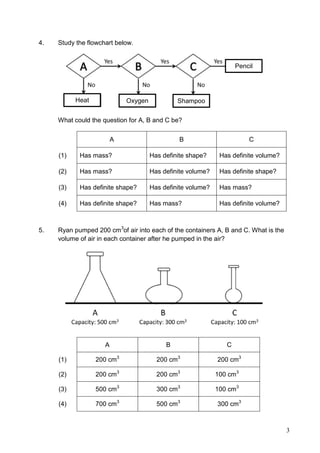
4. Study the flowchart below.
What could the question for A, B and C be?
A B C
(1) Has mass? Has definite shape? Has definite volume?
(2) Has mass? Has definite volume? Has definite shape?
(3) Has definite shape? Has definite volume? Has mass?
(4) Has definite shape? Has mass? Has definite volume?
5. Ryan pumped 200 cm3
of air into each of the containers A, B and C. What is the
volume of air in each container after he pumped in the air?
A B C
(1) 200 cm3
200 cm3
200 cm3
(2) 200 cm3
200 cm3
100 cm3
(3) 500 cm3
300 cm3
100 cm3
(4) 700 cm3
500 cm3
300 cm3
ShampooOxygenHeat
Pencil
4
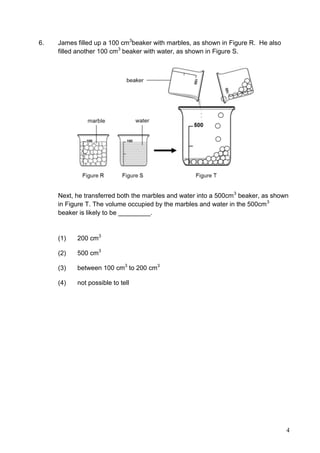
6. James filled up a 100 cm3
beaker with marbles, as shown in Figure R. He also
filled another 100 cm3
beaker with water, as shown in Figure S.
Next, he transferred both the marbles and water into a 500cm3
beaker, as shown
in Figure T. The volume occupied by the marbles and water in the 500cm3
beaker is likely to be _________.
(1) 200 cm3
(2) 500 cm3
(3) between 100 cm3
to 200 cm3
(4) not possible to tell
5
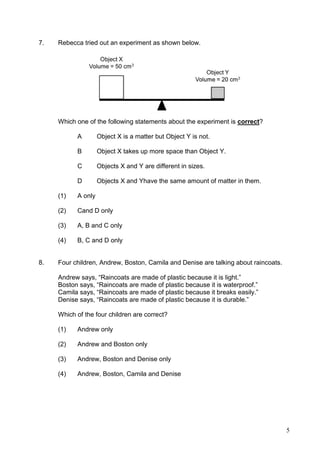
7. Rebecca tried out an experiment as shown below.
Which one of the following statements about the experiment is correct?
A Object X is a matter but Object Y is not.
B Object X takes up more space than Object Y.
C Objects X and Y are different in sizes.
D Objects X and Yhave the same amount of matter in them.
(1) A only
(2) Cand D only
(3) A, B and C only
(4) B, C and D only
8. Four children, Andrew, Boston, Camila and Denise are talking about raincoats.
Andrew says, “Raincoats are made of plastic because it is light.”
Boston says, “Raincoats are made of plastic because it is waterproof.”
Camila says, “Raincoats are made of plastic because it breaks easily.”
Denise says, “Raincoats are made of plastic because it is durable.”
Which of the four children are correct?
(1) Andrew only
(2) Andrew and Boston only
(3) Andrew, Boston and Denise only
(4) Andrew, Boston, Camila and Denise
6
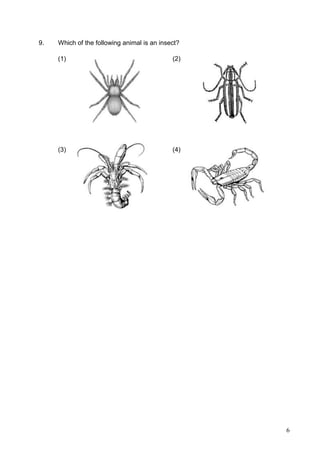
9. Which of the following animal is an insect?
(1) (2)
(3) (4)
7
Section B: (17 marks)
Write your answers to questions 10 to 16 in this question booklet.
The number of marks is shown in brackets [ ] at the end of each question or part
question.
10. Write 'True' or 'False' against each statement in the table. [2m]
Statements True / False
Air has no mass and volume.
Water has no definite shape but has a definite volume.
A sponge is not a solid because it can be squeezed to change
its shape.
When we step on a can and crush it, its shape and mass
changes.
11. Fill in the blanks with the helping words provided. Each helping word can only be
used once. [2m]
Helping words
properties flexible heavy
hard strong fragile
Materials can be classified according to their physical (a)_____________.
A (b)_____________ material does not break easily.A(c)
_____________material can be bent without breaking.A (d) _____________
material cannot be scratched easily.
4
8
12. Study the list of things given in the table and arrange them into the classification
table below. [2m]
Carbon dioxide Bread
Hot Chocolate Wind
(a)
(b) Give suitable headings for P and Q [1m]
P: ___________________________________________________________
Q: ___________________________________________________________
3
9
13. Joseph drops three iron balls of different sizes into 3 similar beakers. Each
beaker has the same amount of water.
(a) Complete the new water level in the diagram below.
Draw lines inBeakers X and Z to show the new water level using a pencil
and a ruler. [1m]
(b) Fill in the blanks with a suitable word. [1m]
From the experiment, Joseph can conclude that the ________________ the size
of the ball, the ________________ the water level in the beaker.
2
10
14. Study the flowchart below carefully.
(a) Using the information in the flowchart, state a difference between Animal C and
Animal E. [1m]
______________________________________________________________
______________________________________________________________
(b) Write the correct letter (A, B, C, D or E) that can represent each animal. [1m]
Duck-billed platypus Monkey
2
11
15. The flow chart below shows the properties of 4 substances A, B, C and D.
(a) Based on the flow chart above, identify the following substances by writing
the letters A, B, C or D in the space provided. [2m]
Substance Represented by letter
Steel bar
Detergent
Sponge
Oxygen
(b) Describe fully the properties of substance D according to the flow chart above.
[1m]
__________________________________________________________
__________________________________________________________
3
12
16. The diagram below shows two set-ups. In set-up 1, a hole was made in milk can
X. In set-up 2, two holes were made in milk can Y. Both milk cans were similar
and has the same amount of milk.
Milk was poured out from the can into a measuring cylinder. The time taken to
collect 100cm3
of milk was recorded in the table below.
Milk Can X Milk Can Y
Volume (ml) Time (min) Volume (ml) Time (min)
0 0 0 0
20 2 20 1
40 4 40 2
60 6 60 3
80 8 80 4
100 10 100 5
(a) Based on the tables, which of the two milk cans, X or Y allowed milk to be
poured out at a faster rate? [1m]
______________________________________________________________
(b) Explain why milk could flow out faster from the milk can in (a) [2m]
______________________________________________________________
______________________________________________________________
3
End of paper

Science Practice Paper 3

  • 1.
    1 PRIMARY THREE PRACTICE PAPER3 SCIENCE Duration: 45 minutes Instructions to pupils: 1. Check that every page is printed. There are 12 printed pages to this paper (including the cover page). 2. Read the instructions carefully before answering the questions. 3. Answer all the questions. 4. Check your answers after you have completed your paper. Name : _______________________ ( ) Class :Primary 3 / _______ Parent’s Signature : __________________ MARKS Section A: / 18 Section B: / 17 Total : / 35
  • 2.
    2 Section A: (9x 2marks = 18marks) For each question from 1 to 9, four options are given. One of them is the correct answer. Make your choice (1, 2, 3 or 4).Shade your answer on the Optical Answer Sheet. 1. Which of the following is matter? (1) air (2) light (3) sound (4) shadow 2. Which of the following is not a liquid? (1) milk (2) jelly (3) honey (4) orange juice 3. Which of the following are characteristics of all living things? (1) They get food from other living things. (2) They can absorb sunlight to make food. (3) They can move from one place to another. (4) They can respond to changes around them.
  • 3.
    3 4. Study theflowchart below. What could the question for A, B and C be? A B C (1) Has mass? Has definite shape? Has definite volume? (2) Has mass? Has definite volume? Has definite shape? (3) Has definite shape? Has definite volume? Has mass? (4) Has definite shape? Has mass? Has definite volume? 5. Ryan pumped 200 cm3 of air into each of the containers A, B and C. What is the volume of air in each container after he pumped in the air? A B C (1) 200 cm3 200 cm3 200 cm3 (2) 200 cm3 200 cm3 100 cm3 (3) 500 cm3 300 cm3 100 cm3 (4) 700 cm3 500 cm3 300 cm3 ShampooOxygenHeat Pencil
  • 4.
    4 6. James filledup a 100 cm3 beaker with marbles, as shown in Figure R. He also filled another 100 cm3 beaker with water, as shown in Figure S. Next, he transferred both the marbles and water into a 500cm3 beaker, as shown in Figure T. The volume occupied by the marbles and water in the 500cm3 beaker is likely to be _________. (1) 200 cm3 (2) 500 cm3 (3) between 100 cm3 to 200 cm3 (4) not possible to tell
  • 5.
    5 7. Rebecca triedout an experiment as shown below. Which one of the following statements about the experiment is correct? A Object X is a matter but Object Y is not. B Object X takes up more space than Object Y. C Objects X and Y are different in sizes. D Objects X and Yhave the same amount of matter in them. (1) A only (2) Cand D only (3) A, B and C only (4) B, C and D only 8. Four children, Andrew, Boston, Camila and Denise are talking about raincoats. Andrew says, “Raincoats are made of plastic because it is light.” Boston says, “Raincoats are made of plastic because it is waterproof.” Camila says, “Raincoats are made of plastic because it breaks easily.” Denise says, “Raincoats are made of plastic because it is durable.” Which of the four children are correct? (1) Andrew only (2) Andrew and Boston only (3) Andrew, Boston and Denise only (4) Andrew, Boston, Camila and Denise
  • 6.
    6 9. Which ofthe following animal is an insect? (1) (2) (3) (4)
  • 7.
    7 Section B: (17marks) Write your answers to questions 10 to 16 in this question booklet. The number of marks is shown in brackets [ ] at the end of each question or part question. 10. Write 'True' or 'False' against each statement in the table. [2m] Statements True / False Air has no mass and volume. Water has no definite shape but has a definite volume. A sponge is not a solid because it can be squeezed to change its shape. When we step on a can and crush it, its shape and mass changes. 11. Fill in the blanks with the helping words provided. Each helping word can only be used once. [2m] Helping words properties flexible heavy hard strong fragile Materials can be classified according to their physical (a)_____________. A (b)_____________ material does not break easily.A(c) _____________material can be bent without breaking.A (d) _____________ material cannot be scratched easily. 4
  • 8.
    8 12. Study thelist of things given in the table and arrange them into the classification table below. [2m] Carbon dioxide Bread Hot Chocolate Wind (a) (b) Give suitable headings for P and Q [1m] P: ___________________________________________________________ Q: ___________________________________________________________ 3
  • 9.
    9 13. Joseph dropsthree iron balls of different sizes into 3 similar beakers. Each beaker has the same amount of water. (a) Complete the new water level in the diagram below. Draw lines inBeakers X and Z to show the new water level using a pencil and a ruler. [1m] (b) Fill in the blanks with a suitable word. [1m] From the experiment, Joseph can conclude that the ________________ the size of the ball, the ________________ the water level in the beaker. 2
  • 10.
    10 14. Study theflowchart below carefully. (a) Using the information in the flowchart, state a difference between Animal C and Animal E. [1m] ______________________________________________________________ ______________________________________________________________ (b) Write the correct letter (A, B, C, D or E) that can represent each animal. [1m] Duck-billed platypus Monkey 2
  • 11.
    11 15. The flowchart below shows the properties of 4 substances A, B, C and D. (a) Based on the flow chart above, identify the following substances by writing the letters A, B, C or D in the space provided. [2m] Substance Represented by letter Steel bar Detergent Sponge Oxygen (b) Describe fully the properties of substance D according to the flow chart above. [1m] __________________________________________________________ __________________________________________________________ 3
  • 12.
    12 16. The diagrambelow shows two set-ups. In set-up 1, a hole was made in milk can X. In set-up 2, two holes were made in milk can Y. Both milk cans were similar and has the same amount of milk. Milk was poured out from the can into a measuring cylinder. The time taken to collect 100cm3 of milk was recorded in the table below. Milk Can X Milk Can Y Volume (ml) Time (min) Volume (ml) Time (min) 0 0 0 0 20 2 20 1 40 4 40 2 60 6 60 3 80 8 80 4 100 10 100 5 (a) Based on the tables, which of the two milk cans, X or Y allowed milk to be poured out at a faster rate? [1m] ______________________________________________________________ (b) Explain why milk could flow out faster from the milk can in (a) [2m] ______________________________________________________________ ______________________________________________________________ 3 End of paper