Observe-Analyze-Reflect-Share
What are the causes of the poor science
education in the Philippines?
What are the factors behind the low
performance in Science of Filipino students?
GUIDING PRINCIPLES OF SCIENCE
CURRICULUM FRAMEWORK
1. Science is for everyone.
2. Science is both content and process.
3. School science should emphasize depth
rather than breadth, coherence rather
than fragmentation, and use of evidence
in constructing explanation.
4. School science should be relevant and
useful.
GUIDING PRINCIPLES OF SCIENCE
CURRICULUM FRAMEWORK
5. School science should nurture interest in
learning.
6. School science should demonstrate a
commitment to the development of a culture of
science.
7. School science should promote the strong link
between science and technology, including
indigenous technology.
8. School science should recognize that science
and technology reflect, influence, and shape our
culture.
IMPLEMENTING RULES AND REGULATIONS OF THE
ENHANCED BASIC EDUCATION ACT OF 2013
Standards and Principles
a) The curriculum shall be learner-centered,
inclusive and developmentally
appropriate;
b) The curriculum shall be relevant,
responsive and research-based;
c) The curriculum shall be gender- and
culture-sensitive;
IMPLEMENTING RULES AND REGULATIONS OF THE
ENHANCED BASIC EDUCATION ACT OF 2013
d) The curriculum shall be contextualized
and global;
e) The curriculum shall use pedagogical
approaches that are constructivist, inquiry-
based, reflective, collaborative and
integrative;
IMPLEMENTING RULES AND REGULATIONS OF THE
ENHANCED BASIC EDUCATION ACT OF 2013
f) The curriculum shall adhere to the
principles and framework of Mother Tongue-
Based Multilingual Education (MTB-MLE)
which starts from where the learners are and
from what they already know proceeding
from the known to the unknown; instructional
materials and capable teachers to
implement the MTB-MLE curriculum shall be
available.
IMPLEMENTING RULES AND REGULATIONS OF THE
ENHANCED BASIC EDUCATION ACT OF 2013
g) The curriculum shall use the spiral
progression approach to ensure mastery of
knowledge and skills after each level; and
h) The curriculum shall be flexible enough to
enable and allow schools to localize,
indigenize and enhance the same based on
their respective educational and social
contexts.
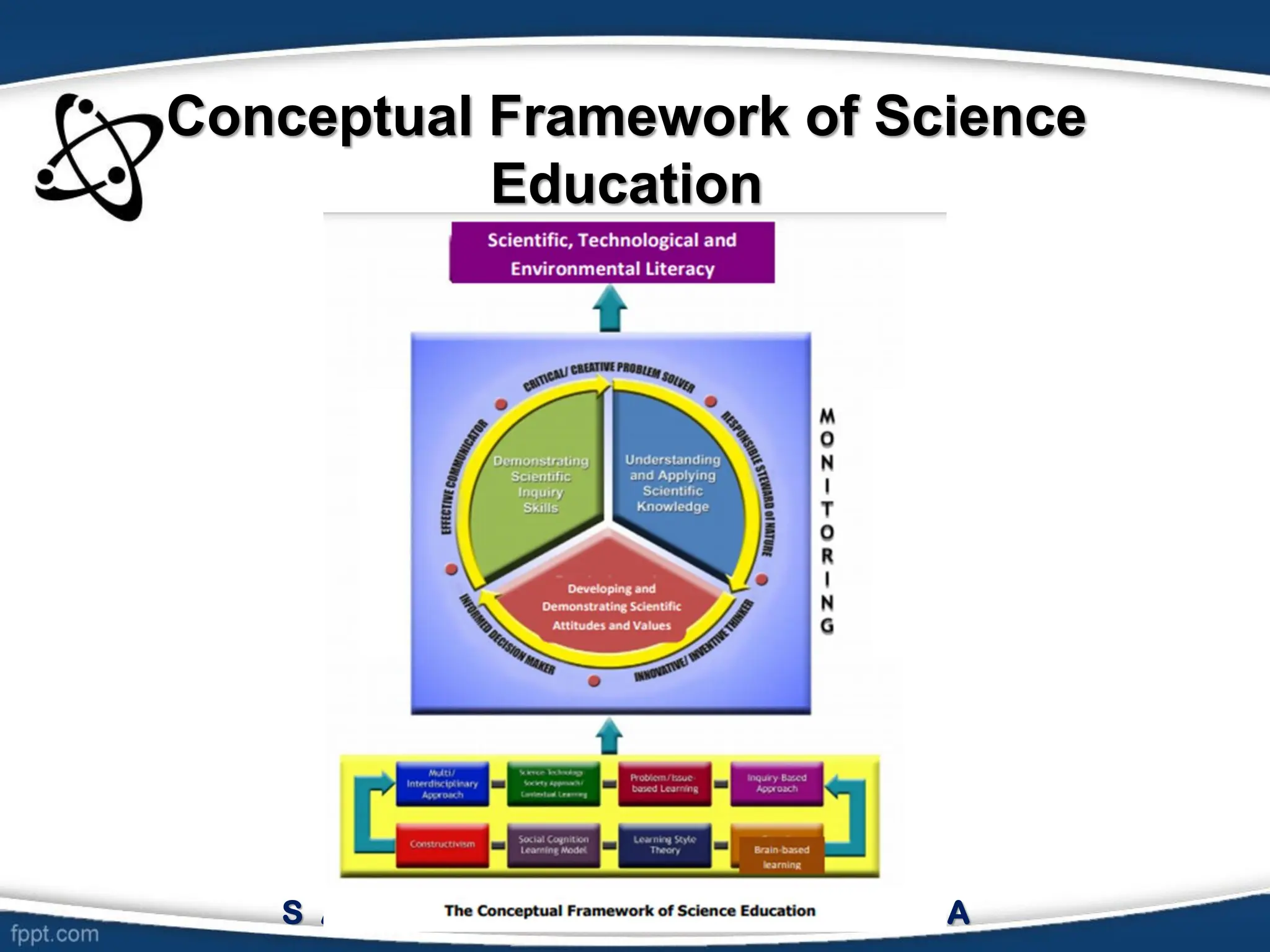
Conceptual Framework of Science
Education
S A A H S S C I E N C E A R E A
AIM OF SCIENCE EDUCATION
Scientific, Technological
and Environmental
Literacy
AIM OF SCIENCE EDUCATION
Scientific literacy
is the ability to engage with science-related
issues, and with the ideas of science, as a
reflective citizen.
(https://www.oecd-ilibrary.org)
A scientifically literate person is willing to engage in reasoned
discourse about science and technology, which requires the
competencies to:
• Explain phenomena scientifically – recognise, offer and
evaluate explanations for a range of natural and
technological phenomena.
• Interpret data and evidence scientifically – analyse and
evaluate data, claims and arguments in a variety of
representations and draw appropriate scientific conclusions.
• Evaluate and design scientific enquiry -– describe and
appraise scientific investigations and propose ways of
addressing questions scientifically.
(https://www.oecd-ilibrary.org)
Technological Literacy
“Technological Literacy is the ability to use, manage, assess, and
understand technology” (Gallop Poll, 2004, p. 1).
Technology Literacy is the ability to safely, responsibly, creatively, and
effectively use appropriate technology to:
• communicate;
• access, collect, manage, integrate, and evaluate information;
• endeavor to predict future needs, solve problems and innovatively
create solutions;
• build and share knowledge;
• improve and enhance learning in all subject areas and experiences;
• apply technology and critical thinking to real-world experiences;
• develop the knowledge and skills to adapt to changing technologies;
and
• use technology to meet personal needs, interests, and learning
styles. (https://www.estrellamountain.edu)
Environmental Literacy
An individual’s understanding, skills and motivation to
make responsible decisions that considers his or her
relationships to natural systems, communities and future
generations.
(https://oelp.oregonstate.edu)
Components of the Framework
1. Demonstrating Scientific Inquiry Skills
2. Developing and demonstrating Scientific
Attitudes and Values
3. Understanding and Applying Scientific
Knowledge
Quick Check!
What are the characteristics of a good
Science Teacher?
Why do we teach science?
How do we teach it?
How do we know if our curriculum is relevant
and effective?
How do we know if we properly implemented
our science curriculum?
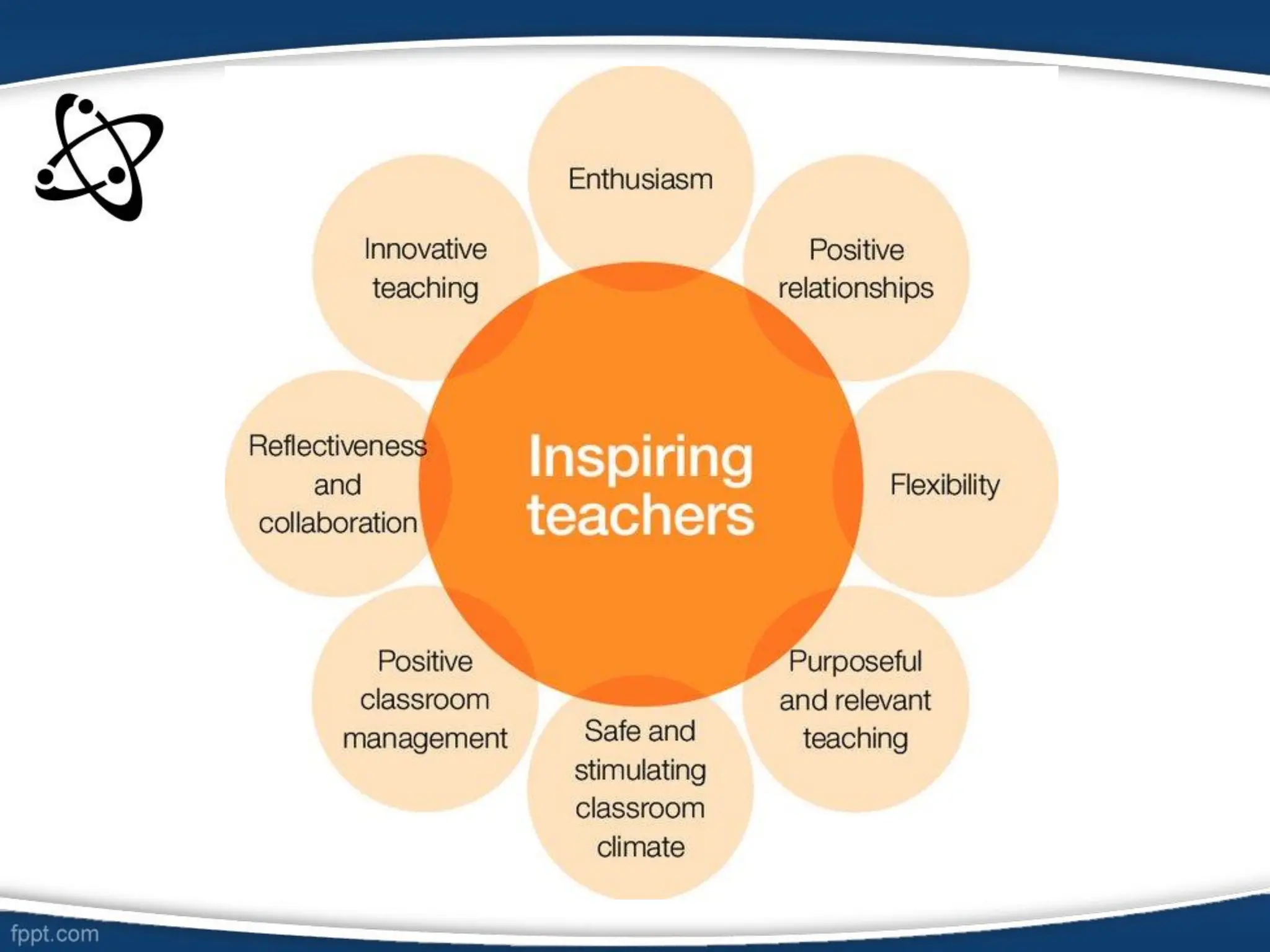
Qualities of a Good Science Teacher
• Engages students at a high level
• Knows students’ learning styles
• Brings science lessons to life with real-world
applications
• Understands student sensitivities and differences
• Is committed to continual professional
improvement
• Adjusts science lesson plans based on students’
assessment evaluations
Quick Check!
Why do we teach science?
How do we teach it?
How do we know if our curriculum is relevant
and effective?
How do we know if we properly implemented
our science curriculum?
Lesson 1 The Science CurriculumLesson 1 The Science CurriculumLesson 1 The Science CurriculumLesson 1 The Science Curriculum.pdf

Lesson 1 The Science CurriculumLesson 1 The Science CurriculumLesson 1 The Science CurriculumLesson 1 The Science Curriculum.pdf

  • 2.
  • 3.
    What are thecauses of the poor science education in the Philippines? What are the factors behind the low performance in Science of Filipino students?
  • 4.
    GUIDING PRINCIPLES OFSCIENCE CURRICULUM FRAMEWORK 1. Science is for everyone. 2. Science is both content and process. 3. School science should emphasize depth rather than breadth, coherence rather than fragmentation, and use of evidence in constructing explanation. 4. School science should be relevant and useful.
  • 5.
    GUIDING PRINCIPLES OFSCIENCE CURRICULUM FRAMEWORK 5. School science should nurture interest in learning. 6. School science should demonstrate a commitment to the development of a culture of science. 7. School science should promote the strong link between science and technology, including indigenous technology. 8. School science should recognize that science and technology reflect, influence, and shape our culture.
  • 6.
    IMPLEMENTING RULES ANDREGULATIONS OF THE ENHANCED BASIC EDUCATION ACT OF 2013 Standards and Principles a) The curriculum shall be learner-centered, inclusive and developmentally appropriate; b) The curriculum shall be relevant, responsive and research-based; c) The curriculum shall be gender- and culture-sensitive;
  • 7.
    IMPLEMENTING RULES ANDREGULATIONS OF THE ENHANCED BASIC EDUCATION ACT OF 2013 d) The curriculum shall be contextualized and global; e) The curriculum shall use pedagogical approaches that are constructivist, inquiry- based, reflective, collaborative and integrative;
  • 8.
    IMPLEMENTING RULES ANDREGULATIONS OF THE ENHANCED BASIC EDUCATION ACT OF 2013 f) The curriculum shall adhere to the principles and framework of Mother Tongue- Based Multilingual Education (MTB-MLE) which starts from where the learners are and from what they already know proceeding from the known to the unknown; instructional materials and capable teachers to implement the MTB-MLE curriculum shall be available.
  • 9.
    IMPLEMENTING RULES ANDREGULATIONS OF THE ENHANCED BASIC EDUCATION ACT OF 2013 g) The curriculum shall use the spiral progression approach to ensure mastery of knowledge and skills after each level; and h) The curriculum shall be flexible enough to enable and allow schools to localize, indigenize and enhance the same based on their respective educational and social contexts.
  • 10.
    Conceptual Framework ofScience Education S A A H S S C I E N C E A R E A
  • 11.
    AIM OF SCIENCEEDUCATION Scientific, Technological and Environmental Literacy
  • 12.
    AIM OF SCIENCEEDUCATION Scientific literacy is the ability to engage with science-related issues, and with the ideas of science, as a reflective citizen. (https://www.oecd-ilibrary.org)
  • 13.
    A scientifically literateperson is willing to engage in reasoned discourse about science and technology, which requires the competencies to: • Explain phenomena scientifically – recognise, offer and evaluate explanations for a range of natural and technological phenomena. • Interpret data and evidence scientifically – analyse and evaluate data, claims and arguments in a variety of representations and draw appropriate scientific conclusions. • Evaluate and design scientific enquiry -– describe and appraise scientific investigations and propose ways of addressing questions scientifically. (https://www.oecd-ilibrary.org)
  • 14.
    Technological Literacy “Technological Literacyis the ability to use, manage, assess, and understand technology” (Gallop Poll, 2004, p. 1). Technology Literacy is the ability to safely, responsibly, creatively, and effectively use appropriate technology to: • communicate; • access, collect, manage, integrate, and evaluate information; • endeavor to predict future needs, solve problems and innovatively create solutions; • build and share knowledge; • improve and enhance learning in all subject areas and experiences; • apply technology and critical thinking to real-world experiences; • develop the knowledge and skills to adapt to changing technologies; and • use technology to meet personal needs, interests, and learning styles. (https://www.estrellamountain.edu)
  • 15.
    Environmental Literacy An individual’sunderstanding, skills and motivation to make responsible decisions that considers his or her relationships to natural systems, communities and future generations. (https://oelp.oregonstate.edu)
  • 16.
    Components of theFramework 1. Demonstrating Scientific Inquiry Skills 2. Developing and demonstrating Scientific Attitudes and Values 3. Understanding and Applying Scientific Knowledge
  • 17.
    Quick Check! What arethe characteristics of a good Science Teacher? Why do we teach science? How do we teach it? How do we know if our curriculum is relevant and effective? How do we know if we properly implemented our science curriculum?
  • 18.
    Qualities of aGood Science Teacher • Engages students at a high level • Knows students’ learning styles • Brings science lessons to life with real-world applications • Understands student sensitivities and differences • Is committed to continual professional improvement • Adjusts science lesson plans based on students’ assessment evaluations
  • 20.
    Quick Check! Why dowe teach science? How do we teach it? How do we know if our curriculum is relevant and effective? How do we know if we properly implemented our science curriculum?