Gr. 7 & 8
Science
Quiz contest
1. Which organelle is known as “the
cell’s brain”?
a. Ribosome
b. Nucleus
c. Mitochondrion
d. Funny Bone
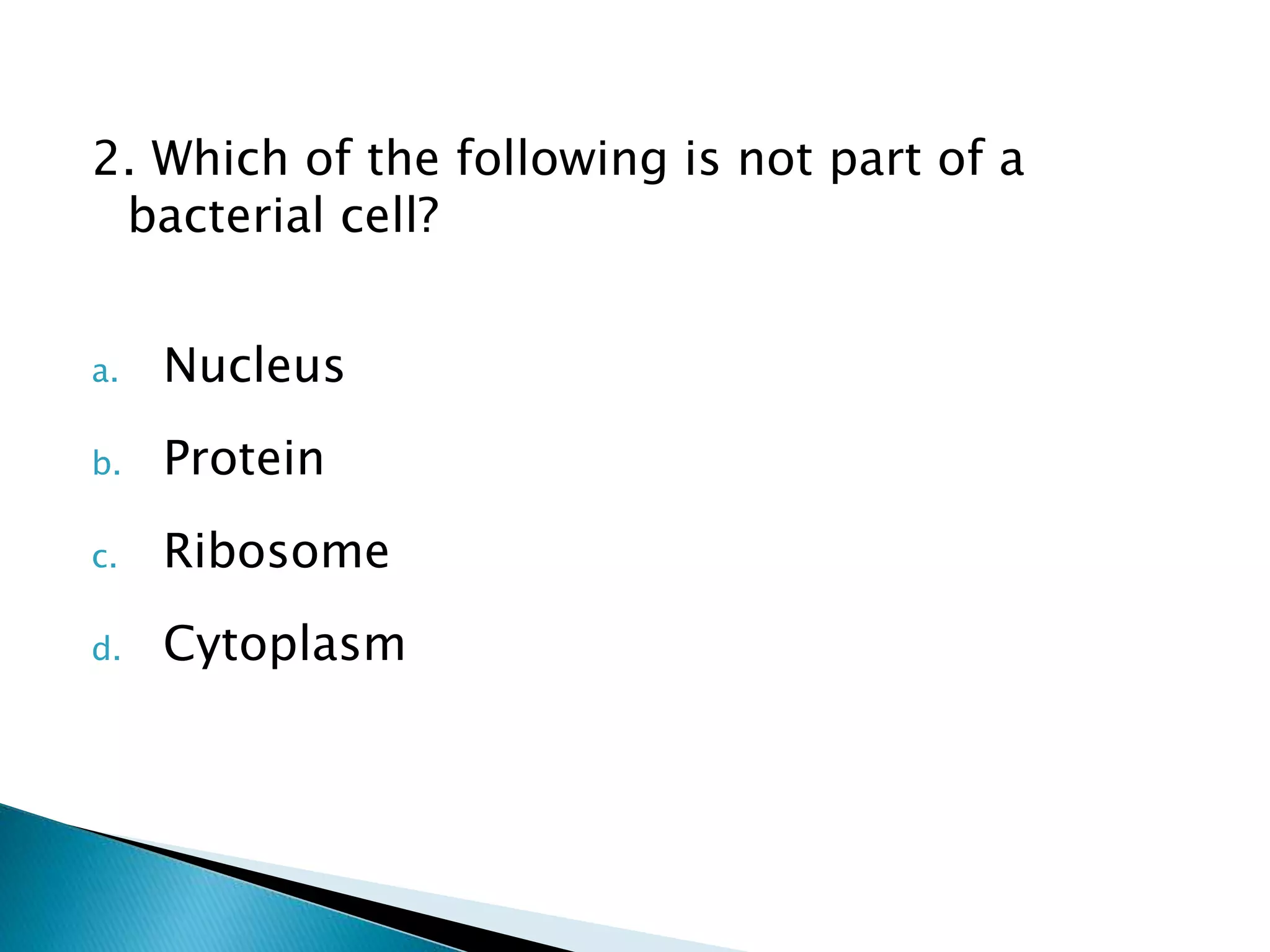
2. Which of the following is not part of a
bacterial cell?
a. Nucleus
b. Protein
c. Ribosome
d. Cytoplasm
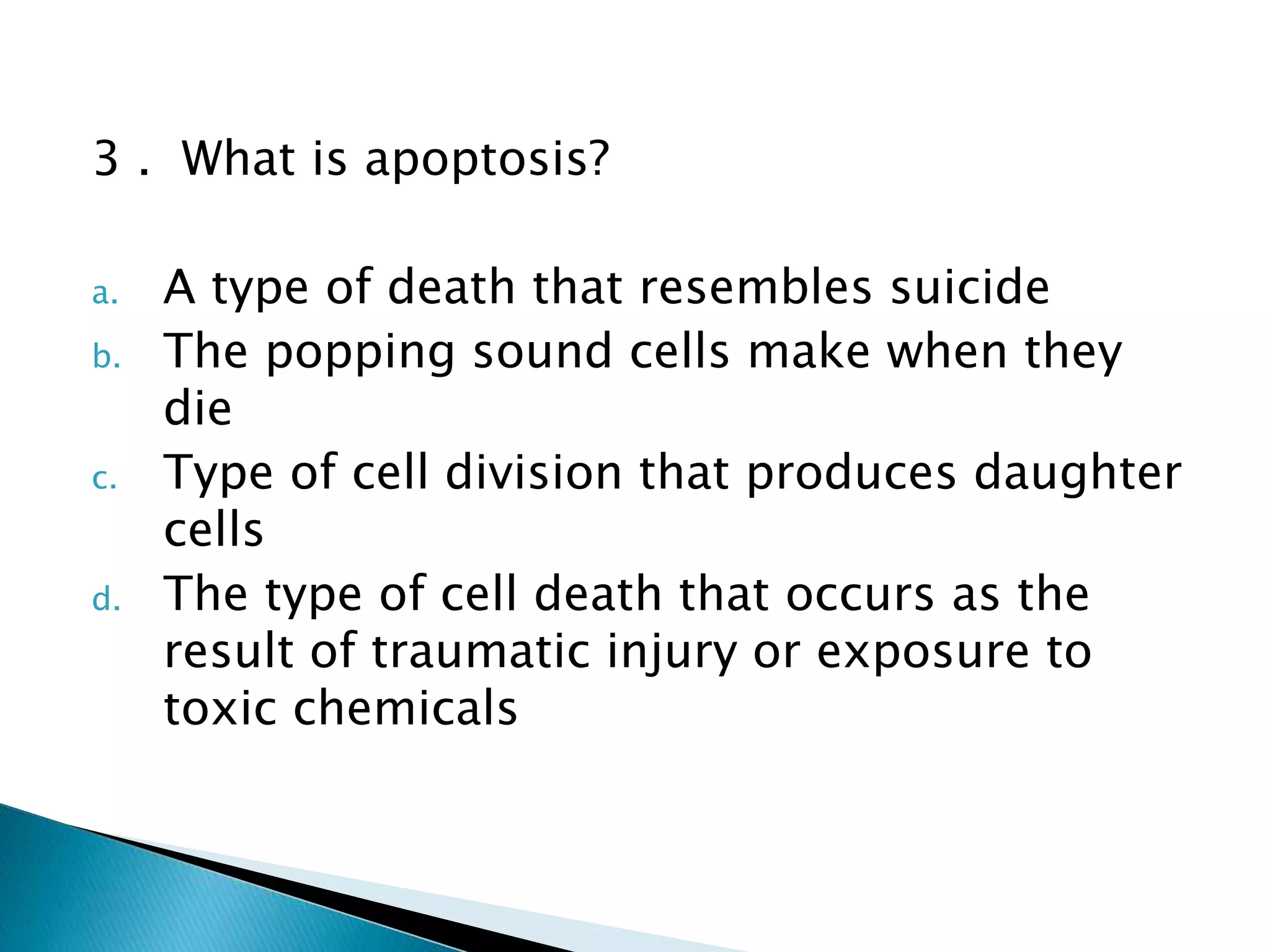
3 . What is apoptosis?
a. A type of death that resembles suicide
b. The popping sound cells make when they
die
c. Type of cell division that produces daughter
cells
d. The type of cell death that occurs as the
result of traumatic injury or exposure to
toxic chemicals
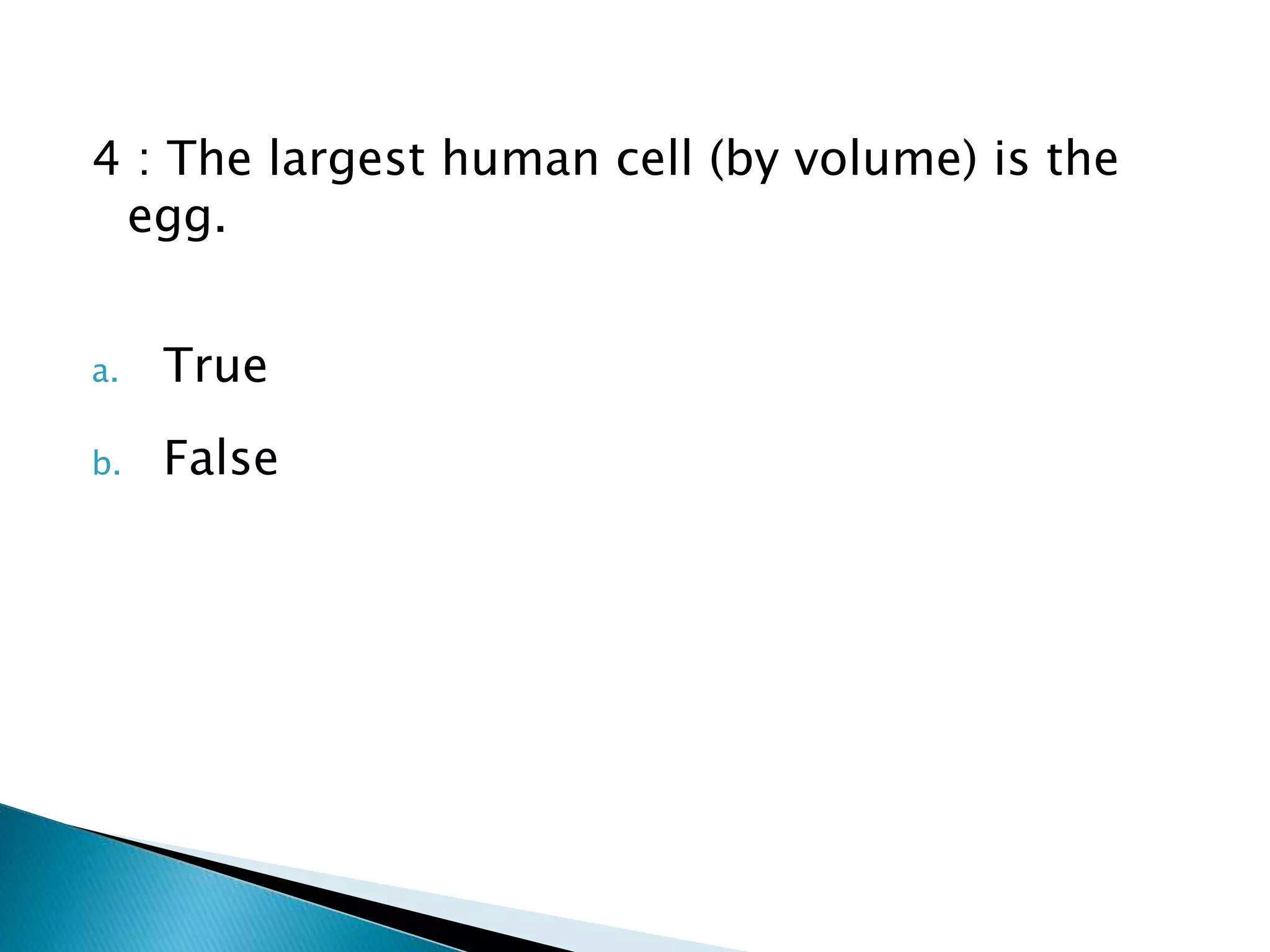
4 : The largest human cell (by volume) is the
egg.
a. True
b. False
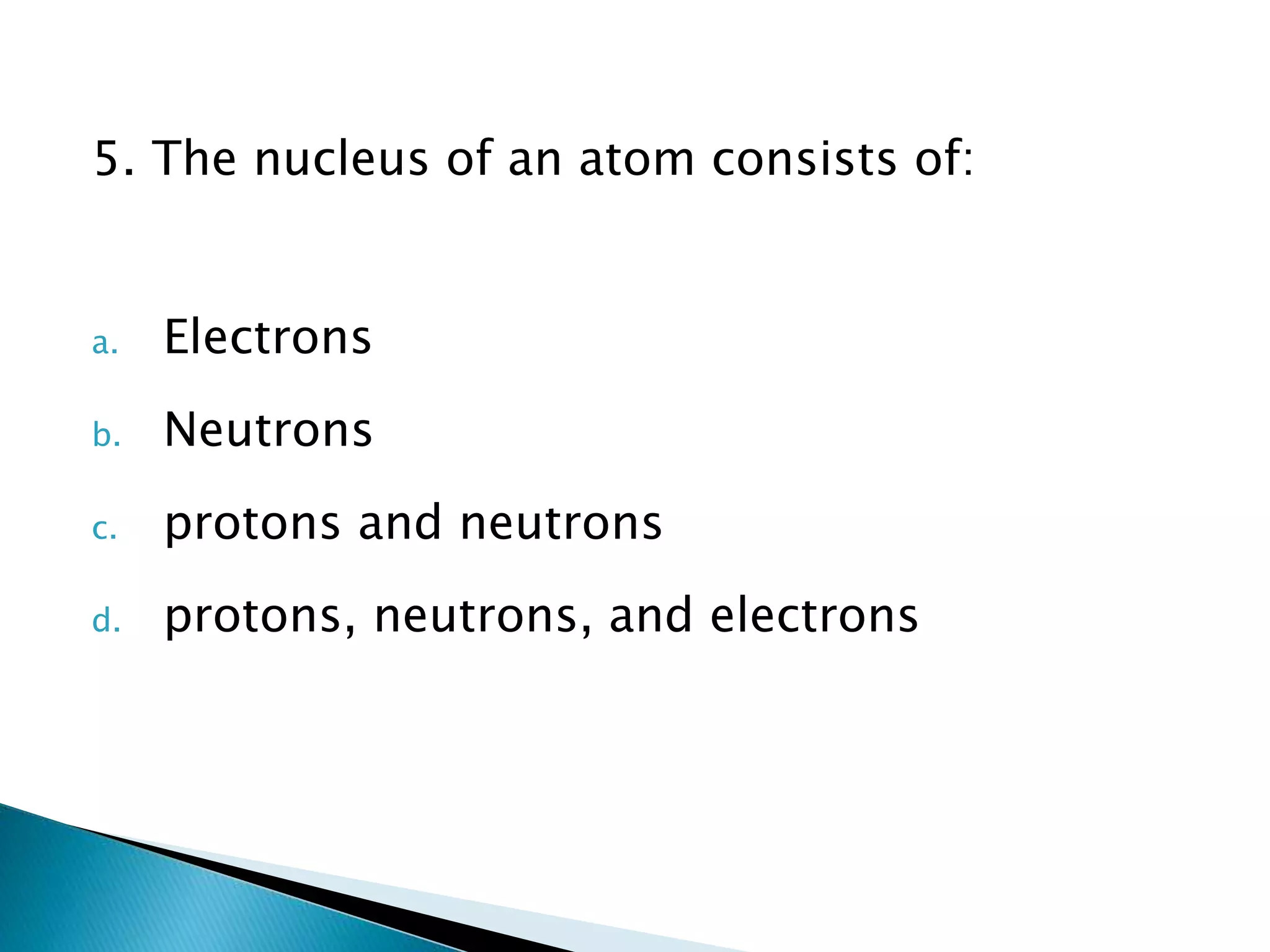
5. The nucleus of an atom consists of:
a. Electrons
b. Neutrons
c. protons and neutrons
d. protons, neutrons, and electrons
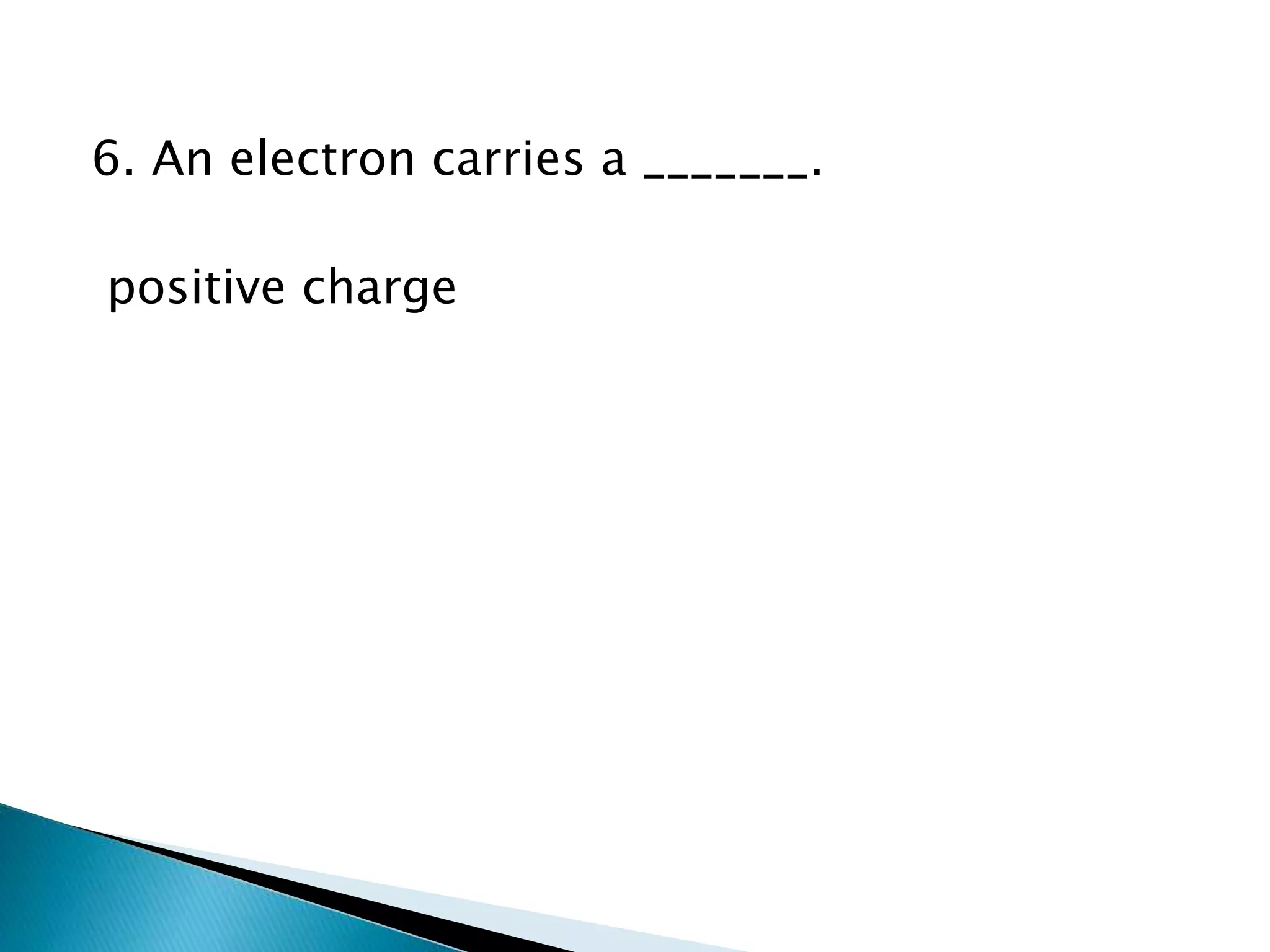
6. An electron carries a _______.
positive charge
7. Entomology is the scientific study of:
a. Internal organs
b. Birds
c. Insects
d. Trees
e. Lichens
8. The green pigment found in plants that
performs photosynthesis is:
a. Melanin
b. Chloroplast
c. Chlorophyll
d. Chromatophore
9. A proton has what electrical charge?
a. no charge
b. positive charge
c. negative charge
d. either a positive or negative charge
10. The ozone layer protects us from too
much:
a. carbon dioxide
b. gamma radiation
c. ultraviolet radiation
d. temperature fluctuation
11. Lizards belong to which animal group?
a. Amphibians
b. Reptiles
c. Invertebrates
d. mammals
12. What is the 7th element on the periodic
table of elements?
 N
13. True or false? DNA is the shortened form of
the term ‘Deoxyribonucleic acid’?
14. Pure water has a pH level of a around?
15. What is the name of the part of the human
skeleton which protects our brain?
16. Is the compound ‘HCl’ an acid or base?
17. These functions are all part of a
mechanism that allows the body to maintain
a balance between itself and the
environment. What is that mechanism
called?
a. Homeostasis
b. Metabolism
c. Osmosis
d. diffusion
18. What is formed immediately after
fertilization occurs?
a. Sperm
b. Egg
c. Embryo
d. zygote
19. Which is a chemical change?
a. melting an ice cube
b. dissolving sugar in boiling water
c. boiling an egg
d. crushing a can
20) What is formed immediately after
fertilization occurs?
a. sperm
b. egg
c. embryo
d. zygote
 21. Mushrooms that grow on the sides of
trees in a forest ecosystem are best
classified by which of the following types of
organisms?
a.Consumers
b.Decomposers
c. Predators
d.Producers
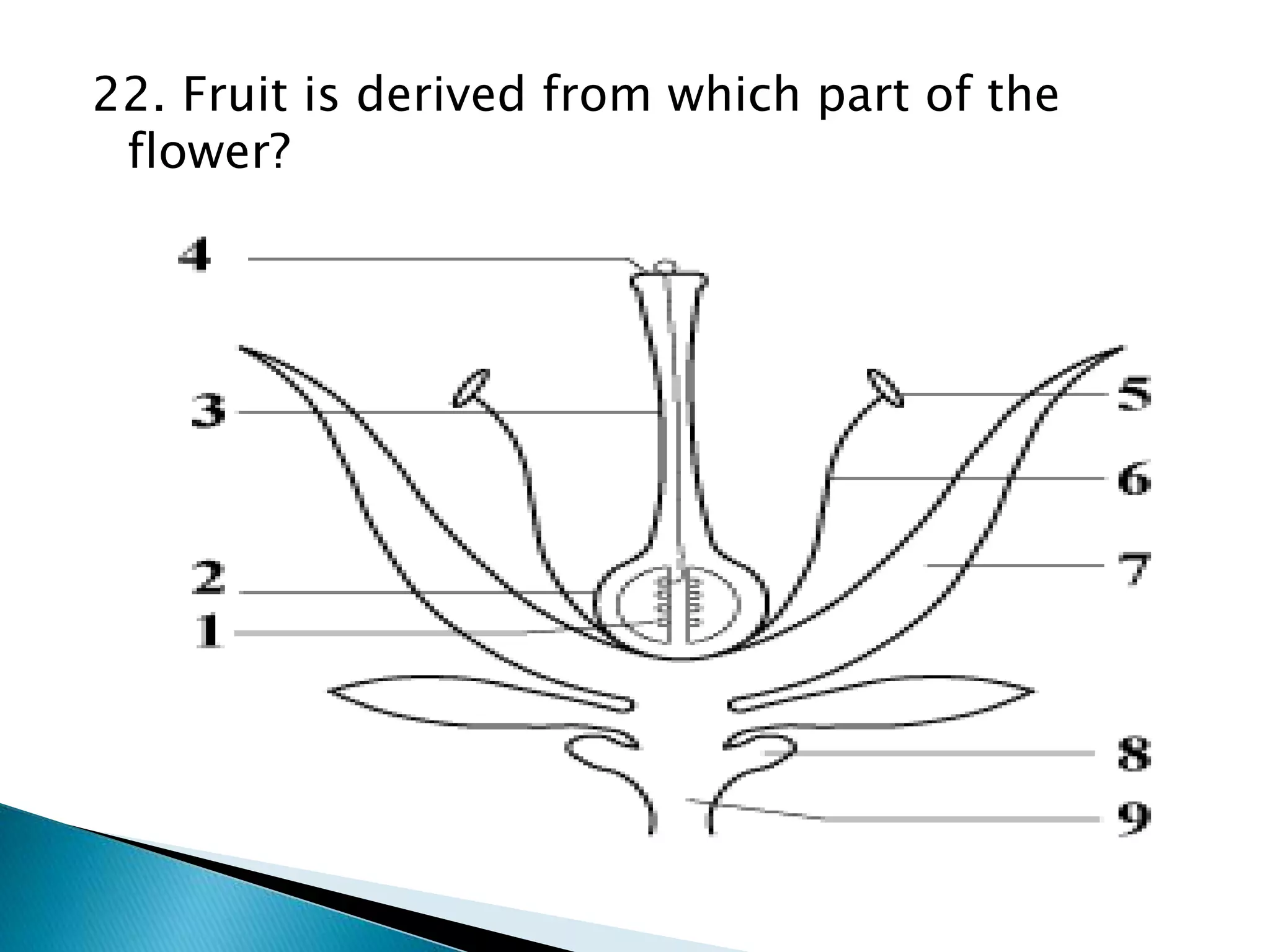
22. Fruit is derived from which part of the
flower?
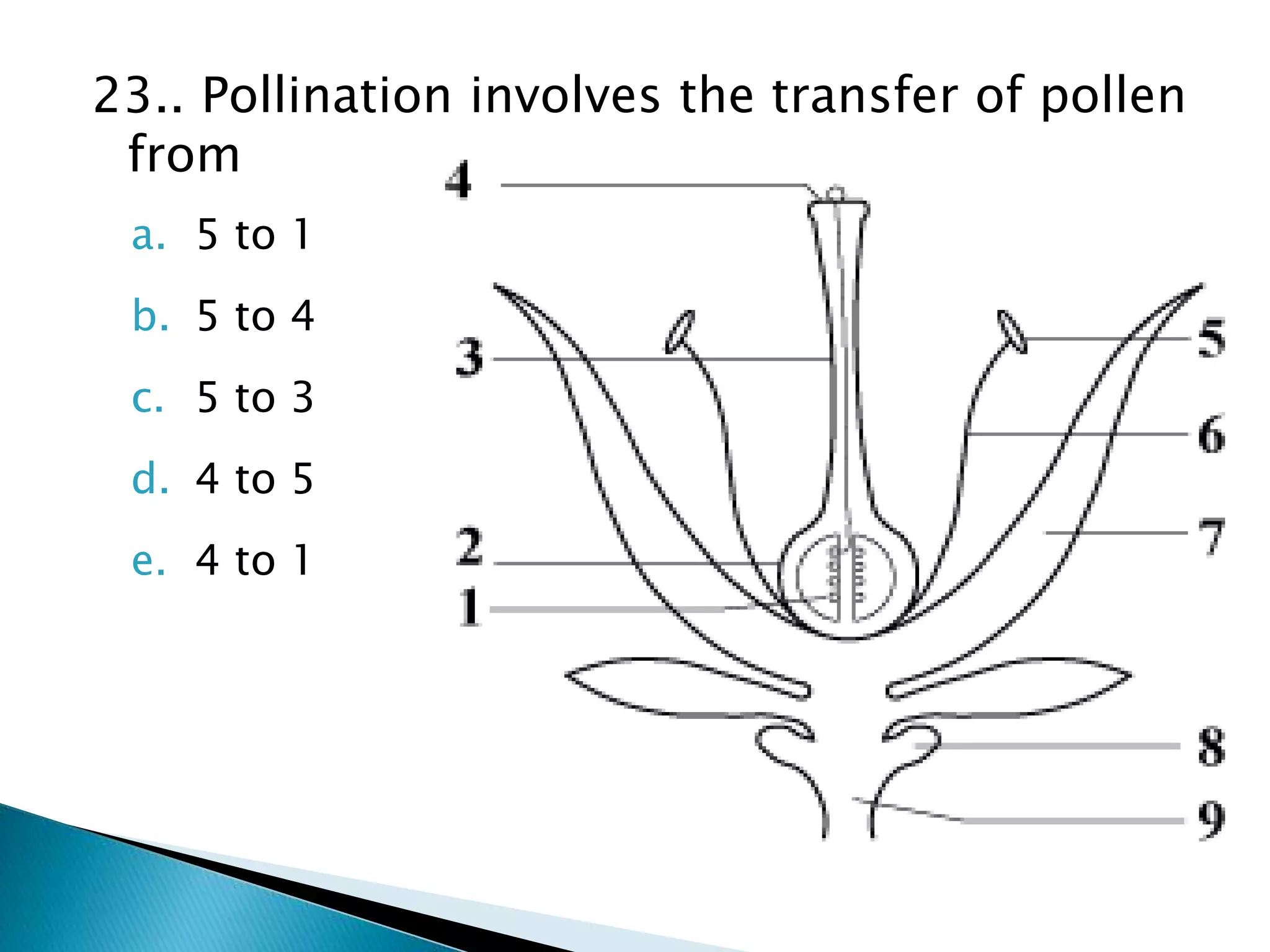
23.. Pollination involves the transfer of pollen
from
a. 5 to 1
b. 5 to 4
c. 5 to 3
d. 4 to 5
e. 4 to 1
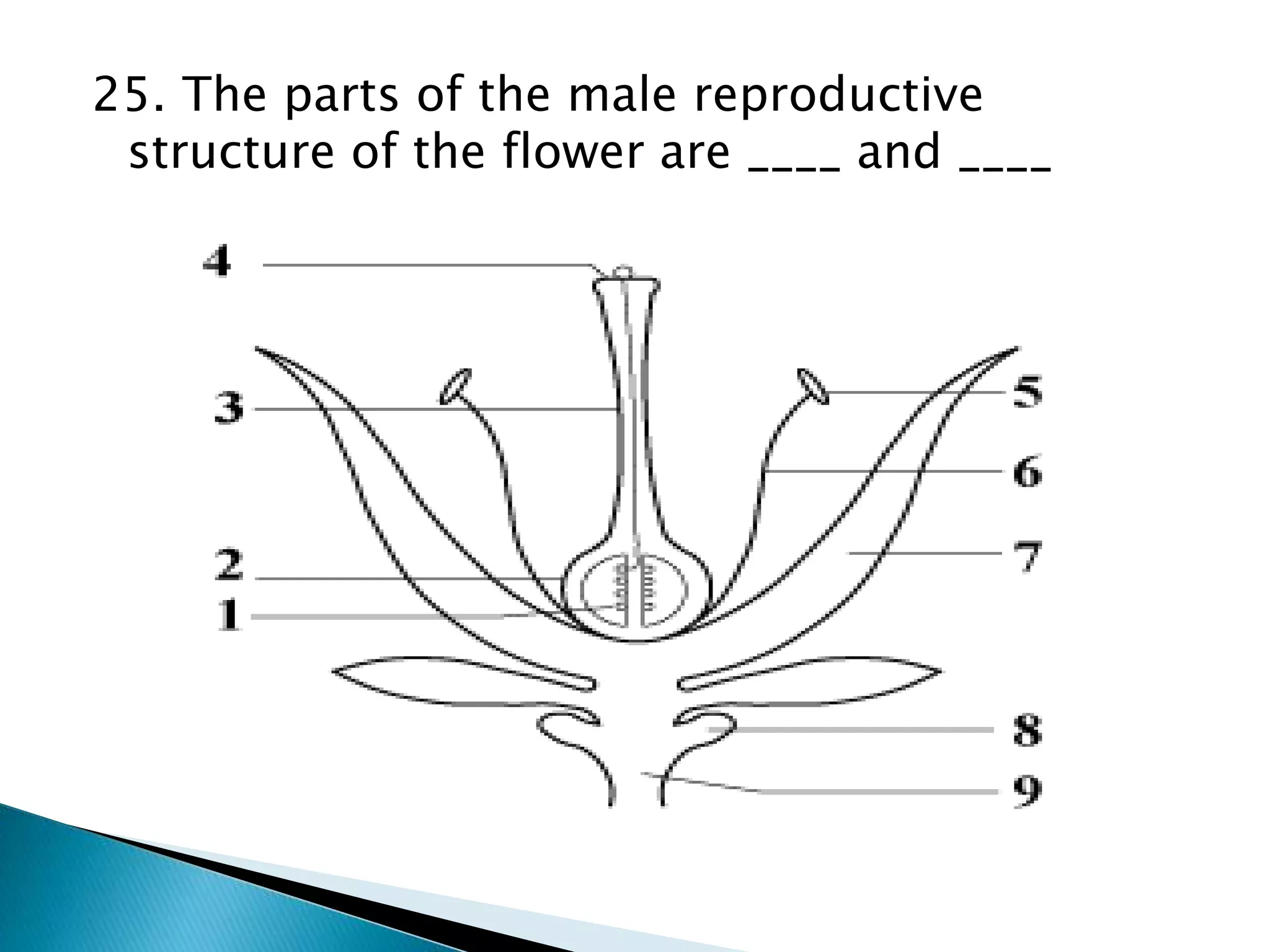
25. The parts of the male reproductive
structure of the flower are ____ and ____
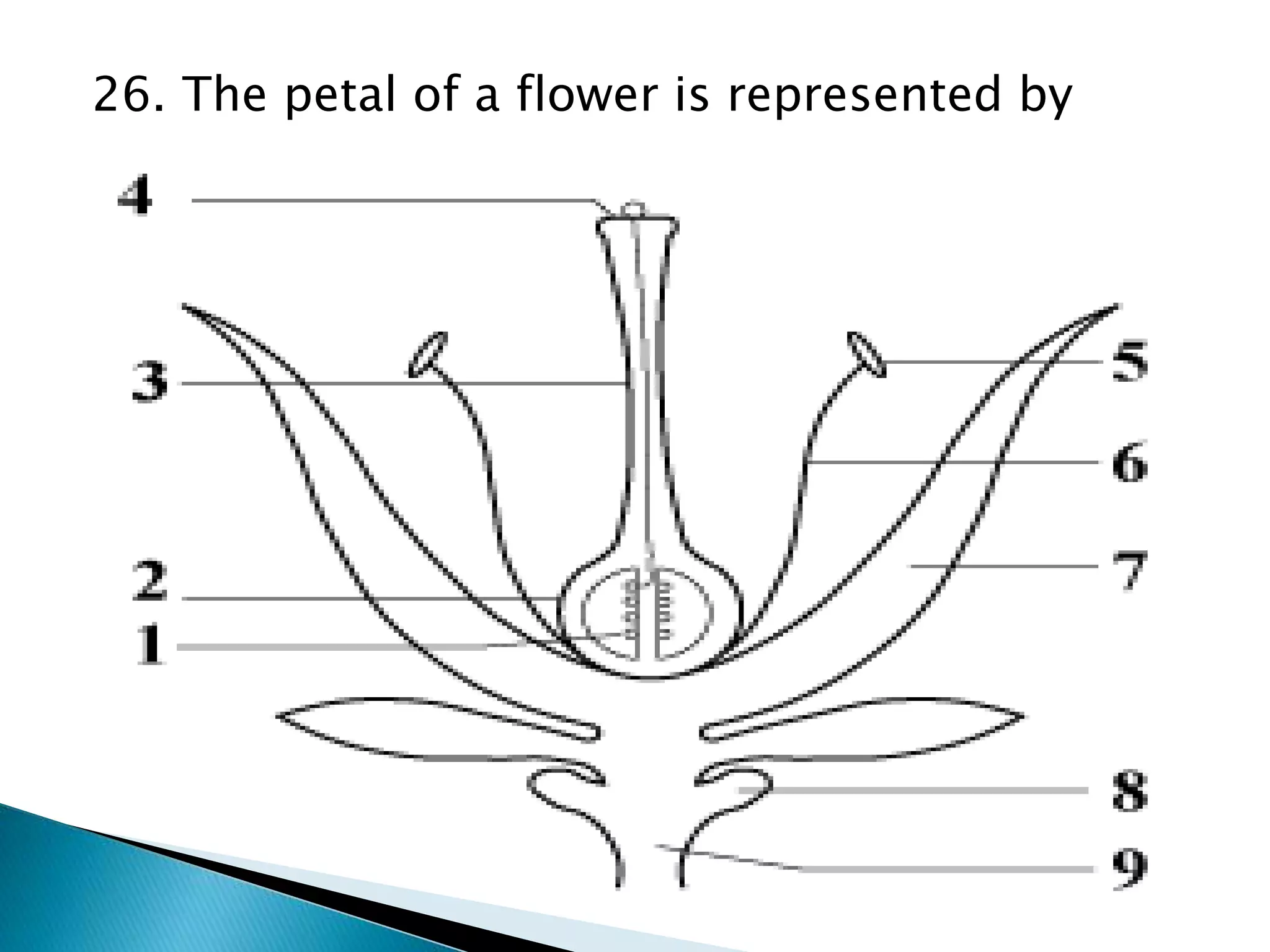
26. The petal of a flower is represented by
27. Organisms that comprise the greatest
mass of living substance (biomass) in a
terrestrial food chain
a. Decomposers (e.g., bacteria)
b. Producers (e.g., grasses)
c. Primary consumers (e.g., mice)
d. Secondary consumers (e.g., snakes)
e. Tertiary consumers (e.g., hawks)
 28. Nitrogenous base that occurs in RNA
but not in DNA
a. Deoxyribose
b. Ribose
c. Uracil
d. Cytosine
e. Thymine
29. What happens when two negatively charged
particles are next to each other?
a. The particles attract each other.
b. One particle becomes uncharged.
c. One particle becomes positively charged.
d. The particles repel each other
30. The two types of prokaryotes are
__________ and ____________
31. Which gas is monatomic at STP?
a. chlorine
b. fluorine
c. neon
d. nitrogen
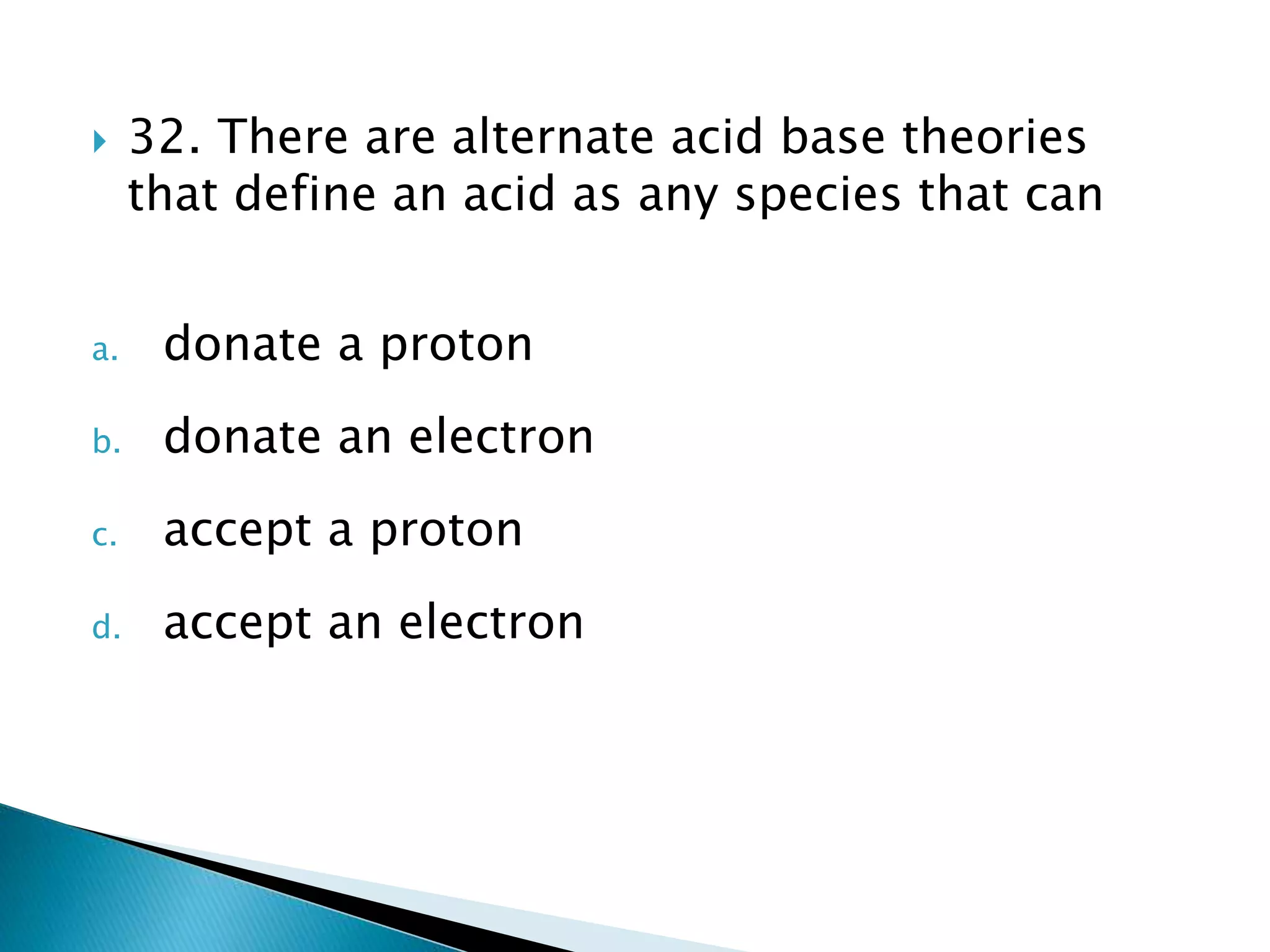
 32. There are alternate acid base theories
that define an acid as any species that can
a. donate a proton
b. donate an electron
c. accept a proton
d. accept an electron
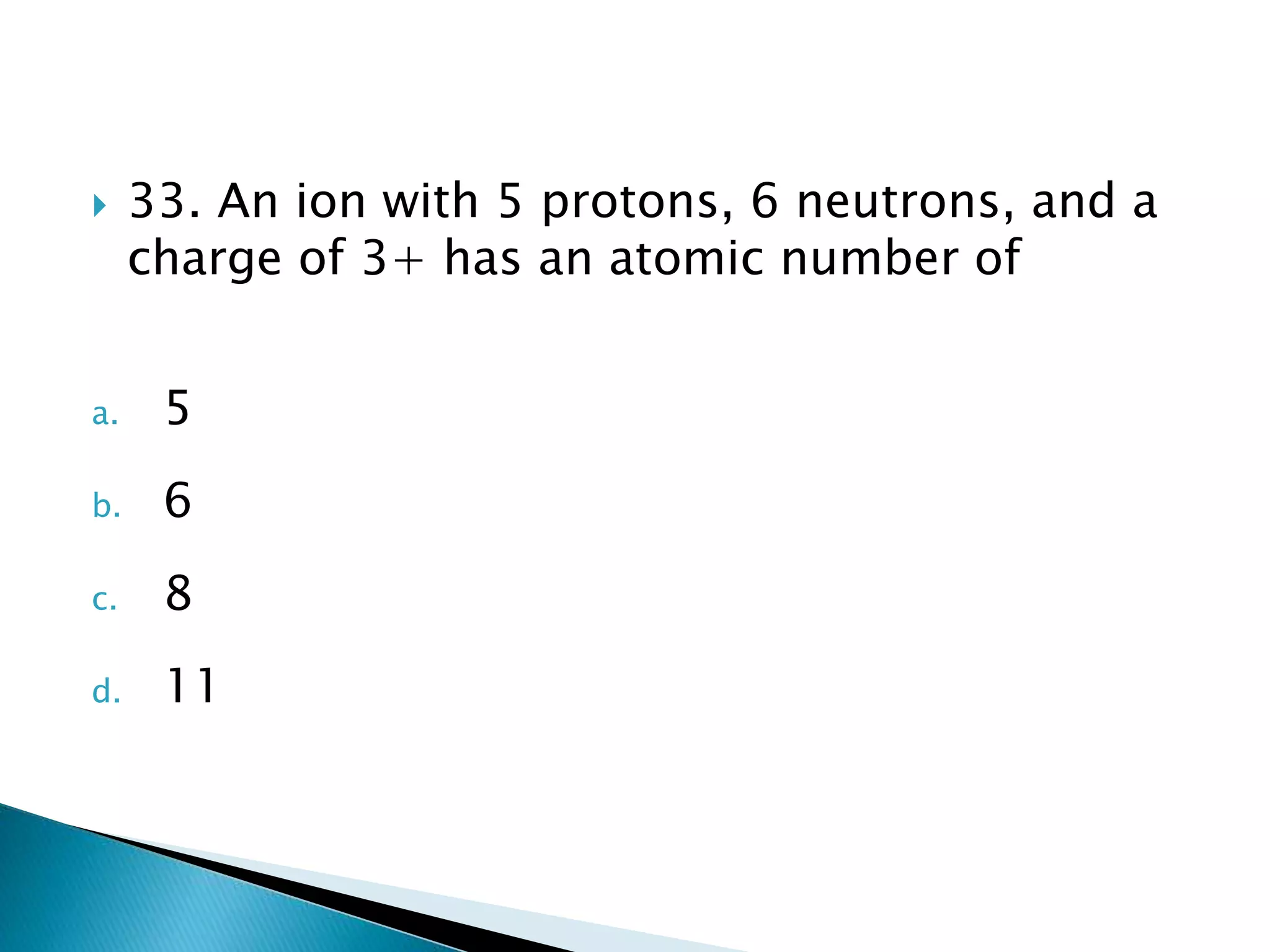
 33. An ion with 5 protons, 6 neutrons, and a
charge of 3+ has an atomic number of
a. 5
b. 6
c. 8
d. 11
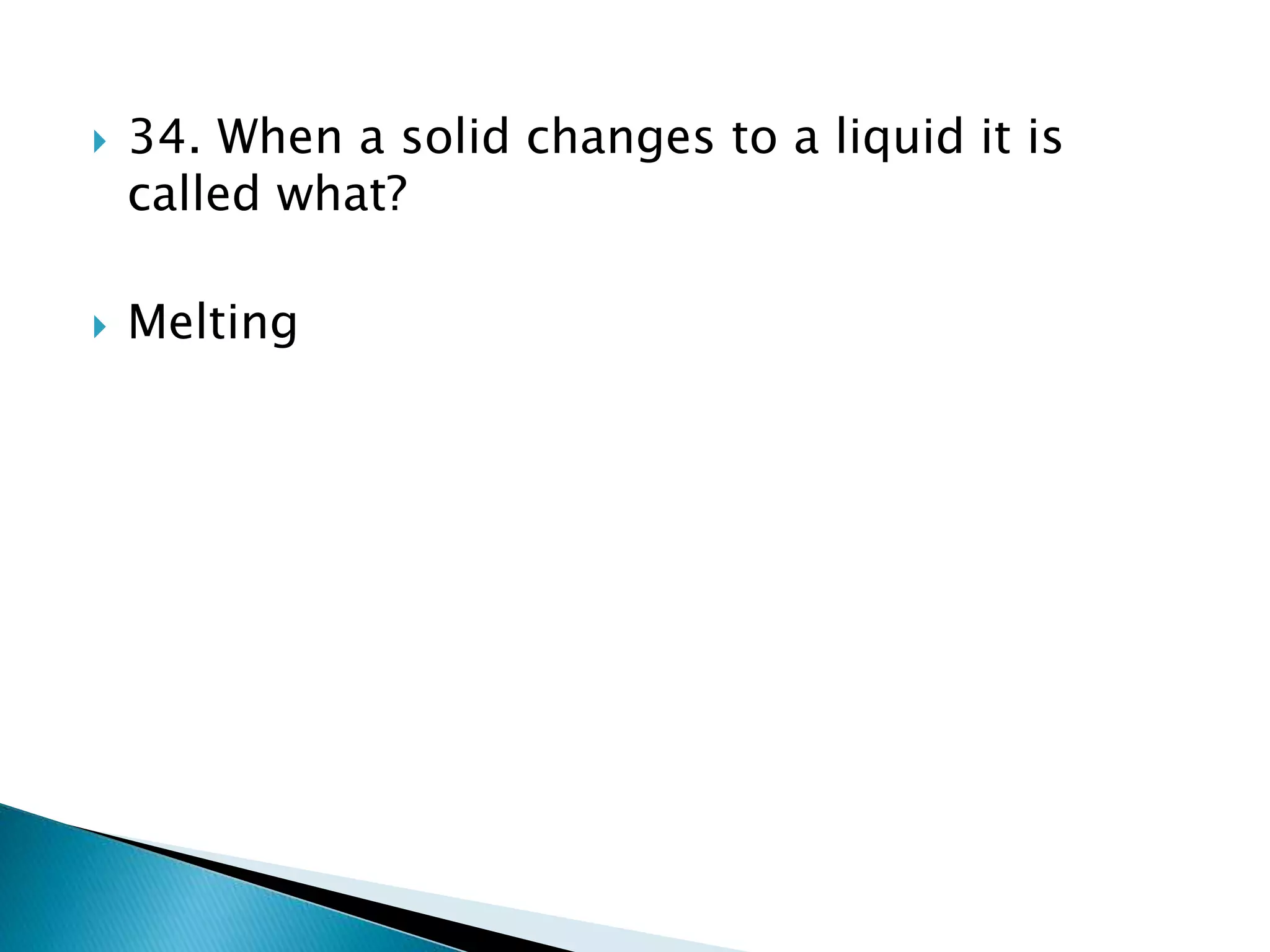
 34. When a solid changes to a liquid it is
called what?
 Melting
 35. When a gas changes into a liquid it is
called ________
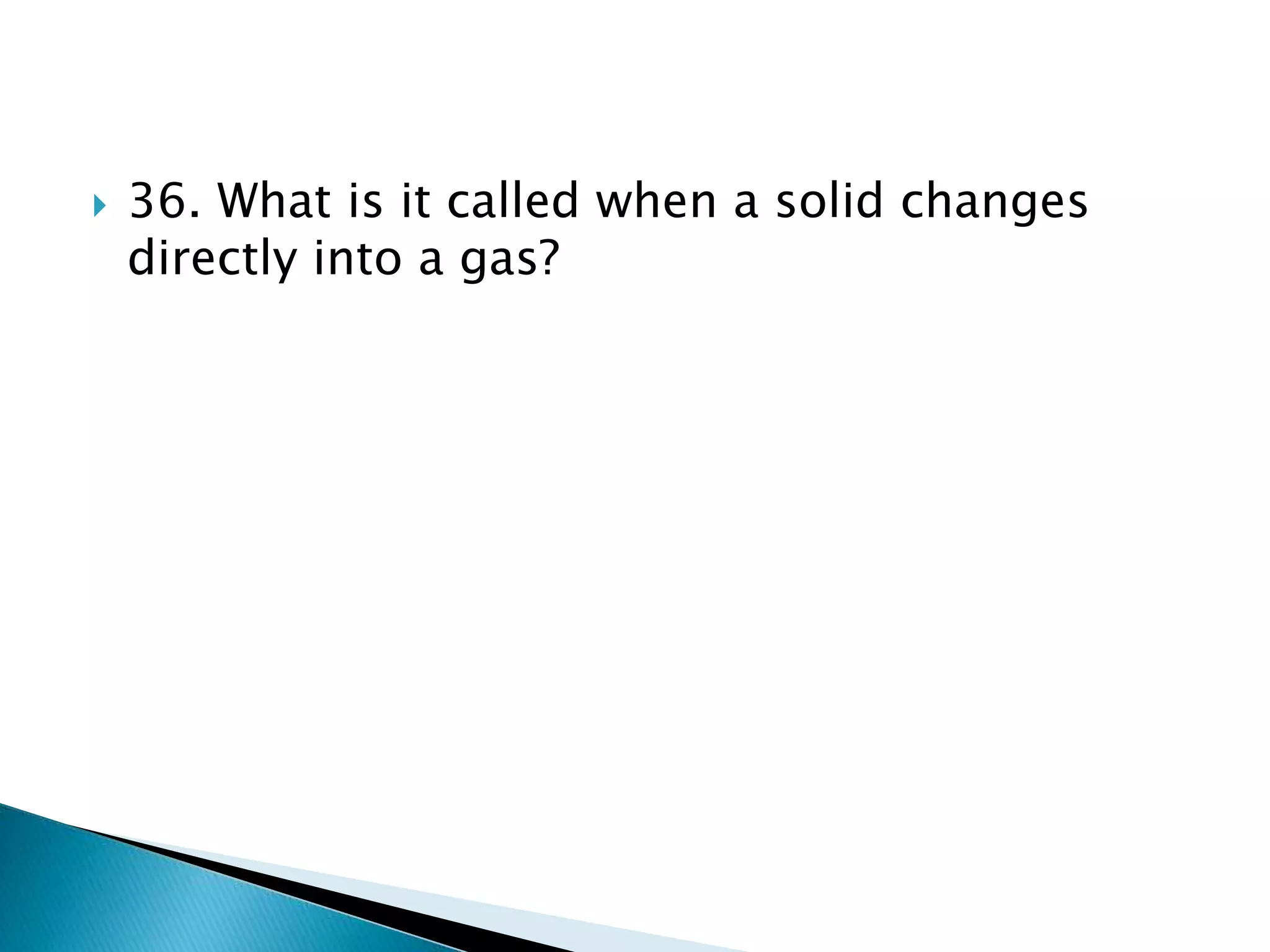
 36. What is it called when a solid changes
directly into a gas?
 37. What is the name given to substances
that are initially involved in a chemical
reaction?
38. Atoms of the same chemical element that
have different atomic mass are known as?
 39. Another name for your voice box is the?
 40. The wind pipe in the reproductive system
is the _________
 41. The external layer of the skin of the body
is called ___________
 42. What is the human body’s biggest organ?
 43. Who was the first person to walk on the
moon?
 Neil Armstrong
 44. At room temperature, what is the only
metal that is in liquid form?
 45. Sound travels faster through water than
air.
 True
 46. What is the freezing temperature of
water?
 47. What is the largest ‘big cat’ in the world?
 Tiger
48. What is the tallest animal in the world?
 Giraffe up to 6m
 49. Which famous scientist is the father of
inheritance?
 50. A person who studies about physics is
called ______________
 51. A person who studies about plants is
called _________________
 52. The SI unit of force is _____
 53. The unit of acceleration is ____
 54. Weight and mass are the same.
 55. There are ______ liters of blood in adult
human being.
 56. The study of heredity is called
_________________
 57. The two types of prokaryotes are
__________ and ____________
 58. Anything that has mass and occupies
space is called _______________.
 59. The average adult human skeleton has
_______ bones. 206
 60. The common pathway for the digestive
system and respiratory system
 61. The smallest, basic, structural and
functional unit of living things is called
a. cell
b. tissue
c. virus
d. bacteria
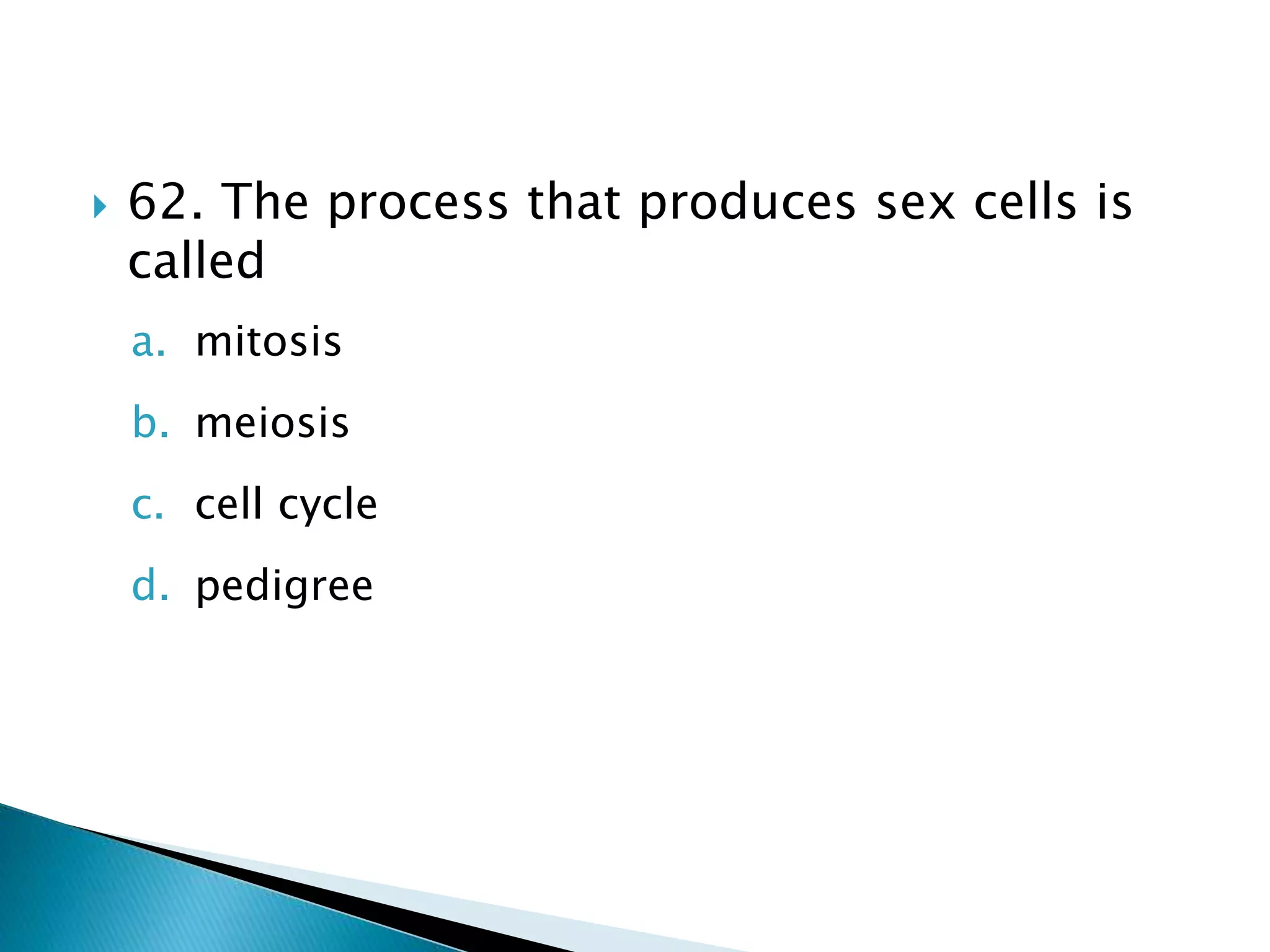
 62. The process that produces sex cells is
called
a. mitosis
b. meiosis
c. cell cycle
d. pedigree
 63. How many different types of amino acids
are there in nature?
 A) 15 B) 30 C) 60 D) 20
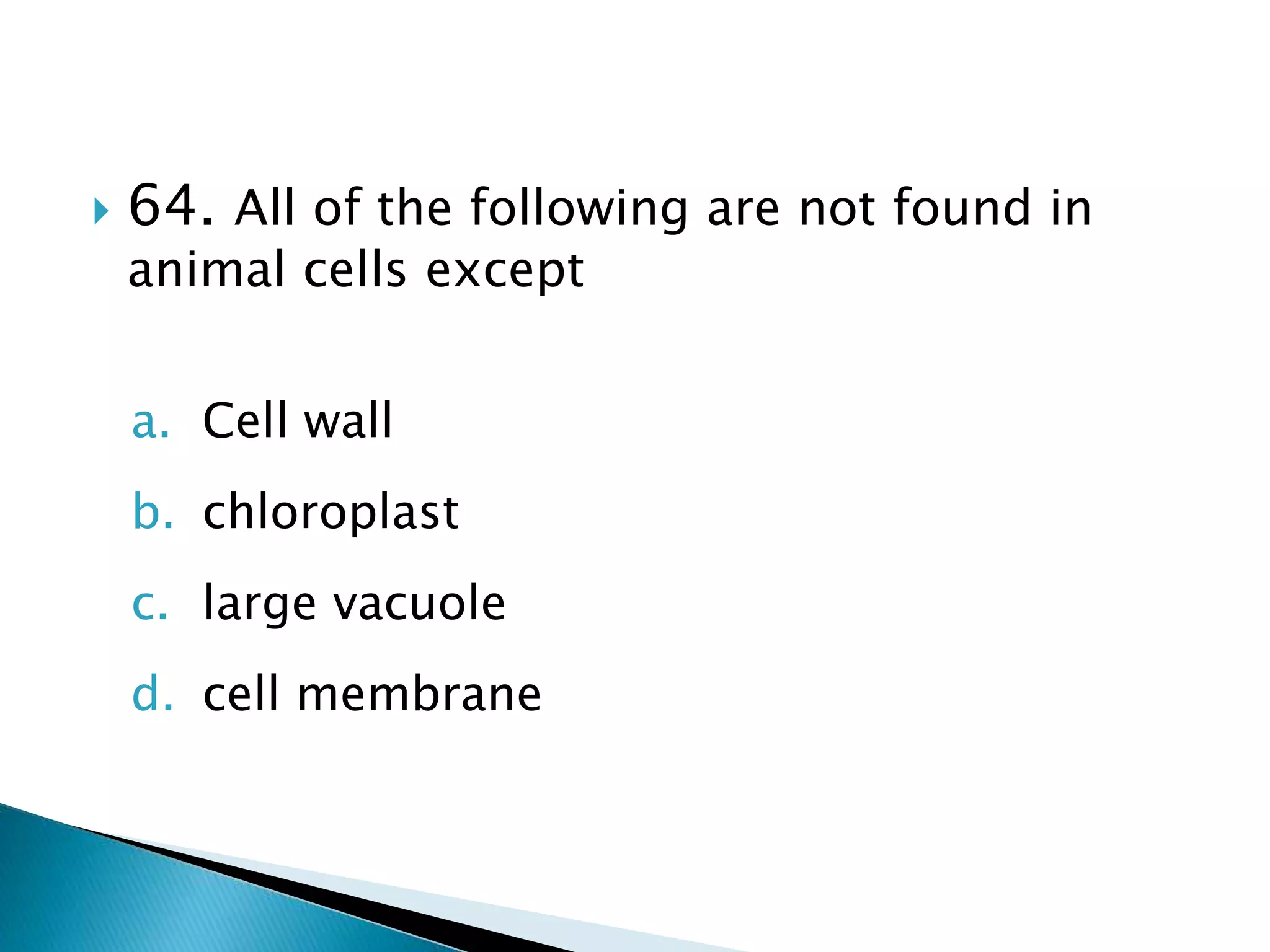
 64. All of the following are not found in
animal cells except
a. Cell wall
b. chloroplast
c. large vacuole
d. cell membrane
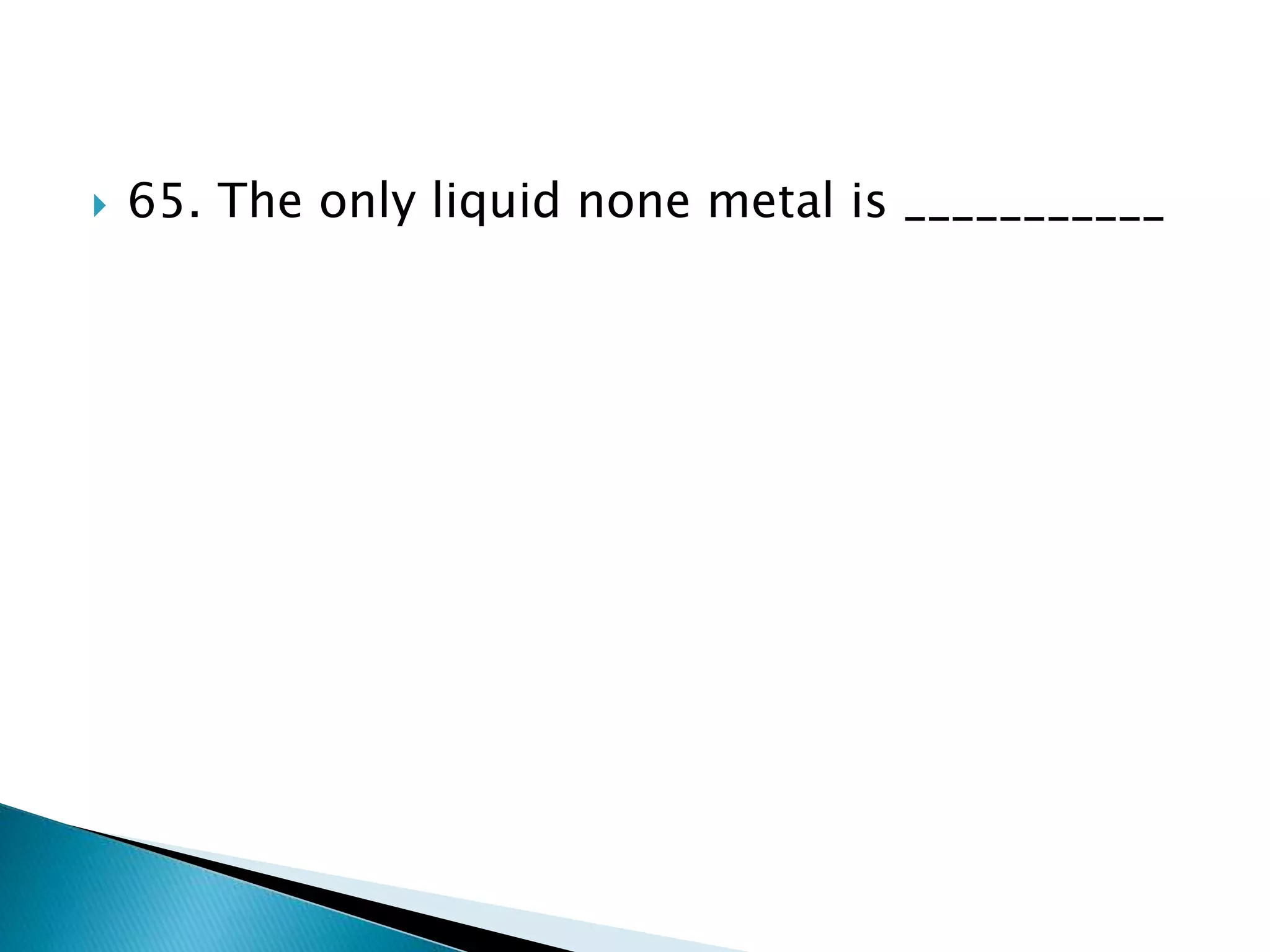
 65. The only liquid none metal is ___________
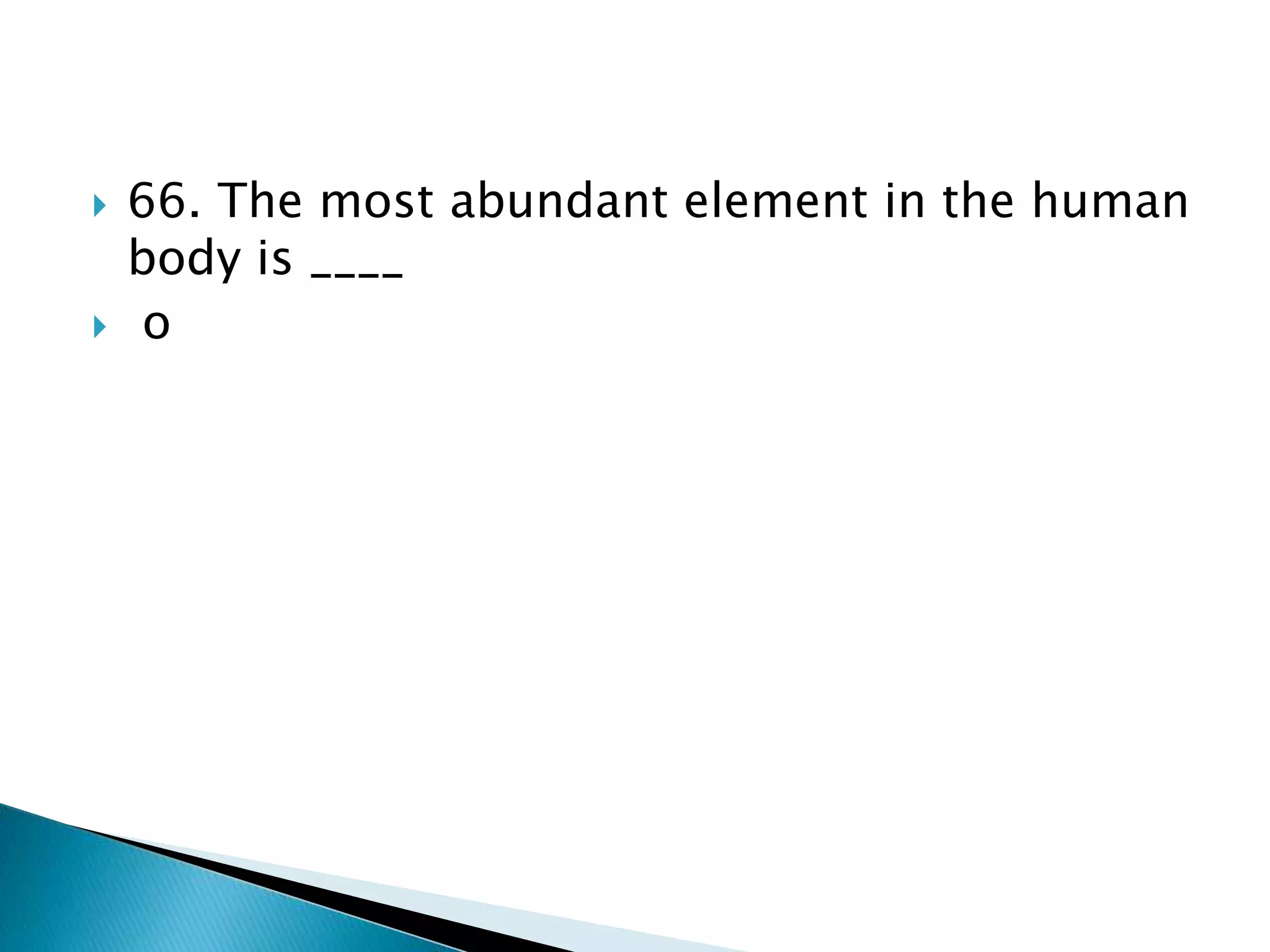
 66. The most abundant element in the human
body is ____
 o
 67. The most abundant element in the
universe is ____
 h
 68. The most abundant element in the earth’s
crust is ____
 o
 69. The largest part of the human brain is the
____
 70. The second most abundant element on
earth is ____
 Si
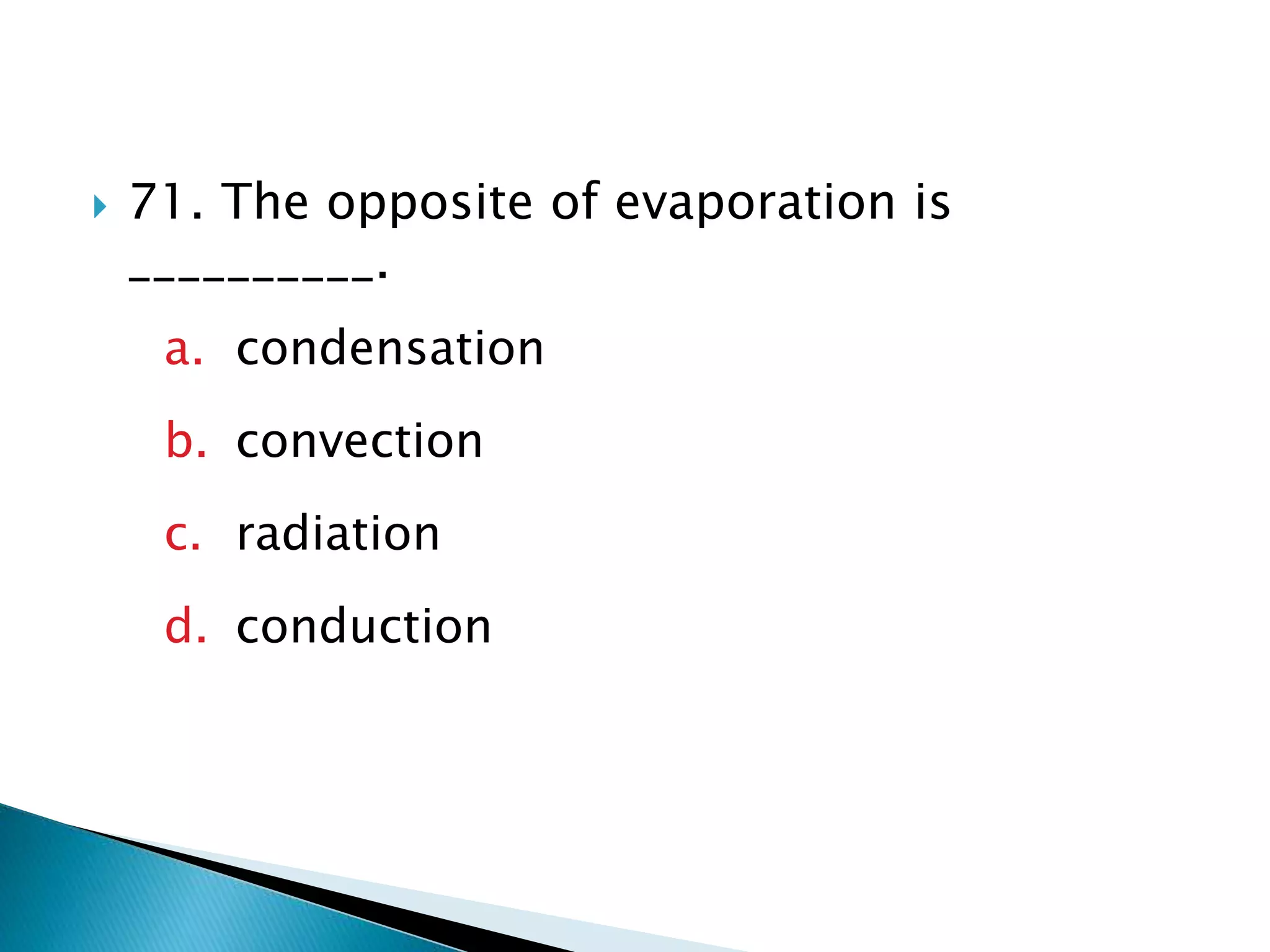
 71. The opposite of evaporation is
__________.
a. condensation
b. convection
c. radiation
d. conduction
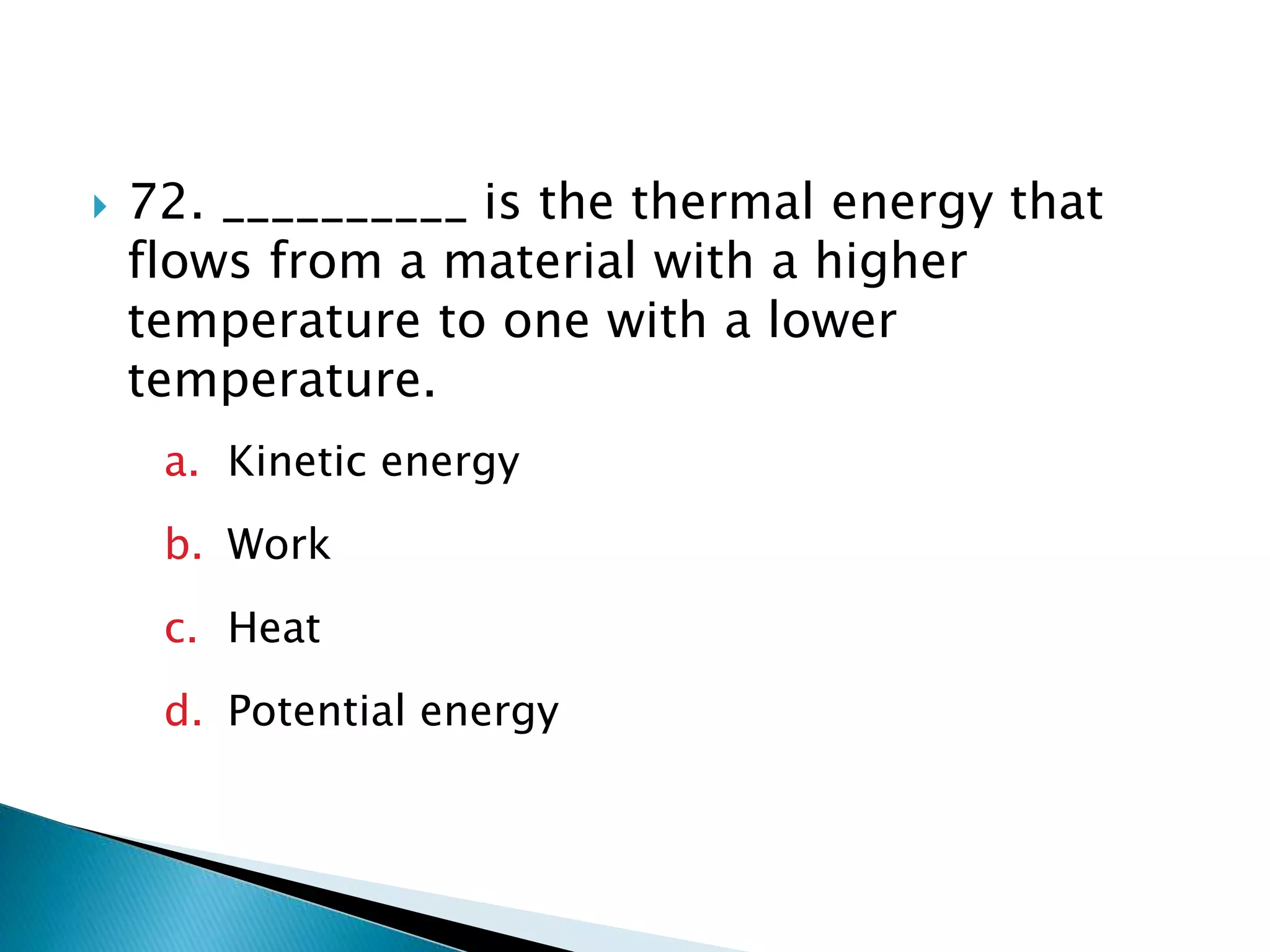
 72. __________ is the thermal energy that
flows from a material with a higher
temperature to one with a lower
temperature.
a. Kinetic energy
b. Work
c. Heat
d. Potential energy
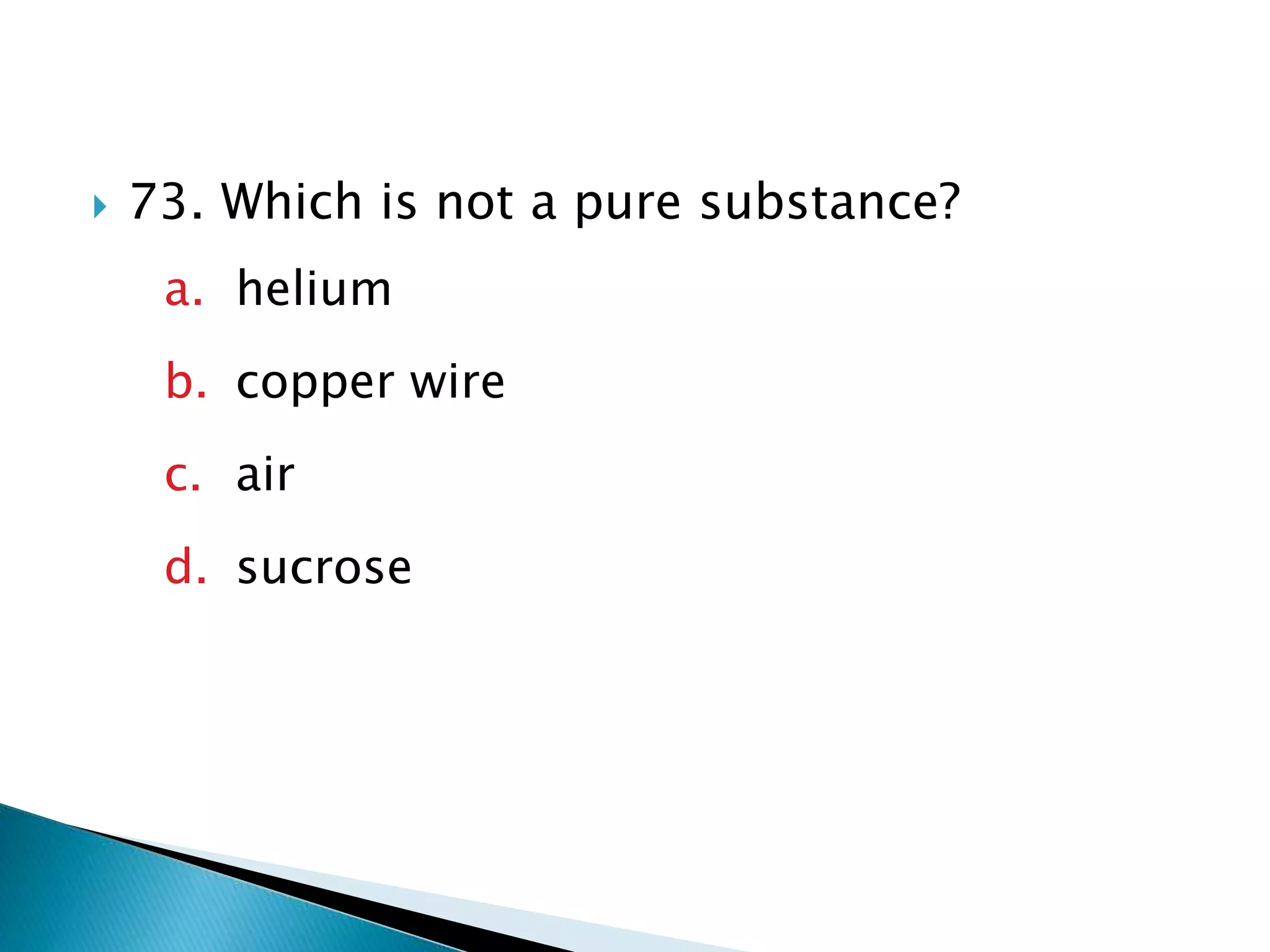
 73. Which is not a pure substance?
a. helium
b. copper wire
c. air
d. sucrose
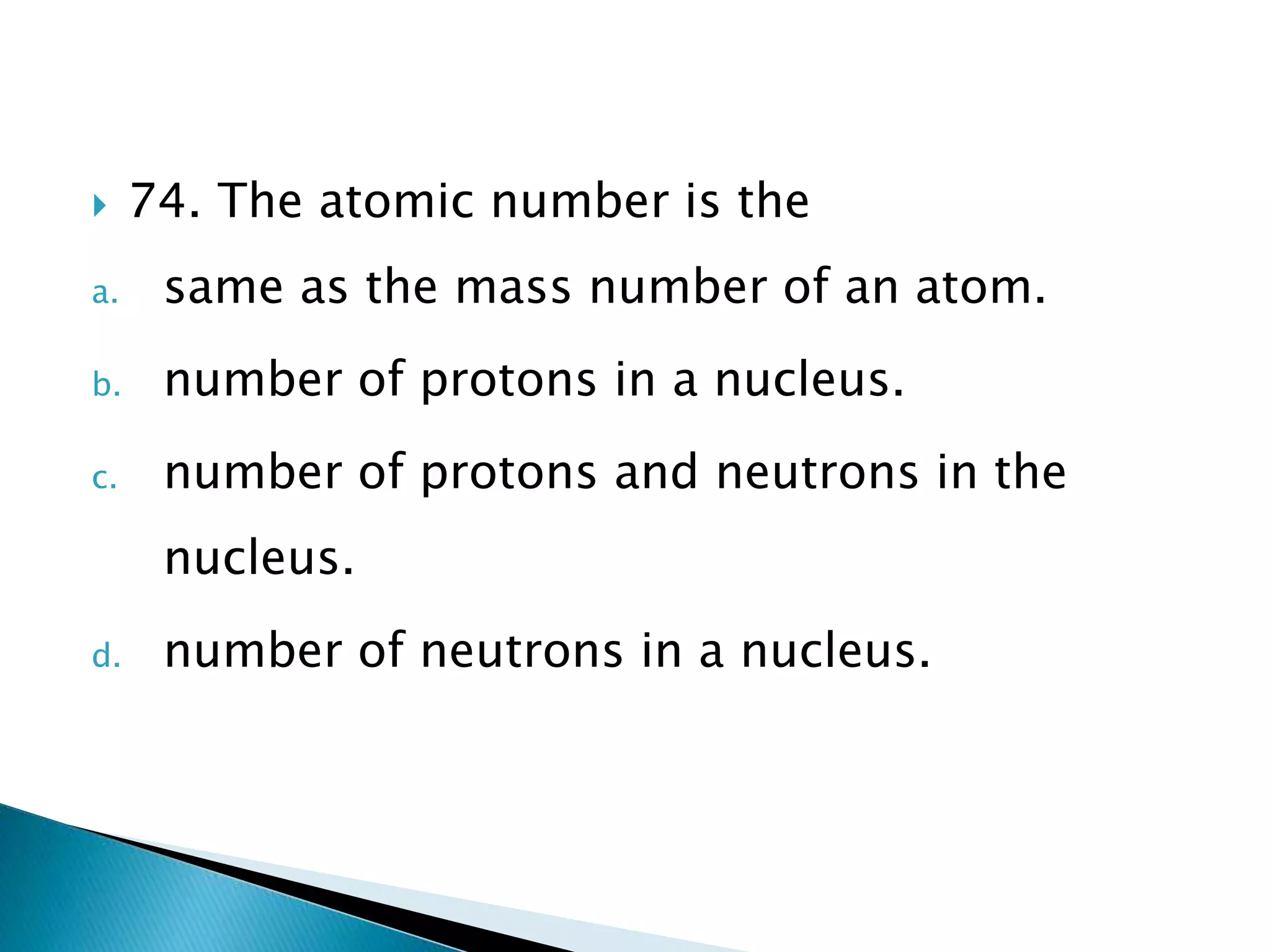
 74. The atomic number is the
a. same as the mass number of an atom.
b. number of protons in a nucleus.
c. number of protons and neutrons in the
nucleus.
d. number of neutrons in a nucleus.
 75. A natural phenomenon that becomes
harmful due to pollution is _____________.

a. global warming
b. ecological balance
c. greenhouse effect
d. desertification
 76. The pollutant responsible for ozone holes
is ____________.
a. CO2
b. SO2
c. CO
d. CFC
 77. One of the best solutions to get rid of
non-biodegradable wastes is ______________
a. burning
b. dumping
c. burying
d. recycling
 78. Which of the following is only a physical
change? [7f-67]
a. magnesium burns brightly when heated
in air
b. marble chips fizz with acid
c. heating green copper carbonate powder
turns it black
d. when zinc oxide is heated it turns yellow,
on cooling it becomes white
 79. An athlete completes a 40 m race in 5
seconds. What is the average speed of the
athlete? [9k-74]
a. 9 m/s
b. 8 m/s
c. 200 m/s
d. 35 m/s
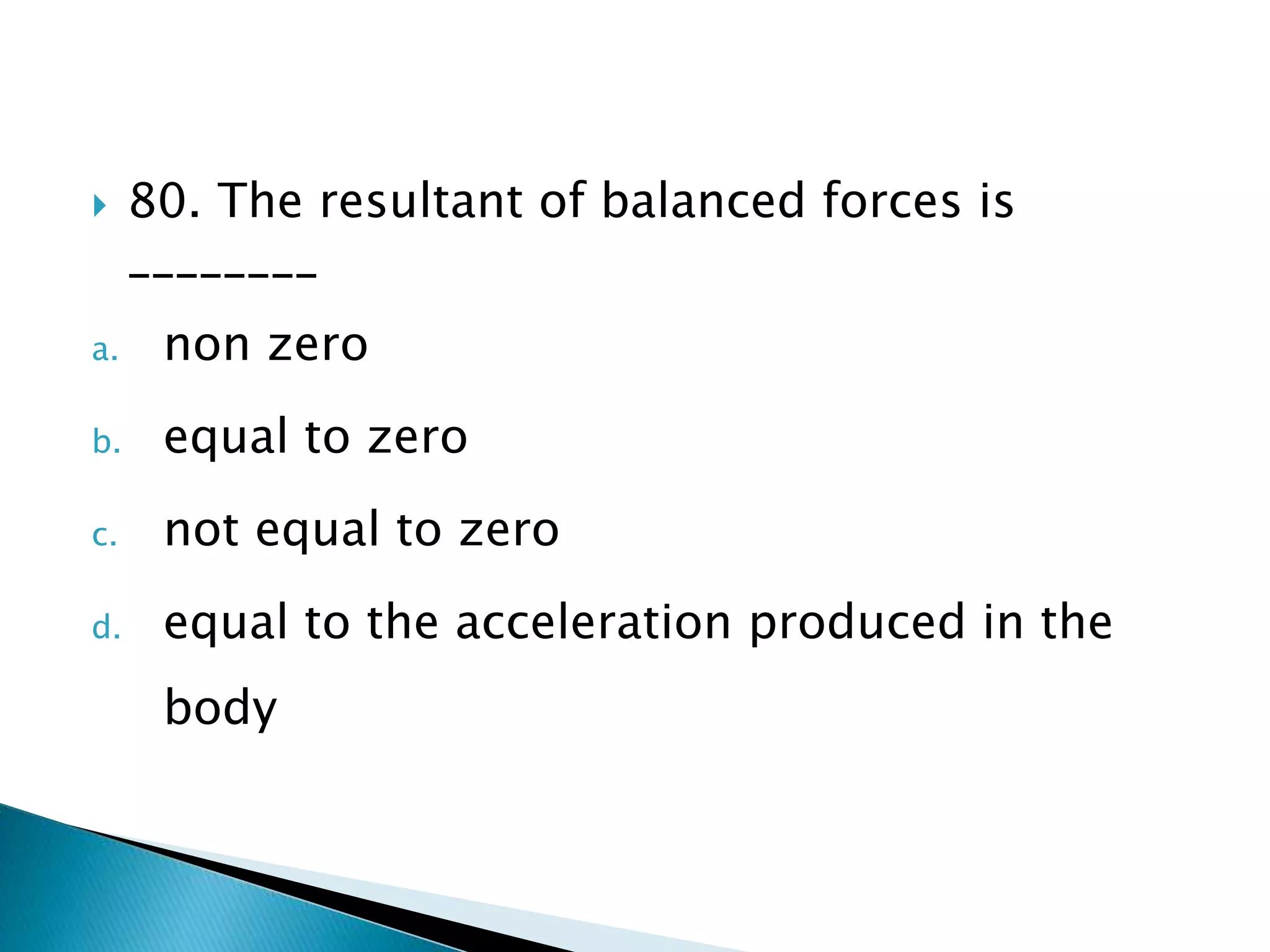
 80. The resultant of balanced forces is
________
a. non zero
b. equal to zero
c. not equal to zero
d. equal to the acceleration produced in the
body
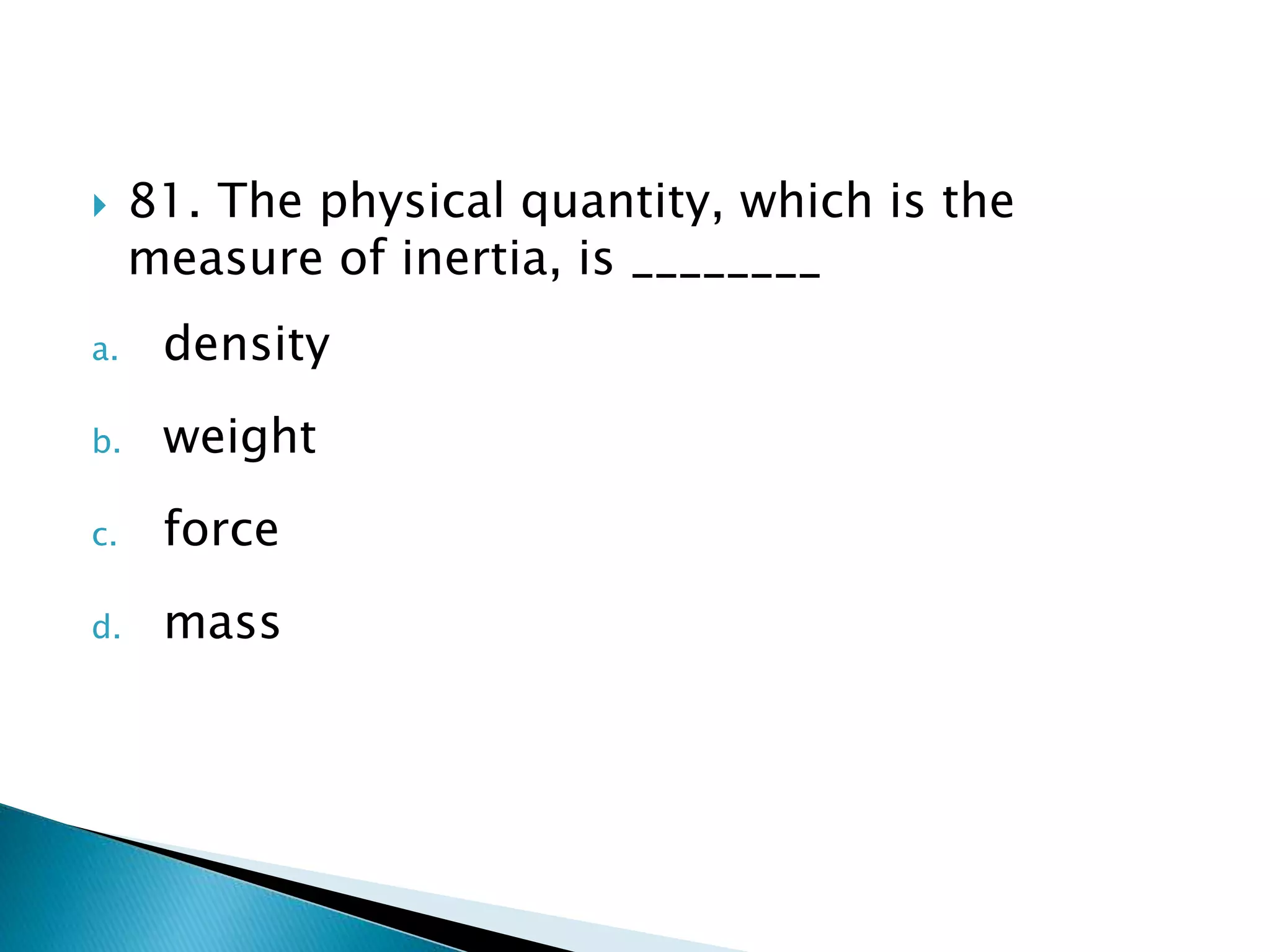
 81. The physical quantity, which is the
measure of inertia, is ________
a. density
b. weight
c. force
d. mass
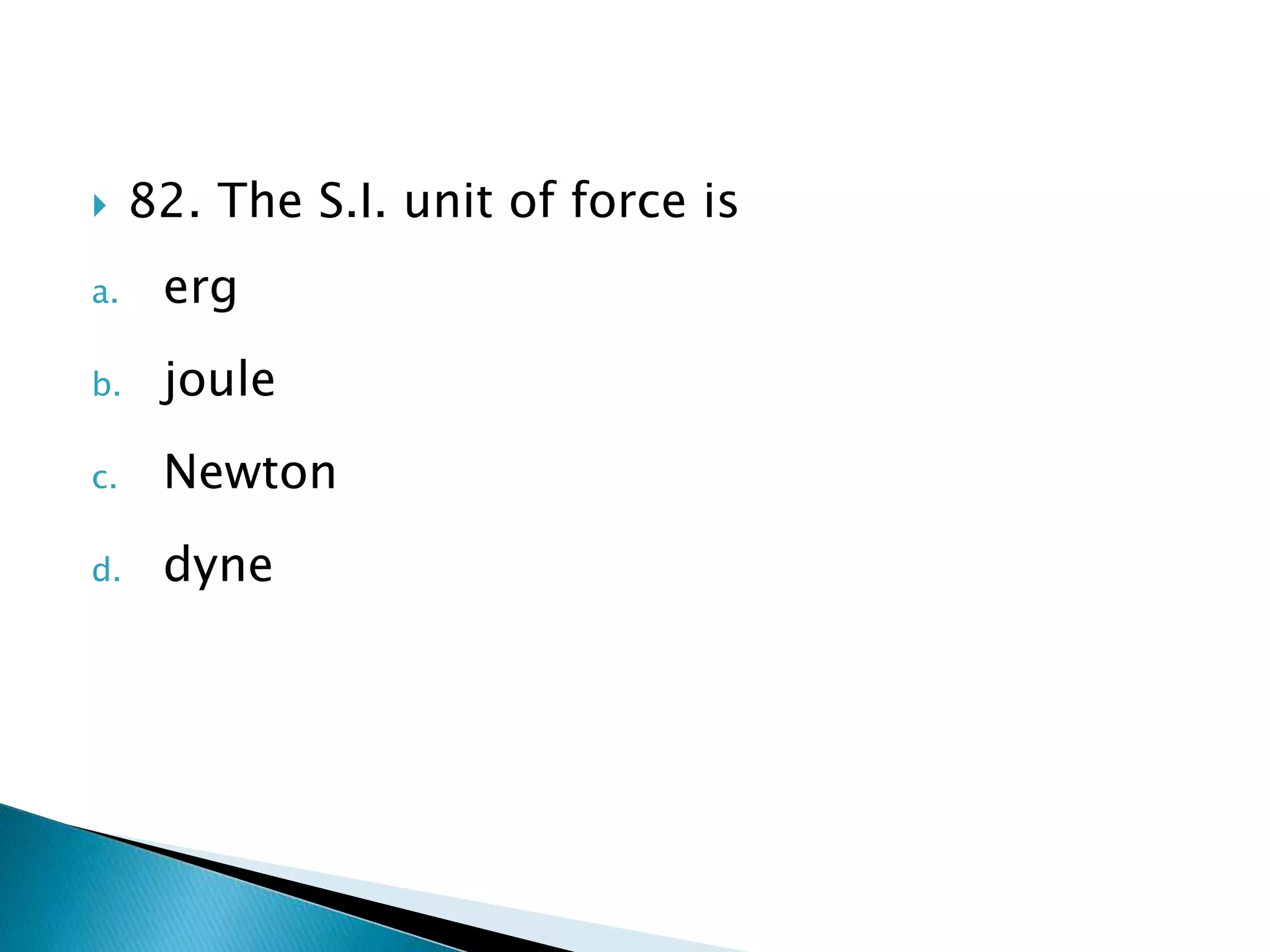
 82. The S.I. unit of force is
a. erg
b. joule
c. Newton
d. dyne
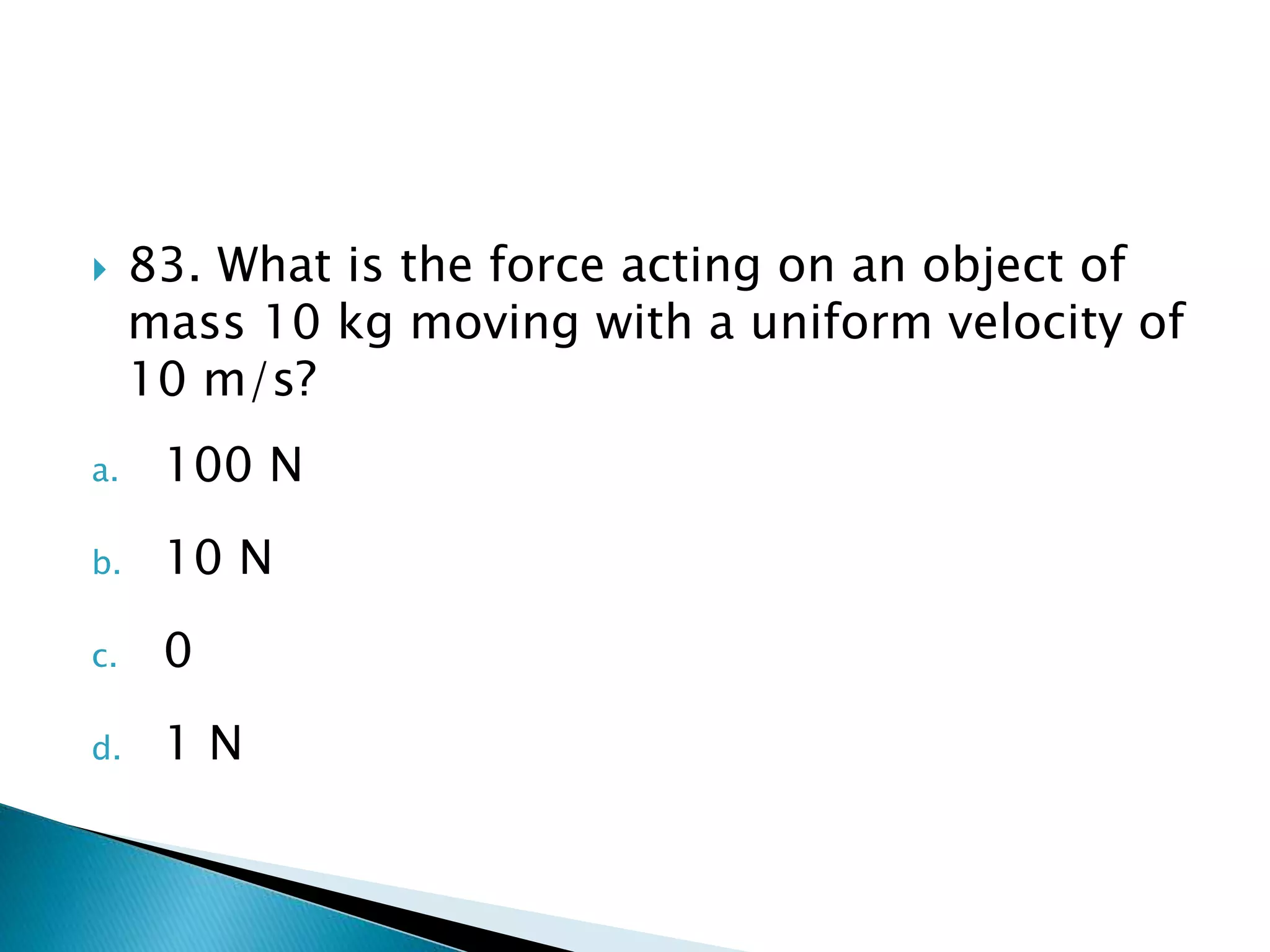
 83. What is the force acting on an object of
mass 10 kg moving with a uniform velocity of
10 m/s?
a. 100 N
b. 10 N
c. 0
d. 1 N
 84. The resultant of action and reaction
forces is _______.
a. greater than zero
b. less than zero
c. zero
d. none of the above
 85. Which substance cannot be decomposed
into simpler substances?
a. ammonia
b. aluminum
c. methane
d. methanol
Science contest
Science contest
Science contest
Science contest
Science contest

Science contest

  • 1.
    Gr. 7 &8 Science Quiz contest
  • 2.
    1. Which organelleis known as “the cell’s brain”? a. Ribosome b. Nucleus c. Mitochondrion d. Funny Bone
  • 3.
    2. Which ofthe following is not part of a bacterial cell? a. Nucleus b. Protein c. Ribosome d. Cytoplasm
  • 4.
    3 . Whatis apoptosis? a. A type of death that resembles suicide b. The popping sound cells make when they die c. Type of cell division that produces daughter cells d. The type of cell death that occurs as the result of traumatic injury or exposure to toxic chemicals
  • 5.
    4 : Thelargest human cell (by volume) is the egg. a. True b. False
  • 6.
    5. The nucleusof an atom consists of: a. Electrons b. Neutrons c. protons and neutrons d. protons, neutrons, and electrons
  • 7.
    6. An electroncarries a _______. positive charge
  • 8.
    7. Entomology isthe scientific study of: a. Internal organs b. Birds c. Insects d. Trees e. Lichens
  • 9.
    8. The greenpigment found in plants that performs photosynthesis is: a. Melanin b. Chloroplast c. Chlorophyll d. Chromatophore
  • 10.
    9. A protonhas what electrical charge? a. no charge b. positive charge c. negative charge d. either a positive or negative charge
  • 11.
    10. The ozonelayer protects us from too much: a. carbon dioxide b. gamma radiation c. ultraviolet radiation d. temperature fluctuation
  • 12.
    11. Lizards belongto which animal group? a. Amphibians b. Reptiles c. Invertebrates d. mammals
  • 13.
    12. What isthe 7th element on the periodic table of elements?  N
  • 14.
    13. True orfalse? DNA is the shortened form of the term ‘Deoxyribonucleic acid’?
  • 15.
    14. Pure waterhas a pH level of a around?
  • 16.
    15. What isthe name of the part of the human skeleton which protects our brain?
  • 17.
    16. Is thecompound ‘HCl’ an acid or base?
  • 18.
    17. These functionsare all part of a mechanism that allows the body to maintain a balance between itself and the environment. What is that mechanism called? a. Homeostasis b. Metabolism c. Osmosis d. diffusion
  • 19.
    18. What isformed immediately after fertilization occurs? a. Sperm b. Egg c. Embryo d. zygote
  • 20.
    19. Which isa chemical change? a. melting an ice cube b. dissolving sugar in boiling water c. boiling an egg d. crushing a can
  • 21.
    20) What isformed immediately after fertilization occurs? a. sperm b. egg c. embryo d. zygote
  • 22.
     21. Mushroomsthat grow on the sides of trees in a forest ecosystem are best classified by which of the following types of organisms? a.Consumers b.Decomposers c. Predators d.Producers
  • 23.
    22. Fruit isderived from which part of the flower?
  • 24.
    23.. Pollination involvesthe transfer of pollen from a. 5 to 1 b. 5 to 4 c. 5 to 3 d. 4 to 5 e. 4 to 1
  • 25.
    25. The partsof the male reproductive structure of the flower are ____ and ____
  • 26.
    26. The petalof a flower is represented by
  • 27.
    27. Organisms thatcomprise the greatest mass of living substance (biomass) in a terrestrial food chain a. Decomposers (e.g., bacteria) b. Producers (e.g., grasses) c. Primary consumers (e.g., mice) d. Secondary consumers (e.g., snakes) e. Tertiary consumers (e.g., hawks)
  • 28.
     28. Nitrogenousbase that occurs in RNA but not in DNA a. Deoxyribose b. Ribose c. Uracil d. Cytosine e. Thymine
  • 29.
    29. What happenswhen two negatively charged particles are next to each other? a. The particles attract each other. b. One particle becomes uncharged. c. One particle becomes positively charged. d. The particles repel each other
  • 30.
    30. The twotypes of prokaryotes are __________ and ____________
  • 31.
    31. Which gasis monatomic at STP? a. chlorine b. fluorine c. neon d. nitrogen
  • 32.
     32. Thereare alternate acid base theories that define an acid as any species that can a. donate a proton b. donate an electron c. accept a proton d. accept an electron
  • 33.
     33. Anion with 5 protons, 6 neutrons, and a charge of 3+ has an atomic number of a. 5 b. 6 c. 8 d. 11
  • 34.
     34. Whena solid changes to a liquid it is called what?  Melting
  • 35.
     35. Whena gas changes into a liquid it is called ________
  • 36.
     36. Whatis it called when a solid changes directly into a gas?
  • 37.
     37. Whatis the name given to substances that are initially involved in a chemical reaction?
  • 38.
    38. Atoms ofthe same chemical element that have different atomic mass are known as?
  • 39.
     39. Anothername for your voice box is the?
  • 40.
     40. Thewind pipe in the reproductive system is the _________
  • 41.
     41. Theexternal layer of the skin of the body is called ___________
  • 42.
     42. Whatis the human body’s biggest organ?
  • 43.
     43. Whowas the first person to walk on the moon?  Neil Armstrong
  • 44.
     44. Atroom temperature, what is the only metal that is in liquid form?
  • 45.
     45. Soundtravels faster through water than air.  True
  • 46.
     46. Whatis the freezing temperature of water?
  • 47.
     47. Whatis the largest ‘big cat’ in the world?  Tiger
  • 48.
    48. What isthe tallest animal in the world?  Giraffe up to 6m
  • 49.
     49. Whichfamous scientist is the father of inheritance?
  • 50.
     50. Aperson who studies about physics is called ______________
  • 51.
     51. Aperson who studies about plants is called _________________
  • 52.
     52. TheSI unit of force is _____
  • 53.
     53. Theunit of acceleration is ____
  • 54.
     54. Weightand mass are the same.
  • 55.
     55. Thereare ______ liters of blood in adult human being.
  • 56.
     56. Thestudy of heredity is called _________________
  • 57.
     57. Thetwo types of prokaryotes are __________ and ____________
  • 58.
     58. Anythingthat has mass and occupies space is called _______________.
  • 59.
     59. Theaverage adult human skeleton has _______ bones. 206
  • 60.
     60. Thecommon pathway for the digestive system and respiratory system
  • 61.
     61. Thesmallest, basic, structural and functional unit of living things is called a. cell b. tissue c. virus d. bacteria
  • 62.
     62. Theprocess that produces sex cells is called a. mitosis b. meiosis c. cell cycle d. pedigree
  • 63.
     63. Howmany different types of amino acids are there in nature?  A) 15 B) 30 C) 60 D) 20
  • 64.
     64. Allof the following are not found in animal cells except a. Cell wall b. chloroplast c. large vacuole d. cell membrane
  • 65.
     65. Theonly liquid none metal is ___________
  • 66.
     66. Themost abundant element in the human body is ____  o
  • 67.
     67. Themost abundant element in the universe is ____  h
  • 68.
     68. Themost abundant element in the earth’s crust is ____  o
  • 69.
     69. Thelargest part of the human brain is the ____
  • 70.
     70. Thesecond most abundant element on earth is ____  Si
  • 71.
     71. Theopposite of evaporation is __________. a. condensation b. convection c. radiation d. conduction
  • 72.
     72. __________is the thermal energy that flows from a material with a higher temperature to one with a lower temperature. a. Kinetic energy b. Work c. Heat d. Potential energy
  • 73.
     73. Whichis not a pure substance? a. helium b. copper wire c. air d. sucrose
  • 74.
     74. Theatomic number is the a. same as the mass number of an atom. b. number of protons in a nucleus. c. number of protons and neutrons in the nucleus. d. number of neutrons in a nucleus.
  • 75.
     75. Anatural phenomenon that becomes harmful due to pollution is _____________.  a. global warming b. ecological balance c. greenhouse effect d. desertification
  • 76.
     76. Thepollutant responsible for ozone holes is ____________. a. CO2 b. SO2 c. CO d. CFC
  • 77.
     77. Oneof the best solutions to get rid of non-biodegradable wastes is ______________ a. burning b. dumping c. burying d. recycling
  • 78.
     78. Whichof the following is only a physical change? [7f-67] a. magnesium burns brightly when heated in air b. marble chips fizz with acid c. heating green copper carbonate powder turns it black d. when zinc oxide is heated it turns yellow, on cooling it becomes white
  • 79.
     79. Anathlete completes a 40 m race in 5 seconds. What is the average speed of the athlete? [9k-74] a. 9 m/s b. 8 m/s c. 200 m/s d. 35 m/s
  • 80.
     80. Theresultant of balanced forces is ________ a. non zero b. equal to zero c. not equal to zero d. equal to the acceleration produced in the body
  • 81.
     81. Thephysical quantity, which is the measure of inertia, is ________ a. density b. weight c. force d. mass
  • 82.
     82. TheS.I. unit of force is a. erg b. joule c. Newton d. dyne
  • 83.
     83. Whatis the force acting on an object of mass 10 kg moving with a uniform velocity of 10 m/s? a. 100 N b. 10 N c. 0 d. 1 N
  • 84.
     84. Theresultant of action and reaction forces is _______. a. greater than zero b. less than zero c. zero d. none of the above
  • 85.
     85. Whichsubstance cannot be decomposed into simpler substances? a. ammonia b. aluminum c. methane d. methanol