SCIENCE
TASK 2
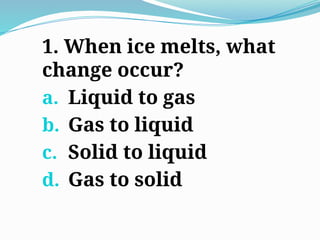
1. When ice melts, what
change occur?
a. Liquid to gas
b. Gas to liquid
c. Solid to liquid
d. Gas to solid
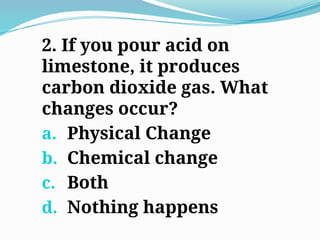
2. If you pour acid on
limestone, it produces
carbon dioxide gas. What
changes occur?
a. Physical Change
b. Chemical change
c. Both
d. Nothing happens
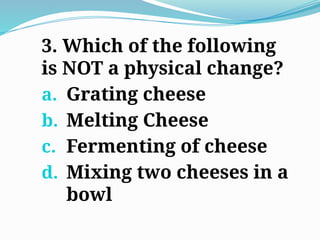
3. Which of the following
is NOT a physical change?
a. Grating cheese
b. Melting Cheese
c. Fermenting of cheese
d. Mixing two cheeses in a
bowl
4. Which transformation of
energy takes place when a
toaster is switched on?
a. Chemical to sound
b. Electrical to sound
c. Chemical to thermal
d. Electrical to thermal
5. When you see bubbles on the bowl
of soup which had been left on the
table for one night, you may infer that:
a. The liquid component of the soup is
evaporating
b. Physical change is taking place in
the soup
c. The soup is undergoing chemical
change
d. Air is dissolved in the soup
6. Deib Lhor kicks a ball on a
level sidewalk. It rolls to stop
after sometime because____
a. No force is acting on the ball
b. Inertia at rest is acting on
the ball
c. Gravity pulls the ball down
d. Friction slows the ball down
7. Max apply grease to the
gears of her bicycle to___
a. Reduce friction
b. Increase acceleration
c. Avoid accident
d. Facilitate easy turn in the
curve
8. Zarnaih threw a ball over
the fence. What energy did
the moving ball have?
a. Heat energy
b. Potential energy
c. Light energy
d. Kinetic energy
9. Which of the following explains the
law of inertia?
a. If no force acts on an object that is
moving, it will continue moving at the
same speed and direction
b. An object accelerates because of a
force that acts on it.
c. For every action, there is an equal
and opposite reaction
d. A force causes the object to move in
circular motion.
10. Chemical spray is harmful
to the environment. Why?
a. Its affects the clouds
b. It pollutes the rivers and
oceans
c. It destroys the ozone layer
d. It destroys our clothes
11. Why can planet Earth
support life?
a. It has an atmosphere
b. It has soil where green
plants grow
c. It has enough sunlight
d. All of the above
12. GLOBAL WARMING is the
abnormal rise of Earth’s
temperature. What cause of it?
a. Greenhouse effect
b. Burning houses
c. Air pollution
d. Garbage dumping
13. A toy robot can walk
and talk and runs on
batteries. What type of
energy is stored in the
batteries?
a. Chemical
b. Electrical
c. Nuclear
14. Which transformation
of energy takes place when
a toaster is switched on?
a. Chemical to sound
b. Electrical to sound
c. Chemical to sound
d. Electrical to sound
15. It is the complete trip of the
blood from the heart to all parts
of the body and back to the
heart.
a. Digestion
b. Circulation
c. Respiration
d. Secretion
16. What happens to the blood when
it reaches the lungs?
a. The blood becomes pure and clean
b. The blood becomes oxygenated in
the lungs
c. The blood becomes deoxygenated
in the lungs
d. The blood flows continuously to
the lungs
17. Which of the following
controls our body activities?
a. Nerves
b. Spinal Cord
c. Brain
d. Backbone
18. Which of the following
carries messages to and
from the brain?
a. Nerves
b. Spinal cord
c. Vertebrae
d. Backbone
19. Why can you hear a sound?
a. The nerves that are sensitive to
sound carry the message to the
brain
b. The nerves that are sensitive to
light carry message to the brain
c. The outer ear collects sounds
d. The sounds are loud enough
20. What is function of the spinal cord?
a. Responsible for man’s ability to learn
habits and develop skills
b. Enables us to think, remember and to
be aware of many things around us
c. Enables the sensory and motor
information to pass between the
brain and the parts of the body
d. Carry impulses from sense receptors
to the central nervous system.
21. What part of the brain is the
largest and controls mental
processes such as thinking,
memorizing, and decision-
making?
a. Spinal Cord
b. Cerebrum
c. Cerebellum
d. Brain Stem
22. You saw your mother carrying a basket
full of grocery items that she brought from
the market. You run to help her. What is the
usual path of messages received by the body
from the environment?
a. brain->nerves->spinal cord-> sense
organs
b. Nerves-> sense organs-> brain-> spinal
cord
c. Spinal cord->sense organs->brain->
nerves
d. Sense organs->nerve->spinal cord-> brain
23. Which organism is an
omnivores?
a. Snake
b. Caterpillar
c. Eagle
d. Chicken
24. The tail enables the sperm to
swim. Why does the sperm need to
be able to swim?
a. To travel around the testicle
b. To prevent drown in the semen
c. Because it is a member of the
fish family
d. In order to get to the egg.
25. Zygote means new
individual. That fusion of the
male and female gamete to
form a zygote is known as___
a. Ejaculation
b. Pollination
c. Fertilization
d. Menstruation
26. To prevent the passing of
eggs from the ovary, which part
of the organ is tied or cut in an
operation called tubal ligation?
a. Urethra
b. Ovary
c. Cervix
d. Fallopian tubes
27. What is the function of the
kidney?
a. It stores urine
b. It carries urine out of the
body
c. It removes wastes from the
blood
d. It gives signal to the brain to
expel the urine from the
28. What do all vertebrates
have in common?
a. They live on land
b. They all have a hard
internal skeleton or
backbone
c. They all have legs
d. They are all warm blooded
29. Which of the following
animals are classified as
amphibians?
a. Frog and salamander
b. Lizard and alligator
c. Monkey and bear
d. Eagle and dove
30. How do clams, oysters, and
snails protect themselves
from their enemies?
a. By making slimy secretions
b. By using their hard shells
c. By using their spines
d. By secreting poison
31. Adaptations are inherited
characteristics that help an
organism to survive and reproduce
in its environment. Looking both
ways before crossing a street helps
us survive because it is____
a. A survival adaptation
b. An inherited survival experience
c. Learned through experience
d. Inherited from our parents
32. Which one of the following
describes an adaptation?
a. An insect that acts as a
decomposer
b. A type of desert animal
c. Feature that helps an animal or
plant to survive
d. A group of bacteria that live in
an environment
33. Which is NOT an example
of plant adaptation?
a. A cactus has a thick cover
to hold water in
b. A tree loses its leaves in the
winter
c. A plant has green leaves
d. A lily grows bright red
flowers to attract
34. The inside of the Earth consists of
four major layers. What is the
correct order of the layers from the
inside of the Earth outwards?
a. Inner core, outer core, crust,
mantle
b. Mantle, inner core, outer core,
crust
c. Inner core, outer core, mantle,
crust
35. The clean-up crew are decomposers.
They get rid of the wastes in an
ecosystem. Decomposers differ from
scavengers because they_____
a. Do not eat dead organism
b. Break down larger organism
c. Only eat dead organism
d. Only feed on dead plants and animals
36. Organisms vary according to
what food they eat and how they
eat it. Which of the following
combinations is NOT true?
a. Python, wild pig, movable jaws
b. Moth, plant parts, proboscis
c. Frog, insects, rolled tongue
d. Bird, insects, beak
37. This is the ability to face things
as they are, to be happy and
cheerful most of the time, to get
along with others and to work in
helpful ways.
a. Good mental health
b. Friendly status
c. Positive action
d. Negative attitude
38. Some living things depend on
each other in a very close
relationship, which lasts over
time. This relationship is called..
a. Symbiosis
b. Parasitism
c. Mutualism
d. Commensalism
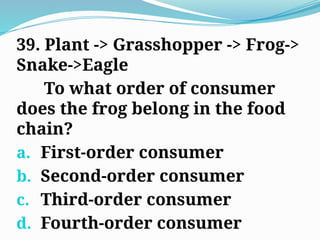
39. Plant -> Grasshopper -> Frog->
Snake->Eagle
To what order of consumer
does the frog belong in the food
chain?
a. First-order consumer
b. Second-order consumer
c. Third-order consumer
d. Fourth-order consumer
GOOD LUCK 

Science Group Task for Grade 6 students.pptx

  • 1.
  • 2.
    1. When icemelts, what change occur? a. Liquid to gas b. Gas to liquid c. Solid to liquid d. Gas to solid
  • 3.
    2. If youpour acid on limestone, it produces carbon dioxide gas. What changes occur? a. Physical Change b. Chemical change c. Both d. Nothing happens
  • 4.
    3. Which ofthe following is NOT a physical change? a. Grating cheese b. Melting Cheese c. Fermenting of cheese d. Mixing two cheeses in a bowl
  • 5.
    4. Which transformationof energy takes place when a toaster is switched on? a. Chemical to sound b. Electrical to sound c. Chemical to thermal d. Electrical to thermal
  • 6.
    5. When yousee bubbles on the bowl of soup which had been left on the table for one night, you may infer that: a. The liquid component of the soup is evaporating b. Physical change is taking place in the soup c. The soup is undergoing chemical change d. Air is dissolved in the soup
  • 7.
    6. Deib Lhorkicks a ball on a level sidewalk. It rolls to stop after sometime because____ a. No force is acting on the ball b. Inertia at rest is acting on the ball c. Gravity pulls the ball down d. Friction slows the ball down
  • 8.
    7. Max applygrease to the gears of her bicycle to___ a. Reduce friction b. Increase acceleration c. Avoid accident d. Facilitate easy turn in the curve
  • 9.
    8. Zarnaih threwa ball over the fence. What energy did the moving ball have? a. Heat energy b. Potential energy c. Light energy d. Kinetic energy
  • 10.
    9. Which ofthe following explains the law of inertia? a. If no force acts on an object that is moving, it will continue moving at the same speed and direction b. An object accelerates because of a force that acts on it. c. For every action, there is an equal and opposite reaction d. A force causes the object to move in circular motion.
  • 11.
    10. Chemical sprayis harmful to the environment. Why? a. Its affects the clouds b. It pollutes the rivers and oceans c. It destroys the ozone layer d. It destroys our clothes
  • 12.
    11. Why canplanet Earth support life? a. It has an atmosphere b. It has soil where green plants grow c. It has enough sunlight d. All of the above
  • 13.
    12. GLOBAL WARMINGis the abnormal rise of Earth’s temperature. What cause of it? a. Greenhouse effect b. Burning houses c. Air pollution d. Garbage dumping
  • 14.
    13. A toyrobot can walk and talk and runs on batteries. What type of energy is stored in the batteries? a. Chemical b. Electrical c. Nuclear
  • 15.
    14. Which transformation ofenergy takes place when a toaster is switched on? a. Chemical to sound b. Electrical to sound c. Chemical to sound d. Electrical to sound
  • 16.
    15. It isthe complete trip of the blood from the heart to all parts of the body and back to the heart. a. Digestion b. Circulation c. Respiration d. Secretion
  • 17.
    16. What happensto the blood when it reaches the lungs? a. The blood becomes pure and clean b. The blood becomes oxygenated in the lungs c. The blood becomes deoxygenated in the lungs d. The blood flows continuously to the lungs
  • 18.
    17. Which ofthe following controls our body activities? a. Nerves b. Spinal Cord c. Brain d. Backbone
  • 19.
    18. Which ofthe following carries messages to and from the brain? a. Nerves b. Spinal cord c. Vertebrae d. Backbone
  • 20.
    19. Why canyou hear a sound? a. The nerves that are sensitive to sound carry the message to the brain b. The nerves that are sensitive to light carry message to the brain c. The outer ear collects sounds d. The sounds are loud enough
  • 21.
    20. What isfunction of the spinal cord? a. Responsible for man’s ability to learn habits and develop skills b. Enables us to think, remember and to be aware of many things around us c. Enables the sensory and motor information to pass between the brain and the parts of the body d. Carry impulses from sense receptors to the central nervous system.
  • 22.
    21. What partof the brain is the largest and controls mental processes such as thinking, memorizing, and decision- making? a. Spinal Cord b. Cerebrum c. Cerebellum d. Brain Stem
  • 23.
    22. You sawyour mother carrying a basket full of grocery items that she brought from the market. You run to help her. What is the usual path of messages received by the body from the environment? a. brain->nerves->spinal cord-> sense organs b. Nerves-> sense organs-> brain-> spinal cord c. Spinal cord->sense organs->brain-> nerves d. Sense organs->nerve->spinal cord-> brain
  • 24.
    23. Which organismis an omnivores? a. Snake b. Caterpillar c. Eagle d. Chicken
  • 25.
    24. The tailenables the sperm to swim. Why does the sperm need to be able to swim? a. To travel around the testicle b. To prevent drown in the semen c. Because it is a member of the fish family d. In order to get to the egg.
  • 26.
    25. Zygote meansnew individual. That fusion of the male and female gamete to form a zygote is known as___ a. Ejaculation b. Pollination c. Fertilization d. Menstruation
  • 27.
    26. To preventthe passing of eggs from the ovary, which part of the organ is tied or cut in an operation called tubal ligation? a. Urethra b. Ovary c. Cervix d. Fallopian tubes
  • 28.
    27. What isthe function of the kidney? a. It stores urine b. It carries urine out of the body c. It removes wastes from the blood d. It gives signal to the brain to expel the urine from the
  • 29.
    28. What doall vertebrates have in common? a. They live on land b. They all have a hard internal skeleton or backbone c. They all have legs d. They are all warm blooded
  • 30.
    29. Which ofthe following animals are classified as amphibians? a. Frog and salamander b. Lizard and alligator c. Monkey and bear d. Eagle and dove
  • 31.
    30. How doclams, oysters, and snails protect themselves from their enemies? a. By making slimy secretions b. By using their hard shells c. By using their spines d. By secreting poison
  • 32.
    31. Adaptations areinherited characteristics that help an organism to survive and reproduce in its environment. Looking both ways before crossing a street helps us survive because it is____ a. A survival adaptation b. An inherited survival experience c. Learned through experience d. Inherited from our parents
  • 33.
    32. Which oneof the following describes an adaptation? a. An insect that acts as a decomposer b. A type of desert animal c. Feature that helps an animal or plant to survive d. A group of bacteria that live in an environment
  • 34.
    33. Which isNOT an example of plant adaptation? a. A cactus has a thick cover to hold water in b. A tree loses its leaves in the winter c. A plant has green leaves d. A lily grows bright red flowers to attract
  • 35.
    34. The insideof the Earth consists of four major layers. What is the correct order of the layers from the inside of the Earth outwards? a. Inner core, outer core, crust, mantle b. Mantle, inner core, outer core, crust c. Inner core, outer core, mantle, crust
  • 36.
    35. The clean-upcrew are decomposers. They get rid of the wastes in an ecosystem. Decomposers differ from scavengers because they_____ a. Do not eat dead organism b. Break down larger organism c. Only eat dead organism d. Only feed on dead plants and animals
  • 37.
    36. Organisms varyaccording to what food they eat and how they eat it. Which of the following combinations is NOT true? a. Python, wild pig, movable jaws b. Moth, plant parts, proboscis c. Frog, insects, rolled tongue d. Bird, insects, beak
  • 38.
    37. This isthe ability to face things as they are, to be happy and cheerful most of the time, to get along with others and to work in helpful ways. a. Good mental health b. Friendly status c. Positive action d. Negative attitude
  • 39.
    38. Some livingthings depend on each other in a very close relationship, which lasts over time. This relationship is called.. a. Symbiosis b. Parasitism c. Mutualism d. Commensalism
  • 40.
    39. Plant ->Grasshopper -> Frog-> Snake->Eagle To what order of consumer does the frog belong in the food chain? a. First-order consumer b. Second-order consumer c. Third-order consumer d. Fourth-order consumer
  • 41.