CO_Q4_Science 8_ Module 1
Science
Quarter 4 – Module 1:
Structures and Functions
of the Digestive System
8
Science – Grade 8
Alternative Delivery Mode
Quarter 4 – Module 1: Structures and Functions of the Digestive System
First Edition, 2020
Republic Act 8293, section 176 states that: No copyright shall subsist in any work of
the Government of the Philippines. However, prior approval of the government agency or office
wherein the work is created shall be necessary for exploitation of such work for profit. Such
agency or office may, among other things, impose as a condition the payment of royalties.
Borrowed materials (i.e., songs, stories, poems, pictures, photos, brand names,
trademarks, etc.) included in this module are owned by their respective copyright holders.
Every effort has been exerted to locate and seek permission to use these materials from their
respective copyright owners. The publisher and authors do not represent nor claim ownership
over them.
Published by the Department of Education
Secretary: Leonor Magtolis Briones
Undersecretary: Diosdado M. San Antonio
Printed in the Philippines by ________________________
Department of Education – Caraga Region
Office Address: Teacher Development Center
J.P. Rosales Avenue, Butuan City, Philippines 8600
Telefax: (085) 342-8207/ (085) 342-5969
E-mail Address: caraga@deped.gov.ph
Development Team of the Module
Writers: Rodeliza R. Wahing, Doriza F. Deso-Asido, Shellah May P. Castillo
Editor: Ana Rubi L. Sereño
Reviewers: Bernabe L. Linog, Corazon P. Roa, Juvy B. Luna, Arlene L. Abala,
Kathleen Torculas, Nonita c. Patalinghug
Illustrator: Rosa Mia L. Pontillo
Layout Artist: Edgardo D. Pamugas III
Layout Evaluators: Celeste Faith R. Almanon, Jay S. Ayap
Management Team: Francis Cesar B. Bringas
Isidro M. Biol, Jr.
Maripaz F. Magno
Josephine Chonie M. Obseñares
Gregoria T. Su
Marvilyn C. Francia
Jay S. Ayap
Nonita C. Patalinghug
8
Science
Quarter 4 – Module 1:
Structures and Functions
of the Digestive System
Introductory Message
This Self-Learning Module (SLM) is prepared so that you, our dear learners,
can continue your studies and learn while at home. Activities, questions, directions,
exercises, and discussions are carefully stated for you to understand each lesson.
Each SLM is composed of different parts. Each part shall guide you step-by-
step as you discover and understand the lesson prepared for you.
Pre-tests are provided to measure your prior knowledge on lessons in each
SLM. This will tell you if you need to proceed on completing this module or if you
need to ask your facilitator or your teacher’s assistance for better understanding of
the lesson. At the end of each module, you need to answer the post-test to self-check
your learning. Answer keys are provided for each activity and test. We trust that you
will be honest in using these.
In addition to the material in the main text, Notes to the Teacher are also
provided to our facilitators and parents for strategies and reminders on how they can
best help you on your home-based learning.
Please use this module with care. Do not put unnecessary marks on any part
of this SLM. Use a separate sheet of paper in answering the exercises and tests. And
read the instructions carefully before performing each task.
If you have any questions in using this SLM or any difficulty in answering the
tasks in this module, do not hesitate to consult your teacher or facilitator.
Thank you.
1
CO_Q4_Science 8_ Module 1
What I Need to Know
This module was designed and written with you in mind. It is here to help
you master the structures and functions of the digestive system. The scope of this
module permits it to be used in many different learning situations. The language
used recognizes the diverse vocabulary level of students. The lessons are arranged
to follow the standard sequence of the course. But the order in which you read
them can be changed to correspond with the learner’s material you are now using.
This module contains:
Lesson 1 – The Digestive System
After going through this module, you are expected to:
1. Identify the organs that make up the digestive system;
2. Give the function of each organ;
3. Describe how some accessory organs and glands help the body in the
digestive process; and
4. Explain ingestion, digestion, absorption, assimilation, and excretion.
(MELC Week 1 S8LT-IVa-13)
2
CO_Q4_Science 8_ Module 1
What I Know
Directions: Choose the letter of the correct answer. Write your answers on a
separate sheet of paper.
1. In what process do animals take in food that provides energy and nutrients?
A. assimilation
B. digestion
C. excretion
D. ingestion
2. The process in which digested foods are distributed into different parts of the
body cells are _______.
A. assimilation
B. digestion
C. excretion
D. ingestion
3. What is the process of turning food into smaller molecules with the aid of
enzymes?
A. churning
B. mastication
C. chemical digestion
D. mechanical digestion
4. Where does the final stage in digestion of food happen?
A. liver
B. mouth
C. small intestine
D. large intestine
5. What type of enzyme present in saliva helps break down starch?
A. amylase
B. lactase
C. lipase
D. maltase
6. Which of the following breaks down food into tinier pieces to begin
mechanical digestion?
A. esophagus
B. stomach
C. teeth
D. tongue
3
CO_Q4_Science 8_ Module 1
7. What organ system is responsible for breaking down of large molecules into
smaller molecules and absorption of organic compounds needed by the body?
A. circulatory system
B. digestive system
C. Nervous system
D. respiratory system
8. What is the main function of the large intestine?
A. It breaks down hemoglobin.
B. It secretes digestive enzymes.
C. It regulates the release of bile.
D. It reabsorbs water from chyme.
9. What do you call the wavelike contraction of the smooth muscles of digestive
tract pushes food in small sections through the gastro-intestinal tube?
A. mixing movement
B. parietal movement
C. contractile movement
D. peristaltic movement
10. If the liver is severely damaged, metabolism of which nutrients would be
most affected?
A. carbohydrates
B. lipids
C. proteins
D. All of the above
11. What is the most essential function of the intestinal villi?
A. pushes the fecal matter into the rectum
B. increases surface area for nutrient absorption
C. secretes serous fluid to decrease friction among the organs
D. secretes mucous to facilitate the movement of chyme via the
alimentary canal
12. Which of the following shows the correct sequence of the processes
involved in the human digestive system?
A. assimilation, absorption, ingestion, digestion, and egestion
B. digestion, ingestion, assimilation, egestion and absorption
C. egestion, absorption, digestion, assimilation and ingestion
D. ingestion, digestion, absorption, assimilation and egestion
13. What is the term for the food that is chewed and mixed with saliva that turns
into a moist ball?
A. bolus
B. chyme
C. feces
D. gastric juice
4
CO_Q4_Science 8_ Module 1
14. It is the process by which the nutrients from the digested food move into the
blood vessels passing through the lining of the small intestine.
A. assimilation
B. digestion
C. egestion
D. elimination
15. Which of these substances is an enzyme that digests protein in the stomach?
A. amylase
B. hydrochloric acid
C. pepsin
D. saliva
Why do we eat? Is eating necessary in keeping us alive? Where do we get
the energy that enables us to carry out the many activities that we do each day?
How do we obtain materials needed for the growth and repair of body parts?
The food that we eat plays a central role in the survival of species. It
provides the energy that enables us to carry out the many activities that we do
each day such as breathing, walking, studying and cooking. Food also provides
the substances needed for growth and repair of body parts.
The cells in the body need food for energy used for growth and repair. Food
must be broken down into a form that these microscopic cells can use. The body
changes food into a usable form by means of a group of organs referred to as the
digestive system.
Lesson
1 The Digestive System
5
CO_Q4_Science 8_ Module 1
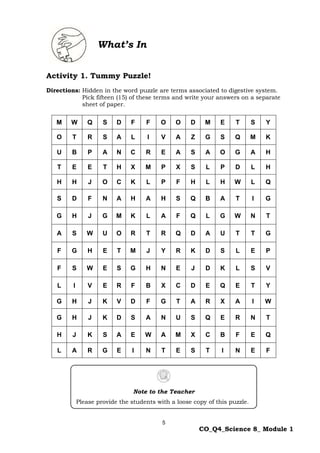
Activity 1. Tummy Puzzle!
Directions: Hidden in the word puzzle are terms associated to digestive system.
Pick fifteen (15) of these terms and write your answers on a separate
sheet of paper.
M W Q S D F F O O D M E T S Y
O T R S A L I V A Z G S Q M K
U B P A N C R E A S A O G A H
T E E T H X M P X S L P D L H
H H J O C K L P F H L H W L Q
S D F N A H A H S Q B A T I G
G H J G M K L A F Q L G W N T
A S W U O R T R Q D A U T T G
F G H E T M J Y R K D S L E P
F S W E S G H N E J D K L S V
L I V E R F B X C D E Q E T Y
G H J K V D F G T A R X A I W
G H J K D S A N U S Q E R N T
H J K S A E W A M X C B F E Q
L A R G E I N T E S T I N E F
What’s In
Note to the Teacher
Please provide the students with a loose copy of this puzzle.
6
CO_Q4_Science 8_ Module 1
Activity 2. A Gutsy Game!
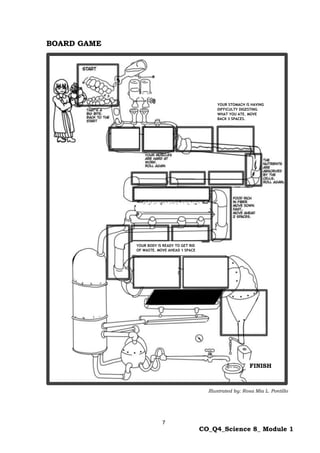
This activity is a board game that needs at least two players. The game
demonstrates the flow of food into our digestive system. The first one to reach the
finish tile wins!
Objectives:
After performing this activity, you are expected to:
1. Identify the parts that compose the digestive system; and
2. Describe the function of each organ.
Materials Needed:
Game board (refer to page 7)
A piece of cube dice or six-sided small box with numbers 1 to 6
Playing token (e.g., pebble, button, etc.)
Procedure:
1. Find someone whom you can play the board game with.
2. Choose a playing token for you and your playmate; place your tokens
on the board’s starting line.
3. Take turns in rolling the dice.
4. The number on the dice tells the number of boxes you may move your token.
5. Should your token land on a box with instructions beside it, execute
the instructions.
6. The player who first makes it all the way throughout the digestive system
and down to finish line wins the game.
Questions:
1. What does the playing token represent?
___________________________________________________________________________ .
2. What do the boxes on the game represent?
___________________________________________________________________________ .
3. What do the instructions beside the boxes tell you about the digestive
system?
___________________________________________________________________________ .
What’s New
7
CO_Q4_Science 8_ Module 1
BOARD GAME
YOUR STOMACH IS HAVING
DIFFICULTY DIGESTING
WHAT YOU ATE. MOVE
BACK 3 SPACES.
YOUR BODY IS READY TO GET RID
OF WASTE. MOVE AHEAD 1 SPACE
FINISH
Illustrated by: Rosa Mia L. Pontillo
8
In Activity 1, you must have inferred that the digestive system is composed of
different organs that work together to break down food and nourish the body. It also
involves important processes in order to carry out the function of the digestive
system.
The function of the digestive system is digestion, the breakdown of organic
compounds into their simple forms for use by the cells. Digestion is the chief
function of the digestive system. It breaks down food mechanically and chemically.
Let us take a journey
throughout the human digestive
system to see how it works and how the
organs coordinate in order to carry out
the processes of digestion (see figure 1).
To make it a little more interesting, try
to imagine what happens to a
hamburger when eaten. Remember
that ground meat is mostly protein,
mayonnaise is mostly fat, and the bun
is mostly carbohydrate. The journey of
the food starts from the mouth down to
the anus takes about 18-20 hours.
A. INGESTION is the first process that
happens in digestive system. It is the
journey of taking in food or any
substance into the body through the
mouth. The journey of food starts when
a bit of hamburger enters your mouth.
B. DIGESTION is the second process involved in digestive system. It is the process
that involves break down of large food molecules into smaller molecules for easy
absorption of the cells. Both chemical and mechanical digestions begin immediately
in the mouth. While the food is in the mouth, the teeth cut, crush, and break it apart
into tiny pieces while the tongue helps mix food with saliva secreted by the salivary
glands forming into a moist ball called bolus so it can be easily swallowed. This
process is known as mastication or chewing considered as a mechanical digestion,
which is the initial stage of digestion. The saliva contains salivary amylase, the
enzyme that breaks down starch into smaller carbohydrate. Then, the bolus passes
from the mouth to the esophagus - a tube that attaches the mouth to the stomach.
A series of wave-like muscle contractions known as peristalsis push and transport
foods and liquids in small sections to the stomach.
What is It
Figure 1. Parts and Processes of the Digestive System
Illustrated by: Rosa Mia L. Pontillo
.
9
The stomach is a J-shaped, bag-like muscular organ that can hold
approximately one liter of fluid and food. The primary function of the stomach is to
store food, which turns to chyme after being acted on by the stomach acid. Chyme
is a semifluid material formed from bolus that is acted upon by the gastric juices
secreted by the stomach. The walls of the stomach have special cells that secrete
gastric juices like hydrochloric acid and pepsin that begin the chemical
breakdown of proteins.
Let us take a short detour into the three organs that are part of the digestive
system and helps in secretion of essential substances. These organs are the liver, the
pancreas and the gall bladder.
The liver produces bile, a green fluid that turns large fat droplets into smaller
ones and stores them in the gall bladder. When necessary, bile gets into the small
intestine and helps in the digestion of fat. The pancreas makes three different kinds
of enzymes namely amylase, peptidase, and lipase released through a pancreatic
duct that aid in the digestion of all three organic compounds such as carbohydrates,
proteins, and fats respectively. The process takes about half of a liter of digestive
juices each day. The liver is the biggest organ inside the body with a mass of about
two kilograms. Gall bladder - a small pear-shaped sac that can hold about 50ml of
bile. The pancreas is a small organ found below the stomach.
The small intestine is an organ that breaks down food further into
substances, such as glucose, that can be absorbed by the villi. It has three parts
namely the duodenum, the jejunum, and ileum. The duodenum is the first and
shortest part of the small intestine that starts at the lower end of the stomach and
extends for about 20 cm to 25 cm in length. Basically, it is in charge for the
continuous breaking-down process as it partially receives the chyme from the
stomach, it resumes chemical digestion of food, and prepares for absorption through
the villi.
Illustrated by: Rosa Mia L. Pontillo
10
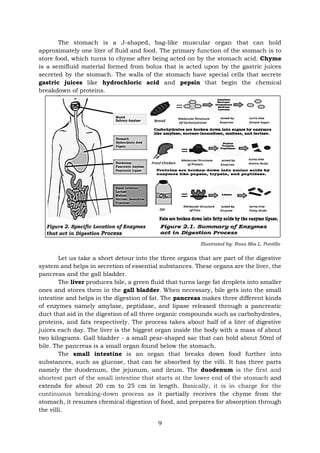
Organic compounds such as carbohydrates, proteins, and fats are specifically
broken down with the aid of different enzymes. Carbohydrates are broken down into
sugars by enzymes like amylase, maltase and lactase. Proteins are broken down into
amino acids by enzymes like trypsin and peptidase. Fats are broken down into fatty
acids by the enzyme lipase. After about four hours, the stomach pushes food into the
small intestines. See Figure 2 and Figure 2.1. The production and release of enzymes
and acids in the digestive system is called secretion. It aids in the breaking down of
complex food molecules into their chemical building blocks.
The jejunum is the second part of the small intestine that is 2.5 cm in length.
Its wall works for absorption through enterocytes or columnar cells of small nutrient
particles which have been previously digested by the enzymes in the duodenum.
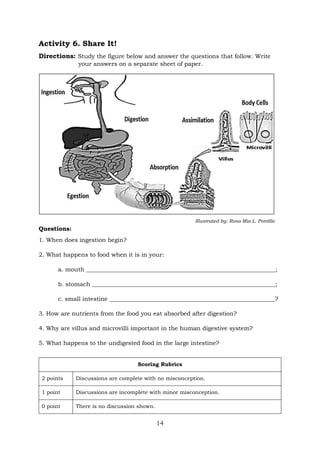
C. Absorption is the third process that
happens in the digestive system. It occurs
mostly in the small intestine where several
digestive juices, pancreatic juice, and bile aid
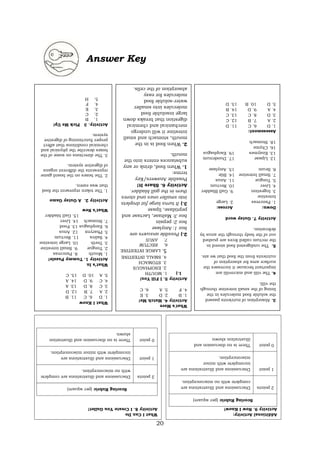
in the chemical digestion of food. Absorption
is the process of passing the soluble food
molecules in the wall of the small intestine
through the villi – the tiny, finger-like
projections from the epithelial lining of the
intestinal wall. Each villus contains blood
capillaries that enable it to absorb water,
glucose, amino acids, vitamins, minerals,
and fatty acids. It also increases the amount
of surface area available for the absorption of
nutrients. See figure 3.
D. Assimilation is the fourth process that occurs in the
digestive system. It is the movement of digested food
nutrients into the blood vessels of the small intestine
through diffusion and use of nutrients into the body
cells through the microvilli – microscopic cellular
membrane projections that serves to expand the
surface area for diffusion and also to lessen any
increase in volume. See figure 4.
The third part of the small intestine is the ileum which
is about 3.5 meters in length. Its main function is the
assimilation (absorption) of B12 and the re-assimilation
(reabsorption) of conjugated bile salts.
The Large intestine is divided into caecum, ascending colon, transverse colon,
descending colon, and sigmoid colon. This is where reabsorption of liquid,
electrolytes and some vitamins from the undigested food takes place. It secretes
mucus to aid in the formation of feces and maintains alkaline conditions. This is the
last segment of the gastrointestinal tract that completes absorption and compacts
waste.
Figure 3. Absorption of nutrients through
the villi.
Body Cells
Figure 4. Diffusion of Nutrients
through the Microvilli.
Villi
Illustrated by: Rosa Mia L. Pontillo
11
E. Egestion is the last process that occurs in the digestive system. It is the release
of undigested food collected in the rectum called feces and pushed out of the body
through the anus by defecation.
Activity 3. Pick Me UP!
Directions: Identify the five organs that are part of the digestive system from
among the picture in the box below. Write only the letters
corresponding to your answer on a separate sheet of paper.
What’s More
Illustrated by: Rosa Mia L. Pontillo
.
12
Activity 4. Match ME!
Directions: Describe the function of each organ in the digestive system by
matching column A with column B. Write only the letter of the
correct answer on a separate sheet of paper.
Column A Column B
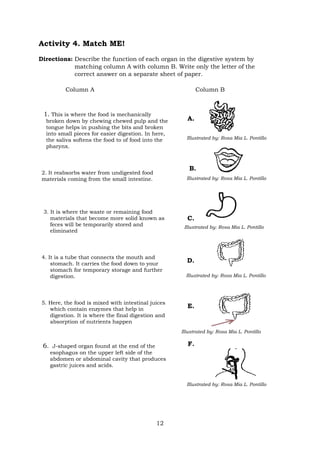
1. This is where the food is mechanically
broken down by chewing chewed pulp and the
tongue helps in pushing the bits and broken
into small pieces for easier digestion. In here,
the saliva softens the food to of food into the
pharynx.
A.
2. It reabsorbs water from undigested food
materials coming from the small intestine.
B.
3. It is where the waste or remaining food
materials that become more solid known as
feces will be temporarily stored and
eliminated
C.
4. It is a tube that connects the mouth and
stomach. It carries the food down to your
stomach for temporary storage and further
digestion.
D.
5. Here, the food is mixed with intestinal juices
which contain enzymes that help in
digestion. It is where the final digestion and
absorption of nutrients happen
E.
6. J-shaped organ found at the end of the
esophagus on the upper left side of the
abdomen or abdominal cavity that produces
gastric juices and acids.
F.
Illustrated by: Rosa Mia L. Pontillo
13
Activity 5. I Fill You!
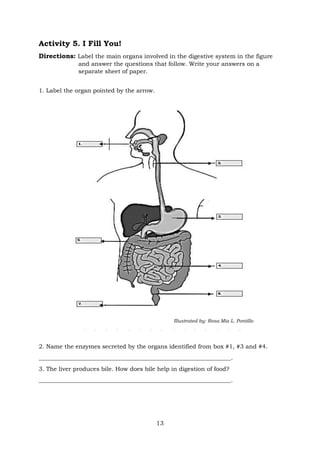
Directions: Label the main organs involved in the digestive system in the figure
and answer the questions that follow. Write your answers on a
separate sheet of paper.
1. Label the organ pointed by the arrow.
2. Name the enzymes secreted by the organs identified from box #1, #3 and #4.
_________________________________________________________________.
3. The liver produces bile. How does bile help in digestion of food?
_________________________________________________________________.
Illustrated by: Rosa Mia L. Pontillo
14
Activity 6. Share It!
Directions: Study the figure below and answer the questions that follow. Write
your answers on a separate sheet of paper.
Questions:
1. When does ingestion begin?
2. What happens to food when it is in your:
a. mouth ________________________________________________________________;
b. stomach ______________________________________________________________;
c. small intestine ________________________________________________________?
3. How are nutrients from the food you eat absorbed after digestion?
4. Why are villus and microvilli important in the human digestive system?
5. What happens to the undigested food in the large intestine?
Scoring Rubrics
2 points Discussions are complete with no misconception.
1 point Discussions are incomplete with minor misconception.
0 point There is no discussion shown.
Illustrated by: Rosa Mia L. Pontillo
15
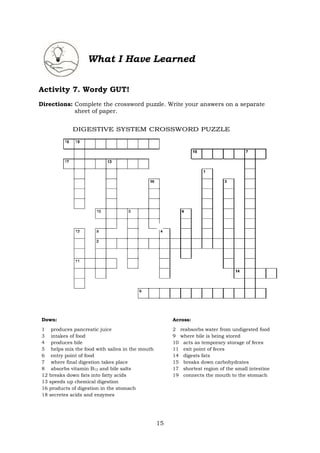
Activity 7. Wordy GUT!
Directions: Complete the crossword puzzle. Write your answers on a separate
sheet of paper.
What I Have Learned
Down:
1 produces pancreatic juice
3 intakes of food
4 produces bile
5 helps mix the food with saliva in the mouth
6 entry point of food
7 where final digestion takes place
8 absorbs vitamin B12 and bile salts
12 breaks down fats into fatty acids
13 speeds up chemical digestion
16 products of digestion in the stomach
18 secretes acids and enzymes
Across:
2 reabsorbs water from undigested food
9 where bile is being stored
10 acts as temporary storage of feces
11 exit point of feces
14 digests fats
15 breaks down carbohydrates
17 shortest region of the small intestine
19 connects the mouth to the stomach
16
● Mechanical digestion ● Stomach
● Chemical digestion ● Small intestine
● Mouth ● Villi
● Saliva ● Large intestine
● Esophagus ● Rectum
● Peristalsis ● Anus
What I Can Do
Activity 8. I Create You Gullet!
Directions: Create a comic strip of digestive process on a sheet of bond paper based
on the situation below. Put a title of your comic strip on one square. Make ten more
squares for your story. Each square shall show both drawings and words to tell your
story. The following terms and concepts should include in your comic strip:
Situation: Imagine that you are a piece of food (bread, pizza, mango, etc.) that is
about to be eaten by a human being! As you journey through the digestive system,
starting from the first bite and ending with your exit from the human body, you are
able to meet the different organs and enzymes that interact with you.
Scoring Rubric (per square)
2 points Discussions and illustrations are complete with no misconception.
1 point Discussions and illustrations are incomplete with minor misconception.
0 point There is no discussion and illustration shown
17
Assessment
Directions: Choose the letter of the correct answer. Write your answers on a separate
sheet of paper.
1. The following organs are part of the human digestive system
EXCEPT:
A. mouth
B. esophagus
C. small Intestine
D. gastro vascular cavity
2. In which part of the digestive system does the breaking down of food into tinier
pieces occur?
A. mouth
B. stomach
C. small intestine
D. large Intestine
3. Which of the following helps in the digestion of food in the mouth?
A. amylase
B. bile
C. protease
D. saliva
4. What enzyme aids the digestion of lipids in the small intestine?
A. amylase
B. gastric enzyme
C. lipase
D. pepsin
5. Which tiny structures line the internal surface of the small intestine to increase
its surface area for the absorption of nutrients?
A. bile ducts
B. cilia
C. salivary glands
D. villi
6. What is the largest internal organ of the human body?
A. heart
B. gall bladder
C. liver
D. stomach
18
7. Which of the following is produced by the liver?
A. amylase
B. bile
C. pepsin
D. renin
8. Which organ stores bile and pumps it into duodenum?
A. appendix
B. colon
C. gall bladder
D. pancreas
9. What is the result of chemical digestion of carbohydrates?
A. amino acid
B. bile
C. fatty acids
D. simple sugars
10. Where does absorption of nutrients mostly occur?
A. stomach
B. small intestine
C. large intestine
D. all the above
11. What aids the passage of food through the digestive tract?
A. pull from the anus
B. chemical absorption
C. movement of the cilia
D. wavelike muscle contractions
12. What is the main work of the digestive system?
A. fights disease
B. regenerates cells
C. breaks down food
D. distributes energy throughout the body
13. Which of the following is the correct order of the digestive tract?
A. mouth → rectum → esophagus → rectum → anus → small intestine
→ large intestine
B. mouth → stomach → esophagus → rectum → anus → small intestine
→large intestine
C. mouth → esophagus → stomach → small intestine → large intestine
→ rectum → anus
D. mouth → esophagus → stomach → small intestine → anus
→ large intestine → rectum
19
14. How do nutrients from digested food reach the blood?
A. by passing through the esophagus into the blood
B. by being absorbed into the blood through the blood vessels
C. by being absorbed into the blood through the walls of the lungs
D. by passing through the small intestine into the large intestine, then
into the blood
15. What will happen to the undigested food that pass through the digestive
tract?
A. goes to the pancreas to await disposal
B. enters to the stomach and await disposal
C. goes to small intestine and await disposal
D. moves down to the large intestine and await disposal
Additional Activities
Activity 9: Now I Know!
The digestive system is an important part of our body. It helps our body breaks
down bulk of food, absorb essential nutrients from what we eat and even get rid of
its waste product. Digestive system may suffer complications that ranges from mild
to severe so it is important to recognize common problems related to digestion.
Directions: Create an infographic of the digestive system - parts and functions as
well as the disorders that you might be getting from malfunction of some organs of
the system.
Note: An infographic is a collection of images, diagrams, and text that provides an
easy-to-understand general idea of a topic. Most infographics use prominent and
attractive illustrations to converse the facts quickly and clearly.
Scoring Rubric (per square)
2 points Discussions and illustrations are complete with no misconception.
1 point Discussions and illustrations are incomplete with minor misconception.
0 point There is no discussion and illustration shown
20
Additional
Activity:
Activity
9.
Now
I
Know!
Scoring
Rubric
(per
square)
2
points
Discussions
and
illustrations
are
complete
with
no
misconception.
1
point
Discussions
and
illustrations
are
incomplete
with
minor
misconception.
0
point
There
is
no
discussion
and
illustration
shown
3.
Absorption
of
nutrients
passed
the
soluble
food
molecules
in
the
lining
of
the
small
intestine
through
the
villi.
4.
The
villi
and
microvilli
are
important
because
it
increases
the
surface
area
for
absorption
of
nutrients
from
the
food
that
we
ate.
5.
The
undigested
food
stored
in
the
rectum
called
feces
are
pushed
out
of
the
body
through
the
anus
by
defecation.
Activity
7.
Gutsy
word
Down:
Across:
1.
Pancreas
2.
Large
Intestine
3.
Ingestion
9.
Gall
Bladder
4.
Liver
10.
Rectum
5.
Tongue
11.
Anus
7.
Small
Intestine
14.
Bile
8.
Ileum
15.
Amylase
12.
Lipase
17.
Duodenum
13.
Enzymes
19.
Esophagus
16.
Chyme
18.
Stomach
Assessment:
1.
D
6.
C
11.
D
2.
A
7.
B
12.
C
3.
D
8.
C
13.
C
4.
A
9.
D
14.
B
5.
D
10.
B
15.
D
What
I
Know
1.
D
6.
C
11.
B
2.
A
7.
B
12.
D
3.
C
8.
D
13.
A
4.
C
9.
D
14.
A
5.
A
10.
D
15.
C
What’s
In
Activity
1.
Tummy
Puzzle!
1.
Mouth
8.
Pancreas
2.
Tongue
9.
Small
intestine
3.
Teeth
10.
Large
intestine
4.
Saliva
11.
Rectum
5.
Pharynx
12.
Anus
6.
Esophagus
13.
Food
7.
Stomach
14.
Liver
15.
Gall
bladder
What’s
New
Activity
2.
A
Gutsy
Game
1.
The
token
represent
the
food
that
was
eaten.
2.
The
boxes
on
the
board
game
represents
the
different
organs
of
digestive
system.
3.
The
directions
on
some
of
the
boxes
describe
the
physical
and
chemical
conditions
that
affect
proper
functioning
of
digestive
system.
Activity.
3
Pick
Me
Up!
1.
B
2.
C
3.
E
4.
F
5.
H
What's
More
Activity
4.
Match
Me!
1.
B
2.
D
3.
E
4.
F
5.
A
6.
C
Activity
5.
I
Fill
You!
1.)
1.
MOUTH
2.
ESOPHAGUS
3.
STOMACH
4.
SMALL
INTESTINE
5.
LARGE
INTESTINE
6.
RECTUM
7.
ANUS
2.)
Possible
answers
are
box
1:
Amylase
box
2:
pepsin
box
3:
Maltase,
Lactase
and
peptidase,
lipase
3.)
It
turns
large
fat
droplets
into
smaller
ones
and
stores
them
in
the
gall
bladder.
Activity
6.
Share
It!
Possible
Answers/Key
terms:
1.
When
food,
drink
or
any
substances
enters
into
the
mouth.
2.
When
food
is
in
the
mouth,
stomach
and
small
intestine
it
will
undergo
mechanical
and
chemical
digestion
that
breaks
down
large
insoluble
food
molecules
into
smaller
water-soluble
food
molecules
for
easy
absorption
of
the
cells.
What
I
Can
Do
Activity
8.
I
Create
You
Gullet!
Scoring
Rubric
(per
square)
2
points
Discussions
and
illustrations
are
complete
with
no
misconception.
1
point
Discussions
and
illustrations
are
incomplete
with
minor
misconception.
0
point
There
is
no
discussion
and
illustration
shown
Answer Key
21
References
Digestive System. (2014, September 26). Retrieved from DepEd Learning Portal:
lrmds.deped.ph/pdf-view/6315
Pia C. Campo, e. a. (2013). Science- Grade8 Learner's Module. Meralco Avenue,
Pasig City: Vibal Publishing House, Inc.
PROJECT EASE. (n.d.). In Module 11 Energy Producing and Distributing Systems
(pp. 2-11). DepEd Complex, Meralco Avenue Pasig City: BUREAU OF
SECONDARY EDUCATION.
For inquiries or feedback, please write or call:
Department of Education - Bureau of Learning Resources (DepEd-BLR)
Ground Floor, Bonifacio Bldg., DepEd Complex
Meralco Avenue, Pasig City, Philippines 1600
Telefax: (632) 8634-1072; 8634-1054; 8631-4985
Email Address: blr.lrqad@deped.gov.ph * blr.lrpd@deped.gov.ph
SCI8-Q4-MOD1.pdf

  • 1.
    CO_Q4_Science 8_ Module1 Science Quarter 4 – Module 1: Structures and Functions of the Digestive System 8
  • 2.
    Science – Grade8 Alternative Delivery Mode Quarter 4 – Module 1: Structures and Functions of the Digestive System First Edition, 2020 Republic Act 8293, section 176 states that: No copyright shall subsist in any work of the Government of the Philippines. However, prior approval of the government agency or office wherein the work is created shall be necessary for exploitation of such work for profit. Such agency or office may, among other things, impose as a condition the payment of royalties. Borrowed materials (i.e., songs, stories, poems, pictures, photos, brand names, trademarks, etc.) included in this module are owned by their respective copyright holders. Every effort has been exerted to locate and seek permission to use these materials from their respective copyright owners. The publisher and authors do not represent nor claim ownership over them. Published by the Department of Education Secretary: Leonor Magtolis Briones Undersecretary: Diosdado M. San Antonio Printed in the Philippines by ________________________ Department of Education – Caraga Region Office Address: Teacher Development Center J.P. Rosales Avenue, Butuan City, Philippines 8600 Telefax: (085) 342-8207/ (085) 342-5969 E-mail Address: caraga@deped.gov.ph Development Team of the Module Writers: Rodeliza R. Wahing, Doriza F. Deso-Asido, Shellah May P. Castillo Editor: Ana Rubi L. Sereño Reviewers: Bernabe L. Linog, Corazon P. Roa, Juvy B. Luna, Arlene L. Abala, Kathleen Torculas, Nonita c. Patalinghug Illustrator: Rosa Mia L. Pontillo Layout Artist: Edgardo D. Pamugas III Layout Evaluators: Celeste Faith R. Almanon, Jay S. Ayap Management Team: Francis Cesar B. Bringas Isidro M. Biol, Jr. Maripaz F. Magno Josephine Chonie M. Obseñares Gregoria T. Su Marvilyn C. Francia Jay S. Ayap Nonita C. Patalinghug
  • 3.
    8 Science Quarter 4 –Module 1: Structures and Functions of the Digestive System
  • 4.
    Introductory Message This Self-LearningModule (SLM) is prepared so that you, our dear learners, can continue your studies and learn while at home. Activities, questions, directions, exercises, and discussions are carefully stated for you to understand each lesson. Each SLM is composed of different parts. Each part shall guide you step-by- step as you discover and understand the lesson prepared for you. Pre-tests are provided to measure your prior knowledge on lessons in each SLM. This will tell you if you need to proceed on completing this module or if you need to ask your facilitator or your teacher’s assistance for better understanding of the lesson. At the end of each module, you need to answer the post-test to self-check your learning. Answer keys are provided for each activity and test. We trust that you will be honest in using these. In addition to the material in the main text, Notes to the Teacher are also provided to our facilitators and parents for strategies and reminders on how they can best help you on your home-based learning. Please use this module with care. Do not put unnecessary marks on any part of this SLM. Use a separate sheet of paper in answering the exercises and tests. And read the instructions carefully before performing each task. If you have any questions in using this SLM or any difficulty in answering the tasks in this module, do not hesitate to consult your teacher or facilitator. Thank you.
  • 5.
    1 CO_Q4_Science 8_ Module1 What I Need to Know This module was designed and written with you in mind. It is here to help you master the structures and functions of the digestive system. The scope of this module permits it to be used in many different learning situations. The language used recognizes the diverse vocabulary level of students. The lessons are arranged to follow the standard sequence of the course. But the order in which you read them can be changed to correspond with the learner’s material you are now using. This module contains: Lesson 1 – The Digestive System After going through this module, you are expected to: 1. Identify the organs that make up the digestive system; 2. Give the function of each organ; 3. Describe how some accessory organs and glands help the body in the digestive process; and 4. Explain ingestion, digestion, absorption, assimilation, and excretion. (MELC Week 1 S8LT-IVa-13)
  • 6.
    2 CO_Q4_Science 8_ Module1 What I Know Directions: Choose the letter of the correct answer. Write your answers on a separate sheet of paper. 1. In what process do animals take in food that provides energy and nutrients? A. assimilation B. digestion C. excretion D. ingestion 2. The process in which digested foods are distributed into different parts of the body cells are _______. A. assimilation B. digestion C. excretion D. ingestion 3. What is the process of turning food into smaller molecules with the aid of enzymes? A. churning B. mastication C. chemical digestion D. mechanical digestion 4. Where does the final stage in digestion of food happen? A. liver B. mouth C. small intestine D. large intestine 5. What type of enzyme present in saliva helps break down starch? A. amylase B. lactase C. lipase D. maltase 6. Which of the following breaks down food into tinier pieces to begin mechanical digestion? A. esophagus B. stomach C. teeth D. tongue
  • 7.
    3 CO_Q4_Science 8_ Module1 7. What organ system is responsible for breaking down of large molecules into smaller molecules and absorption of organic compounds needed by the body? A. circulatory system B. digestive system C. Nervous system D. respiratory system 8. What is the main function of the large intestine? A. It breaks down hemoglobin. B. It secretes digestive enzymes. C. It regulates the release of bile. D. It reabsorbs water from chyme. 9. What do you call the wavelike contraction of the smooth muscles of digestive tract pushes food in small sections through the gastro-intestinal tube? A. mixing movement B. parietal movement C. contractile movement D. peristaltic movement 10. If the liver is severely damaged, metabolism of which nutrients would be most affected? A. carbohydrates B. lipids C. proteins D. All of the above 11. What is the most essential function of the intestinal villi? A. pushes the fecal matter into the rectum B. increases surface area for nutrient absorption C. secretes serous fluid to decrease friction among the organs D. secretes mucous to facilitate the movement of chyme via the alimentary canal 12. Which of the following shows the correct sequence of the processes involved in the human digestive system? A. assimilation, absorption, ingestion, digestion, and egestion B. digestion, ingestion, assimilation, egestion and absorption C. egestion, absorption, digestion, assimilation and ingestion D. ingestion, digestion, absorption, assimilation and egestion 13. What is the term for the food that is chewed and mixed with saliva that turns into a moist ball? A. bolus B. chyme C. feces D. gastric juice
  • 8.
    4 CO_Q4_Science 8_ Module1 14. It is the process by which the nutrients from the digested food move into the blood vessels passing through the lining of the small intestine. A. assimilation B. digestion C. egestion D. elimination 15. Which of these substances is an enzyme that digests protein in the stomach? A. amylase B. hydrochloric acid C. pepsin D. saliva Why do we eat? Is eating necessary in keeping us alive? Where do we get the energy that enables us to carry out the many activities that we do each day? How do we obtain materials needed for the growth and repair of body parts? The food that we eat plays a central role in the survival of species. It provides the energy that enables us to carry out the many activities that we do each day such as breathing, walking, studying and cooking. Food also provides the substances needed for growth and repair of body parts. The cells in the body need food for energy used for growth and repair. Food must be broken down into a form that these microscopic cells can use. The body changes food into a usable form by means of a group of organs referred to as the digestive system. Lesson 1 The Digestive System
  • 9.
    5 CO_Q4_Science 8_ Module1 Activity 1. Tummy Puzzle! Directions: Hidden in the word puzzle are terms associated to digestive system. Pick fifteen (15) of these terms and write your answers on a separate sheet of paper. M W Q S D F F O O D M E T S Y O T R S A L I V A Z G S Q M K U B P A N C R E A S A O G A H T E E T H X M P X S L P D L H H H J O C K L P F H L H W L Q S D F N A H A H S Q B A T I G G H J G M K L A F Q L G W N T A S W U O R T R Q D A U T T G F G H E T M J Y R K D S L E P F S W E S G H N E J D K L S V L I V E R F B X C D E Q E T Y G H J K V D F G T A R X A I W G H J K D S A N U S Q E R N T H J K S A E W A M X C B F E Q L A R G E I N T E S T I N E F What’s In Note to the Teacher Please provide the students with a loose copy of this puzzle.
  • 10.
    6 CO_Q4_Science 8_ Module1 Activity 2. A Gutsy Game! This activity is a board game that needs at least two players. The game demonstrates the flow of food into our digestive system. The first one to reach the finish tile wins! Objectives: After performing this activity, you are expected to: 1. Identify the parts that compose the digestive system; and 2. Describe the function of each organ. Materials Needed: Game board (refer to page 7) A piece of cube dice or six-sided small box with numbers 1 to 6 Playing token (e.g., pebble, button, etc.) Procedure: 1. Find someone whom you can play the board game with. 2. Choose a playing token for you and your playmate; place your tokens on the board’s starting line. 3. Take turns in rolling the dice. 4. The number on the dice tells the number of boxes you may move your token. 5. Should your token land on a box with instructions beside it, execute the instructions. 6. The player who first makes it all the way throughout the digestive system and down to finish line wins the game. Questions: 1. What does the playing token represent? ___________________________________________________________________________ . 2. What do the boxes on the game represent? ___________________________________________________________________________ . 3. What do the instructions beside the boxes tell you about the digestive system? ___________________________________________________________________________ . What’s New
  • 11.
    7 CO_Q4_Science 8_ Module1 BOARD GAME YOUR STOMACH IS HAVING DIFFICULTY DIGESTING WHAT YOU ATE. MOVE BACK 3 SPACES. YOUR BODY IS READY TO GET RID OF WASTE. MOVE AHEAD 1 SPACE FINISH Illustrated by: Rosa Mia L. Pontillo
  • 12.
    8 In Activity 1,you must have inferred that the digestive system is composed of different organs that work together to break down food and nourish the body. It also involves important processes in order to carry out the function of the digestive system. The function of the digestive system is digestion, the breakdown of organic compounds into their simple forms for use by the cells. Digestion is the chief function of the digestive system. It breaks down food mechanically and chemically. Let us take a journey throughout the human digestive system to see how it works and how the organs coordinate in order to carry out the processes of digestion (see figure 1). To make it a little more interesting, try to imagine what happens to a hamburger when eaten. Remember that ground meat is mostly protein, mayonnaise is mostly fat, and the bun is mostly carbohydrate. The journey of the food starts from the mouth down to the anus takes about 18-20 hours. A. INGESTION is the first process that happens in digestive system. It is the journey of taking in food or any substance into the body through the mouth. The journey of food starts when a bit of hamburger enters your mouth. B. DIGESTION is the second process involved in digestive system. It is the process that involves break down of large food molecules into smaller molecules for easy absorption of the cells. Both chemical and mechanical digestions begin immediately in the mouth. While the food is in the mouth, the teeth cut, crush, and break it apart into tiny pieces while the tongue helps mix food with saliva secreted by the salivary glands forming into a moist ball called bolus so it can be easily swallowed. This process is known as mastication or chewing considered as a mechanical digestion, which is the initial stage of digestion. The saliva contains salivary amylase, the enzyme that breaks down starch into smaller carbohydrate. Then, the bolus passes from the mouth to the esophagus - a tube that attaches the mouth to the stomach. A series of wave-like muscle contractions known as peristalsis push and transport foods and liquids in small sections to the stomach. What is It Figure 1. Parts and Processes of the Digestive System Illustrated by: Rosa Mia L. Pontillo .
  • 13.
    9 The stomach isa J-shaped, bag-like muscular organ that can hold approximately one liter of fluid and food. The primary function of the stomach is to store food, which turns to chyme after being acted on by the stomach acid. Chyme is a semifluid material formed from bolus that is acted upon by the gastric juices secreted by the stomach. The walls of the stomach have special cells that secrete gastric juices like hydrochloric acid and pepsin that begin the chemical breakdown of proteins. Let us take a short detour into the three organs that are part of the digestive system and helps in secretion of essential substances. These organs are the liver, the pancreas and the gall bladder. The liver produces bile, a green fluid that turns large fat droplets into smaller ones and stores them in the gall bladder. When necessary, bile gets into the small intestine and helps in the digestion of fat. The pancreas makes three different kinds of enzymes namely amylase, peptidase, and lipase released through a pancreatic duct that aid in the digestion of all three organic compounds such as carbohydrates, proteins, and fats respectively. The process takes about half of a liter of digestive juices each day. The liver is the biggest organ inside the body with a mass of about two kilograms. Gall bladder - a small pear-shaped sac that can hold about 50ml of bile. The pancreas is a small organ found below the stomach. The small intestine is an organ that breaks down food further into substances, such as glucose, that can be absorbed by the villi. It has three parts namely the duodenum, the jejunum, and ileum. The duodenum is the first and shortest part of the small intestine that starts at the lower end of the stomach and extends for about 20 cm to 25 cm in length. Basically, it is in charge for the continuous breaking-down process as it partially receives the chyme from the stomach, it resumes chemical digestion of food, and prepares for absorption through the villi. Illustrated by: Rosa Mia L. Pontillo
  • 14.
    10 Organic compounds suchas carbohydrates, proteins, and fats are specifically broken down with the aid of different enzymes. Carbohydrates are broken down into sugars by enzymes like amylase, maltase and lactase. Proteins are broken down into amino acids by enzymes like trypsin and peptidase. Fats are broken down into fatty acids by the enzyme lipase. After about four hours, the stomach pushes food into the small intestines. See Figure 2 and Figure 2.1. The production and release of enzymes and acids in the digestive system is called secretion. It aids in the breaking down of complex food molecules into their chemical building blocks. The jejunum is the second part of the small intestine that is 2.5 cm in length. Its wall works for absorption through enterocytes or columnar cells of small nutrient particles which have been previously digested by the enzymes in the duodenum. C. Absorption is the third process that happens in the digestive system. It occurs mostly in the small intestine where several digestive juices, pancreatic juice, and bile aid in the chemical digestion of food. Absorption is the process of passing the soluble food molecules in the wall of the small intestine through the villi – the tiny, finger-like projections from the epithelial lining of the intestinal wall. Each villus contains blood capillaries that enable it to absorb water, glucose, amino acids, vitamins, minerals, and fatty acids. It also increases the amount of surface area available for the absorption of nutrients. See figure 3. D. Assimilation is the fourth process that occurs in the digestive system. It is the movement of digested food nutrients into the blood vessels of the small intestine through diffusion and use of nutrients into the body cells through the microvilli – microscopic cellular membrane projections that serves to expand the surface area for diffusion and also to lessen any increase in volume. See figure 4. The third part of the small intestine is the ileum which is about 3.5 meters in length. Its main function is the assimilation (absorption) of B12 and the re-assimilation (reabsorption) of conjugated bile salts. The Large intestine is divided into caecum, ascending colon, transverse colon, descending colon, and sigmoid colon. This is where reabsorption of liquid, electrolytes and some vitamins from the undigested food takes place. It secretes mucus to aid in the formation of feces and maintains alkaline conditions. This is the last segment of the gastrointestinal tract that completes absorption and compacts waste. Figure 3. Absorption of nutrients through the villi. Body Cells Figure 4. Diffusion of Nutrients through the Microvilli. Villi Illustrated by: Rosa Mia L. Pontillo Illustrated by: Rosa Mia L. Pontillo
  • 15.
    11 E. Egestion isthe last process that occurs in the digestive system. It is the release of undigested food collected in the rectum called feces and pushed out of the body through the anus by defecation. Activity 3. Pick Me UP! Directions: Identify the five organs that are part of the digestive system from among the picture in the box below. Write only the letters corresponding to your answer on a separate sheet of paper. What’s More Illustrated by: Rosa Mia L. Pontillo .
  • 16.
    12 Activity 4. MatchME! Directions: Describe the function of each organ in the digestive system by matching column A with column B. Write only the letter of the correct answer on a separate sheet of paper. Column A Column B 1. This is where the food is mechanically broken down by chewing chewed pulp and the tongue helps in pushing the bits and broken into small pieces for easier digestion. In here, the saliva softens the food to of food into the pharynx. A. 2. It reabsorbs water from undigested food materials coming from the small intestine. B. 3. It is where the waste or remaining food materials that become more solid known as feces will be temporarily stored and eliminated C. 4. It is a tube that connects the mouth and stomach. It carries the food down to your stomach for temporary storage and further digestion. D. 5. Here, the food is mixed with intestinal juices which contain enzymes that help in digestion. It is where the final digestion and absorption of nutrients happen E. 6. J-shaped organ found at the end of the esophagus on the upper left side of the abdomen or abdominal cavity that produces gastric juices and acids. F. Illustrated by: Rosa Mia L. Pontillo Illustrated by: Rosa Mia L. Pontillo Illustrated by: Rosa Mia L. Pontillo Illustrated by: Rosa Mia L. Pontillo Illustrated by: Rosa Mia L. Pontillo Illustrated by: Rosa Mia L. Pontillo
  • 17.
    13 Activity 5. IFill You! Directions: Label the main organs involved in the digestive system in the figure and answer the questions that follow. Write your answers on a separate sheet of paper. 1. Label the organ pointed by the arrow. 2. Name the enzymes secreted by the organs identified from box #1, #3 and #4. _________________________________________________________________. 3. The liver produces bile. How does bile help in digestion of food? _________________________________________________________________. Illustrated by: Rosa Mia L. Pontillo
  • 18.
    14 Activity 6. ShareIt! Directions: Study the figure below and answer the questions that follow. Write your answers on a separate sheet of paper. Questions: 1. When does ingestion begin? 2. What happens to food when it is in your: a. mouth ________________________________________________________________; b. stomach ______________________________________________________________; c. small intestine ________________________________________________________? 3. How are nutrients from the food you eat absorbed after digestion? 4. Why are villus and microvilli important in the human digestive system? 5. What happens to the undigested food in the large intestine? Scoring Rubrics 2 points Discussions are complete with no misconception. 1 point Discussions are incomplete with minor misconception. 0 point There is no discussion shown. Illustrated by: Rosa Mia L. Pontillo
  • 19.
    15 Activity 7. WordyGUT! Directions: Complete the crossword puzzle. Write your answers on a separate sheet of paper. What I Have Learned Down: 1 produces pancreatic juice 3 intakes of food 4 produces bile 5 helps mix the food with saliva in the mouth 6 entry point of food 7 where final digestion takes place 8 absorbs vitamin B12 and bile salts 12 breaks down fats into fatty acids 13 speeds up chemical digestion 16 products of digestion in the stomach 18 secretes acids and enzymes Across: 2 reabsorbs water from undigested food 9 where bile is being stored 10 acts as temporary storage of feces 11 exit point of feces 14 digests fats 15 breaks down carbohydrates 17 shortest region of the small intestine 19 connects the mouth to the stomach
  • 20.
    16 ● Mechanical digestion● Stomach ● Chemical digestion ● Small intestine ● Mouth ● Villi ● Saliva ● Large intestine ● Esophagus ● Rectum ● Peristalsis ● Anus What I Can Do Activity 8. I Create You Gullet! Directions: Create a comic strip of digestive process on a sheet of bond paper based on the situation below. Put a title of your comic strip on one square. Make ten more squares for your story. Each square shall show both drawings and words to tell your story. The following terms and concepts should include in your comic strip: Situation: Imagine that you are a piece of food (bread, pizza, mango, etc.) that is about to be eaten by a human being! As you journey through the digestive system, starting from the first bite and ending with your exit from the human body, you are able to meet the different organs and enzymes that interact with you. Scoring Rubric (per square) 2 points Discussions and illustrations are complete with no misconception. 1 point Discussions and illustrations are incomplete with minor misconception. 0 point There is no discussion and illustration shown
  • 21.
    17 Assessment Directions: Choose theletter of the correct answer. Write your answers on a separate sheet of paper. 1. The following organs are part of the human digestive system EXCEPT: A. mouth B. esophagus C. small Intestine D. gastro vascular cavity 2. In which part of the digestive system does the breaking down of food into tinier pieces occur? A. mouth B. stomach C. small intestine D. large Intestine 3. Which of the following helps in the digestion of food in the mouth? A. amylase B. bile C. protease D. saliva 4. What enzyme aids the digestion of lipids in the small intestine? A. amylase B. gastric enzyme C. lipase D. pepsin 5. Which tiny structures line the internal surface of the small intestine to increase its surface area for the absorption of nutrients? A. bile ducts B. cilia C. salivary glands D. villi 6. What is the largest internal organ of the human body? A. heart B. gall bladder C. liver D. stomach
  • 22.
    18 7. Which ofthe following is produced by the liver? A. amylase B. bile C. pepsin D. renin 8. Which organ stores bile and pumps it into duodenum? A. appendix B. colon C. gall bladder D. pancreas 9. What is the result of chemical digestion of carbohydrates? A. amino acid B. bile C. fatty acids D. simple sugars 10. Where does absorption of nutrients mostly occur? A. stomach B. small intestine C. large intestine D. all the above 11. What aids the passage of food through the digestive tract? A. pull from the anus B. chemical absorption C. movement of the cilia D. wavelike muscle contractions 12. What is the main work of the digestive system? A. fights disease B. regenerates cells C. breaks down food D. distributes energy throughout the body 13. Which of the following is the correct order of the digestive tract? A. mouth → rectum → esophagus → rectum → anus → small intestine → large intestine B. mouth → stomach → esophagus → rectum → anus → small intestine →large intestine C. mouth → esophagus → stomach → small intestine → large intestine → rectum → anus D. mouth → esophagus → stomach → small intestine → anus → large intestine → rectum
  • 23.
    19 14. How donutrients from digested food reach the blood? A. by passing through the esophagus into the blood B. by being absorbed into the blood through the blood vessels C. by being absorbed into the blood through the walls of the lungs D. by passing through the small intestine into the large intestine, then into the blood 15. What will happen to the undigested food that pass through the digestive tract? A. goes to the pancreas to await disposal B. enters to the stomach and await disposal C. goes to small intestine and await disposal D. moves down to the large intestine and await disposal Additional Activities Activity 9: Now I Know! The digestive system is an important part of our body. It helps our body breaks down bulk of food, absorb essential nutrients from what we eat and even get rid of its waste product. Digestive system may suffer complications that ranges from mild to severe so it is important to recognize common problems related to digestion. Directions: Create an infographic of the digestive system - parts and functions as well as the disorders that you might be getting from malfunction of some organs of the system. Note: An infographic is a collection of images, diagrams, and text that provides an easy-to-understand general idea of a topic. Most infographics use prominent and attractive illustrations to converse the facts quickly and clearly. Scoring Rubric (per square) 2 points Discussions and illustrations are complete with no misconception. 1 point Discussions and illustrations are incomplete with minor misconception. 0 point There is no discussion and illustration shown
  • 24.
    20 Additional Activity: Activity 9. Now I Know! Scoring Rubric (per square) 2 points Discussions and illustrations are complete with no misconception. 1 point Discussions and illustrations are incomplete with minor misconception. 0 point There is no discussion and illustration shown 3. Absorption of nutrients passed the soluble food molecules in the lining of the small intestine through the villi. 4. The villi and microvilli are important because it increases the surface area for absorption of nutrients from the food that we ate. 5. The undigested food stored in the rectum called feces are pushed out of the body through the anus by defecation. Activity 7. Gutsy word Down: Across: 1. Pancreas 2. Large Intestine 3. Ingestion 9. Gall Bladder 4. Liver 10. Rectum 5. Tongue 11. Anus 7. Small Intestine 14. Bile 8. Ileum 15. Amylase 12. Lipase 17. Duodenum 13. Enzymes 19. Esophagus 16. Chyme 18. Stomach Assessment: 1. D 6. C 11. D 2. A 7. B 12. C 3. D 8. C 13. C 4. A 9. D 14. B 5. D 10. B 15. D What I Know 1. D 6. C 11. B 2. A 7. B 12. D 3. C 8. D 13. A 4. C 9. D 14. A 5. A 10. D 15. C What’s In Activity 1. Tummy Puzzle! 1. Mouth 8. Pancreas 2. Tongue 9. Small intestine 3. Teeth 10. Large intestine 4. Saliva 11. Rectum 5. Pharynx 12. Anus 6. Esophagus 13. Food 7. Stomach 14. Liver 15. Gall bladder What’s New Activity 2. A Gutsy Game 1. The token represent the food that was eaten. 2. The boxes on the board game represents the different organs of digestive system. 3. The directions on some of the boxes describe the physical and chemical conditions that affect proper functioning of digestive system. Activity. 3 Pick Me Up! 1. B 2. C 3. E 4. F 5. H What's More Activity 4. Match Me! 1. B 2. D 3. E 4. F 5. A 6. C Activity 5. I Fill You! 1.) 1. MOUTH 2. ESOPHAGUS 3. STOMACH 4. SMALL INTESTINE 5. LARGE INTESTINE 6. RECTUM 7. ANUS 2.) Possible answers are box 1: Amylase box 2: pepsin box 3: Maltase, Lactase and peptidase, lipase 3.) It turns large fat droplets into smaller ones and stores them in the gall bladder. Activity 6. Share It! Possible Answers/Key terms: 1. When food, drink or any substances enters into the mouth. 2. When food is in the mouth, stomach and small intestine it will undergo mechanical and chemical digestion that breaks down large insoluble food molecules into smaller water-soluble food molecules for easy absorption of the cells. What I Can Do Activity 8. I Create You Gullet! Scoring Rubric (per square) 2 points Discussions and illustrations are complete with no misconception. 1 point Discussions and illustrations are incomplete with minor misconception. 0 point There is no discussion and illustration shown Answer Key
  • 25.
    21 References Digestive System. (2014,September 26). Retrieved from DepEd Learning Portal: lrmds.deped.ph/pdf-view/6315 Pia C. Campo, e. a. (2013). Science- Grade8 Learner's Module. Meralco Avenue, Pasig City: Vibal Publishing House, Inc. PROJECT EASE. (n.d.). In Module 11 Energy Producing and Distributing Systems (pp. 2-11). DepEd Complex, Meralco Avenue Pasig City: BUREAU OF SECONDARY EDUCATION.
  • 26.
    For inquiries orfeedback, please write or call: Department of Education - Bureau of Learning Resources (DepEd-BLR) Ground Floor, Bonifacio Bldg., DepEd Complex Meralco Avenue, Pasig City, Philippines 1600 Telefax: (632) 8634-1072; 8634-1054; 8631-4985 Email Address: blr.lrqad@deped.gov.ph * blr.lrpd@deped.gov.ph