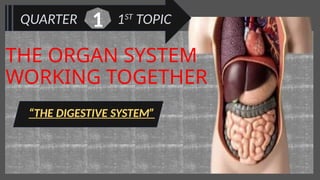
THE ORGAN SYSTEM
WORKING TOGETHER
“THE DIGESTIVE SYSTEM”
QUARTER 1ST
TOPIC
1
LEARNING OBJECTIVES
reinforce their knowledge of the different parts of the
digestive system.
understand how food travels through the digestive system
and what happens in each part.
Create a colored poster showing the digestive system and
how food moves through it.
1
2
3
At the end of this lesson, the students are able to;
ACTIVITY "Digestive System Puzzle"
1
Instructions:
1. In pairs, learners will receive an envelope with puzzle pieces
and organ function cards.
2. They will match each organ piece with the correct function
description.
3. Once matched, they will arrange the pieces in order, showing
the correct sequence of the digestive process.
4. After checking with the teacher, they will paste the puzzle on a
clean sheet of paper and label it.
5. Share one new thing they learned with the class.
ACTIVITY “Label Me Right!”
2
Instructions:
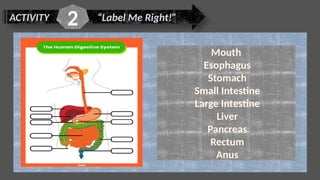
1.Give each learner a worksheet with an unlabeled diagram of the
human digestive system.
2.Provide a word bank at the bottom with organ names: Mouth,
Esophagus, Stomach, Small Intestine, Large Intestine, Liver,
Pancreas, Rectum, Anus.
3.Ask them to label each part by writing the correct organ name in
the blank spaces.
4.When done, they can color the organs for fun and better recall.
ACTIVITY “Label Me Right!”
2
Mouth
Esophagus
Stomach
Small Intestine
Large Intestine
Liver
Pancreas
Rectum
Anus
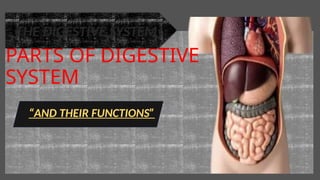
PARTS OF DIGESTIVE
SYSTEM
“AND THEIR FUNCTIONS”
THE DIGESTIVE SYSTEM
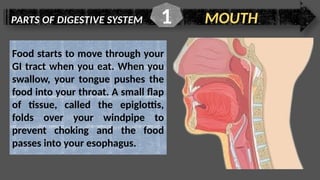
PARTS OF DIGESTIVE SYSTEM MOUTH
1
Food starts to move through your
GI tract when you eat. When you
swallow, your tongue pushes the
food into your throat. A small flap
of tissue, called the epiglottis,
folds over your windpipe to
prevent choking and the food
passes into your esophagus.
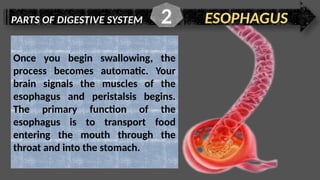
PARTS OF DIGESTIVE SYSTEM ESOPHAGUS
2
Once you begin swallowing, the
process becomes automatic. Your
brain signals the muscles of the
esophagus and peristalsis begins.
The primary function of the
esophagus is to transport food
entering the mouth through the
throat and into the stomach.
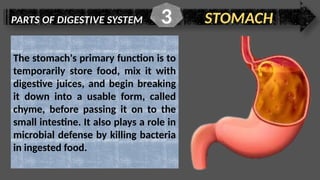
PARTS OF DIGESTIVE SYSTEM STOMACH
3
The stomach's primary function is to
temporarily store food, mix it with
digestive juices, and begin breaking
it down into a usable form, called
chyme, before passing it on to the
small intestine. It also plays a role in
microbial defense by killing bacteria
in ingested food.
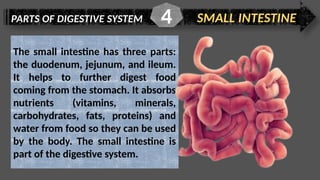
PARTS OF DIGESTIVE SYSTEM SMALL INTESTINE
4
The small intestine has three parts:
the duodenum, jejunum, and ileum.
It helps to further digest food
coming from the stomach. It absorbs
nutrients (vitamins, minerals,
carbohydrates, fats, proteins) and
water from food so they can be used
by the body. The small intestine is
part of the digestive system.
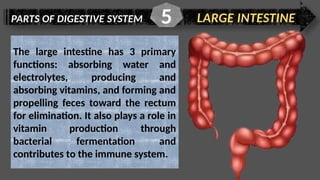
PARTS OF DIGESTIVE SYSTEM LARGE INTESTINE
5
The large intestine has 3 primary
functions: absorbing water and
electrolytes, producing and
absorbing vitamins, and forming and
propelling feces toward the rectum
for elimination. It also plays a role in
vitamin production through
bacterial fermentation and
contributes to the immune system.
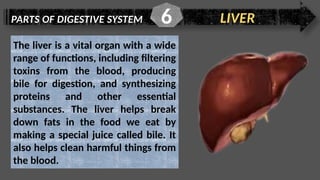
PARTS OF DIGESTIVE SYSTEM LIVER
6
The liver is a vital organ with a wide
range of functions, including filtering
toxins from the blood, producing
bile for digestion, and synthesizing
proteins and other essential
substances. The liver helps break
down fats in the food we eat by
making a special juice called bile. It
also helps clean harmful things from
the blood.
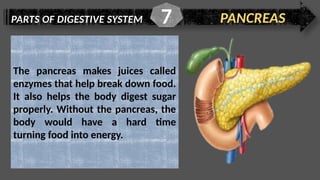
PARTS OF DIGESTIVE SYSTEM PANCREAS
7
The pancreas makes juices called
enzymes that help break down food.
It also helps the body digest sugar
properly. Without the pancreas, the
body would have a hard time
turning food into energy.
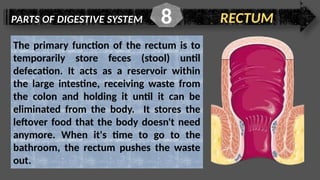
PARTS OF DIGESTIVE SYSTEM RECTUM
8
The primary function of the rectum is to
temporarily store feces (stool) until
defecation. It acts as a reservoir within
the large intestine, receiving waste from
the colon and holding it until it can be
eliminated from the body. It stores the
leftover food that the body doesn't need
anymore. When it's time to go to the
bathroom, the rectum pushes the waste
out.
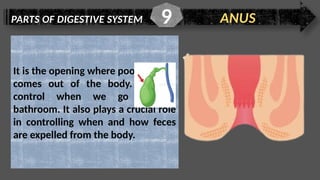
PARTS OF DIGESTIVE SYSTEM ANUS
9
It is the opening where poop (waste)
comes out of the body. It helps
control when we go to the
bathroom. It also plays a crucial role
in controlling when and how feces
are expelled from the body.
PARTS OF DIGESTIVE SYSTEM
Mouth – food is chewed.
Esophagus – food is pushed down to the stomach.
Stomach – food is mixed and broken down by acid.
Small Intestine – nutrients are absorbed.
Large Intestine – water is absorbed from the food.
Rectum – waste is stored.
Anus – waste leaves the body.
Liver – makes bile to help digest fats.
Gallbladder – stores bile from the liver.
Pancreas – makes enzymes to help digestion.
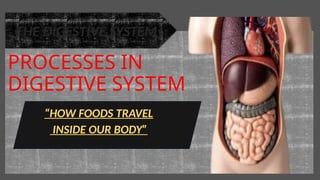
PROCESSES IN
DIGESTIVE SYSTEM
“HOW FOODS TRAVEL
INSIDE OUR BODY”
THE DIGESTIVE SYSTEM
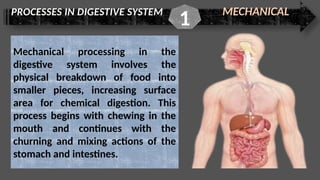
PROCESSES IN DIGESTIVE SYSTEM MECHANICAL
1
Mechanical processing in the
digestive system involves the
physical breakdown of food into
smaller pieces, increasing surface
area for chemical digestion. This
process begins with chewing in the
mouth and continues with the
churning and mixing actions of the
stomach and intestines.
PROCESSES IN DIGESTIVE SYSTEM SECRETION
2
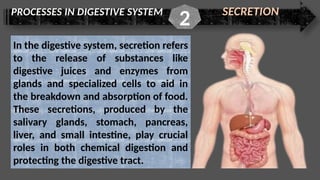
In the digestive system, secretion refers
to the release of substances like
digestive juices and enzymes from
glands and specialized cells to aid in
the breakdown and absorption of food.
These secretions, produced by the
salivary glands, stomach, pancreas,
liver, and small intestine, play crucial
roles in both chemical digestion and
protecting the digestive tract.
PROCESSES IN DIGESTIVE SYSTEM DIGESTION
3
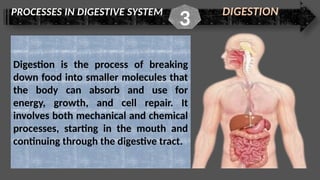
Digestion is the process of breaking
down food into smaller molecules that
the body can absorb and use for
energy, growth, and cell repair. It
involves both mechanical and chemical
processes, starting in the mouth and
continuing through the digestive tract.
PROCESSES IN DIGESTIVE SYSTEM ABSORPTION
4
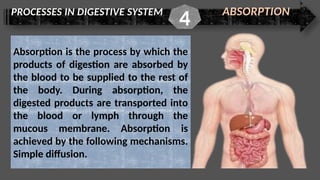
Absorption is the process by which the
products of digestion are absorbed by
the blood to be supplied to the rest of
the body. During absorption, the
digested products are transported into
the blood or lymph through the
mucous membrane. Absorption is
achieved by the following mechanisms.
Simple diffusion.
PROCESSES IN DIGESTIVE SYSTEM ELIMINATION
5
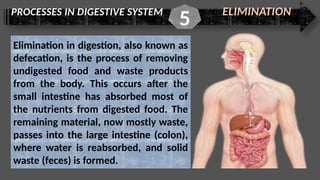
Elimination in digestion, also known as
defecation, is the process of removing
undigested food and waste products
from the body. This occurs after the
small intestine has absorbed most of
the nutrients from digested food. The
remaining material, now mostly waste,
passes into the large intestine (colon),
where water is reabsorbed, and solid
waste (feces) is formed.
ACTIVITY "My Food Journey Map"
3
Instructions:
1.Draw a simple map of the digestive system on paper.
2.Use arrows to show how food moves from one part to another
(from mouth to anus).
3.Write 1 short sentence beside each part to explain what
happens there.
1.Example: “Mouth – food is chewed.”
4.Use these keywords in your answers:
mechanical, secretion, digestion, absorption, elimination.
5.Color your map and give your food a name (example: "Banana
Boy").
ACTIVITY "My Food Journey Map"
3
GUIDE QUESTIONS
1. What happens to the food when it enters your mouth?
2. Which part of the digestive system breaks
down food using acid?
3. Where are nutrients absorbed into the body?
4. How does your body remove food that it no
longer needs?
ACTIVITY "My Food Journey Map"
3
📝 Sample Reflection Question:
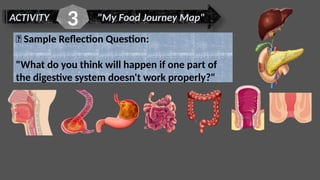
"What do you think will happen if one part of
the digestive system doesn't work properly?"
ACTIVITY "Digestive System Info-Poster"
4
Task: Create a colored poster showing the digestive system and
how food moves through it.
Your poster must include:
1. A labeled drawing of the digestive organs
2. Short descriptions of the digestive processes:
✅ Mechanical processing✅ Secretion✅ Digestion✅ Excretion
3. Use arrows or symbols to show the path of food
4. Use neat handwriting and proper spacing
ACTIVITY "Digestive System Info-Poster"
4
📌 Output Format:
1. Size: Short bond paper or 1/4 illustration board
2. Title: “How Our Body Digests Food”
3. May include drawings, symbols, or creative elements (e.g.
arrows, fun colors)
ACTIVITY "Digestive System Info-Poster"
4
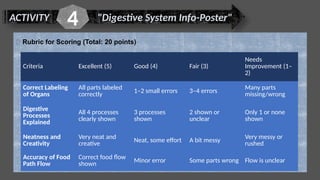
Criteria Excellent (5) Good (4) Fair (3)
Needs
Improvement (1–
2)
Correct Labeling
of Organs
All parts labeled
correctly 1–2 small errors 3–4 errors
Many parts
missing/wrong
Digestive
Processes
Explained
All 4 processes
clearly shown
3 processes
shown
2 shown or
unclear
Only 1 or none
shown
Neatness and
Creativity
Very neat and
creative Neat, some effort A bit messy
Very messy or
rushed
Accuracy of Food
Path Flow
Correct food flow
shown
Minor error Some parts wrong Flow is unclear
✅ Rubric for Scoring (Total: 20 points)
human ORGAN-SYSTEM-WORKING-TOGETHER.pptx

  • 1.
    THE ORGAN SYSTEM WORKINGTOGETHER “THE DIGESTIVE SYSTEM” QUARTER 1ST TOPIC 1
  • 2.
    LEARNING OBJECTIVES reinforce theirknowledge of the different parts of the digestive system. understand how food travels through the digestive system and what happens in each part. Create a colored poster showing the digestive system and how food moves through it. 1 2 3 At the end of this lesson, the students are able to;
  • 3.
    ACTIVITY "Digestive SystemPuzzle" 1 Instructions: 1. In pairs, learners will receive an envelope with puzzle pieces and organ function cards. 2. They will match each organ piece with the correct function description. 3. Once matched, they will arrange the pieces in order, showing the correct sequence of the digestive process. 4. After checking with the teacher, they will paste the puzzle on a clean sheet of paper and label it. 5. Share one new thing they learned with the class.
  • 4.
    ACTIVITY “Label MeRight!” 2 Instructions: 1.Give each learner a worksheet with an unlabeled diagram of the human digestive system. 2.Provide a word bank at the bottom with organ names: Mouth, Esophagus, Stomach, Small Intestine, Large Intestine, Liver, Pancreas, Rectum, Anus. 3.Ask them to label each part by writing the correct organ name in the blank spaces. 4.When done, they can color the organs for fun and better recall.
  • 5.
    ACTIVITY “Label MeRight!” 2 Mouth Esophagus Stomach Small Intestine Large Intestine Liver Pancreas Rectum Anus
  • 6.
    PARTS OF DIGESTIVE SYSTEM “ANDTHEIR FUNCTIONS” THE DIGESTIVE SYSTEM
  • 7.
    PARTS OF DIGESTIVESYSTEM MOUTH 1 Food starts to move through your GI tract when you eat. When you swallow, your tongue pushes the food into your throat. A small flap of tissue, called the epiglottis, folds over your windpipe to prevent choking and the food passes into your esophagus.
  • 8.
    PARTS OF DIGESTIVESYSTEM ESOPHAGUS 2 Once you begin swallowing, the process becomes automatic. Your brain signals the muscles of the esophagus and peristalsis begins. The primary function of the esophagus is to transport food entering the mouth through the throat and into the stomach.
  • 9.
    PARTS OF DIGESTIVESYSTEM STOMACH 3 The stomach's primary function is to temporarily store food, mix it with digestive juices, and begin breaking it down into a usable form, called chyme, before passing it on to the small intestine. It also plays a role in microbial defense by killing bacteria in ingested food.
  • 10.
    PARTS OF DIGESTIVESYSTEM SMALL INTESTINE 4 The small intestine has three parts: the duodenum, jejunum, and ileum. It helps to further digest food coming from the stomach. It absorbs nutrients (vitamins, minerals, carbohydrates, fats, proteins) and water from food so they can be used by the body. The small intestine is part of the digestive system.
  • 11.
    PARTS OF DIGESTIVESYSTEM LARGE INTESTINE 5 The large intestine has 3 primary functions: absorbing water and electrolytes, producing and absorbing vitamins, and forming and propelling feces toward the rectum for elimination. It also plays a role in vitamin production through bacterial fermentation and contributes to the immune system.
  • 12.
    PARTS OF DIGESTIVESYSTEM LIVER 6 The liver is a vital organ with a wide range of functions, including filtering toxins from the blood, producing bile for digestion, and synthesizing proteins and other essential substances. The liver helps break down fats in the food we eat by making a special juice called bile. It also helps clean harmful things from the blood.
  • 13.
    PARTS OF DIGESTIVESYSTEM PANCREAS 7 The pancreas makes juices called enzymes that help break down food. It also helps the body digest sugar properly. Without the pancreas, the body would have a hard time turning food into energy.
  • 14.
    PARTS OF DIGESTIVESYSTEM RECTUM 8 The primary function of the rectum is to temporarily store feces (stool) until defecation. It acts as a reservoir within the large intestine, receiving waste from the colon and holding it until it can be eliminated from the body. It stores the leftover food that the body doesn't need anymore. When it's time to go to the bathroom, the rectum pushes the waste out.
  • 15.
    PARTS OF DIGESTIVESYSTEM ANUS 9 It is the opening where poop (waste) comes out of the body. It helps control when we go to the bathroom. It also plays a crucial role in controlling when and how feces are expelled from the body.
  • 16.
    PARTS OF DIGESTIVESYSTEM Mouth – food is chewed. Esophagus – food is pushed down to the stomach. Stomach – food is mixed and broken down by acid. Small Intestine – nutrients are absorbed. Large Intestine – water is absorbed from the food. Rectum – waste is stored. Anus – waste leaves the body. Liver – makes bile to help digest fats. Gallbladder – stores bile from the liver. Pancreas – makes enzymes to help digestion.
  • 17.
    PROCESSES IN DIGESTIVE SYSTEM “HOWFOODS TRAVEL INSIDE OUR BODY” THE DIGESTIVE SYSTEM
  • 18.
    PROCESSES IN DIGESTIVESYSTEM MECHANICAL 1 Mechanical processing in the digestive system involves the physical breakdown of food into smaller pieces, increasing surface area for chemical digestion. This process begins with chewing in the mouth and continues with the churning and mixing actions of the stomach and intestines.
  • 19.
    PROCESSES IN DIGESTIVESYSTEM SECRETION 2 In the digestive system, secretion refers to the release of substances like digestive juices and enzymes from glands and specialized cells to aid in the breakdown and absorption of food. These secretions, produced by the salivary glands, stomach, pancreas, liver, and small intestine, play crucial roles in both chemical digestion and protecting the digestive tract.
  • 20.
    PROCESSES IN DIGESTIVESYSTEM DIGESTION 3 Digestion is the process of breaking down food into smaller molecules that the body can absorb and use for energy, growth, and cell repair. It involves both mechanical and chemical processes, starting in the mouth and continuing through the digestive tract.
  • 21.
    PROCESSES IN DIGESTIVESYSTEM ABSORPTION 4 Absorption is the process by which the products of digestion are absorbed by the blood to be supplied to the rest of the body. During absorption, the digested products are transported into the blood or lymph through the mucous membrane. Absorption is achieved by the following mechanisms. Simple diffusion.
  • 22.
    PROCESSES IN DIGESTIVESYSTEM ELIMINATION 5 Elimination in digestion, also known as defecation, is the process of removing undigested food and waste products from the body. This occurs after the small intestine has absorbed most of the nutrients from digested food. The remaining material, now mostly waste, passes into the large intestine (colon), where water is reabsorbed, and solid waste (feces) is formed.
  • 23.
    ACTIVITY "My FoodJourney Map" 3 Instructions: 1.Draw a simple map of the digestive system on paper. 2.Use arrows to show how food moves from one part to another (from mouth to anus). 3.Write 1 short sentence beside each part to explain what happens there. 1.Example: “Mouth – food is chewed.” 4.Use these keywords in your answers: mechanical, secretion, digestion, absorption, elimination. 5.Color your map and give your food a name (example: "Banana Boy").
  • 24.
    ACTIVITY "My FoodJourney Map" 3 GUIDE QUESTIONS 1. What happens to the food when it enters your mouth? 2. Which part of the digestive system breaks down food using acid? 3. Where are nutrients absorbed into the body? 4. How does your body remove food that it no longer needs?
  • 25.
    ACTIVITY "My FoodJourney Map" 3 📝 Sample Reflection Question: "What do you think will happen if one part of the digestive system doesn't work properly?"
  • 26.
    ACTIVITY "Digestive SystemInfo-Poster" 4 Task: Create a colored poster showing the digestive system and how food moves through it. Your poster must include: 1. A labeled drawing of the digestive organs 2. Short descriptions of the digestive processes: ✅ Mechanical processing✅ Secretion✅ Digestion✅ Excretion 3. Use arrows or symbols to show the path of food 4. Use neat handwriting and proper spacing
  • 27.
    ACTIVITY "Digestive SystemInfo-Poster" 4 📌 Output Format: 1. Size: Short bond paper or 1/4 illustration board 2. Title: “How Our Body Digests Food” 3. May include drawings, symbols, or creative elements (e.g. arrows, fun colors)
  • 28.
    ACTIVITY "Digestive SystemInfo-Poster" 4 Criteria Excellent (5) Good (4) Fair (3) Needs Improvement (1– 2) Correct Labeling of Organs All parts labeled correctly 1–2 small errors 3–4 errors Many parts missing/wrong Digestive Processes Explained All 4 processes clearly shown 3 processes shown 2 shown or unclear Only 1 or none shown Neatness and Creativity Very neat and creative Neat, some effort A bit messy Very messy or rushed Accuracy of Food Path Flow Correct food flow shown Minor error Some parts wrong Flow is unclear ✅ Rubric for Scoring (Total: 20 points)