MARCH 1995
$3.95
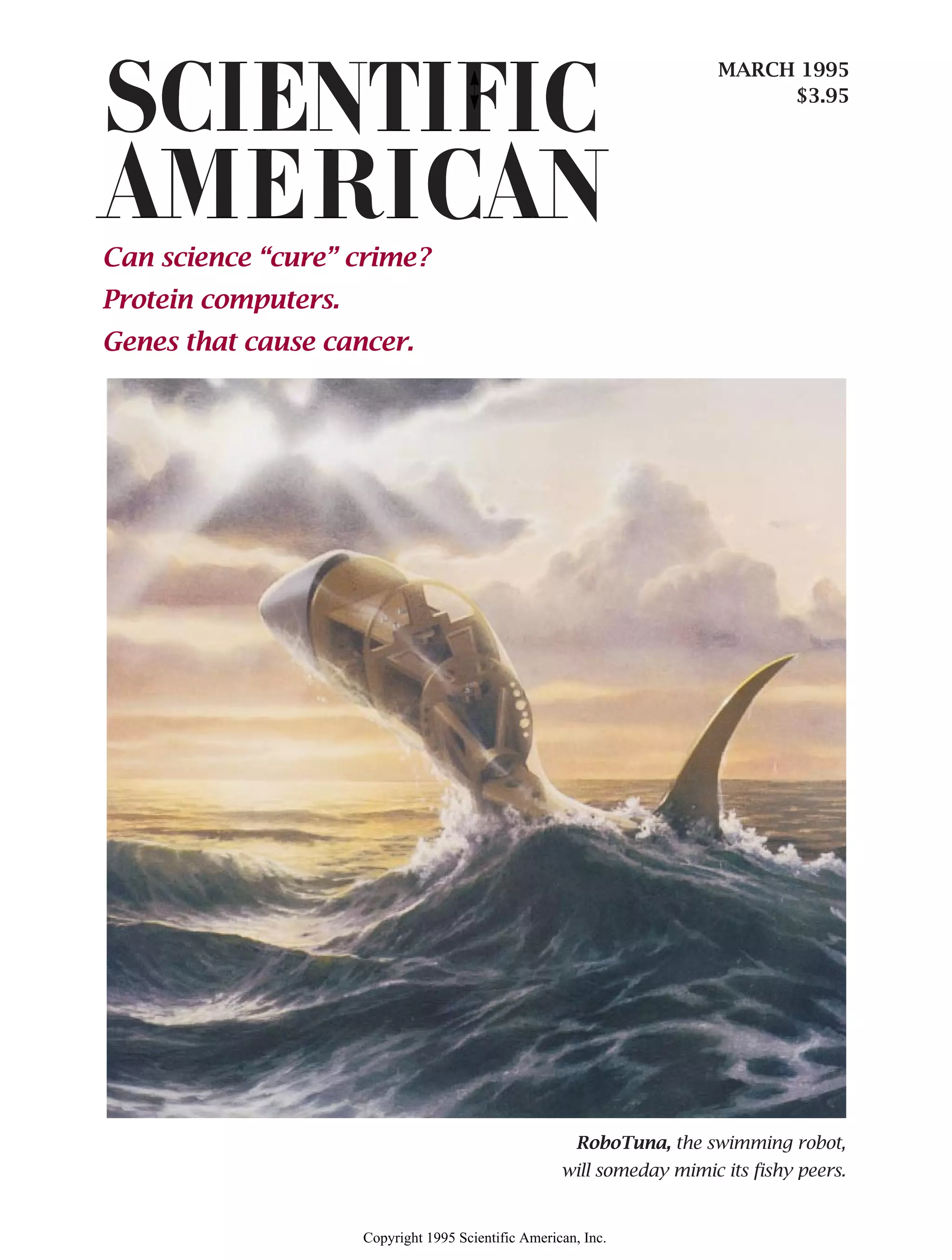
RoboTuna, the swimming robot,
will someday mimic its Þshy peers.
Can science ÒcureÓ crime?
Protein computers.
Genes that cause cancer.
Copyright 1995 Scientific American, Inc.
March 1995 Volume 272 Number 3
48
82
64
72
Faster Evaluation of Vital Drugs
David A. Kessler and Karyn L. Feiden
Bonobo Sex and Society
Frans B. M. de Waal
An EÛcient Swimming Machine
Michael S. Triantafyllou and George S. Triantafyllou
56 Laser Control of Chemical Reactions
Paul Brumer and Moshe Shapiro
The Genetic Basis of Cancer
Webster K. Cavenee and Raymond L. White
The AIDS crisis has driven home the necessity of making potentially therapeutic
drugs available quickly to the patient population. Yet even desperately needed
medicines must not be brought to market unless their demonstrated beneÞts out-
weigh their risks. The director of the Food and Drug Administration explains the
new review procedures that maintain a balance between these priorities.
None of the great apes is more human in appearance, intelligence and behavior
than the bonobo. Surprisingly, though, none also does more to upset conventional
views of how our evolutionary forebears acted. Bonobos live in a uniquely peaceful
society in which femalesÑnot the physically larger malesÑdominate the hierarchy,
and casual sex soothes all conßict.
Fish, dolphins and other marine creatures maneuver through the water with a
speed and eÛciency that put propeller-driven craft to shame. The secret of their
success is their exploitation of the swirling vortices that their own transit creates in
the surrounding water. Engineers, striving to match that Þnny feat, have developed
a mechanical model to test their ideas. Meet RoboTuna.
Normal cells do not turn malignant instantaneously. Instead they gradually fall vic-
tim to an accumulation of irreversible genetic accidents. Some of these mutations
spur growth or replication; others remove the molecular brakes that normally hold
these activities in check. The good news is that this multistep process oÝers many
opportunities for medical intervention.
Chemists have traditionally been hopeful matchmakers: they introduce reactant
molecules to one another under the best conditions possible, then wait for the
(sometimes disappointing) results. Lasers promise to change that. Using Þnely
tuned beams to create subtle quantum eÝects, chemists should be able to alter the
energies of individual molecules and raise the desired yields of bulk reactions.
4
90
96
100
Environmental Degradation in Ancient Greece
Curtis N. Runnels
50 and 100 Years Ago
1945: ÒCopper manÓ warms up.
1895: Argon is announced.
115
111
10
12
5
Letters to the Editors
Objections to origins....
Future of the brain.
Book Reviews: Philip Morrison
How much do we own?... Tricks
of the diamond-making trade.
Essay: Steven Shackley
A misguided law hurts Native
Americans and museums.
TRENDS IN BEHAVIORAL SCIENCE
Seeking the Criminal Element
W. Wayt Gibbs, staÝ writer
Protein-Based Computers
Robert R. Birge
Scientific American (ISSN 0036-8733), published monthly by Scientific American, Inc., 415 Madison Avenue, New York, N.Y. 10017-1111. Copyright © 1995 by Scientific American, Inc. All
rights reserved. No part of this issue may be reproduced by any mechanical, photographic or electronic process, or in the form of a phonographic recording, nor may it be stored in a retrieval
system, transmitted or otherwise copied for public or private use without written permission of the publisher. Second-class postage paid at New York, N.Y., and at additional mailing offices.
Canada Post International Publications Mail (Canadian Distribution) Sales Agreement No. 242764. Canadian GST No. R 127387652. Subscription rates: one year $36 (outside U.S. and possessions
add $11 per year for postage). Postmaster: Send address changes to Scientific American, Box 3187, Harlan, Iowa 51537. Reprints available: write Reprint Department, Scientific American, Inc., 415
Madison Avenue, New York, N.Y. 10017-1111; fax: (212) 355-0408 or send E-mail to SCAinquiry@aol.com. Subscription inquiries: U.S. and Canada (800) 333-1199; other (515) 247-7631.
Primitive bacteria and tomorrowÕs most advanced computers might have some-
thing in common: bacteriorhodopsin, a protein that changes shape in response to
light. Switches made from it could be ideal for three-dimensional optical systems
that would hold 300 times more information than todayÕs computer memories.
The 19th-century Romantics pined nostalgically for a bygone ÒGolden AgeÓ when
preindustrial society lived harmoniously with nature. Unfortunately, their Arcadian
Greek paradise seems to have been as mythical as the centaurs: archaeological and
geologic evidence shows that ancient Greek farmers seriously eroded their soil.
Frightened by high crime rates? A few biologists, psychologists and sociologists
think they are zeroing in on ÒmarkerÓ traits that might identify persons most at
risk of becoming violent criminals. If they are rightÑperhaps a big ifÑit might be
possible to prevent crime by looking for these markers and interceding. But devel-
oping a sane social policy from that information is perilous.
DEPARTMENTS
18 Science and the Citizen
Old nuclear waste, new nuclear
Þssion.... Gutting the Endangered
Species Act.... The embargo on nu-
trition in Cuba .... Beauty in junk
DNA.... Tom Stoppard puts science
center stage.... Flaky prediction.
The Analytical Economist
An Indian enigma.
Technology and Business
Biotech foods keep rolling outÑ
and the U.S. shrugs.... New fron-
tiers in telecommunications mar-
kets.... Low-tech routes to high-
tech imaging.
ProÞle
Fred Hoyle takes to the mainstream.
108 Mathematical Recreations
Mapping an escape from
a puzzling room.
DANLAMONTMatrix
6 SCIENTIFIC AMERICAN March 1995
THE COVER painting depicts an artistÕs con-
ception of a free-swimming robotic Þsh.
The forerunners of such devices are under
development at M.I.T., where they are help-
ing scientists understand how Þsh instinc-
tively exploit the principles of ßuid mechan-
ics to achieve enviable speed and agility.
One day robotic craft may use these same
principles as they explore the ocean, main-
tain oÝshore platforms and perform military
missions (see ÒAn EÛcient Swimming Ma-
chine,Ó by M. S. Triantafyllou and G. S. Trian-
tafyllou, page 64). Painting by Al Kamajian.
¨
Established 1845
EDITOR IN CHIEF: John Rennie
BOARD OF EDITORS: Michelle Press, Managing
Editor; Marguerite Holloway, News Editor; Ricki
L . Rusting, Associate Editor; Timothy M. Beards-
ley; W. Wayt Gibbs; John Horgan, Senior Writer;
Kristin Leutwyler; Philip Morrison, Book Editor;
Madhusree Mukerjee; Sasha Nemecek; Corey S.
Powell; David A. Schneider; Gary Stix ; Paul Wal-
lich; Philip M. Yam
ART: Edward Bell, Art Director; Jessie Nathans,
Associate Art Director; Johnny Johnson, Assistant
Art Director; Nisa Geller, Photography Editor;
Lisa Burnett, Production Editor
COPY: Maria-Christina Keller, Copy Chief; Nancy
L . Freireich; Molly K. Frances; Daniel C. Schlen-
oÝ; Bridget Gerety
CIRCULATION: Lorraine Leib Terlecki, Associate
Publisher/Circulation Director; Katherine Robold,
Circulation Manager; Joanne Guralnick, Circula-
tion Promotion Manager; Rosa Davis, FulÞllment
Manager
ADVERTISING: Kate Dobson, Associate Publish-
er/Advertising Director. OFFICES: NEW YORK:
Meryle Lowenthal, New York Advertising Man-
ager; Randy James, Rick Johnson, Elizabeth
Ryan, Timothy Whiting. CHICAGO: 333 N. Michi-
gan Ave., Suite 912, Chicago, IL 60601; Patrick
Bachler, Advertising Manager. DETROIT: 3000
Town Center, Suite 1435, SouthÞeld, MI 48075;
Edward A. Bartley, Detroit Manager. WEST
COAST: 1554 S. Sepulveda Blvd., Suite 212, Los
Angeles, CA 90025; Lisa K. Carden, Advertising
Manager; Tonia Wendt. 235 Montgomery St.,
Suite 724, San Francisco, CA 94104; Debra Sil-
ver. CANADA: Fenn Company, Inc. DALLAS:
GriÛth Group
MARKETING SERVICES: Laura Salant, Marketing
Director ; Diane Schube, Promotion Manager;
Susan Spirakis, Research Manager; Nancy Mon-
gelli, Assistant Marketing Manager
INTERNATIONAL: EUROPE: Roy Edwards, Inter-
national Advertising Manager, London; Vivienne
Davidson, Linda Kaufman, Intermedia Ltd., Par-
is; Karin OhÝ, Groupe Expansion, Frankfurt;
Barth David Schwartz, Director, Special Proj-
ects, Amsterdam. SEOUL: Biscom, Inc. TOKYO:
Nikkei International Ltd.; TAIPEI: Jennifer Wu,
JR International Ltd.
ADMINISTRATION: John J. Moeling, Jr., Publisher;
Marie M. Beaumonte, General Manager; Con-
stance Holmes, Manager, Advertising Account-
ing and Coordination
SCIENTIFIC AMERICAN, INC.
415 Madison Avenue
New York, NY 10017-1111
CHAIRMAN AND CHIEF EXECUTIVE OFFICER:
John J. Hanley
CO-CHAIRMAN: Dr. Pierre Gerckens
DIRECTOR, ELECTRONIC PUBLISHING: Martin Paul
CORPORATE OFFICERS: John J. Moeling, Jr.,
President; R. Vincent Barger, Chief Financial
OÛcer; Robert L. Biewen, Vice President
PRINTED IN U.S.A.
PRODUCTION: Richard Sasso, Associate Publish-
er/Vice President, Production; William Sherman,
Director, Production; Managers: Carol Albert,
Print Production; Janet Cermak, Makeup & Qual-
ity Control; Tanya DeSilva , Prepress; Silvia Di
Placido, Special Projects; Carol Hansen, Compo-
sition; Madelyn Keyes, Systems; Ad TraÛc: Carl
Cherebin; Carey S. Ballard; Kelly Ann Mercado
Copyright 1995 Scientific American, Inc.
Living in the Beginning
Leslie E. OrgelÕs article ÒThe Origin of
Life on the EarthÓ [SCIENTIFIC AMERI-
CAN, October 1994], along with virtual-
ly every other text on prebiotic chem-
istry, refers to Stanley MillerÕs WHAM
(water, hydrogen, ammonia and meth-
ane) experiment. In common with other
descriptions of Miller-type experiments,
OrgelÕs article makes no mention of the
fact that any amino acids are Ògeneral-
ly minor constituents of tarsÓ (accord-
ing to ÒThe First Organisms,Ó by A. G.
Cairns-Smith; SCIENTIFIC AMERICAN,
June 1985) and quite unusable as the
building blocks of a protein. Why do
hundreds of texts and articles fail to
refer to this damaging ßaw in the edi-
Þce that has been built on MillerÕs work?
C. W. STAMMERS
Bath, England
Orgel writes that Òbefore the mid-
17th century most people believed God
had created mankind.Ó I would add that,
at the present time, a considerable num-
ber still do. The probability of chance
formation and the further creation of
the multitude of biochemical products
necessary to sustain life is minuscule.
In Genesis and the Big Bang, Gerald L.
Schroeder states that to create a single
protein by chance, 10110 trials would
have had to be completed each second
since the start of time. Less than 1018
seconds have elapsed since the Òbig
bang.Ó These computations are a for-
midable barrier to accepting the chance
formation of life.
JOSEPH M. MILLER
Timonium, Md.
Orgel replies:
The criticism of Stanley MillerÕs exper-
iment made by Cairns-Smith and cited
above expresses an opinion that most
scientists would Þnd too extreme. I
agree that textbooks oversimplify. In
the future I hope they will make it clear
that cometary impacts, reduction of car-
bon dioxide and other mechanisms are
also possible sources of organics on
the primitive earth.
Whatever ScientiÞc American readers
believe about the creation of mankind,
I doubt that many believe in the spon-
taneous generation of frogs. Does Mr.
Miller? If not, why didnÕt he quote my
full sentence fairly (Ò...and that insects,
frogs and other small creatures could
arise spontaneously in mud or decaying
matter.Ó)? Regarding his second point,
very few scientists think functional pro-
teins (or frogs) could arise by chance in
a single step. Complex, adapted entities
arise from simpler ones by natural se-
lection. Molecular biologists have shown
unequivocally that ribozymes, compa-
rable in many ways to protein enzymes,
can be obtained at will in the laborato-
ry from completely random mixtures
of RNA through natural selection.
Out with the Bang?
In ÒThe Evolution of the Universe,Ó by
P. James E. Peebles, David N. Schramm,
Edwin L. Turner and Richard G. Kron
[SCIENTIFIC AMERICAN, October 1994],
the authors write: ÒAt present, there are
no fundamental challenges to the big
bang theory....Ó But on a regular basis
some reports do challenge the theoryÕs
fundamental underpinnings. The uni-
form expansion of the visible universe
is not so uniform: a great part of the
local universe reportedly is moving en
masse in a diÝerent direction than the
rest of the cosmos. The distribution of
galaxies is not close to homogeneous
on a three-dimensional map. Further-
more, does not the big bang theory rest
on the ad hoc theory of Òdark matterÓ?
I remain skeptical of any group of sci-
entists saying that their interpretation
of fact is unchallenged.
BILL BUTLER
Palm Desert, Calif.
I encountered a problem in ÒThe Evo-
lution of the Universe.Ó It takes a little
less than seven hours for light from the
sun to reach the outermost planet, Plu-
to. According to EinsteinÕs Special The-
ory of Relativity, nothing travels faster
than the speed of light. Yet the article
states that Òall the matter we can mea-
sure Þlled a region the size of the solar
system.... The universe [then grew] by
another factor of 1,000.... All of this
occurred within the Þrst minute of the
expansion.Ó What happened that al-
lowed matter and energy to travel thou-
sands of times faster than light?
JACK A. WILLIAMSON
Penetanguishene, Ontario
Peebles, Schramm, Turner
and Kron reply:
The recent reports of challenges to
the big bang theory really refer to at-
tempts to understand the history of the
cosmos within the context of this theo-
ry. Observations that galaxies cluster
and move together on very large scales,
for instance, present problems for cer-
tain theories of galaxy formation but
are good news for others. Some of these
theories do postulate exotic dark mat-
ter, but the reality of such matter is be-
ing tested in laboratory experiments.
The faster-than-light expansion of space
in the young universe does not violate
Special Relativity, which only says that
information cannot be transmitted fast-
er than light.
The current ßood of observational
and experimental results makes this an
exciting time for cosmology; as in the
past, we will no doubt need to reÞne or
even to revise our theories as the data
improve. Still, the basic picture of the
big bang has proved remarkably robust
when confronted with new puzzles.
Making Better Minds
In ÒWill Robots Inherit the Earth?Ó
[SCIENTIFIC AMERICAN, October 1994],
Marvin Minsky tells us that Òas a spe-
cies, we seem to have reached a plateau
in our intellectual development.Ó The
brainÕs limited capacity as a storehouse
is, however, a red herring. Progress in
knowledge depends on the availability
of information, not on its place of stor-
age, and information is more widely
available when it lies in public networks
than when it lies inside a human skull.
There is a lesson here: the pursuit of
knowledge is a social enterprise. Should
we turn ourselves into turbocharged
machines? My comments point to a dif-
ferent strategyÑthat we develop better
ways of connecting people, as they are,
to one another.
MARC MOREAU
Philadelphia, Pa.
Letters selected for publication may
be edited for length and clarity. Unso-
licited manuscripts and correspondence
will not be returned or acknowledged
unless accompanied by a stamped, self-
addressed envelope.
10 SCIENTIFIC AMERICAN March 1995
LETTERS TO THE EDITORS
Copyright 1995 Scientific American, Inc.
12 SCIENTIFIC AMERICAN March 1995
MARCH 1945
Better loaves in less time is the claim
advanced for a novel bread-baking
machine that uses infra-red rays instead
of oven heat. Since the infra-red rays
are more penetrating than ordinary
heat from ovens, baking begins in the
heart of the loaf practically as quickly
as it does on the surface, and the cook-
ing proceeds more evenly throughout.
Smoother crust is another advantageous
feature of the process.Ó
ÒThe technology for exploring the up-
per atmosphere has been advanced
considerably by the use of a device
known as ÔThe Weather Broadcaster.Õ
The Weather Broadcaster contains three
weather ÔfeelersÕ that are sensitive to
changes in temperature, humidity, and
pressure. A simple alarm clock mecha-
nism keeps a recording helix continu-
ously revolving, and a radio transmit-
ting device sends signals to a recorder
on the ground. The whole instrument
is carried aloft by a Þve-foot latex bal-
loon to an average limit of ascension of
between 50,000 and 60,000 feet.Ó
ÒEveryone knows that a big building
boom is due just over the horizon. Is
John Q. Public going to be satisÞed with
a domicile that looks just like his neigh-
borsÕ, for as far as the eye can see? It is
hardly necessary here to record the
negative answer.Ó
Ò ÔTransatlantic rockets are unlikely in
this war, but rocket planes making
ßights from London to Paris will mate-
rialize in the not too distant future,Õ ac-
cording to Alfred Africano, former Pres-
ident of the American Rocket Society.
ÔWhile military applications of jet pro-
pulsion engines are now possible, the
subject is still in its infancy as far as
commercial applications of the tech-
nology are concerned.Õ Ó
ÒA life-size Ôcopper manÕ which repro-
duces the temperature response of the
human circulatory system has been de-
veloped as a test machine for electrical-
ly warmed ßying suits and other similar
equipment. The copper man provides
the perfect scientiÞc answer to the
problem of testing electrically warmed
ßying suits, gloves, shoes, and blankets
at low temperatures without inßicting
suÝering and danger on human beings.Ó
MARCH 1895
Lord Rayleigh startled the world by
announcing the discovery of a new
constituent of the atmosphere. The new
gas is called ÔargonÕ; and, so far as is at
present known, it stands entirely unre-
lated to any other chemical substance
in nature.Ó
ÒIt is a well known fact in chemistry
that red phosphorusÑone of the con-
stituents of the safety match box rub-
berÑcombines with explosive violence
with chlorate of potash; but the possi-
bility of such a reaction taking place in
a personÕs pocket has not been fore-
seen. However, several papers recently
reported that the simultaneous occur-
rence of a safety match box and chlo-
rate of potash lozenges in the same
pocket led to a series of small-scale ex-
plosions, setting Þre to the clothes of
the unfortunate wearer and severely
burning his legs.Ó
ÒM. De Chateaubourg describes a new
treatment of whooping cough, which
consists in injecting, subcutaneously,
two cubic centimeters and a half of a
ten per cent solution of guaiacol and
eucalyptol in sterilized oil. After the
third injection, the Þts of coughing di-
minish noticeably, the appetite returns,
and, as the vomiting rapidly ceases and
the general condition begins to feel the
good eÝects of the treatment, the
whooping cough disappears. The au-
thor reported Þve cases.Ó
ÒM. Dieulafoy, who with his wife ex-
plored the ruins of Susa, has been
elected to the French Academie des In-
scriptions. Mme. Dieulafoy not only re-
ceived the Legion of Honor for her
share in the work, but also the right to
wear menÕs clothes in public.Ó
ÒAmong the extraordinary passions for
eating uncommon things must be reck-
oned that which some peoples exhibit
for eating earth or clay. This practice
appears to have once prevailed all over
the world. In some places, the custom
has degenerated into a ceremonial one,
while in others the eating of this
strange food still prevails as a kind of
necessity to the lives of those who are
addicted to it.Ó
ÒIn our illustration of the TeachersÕ
College of New York City, it will be no-
ticed that the chemical laboratory is oc-
cupied by children and grown people.
The boys as well as girls are the stu-
dents of the Horace Mann School, do-
ing practical work in chemistry, while
interspersed among them, either as-
sisting, teaching or observing, are seen
the adult students of the TeachersÕ Col-
lege. At the College, students are not
simply taught chemistry or physics,
but study the most advanced methods
of teaching these sciences in the school
room and laboratory.Ó
50 AND 100 YEARS AGO
Chemical laboratory at TeachersÕ College
Copyright 1995 Scientific American, Inc.
18 SCIENTIFIC AMERICAN March 1995
L
ast December, Federal District Judge
William L. Dwyer gave a legal
thumbs-up to the Clinton admin-
istrationÕs compromise plan for logging
and conservation in federally owned
forests of the Northwest. The program
allows logging operationsÑwhich the
judge halted in 1991Ñto recommence
at reduced rates. It also establishes a
mosaic of six diÝerent forms of logging-
controlled areas. The strategy aims to
guard not only species listed as threat-
ened under the Endangered Species Act,
such as the northern spotted owl and
the marbled murrelet, but hundreds of
other life-forms.
The verdict marked a crucial turning
point in the protracted, bitter struggle
between environmentalists and timber
interests. Yet, in all probability, it will
not be the last word. Biologists, who
generally accept the agreement as a
step in the right direction, dis-
agree over how much it protects
imperiled species. In addition,
the plan relies on federal agen-
cies to monitor habitatsÑsome-
thing critics say government has
failed to do.
Moreover, Congress may re-
write the very laws underlying
the plan. Representative Don
Young of Alaska, chairman of
the Resources Committee in the
House (known until this year as
the Natural Resources Commit-
tee), has declared his immedi-
ate intention to rework the En-
dangered Species Act. Young,
who has considerable inßuence,
openly disdains eÝorts to pro-
tect rare plants and animals.
He denies there is good evi-
dence that the spotted owl is
threatened, a view shared by
the timber industry. David S.
Wilcove of the Environmental
Defense Fund, who argues that
the owl in question has been
better studied than almost any
U.S. bird, says YoungÕs position
represents Òa degree of denial
worthy of inclusion in a psy-
chology textbook.Ó
Young further maintains that
the act should compensate property
owners who refrain from development
because of its provisions. To many en-
vironmentalists, the cost of such a
change would make the act untenable.
Congressional and legal assaults on
the act could aÝect the outcome of any
future challenges to the way in which
the forestry plan is implemented. And,
according to scientists, there are many
ways its enactment could be less than
perfect. E. Charles Meslow of the Wild-
life Management Institute in Washing-
ton, D.C., contends the Òagencies have
never been able to accomplish the mon-
itoring thatÕs been speciÞed.Ó
Meslow says he can now see ßaws in
the plan that he helped to design. The
scientiÞc groups involved drew up 10
diÝerent options, each allowing various
amounts of logging. Today Meslow be-
lieves that from the outset the adminis-
tration had an unstated goal for the
amount of timber to be harvested. ÒIf
weÕd known that, we would have spent
our time more wisely,Ó Meslow explains.
The compromise breaks new ground
by employing Òecosystem management.Ó
Rather than catering to every species
that might cause concern, the approach
focuses on preserving entire habitats.
The pragmatic philosophy acknowledg-
es the paucity of hard data on most af-
fected creatures. ÒMy opinion has al-
ways been that if we persisted in a spe-
cies-by-species approach, society was
not going to have enough patience,Ó
says Jerry F. Franklin, a professor at
the University of Washington and a key
player in the drafting of the plan.
Franklin points out that the view of
many biologists that the spotted owl is
in accelerated decline Òis not complete-
ly accepted.Ó He thinks environmental-
ists should be content to have achieved
most of their objectives. ÒTaking ex-
treme positions on the amount of pro-
tection needed is a pretty dangerous
thing to do,Ó he states. ÒA num-
ber of environmental scientists
have not got the message yet.Ó
The critics remain uncon-
vinced. The plan estimates, for
example, that the spotted owl
and the marbled murrelet have
more than a 80 percent chance
of keeping a Òwell-distributedÓ
population over the next 100
years. But Daniel Doak, a math-
ematical modeler at the Univer-
sity of California at Santa Cruz,
disagrees. ÒThere is a real ques-
tion about whether there will be
any owls left in the wild in 100
yearsÕ time to enjoy the nice
landscape weÕre making for
them,Ó Doak declares.
Christopher A. Frissell, an
aquatic ecologist at the Univer-
sity of Montana, complains that
the Forest Service deliberately
decided not to scrutinize Þsh
data. According to Frissell, Þnd-
ings indicate that several spe-
cies may have less than a 50
percent chance of surviving un-
der the agreement.
ÒThere should be better con-
sideration of species and
stocks,Ó concurs James R. Karr,
director of the Institute for En-
SCIENCE AND THE CITIZEN
Endangered: One Endangered Species Act
Cutting resumes in the forestÑand on the Hill
NORTHERN SPOTTED OWLÕS habitat is protected un-
der the forestry plan, but its survival is not assured.
JOEMCDONALDAnimalsAnimals
Copyright 1995 Scientific American, Inc.
I
n some circles science and art are
known as Òthe two cultures,Ó seem-
ingly separated by an impenetrable
wall. Members from each side of the di-
vide gathered recently for a roundtable
discussion at the Mitzi E. Newhouse
Theater at Lincoln Center in New York
City to talk about how the two disci-
plines can enrich each otherÑparticu-
larly as science and technology increas-
ingly aÝect peopleÕs lives.
The discussion was catalyzed by the
appearance at Lincoln Center of two
plays by Tom Stoppard. Both Hapgood,
now Þnishing its run, and Arcadia,
which opens this month at the Vivian
Beaumont Theater, draw on images and
ideas from physics and mathematics. In
Hapgood the title character is a British
intelligence oÛcer who protects scien-
tiÞc secrets during the cold war; anoth-
er character, a Soviet scientist and dou-
ble agent, employs models from phys-
ics as metaphors for human experience.
Arcadia deals with related concepts: in
a recent essay, Stoppard described the
piece as Òa seasoning of chaos and a
pinch of thermodynamics following a
dash of quantum mechanics.Ó
The panelists opened their discussion
by noting that scientists and artists ben-
eÞt from models and metaphors. Biolo-
gists image proteins, chemists use balls
and sticks to show molecules, and phys-
icists describe the atom with quantum-
mechanical representation. Writers take
advantage of metaphors to deepen
meaning. ÒI think artists [and scientists]
use models in very similar kinds of
ways,Ó remarked poet-naturalist Diane
Ackerman. Both hope the representa-
tions will let them Òsee some aspect of
the human condition that fascinates
them from yet another vantage point.Ó
She compared the poem ÒThirteen Ways
of Looking at a Blackbird,Ó by Wallace
Stevens, to its scientiÞc counterpart on
video, which another speaker dubbed
20 SCIENTIFIC AMERICAN March 1995
vironmental Studies at the University
of Washington. The focus on habitats,
he believes, means that threats to some
species, particularly salmonid Þsh, have
been overlooked because they occur
outside the geographic scope of the
compromise. The plan recognizes that
hundreds of less well known terrestrial
and aquatic species in the region may
not survive the changes.
Despite the doubts, conservationists
seemed ready in January to accept Dwy-
erÕs ruling. ÒItÕs a reasonable plan, and I
want to be supportive,Ó says Wilcove of
the Environmental Defense Fund. But,
among all the swirling uncertainties,
one thing is sure: the legal and scien-
tiÞc scrutiny of wildlife and the govern-
mentÕs actions in the PaciÞc Northwest
is far from over. ÑTim Beardsley
MOLECULAR MODEL of buckminsterfullerene utilizes artistic techniques to display
the symmetry elements of the molecule, named after the famous architect.
Science and Art on Stage
Poets and physicists grapple with models and metaphors
BIOSYMTECHNOLOGIES,INC.
Copyright 1995 Scientific American, Inc.
Ò36 Ways of Looking at One Enzyme.Ó
But perhaps scientists and artists ma-
nipulate these tools for diÝerent ends,
countered John Hollander, a poet from
Yale University. ÒModels are built in or-
der that they may be discarded when
there are new data. Metaphors never
get discarded,Ó he stated.
Indeed, chemist and poet Roald HoÝ-
mann of Cornell UniversityÑwho rep-
resents a convergence of science and
artÑmaintained that diÝerences of lan-
guage exist between the two worlds.
One of those Òis the positive valuation
of ambiguity in art. A word may have
two meanings that conßict with each
other; it may mean the same and the op-
posite of itself. ThatÕs what makes po-
etry work, in part,Ó HoÝmann explained.
ÒIn science we try, but we donÕt really
succeed, to clean up the language and to
get the concepts straight between us.Ó
Nevertheless, scientiÞc duality persists:
a character in Hapgood draws on the
theory of lightÕs being both waves and
particles to justify how he can work as a
spy for both the British and the Soviets.
Ackerman said she believes artists
like Òthe pure fun of using metaphors
and structures from science.Ó She gave
the example of Paul WestÕs novel Gala,
in which every paragraph begins with a
letter of the genetic code: ÒFor him, it
was a form of organization and play. I
think writers do that very often.Ó
Although the application of scientiÞc
metaphor is obviously not limited to
writing, some of the speakers cited ex-
amples from their favorite texts. Physi-
cist Melissa Franklin of Harvard Univer-
sity mentioned Thomas PynchonÕs book
V, in which he describes the electronic
circuitry of a stereo system. According
to Franklin, Pynchon Òunderstands it all
perfectly, from the shuddering of the
speakers to the music going into his
[characterÕs] head.Ó Furthermore, Frank-
lin noted that Pynchon Òdescribes it as
if heÕs describing a sunset. It is just one
of the most beautiful things IÕve seen.Ó
The panelists concluded that people
tend to feel intimidated by science but
that artistic treatments might help con-
vince them that science is interesting
and accessible. At the close of the dis-
cussion, HoÝmann answered a question
about how art and science can become
more integrated into daily life. ÒI think
we must get away from that ÔhighÕ
thing,Ó he responded. ÒI think it is im-
portant not to deÞne theater as high
theater. I think Bob Dylan writes poetry.
And a lot of simple, everyday experienc-
es are examples of physics, like cooking
or watching a tire deßate,Ó he said. ÒI
think we can bring that to young people.
I think to do that would be to accom-
plish a great thing.Ó ÑSasha Nemecek
SCIENTIFIC AMERICAN March 1995 21
T
he discovery of new elements can
be cause for celebration, but late-
ly it has become cause for argu-
ment. Researchers at the Center for
Heavy Ion Research in Darmstadt, Ger-
many, announced last November that
they had created element 110. Then, in
December, they presented 111. Choos-
ing the right name for the new sub-
stances may prove more challenging
than making them.
The Þndings come right on the heels
of an intense Þght over what to dub 101
through 109. Although the elements
themselves do not endureÑfor instance,
110 lives for about two thousandths of
a secondÑsome of the researchers who
made them would like to. The discover-
ers of 106 provisionally named it sea-
borgium, after Glenn T. Seaborg, a lead-
ing U.S. researcher. But the International
Union of Pure and Applied Chemistry
will vote this August on whether the
name should be rutherfordium instead,
claiming that an element should not be
named after a living person. (British
physicist Ernest Rutherford died in
1937.) Not only does this plan upset the
parents of element 106, it makes nam-
ing other heavy elements more diÛ-
cult: number 104 was previously known
as rutherfordium, except by some Rus-
sian scientists who referred to it as
kurchatovium. Now the recommended
name is dubnium.
As for elements 110 and 111, they will
have to wait their turn. Albert Ghiorso
of Lawrence Berkeley Laboratory men-
tions a rumor he heard that the Darm-
stadt group might hold element 111
hostage until the other names are set-
tled. And Seaborg has Òno ideaÓ what ele-
ment 110 might be christened: ÒThereÕs
tremendous confusion right now.Ó
Irrespective of the naming game, sci-
entists continue to make these short-
lived compounds to verify theoretical
calculations and to satisfy basic curios-
ity. ÒYou never know what will happen
along the way,Ó Ghiorso says. The just
created elements promise to gratify re-
searchers by demonstrating Òthat super-
heavy elements are within our grasp,Ó
he adds. Investigators are now aiming
for element 114, which calculations sug-
gest will be particularly stable. But 112
will probably be very diÛcult to makeÑ
as well as to name. ÑSasha Nemecek
Not Yet Elemental, My Dear Seaborg
The periodic table gains 110 and 111Ñbut no names
Copyright 1995 Scientific American, Inc.
W
hatÕs in a word? Several nucleo-
tides, some researchers might
say. By applying statistical
methods developed by linguists, inves-
tigators have found that ÒjunkÓ parts of
the genomes of many organisms may be
expressing a language. These regions
have traditionally been regarded as use-
less accumulations of material from mil-
lions of years of evolution. ÒThe feeling
is,Ó says Boston University physicist H.
Eugene Stanley, Òthat thereÕs something
going on in the noncoding region.Ó
Junk DNA got its name because the
nucleotides there (the fundamental
pieces of DNA, combined into so-called
base pairs) do not encode instructions
for making proteins, the basis for life.
In fact, the vast majority of genetic ma-
terial in organisms from bacteria to
mammals consists of noncoding DNA
segments, which are interspersed with
the coding parts. In humans, about 97
percent of the genome is junk.
Over the past 10 years biologists be-
gan to suspect that this feature is not
entirely trivial. ÒItÕs unlikely that every
base pair in noncoding DNA is critical,
but it is also foolish to say that all of it
is junk,Ó notes Robert Tjian, a biochem-
ist at the University of California at
Berkeley. For instance, studies have
found that mutations in certain parts of
the noncoding regions lead to cancer.
Physicists backed the suspicions a
few years ago, when those studying
fractals noticed certain patterns in junk
DNA. They found that noncoding se-
quences display what are termed long-
range correlations. That is, the position
of a nucleotide depends to some extent
on the placement of other nucleotides.
Their patterns follow
a fractallike property
called 1/f noise,
which is inherent in
many physical sys-
tems that evolve over
time, such as elec-
tronic circuits, period-
icity of earthquakes
and even traÛc pat-
terns. In the genome,
however, the long-
range correlations
held only for the non-
coding sequences; the
coding parts exhibit-
ed an uncorrelated
pattern.
Those signs sug-
gested that junk DNA
might contain some
kind of organized in-
formation. To deci-
pher the message,
Stanley and his col-
leagues Rosario N.
Mantegna, Sergey V.
Buldyrev and Shlomo
Havlin collaborated
with Ary L. Goldber-
ger, Chung-Kang Peng
and Michael Simons
of Harvard Medical
School. They borrowed from the work
of linguist George K. Zipf, who, by look-
ing at texts from several languages,
ranked the frequency with which words
occur. Plotting the rank of words against
those in a text produces a distinct rela-
tion. The most common word (ÒtheÓ in
English) occurs 10 times more often
than the 10th most common word, 100
times more often than the 100th most
common, and so forth.
The researchers tested the relation
on 40 DNA sequences of species rang-
ing from viruses to humans. They then
grouped pairs of nucleotides to create
words between three and eight base
pairs long (it takes three pairs to speci-
fy an amino acid). In every case, they
found that noncoding regions followed
the Zipf relation more closely than did
coding regions, suggesting that junk
DNA follows the structure of languages.
ÒWe didnÕt expect the coding DNA to
obey Zipf,Ó Stanley notes. ÒA code is lit-
eralÑone if by land, two if by sea. You
canÕt have any mistakes in a code.Ó Lan-
guage, in contrast, is a statistical, struc-
tured system with built-in redundan-
cies. A few mumbled words or scattered
typos usually do not render a sentence
incomprehensible. In fact, the workers
tested this notion of repetition by ap-
plying a second analysis, this time from
information theorist Claude E. Shannon,
who in the 1950s quantiÞed redundan-
cies in languages. They found that junk
DNA contains three to four times the
redundancies of coding segments.
Because of the statistical nature of the
results, the researchers admit their Þnd-
ings are unlikely to help biologists iden-
tify functional aspects of junk DNA.
Rather the work may indicate some-
thing about eÛcient information stor-
age. ÒThere has to be some sort of hier-
archical arrangement of the information
to allow one to use it in an eÛcient
fashion and to have some adaptability
and ßexibility,Ó Goldberger observes.
Another speculation is that junk se-
quences may be essential to the way
DNA has to fold to Þt into a nucleus.
Some researchers question whether
the group has found anything signiÞ-
cant. One of those is Benoit B. Mandel-
brot of Yale University. In the 1950s the
mathematician pointed out that ZipfÕs
law is a statistical numbers game that
has little to do with recognizable lan-
guage features, such as semantics. More-
over, he claims the group made several
errors. ÒTheir evidence does not estab-
lish ZipfÕs law even remotely,Ó he says.
But such criticisms are not stopping
the Boston workers from trying to deci-
pher junk DNAÕs tongue. ÒIt could be a
dead language,Ó Stanley says, Òbut the
search will be exciting.Ó ÑPhilip Yam
24 SCIENTIFIC AMERICAN March 1995
Talking Trash
Linguistic patterns show up in junk DNA
ÒWORDÓ USE in yeast DNA, represented with spectral colors, changes in a regular
way in noncoding segments (top) but not in coding parts (bottom).
H.EUGENESTANLEYBostonUniversity
MICHAELCRAWFORD
Copyright 1995 Scientific American, Inc.
G
etting rid of the long-lived, ra-
dioactive by-products of nucle-
ar power is a problem that has
stalked the industry for its 40-year his-
toryÑand the pressure will intensify
this year. No nation has established a
permanent disposal site for its most
dangerous products: used reactor fuel
and the high-level waste created when
it is reprocessed. Attempts to locate
such sites have ignited public outcry in
several countries. And next month is
likely to see controversy over another
nuclear by-product, plutonium.
What promises to be a stormy con-
ference will decide whether, or for how
long, to extend the Nuclear Non-Prolif-
eration Treaty, which aims to prevent
the spread of nuclear weapons. Global
trade in plutonium, which is extracted
from used fuel during reprocessing,
makes it harder to enforce the treaty,
reports the Nuclear Control Institute in
Washington, D.C. Reprocessing whets
appetites for plutonium in countries
lacking nuclear weapons. It also increas-
es the chances that a few kilograms of
the metal, enough for a crude nuclear
bomb, will Þnd their way into the hands
of terrorists.
Putting aside issues of safety, the Nu-
clear Control Institute argues that re-
processing spent fuel makes little eco-
nomic sense. The fundamental prob-
lem for countries that reprocess is that
plutonium is accumulating faster than
it is being used. Nuclear power has not
expanded as the industry expected it
would, and the price of uranium, the
primary nuclear fuel, is at a historic low.
Thus, there is little industrial demand
for plutonium, which can be used in
some reactors as a supplemental fuel.
International commercial reprocess-
ing means that high-level waste and
spent fuel have to be shipped around
the globe. France is steeling itself for
protests when the state-owned repro-
cessing company COGEMA ships the
Þrst in a likely series of cargoes of high-
level waste from its plant in La Hague
to Japan. The material, produced during
the reprocessing of Japanese fuel, has
been solidiÞed into glass blocks. The
Þrst shipment was scheduled for Febru-
ary. The obvious route runs through the
Panama Canal, but Caribbean nations
have objected to having the waste enter
their waters. The Philippines, which lies
on an alternative route, has also banned
the cargo.
The French government seems to
have little stomach for a Þght. ÒIt will
in the future be very diÛcult to repro-
cess for other people,Ó comments Dan-
iel Leroy of the French Embassy in Wash-
ington, D.C. He predicts that more coun-
tries will begin to reprocess their own
waste. Indeed, Japan, which has the
largest nuclear program in the world
after the U.S., the U.K. and France, is
building a second reprocessing plant.
A drive toward nuclear self-suÛcien-
cy could be bad news for companies
such as COGEMA and for British Nucle-
ar Fuels Limited (BNFL), which also re-
processes foreign fuel. BNFL is commis-
sioning a new plant at its site in Sella-
Þeld, despite doubts that have been
raised about its health eÝects on the lo-
cal population and its economic viabili-
ty. The Þnancial worries were under-
scored last December when two German
utilities said they would break contracts
with BNFL and pay the penalties.
Russia may also be competing for
COGEMAÕs and BNFLÕs business. The
country is expanding reprocessing op-
erations as a means of earning foreign
capital. A plant at Krasnoyarsk in Siber-
ia, which has languished unÞnished for
several years, will apparently be com-
pleted, according to Russian press re-
ports. South Korea is among the nations
that might reprocess spent fuel there.
Opposition by environmentalists is
mounting, however. Russia allowed high-
level waste from reprocessed Finnish
fuel to remain in the countryÑtaking the
problem out of Finnish hands. Damon
Moglen of Greenpeace International
states that the Czech Republic wants to
establish a similar arrangement. Rus-
siaÕs preferred method of disposal has
been to pump high-level waste in liquid
form into the groundÑbut it has al-
ready started to leach out.
Although the U.S. refrains from re-
processing, utilities have encountered
legal problems over accumulating spent
fuel. Most of it is in ÒpoolsÓ where it is
allowed to cool for some years. Some of
these are now full, and local jurisdic-
tions are objecting to the huge casks
that the utilities want to use for ongoing
storage. The Department of Energy re-
mains under congressional mandate to
decide by the year 2001 whether Yucca
Mountain in Nevada is suitable as a lo-
cation for a permanent repository. If
certiÞed, the site could commence op-
erations around 2010.
Prospects for the facility, however,
have had a recent setback. The DOE
found water containing tritium from
aboveground atomic testsÑwhich there-
fore must be younger than 50 yearsÑ
less than half a mile from the suggest-
28 SCIENTIFIC AMERICAN March 1995
Pass the Plutonium, Please
International nuclear worries warm up
CORRESPONDENCE
Reprints are available; to order, write
Reprint Department, ScientiÞc Ameri-
can, 415 Madison Avenue, New York,
NY 10017-1111, or fax inquiries to
(212) 355-0408.
Back issues: $6 each ($7 outside U.S.)
prepaid. Most numbers available. Cred-
it card (Mastercard/ Visa) orders for
two or more issues accepted. To or-
der, fax (212) 355-0408.
Index of articles since 1948 available
in electronic format. Write SciDex ®,
ScientiÞc American, 415 Madison Ave-
nue, New York, NY 10017-1111, fax
(212) 980-8175 or call (800) 777-0444.
ScientiÞc American-branded products
available. For free catalogue, write Sci-
entiÞc American Selections, P.O. Box
11314, Des Moines, IA 50340-1314, or
call (800) 777-0444.
Photocopying rights are hereby grant-
ed by ScientiÞc American, Inc., to li-
braries and others registered with the
Copyright Clearance Center (CCC) to
photocopy articles in this issue of Sci-
entiÞc American for the fee of $3.00
per copy of each article plus $0.50 per
page. Such clearance does not extend
to the photocopying of articles for pro-
motion or other commercial purposes.
Correspondence and payment should
be addressed to Copyright Clearance
Center, Inc., 222 Rosewood Drive, Dan-
vers, MA 01923. Specify CCC Ref-
erence Number ISSN 0036-8733/95.
$3.00 + 0.50.
Editorial correspondence should be
addressed to The Editors, ScientiÞc
American, 415 Madison Avenue, New
York, NY 10017-1111. Manuscripts are
submitted at the authorsÕ risk and will
not be returned unless accompanied
by postage.
Advertising correspondence should
be addressed to Advertising Manager,
ScientiÞc American, 415 Madison Ave-
nue, New York, NY 10017-1111, or fax
(212) 754-1138.
Subscription correspondence should
be addressed to Subscription Manager,
ScientiÞc American, P.O. Box 3187, Har-
lan, IA 51537. The date of the last issue
of your subscription appears on each
monthÕs mailing label. For change of
address notify us at least four weeks in
advance. Please send your old address
(mailing label, if possible) and your new
address. E-mail: SCAinquiry@aol.com.
Copyright 1995 Scientific American, Inc.
ed site. The contamination was found
at a depth of about 1,000 feet, the same
depth of the planned facility. Accord-
ing to Robert R. Loux, head of NevadaÕs
Agency for Nuclear Projects, which op-
poses the Yucca proposal, the deep
presence of Òyoung waterÓ indicates
that it can travel more freely in the
mountain than the DOE assumed. The
state intends to make the tainted water
the basis of constitutional challenges
to the program.
A congressional bill introduced on
January 5 by Senator J. Bennett John-
ston of Louisiana would solve many of
the U.S. industryÕs problems by waiving
some of the legal requirements that ap-
ply to the Yucca Mountain projectÑin-
cluding some relating to water qualityÑ
thereby easing certiÞcation. But John-
ston, a beneÞciary of the nuclear power
industryÕs political action committee,
may Þnd his bill facing rough passage.
Its main provision is a proposal for a
temporary, aboveground storage facili-
ty at Yucca Mountain that would be
used until the Þnal one is completed.
The cost of the entire project runs into
the billions of dollars. And with budget
cuts being the political ßavor of the
month, any such proposal is likely to
receive more than desultory scrutiny.
There could be an alternative by the
time JohnstonÕs bill is considered. The
Mescalero Apaches of New Mexico may
establish a temporary storage facility
in that state. Despite political opposi-
tion, this private-sector initiative may
Þnd more support than the DOE can,
although legal challenges could hold
up the project for years. Still, the radio-
active albatross around the nuclear
power industryÕs neck shows no signs
of going away anytime soon, nationally
or internationally. ÑTim Beardsley
SCIENTIFIC AMERICAN March 1995 29
Nuclear Empowerment
J
ust as nuclear power seems to be dying a slow, disrep-
utable death comes a proposal for making reactors
clean, safe and unattractive to those who might want
to blow up New York City. If nuclear fission is induced not
by neutrons from chain reactions but by neutrons from a
new generation of powerful accelerators, the reactor can-
not burn out of control, argue scientists at Los Alamos Na-
tional Laboratory and CERN, the European laboratory for
particle physics near Geneva. Radioactive waste could also
be eliminated, and bomb makers could not divert the fuel.
Conventional reactors often use a mixture of uranium
isotopes. When a neutron hits one such nucleus, it breaks
into two halves, releasing energy and two or three other
neutrons. These particles either escape or induce further
fissions, producing a chain reaction. The reactor needs to
maintain a delicate balance in the number of neutrons. Too
few, and the reaction dies out. Too many—even by 1 per-
cent—and there could be a Chernobyl.
(Control rods, which absorb excess neu-
trons, help to tame the reaction.)
Imagine instead that the neutrons
were produced by an accelerator—in
practice, by a beam of protons hitting a
heavy target. Then there would be no
danger of a runaway. “If the lights go
out, the cooler stops circulating, and
nothing works,” says Edward A. Heigh-
way of Los Alamos. “The reaction will
just stop.” The neutrons transmute the
fuel, which consists of thorium 232,
into uranium 233, which fissions, pro-
ducing heat. About 15 percent of the
energy would be fed back to run the ac-
celerator. The rest—1,000 megawatts in
one scenario—can be purchased.
Because thorium 232, which is natu-
rally abundant, is not fissile, the reac-
tor’s inventory is not attractive for mili-
tary uses. And although uranium 233
can fission, it is contaminated with oth-
er uranium isotopes. A dedicated bomb
builder would have to separate these
out by an arduous process.
The thorium reactor would also pro-
duce about 100 times less radioactive
waste than would other reactors. The
worst of these elements—those that are
radioactive for thousands of years or that might leak out of
a container—could be transmuted by neutrons. Weapons-
grade plutonium or waste from conventional reactors may
also be consumed. (But if all the neutrons are used up dur-
ing cleaning, none would be around to generate more en-
ergy, so burning all the waste might not be cost-effective.
After about 40 years of running, some kilograms would
probably have to be consigned to man-made repositories.)
“Our goal is similar to that of fusion,” says Carlo Rubbia
of CERN. “We want to find an environmentally acceptable
fuel. But in this case, there are no significant technological
barriers.” Although no accelerator can yet deliver a proton
beam of the required intensity, Charles Bowman of Los
Alamos envisions building a prototype in seven years: “It’s
just a question of getting on with it.” That is, if the Depart-
ment of Energy or the European Union, as the case may
be, sees fit to provide the funds. —Madhusree Mukerjee
ACCELERATORS such as this one can be used to drive clean nuclear Þssion,
explains Edward A. Heighway of Los Alamos National Laboratory.
CHIPSIMONS
Copyright 1995 Scientific American, Inc.
30 SCIENTIFIC AMERICAN March 1995
N
othing is constantÑnot the
world, and certainly not the way
scientists view it. For nearly two
decades geophysicists have engaged in
spirited disagreements about how the
earth moves internally. Yet a consensus
Þnally appears to be emerging on
the nature of the deep motions that
give rise to some of the globeÕs
great changes: earthquakes, volca-
noes and the roving of continents.
Opinions about the earthÕs inter-
nal structure have traditionally
been rooted in one of two theories.
The Þrst posits that the mantle (the
thick zone of hot rock situated be-
tween the metallic core and the sur-
face) is divided into two layers. In
this view, the sections circulate in-
ternally but do not intermingle. The
alternative holds that convective
churning dredges material from the
core up through the mantle to the
surface and back down again.
ÒAs usual, the answer lies some-
where in between,Ó says Paul J.
Tackley of the University of California at
Los Angeles. Tackley and his colleagues
have developed elaborate computer
models of the earthÕs interior, which
have helped inspire the current scien-
tiÞc compromise. When simulating the
passage of eons, these models show an
earth that oscillates between layered
and top-to-bottom circulation. Most of
the time the upper and lower mantles
convect independently of each other.
But cooler material accumulates at the
bottom of the upper mantle until a
threshold is reached. At that point, the
material crashes down through the
boundary, forcing a surge of hot rock
up from the lower mantle.
This vision jibes with recent studies
of the behavior of the mobile plates that
make up the earthÕs crust. As continents
move, parts of the crust squeeze togeth-
er, driving plates inward. Rob van der
Hilst of the University of Leeds and his
team have found that in some places
plates seem to deform and pause at
the boundary between the layers of the
mantle. In other locations material ap-
pears to sink far lower, perhaps all the
way to the top of the earthÕs core. Such
deep divers may correspond to the cat-
astrophic ßows that show up on the
computer screens. ÒWe now see that
the mantle convects in a very complex
style,Ó comments Hua-Wei Zhou of the
University of Houston.
So is the debate closed? Not quite.
Don L. Anderson of the California
Institute of Technology, a longtime
booster of layered convection, re-
mains unconvinced by the evidence
that the lower mantle interacts with
the earthÕs outer layers. He argues
that all the chaotic behavior inferred
from the evidence could easily orig-
inate in the upper mantle. And An-
derson expresses caution about
computer models because they do
not yet take into account the ther-
mal eÝects of continents.
Gerald Schubert, also at U.C.L.A.,
concurs that, absent continents, the
simulations are seriously hindered.
Even so, he Þnds it encouraging that
computer models of the earth yield
the same kind of erratic behavior that
seismologists and geochemists have
been detecting for real.
The new synthesis has implications
for understanding how the continentsÑ
and even living thingsÑevolved. In a
recent paper in Nature Mordechai Stein
of the Hebrew University in Jerusalem
and Albrecht W. Hofmann of the Max
The Chaos Within
As the mantle turns, so do views on how
Swing Wide of That One
Some business executives flying to
the Far East last fall learned that not
all activity in the Pacific Rim is econom-
ic. As the tectonic plate blanketing that
basin shifts inexorably to the north-
west and plunges into the earth’s man-
tle, it engenders large earthquakes and
explosive volcanism. On September 30,
after three weeks of minor activity, the
Kliuchevskoi volcano—one of many
dotting Russia’s Kamchatka peninsu-
la—erupted in full glory.
The plume of ash that spewed out of
Mount Kliuchevskoi disrupted North
Pacific air traffic for nearly three days.
During this time, the event was also
witnessed by astronauts on board the
space shuttle Endeavour. At the right is
one space-based perspective of the
15,584-foot (4,750-meter) volcano,
showing the column of ash being
blown by high-altitude winds into the
Pacific air lanes. —David Schneider
COOL ROCKS (blue) may plunge to the core
(green) and mix the mantle from top to bottom.
NATIONALAERONAUTICSANDSPACEADMINISTRATION
PAULTACKLEYUniversityofCalifornia,LosAngeles
Copyright 1995 Scientific American, Inc.
T
he Cuban government has al-
ways pointed to its health care
system as one of the triumphs of
the 1959 revolution. But the end of
subsidies from the former Soviet Union
and an economy overly reliant on pro-
ducing sugar have placed enormous Þ-
nancial strains on the islandÕs network
of clinics and hospitals. Basic supplies,
from antibiotics to sterilizing deter-
gents, are hard to Þnd. And CubansÕ
health has worsened because they have
had little to eat during what the govern-
ment has dubbed the periodo especial.
The crisis has prompted a U.S.-based
physiciansÕ group to ask that the Amer-
ican government lift the embargo on
sales of food and medical supplies. Last
fall Jack P. Whisnant, president of the
American Academy of Neurology, wrote
to President Bill Clinton and every con-
gressional representative to request that
the ban on these items cease. The ap-
peal is similar to pleas by the American
Public Health Association and by the
United Nations General Assembly, which
have both called for the full lifting of
the embargo.
For its part, the academy decided to
tread into the mire of Cuban-American
politics when a member documented
one of the worst neurological epidemics
of the 20th century. At the behest of
the Pan American Health Organization
(PAHO), Gustavo C. Roman led a team
of physicians on a visit to Cuba from
May to September 1993. Roman, who
was then chief of neuroepidemiology at
the National Institutes of Health, and his
colleagues conÞrmed the Cuban Þnding
that more than 50,000 of the 11 million
inhabitants were suÝering from such
maladies as optic neuropathy (visual
loss), deafness, sensory neuropathy
(loss of sensation in the hands and
feet) and a spinal cord disorder that
impaired walking and bladder control.
Cuban and PAHO physicians discard-
ed a hypothesis that the illnesses result-
ed from toxins. They determined that a
spare diet, along with great physical ex-
ertion because of the lack of transpor-
tation, had caused severe thiamine de-
Þciency. (Thiamine, a B vitamin, is need-
ed to metabolize sugar.) A comparable
outbreak was seen among malnourished
Allied inmates in Japanese prison camps
during World War II. Distribution of B vi-
tamins to the Cuban population curbed
the neuropathies; 200 people did not
fully recover.
Roman reported his Þndings in Neu-
rology in 1994. Although details of the
scourge had been chronicled elsewhere,
Roman went beyond his capacity as a
neutral statistician: he lay part of the
blame on a 1992 law that tightens the
30-year-old embargo prohibiting U.S.
companies from trade with Cuba.
The Cuban Democracy Act of 1992
blocks foreign subsidiaries of U.S. busi-
nesses from trading with Cuba. Until its
passage, dealings with subsidiaries had
allowed Cuba to import critical medi-
cines and foodstuÝs cheaply. ÒAlthough
the U.S. economic embargo may not
have been the primary cause of the epi-
demic in Cuba, it has contributed to its
development, complicated its investi-
32 SCIENTIFIC AMERICAN March 1995
Ban That Embargo
Physicians advocate lifting sanctions against Cuba
Seeing the world in a grain of sand may be passé. Researchers at the U.S.
Department of Agriculture are endeavoring instead to find the future in a
grain of snow. By analyzing the size, structure and water content of snow-
flakes, hydrologists there hope to predict the amount of spring runoff that
will be available in areas where snow is a major source of agricultural water.
The approach originated in the USDA’s Scanning Electron Microscopy Labo-
ratory in Beltsville, Md. In December 1993, when the lab completed the instal-
lation of a low-temperature specimen holder, scientists scurried outside to find
an insect to image. All they found was a fresh blanket of snow. The investiga-
tors collected flakes, dipped them in liquid nitrogen, coated them with a thin
layer of platinum and scanned them. The pictures ultimately reached hydrol-
ogist Albert Rango and his colleagues, also at the USDA, who envisioned us-
ing them to improve estimates of the amount of water held in drifts. “We use
microwave data from satellites to determine the area and number of snow
grains in a snowpack,” Rango notes. “But there is some confusion about the ac-
tual water content.” The group is sampling snow in the Sierra Nevada Moun-
tains and will combine these data with satellite information. —Steven Vames
U.S.DEPARTMENTOFAGRICULTURE
ScientistsÕ Sense of Snow
Planck Institute for Chemistry in Mainz
note that continents did not appear si-
multaneously but seem to have grown
in Þts and starts. They speculate that
great pulses of geologic activity oc-
curred when the mantle overturned.
Such episodes could have aÝected life,
both by creating dry land and by dump-
ing carbon dioxide into the atmosphere,
which would cause increased green-
house warming. Indeed, rapid crust
formation seems to have been associat-
ed with the balmy temperatures di-
nosaurs enjoyed 100 million years ago.
ÒThis is an exciting time, because peo-
ple from diÝerent disciplines can all Þ-
nally work together,Ó Zhou exclaims. In
science as in nature, chaos makes the
world go Õround. ÑCorey S. Powell
Copyright 1995 Scientific American, Inc.
gation and treatment, and continues to
hamper its prevention,Ó Roman wrote.
He cited other factors related to the em-
bargo, such as the increased costs of
importing soybeans from as far away
as China.
RomanÕs commentary has been
echoed by other health workers. An ar-
ticle in the October 1994 issue of the
Journal of the Florida Medical Associa-
tion, ÒThe Time Has Come to Lift the
Economic Embargo against Cuba,Ó not-
ed that the country experienced sub-
stantially higher costs for health care
imports and, in some cases, an inability
to obtain these critical goods at all.
ÒSome essential medicines and supplies
are produced only in the United States
and thus can no longer be purchased,Ó
the authors observed. ÒThese include
the only eÝective treatment for pedi-
atric leukemia, x-ray Þlm for breast can-
cer detection, U.S.-made replacement
parts for European-made respirators,
and Spanish-language medical books
from a Þrm recently bought by a Unit-
ed States conglomerate.Ó
Advocacy to ease the ban is a pro-
vocative gesture, given the opposition
of many Cuban-Americans to Fidel Cas-
troÕs regime. Editors at the Journal of
the Florida Medical Association were
ßooded with negative calls; one of its
authors, Anthony F.
Kirkpatrick, says he
has received violent
threats. The editor of
Neurology received a
letter from a physi-
cian asking why Ro-
manÕs Òextremist po-
litical viewsÓ had
made their way into a
scientiÞc journal.
Calls for allowing
medical and food ex-
ports have not
prompted any ßurry
of activity in Wash-
ington. The Clinton
administration has
not replied to the neu-
rology academyÕs let-
ter, and all but a few congressmen ig-
nored it. The State Department says the
law permits donations of food and med-
icine by pharmaceutical companies and
charitable and religious organizations,
which have totaled $50 million since
1992. Other countries can still trade
with CubaÑalthough their ships can-
not visit a U.S. port for six months af-
ter a stop there.
The revised embargo, oÛcials explain,
does not speciÞcally exclude medicine.
It states that the administration must
be able to verify, through on-site inspec-
tions, that these goods get used for
their intended purpose. The restriction
was included because such items are
said to be sold for foreign exchange.
ÒMedical donations can be found in
dollar stores for tourists,Ó says Richard
A. Nuccio of the State DepartmentÕs Bu-
reau of Inter-American AÝairs.
A Johnson & Johnson subsidiary in
Europe has, in fact, exported anesthet-
ics and some other supplies to Cuba.
But it was necessary to get the Belgian
SCIENTIFIC AMERICAN March 1995 33
CLINICIAN inspects a patient for visual loss during a Cu-
ban neurological epidemic in 1992 and 1993 that result-
ed from a diet poor in thiamine and other B vitamins.
ADALBERTOROQUEAgenceFrance-Presse
Copyright 1995 Scientific American, Inc.
A
lthough the American population
is stabilizing in number, it is bal-
looning in mass. The epidemic
in obesity continues to spread, now af-
ßicting 35 percent of women and 31
percent of men, up from 27 and 24 per-
cent just 10 years ago. As metabolic re-
searchers clarify the links between ex-
cess fat and a host of diseases, the bill
for our larger meals is also becoming
clearer: more than $70 billion in health
care costs, according to a recent report
by the Institute of Medicine (IOM).
Fads, quacks and the proliferation of
ÒliteÓ foods have failed to reverse the
trend. Medicine, an increasingly vocal
minority of doctors argue, can and
should do better. But it faces two hur-
dles: physicians tend to dismiss their
patientsÕ obesity as a behavioral prob-
lem, and many insurance companies
refuse to reimburse patients for clini-
cal weight-loss treatments.
The Þrst obstacle seems to be yield-
ing to a new medical consensus that
obesity is a physiological diseaseÑmys-
terious, incurable, yet preventable and
treatable. ÒThere is a sea change hap-
pening in the treatment of obesity,Ó as-
serts Albert J. Stunkard, a psychiatrist
at the University of Pennsylvania who
contributed to the IOM report, Weigh-
ing the Options: Criteria for Evaluating
Weight-Management Programs.
The shift in attitude is the result in
part of accumulating scientiÞc evidence
that brings both good and bad news.
The bad news is that the obeseÑthose
whose weight in kilograms is more
than 27 times the square of their height
in metersÑrun a signiÞcantly higher
risk of coronary heart disease, stroke,
high blood pressure, sleep apnea, dia-
34 SCIENTIFIC AMERICAN March 1995
Treatment That Tightens the Belt
Is insurance part of AmericaÕs obesity problem?
In the liquid-crystal display of a laptop computer or
hand-held video game, glass sheets constrain the fluid’s
long molecules so that they lie in fixed directions. But sup-
pose a film of liquid crystal floats freely on a glycerin sub-
strate. Then the molecules lie in any direction they please
on the glycerin and stand up vertically near the air, form-
ing a new curiosity of condensed-matter physics.
This free film is between just 10 to 1,000 molecules
thick, so that the orientation of these molecules has to
change very quickly between the bounding surfaces. The
fluid tries to parcel out the resulting stress by creating de-
fects along the plane. In one such feature—called a boo-
jum—the molecules lie in a star-shaped pattern on the
lower surface and tilt up in successive layers.
Such defects show up when the film is placed between
crossed polarizers. The first filter permits only light that
has an electric field pulsing in one direction to pass
through. The second polarizer stops this very light, unless
the intervening liquid crystal has rotated the electric field.
The fluid can perform this trick when the molecules lie at
some angle (other than 0 or 90 degrees) to the polarizers.
Thus, a boojum appears as a cross, and more complex de-
fects appear as points with many dark lines radiating out,
as in the micrograph above. —Madhusree Mukerjee
Liquid Crystals on Display
Embassy in Cuba or the PAHO to en-
sure that they were used for their spec-
iÞed purposeÑa requirement that has
deterred the company from making
routine shipments.
Critics of the U.S. policy maintain that
the impact of the embargo is to dis-
courage trade in medicine. They fail to
see why Cuba must be subject to re-
strictions when the U.S. trades with Chi-
na and Saudi Arabia, governments with
one-party systems and their own share
of human-rights problems.
The intractable positions may ulti-
mately be swayed by the irresistible de-
sire to buy and sell, however small the
emerging market. If McDonaldÕs has
reached Moscow, Coca-Cola can surely
make the 90-mile jump from Key West.
A number of U.S. companies, from Gen-
eral Motors to Archer Daniels Midland,
have reportedly begun to plan for the
day Havana once again becomes a shut-
tle trip from Miami. If Cubans lace rum
with Coke again, Tylenol and Clorox
cannot be far behind. ÑGary Stix
OLEGD.LAVRENTOVICHKentStateUniversity
Copyright 1995 Scientific American, Inc.
betes mellitus, gout, arthritis, gallstones,
infertility, accidents and childbirth com-
plications. Between 80 and 90 percent
of the 10 million Americans aÝected by
noninsulin-dependent diabetes are
obese, for example.
The good news, says Arthur Frank,
medical director of George Washington
UniversityÕs Obesity Management Pro-
gram, is that Òpeople donÕt have to lose
all their excess weight in order to ac-
complish a great deal.Ó In a recent study
of severely obese diabetics, all the pa-
tients swallowing drugs and 87 percent
of those injecting insulin who shed at
least 22 percent of their initial weight
were able to stop taking medication.
The discovery announced last Decem-
ber of a gene for a protein that in mice
appears to act as a ÒsatietyÓ hormone
raises the hope that appetite might one
day be controlled in people. Meanwhile
Stunkard and others advocate increased
use of drugs and surgery. ÒUnfortunate-
ly, there is a tremendous disinclination
to prescribe drugs to treat obesity be-
cause of previous abuse of ampheta-
mines, even though newer drugs are
not addictive,Ó Stunkard says.
The reluctance extends to state med-
ical review boards, most of which pro-
hibit prescribing antiobesity drugs for
more than three months. The Food and
Drug Administration has also dragged
its feet, approving no new medicines for
obesity since 1972. One application has
languished six years so far under review.
Gastric surgeryÑstapling a corner of
the stomachÑis a riskier but much
more eÝective option for dangerously
heavy people. ÒThere is compelling evi-
dence,Ó the IOM panel concluded, Òthat
comorbidities [such as diabetes] are re-
duced or delayed in severely obese pa-
tients who have lost weight as a result
of gastric surgery. Therefore, it is puz-
zling that this is not more widely used.Ó
The devil may be in the dollars. Inva-
sive surgery is expensive, and, the IOM
authors note, it is not always reimburs-
able by insurance companies. In fact,
according to F. Xavier Pi-Sunyer, director
of the Obesity Research Center at St.
LukeÕsÐRoosevelt Hospital in New York
City, Òmany managed-care programs
and health insurance plans speciÞcally
exclude obesity treatment from their
beneÞts package.Ó
Richard Coorsh, a spokesman for the
Health Insurance Association of Ameri-
ca, denies that charge. ÒIt is a fairly ac-
cepted practice to reimburse for physi-
cian-supervised weight-reduction pro-
grams as part of a doctorÕs care,Ó he
asserts. Stunkard and Frank raise their
eyebrows at this remark. ÒI would go to
the mat with them on that,Ó Stunkard
says. ÒI have never gotten a cent from
any insurance company for any patient
that I have treated, unless we put in a
claim for hypertension by fudging the
[blood pressure] numbers a bit.Ó
There are other arguments insurers
could make to justify their decision.
Some studies have found that losing fat
may be nearly as hazardous as keeping
it: in one, patients who slimmed by 15
percent or more faced twice the mortal-
ity risk of those who dropped 5 percent
or less. And evaluations of popular diet-
ing programs reveal that even the stal-
warts who complete them (most drop
out) gain back an average of two thirds
of their 10 percent loss within a year.
For treatments to work, Stunkard con-
cedes, Òyou have to continue them for
years.Ó That could get expensive.
Frank is cynical about the prospects
for insurance coverage. ÒInsurance com-
panies have never denied payments be-
cause a treatment doesnÕt workÑlook
at the common cold,Ó he says. ÒThey
are denying beneÞts because they can
get away with it. And they will get away
with it as long as society has a preju-
dice against obesity.Ó ÑW. Wayt Gibbs
SCIENTIFIC AMERICAN March 1995 35Copyright 1995 Scientific American, Inc.
SCIENTIFIC AMERICAN March 1995 37
F
or the past 30 years the Indian
state of Kerala has been one of
economistsÕ favorite anomalies.
People there are very poor, and the
economy is growing very slowly, but its
respectable Þgures for child mortality,
literacy and general life expectancy are
what one might expect from a far rich-
er region. Experts such as Amartya Sen
of Harvard University have cited the
stateÕs accomplishments as proof that
purely economic yardsticks, such as
per capita gross national products, are
doubtful indicators of an areaÕs true
prosperity [see ÒThe Economics of Life
and Death,Ó by Amartya Sen; SCIENTIF-
IC AMERICAN, May 1993].
Kerala, which has pursued redistrib-
utive social programs since communists
won elections in 1957, also scores high
on equalizing income distribution and
on improving the situation of womenÑ
a key factor in achieving the low popu-
lation growth that sets Kerala apart
from most impoverished regions. As a
result, some development experts have
suggested that Kerala may be a model
for the low-consumption future that
we all could face as rising living stan-
dards collide with limited resources.
Another set of noneconomic data,
however, may be calling into question
the rosy picture that Sen and others
paint. Crime is up, the suicide rate is
three times the national average and
more than 600,000 of KeralaÕs 29 mil-
lion citizens have left to Þnd employ-
ment elsewhere. Indeed, the expatriate
work forceÑabout 300,000 of whom
labor in Persian Gulf countries such as
Saudi Arabia and KuwaitÑsent home
enough money in 1989 to expand Ker-
alaÕs total income by 13 percent, says
Richard W. Franke of Montclair State
College. Most of these remittances went
toward buying consumer goods or Þ-
nancing house construction.
As a result, according to government
Þgures, Keralan consumption exceeded
local earnings by about 4 percent. Ex-
patriates also shipped VCRs and other
items to their families, but the volume
of that traÛc is even more diÛcult to
estimate than are the ßows of money.
Meanwhile local unemployment rates
are oÛcially about 25 percent and un-
oÛcially closer to 35 percent, states
Franke, one of the few U.S. scholars ac-
tually studying Kerala.
Franke contends, however, that those
who attempt to portray Kerala as an
egalitarian utopia gone awry are attack-
ing a straw Þgure. Unemployment and
the lack of industrial investment have
been well-known sore points in the
stateÕs proÞle for decades. Despite a
plethora of projects, neither the left-
wing governments that ran the state on
and oÝ between 1957 and 1991 nor the
current conservative regime has been
able to do much about the situation. In-
dian industrialists have tended to avoid
Kerala because of powerful unions and
high wages relative to other states; in
spite or, perhaps, because of this pro-
worker reputation, local businesses lose
fewer days to strikes than does the av-
erage Þrm elsewhere in India.
KeralaÕs mixed situation seems to call
into question not only any simple mea-
sure of development or economic health
but many of the assumptions on which
such measures are based. The volume
of remittances, for example, skews re-
gional income Þgures in ways that are
diÛcult to adjust. When economists
speak of integrating a locality into the
global economy, they usually think in
terms of large, easily measured ßows
of imports and exportsÑnot hundreds
of thousands of accountants, nurses,
maids and construction workers send-
ing cash to their cousins.
Similarly, labor economics predicts
that high unemployment will eventually
cause wages to fall, but this adjustment
does not appear to have happened in
Kerala. The anomaly might be explained
by the strong unions or by government
intervention in the market or even by
the notion that gaining the basic neces-
sities of life makes work at low wages
less attractive. Yet invoking such factors
raises questions about whether such an
unusual labor market is amenable to
conventional analysis.
KeralaÕs lack of capital for investment
is a Þnal puzzle piece. It is not surpris-
ing that much of the money sent home
by expatriates should go to home build-
ing and consumer goods, Franke says;
despite large-scale government con-
struction programs, much of the
stateÕs housing is still substandard.
The question is where the money goes
from there. Although remittances have
spurred some growth in the local con-
struction industry, much of the money
has seemingly ßowed out of Kerala as
invisibly as it ßowed in.
If the situation does not change, Ker-
alans will have a long time to ponder
these apparent paradoxes. The most
recent census reports that life ex-
pectancy is now up to 69 years, longer
than in any other poor region, and on a
par with the formerly industrialized na-
tions of eastern Europe. ÑPaul Wallich
THE ANALYTICAL ECONOMIST
A Mystery Inside a Riddle Inside an Enigma
KERALAN WOMEN do relatively well economically and serve as a model for devel-
opment. But the Indian state remains a Þnancial and social puzzle.
RAGHUBIRSINGH
Copyright 1995 Scientific American, Inc.
J
im P. Corrigan, the proprietor of
Carrot Top, a premium produce
store in the Chicago suburbs, says
he talked to hundreds of report-
ers following his Þrst sales last May of
the genetically engineered Flavr Savr
tomato. ÒI was surprised that a tomato
could generate that much interest,Ó
Corrigan notes.
As the months passed, the number
of calls dwindledÑand so did the in-
tense national interest in bioengineered
crops. ÒAll of a sudden biotechnology
foods have become a nonissue for the
media,Ó remarks Thomas J. Hoban of
North Carolina State University, who has
conducted consumer surveys on food
biotechnology.
Nevertheless, public-interest organi-
zations are still trying to focus attention
on the health and environmental impli-
cations stemming from more than
2,200 U.S. Þeld trials of bioengineered
crops. Many of these groups view the
regulatory agencies as unwilling to as-
sess the long-term risks of prospective
products.
Last November the Food and Drug
Administration raised no objections to
marketing seven bioengineered cropsÑ
including a yellow crookneck squash
resistant to viruses and a potato that
produces its own insecticide. In Decem-
ber the U.S. Department of Agriculture
gave its endorsement to the yellow
squash. Because the gourd passed mus-
ter, it will be treated like any other fruit
or vegetable.
Calgene, maker of the Flavr Savr, vol-
untarily slapped a Ògenetically engi-
neeredÓ label on its tomatoes, the
worldÕs Þrst produce with that designa-
tion. But farmers who sow seeds this
spring for the squash, known as Free-
dom II, or more cryptically ZW-20, will
probably not label it. (The other six
crops that passed through the FDA still
need a stamp from the USDA or the En-
vironmental Protection Agency, or both,
but no major obstacles are expected.)
Some biotechnology companies hope
the quiet will persist. Asgrow Seed Com-
pany, parent of ZW-20, was pleased that
its progeny has not attracted a surfeit
of media calls. If the squash had been
the Þrst gene-tinkered fruit or vegeta-
ble to reach the marketplace, it would
have dramatically increased the com-
panyÕs public-relations costs, says As-
growÕs Leo Zanoni. ÒAlthough we had
the product available, it was not to our
advantage to push it through that rap-
idly,Ó he adds.
The relatively benign public reaction
to a bioaltered vegetable might also
have diÝered if ZW-20 had reached the
headlines Þrst. Some prominent scien-
tists have questioned what they de-
scribe as an insuÛcient review of the
squash. They called for further assess-
ment of whether the squash could
transfer genes to wild weeds that are
its relatives, making them hardier.
Hugh D. Wilson, a taxonomist with
Texas A&M University who analyzed the
ZW-20 for the USDA, points to evidence
that the yellow crookneck squash had
wild ancestors whose origins are tied to
the American continent north of Mex-
ico. Few other economically useful
plants are so classiÞed. Scientists wor-
ry that this large and varied gene pool
needed for crossbreeding might be di-
minished if a genetically engineered
trait gets transferred to a domesticated
plantÕs wild relatives. A wild plant con-
taining the new gene might thrive and
drive out close kin lacking the gene.
The USDA found no merit to any of
these arguments. The transfer of the
gene to a wild relative would not pro-
vide any selective advantage, the agen-
cy concluded, since there was no indi-
cation that the squashÕs cousins were
infected by these viruses. So resistance
to these viruses would not enhance the
Þtness of this plant.
Much of the USDA evaluation was
based on an analysis of interactions be-
tween the squash and its relatives that
was performed for the agency by As-
grow, ZW-20Õs creator. ÒWe think the
fact that the mere 14 wild plants they
looked at didnÕt have a virus doesnÕt
tell you anything about selective pres-
sures,Ó says Jane Rissler of the Union
of Concerned Scientists.
The biotechnology industryÕs hopes
for keeping a low proÞle may be short-
lived. The Pure Food CampaignÑa
group that has squashed tomatoes and
dumped milkÑplanned to begin a new
series of protests in February. ÒWe be-
lieve [the government] inadequately
looked at the environmental issues, the
health and safety issues and the labeling
issues,Ó says Jeremy Rifkin, the groupÕs
president.
The new campaign will have more of
a focus on bioengineered crops. Much
of the Pure Food CampaignÕs protests to
date have centered on bovine somato-
tropin (BST), the genetically engineered
hormone that increases cowsÕ milk pro-
duction. The FDA declared the hormone
safe and requires no labeling for it, but
critics voice concerns about associated
udder infections and the economic im-
pacts of increased production.
Some companies are grappling with
these safety issues. Pioneer Hi-Bred In-
ternational has stopped commercializ-
ing a soybean that incorporates addi-
tional methionine, an amino acid in
which the legume is deÞcient. In its soy-
bean, production of the amino acid is
driven by a gene from the Brazil nut, to
which people sometimes have allergic
38 SCIENTIFIC AMERICAN March 1995
TECHNOLOGY AND BUSINESS
A Recombinant Feast
New bioengineered crops move toward market
GENETICALLY ENGINEERED TOMATOES are oÝered by Roger Salquist of Calgene.
These Flavr Savr tomatoes soften slowly, letting the produce ripen longer on the vine.
ASSOCIATEDPRESS
Copyright 1995 Scientific American, Inc.
40 SCIENTIFIC AMERICAN March 1995
reactions. University of Nebraska scien-
tists found that blood serum from six
of eight individuals allergic to Brazil
nuts produced antibodies to the soy-
beans, suggesting the possibility of an
adverse reaction. The company is now
seeking another means of enhancing
methionine levels.
Despite an incident or two, U.S. agri-
cultural biotechnology ßourishes. Rifkin
would have an easier job if he moved
to Stuttgart. Europe has not provided a
similar welcome mat for bioengineered
crops, even though it does not wish to
be left behind in this emerging industry.
In December the European Union voted
to allow limited testing of BST but opt-
ed to continue a ban on commercial
use of the compound through 1999.
Europe, too, may lack the American
ßair for public relations. In the U.S., Cal-
gene has even plied members of Con-
gress with bacon, lettuce and tomato
sandwichesÑall made with the Flavr
Savr. Natural selection in the market-
place depends heavily on recombinant
image making. ÑGary Stix
GIF Us a Break
It was all over before the arguments really even began.
On December 29, CompuServe announced that it would
henceforth charge royalties on the Graphics Interchange
Format, or GIF. Electronic yowls of protest surged over
computer networks—at least among those not too busy
drinking, digesting or otherwise holiday making to notice.
The GIF file is the networked world’s equivalent of the pho-
tographic print. It encodes millions of images on disk
drives across the globe. Was the whole on-line community
to be forced to scrape together its Christmas money from
Santa and turn it over to CompuScrooge?
Not this time. Unisys, which owns the patent whose in-
fringement had forced CompuServe to demand royalties in
the first place (don’t worry, these complications will be ex-
plained shortly), clarified in early January. It wanted royalties
only from for-profit developers of software that encoded or
decoded GIF files. Unisys had no intention of charging for
GIF storage or transmission. It wanted small royalties, about
1 percent of the average selling price. And it would not
charge anybody who had developed a program before
1995—that is, before CompuServe’s announcement. Yowls
dimmed to grumbles, and net arguments drifted back to
sex and politics as usual.
Next time, however, things could be different. Although
the circumstances of the GIF case were by no means typi-
cal, the application of slow-moving patent protection to fast-
moving software development carries the risk that some-
day someone really will decide to hold the networked world
to ransom. Certain net-watchers now argue that solving
the intellectual-property problems created by software will
require a third form of legal protection for ideas—not copy-
right, not patent, but something different.
The trouble with software patents is that they are
sweeping and slow. A patent grants ownership of an idea.
Full stop. It doesn’t matter if somebody holed up in a cave
in Tibet has reinvented your idea from thin air and incense
smoke. If it’s your idea, they have to pay. But a patent takes
between a year and a half to two years to issue. Complicat-
ed software patents can take longer. In the U.S. patent ap-
plications are kept secret until granted.
But two years is also the life cycle of most software
products. The Internet currently quadruples in size every
two years (it now encompasses more than three million
computers). Some parts of the networked world grow
even faster. From 1992 to 1994, for example, the World
Wide Web—linking text, pictures, video and sound—grew
from hundreds of sites to hundreds of thousands. In 1994
the U.S. Patent and Trademark Office approved about
4,500 software patents. Now imagine what might have
happened—what might still happen—if a patent submitted
in 1992 covered a key component of the Web.
On the other side of the intellectual-property fence,
copyright risks missing the point of software. It was de-
signed to cover the text of a document or the look of an il-
lustration rather than the function of a piece of machin-
ery—or a piece of software. Yet it is precisely function that
gives value to software. True, copyright is automatically
granted as soon as the item is “published.” But given a
choice between the overweening market power of a patent
and the lightweight speed of copyright, which would you
think software developers would choose? (Hint: The U.S.
Patent and Trademark Office granted only about half as
many software patents in 1993 as it did in 1994.)
Some experts think there is a better way. Pamela Sam-
uelson of the University of Pittsburgh Law School, Jerome
H. Reichman of Vanderbilt Law School, Mitchell D. Kapor,
founder of Lotus Development, and Randall Davis of the
Massachusetts Institute of Technology recommend creat-
ing a middle ground for software. Ownership would begin
immediately, without the long deliberations required for
patents. It would also last for only a few years rather than
the 19 years of a patent or the 75 years of a copyright.
The interesting question, however, and the one expressly
left open for debate by their proposals—published in the
December 1994 Columbia Law Review—is what precisely
the law should give ownership to.
Copyright grants control over the text of a document
but not over the ideas expressed therein. Patents cov-
er ideas for making things with a given function. Defining
middle ground between idea and expression to fit the mid-
dle ground of intellectual property should be no mean feat.
Presumably no one could simply copy a piece of software.
But what if two researchers come up with the same idea
independently? What if only part of the software is copied?
Not easy questions to answer. But they are well worth
debating, given the legal carnage that patents could un-
leash in the software industry. Of course, it is worth re-
membering that bad laws are not the only reason bad
things happen. People can just plain mess up. And while
CompuServe’s Christmas message certainly highlights the
dangers of less than perfect law, the actual facts of the
case involve a lot of just plain messing up.
Here are the facts. In 1985 Sperry, which merged with
Burroughs to form Unisys, was granted a patent on a meth-
od of compressing data called the Lempel Zev Welch (LZW)
algorithm. CompuServe did not seem to notice. In 1987
CompuServe began developing the GIF to store and trans-
mit graphic images based on—you guessed it—the LZW al-
gorithm. Unisys did not seem to notice. From 1987 to 1993
CompuServe blithely encouraged programmers to use the
GIF. Many did. In 1994 when Unisys forced CompuServe to
pay royalties on LZW for GIF files, everybody would have
noticed had the two tried to pass the cost of those royal-
ties on to the network. Fortunately, common sense and
humility prevailed, at least this time. —John Browning
Copyright 1995 Scientific American, Inc.
I
nstead of becoming higher tech with
time, magnetic resonance imaging
(MRI) appears to be going retro. Al-
though clinical use of MRI scanners is
nearly two decades oldÑand several
million scans are now done annuallyÑ
some doctors and patients remain frus-
trated with the machinesÕ low-tempera-
ture superconductive magnets and their
expense. Several manufacturers are an-
swering these concerns, not with so-
phisticated high-temperature supercon-
ductors but with straightforward solu-
tions reminiscent of some early versions.
From the outset, many MRI designers
chose to employ technically elegant su-
perconductive magnet systems; these
ÒsuperconsÓ make up the majority of
the 4,000 or so scanners found in the
U.S. The advantage of these magnets is
their ability to maintain high currents
and intense Þelds while expending neg-
ligible energy. Their enormous Þelds
give bigger signals and yield clearer im-
ages than those of lower-Þeld machines.
High-Þeld superconductive MRIs do,
however, have drawbacks. They usually
require extensive magnetic shielding to
be erected around them. To keep their
coils chilled to within a few degrees of
absolute zero, the magnets also demand
regular feedings of liquid heliumÑa
commodity both expensive and inher-
ently perishable because it boils away
quickly. The liqueÞed gas can also be
dangerously explosive and must be han-
dled by trained technicians.
Superconductive designs further suf-
fer from restrictive geometry. The pa-
tient must lie in a narrow tunnel within
a helium-Þlled vacuum dewar, an expe-
rienceÑnot unlike being trapped in a
thermos bottleÑthat can sometimes
provoke claustrophobia. J. Carlos Me-
lŽndez and Ernest McCrank of the Uni-
versity of Western Ontario reported in
the August 11, 1993, issue of the Jour-
nal of the American Medical Associa-
tion that Ò10 percent of patients under-
going an MRI examination at our insti-
tution experience anxiety to the point
that the procedure has to be modiÞed,
postponed, or canceled.Ó
Another disappointment with high-
Þeld designs is the expense: such MRI
facilities can require an outlay of $2
million or more. These expenditures
are, of course, reßected in patient fees,
which range from $500 to more than
$1,000 for a standard brain scan.
Many of these problems can be avoid-
ed with lower-Þeld MRIs that utilize
permanent magnets or electromagnets.
These installations are relatively easy to
shield and hence have less demanding
siting requirements. Maintenance is sim-
pler because the magnets do not use liq-
uid helium. Moreover, such MRIs now
oÝer anticlaustrophobic architecture.
Spacious whole-body scanners can, for
instance, permit the imaging of trauma
patients or scanning during surgery.
These systems also cost a lot less.
Open whole-body scanners can, for ex-
ample, be had for well under $1 million
from Fonar Corporation, a manufactur-
er that has consistently shunned the
complications of cryogenic magnets, or
from Toshiba, a company that sells both
permanent-magnet and supercon types.
The key question is whether the use
of lower magnetic-Þeld intensities com-
promises the technique. JeÝrey C. Wein-
reb, a radiologist at New York Universi-
ty Medical Center, cautions that the an-
swer is complex: ÒIf your major interest
is in the quality of the images and the
range of capabilities, there may be some
advantage to the high-Þeld systems.Ó
Weinreb adds that ÒmidÞeld machines
maybe donÕt have all the bells and whis-
tles, but they can do a nice job for 90
percent of the things you need to do.Ó
Raymond Damadian, a pioneer of
magnetic resonance imaging who is
now president of Fonar, says price is
the real issue. ÒMy perception is
that the diÝerence in quality of
the images is small: they get to
looking a lot diÝerent when you
havenÕt got the money to buy
one,Ó he notes. Catering to cus-
tomers who have not previously
had the money seems to be a
growing trend.
General Electric, long promi-
nent in manufacturing supercon-
ductive MRI systems, will soon
add a permanent-magnet model
to its line of supercons. Smaller
Þrms are marketing compact,
permanent-magnet scanners de-
signed speciÞcally to image arms
and legs. These recent shifts to-
ward more economical designs
suggest that the MRI industry is
responding to cost-consciousness
in the health care marketplace,
which of late has been particular-
ly disappointing for makers. Sales
of MRI systems have declined by
50 percent in the past two years.
Although it is tempting for
manufacturers to portray their new
magnet conÞgurations as remarkable
technological advances, permanent
magnets and relatively open designs
have been available since the inception
of commercial MRI in the early 1980s.
What is fundamentally new is that the
economy of such systems now really
matters.
The money saved with more manage-
able magnets should translate to re-
duced capital and operating expenses
for these spectacular but often prohib-
itively pricey diagnostic tools. So it is
not unreasonable to hope that the high
fees associated with MRI will, like the
magnetic-Þeld intensities used to gen-
erate the images, defy expectation and
head downward. ÑDavid Schneider
42 SCIENTIFIC AMERICAN March 1995
MRI Goes Back to the Future
New designs embrace simpler magnetsÑand lower costs
NARROW ACCESS for patients and massive shielding are typical of superconductive MRIs.
HANKMORGANScienceSource,PhotoResearchers,Inc.
Copyright 1995 Scientific American, Inc.
T
o hear the worldÕs telephone
companies tell it, providing basic
communications to homes and
small businesses requires high-tech no-
blesse oblige. Customers are demand-
ing, the technology is uninteresting and
regulations keep the prices of such ser-
vices below the cost of providing them.
Who, they muse, could aÝord to shoul-
der this load without a regulatory Þllip
here, a cross-subsidy there or a market
privilege elsewhere? Enter Ionica, a small
British company that reckons technolo-
gy has transformed telephone service
from burden to opportunity. If Ionica is
right, many assumptions about telecom-
munications markets are wrong.
For now, this experiment is unfold-
ing in Britain because Britain is
the only country whose regulators
will allow it to happen. But given a
Republican Congress talking about
reviving legislation to deregulate
U.S. telecommunicationsÑand oth-
er countries moving in this direc-
tion as wellÑthe British case mer-
its attention. Unlike the U.S., which
has maintained regulated monop-
olies for local services while pro-
moting competition in long-dis-
tance and other lucrative arenas,
Britain has encouraged rivalry in
all telecommunications sectors for
a decade. In 1991, when BritainÕs
market was opened to all, most
entrants avoided local service and
grabbed for higher proÞt margins.
Nigel Playford, however, founded
Ionica to compete solely for low-
volume, local services.
A key problem for telecommu-
nications contestants is that the
cost of wiring homes and busi-
nesses is huge compared with the
amount of revenues collected. Ca-
ble television companiesÑthe
chief competition in local British
telecommunicationsÑspent more
than £600 ($900) for each of the some
four million homes reached by their ca-
bles. Only the sale of video entertain-
ment could justify such an outlay. But
Ionica Þgures that by using radio-based
systems it can reach homes for less
than £10 apieceÑso it can boldly com-
pete where none have ventured before.
Ionica will reach customers with a
stripped-down version of the technolo-
gy used to create digital mobile tele-
phones. IonicaÕs device, developed joint-
ly with Northern Telecom in Canada, is
not mobile: its transceiver is screwed to
the side of a buyerÕs house. Thus, Ioni-
ca need not worry about miniaturiza-
tion, battery life, reception within build-
ings or tracking roaming callers.
This spring Ionica will roll out its op-
tions. It promises prices well below cur-
rent ones and quality at least as high.
Rivals sniÝ a bit at IonicaÕs contention,
arguing radio interference could prove
more of a problem than the company
now admitsÑparticularly in the English
rain. Ionica retorts that its system is
amenable to error-correction techniques
that its competitorsÕ analog ones are not.
The interesting twist to IonicaÕs prop-
osition is that the very technology that
enables it to compete limits it to basic
services. IonicaÕs bandwidth of tens or
hundreds of thousands of bits a second
is great for voice, fax, data and Internet
access. But video requires at least a mil-
lion bits a second. One of the ironies of
the struggle for telecommunications
markets has been that competition has
been made Þercer by the assumption
that most companies will eventually of-
fer similar services. Because information
is increasingly transmitted in digital
form, runs conventional wisdom, it will
all increasingly ßow together across the
same lines. Given new investments in
telephone and cable networks, the two
will ÒconvergeÓ into a web that carries
voice, data and video side by side. Ioni-
ca presents another option. Choosing
Ionica is not merely choosing a diÝer-
ent route to a common goal but choos-
ing a diÝerent goalÑone that excludes
video. Ionica is just the beginning.
So-called personal communications
networks (PCNs), currently being built
on both sides of the Atlantic, will use
digital, wireless systems for telephones
that travel everywhere. (Nearly every
U.S. telecommunications company put
in a bid at the governmentÕs recent
auction of spectrum so they can set up
PCNs.) Peter W. Huber, a telecommuni-
cations expert in Washington, D.C., has
coined the phrase Ògeodesic networkÓ
to describe the interconnected network
of networks that is beginning to follow
deregulation. These choices for consum-
ers bring quandaries for regulators.
The Þrst concerns pricing. Regulators
often tax long-distance and business
customers so as to subsidize low-cost
services. Inasmuch as Ionica and its ilk
live up to their promise, they will
push consumers toward a less
than optimal world: one in which
artiÞcially high prices for long dis-
tance are used to make the price
of perhaps less eÛcient local ser-
vices artiÞcially competitive.
More intriguing problems con-
cern diversity. The oÛcial job of
regulators has been to establish
minimum levels of performance,
thereby creating common ground
for communications. The assump-
tion of this role seems to live on in
the American politiciansÕ promise
that competition will foster an
Òinformation superhighwayÓÑas
if that single result were a fore-
gone conclusion. But what if some
people simply opt to travel in the
slow lane? Are they Òinformation
have-nots,Ó to take the phrase of
Vice President Al Gore, or merely
smart consumers?
Diversity is approaching every-
where. In remote areas of Texas,
GTE is using wireless technologies
to cut the cost of reaching people
far from wires. In the developing
world, many countries are won-
dering if Þxed-cellular services might
oÝer a quick, cheap way of creating a
telecommunications infrastructure.
Ionica and Northern Telecom have li-
censed their technology to Mexico and
Indonesia, and they are talking to,
among others, China. Today in the de-
veloped world the question is how the
low cost and convenience of wireless
will compete with the huge bandwidth
of wired services. Tomorrow in the de-
veloping world the question could be
quite the opposite. In either case, local
markets may yet be transformed from
erstwhile public service to competitive
battleground. ÑJohn Browning
SCIENTIFIC AMERICAN March 1995 43
Phone Fight
Regulators may be in the dark about telecommunications
NIGEL PLAYFORD, founder of Ionica, is tackling
assumptions about telecommunications markets.
DAVIDLEVENSONBlackStar
Copyright 1995 Scientific American, Inc.
I
n the dead of night, when the de-
mons come, a special fear may creep
into the hearts of scientists: What if
Fred Hoyle is right? Then astronomy is
a sham, biology a house of cards and
modern medicine an illusion.
Those who adhere to the paradigms
that be have more reason than usual to
harbor such worries these days. The me-
dia, no doubt bored by the glacial pace
of mainstream research, have acquired
a sudden fondness for Hoyle, whom
they had long viliÞed or ig-
nored. Journalists are treat-
ing the British iconoclastÕs
attacks on the big bang
theory and other pillars of
modern science with new-
found respect. ÒA second
dawn for the universal reb-
el,Ó proclaimed the London
Times last fall.
Peer-reviewed journals
have also clasped HoyleÕs
autobiography, Home Is
Where the Wind Blows, to
their bosoms. ÒWhat good
fortune to have this beauti-
fully written autobiography
of one of this centuryÕs
leading scientists,Ó gushed
Nature, which in 1993 had
harrumphed that HoyleÕs
recent writings provided
Òfull documentation of the
way in which a brilliant
mind can be turned to the
pursuit of bizarre ideas.Ó
HoyleÕs autobiography
recalls just how much he
accomplished in his prime.
In the 1950s he helped to
show that we are made,
literally, of stardust: ele-
ments forged in the cores of stars and
ßung into space by supernovae. He
founded the prestigious Institute of
Theoretical Astronomy at the Universi-
ty of Cambridge in the early 1960s and
served as its Þrst director. For these
and other achievements he was knight-
ed in 1972. Yes, Hoyle is Sir Fred.
HoyleÕs personality no doubt adds to
his appeal. With his pug nose, jutting
jaw and penchant for slangÑcolleagues
are ÒchapsÓ and a ßawed theory a Òbust
ßushÓÑhe exudes a kind of blue-collar
integrity. Hoyle strikes one as a man
doggedly pursuing the truth, to hell with
the consequences. And he has a knack
for sounding reasonable. Arguing that
the seeds of life must have come from
space, he points out that asteroid im-
pacts rendered the earth uninhabitable
until at least 3.8 billion years ago and
that cellular life had almost certainly
appeared by 3.7 billion years ago. If one
thinks of the entire 4.5-billion-year his-
tory of the planet as a 24-hour day,
Hoyle elaborates, then life appeared in
about half an hour.
ÒYouÕve got to discover DNA; youÕve
got to make thousands of enzymes in
that half an hour,Ó he explains to me in
an interview at his home in Bourne-
mouth. ÒAnd youÕve got to do it in a
very hostile situation. So I Þnd when
you put all this together it doesnÕt add
up to a very attractive situation.Ó The
spontaneous generation of life on the
earth, Hoyle once remarked, would
have been as likely as the assemblage
of a 747 aircraft by a tornado passing
through a junkyard.
As Hoyle spoke, I found myself nod-
ding in agreement. Yes, of course life
could not have originated here. What
could be more obvious? Only later did I
realize that according to HoyleÕs time-
table, apes were transmogriÞed into hu-
mans some 20 seconds ago, and mod-
ern civilization sprang into existence in
less than one tenth of a second.
HoyleÕs persistence in promoting his
views has not been in vain. Last summer
radio astronomers at the University of
Illinois found the spectral signature of
amino acidsÑthe building blocks of
proteinsÑin interstellar space. New Sci-
entist concluded, rather generously, that
the observations lent credence to the
claims of Hoyle and his collaborator
N. Chandra Wickramasinghe that space
is teeming with microbes. Just one year
earlier the British journal had compared
one of their books with Erich Von Dan-
ikenÕs pseudoscientiÞc best-seller Char-
iots of the Gods.
Hoyle has accepted the
recent ßurry of favorable
publicity with a grain of
salt. ÒIf a chap lives to 80,
he deserves a pat on the
back.Ó (Actually, Hoyle
turns 80 this June.) He
seems pleased at his con-
tinuing ability to provoke
controversy. ÒWhen I was
young, the old regarded
me as an outrageous
young fellow,Ó he says
with a rakish grin, Òand
now that IÕm old the
young regard me as an
outrageous old fellow.Ó
In his autobiography
Hoyle depicts himself as a
bright but restless boy.
The son of a teacher and a
cloth salesman, he often
skipped classes in favor of
watching barges lumber
through canal locks near
his home in Yorkshire.
Still, he was smart enough
to gain entrance to Cam-
bridge. His doctoral super-
visor, the physicist P.A.M.
Dirac, helped him win a
position there shortly af-
ter World War II.
Hoyle swiftly moved to the forefront
of astronomy, showing how nuclear
physics could illuminate such celestial
phenomena as white dwarfs, red giants,
supernovae and the brilliant radio sourc-
es that came to be known as quasars.
In 1953 HoyleÕs investigations of how
stars generate heavy elements led him
to predict the existence of a previously
unknown state of the isotope carbon 12.
Shortly thereafter the physicist William
A. Fowler performed experiments that
conÞrmed HoyleÕs prediction. HoyleÕs
work on stellar nucleosynthesis culmi-
nated in a 1957 paper, written with
46 SCIENTIFIC AMERICAN March 1995
The Return of the Maverick
PROFILE: FRED HOYLE
SIR FRED has been honored and reviled by the establishment.
DAVIDLEVENSONBlackStar
Copyright 1995 Scientific American, Inc.
Fowler and GeoÝrey R. and E. Margaret
Burbidge, that remains a milestone in
modern astrophysics. Even HoyleÕs crit-
ics think he deserved to share the No-
bel Prize that Fowler received in 1983
for this research.
HoyleÕs speculations on the universeÕs
origin, or lack thereof, grew out of his
friendship with Thomas Gold and Her-
mann Bondi, physicists with whom he
had designed radar systems during the
war. ÒBondi had a relative somewhereÑ
he seemed to have relatives every-
whereÑand one sent him a case of
rum,Ó Hoyle recounts. While imbibing
BondiÕs elixir, the three physicists turned
to a perennial puzzle of the young and
intoxicated: How did we come to be?
The Þnding that all galaxies in the
cosmos are receding from one another
had already convinced many astrono-
mers that the universe had exploded
into being at a speciÞc time in the past
and was still expanding. HoyleÕs funda-
mental objection to this model was and
is philosophical: he believes it does not
make sense to talk about the creation
of the universe unless one already has
space and time for the universe to be
created in.
ÒYou lose the universality of the laws
of physics,Ó Hoyle explains. ÒPhysics is
no longer.Ó The only alternative to this
absurdity, Hoyle then decided, was that
space and time must have always exist-
ed. He, Gold and Bondi thus invented
the steady-state theory, which posits
that the universe is inÞnite both in
space and time and constantly gener-
ates new matter through some un-
known mechanism.
Together with his longtime collabo-
rator GeoÝrey Burbidge of the Univer-
sity of California at San Diego and the
Indian astronomer J. V. Narlikar, Hoyle
has recently developed a new and im-
proved version of the steady-state the-
ory. This ÒquasiÐsteady stateÓ theory re-
places one big bang with many little
bangs, perhaps occurring within qua-
sars and other so-called active galaxies.
These little bangs generate light ele-
ments such as helium and lithium as
well as the local expansion of galaxies.
Although Hoyle and his colleagues
have outlined their quasiÐsteady state
theory in such reputable outlets as the
Astrophysical Journal, they have won
few converts. Astronomers contend that
the theory merely substitutes many lit-
tle miracles for a single large one. More-
over, HoyleÕs group oÝers no plausible
explanation for the microwave radia-
tion, discovered in 1965, which most
cosmologists believe is the afterglow of
the big bang. Hoyle insists that recent
versions of the big bang theoryÑwhich
can account for observations only by
invoking vast amounts of dark matterÑ
are much more deeply ßawed. ÒItÕs like
medieval theology,Ó he snaps.
One of the great ironies of modern
science is that Hoyle, the big bangÕs
most notorious basher, coined the term
in 1950 while he was doing a series of
radio lectures on astronomy. Hoyle did
not intend to disparage the theory, as
many accounts have suggested, but
merely to make it vivid. Last year Sky &
Telescope magazine held a contest to
rename the theory. After mulling over
thousands of suggestions, the judges
announced they could Þnd none wor-
thy of supplanting Òbig bang.Ó Hoyle
was not surprised. ÒWords are like har-
poons,Ó he comments. ÒOnce they go
in, they are very hard to pull out.Ó
In the 1960s Hoyle curbed his theo-
retical speculations somewhat as a re-
sult of his involvement in CambridgeÕs
Institute of Theoretical Astronomy. Al-
though he helped to make the institute
a potent force in astronomy, he grew
tired of Þghting with university oÛcials
over administrative matters and re-
signed from the directorship in 1972.
The hatchet was not buried until 1992,
when the institute held a ceremony
honoring Hoyle and unveiled a statue
of him.
Hoyle claims to have no regrets about
abandoning his lofty position. ÒFrom
the point of view of ideas it was a stulti-
fying period,Ó he says. Hoyle soon began
collaborating with Wickramasinghe,
now at the University of Wales, on a
study of complex molecules in space.
They eventually concludedÑbased on
their interpretation of data from radio
and optical telescopesÑthat space is
Þlled not only with organic compounds
but with bacteria and other organisms.
Hoyle had actually Þrst broached this
possibility in his 1957 book The Black
Cloud, which remains the best known
of his dozen science Þction novels.
Hoyle and Wickramasinghe now as-
sert that space-faring microbes spawned
life on the earth and spurred evolution
thereafter. Perhaps their most contro-
versial hypothesis is that epidemics of
inßuenza, whooping cough and other
diseases are triggered when the earth
passes through clouds of pathogens.
Discussing the biomedical establish-
mentÕs belief in the more conventional,
person-to-person mode of disease trans-
mission, Hoyle shows a rare ßash of an-
ger. ÒThey donÕt look at those data and
say, ÔWell, itÕs wrong,Õ and stop teaching
it. They just go on doping out the same
rubbish. And thatÕs why if you go to the
hospital and thereÕs something wrong
with you, youÕll be lucky if they cure it.Ó
But if space is swarming with micro-
organisms, why havenÕt they been de-
tected? They probably have been, Hoyle
replies. He suspects that U.S. experi-
ments on high-altitude balloons and
other platforms turned up evidence of
life in space in the 1960s, but oÛcials
hushed it up. Why? Perhaps for reasons
related to national security, Hoyle sug-
gests, or because the results contradict-
ed received wisdom. (Scientists famil-
iar with the high-altitude experiments
deny HoyleÕs allegations.)
ÒScience today is locked into para-
digms,Ó he declares. ÒEvery avenue is
blocked by beliefs that are wrong, and
if you try to get anything published by
a journal today, you will run up against
a paradigm, and the editors will turn
it down.Ó Hoyle emphasizes that he has
never asserted, as some reports have
stated, that the AIDS virus has an ex-
traterrestrial source. It Òis such a strange
virus I have to believe itÕs a laboratory
product,Ó he comments. Is Hoyle sug-
gesting that the pathogen might have
been produced by a biological warfare
program that went awry? ÒYes, thatÕs
my feeling,Ó he responds.
Purpose pervades HoyleÕs universe.
He has long felt that natural selection
alone could not account for the appear-
ance and rapid evolution of life on the
earth. Some supernatural intelligence
must be directing the evolution of life
and indeed of the entire cosmosÑal-
though to what end Hoyle does not
know. The universe is an Òobvious Þx,Ó
he remarks. ÒThere are too many things
that look accidental that are not.Ó
Sensible scientists will dismiss such
talk as preposterous. But every now
and then, in their inevitable moments
of doubt, they may wonder: Could Sir
Fred be right? ÑJohn Horgan
SCIENTIFIC AMERICAN March 1995 47
HOYLE sees purpose everywhere.
DAVIDLEVENSONBlackStar
Copyright 1995 Scientific American, Inc.
I
n the spring of 1994 a group of
AIDS activists gathered on the third
ßoor of the Parklawn Building, head-
quarters of the Food and Drug Admin-
istration in Rockville, Md. The activists
made an extraordinary plea to top agen-
cy oÛcials: donÕt approve drugs to treat
disease caused by the human immuno-
deÞciency virus (HIV) too quickly. No
one familiar with events of the previous
decade could have predicted this turn-
about. Only a few years earlier angry
activists had besieged Parklawn, de-
manding access to compounds that
had barely moved out of the test tube.
Faced with imminent death, people with
AIDS clamored for the right to take ther-
apeutic risks. Experimental drugs were
a ray of hope on a bleak treatment land-
scape, and many patients were unwill-
ing to accept any restraint on access.
Promising drugs generally take sever-
al years to test; an additional 18 months
or more may elapse from the time a
sponsor requests product approval un-
til a compound is widely available. In
response to concerns about the length
of time needed to develop and evaluate
new drugs, the FDA made some dramat-
ic changes in the way it conducts busi-
ness. In the late 1980s it introduced
rules that expand access to unapproved
but promising therapies. In 1992 the
agency adopted a regulation that allows
it to approve drugs before complete
data on their safety and eÛcacy have
been collected. These initiatives, which
apply only to drugs for serious and life-
threatening diseases, attempt to bal-
ance the urgent needs of desperately ill
patients with the FDAÕs responsibility
to determine whether the drugs work.
Have these policies been too success-
ful in speeding the availability of new
drugs? AIDS activists at the FDA last
spring feared that answers had begun
to take a back seat to access. They were
concerned that patients and their phy-
sicians did not know how to make opti-
mal use of the existing antiviral AIDS
drugs. They wanted to discuss ways to
learn more about the value of experi-
mental therapies and to learn it soon-
erÑwhen each drug should be admin-
istered, to whom and in what dose.
Without such information, novel drugs
might be of little use.
Although these activistsÕ caution re-
ßected only one perspective within the
AIDS communities, there is no doubt
that making a drug widely available
early means that it will initially be used
without full understanding of its char-
acteristics. The FDA stands behind the
tools that have put therapies into pa-
tientsÕ hands more swiftly, but it also
remains committed to the time-hon-
ored legal standards for evaluating new
products.
The Usual Approval Threshold
Under law, the FDA is charged with
ensuring that therapeutic agents
used in the U.S. are safe and eÝective.
A therapyÕs known and potential bene-
Þts must outweigh its risks, under the
proposed conditions of use. Most new
48 SCIENTIFIC AMERICAN March 1995
Faster Evaluation
of Vital Drugs
Traditional clinical trials may delay the
availability of lifesaving therapies. Regulators now
attempt to balance speed against the risk of errors
by David A. Kessler and Karyn L. Feiden
DONNABINDERImpactVisuals
Copyright 1995 Scientific American, Inc.
therapies move through a series of clin-
ical trials. At each stage, researchers re-
cruit progressively larger patient popu-
lations and accumulate more data about
safety and eÛcacy. Once the company
sponsoring a product believes it has
enough information, it will submit a
new product application to the FDA; the
agency receives about 100 original drug
applications every year.
The agency usually requires at least
two controlled (comparative) trials in
humans as evidence that a medicine
works. Although it may become appar-
ent that a drug is useful relatively ear-
ly, it generally takes longer to gather
other important information, such as
response at diÝerent doses, rates of less
frequent but important adverse eÝects
and the need to modify doses for par-
ticular classes of patients, such as peo-
ple with kidney failure or other dis-
eases. Certain rare side eÝects may be-
come apparent only after a product is
in widespread use.
For these reasons, pharmaceutical
companies usually study a product in
three phases. Phase 1 trials examine a
drug in a small number of subjects to
determine how well it is tolerated and
how the drug is metabolized. They also
look for short-term eÝects such as
changes in blood pressure. (At this
stage, evidence of activity is only a sec-
ondary concern.) In phase 2, research-
ers study patients with the condition
that the drug is intended to treat to as-
sess its eÝectiveness and the rate of
more common adverse events. Depend-
ing on circumstances, the treatment
group may be compared with a group
receiving either a placeboÑan inert sub-
stance without medical eÝectÑor ther-
apy known to be helpful. In general,
placebos cannot be used when there is
DAVID A. KESSLER and KARYN L. FEIDEN are, respectively, commissioner of the Food
and Drug Administration, and a writer specializing in health and science. Kessler was
appointed commissioner in 1990. He received his M.D. from Harvard University and his
J.D. from the University of Chicago and completed his pediatric training at Johns Hop-
kins University. Before becoming FDA commissioner, he ran a hospital in the Bronx. The
authors would like to acknowledge the extensive contributions of these FDA experts:
Rachel E. Behrman, Susan S. Ellenberg, David W. Feigal, Renie Schapiro, Jay P. Siegel,
Robert J. Temple, Janet Woodcock and Randolph F. WykoÝ.
PROTESTERS accuse the Food and Drug Administration of dragging its feet in re-
viewing potentially lifesaving medicines in this 1988 demonstration at the agen-
cyÕs headquarters. Since then, the FDA has streamlined its procedures and in-
creased access to experimental drugs. Some activists have now suggested that new
compounds are being made available too quickly.
Copyright 1995 Scientific American, Inc.
a treatment known to improve survival
or prevent irreversible damage.
Phase 3 studies, whose design is guid-
ed by the results of earlier trials, may
involve as many as several thousand
patients and are intended to provide
additional deÞnitive data for approval.
These controlled trials assess response
to diÝerent doses, long-term safety,
drug interactions and responses that
diÝer by sex. They also gather other
data needed to label the drug properly
and deÞne the conditions for its use.
Ideally, phase 3 trials will also investi-
gate any diÝerences in a compoundÕs
eÝect on subpopulations that diÝer by
age, race, concurrent illness or other
factors. Many of the studies are dou-
ble-blindÑneither the patients nor the
investigators know who is getting which
therapyÑto safeguard against bias, and
patients are randomly assigned to dif-
ferent treatments. Long-term safety
data, however, may come from unblind-
ed, uncontrolled studies.
Trials may be conducted by drug
companies or by researchers aÛliated
with hospitals, government laboratories
or universities; depending on the drug
being tested, sponsors may advertise
for patients directly or wait for referrals
from physicians. Sources of funds for
trials are similarly variable: in the vast
majority of cases the manufacturer
covers the cost of the trial; the National
Institutes of Health also supports stud-
ies, and patients or their insurers may
cover the cost of other medical care as-
sociated with the trial. In some cases,
the availability of a drug or of research
support may be a crucial factor in de-
termining where and how a trial is car-
ried out.
For a product (such as a mild pain-
killer) that provides at most a marginal
clinical advantage or treats a relatively
innocuous condition, there is seldom
any need to depart from the usual pro-
cedures. Under certain urgent circum-
stances, however, the FDA may allow ac-
cess to the therapy before approval or
approve promising therapies, on the
basis of more limited data. The agency
considers many factors, including the
severity of the disease and current op-
tions for treating it, the information
available on the new treatment, the ad-
equacy of studies designed to secure
more conclusive answers and the risk
that increasing access might make it
more diÛcult to Þnd out whether the
drug works or not. Drug companies
must still conduct well-controlled trials
before Þnal approval.
Inevitably, there is a trade-oÝ be-
tween speed and certainty. Judgments
based on preliminary or incomplete
data can increase the chance that im-
portant adverse eÝects will emerge to
undermine the drugÕs value or that er-
rors in the recommended dosage will
lead to suboptimal use. Moreover, once
a drug has been made widely available,
controlled studies to determine appro-
priate dosages, duration of use or inter-
actions among drugs can become more
diÛcult to perform. Sponsors have less
incentive to conduct further studies,
and patients who can get medication
without signing up for a trial may be
less willing to participate. These risks
make it imperative that research contin-
ue until an experimental drug has met
the same standards of safety and eÛ-
cacy as other therapeutic products. The
FDA is responsible for ensuring that
sponsors complete those studies.
Early Access to Therapies
For many years, the agency has per-
mitted cancer patients to receive
certain promising experimental thera-
pies. Since 1987 the Treatment Investi-
gational New Drug (IND) regulations al-
low promising drugs for other serious
illnesses to be widely distributed on the
basis of considerably fewer data than
are required for full marketing approv-
50 SCIENTIFIC AMERICAN March 1995
DRUG DEVELOPMENT PROCESS can span years as a com-
pound passes through a series of successively larger clinical
studies (top). The FDAÕs expanded-access rules may make a
drug for a serious illness available to patients while it is still
under investigation (middle). The agency has also reduced
the time it takes to approve new drugs for sale, and it may is-
sue provisional approval for widespread marketing of a com-
pound on the basis of signiÞcantly fewer data than it once re-
quired (bottom). A drug may then be removed from the mar-
ket if later evaluations show that it is not beneÞcial.
YEARS
0 1 2 3
STANDARD
APPROVAL
PROCESS
PARALLEL
TRACK
TREATMENT IND
(INVESTIGATIONAL
NEW DRUG)
EXPANDED ACCESS
APPROVAL BASED
ON SURROGATE MARKERS
TELESCOPED
TRIALS
ACCELERATED
PROCEDURES
Timetable for Drug Evaluation
Copyright 1995 Scientific American, Inc.
al. Typically the clinical trial process is
nearing completion; the sponsor must
be pursuing marketing approval dili-
gently. More recently Òparallel trackÓ
regulations, issued in 1992, have let pa-
tients with HIV disease who do not qual-
ify for clinical trials and have no thera-
peutic alternatives receive experimental
therapies through their private physi-
cians very early in testing.
Expanded access can provide treat-
ment to people with otherwise untreat-
able, life-threatening diseases. Yet it can
also discourage enrollment in controlled
studies and so prevent deÞnitive data
from ever being collected.
The use of ganciclovir to prevent cy-
tomegalovirus (CMV) retinitis, a sight-
threatening opportunistic infection as-
sociated with AIDS, oÝers a sobering
example of what can go wrong. The
widespread, uncontrolled distribution
of unapproved ganciclovir convinced
both patients and the scientiÞc com-
munity that the therapy worked; re-
searchers thus could not conduct con-
trolled trials in which patients risked
receiving a placebo. After much discus-
sion, the sponsor, Syntex, gained ap-
proval on the basis of a trial using a
historical control (that is, by comparing
the course of disease in patients who
used ganciclovir with records of pa-
tients who had had CMV retinitis before
ganciclovir became available). In retro-
spect, it seems clear that small random-
ized trials conducted before the drug
was widely distributed would have col-
lected more rigorous eÛcacy data and
allowed the drug to be approved sever-
al years earlier.
Exosurf, used to prevent or treat hya-
line membrane disease, a leading cause
of death among premature infants,
yields a more reassuring example of
how expanded access mechanisms
should be applied. After Burroughs
Wellcome shared interim data from pla-
cebo-controlled trials with the FDA,
agency reviewers concluded that mar-
keting approval was likely, assuming
that the Þndings were conÞrmed by a
closer review. The agency then agreed
with Burroughs WellcomeÕs decision to
halt the trial and allowed Exosurf to be
distributed while the company wrote
the marketing application.
From the FDAÕs perspective, partici-
pation in the analysis of interim data
was potentially riskyÑif the deÞnitive
review had led to rejection, early termi-
nation of the Exosurf study would have
resulted in a lost opportunity to secure
more complete information. Yet the
drug was important enough that the
chance seemed worth taking. Fortunate-
ly, full analysis resulted in approval just
Þve months after the company submit-
ted its application, well before the drug
would have been available otherwise.
The standards of evidence that allow
a therapeutic product to be provided on
an expanded-access basis become more
rigorous as a product approaches Þnal
approval. Drugs distributed on a paral-
lel track must be Òpromising.Ó Treat-
ment INDs, named nearer to the time
of an approval decision, must show ev-
idence that they Òmay be eÝective.Ó If
the agency actually approves a drug for
marketing before trials are completed,
the data must demonstrate a Òreason-
ableÓ likelihood of beneÞt. In every
case, information gathering continues.
No matter who gets to use a drug as it
winds through the testing process, it
must eventually meet the most rigorous
regulatory standard, providing Òsub-
stantial evidenceÓ that it works.
Accelerated Approval
What indicators should researchers
measure to determine a drugÕs ef-
Þcacy? In the case of a life-threatening
disease, mortality is the most conclu-
sive indicator of a drugÕs impact, but
when a fatal disease progresses over
the course of years, waiting for a dis-
cernible eÝect on mortality may lead to
unacceptable delays. Instead research-
ers sometimes look at surrogate end
points, laboratory or clinical measure-
ments they believe to be correlated with
a real beneÞt, even though they do not
help a patient per se. For example, de-
creased blood pressure or cholesterol
levels do not make a patient feel better
but may reduce the risk of a heart at-
tack or stroke.
In December 1992 the FDA formal-
ized its procedures for accelerating the
approval of drugs for serious diseases
with no good alternative treatment on
the basis of surrogate end points that
are reasonably likely to be valid. In these
cases, the sponsor must commit to con-
SCIENTIFIC AMERICAN March 1995 51
4 5 6 7 8
PHASE 1
TRIALS
PHASE 2
TRIALS
PHASE 3
TRIALS
POSTAPPROVAL
STUDIES
LIMITED
AVAILABILITY
FULL AVAILABILITY
INVESTIGATIONAL
NEW DRUG
APPLICATION
FDA REVIEW
LAURIEGRACEANDJANABRENNING
Copyright 1995 Scientific American, Inc.
ducting controlled trials to verify clin-
ical beneÞts after approval. (Usually
such trials will be under way at the time
of approval.) If those beneÞts fail to ma-
terialize, the FDA can remove the drug
from the market quickly. This regula-
tion accepts a modest risk of approving
a drug that eventually proves ineÝec-
tive in return for the gain of making a
drug for a serious illness available sig-
niÞcantly faster.
The review and approval of dideoxy-
inosine (ddI, an antiviral drug that acts
much like zidovudine, also called AZT)
was the model for the accelerated ap-
proval regulation. In April 1991, Bristol-
Myers Squibb, ddIÕs sponsor, submitted
a marketing application to the FDA on
the basis of data from the initial phase
of clinical studies, which included just
170 adults and 98 children. Like most
early trials, these had not been designed
to provide deÞnitive eÛcacy data. There
was no control group, and as a surro-
gate for clinical beneÞt, researchers had
measured patientsÕ CD4+ lymphocyte
count, a barometer of immune system
function. The available information was
unlikely to permit drug approval be-
cause of the uncertainty of the CD4+
end point, but the absence of therapeu-
tic alternatives for patients not respond-
ing to zidovudine argued against wait-
ing nearly a year for deÞnitive data from
three controlled trials then under way.
The agency therefore launched an in-
tensive eÝort to obtain more informa-
tion about the action of ddI on CD4+
cells and the relation between CD4+
cell counts and clinical outcome. In ad-
dition, investigators took an unusual,
unscheduled look at CD4+ data from
patients in an ongoing trial.
On October 9, 1991, the FDA ap-
proved ddI for patients with no satis-
factory options, primarily because the
compound had a positive eÝect on
CD4+ cell count, and with the under-
standing that the trials would be com-
pleted. These ultimately produced per-
suasive clinical data that conÞrmed the
early approval and also led to labeling
changes broadening ddIÕs indication.
Even so, CD4+ cell counts have not been
so closely correlated with the progres-
sion of HIV disease and survival as
many had hoped: a reminder that sur-
rogate end points add uncertainty to
drug evaluation.
The National Heart, Lung and Blood
InstituteÕs Cardiac Arrhythmia Suppres-
sion Trial (CAST) shows how treacher-
ous surrogate end points can be. Re-
searchers had found that individuals
with ventricular premature contractions
(an electrically abnormal heartbeat) af-
ter a heart attack were more likely to
die than patients without those con-
tractions. Because it seemed intuitively
reasonable to believe that suppressing
those contractions would reduce mor-
tality, the results of the CAST trials were
a major surprise. The drugs under study
suppressed the abnormal beats, but
the patients who used them died at 2.5
times the rate of the control group.
Whether this outcome reßects the tox-
icity of the drugs studied or some oth-
er factor is not known.
Another risk, not so well appreciated,
is that researchers may abandon a drug
prematurely because it has no eÝect on
a surrogate. Workers initially investi-
gating gamma-interferon expected it to
aÝect superoxide production and the
destruction of bacteria by blood cells
and thus to alleviate the life-threaten-
ing infections that characterize chronic
granulomatous disease, a rare immune
disorder seen in children. Although the
drugÕs lack of inßuence on these labo-
ratory Þndings was determined within
a few weeks, the trial continued as
scheduled. The results were surprising:
after a year, gamma-interferon had
clearly reduced the rate of infection but
had no detectable eÝect on either sur-
rogate. Only the clinical end point al-
lowed the drugÕs value to be identiÞed.
Even with their drawbacks, surrogate
data can be a valuable way to bridge the
gap between access (provided on the
basis of a promising surrogate) and an-
swers (secured when clinical beneÞt is
established). In AIDS, as in other life-
threatening diseases, the search contin-
ues for the best surrogates possible.
Flexible Trial Designs
The FDA is trying to encourage eÛ-
cient drug development strategies
by increasing the range of trial designs
that may be acceptable. Researchers
may be able to expedite data gathering
without compromising quality. The
agency encourages investigators to
meet with FDA representatives so that
research plans can be reviewed; it is of-
ten possible to depart from traditional
practices and still maintain rigor.
One approach to speeding data col-
lection is the Òlarge, simple trial.Ó Such
trials have relaxed criteria for eligibility,
enroll patients in a variety of care set-
tings and collect considerably less ex-
tensive baseline and outcome data than
do traditional trials. As a result, more
patients with a broader range of charac-
teristics can participate, and research-
ers can conduct very large studies in a
remarkably short time.
An example is the Þrst International
Study of Infarct Survival (ISIS), in which
16,000 patients in 10 countries were
given an intravenous beta blocker or
matching placebo after a heart attack.
Investigators found a 15 percent reduc-
tion in mortality after seven days (4.6
percent in patients who did not receive
the drug versus 3.9 percent among
52 SCIENTIFIC AMERICAN March 1995
CASE HISTORY of dideoxyinosine (ddI) shows how eÝorts to streamline the regu-
latory process have paid oÝ. In September 1989 the drug was made available to
many AIDS patients on an expanded-access basis. The FDA approved the drug for
sale after reviewing preliminary results from ongoing studies and then expanded
the approval once Þnal results came in.
APPROVAL for drugs to treat some life-
threatening diseases has been speeded
up in recent years. The Þve drugs ap-
proved under accelerated procedures
during the past four years typically
passed FDA review in less than half the
time required of other new therapies.
LAURIEGRACEANDJANABRENNING
1991 1992 1993 1994
MEDIANAPPROVALTIME(MONTHS)
24
20
16
12
8
4
0
ACCELERATED APPROVALS
ALL NOVEL COMPOUNDS
LAURIEGRACE
Copyright 1995 Scientific American, Inc.
those who did), an eÝect that
had not been detected in pre-
vious, smaller studies. The
trial was simple because it re-
quired relatively little data
collection, but its huge size
allowed detection of a small,
but clearly valuable, eÝect.
Such trials are generally
most feasible when a drugÕs
toxicity proÞle and mecha-
nism of action are already
well understood. They can
identify effects of moderate
size that could not have been
discovered in small popula-
tions. Large, simple trials can
also be used to collect impor-
tant data about how a drug is
best administered in clinical
settings and can be a tool for
making promising experimen-
tal therapies available while
research is completed. Recent-
ly some observers have pro-
posed that the FDA consider
requiring such trials either
before granting accelerated approval or
afterward, as a means of completing
postmarketing studies.
The criteria for entry into a study are
another area where investigators may
be more ßexible. Historically, research-
ers have deÞned entry criteria narrowly
and excluded, as far as possible, pa-
tients who use concomitant therapy.
These restrictions have some merits,
because they decrease variability and
make it easier to show an eÝect of the
study drug. Nevertheless, they also
have scientiÞc downsides. For example,
it may be ethically diÛcult to deny se-
riously ill patients potentially beneÞcial
treatments as a condition of trial par-
ticipation. Moreover, these restrictions
may slow enrollment, encourage the
unrecorded use of other therapies and
result in trials that do not mirror the
actual conditions under which a drug
may eventually be used. With accept-
able increases in sample size, it is pos-
sible to apply much broader entry cri-
teria and allow patients access to other
treatments. This relaxation of entry cri-
teria has been especially important in
trials of AIDS drugs.
Where patients are using multiple
therapies, investigators may have to
study the toxicity and beneÞt of diÝer-
ent drug combinations, rather than of a
single agent, to determine whether a
new compound adds measurably to an
existing arsenal. Factorial designs that
test multiple interventions are emerg-
ing as a fast, eÝective way of accumu-
lating knowledge. In the simplest form,
one group of patients receives therapy
A, one receives therapy B, one receives
both A and B and the fourth group re-
ceives neither. For example, diÝerent
antiviral agents, or antiviral agents and
agents to prevent opportunistic infec-
tions, can be evaluated concurrently in
AIDS patients.
A factorial design can be more eÛ-
cient than two separate trials because it
can answer multiple questions through
a single process. Results may be diÛcult
to interpret, however, if medications in-
teract in complex ways. For example,
one therapy might have no eÝect when
used alone, but a strong one in combi-
nation. Large sample sizes and careful
statistical design will moderate such
diÛculties. Factorial designs also may
alert investigators to important drug
interactions.
Under certain circumstances, the FDA
may base approval of a drug on results
from a single study rather than two in-
dependent trials. The agency makes
such decisions when the trial shows a
particularly persuasive diÝerence in sur-
vival or serious morbidity, as was the
case in the initial multicenter, double-
blind, placebo-controlled trial of zido-
vudine in patients with AIDS. Among
patients receiving a placebo, 16 died,
whereas only one death was recorded
among those taking zidovudine. As a re-
sult, researchers stopped the trial, and
the drug met with prompt approval.
Investigators now routinely conduct
interim analyses of clinical results in
studies examining survival or major
morbidity and may halt a trial ahead of
schedule as a result. For example, two
key zidovudine trials ended after an in-
terim analysis showed signiÞcantly slow-
er disease progression among
those taking the drug. The
Þndings led to the March 1990
relabeling of zidovudine to in-
clude a broader spectrum of
the HIV-infected population.
Decisions based on interim
analyses must be made cau-
tiously, however, because the
data are incomplete and may
lack suÛcient long-term fol-
low-up. In April 1993 British
and French investigators re-
ported that three years of fol-
low-up time showed no sig-
niÞcant beneÞt to the long-
term use of zidovudine by
asymptomatic individuals. Al-
though that verdict in turn is
not deÞnitiveÑsome lasting
value to early zidovudine use
has been demonstratedÑit
underscores the importance
of continued follow-up when
relying on interim analyses.
Telescoping Trials
Asingle phase 1 trial may sometimes
be used to collect both toxicity
data and the preliminary, short-term ef-
Þcacy data ordinarily collected in phase
2. Such trials are usually larger than
traditional phase 1 studies, should be
randomized and must encompass a rea-
sonable range of dosages. Under some
circumstances, it may also be possible
to eliminate phase 3. If the phase 2 trial
of a drug for a serious disease shows
an inßuence on survival or irreversible
morbidity, the FDA may be able to con-
clude that the beneÞts of treatment
outweigh risks, even if those risks need
further evaluation.
There are hazards in telescoping tri-
als, however; of particular concern is
the absence of adequate dose-response
information and reliance on a small
sample of patients, often followed for
only a short time. Had the work that led
to the initial approval of zidovudine in-
cluded a low-dose cohort, doctors might
have learned earlier that the clinical ben-
eÞt of zidovudine could be attained at
a lower, much less toxic, dose and pa-
tients would have endured fewer side
eÝects. Nevertheless, the early demon-
stration of increased survival made ap-
proval appropriate, with reÞnements to
be made later. Fortunately, the pivotal
studies for two other antiviral AIDS
drugs, ddI and ddC, were designed with
the zidovudine lesson in mind, and both
included high- and low-dose arms.
Depending on the circumstances, one
of many trial designs may be most ap-
propriate for studying a new drug. As
the FDA and researchers review plans
SCIENTIFIC AMERICAN March 1995 53
CLINICAL TRIAL of zidovudine in HIV-positive patients
gathers data that could slow the incidence of AIDS. Con-
ducting well-controlled trials can be diÛcult once a drug is
available from other sources.
ERICNELSONCustomMedicalStock
Copyright 1995 Scientific American, Inc.
for clinical trials, we will continue to re-
Þne our understanding of what meth-
ods will yield the best possible data in
a reasonable time.
Lives in the Balance
In the face of a serious or life-threat-
ening disease, the need to obtain op-
timal information about promising ther-
apies before adoption must be tem-
pered by the imperative of making
useful products available quickly. Ideal-
ly, the agency would approve a new
product only on the basis of mature,
solidly reproducible data demonstrat-
ing real beneÞt to patients. Neverthe-
less, there are inevitably times when a
drug is so important that it is approved
or widely distributed on the strength of
a limited, but still suÛcient database.
When this early approval occurs, in-
vestigators, clinicians and patients must
understand the risks. Although the FDA
has not yet had to revoke an accelerat-
ed approval, it is likely that we will
eventually allow widespread access to
a drug that does not work. Patients will
have wasted precious time taking an
ineÝective product; they may even be
harmed. This risk underscores the need
for clinical trials to continue after accel-
erated approval has been granted. In-
complete or misleading data serve nei-
ther patients nor the cause of knowl-
edge. For all the mechanisms that may
be put in place to speed access to new
therapies, the FDAÕs commitment to
safety and eÛcacy remains unchangedÑ
all approved drugs, even those for po-
tentially fatal diseases, must ultimately
meet the same rigorous standards.
54 SCIENTIFIC AMERICAN March 1995
When researchers test
a new drug, pres-
sures from many differ-
ent constituencies con-
verge on the clinical trial.
The Food and Drug Ad-
ministration, for example,
must worry about wheth-
er the trial will adequate-
ly answer questions about
the drug. A drug compa-
ny must decide whether
sales will repay the cost
of studies. Patients worry
about getting the best
treatment for their illness.
Insurers attempt to avoid
footing the bill for inves-
tigations that are not part
of ordinary care. As the
FDA rethinks how drugs
should be studied, the
balance among other par-
ties may also shift.
The cost of clinical trials—indeed,
the cost of drug development as a
whole—is a contentious issue. Con-
sumer activist James P. Love of the
Center for Study of Responsive Law
contends that testing a typical com-
pound in people consumes about
$12.5 million. Economist Joseph Di-
Masi of Tufts University puts the fig-
ure at $93 million instead; the differ-
ence is that DiMasi counts the money
spent testing other drugs that do not
pan out (only about one in four gen-
erally does), animal testing and fixed
R&D costs. He also adds “opportunity
cost”: the profit that could have been
made by investing drug development
dollars elsewhere. Opportunity costs
account for approximately half of his
figure, DiMasi says.
Regardless of whose number is
closer, drug companies definitely do
abandon some compounds for lack
of a market rather than lack of thera-
peutic promise, DiMasi says. Orphan
drug legislation enacted in 1983,
which gives companies seven years
of exclusive marketing rights, has
had some impact on bringing useful
but economically marginal products
to market, he notes. At the same
time, some companies have reaped
windfalls by winning orphan status
for drugs that later turned out to be
immensely popular, among them hu-
man growth hormone.
Meanwhile as companies track op-
portunity costs, patients and insurers
skirmish over the hidden extra fees of
clinical trials. Abbey S. Meyers of the
National Organization for Rare Disor-
ders says that researchers do not
charge for administering experimen-
tal therapy and recording clinical data
but that everything else is up for
grabs: a hospital stay while the drug
is being administered, blood tests to
check for side effects, even long-term
care if the patient has a disabling re-
action. In addition, participation in a
study generally precludes patients
from suing for injuries a new therapy
may cause. Meyers recalls one propos-
al for a study of gene therapy for can-
cer in which investigators offered to
alter the DNA of bone marrow cells
free of charge as long as patients
paid the $200,000 needed to have
the cells extracted and reimplanted.
At one time, insurance companies
covered parts of experimental thera-
pies, but lately they have shied away
from paying charges that patients re-
ceiving ordinary treatment would not
incur. (Paradoxically, for some diseas-
es, cancer and AIDS among them, re-
search progresses so rapidly that clin-
ical trials are an almost routine ave-
nue for care.) Meyers expresses
concern not only for the potential in-
equity of limiting advanced treat-
ments to the few who can afford them
but also for the way that scientific re-
sults may be skewed by testing drugs
in a tiny, unrepresentative slice of
the population. As pressure to con-
tain health care spending increases,
however, there are no obvious alter-
native candidates willing to foot the
bill. —Paul Wallich, staff writer
ARTIST WITH AIDS receives the antiviral drug
ganciclovir by intravenous infusion. New drugs
now in clinical trials may control sight-threaten-
ing infections better than does ganciclovirÑand
with fewer side eÝects.
FURTHER READING
CHANGES IN NORMAL DRUG APPROVAL
PROCESS IN RESPONSE TO THE AIDS CRI-
SIS. Ellen C. Cooper in Food, Drug and
Cosmetic Law Journal, Vol. 45, No. 4,
pages 329Ð338; July 1990.
DESIGN CONSIDERATIONS FOR AIDS TRI-
ALS. David P. Byar et al. in New England
Journal of Medicine, Vol. 323, No. 19,
pages 1343Ð1348; November 8, 1990.
STATISTICAL ISSUES ARISING IN AIDS CLIN-
ICAL TRIALS. Susan S. Ellenberg, Dianne
M. Finkelstein and David A. Schoenfeld
in Journal of the American Statistical As-
sociation, Vol. 87, No. 418, pages 562Ð
583; June 1992.
EVALUATING THERAPEUTIC INTERVEN-
TIONS: SOME ISSUES AND EXPERIENCES.
Thomas R. Fleming in Statistical Science,
Vol. 7, No. 4, pages 428Ð456; November
1992.
TRENDS IN PHARMACEUTICAL DEVELOP-
MENT. Robert Temple in Drug Informa-
tion Journal, Vol. 27, No. 2, pages 355Ð
366; April 1993.
The Many Costs of Drug Testing
HANKMORGANScienceSource,PhotoResearchers,Inc.
Copyright 1995 Scientific American, Inc.
A
lthough the science of chemistry
has made considerable progress
in the past century, the main
principles behind the industrial prac-
tice of chemistry have remained basi-
cally unchanged. Methods for breaking
and re-forming chemical bonds still of-
ten rely heavily on altering the temper-
ature and pressure of the reaction or
adding a catalyst. This approach is of-
ten ineÝective because it takes no ac-
count of our understanding of the mo-
tions of molecules. As a result, bulk re-
actions are often ineÛcient, generating
large quantities of useless by-products
in addition to the desired materials.
Recently investigators have devised
new techniques, based on illuminating
chemical compounds with lasers, that
can potentially control the paths taken
by reactions. These methods promise
to alter the yields in selected ways by
exploiting an essential feature of quan-
tum mechanicsÑnamely, the wavelike
properties of both light and matter.
The latest calculations show that lasers
can be enormously eÝective in steering
a reaction down a preferred pathway.
The idea of using lasers to drive reac-
tions is not revolutionaryÑin fact, at-
tempts to do so began shortly after the
Þrst laser was invented about 35 years
ago. These devices emit radiation of a
precise frequency, or color, and thus
can impart a well-deÞned parcel of en-
ergy to a given target. Chemical bonds
were seen as individual springs of dif-
ferent strengths, each of which vibrated
when given a certain amount of energy.
The hope was that lasers could be tuned
to attack a particular bond, weakening
or breaking it and thereby encouraging
one product to form in lieu of another.
But this approach, called mode-selec-
tive chemistry, has seen only limited
success. In fact, it is doomed to fail for
the vast majority of molecules because
it assumes that chemical bonds are
largely independent of one another.
Only a few compounds have bonds that
meet this requirement. Rather most
bonds are strongly interdependent: en-
ergy readily ßows between them. As a
consequence, the energy imparted by
the laser is distributed throughout the
molecule in a fashion similar to that re-
sulting from traditional, and far cheap-
er, sources.
The latest approach, called coherent
control, has grown out of research be-
gun in the mid-1980s, when investiga-
tors began to take a look at properties
of laser light that had been ignored in
earlier considerations of chemical con-
trol. One such property is the coher-
ence of laser light. ÒCoherenceÓ relates
to the way that atoms emit light. In con-
ventional light sources, such as house-
hold bulbs, electricity heats up the Þl-
ament, exciting tungsten atoms. The
atoms spontaneously lose this energy
by giving oÝ a bit of light. Each atom,
however, emits light independently of
the other atoms. The total light from the
Þlament therefore consists of a jumble
of waves from individual atoms. In a
way, light from ordinary sources resem-
bles a column of soldiers marching out
of step with one another. Physicists say
that such light is incoherent, or out of
phase. In contrast, atoms in lasers act
together. Consequently, all the waves
that make up the entire laser beam
match perfectly, behaving like soldiers
marching in step.
Coherent light readily displays an
important propertyÑconstructive and
destructive interference. The term Òin-
terferenceÓ does not necessarily mean
that the waves disturb one anotherÕs tra-
jectories; it refers to the way all waves
(including those on water) combine. In
constructive interference, the crests or
troughs of two (or more) waves meet
so that the wave heights or dips add to-
gether. The wave therefore becomes
bigger and deeper (in other words, the
amplitude of the wave increases). In
destructive interference, crest meets
trough, and the wave is extinguished.
Interfering Light Waves
The phenomena of constructive and
destructive interference become ap-
parent if we shine a laser beam on an
opaque plate that has two narrow slits
cut into it. Each slit acts as a new source
of light waves. The waves emanating
from each slit, which fan out, can then
interfere with each other. The interfer-
ence can be rendered visible if we place
a viewing screen just beyond the slits.
The screen will show a pattern of dark
and light stripes, or fringes. The light
areas correspond to constructive in-
terference; the dark areas, destructive
interference.
The latest technique to control mole-
cules takes advantage of the fact that
light is not the only entity that displays
interference. In accordance with a basic
Laser Control
of Chemical Reactions
For years, chemists have sought to control reactions with lasers—and
have mostly failed. Success may come from exploiting subtle
quantum e›ects resulting from the interaction of light and matter
by Paul Brumer and Moshe Shapiro
PAUL BRUMER and MOSHE SHAPIRO
have been research collaborators since
they met at Harvard University more
than 20 years ago. Brumer is a professor
in the chemical physics theory group at
the University of Toronto and is current-
ly a Killam Research Fellow. He recently
received the Chemical Institute of Cana-
daÕs Palladium Medal, one of the organ-
izationÕs highest awards. He earned his
Ph.D. from Harvard. Shapiro obtained his
Ph.D. from the Hebrew University of Je-
rusalem. The Jacques Mimran Professor
of Theoretical Chemical Physics at the
Weizmann Institute of Science in Rehov-
ot, Israel, he has also held several visit-
ing appointments throughout the U.S.,
Europe and Canada. The authors grate-
fully acknowledge funding and support
from the U.S. OÛce of Naval Research.
56 SCIENTIFIC AMERICAN March 1995 Copyright 1995 Scientific American, Inc.
principle of quantum mechanics, parti-
cles such as electrons, atoms and mole-
cules can also behave as waves that can
interfere with one another [see ÒThe
Duality in Matter and Light,Ó by Bert-
hold-Georg Englert, Marlan O. Scully and
Herbert Walther; SCIENTIFIC AMERICAN,
December 1994]. Experiments have ful-
ly conÞrmed the existence of such mat-
ter waves and of the associated inter-
ference of particles.
How can chemists exploit interfer-
ence phenomena to control reactions?
Numerous techniques have been devel-
oped, but the simplest one trains two
diÝerent lasers beams on molecules.
Each beam excites the wavelike aspect
of the molecules in a particular way.
These two matter waves can then inter-
fere with each other. Constructive inter-
ference, in turn, may result in the for-
mation of a particular product. Destruc-
tive interference would result in the ab-
sence of that product or the enhanced
formation of another. It turns out that
we can control the interference pat-
ternÑthat is, the yield of the reaction
productsÑby adjusting the coherence
and intensity properties of the two la-
ser beams.
A more speciÞc explanation incorpo-
rates an abstraction known as a wave
function, which physicists use to de-
SCIENTIFIC AMERICAN March 1995 57
LASER BEAMS Þred into a vessel Þlled with paired sodium
atoms, or dimers, can control the breakup of the molecules.
The beams, each of a diÝerent frequency (appearing as yel-
low and red), place the molecules into quantum states that
interfere with one another. Each molecule subsequently
breaks up into one sodium atom in its normal state and an-
other sodium atom in any of several excited states. The par-
ticular state formed is governed by the degree of interference.
RICKIROSENSABA
Copyright 1995 Scientific American, Inc.
scribe atomic and molecular systems.
Consider a molecule made of three com-
ponents connected in a lineÑcall them
A, B and C. Because particles behave as
waves, physicists can describe the ini-
tial state of the molecule with a mathe-
matical entityÑa wave function. It em-
bodies all available information about
the state of a particle and its motions,
or dynamics. For example, the square
of the wave function gives the proba-
bility of Þnding the molecule in a par-
ticular geometry. Wave functions serve
as the basic descriptive tool of quan-
tum mechanics.
Now imagine that we can break the
ABC molecule apart in two ways. Either
the bond between A and B can break,
or the one between B and C. Thus, two
pairs of compounds are possible: A and
BC or AB and C. To produce either pos-
sibility, we must add energy to the mol-
ecule. We can irradiate it with a photon
of a particular frequency (and thus im-
part a known amount of energy to it),
which the molecule absorbs. If the pho-
ton is suÛciently energetic, it brings the
ABC molecule to the Þnal stateÑthat is,
to the energy level at which ABC dissoci-
ates into two products. The wave func-
tion describing the ABC molecule in this
state incorporates two kinds of infor-
mation. One is the wave nature of the
laser light impinging on the molecule;
the second is the quantum-mechanical
wave nature of the molecule itself.
But what if we irradiate the molecule
at one third the frequency (that is, with
light carrying one third the energy)? In
this case, the molecule would have to
absorb three photons instead of one in
order to dissociate. The molecular wave
function at the point of dissociation
would then be diÝerent, reßecting the
fact that the molecule absorbed three
photons rather than just one.
We can control molecular motion if
we simultaneously irradiate ABC with
both light Þelds. Doing so produces two
distinct wave functions at the energy of
dissociation. The two modes of excita-
tion interfere, just as coherent light
does when it passes through two slits
[see box on page 62]. It may seem
strange that two reaction pathways can
interfere, but such interference is the
essence of quantum mechanics.
Fortunately for chemists seeking to
control molecules, the mathematical
term describing the interference diÝers
for the two possible outcomes of the
reaction. We can create predominantly
A and BC or mostly AB and C by adjust-
ing the interference term. The interfer-
ence, and hence the amount of each
product, depends on the relative ampli-
tude and phase of the two original la-
ser beams, and so it can be altered by
adjusting these characteristics. Note
that because control relies on interfer-
ence, the method does not require the
use of intense lasers. In other words,
weak light can have a substantial eÝect
on the dynamics of molecules.
Working with Chi K. Chan, then at
the University of Toronto, we studied
the dissociation of the diatomic mole-
cule iodine monobromine (IBr). This
molecule can separate into I + Br or
I + Br*, where the asterisk indicates that
the bromine atom has excess energy.
Our calculations predict that varying the
intensities and relative phase of two la-
60 SCIENTIFIC AMERICAN March 1995
PHASE COHERENCE refers to the way
atoms emit radiant energy. In ordinary
sources such as lightbulbs, excited
atoms spontaneously give oÝ light in-
dependently of one another. Hence, the
light waves from each do not Òline up,Ó
and the total output over time consists
of random emissions (left). In laser light
(right), all the atoms emit in phase, so
the output is coherent.
CONTROLLED CHEMICAL DISSOCIATION can be accomplished
if a compound is irradiated simultaneously by two types of
laser photons, one of which is more energetic than the other.
For instance, the molecule ABC can dissociate if it absorbs a
photon of a certain energy, or three photons, each with one
third the energy. The wave functions associated with the ex-
citation by each type of photon quantum-mechanically inter-
fere with one another. The extent of the interferenceÑand
hence, the yieldÑis controlled by adjusting the relative ampli-
tude (the height of the wave) and the phase of the laser light.
ORDINARY LIGHT
TOTAL OUTPUT
ATOM
A
B C
A
B C+
+
LASER PHOTONS
PHASE-SHIFTED
PHOTON
AMPLITUDE-SHIFTED
PHOTON
MOLECULE YIELD
YIELD
90 PERCENT
90 PERCENT
10 PERCENT
10 PERCENT
A
B C
A
B C+
+
A
B C
A
B C
DIMITRYSCHIDLOVSKY
Copyright 1995 Scientific American, Inc.
ser beams would provide an enormous
range of control over the reaction. We
would be able to vary the amount of
energetic bromine produced to ensure
that it accounted for between 25 and
95 percent of the total product formed.
This degree of control far exceeds the
hopes of conventional industrial chem-
istry, which seeks to improve reaction
selectivity by about 10 percent. Experi-
ments by Daniel S. Elliott of Purdue
University have demonstrated the suc-
cess of this approach for controlling the
ionization of atoms. Robert J. Gordon
of the University of Illinois at Chicago
has also obtained beautiful results in
the control of diatomic and polyatomic
molecules.
This form of coherent control is not
restricted to the use of one photon and
three photons at one third the energy.
Rather quantum mechanics permits
control over the probability that a par-
ticular reaction will occur if each of the
two paths corresponds to the absorp-
tion of either an even number or an odd
number of photons. For example, An-
dre Bandrauk of the University of Sher-
brooke in Quebec has computationally
displayed extensive control over the
photodissociation of a chlorine mole-
cule into energetic and nonenergetic
atoms when the molecule absorbs two
photons from one laser beam and four
photons, each of half the energy, from
the second laser beam. Similarly, we
have shown that using one photon in
conjunction with two photons, each of
half the energy, can be used to control
the direction that molecules take when
they leave the reaction region. Such an
ability may render the separation of
products easier and thereby boost the
eÛciency of the reaction.
Current Limitations
Although the concepts behind con-
trolling reactions with coherent
light apply to a wide range of isolated
molecules, there are at least two obsta-
cles to their immediate broad applica-
tion. One is that the eÛciency of laser
control drops substantially when the
light waves or the molecular wave func-
tions have ill-deÞned phases. Loss of
phase deÞnition occurs mainly because
of collisions between molecules, which
increase with higher temperature and
pressure and which commonly occur in
industrial environments. Further work
is necessary to be able to introduce co-
herent control into modern commer-
cial settings. Consequently, at present,
the schemes must be applied in clever-
ly designed environments or must be
restricted to a limited class of reactions.
For instance, current technology works
well on dilute gases, where the mole-
cules are far apart and so collide less
frequently.
The second major obstacle, now be-
ginning to seem surmountable, involves
the phase of the laser light. Given two
arbitrary laser sources, we generally do
not know the extent to which the light
from one will be in phase with the oth-
er. In addition, the phase diÝerence is
aÝected by any instabilities in the equip-
ment. An unstable phase diÝerence be-
tween the two lasers reduces the degree
of interference and control.
Sophisticated optical techniques have
the potential to eliminate such phase
problems. For example, photons may
be generated by passing light at one
frequency through a particular material
that is thereby induced to emit light at
another frequency. This process yields
two light Þelds whose phase relations
are well deÞned. We can further con-
trol the phase diÝerences between the
two light sources by temporarily slow-
ing one light beam relative to the other.
SCIENTIFIC AMERICAN March 1995 61
TWO-PULSE LASER STRATEGY can also govern the yield of a
chemical reaction. The Þrst pulse places the molecule in a su-
perposition stateÑin other words, it sets the molecule vibrat-
ing and rotating in a particular way. The motion depends on
the characteristics of the molecule and the laser. The second
pulse causes the molecule to break up. The diÝerences in
yield are controlled by varying the time between pulses and
by changing the frequencies that make up the pulses.
TOTAL OUTPUT
LASER LIGHT
MOLECULE
PULSE 1 PULSE 2
+
+
A
B
C
A
B
C
A
B
C
A
B
C
DIMITRYSCHIDLOVSKY
DIMITRYSCHIDLOVSKY
Copyright 1995 Scientific American, Inc.
Another way to control phase prob-
lems relies on intense laser beams, the
focus of many recent investigations.
With Zhidang Chen of the University of
Toronto, we have shown that such la-
sers make it possible to bypass the need
for radiation having well-deÞned and
carefully controlled phases. In addition,
such strong-Þeld methods have the po-
tential to increase substantially the ab-
solute yield of the reaction and to over-
come unwanted collisional eÝects. A
particular scheme has just been used
experimentally at the Weizmann Insti-
tute of Science in Israel by Irit Sofer,
Alexander Shnitman, Ilya Golub, Am-
non Yogev and us to demonstrate con-
trol over the various products formed
in the dissociation of paired sodium
molecules.
Using Pulses
Because interference of molecular
pathways is the key to governing re-
actions, any laser scenario that induces
such interference may serve as a means
of controlling reactions. Instead of shin-
ing two steady beams on a target, one
might use ultrashort pulses of laser
light. Modern lasers can generate bursts
as short as 10Ð14 second. Unlike contin-
uous-wave radiation, a light pulse is
made up of a collection of distinct fre-
quencies and, hence, of a collection of
photons with diÝerent energies. Such
light also has a perhaps counterintuitive
property. The briefer the pulse, the
broader the range of energies within it.
This property plays a major role in
pulsed-laser methods for controlling
the outcomes of chemical reactions. By
delivering a range of energies, a pulse
can induce motion (such as vibration
or rotation) in a molecule, which in turn
aÝects the way it interacts with other
light pulses. Ordinarily a molecule such
as ABC exists at a speciÞc (that is, quan-
tized) energy value. A system at one of
these Þxed energies resides in a so-called
stationary state and does not move over
62 SCIENTIFIC AMERICAN March 1995
Perhaps the most unusual aspect of quantum mechan-
ics is that, under certain circumstances, matter be-
haves just as waves do. In particular, it displays interfer-
ence. Because this property is essential to the ability of
lasers to control chemical reactions, some of the mathe-
matics and more technical quantum-mechanical concepts
underlying the phenomenon may be of interest.
Interference arises from the way waves add together.
The rule for combining many different waves is first to
sum their amplitudes (the height of the wave) and then
square the result. Consider the interference of two waves
whose amplitudes at a given position and time are a and
b. The intensity of each
wave is a2 and b2. The
combined amplitude, c,
is the sum c = a + b,
and the combined in-
tensity is c2 = (a + b)2 =
a2 + b2 + 2ab.
Note that the com-
bined intensity is not
merely the sum of the
intensities of each wave
(which would be a2 +
b2), but that an addi-
tional interference term,
2ab, contributes. If a
and b are both positive
or both negative, this
interference term is
positive. The resulting
intensity, c2, is thus greater than the simple sum of inten-
sities of each wave. The interference in this case is said to
be constructive. If a is positive and b is negative (or vice
versa), the interference term is negative, and the resulting
intensity is smaller than the simple sum of the individual
intensities. Interference in this case is said to be destructive.
The variation in intensity produced by interfering light
waves can be seen in the famous double-slit experiment,
in which a beam of coherent light passes through two slits
and onto a screen (diagram). The bright regions on the
screen arise from the constructive interference between
the two beams of light passing through the two slits; dark
regions result from the destructive interference. Intensi-
ties in between these two extremes arise from the combi-
nations of maxima and minima meeting at the screen.
Now consider replacing the light with particles such as
electrons, atoms or molecules. Classical intuition would
suggest that the emergent pattern on the screen would re-
semble two nearly rectangular blobs, resulting from the
direct passage of particles through the slits. In fact—and
this is the essential feature of quantum mechanics—the
observed pattern can clearly display an interference pat-
tern. That is, the particles can show behavior characteris-
tic of waves (as long as the particles are themselves “co-
herent”—that is, prepared so that they have well-defined
wave functions). There is simply no way to explain these
observations on the ba-
sis of a classical theory
of particles.
For this reason, the
proper description of
particle dynamics in
quantum mechanics en-
tails a wave function
that, as in the case for
waves, is described by
both an amplitude and
a phase. In the double-
slit experiment applied
to particles, quantum
wave functions arriving
at the screen via the
slits interfere with one
another. Most signifi-
cant is another unusual
feature of the quantum world: interference arises because
we do not know through which of the slits the particles
passed. If we do record such information, the interference
pattern disappears.
The two-slit experiment embodies the fundamental quan-
tum principle that two (or more) phase-preserving routes
that a molecule can take to some final state can be made
to interfere. In the case of the one-photon plus three-pho-
ton experiment mentioned in the main body of the article,
we do not know which of the two possible excitation
routes leads to the observed final state. Hence, the two
routes interfere. This optically induced interference forms
the foundation for coherent radiative control of molecular
processes.
Interference and Coherent Control
INTERFERENCE FRINGES are made if coherent light passes through
two slits. Particles such as molecules also interfere in this way.
SCREEN
SLITS
INTERFERENCE
PATTERN
LASER
DIMITRYSCHIDLOVSKY
Copyright 1995 Scientific American, Inc.
time. For a molecule to undergo the dy-
namics, it must live in several energy
levels at once. Such an assemblage of
energy levels is called a superposition
state. The wave function describing the
superposition state is the sum of wave
functions representing stationary states
of diÝerent energies. To construct it, re-
searchers shine a pulse of coherent la-
ser light on the molecule. The way the
molecule then moves depends on the
nature of the light pulse and its interac-
tion with the molecule. Thus, we can ef-
fect dynamic changes in the molecule by
shifting the relative contribution of the
frequencies that compose the pulseÑ
that is, by shaping the pulse.
Several researchers have developed
these ideas. They include Stuart A. Rice
of the University of Chicago, David J.
Tannor of Notre Dame University, Her-
schel Rabitz of Princeton University,
Ronnie KosloÝ of the Hebrew University
of Jerusalem and Kent R. Wilson of the
University of California at San Diego.
Their results show that pulses built out
of a complicated mixture of frequencies
are required to control molecular dy-
namics optimally, but simple approxi-
mations often suÛce to break apart
molecules in a controlled way.
Although a single light pulse can al-
ter the dynamics of a molecule, it does
not by itself aÝord an active means of
controlling the yield of a chemical reac-
tion. Rather an idea originally intro-
duced by Rice and Tannor and subse-
quently extended by us in collabora-
tion with Tamar Seideman, now at the
National Research Council of Canada,
does allow for control with pulses. Spe-
ciÞcally, one needs to employ a two-
pulse sequence. The Þrst pulse places
the molecule in a superposition state
that dictates how that molecule will lat-
er respond to the follow-up pulse. The
second pulse breaks up the molecule
into diÝerent products.
Although not apparent, this scenario
is similar to that using continuous-wave
lasers in that quantum interference be-
tween wave functions is responsible for
the control. Interference between mo-
lecular wave functions, however, is now
created by the various frequencies with-
in the two light pulses incident on the
molecule. The interference, and hence
the yield of the products formed, can
be altered easily by varying the interval
between the two pulses and the frequen-
cies that make up the Þrst laser pulse.
Hence, unlike the continuous-wave laser
experiments in which a steady stream
of products is formed, pulsed lasers let
us take advantage of time as an experi-
mental variable.
Indeed, computational studies by Iz-
hak Levy, formerly at the Weizmann In-
stitute, and us show that the range of
control is potentially quite extensive. In
an analysis of the dissociation of di-
atomic molecules, we showed that the
yield can be varied so that the desired
product accounts for between 3 percent
of the total yield and 95 percent, de-
pending on the laser settings selected.
One can basically turn a process com-
pletely on or oÝ. For polyatomic mole-
cules, control is not as extensive but is
considerable nonetheless. We have, for
instance, successfully applied this ap-
proach to the dissociation of monodeu-
terated water (HOD), made of hydrogen,
oxygen and deuterium, to produce con-
trollable amounts of H + OD or D + OH.
Help for Pharmaceuticals
One of the Þrst real-world applica-
tions of laser control may well be
enjoyed by the pharmaceutical indus-
try. Currently chemists must take care
to ensure that reaction products adopt
a speciÞc conformation. Often the same
molecule can exist in two forms, known
as enantiomers. Like our right and left
hands, enantiomers are mirror images
of each other. Indeed, such molecules
are often referred to as right- or left-
handed. Drug companies expend con-
siderable eÝort to form compounds
with the correct handedness because
often one enantiomer is biologically ac-
tive, and the other is either inactive or
harmful.
Laser control could be a solution for
achieving the correct outcome. We ex-
amined the dissociation of a compound
that can break up into either right- or
left-handed formsÑcall the substance
ABA′, where A and A′ are enantiomers.
The reaction can produce A and BA′ or
A′ and BA. Because ABA′ is highly sym-
metrical, traditional dissociation of
ABA′ by absorption of light does not
push the reaction in any particular di-
rection; the result is an equal yield of A
and A′. But our studies show that un-
der certain conditions (in particular, in
the presence of a weak magnetic Þeld)
the two-pulse scheme can be used to
control enantiomeric yield so that we
can produce A rather than A′.
Procedures based on quantum inter-
ference can do more than control chem-
ical reactions. They can be used to pro-
duce entirely novel kinds of technology.
The methods can allow workers to se-
lect the particular energy state of the
products of a chemical reaction. These
products could in turn generate laser
light at frequencies not obtainable with
current equipment. Even more interest-
ing, Paul B. Corkum of the National Re-
search Council of Canada has proposed
using interference eÝects to build lasers
that emit supershort bursts of light, on
the timescale of 10Ð16 second. This in-
terval is about one tenth the length of
pulses from the best lasers in use today.
With Gershon Kurizki of the Weiz-
mann Institute, we have proposed us-
ing quantum interference to regulate
the ßow of electrons in semiconductors.
One can design two pathways by which
a donor atom loses an electron on ab-
sorption of light. These paths can be
made to interfere. Controlling this in-
terference means that the direction of
the ejected electronsÑand hence the di-
rection of the electric currentÑcan be
regulated. The result would be a fast
optical switch, perhaps on the order of
10Ð12 second, many times faster than
present-day switches. Experimental ev-
idence for such directional control has
now been obtained by Boris Zeldovich,
now at the University of Central Florida,
in photoelectric detectors, by Corkum
in semiconductor devices and by Elliott
in atoms that are ionized by light.
The advent of quantum mechanics
introduced new concepts in the under-
standing of nature. But we are now mov-
ing past the role of passive observer.
As we approach the 21st century, it is
clear that we can extend quantum-me-
chanical ideas to open up unprecedent-
ed possibilities for gaining further con-
trol over atomic, molecular and elec-
tronic processes.
SCIENTIFIC AMERICAN March 1995 63
FURTHER READING
COHERENT PULSE SEQUENCE CONTROL OF
PRODUCT FORMATION IN CHEMICAL RE-
ACTIONS. D. J. Tannor and S. A. Rice in
Advances in Chemical Physics, Vol. 70,
Part 1, pages 441Ð523; 1988.
INTERFERENCE BETWEEN OPTICAL TRAN-
SITIONS. C. Chen, Y.-Y. Yin and D. S. El-
liott in Physical Review Letters, Vol. 64,
No. 5, pages 507Ð510; January 29, 1990.
CONTROLLED PHOTON INDUCED SYMME-
TRY BREAKING CHIRAL MOLECULAR
PRODUCTS FROM ACHIRAL PRECURSORS.
M. Shapiro and P. Brumer in Journal of
Chemical Physics, Vol. 95, No. 11, pages
8658Ð8661; December 1, 1991.
COHERENT LASER CONTROL OF BOUND-
TO-BOUND TRANSITIONS OF HCL AND
CO. S.-P. Lu, S. M. Park, Y. Xie and R. J.
Gordon in Journal of Chemical Physics,
Vol. 96, No. 9, pages 6613Ð6620; May 1,
1992.
COHERENT AND INCOHERENT LASER CON-
TROL OF PHOTO CHEMICAL REACTIONS.
M. Shapiro and P. Brumer in Interna-
tional Reviews in Physical Chemistry,
Vol. 13, No. 2, pages 187Ð229; Septem-
ber 1994.
COHERENCE CHEMISTRY: CONTROLLING
CHEMICAL REACTIONS WITH LASERS. P.
Brumer and M. Shapiro in Accounts of
Chemical Research, Vol. 22, No. 12,
pages 407Ð413; December 1994.
Copyright 1995 Scientific American, Inc.
O
ver millions of years in a vast
and often hostile realm, Þsh
have evolved swimming capa-
bilities far superior in many ways to
what has been achieved by nautical sci-
ence and technology. Instinctively, they
use their superbly streamlined bodies
to exploit ßuid-mechanical principles
in ways naval architects today can only
dream about, achieving extraordinary
propulsion eÛciencies, acceleration and
maneuverability.
Dolphins, for example, dart through
water with impressive grace and appar-
ent ease, playfully bursting through the
waves as they follow ships cruising at
20 nautical miles per hour (knots), or
about 23 mph. Whereas records of the
maximum speeds of Þsh are not always
reliable and are often quite contentious,
marine biologists have reported that yel-
lowÞn tuna caught on a Þshing line can
swim at speeds of at least 40 knots. The
aggressive pike overcomes its prey with
short bursts of acceleration that can ex-
ceed that of gravity by about 20 times.
Similarly, detailed observations have
shown that Þsh that depend on aquatic
agility for their survival can reverse di-
rection without slowing down and with
a turning radius only 10 to 30 percent
of the length of their bodies. For com-
parison, maneuvering ships must re-
duce their speed by more than 50 per-
cent, and their turning radius is at least
10 times larger than the corresponding
value for Þsh.
Nevertheless, and despite huge po-
tential payoÝs, relatively little work has
An EÛcient
Swimming Machine
Instinctive control of vortices lets fish swim
the way they do. A robotic tuna has also managed it;
boats and submarines may be next
by Michael S. Triantafyllou and George S. Triantafyllou
ROBERTOOSTI
Copyright 1995 Scientific American, Inc.
been done to identify and apply the
speciÞc features of piscine propulsion
that might beneÞt underwater and sur-
face ships. Certainly the obstacle has
not been lack of commercial motive;
the immense amounts of cargo and
passengers hauled by ship every year
worldwide mean that even minute in-
creases in eÛciency would result in
enormous savings in fuel. Increased
maneuverability, moreover, could mean
fewer accidents and greater safety for
passengers, scientiÞc instruments and
the environment.
Such intriguing if distant possibilities
were the topic of informal conversation
with our colleagues at the Woods Hole
Oceanographic Institution on Cape Cod,
Mass., in the summer of 1989. In many
places, the discussions would have been
idle. But at Woods Hole, as at the Mas-
sachusetts Institute of Technology, the
need for advanced and eÛcient propul-
sion systems is immediate. The two or-
ganizations are among several dozen
around the world that are developing
robotic, free-swimming craft that will
one day explore ocean deeps, undertake
military missions and help to maintain
oÝshore oil installations. Extreme con-
straints on energy storage on board
these so-called autonomous underwa-
ter vehicles demand propulsors more
eÛcient than the propellers now used.
Developing them, however, would
prove challenging. Replicating the per-
formance of a Þsh by merely imitating
its form and function would be impos-
sible, because a smoothly and continu-
ously ßexing vehicle, with a Þshlike
body, is beyond the state of the art of
todayÕs robotics. Still, the prospective
rewards of the eÝort were irresistible.
Besides the authors, our team con-
sists of Mark Grosenbaugh of the
Woods Hole Oceanographic Institution,
Dick K. P. Yue of M.I.T. and a number
of our students and postdoctoral asso-
ciates, most notably Knut Streitlien of
City College of New York and David S.
Barrett of M.I.T. Our eÝort comple-
ments biological studies such as Law-
rence C. RomeÕs study of power con-
sumed by Þsh muscle, conducted at
the University of Pennsylvania; Richard
W. BlakeÕs measurements of the fast-
starting performance of pike, carried
out at the University of British Colum-
bia; and research into the stability of
MICHAEL S. TRIANTAFYLLOU and GEORGE S. TRIANTAFYLLOU are brothers who in-
dependently became interested in fluid dynamics during their undergraduate years at
the National Technical University of Athens. Both went on to earn masterÕs and doctor-
ate degrees in ocean engineering from the Massachusetts Institute of Technology, where
they collaborated on studies of wakes created by nonstreamlined objects in a flow. For
the work on fish swimming described in this article, they gratefully acknowledge the
support of the Advanced Research Projects Agency, the Office of Naval Research and
the Sea Grant Program at M.I.T. Michael now teaches in M.I.T.Õs department of ocean en-
gineering and is director of the Ocean Engineering Testing Tank Facility. George is pro-
fessor of mechanical engineering and member of the Benjamin Levich Institute for
Physicochemical Hydrodynamics of City College of New York. Remarkably, both of them
take breaks from their work by going swimming.
FISH ENCOUNTERING VORTICES senses the pressure variations of the spinning ed-
dies as they move along its side. To capture energy from the vortices and boost its
swimming efÞciency, the Þsh instinctively times the ßapping of its tail to create
counterrotating whorls that meet and weaken the encountered ones.
Copyright 1995 Scientific American, Inc.
Þsh swimming done by Paul W. Webb
of the University of Michigan.
We started out by building simple
foils that approximated the swish of a
tail closely enough for us to reach new
conclusions on the role of vortices in
eÛcient swimming. Bolstered by these
results, we built a fairly detailed replica
of a blueÞn tuna (Thunnus thynnus).
The robotic, eight-link body and tail
mechanism, which we called RoboTuna,
let us further reÞne our Þndings and
served as a prototype for the free-swim-
ming model we are now fashioning.
Delphine Mystery
While planning our machines, we
availed ourselves of the long trail
of theoretical, experimental and biolog-
ical studies of how Þsh swim. In 1936
the British zoologist James Gray creat-
ed a stir by calculating the power that
a dolphin would need to move at 20
knots, as some were reported to do.
Gray assumed that the resistance of the
moving dolphin was the same as that of
a rigid model and estimated the power
that the muscles of the dolphin could
deliver. His conclusion, known as GrayÕs
paradox, was that the dolphin was too
weak, by a factor of about seven, to at-
tain such speeds. The inescapable im-
plication is that there are ßow mecha-
nisms at work around the body of the
moving dolphin that lower its drag by a
factor of seven.
Almost 60 years after its formulation,
GrayÕs paradox has yet to be proved or
disproved conclusively. (The biological
and hydrodynamic tests that would be
needed for scientiÞc certainty require
accuracies beyond the state of the art
in both Þelds.) Nevertheless, it has
spawned numerous studies and has led
to the accumulation of a substantial
body of theoretical and experimental re-
sults related to Þsh swimming. Despite
all the studies and experiments, howev-
er, hardly any useful technologies can
be traced even indirectly to the princi-
ples of Þsh swimming. In some earlier
eÝorts, despite promising theoretical
foundations, Þsh-inspired mechanisms
performed poorly. Given the remark-
able abilities of Þsh, this seemed to us
the true paradox.
If the Þsh is as eÛcient a swimming
machine as is generally thought, its pri-
mary thrusterÑits tailÑmust also be
quite eÛcient. One of the puzzles we
found from previous work, however,
was that experiments conducted with
Þshlike tails achieved disappointingly
low eÛciency. Our Þrst task, therefore,
was to Þnd out why this was so.
In a motor-driven craft, eÛciency is
the ratio of useful power (thrust times
66 SCIENTIFIC AMERICAN March 1995
FISH OF ALL KINDS ßap their tails to create vortices that produce a jet of high pro-
pulsive eÛciency. Key parameters describing the jet are related in a ratio known
as the Strouhal number, deÞned as the product of the frequency of tail ßapping
(yellow arrows) times the jetÕs width (purple), divided by the ÞshÕs speed (red). A
Strouhal number between 0.25 and 0.35 is a hallmark of eÛcient swimming.
STROUHAL NUMBER
0.2 0.3 0.4
THEORETICAL
OPTIMAL RANGE
RAINBOW
TROUT
BLACK TIP
SHARK
COD
SOCKEYE
SALMON
JACK
MACKEREL
BROWN
TROUT
DOLPHIN
DACE
ROBERTOOSTIROBERTOOSTI
Copyright 1995 Scientific American, Inc.
forward velocity) divided by the power
expended by the motor to drive the foil
or propeller. Ideally, all the motorÕs
power would be converted into propul-
sion, yielding a ratio of one. In practice,
eÛciency is always less than one, be-
cause some of the motorÕs power is
wasted in wayward vortices and other
undesirable turbulence as well as heat.
For performance, the most important
factor is the propulsorÕs eÛciency at
reasonably high levels of thrust; a de-
vice that is very eÛcient while produc-
ing only low levels of thrust is useless.
Any object in a ßow, whether it is a
wire in the wind or a swimming sword-
Þsh, creates a trail of spinning vortices.
The wire obstructs the ßow and leaves
a wake, whereas the tail of a Þsh push-
es water backward, establishing what is
more properly known as a jetÑa col-
umn of moving ßuid that includes
thrust-producing vortices. We became
convinced that these jet vortices play
the central role in the generation of
thrust, and we argued that their opti-
mal formation would increase eÛcien-
cy tremendously.
From previous studies we had done
on the vortices produced by a wire in a
stream of air, we were well acquainted
with a ßuid-dynamic parameter known
as the Strouhal number. It is the prod-
uct of the frequency of vortex forma-
tion behind an object in a ßow and the
width of the wake, divided by the speed
of the ßow. What the number indicates,
compactly, is how often vortices are
created in the wake and how close they
are. Interestingly, the ratio remains con-
stant at about 0.2 for a variety of ßow
conditions and object shapes.
Although the Strouhal number was
invented to describe the wakes behind
ßow obstructions, the similarities be-
tween wakes and jets are such that we
realized we could use the number to
describe jets. For a swimming Þsh, we
deÞned the Strouhal number as the
product of the frequency of tail swish-
ing and the width of the jet, divided by
the speed of the Þsh.
By analyzing data from ßapping foils,
we found that thrust-inducing vortices
form optimally when the Strouhal num-
ber lies between 0.25 and 0.35. We an-
ticipated that eÛciency should be at a
maximum for these values. Some pre-
liminary experiments at the M.I.T. test-
ing tank conÞrmed that the eÛciency of
a ßapping foil does indeed peak when
the Strouhal number is in this range.
With GrosenbaughÕs collaboration, we
subsequently analyzed a large amount
of data collected about swimming Þsh.
We found that Þsh of all sizes, from
goldÞsh to sharks, swing their tail with-
in the theoretically determined Strouhal
number range of 0.25 to 0.35 [see top
illustration on opposite page]. To show
the formation of vortices and turbu-
lence clearly, we conducted a separate
trial in which we placed a small tropi-
cal Þsh in ßuid that contained a sus-
pension of tiny particles. By measuring
the speed of the Þsh, as well as the fre-
quency and the amplitude of its ßap-
ping tail, we calculated a Strouhal num-
ber of 0.30. Having satisÞed ourselves
of the numberÕs importance in achiev-
ing high eÛciency, we calculated its
value for previous ßapping-foil experi-
ments that had reported disappointing
eÛciencies. None were even close to the
0.25 to 0.35 range. Returning to our lab-
oratory with renewed zeal, we adjusted
our foils to operate in this rangeÑand
measured eÛciencies higher than 86
percent. In contrast, the small propel-
lers used to drive underwater vehicles
are typically no more than 40 percent
eÝective.
Why Foils Are EÛcient
What makes the high eÛciency and
high thrust of our foils possible is
the manner in which the vortices are ar-
ranged behind the foil (or a ÞshÕs tail).
The vortices become stronger as the
load increases, but their rotational di-
rection is always compatible with the
desired direction of thrust, producing
an eÛcient jet. A propeller, on the other
hand, generates a long jet that rotates
in the direction of propeller rotation,
which is perpendicular to the direction
of motion and needed thrust. All the
power that goes into rotating this jet is
wasted. The only way to minimize it and
improve eÛciency is to load the propel-
ler very lightly, typically by giving it the
largest possible diameter.
Another striking result from these
experiments concerns the relation be-
tween eÛciency and Òangle of attack,Ó
the instantaneous angle between a
foilÕs direction of motion and the plane
formed by its leading and trailing edg-
es. In our experiments, we found eÛ-
ciency was at its peak when the largest
angle of attack was between 15 and 25
degrees. This Þnding indicates the fun-
SCIENTIFIC AMERICAN March 1995 67
FORCEFUL FLAP, followed in quick suc-
cession by another one in the reverse
direction, produces a strong, sudden
thrust well suited to pouncing on prey
or a fast getaway. The initial ßap makes
a large vortex (1), and the second ßap
creates a diÝerent, counterrotating vor-
tex (2, 3). Strong forward thrust and a
stray but manageable lateral force result
when the two vortices meet and com-
bine to create a jet and are pushed away
from the tail, weakening each other (4).
ROBERTOOSTI
1
2
3
4
Copyright 1995 Scientific American, Inc.
damental diÝerence between steady
airplane ßight and ßapping propulsion.
The basic principles of Þxed-wing ßight
require that, to avoid a stall, wings gen-
erally be kept to an angle of attack well
below 15 degrees. Noticeable stall did
not occur with the foil until the angle
exceeded 30 degrees.
These results show that the criteria
that indicate a stall for Þxed wings do
not apply to a ßapping foil. True, what
causes a stall in both cases is the sud-
den formation of uncontrolled vortic-
esÑabove and behind the wings, in the
case of aircraft, disrupting the normally
smooth ßow over them. With the ßap-
ping foil, however, vortices do not in
and of themselves cause a stall. In fact,
vorticesÑproperly controlled and ar-
rangedÑare essential to a foilÕs eÛcient
operation, so it should be no surprise
that they can be controlled over a wid-
er range of angles to produce useful
thrust.
These Þndings, along with those con-
cerning the Strouhal number, suggest
that a properly designed foil could be a
very attractive propulsor for ships, mo-
tor yachts and underwater vehicles. Giv-
en its natural advantages and the fact
that development of the proper motors
and gears is well within todayÕs techno-
logical capabilities, this foil might be
the Þrst Þsh-inspired technological ap-
plication. The use of an even number
of countermoving foils, properly posi-
tioned, could minimize unpleasant sway-
ing or vibration. Of course, future ship-
builders would also have to address
structural reliability, the hydrodynamic
shapes of sterns and other variables.
Trick of the Tail
The coincidence of high thrust and
eÛciency is not the only advantage
of a ßapping foil. It also oÝers the pos-
sibilities of more ßexible operation,
more maneuverability and, most in-
triguingly, tempting opportunities for
recapturing kinetic energy from a wake.
Fish instinctively exert precise and
eÝective control of the ßow around
their bodies to extract energy from
waves, turbulence and even their own
wakes. They have also evolved ways of
controlling the ßow so as to enhance
their turning and starting. The underly-
ing principles are not unique to Þsh or
even to ßapping propulsion. A propel-
ler mounted on a ship is somewhat
more eÛcient than one tested in a tank,
because the moving propeller recovers
some of the energy from the wake. The
phenomenon is routinely exploited by
ship designers.
Fish, marine animals and their me-
chanical imitators, however, are much
better suited to this kind of control.
Frolicking and leaping in the wakes of
ships for miles on end, dolphins are
clearly recovering energy by position-
ing their bodies and ßapping their tails
appropriately, as Gray noted decades
ago and as Neil Bose of Memorial Uni-
68 SCIENTIFIC AMERICAN March 1995
The body of a robotic tuna consists of aluminum links
connected by hinges. Six motors, external to the robot,
supply the power to mimic the undulatory swimming of a
real tuna. Separate systems of pulleys and tendons trans-
fer torque from each motor, while isolating the motion of
the links. As it swims in the Ocean Engineering Testing
Tank Facility at the Massachusetts Institute of Technology,
the robotic fish hangs from a carriage (photograph, right ).
A Tuna of Aluminum and Lycra
Pulleys and tendons convey power from the motors to the
links. Sensors on the tendons and in the fish measure input
power, as well as external forces, pressure and velocity, and
track vortices as they move along the robotÕs side.
Links are connected by aluminum hinges, to
which are aÛxed beams supporting ribs
spaced one inch apart. The ribs and ßexible
beams hold the skin in place while allowing
the body to ßex continuously.
A skin of foam and Ly-
cra is smooth enough
to eliminate wrinkles or
bulges and their stray
turbulence.
A strut supports the
robot, encloses the
tendons and conveys
control and sensor
information.
IANWORPOLE
DAVEBARRETT
Copyright 1995 Scientific American, Inc.
versity of Newfoundland has studied
more recently. Fish can also recover en-
ergy from vortices in the ocean or even
from vortices spun oÝ from their own
bodies.
The extraction of energy from un-
steady ßows using a stationary foil is
called the Katzmayr eÝect, after the
German engineer who Þrst studied it,
in 1927. In 1991 we explored a related
phenomenon by placing a ßapping foil
some distance behind a cylinder in a
stream. Rows of vortices generated by
the cylinder moved toward the foil,
which we could pitch and move side-
ways to encounter them in various po-
sitions. Systematic experiments con-
Þrmed that these adjustments could
enhance or decrease eÛciency.
SpeciÞcally, when the timing was
right, vortices created by foil oscillations
met incoming vortices spinning in the
opposite direction. This eÝect weakened
the vortices in the wake, resulting in the
capture of energy by the foil and an in-
crease in its eÛciency. This mode, ob-
viously the most desirable for accelera-
tion or high-speed swimming, is only
one of three possible with such a setup.
With a shift in timing, we induced vor-
tices spinning in the same direction to
meet and reinforce one another, caus-
ing a strong jet ßow with no immedi-
ately obvious practical use. In the third
situation, we paired counterrotating vor-
tices to create mushroom-shaped ed-
dies; if generated by a ÞshÕs tail, they
would slow the creature down. Overall
we could vary the eÛciency of the foil
by a factor of at least two, depending
on the mode.
This one set of Þndings cast new light
on a diverse set of observations. Pho-
tographs taken by the American engi-
neer Moe William Rosen in 1959 of the
ßow behind a small, fast Þsh clearly
show vortices from the creatureÕs tail
interacting with oppositely spinning
vortices from its body. It has been re-
ported as well that Þsh such as salmon
and trout exploit oncoming vortices,
such as those created behind rocks, to
boost their swimming eÛciency during
their arduous upstream voyages. Aided
by a continuous parade of such vortic-
es, it is even possible for a ÞshÕs swim-
ming eÛciency to exceed 100 percent.
Vorticity control is also fundamental
to the astounding transient performance
of some Þsh, whose fast starts, sudden
accelerations and maneuverings are far
superior to those of ships and subma-
rines. What makes this agility possible,
in essence, is the ability to produce sud-
den, very large forces. Ships and sub-
marines, on the other hand, exert no
control over the ßow around their hulls
and move at a slow pace, their very
large wakes with uncontrolled vortices
creating enormous drag forces.
The control of vortices oÝers a novel
solution. The idea is to produce favor-
able pressure gradients and then con-
trol them to optimize the response.
SpeciÞcally, pitching and heaving a foil
to a maximum angle and then back
again produces a strong, sudden force,
ideally suited to maneuvering and a fast
start. The motion gives rise to a large
initial vortex, followed quickly by an-
other one spinning in the opposite di-
rection. Sudden forward thrust, as well
as a lateral force, results when the sec-
ond vortex is brießy trapped between
the Þrst one and the surface of the foil.
This maneuver is exactly what a fast-
starting, agile Þsh does with its tail. Just
before shooting oÝ in some direction,
its body ßexes sharply, with the forward
half of the body oriented at 60 to 120
degrees with respect to the ultimate di-
rection of motion. Such orientation is
necessary for the Þsh to compensate
for the lateral force that accompanies
the thrust.
A Motorized BlueÞn
As useful as the ßapping foils were in
elucidating the hydrodynamics of
Þsh swimming, the real proof of the
principles, as well as the Þrst step to-
ward transferring the technology, lies in
constructing an artiÞcial Þsh that uses
them to swim. About two years ago we
had become conÞdent enough to begin
doing just that. We selected the blueÞn
tuna as our model because of its well-
known ability to cruise but also be-
cause of its size, which would Þt nicely
in M.I.T.Õs testing tank.
The body and tail of the 49-inch
RoboTuna are ßexed by an eight-link
mechanism of anodized aluminum,
driven by six brushless motors and an
assembly of strings and pulleys [see box
on these two pages]. A set of densely
packed ÒribsÓ and a special skin of re-
SCIENTIFIC AMERICAN March 1995 69
SAMOGDEN
Copyright 1995 Scientific American, Inc.
ticulated foam and conformal Lycra al-
low smooth ßexing and keep stray tur-
bulence to a minimum. We attached the
entire assembly to a carriage, on which
we mounted all the motors and control
and communication equipment. A sin-
gle strut encloses the cables for data
and power.
Several sensors along the side of
RoboTuna record ßow pressure, just as
Þsh use their Òlateral lineÓ sense organs
to detect pressure variations. Along with
force and motion transducers, they
permit detailed evaluation of swimming
forces and propulsive eÛciency. Simul-
taneous measurement of forces lets us
directly link ßow features to swimming
performance and also control the ßow
to enhance the modelÕs propulsion and
maneuvering. Soon the side-mounted
pressure transducers will enable us to
experiment with closed-loop control of
vorticity, so that RoboTuna, like its nat-
ural counterpart, will be able to move
its tail in response to oncoming vortic-
es and the ßow around its body. We
made the ßow around the robotic Þsh
visible by using either dyes or a laser
beam that causes microscopic particles
in the water to phosphoresce.
In a few months, another generation
of RoboTuna will take shape. We expect
to begin building a free-swimming mod-
el, borrowing on the technology devel-
oped for the existing robot. This suc-
cessor will be used to develop still more
advanced technologies, based on our
growing understanding of ßow-control
mechanisms, for possible application
to commercial and naval vehicles.
More important, it will be a test bed
for improving maneuvering and fast
starting of vehicles using the fast gen-
eration and manipulation of large vor-
tices. Such capabilities could prove in-
valuable even in oceanographic research,
where underwater vehicles must some-
times operate in forbidding or conÞned
environments. Near thermal vents, for
example, temperatures can shoot up
to hundreds of degrees Celsius in the
space of a few feet or in a few seconds.
In cluttered spaces, too, agility can
sometimes stave oÝ a collision or a
catastrophic failure.
Nothing Like the Real Thing
The more sophisticated our robotic-
tuna designs become, the more ad-
miration we have for its ßesh-and-
blood model. Aware that we will never
match the perfection of design of the
living creature, we strive instead to un-
cover natural, useful mechanisms opti-
mized by millions of years of evolution.
Once identiÞed, a kind of reverse engi-
neering may enable us to devise novel
ways of using these mechanisms. In
time, these biologically inspired cre-
ations may even outperform their natu-
ral antecedents in useful waysÑfor in-
stance, in surveying a stretch of seaßoor.
This goal is the guiding principle of
the emerging science of biomimesis. By
focusing research eÝorts and guiding
the selection of parameters, details of
the behavior and instincts of highly
adapted, successful creatures can be a
great asset in developing certain robots
and other useful systems. Our project
has required us to pose and answer
fundamental questions about the me-
chanics of swimming.
For example, is Þsh swimming a sim-
ple perfection of hydrodynamic princi-
ples, constrained only by the mechani-
cal limitations of muscle? Although the
dolphin and the tuna are both fast and
ßex their bodies in similar ways while
swimming, there are signiÞcant diÝer-
ences in the details of swimming as
well. Are they both optimal solutions?
If one is better than the other, is the su-
periority limited to certain situations?
More important, as far as we are con-
cerned, is there an even better design
than either of them for swimming?
These are among the questions we
hope to address with our next robotic
tuna. The state of the art in mechanical
systems suggests that it will take our
best eÝorts to approach the breathtak-
ing abilities of its living model, but we
will be patient. After all, in the span of
a few years we are learning processes
that took eons to develop.
70 SCIENTIFIC AMERICAN March 1995
FURTHER READING
ANIMAL LOCOMOTION. James Gray. Wei-
denfeld & Nicolson, 1968.
SWIMMING AND FLYING IN NATURE, Vol.
2. Edited by Theodore Y. T. Wu, C. J.
Brokaw and Christopher Brennen.
Plenum Press, 1975.
LOCOMOTION BY SCOMBRID FISHES: HY-
DROMECHANICS MORPHOLOGY AND BE-
HAVIOR. J. J. Magnuson in Fish Physiolo-
gy. Edited by W. S. Hoar and D. J. Ran-
dall. Academic Press, 1978.
OPTIMAL THRUST DEVELOPMENT IN OS-
CILLATING FOILS WITH APPLICATION TO
FISH PROPULSION. G. S. Triantafyllou, M.
S. Triantafyllou and M. A. Grosenbaugh
in Journal of Fluids and Structures, Vol.
7, No. 2, pages 205Ð224; February 1993.
ACTIVE VORTICITY CONTROL IN A SHEAR
FLOW USING A FLAPPING FOIL. R. Gopal-
krishnan, Michael S. Triantafyllou,
George S. Triantafyllou and David Bar-
rett in Journal of Fluid Mechanics, Vol.
274, pages 1Ð21; September 10, 1994.
TAIL OF ROBOTIC TUNA spins oÝ a trail of vortices of alter-
nating orientation, made visible by dye: the tail swings to one
side, creating a clockwise vortex, and then to the other, caus-
ing a counterclockwise one. Precise control of the timing and
spacing of vortices is the main reason Þsh of all kinds swim
as eÛciently and skillfully as they do.
SAMOGDEN
Copyright 1995 Scientific American, Inc.
P
atients stricken with cancer feel
as if they have been invaded by
an alien force. Yet malignancies
arise from our own tissue. In fact, the
weight of evidence today indicates that
cancers generally derive from a single
cell that is changed dramatically by a
series of genetic alterations.
A healthy cell has a well-deÞned
shape and Þts neatly within the ordered
array of cells surrounding it. It responds
to the dictates of its environment, giving
rise to daughter cells solely when the
balance of stimulatory and inhibitory
signals from the outside favors cell di-
vision. But the process of replication, or
growth, carries the constant hazard of
genetic mutations: random changes that
can impair the regulatory circuits of a
cell. If a single mutation occurs, the
newly damaged cell, which may look
normal and be slightly less responsive
to external messages, may occasionally
undergo unscheduled cell division.
Eventually, an accumulation of genet-
ic damage can cause a daughter cell to
become quite deaf to external messages
and to display the signs of malignancy.
In particular, it loses its distinctive shape
and boundaries, ceases to respond to
growth-inhibiting signals and gains the
ability to replicate uncontrollably. The
resulting mass, in turn, can compress
and damage healthy tissue in its vicini-
ty. What is worse, it can invade the bar-
riers that separate one organ from an-
other and can metastasize, establishing
new colonies at distant sites.
Studies carried out over the past 20
years have begun to identify many of
the genes that take part in this progres-
sion from normalcy to cancer. The on-
going research is conÞrming and ex-
tending early proposals that cancer de-
velops primarily because cells suÝer ir-
reversible damage to particular classes
of genes. It is also creating opportunities
for improved diagnosis and therapy.
The emerging view of tumor progres-
sion reßects a convergence of several
lines of research, the oldest of which
still involves painstakingly looking at
cells through a microscope. By 1914, for
instance, the German cytologist Theo-
dor Boveri had concluded from such
72 SCIENTIFIC AMERICAN March 1995
WEBSTER K. CAVENEE and RAYMOND
L. WHITE collaborated at the University
of Utah in the early 1980s. Cavenee is
director of the Ludwig Institute for Can-
cer Research at the San Diego branch.
He is also professor of medicine and
member of the Center for Molecular Ge-
netics at the University of California,
San Diego. Before accepting his current
posts, he had faculty appointments at
the University of Cincinnati and McGill
University. White, who has been on the
faculty of the University of Utah since
1980, is director of the Huntsman Can-
cer Institute and chairman of the depart-
ment of oncological sciences. This is his
second article for ScientiÞc American.
The Genetic Basis of Cancer
An accumulation of genetic defects can apparently
cause normal cells to become cancerous and cancerous
cells to become increasingly dangerous
by Webster K. Cavenee and Raymond L. White
Copyright 1995 Scientific American, Inc.
observations that malignant cells had
abnormal chromosomes and that any
event leading to such aberrancy would
cause cancer.
Microscopic observations became
considerably more speciÞc after 1970,
when new staining techniques, together
with improved equipment, made it pos-
sible to distinguish each of the 23 pairs
of chromosomes that collectively con-
tain all the genes forming the blueprint
for a human being. (All human cells, ex-
cept for sperm and eggs, carry two sets
of chromosomesÑone inherited from
the mother and one from the father.)
Each chromosome takes up the stain in
speciÞc regions and thus becomes
marked by a characteristic series of light
and dark bands, a kind of bar code
identifying the individual chromosome.
By comparing stained chromosomes
from normal cells with those from tu-
mors, investigators noted many diÝer-
ent signs of genetic disarray in cancers.
The chromosomes of tumors were often
broken, with some of the pieces joined
to other chromosomes. Individual chro-
mosomes were present in multiple cop-
ies rather than the normal two. Whole
chromosomes, or sometimes internal
segments, seemed to have disappeared
entirely. Unfortunately, until the 1980s
researchers generally lacked the tools
they needed to determine whether the
chromosomal rearrangements were
among the causes of cancer or were a
by-product of its development.
Two Hits
Quite diÝerent evidence that genes
had a role to play came from ob-
servations that some extended
families suffered an unusually high in-
cidence of certain cancers. When par-
ticular diseases ÒrunÓ in families in pre-
dictable patterns, an inherited defect is
usually at fault.
Yet the discovery that some cancers
could apparently be inherited also raised
perplexing questions. A genetic defect
passed to a child through the sperm or
egg should appear in every cell of the
body. Why, then, did people with inher-
ited disease typically acquire only one
or a few cancers and only at discrete
sites? Further, did the existence of fa-
milial cancers necessarily mean that
sporadic (nonfamilial) disease, which is
much more common, also had a genet-
ic basis? Or did sporadic cancers arise
by completely diÝerent processes than
inherited ones?
A proposal put forward in 1971 by
Alfred G. Knudson, Jr., now at the Fox
Chase Cancer Center in Philadelphia,
seemed to oÝer an answer to both ques-
tions, although it took about a decade
for his ideas to gain broad acceptance.
Knudson had been puzzling over the
cause of retinoblastoma, a rare child-
hood disorder in which malignant tu-
mors develop in the retina before the
age of six. He noted that sometimes the
disease occurred in both eyes, but most
of the time it aÝected only one eye.
Moreover, children who were aÝected
bilaterally often had close relatives af-
ßicted with retinoblastoma.
A statistical analysis comparing the
age at onset for each form of the dis-
ease showed that the bilateral type was
usually diagnosed at an earlier age than
was the unilateral type. Also, the shape
of the age distribution curves suggest-
ed to Knudson that retinoblastoma re-
sulted from two cellular defects arising
at separate times. In bilateral disease
the Þrst defect was probably inherited
and present in all cells of the body from
the moment of conception. In unilateral
disease the Þrst defect probably arose
during development or later and per-
haps exclusively in retinal cells. In both
cases, however, a tumor formed only if
the Þrst defect in a retinal cell was later
accompanied by a second, independent
one. KnudsonÕs two-hit theory, as it is
frequently called, turns out to be essen-
tially correct for all cancers, not just ret-
inoblastoma, although more than just
two hits are often required.
The need for two hitsÑnow known to
constitute damage to genesÑexplains
why patients in cancer-prone families
are not riddled with tumors throughout
their bodies: inheritance of just one ge-
netic defect predisposes a person to
SCIENTIFIC AMERICAN March 1995 73
CANCER OF THE BRAIN progressed in
just three months from being invisible
on a scan (left) to covering a large area
of one hemisphere (blue area, right).
The patient, whose initial complaint
was an uncontrollable twitching in one
eye, died two months after the second
image was made. Recent evidence indi-
cates that brain tumors and other ma-
lignancies arise when multiple genetic
mutations combine to free a single cell
from normal restraints on proliferation,
invasiveness and movement.
TOMMIKKELSENHenryFordHospital,Detroit
Copyright 1995 Scientific American, Inc.
cancer but does not cause it directly; a
second event is required. KnudsonÕs in-
tuition that the causes of sporadic and
familial cases can involve the same bio-
chemical abnormalities has also been
conÞrmed. But even back in the 1970s
his insights provided justiÞcation for
thinking that research aimed at discov-
ering genetic and other cellular aberra-
tions in rare familial cancers could shed
light on the processes leading to spo-
radic malignancies.
Oncogenes Take Center Stage
As various researchers focused on
the genetics of familial malignan-
cies, other workers convinced that genes
were at the root of cancer were taking
a rather diÝerent approach to Þnding
cancer-related genes. It had been known
for many years that viruses can cause
tumors in animals. That link had
spurred a great deal of research aimed
at identifying the cancer-causing genes
carried by the viruses and at Þnding the
host genes that were aÝected. Those ef-
forts revealed, surprisingly, that the
genes implicated in malignant diseases
were often altered forms of human
genes that the viruses had picked up
during their travels. Other times the vi-
ruses activated host genes that were
usually quiescent.
The normal versions of the pirated
and activated genesÑnow called proto-
oncogenesÑcarry codes specifying the
composition of proteins that encourage
cells to replicate. These growth-promot-
ing genes come in many varieties. Some
specify the amino acid sequences of re-
ceptors that protrude from the cell sur-
face and bind to molecules known as
growth factors. When bound by such
factors, receptors issue an intracellular
signal that ultimately causes cells to
replicate. Others of the genes code for
proteins that lie inside the cell and gov-
ern the propagation of the intracellular
growth signal. Still others encode pro-
teins that control cell division.
Discovery that the viral genes had
human counterparts introduced the in-
triguing possibility that human can-
cersÑincluding the majority not caused
by virusesÑmight stem from mutations
that convert useful proto-oncogenes
into carcinogenic forms, or oncogenes.
Consistent with this notion, studies in-
dicated that alteration of just one copy,
or allele, of these proto-oncogenes was
enough to transformÑrender cancer-
ousÑsome types of cells growing in cul-
ture. Such dominant mutations cause
cells to overproduce a normal protein or
to make an aberrant form that is over-
active. In either case, the result is that
stimulatory signals increase within the
cell even when no such signals come
from the outside.
Later studies supported a role for on-
cogenesÑand also complicated matters.
Notably, in 1982 and 1983, investigators
in France and the U.S. conducted stud-
ies similar to the original cell-culture ex-
periments, but with an important dif-
ference. Because normal cells would not
grow indeÞnitely in a culture dish, those
earlier studies had relied on rodent cells
that were unusual in their ability to pro-
liferate for a long time in culture. To
eliminate this possibly confounding in-
ßuence, Fran•ois Cuzin of the University
of Nice, Robert A. Weinberg of the Mas-
sachusetts Institute of Technology and
H. Earl Ruley, then at Cold Spring Har-
bor Laboratory in New York State, asked
whether single oncogenes could also
transform normal rodent cells.
They found that mutations in at least
two proto-oncogenes had to be present
and that only certain combinations of
mutations led to malignancy. These re-
sults suggested that individual onco-
genes, though potentially quite power-
ful, were not able to cause tumors by
themselves. A major eÝort was then
launched to see whether human tumors
carried oncogenic alterations of the
types and combinations that were able
to transform cells in culture.
For a while it seemed that oncogenes
might explain most cases of cancer.
This view was strengthened by discov-
ery of more than a dozen of them in
human tumors. The results were ulti-
mately disappointing, however; a mere
20 percent of human tumors turned
out to carry the expected alterations
singly, and none of them had the pairs
of cooperative alterations found in cul-
tured cells. At the time, it also appeared
that the inherited mutations responsi-
ble for predisposing people to familial
cancers were not oncogenes. These
were all strong hints that the full story
was yet to be told.
Enter Tumor Suppressor Genes
Even before those hints attracted
much attention, the two of us were
beginning to suspect that damage to
a diÝerent kind of gene might play a
part in cancers. Such genes came to be
known as tumor suppressors because
many of them code for proteins that
inhibit cell replication. In contrast to
the mutations that activate oncogenes,
mutations of these genes, we believed,
would be recessive: they would aÝect
cell function only when both alleles were
damaged or lost. In testing this idea, we
relied on new technology we had devel-
oped for the more general purpose of
following the inheritance of genes and
chromosomes through extended fami-
lies [see ÒChromosome Mapping with
DNA Markers,Ó by Ray White and Jean-
Marc Lalouel; SCIENTIFIC AMERICAN, Feb-
ruary 1988].
In the early 1980s, while collaborating
at the University of Utah, we realized
that our techniqueÑwhich involved
tracking genetic markers (identiÞable
segments of DNA) in tissuesÑcould be
used to determine whether segments of
chromosomes carried by normal cells
were missing in a tumor. For instance, if
a selected region of a chromosome was
deleted in a tumor, we could spot that
loss by observing that a marker known
to travel with that region was also
missing.
Our experiments were focused by
earlier studies of Jorge J. Yunis of the
University of Minnesota and Uta Francke
of Yale University. That research indi-
cated a gene on chromosome 13 might
be involved in retinoblastoma. With our
DNA-marker technology, we were able
to demonstrate in 1983 that large seg-
ments of chromosome 13 were missing
in cells taken from sporadic as well as
inherited retinoblastomas. This new ev-
idence strongly supported the idea that
the two hits hypothesized by Knudson
could consist of the physical or func-
tional loss of one allele of a gene fol-
lowed by elimination of or damage to
the normal copy. The missing DNA on
chromosome 13, now known as the RB
(retinoblastoma) gene, was isolated by
Stephen H. Friend of WeinbergÕs labo-
ratory in 1986 [see ÒFinding the Anti-
Oncogene,Ó by Robert A. Weinberg; SCI-
ENTIFIC AMERICAN, September 1988].
Subsequent studies have shown that
recessive loss of the RB gene occurs in
other cancers as well. What is more, in-
activation or loss of DNA has now been
shown to be a major feature in the gen-
esis of every solid cancer examined so
far. Breast cancer, prostate cancer, lung
cancer, bladder cancer, pancreatic can-
cer and many others are marked by the
disruption or elimination of multiple
tumor suppressor genes.
By the late 1980s, then, there was
good evidence that mutations in both
proto-oncogenes and tumor suppres-
sors could participate in causing can-
cer. It seemed reasonable to guess that
some kinds of cancer resulted from a
combination of such mutations. But did
the mutations collect in the same cell or
did some aÝect one cell, and others, dif-
ferent cells? A model of tumor progres-
sion proposed in the 1950s by Leslie
Foulds of the Chester Beatty Research
Institute in London and expanded in
the 1970s by Peter C. Nowell of the
University of Pennsylvania suggested
that if both kinds of mutations were in-
74 SCIENTIFIC AMERICAN March 1995
Copyright 1995 Scientific American, Inc.
volved, they would accumulate in one
cell and its direct descendants.
In this scheme, cancers are thought
to arise and become more dangerous
through a process known as clonal evo-
lution. First, a single cell undergoes a
genetic mutation that enables it to di-
vide under conditions that cause normal
cells to stop replicating. Because the in-
appropriately dividing cells copy their
DNA and give identical sets to their oÝ-
spring, the next generation of cells car-
ries the same changes and shows the
same inappropriate growth. Later, one
of these cells or their descendants un-
dergoes a mutation that further enhanc-
es its ability to escape normal regula-
tion, perhaps allowing it to pass through
surrounding tissue and enter the blood-
stream. This mutation, too, is passed to
daughter cells. Repetition of the process
enables one cell to accumulate the mu-
tations it needs to metastasize and col-
onize other organs.
If the theory were correct, it would
mean the majority of cells in a tumor
would carry the same defects. That be-
ing the case, therapy capable of coun-
teracting one or more of those defects
would be eÝective against all, or a great
SCIENTIFIC AMERICAN March 1995 75
NORMAL CELL REPRODUCES ITSELF (sequence at top) in re-
sponse to stimulation by external growth factors (green); it
stops dividing in response to inhibitory factors (red, far right).
For either reaction to occur, messages from the factors must
be relayed deep into the target cell (large panels). Many can-
cer-causing genes are abnormal versions of ones that code
for proteins in stimulatory pathways (left panel ). The altered
genes, called oncogenes, cause stimulatory proteins to be
overproduced or overactive. In one example, mutation of a
particular ras gene can lead to synthesis of a hyperactive ras
protein (inset at left). Many other cancer-related genes code
for proteins in inhibitory pathways (right panel) and are of-
ten called tumor suppressors. Damage to these genes can
promote cancer if the defects prevent inhibitory proteins
from being made or functioning properlyÑas often occurs
when the p53 gene is mutated (inset at right).
STIMULATORY PATHWAY INHIBITORY PATHWAY
GROWTH
FACTOR
TRANSCRIPTION
FACTOR
DNA
INTRACELLULAR
RELAYS
PROTEIN THAT HELPS
CELLS DIVIDE
NUCLEUS
GROWTH-
INHIBITING
FACTOR
RECEPTOR
PROTEIN THAT BLOCKS
CELLS FROM DIVIDING
RECEPTOR
NO
SIGNAL
NO
SIGNAL
ABERRANT
RAS PROTEIN
ISSUES GROWTH
SIGNALS
ON ITS OWN
CELL BEGINS TO
REPLICATE EXCESSIVELY
EFFECT OF MUTATION IN
A RAS GENE
EFFECT OF MUTATION
IN P53 GENE
ABERRANT
P53 PROTEIN
IS UNABLE TO
ACTIVATE GENES
PROTEIN NEEDED TO STALL
CELL DIVISION IS NOT MADE
NUCLEUS
TRANSCRIPTION
FACTOR
INTRACELLULAR
RELAYS
JAREDSCHNEIDMANDESIGNTOMONARASHIMA
Copyright 1995 Scientific American, Inc.
majority, of the cancer cellsÑa feature
that is essential for eradicating any ma-
lignancy. For this reason and others, we
set out to see if we could Þnd evidence
for the clonal evolution of tumors. One
of us (White) focused primarily on co-
lon cancer, and the other of us (Cave-
nee) on brain tumors. As part of this
work, we had to identify many of the
genes involved in these cancers.
The Genetics of Colon Cancer
White turned to colon cancer in part
because it usually emerges from a
well-deÞned precursorÑthe colon pol-
yp. If a cancer developed in a clonal
fashion, mutations arising in an early
stage of tumor development would be
expected to be present in later stages,
and each successive stage would be
marked by additional mutations. To
test this expectation experimentally, it
is necessary to collect samples from the
successive stages and compare their
genes. In colon disease, samples are
fairly easy to obtain. As a polyp, which
is initially microscopic, becomes larger
and more irregular, it becomes readily
accessible to the gastroenterologist
(who removes it for therapeutic purpos-
es) and thus to the experimentalist.
Colon cancer also held appeal for our
purpose because families that were ge-
netically prone to a rare disease called
familial adenomatous polyposis had
been identiÞed and were available for
study. In aÝected individuals the colon
becomes carpeted with hundreds or
thousands of polyps, one or more of
which is likely to become cancerous in
midlife. Clearly, an inherited defect in
some geneÑcalled APC (for adenoma-
tous polyposis coli)Ñwas necessary for
polyp formation and, in turn, for the
development of colon cancer in such
patients. It also seemed possible that
appearance of a defect in the APC gene
was one of the earliest steps, if not the
Þrst step, leading to many cases of spo-
radic colon cancer. If that gene could
be isolated, these ideas could be tested,
and investigators would have at least
one of the genes needed for evaluating
whether colon cancer developed in a
clonal manner.
In 1987 Mark Leppert in WhiteÕs lab-
oratory at Utah and Walter F. Bodmer
and his colleagues at the Imperial Can-
cer Research Fund in London separately
demonstrated, through use of the mark-
er technology described earlier, that the
APC gene resided near the middle of the
long arm of chromosome 5. Intensive
work, often collaborative, by WhiteÕs
laboratory and those of two other in-
vestigatorsÑYusuke Nakamura of the
Cancer Institute in Tokyo and Bert Vo-
gelstein of Johns Hopkins UniversityÑ
eventually revealed the precise location
of the gene. The research also identiÞed
several inherited APC mutations that
appeared in sporadic as well as familial
colon tumors. This work thus deÞned a
Þrst step in the evolution of colon can-
cer. It also provided additional conÞr-
mation of the speculation that the same
genes are often mutated in both inher-
ited and sporadic tumors.
The groups found, too, that all the
cancer-related mutations in the APC
gene led to production of an incomplete
protein. Evidently, cells could operate
relatively normally if they retained one
normal APC allele and thus made some
amount of the full APC protein. But if
both alleles became damaged, a needed
brake on replication disappeared. The
precise function of the APC gene is un-
clear, but now that the gene is in hand,
its normal responsibilities and its role
in cancer should soon be deÞned.
Multiple Defects
The steps that follow immediately
after the APC gene is inactivated are
still obscure. In many cases, however,
later mutation in a single allele of a par-
ticular proto-oncogene seems to push a
polyp toward malignancy. This gene, as
Manuel Perucho observed when he was
at Cold Spring Harbor Laboratory, is one
of several ras genes. The protein nor-
mally made under the direction of this
gene sits under the cell membrane and
relays stimulatory messages from
growth factor receptors to other mole-
cules in the cytoplasm. The mutant ver-
sion does not wait for signals from the
outside but issues its own autonomous
growth signals.
Vogelstein and his group have shown
that large polyps and colon cancers of-
ten carry only mutated copies of two
additional tumor suppressor genes. One
76 SCIENTIFIC AMERICAN March 1995
GENES ARE INHERITED IN MATCHING PAIRSÑone from the mother and one from
the father (top). Sometimes mutation of a single copy pushes a cell toward cancer
(left)Ñsuch as when it leads to production of a protein that activates excessive cell
division. (Oncogenic mutations fall into that category.) Other times both copies
must be alteredÑsuch as when a gene coding for a protein that stalls cell division
is inactivated (right). If only one copy of such a gene is aÝected (a), the other copy
can still generate the needed protein. But if both copies are hobbled (b), an impor-
tant brake on tumor development is lost.
ACTIVATING MUTATIONS
MUTATED GENE
INACTIVATING MUTATIONS
Cell continues
to function properly
Cell proliferates excessively
a
b
NORMAL GENE
MUTATED GENE YIELDS ABNORMAL
PROTEIN OR TOO MUCH PROTEIN
MUTATED GENE YIELDS NO
PROTEIN OR AN INACTIVE FORM
MUTATED GENE
NORMAL GENE
HEALTHY GENE YIELDS
NORMAL PROTEIN IN
NORMAL AMOUNTS
MUTATED GENE
MUTATED GENE
Cell proliferates excessively
JAREDSCHNEIDMANDESIGN
PATERNAL
CHROMOSOME
MATERNAL
CHROMOSOME
NORMAL COPIES
OF GENE 1
NORMAL COPIES
OF GENE 2
TOMONARASHIMA
Copyright 1995 Scientific American, Inc.
is p53, which resides on chromosome
17 and is now known to be involved in
many diÝerent cancers. The normal pro-
tein product of this gene functions in
several biochemical pathways, includ-
ing those enabling a cell to repair dam-
age to DNA. The other is a geneÑprob-
ably DCC (for deleted in colorectal can-
cer)Ñthat resides on chromosome 18.
DCC codes for a protein that appears
on the cell surface and helps colon cells
stick to one another.
The discovery that genetic changes in
the APC gene occur early and persist,
whereas other changes appear only in
later stages, Þts well with the theory of
clonal evolution. But that conclusion
was initially statistical and based on ex-
amining tissues removed from many
diÝerent patients. That approach could
not demonstrate conclusively that mu-
tations appearing in one generation of
cells are passed to later generations of
those same cells. Another strategy, how-
ever, provided more convincing results.
Sometimes the polyp from which a
cancer has emerged can be identiÞed at
the edge of a cancer. By comparing the
DNA in a polyp with that in its adjacent
cancer, Vogelstein showed that every
mutational hit found in a polyp also ap-
peared in the corresponding cancer, as
would be expected if the tumor formed
by clonal evolution. Further, the cancer
invariably included mutations that were
not found in the polyp, as would also
be expected if the added mutations ac-
counted for the increased aggressive-
ness of a cancer. For instance, some
polyps carried a ras mutation without
a p53 defect, but the cancers growing
from the polyps had both mutations.
As yet, there is no strong evidence that
mutation of ras, p53 and DCC genes
must happen in any particular order for
a polyp to become cancerous, although
the ras mutation seems to come Þrst
fairly often.
Brain Tumors Reveal Their Secrets
In spite of these encouraging Þndings,
study of colon cancer has a major an-
alytical limitation. To truly demonstrate
that a given clone of cells is undergoing
progressive changes in its genes, one
needs to examine the same tumor over
time. In the case of colon cancer, tumors
are almost always removed at the earli-
est stage of detection. Such practice
makes good clinical sense, but it pre-
vents sequential observations. This con-
sideration led Cavenee to seek out a
disease in which removal of a tumor is
sometimes followed by the reappear-
ance of the tumor in a more aggressive
form at the same site. In 1987, while he
was at the Ludwig Institute for Cancer
Research at McGill University, he and his
co-workers settled on cancers known as
astrocytomasÑthe most common tu-
mors that originate in the brain.
Cancer of the brain is deÞned some-
what diÝerently than it is in other tis-
sues. In that organ, cells do not need to
invade connective tissue or metastasize
in order to be lethal; sadly, proliferation
at a site critical to survival can some-
times be enough to kill a patient. Hence,
most masses in the brain are called can-
cers. CaveneeÕs group examined pro-
gression of astrocytomas from their less
malignant to more malignant stages, as
determined by the size and shape of the
tumors and by the structure of their
constituent cells.
When the investigators began this
work in 1987, they did not have the
blueprint of genetic change that was
emerging for colon cancer. They there-
fore began by laying the groundwork
for future studies of individual patients.
They obtained tumors from many dif-
ferent patients, grouped them accord-
ing to stages, or grades, of advancing
disease, and compared the genetic de-
rangements found in each stage.
Over the next four years they made
good headway. They learned, for in-
stance, that tumors of every grade had
inactivating alterations in chromosome
17, in a gene they had not yet identiÞed.
Moreover, the proportion of tumors dis-
playing the mutation in the lowest stage
was equal to that in all other stages;
this pattern is a sign that the mutation
came early and was retained. If a muta-
tion generally occurred later in disease,
SCIENTIFIC AMERICAN March 1995 77
EMERGENCE OF A CANCER CELL from a normal one (tan) is thought to occur through a
process known as clonal evolution. First, one daughter cell (pink) inherits or acquires a
cancer-promoting mutation and passes the defect to its progeny and all future genera-
tions. At some point, one of the descendants (red) acquires a second mutation, and a
later descendant (green) acquires a third, and so on. Eventually, some cell (purple) ac-
cumulates enough mutations to cross the threshold to cancer.
NORMAL
CELL
FIRST MUTATION Cell seems normal but is predisposed to proliferate excessively
SECOND MUTATION
THIRD MUTATION
FOURTH OR
LATER MUTATION
MALIGNANT CELL
Cell grows uncontrollably
and looks obviously
deranged
Cell proliferates more rapidly; it also
undergoes structural changes
Cell begins to proliferate too much
but is otherwise normal
JAREDSCHNEIDMANDESIGN
Copyright 1995 Scientific American, Inc.
the frequency would rise in the later
stages. By the end of the 1980s Vogel-
steinÕs laboratory established that mu-
tations in the p53 gene, on chromosome
17, were among the most common al-
terations in human cancer. Subsequent
analysis of CaveneeÕs tissue samples
conÞrmed his growing suspicion that
the chromosome 17 mutation was ac-
tually a defect in the p53 gene.
Aware that a particular region of
chromosome 9 was deleted in other
kinds of brain tumors, C. David James
on CaveneeÕs team, in conjunction with
V. Peter Collins of the Ludwig Institute
in Stockholm, examined this chromo-
some as well. Middle- and late-stage as-
trocytomas, but not early ones, often
showed a loss in both copies of this
chromosome. Thus, the deletion proba-
bly encouraged progression to middle-
stage tumors from a lesser stage. The
lost region contains a cluster of genes
that code for proteins known as inter-
ferons. Such proteins can draw the at-
tention of the immune system to dis-
eased cells, and so elimination of their
genes presumably helps cancer cells
evade immune destruction. The missing
region may additionally include two
newly discovered genes, called multiple
tumor suppressors 1 and 2, whose pro-
tein products are involved in regulating
cell division. Disappearance of any of
these genes could potentially contrib-
ute to a variety of cancers.
The tissue studies also extended re-
ports by Axel Ullrich of Genentech,
Michael D. WaterÞeld of the Ludwig In-
stitute in London and Joseph Schlessin-
ger of the Weizmann Institute of Science
in Israel that chromosomes in astrocy-
tomas often carry more than one copy
of the gene specifying the receptor for
epidermal growth factor. Because each
copy can be used to make the protein,
cells will carry extra receptors on their
surface. That abundance, in turn, can
cause cells to overreact to the presence
of the growth factor. This alteration
seems to participate in bringing tumors
from a middle to a late stage of disease.
Finally, CaveneeÕs group found that
virtually all the end-stage tumors exam-
ined were missing one copy of chromo-
some 10 and that the loss was rare in
earlier stages. This pattern says the loss
is probably involved in advancement to
the most virulent stage. Regrettably,
though, we do not yet know which gene
or genes on the lost chromosome are
most important to the progression.
These results suggested by 1991 that
formation of brain tumors involves, at
a minimum, inactivation of the p53
gene, loss of a gene on chromosome 9,
oncogenic ampliÞcation of the gene for
the epidermal growth factor receptor
and, at a very late stage, loss of at least
one copy of chromosome 10. But strong-
er proof that astrocytomas are caused
by the accumulation of these, and pos-
sibly other, defects in cells required ex-
amining genetic changes in the cancer
of single individuals over time.
At about that time Tom Mikkelsen
joined CaveneeÕs laboratory and took
on the challenge of comparing the ge-
netic makeup of original astrocytomas
with that of later recurrences arising at
the same sites. This task was impossi-
ble earlier not only because the genes
involved were not known but also be-
78 SCIENTIFIC AMERICAN March 1995
PETERC.NOWELLUniversityofPennsylvania
GENETIC CHANGES indicated at the top are among those
thought to participate frequently in the development of co-
lon cancer (left) or in the progression of a common brain can-
cer (astrocytoma) from its mildest to its most aggressive
PHILADELPHIA CHROMOSOME (at right in inset) was the Þrst chromosomal ab-
normality ever linked to a speciÞc cancer. In the 1960s Peter C. Nowell of the Uni-
versity of Pennsylvania observed that the appearance of an unusually small chro-
mosome in white blood cells was a hallmark of leukemia. It is now known that the
aberrant structure forms when a normal version of chromosome 22 (at left in in-
set) swaps genetic material with another chromosome, in the process giving up
more than it receives. Unfortunately, the DNA gained by chromosome 22 com-
bines with a preexisting gene to form a hybrid oncogene.
ERICR.FEARONYaleUniversityAND
KATHLEENR.CHOJohnsHopkinsUniversity
LOSS OF APC GENE
(CHROMOSOME 5)
COLON CANCER
ONCOGENIC MUTATION
OF A RAS GENE
(CHROMOSOME 12)
LOSS OF P53 GENE
(CHROMOSOME 17)
LOSS OF A GENE (POSSIBLY
DCC) ON CHROMOSOME 18
NORMAL TISSUE SMALL BENIGN POLYP LARGE BENIGN POLYP CANCER
Copyright 1995 Scientific American, Inc.
cause matched pairs of tumors are hard
to obtain. A patient seen initially at one
institution may be cared for elsewhere
when the cancer returns. Also, physi-
cians do not remove tumors that reap-
pear if it is thought that surgery is un-
likely to extend survival. Luckily, howev-
er, two distinguished cliniciansÑMark L.
Rosenblum of the University of Califor-
nia at San Francisco and Karl Schwech-
heimer of Albert Ludwigs University in
Freiberg, GermanyÑhad come forward
with collections of frozen tissue that
included a few matched sets.
To CaveneeÕs satisfaction and delight,
the genetic analysis of these tissuesÑ
done in collaboration with David Sid-
ransky in VogelsteinÕs groupÑfulÞlled
the predictions of the theory of clonal
evolution. The initial tumors possessed
fewer mutations than did the recurrenc-
es. These alterations included one or
more of the genetic hits (such as dam-
age to chromosome 17) that had been
identiÞed in the low-grade tumors ana-
lyzed previously. And, most signiÞcant,
the corresponding high-grade versions
possessed each alteration found in the
primary tumor as well as additional de-
fects (of the kinds identiÞed in the ear-
lier studies). For reasons that are not
obvious, progression of astrocytomas
seems to follow a more deÞned se-
quence of genetic changes than is ap-
parent in colon cancer.
Next on the Agenda
The collected results we have de-
scribed oÝer strong support for the
idea that cancer develops and becomes
more dangerous primarily because cells
in a single lineage accumulate defects
in genes that normally regulate cell pro-
liferation. Changes in other kinds of
genes, many of which have not yet been
identiÞed, presumably facilitate the
ability of tumors to grow, invade local
tissue and establish distant metastases.
Hormones and other factors in the en-
vironment around the genetically al-
tered cells almost certainly enhance
their genetically deÞned deregulation.
Questions remain. Why do cell types
diÝer in the mix of mutations they re-
quire in order to become cancerous?
And how is it possible for Þve or more
mutations to accumulate in cells? After
all, the probability is actually quite
small that any given cell bearing a per-
manent mutation in a cancer-related
gene will independently gain another
mutation in such a gene.
Newly discovered genetic aberrations
found in a second form of inherited co-
lon tumors (hereditary nonpolyposis co-
lon cancer) may oÝer a partial answer
to the last question. The aÝected genes
specify proteins responsible for identi-
fying and repairing mistakes made
when DNA in a replicating cell is cop-
ied. If these repair genes themselves
are damaged, the number of mutations
passed to daughter cells will go up dra-
matically. The daughter cells may then
deliver DNA carrying still more muta-
tions to their progeny. Defects in repair
genes may thus play a role in making
late-stage tumors highly aggressive.
They may even account for the aston-
ishingly fast rate at which some tumors
arise and become killers.
Mutations in certain genes can also be
especially devastating if the mutations
have multiple eÝects. As a case in point,
damage to the p53 gene can apparently
do more than release a brake on prolif-
eration. Certain mutations seem to re-
duce the ability of cells to limit blood
vessel formation. As extra vessels grow
in a tumor, they help to nourish the
mass and to serve as conduits through
which malignant cells can spread to dis-
tant sites. In parallel, the abnormal pro-
teins yielded by the altered gene may
aid tumor cells in resisting the destruc-
tive eÝects of radiation.
As investigators gain clarity on the
speciÞc groups of genetic changes that
lead to and exacerbate particular forms
of cancer, their insights should point the
way to practical beneÞts for patients.
When the mutations follow in a fairly
set sequence, their identiÞcation in a
patientÕs tumor should be of value for
clarifying the stage of disease and thus
for tailoring therapy to the individualÕs
needs. In addition, knowledge of the
genes that are mutated in a primary tu-
mor may make it possible to detect re-
currences of some cancers earlier than
is now possibleÑby spotting mutations
that have occurred in tissues not yet
displaying detectable masses.
Expanded understanding of the genet-
ic bases of cancer can also be expected
to lead to the introduction of drugs that
will counteract the eÝects of selected
mutations and thereby slow tumor de-
velopment or halt it altogether. Some
evidence suggests it may not be neces-
sary to correct the eÝects of every mu-
tation; doing so for one or two genes
may well prove to be suÛcient for tam-
ing renegade cells.
The process by which normal cells
become cancerous and grow ever more
dangerous is undoubtedly even more
complicated than has been discovered
so far. But continued investigation of
the genetic changes underlying speciÞc
cancers seems a rational way to tease
apart many of those complexitiesÑand
to gain new leads for treatment.
SCIENTIFIC AMERICAN March 1995 79
FURTHER READING
THE CLONAL EVOLUTION OF TUMOR CELL
POPULATIONS. Peter C. Nowell in Science,
Vol. 194, pages 23Ð28; October 1, 1976.
GENETIC AND EPIGENETIC LOSSES OF HET-
EROZYGOSITY IN CANCER PREDISPOSI-
TION AND PROGRESSION. Heidi J. Scra-
ble, Carmen Sapienza and Webster K.
Cavenee in Advances in Cancer Re-
search, Vol. 54, pages 25Ð62; 1990.
A GENETIC MODEL FOR COLORECTAL TU-
MORIGENESIS. Eric R. Fearon and Bert
Vogelstein in Cell, Vol. 61, No. 5, pages
759Ð767; June 1, 1990.
TUMOR SUPPRESSOR GENES. Robert A.
Weinberg in Science, Vol. 254, pages
1138Ð1146; November 22, 1991.
form (right). Other genes not listed here play roles as well.
Unless otherwise indicated, the term Ògene lossÓ indicates
that both copies of a tumor suppressor gene have been dam-
aged or deleted. The images show magniÞed slices of tissue.
TOMMIKKELSEN
LOSS OF P53 GENE
ASTROCYTOMA
LOSS OF A CLUSTER OF GENES
ON CHROMOSOME 9
MULTIPLICATION OF GENE FOR
EPIDERMAL GROWTH FACTOR
RECEPTOR (CHROMOSOME 7)
LOSS OF ONE COPY OF
CHROMOSOME 10
NORMAL TISSUE LOW-GRADE TUMOR HIGHER-GRADE TUMOR MOST AGGRESSIVE FORM OF TUMOR
Copyright 1995 Scientific American, Inc.
A
t a juncture in history during
which women are seeking equal-
ity with men, science arrives with
a belated gift to the feminist movement.
Male-biased evolutionary scenariosÑ
Man the Hunter, Man the Toolmaker
and so onÑare being challenged by the
discovery that females play a central,
perhaps even dominant, role in the so-
cial life of one of our nearest relatives.
In the past few years many strands of
knowledge have come together con-
cerning a relatively unknown ape with
an unorthodox repertoire of behavior:
the bonobo.
The bonobo is one of the last large
mammals to be found by science. The
creature was discovered in 1929 in a
Belgian colonial museum, far from its
lush African habitat. A German anato-
mist, Ernst Schwarz, was scrutinizing a
skull that had been ascribed to a juve-
nile chimpanzee because of its small
size, when he realized that it belonged
to an adult. Schwarz declared that he
had stumbled on a new subspecies of
chimpanzee. But soon the animal was
assigned the status of an entirely dis-
tinct species within the same genus as
the chimpanzee, Pan.
The bonobo was oÛcially classiÞed
as Pan paniscus, or the diminutive Pan.
But I believe a diÝerent label might
have been selected had the discoverers
known then what we know now. The old
taxonomic name of the chimpanzee, P.
satyrusÑwhich refers to the myth of
apes as lustful satyrsÑwould have been
perfect for the bonobo.
The species is best characterized as
female-centered and egalitarian and as
one that substitutes sex for aggression.
Whereas in most other species sexual
behavior is a fairly distinct category, in
the bonobo it is part and parcel of social
relationsÑand not just between males
and females. Bonobos engage in sex in
virtually every partner combination (al-
though such contact among close fami-
ly members may be suppressed). And
sexual interactions occur more often
among bonobos than among other pri-
mates. Despite the frequency of sex, the
bonoboÕs rate of reproduction in the
wild is about the same as that of the
chimpanzee. A female gives birth to a
single infant at intervals of between Þve
and six years. So bonobos share at least
one very important characteristic with
our own species, namely, a partial sep-
aration between sex and reproduction.
A Near Relative
This Þnding commands attention be-
cause the bonobo shares more than
98 percent of our genetic proÞle, mak-
ing it as close to a human as, say, a fox
is to a dog. The split between the hu-
man line of ancestry and the line of the
chimpanzee and the bonobo is believed
to have occurred a mere eight million
years ago. The subsequent divergence
of the chimpanzee and the bonobo lines
came much later, perhaps prompted by
the chimpanzeeÕs need to adapt to rela-
tively open, dry habitats [see ÒEast Side
Story: The Origin of Humankind,Ó by
Yves Coppens; SCIENTIFIC AMERICAN,
May 1994].
In contrast, bonobos probably nev-
er left the protection of the trees. Their
present range lies in humid forests
south of the Zaire River, where perhaps
fewer than 10,000 bonobos survive.
(Given the speciesÕ slow rate of repro-
duction, the rapid destruction of its
tropical habitat and the political insta-
bility of central Africa, there is reason
for much concern about its future.)
If this evolutionary scenario of eco-
logical continuity is true, the bonobo
may have undergone less transforma-
tion than either humans or chimpan-
zees. It could most closely resemble the
common ancestor of all three modern
species. Indeed, in the 1930s Harold J.
CoolidgeÑthe American anatomist who
gave the bonobo its eventual taxonom-
ic statusÑsuggested that the animal
might be most similar to the primogen-
itor, since its anatomy is less specialized
than is the chimpanzeeÕs. Bonobo body
proportions have been compared with
those of the australopithecines, a form
of prehuman. When the apes stand or
walk upright, they look as if they
stepped straight out of an artistÕs im-
pression of early hominids.
Not too long ago the savanna baboon
was regarded as the best living model
of the human ancestor. That primate is
adapted to the kinds of ecological con-
ditions that prehumans may have faced
after descending from the trees. But in
the late 1970s, chimpanzees, which are
much more closely related to humans,
became the model of choice. Traits that
are observed in chimpanzeesÑinclud-
ing cooperative hunting, food sharing,
tool use, power politics and primitive
warfareÑwere absent or not as devel-
oped in baboons. In the laboratory the
apes have been able to learn sign lan-
guage and to recognize themselves in a
mirror, a sign of self-awareness not yet
demonstrated in monkeys.
Although selecting the chimpanzee
as the touchstone of hominid evolution
represented a great improvement, at
least one aspect of the former model
did not need to be revised: male supe-
riority remained the natural state of af-
fairs. In both baboons and chimpan-
zees, males are conspicuously dominant
over females; they reign supremely and
often brutally. It is highly unusual for a
fully grown male chimpanzee to be
dominated by any female.
Enter the bonobo. Despite their com-
mon nameÑthe pygmy chimpanzeeÑ
bonobos cannot be distinguished from
the chimpanzee by size. Adult males of
Bonobo Sex and Society
The behavior of a close relative
challenges assumptions about male
supremacy in human evolution
by Frans B. M. de Waal
FRANS B. M. DE WAAL was trained as
an ethologist in the European tradition,
receiving his Ph.D. from the University
of Utrecht in 1977. After a six-year study
of the chimpanzee colony at the Arn-
hem Zoo, he moved to the U.S. in 1981 to
work on other primate species, includ-
ing bonobos. He is now a research pro-
fessor at the Yerkes Regional Primate Re-
search Center in Atlanta and professor
of psychology at Emory University.
82 SCIENTIFIC AMERICAN March 1995 Copyright 1995 Scientific American, Inc.
the smallest subspecies of chimpanzee
weigh some 43 kilograms (95 pounds)
and females 33 kilograms (73 pounds),
about the same as bonobos. Although
female bonobos are much smaller than
the males, they seem to rule.
Graceful Apes
In physique, a bonobo is as diÝerent
from a chimpanzee as a Concorde is
from a Boeing 747. I do not wish to of-
fend any chimpanzees, but bonobos
have more style. The bonobo, with its
long legs and small head atop narrow
shoulders, has a more gracile build than
does a chimpanzee. Bonobo lips are red-
dish in a black face, the ears small and
the nostrils almost as wide as a goril-
laÕs. These primates also have a ßatter,
more open face with a higher forehead
than the chimpanzeeÕs andÑto top it
all oÝÑan attractive coiÝure with long,
Þne, black hair neatly parted in the
middle.
Like chimpanzees, female bonobos
nurse and carry around their young for
up to Þve years. By the age of seven the
oÝspring reach adolescence. Wild fe-
males give birth for the Þrst time at 13
or 14 years of age, becoming full grown
by about 15. A bonoboÕs longevity is
unknown, but judging by the chimpan-
zee it may be older than 40 in the wild
and close to 60 in captivity.
Fruit is central to the diets of both
wild bonobos and chimpanzees. The
former supplement with more pith
from herbaceous plants, and the latter
add meat. Although bonobos do eat in-
vertebrates and occasionally capture
and eat small vertebrates, including
mammals, their diet seems to contain
relatively little animal protein. Unlike
chimpanzees, they have not been ob-
served to hunt monkeys.
Whereas chimpanzees use a rich array
of strategies to obtain foodsÑfrom
cracking nuts with stone tools to Þsh-
ing for ants and termites with sticksÑ
tool use in wild bonobos seems unde-
veloped. (Captive bonobos use tools
skillfully.) Apparently as intelligent as
chimpanzees, bonobos have, however,
a far more sensitive temperament. Dur-
ing World War II bombing of Hellabrun,
Germany, the bonobos in a nearby zoo
all died of fright from the noise; the
chimpanzees were unaÝected.
Bonobos are also imaginative in play.
I have watched captive bonobos engage
in ÒblindmanÕs buÝ.Ó A bonobo covers
her eyes with a banana leaf or an arm
or by sticking two Þngers in her eyes.
Thus handicapped, she stumbles around
on a climbing frame, bumping into oth-
ers or almost falling. She seems to be
imposing a rule on herself: ÒI cannot
look until I lose my balance.Ó Other apes
and monkeys also indulge in this game,
but I have never seen it performed with
such dedication and concentration as
by bonobos.
Juvenile bonobos are incurably play-
ful and like to make funny faces, some-
times in long solitary pantomimes and
at other times while tickling one anoth-
er. Bonobos are, however, more con-
trolled in expressing their emotionsÑ
whether it be joy, sorrow, excitement or
angerÑthan are the extroverted chim-
panzees. Male chimpanzees often en-
gage in spectacular charging displays in
which they show oÝ their strength:
throwing rocks, breaking branches and
uprooting small trees in the process.
They keep up these noisy performances
for many minutes, during which most
other members of the group wisely stay
out of their way. Male bonobos, on the
other hand, usually limit displays to a
brief run while dragging a few branch-
es behind them.
Both primates signal emotions and
intentions through facial expressions
and hand gestures, many of which are
also present in the nonverbal commu-
nication of humans. For example, bono-
bos will beg by stretching out an open
SCIENTIFIC AMERICAN March 1995 83
BONOBO FEMALE interacts with an infant. Juvenile bonobos
depend on their mothers for milk and transport for up to Þve
years. They are extremely well tolerated by adults, who have
rarely been seen to attack or threaten them.
FRANSLANTINGMindenPictures
Copyright 1995 Scientific American, Inc.
hand (or, sometimes, a foot) to a pos-
sessor of food and will pout their lips
and make whimpering sounds if the ef-
fort is unsuccessful. But bonobos make
diÝerent sounds than chimpanzees do.
The renowned low-pitched, extended
Òhuuu-huuuÓ pant-hooting of the latter
contrasts with the rather sharp, high-
pitched barking sounds of the bonobo.
Love, Not War
My own interest in bonobos came
not from an inherent fascination
with their charms but from research on
aggressive behavior in primates. I was
particularly intrigued with the after-
math of conßict. After two chimpanzees
have fought, for instance, they may
come together for a hug and mouth-to-
mouth kiss. Assuming that such re-
unions serve to restore peace and har-
mony, I labeled them reconciliations.
Any species that combines close
bonds with a potential for conßict needs
such conciliatory mechanisms. Thinking
how much faster marriages would
break up if people had no way of com-
pensating for hurting each other, I set
out to investigate such mechanisms in
several primates, including bonobos.
Although I expected to see peacemak-
ing in these apes, too, I was little pre-
pared for the form it would take.
For my study, which began in 1983, I
chose the San Diego Zoo. At the time, it
housed the worldÕs largest captive bo-
nobo colonyÑ10 members divided into
three groups. I spent entire days in
front of the enclosure with a video cam-
era, which was switched on at feeding
time. As soon as a caretaker approached
the enclosure with food, the males
would develop erections. Even before
the food was thrown into the area, the
bonobos would be inviting each other
for sex: males would invite females,
and females would invite males and
other females.
Sex, it turned out, is the key to the
social life of the bonobo. The Þrst sug-
gestion that the sexual behavior of bono-
bos is diÝerent had come from obser-
vations at European zoos. Wrapping
their Þndings in Latin, primatologists
Eduard Tratz and Heinz Heck reported
in 1954 that the chimpanzees at Hel-
labrun mated more canum (like dogs)
and bonobos more hominum (like peo-
ple). In those days, face-to-face copula-
tion was considered uniquely human, a
cultural innovation that needed to be
taught to preliterate people (hence the
term Òmissionary positionÓ). These early
studies, written in German, were ig-
nored by the international scientiÞc es-
tablishment. The bonoboÕs humanlike
sexuality needed to be rediscovered in
the 1970s before it became accepted as
characteristic of the species.
Bonobos become sexually aroused
remarkably easily, and they express this
excitement in a variety of mounting po-
sitions and genital contacts. Although
chimpanzees virtually never adopt face-
to-face positions, bonobos do so in one
out of three copulations in the wild.
Furthermore, the frontal orientation of
the bonobo vulva and clitoris strongly
suggest that the female genitalia are
adapted for this position.
Another similarity with humans is in-
creased female sexual receptivity. The
tumescent phase of the femaleÕs geni-
tals, resulting in a pink swelling that
signals willingness to mate, covers a
much longer part of estrus in bonobos
than in chimpanzees. Instead of a few
days out of her cycle, the female bono-
bo is almost continuously sexually at-
tractive and active [see illustration on
page 86].
Perhaps the bonoboÕs most typical
sexual pattern, undocumented in any
other primate, is genito-genital rubbing
(or GG rubbing) between adult females.
One female facing another clings with
arms and legs to a partner that, stand-
ing on both hands and feet, lifts her oÝ
the ground. The two females then rub
their genital swellings laterally together,
emitting grins and squeals that proba-
bly reßect orgasmic experiences. ( Labo-
ratory experiments on stump-tailed ma-
caques have demonstrated that women
are not the only female primates capa-
ble of physiological orgasm.)
Male bonobos, too, may engage in
pseudocopulation but generally per-
form a variation. Standing back to back,
one male brießy rubs his scrotum
against the buttocks of another. They
also practice so-called penis-fencing, in
which two males hang face to face from
a branch while rubbing their erect penis-
es together.
The diversity of erotic contacts in bo-
nobos includes sporadic oral sex, mas-
sage of another individualÕs genitals and
intense tongue-kissing. Lest this leave
the impression of a pathologically over-
sexed species, I must add, based on
hundreds of hours of watching bono-
bos, that their sexual activity is rather
casual and relaxed. It appears to be a
completely natural part of their group
life. Like people, bonobos engage in sex
only occasionally, not continuously.
Furthermore, with the average copula-
tion lasting 13 seconds, sexual contact
in bonobos is rather quick by human
standards.
That sex is connected to feeding, and
even appears to make food sharing pos-
sible, has been observed not only in
zoos but also in the wild. Nancy Thomp-
son-Handler, then at the State Universi-
ty of New York at Stony Brook, saw bo-
nobos in ZaireÕs Lomako Forest engage
in sex after they had entered trees load-
ed with ripe Þgs or when one among
them had captured a prey animal, such
as a small forest duiker. The ßurry of
sexual contacts would last for Þve to
10 minutes, after which the apes would
settle down to consume the food.
One explanation for the sexual activ-
ity at feeding time could be that excite-
ment over food translates into sexual
arousal. This idea may be partly true.
84 SCIENTIFIC AMERICAN March 1995
EVOLUTIONARY TREE of primates, based on DNA analysis, shows that humans di-
verged from bonobos and chimpanzees a mere eight million years ago. The three
species share more than 98 percent of their genetic makeup.
GORILLA CHIMP BONOBO HUMAN BABOON MACAQUE
3
8
10
16
22
ORANGUTAN
GIBBON
MILLIONS
OF YEARS
AGO
HUMANS
AND APES
OLD WORLD
MONKEYS
LAURIEGRACE
Copyright 1995 Scientific American, Inc.
Yet another motivation is probably the
real cause: competition. There are two
reasons to believe sexual activity is the
bonoboÕs answer to avoiding conßict.
First, anything, not just food, that
arouses the interest of more than one
bonobo at a time tends to result in sex-
ual contact. If two bonobos approach a
cardboard box thrown into their enclo-
sure, they will brießy mount each other
before playing with the box. Such situa-
tions lead to squabbles in most other
species. But bonobos are quite tolerant,
perhaps because they use sex to divert
attention and to diÝuse tension.
Second, bonobo sex often occurs in
aggressive contexts totally unrelated to
food. A jealous male might chase an-
other away from a female, after which
the two males reunite and engage in
scrotal rubbing. Or after a female hits a
juvenile, the latterÕs mother may lunge
at the aggressor, an action that is im-
mediately followed by genital rubbing
between the two adults.
I once observed a young male, Kako,
inadvertently blocking an older, female
juvenile, Leslie, from moving along a
branch. First, Leslie pushed him; Kako,
who was not very conÞdent in trees,
tightened his grip, grinning nervously.
Next Leslie gnawed on one of his hands,
presumably to loosen his grasp. Kako
uttered a sharp peep and stayed put.
Then Leslie rubbed her vulva against his
shoulder. This gesture calmed Kako, and
he moved along the branch. It seemed
that Leslie had been very close to using
force but instead had reassured both
herself and Kako with sexual contact.
During reconciliations, bonobos use
the same sexual repertoire as they do
during feeding time. Based on an analy-
sis of many such incidents, my study
yielded the Þrst solid evidence for sex-
ual behavior as a mechanism to over-
come aggression. Not that this function
is absent in other animalsÑor in hu-
mans, for that matterÑbut the art of
sexual reconciliation may well have
reached its evolutionary peak in the
SCIENTIFIC AMERICAN March 1995 85
LAURIEGRACE
Social Organization among Various Primates
In chimpanzee groups the
strongest bonds are established
between the males in order to
hunt and to protect their shared
territory. The females live in over-
lapping home ranges within this
territory but are not strongly
bonded to other females or to any
one male.
Human society is the most di-
verse among the primates. Males
unite for cooperative ventures,
whereas females also bond with
those of their own sex. Mono-
gamy, polygamy and polyandry
are all in evidence.
HUMAN
GORILLA
ORANGUTAN
GIBBONBONOBO
CHIMPANZEE
Bonobo communities are peace-
loving and generally egalitarian.
The strongest social bonds (blue)
are those among females (green),
although females also bond with
males. The status of a male (pur-
ple) depends on the position of
his mother, to whom he remains
closely bonded for her entire life.
Gibbons establish monogamous,
egalitarian relations, and one cou-
ple will maintain a territory to the
exclusion of other pairs.
The social organization of goril-
las provides a clear example of
polygamy. Usually a single male
maintains a range for his family
unit, which contains several fe-
males. The strongest bonds are
those between the male and his
females.
Orangutans live solitary lives
with little bonding in evidence.
Male orangutans are intolerant of
one another. In his prime, a single
male establishes a large territory,
within which live several females.
Each female has her own, sepa-
rate home range.
Copyright 1995 Scientific American, Inc.
bonobo. For these animals, sexual be-
havior is indistinguishable from social
behavior. Given its peacemaking and
appeasement functions, it is not sur-
prising that sex among bonobos occurs
in so many diÝerent partner combina-
tions, including between juveniles and
adults. The need for peaceful coexis-
tence is obviously not restricted to
adult heterosexual pairs.
Female Alliance
Apart from maintaining harmony,
sex is also involved in creating the
singular social structure of the bonobo.
This use of sex becomes clear when
studying bonobos in the wild. Field re-
search on bonobos started only in the
mid-1970s, more than a decade after
the most important studies on wild
chimpanzees had been initiated. In
terms of continuity and invested (wo)m-
anpower, the chimpanzee projects of
Jane Goodall and Toshisada Nishida,
both in Tanzania, are unparalleled. But
bonobo research by Takayoshi Kano
and others of Kyoto University is now
two decades under way at Wamba in
Zaire and is beginning to show the
same payoÝs.
Both bonobos and chimpanzees live
in so-called Þssion-fusion societies. The
apes move alone or in small parties of
a few individuals at a time, the compo-
sition of which changes constantly.
Several bonobos traveling together in
the morning might meet another group
in the forest, whereupon one individual
from the Þrst group wanders oÝ with
others from the second group, while
those left behind forage together. All
associations, except the one between
mother and dependent oÝspring, are
of a temporary character.
Initially this ßexibility baÜed investi-
gators, making them wonder if these
apes formed any social groups with
stable membership. After years of doc-
umenting the travels of chimpanzees
in the Mahale Mountains, Nishida Þrst
reported that they form large commu-
nities: all members of one community
mix freely in ever changing parties, but
members of diÝerent communities nev-
er gather. Later, Goodall added territo-
riality to this picture. That is, not only
do communities not mix, but males of
diÝerent chimpanzee communities en-
gage in lethal battles.
In both bonobos and chimpanzees,
males stay in their natal group, where-
as females tend to migrate during ado-
lescence. As a result, the senior males
of a chimpanzee or bonobo group have
known all junior males since birth, and
all junior males have grown up togeth-
er. Females, on the other hand, transfer
to an unfamiliar and often hostile group
where they may know no one. A chief
diÝerence between chimpanzee and
bonobo societies is the way in which
young females integrate into their new
community.
On arrival in another community,
young bonobo females at Wamba single
out one or two senior resident females
for special attention, using frequent GG
rubbing and grooming to establish a re-
lation. If the residents reciprocate, close
associations are set up, and the young-
er female gradually becomes accepted
into the group. After producing her Þrst
oÝspring, the young femaleÕs position
becomes more stable and central. Even-
tually the cycle repeats with younger
immigrants, in turn, seeking a good re-
lation with the now established female.
Sex thus smooths the migrantÕs en-
trance into the community of females,
which is much more close-knit in the
bonobo than in the chimpanzee.
Bonobo males remain attached to
their mothers all their lives, following
them through the forest and being de-
pendent on them for protection in ag-
gressive encounters with other males.
As a result, the highest-ranking males
of a bonobo community tend to be
sons of important females.
What a contrast with chimpanzees!
Male chimpanzees Þght their own bat-
tles, often relying on the support of
other males. Furthermore, adult male
chimpanzees travel together in same-
sex parties, grooming each other fre-
quently. Males form a distinct social hi-
erarchy with high levels of both compe-
tition and association. Given the need
to stick together against males of neigh-
boring communities, their bonding is
not surprising: failure to form a united
front might result in the loss of lives
and territory. The danger of being male
is reßected in the adult sex ratio of
chimpanzee populations, with consid-
erably fewer males than females.
Serious conßict between bonobo
groups has been witnessed in the Þeld,
but it seems quite rare. On the con-
trary, reports exist of peaceable min-
gling, including mutual sex and groom-
ing, between what appear to be diÝer-
ent communities. If intergroup combat
is indeed unusual, it may explain the
lower rate of all-male associations.
Rather than being male-bonded, bonobo
society gives the impression of being
female-bonded, with even adult males
relying on their mothers instead of on
other males. No wonder Kano calls
mothers the ÒcoreÓ of bonobo society.
The bonding among female bonobos
violates a fairly general rule, outlined
by Harvard University anthropologist
Richard W. Wrangham, that the sex that
stays in the natal group develops the
strongest mutual bonds. Bonding among
male chimpanzees follows naturally be-
cause they remain in the community of
their birth. The same is true for female
kinship bonding in Old World monkeys,
such as macaques and baboons, where
males are the migratory sex.
Bonobos are unique in that the mi-
gratory sex, females, strongly bond with
same-sex strangers later in life. In set-
ting up an artiÞcial sisterhood, bono-
bos can be said to be secondarily bond-
ed. (Kinship bonds are said to be pri-
mary.) Although we now know how this
happensÑthrough the use of sexual
contact and groomingÑwe do not yet
know why bonobos and chimpanzees
diÝer in this respect. The answer may
lie in the diÝerent ecological environ-
ments of bonobos and chimpanzeesÑ
such as the abundance and quality of
food in the forest. But it is uncertain if
such explanations will suÛce.
86 SCIENTIFIC AMERICAN March 1995
FEMALE RECEPTIVITY for sex, manifested by swollen genitals, occupies a much
larger proportion of the estrus cycle of bonobos (top) than of chimpanzees (bot-
tom). The receptivity of bonobos continues through lactation. (In chimpanzees, it
disappears.) This circumstance allows sex to play a large part in the social relations
of bonobos. The graph was provided by Jeremy Dahl of the Yerkes Primate Center.
EXTENTOFSWELLING
DAYS
0
0
0 16 32 48 64 80 96
MENSTRUATION
LAURIEGRACE
Copyright 1995 Scientific American, Inc.
Bonobo society is, however, not only
female-centered but also appears to be
female-dominated. Bonobo specialists,
while long suspecting such a reality,
have been reluctant to make the contro-
versial claim. But in 1992, at the 14th
Congress of the International Primato-
logical Society in Strasbourg, investiga-
tors of both captive and wild bonobos
presented data that left little doubt
about the issue.
Amy R. Parish of the University of
California at Davis reported on food
competition in identical groups (one
adult male and two adult females) of
chimpanzees and bonobos at the
Stuttgart Zoo. Honey was provided in a
Òtermite hillÓ from which it could be
extracted by dipping sticks into a small
hole. As soon as honey was made avail-
able, the male chimpanzee would make
a charging display through the enclo-
sure and claim everything for himself.
Only when his appetite was satisÞed
would he let the females Þsh for honey.
In the bonobo group, it was the fe-
males that approached the honey Þrst.
After having engaged in some GG rub-
bing, they would feed together, taking
turns with virtually no competition be-
tween them. The male might make as
many charging displays as he wanted;
the females were not intimidated and
ignored the commotion.
Observers at the Belgian animal park
of Planckendael, which currently has
the most naturalistic bonobo colony,
reported similar Þndings. If a male
bonobo tried to harass a female, all fe-
males would band together to chase
him oÝ. Because females appeared more
successful in dominating males when
they were together than on their own,
their close association and frequent
genital rubbing may represent an al-
liance. Females may bond so as to out-
compete members of the individually
stronger sex.
The fact that they manage to do so
not only in captivity is evident from zo-
ologist Takeshi FuruichiÕs summary of
the relation between the sexes at Wam-
ba, where bonobos are enticed out of
the forest with sugarcane. ÒMales usual-
ly appeared at the feeding site Þrst, but
they surrendered preferred positions
when the females appeared. It seemed
that males appeared Þrst not because
they were dominant, but because they
had to feed before the arrival of fe-
males,Ó Furuichi reported at Strasbourg.
Sex for Food
Occasionally, the role of sex in rela-
tion to food is taken one step fur-
ther, bringing bonobos very close to
humans in their behavior. It has been
speculated by anthropologistsÑinclud-
ing C. Owen Lovejoy of Kent State Uni-
versity and Helen Fisher of Rutgers Uni-
versityÑthat sex is partially separated
from reproduction in our species be-
cause it serves to cement mutually prof-
itable relationships between men and
SCIENTIFIC AMERICAN March 1995 87
SUZANNEBARNES
CHIMPANZEE
DOMINANCE BY BONDING is evinced by female bonobos,
who engage in genito-genital (GG) rubbing before eating sug-
arcane (a), while a bigger male displays to no avail. The fe-
males then share the food without competition (b). Only when
they leave can the male get to the sugarcane (c). In male-
dominated chimpanzee society the male eats Þrst (d), while
the females wait at a safe distance. After he leaves (e), carrying
as many bananas as he can, the dominant female gets what is
left (f ). (Small amounts of sugarcane and bananas are provid-
ed at some research sites in Zaire.)
BONOBO
a
d e f
b c
Copyright 1995 Scientific American, Inc.
women. The human femaleÕs capacity
to mate throughout her cycle and her
strong sex drive allow her to exchange
sex for male commitment and paternal
care, thus giving rise to the nuclear
family.
This arrangement is thought to be fa-
vored by natural selection because it al-
lows women to raise more oÝspring
than they could if they were on their
own. Although bonobos clearly do not
establish the exclusive heterosexual
bonds characteristic of our species,
their behavior does Þt important ele-
ments of this model. A female bonobo
shows extended receptivity and uses
sex to obtain a maleÕs favors whenÑ
usually because of youthÑshe is too
low in social status to dominate him.
At the San Diego Zoo, I observed that
if Loretta was in a sexually attractive
state, she would not hesitate to ap-
proach the adult male, Vernon, if he
had food. Presenting herself to Vernon,
she would mate with him and make
high-pitched food calls while taking over
his entire bundle of branches and leaves.
When Loretta had no genital swelling,
she would wait until Vernon was ready
to share. Primatologist Suehisa Kuroda
reports similar exchanges at Wamba:
ÒA young female approached a male,
who was eating sugarcane. They copu-
lated in short order, whereupon she
took one of the two canes held by him
and left.Ó
Despite such quid pro quo between
the sexes, there are no indications that
bonobos form humanlike nuclear fami-
lies. The burden of raising oÝspring ap-
pears to rest entirely on the femaleÕs
shoulders. In fact, nuclear families are
probably incompatible with the diverse
use of sex found in bonobos. If our an-
cestors started out with a sex life simi-
lar to that of bonobos, the evolution of
the family would have required dramatic
change.
Human family life implies paternal
investment, which is unlikely to devel-
op unless males can be reasonably cer-
tain that they are caring for their own,
not someone elseÕs, oÝspring. Bonobo
society lacks any such guarantee, but
humans protect the integrity of their
family units through all kinds of moral
restrictions and taboos. Thus, although
our species is characterized by an ex-
traordinary interest in sex, there are no
societies in which people engage in it
at the drop of a hat (or a cardboard box,
as the case may be). A sense of shame
and a desire for domestic privacy are
typical human concepts related to the
evolution and cultural bolstering of the
family.
Yet no degree of moralizing can make
sex disappear from every realm of hu-
man life that does not relate to the nu-
clear family. The bonoboÕs behavioral
peculiarities may help us understand the
role of sex and may have serious impli-
cations for models of human society.
Just imagine that we had never heard
of chimpanzees or baboons and had
known bonobos Þrst. We would at pres-
ent most likely believe that early homin-
ids lived in female-centered societies, in
which sex served important social func-
tions and in which warfare was rare or
absent. In the end, perhaps the most
successful reconstruction of our past
will be based not on chimpanzees or
even on bonobos but on a three-way
comparison of chimpanzees, bonobos
and humans.
88 SCIENTIFIC AMERICAN March 1995
FURTHER READING
THE PYGMY CHIMPANZEE: EVOLUTIONARY
BIOLOGY AND BEHAVIOR. Edited by Ran-
dall L. Susman. Plenum Press, 1984.
THE COMMUNICATIVE REPERTOIRE OF
CAPTIVE BONOBOS (PAN PANISCUS )
COMPARED TO THAT OF CHIMPANZEES.
F.B.M. de Waal in Behaviour, Vol. 106,
Nos. 3Ð4, pages 183Ð251; September
1988.
PEACEMAKING AMONG PRIMATES. F.B.M.
de Waal. Harvard University Press, 1989.
UNDERSTANDING CHIMPANZEES. Edited
by Paul Heltne and Linda A. Marquardt.
Harvard University Press, 1989.
THE LAST APE: PYGMY CHIMPANZEE BE-
HAVIOR AND ECOLOGY. Takayoshi Kano.
Stanford University Press, 1992.
CHIMPANZEE CULTURES. R. Wrangham,
W. C. McGrew, F.B.M. de Waal and P.
Heltne. Harvard University Press, 1994.
BEHAVIOR among bonobos is often reminiscent of that among
humans. A female and an infant play (left ); two juveniles
practice sex without penetration (top center); a bonobo walks
upright, using his hands to carry food (right ); and a male and
female have sex (bottom center), after which the female
leaves with one of the maleÕs two oranges.
FRANSLANTINGMindenPictures
FRANSDEWAAL
Copyright 1995 Scientific American, Inc.
T
he worldÕs most advanced super-
computer does not require a sin-
gle semiconductor chip. The hu-
man brain consists of organic mole-
cules that combine to form a highly
sophisticated network able to calculate,
perceive, manipulate, self-repair, think
and feel. Digital computers can certain-
ly perform calculations much faster
and more precisely than humans can,
but even simple organisms are superior
to computers in the other Þve domains.
Computer designers may never be able
to make machines having all the facul-
ties of a natural brain, but many of us
think we can exploit some special prop-
erties of biological moleculesÑparticu-
larly proteinsÑto build computer com-
ponents that are smaller, faster and
more powerful than any electronic de-
vices on the drawing boards thus far.
The size issue is especially pressing.
Since the 1960s the computer industry
has been compelled to make the indi-
vidual components on semiconductor
chips smaller and smaller in order to
manufacture larger memories and more
powerful processors economically.
These chips essentially consist of arrays
of switches, usually of the kind known
as logic gates, that ßip between two
statesÑdesignated as 0 and 1Ñin re-
sponse to changes in the electric cur-
rent passing through them. (Comput-
ers typically represent all information
in terms of such binary digits, or bits.)
If the trend toward miniaturization con-
tinues, the size of a single logic gate
will approach the size of molecules by
about the year 2030.
But there is a serious roadblock. Each
factor of two in miniaturization increas-
es the cost of manufacturing a chip by a
factor of Þve. At some point the search
for ever smaller electronic devices may
be limited by economics rather than
physics [see ÒThe Wall,Ó by Gary Stix,
ÒScience and Business,Ó SCIENTIFIC
AMERICAN, July 1994]. On the other
hand, the use of biological molecules
as the active components in computer
circuitry may offer an alternative ap-
proach that is more economical.
Molecules can potentially serve as
computer switches because their atoms
are mobile and change position in a
predictable way. If we can direct that
atomic motion and thereby consistent-
ly generate at least two discrete states
in a molecule, we can use each state to
represent either 0 or 1. Such switches
oÝer reductions in the size of hardware
because they are themselves smallÑ
about one thousandth the size of the
semiconductor transistors used today
as gates (which measure about one mi-
cron, or a millionth of a meter, across).
Indeed, a biomolecular computer could
in principle be one Þftieth the size of a
present-day semiconductor computer
composed of a similar number of logic
elements. In the computer business,
smaller gate size generally makes for a
faster device, and protein-based com-
puters could theoretically operate 1,000
times faster than modern computers.
At this stage no one is seriously pro-
posing a purely biomolecular computer.
Far more likely, at least for the near fu-
ture, is the use of hybrid technology in
which molecules and semiconductors
are used in combination. Such an ap-
proach should provide computers that
are one Þftieth the size and as much as
100 times faster than current ones.
Biological molecules also appeal be-
cause they can be designed one atom
90 SCIENTIFIC AMERICAN March 1995
Protein-Based Computers
Devices fabricated from biological molecules promise compact size and
faster data storage. They lend themselves to use in parallel-processing
computers, three-dimensional memories and neural networks
by Robert R. Birge
BARRIEROKEACH;RICKGROSSANDDESHANGOVENDER(inset)
BACTERIORHODOPSIN
TOMONARASHIMA
at a timeÑgiving engineers the control
they need to manufacture gates able to
perform exactly as an application re-
quires. Further, bioelectronic comput-
ers should help in the ongoing pursuit
of more adaptable computers. Comput-
er scientists are already enhancing the
versatility of electronic devices by devel-
oping new conÞgurations of computer
hardware known as architectures.
Researchers have introduced paral-
lel-processing architectures, which al-
low multiple sets of data to be manipu-
lated simultaneously. In order to expand
memory capacities, they are devising
hardware that stores data in three di-
mensions instead of the usual two. And
scientists have built neural networks
that mimic the learning-by-association
capabilities of the brain, an ability nec-
essary for signiÞcant progress toward
artiÞcial intelligence. The ability of cer-
tain proteins to change their properties
in response to light should simplify the
hardware required for implementation
of these architectures.
Although no computer components
made entirely or partly from proteins
are on the market yet, ongoing interna-
tional research eÝorts are making ex-
citing headway. It seems reasonable to
predict that hybrid technology combin-
ing semiconductor chips and biological
molecules will move from the realm of
science Þction to commercial applica-
tion fairly soon. Liquid-crystal-display
technology oÝers a prime example of a
hybrid system that has achieved com-
mercial success. Most laptop comput-
ers today depend on liquid-crystal dis-
plays, which combine semiconductor
devices and organic molecules to con-
trol the intensity of the image on screen.
Several biological molecules are un-
der consideration for use in computer
hardware, but the bacterial protein bac-
teriorhodopsin has generated the most
interest. During the past 10 years, my
laboratory and others in North America,
Europe and Japan have built prototype
parallel-processing devices, three-di-
mensional data storage hardware and
neural networks based on this protein.
Origins in the Salt Marsh
Interest in bacteriorhodopsin dates
back to the early 1970s, when Walther
Stoeckenius of the University of Cali-
fornia at San Francisco and Dieter Oes-
terhelt, now at the Max Planck Institute
for Biochemistry in Martinsried, discov-
ered that the protein exhibited unusual
properties when it was exposed to light
[see ÒThe Purple Membrane of Salt-Lov-
ing Bacteria,Ó by Walther Stoeckenius;
SCIENTIFIC AMERICAN, June 1976].
Found in the membrane of Halobacteri-
um salinarium, bacteriorhodopsin en-
ables the bacterium to grow when the
concentration of oxygen is insuÛcient
to otherwise sustain the organism.
When struck by light, the protein chang-
es its structure and transports a proton
across the membrane, thereby supply-
ing energy to maintain cell metabolism.
Soviet scientists were the Þrst to rec-
ognize and develop the potential of bac-
teriorhodopsin for computing. Soon af-
ter it was discovered, the late Yuri A.
Ovchinnikov of the Shemyakin Institute
of Bioorganic Chemistry in Moscow as-
sembled a team of scientists from Þve
Soviet institutions to work on biomolec-
ular electronics as part of what came to
be called Project Rhodopsin. Ovchin-
nikov obtained a good deal of funding
SCIENTIFIC AMERICAN March 1995 91
ROBERT R. BIRGE is professor of chemistry, director of the W. M. Keck Center for Mo-
lecular Electronics and research director of the New York State Center for Advanced
Technology in Computer Applications and Software Engineering at Syracuse University.
In addition to working on the development of protein-based electronic devices and hy-
brid computers, he investigates laser spectroscopy and quantum theory of proteins. He
received his B.S. in chemistry from Yale University in 1968, his Ph.D. in chemical physics
from Wesleyan University in 1972 and was a National Institutes of Health postdoctoral
fellow at Harvard University from 1973 to 1975.
HYDROGEN
OXYGEN
CARBON
NITROGEN
BACKBONE
CARBON
SALTY WATERS in Owens Lake, Calif., shown in an aerial view (left), have a purple
hue caused by the presence of bacteria (inset) containing a colorful protein called
bacteriorhodopsin. This protein, depicted here as a ribbon (center), includes a seg-
ment known as a chromophore (shown as balls and sticks) that absorbs light. After
this chromophore is excited by light, its structure changes (right) and thereby al-
ters the conformation of the rest of the protein. Because bacteriorhodopsin adopts
diÝerent, readily detectable states in response to light, it can serve as logic gates,
or switches, in protein-based optical computers.
CHROMOPHORE
TOMONARASHIMA
for such research because he had the
ear of Soviet military leaders and was
able to convince them that by exploring
bioelectronics, Soviet science could leap-
frog the West in computer technology.
Many aspects of this ambitious proj-
ect are still considered military secrets
and may never be revealed. We do know
that the Soviet military made microÞche
Þlms, called Biochrome, out of bacteri-
orhodopsin. Informal reports from for-
mer Soviet scientists now in the U.S. in-
dicate that researchers there also made
optical data processors using protein
technology. The details of their most
impressive accomplishment, a proces-
sor for military radar, remain obscure.
I became interested in bacteriorho-
dopsin in the 1970s, while I was study-
ing the biochemical basis of vision at
the University of California at Riverside.
My work had initially focused on a re-
lated protein, rhodopsin, present in the
retina of mammals. Both rhodopsin and
bacteriorhodopsin are complex proteins
that include a light-absorbing compo-
nent known as a chromophore. The
chromophore absorbs energy from
light, triggering a complex series of in-
ternal motions that result in dramatic
changes in the structure of the larger
protein. These changes alter the pro-
teinÕs optical and electrical characteris-
tics. For example, when rhodopsin ab-
sorbs light in the human eye, the change
in structure releases energy that serves
as an electrical signal able to convey vi-
sual information to the brain.
Computer Applications
At Þrst I was concerned purely with
understanding how such light-acti-
vated changes to rhodopsin occurred.
During the late 1970s, however, I be-
came interested in bacteriorhodopsin
as well. I had also decided to apply my
knowledge of its properties to the de-
sign of computer memories and pro-
cessors based on the protein. Albert F.
Lawrence, then at Hughes Aircraft Com-
pany, played an important role in con-
vincing me that bioelectronics had po-
tential. He joined my lab for one year
92 SCIENTIFIC AMERICAN March 1995
GREEN
LIGHT SOURCE
RED
LIGHT SOURCE
O
P
Q
bR
K
M
BLUE
LIGHT
SOURCE
PHOTOCYCLE of bacteriorhodopsinÑthe se-
quence of structural changes induced by
lightÑallows for the storage of data in memo-
ry. Green light transforms the initial resting
state, known as bR, to the intermediate K. Next
K relaxes, forming M and then O. If the O inter-
mediate is exposed to red light, a so-called
branching reaction occurs. Structure O con-
verts to the P state, which quickly relaxes to
the Q stateÑa form that remains stable almost
indeÞnitely. Blue light, however, will convert Q
back to bR. Any two long-lasting states can be
assigned the binary value 0 or 1, making it pos-
sible to store information as a series of bacteri-
orhodopsin molecules in one state or the other.
LIGHT-
INDUCED
TRANSMISSION
RELAXATION
TOMONARASHIMA
WRITING OF INFORMATION into cubes of bacteriorhodopsin
(purple), and reading out of that information, is accomplished
with laser beams. The writing process is begun by Þring green
laser beams through a plane of the cube (1); this step begins
the proteinÕs photocycle. Then, red lasers are Þred (2) at the
particular set of molecules in the plane ( green) to be convert-
ed to the binary 1 state; the remaining molecules represent
binary 0. The targeted molecules Þrst form the P state (3),
DETECTOR
WRITING DATA
1
LASER
ARRAYS
3 P STATE2
to explore the use of biological materi-
als in optical memories.
We focused on bacteriorhodopsin in-
stead of rhodopsin because of the for-
merÕs greater stability and better opti-
cal properties. Also, it can be prepared
in large quantities. The components of
computers must be able to withstand
changes in their environment without
breaking apart. Bacteriorhodopsin nat-
urally functions in salt marshes where
temperatures can exceed 150 degrees
Fahrenheit and where the molecule is
often exposed to intense light.
The applications under study for
computer processors and the memo-
ries on which they operate exploit what
is called the photocycleÑthe series of
structural changes bacteriorhodopsin
undergoes in response to light. (In its
resting state the molecule is known as
bR, and each intermediate in the series
is identiÞed by a letter of the alphabet.)
The various intermediates can be used
to represent bits of data.
Moreover, the intermediates absorb
light in diÝerent regions of the spec-
trum. As a consequence, we can read
the data by shining laser beams on the
molecules and noting the wavelengths
that do not pass through to the detec-
tor. Because we can alter the structure
of bacteriorhodopsin with one laser
and then, with another laser, determine
which intermediates have formed, we
have the needed basis for writing to
and then reading from memory.
Most devices under study make use
of the resting state and one intermedi-
ate of bacteriorhodopsin. One state is
designated as 0 and the other as 1, and
switching between the states is con-
trolled by a laser beam. Many early
memory devices based on bacteriorho-
dopsin could operate only at the ex-
tremely cold temperature of liquid
nitrogen, at which the light-induced
switching between the initial bR struc-
ture and an intermediate known as the
K state could be controlled. These devic-
es were very fast compared with semi-
conductor switches (the bR to K con-
version takes place in a few trillionths
of a second, compared with the few bil-
lionths of a second that common semi-
conductor devices require). But the
need for such low temperatures pre-
cluded general application.
Today most bacteriorhodopsin-based
devices function at or near room tem-
perature, a condition under which an-
other intermediate, M, is stable. Al-
though most bacteriorhodopsin-based
memory devices incorporate the bR-to-
M switch, other structures may actual-
ly prove more useful in protein-based
computer systems.
Parallel Processing
Certain of the intermediates pro-
duced after bacteriorhodopsin is
initially exposed to light will change to
unusual structures when they absorb
energy from a second laser beam, in a
process known as a sequential one-pho-
ton architecture. For example, such a
branching reaction occurs from the O
intermediate to form P and Q . These
structures are generated by two consec-
utive pulses of laser lightÑÞrst green
light, then red. Although P is fairly short-
lived, it relaxes into a form known as
Q , which is stable for extended periods,
even up to several years. Because of its
extended stability, the Q state has great
signiÞcance in the search for long-term,
high-density memory.
The intermediates P and Q , formed
in the sequential one-photon process,
are particularly useful for parallel pro-
cessing. For writing data in parallel, our
approach incorporates another innova-
tion: three-dimensional data storage. A
cube of bacteriorhodopsin is surround-
ed by two arrays of laser beams placed
90 degrees from each other. One array
of lasers, all set to green and called pag-
ing beams, activates the photocycle of
the protein in any selected square plane,
or page, within the cube. After a few
milliseconds, when the number of O in-
termediates reaches near maximum,
the other laser arrayÑthis time of red
beamsÑis Þred.
This second array is programmed to
illuminate only the region of the activat-
ed square where data bits are to be writ-
ten, switching the molecules there to
the P structure. The P intermediate then
relaxes its structure to form the highly
stable Q state. If we assign the bR struc-
ture to binary state 0 and both P and Q
to binary state 1, the process is analo-
gous to the binary switching that takes
place in semiconductor or magnetic
memory. Because the laser array can
activate molecules in various places
throughout the chosen illuminated
page, multiple data locations, known as
addresses, can be written to simultane-
ouslyÑin other words, in parallel.
Our system for reading stored memo-
ryÑwhether during processing or dur-
ing the extraction of a resultÑrelies on
the selective absorption of red light by
the O intermediate. To read multiple
bits of data in parallel, we start just as
we do in the writing process. First, the
SCIENTIFIC AMERICAN March 1995 93
MICHAELGOODMAN
READING DATA
4 6
5
then relax to the Q structure (4). Reading from the protein-
based memory is begun by again activating the plane with
green light (5). Then, red lasers of low intensity are Þred.
Molecules that were originally in the bR state absorb the red
light, and molecules in the P or Q state allow the low light
levels to pass through. Hence, the resulting pattern of dark
and lightÑthat is, 0Õs and 1ÕsÑcan be picked up by a detector
placed directly opposite from the red laser array (6).
green paging beam Þres at the square
of protein to be read, starting the nor-
mal photocycle of the molecules in the
bR state. After two milliseconds, the en-
tire laser array is turned on at a very low
intensity of red light. The molecules
that are in the binary 1 state (P or Q in-
termediates) do not absorb these red
beams or change their state.
But the molecules that started out in
the original binary 0 state (bR) do ab-
sorb the beams (but do not change their
structure), because they have cycled to
the red-absorbing O intermediate. A de-
tector images the light passing through
the cube of memory and records the lo-
cation of O and of P or Q structuresÑ
or in terms of binary code, the detector
reads 0Õs and 1Õs. The process is com-
plete in approximately 10 milliseconds,
a rate of 10 megabytes per second for
each page of memory.
Three-Dimensional Memories
In addition to facilitating parallel pro-
cessing, three-dimensional cubes of
bacteriorhodopsin provide much more
memory space than do two-dimension-
al optical memories. For example, a rel-
atively recent, nonbiological memory
system incorporates a thin Þlm of mag-
netic material that is written on by a
laser beam and erased by a magnetic
Þeld. These memories are two-dimen-
sional because data are stored on the
surface of the disk. Such two-dimen-
sional memories have a storage capaci-
ty that is limited to about 100 million
bits per square centimeter.
In contrast, three-dimensional optical
memories can theoretically approach
storage densities of one trillion bits per
cubic centimeter. In practice, optical and
hardware limitations lower possible den-
sities for volumetric memories. Never-
theless, most investigators believe a
300-fold improvement in storage capac-
ity over two-dimensional devices should
be possible. Indeed, I anticipate that the
major near-term impact of bioelectron-
ics on computer hardware will be in the
area of volumetric memory.
Speed is also an important beneÞt of
volumetric memories. The combination
of three-dimensional storage with the
use of parallel architectures enhances
the speed of such memories, just as
parallel processing in the human brain
overcomes relatively slow neural pro-
cesses and allows the brain to be a
thinking machine with fast reßexes and
rapid decision-making capability. The
entire writing process described above
takes place in about 10 milliseconds. If
we illuminate a square measuring 1,024
bits by 1,024 bits within a larger cube
of protein, we can write 1,048,576 bits
of data, or about 105 kilobytes, into
memory in a 10-millisecond cycle. These
values represent an overall write speed
of 10 million characters per second,
comparable to slow semiconductor
memory. Yet each memory device can
access more than one data cube, and
the speed of the memory is propor-
tional to the number of cubes operating
in parallel. Thus, an eight-cube memory
would operate much faster, at 80 mil-
lion characters per second.
Cubes of memory must be extremely
uniform in their composition to ensure
accurate reading and writing, because
too many or too few molecules in one
region will distort information stored
there. Manufacturing the cubes in low
gravity can produce the needed homo-
geneity for memory devices. Two space
shuttle ßights investigating this possi-
bility were sponsored by the W. M.
Keck Center for Molecular Electronics
at Syracuse University in collaboration
with BioServe Space Technologies, the
U.S. Air Force Rome Laboratory and the
National Aeronautics and Space Admin-
istration. The results have been encour-
aging, and more ßights are planned.
Several other types of computer sys-
tems based on bacteriorhodopsin are
being investigated. For example, biolog-
ical molecules seem to hold promise as
components of the associative memo-
ries needed for neural networks and,
eventually, for artiÞcial intelligence.
Neural Networks
Associative memories operate rather
diÝerently from the memories that
dominate current computer architec-
tures. This type of architecture takes a
set of data, often in the form of an im-
age, and scans the entire memory bank
until it Þnds a data set that matches it.
In some cases, the computer will Þnd
the closest match if it cannot Þnd a per-
fect match, in a sense taking an educat-
ed guess at an answer. Because the hu-
man brain operates in a neural, asso-
ciative mode, many computer scientists
believe large-capacity associative mem-
ories will be required if we are to achieve
artiÞcial intelligence.
My laboratory has developed an as-
sociative-memory device that relies on
the holographic properties of thin Þlms
of bacteriorhodopsin. Holograms allow
multiple images to be stored in the same
segment of memory, permitting large
data sets to be analyzed simultaneous-
ly. The memory system is based on the
classic design of Eung G. Paek and De-
metri Psaltis of the California Institute
of Technology [see ÒOptical Neural Com-
puters,Ó by Yaser S. Abu-Mostafa and
Demetri Psaltis; SCIENTIFIC AMERICAN,
March 1987]. We Þnd that bacteriorho-
dopsin oÝers distinct advantages over
the photorefractive crystals used to fab-
ricate these memories. Because the pro-
tein is more sensitive to light than are
inorganic crystals, lower light levels can
be employed. In consequence, less ener-
gy is needed for writing to and reading
from memory, and the speed of these
processes improves. Further, bacterio-
rhodopsin can be written to and read
94 SCIENTIFIC AMERICAN March 1995
COMPUTERS OF THE FUTURE might be hybrids, consisting of
cards with both proteins (purple) and semiconductors. The
cards shown here, which have not yet been built, could pro-
vide associative memory (a) and three-dimensional memo-
MICHAELGOODMAN
a b
from many more times than can crys-
tals, which suÝer from fatigue after re-
peated read-write cycles.
As studies of natural bacteriorho-
dopsin continue, many laboratories are
also exploring the value of modiÞed
forms of the protein in computer de-
vices. SpeciÞcally, they are studying ge-
netically engineered versions of the
protein, in which one amino acid re-
places another in order to enhance the
properties needed for particular appli-
cations. For example, the lifetime of the
M state in the photocycle can be length-
ened by removal of an internal amino
acid from the protein, as shown by Nor-
bert Hampp and Christoph BrŠuchle of
the University of Munich, in collabora-
tion with Oesterhelt.
Of course, biomolecular computers
represent the ultimate goal. As I men-
tioned earlier, however, most scientists
believe the Þrst step in the development
of protein-based computers will be the
generation of hybrid systems that com-
bine the best features of semiconduc-
tor and molecular architectures. In par-
ticular, hybrid technology, composed
in part of high-density, protein-based
memory, may help solve the lingering
problem of memory capacity.
During the past decade, the speed of
computer processors increased almost
1,000 times, whereas external data stor-
age capacities increased by only a fac-
tor of 50. Also, the transfer of data with-
in the computer remains the principal
bottleneck that limits performance. Par-
allel processing and light-based inter-
connections, both made faster with hy-
brid computers that exploit the eÛcient
switching of biological molecules, allow
for the storage, transfer and manipula-
tion of massive amounts of data.
To explore the possible value of hy-
brid computers, my laboratory is cur-
rently designing one that contains four
types of memory units or processors,
known as cards. The card with the cen-
tral processing unit of this computer
will consist of traditional semiconduc-
tor technology. Two cards will contain
protein-based volumetric memory with
a total capacity of roughly 40 gigabytes.
One of these cards will be a fast, perma-
nent, random-access memory using no
moving parts; the other will oÝer less
expensive, removable, long-term data
storage. The fourth card will contain an
associative memory based on Þlms of
bacteriorhodopsin.
The Future of Computers
The hybrid computer we envision
would be highly ßexible. By taking
advantage of particular combinations
of the memory cards described above,
the computer should be able to handle
large pools of data, carry out complex
scientiÞc simulations or serve as a
unique platform for investigations of
artiÞcial intelligence. With close to a ter-
abyte (1012 bytes) of memory in cubes
of bacteriorhodopsin, this machine
would handle large databases with alac-
rity. Associative memory processing
coupled with volumetric memory would
make database searches many orders
of magnitude faster than is currently
possible. Because this hybrid computer
can be designed to function as a neural
associative computer capable of learn-
ing and of analyzing data and images
in much the same way as the human
brain, the likely importance of hybrid
computers to studies in artiÞcial intelli-
gence cannot be underestimated.
Although my group and others have
had remarkable success developing vol-
umetric memories and associative pro-
cessors, more work is needed before a
fully operational hybrid computer can
be built. Along the way toward develop-
ing a powerful yet reasonably priced
design, other competing architectures
may replace many of the hardware com-
ponents we have described. Neverthe-
less, we are conÞdent that hybrid com-
puters of some type will be available
within the next eight years.
We further expect that during the
next two decades, they will evolve into
the dominant architectures for certain
types of computing, such as for scien-
tiÞc calculations and multimedia appli-
cations. Personal computer users will
beneÞt by having large and inexpensive
memory boards that have many giga-
bytes of data storage and removable
memory components that contain a few
gigabytes of data storage in a small
cube. Imagine the advantage of carry-
ing in your pocket a small cube storing
the equivalent of a comprehensive en-
cyclopedia and all the words you have
written in the past 10 years.
But the most dramatic application
may well be found in yet another realm.
With terabytes of data storage, neural
associative capabilities and a high ca-
pacity for parallel processing, hybrid
computers will, for the Þrst time, incor-
porate the three crucial hardware re-
quirements for artiÞcial intelligence. We
are indeed at the threshold of an excit-
ing new era in computing.
SCIENTIFIC AMERICAN March 1995 95
ryÑ32 gigabytes of permanent memory (b) and eight giga-
bytes of removable memory (c). When combined with a semi-
conductor central processing unit (d), these cards form a com-
plete computer system with enhanced capabilities.
FURTHER READING
THREE-DIMENSIONAL OPTICAL STORAGE
MEMORY. Dimitri A. Parthenopoulos
and Peter M. Rentzepis in Science, Vol.
245, pages 843Ð845; August 25, 1989.
BACTERIORHODOPSIN: A BIOLOGICAL MA-
TERIAL FOR INFORMATION PROCESSING.
Dieter Oesterhelt, Christoph BrŠuchle
and Norbert Hampp in Quarterly Re-
views of Biophysics, Vol. 24, No. 4, pag-
es 425Ð478; November 1991.
PROTEIN-BASED OPTICAL COMPUTING AND
MEMORIES. Robert R. Birge in Computer,
Vol. 25, No. 11, pages 56Ð67; Novem-
ber 1992.
PROTEIN-BASED THREE-DIMENSIONAL
MEMORY. Robert R. Birge in American
Scientist, Vol. 82, No. 4, pages 348Ð355;
JulyÐAugust 1994.
MICHAELGOODMAN
c d
96 SCIENTIFIC AMERICAN March 1995
T
he stark Greek landscape charms
everyone who sees it. For thou-
sands of years, Greeks and visi-
tors alike have sung the praises of this
small country, famous for its Bronze
Age civilizations and the cultural
achievements of its people in classical
times. But is the countryside one sees
today the result of climate acting alone,
or have humans played a part by clear-
ing forests and causing soil erosion?
Recent archaeological work is chang-
ing a long-standing view of the impact
of agriculture on the land in Greece.
The evidence mounts for episodes of de-
forestation and catastrophic soil ero-
sion over the past 8,000 years. Many
scholars believe they resulted from a
long history of human land use and
abuse. This new perspective on human
settlement and its impact on the natu-
ral environment stands in sharp con-
trast to the views of the 19th-century
Romantics, who saw the ancient Greeks
as careful stewards of a land they held
to be Þlled with gods.
Indeed, it remains a widely espoused
opinion today that the destructive eco-
logical practices of modern civilization
are a new development. The popular
press frequently carries reports of peo-
ple who advocate returning to the bal-
anced and reverential regard they sup-
pose our ancestors had for the natural
world. The Garden of Eden is a primal
myth of Western civilization, and it was
preceded in classical antiquity by the
belief in the Golden AgeÑa time, alas
now lost, when human beings were said
to have lived in innocent harmony with
their natural environment.
Sir Peter B. Medawar (in The Limits of
Science, a book of his essays published
in 1984) described this kind of thinking
as ÒArcadian.Ó He compared the con-
cepts of Utopia and Arcadia and con-
cluded that Arcadia is closer to the ide-
al of a Golden Age than are the Utopias
of Thomas More and Francis Bacon.
Their Utopias were places where sci-
ence-based technology was employed
for the melioration of society, whereas
Arcadia Òis the conception farthest re-
moved from Utopia, for one of its prin-
cipal virtues is to be pastoral, prescien-
tiÞc and pretechnological. In Arcadia,
mankind lives in happiness, ignorance
and innocence, free from the diseases
and psychic disquiet that civilization
brings with itÑliving indeed in that
state of inner spiritual tranquillity which
comes today only from having a sub-
stantial private income derived from
trustee securities.Ó
The eÝects of Arcadian thinking can
be seen in the debate about the degree
to which the ancient Greeks were re-
sponsible for the deforestation and ero-
sion that have reduced much of Greece
to a barren, stonyÑif picturesqueÑ
wasteland. To be sure, environmental
degradation (if not its causes) was not-
ed in ancient times; many references to
it appear in the writings of the ancients,
particularly Plato and Aristotle. They
give accurate and apparently eyewit-
ness accounts of deforestation and soil
erosion in the fourth century B.C. Ar-
chaeology can now conÞrm that de-
spoilment of the natural environment
took place in antiquity, but the evidence
allows one also to place the responsibil-
ity for this destruction primarily on the
inhabitants of that time.
A New Kind of Archaeology
Over the past two decades, the in-
troduction of multidisciplinary and
intensive regional survey techniques in
Greece has revolutionized Greek archae-
ology. One aspect of this revolution is a
shift away from the investigation of sin-
gle sites to studies of the natural and
cultural history of entire regions. This
approach is achieved in part by using
new methods of Þeldwork, particularly
searching large areas (typically more
than 100 square kilometers) with teams
of people who record every artifact, fea-
ture and site that can be detected. An-
other innovation is the large-scale use of
remote sensing, ranging from ground-
penetrating radar to satellite images, to
assist the archaeologist in detecting
past human activity. Further aid has
come from the new discipline of geoar-
chaeology, which combines the tech-
niques of geology and archaeology to
improve the interpretation of the natu-
ral contexts of ancient cultures.
An example of the collaboration be-
tween archaeologists and geoarchaeol-
ogists can be seen in the study of land-
scape change in southern Greece. Two
major projects in which I have partici-
pated since 1979 in the Argolid (the
northeastern part of the Peloponnese
peninsula) combined walking tours de-
signed to identify archaeological sites
with geologic surveys that attempted to
reconstruct the history of the landscape
during the Pleistocene and Holocene
epochs of the past 50,000 years.
One of these projects targeted the
Argive plain. According to Aristotle, it
had undergone considerable alteration
in the Bronze Age, from about 3000 to
CURTIS N. RUNNELS earned degrees
in archaeology from the University of
Kansas and Indiana University and has
taught at Stanford University. He is asso-
ciate professor of archaeology at Boston
University. Runnels has worked for 20
years in Greece, specializing in the study
of early prehistory and the relation be-
tween human settlement and landscape
through time. His most recent book is A
Greek Countryside: The Southern Argolid
from Prehistory to the Present Day, writ-
ten with Michael H. Jameson and Tjeerd
H. van Andel.
Environmental Degradation
in Ancient Greece
Contrary to the view that the ancients lived in harmony
with their environment, archaeological and geologic
evidence shows that they often abused the land
by Curtis N. Runnels
Copyright 1995 Scientific American, Inc.
1000 B.C. To investigate ancient land
use, I joined archaeologist Berit Wells,
director of the Swedish Institute in Ath-
ens, and Eberhard A. W. Zangger, a geo-
archaeologist now at the University of
Heidelberg. Our goal was to survey two
valleys, Berbati and Limnes, which lie on
the northern edge of the Argive plain
and have a combined area of 60 square
kilometers.
This project, sponsored by the Swed-
ish Institute and headed by Wells, had
two parts. One was a geoarchaeological
study of the two valleys by Zangger,
who had done a similar study of the
Argive plain while working on his doc-
toral dissertation at Stanford Universi-
ty. The other was an intensive archaeo-
logical survey.
The survey brought to light evidence
of human activity from the Middle Pa-
leolithic period, some 50,000 years ago,
and showed that agriculturists entered
the area about 7,000 years ago, settling
on the edges of the Berbati Valley near
the best soils and supplies of water. Af-
ter this initial colonization, the size of
the original Neolithic settlements began
to grow, and new ones were founded.
By the Late Neolithic period (between
4000 and 3000 B.C.), more than 20 set-
tlements and smaller sites were scat-
tered over the region. This expansion
continued for the Þrst few centuries of
the third millenniumÑthe Early Bronze
Age in cultural terms.
Ancient Land Use
From the larger settlements came ev-
idence of agriculture and many arti-
facts such as pottery, querns for grind-
ing grain and simple stone tools of ßint
and obsidian. Some of the smaller sites
doubtless served special purposes (as
huts for shepherds and storehouses for
tools, for example) and were not neces-
sarily inhabited permanently. Neverthe-
less, they demonstrate the more inten-
sive use of the landscape at this time be-
cause they are located on steep slopes,
at high elevations and in areas where
only soils of marginal productivity ever
existed.
In addition to sites where past hu-
man activity left concentrations of arti-
facts, our searching technique revealed
tens of thousands of individual Neo-
lithic items scattered over the country-
side. These thin scatters of artifacts are
found in areas now uninhabited and in
some cases uninhabitable because they
are devoid of soil and vegetation.
The pattern of settlements and arti-
facts reveals the structure of what ar-
chaeologists call fossil cultural land-
scapes. Particularly interesting are the
numerous Þnds of ground and polished
hard-stone axes and ßint blades, which
have edges coated with silica deposited
when the blades were used to cut grass-
es and other plants. These common agri-
SCIENTIFIC AMERICAN March 1995 97
GOLDEN AGE of Greece is represented in Claude LorrainÕs
painting The Judgment of Paris (1646), in which the goddess
of strife throws down a golden apple inscribed Òto the fair-
estÓ and says that Paris must award it to one of three god-
desses. The persistent view of the ancient Greeks as careful
stewards of a land that they saw as guided by gods and god-
desses is belied by recent archaeological evidence of soil ero-
sion caused by human land abuse.
COURTESYOFTHENATIONALGALLERYOFART,AILSAMELLONBRUCEFUND
Copyright 1995 Scientific American, Inc.
cultural tools belong to the Neolithic
period and the Early Bronze Age and
mark regions where agricultural Þelds
once existed. We believe grazing and
farming were the principal activities on
the slopes of the Berbati and Limnes
valleys from 4000 to 3000 B.C. and that
they resulted in one or more episodes
of catastrophic soil erosion, which left
alluvial fans in the valley bottoms and
deep layers of sediments to mantle the
Argive plain.
One episode occurred at the end of
the Neolithic period, well after the ex-
pansion of settlement in the Berbati and
Limnes valleys. This erosion buried at
least one Neolithic site in the Argive
plain, which was found in one of Zang-
gerÕs cores that was drilled through the
thick alluvium. What appears to have
been a second similar event came in the
third millennium, at the end of the Ear-
ly Bronze Age. The erosional deposits
of this period spread across the Argive
plain to make up most of its present
surface. Nor were these the last events
to be recorded. Flooding eclipsed parts
of the town of Tiryns at the end of the
Late Bronze Age (around 1200 B.C.).
After this natural disaster, the slopes
of Berbati were abandoned and for the
most part never inhabited again.
ConÞrmation of the picture oÝered
by the archaeological record comes
from pollen taken from a seven-meter
core obtained from the now vanished
Lake Lerna in the Argive plain and ana-
lyzed by Susanne Jahns of the Universi-
ty of Gšttingen. It shows that deciduous
oak trees were common in the Argolid
in the Holocene epoch. By the middle
of the fourth millennium B.C., however,
the oak pollen had dropped oÝ sharp-
ly and was replaced by pollen of horn-
beam, pine, scrub oak and heather.
These plants are endemic to cleared
and disturbed land. Today the slopes
surrounding the Argive plain consist of
bare, rocky land covered with a thin
scrub vegetation of low bushes and
herbaceous plants, with only isolated
pockets of treesÑchießy pines.
Other projects in Greece have found
signs of soil erosion. The episodes do
not correlate in time with the periods of
erosion in the Argolid. If climate were
the sole cause, most of Greece would
have simultaneously been aÝected. The
variation in timing therefore points to
a human role. Clearing natural vegeta-
tion from the slopes, which was neces-
sary to bring them under cultivation
and to open them for grazing by sheep
and goats, made the soil unstable and
thereby triggered extensive and perma-
nent erosion.
The Soil Tells a Story
Our second project produced further
evidence of regional land abuse.
This study was carried out in the south-
ern Argolid, a remote part of the Pelo-
ponnese peninsula. With historian Mi-
chael H. Jameson of Stanford and geo-
98 SCIENTIFIC AMERICAN March 1995
LAND ABUSE by ancient Greeks followed a consistent pattern
(left ). At first (a), a mixed forest held the soil in place on a
slope. When the forest was cleared for farming (b), the soil
stayed in place for a time, but eventually erosion carried it
oÝ the slope, depositing alluvium in the valley bottom (c). As a
result, a typical geologic proÞle (right ) from the southern Ar-
golid region of Greece shows a sequence of erosional depos-
its and intervening soils (with their approximate ages). In each
period the soil that gradually forms above the deposits is thin-
ner and less developed and is less able to support vegetation.
JANABRENNING
17TH TO 20TH
CENTURY
MIDDLE
BYZANTINE
300–50 B.C.
2500–2000 B.C.
45,000–
32,000 B.P.
60,000 B.P.
250,000
YEARS
BEFORE
PRESENT
a
b
c
Copyright 1995 Scientific American, Inc.
archaeologist Tjeerd H. van Andel of
the University of Cambridge, I conduct-
ed an archaeological reconnaissance of
some 250 square kilometers. The survey
identiÞed more than 350 sites of hu-
man activity spanning a period of some
50,000 years.
An interesting pattern of settlement
emerged when we plotted the numbers
of sites by archaeological period. It
turned out that the sites are not dis-
tributed evenly through time but in-
stead exhibit a series of abrupt peaks
and valleys, suggesting that periods of
expansion of sites over the land were
followed by periods of abandonment.
Somewhat to our surprise, we found
that this unexpected pattern of settle-
ment could be correlated with the geo-
logic history of the region.
This correlation resulted from an anal-
ysis of the erosional history of the area
made by van Andel and Kevin O. Pope,
also at Stanford. An innovative feature
of their work was the study of soils.
Soils can be distinguished from the de-
posits of erosion because they form on
the deposits as a result of the chemical
weathering and transformation of un-
derlying sedimentsÑa process that can
take thousands of years in the semiarid
parts of Greece. Van Andel and Pope
identiÞed at least seven cycles of soil
erosion that were followed by times of
stability when thick proÞles of soil had
the opportunity to accumulate. The age-
related features of soil proÞles make it
possible to correlate the diÝerent ero-
sional deposits and soil proÞles with ar-
chaeological Þndings.
Three of the erosional events that
left marks in the geologic record took
place during the last ice ageÑat about
272,000, 52,000 and 33,000 years ago.
They can be attributed to global climate
changes. But four episodes belong to the
past 5,000 years. Each episodeÑat
about 2500 B.C., 350 to 50 B.C., A.D. 950
to 1450 and in recent timesÑwas fol-
lowed by a period of stability when sub-
stantial soil proÞles formed. Although
small-scale climate changes may partly
explain this pattern, we place the chief
blame on the activities of the local in-
habitants. Our evidence for this claim is
twofold: the correlation between the pe-
riods of erosion and the periods of in-
tense human settlement, and the for-
mation of soil during the periods when
the human impact was minimal.
Our dating technique began with a
search for archaeological sites and arti-
facts that are covered by alluvium,
buried in it or sitting on it. By combin-
ing archaeological and geologic data,
we were able to date the times of ero-
sion closely. An important element in
this work was the recognition that lay-
ers of soils could be used to determine
periods of surface stability that con-
trasted with the erosional periods.
From these data we concluded that
the clearing of land during times of in-
tensive human settlement gave rise to
soil erosion, which in turn caused the
people to abandon their settlements or
at least to scale back their activities.
And the reduced human activity per-
mitted erosional deposits to stabilize
and soils to form.
Soil erosion on a similar scale has been
reported from other parts of GreeceÑ
the northern provinces of Macedonia
and Thessaly and the islands of Euboea
in the center of the country and of
Crete in the south. The episodes date
from as early as the sixth millennium
B.C. and continue through virtually ev-
ery historical era to the present day.
The archaeological study of ancient
environmental catastrophes has only
just begun, and it is perhaps too early
to say that such analyses can always
distinguish the eÝects of human habita-
tion from those of climate. Nevertheless,
it is clear from the variety and different
timing of these events in neighboring
regions that a climatic explanation is
unlikely to account for all the data. We
have learned enough to maintain that
the changes in the natural landscape in
antiquity are at least partly the result
of shortsighted human activity. The les-
son to be drawn from our work is that
people have a long history of misusing
the land: environmental catastrophes
are not an innovation of the modern
world.
SCIENTIFIC AMERICAN March 1995 99
“In the time of the Trojan wars the Argive land was marshy and could only
support a small population, whereas the land of Mycenae was in good condi-
tion (and for this reason Mycenae was the superior). But now the opposite is
the case...the land of Mycenae has become...dry and barren, while the Ar-
give land that was formerly barren owing to the water has now become fruit-
ful. Now the same process that has taken place in this small district must be
supposed to be going on over whole countries and on a large scale.”
— Aristotle, from Meteorologica, Book 1, Chapter 14
A typical landscape in the Argolid region of Greece today
FURTHER READING
FIVE THOUSAND YEARS OF LAND USE
AND ABUSE IN THE SOUTHERN ARGOLID,
GREECE. Tjeerd H. van Andel, Curtis N.
Runnels and Kevin O. Pope in Hesperia,
Vol. 55, No. 1, pages 103Ð128; Jan-
uaryÐMarch 1986.
LAND USE AND SOIL EROSION IN PREHIS-
TORIC AND HISTORICAL GREECE. Tjeerd
H. van Andel, Eberhard Zangger and
Anne Demitrack in Journal of Field Ar-
chaeology, Vol. 17, No. 4, pages 379Ð
396; Winter 1990.
THE BERBATI-LIMNES ARCHAEOLOGICAL
SURVEY: THE 1988 SEASON. Berit Wells,
Curtis Runnels and Eberhard Zangger
in Opuscula Atheniensia, Vol. 18, No.
15, pages 207Ð238; 1990.
NEOLITHIC TO PRESENT SOIL EROSION IN
GREECE. Eberhard Zangger in Past and
Present Soil Erosion. Edited by Martin
Bell and John Boardman. Oxbow Books,
1992.
THE GEOARCHAEOLOGY OF THE ARGOLID.
Eberhard Zangger. Mann Verlag, 1993.
Paradise Lost
EUGENEG.SCHULZ
Copyright 1995 Scientific American, Inc.
TRENDS IN BEHAVIORAL SCIENCE
Seeking the Criminal Element
by W. Wayt Gibbs, staÝ writer
Copyright 1995 Scientific American, Inc.
Scientists are homing in on social and biological risk factors
that they believe predispose individuals to criminal behavior. The
knowledge could be ripe with promise—or rife with danger
I
magine you are the father of an
eight-year-old boy,Ó says psycholo-
gist Adrian Raine, explaining where
he believes his 17 years of research on
the biological basis of crime is leading.
ÒThe ethical dilemma is this: I could
say to you, ÔWell, we have taken a wide
variety of measurements, and we can
predict with 80 percent accuracy that
your son is going to become seriously
violent within 20 years. We can oÝer
you a series of biological, social and
cognitive intervention programs that
will greatly reduce the chance of his be-
coming a violent oÝender.Õ
ÒWhat do you do? Do you place your
boy in those programs and risk stigma-
tizing him as a violent criminal even
though there is a real possibility that
he is innocent? Or do you say no to the
treatment and run an 80 percent chance
that your child will grow up to (a) de-
stroy his life, (b) destroy your life, (c)
destroy the lives of his brothers and
sisters and, most important, (d) de-
stroy the lives of the innocent victims
who suÝer at his hands?Ó
For now, such a HobsonÕs choice is
purely hypothetical. Scientists cannot
yet predict which children will become
dangerously aggressive with anything
like 80 percent accuracy. But increas-
ingly, those who study the causes of
criminal and violent behavior are look-
ing beyond broad demographic charac-
teristics such as age, race and income
level to factors in individualsÕ personal-
ity, history, environment and physiolo-
gy that seem to put themÑand soci-
etyÑat risk. As sociologists reap the
beneÞts of rigorous long-term studies
and neuroscientists tug at the tangled
web of relations between behavior and
brain chemistry, many are optimistic
that science will identify markers of
maleÞcence. ÒThis research might not
pay oÝ for 10 years, but in 10 years it
might revolutionize our criminal justice
system,Ó asserts Roger D. Masters, a po-
litical scientist at Dartmouth College.
ÒWith the expected advances, weÕre
going to be able to diagnose many peo-
ple who are biologically brain-prone to
violence,Ó claims Stuart C. Yudofsky,
chair of the psychiatry department at
Baylor College of Medicine and editor
of the Journal of Neuropsychiatry and
Clinical Neurosciences. ÒIÕm not worried
about the downside as much as I am en-
couraged by the opportunity to prevent
tragediesÑto screen people who might
have high risk and to prevent them
from harming someone else.Ó Raine, Yu-
dofsky and others argue that in order
to control violence, Americans should
trade their traditional concept of justice
based on guilt and punishment for a
Òmedical modelÓ based on prevention,
diagnosis and treatment.
But many scientists and observers do
worry about a downside. They are con-
cerned that some researchers underplay
the enormous complexity of individual
behavior and overstate scientistsÕ abili-
ty to understand and predict it. They
also fear that a society desperate to re-
duce crime might Þnd the temptation to
make premature or inappropriate use
of such knowledge irresistible.
Indeed, the history of scienceÕs as-
sault on crime is blemished by instanc-
es in which incorrect conclusions were
used to justify cruel and unusual pun-
ishments. In the early 1930s, when the
homicide rate was even higher than it is
today, eugenics was in fashion. ÒThe eu-
genics movement was based on the idea
that certain mental illness and criminal
traits were all inherited,Ó says Ronald L.
Akers, director of the Center for Studies
in Criminology and Law at the Universi-
ty of Florida. ÒIt was based on bad sci-
ence, but they thought it was good sci-
ence at the time.Ó By 1931, 27 states
had passed laws allowing compulsory
sterilization of Òthe feeble-minded,Ó
the insane and the habitually criminal.
Studies in the late 1960sÑwhen crime
was again high and risingÑrevealed
that many violent criminals had an ex-
tra Y chromosome and thus an extra set
of ÒmaleÓ genes. ÒIt was a dark day for
science in Boston when they started
screening babies for it,Ó recalls Xandra
SCIENTIFIC AMERICAN March 1995 101
TEXAN TEENS playing with gang signs
and loaded guns are acting their ageÑ
most adolescents dabble in delinquency
for several years. But a small fraction
grow into the chronic felons that com-
mit the majority of violent crimes. Can
scientists identify the dangerous few be-
fore they attackÑand if so, what then?
BRUCEDAVIDSONMagnumPhotos
Copyright 1995 Scientific American, Inc.
O. BreakeÞeld, a geneticist at Massa-
chusetts General Hospital. Subsequent
studies revealed that although XYY men
tend to score lower on IQ tests, they are
not unusually aggressive.
False Positive ID
Social science studies on the causes
of crime have been less controver-
sial, in part because they have focused
more on populations than on individu-
als. But as consensus builds among
criminologists on a few key facts, re-
searchers are assembling these into pre-
diction models that try to identify the
juveniles most likely to lapse into de-
linquency and then into violent crime.
Perhaps their most consistent Þnd-
ing is that a very small number of crim-
inals are responsible for most of the vi-
olence. One study tracked 10,000 males
born in Philadelphia in 1945 for 27
years; it found that just 6 percent of
them committed 71 percent of the hom-
icides, 73 percent of the rapes and 69
percent of the aggravated assaults at-
tributed to the group.
Preventing just a small fraction of
adolescent males from degenerating
into chronic violent criminals could thus
make a sizable impact on the violent
crime rate, which has remained persis-
tently high since 1973 despite a sub-
stantial decline in property crime. (Fe-
males accounted for only 12.5 percent
of violent crime in 1992.) ÒFor every 1
percent that we reduce violence, we save
the country $1.2 billion,Ó Raine asserts.
The problem, says Terrie E. MoÛtt, a
psychologist at the University of Wis-
consin who is conducting long-term de-
linquency prediction studies, is that Òa
lot of adolescents participate in antiso-
cial behaviorÓÑ87 percent, according
to a survey of U.S. teens. ÒThe vast ma-
jority desist by age 21,Ó she says. The
dangerous few Òare buried within that
population of males trying out delin-
quency. How do you pick them out?
Our hypothesis is that those who start
earliest are at highest risk.Ó
Marion S. Forgatch of the Oregon So-
cial Learning Center tested that hy-
pothesis on 319 boys from high-crime
neighborhoods in Eugene. Last Novem-
ber at the American Society of Crimi-
nology meeting, she reported her Þnd-
ings: boys who had been arrested by
age 14 were 17.9 times more likely to
become chronic oÝenders than those
who had not, and chronic oÝenders
were 14.3 times more likely to commit
violent oÝenses. ÒThis is a good way of
predicting,Ó she says.
Good is a relative term. For if one
were to predict that every boy in her
study who was arrested early would go
on to commit violent crimes, one would
be wrong more than 65 percent of the
time. To statisticians, those so misiden-
tiÞed are known as false positives. ÒAll
of these predictors have a lot of false
positivesÑabout 50 percent on aver-
age,Ó says Akers, who recently complet-
ed a survey of delinquency prediction
models. Their total accuracy is even
lower, because the models also fail to
identify some future criminals.
The risk factors that Akers says re-
searchers have found to be most close-
ly associated with delinquency are hard-
ly surprising. Drug use tops the list, fol-
lowed by family dysfunction, childhood
behavior problems, deviant peers, poor
school performance, inconsistent par-
ental supervision and discipline, sepa-
ration from parents, and poverty. Nu-
merous other controlled studies have
found that alcoholism, childhood abuse,
low verbal IQ and witnessing violent
acts are also significant risk factors.
Compared with violent behavior, how-
ever, all these experiences are exceed-
ingly common. The disparity makes it
very diÛcult to determine which factors
are causes and which merely correlates.
Preventive Intervention
The diÝerence is important, notes
Mark W. Lipsey of Vanderbilt Uni-
versity, because Òchanging a risk factor
if it is not causal may have no impact,Ó
and the ultimate goal of prediction is
to stop violence by intervening before
it begins. Unfortunately, improvements
in predictive models do not necessari-
ly translate into eÝective intervention
strategies. Lipsey recently analyzed how
well some 500 delinquency treatment
programs reduced recidivism. ÒThe con-
ventional wisdom that nothing works
is just wrong,Ó he concludes. But he con-
cedes that Òthe net eÝect is modestÓÑ
on average, 45 percent of program par-
ticipants were rearrested, versus 50
percent of those left to their own devic-
es. Half of that small apparent improve-
ment, he adds, may be the result of in-
consistency in the methods used to
evaluate the programs.
Some strategies do work better than
others, Lipsey discovered. Behavioral
programs that concentrated on teach-
ing job skills and rewarding prosocial
attitudes cut rearrest rates to about 35
percent. ÒScared straightÓ and boot
camp programs, on the other hand,
tended to increase recidivism slightly.
102 SCIENTIFIC AMERICAN March 1995
CRIME RATES have not responded consistently to Òget toughÓ approaches to incar-
ceration. Since the early 1970s the proportion of Americans behind bars has more
than tripled. Property crime (including burglary, robbery and personal larceny) has
dropped about 30 percent, but violent crime remains high.
JOHNNYJOHNSON
YEAR
1973 1975 1977 1979 1981 1983 1985 1987 1989 1991 1993
RATEPER1,000PEOPLE
140
130
120
110
100
90
80
70
60
50
40
30
20
10
0
4
3
2
1
0
0.11
0.10
0.09
0.08
0.07
BURGLARY
ALL PERSONAL CRIMES
ASSAULT
ROBBERY
RAPE
SOURCE: Bureau of Justice Statistics, U.S. Department of Justice
MURDER
INCARCERATION
Copyright 1995 Scientific American, Inc.
Patrick H. Tolan of the University of
Illinois at Chicago has also recently pub-
lished an empirical review of delinquen-
cy programs. To LipseyÕs Þndings he
adds that Òfamily interventions have
repeatedly shown eÛcacy for reducing
antisocial behavior and appear to be
among the most promising interventions
to date.Ó According to Forgatch, two ex-
periments in Eugene, Ore., showed that
teaching parents better monitoring and
more consistent, less coercive discipline
techniques reduces their kidsÕ misbehav-
ior. ÒWe should make parenting skills
classes compulsory for high school stu-
dents,Ó argues Raine of the University
of Southern California.
Unfortunately, Tolan observes, fami-
ly intervention is diÛcult and rarely at-
tempted. The most common kinds of
programsÑcounseling by social work-
ers, peer mediation and neighborhood
antiviolence initiativesÑare hardly ever
examined to see whether they produce
lasting beneÞts. ÒIt usually is hard to
imagine that a good idea put into action
by well-meaning and enlightened peo-
ple cannot help,Ó he noted in the paper.
ÒIt may seem that any eÝort is better
than nothing. Yet our review and sever-
al of the more long-term and sophisti-
cated analyses suggest that
both of these assumptions
can be dangerously wrong.
Not only have programs that
have been earnestly launched
been ineÝective, but some of
our seemingly best ideas have
led to worsening of the be-
havior of those subjected to
the intervention.Ó
Many researchers are thus
frustrated that the Violent
Crime Control and Law En-
forcement Act of 1994 puts
most of its $6.1 billion for
crime prevention in untested
and controversial programs,
such as Òmidnight basketballÓ
and other after-school activi-
ties. ÒMaybe these programs
will help; maybe they wonÕt,Ó Tolan says.
ÒNo one has done a careful evaluation.Ó
The Crime Act does not insist that grant
applicants demonstrate or even mea-
sure the eÝectiveness of their approach.
For these and other reasons, Republi-
cans vowed in their ÒContract with
AmericaÓ to repeal all prevention pro-
grams in the Crime Act and to increase
funding for prison construction. But
that strategy also ignores research. ÒWe
do know,Ó Tolan asserts, Òthat locking
kids up will not reduce crime and may
eventually make the problem worse.Ó
All in Our Heads?
The failure of sociology to demon-
strate conclusively eÝective means
of controlling violent crime has made
some impatient. ÒThere is a growing
recognition that weÕre not going to solve
SCIENTIFIC AMERICAN March 1995 103
POOR PARENTAL SUPERVISION is a major risk factor for later
delinquency. These children in Philadelphia play with empty
crack cocaine vials. Parent training programs have been among
the most successful in reducing kidsÕ antisocial behavior.
BRAIN OF MURDERER (right) shows less activity
in the frontal cortex (top third of image) than the
brain of a nonviolent subject of the same age and
sex. In one study of 22 murderers, about 75 per-
cent had low frontal activity, which is believed to
indirectly regulate aggressive impulses.
ADRIANRAINEANDMONTES.BUCHSBAUM
EUGENERICHARDSMagnumPhotos
Copyright 1995 Scientific American, Inc.
any problem in society using just one
discipline,Ó says Diana Fishbein, a pro-
fessor of criminology at the University
of Baltimore. ÒSociological factors play
a role. But they have not been able to
explain why one person becomes vio-
lent and another doesnÕt.Ó
Some social scientists are looking to
psychiatrists, neurologists and geneti-
cists to provide answers to that ques-
tion, ready or not. ÒScience must tell us
what individuals will or will not become
criminals, what individuals will or will
not become victims, and what law en-
forcement strategies will or will not
work,Ó wrote C. Ray JeÝery, a criminol-
ogist at Florida State University, last
year in the Journal of Research in Crime
and Delinquency.
As medical researchers have teased
out a few tantalizing links between
brain chemistry, heredity, hormones,
physiology and assaultive behavior,
some have become emboldened. ÒRe-
search in the past 10 years conclusively
demonstrates that biological factors
play some role in the etiology of vio-
lence. That is scientiÞcally beyond
doubt,Ó Raine holds forth. The impor-
tance of that role is still very much in
doubt, however.
As with social risk factors, no biolog-
ical abnormality has been shown to
cause violent aggressionÑnor is that
likely except in cases of extreme psy-
chiatric disorder. But researchers have
spotted several unusual features, too
subtle even to be considered medical
problems, that tend to appear in the
bodies and brains of physically aggres-
sive men. On average, for example, they
have higher levels of testosterone, a sex
hormone important for building muscle
mass and strength, among other func-
tions. James M. Dabbs, Jr., of Georgia
State University has found in his exper-
iments with prison inmates that men
with the highest testosterone concen-
trations are more likely to have com-
mitted violent crimes. But Dabbs em-
phasizes that the link is indirect and
Òmediated by numerous social factors,Ó
such as higher rates of divorce and
substance abuse.
ÒLow resting heart rate probably rep-
104 SCIENTIFIC AMERICAN March 1995
The failure of expensive prison booms and welfare pro-
grams to beat back the historically high violent crime
rates of the past 20 years has prepared fertile ground for
new approaches to crime control. Encouraged by research
that tentatively links a few instances of antisocial aggres-
sion with biological abnormalities, some politicians and ac-
tivists are turning to science, perhaps too hastily, to identi-
fy and treat those who are likely to become dangerous.
Take the case of Everett L. “Red” Hodges, a California oil-
man who has spent more than $1 million to support re-
search that implicates the trace metal manganese as a mark-
er for violent criminal behavior. Hodges was struggling to
tame a delinquent son in 1984 when he came across a Sci-
ence News story on a study that had found high levels of
lead, cadmium and copper in the head hair of violent felons.
Intrigued, Hodges offered funding to Louis A. Gottschalk,
a psychiatrist at the University of California at Irvine, to
conduct a controlled study to replicate the results. Analysis
of hair clipped from convicted and accused felons at a pris-
on and two county jails in southern California revealed no
unusual levels of lead, cadmium or copper. But Gottschalk
did find that average levels of manganese were about 3.6
times higher in the alleged felons than in men of similar age
and race at local barbershops. “A new paradigm is opening
in criminal justice,” Hodges says, beaming. “It’s a marker.”
That judgment may be premature. Critics of Gottschalk’s
research, published in 1991 in a psychiatric (rather than a
nutrition) journal, point out that average manganese levels
varied from 2.2 parts per million in the prisoners to just
0.71 in one of the groups of jail inmates. Previous studies
had found lower manga-
nese levels in inmates than
in control subjects. Skep-
tics also note that Gott-
schalk threw a wide net,
measuring levels of 23
trace metals. “If you look at
enough variables, you’re
bound to find a statistical-
ly significant association,”
comments Curtiss D. Hunt
of the Grand Forks Human
Nutrition Research Center
in North Dakota. “But it
may be meaningless.” Hunt
adds that the concentration
of a metal in the hair does
not tell one how much is
The Tangled Roots of Violence
SINS OF THE PARENT are often visited
on the child. Delinquents are more like-
ly to have parents who abuse drugs or
alcohol, commit crimes or beat them.
But risk factors are generally poor pre-
dictors: most children of such parents
do not become chronic criminals.
EUGENERICHARDSMagnumPhotos
KELLYNEWSANDENTERTAINMENTKCRA,Sacramento
Copyright 1995 Scientific American, Inc.
resents the best replicated biological
correlate of antisocial behavior,Ó Raine
observes, pointing to 14 studies that
have found that problem children and
petty criminals tend to have signiÞcant-
ly lower pulses than do well-behaved
counterparts. A slower heartbeat Òprob-
ably reßects fearlessness and under-
arousal,Ó Raine theorizes. ÒIf we lack
the fear of getting hurt, it may lead to a
predisposition to engage in violence.Ó
But that hypothesis fails to explain why
at least 15 studies have failed to Þnd
abnormal heart rates in psychopaths.
Jerome Kagan, a Harvard University
psychologist, has suggested that an in-
hibited ÒtemperamentÓ may explain
why the great majority of children from
high-risk homes grow up to become
law-abiding citizens. One study tested
pulse, pupil dilation, vocal tension and
blood levels of the neurotransmitter
norepinephrine and the stress-regulat-
ing hormone cortisol to distinguish in-
hibited from uninhibited, underaroused
two-year-olds. An expert panel on ÒUn-
derstanding and Preventing ViolenceÓ
convened by the National Research
Council suggested in its 1993 report
that inhibited children may be protect-
ed by their fearfulness from becoming
aggressive, whereas uninhibited chil-
dren may be prone to later violence. The
panel concluded that Òalthough such
factors in isolation may not be expect-
ed to be strong predictors of violence,
in conjunction with other early family
and cognitive measures, the degree of
prediction may be considerable.Ó
Perhaps the most frequently cited bi-
ological correlate of violent behavior is
a low level of serotonin, a chemical that
in the body inhibits the secretion of
stomach acid and stimulates smooth
muscle and in the brain functions as a
neurotransmitter. A large body of ani-
mal evidence links low levels of sero-
tonin to impulsive aggression. Its role
in humans is often oversimpliÞed, how-
ever. ÒSerotonin has a calming eÝect on
behavior by reducing the level of vio-
lence,Ó JeÝery wrote in 1993 in the Jour-
nal of Criminal Justice Education. ÒThus,
by increasing the level of serotonin in
the brain, we can reduce the level of vi-
SCIENTIFIC AMERICAN March 1995 105
in the blood or the brain. “We know so little about man-
ganese’s role in the body that we haven’t even set an RDA
[recommended daily allowance] for it.”
Hodges remains convinced he is on the right track. “Vio-
lence can be detected and treated,” he argues. In 1987 a
mugger fractured the skull of another of Hodges’s sons.
That year Hodges founded the Violence Research Founda-
tion (VRF) to lobby public officials to experiment with treat-
ment programs that use what he calls “the power of nutri-
tion” to pacify violent criminals.
The VRF found an ally in Senator Robert Presley of Cali-
fornia, who pushed through a bill in 1989 authorizing a
study of male prisoners by Stephen Schoenthaler of Califor-
nia State University at Stanislaus. In the first part of the
study, 402 offenders were divided randomly into three
groups and given vitamin-mineral supplements equivalent
to the RDA, three times the RDA or a placebo. Preliminary
results showed that rule violations among the first group
dropped 38 percent during the study. Strangely, the behav-
ior of inmates getting the higher dose did not improve sig-
nificantly, and violations rose 20 percent among the place-
bo group.
Although encouraging, the equivocal results are so incon-
clusive that Schoenthaler has decided not to publish them
until he completes further studies with more controls.
Hodges, however, has publicized the results widely at con-
ferences and on television talk shows (left), much to the
scientist’s annoyance. “We have asked that all reports on the
study be embargoed until the final paper goes through the
peer-review process,” Schoenthaler says, “but he [Hodges]
continues to make an example of it.”
With two studies in hand, Hodges has redirected his cru-
sade to Washington. “What we need is a leap of faith from
the Justice Department,” he says. So he has begun search-
ing for converts. Hodges claims to have the support of for-
mer attorney general Edwin Meese, with whom he has met
several times, and Senator Tom Harkin of Iowa. “I have an
invitation from [Utah senator] Orrin G. Hatch to come up to
Washington as soon as he becomes chairman of the Judicia-
ry Committee,” Hodges stated in December. A member of
Hatch’s staff says that Hodges’s “material is under review, but
no agreements have been made yet.”
Trace element deficiencies are just one of many frequent-
ly cited but poorly demonstrated claims that nutritional
problems can cause criminal and violent behavior. A 1992
report by the Federal Bureau of Prisons stated that correc-
tional facilities in 46 states have incorporated a wide array
of dietary intervention and testing programs, even though
“such programs are perceived by many physicians, scientif-
ic researchers, registered dietitians, and other health care
professionals as an incorporation of food faddism into pub-
lic policy.” —Steven Vames and W. Wayt Gibbs
CHILDHOOD AGGRESSIVENESS, seen in
this boy threatening his brother with a
broom, is one of the strongest known
predictors of later violence. Yet in 1990
a 17-year study found that of 209 hyper-
aggressive preschoolers predicted to de-
velop antisocial behavior, 177 did not.
STEPHENSHAMESMatrix
Copyright 1995 Scientific American, Inc.
olence.Ó A front-page article in the Chi-
cago Tribune in December 1993 ex-
plained that Òwhen serotonin declines...
impulsive aggression is unleashed.Ó
Such explanations do violence to the
science. In human experiments, re-
searchers do not generally have access
to the serotonin inside their subjectÕs
braincase. Instead they tap cerebrospi-
nal ßuid from the spinal column and
measure the concentration of 5-hydrox-
yindoleacetic acid (5-HIAA), which is
produced when serotonin is used up
and broken down by the enzyme
monoamine oxidase (MAO). Serotonin
does its job by binding to any of more
than a dozen diÝerent neural receptors,
each of which seems to perform a dis-
tinct function. The low levels of 5-HIAA
repeatedly seen in violent oÝenders
may indicate a shortage of serotonin in
the brain or simply a dearth of MAOÑ
in which case their serotonin levels may
actually be high. Moreover, serotonin
can rise or drop in diÝerent regions of
the brain at diÝerent times, with mar-
kedly diÝerent eÝects.
Environment, too, plays a role: non-
human primate studies show that sero-
tonin often ßuctuates with pecking or-
der, dropping in animals when they are
threatened and rising when they as-
sume a dominant status. The numerous
pathways through which serotonin can
inßuence mood and behavior confound
attempts to simply Òreduce the level of
violenceÓ by administering serotonin
boosters such as Prozac, a widely pre-
scribed antidepressant.
Nevertheless, the link between 5-HIAA
and impulsive aggression has led to a
concerted hunt for the genes that con-
trol the production and activity of sero-
tonin and several other neurotransmit-
ters. ÒRight now we have in our hand
many of the genes that aÝect brain
function,Ó says David Goldman, chief of
neurogenetics at the National Institute
106 SCIENTIFIC AMERICAN March 1995
SOCIAL RISK FACTORS that seemingly push youths toward
violent behavior include repeatedly witnessing assaults, heavy
drinking or drug use (implicated in about 60 percent of all of-
fenses), association with deviant peers and gun possession.
Scientists pursuing the role of biology in violent behav-
ior have been twice shy since 1992, when shrill public
criticism forced the National Institutes of Health to with-
draw financial support of a conference on the ethical im-
plications of “Genetic Factors in Crime” and compelled for-
mer health secretary Louis Sullivan to abort his proposed
“Violence Initiative.” Led by firebrand psychiatrist Peter
Breggin, critics charged that in a society where blacks ac-
count for 12.4 percent of the population but 44.8 percent
of arrests for violent crimes, such research plays into the
hands of racists.
The controversy did little to dissuade scientists from
their studies, which continue to grow in number. The NIH
has reinstated funding for the genetics conference and in-
creased its budget for violence-related research to $58
million. Most Violence Initiative projects have found sup-
port in other programs. And last December the National
Science Foundation began soliciting proposals for a $12-
million, five-year violence research consortium.
But the political wrangling seems to have intimidated
investigators from including minorities in any violence
studies with a biological tinge—and from collecting medi-
cal data in multiracial studies. Designers of an 11,000-
subject, eight-year study of the causes of crime in Chicago,
for example, were forced last summer to ditch plans to col-
lect blood and urine samples when Breggin organized ral-
lies to block the project, says Felton Earls, a Harvard Uni-
versity professor and co-director of the study. As a result
of such pressure, asserts Adrian Raine of the University of
Southern California, “all the biological and genetic studies
conducted to date have been done on whites. Scientifical-
ly, we can make no statements on the biological basis of
violence and crime in blacks or Hispanics or Asians.”
There is no reason to suspect that any genetic connec-
tion links race to antisocial behavior. But there is reason to
be concerned that ostensibly objective biological studies,
blindly ignoring social and cultural differences, could mis-
guidedly reinforce racial stereotypes. Still, Earls, Raine and
other researchers emphasize that biological factors, if
they exist, are important only insofar as they protect indi-
viduals from—or make them vulnerable to—bad influ-
ences in their family, school and neighborhood. Research
that excludes those who are most burdened by such pres-
sures may be most expedient, but is it most useful?
For Biological Studies, Minorities Need Not Apply
KENNETHJARECKEContactPressImages
ANDREWLICHTENSTEINImpactVisuals
Copyright 1995 Scientific American, Inc.
on Alcohol Abuse and Alcoholism. Al-
though none has yet been shown to
presage violence, ÒI believe the markers
are there,Ó he says. But he warns that
ÒweÕre going to have to understand a
whole lot more about the genetic, envi-
ronmental and developmental origins
of personality and psychiatric diseaseÓ
before making use of the knowledge.
Yudofsky is less circumspect. ÒWe are
now on the verge of a revolution in ge-
netic medicine,Ó he asserts. ÒThe future
will be to understand the genetics of
aggressive disorders and to identify
those who have greater tendencies to
become violent.Ó
A Compelling Option
Few researchers believe genetics
alone will ever yield reliable predic-
tors of behavior as complex and multi-
farious as harmful aggression. Still, the
notion that biologists and sociologists
might together be able to assemble a
complicated model that can scientiÞc-
ally pick out those who pose the great-
est threat of vicious attack seems to be
gaining currency. Already some well-re-
spected behavioral scientists are advo-
cating a medical approach to crime
control based on screening, diagnostic
prediction and treatment. ÒA future
generation will reconceptualize non-
trivial recidivistic crime as a disorder,Ó
Raine predicted in his 1993 book, The
Psychopathology of Crime.
But the medical model of crime may
be fraught with peril. When the Òdis-
easeÓ is intolerable behavior that threat-
ens society, will ÒtreatmentÓ necessari-
ly be compulsory and indeÞnite? If, to
reexamine RaineÕs hypothetical exam-
ple, prediction models are judged reli-
able but Òbiological, social and cognitive
intervention programsÓ are not, might
eight-year-old boys be judged incorrigi-
ble before they have broken any law?
Calls for screening are now heard
more often. ÒThere are areas where we
can begin to incorporate biological ap-
proaches,Ó Fishbein argues. ÒDelinquents
need to be individually assessed.Ó Mas-
ters claims that Òwe now know enough
about the serotonergic system so that if
we see a kid doing poorly in school, we
ought to look at his serotonin levels.Ó
In his 1993 article JeÝery emphasized
that Òattention must focus on the 5 per-
cent of the delinquent population who
commit 50 percent of the oÝenses....
This eÝort must identify high-risk per-
sons at an early age and place them in
treatment programs before they have
committed the 10 to 20 major felonies
characteristic of the career criminal.Ó
Yudofsky suggests a concrete meth-
od to do this: ÒYou could ask parents
whether they consider their infant high-
strung or hyperactive. Then screen
more closely by challenging the infants
with provocative situations.Ó When kids
respond too aggressively, he suggests
Òyou could do careful neurologic testing
and train the family how not to goad
and Þght them. Teach the children non-
violent ways to reduce frustration. And
when these things donÕt work, consider
medical interventions, such as beta
blockers, anticonvulsants or lithium.
ÒWe havenÕt done this research, but I
have no doubt that it would make an
enormous impact and would be imme-
diately cost-eÝective,Ó Yudofsky contin-
ues. While he bemoans a lack of drugs
designed speciÞcally to treat aggression,
he sees a tremendous Òopportunity for
the pharmaceutical industry,Ó which he
maintains is ÒÞnally getting interested.Ó
But some worry that voluntary screen-
ing for the good of the child might lead
to mandatory screening for the protec-
tion of society. ÒIt is one thing to con-
vict someone of an oÝense and compel
them to do something. It is another
thing to go to someone who has not
done anything wrong and say, ÔYou
look like a high risk, so you have to do
this,Õ Ó Akers observes. ÒThere is a very
clear ethical diÝerence, but that is a
very thin line that people, especially
politicians, might cross over.Ó
Even compelling convicted criminals
to undergo treatment raises thorny eth-
ical issues. Today the standards for
proving that an oÝender is so mentally
ill that he poses a danger to himself or
others and thus can be incarcerated
indeÞnitely are quite high. The medical
model of violent crime threatens to
lower those standards substantially. In-
deed, JeÝery argues that Òif we are to
follow the medical model, we must use
neurological examinations in place of
the insanity defense and the concept of
guilt. Criminals must be placed in med-
ical clinics, not prisons.Ó Fishbein says
she is Òbeginning to think that treat-
ment should be mandatory. We donÕt
ask oÝenders whether they want to be
incarcerated or executed. They should
remain in a secure facility until they can
show without a doubt that they are self-
controlled.Ó And if no eÝective treat-
ments are available? ÒThey should be
held indeÞnitely,Ó she says.
Unraveling the mystery of human be-
havior, just like untangling the genetic
code of human physiology, creates a
moral imperative to use that knowl-
edge. To ignore itÑto imprison without
treatment those whom we deÞne as sick
for the behavioral symptoms of their
illnessÑis morally indefensible. But to
replace a Þxed term of punishment set
by the conscience of a society with
forced therapy based on the judgment
of scientiÞc experts is to invite even
greater injustice.
SCIENTIFIC AMERICAN March 1995 107
Shown here (left to right) are boys in Omaha detained after a drive-by shoot-out,
underage drinking in New York City and the aftermath of a shooting in Houston.
FURTHER READING
THE PSYCHOPATHOLOGY OF CRIME. Adri-
an Raine. Academic Press, 1993.
UNDERSTANDING AND PREVENTING VIO-
LENCE. Edited by A. J. Reiss, Jr., and J. A.
Roth. National Academy Press, 1993.
WHAT WORKS IN REDUCING ADOLESCENT
VIOLENCE. Patrick Tolan and Nancy
Guerra. Available from the Center for
the Study and Prevention of Violence,
University of Colorado, 1994.
Crime statistics and violence prevention
program information are available at
gopher://justice2.usdoj.gov:70/1/ojp
on the World Wide Web.
STEPHENSHAMESMatrix
Copyright 1995 Scientific American, Inc.
U
p on the 67th ßoor of RuÝ Tow-
ers, two employees from We-
Haulit-4U Moving dragged the
last of nine tables into a storeroom.
The door clicked shut.
ÒDone,Ó said Dan, breathing heavily.
ÒFinal check, then IÕll buy us lunch at
the Plushy Pink Pizza Palace. Okay, two
oak square tables, six rectangular ta-
blesÑfour pine and two formicaÑand
one giant antique mahogany square.Ó
ÒRight,Ó said Max, crossing oÝ each
item on his clipboard. ÒSay, itÕs a bit
crowded in here.Ó
ÒJam-packed. Wall-to-wall tables, ex-
cept where weÕre standing.Ó
ÒWe were lucky to Þt them in so well.Ó
ÒSure were,Ó said Dan, glancing around
the room. ÒOh, no. Look! ThereÕs a leak
in the ceilingÑdripping right onto the
antique. WeÕll have to move it. It will be
ruined if we donÕt.Ó
ÒThis is not going to be easy,Ó Max
observed.
ÒCanÕt we pile it on top of the other
tables?Ó
ÒNot a chance. The ceiling is too low.Ó
ÒWeÕd be okay provided we could
move the two formica tables under the
leak and the antique table to the oppo-
site corner, just in case the leak spreads
[see diagram on this page]. We can slide
the tables into the space thatÕs left, one
by one, thereby making new spaces to
slide more of them into.Ó
ÒWonÕt we get trapped?Ó
ÒNo. We can crawl underneath the ta-
bles,Ó Max said.
Dan stooped to peer under a table.
ÒYouÕre rightÑthereÕs plenty of room.Ó
Thirty minutes later they had suc-
cessfully moved the antique table to
the middle of the right-hand wall, more
or less out of harmÕs way, but now one
of the pine tables was getting wet, and
the door was blocked [see top illustra-
tion on page 109].
ÒWhat we need,Ó Max mused, Òis a
map.Ó
ÒMax, we can see where the tables
are.Ó
ÒNot a map of the room. A map of
the puzzle.Ó
Dan stared at him. ÒHave you gone
crazy? Puzzles donÕt have maps.Ó
ÒI hate to contradict you, but puzzles
do have conceptual maps, imaginary
maps in the brain. Maps that show you
all the positions in the puzzle and how
to get from one to another.Ó
Dan nodded. ÒItÕs going to be a pret-
ty complicated map, Max. There are an
awful lot of positionsÑand moves.Ó
ÒTrue. So weÕd better Þnd some way
to break the problem into simpler piec-
es. Hey! ThatÕs it. First of all, letÕs Þnd
out what we can do easily. Then we can
string those together somehow.Ó
ÒWell, if youÕve got a square hole
with just the two smallest tables in
it, you can move them around pretty
freely,Ó Dan said.
ÒThatÕs the idea. A sort of subpuz-
zle, where you move only a few ta-
bles inside some well-deÞned area [see
bottom illustration on page 109]. Hmm.
ThereÕs one, a bit more complicated,
where you have a rectangular region
containing only two rectangular tables
and two square ones.Ó
ÒSo you could assume that the posi-
tions that diÝer from one another by
shuÜing tables around inside one of
these subpuzzles are eÝectively the
same,Ó Dan said. ÒThat must cut the
list of positions down quite a bit.Ó
ÒYeah. And sometimes thereÕs only
one sensible way to continue moving
the tables, if you donÕt want to undo
what youÕve already done.Ó
ÒSo provided you know where youÕre
starting from and where youÕre trying
to go, sequences like that can be left
oÝ the map?Ó
ÒPrecisely. Hand me that clipboard.Ó
In no time, Max had drawn a map show-
ing some of the possible positions and
moves [see upper illustration on page
110].
ÒIÕve marked the start and the Þnish
positions,Ó Max said. ÒThen there are
six diÝerent ways to place key tables,
labeled A, B, C, D, E and F.Ó
ÒIÕd have expected more than six.Ó
ÒThere are more. This is just part of
the map. But six are enough to solve
the puzzle. Now shut up and listen.
Turning the Tables Around
108 SCIENTIFIC AMERICAN March 1995
MOVERS Dan and Max, shown as two circles on the diagram,
are surrounded by nine tables. To safeguard the seven wood
tables against water damage, they must move the tables until
the two formica ones Þt in the top left corner under the leak.
MATHEMATICAL RECREATIONS by Ian Stewart
?
ROBINBRICKMANJOHNNYJOHNSON
Copyright 1995 Scientific American, Inc.
The lines show sequences of forced
movesÑin the sense that if you know
where to start and where to Þnish, the
moves in between are fairly obvious be-
cause thereÕs really only one choice you
can make at each step, right?Ó
ÒOkay, I see that.Ó
ÒGood. IÕve shaded in rectangular re-
gions where thereÕs a subpuzzle to
solve. To show which one, IÕve drawn
little pictures of the start and Þnish po-
sitions within the rectangle, at the ap-
propriate ends of the connecting lines.Ó
DanÕs mouth opened like a goldÞshÕs.
ÒSorry, I donÕt quite follow.Ó
ÒWell, suppose you want to know
how to move from C to E. Look at the
horizontal line that joins them; it pass-
es through two little diagrams. If you
replace the shaded area in C with the
left diagram and the shaded area in E
with the right one, that will give you
the start and Þnish positions. Because
the moves in between are Ôforced,Õ it
doesnÕt take very long to work them
out. If you make a copy of the puzzle
using bits of card, you can move them
around and check.Ó
ÒWhat does ÔDEAD ENDÕ mean?Ó
ÒWhat do you think? Now, what does
the map tell us?Ó
ÒWhere things are and how to go
from one to another. Well, clues to
those things.Ó
ÒIt tells us even more than that. It
tells us that one way to solve the puz-
zle is to go along the route START-C-A-
B-FINISH.Ó
DanÕs face lit up in admiration. ÒYou
could go START-C-D-B-FINISH instead?Ó
ÒSure. Or even START-C-E-F-D-B-FIN-
ISHÑbut that would be an unnecessari-
ly complicated route.Ó
Dan was getting into it now. ÒOr
START-C-D-F-E-C-D-B-A-B-D-C-EÑÓ
ÒYes,Ó Max interrupted, Òbut that
would be an even more unnecessarily
complicated route.Ó
ÒIÕll settle for the simplest one.Ó
ÒFine by me. LetÕs get these tables
moving!Ó
In a little while they had moved the
tables so that the antique sat far from
the leak, the two formica tables were
under the leak, and the door stood free
and clear. Having missed both lunch
and dinner, Dan and Max were starved.
They raced to the Þrst ßoor and set oÝ
for the Plushy Pink Pizza Palace, which
SCIENTIFIC AMERICAN March 1995 109
SEQUENCE OF MOVES illustrates how
Dan and Max began rearranging the
tables and managed to slide the large
square antique over to the right wall.
SUBPUZZLES provide some useful maneuvers. In each, the tables can easily be re-
arranged without going outside the marked boundaries.
?
1 2 3 4 5 6
7 8 9 10 11 12
13 14 15 16 17 18
JOHNNYJOHNSON
JOHNNYJOHNSON
Copyright 1995 Scientific American, Inc.
was open all night.
ÒYou know,Ó Dan said, Òthat wasnÕt
so hard.Ó
ÒNot once we worked out that map.
But we were lucky. It was a simple one.Ó
ÒThatÕs because you used some tricks
to simplify it.Ó
ÒThe tricks help, but there are plenty
of sliding block puzzles with far more
complicated maps, even when you use
every trick you can think of.Ó [For addi-
tional puzzles, see Winning Ways, Vol.
2: Games in Particular, by Elwyn R.
Berlekamp, John H. Conway and Rich-
ard K. Guy. Academic Press, 1982.]
ÒLike what?Ó
ÒWell, thereÕs one called the Donkey
Puzzle, probably from 19th-century
France. ThatÕs a good bit harder. The
Century Puzzle, invented around 1980,
is harder still. It takes 100 moves to
solve. And if you insist that the Þnish-
ing position should be like the starting
position upside down, itÕs really hard.
That version is called the Century and
a Half Puzzle because it requires 151
moves.Ó
Max ordered a deep-pan pizza with
extra cheese. Dan ordered a special
with a lot of extra toppingsÑpepper-
oni, tuna, capers, pineapple, hot tama-
les, a whole banana, chewing gum, licor-
ice and a lighted sparkler.
When the pizzas arrived, DanÕs didnÕt
look quite right. Most of the ingredients
were upside down, including the crust.
The waitress had included a whole tuna
and set the licorice on Þre.
ÒEnjoy your puzzle, sir,Ó she said over
her shoulder.
ÒSend it back,Ó Max suggested.
ÒNo, no, you heard what she said. I
canÕt resist a challenge.Ó He straight-
ened his back, squared his shoulders
and reached for the clipboard.
ÒWhat are you doing?Ó Max asked.
ÒJust wait until IÕve made a map of
this pizza.Ó
110 SCIENTIFIC AMERICAN March 1995
DONKEY PUZZLE involves moving the
blocks from the position shown in dia-
gram A to that in diagram B. The Cen-
tury Puzzle requires 100 moves to re-
conÞgure the blocks from C to B. The
Century and a Half Puzzle, from C to D,
takes 151 moves.
,,,,,
,,,,,
,,,,,
,,,,,
,,,,,
,,,,
,,,,
,,,,
,,,,
,,,,
,,,,,
,,,,,
,,,,,
,,,,,
,,,,,
,,,,,
,,,,,
,,,,,
,,,,,
,,,,,
,,,,,
,,,,,
,,,,,
,,,,,
,,,,,
,,,,,
,,,,,
?
?
?
?
?
DEAD
END
A
B
C
D
E
F
FINISH
STARTPARTIAL MAP of the puzzle shows where
certain key tables can be placed and how
to move from one position to another. The
lines indicate sequences of moves that are
essentially forced if you know where you
want to go. The small diagrams depict how
the subpuzzles must be arranged at the
start and Þnish of these sequences.
A B
C D
JOHNNYJOHNSONJOHNNYJOHNSON
Copyright 1995 Scientific American, Inc.
SCIENTIFIC AMERICAN March 1995 111
The Big Picture
MATERIAL WORLD: A GLOBAL FAMILY
PORTRAIT, by Peter Menzel. Text by
Charles C. Mann. Sierra Club Books,
distributed by Random House ($30).
CD-ROM from StarPress Multimedia
(1-800-782-7944; $59.95).
O
ur world now counts about a
billion households. This remark-
able book, well supported by
the United Nations, vividly presents its
own cross section of families today,
with the energy and intimacy of a work
of art for our times, choosing just one
family from each of 30 lands. It carries
a quiet challenge: it is the prosperous
minority in this world who can most
easily move toward an equitable and
stable future.
Californian Peter Menzel, creator of
the work, is a globe-trotting photojour-
nalist of wide experience and acclaim.
He selected the Þnal list of countries by
modifying the expertsÕ cool economic
and social criteria to emphasize inter-
esting and timely visitsÑthose Òwe can
learn from and that I wanted to see.Ó
Finally, he and a respected local com-
panion knocked on doors of typical
houses in typical neighborhoods to seek
one cooperative family. Each family had
to be willing and able to take part in the
Big Picture, one that would display the
whole family outside their home sur-
rounded by their material goods, moved
out for the day to allow the camera vi-
sual access. In crowded Tel Aviv the en-
terprising photographer hired a con-
struction crane to lift high a platform
that bore the entire contents of the
small apartment with its tenants, their
red Alfa Romeo, computer, menorah and
all, held in front of their large apart-
ment house for picture taking.
Not everyone wants to put such a
show before the neighbors. But it
worked out wonderfully. We even get a
full list of those holdings that were not
moved into camera range: many pigs,
chickens, Þsh ponds, rice storage bins,
laden freezers, groves of orange and
banana trees, and Òtwo acrobatic air-
planes.Ó The Big Picture, a documented
day of hard work for all, was preceded
by a few days of candid snapshotsÑ
2,000 rolls totalÑand lots of video as
well. A long list of questions about dai-
ly living and cherished values was put
to each family as the visitors and hosts
came to know one another. These
friendly visits took place between late
1992 and early 1994.
Whom will you meet? Rice farming is
the single occupation most represent-
ed, just as the world works today. In
northern India the young parents and
four kids are seen on the family string
bed next to three heavy bags from the
last rice harvest. All they had was in
the picture, and that is not much. Their
windowless house of stucco or plaster
measures 12 feet by 30. They named
their most valued possessions: four or
BOOK REVIEWS by Philip Morrison
ISRAELI FAMILY poses outside their apartment (end unit on top ßoor), surrounded by their worldly possessions.
PETERGINTER
Copyright 1995 Scientific American, Inc.
Þve prints and Þgurines of gods and
goddesses; their fondest hopes were for
a cow or two. One of the most endear-
ing spreads here shows the wifeÕs feet
among those of her friends, all being
painted with the traditional red dyes and
newer nail polish that would proudly set
oÝ their silver anklets and toe rings.
In Haiti the peasant family we meet
is poorer still, growing some sugarcane
and millet to sell. Their breakfast con-
sisted of potatoes, smoked Þsh, coÝee;
potatoes alone make a typical lunch;
for a typical dinnerÑnothing at all. A
toy VW Bug, its four wheels missing,
adds a touching note. In January 1994
fear of armed authority was real in Hai-
ti; the photographer, too, Ògot an adren-
aline rushÓ from the militia search at ri-
ße point on his way back to the city. A
Thai rice-farming household is by com-
parison rich, its appliances many in
their two-story frame house with its four
windowed rooms, two water buÝalo in
front of the paddy, and the motor scoot-
er most valued among their goods.
We meet about 10 diverse families
from the developed world, among them
those of an Icelandic airline pilot, a ca-
ble splicer near Houston, a salaried Jap-
anese warehouseman and an aÜuent
and worried professor of political sci-
ence at Kuwait University, whose four
cars and a sofa 45 feet long appear in
his familyÕs Big Picture.
Three instructive color spreads oÝer
a dozen or two color photographs each,
to sample the current televisions, meals
and toilets of the world. Most of these
families are in daily touch with outside
events; only four out of the 30 own nei-
ther a radio nor a television. The work
week is a long one everywhere outside
the developed world; even in most de-
veloped countries the toil of women re-
mains long.
This is a record of striking value, in
particular for the schools. It should ap-
pear anew every 20 years. No time trav-
eler could bring back a more valuable
souvenir!
Grace under Pressure
THE NEW ALCHEMISTS: BREAKING
THROUGH THE BARRIERS OF HIGH PRES-
SURE, by Robert M. Hazen. Times Books,
1993 ($23).
W
herever you live on the earth
there is a region nearby where
diamonds aboundÑbut it is
out of sight 100 miles underground.
The geologists have inferred this from
indirect evidence, although we have nev-
er seen diamonds form in nature. They
sit stably in the hot depths for several
billion years, until some local crustal
weakness admits a sudden explosion.
The high-pressure material cools as it
expands violently upward, to punch out
a narrow shaft or pipe and to exit with
fearful force, spalling a funnel-shaped
cavity in the surface rocks. The over-
burden is ßung high, to fall back as a
jumbled mass of debris across the dia-
mond-bearing plug. Such is the celebrat-
ed site at Kimberley, South Africa, the
Þrst understood among diamond pipes.
The rocky outrush must be explosive-
ly rapid, for hot diamonds cannot sur-
vive long at reduced pressure; they turn
within a minute to stable graphite. The
geologists have found within some
pipes the telltale crystal shapes of dia-
mond in Òincredibly richÓ masses, now
gone to graphite. The natural diamonds
we know are the rare survivors that
reached the surface before Þrst revert-
ing. Only cooling quenches the atomic
rearrangement.
Diamonds in your hand are metasta-
ble; they may endure for a long time in
human terms, but not forever. At white-
hot temperatures under pressures of
50,000 or 75,000 atmospheres, it is the
graphite that is metastable and soon
turns to small diamond crystals, most
easily if dissolved in iron or nickel.
ÒKimberlite taught scientists what they
had to do to make diamonds:... squeeze
carbon and heat it unmercifully....
Those were tricks worth learning.Ó
Not all the tricks were taught by na-
ture. This book is a chronicle, often at
Þrsthand, of the livelier tricks of dia-
mond making, now become a multibil-
lion-dollar industry, indispensable in
metalworking and in drilling for oil, not
to mention one-hour eyeglass produc-
tion or thermonuclear bombs. Here is a
lively tangle of the physics of materi-
als, its experimental ingenuity and the-
oretical insight, with lots of intrigueÑ
personal, corporate and governmental.
Even the circumstances of the Þrst
true synthesis of diamond are still not
beyond doubt: it might or might not
have been done and recognized in
Stockholm in 1953, although the claim
made for Schenectady late in 1954 has
its strengths. The Þrst patents for dia-
mond synthesis were certainly issued to
the General Electric Company, although
delayed from publication for a few years
by U.S. government classiÞcation as
strategic. Once classiÞcation was lifted
in 1959, GE lawyers Þled patent papers
across the globe.
One week later De Beers, Pretoria
sovereign over the diamond trade, sub-
mitted full diamond-making patents of
its own. How much was leakage, how
much convergence, is still clouded and
still fascinating. The eÝorts at patent
112 SCIENTIFIC AMERICAN March 1995 Copyright 1995 Scientific American, Inc.
breaking led to a decade of subsequent
combat between the well-documented
GE defenders and the ingenious assail-
ants mustered by De Beers. Would you
believe the audacious witness George
Kennedy, a U.C.L.A. diamond physicist
known both for his originality and his
precision? He was versatile enough to
have lectured thrice in one single day
at OxfordÑon high-pressure physics,
on new exotic orchids and on the dating
of pre-Columbian pottery. On his own
oÝ-campus time, the nonpareil Kennedy
married a Hollywood heiress and scan-
dalously burned down her house while
smoking in bed, but he soon made
amends, Þnding them a magniÞcent
joint residence in the Santa Monica
Mountains.
By now patent licenses abound, and
diamonds grow for GE, De Beers and
many others. GE operates its scores of
massive 1,000-ton presses around the
clock in its plant in the suburbs of Co-
lumbus, Ohio, where the well-run Òpres-
sure cookersÓ synthesize some 30 tons
of tiny diamonds a year. Smaller, newer
presses, in which six cleverly aligned
tungsten carbide anvils press hard on
the faces of a cube-shaped sample
chamber, make a number of larger dia-
monds, fully competitive in smaller
niches of the trade.
Synthetic diamonds appear now at
about 100 tons a year, most for indus-
try. The big mines in three continents
yield about 10 tons a year, half for the
gem trade. Meanwhile Du Pont makes
diamond abrasives in noisy caverns by
passing high-explosive shocks through
graphite-copper mixes. Whole Þlmy lay-
ers of diamond can be deposited from
vapor, as the winds from carbon stars
made tiny diamond plates that drifted
into the early solar system. More re-
cently diamonds have been made from
the new molecular buckyballs (C60) well
squeezed at room temperature.
But the most unexpected innovation
is not diamond synthesis. It is the dia-
mond-anvil pressure cell developed in
1959 by Alvin Van Valkenburg and
Charles Weir of the National Bureau of
Standards. (An independent Chicago
team shares credit.) ÒAn elaborate nut-
crackerÓ of two gem diamonds, the little
device reproduces the pressures of plan-
etary depths right there on the desktop
under the experimenterÕs hand. Turn a
small crank to wind a sturdy screw that
presses together two ßat diamond faces
(nothing is stronger or more transpar-
ent) that squeeze between them a soft-
metal gasket ring. High pressure ap-
pears on whatever is placed in the ring.
Ten or 20 pounds of push can bring a
sample volume that is only one tenth of
a millimeter across up to pressures as
high as 100,000 atmospheres. There is
still ample room for pinhead samples
and probing photons in all variety. It is
the high density of energy that makes
high pressure, even when the total en-
ergy is minor.
Faraday could have done this; our
author thinks even Isaac Newton might
have. Heating is available now by care-
ful design, and x-rays, laser light and
meticulous spectroscopy are welcome.
Special diamond shaping distributes
stress over curved faces and can push
the pressure up 10-fold: such desktop
diamond vises now outperform all the
heavy steel and carbide presses in the
world, be they Þve stories high, as is
one in Moscow.
Of course, the little cells cannot put
out much new material; their product
is knowledge. Many minerals expected
in the earthÕs interior are now opened
to pressure probing. It looks as if the
earthÕs mantle might converge to one
optimal crystal form, whatever its mix
of materials. That old grail of the high-
pressure lab, hydrogen atoms squeezed
to merge into an electron-sharing metal,
is also strongly hinted at but still eludes.
Plenty of novelty is ahead at atomic
energy densities, even though the far
grander energy densities between col-
liding protons will not be studied in
the echoing tunnels of Texas.
Local FluÝ and Other StuÝ
THE GUIDE TO THE GALAXY, by Nigel
Henbest and Heather Couper. Cam-
bridge University Press, 1994 ($49.95;
paperbound, $24.95).
I
t is galaxies that shine out from the
gravitational potholes in our cos-
mos. We dwell right inside one
showy specimen so that surely we are
obliged to map our own backyard. This
book is a comprehensive tour guide,
with many square, colorful pages (al-
though often the color is computer-
contrived, as conventional as the red
that once marked maps of the British
Empire). Dust is both pierced and dis-
closed by powerful infrared arrays, x-
rays single out dilute pools of Þercely
hot gas and the radio dishes analyze
both for cold molecules and for mag-
netized relativistic plasma. Even the
coded colors are packed with meaning.
The chapters open with a useful his-
tory of what we know. The black river
of the Milky Way that dominates a me-
dieval Korean map of the visible sky is
a splendid icon. Like Mount Everest, the
Milky Way is there. (Its current loss to
the eye within the wasteful skyglow of
our cities is a major deprivation, com-
SCIENTIFIC AMERICAN March 1995 113Copyright 1995 Scientific American, Inc.
parable with and more widespread than
the scarceness of the blue whale.)
Our knowing guides begin the tour in
the suburbs of the Milky Way. We gain
perspective from the galaxies that com-
prise its near neighbors, called the Lo-
cal Group. Our own view of the star for-
est is lost in trees. By such comparisons
we came to expect and to Þnd how the
stars circle the carousel of the disk
(turning clockwise as viewed from the
north), locally bobbing and even weav-
ing under complicated Newtonian pulls.
Then we map the sights in three arms
of this, our spiral. The Local Arm (some-
times called after Orion, where a near-
by starburst glows) lies between the Per-
seus Arm, just outward, and the arm
next inward, named for Sagittarius. It is
in the Perseus Arm, for instance, that we
Þnd the Crab Nebula and the brightest
radio source, Cassiopeia A, two relics of
very recent supernova explosions. Our
own Arm might as well have been
named for any bright constellation,
since all the bright nearby stars are
within it. Hundreds of important land-
marksÑskymarks?Ñthat bear familiar
names (the Hyades, the Jewel Box, Kep-
lerÕs supernova) are colorfully mapped
and indexed at diÝering scales. It be-
comes pretty clear how easily we over-
simplify the Þrst maps we make. Ages
and motions allow inferences that no
static map can make clear, especially be-
cause without a deeply physical study
we view the remote sky only in two and
not in all four dimensions of space-time.
Magnify two small regions of special
interest. First, inspect our precincts on
the small scale of 50 light-years. We re-
side within a gas cloud of modest hy-
drogen density, dubbed the Local FluÝ,
not extending out as far as Sirius or
Arcturus. Radio astronomy maps its
physical bounds. But that ßuÝ is itself
within a hotter, more dilute gas bubble
a couple of hundred light-years in di-
ameter. The implied sequence is quite
general; newly formed hot stars do
blow bubbles in the same hydrogenous
medium from which they formed, and
those blowing winds, sometimes the
shock waves of full supernova explo-
sions, then compress the gas they reach,
often to initiate star formation anew.
The many infrared images here are
essential, but they so lack the crispness
of the optical photographs that they
impelled this viewer over and over again
to wipe his spectacles. This is no fault in
the wonderful observations. We badly
miss a page or so to explain how these
infrared images are made and their cur-
rent limitations. Still, any readers who
like to see and to know just where they
are will enjoy this textually and visually
nourishing volume by two deft writers.
114 SCIENTIFIC AMERICAN March 1995 Copyright 1995 Scientific American, Inc.
W
hat a wonderful idea it seems,
especially in these politically
correct days: force museums
and universities to return sacred relics
and excavated burials that scientists
stole from Native Americans and Ha-
waiians years ago. In November 1990
that logic led the U.S. Congress and
President George Bush to enact a new
law, the Native Americans Graves Pro-
tection and Repatriation Act (NAGPRA).
Most institutions openly embrace the
need to repatriate Native American ar-
tifacts, but NAGPRA represents a quin-
tessential example of good intentions
gone badly awry. In typical fashion, the
lawmakers gave little forethought to
the social and economic consequences
of the act, not only for museums but
also for tribal organizations, which must
now sift through reams of inventory
lists describing objects and skeletal re-
mains that may or may not be associ-
ated with their ancestors. The law is
straining museumsÕ meager resources
and may foster legal battles that will do
little for scientists or for native groups
trying to rebuild their ethnic heritage.
Under NAGPRA, institutions have had
to prepare complete, lengthy lists of
holdings that might properly belong to
Native American groups. The deadline
for the summaries of this material has
already passed; full inventories of ar-
chaeological artifacts are due in Novem-
ber 1995. But the Department of the In-
terior, which oversees the enforcement
of NAGPRA, has yet to generate the fed-
erally mandated guidelines to aid the
short-staÝed museums in their tasks.
Recently Congress allocated $2.3 mil-
lion to assist both museums and native
groups in implementing parts of the law.
That sum could not fund the work at
my museum, let alone the hundreds of
aÝected institutions around the country.
In the meantime some members of
the NAGPRA Review Committee, an or-
ganization of Native Americans and
nonnative Òprofessionals,Ó have been
interpreting the law to suit their ends.
Several sections of the original text of
the law state that it applies only to
those ÒtribesÓ that have received feder-
al recognition through due process. The
review committee now suggests that
groups that are not federally recognized
should be consulted, too. The eÝect is
to compel museums and universities to
serve as intermediaries between the
federal government and unoÛcial na-
tive groups that are attempting to use
claims Þled under NAGPRA as a way to
gain federal recognition. The goal, of
course, is to get the attendant rights and
funding. NAGPRA has turned into an
unintended piece of civil rights legisla-
tion, one that may require Congress to
grant new entitlements even as the old
ones become prime targets for cutting.
Ido not mean to say that all the lawÕs
eÝects have been bad. Museums and
universities are now communicating
with native groups to an extent unheard
of a few years ago. In the course of ne-
gotiations, many of those groups are re-
alizing that they have no proper way to
catalogue, store and preserve the sacred
artifacts and burial remains covered by
NAGPRA. In addition, such groups often
no longer practice the original rituals in
which the items were used, or if they do,
they may produce objects more useful
than the old, fragile relics. Native Amer-
icans and scientists are thus Þnding that
their interests often dovetail.
One example of the new spirit of col-
laboration is taking place at the Santa
Barbara campus of the University of Cal-
ifornia. Phillip L. Walker, a professor
there and a member of the NAGPRA Re-
view Committee, entered into an agree-
ment with the Chumash tribe to create
an on-campus ossuary that is controlled
by the Chumash but open to Walker and
to the university. This particular solu-
tion was possible in part because of the
unambiguous history of the Chumash.
There is good archaeological and his-
toric evidence that the modern Chu-
mash are direct descendants of the na-
tives whose remains have been exca-
vated on the California mainland and
nearby Channel Islands. It therefore
seemed sensible to grant the Chumash
control over most of the artifacts found
in this region. As long as the current
Chumash group continues in power, the
agreement worked out by Walker and
the university will stand. If, as is often
the case in politics, the next Chumash
leadership disagrees with its predeces-
sorÕs decisions, Walker could lose ac-
cess to the collection.
In much of North America, working
out such curatorial compromises is
complicated by solid evidence that
modern tribes are not directly descend-
ed from the prehistoric inhabitants of
the same area. Many groups, particu-
larly early hunter-gatherers, moved fre-
quently among many regions. The fed-
erally recognized Native Americans liv-
ing in an area today may have no more
lineal connection to the makers of the
local archaeological remains than do the
excavators themselves. One solution fa-
vored by certain native groups is to give
the remains to the local tribe regardless
of any empirical connection between
modern and ancient dwellers. Some Na-
tive AmericansÑand some scientists,
including meÑoppose such action on
ritual and rational grounds. Allowing
one set of people to dictate the treat-
ment of relics that belong to another
runs directly contrary to the ideal that
motivated NAGPRA in the Þrst place.
I have deliberately not argued for the
scientiÞc value of keeping collections
by universities; this topic has been ar-
gued to death. It is only fair that native
groups should be able to regain pos-
session of artifacts that legitimately be-
long to them. But it is worth noting that
genetic research related to skeletal re-
mains has reached a critical threshold;
future work would have great import
for science and for native groups alike.
Archaeological research into the geog-
raphy of tribal territories, patterns of
migration and interactions between
groups could actually aid Native Amer-
icans in their land claims.
The greater problem here is the bu-
reaucracy in charge of the process. At a
1992 meeting of the American Anthro-
pological Association, C. Timothy Mc-
Keown of the Department of the Interi-
or stated that he would feel the depart-
ment had done its job if all parties were
dissatisÞed. No wonder the electorate
is so angry at government. Universities,
museums and native groups appear,
despite the many obstacles, to be Þnd-
ing resolutions to the problem of repa-
triation. In the end, I am sure the NAG-
PRA Review Committee and the Depart-
ment of the Interior will take credit for
the beneÞcial solutions that result.
STEVEN SHACKLEY is an assistant re-
search archaeologist at the P. A. Hearst
Museum of Anthropology at the Univer-
sity of California, Berkeley.
SCIENTIFIC AMERICAN March 1995 115
ESSAY by Steven Shackley
Relics, Rights and Regulations
Copyright 1995 Scientific American, Inc.

Sci am 1995.03 - can science cure crime

  • 1.
    MARCH 1995 $3.95 RoboTuna, theswimming robot, will someday mimic its Þshy peers. Can science ÒcureÓ crime? Protein computers. Genes that cause cancer. Copyright 1995 Scientific American, Inc.
  • 2.
    March 1995 Volume272 Number 3 48 82 64 72 Faster Evaluation of Vital Drugs David A. Kessler and Karyn L. Feiden Bonobo Sex and Society Frans B. M. de Waal An EÛcient Swimming Machine Michael S. Triantafyllou and George S. Triantafyllou 56 Laser Control of Chemical Reactions Paul Brumer and Moshe Shapiro The Genetic Basis of Cancer Webster K. Cavenee and Raymond L. White The AIDS crisis has driven home the necessity of making potentially therapeutic drugs available quickly to the patient population. Yet even desperately needed medicines must not be brought to market unless their demonstrated beneÞts out- weigh their risks. The director of the Food and Drug Administration explains the new review procedures that maintain a balance between these priorities. None of the great apes is more human in appearance, intelligence and behavior than the bonobo. Surprisingly, though, none also does more to upset conventional views of how our evolutionary forebears acted. Bonobos live in a uniquely peaceful society in which femalesÑnot the physically larger malesÑdominate the hierarchy, and casual sex soothes all conßict. Fish, dolphins and other marine creatures maneuver through the water with a speed and eÛciency that put propeller-driven craft to shame. The secret of their success is their exploitation of the swirling vortices that their own transit creates in the surrounding water. Engineers, striving to match that Þnny feat, have developed a mechanical model to test their ideas. Meet RoboTuna. Normal cells do not turn malignant instantaneously. Instead they gradually fall vic- tim to an accumulation of irreversible genetic accidents. Some of these mutations spur growth or replication; others remove the molecular brakes that normally hold these activities in check. The good news is that this multistep process oÝers many opportunities for medical intervention. Chemists have traditionally been hopeful matchmakers: they introduce reactant molecules to one another under the best conditions possible, then wait for the (sometimes disappointing) results. Lasers promise to change that. Using Þnely tuned beams to create subtle quantum eÝects, chemists should be able to alter the energies of individual molecules and raise the desired yields of bulk reactions. 4
  • 3.
    90 96 100 Environmental Degradation inAncient Greece Curtis N. Runnels 50 and 100 Years Ago 1945: ÒCopper manÓ warms up. 1895: Argon is announced. 115 111 10 12 5 Letters to the Editors Objections to origins.... Future of the brain. Book Reviews: Philip Morrison How much do we own?... Tricks of the diamond-making trade. Essay: Steven Shackley A misguided law hurts Native Americans and museums. TRENDS IN BEHAVIORAL SCIENCE Seeking the Criminal Element W. Wayt Gibbs, staÝ writer Protein-Based Computers Robert R. Birge Scientific American (ISSN 0036-8733), published monthly by Scientific American, Inc., 415 Madison Avenue, New York, N.Y. 10017-1111. Copyright © 1995 by Scientific American, Inc. All rights reserved. No part of this issue may be reproduced by any mechanical, photographic or electronic process, or in the form of a phonographic recording, nor may it be stored in a retrieval system, transmitted or otherwise copied for public or private use without written permission of the publisher. Second-class postage paid at New York, N.Y., and at additional mailing offices. Canada Post International Publications Mail (Canadian Distribution) Sales Agreement No. 242764. Canadian GST No. R 127387652. Subscription rates: one year $36 (outside U.S. and possessions add $11 per year for postage). Postmaster: Send address changes to Scientific American, Box 3187, Harlan, Iowa 51537. Reprints available: write Reprint Department, Scientific American, Inc., 415 Madison Avenue, New York, N.Y. 10017-1111; fax: (212) 355-0408 or send E-mail to SCAinquiry@aol.com. Subscription inquiries: U.S. and Canada (800) 333-1199; other (515) 247-7631. Primitive bacteria and tomorrowÕs most advanced computers might have some- thing in common: bacteriorhodopsin, a protein that changes shape in response to light. Switches made from it could be ideal for three-dimensional optical systems that would hold 300 times more information than todayÕs computer memories. The 19th-century Romantics pined nostalgically for a bygone ÒGolden AgeÓ when preindustrial society lived harmoniously with nature. Unfortunately, their Arcadian Greek paradise seems to have been as mythical as the centaurs: archaeological and geologic evidence shows that ancient Greek farmers seriously eroded their soil. Frightened by high crime rates? A few biologists, psychologists and sociologists think they are zeroing in on ÒmarkerÓ traits that might identify persons most at risk of becoming violent criminals. If they are rightÑperhaps a big ifÑit might be possible to prevent crime by looking for these markers and interceding. But devel- oping a sane social policy from that information is perilous. DEPARTMENTS 18 Science and the Citizen Old nuclear waste, new nuclear Þssion.... Gutting the Endangered Species Act.... The embargo on nu- trition in Cuba .... Beauty in junk DNA.... Tom Stoppard puts science center stage.... Flaky prediction. The Analytical Economist An Indian enigma. Technology and Business Biotech foods keep rolling outÑ and the U.S. shrugs.... New fron- tiers in telecommunications mar- kets.... Low-tech routes to high- tech imaging. ProÞle Fred Hoyle takes to the mainstream. 108 Mathematical Recreations Mapping an escape from a puzzling room. DANLAMONTMatrix
  • 4.
    6 SCIENTIFIC AMERICANMarch 1995 THE COVER painting depicts an artistÕs con- ception of a free-swimming robotic Þsh. The forerunners of such devices are under development at M.I.T., where they are help- ing scientists understand how Þsh instinc- tively exploit the principles of ßuid mechan- ics to achieve enviable speed and agility. One day robotic craft may use these same principles as they explore the ocean, main- tain oÝshore platforms and perform military missions (see ÒAn EÛcient Swimming Ma- chine,Ó by M. S. Triantafyllou and G. S. Trian- tafyllou, page 64). Painting by Al Kamajian. ¨ Established 1845 EDITOR IN CHIEF: John Rennie BOARD OF EDITORS: Michelle Press, Managing Editor; Marguerite Holloway, News Editor; Ricki L . Rusting, Associate Editor; Timothy M. Beards- ley; W. Wayt Gibbs; John Horgan, Senior Writer; Kristin Leutwyler; Philip Morrison, Book Editor; Madhusree Mukerjee; Sasha Nemecek; Corey S. Powell; David A. Schneider; Gary Stix ; Paul Wal- lich; Philip M. Yam ART: Edward Bell, Art Director; Jessie Nathans, Associate Art Director; Johnny Johnson, Assistant Art Director; Nisa Geller, Photography Editor; Lisa Burnett, Production Editor COPY: Maria-Christina Keller, Copy Chief; Nancy L . Freireich; Molly K. Frances; Daniel C. Schlen- oÝ; Bridget Gerety CIRCULATION: Lorraine Leib Terlecki, Associate Publisher/Circulation Director; Katherine Robold, Circulation Manager; Joanne Guralnick, Circula- tion Promotion Manager; Rosa Davis, FulÞllment Manager ADVERTISING: Kate Dobson, Associate Publish- er/Advertising Director. OFFICES: NEW YORK: Meryle Lowenthal, New York Advertising Man- ager; Randy James, Rick Johnson, Elizabeth Ryan, Timothy Whiting. CHICAGO: 333 N. Michi- gan Ave., Suite 912, Chicago, IL 60601; Patrick Bachler, Advertising Manager. DETROIT: 3000 Town Center, Suite 1435, SouthÞeld, MI 48075; Edward A. Bartley, Detroit Manager. WEST COAST: 1554 S. Sepulveda Blvd., Suite 212, Los Angeles, CA 90025; Lisa K. Carden, Advertising Manager; Tonia Wendt. 235 Montgomery St., Suite 724, San Francisco, CA 94104; Debra Sil- ver. CANADA: Fenn Company, Inc. DALLAS: GriÛth Group MARKETING SERVICES: Laura Salant, Marketing Director ; Diane Schube, Promotion Manager; Susan Spirakis, Research Manager; Nancy Mon- gelli, Assistant Marketing Manager INTERNATIONAL: EUROPE: Roy Edwards, Inter- national Advertising Manager, London; Vivienne Davidson, Linda Kaufman, Intermedia Ltd., Par- is; Karin OhÝ, Groupe Expansion, Frankfurt; Barth David Schwartz, Director, Special Proj- ects, Amsterdam. SEOUL: Biscom, Inc. TOKYO: Nikkei International Ltd.; TAIPEI: Jennifer Wu, JR International Ltd. ADMINISTRATION: John J. Moeling, Jr., Publisher; Marie M. Beaumonte, General Manager; Con- stance Holmes, Manager, Advertising Account- ing and Coordination SCIENTIFIC AMERICAN, INC. 415 Madison Avenue New York, NY 10017-1111 CHAIRMAN AND CHIEF EXECUTIVE OFFICER: John J. Hanley CO-CHAIRMAN: Dr. Pierre Gerckens DIRECTOR, ELECTRONIC PUBLISHING: Martin Paul CORPORATE OFFICERS: John J. Moeling, Jr., President; R. Vincent Barger, Chief Financial OÛcer; Robert L. Biewen, Vice President PRINTED IN U.S.A. PRODUCTION: Richard Sasso, Associate Publish- er/Vice President, Production; William Sherman, Director, Production; Managers: Carol Albert, Print Production; Janet Cermak, Makeup & Qual- ity Control; Tanya DeSilva , Prepress; Silvia Di Placido, Special Projects; Carol Hansen, Compo- sition; Madelyn Keyes, Systems; Ad TraÛc: Carl Cherebin; Carey S. Ballard; Kelly Ann Mercado Copyright 1995 Scientific American, Inc.
  • 5.
    Living in theBeginning Leslie E. OrgelÕs article ÒThe Origin of Life on the EarthÓ [SCIENTIFIC AMERI- CAN, October 1994], along with virtual- ly every other text on prebiotic chem- istry, refers to Stanley MillerÕs WHAM (water, hydrogen, ammonia and meth- ane) experiment. In common with other descriptions of Miller-type experiments, OrgelÕs article makes no mention of the fact that any amino acids are Ògeneral- ly minor constituents of tarsÓ (accord- ing to ÒThe First Organisms,Ó by A. G. Cairns-Smith; SCIENTIFIC AMERICAN, June 1985) and quite unusable as the building blocks of a protein. Why do hundreds of texts and articles fail to refer to this damaging ßaw in the edi- Þce that has been built on MillerÕs work? C. W. STAMMERS Bath, England Orgel writes that Òbefore the mid- 17th century most people believed God had created mankind.Ó I would add that, at the present time, a considerable num- ber still do. The probability of chance formation and the further creation of the multitude of biochemical products necessary to sustain life is minuscule. In Genesis and the Big Bang, Gerald L. Schroeder states that to create a single protein by chance, 10110 trials would have had to be completed each second since the start of time. Less than 1018 seconds have elapsed since the Òbig bang.Ó These computations are a for- midable barrier to accepting the chance formation of life. JOSEPH M. MILLER Timonium, Md. Orgel replies: The criticism of Stanley MillerÕs exper- iment made by Cairns-Smith and cited above expresses an opinion that most scientists would Þnd too extreme. I agree that textbooks oversimplify. In the future I hope they will make it clear that cometary impacts, reduction of car- bon dioxide and other mechanisms are also possible sources of organics on the primitive earth. Whatever ScientiÞc American readers believe about the creation of mankind, I doubt that many believe in the spon- taneous generation of frogs. Does Mr. Miller? If not, why didnÕt he quote my full sentence fairly (Ò...and that insects, frogs and other small creatures could arise spontaneously in mud or decaying matter.Ó)? Regarding his second point, very few scientists think functional pro- teins (or frogs) could arise by chance in a single step. Complex, adapted entities arise from simpler ones by natural se- lection. Molecular biologists have shown unequivocally that ribozymes, compa- rable in many ways to protein enzymes, can be obtained at will in the laborato- ry from completely random mixtures of RNA through natural selection. Out with the Bang? In ÒThe Evolution of the Universe,Ó by P. James E. Peebles, David N. Schramm, Edwin L. Turner and Richard G. Kron [SCIENTIFIC AMERICAN, October 1994], the authors write: ÒAt present, there are no fundamental challenges to the big bang theory....Ó But on a regular basis some reports do challenge the theoryÕs fundamental underpinnings. The uni- form expansion of the visible universe is not so uniform: a great part of the local universe reportedly is moving en masse in a diÝerent direction than the rest of the cosmos. The distribution of galaxies is not close to homogeneous on a three-dimensional map. Further- more, does not the big bang theory rest on the ad hoc theory of Òdark matterÓ? I remain skeptical of any group of sci- entists saying that their interpretation of fact is unchallenged. BILL BUTLER Palm Desert, Calif. I encountered a problem in ÒThe Evo- lution of the Universe.Ó It takes a little less than seven hours for light from the sun to reach the outermost planet, Plu- to. According to EinsteinÕs Special The- ory of Relativity, nothing travels faster than the speed of light. Yet the article states that Òall the matter we can mea- sure Þlled a region the size of the solar system.... The universe [then grew] by another factor of 1,000.... All of this occurred within the Þrst minute of the expansion.Ó What happened that al- lowed matter and energy to travel thou- sands of times faster than light? JACK A. WILLIAMSON Penetanguishene, Ontario Peebles, Schramm, Turner and Kron reply: The recent reports of challenges to the big bang theory really refer to at- tempts to understand the history of the cosmos within the context of this theo- ry. Observations that galaxies cluster and move together on very large scales, for instance, present problems for cer- tain theories of galaxy formation but are good news for others. Some of these theories do postulate exotic dark mat- ter, but the reality of such matter is be- ing tested in laboratory experiments. The faster-than-light expansion of space in the young universe does not violate Special Relativity, which only says that information cannot be transmitted fast- er than light. The current ßood of observational and experimental results makes this an exciting time for cosmology; as in the past, we will no doubt need to reÞne or even to revise our theories as the data improve. Still, the basic picture of the big bang has proved remarkably robust when confronted with new puzzles. Making Better Minds In ÒWill Robots Inherit the Earth?Ó [SCIENTIFIC AMERICAN, October 1994], Marvin Minsky tells us that Òas a spe- cies, we seem to have reached a plateau in our intellectual development.Ó The brainÕs limited capacity as a storehouse is, however, a red herring. Progress in knowledge depends on the availability of information, not on its place of stor- age, and information is more widely available when it lies in public networks than when it lies inside a human skull. There is a lesson here: the pursuit of knowledge is a social enterprise. Should we turn ourselves into turbocharged machines? My comments point to a dif- ferent strategyÑthat we develop better ways of connecting people, as they are, to one another. MARC MOREAU Philadelphia, Pa. Letters selected for publication may be edited for length and clarity. Unso- licited manuscripts and correspondence will not be returned or acknowledged unless accompanied by a stamped, self- addressed envelope. 10 SCIENTIFIC AMERICAN March 1995 LETTERS TO THE EDITORS Copyright 1995 Scientific American, Inc.
  • 6.
    12 SCIENTIFIC AMERICANMarch 1995 MARCH 1945 Better loaves in less time is the claim advanced for a novel bread-baking machine that uses infra-red rays instead of oven heat. Since the infra-red rays are more penetrating than ordinary heat from ovens, baking begins in the heart of the loaf practically as quickly as it does on the surface, and the cook- ing proceeds more evenly throughout. Smoother crust is another advantageous feature of the process.Ó ÒThe technology for exploring the up- per atmosphere has been advanced considerably by the use of a device known as ÔThe Weather Broadcaster.Õ The Weather Broadcaster contains three weather ÔfeelersÕ that are sensitive to changes in temperature, humidity, and pressure. A simple alarm clock mecha- nism keeps a recording helix continu- ously revolving, and a radio transmit- ting device sends signals to a recorder on the ground. The whole instrument is carried aloft by a Þve-foot latex bal- loon to an average limit of ascension of between 50,000 and 60,000 feet.Ó ÒEveryone knows that a big building boom is due just over the horizon. Is John Q. Public going to be satisÞed with a domicile that looks just like his neigh- borsÕ, for as far as the eye can see? It is hardly necessary here to record the negative answer.Ó Ò ÔTransatlantic rockets are unlikely in this war, but rocket planes making ßights from London to Paris will mate- rialize in the not too distant future,Õ ac- cording to Alfred Africano, former Pres- ident of the American Rocket Society. ÔWhile military applications of jet pro- pulsion engines are now possible, the subject is still in its infancy as far as commercial applications of the tech- nology are concerned.Õ Ó ÒA life-size Ôcopper manÕ which repro- duces the temperature response of the human circulatory system has been de- veloped as a test machine for electrical- ly warmed ßying suits and other similar equipment. The copper man provides the perfect scientiÞc answer to the problem of testing electrically warmed ßying suits, gloves, shoes, and blankets at low temperatures without inßicting suÝering and danger on human beings.Ó MARCH 1895 Lord Rayleigh startled the world by announcing the discovery of a new constituent of the atmosphere. The new gas is called ÔargonÕ; and, so far as is at present known, it stands entirely unre- lated to any other chemical substance in nature.Ó ÒIt is a well known fact in chemistry that red phosphorusÑone of the con- stituents of the safety match box rub- berÑcombines with explosive violence with chlorate of potash; but the possi- bility of such a reaction taking place in a personÕs pocket has not been fore- seen. However, several papers recently reported that the simultaneous occur- rence of a safety match box and chlo- rate of potash lozenges in the same pocket led to a series of small-scale ex- plosions, setting Þre to the clothes of the unfortunate wearer and severely burning his legs.Ó ÒM. De Chateaubourg describes a new treatment of whooping cough, which consists in injecting, subcutaneously, two cubic centimeters and a half of a ten per cent solution of guaiacol and eucalyptol in sterilized oil. After the third injection, the Þts of coughing di- minish noticeably, the appetite returns, and, as the vomiting rapidly ceases and the general condition begins to feel the good eÝects of the treatment, the whooping cough disappears. The au- thor reported Þve cases.Ó ÒM. Dieulafoy, who with his wife ex- plored the ruins of Susa, has been elected to the French Academie des In- scriptions. Mme. Dieulafoy not only re- ceived the Legion of Honor for her share in the work, but also the right to wear menÕs clothes in public.Ó ÒAmong the extraordinary passions for eating uncommon things must be reck- oned that which some peoples exhibit for eating earth or clay. This practice appears to have once prevailed all over the world. In some places, the custom has degenerated into a ceremonial one, while in others the eating of this strange food still prevails as a kind of necessity to the lives of those who are addicted to it.Ó ÒIn our illustration of the TeachersÕ College of New York City, it will be no- ticed that the chemical laboratory is oc- cupied by children and grown people. The boys as well as girls are the stu- dents of the Horace Mann School, do- ing practical work in chemistry, while interspersed among them, either as- sisting, teaching or observing, are seen the adult students of the TeachersÕ Col- lege. At the College, students are not simply taught chemistry or physics, but study the most advanced methods of teaching these sciences in the school room and laboratory.Ó 50 AND 100 YEARS AGO Chemical laboratory at TeachersÕ College Copyright 1995 Scientific American, Inc.
  • 7.
    18 SCIENTIFIC AMERICANMarch 1995 L ast December, Federal District Judge William L. Dwyer gave a legal thumbs-up to the Clinton admin- istrationÕs compromise plan for logging and conservation in federally owned forests of the Northwest. The program allows logging operationsÑwhich the judge halted in 1991Ñto recommence at reduced rates. It also establishes a mosaic of six diÝerent forms of logging- controlled areas. The strategy aims to guard not only species listed as threat- ened under the Endangered Species Act, such as the northern spotted owl and the marbled murrelet, but hundreds of other life-forms. The verdict marked a crucial turning point in the protracted, bitter struggle between environmentalists and timber interests. Yet, in all probability, it will not be the last word. Biologists, who generally accept the agreement as a step in the right direction, dis- agree over how much it protects imperiled species. In addition, the plan relies on federal agen- cies to monitor habitatsÑsome- thing critics say government has failed to do. Moreover, Congress may re- write the very laws underlying the plan. Representative Don Young of Alaska, chairman of the Resources Committee in the House (known until this year as the Natural Resources Commit- tee), has declared his immedi- ate intention to rework the En- dangered Species Act. Young, who has considerable inßuence, openly disdains eÝorts to pro- tect rare plants and animals. He denies there is good evi- dence that the spotted owl is threatened, a view shared by the timber industry. David S. Wilcove of the Environmental Defense Fund, who argues that the owl in question has been better studied than almost any U.S. bird, says YoungÕs position represents Òa degree of denial worthy of inclusion in a psy- chology textbook.Ó Young further maintains that the act should compensate property owners who refrain from development because of its provisions. To many en- vironmentalists, the cost of such a change would make the act untenable. Congressional and legal assaults on the act could aÝect the outcome of any future challenges to the way in which the forestry plan is implemented. And, according to scientists, there are many ways its enactment could be less than perfect. E. Charles Meslow of the Wild- life Management Institute in Washing- ton, D.C., contends the Òagencies have never been able to accomplish the mon- itoring thatÕs been speciÞed.Ó Meslow says he can now see ßaws in the plan that he helped to design. The scientiÞc groups involved drew up 10 diÝerent options, each allowing various amounts of logging. Today Meslow be- lieves that from the outset the adminis- tration had an unstated goal for the amount of timber to be harvested. ÒIf weÕd known that, we would have spent our time more wisely,Ó Meslow explains. The compromise breaks new ground by employing Òecosystem management.Ó Rather than catering to every species that might cause concern, the approach focuses on preserving entire habitats. The pragmatic philosophy acknowledg- es the paucity of hard data on most af- fected creatures. ÒMy opinion has al- ways been that if we persisted in a spe- cies-by-species approach, society was not going to have enough patience,Ó says Jerry F. Franklin, a professor at the University of Washington and a key player in the drafting of the plan. Franklin points out that the view of many biologists that the spotted owl is in accelerated decline Òis not complete- ly accepted.Ó He thinks environmental- ists should be content to have achieved most of their objectives. ÒTaking ex- treme positions on the amount of pro- tection needed is a pretty dangerous thing to do,Ó he states. ÒA num- ber of environmental scientists have not got the message yet.Ó The critics remain uncon- vinced. The plan estimates, for example, that the spotted owl and the marbled murrelet have more than a 80 percent chance of keeping a Òwell-distributedÓ population over the next 100 years. But Daniel Doak, a math- ematical modeler at the Univer- sity of California at Santa Cruz, disagrees. ÒThere is a real ques- tion about whether there will be any owls left in the wild in 100 yearsÕ time to enjoy the nice landscape weÕre making for them,Ó Doak declares. Christopher A. Frissell, an aquatic ecologist at the Univer- sity of Montana, complains that the Forest Service deliberately decided not to scrutinize Þsh data. According to Frissell, Þnd- ings indicate that several spe- cies may have less than a 50 percent chance of surviving un- der the agreement. ÒThere should be better con- sideration of species and stocks,Ó concurs James R. Karr, director of the Institute for En- SCIENCE AND THE CITIZEN Endangered: One Endangered Species Act Cutting resumes in the forestÑand on the Hill NORTHERN SPOTTED OWLÕS habitat is protected un- der the forestry plan, but its survival is not assured. JOEMCDONALDAnimalsAnimals Copyright 1995 Scientific American, Inc.
  • 8.
    I n some circlesscience and art are known as Òthe two cultures,Ó seem- ingly separated by an impenetrable wall. Members from each side of the di- vide gathered recently for a roundtable discussion at the Mitzi E. Newhouse Theater at Lincoln Center in New York City to talk about how the two disci- plines can enrich each otherÑparticu- larly as science and technology increas- ingly aÝect peopleÕs lives. The discussion was catalyzed by the appearance at Lincoln Center of two plays by Tom Stoppard. Both Hapgood, now Þnishing its run, and Arcadia, which opens this month at the Vivian Beaumont Theater, draw on images and ideas from physics and mathematics. In Hapgood the title character is a British intelligence oÛcer who protects scien- tiÞc secrets during the cold war; anoth- er character, a Soviet scientist and dou- ble agent, employs models from phys- ics as metaphors for human experience. Arcadia deals with related concepts: in a recent essay, Stoppard described the piece as Òa seasoning of chaos and a pinch of thermodynamics following a dash of quantum mechanics.Ó The panelists opened their discussion by noting that scientists and artists ben- eÞt from models and metaphors. Biolo- gists image proteins, chemists use balls and sticks to show molecules, and phys- icists describe the atom with quantum- mechanical representation. Writers take advantage of metaphors to deepen meaning. ÒI think artists [and scientists] use models in very similar kinds of ways,Ó remarked poet-naturalist Diane Ackerman. Both hope the representa- tions will let them Òsee some aspect of the human condition that fascinates them from yet another vantage point.Ó She compared the poem ÒThirteen Ways of Looking at a Blackbird,Ó by Wallace Stevens, to its scientiÞc counterpart on video, which another speaker dubbed 20 SCIENTIFIC AMERICAN March 1995 vironmental Studies at the University of Washington. The focus on habitats, he believes, means that threats to some species, particularly salmonid Þsh, have been overlooked because they occur outside the geographic scope of the compromise. The plan recognizes that hundreds of less well known terrestrial and aquatic species in the region may not survive the changes. Despite the doubts, conservationists seemed ready in January to accept Dwy- erÕs ruling. ÒItÕs a reasonable plan, and I want to be supportive,Ó says Wilcove of the Environmental Defense Fund. But, among all the swirling uncertainties, one thing is sure: the legal and scien- tiÞc scrutiny of wildlife and the govern- mentÕs actions in the PaciÞc Northwest is far from over. ÑTim Beardsley MOLECULAR MODEL of buckminsterfullerene utilizes artistic techniques to display the symmetry elements of the molecule, named after the famous architect. Science and Art on Stage Poets and physicists grapple with models and metaphors BIOSYMTECHNOLOGIES,INC. Copyright 1995 Scientific American, Inc.
  • 9.
    Ò36 Ways ofLooking at One Enzyme.Ó But perhaps scientists and artists ma- nipulate these tools for diÝerent ends, countered John Hollander, a poet from Yale University. ÒModels are built in or- der that they may be discarded when there are new data. Metaphors never get discarded,Ó he stated. Indeed, chemist and poet Roald HoÝ- mann of Cornell UniversityÑwho rep- resents a convergence of science and artÑmaintained that diÝerences of lan- guage exist between the two worlds. One of those Òis the positive valuation of ambiguity in art. A word may have two meanings that conßict with each other; it may mean the same and the op- posite of itself. ThatÕs what makes po- etry work, in part,Ó HoÝmann explained. ÒIn science we try, but we donÕt really succeed, to clean up the language and to get the concepts straight between us.Ó Nevertheless, scientiÞc duality persists: a character in Hapgood draws on the theory of lightÕs being both waves and particles to justify how he can work as a spy for both the British and the Soviets. Ackerman said she believes artists like Òthe pure fun of using metaphors and structures from science.Ó She gave the example of Paul WestÕs novel Gala, in which every paragraph begins with a letter of the genetic code: ÒFor him, it was a form of organization and play. I think writers do that very often.Ó Although the application of scientiÞc metaphor is obviously not limited to writing, some of the speakers cited ex- amples from their favorite texts. Physi- cist Melissa Franklin of Harvard Univer- sity mentioned Thomas PynchonÕs book V, in which he describes the electronic circuitry of a stereo system. According to Franklin, Pynchon Òunderstands it all perfectly, from the shuddering of the speakers to the music going into his [characterÕs] head.Ó Furthermore, Frank- lin noted that Pynchon Òdescribes it as if heÕs describing a sunset. It is just one of the most beautiful things IÕve seen.Ó The panelists concluded that people tend to feel intimidated by science but that artistic treatments might help con- vince them that science is interesting and accessible. At the close of the dis- cussion, HoÝmann answered a question about how art and science can become more integrated into daily life. ÒI think we must get away from that ÔhighÕ thing,Ó he responded. ÒI think it is im- portant not to deÞne theater as high theater. I think Bob Dylan writes poetry. And a lot of simple, everyday experienc- es are examples of physics, like cooking or watching a tire deßate,Ó he said. ÒI think we can bring that to young people. I think to do that would be to accom- plish a great thing.Ó ÑSasha Nemecek SCIENTIFIC AMERICAN March 1995 21 T he discovery of new elements can be cause for celebration, but late- ly it has become cause for argu- ment. Researchers at the Center for Heavy Ion Research in Darmstadt, Ger- many, announced last November that they had created element 110. Then, in December, they presented 111. Choos- ing the right name for the new sub- stances may prove more challenging than making them. The Þndings come right on the heels of an intense Þght over what to dub 101 through 109. Although the elements themselves do not endureÑfor instance, 110 lives for about two thousandths of a secondÑsome of the researchers who made them would like to. The discover- ers of 106 provisionally named it sea- borgium, after Glenn T. Seaborg, a lead- ing U.S. researcher. But the International Union of Pure and Applied Chemistry will vote this August on whether the name should be rutherfordium instead, claiming that an element should not be named after a living person. (British physicist Ernest Rutherford died in 1937.) Not only does this plan upset the parents of element 106, it makes nam- ing other heavy elements more diÛ- cult: number 104 was previously known as rutherfordium, except by some Rus- sian scientists who referred to it as kurchatovium. Now the recommended name is dubnium. As for elements 110 and 111, they will have to wait their turn. Albert Ghiorso of Lawrence Berkeley Laboratory men- tions a rumor he heard that the Darm- stadt group might hold element 111 hostage until the other names are set- tled. And Seaborg has Òno ideaÓ what ele- ment 110 might be christened: ÒThereÕs tremendous confusion right now.Ó Irrespective of the naming game, sci- entists continue to make these short- lived compounds to verify theoretical calculations and to satisfy basic curios- ity. ÒYou never know what will happen along the way,Ó Ghiorso says. The just created elements promise to gratify re- searchers by demonstrating Òthat super- heavy elements are within our grasp,Ó he adds. Investigators are now aiming for element 114, which calculations sug- gest will be particularly stable. But 112 will probably be very diÛcult to makeÑ as well as to name. ÑSasha Nemecek Not Yet Elemental, My Dear Seaborg The periodic table gains 110 and 111Ñbut no names Copyright 1995 Scientific American, Inc.
  • 10.
    W hatÕs in aword? Several nucleo- tides, some researchers might say. By applying statistical methods developed by linguists, inves- tigators have found that ÒjunkÓ parts of the genomes of many organisms may be expressing a language. These regions have traditionally been regarded as use- less accumulations of material from mil- lions of years of evolution. ÒThe feeling is,Ó says Boston University physicist H. Eugene Stanley, Òthat thereÕs something going on in the noncoding region.Ó Junk DNA got its name because the nucleotides there (the fundamental pieces of DNA, combined into so-called base pairs) do not encode instructions for making proteins, the basis for life. In fact, the vast majority of genetic ma- terial in organisms from bacteria to mammals consists of noncoding DNA segments, which are interspersed with the coding parts. In humans, about 97 percent of the genome is junk. Over the past 10 years biologists be- gan to suspect that this feature is not entirely trivial. ÒItÕs unlikely that every base pair in noncoding DNA is critical, but it is also foolish to say that all of it is junk,Ó notes Robert Tjian, a biochem- ist at the University of California at Berkeley. For instance, studies have found that mutations in certain parts of the noncoding regions lead to cancer. Physicists backed the suspicions a few years ago, when those studying fractals noticed certain patterns in junk DNA. They found that noncoding se- quences display what are termed long- range correlations. That is, the position of a nucleotide depends to some extent on the placement of other nucleotides. Their patterns follow a fractallike property called 1/f noise, which is inherent in many physical sys- tems that evolve over time, such as elec- tronic circuits, period- icity of earthquakes and even traÛc pat- terns. In the genome, however, the long- range correlations held only for the non- coding sequences; the coding parts exhibit- ed an uncorrelated pattern. Those signs sug- gested that junk DNA might contain some kind of organized in- formation. To deci- pher the message, Stanley and his col- leagues Rosario N. Mantegna, Sergey V. Buldyrev and Shlomo Havlin collaborated with Ary L. Goldber- ger, Chung-Kang Peng and Michael Simons of Harvard Medical School. They borrowed from the work of linguist George K. Zipf, who, by look- ing at texts from several languages, ranked the frequency with which words occur. Plotting the rank of words against those in a text produces a distinct rela- tion. The most common word (ÒtheÓ in English) occurs 10 times more often than the 10th most common word, 100 times more often than the 100th most common, and so forth. The researchers tested the relation on 40 DNA sequences of species rang- ing from viruses to humans. They then grouped pairs of nucleotides to create words between three and eight base pairs long (it takes three pairs to speci- fy an amino acid). In every case, they found that noncoding regions followed the Zipf relation more closely than did coding regions, suggesting that junk DNA follows the structure of languages. ÒWe didnÕt expect the coding DNA to obey Zipf,Ó Stanley notes. ÒA code is lit- eralÑone if by land, two if by sea. You canÕt have any mistakes in a code.Ó Lan- guage, in contrast, is a statistical, struc- tured system with built-in redundan- cies. A few mumbled words or scattered typos usually do not render a sentence incomprehensible. In fact, the workers tested this notion of repetition by ap- plying a second analysis, this time from information theorist Claude E. Shannon, who in the 1950s quantiÞed redundan- cies in languages. They found that junk DNA contains three to four times the redundancies of coding segments. Because of the statistical nature of the results, the researchers admit their Þnd- ings are unlikely to help biologists iden- tify functional aspects of junk DNA. Rather the work may indicate some- thing about eÛcient information stor- age. ÒThere has to be some sort of hier- archical arrangement of the information to allow one to use it in an eÛcient fashion and to have some adaptability and ßexibility,Ó Goldberger observes. Another speculation is that junk se- quences may be essential to the way DNA has to fold to Þt into a nucleus. Some researchers question whether the group has found anything signiÞ- cant. One of those is Benoit B. Mandel- brot of Yale University. In the 1950s the mathematician pointed out that ZipfÕs law is a statistical numbers game that has little to do with recognizable lan- guage features, such as semantics. More- over, he claims the group made several errors. ÒTheir evidence does not estab- lish ZipfÕs law even remotely,Ó he says. But such criticisms are not stopping the Boston workers from trying to deci- pher junk DNAÕs tongue. ÒIt could be a dead language,Ó Stanley says, Òbut the search will be exciting.Ó ÑPhilip Yam 24 SCIENTIFIC AMERICAN March 1995 Talking Trash Linguistic patterns show up in junk DNA ÒWORDÓ USE in yeast DNA, represented with spectral colors, changes in a regular way in noncoding segments (top) but not in coding parts (bottom). H.EUGENESTANLEYBostonUniversity MICHAELCRAWFORD Copyright 1995 Scientific American, Inc.
  • 11.
    G etting rid ofthe long-lived, ra- dioactive by-products of nucle- ar power is a problem that has stalked the industry for its 40-year his- toryÑand the pressure will intensify this year. No nation has established a permanent disposal site for its most dangerous products: used reactor fuel and the high-level waste created when it is reprocessed. Attempts to locate such sites have ignited public outcry in several countries. And next month is likely to see controversy over another nuclear by-product, plutonium. What promises to be a stormy con- ference will decide whether, or for how long, to extend the Nuclear Non-Prolif- eration Treaty, which aims to prevent the spread of nuclear weapons. Global trade in plutonium, which is extracted from used fuel during reprocessing, makes it harder to enforce the treaty, reports the Nuclear Control Institute in Washington, D.C. Reprocessing whets appetites for plutonium in countries lacking nuclear weapons. It also increas- es the chances that a few kilograms of the metal, enough for a crude nuclear bomb, will Þnd their way into the hands of terrorists. Putting aside issues of safety, the Nu- clear Control Institute argues that re- processing spent fuel makes little eco- nomic sense. The fundamental prob- lem for countries that reprocess is that plutonium is accumulating faster than it is being used. Nuclear power has not expanded as the industry expected it would, and the price of uranium, the primary nuclear fuel, is at a historic low. Thus, there is little industrial demand for plutonium, which can be used in some reactors as a supplemental fuel. International commercial reprocess- ing means that high-level waste and spent fuel have to be shipped around the globe. France is steeling itself for protests when the state-owned repro- cessing company COGEMA ships the Þrst in a likely series of cargoes of high- level waste from its plant in La Hague to Japan. The material, produced during the reprocessing of Japanese fuel, has been solidiÞed into glass blocks. The Þrst shipment was scheduled for Febru- ary. The obvious route runs through the Panama Canal, but Caribbean nations have objected to having the waste enter their waters. The Philippines, which lies on an alternative route, has also banned the cargo. The French government seems to have little stomach for a Þght. ÒIt will in the future be very diÛcult to repro- cess for other people,Ó comments Dan- iel Leroy of the French Embassy in Wash- ington, D.C. He predicts that more coun- tries will begin to reprocess their own waste. Indeed, Japan, which has the largest nuclear program in the world after the U.S., the U.K. and France, is building a second reprocessing plant. A drive toward nuclear self-suÛcien- cy could be bad news for companies such as COGEMA and for British Nucle- ar Fuels Limited (BNFL), which also re- processes foreign fuel. BNFL is commis- sioning a new plant at its site in Sella- Þeld, despite doubts that have been raised about its health eÝects on the lo- cal population and its economic viabili- ty. The Þnancial worries were under- scored last December when two German utilities said they would break contracts with BNFL and pay the penalties. Russia may also be competing for COGEMAÕs and BNFLÕs business. The country is expanding reprocessing op- erations as a means of earning foreign capital. A plant at Krasnoyarsk in Siber- ia, which has languished unÞnished for several years, will apparently be com- pleted, according to Russian press re- ports. South Korea is among the nations that might reprocess spent fuel there. Opposition by environmentalists is mounting, however. Russia allowed high- level waste from reprocessed Finnish fuel to remain in the countryÑtaking the problem out of Finnish hands. Damon Moglen of Greenpeace International states that the Czech Republic wants to establish a similar arrangement. Rus- siaÕs preferred method of disposal has been to pump high-level waste in liquid form into the groundÑbut it has al- ready started to leach out. Although the U.S. refrains from re- processing, utilities have encountered legal problems over accumulating spent fuel. Most of it is in ÒpoolsÓ where it is allowed to cool for some years. Some of these are now full, and local jurisdic- tions are objecting to the huge casks that the utilities want to use for ongoing storage. The Department of Energy re- mains under congressional mandate to decide by the year 2001 whether Yucca Mountain in Nevada is suitable as a lo- cation for a permanent repository. If certiÞed, the site could commence op- erations around 2010. Prospects for the facility, however, have had a recent setback. The DOE found water containing tritium from aboveground atomic testsÑwhich there- fore must be younger than 50 yearsÑ less than half a mile from the suggest- 28 SCIENTIFIC AMERICAN March 1995 Pass the Plutonium, Please International nuclear worries warm up CORRESPONDENCE Reprints are available; to order, write Reprint Department, ScientiÞc Ameri- can, 415 Madison Avenue, New York, NY 10017-1111, or fax inquiries to (212) 355-0408. Back issues: $6 each ($7 outside U.S.) prepaid. Most numbers available. Cred- it card (Mastercard/ Visa) orders for two or more issues accepted. To or- der, fax (212) 355-0408. Index of articles since 1948 available in electronic format. Write SciDex ®, ScientiÞc American, 415 Madison Ave- nue, New York, NY 10017-1111, fax (212) 980-8175 or call (800) 777-0444. ScientiÞc American-branded products available. For free catalogue, write Sci- entiÞc American Selections, P.O. Box 11314, Des Moines, IA 50340-1314, or call (800) 777-0444. Photocopying rights are hereby grant- ed by ScientiÞc American, Inc., to li- braries and others registered with the Copyright Clearance Center (CCC) to photocopy articles in this issue of Sci- entiÞc American for the fee of $3.00 per copy of each article plus $0.50 per page. Such clearance does not extend to the photocopying of articles for pro- motion or other commercial purposes. Correspondence and payment should be addressed to Copyright Clearance Center, Inc., 222 Rosewood Drive, Dan- vers, MA 01923. Specify CCC Ref- erence Number ISSN 0036-8733/95. $3.00 + 0.50. Editorial correspondence should be addressed to The Editors, ScientiÞc American, 415 Madison Avenue, New York, NY 10017-1111. Manuscripts are submitted at the authorsÕ risk and will not be returned unless accompanied by postage. Advertising correspondence should be addressed to Advertising Manager, ScientiÞc American, 415 Madison Ave- nue, New York, NY 10017-1111, or fax (212) 754-1138. Subscription correspondence should be addressed to Subscription Manager, ScientiÞc American, P.O. Box 3187, Har- lan, IA 51537. The date of the last issue of your subscription appears on each monthÕs mailing label. For change of address notify us at least four weeks in advance. Please send your old address (mailing label, if possible) and your new address. E-mail: SCAinquiry@aol.com. Copyright 1995 Scientific American, Inc.
  • 12.
    ed site. Thecontamination was found at a depth of about 1,000 feet, the same depth of the planned facility. Accord- ing to Robert R. Loux, head of NevadaÕs Agency for Nuclear Projects, which op- poses the Yucca proposal, the deep presence of Òyoung waterÓ indicates that it can travel more freely in the mountain than the DOE assumed. The state intends to make the tainted water the basis of constitutional challenges to the program. A congressional bill introduced on January 5 by Senator J. Bennett John- ston of Louisiana would solve many of the U.S. industryÕs problems by waiving some of the legal requirements that ap- ply to the Yucca Mountain projectÑin- cluding some relating to water qualityÑ thereby easing certiÞcation. But John- ston, a beneÞciary of the nuclear power industryÕs political action committee, may Þnd his bill facing rough passage. Its main provision is a proposal for a temporary, aboveground storage facili- ty at Yucca Mountain that would be used until the Þnal one is completed. The cost of the entire project runs into the billions of dollars. And with budget cuts being the political ßavor of the month, any such proposal is likely to receive more than desultory scrutiny. There could be an alternative by the time JohnstonÕs bill is considered. The Mescalero Apaches of New Mexico may establish a temporary storage facility in that state. Despite political opposi- tion, this private-sector initiative may Þnd more support than the DOE can, although legal challenges could hold up the project for years. Still, the radio- active albatross around the nuclear power industryÕs neck shows no signs of going away anytime soon, nationally or internationally. ÑTim Beardsley SCIENTIFIC AMERICAN March 1995 29 Nuclear Empowerment J ust as nuclear power seems to be dying a slow, disrep- utable death comes a proposal for making reactors clean, safe and unattractive to those who might want to blow up New York City. If nuclear fission is induced not by neutrons from chain reactions but by neutrons from a new generation of powerful accelerators, the reactor can- not burn out of control, argue scientists at Los Alamos Na- tional Laboratory and CERN, the European laboratory for particle physics near Geneva. Radioactive waste could also be eliminated, and bomb makers could not divert the fuel. Conventional reactors often use a mixture of uranium isotopes. When a neutron hits one such nucleus, it breaks into two halves, releasing energy and two or three other neutrons. These particles either escape or induce further fissions, producing a chain reaction. The reactor needs to maintain a delicate balance in the number of neutrons. Too few, and the reaction dies out. Too many—even by 1 per- cent—and there could be a Chernobyl. (Control rods, which absorb excess neu- trons, help to tame the reaction.) Imagine instead that the neutrons were produced by an accelerator—in practice, by a beam of protons hitting a heavy target. Then there would be no danger of a runaway. “If the lights go out, the cooler stops circulating, and nothing works,” says Edward A. Heigh- way of Los Alamos. “The reaction will just stop.” The neutrons transmute the fuel, which consists of thorium 232, into uranium 233, which fissions, pro- ducing heat. About 15 percent of the energy would be fed back to run the ac- celerator. The rest—1,000 megawatts in one scenario—can be purchased. Because thorium 232, which is natu- rally abundant, is not fissile, the reac- tor’s inventory is not attractive for mili- tary uses. And although uranium 233 can fission, it is contaminated with oth- er uranium isotopes. A dedicated bomb builder would have to separate these out by an arduous process. The thorium reactor would also pro- duce about 100 times less radioactive waste than would other reactors. The worst of these elements—those that are radioactive for thousands of years or that might leak out of a container—could be transmuted by neutrons. Weapons- grade plutonium or waste from conventional reactors may also be consumed. (But if all the neutrons are used up dur- ing cleaning, none would be around to generate more en- ergy, so burning all the waste might not be cost-effective. After about 40 years of running, some kilograms would probably have to be consigned to man-made repositories.) “Our goal is similar to that of fusion,” says Carlo Rubbia of CERN. “We want to find an environmentally acceptable fuel. But in this case, there are no significant technological barriers.” Although no accelerator can yet deliver a proton beam of the required intensity, Charles Bowman of Los Alamos envisions building a prototype in seven years: “It’s just a question of getting on with it.” That is, if the Depart- ment of Energy or the European Union, as the case may be, sees fit to provide the funds. —Madhusree Mukerjee ACCELERATORS such as this one can be used to drive clean nuclear Þssion, explains Edward A. Heighway of Los Alamos National Laboratory. CHIPSIMONS Copyright 1995 Scientific American, Inc.
  • 13.
    30 SCIENTIFIC AMERICANMarch 1995 N othing is constantÑnot the world, and certainly not the way scientists view it. For nearly two decades geophysicists have engaged in spirited disagreements about how the earth moves internally. Yet a consensus Þnally appears to be emerging on the nature of the deep motions that give rise to some of the globeÕs great changes: earthquakes, volca- noes and the roving of continents. Opinions about the earthÕs inter- nal structure have traditionally been rooted in one of two theories. The Þrst posits that the mantle (the thick zone of hot rock situated be- tween the metallic core and the sur- face) is divided into two layers. In this view, the sections circulate in- ternally but do not intermingle. The alternative holds that convective churning dredges material from the core up through the mantle to the surface and back down again. ÒAs usual, the answer lies some- where in between,Ó says Paul J. Tackley of the University of California at Los Angeles. Tackley and his colleagues have developed elaborate computer models of the earthÕs interior, which have helped inspire the current scien- tiÞc compromise. When simulating the passage of eons, these models show an earth that oscillates between layered and top-to-bottom circulation. Most of the time the upper and lower mantles convect independently of each other. But cooler material accumulates at the bottom of the upper mantle until a threshold is reached. At that point, the material crashes down through the boundary, forcing a surge of hot rock up from the lower mantle. This vision jibes with recent studies of the behavior of the mobile plates that make up the earthÕs crust. As continents move, parts of the crust squeeze togeth- er, driving plates inward. Rob van der Hilst of the University of Leeds and his team have found that in some places plates seem to deform and pause at the boundary between the layers of the mantle. In other locations material ap- pears to sink far lower, perhaps all the way to the top of the earthÕs core. Such deep divers may correspond to the cat- astrophic ßows that show up on the computer screens. ÒWe now see that the mantle convects in a very complex style,Ó comments Hua-Wei Zhou of the University of Houston. So is the debate closed? Not quite. Don L. Anderson of the California Institute of Technology, a longtime booster of layered convection, re- mains unconvinced by the evidence that the lower mantle interacts with the earthÕs outer layers. He argues that all the chaotic behavior inferred from the evidence could easily orig- inate in the upper mantle. And An- derson expresses caution about computer models because they do not yet take into account the ther- mal eÝects of continents. Gerald Schubert, also at U.C.L.A., concurs that, absent continents, the simulations are seriously hindered. Even so, he Þnds it encouraging that computer models of the earth yield the same kind of erratic behavior that seismologists and geochemists have been detecting for real. The new synthesis has implications for understanding how the continentsÑ and even living thingsÑevolved. In a recent paper in Nature Mordechai Stein of the Hebrew University in Jerusalem and Albrecht W. Hofmann of the Max The Chaos Within As the mantle turns, so do views on how Swing Wide of That One Some business executives flying to the Far East last fall learned that not all activity in the Pacific Rim is econom- ic. As the tectonic plate blanketing that basin shifts inexorably to the north- west and plunges into the earth’s man- tle, it engenders large earthquakes and explosive volcanism. On September 30, after three weeks of minor activity, the Kliuchevskoi volcano—one of many dotting Russia’s Kamchatka peninsu- la—erupted in full glory. The plume of ash that spewed out of Mount Kliuchevskoi disrupted North Pacific air traffic for nearly three days. During this time, the event was also witnessed by astronauts on board the space shuttle Endeavour. At the right is one space-based perspective of the 15,584-foot (4,750-meter) volcano, showing the column of ash being blown by high-altitude winds into the Pacific air lanes. —David Schneider COOL ROCKS (blue) may plunge to the core (green) and mix the mantle from top to bottom. NATIONALAERONAUTICSANDSPACEADMINISTRATION PAULTACKLEYUniversityofCalifornia,LosAngeles Copyright 1995 Scientific American, Inc.
  • 14.
    T he Cuban governmenthas al- ways pointed to its health care system as one of the triumphs of the 1959 revolution. But the end of subsidies from the former Soviet Union and an economy overly reliant on pro- ducing sugar have placed enormous Þ- nancial strains on the islandÕs network of clinics and hospitals. Basic supplies, from antibiotics to sterilizing deter- gents, are hard to Þnd. And CubansÕ health has worsened because they have had little to eat during what the govern- ment has dubbed the periodo especial. The crisis has prompted a U.S.-based physiciansÕ group to ask that the Amer- ican government lift the embargo on sales of food and medical supplies. Last fall Jack P. Whisnant, president of the American Academy of Neurology, wrote to President Bill Clinton and every con- gressional representative to request that the ban on these items cease. The ap- peal is similar to pleas by the American Public Health Association and by the United Nations General Assembly, which have both called for the full lifting of the embargo. For its part, the academy decided to tread into the mire of Cuban-American politics when a member documented one of the worst neurological epidemics of the 20th century. At the behest of the Pan American Health Organization (PAHO), Gustavo C. Roman led a team of physicians on a visit to Cuba from May to September 1993. Roman, who was then chief of neuroepidemiology at the National Institutes of Health, and his colleagues conÞrmed the Cuban Þnding that more than 50,000 of the 11 million inhabitants were suÝering from such maladies as optic neuropathy (visual loss), deafness, sensory neuropathy (loss of sensation in the hands and feet) and a spinal cord disorder that impaired walking and bladder control. Cuban and PAHO physicians discard- ed a hypothesis that the illnesses result- ed from toxins. They determined that a spare diet, along with great physical ex- ertion because of the lack of transpor- tation, had caused severe thiamine de- Þciency. (Thiamine, a B vitamin, is need- ed to metabolize sugar.) A comparable outbreak was seen among malnourished Allied inmates in Japanese prison camps during World War II. Distribution of B vi- tamins to the Cuban population curbed the neuropathies; 200 people did not fully recover. Roman reported his Þndings in Neu- rology in 1994. Although details of the scourge had been chronicled elsewhere, Roman went beyond his capacity as a neutral statistician: he lay part of the blame on a 1992 law that tightens the 30-year-old embargo prohibiting U.S. companies from trade with Cuba. The Cuban Democracy Act of 1992 blocks foreign subsidiaries of U.S. busi- nesses from trading with Cuba. Until its passage, dealings with subsidiaries had allowed Cuba to import critical medi- cines and foodstuÝs cheaply. ÒAlthough the U.S. economic embargo may not have been the primary cause of the epi- demic in Cuba, it has contributed to its development, complicated its investi- 32 SCIENTIFIC AMERICAN March 1995 Ban That Embargo Physicians advocate lifting sanctions against Cuba Seeing the world in a grain of sand may be passé. Researchers at the U.S. Department of Agriculture are endeavoring instead to find the future in a grain of snow. By analyzing the size, structure and water content of snow- flakes, hydrologists there hope to predict the amount of spring runoff that will be available in areas where snow is a major source of agricultural water. The approach originated in the USDA’s Scanning Electron Microscopy Labo- ratory in Beltsville, Md. In December 1993, when the lab completed the instal- lation of a low-temperature specimen holder, scientists scurried outside to find an insect to image. All they found was a fresh blanket of snow. The investiga- tors collected flakes, dipped them in liquid nitrogen, coated them with a thin layer of platinum and scanned them. The pictures ultimately reached hydrol- ogist Albert Rango and his colleagues, also at the USDA, who envisioned us- ing them to improve estimates of the amount of water held in drifts. “We use microwave data from satellites to determine the area and number of snow grains in a snowpack,” Rango notes. “But there is some confusion about the ac- tual water content.” The group is sampling snow in the Sierra Nevada Moun- tains and will combine these data with satellite information. —Steven Vames U.S.DEPARTMENTOFAGRICULTURE ScientistsÕ Sense of Snow Planck Institute for Chemistry in Mainz note that continents did not appear si- multaneously but seem to have grown in Þts and starts. They speculate that great pulses of geologic activity oc- curred when the mantle overturned. Such episodes could have aÝected life, both by creating dry land and by dump- ing carbon dioxide into the atmosphere, which would cause increased green- house warming. Indeed, rapid crust formation seems to have been associat- ed with the balmy temperatures di- nosaurs enjoyed 100 million years ago. ÒThis is an exciting time, because peo- ple from diÝerent disciplines can all Þ- nally work together,Ó Zhou exclaims. In science as in nature, chaos makes the world go Õround. ÑCorey S. Powell Copyright 1995 Scientific American, Inc.
  • 15.
    gation and treatment,and continues to hamper its prevention,Ó Roman wrote. He cited other factors related to the em- bargo, such as the increased costs of importing soybeans from as far away as China. RomanÕs commentary has been echoed by other health workers. An ar- ticle in the October 1994 issue of the Journal of the Florida Medical Associa- tion, ÒThe Time Has Come to Lift the Economic Embargo against Cuba,Ó not- ed that the country experienced sub- stantially higher costs for health care imports and, in some cases, an inability to obtain these critical goods at all. ÒSome essential medicines and supplies are produced only in the United States and thus can no longer be purchased,Ó the authors observed. ÒThese include the only eÝective treatment for pedi- atric leukemia, x-ray Þlm for breast can- cer detection, U.S.-made replacement parts for European-made respirators, and Spanish-language medical books from a Þrm recently bought by a Unit- ed States conglomerate.Ó Advocacy to ease the ban is a pro- vocative gesture, given the opposition of many Cuban-Americans to Fidel Cas- troÕs regime. Editors at the Journal of the Florida Medical Association were ßooded with negative calls; one of its authors, Anthony F. Kirkpatrick, says he has received violent threats. The editor of Neurology received a letter from a physi- cian asking why Ro- manÕs Òextremist po- litical viewsÓ had made their way into a scientiÞc journal. Calls for allowing medical and food ex- ports have not prompted any ßurry of activity in Wash- ington. The Clinton administration has not replied to the neu- rology academyÕs let- ter, and all but a few congressmen ig- nored it. The State Department says the law permits donations of food and med- icine by pharmaceutical companies and charitable and religious organizations, which have totaled $50 million since 1992. Other countries can still trade with CubaÑalthough their ships can- not visit a U.S. port for six months af- ter a stop there. The revised embargo, oÛcials explain, does not speciÞcally exclude medicine. It states that the administration must be able to verify, through on-site inspec- tions, that these goods get used for their intended purpose. The restriction was included because such items are said to be sold for foreign exchange. ÒMedical donations can be found in dollar stores for tourists,Ó says Richard A. Nuccio of the State DepartmentÕs Bu- reau of Inter-American AÝairs. A Johnson & Johnson subsidiary in Europe has, in fact, exported anesthet- ics and some other supplies to Cuba. But it was necessary to get the Belgian SCIENTIFIC AMERICAN March 1995 33 CLINICIAN inspects a patient for visual loss during a Cu- ban neurological epidemic in 1992 and 1993 that result- ed from a diet poor in thiamine and other B vitamins. ADALBERTOROQUEAgenceFrance-Presse Copyright 1995 Scientific American, Inc.
  • 16.
    A lthough the Americanpopulation is stabilizing in number, it is bal- looning in mass. The epidemic in obesity continues to spread, now af- ßicting 35 percent of women and 31 percent of men, up from 27 and 24 per- cent just 10 years ago. As metabolic re- searchers clarify the links between ex- cess fat and a host of diseases, the bill for our larger meals is also becoming clearer: more than $70 billion in health care costs, according to a recent report by the Institute of Medicine (IOM). Fads, quacks and the proliferation of ÒliteÓ foods have failed to reverse the trend. Medicine, an increasingly vocal minority of doctors argue, can and should do better. But it faces two hur- dles: physicians tend to dismiss their patientsÕ obesity as a behavioral prob- lem, and many insurance companies refuse to reimburse patients for clini- cal weight-loss treatments. The Þrst obstacle seems to be yield- ing to a new medical consensus that obesity is a physiological diseaseÑmys- terious, incurable, yet preventable and treatable. ÒThere is a sea change hap- pening in the treatment of obesity,Ó as- serts Albert J. Stunkard, a psychiatrist at the University of Pennsylvania who contributed to the IOM report, Weigh- ing the Options: Criteria for Evaluating Weight-Management Programs. The shift in attitude is the result in part of accumulating scientiÞc evidence that brings both good and bad news. The bad news is that the obeseÑthose whose weight in kilograms is more than 27 times the square of their height in metersÑrun a signiÞcantly higher risk of coronary heart disease, stroke, high blood pressure, sleep apnea, dia- 34 SCIENTIFIC AMERICAN March 1995 Treatment That Tightens the Belt Is insurance part of AmericaÕs obesity problem? In the liquid-crystal display of a laptop computer or hand-held video game, glass sheets constrain the fluid’s long molecules so that they lie in fixed directions. But sup- pose a film of liquid crystal floats freely on a glycerin sub- strate. Then the molecules lie in any direction they please on the glycerin and stand up vertically near the air, form- ing a new curiosity of condensed-matter physics. This free film is between just 10 to 1,000 molecules thick, so that the orientation of these molecules has to change very quickly between the bounding surfaces. The fluid tries to parcel out the resulting stress by creating de- fects along the plane. In one such feature—called a boo- jum—the molecules lie in a star-shaped pattern on the lower surface and tilt up in successive layers. Such defects show up when the film is placed between crossed polarizers. The first filter permits only light that has an electric field pulsing in one direction to pass through. The second polarizer stops this very light, unless the intervening liquid crystal has rotated the electric field. The fluid can perform this trick when the molecules lie at some angle (other than 0 or 90 degrees) to the polarizers. Thus, a boojum appears as a cross, and more complex de- fects appear as points with many dark lines radiating out, as in the micrograph above. —Madhusree Mukerjee Liquid Crystals on Display Embassy in Cuba or the PAHO to en- sure that they were used for their spec- iÞed purposeÑa requirement that has deterred the company from making routine shipments. Critics of the U.S. policy maintain that the impact of the embargo is to dis- courage trade in medicine. They fail to see why Cuba must be subject to re- strictions when the U.S. trades with Chi- na and Saudi Arabia, governments with one-party systems and their own share of human-rights problems. The intractable positions may ulti- mately be swayed by the irresistible de- sire to buy and sell, however small the emerging market. If McDonaldÕs has reached Moscow, Coca-Cola can surely make the 90-mile jump from Key West. A number of U.S. companies, from Gen- eral Motors to Archer Daniels Midland, have reportedly begun to plan for the day Havana once again becomes a shut- tle trip from Miami. If Cubans lace rum with Coke again, Tylenol and Clorox cannot be far behind. ÑGary Stix OLEGD.LAVRENTOVICHKentStateUniversity Copyright 1995 Scientific American, Inc.
  • 17.
    betes mellitus, gout,arthritis, gallstones, infertility, accidents and childbirth com- plications. Between 80 and 90 percent of the 10 million Americans aÝected by noninsulin-dependent diabetes are obese, for example. The good news, says Arthur Frank, medical director of George Washington UniversityÕs Obesity Management Pro- gram, is that Òpeople donÕt have to lose all their excess weight in order to ac- complish a great deal.Ó In a recent study of severely obese diabetics, all the pa- tients swallowing drugs and 87 percent of those injecting insulin who shed at least 22 percent of their initial weight were able to stop taking medication. The discovery announced last Decem- ber of a gene for a protein that in mice appears to act as a ÒsatietyÓ hormone raises the hope that appetite might one day be controlled in people. Meanwhile Stunkard and others advocate increased use of drugs and surgery. ÒUnfortunate- ly, there is a tremendous disinclination to prescribe drugs to treat obesity be- cause of previous abuse of ampheta- mines, even though newer drugs are not addictive,Ó Stunkard says. The reluctance extends to state med- ical review boards, most of which pro- hibit prescribing antiobesity drugs for more than three months. The Food and Drug Administration has also dragged its feet, approving no new medicines for obesity since 1972. One application has languished six years so far under review. Gastric surgeryÑstapling a corner of the stomachÑis a riskier but much more eÝective option for dangerously heavy people. ÒThere is compelling evi- dence,Ó the IOM panel concluded, Òthat comorbidities [such as diabetes] are re- duced or delayed in severely obese pa- tients who have lost weight as a result of gastric surgery. Therefore, it is puz- zling that this is not more widely used.Ó The devil may be in the dollars. Inva- sive surgery is expensive, and, the IOM authors note, it is not always reimburs- able by insurance companies. In fact, according to F. Xavier Pi-Sunyer, director of the Obesity Research Center at St. LukeÕsÐRoosevelt Hospital in New York City, Òmany managed-care programs and health insurance plans speciÞcally exclude obesity treatment from their beneÞts package.Ó Richard Coorsh, a spokesman for the Health Insurance Association of Ameri- ca, denies that charge. ÒIt is a fairly ac- cepted practice to reimburse for physi- cian-supervised weight-reduction pro- grams as part of a doctorÕs care,Ó he asserts. Stunkard and Frank raise their eyebrows at this remark. ÒI would go to the mat with them on that,Ó Stunkard says. ÒI have never gotten a cent from any insurance company for any patient that I have treated, unless we put in a claim for hypertension by fudging the [blood pressure] numbers a bit.Ó There are other arguments insurers could make to justify their decision. Some studies have found that losing fat may be nearly as hazardous as keeping it: in one, patients who slimmed by 15 percent or more faced twice the mortal- ity risk of those who dropped 5 percent or less. And evaluations of popular diet- ing programs reveal that even the stal- warts who complete them (most drop out) gain back an average of two thirds of their 10 percent loss within a year. For treatments to work, Stunkard con- cedes, Òyou have to continue them for years.Ó That could get expensive. Frank is cynical about the prospects for insurance coverage. ÒInsurance com- panies have never denied payments be- cause a treatment doesnÕt workÑlook at the common cold,Ó he says. ÒThey are denying beneÞts because they can get away with it. And they will get away with it as long as society has a preju- dice against obesity.Ó ÑW. Wayt Gibbs SCIENTIFIC AMERICAN March 1995 35Copyright 1995 Scientific American, Inc.
  • 18.
    SCIENTIFIC AMERICAN March1995 37 F or the past 30 years the Indian state of Kerala has been one of economistsÕ favorite anomalies. People there are very poor, and the economy is growing very slowly, but its respectable Þgures for child mortality, literacy and general life expectancy are what one might expect from a far rich- er region. Experts such as Amartya Sen of Harvard University have cited the stateÕs accomplishments as proof that purely economic yardsticks, such as per capita gross national products, are doubtful indicators of an areaÕs true prosperity [see ÒThe Economics of Life and Death,Ó by Amartya Sen; SCIENTIF- IC AMERICAN, May 1993]. Kerala, which has pursued redistrib- utive social programs since communists won elections in 1957, also scores high on equalizing income distribution and on improving the situation of womenÑ a key factor in achieving the low popu- lation growth that sets Kerala apart from most impoverished regions. As a result, some development experts have suggested that Kerala may be a model for the low-consumption future that we all could face as rising living stan- dards collide with limited resources. Another set of noneconomic data, however, may be calling into question the rosy picture that Sen and others paint. Crime is up, the suicide rate is three times the national average and more than 600,000 of KeralaÕs 29 mil- lion citizens have left to Þnd employ- ment elsewhere. Indeed, the expatriate work forceÑabout 300,000 of whom labor in Persian Gulf countries such as Saudi Arabia and KuwaitÑsent home enough money in 1989 to expand Ker- alaÕs total income by 13 percent, says Richard W. Franke of Montclair State College. Most of these remittances went toward buying consumer goods or Þ- nancing house construction. As a result, according to government Þgures, Keralan consumption exceeded local earnings by about 4 percent. Ex- patriates also shipped VCRs and other items to their families, but the volume of that traÛc is even more diÛcult to estimate than are the ßows of money. Meanwhile local unemployment rates are oÛcially about 25 percent and un- oÛcially closer to 35 percent, states Franke, one of the few U.S. scholars ac- tually studying Kerala. Franke contends, however, that those who attempt to portray Kerala as an egalitarian utopia gone awry are attack- ing a straw Þgure. Unemployment and the lack of industrial investment have been well-known sore points in the stateÕs proÞle for decades. Despite a plethora of projects, neither the left- wing governments that ran the state on and oÝ between 1957 and 1991 nor the current conservative regime has been able to do much about the situation. In- dian industrialists have tended to avoid Kerala because of powerful unions and high wages relative to other states; in spite or, perhaps, because of this pro- worker reputation, local businesses lose fewer days to strikes than does the av- erage Þrm elsewhere in India. KeralaÕs mixed situation seems to call into question not only any simple mea- sure of development or economic health but many of the assumptions on which such measures are based. The volume of remittances, for example, skews re- gional income Þgures in ways that are diÛcult to adjust. When economists speak of integrating a locality into the global economy, they usually think in terms of large, easily measured ßows of imports and exportsÑnot hundreds of thousands of accountants, nurses, maids and construction workers send- ing cash to their cousins. Similarly, labor economics predicts that high unemployment will eventually cause wages to fall, but this adjustment does not appear to have happened in Kerala. The anomaly might be explained by the strong unions or by government intervention in the market or even by the notion that gaining the basic neces- sities of life makes work at low wages less attractive. Yet invoking such factors raises questions about whether such an unusual labor market is amenable to conventional analysis. KeralaÕs lack of capital for investment is a Þnal puzzle piece. It is not surpris- ing that much of the money sent home by expatriates should go to home build- ing and consumer goods, Franke says; despite large-scale government con- struction programs, much of the stateÕs housing is still substandard. The question is where the money goes from there. Although remittances have spurred some growth in the local con- struction industry, much of the money has seemingly ßowed out of Kerala as invisibly as it ßowed in. If the situation does not change, Ker- alans will have a long time to ponder these apparent paradoxes. The most recent census reports that life ex- pectancy is now up to 69 years, longer than in any other poor region, and on a par with the formerly industrialized na- tions of eastern Europe. ÑPaul Wallich THE ANALYTICAL ECONOMIST A Mystery Inside a Riddle Inside an Enigma KERALAN WOMEN do relatively well economically and serve as a model for devel- opment. But the Indian state remains a Þnancial and social puzzle. RAGHUBIRSINGH Copyright 1995 Scientific American, Inc.
  • 19.
    J im P. Corrigan,the proprietor of Carrot Top, a premium produce store in the Chicago suburbs, says he talked to hundreds of report- ers following his Þrst sales last May of the genetically engineered Flavr Savr tomato. ÒI was surprised that a tomato could generate that much interest,Ó Corrigan notes. As the months passed, the number of calls dwindledÑand so did the in- tense national interest in bioengineered crops. ÒAll of a sudden biotechnology foods have become a nonissue for the media,Ó remarks Thomas J. Hoban of North Carolina State University, who has conducted consumer surveys on food biotechnology. Nevertheless, public-interest organi- zations are still trying to focus attention on the health and environmental impli- cations stemming from more than 2,200 U.S. Þeld trials of bioengineered crops. Many of these groups view the regulatory agencies as unwilling to as- sess the long-term risks of prospective products. Last November the Food and Drug Administration raised no objections to marketing seven bioengineered cropsÑ including a yellow crookneck squash resistant to viruses and a potato that produces its own insecticide. In Decem- ber the U.S. Department of Agriculture gave its endorsement to the yellow squash. Because the gourd passed mus- ter, it will be treated like any other fruit or vegetable. Calgene, maker of the Flavr Savr, vol- untarily slapped a Ògenetically engi- neeredÓ label on its tomatoes, the worldÕs Þrst produce with that designa- tion. But farmers who sow seeds this spring for the squash, known as Free- dom II, or more cryptically ZW-20, will probably not label it. (The other six crops that passed through the FDA still need a stamp from the USDA or the En- vironmental Protection Agency, or both, but no major obstacles are expected.) Some biotechnology companies hope the quiet will persist. Asgrow Seed Com- pany, parent of ZW-20, was pleased that its progeny has not attracted a surfeit of media calls. If the squash had been the Þrst gene-tinkered fruit or vegeta- ble to reach the marketplace, it would have dramatically increased the com- panyÕs public-relations costs, says As- growÕs Leo Zanoni. ÒAlthough we had the product available, it was not to our advantage to push it through that rap- idly,Ó he adds. The relatively benign public reaction to a bioaltered vegetable might also have diÝered if ZW-20 had reached the headlines Þrst. Some prominent scien- tists have questioned what they de- scribe as an insuÛcient review of the squash. They called for further assess- ment of whether the squash could transfer genes to wild weeds that are its relatives, making them hardier. Hugh D. Wilson, a taxonomist with Texas A&M University who analyzed the ZW-20 for the USDA, points to evidence that the yellow crookneck squash had wild ancestors whose origins are tied to the American continent north of Mex- ico. Few other economically useful plants are so classiÞed. Scientists wor- ry that this large and varied gene pool needed for crossbreeding might be di- minished if a genetically engineered trait gets transferred to a domesticated plantÕs wild relatives. A wild plant con- taining the new gene might thrive and drive out close kin lacking the gene. The USDA found no merit to any of these arguments. The transfer of the gene to a wild relative would not pro- vide any selective advantage, the agen- cy concluded, since there was no indi- cation that the squashÕs cousins were infected by these viruses. So resistance to these viruses would not enhance the Þtness of this plant. Much of the USDA evaluation was based on an analysis of interactions be- tween the squash and its relatives that was performed for the agency by As- grow, ZW-20Õs creator. ÒWe think the fact that the mere 14 wild plants they looked at didnÕt have a virus doesnÕt tell you anything about selective pres- sures,Ó says Jane Rissler of the Union of Concerned Scientists. The biotechnology industryÕs hopes for keeping a low proÞle may be short- lived. The Pure Food CampaignÑa group that has squashed tomatoes and dumped milkÑplanned to begin a new series of protests in February. ÒWe be- lieve [the government] inadequately looked at the environmental issues, the health and safety issues and the labeling issues,Ó says Jeremy Rifkin, the groupÕs president. The new campaign will have more of a focus on bioengineered crops. Much of the Pure Food CampaignÕs protests to date have centered on bovine somato- tropin (BST), the genetically engineered hormone that increases cowsÕ milk pro- duction. The FDA declared the hormone safe and requires no labeling for it, but critics voice concerns about associated udder infections and the economic im- pacts of increased production. Some companies are grappling with these safety issues. Pioneer Hi-Bred In- ternational has stopped commercializ- ing a soybean that incorporates addi- tional methionine, an amino acid in which the legume is deÞcient. In its soy- bean, production of the amino acid is driven by a gene from the Brazil nut, to which people sometimes have allergic 38 SCIENTIFIC AMERICAN March 1995 TECHNOLOGY AND BUSINESS A Recombinant Feast New bioengineered crops move toward market GENETICALLY ENGINEERED TOMATOES are oÝered by Roger Salquist of Calgene. These Flavr Savr tomatoes soften slowly, letting the produce ripen longer on the vine. ASSOCIATEDPRESS Copyright 1995 Scientific American, Inc.
  • 20.
    40 SCIENTIFIC AMERICANMarch 1995 reactions. University of Nebraska scien- tists found that blood serum from six of eight individuals allergic to Brazil nuts produced antibodies to the soy- beans, suggesting the possibility of an adverse reaction. The company is now seeking another means of enhancing methionine levels. Despite an incident or two, U.S. agri- cultural biotechnology ßourishes. Rifkin would have an easier job if he moved to Stuttgart. Europe has not provided a similar welcome mat for bioengineered crops, even though it does not wish to be left behind in this emerging industry. In December the European Union voted to allow limited testing of BST but opt- ed to continue a ban on commercial use of the compound through 1999. Europe, too, may lack the American ßair for public relations. In the U.S., Cal- gene has even plied members of Con- gress with bacon, lettuce and tomato sandwichesÑall made with the Flavr Savr. Natural selection in the market- place depends heavily on recombinant image making. ÑGary Stix GIF Us a Break It was all over before the arguments really even began. On December 29, CompuServe announced that it would henceforth charge royalties on the Graphics Interchange Format, or GIF. Electronic yowls of protest surged over computer networks—at least among those not too busy drinking, digesting or otherwise holiday making to notice. The GIF file is the networked world’s equivalent of the pho- tographic print. It encodes millions of images on disk drives across the globe. Was the whole on-line community to be forced to scrape together its Christmas money from Santa and turn it over to CompuScrooge? Not this time. Unisys, which owns the patent whose in- fringement had forced CompuServe to demand royalties in the first place (don’t worry, these complications will be ex- plained shortly), clarified in early January. It wanted royalties only from for-profit developers of software that encoded or decoded GIF files. Unisys had no intention of charging for GIF storage or transmission. It wanted small royalties, about 1 percent of the average selling price. And it would not charge anybody who had developed a program before 1995—that is, before CompuServe’s announcement. Yowls dimmed to grumbles, and net arguments drifted back to sex and politics as usual. Next time, however, things could be different. Although the circumstances of the GIF case were by no means typi- cal, the application of slow-moving patent protection to fast- moving software development carries the risk that some- day someone really will decide to hold the networked world to ransom. Certain net-watchers now argue that solving the intellectual-property problems created by software will require a third form of legal protection for ideas—not copy- right, not patent, but something different. The trouble with software patents is that they are sweeping and slow. A patent grants ownership of an idea. Full stop. It doesn’t matter if somebody holed up in a cave in Tibet has reinvented your idea from thin air and incense smoke. If it’s your idea, they have to pay. But a patent takes between a year and a half to two years to issue. Complicat- ed software patents can take longer. In the U.S. patent ap- plications are kept secret until granted. But two years is also the life cycle of most software products. The Internet currently quadruples in size every two years (it now encompasses more than three million computers). Some parts of the networked world grow even faster. From 1992 to 1994, for example, the World Wide Web—linking text, pictures, video and sound—grew from hundreds of sites to hundreds of thousands. In 1994 the U.S. Patent and Trademark Office approved about 4,500 software patents. Now imagine what might have happened—what might still happen—if a patent submitted in 1992 covered a key component of the Web. On the other side of the intellectual-property fence, copyright risks missing the point of software. It was de- signed to cover the text of a document or the look of an il- lustration rather than the function of a piece of machin- ery—or a piece of software. Yet it is precisely function that gives value to software. True, copyright is automatically granted as soon as the item is “published.” But given a choice between the overweening market power of a patent and the lightweight speed of copyright, which would you think software developers would choose? (Hint: The U.S. Patent and Trademark Office granted only about half as many software patents in 1993 as it did in 1994.) Some experts think there is a better way. Pamela Sam- uelson of the University of Pittsburgh Law School, Jerome H. Reichman of Vanderbilt Law School, Mitchell D. Kapor, founder of Lotus Development, and Randall Davis of the Massachusetts Institute of Technology recommend creat- ing a middle ground for software. Ownership would begin immediately, without the long deliberations required for patents. It would also last for only a few years rather than the 19 years of a patent or the 75 years of a copyright. The interesting question, however, and the one expressly left open for debate by their proposals—published in the December 1994 Columbia Law Review—is what precisely the law should give ownership to. Copyright grants control over the text of a document but not over the ideas expressed therein. Patents cov- er ideas for making things with a given function. Defining middle ground between idea and expression to fit the mid- dle ground of intellectual property should be no mean feat. Presumably no one could simply copy a piece of software. But what if two researchers come up with the same idea independently? What if only part of the software is copied? Not easy questions to answer. But they are well worth debating, given the legal carnage that patents could un- leash in the software industry. Of course, it is worth re- membering that bad laws are not the only reason bad things happen. People can just plain mess up. And while CompuServe’s Christmas message certainly highlights the dangers of less than perfect law, the actual facts of the case involve a lot of just plain messing up. Here are the facts. In 1985 Sperry, which merged with Burroughs to form Unisys, was granted a patent on a meth- od of compressing data called the Lempel Zev Welch (LZW) algorithm. CompuServe did not seem to notice. In 1987 CompuServe began developing the GIF to store and trans- mit graphic images based on—you guessed it—the LZW al- gorithm. Unisys did not seem to notice. From 1987 to 1993 CompuServe blithely encouraged programmers to use the GIF. Many did. In 1994 when Unisys forced CompuServe to pay royalties on LZW for GIF files, everybody would have noticed had the two tried to pass the cost of those royal- ties on to the network. Fortunately, common sense and humility prevailed, at least this time. —John Browning Copyright 1995 Scientific American, Inc.
  • 21.
    I nstead of becominghigher tech with time, magnetic resonance imaging (MRI) appears to be going retro. Al- though clinical use of MRI scanners is nearly two decades oldÑand several million scans are now done annuallyÑ some doctors and patients remain frus- trated with the machinesÕ low-tempera- ture superconductive magnets and their expense. Several manufacturers are an- swering these concerns, not with so- phisticated high-temperature supercon- ductors but with straightforward solu- tions reminiscent of some early versions. From the outset, many MRI designers chose to employ technically elegant su- perconductive magnet systems; these ÒsuperconsÓ make up the majority of the 4,000 or so scanners found in the U.S. The advantage of these magnets is their ability to maintain high currents and intense Þelds while expending neg- ligible energy. Their enormous Þelds give bigger signals and yield clearer im- ages than those of lower-Þeld machines. High-Þeld superconductive MRIs do, however, have drawbacks. They usually require extensive magnetic shielding to be erected around them. To keep their coils chilled to within a few degrees of absolute zero, the magnets also demand regular feedings of liquid heliumÑa commodity both expensive and inher- ently perishable because it boils away quickly. The liqueÞed gas can also be dangerously explosive and must be han- dled by trained technicians. Superconductive designs further suf- fer from restrictive geometry. The pa- tient must lie in a narrow tunnel within a helium-Þlled vacuum dewar, an expe- rienceÑnot unlike being trapped in a thermos bottleÑthat can sometimes provoke claustrophobia. J. Carlos Me- lŽndez and Ernest McCrank of the Uni- versity of Western Ontario reported in the August 11, 1993, issue of the Jour- nal of the American Medical Associa- tion that Ò10 percent of patients under- going an MRI examination at our insti- tution experience anxiety to the point that the procedure has to be modiÞed, postponed, or canceled.Ó Another disappointment with high- Þeld designs is the expense: such MRI facilities can require an outlay of $2 million or more. These expenditures are, of course, reßected in patient fees, which range from $500 to more than $1,000 for a standard brain scan. Many of these problems can be avoid- ed with lower-Þeld MRIs that utilize permanent magnets or electromagnets. These installations are relatively easy to shield and hence have less demanding siting requirements. Maintenance is sim- pler because the magnets do not use liq- uid helium. Moreover, such MRIs now oÝer anticlaustrophobic architecture. Spacious whole-body scanners can, for instance, permit the imaging of trauma patients or scanning during surgery. These systems also cost a lot less. Open whole-body scanners can, for ex- ample, be had for well under $1 million from Fonar Corporation, a manufactur- er that has consistently shunned the complications of cryogenic magnets, or from Toshiba, a company that sells both permanent-magnet and supercon types. The key question is whether the use of lower magnetic-Þeld intensities com- promises the technique. JeÝrey C. Wein- reb, a radiologist at New York Universi- ty Medical Center, cautions that the an- swer is complex: ÒIf your major interest is in the quality of the images and the range of capabilities, there may be some advantage to the high-Þeld systems.Ó Weinreb adds that ÒmidÞeld machines maybe donÕt have all the bells and whis- tles, but they can do a nice job for 90 percent of the things you need to do.Ó Raymond Damadian, a pioneer of magnetic resonance imaging who is now president of Fonar, says price is the real issue. ÒMy perception is that the diÝerence in quality of the images is small: they get to looking a lot diÝerent when you havenÕt got the money to buy one,Ó he notes. Catering to cus- tomers who have not previously had the money seems to be a growing trend. General Electric, long promi- nent in manufacturing supercon- ductive MRI systems, will soon add a permanent-magnet model to its line of supercons. Smaller Þrms are marketing compact, permanent-magnet scanners de- signed speciÞcally to image arms and legs. These recent shifts to- ward more economical designs suggest that the MRI industry is responding to cost-consciousness in the health care marketplace, which of late has been particular- ly disappointing for makers. Sales of MRI systems have declined by 50 percent in the past two years. Although it is tempting for manufacturers to portray their new magnet conÞgurations as remarkable technological advances, permanent magnets and relatively open designs have been available since the inception of commercial MRI in the early 1980s. What is fundamentally new is that the economy of such systems now really matters. The money saved with more manage- able magnets should translate to re- duced capital and operating expenses for these spectacular but often prohib- itively pricey diagnostic tools. So it is not unreasonable to hope that the high fees associated with MRI will, like the magnetic-Þeld intensities used to gen- erate the images, defy expectation and head downward. ÑDavid Schneider 42 SCIENTIFIC AMERICAN March 1995 MRI Goes Back to the Future New designs embrace simpler magnetsÑand lower costs NARROW ACCESS for patients and massive shielding are typical of superconductive MRIs. HANKMORGANScienceSource,PhotoResearchers,Inc. Copyright 1995 Scientific American, Inc.
  • 22.
    T o hear theworldÕs telephone companies tell it, providing basic communications to homes and small businesses requires high-tech no- blesse oblige. Customers are demand- ing, the technology is uninteresting and regulations keep the prices of such ser- vices below the cost of providing them. Who, they muse, could aÝord to shoul- der this load without a regulatory Þllip here, a cross-subsidy there or a market privilege elsewhere? Enter Ionica, a small British company that reckons technolo- gy has transformed telephone service from burden to opportunity. If Ionica is right, many assumptions about telecom- munications markets are wrong. For now, this experiment is unfold- ing in Britain because Britain is the only country whose regulators will allow it to happen. But given a Republican Congress talking about reviving legislation to deregulate U.S. telecommunicationsÑand oth- er countries moving in this direc- tion as wellÑthe British case mer- its attention. Unlike the U.S., which has maintained regulated monop- olies for local services while pro- moting competition in long-dis- tance and other lucrative arenas, Britain has encouraged rivalry in all telecommunications sectors for a decade. In 1991, when BritainÕs market was opened to all, most entrants avoided local service and grabbed for higher proÞt margins. Nigel Playford, however, founded Ionica to compete solely for low- volume, local services. A key problem for telecommu- nications contestants is that the cost of wiring homes and busi- nesses is huge compared with the amount of revenues collected. Ca- ble television companiesÑthe chief competition in local British telecommunicationsÑspent more than £600 ($900) for each of the some four million homes reached by their ca- bles. Only the sale of video entertain- ment could justify such an outlay. But Ionica Þgures that by using radio-based systems it can reach homes for less than £10 apieceÑso it can boldly com- pete where none have ventured before. Ionica will reach customers with a stripped-down version of the technolo- gy used to create digital mobile tele- phones. IonicaÕs device, developed joint- ly with Northern Telecom in Canada, is not mobile: its transceiver is screwed to the side of a buyerÕs house. Thus, Ioni- ca need not worry about miniaturiza- tion, battery life, reception within build- ings or tracking roaming callers. This spring Ionica will roll out its op- tions. It promises prices well below cur- rent ones and quality at least as high. Rivals sniÝ a bit at IonicaÕs contention, arguing radio interference could prove more of a problem than the company now admitsÑparticularly in the English rain. Ionica retorts that its system is amenable to error-correction techniques that its competitorsÕ analog ones are not. The interesting twist to IonicaÕs prop- osition is that the very technology that enables it to compete limits it to basic services. IonicaÕs bandwidth of tens or hundreds of thousands of bits a second is great for voice, fax, data and Internet access. But video requires at least a mil- lion bits a second. One of the ironies of the struggle for telecommunications markets has been that competition has been made Þercer by the assumption that most companies will eventually of- fer similar services. Because information is increasingly transmitted in digital form, runs conventional wisdom, it will all increasingly ßow together across the same lines. Given new investments in telephone and cable networks, the two will ÒconvergeÓ into a web that carries voice, data and video side by side. Ioni- ca presents another option. Choosing Ionica is not merely choosing a diÝer- ent route to a common goal but choos- ing a diÝerent goalÑone that excludes video. Ionica is just the beginning. So-called personal communications networks (PCNs), currently being built on both sides of the Atlantic, will use digital, wireless systems for telephones that travel everywhere. (Nearly every U.S. telecommunications company put in a bid at the governmentÕs recent auction of spectrum so they can set up PCNs.) Peter W. Huber, a telecommuni- cations expert in Washington, D.C., has coined the phrase Ògeodesic networkÓ to describe the interconnected network of networks that is beginning to follow deregulation. These choices for consum- ers bring quandaries for regulators. The Þrst concerns pricing. Regulators often tax long-distance and business customers so as to subsidize low-cost services. Inasmuch as Ionica and its ilk live up to their promise, they will push consumers toward a less than optimal world: one in which artiÞcially high prices for long dis- tance are used to make the price of perhaps less eÛcient local ser- vices artiÞcially competitive. More intriguing problems con- cern diversity. The oÛcial job of regulators has been to establish minimum levels of performance, thereby creating common ground for communications. The assump- tion of this role seems to live on in the American politiciansÕ promise that competition will foster an Òinformation superhighwayÓÑas if that single result were a fore- gone conclusion. But what if some people simply opt to travel in the slow lane? Are they Òinformation have-nots,Ó to take the phrase of Vice President Al Gore, or merely smart consumers? Diversity is approaching every- where. In remote areas of Texas, GTE is using wireless technologies to cut the cost of reaching people far from wires. In the developing world, many countries are won- dering if Þxed-cellular services might oÝer a quick, cheap way of creating a telecommunications infrastructure. Ionica and Northern Telecom have li- censed their technology to Mexico and Indonesia, and they are talking to, among others, China. Today in the de- veloped world the question is how the low cost and convenience of wireless will compete with the huge bandwidth of wired services. Tomorrow in the de- veloping world the question could be quite the opposite. In either case, local markets may yet be transformed from erstwhile public service to competitive battleground. ÑJohn Browning SCIENTIFIC AMERICAN March 1995 43 Phone Fight Regulators may be in the dark about telecommunications NIGEL PLAYFORD, founder of Ionica, is tackling assumptions about telecommunications markets. DAVIDLEVENSONBlackStar Copyright 1995 Scientific American, Inc.
  • 23.
    I n the deadof night, when the de- mons come, a special fear may creep into the hearts of scientists: What if Fred Hoyle is right? Then astronomy is a sham, biology a house of cards and modern medicine an illusion. Those who adhere to the paradigms that be have more reason than usual to harbor such worries these days. The me- dia, no doubt bored by the glacial pace of mainstream research, have acquired a sudden fondness for Hoyle, whom they had long viliÞed or ig- nored. Journalists are treat- ing the British iconoclastÕs attacks on the big bang theory and other pillars of modern science with new- found respect. ÒA second dawn for the universal reb- el,Ó proclaimed the London Times last fall. Peer-reviewed journals have also clasped HoyleÕs autobiography, Home Is Where the Wind Blows, to their bosoms. ÒWhat good fortune to have this beauti- fully written autobiography of one of this centuryÕs leading scientists,Ó gushed Nature, which in 1993 had harrumphed that HoyleÕs recent writings provided Òfull documentation of the way in which a brilliant mind can be turned to the pursuit of bizarre ideas.Ó HoyleÕs autobiography recalls just how much he accomplished in his prime. In the 1950s he helped to show that we are made, literally, of stardust: ele- ments forged in the cores of stars and ßung into space by supernovae. He founded the prestigious Institute of Theoretical Astronomy at the Universi- ty of Cambridge in the early 1960s and served as its Þrst director. For these and other achievements he was knight- ed in 1972. Yes, Hoyle is Sir Fred. HoyleÕs personality no doubt adds to his appeal. With his pug nose, jutting jaw and penchant for slangÑcolleagues are ÒchapsÓ and a ßawed theory a Òbust ßushÓÑhe exudes a kind of blue-collar integrity. Hoyle strikes one as a man doggedly pursuing the truth, to hell with the consequences. And he has a knack for sounding reasonable. Arguing that the seeds of life must have come from space, he points out that asteroid im- pacts rendered the earth uninhabitable until at least 3.8 billion years ago and that cellular life had almost certainly appeared by 3.7 billion years ago. If one thinks of the entire 4.5-billion-year his- tory of the planet as a 24-hour day, Hoyle elaborates, then life appeared in about half an hour. ÒYouÕve got to discover DNA; youÕve got to make thousands of enzymes in that half an hour,Ó he explains to me in an interview at his home in Bourne- mouth. ÒAnd youÕve got to do it in a very hostile situation. So I Þnd when you put all this together it doesnÕt add up to a very attractive situation.Ó The spontaneous generation of life on the earth, Hoyle once remarked, would have been as likely as the assemblage of a 747 aircraft by a tornado passing through a junkyard. As Hoyle spoke, I found myself nod- ding in agreement. Yes, of course life could not have originated here. What could be more obvious? Only later did I realize that according to HoyleÕs time- table, apes were transmogriÞed into hu- mans some 20 seconds ago, and mod- ern civilization sprang into existence in less than one tenth of a second. HoyleÕs persistence in promoting his views has not been in vain. Last summer radio astronomers at the University of Illinois found the spectral signature of amino acidsÑthe building blocks of proteinsÑin interstellar space. New Sci- entist concluded, rather generously, that the observations lent credence to the claims of Hoyle and his collaborator N. Chandra Wickramasinghe that space is teeming with microbes. Just one year earlier the British journal had compared one of their books with Erich Von Dan- ikenÕs pseudoscientiÞc best-seller Char- iots of the Gods. Hoyle has accepted the recent ßurry of favorable publicity with a grain of salt. ÒIf a chap lives to 80, he deserves a pat on the back.Ó (Actually, Hoyle turns 80 this June.) He seems pleased at his con- tinuing ability to provoke controversy. ÒWhen I was young, the old regarded me as an outrageous young fellow,Ó he says with a rakish grin, Òand now that IÕm old the young regard me as an outrageous old fellow.Ó In his autobiography Hoyle depicts himself as a bright but restless boy. The son of a teacher and a cloth salesman, he often skipped classes in favor of watching barges lumber through canal locks near his home in Yorkshire. Still, he was smart enough to gain entrance to Cam- bridge. His doctoral super- visor, the physicist P.A.M. Dirac, helped him win a position there shortly af- ter World War II. Hoyle swiftly moved to the forefront of astronomy, showing how nuclear physics could illuminate such celestial phenomena as white dwarfs, red giants, supernovae and the brilliant radio sourc- es that came to be known as quasars. In 1953 HoyleÕs investigations of how stars generate heavy elements led him to predict the existence of a previously unknown state of the isotope carbon 12. Shortly thereafter the physicist William A. Fowler performed experiments that conÞrmed HoyleÕs prediction. HoyleÕs work on stellar nucleosynthesis culmi- nated in a 1957 paper, written with 46 SCIENTIFIC AMERICAN March 1995 The Return of the Maverick PROFILE: FRED HOYLE SIR FRED has been honored and reviled by the establishment. DAVIDLEVENSONBlackStar Copyright 1995 Scientific American, Inc.
  • 24.
    Fowler and GeoÝreyR. and E. Margaret Burbidge, that remains a milestone in modern astrophysics. Even HoyleÕs crit- ics think he deserved to share the No- bel Prize that Fowler received in 1983 for this research. HoyleÕs speculations on the universeÕs origin, or lack thereof, grew out of his friendship with Thomas Gold and Her- mann Bondi, physicists with whom he had designed radar systems during the war. ÒBondi had a relative somewhereÑ he seemed to have relatives every- whereÑand one sent him a case of rum,Ó Hoyle recounts. While imbibing BondiÕs elixir, the three physicists turned to a perennial puzzle of the young and intoxicated: How did we come to be? The Þnding that all galaxies in the cosmos are receding from one another had already convinced many astrono- mers that the universe had exploded into being at a speciÞc time in the past and was still expanding. HoyleÕs funda- mental objection to this model was and is philosophical: he believes it does not make sense to talk about the creation of the universe unless one already has space and time for the universe to be created in. ÒYou lose the universality of the laws of physics,Ó Hoyle explains. ÒPhysics is no longer.Ó The only alternative to this absurdity, Hoyle then decided, was that space and time must have always exist- ed. He, Gold and Bondi thus invented the steady-state theory, which posits that the universe is inÞnite both in space and time and constantly gener- ates new matter through some un- known mechanism. Together with his longtime collabo- rator GeoÝrey Burbidge of the Univer- sity of California at San Diego and the Indian astronomer J. V. Narlikar, Hoyle has recently developed a new and im- proved version of the steady-state the- ory. This ÒquasiÐsteady stateÓ theory re- places one big bang with many little bangs, perhaps occurring within qua- sars and other so-called active galaxies. These little bangs generate light ele- ments such as helium and lithium as well as the local expansion of galaxies. Although Hoyle and his colleagues have outlined their quasiÐsteady state theory in such reputable outlets as the Astrophysical Journal, they have won few converts. Astronomers contend that the theory merely substitutes many lit- tle miracles for a single large one. More- over, HoyleÕs group oÝers no plausible explanation for the microwave radia- tion, discovered in 1965, which most cosmologists believe is the afterglow of the big bang. Hoyle insists that recent versions of the big bang theoryÑwhich can account for observations only by invoking vast amounts of dark matterÑ are much more deeply ßawed. ÒItÕs like medieval theology,Ó he snaps. One of the great ironies of modern science is that Hoyle, the big bangÕs most notorious basher, coined the term in 1950 while he was doing a series of radio lectures on astronomy. Hoyle did not intend to disparage the theory, as many accounts have suggested, but merely to make it vivid. Last year Sky & Telescope magazine held a contest to rename the theory. After mulling over thousands of suggestions, the judges announced they could Þnd none wor- thy of supplanting Òbig bang.Ó Hoyle was not surprised. ÒWords are like har- poons,Ó he comments. ÒOnce they go in, they are very hard to pull out.Ó In the 1960s Hoyle curbed his theo- retical speculations somewhat as a re- sult of his involvement in CambridgeÕs Institute of Theoretical Astronomy. Al- though he helped to make the institute a potent force in astronomy, he grew tired of Þghting with university oÛcials over administrative matters and re- signed from the directorship in 1972. The hatchet was not buried until 1992, when the institute held a ceremony honoring Hoyle and unveiled a statue of him. Hoyle claims to have no regrets about abandoning his lofty position. ÒFrom the point of view of ideas it was a stulti- fying period,Ó he says. Hoyle soon began collaborating with Wickramasinghe, now at the University of Wales, on a study of complex molecules in space. They eventually concludedÑbased on their interpretation of data from radio and optical telescopesÑthat space is Þlled not only with organic compounds but with bacteria and other organisms. Hoyle had actually Þrst broached this possibility in his 1957 book The Black Cloud, which remains the best known of his dozen science Þction novels. Hoyle and Wickramasinghe now as- sert that space-faring microbes spawned life on the earth and spurred evolution thereafter. Perhaps their most contro- versial hypothesis is that epidemics of inßuenza, whooping cough and other diseases are triggered when the earth passes through clouds of pathogens. Discussing the biomedical establish- mentÕs belief in the more conventional, person-to-person mode of disease trans- mission, Hoyle shows a rare ßash of an- ger. ÒThey donÕt look at those data and say, ÔWell, itÕs wrong,Õ and stop teaching it. They just go on doping out the same rubbish. And thatÕs why if you go to the hospital and thereÕs something wrong with you, youÕll be lucky if they cure it.Ó But if space is swarming with micro- organisms, why havenÕt they been de- tected? They probably have been, Hoyle replies. He suspects that U.S. experi- ments on high-altitude balloons and other platforms turned up evidence of life in space in the 1960s, but oÛcials hushed it up. Why? Perhaps for reasons related to national security, Hoyle sug- gests, or because the results contradict- ed received wisdom. (Scientists famil- iar with the high-altitude experiments deny HoyleÕs allegations.) ÒScience today is locked into para- digms,Ó he declares. ÒEvery avenue is blocked by beliefs that are wrong, and if you try to get anything published by a journal today, you will run up against a paradigm, and the editors will turn it down.Ó Hoyle emphasizes that he has never asserted, as some reports have stated, that the AIDS virus has an ex- traterrestrial source. It Òis such a strange virus I have to believe itÕs a laboratory product,Ó he comments. Is Hoyle sug- gesting that the pathogen might have been produced by a biological warfare program that went awry? ÒYes, thatÕs my feeling,Ó he responds. Purpose pervades HoyleÕs universe. He has long felt that natural selection alone could not account for the appear- ance and rapid evolution of life on the earth. Some supernatural intelligence must be directing the evolution of life and indeed of the entire cosmosÑal- though to what end Hoyle does not know. The universe is an Òobvious Þx,Ó he remarks. ÒThere are too many things that look accidental that are not.Ó Sensible scientists will dismiss such talk as preposterous. But every now and then, in their inevitable moments of doubt, they may wonder: Could Sir Fred be right? ÑJohn Horgan SCIENTIFIC AMERICAN March 1995 47 HOYLE sees purpose everywhere. DAVIDLEVENSONBlackStar Copyright 1995 Scientific American, Inc.
  • 25.
    I n the springof 1994 a group of AIDS activists gathered on the third ßoor of the Parklawn Building, head- quarters of the Food and Drug Admin- istration in Rockville, Md. The activists made an extraordinary plea to top agen- cy oÛcials: donÕt approve drugs to treat disease caused by the human immuno- deÞciency virus (HIV) too quickly. No one familiar with events of the previous decade could have predicted this turn- about. Only a few years earlier angry activists had besieged Parklawn, de- manding access to compounds that had barely moved out of the test tube. Faced with imminent death, people with AIDS clamored for the right to take ther- apeutic risks. Experimental drugs were a ray of hope on a bleak treatment land- scape, and many patients were unwill- ing to accept any restraint on access. Promising drugs generally take sever- al years to test; an additional 18 months or more may elapse from the time a sponsor requests product approval un- til a compound is widely available. In response to concerns about the length of time needed to develop and evaluate new drugs, the FDA made some dramat- ic changes in the way it conducts busi- ness. In the late 1980s it introduced rules that expand access to unapproved but promising therapies. In 1992 the agency adopted a regulation that allows it to approve drugs before complete data on their safety and eÛcacy have been collected. These initiatives, which apply only to drugs for serious and life- threatening diseases, attempt to bal- ance the urgent needs of desperately ill patients with the FDAÕs responsibility to determine whether the drugs work. Have these policies been too success- ful in speeding the availability of new drugs? AIDS activists at the FDA last spring feared that answers had begun to take a back seat to access. They were concerned that patients and their phy- sicians did not know how to make opti- mal use of the existing antiviral AIDS drugs. They wanted to discuss ways to learn more about the value of experi- mental therapies and to learn it soon- erÑwhen each drug should be admin- istered, to whom and in what dose. Without such information, novel drugs might be of little use. Although these activistsÕ caution re- ßected only one perspective within the AIDS communities, there is no doubt that making a drug widely available early means that it will initially be used without full understanding of its char- acteristics. The FDA stands behind the tools that have put therapies into pa- tientsÕ hands more swiftly, but it also remains committed to the time-hon- ored legal standards for evaluating new products. The Usual Approval Threshold Under law, the FDA is charged with ensuring that therapeutic agents used in the U.S. are safe and eÝective. A therapyÕs known and potential bene- Þts must outweigh its risks, under the proposed conditions of use. Most new 48 SCIENTIFIC AMERICAN March 1995 Faster Evaluation of Vital Drugs Traditional clinical trials may delay the availability of lifesaving therapies. Regulators now attempt to balance speed against the risk of errors by David A. Kessler and Karyn L. Feiden DONNABINDERImpactVisuals Copyright 1995 Scientific American, Inc.
  • 26.
    therapies move througha series of clin- ical trials. At each stage, researchers re- cruit progressively larger patient popu- lations and accumulate more data about safety and eÛcacy. Once the company sponsoring a product believes it has enough information, it will submit a new product application to the FDA; the agency receives about 100 original drug applications every year. The agency usually requires at least two controlled (comparative) trials in humans as evidence that a medicine works. Although it may become appar- ent that a drug is useful relatively ear- ly, it generally takes longer to gather other important information, such as response at diÝerent doses, rates of less frequent but important adverse eÝects and the need to modify doses for par- ticular classes of patients, such as peo- ple with kidney failure or other dis- eases. Certain rare side eÝects may be- come apparent only after a product is in widespread use. For these reasons, pharmaceutical companies usually study a product in three phases. Phase 1 trials examine a drug in a small number of subjects to determine how well it is tolerated and how the drug is metabolized. They also look for short-term eÝects such as changes in blood pressure. (At this stage, evidence of activity is only a sec- ondary concern.) In phase 2, research- ers study patients with the condition that the drug is intended to treat to as- sess its eÝectiveness and the rate of more common adverse events. Depend- ing on circumstances, the treatment group may be compared with a group receiving either a placeboÑan inert sub- stance without medical eÝectÑor ther- apy known to be helpful. In general, placebos cannot be used when there is DAVID A. KESSLER and KARYN L. FEIDEN are, respectively, commissioner of the Food and Drug Administration, and a writer specializing in health and science. Kessler was appointed commissioner in 1990. He received his M.D. from Harvard University and his J.D. from the University of Chicago and completed his pediatric training at Johns Hop- kins University. Before becoming FDA commissioner, he ran a hospital in the Bronx. The authors would like to acknowledge the extensive contributions of these FDA experts: Rachel E. Behrman, Susan S. Ellenberg, David W. Feigal, Renie Schapiro, Jay P. Siegel, Robert J. Temple, Janet Woodcock and Randolph F. WykoÝ. PROTESTERS accuse the Food and Drug Administration of dragging its feet in re- viewing potentially lifesaving medicines in this 1988 demonstration at the agen- cyÕs headquarters. Since then, the FDA has streamlined its procedures and in- creased access to experimental drugs. Some activists have now suggested that new compounds are being made available too quickly. Copyright 1995 Scientific American, Inc.
  • 27.
    a treatment knownto improve survival or prevent irreversible damage. Phase 3 studies, whose design is guid- ed by the results of earlier trials, may involve as many as several thousand patients and are intended to provide additional deÞnitive data for approval. These controlled trials assess response to diÝerent doses, long-term safety, drug interactions and responses that diÝer by sex. They also gather other data needed to label the drug properly and deÞne the conditions for its use. Ideally, phase 3 trials will also investi- gate any diÝerences in a compoundÕs eÝect on subpopulations that diÝer by age, race, concurrent illness or other factors. Many of the studies are dou- ble-blindÑneither the patients nor the investigators know who is getting which therapyÑto safeguard against bias, and patients are randomly assigned to dif- ferent treatments. Long-term safety data, however, may come from unblind- ed, uncontrolled studies. Trials may be conducted by drug companies or by researchers aÛliated with hospitals, government laboratories or universities; depending on the drug being tested, sponsors may advertise for patients directly or wait for referrals from physicians. Sources of funds for trials are similarly variable: in the vast majority of cases the manufacturer covers the cost of the trial; the National Institutes of Health also supports stud- ies, and patients or their insurers may cover the cost of other medical care as- sociated with the trial. In some cases, the availability of a drug or of research support may be a crucial factor in de- termining where and how a trial is car- ried out. For a product (such as a mild pain- killer) that provides at most a marginal clinical advantage or treats a relatively innocuous condition, there is seldom any need to depart from the usual pro- cedures. Under certain urgent circum- stances, however, the FDA may allow ac- cess to the therapy before approval or approve promising therapies, on the basis of more limited data. The agency considers many factors, including the severity of the disease and current op- tions for treating it, the information available on the new treatment, the ad- equacy of studies designed to secure more conclusive answers and the risk that increasing access might make it more diÛcult to Þnd out whether the drug works or not. Drug companies must still conduct well-controlled trials before Þnal approval. Inevitably, there is a trade-oÝ be- tween speed and certainty. Judgments based on preliminary or incomplete data can increase the chance that im- portant adverse eÝects will emerge to undermine the drugÕs value or that er- rors in the recommended dosage will lead to suboptimal use. Moreover, once a drug has been made widely available, controlled studies to determine appro- priate dosages, duration of use or inter- actions among drugs can become more diÛcult to perform. Sponsors have less incentive to conduct further studies, and patients who can get medication without signing up for a trial may be less willing to participate. These risks make it imperative that research contin- ue until an experimental drug has met the same standards of safety and eÛ- cacy as other therapeutic products. The FDA is responsible for ensuring that sponsors complete those studies. Early Access to Therapies For many years, the agency has per- mitted cancer patients to receive certain promising experimental thera- pies. Since 1987 the Treatment Investi- gational New Drug (IND) regulations al- low promising drugs for other serious illnesses to be widely distributed on the basis of considerably fewer data than are required for full marketing approv- 50 SCIENTIFIC AMERICAN March 1995 DRUG DEVELOPMENT PROCESS can span years as a com- pound passes through a series of successively larger clinical studies (top). The FDAÕs expanded-access rules may make a drug for a serious illness available to patients while it is still under investigation (middle). The agency has also reduced the time it takes to approve new drugs for sale, and it may is- sue provisional approval for widespread marketing of a com- pound on the basis of signiÞcantly fewer data than it once re- quired (bottom). A drug may then be removed from the mar- ket if later evaluations show that it is not beneÞcial. YEARS 0 1 2 3 STANDARD APPROVAL PROCESS PARALLEL TRACK TREATMENT IND (INVESTIGATIONAL NEW DRUG) EXPANDED ACCESS APPROVAL BASED ON SURROGATE MARKERS TELESCOPED TRIALS ACCELERATED PROCEDURES Timetable for Drug Evaluation Copyright 1995 Scientific American, Inc.
  • 28.
    al. Typically theclinical trial process is nearing completion; the sponsor must be pursuing marketing approval dili- gently. More recently Òparallel trackÓ regulations, issued in 1992, have let pa- tients with HIV disease who do not qual- ify for clinical trials and have no thera- peutic alternatives receive experimental therapies through their private physi- cians very early in testing. Expanded access can provide treat- ment to people with otherwise untreat- able, life-threatening diseases. Yet it can also discourage enrollment in controlled studies and so prevent deÞnitive data from ever being collected. The use of ganciclovir to prevent cy- tomegalovirus (CMV) retinitis, a sight- threatening opportunistic infection as- sociated with AIDS, oÝers a sobering example of what can go wrong. The widespread, uncontrolled distribution of unapproved ganciclovir convinced both patients and the scientiÞc com- munity that the therapy worked; re- searchers thus could not conduct con- trolled trials in which patients risked receiving a placebo. After much discus- sion, the sponsor, Syntex, gained ap- proval on the basis of a trial using a historical control (that is, by comparing the course of disease in patients who used ganciclovir with records of pa- tients who had had CMV retinitis before ganciclovir became available). In retro- spect, it seems clear that small random- ized trials conducted before the drug was widely distributed would have col- lected more rigorous eÛcacy data and allowed the drug to be approved sever- al years earlier. Exosurf, used to prevent or treat hya- line membrane disease, a leading cause of death among premature infants, yields a more reassuring example of how expanded access mechanisms should be applied. After Burroughs Wellcome shared interim data from pla- cebo-controlled trials with the FDA, agency reviewers concluded that mar- keting approval was likely, assuming that the Þndings were conÞrmed by a closer review. The agency then agreed with Burroughs WellcomeÕs decision to halt the trial and allowed Exosurf to be distributed while the company wrote the marketing application. From the FDAÕs perspective, partici- pation in the analysis of interim data was potentially riskyÑif the deÞnitive review had led to rejection, early termi- nation of the Exosurf study would have resulted in a lost opportunity to secure more complete information. Yet the drug was important enough that the chance seemed worth taking. Fortunate- ly, full analysis resulted in approval just Þve months after the company submit- ted its application, well before the drug would have been available otherwise. The standards of evidence that allow a therapeutic product to be provided on an expanded-access basis become more rigorous as a product approaches Þnal approval. Drugs distributed on a paral- lel track must be Òpromising.Ó Treat- ment INDs, named nearer to the time of an approval decision, must show ev- idence that they Òmay be eÝective.Ó If the agency actually approves a drug for marketing before trials are completed, the data must demonstrate a Òreason- ableÓ likelihood of beneÞt. In every case, information gathering continues. No matter who gets to use a drug as it winds through the testing process, it must eventually meet the most rigorous regulatory standard, providing Òsub- stantial evidenceÓ that it works. Accelerated Approval What indicators should researchers measure to determine a drugÕs ef- Þcacy? In the case of a life-threatening disease, mortality is the most conclu- sive indicator of a drugÕs impact, but when a fatal disease progresses over the course of years, waiting for a dis- cernible eÝect on mortality may lead to unacceptable delays. Instead research- ers sometimes look at surrogate end points, laboratory or clinical measure- ments they believe to be correlated with a real beneÞt, even though they do not help a patient per se. For example, de- creased blood pressure or cholesterol levels do not make a patient feel better but may reduce the risk of a heart at- tack or stroke. In December 1992 the FDA formal- ized its procedures for accelerating the approval of drugs for serious diseases with no good alternative treatment on the basis of surrogate end points that are reasonably likely to be valid. In these cases, the sponsor must commit to con- SCIENTIFIC AMERICAN March 1995 51 4 5 6 7 8 PHASE 1 TRIALS PHASE 2 TRIALS PHASE 3 TRIALS POSTAPPROVAL STUDIES LIMITED AVAILABILITY FULL AVAILABILITY INVESTIGATIONAL NEW DRUG APPLICATION FDA REVIEW LAURIEGRACEANDJANABRENNING Copyright 1995 Scientific American, Inc.
  • 29.
    ducting controlled trialsto verify clin- ical beneÞts after approval. (Usually such trials will be under way at the time of approval.) If those beneÞts fail to ma- terialize, the FDA can remove the drug from the market quickly. This regula- tion accepts a modest risk of approving a drug that eventually proves ineÝec- tive in return for the gain of making a drug for a serious illness available sig- niÞcantly faster. The review and approval of dideoxy- inosine (ddI, an antiviral drug that acts much like zidovudine, also called AZT) was the model for the accelerated ap- proval regulation. In April 1991, Bristol- Myers Squibb, ddIÕs sponsor, submitted a marketing application to the FDA on the basis of data from the initial phase of clinical studies, which included just 170 adults and 98 children. Like most early trials, these had not been designed to provide deÞnitive eÛcacy data. There was no control group, and as a surro- gate for clinical beneÞt, researchers had measured patientsÕ CD4+ lymphocyte count, a barometer of immune system function. The available information was unlikely to permit drug approval be- cause of the uncertainty of the CD4+ end point, but the absence of therapeu- tic alternatives for patients not respond- ing to zidovudine argued against wait- ing nearly a year for deÞnitive data from three controlled trials then under way. The agency therefore launched an in- tensive eÝort to obtain more informa- tion about the action of ddI on CD4+ cells and the relation between CD4+ cell counts and clinical outcome. In ad- dition, investigators took an unusual, unscheduled look at CD4+ data from patients in an ongoing trial. On October 9, 1991, the FDA ap- proved ddI for patients with no satis- factory options, primarily because the compound had a positive eÝect on CD4+ cell count, and with the under- standing that the trials would be com- pleted. These ultimately produced per- suasive clinical data that conÞrmed the early approval and also led to labeling changes broadening ddIÕs indication. Even so, CD4+ cell counts have not been so closely correlated with the progres- sion of HIV disease and survival as many had hoped: a reminder that sur- rogate end points add uncertainty to drug evaluation. The National Heart, Lung and Blood InstituteÕs Cardiac Arrhythmia Suppres- sion Trial (CAST) shows how treacher- ous surrogate end points can be. Re- searchers had found that individuals with ventricular premature contractions (an electrically abnormal heartbeat) af- ter a heart attack were more likely to die than patients without those con- tractions. Because it seemed intuitively reasonable to believe that suppressing those contractions would reduce mor- tality, the results of the CAST trials were a major surprise. The drugs under study suppressed the abnormal beats, but the patients who used them died at 2.5 times the rate of the control group. Whether this outcome reßects the tox- icity of the drugs studied or some oth- er factor is not known. Another risk, not so well appreciated, is that researchers may abandon a drug prematurely because it has no eÝect on a surrogate. Workers initially investi- gating gamma-interferon expected it to aÝect superoxide production and the destruction of bacteria by blood cells and thus to alleviate the life-threaten- ing infections that characterize chronic granulomatous disease, a rare immune disorder seen in children. Although the drugÕs lack of inßuence on these labo- ratory Þndings was determined within a few weeks, the trial continued as scheduled. The results were surprising: after a year, gamma-interferon had clearly reduced the rate of infection but had no detectable eÝect on either sur- rogate. Only the clinical end point al- lowed the drugÕs value to be identiÞed. Even with their drawbacks, surrogate data can be a valuable way to bridge the gap between access (provided on the basis of a promising surrogate) and an- swers (secured when clinical beneÞt is established). In AIDS, as in other life- threatening diseases, the search contin- ues for the best surrogates possible. Flexible Trial Designs The FDA is trying to encourage eÛ- cient drug development strategies by increasing the range of trial designs that may be acceptable. Researchers may be able to expedite data gathering without compromising quality. The agency encourages investigators to meet with FDA representatives so that research plans can be reviewed; it is of- ten possible to depart from traditional practices and still maintain rigor. One approach to speeding data col- lection is the Òlarge, simple trial.Ó Such trials have relaxed criteria for eligibility, enroll patients in a variety of care set- tings and collect considerably less ex- tensive baseline and outcome data than do traditional trials. As a result, more patients with a broader range of charac- teristics can participate, and research- ers can conduct very large studies in a remarkably short time. An example is the Þrst International Study of Infarct Survival (ISIS), in which 16,000 patients in 10 countries were given an intravenous beta blocker or matching placebo after a heart attack. Investigators found a 15 percent reduc- tion in mortality after seven days (4.6 percent in patients who did not receive the drug versus 3.9 percent among 52 SCIENTIFIC AMERICAN March 1995 CASE HISTORY of dideoxyinosine (ddI) shows how eÝorts to streamline the regu- latory process have paid oÝ. In September 1989 the drug was made available to many AIDS patients on an expanded-access basis. The FDA approved the drug for sale after reviewing preliminary results from ongoing studies and then expanded the approval once Þnal results came in. APPROVAL for drugs to treat some life- threatening diseases has been speeded up in recent years. The Þve drugs ap- proved under accelerated procedures during the past four years typically passed FDA review in less than half the time required of other new therapies. LAURIEGRACEANDJANABRENNING 1991 1992 1993 1994 MEDIANAPPROVALTIME(MONTHS) 24 20 16 12 8 4 0 ACCELERATED APPROVALS ALL NOVEL COMPOUNDS LAURIEGRACE Copyright 1995 Scientific American, Inc.
  • 30.
    those who did),an eÝect that had not been detected in pre- vious, smaller studies. The trial was simple because it re- quired relatively little data collection, but its huge size allowed detection of a small, but clearly valuable, eÝect. Such trials are generally most feasible when a drugÕs toxicity proÞle and mecha- nism of action are already well understood. They can identify effects of moderate size that could not have been discovered in small popula- tions. Large, simple trials can also be used to collect impor- tant data about how a drug is best administered in clinical settings and can be a tool for making promising experimen- tal therapies available while research is completed. Recent- ly some observers have pro- posed that the FDA consider requiring such trials either before granting accelerated approval or afterward, as a means of completing postmarketing studies. The criteria for entry into a study are another area where investigators may be more ßexible. Historically, research- ers have deÞned entry criteria narrowly and excluded, as far as possible, pa- tients who use concomitant therapy. These restrictions have some merits, because they decrease variability and make it easier to show an eÝect of the study drug. Nevertheless, they also have scientiÞc downsides. For example, it may be ethically diÛcult to deny se- riously ill patients potentially beneÞcial treatments as a condition of trial par- ticipation. Moreover, these restrictions may slow enrollment, encourage the unrecorded use of other therapies and result in trials that do not mirror the actual conditions under which a drug may eventually be used. With accept- able increases in sample size, it is pos- sible to apply much broader entry cri- teria and allow patients access to other treatments. This relaxation of entry cri- teria has been especially important in trials of AIDS drugs. Where patients are using multiple therapies, investigators may have to study the toxicity and beneÞt of diÝer- ent drug combinations, rather than of a single agent, to determine whether a new compound adds measurably to an existing arsenal. Factorial designs that test multiple interventions are emerg- ing as a fast, eÝective way of accumu- lating knowledge. In the simplest form, one group of patients receives therapy A, one receives therapy B, one receives both A and B and the fourth group re- ceives neither. For example, diÝerent antiviral agents, or antiviral agents and agents to prevent opportunistic infec- tions, can be evaluated concurrently in AIDS patients. A factorial design can be more eÛ- cient than two separate trials because it can answer multiple questions through a single process. Results may be diÛcult to interpret, however, if medications in- teract in complex ways. For example, one therapy might have no eÝect when used alone, but a strong one in combi- nation. Large sample sizes and careful statistical design will moderate such diÛculties. Factorial designs also may alert investigators to important drug interactions. Under certain circumstances, the FDA may base approval of a drug on results from a single study rather than two in- dependent trials. The agency makes such decisions when the trial shows a particularly persuasive diÝerence in sur- vival or serious morbidity, as was the case in the initial multicenter, double- blind, placebo-controlled trial of zido- vudine in patients with AIDS. Among patients receiving a placebo, 16 died, whereas only one death was recorded among those taking zidovudine. As a re- sult, researchers stopped the trial, and the drug met with prompt approval. Investigators now routinely conduct interim analyses of clinical results in studies examining survival or major morbidity and may halt a trial ahead of schedule as a result. For example, two key zidovudine trials ended after an in- terim analysis showed signiÞcantly slow- er disease progression among those taking the drug. The Þndings led to the March 1990 relabeling of zidovudine to in- clude a broader spectrum of the HIV-infected population. Decisions based on interim analyses must be made cau- tiously, however, because the data are incomplete and may lack suÛcient long-term fol- low-up. In April 1993 British and French investigators re- ported that three years of fol- low-up time showed no sig- niÞcant beneÞt to the long- term use of zidovudine by asymptomatic individuals. Al- though that verdict in turn is not deÞnitiveÑsome lasting value to early zidovudine use has been demonstratedÑit underscores the importance of continued follow-up when relying on interim analyses. Telescoping Trials Asingle phase 1 trial may sometimes be used to collect both toxicity data and the preliminary, short-term ef- Þcacy data ordinarily collected in phase 2. Such trials are usually larger than traditional phase 1 studies, should be randomized and must encompass a rea- sonable range of dosages. Under some circumstances, it may also be possible to eliminate phase 3. If the phase 2 trial of a drug for a serious disease shows an inßuence on survival or irreversible morbidity, the FDA may be able to con- clude that the beneÞts of treatment outweigh risks, even if those risks need further evaluation. There are hazards in telescoping tri- als, however; of particular concern is the absence of adequate dose-response information and reliance on a small sample of patients, often followed for only a short time. Had the work that led to the initial approval of zidovudine in- cluded a low-dose cohort, doctors might have learned earlier that the clinical ben- eÞt of zidovudine could be attained at a lower, much less toxic, dose and pa- tients would have endured fewer side eÝects. Nevertheless, the early demon- stration of increased survival made ap- proval appropriate, with reÞnements to be made later. Fortunately, the pivotal studies for two other antiviral AIDS drugs, ddI and ddC, were designed with the zidovudine lesson in mind, and both included high- and low-dose arms. Depending on the circumstances, one of many trial designs may be most ap- propriate for studying a new drug. As the FDA and researchers review plans SCIENTIFIC AMERICAN March 1995 53 CLINICAL TRIAL of zidovudine in HIV-positive patients gathers data that could slow the incidence of AIDS. Con- ducting well-controlled trials can be diÛcult once a drug is available from other sources. ERICNELSONCustomMedicalStock Copyright 1995 Scientific American, Inc.
  • 31.
    for clinical trials,we will continue to re- Þne our understanding of what meth- ods will yield the best possible data in a reasonable time. Lives in the Balance In the face of a serious or life-threat- ening disease, the need to obtain op- timal information about promising ther- apies before adoption must be tem- pered by the imperative of making useful products available quickly. Ideal- ly, the agency would approve a new product only on the basis of mature, solidly reproducible data demonstrat- ing real beneÞt to patients. Neverthe- less, there are inevitably times when a drug is so important that it is approved or widely distributed on the strength of a limited, but still suÛcient database. When this early approval occurs, in- vestigators, clinicians and patients must understand the risks. Although the FDA has not yet had to revoke an accelerat- ed approval, it is likely that we will eventually allow widespread access to a drug that does not work. Patients will have wasted precious time taking an ineÝective product; they may even be harmed. This risk underscores the need for clinical trials to continue after accel- erated approval has been granted. In- complete or misleading data serve nei- ther patients nor the cause of knowl- edge. For all the mechanisms that may be put in place to speed access to new therapies, the FDAÕs commitment to safety and eÛcacy remains unchangedÑ all approved drugs, even those for po- tentially fatal diseases, must ultimately meet the same rigorous standards. 54 SCIENTIFIC AMERICAN March 1995 When researchers test a new drug, pres- sures from many differ- ent constituencies con- verge on the clinical trial. The Food and Drug Ad- ministration, for example, must worry about wheth- er the trial will adequate- ly answer questions about the drug. A drug compa- ny must decide whether sales will repay the cost of studies. Patients worry about getting the best treatment for their illness. Insurers attempt to avoid footing the bill for inves- tigations that are not part of ordinary care. As the FDA rethinks how drugs should be studied, the balance among other par- ties may also shift. The cost of clinical trials—indeed, the cost of drug development as a whole—is a contentious issue. Con- sumer activist James P. Love of the Center for Study of Responsive Law contends that testing a typical com- pound in people consumes about $12.5 million. Economist Joseph Di- Masi of Tufts University puts the fig- ure at $93 million instead; the differ- ence is that DiMasi counts the money spent testing other drugs that do not pan out (only about one in four gen- erally does), animal testing and fixed R&D costs. He also adds “opportunity cost”: the profit that could have been made by investing drug development dollars elsewhere. Opportunity costs account for approximately half of his figure, DiMasi says. Regardless of whose number is closer, drug companies definitely do abandon some compounds for lack of a market rather than lack of thera- peutic promise, DiMasi says. Orphan drug legislation enacted in 1983, which gives companies seven years of exclusive marketing rights, has had some impact on bringing useful but economically marginal products to market, he notes. At the same time, some companies have reaped windfalls by winning orphan status for drugs that later turned out to be immensely popular, among them hu- man growth hormone. Meanwhile as companies track op- portunity costs, patients and insurers skirmish over the hidden extra fees of clinical trials. Abbey S. Meyers of the National Organization for Rare Disor- ders says that researchers do not charge for administering experimen- tal therapy and recording clinical data but that everything else is up for grabs: a hospital stay while the drug is being administered, blood tests to check for side effects, even long-term care if the patient has a disabling re- action. In addition, participation in a study generally precludes patients from suing for injuries a new therapy may cause. Meyers recalls one propos- al for a study of gene therapy for can- cer in which investigators offered to alter the DNA of bone marrow cells free of charge as long as patients paid the $200,000 needed to have the cells extracted and reimplanted. At one time, insurance companies covered parts of experimental thera- pies, but lately they have shied away from paying charges that patients re- ceiving ordinary treatment would not incur. (Paradoxically, for some diseas- es, cancer and AIDS among them, re- search progresses so rapidly that clin- ical trials are an almost routine ave- nue for care.) Meyers expresses concern not only for the potential in- equity of limiting advanced treat- ments to the few who can afford them but also for the way that scientific re- sults may be skewed by testing drugs in a tiny, unrepresentative slice of the population. As pressure to con- tain health care spending increases, however, there are no obvious alter- native candidates willing to foot the bill. —Paul Wallich, staff writer ARTIST WITH AIDS receives the antiviral drug ganciclovir by intravenous infusion. New drugs now in clinical trials may control sight-threaten- ing infections better than does ganciclovirÑand with fewer side eÝects. FURTHER READING CHANGES IN NORMAL DRUG APPROVAL PROCESS IN RESPONSE TO THE AIDS CRI- SIS. Ellen C. Cooper in Food, Drug and Cosmetic Law Journal, Vol. 45, No. 4, pages 329Ð338; July 1990. DESIGN CONSIDERATIONS FOR AIDS TRI- ALS. David P. Byar et al. in New England Journal of Medicine, Vol. 323, No. 19, pages 1343Ð1348; November 8, 1990. STATISTICAL ISSUES ARISING IN AIDS CLIN- ICAL TRIALS. Susan S. Ellenberg, Dianne M. Finkelstein and David A. Schoenfeld in Journal of the American Statistical As- sociation, Vol. 87, No. 418, pages 562Ð 583; June 1992. EVALUATING THERAPEUTIC INTERVEN- TIONS: SOME ISSUES AND EXPERIENCES. Thomas R. Fleming in Statistical Science, Vol. 7, No. 4, pages 428Ð456; November 1992. TRENDS IN PHARMACEUTICAL DEVELOP- MENT. Robert Temple in Drug Informa- tion Journal, Vol. 27, No. 2, pages 355Ð 366; April 1993. The Many Costs of Drug Testing HANKMORGANScienceSource,PhotoResearchers,Inc. Copyright 1995 Scientific American, Inc.
  • 32.
    A lthough the scienceof chemistry has made considerable progress in the past century, the main principles behind the industrial prac- tice of chemistry have remained basi- cally unchanged. Methods for breaking and re-forming chemical bonds still of- ten rely heavily on altering the temper- ature and pressure of the reaction or adding a catalyst. This approach is of- ten ineÝective because it takes no ac- count of our understanding of the mo- tions of molecules. As a result, bulk re- actions are often ineÛcient, generating large quantities of useless by-products in addition to the desired materials. Recently investigators have devised new techniques, based on illuminating chemical compounds with lasers, that can potentially control the paths taken by reactions. These methods promise to alter the yields in selected ways by exploiting an essential feature of quan- tum mechanicsÑnamely, the wavelike properties of both light and matter. The latest calculations show that lasers can be enormously eÝective in steering a reaction down a preferred pathway. The idea of using lasers to drive reac- tions is not revolutionaryÑin fact, at- tempts to do so began shortly after the Þrst laser was invented about 35 years ago. These devices emit radiation of a precise frequency, or color, and thus can impart a well-deÞned parcel of en- ergy to a given target. Chemical bonds were seen as individual springs of dif- ferent strengths, each of which vibrated when given a certain amount of energy. The hope was that lasers could be tuned to attack a particular bond, weakening or breaking it and thereby encouraging one product to form in lieu of another. But this approach, called mode-selec- tive chemistry, has seen only limited success. In fact, it is doomed to fail for the vast majority of molecules because it assumes that chemical bonds are largely independent of one another. Only a few compounds have bonds that meet this requirement. Rather most bonds are strongly interdependent: en- ergy readily ßows between them. As a consequence, the energy imparted by the laser is distributed throughout the molecule in a fashion similar to that re- sulting from traditional, and far cheap- er, sources. The latest approach, called coherent control, has grown out of research be- gun in the mid-1980s, when investiga- tors began to take a look at properties of laser light that had been ignored in earlier considerations of chemical con- trol. One such property is the coher- ence of laser light. ÒCoherenceÓ relates to the way that atoms emit light. In con- ventional light sources, such as house- hold bulbs, electricity heats up the Þl- ament, exciting tungsten atoms. The atoms spontaneously lose this energy by giving oÝ a bit of light. Each atom, however, emits light independently of the other atoms. The total light from the Þlament therefore consists of a jumble of waves from individual atoms. In a way, light from ordinary sources resem- bles a column of soldiers marching out of step with one another. Physicists say that such light is incoherent, or out of phase. In contrast, atoms in lasers act together. Consequently, all the waves that make up the entire laser beam match perfectly, behaving like soldiers marching in step. Coherent light readily displays an important propertyÑconstructive and destructive interference. The term Òin- terferenceÓ does not necessarily mean that the waves disturb one anotherÕs tra- jectories; it refers to the way all waves (including those on water) combine. In constructive interference, the crests or troughs of two (or more) waves meet so that the wave heights or dips add to- gether. The wave therefore becomes bigger and deeper (in other words, the amplitude of the wave increases). In destructive interference, crest meets trough, and the wave is extinguished. Interfering Light Waves The phenomena of constructive and destructive interference become ap- parent if we shine a laser beam on an opaque plate that has two narrow slits cut into it. Each slit acts as a new source of light waves. The waves emanating from each slit, which fan out, can then interfere with each other. The interfer- ence can be rendered visible if we place a viewing screen just beyond the slits. The screen will show a pattern of dark and light stripes, or fringes. The light areas correspond to constructive in- terference; the dark areas, destructive interference. The latest technique to control mole- cules takes advantage of the fact that light is not the only entity that displays interference. In accordance with a basic Laser Control of Chemical Reactions For years, chemists have sought to control reactions with lasers—and have mostly failed. Success may come from exploiting subtle quantum e›ects resulting from the interaction of light and matter by Paul Brumer and Moshe Shapiro PAUL BRUMER and MOSHE SHAPIRO have been research collaborators since they met at Harvard University more than 20 years ago. Brumer is a professor in the chemical physics theory group at the University of Toronto and is current- ly a Killam Research Fellow. He recently received the Chemical Institute of Cana- daÕs Palladium Medal, one of the organ- izationÕs highest awards. He earned his Ph.D. from Harvard. Shapiro obtained his Ph.D. from the Hebrew University of Je- rusalem. The Jacques Mimran Professor of Theoretical Chemical Physics at the Weizmann Institute of Science in Rehov- ot, Israel, he has also held several visit- ing appointments throughout the U.S., Europe and Canada. The authors grate- fully acknowledge funding and support from the U.S. OÛce of Naval Research. 56 SCIENTIFIC AMERICAN March 1995 Copyright 1995 Scientific American, Inc.
  • 33.
    principle of quantummechanics, parti- cles such as electrons, atoms and mole- cules can also behave as waves that can interfere with one another [see ÒThe Duality in Matter and Light,Ó by Bert- hold-Georg Englert, Marlan O. Scully and Herbert Walther; SCIENTIFIC AMERICAN, December 1994]. Experiments have ful- ly conÞrmed the existence of such mat- ter waves and of the associated inter- ference of particles. How can chemists exploit interfer- ence phenomena to control reactions? Numerous techniques have been devel- oped, but the simplest one trains two diÝerent lasers beams on molecules. Each beam excites the wavelike aspect of the molecules in a particular way. These two matter waves can then inter- fere with each other. Constructive inter- ference, in turn, may result in the for- mation of a particular product. Destruc- tive interference would result in the ab- sence of that product or the enhanced formation of another. It turns out that we can control the interference pat- ternÑthat is, the yield of the reaction productsÑby adjusting the coherence and intensity properties of the two la- ser beams. A more speciÞc explanation incorpo- rates an abstraction known as a wave function, which physicists use to de- SCIENTIFIC AMERICAN March 1995 57 LASER BEAMS Þred into a vessel Þlled with paired sodium atoms, or dimers, can control the breakup of the molecules. The beams, each of a diÝerent frequency (appearing as yel- low and red), place the molecules into quantum states that interfere with one another. Each molecule subsequently breaks up into one sodium atom in its normal state and an- other sodium atom in any of several excited states. The par- ticular state formed is governed by the degree of interference. RICKIROSENSABA Copyright 1995 Scientific American, Inc.
  • 34.
    scribe atomic andmolecular systems. Consider a molecule made of three com- ponents connected in a lineÑcall them A, B and C. Because particles behave as waves, physicists can describe the ini- tial state of the molecule with a mathe- matical entityÑa wave function. It em- bodies all available information about the state of a particle and its motions, or dynamics. For example, the square of the wave function gives the proba- bility of Þnding the molecule in a par- ticular geometry. Wave functions serve as the basic descriptive tool of quan- tum mechanics. Now imagine that we can break the ABC molecule apart in two ways. Either the bond between A and B can break, or the one between B and C. Thus, two pairs of compounds are possible: A and BC or AB and C. To produce either pos- sibility, we must add energy to the mol- ecule. We can irradiate it with a photon of a particular frequency (and thus im- part a known amount of energy to it), which the molecule absorbs. If the pho- ton is suÛciently energetic, it brings the ABC molecule to the Þnal stateÑthat is, to the energy level at which ABC dissoci- ates into two products. The wave func- tion describing the ABC molecule in this state incorporates two kinds of infor- mation. One is the wave nature of the laser light impinging on the molecule; the second is the quantum-mechanical wave nature of the molecule itself. But what if we irradiate the molecule at one third the frequency (that is, with light carrying one third the energy)? In this case, the molecule would have to absorb three photons instead of one in order to dissociate. The molecular wave function at the point of dissociation would then be diÝerent, reßecting the fact that the molecule absorbed three photons rather than just one. We can control molecular motion if we simultaneously irradiate ABC with both light Þelds. Doing so produces two distinct wave functions at the energy of dissociation. The two modes of excita- tion interfere, just as coherent light does when it passes through two slits [see box on page 62]. It may seem strange that two reaction pathways can interfere, but such interference is the essence of quantum mechanics. Fortunately for chemists seeking to control molecules, the mathematical term describing the interference diÝers for the two possible outcomes of the reaction. We can create predominantly A and BC or mostly AB and C by adjust- ing the interference term. The interfer- ence, and hence the amount of each product, depends on the relative ampli- tude and phase of the two original la- ser beams, and so it can be altered by adjusting these characteristics. Note that because control relies on interfer- ence, the method does not require the use of intense lasers. In other words, weak light can have a substantial eÝect on the dynamics of molecules. Working with Chi K. Chan, then at the University of Toronto, we studied the dissociation of the diatomic mole- cule iodine monobromine (IBr). This molecule can separate into I + Br or I + Br*, where the asterisk indicates that the bromine atom has excess energy. Our calculations predict that varying the intensities and relative phase of two la- 60 SCIENTIFIC AMERICAN March 1995 PHASE COHERENCE refers to the way atoms emit radiant energy. In ordinary sources such as lightbulbs, excited atoms spontaneously give oÝ light in- dependently of one another. Hence, the light waves from each do not Òline up,Ó and the total output over time consists of random emissions (left). In laser light (right), all the atoms emit in phase, so the output is coherent. CONTROLLED CHEMICAL DISSOCIATION can be accomplished if a compound is irradiated simultaneously by two types of laser photons, one of which is more energetic than the other. For instance, the molecule ABC can dissociate if it absorbs a photon of a certain energy, or three photons, each with one third the energy. The wave functions associated with the ex- citation by each type of photon quantum-mechanically inter- fere with one another. The extent of the interferenceÑand hence, the yieldÑis controlled by adjusting the relative ampli- tude (the height of the wave) and the phase of the laser light. ORDINARY LIGHT TOTAL OUTPUT ATOM A B C A B C+ + LASER PHOTONS PHASE-SHIFTED PHOTON AMPLITUDE-SHIFTED PHOTON MOLECULE YIELD YIELD 90 PERCENT 90 PERCENT 10 PERCENT 10 PERCENT A B C A B C+ + A B C A B C DIMITRYSCHIDLOVSKY Copyright 1995 Scientific American, Inc.
  • 35.
    ser beams wouldprovide an enormous range of control over the reaction. We would be able to vary the amount of energetic bromine produced to ensure that it accounted for between 25 and 95 percent of the total product formed. This degree of control far exceeds the hopes of conventional industrial chem- istry, which seeks to improve reaction selectivity by about 10 percent. Experi- ments by Daniel S. Elliott of Purdue University have demonstrated the suc- cess of this approach for controlling the ionization of atoms. Robert J. Gordon of the University of Illinois at Chicago has also obtained beautiful results in the control of diatomic and polyatomic molecules. This form of coherent control is not restricted to the use of one photon and three photons at one third the energy. Rather quantum mechanics permits control over the probability that a par- ticular reaction will occur if each of the two paths corresponds to the absorp- tion of either an even number or an odd number of photons. For example, An- dre Bandrauk of the University of Sher- brooke in Quebec has computationally displayed extensive control over the photodissociation of a chlorine mole- cule into energetic and nonenergetic atoms when the molecule absorbs two photons from one laser beam and four photons, each of half the energy, from the second laser beam. Similarly, we have shown that using one photon in conjunction with two photons, each of half the energy, can be used to control the direction that molecules take when they leave the reaction region. Such an ability may render the separation of products easier and thereby boost the eÛciency of the reaction. Current Limitations Although the concepts behind con- trolling reactions with coherent light apply to a wide range of isolated molecules, there are at least two obsta- cles to their immediate broad applica- tion. One is that the eÛciency of laser control drops substantially when the light waves or the molecular wave func- tions have ill-deÞned phases. Loss of phase deÞnition occurs mainly because of collisions between molecules, which increase with higher temperature and pressure and which commonly occur in industrial environments. Further work is necessary to be able to introduce co- herent control into modern commer- cial settings. Consequently, at present, the schemes must be applied in clever- ly designed environments or must be restricted to a limited class of reactions. For instance, current technology works well on dilute gases, where the mole- cules are far apart and so collide less frequently. The second major obstacle, now be- ginning to seem surmountable, involves the phase of the laser light. Given two arbitrary laser sources, we generally do not know the extent to which the light from one will be in phase with the oth- er. In addition, the phase diÝerence is aÝected by any instabilities in the equip- ment. An unstable phase diÝerence be- tween the two lasers reduces the degree of interference and control. Sophisticated optical techniques have the potential to eliminate such phase problems. For example, photons may be generated by passing light at one frequency through a particular material that is thereby induced to emit light at another frequency. This process yields two light Þelds whose phase relations are well deÞned. We can further con- trol the phase diÝerences between the two light sources by temporarily slow- ing one light beam relative to the other. SCIENTIFIC AMERICAN March 1995 61 TWO-PULSE LASER STRATEGY can also govern the yield of a chemical reaction. The Þrst pulse places the molecule in a su- perposition stateÑin other words, it sets the molecule vibrat- ing and rotating in a particular way. The motion depends on the characteristics of the molecule and the laser. The second pulse causes the molecule to break up. The diÝerences in yield are controlled by varying the time between pulses and by changing the frequencies that make up the pulses. TOTAL OUTPUT LASER LIGHT MOLECULE PULSE 1 PULSE 2 + + A B C A B C A B C A B C DIMITRYSCHIDLOVSKY DIMITRYSCHIDLOVSKY Copyright 1995 Scientific American, Inc.
  • 36.
    Another way tocontrol phase prob- lems relies on intense laser beams, the focus of many recent investigations. With Zhidang Chen of the University of Toronto, we have shown that such la- sers make it possible to bypass the need for radiation having well-deÞned and carefully controlled phases. In addition, such strong-Þeld methods have the po- tential to increase substantially the ab- solute yield of the reaction and to over- come unwanted collisional eÝects. A particular scheme has just been used experimentally at the Weizmann Insti- tute of Science in Israel by Irit Sofer, Alexander Shnitman, Ilya Golub, Am- non Yogev and us to demonstrate con- trol over the various products formed in the dissociation of paired sodium molecules. Using Pulses Because interference of molecular pathways is the key to governing re- actions, any laser scenario that induces such interference may serve as a means of controlling reactions. Instead of shin- ing two steady beams on a target, one might use ultrashort pulses of laser light. Modern lasers can generate bursts as short as 10Ð14 second. Unlike contin- uous-wave radiation, a light pulse is made up of a collection of distinct fre- quencies and, hence, of a collection of photons with diÝerent energies. Such light also has a perhaps counterintuitive property. The briefer the pulse, the broader the range of energies within it. This property plays a major role in pulsed-laser methods for controlling the outcomes of chemical reactions. By delivering a range of energies, a pulse can induce motion (such as vibration or rotation) in a molecule, which in turn aÝects the way it interacts with other light pulses. Ordinarily a molecule such as ABC exists at a speciÞc (that is, quan- tized) energy value. A system at one of these Þxed energies resides in a so-called stationary state and does not move over 62 SCIENTIFIC AMERICAN March 1995 Perhaps the most unusual aspect of quantum mechan- ics is that, under certain circumstances, matter be- haves just as waves do. In particular, it displays interfer- ence. Because this property is essential to the ability of lasers to control chemical reactions, some of the mathe- matics and more technical quantum-mechanical concepts underlying the phenomenon may be of interest. Interference arises from the way waves add together. The rule for combining many different waves is first to sum their amplitudes (the height of the wave) and then square the result. Consider the interference of two waves whose amplitudes at a given position and time are a and b. The intensity of each wave is a2 and b2. The combined amplitude, c, is the sum c = a + b, and the combined in- tensity is c2 = (a + b)2 = a2 + b2 + 2ab. Note that the com- bined intensity is not merely the sum of the intensities of each wave (which would be a2 + b2), but that an addi- tional interference term, 2ab, contributes. If a and b are both positive or both negative, this interference term is positive. The resulting intensity, c2, is thus greater than the simple sum of inten- sities of each wave. The interference in this case is said to be constructive. If a is positive and b is negative (or vice versa), the interference term is negative, and the resulting intensity is smaller than the simple sum of the individual intensities. Interference in this case is said to be destructive. The variation in intensity produced by interfering light waves can be seen in the famous double-slit experiment, in which a beam of coherent light passes through two slits and onto a screen (diagram). The bright regions on the screen arise from the constructive interference between the two beams of light passing through the two slits; dark regions result from the destructive interference. Intensi- ties in between these two extremes arise from the combi- nations of maxima and minima meeting at the screen. Now consider replacing the light with particles such as electrons, atoms or molecules. Classical intuition would suggest that the emergent pattern on the screen would re- semble two nearly rectangular blobs, resulting from the direct passage of particles through the slits. In fact—and this is the essential feature of quantum mechanics—the observed pattern can clearly display an interference pat- tern. That is, the particles can show behavior characteris- tic of waves (as long as the particles are themselves “co- herent”—that is, prepared so that they have well-defined wave functions). There is simply no way to explain these observations on the ba- sis of a classical theory of particles. For this reason, the proper description of particle dynamics in quantum mechanics en- tails a wave function that, as in the case for waves, is described by both an amplitude and a phase. In the double- slit experiment applied to particles, quantum wave functions arriving at the screen via the slits interfere with one another. Most signifi- cant is another unusual feature of the quantum world: interference arises because we do not know through which of the slits the particles passed. If we do record such information, the interference pattern disappears. The two-slit experiment embodies the fundamental quan- tum principle that two (or more) phase-preserving routes that a molecule can take to some final state can be made to interfere. In the case of the one-photon plus three-pho- ton experiment mentioned in the main body of the article, we do not know which of the two possible excitation routes leads to the observed final state. Hence, the two routes interfere. This optically induced interference forms the foundation for coherent radiative control of molecular processes. Interference and Coherent Control INTERFERENCE FRINGES are made if coherent light passes through two slits. Particles such as molecules also interfere in this way. SCREEN SLITS INTERFERENCE PATTERN LASER DIMITRYSCHIDLOVSKY Copyright 1995 Scientific American, Inc.
  • 37.
    time. For amolecule to undergo the dy- namics, it must live in several energy levels at once. Such an assemblage of energy levels is called a superposition state. The wave function describing the superposition state is the sum of wave functions representing stationary states of diÝerent energies. To construct it, re- searchers shine a pulse of coherent la- ser light on the molecule. The way the molecule then moves depends on the nature of the light pulse and its interac- tion with the molecule. Thus, we can ef- fect dynamic changes in the molecule by shifting the relative contribution of the frequencies that compose the pulseÑ that is, by shaping the pulse. Several researchers have developed these ideas. They include Stuart A. Rice of the University of Chicago, David J. Tannor of Notre Dame University, Her- schel Rabitz of Princeton University, Ronnie KosloÝ of the Hebrew University of Jerusalem and Kent R. Wilson of the University of California at San Diego. Their results show that pulses built out of a complicated mixture of frequencies are required to control molecular dy- namics optimally, but simple approxi- mations often suÛce to break apart molecules in a controlled way. Although a single light pulse can al- ter the dynamics of a molecule, it does not by itself aÝord an active means of controlling the yield of a chemical reac- tion. Rather an idea originally intro- duced by Rice and Tannor and subse- quently extended by us in collabora- tion with Tamar Seideman, now at the National Research Council of Canada, does allow for control with pulses. Spe- ciÞcally, one needs to employ a two- pulse sequence. The Þrst pulse places the molecule in a superposition state that dictates how that molecule will lat- er respond to the follow-up pulse. The second pulse breaks up the molecule into diÝerent products. Although not apparent, this scenario is similar to that using continuous-wave lasers in that quantum interference be- tween wave functions is responsible for the control. Interference between mo- lecular wave functions, however, is now created by the various frequencies with- in the two light pulses incident on the molecule. The interference, and hence the yield of the products formed, can be altered easily by varying the interval between the two pulses and the frequen- cies that make up the Þrst laser pulse. Hence, unlike the continuous-wave laser experiments in which a steady stream of products is formed, pulsed lasers let us take advantage of time as an experi- mental variable. Indeed, computational studies by Iz- hak Levy, formerly at the Weizmann In- stitute, and us show that the range of control is potentially quite extensive. In an analysis of the dissociation of di- atomic molecules, we showed that the yield can be varied so that the desired product accounts for between 3 percent of the total yield and 95 percent, de- pending on the laser settings selected. One can basically turn a process com- pletely on or oÝ. For polyatomic mole- cules, control is not as extensive but is considerable nonetheless. We have, for instance, successfully applied this ap- proach to the dissociation of monodeu- terated water (HOD), made of hydrogen, oxygen and deuterium, to produce con- trollable amounts of H + OD or D + OH. Help for Pharmaceuticals One of the Þrst real-world applica- tions of laser control may well be enjoyed by the pharmaceutical indus- try. Currently chemists must take care to ensure that reaction products adopt a speciÞc conformation. Often the same molecule can exist in two forms, known as enantiomers. Like our right and left hands, enantiomers are mirror images of each other. Indeed, such molecules are often referred to as right- or left- handed. Drug companies expend con- siderable eÝort to form compounds with the correct handedness because often one enantiomer is biologically ac- tive, and the other is either inactive or harmful. Laser control could be a solution for achieving the correct outcome. We ex- amined the dissociation of a compound that can break up into either right- or left-handed formsÑcall the substance ABA′, where A and A′ are enantiomers. The reaction can produce A and BA′ or A′ and BA. Because ABA′ is highly sym- metrical, traditional dissociation of ABA′ by absorption of light does not push the reaction in any particular di- rection; the result is an equal yield of A and A′. But our studies show that un- der certain conditions (in particular, in the presence of a weak magnetic Þeld) the two-pulse scheme can be used to control enantiomeric yield so that we can produce A rather than A′. Procedures based on quantum inter- ference can do more than control chem- ical reactions. They can be used to pro- duce entirely novel kinds of technology. The methods can allow workers to se- lect the particular energy state of the products of a chemical reaction. These products could in turn generate laser light at frequencies not obtainable with current equipment. Even more interest- ing, Paul B. Corkum of the National Re- search Council of Canada has proposed using interference eÝects to build lasers that emit supershort bursts of light, on the timescale of 10Ð16 second. This in- terval is about one tenth the length of pulses from the best lasers in use today. With Gershon Kurizki of the Weiz- mann Institute, we have proposed us- ing quantum interference to regulate the ßow of electrons in semiconductors. One can design two pathways by which a donor atom loses an electron on ab- sorption of light. These paths can be made to interfere. Controlling this in- terference means that the direction of the ejected electronsÑand hence the di- rection of the electric currentÑcan be regulated. The result would be a fast optical switch, perhaps on the order of 10Ð12 second, many times faster than present-day switches. Experimental ev- idence for such directional control has now been obtained by Boris Zeldovich, now at the University of Central Florida, in photoelectric detectors, by Corkum in semiconductor devices and by Elliott in atoms that are ionized by light. The advent of quantum mechanics introduced new concepts in the under- standing of nature. But we are now mov- ing past the role of passive observer. As we approach the 21st century, it is clear that we can extend quantum-me- chanical ideas to open up unprecedent- ed possibilities for gaining further con- trol over atomic, molecular and elec- tronic processes. SCIENTIFIC AMERICAN March 1995 63 FURTHER READING COHERENT PULSE SEQUENCE CONTROL OF PRODUCT FORMATION IN CHEMICAL RE- ACTIONS. D. J. Tannor and S. A. Rice in Advances in Chemical Physics, Vol. 70, Part 1, pages 441Ð523; 1988. INTERFERENCE BETWEEN OPTICAL TRAN- SITIONS. C. Chen, Y.-Y. Yin and D. S. El- liott in Physical Review Letters, Vol. 64, No. 5, pages 507Ð510; January 29, 1990. CONTROLLED PHOTON INDUCED SYMME- TRY BREAKING CHIRAL MOLECULAR PRODUCTS FROM ACHIRAL PRECURSORS. M. Shapiro and P. Brumer in Journal of Chemical Physics, Vol. 95, No. 11, pages 8658Ð8661; December 1, 1991. COHERENT LASER CONTROL OF BOUND- TO-BOUND TRANSITIONS OF HCL AND CO. S.-P. Lu, S. M. Park, Y. Xie and R. J. Gordon in Journal of Chemical Physics, Vol. 96, No. 9, pages 6613Ð6620; May 1, 1992. COHERENT AND INCOHERENT LASER CON- TROL OF PHOTO CHEMICAL REACTIONS. M. Shapiro and P. Brumer in Interna- tional Reviews in Physical Chemistry, Vol. 13, No. 2, pages 187Ð229; Septem- ber 1994. COHERENCE CHEMISTRY: CONTROLLING CHEMICAL REACTIONS WITH LASERS. P. Brumer and M. Shapiro in Accounts of Chemical Research, Vol. 22, No. 12, pages 407Ð413; December 1994. Copyright 1995 Scientific American, Inc.
  • 38.
    O ver millions ofyears in a vast and often hostile realm, Þsh have evolved swimming capa- bilities far superior in many ways to what has been achieved by nautical sci- ence and technology. Instinctively, they use their superbly streamlined bodies to exploit ßuid-mechanical principles in ways naval architects today can only dream about, achieving extraordinary propulsion eÛciencies, acceleration and maneuverability. Dolphins, for example, dart through water with impressive grace and appar- ent ease, playfully bursting through the waves as they follow ships cruising at 20 nautical miles per hour (knots), or about 23 mph. Whereas records of the maximum speeds of Þsh are not always reliable and are often quite contentious, marine biologists have reported that yel- lowÞn tuna caught on a Þshing line can swim at speeds of at least 40 knots. The aggressive pike overcomes its prey with short bursts of acceleration that can ex- ceed that of gravity by about 20 times. Similarly, detailed observations have shown that Þsh that depend on aquatic agility for their survival can reverse di- rection without slowing down and with a turning radius only 10 to 30 percent of the length of their bodies. For com- parison, maneuvering ships must re- duce their speed by more than 50 per- cent, and their turning radius is at least 10 times larger than the corresponding value for Þsh. Nevertheless, and despite huge po- tential payoÝs, relatively little work has An EÛcient Swimming Machine Instinctive control of vortices lets fish swim the way they do. A robotic tuna has also managed it; boats and submarines may be next by Michael S. Triantafyllou and George S. Triantafyllou ROBERTOOSTI Copyright 1995 Scientific American, Inc.
  • 39.
    been done toidentify and apply the speciÞc features of piscine propulsion that might beneÞt underwater and sur- face ships. Certainly the obstacle has not been lack of commercial motive; the immense amounts of cargo and passengers hauled by ship every year worldwide mean that even minute in- creases in eÛciency would result in enormous savings in fuel. Increased maneuverability, moreover, could mean fewer accidents and greater safety for passengers, scientiÞc instruments and the environment. Such intriguing if distant possibilities were the topic of informal conversation with our colleagues at the Woods Hole Oceanographic Institution on Cape Cod, Mass., in the summer of 1989. In many places, the discussions would have been idle. But at Woods Hole, as at the Mas- sachusetts Institute of Technology, the need for advanced and eÛcient propul- sion systems is immediate. The two or- ganizations are among several dozen around the world that are developing robotic, free-swimming craft that will one day explore ocean deeps, undertake military missions and help to maintain oÝshore oil installations. Extreme con- straints on energy storage on board these so-called autonomous underwa- ter vehicles demand propulsors more eÛcient than the propellers now used. Developing them, however, would prove challenging. Replicating the per- formance of a Þsh by merely imitating its form and function would be impos- sible, because a smoothly and continu- ously ßexing vehicle, with a Þshlike body, is beyond the state of the art of todayÕs robotics. Still, the prospective rewards of the eÝort were irresistible. Besides the authors, our team con- sists of Mark Grosenbaugh of the Woods Hole Oceanographic Institution, Dick K. P. Yue of M.I.T. and a number of our students and postdoctoral asso- ciates, most notably Knut Streitlien of City College of New York and David S. Barrett of M.I.T. Our eÝort comple- ments biological studies such as Law- rence C. RomeÕs study of power con- sumed by Þsh muscle, conducted at the University of Pennsylvania; Richard W. BlakeÕs measurements of the fast- starting performance of pike, carried out at the University of British Colum- bia; and research into the stability of MICHAEL S. TRIANTAFYLLOU and GEORGE S. TRIANTAFYLLOU are brothers who in- dependently became interested in fluid dynamics during their undergraduate years at the National Technical University of Athens. Both went on to earn masterÕs and doctor- ate degrees in ocean engineering from the Massachusetts Institute of Technology, where they collaborated on studies of wakes created by nonstreamlined objects in a flow. For the work on fish swimming described in this article, they gratefully acknowledge the support of the Advanced Research Projects Agency, the Office of Naval Research and the Sea Grant Program at M.I.T. Michael now teaches in M.I.T.Õs department of ocean en- gineering and is director of the Ocean Engineering Testing Tank Facility. George is pro- fessor of mechanical engineering and member of the Benjamin Levich Institute for Physicochemical Hydrodynamics of City College of New York. Remarkably, both of them take breaks from their work by going swimming. FISH ENCOUNTERING VORTICES senses the pressure variations of the spinning ed- dies as they move along its side. To capture energy from the vortices and boost its swimming efÞciency, the Þsh instinctively times the ßapping of its tail to create counterrotating whorls that meet and weaken the encountered ones. Copyright 1995 Scientific American, Inc.
  • 40.
    Þsh swimming doneby Paul W. Webb of the University of Michigan. We started out by building simple foils that approximated the swish of a tail closely enough for us to reach new conclusions on the role of vortices in eÛcient swimming. Bolstered by these results, we built a fairly detailed replica of a blueÞn tuna (Thunnus thynnus). The robotic, eight-link body and tail mechanism, which we called RoboTuna, let us further reÞne our Þndings and served as a prototype for the free-swim- ming model we are now fashioning. Delphine Mystery While planning our machines, we availed ourselves of the long trail of theoretical, experimental and biolog- ical studies of how Þsh swim. In 1936 the British zoologist James Gray creat- ed a stir by calculating the power that a dolphin would need to move at 20 knots, as some were reported to do. Gray assumed that the resistance of the moving dolphin was the same as that of a rigid model and estimated the power that the muscles of the dolphin could deliver. His conclusion, known as GrayÕs paradox, was that the dolphin was too weak, by a factor of about seven, to at- tain such speeds. The inescapable im- plication is that there are ßow mecha- nisms at work around the body of the moving dolphin that lower its drag by a factor of seven. Almost 60 years after its formulation, GrayÕs paradox has yet to be proved or disproved conclusively. (The biological and hydrodynamic tests that would be needed for scientiÞc certainty require accuracies beyond the state of the art in both Þelds.) Nevertheless, it has spawned numerous studies and has led to the accumulation of a substantial body of theoretical and experimental re- sults related to Þsh swimming. Despite all the studies and experiments, howev- er, hardly any useful technologies can be traced even indirectly to the princi- ples of Þsh swimming. In some earlier eÝorts, despite promising theoretical foundations, Þsh-inspired mechanisms performed poorly. Given the remark- able abilities of Þsh, this seemed to us the true paradox. If the Þsh is as eÛcient a swimming machine as is generally thought, its pri- mary thrusterÑits tailÑmust also be quite eÛcient. One of the puzzles we found from previous work, however, was that experiments conducted with Þshlike tails achieved disappointingly low eÛciency. Our Þrst task, therefore, was to Þnd out why this was so. In a motor-driven craft, eÛciency is the ratio of useful power (thrust times 66 SCIENTIFIC AMERICAN March 1995 FISH OF ALL KINDS ßap their tails to create vortices that produce a jet of high pro- pulsive eÛciency. Key parameters describing the jet are related in a ratio known as the Strouhal number, deÞned as the product of the frequency of tail ßapping (yellow arrows) times the jetÕs width (purple), divided by the ÞshÕs speed (red). A Strouhal number between 0.25 and 0.35 is a hallmark of eÛcient swimming. STROUHAL NUMBER 0.2 0.3 0.4 THEORETICAL OPTIMAL RANGE RAINBOW TROUT BLACK TIP SHARK COD SOCKEYE SALMON JACK MACKEREL BROWN TROUT DOLPHIN DACE ROBERTOOSTIROBERTOOSTI Copyright 1995 Scientific American, Inc.
  • 41.
    forward velocity) dividedby the power expended by the motor to drive the foil or propeller. Ideally, all the motorÕs power would be converted into propul- sion, yielding a ratio of one. In practice, eÛciency is always less than one, be- cause some of the motorÕs power is wasted in wayward vortices and other undesirable turbulence as well as heat. For performance, the most important factor is the propulsorÕs eÛciency at reasonably high levels of thrust; a de- vice that is very eÛcient while produc- ing only low levels of thrust is useless. Any object in a ßow, whether it is a wire in the wind or a swimming sword- Þsh, creates a trail of spinning vortices. The wire obstructs the ßow and leaves a wake, whereas the tail of a Þsh push- es water backward, establishing what is more properly known as a jetÑa col- umn of moving ßuid that includes thrust-producing vortices. We became convinced that these jet vortices play the central role in the generation of thrust, and we argued that their opti- mal formation would increase eÛcien- cy tremendously. From previous studies we had done on the vortices produced by a wire in a stream of air, we were well acquainted with a ßuid-dynamic parameter known as the Strouhal number. It is the prod- uct of the frequency of vortex forma- tion behind an object in a ßow and the width of the wake, divided by the speed of the ßow. What the number indicates, compactly, is how often vortices are created in the wake and how close they are. Interestingly, the ratio remains con- stant at about 0.2 for a variety of ßow conditions and object shapes. Although the Strouhal number was invented to describe the wakes behind ßow obstructions, the similarities be- tween wakes and jets are such that we realized we could use the number to describe jets. For a swimming Þsh, we deÞned the Strouhal number as the product of the frequency of tail swish- ing and the width of the jet, divided by the speed of the Þsh. By analyzing data from ßapping foils, we found that thrust-inducing vortices form optimally when the Strouhal num- ber lies between 0.25 and 0.35. We an- ticipated that eÛciency should be at a maximum for these values. Some pre- liminary experiments at the M.I.T. test- ing tank conÞrmed that the eÛciency of a ßapping foil does indeed peak when the Strouhal number is in this range. With GrosenbaughÕs collaboration, we subsequently analyzed a large amount of data collected about swimming Þsh. We found that Þsh of all sizes, from goldÞsh to sharks, swing their tail with- in the theoretically determined Strouhal number range of 0.25 to 0.35 [see top illustration on opposite page]. To show the formation of vortices and turbu- lence clearly, we conducted a separate trial in which we placed a small tropi- cal Þsh in ßuid that contained a sus- pension of tiny particles. By measuring the speed of the Þsh, as well as the fre- quency and the amplitude of its ßap- ping tail, we calculated a Strouhal num- ber of 0.30. Having satisÞed ourselves of the numberÕs importance in achiev- ing high eÛciency, we calculated its value for previous ßapping-foil experi- ments that had reported disappointing eÛciencies. None were even close to the 0.25 to 0.35 range. Returning to our lab- oratory with renewed zeal, we adjusted our foils to operate in this rangeÑand measured eÛciencies higher than 86 percent. In contrast, the small propel- lers used to drive underwater vehicles are typically no more than 40 percent eÝective. Why Foils Are EÛcient What makes the high eÛciency and high thrust of our foils possible is the manner in which the vortices are ar- ranged behind the foil (or a ÞshÕs tail). The vortices become stronger as the load increases, but their rotational di- rection is always compatible with the desired direction of thrust, producing an eÛcient jet. A propeller, on the other hand, generates a long jet that rotates in the direction of propeller rotation, which is perpendicular to the direction of motion and needed thrust. All the power that goes into rotating this jet is wasted. The only way to minimize it and improve eÛciency is to load the propel- ler very lightly, typically by giving it the largest possible diameter. Another striking result from these experiments concerns the relation be- tween eÛciency and Òangle of attack,Ó the instantaneous angle between a foilÕs direction of motion and the plane formed by its leading and trailing edg- es. In our experiments, we found eÛ- ciency was at its peak when the largest angle of attack was between 15 and 25 degrees. This Þnding indicates the fun- SCIENTIFIC AMERICAN March 1995 67 FORCEFUL FLAP, followed in quick suc- cession by another one in the reverse direction, produces a strong, sudden thrust well suited to pouncing on prey or a fast getaway. The initial ßap makes a large vortex (1), and the second ßap creates a diÝerent, counterrotating vor- tex (2, 3). Strong forward thrust and a stray but manageable lateral force result when the two vortices meet and com- bine to create a jet and are pushed away from the tail, weakening each other (4). ROBERTOOSTI 1 2 3 4 Copyright 1995 Scientific American, Inc.
  • 42.
    damental diÝerence betweensteady airplane ßight and ßapping propulsion. The basic principles of Þxed-wing ßight require that, to avoid a stall, wings gen- erally be kept to an angle of attack well below 15 degrees. Noticeable stall did not occur with the foil until the angle exceeded 30 degrees. These results show that the criteria that indicate a stall for Þxed wings do not apply to a ßapping foil. True, what causes a stall in both cases is the sud- den formation of uncontrolled vortic- esÑabove and behind the wings, in the case of aircraft, disrupting the normally smooth ßow over them. With the ßap- ping foil, however, vortices do not in and of themselves cause a stall. In fact, vorticesÑproperly controlled and ar- rangedÑare essential to a foilÕs eÛcient operation, so it should be no surprise that they can be controlled over a wid- er range of angles to produce useful thrust. These Þndings, along with those con- cerning the Strouhal number, suggest that a properly designed foil could be a very attractive propulsor for ships, mo- tor yachts and underwater vehicles. Giv- en its natural advantages and the fact that development of the proper motors and gears is well within todayÕs techno- logical capabilities, this foil might be the Þrst Þsh-inspired technological ap- plication. The use of an even number of countermoving foils, properly posi- tioned, could minimize unpleasant sway- ing or vibration. Of course, future ship- builders would also have to address structural reliability, the hydrodynamic shapes of sterns and other variables. Trick of the Tail The coincidence of high thrust and eÛciency is not the only advantage of a ßapping foil. It also oÝers the pos- sibilities of more ßexible operation, more maneuverability and, most in- triguingly, tempting opportunities for recapturing kinetic energy from a wake. Fish instinctively exert precise and eÝective control of the ßow around their bodies to extract energy from waves, turbulence and even their own wakes. They have also evolved ways of controlling the ßow so as to enhance their turning and starting. The underly- ing principles are not unique to Þsh or even to ßapping propulsion. A propel- ler mounted on a ship is somewhat more eÛcient than one tested in a tank, because the moving propeller recovers some of the energy from the wake. The phenomenon is routinely exploited by ship designers. Fish, marine animals and their me- chanical imitators, however, are much better suited to this kind of control. Frolicking and leaping in the wakes of ships for miles on end, dolphins are clearly recovering energy by position- ing their bodies and ßapping their tails appropriately, as Gray noted decades ago and as Neil Bose of Memorial Uni- 68 SCIENTIFIC AMERICAN March 1995 The body of a robotic tuna consists of aluminum links connected by hinges. Six motors, external to the robot, supply the power to mimic the undulatory swimming of a real tuna. Separate systems of pulleys and tendons trans- fer torque from each motor, while isolating the motion of the links. As it swims in the Ocean Engineering Testing Tank Facility at the Massachusetts Institute of Technology, the robotic fish hangs from a carriage (photograph, right ). A Tuna of Aluminum and Lycra Pulleys and tendons convey power from the motors to the links. Sensors on the tendons and in the fish measure input power, as well as external forces, pressure and velocity, and track vortices as they move along the robotÕs side. Links are connected by aluminum hinges, to which are aÛxed beams supporting ribs spaced one inch apart. The ribs and ßexible beams hold the skin in place while allowing the body to ßex continuously. A skin of foam and Ly- cra is smooth enough to eliminate wrinkles or bulges and their stray turbulence. A strut supports the robot, encloses the tendons and conveys control and sensor information. IANWORPOLE DAVEBARRETT Copyright 1995 Scientific American, Inc.
  • 43.
    versity of Newfoundlandhas studied more recently. Fish can also recover en- ergy from vortices in the ocean or even from vortices spun oÝ from their own bodies. The extraction of energy from un- steady ßows using a stationary foil is called the Katzmayr eÝect, after the German engineer who Þrst studied it, in 1927. In 1991 we explored a related phenomenon by placing a ßapping foil some distance behind a cylinder in a stream. Rows of vortices generated by the cylinder moved toward the foil, which we could pitch and move side- ways to encounter them in various po- sitions. Systematic experiments con- Þrmed that these adjustments could enhance or decrease eÛciency. SpeciÞcally, when the timing was right, vortices created by foil oscillations met incoming vortices spinning in the opposite direction. This eÝect weakened the vortices in the wake, resulting in the capture of energy by the foil and an in- crease in its eÛciency. This mode, ob- viously the most desirable for accelera- tion or high-speed swimming, is only one of three possible with such a setup. With a shift in timing, we induced vor- tices spinning in the same direction to meet and reinforce one another, caus- ing a strong jet ßow with no immedi- ately obvious practical use. In the third situation, we paired counterrotating vor- tices to create mushroom-shaped ed- dies; if generated by a ÞshÕs tail, they would slow the creature down. Overall we could vary the eÛciency of the foil by a factor of at least two, depending on the mode. This one set of Þndings cast new light on a diverse set of observations. Pho- tographs taken by the American engi- neer Moe William Rosen in 1959 of the ßow behind a small, fast Þsh clearly show vortices from the creatureÕs tail interacting with oppositely spinning vortices from its body. It has been re- ported as well that Þsh such as salmon and trout exploit oncoming vortices, such as those created behind rocks, to boost their swimming eÛciency during their arduous upstream voyages. Aided by a continuous parade of such vortic- es, it is even possible for a ÞshÕs swim- ming eÛciency to exceed 100 percent. Vorticity control is also fundamental to the astounding transient performance of some Þsh, whose fast starts, sudden accelerations and maneuverings are far superior to those of ships and subma- rines. What makes this agility possible, in essence, is the ability to produce sud- den, very large forces. Ships and sub- marines, on the other hand, exert no control over the ßow around their hulls and move at a slow pace, their very large wakes with uncontrolled vortices creating enormous drag forces. The control of vortices oÝers a novel solution. The idea is to produce favor- able pressure gradients and then con- trol them to optimize the response. SpeciÞcally, pitching and heaving a foil to a maximum angle and then back again produces a strong, sudden force, ideally suited to maneuvering and a fast start. The motion gives rise to a large initial vortex, followed quickly by an- other one spinning in the opposite di- rection. Sudden forward thrust, as well as a lateral force, results when the sec- ond vortex is brießy trapped between the Þrst one and the surface of the foil. This maneuver is exactly what a fast- starting, agile Þsh does with its tail. Just before shooting oÝ in some direction, its body ßexes sharply, with the forward half of the body oriented at 60 to 120 degrees with respect to the ultimate di- rection of motion. Such orientation is necessary for the Þsh to compensate for the lateral force that accompanies the thrust. A Motorized BlueÞn As useful as the ßapping foils were in elucidating the hydrodynamics of Þsh swimming, the real proof of the principles, as well as the Þrst step to- ward transferring the technology, lies in constructing an artiÞcial Þsh that uses them to swim. About two years ago we had become conÞdent enough to begin doing just that. We selected the blueÞn tuna as our model because of its well- known ability to cruise but also be- cause of its size, which would Þt nicely in M.I.T.Õs testing tank. The body and tail of the 49-inch RoboTuna are ßexed by an eight-link mechanism of anodized aluminum, driven by six brushless motors and an assembly of strings and pulleys [see box on these two pages]. A set of densely packed ÒribsÓ and a special skin of re- SCIENTIFIC AMERICAN March 1995 69 SAMOGDEN Copyright 1995 Scientific American, Inc.
  • 44.
    ticulated foam andconformal Lycra al- low smooth ßexing and keep stray tur- bulence to a minimum. We attached the entire assembly to a carriage, on which we mounted all the motors and control and communication equipment. A sin- gle strut encloses the cables for data and power. Several sensors along the side of RoboTuna record ßow pressure, just as Þsh use their Òlateral lineÓ sense organs to detect pressure variations. Along with force and motion transducers, they permit detailed evaluation of swimming forces and propulsive eÛciency. Simul- taneous measurement of forces lets us directly link ßow features to swimming performance and also control the ßow to enhance the modelÕs propulsion and maneuvering. Soon the side-mounted pressure transducers will enable us to experiment with closed-loop control of vorticity, so that RoboTuna, like its nat- ural counterpart, will be able to move its tail in response to oncoming vortic- es and the ßow around its body. We made the ßow around the robotic Þsh visible by using either dyes or a laser beam that causes microscopic particles in the water to phosphoresce. In a few months, another generation of RoboTuna will take shape. We expect to begin building a free-swimming mod- el, borrowing on the technology devel- oped for the existing robot. This suc- cessor will be used to develop still more advanced technologies, based on our growing understanding of ßow-control mechanisms, for possible application to commercial and naval vehicles. More important, it will be a test bed for improving maneuvering and fast starting of vehicles using the fast gen- eration and manipulation of large vor- tices. Such capabilities could prove in- valuable even in oceanographic research, where underwater vehicles must some- times operate in forbidding or conÞned environments. Near thermal vents, for example, temperatures can shoot up to hundreds of degrees Celsius in the space of a few feet or in a few seconds. In cluttered spaces, too, agility can sometimes stave oÝ a collision or a catastrophic failure. Nothing Like the Real Thing The more sophisticated our robotic- tuna designs become, the more ad- miration we have for its ßesh-and- blood model. Aware that we will never match the perfection of design of the living creature, we strive instead to un- cover natural, useful mechanisms opti- mized by millions of years of evolution. Once identiÞed, a kind of reverse engi- neering may enable us to devise novel ways of using these mechanisms. In time, these biologically inspired cre- ations may even outperform their natu- ral antecedents in useful waysÑfor in- stance, in surveying a stretch of seaßoor. This goal is the guiding principle of the emerging science of biomimesis. By focusing research eÝorts and guiding the selection of parameters, details of the behavior and instincts of highly adapted, successful creatures can be a great asset in developing certain robots and other useful systems. Our project has required us to pose and answer fundamental questions about the me- chanics of swimming. For example, is Þsh swimming a sim- ple perfection of hydrodynamic princi- ples, constrained only by the mechani- cal limitations of muscle? Although the dolphin and the tuna are both fast and ßex their bodies in similar ways while swimming, there are signiÞcant diÝer- ences in the details of swimming as well. Are they both optimal solutions? If one is better than the other, is the su- periority limited to certain situations? More important, as far as we are con- cerned, is there an even better design than either of them for swimming? These are among the questions we hope to address with our next robotic tuna. The state of the art in mechanical systems suggests that it will take our best eÝorts to approach the breathtak- ing abilities of its living model, but we will be patient. After all, in the span of a few years we are learning processes that took eons to develop. 70 SCIENTIFIC AMERICAN March 1995 FURTHER READING ANIMAL LOCOMOTION. James Gray. Wei- denfeld & Nicolson, 1968. SWIMMING AND FLYING IN NATURE, Vol. 2. Edited by Theodore Y. T. Wu, C. J. Brokaw and Christopher Brennen. Plenum Press, 1975. LOCOMOTION BY SCOMBRID FISHES: HY- DROMECHANICS MORPHOLOGY AND BE- HAVIOR. J. J. Magnuson in Fish Physiolo- gy. Edited by W. S. Hoar and D. J. Ran- dall. Academic Press, 1978. OPTIMAL THRUST DEVELOPMENT IN OS- CILLATING FOILS WITH APPLICATION TO FISH PROPULSION. G. S. Triantafyllou, M. S. Triantafyllou and M. A. Grosenbaugh in Journal of Fluids and Structures, Vol. 7, No. 2, pages 205Ð224; February 1993. ACTIVE VORTICITY CONTROL IN A SHEAR FLOW USING A FLAPPING FOIL. R. Gopal- krishnan, Michael S. Triantafyllou, George S. Triantafyllou and David Bar- rett in Journal of Fluid Mechanics, Vol. 274, pages 1Ð21; September 10, 1994. TAIL OF ROBOTIC TUNA spins oÝ a trail of vortices of alter- nating orientation, made visible by dye: the tail swings to one side, creating a clockwise vortex, and then to the other, caus- ing a counterclockwise one. Precise control of the timing and spacing of vortices is the main reason Þsh of all kinds swim as eÛciently and skillfully as they do. SAMOGDEN Copyright 1995 Scientific American, Inc.
  • 45.
    P atients stricken withcancer feel as if they have been invaded by an alien force. Yet malignancies arise from our own tissue. In fact, the weight of evidence today indicates that cancers generally derive from a single cell that is changed dramatically by a series of genetic alterations. A healthy cell has a well-deÞned shape and Þts neatly within the ordered array of cells surrounding it. It responds to the dictates of its environment, giving rise to daughter cells solely when the balance of stimulatory and inhibitory signals from the outside favors cell di- vision. But the process of replication, or growth, carries the constant hazard of genetic mutations: random changes that can impair the regulatory circuits of a cell. If a single mutation occurs, the newly damaged cell, which may look normal and be slightly less responsive to external messages, may occasionally undergo unscheduled cell division. Eventually, an accumulation of genet- ic damage can cause a daughter cell to become quite deaf to external messages and to display the signs of malignancy. In particular, it loses its distinctive shape and boundaries, ceases to respond to growth-inhibiting signals and gains the ability to replicate uncontrollably. The resulting mass, in turn, can compress and damage healthy tissue in its vicini- ty. What is worse, it can invade the bar- riers that separate one organ from an- other and can metastasize, establishing new colonies at distant sites. Studies carried out over the past 20 years have begun to identify many of the genes that take part in this progres- sion from normalcy to cancer. The on- going research is conÞrming and ex- tending early proposals that cancer de- velops primarily because cells suÝer ir- reversible damage to particular classes of genes. It is also creating opportunities for improved diagnosis and therapy. The emerging view of tumor progres- sion reßects a convergence of several lines of research, the oldest of which still involves painstakingly looking at cells through a microscope. By 1914, for instance, the German cytologist Theo- dor Boveri had concluded from such 72 SCIENTIFIC AMERICAN March 1995 WEBSTER K. CAVENEE and RAYMOND L. WHITE collaborated at the University of Utah in the early 1980s. Cavenee is director of the Ludwig Institute for Can- cer Research at the San Diego branch. He is also professor of medicine and member of the Center for Molecular Ge- netics at the University of California, San Diego. Before accepting his current posts, he had faculty appointments at the University of Cincinnati and McGill University. White, who has been on the faculty of the University of Utah since 1980, is director of the Huntsman Can- cer Institute and chairman of the depart- ment of oncological sciences. This is his second article for ScientiÞc American. The Genetic Basis of Cancer An accumulation of genetic defects can apparently cause normal cells to become cancerous and cancerous cells to become increasingly dangerous by Webster K. Cavenee and Raymond L. White Copyright 1995 Scientific American, Inc.
  • 46.
    observations that malignantcells had abnormal chromosomes and that any event leading to such aberrancy would cause cancer. Microscopic observations became considerably more speciÞc after 1970, when new staining techniques, together with improved equipment, made it pos- sible to distinguish each of the 23 pairs of chromosomes that collectively con- tain all the genes forming the blueprint for a human being. (All human cells, ex- cept for sperm and eggs, carry two sets of chromosomesÑone inherited from the mother and one from the father.) Each chromosome takes up the stain in speciÞc regions and thus becomes marked by a characteristic series of light and dark bands, a kind of bar code identifying the individual chromosome. By comparing stained chromosomes from normal cells with those from tu- mors, investigators noted many diÝer- ent signs of genetic disarray in cancers. The chromosomes of tumors were often broken, with some of the pieces joined to other chromosomes. Individual chro- mosomes were present in multiple cop- ies rather than the normal two. Whole chromosomes, or sometimes internal segments, seemed to have disappeared entirely. Unfortunately, until the 1980s researchers generally lacked the tools they needed to determine whether the chromosomal rearrangements were among the causes of cancer or were a by-product of its development. Two Hits Quite diÝerent evidence that genes had a role to play came from ob- servations that some extended families suffered an unusually high in- cidence of certain cancers. When par- ticular diseases ÒrunÓ in families in pre- dictable patterns, an inherited defect is usually at fault. Yet the discovery that some cancers could apparently be inherited also raised perplexing questions. A genetic defect passed to a child through the sperm or egg should appear in every cell of the body. Why, then, did people with inher- ited disease typically acquire only one or a few cancers and only at discrete sites? Further, did the existence of fa- milial cancers necessarily mean that sporadic (nonfamilial) disease, which is much more common, also had a genet- ic basis? Or did sporadic cancers arise by completely diÝerent processes than inherited ones? A proposal put forward in 1971 by Alfred G. Knudson, Jr., now at the Fox Chase Cancer Center in Philadelphia, seemed to oÝer an answer to both ques- tions, although it took about a decade for his ideas to gain broad acceptance. Knudson had been puzzling over the cause of retinoblastoma, a rare child- hood disorder in which malignant tu- mors develop in the retina before the age of six. He noted that sometimes the disease occurred in both eyes, but most of the time it aÝected only one eye. Moreover, children who were aÝected bilaterally often had close relatives af- ßicted with retinoblastoma. A statistical analysis comparing the age at onset for each form of the dis- ease showed that the bilateral type was usually diagnosed at an earlier age than was the unilateral type. Also, the shape of the age distribution curves suggest- ed to Knudson that retinoblastoma re- sulted from two cellular defects arising at separate times. In bilateral disease the Þrst defect was probably inherited and present in all cells of the body from the moment of conception. In unilateral disease the Þrst defect probably arose during development or later and per- haps exclusively in retinal cells. In both cases, however, a tumor formed only if the Þrst defect in a retinal cell was later accompanied by a second, independent one. KnudsonÕs two-hit theory, as it is frequently called, turns out to be essen- tially correct for all cancers, not just ret- inoblastoma, although more than just two hits are often required. The need for two hitsÑnow known to constitute damage to genesÑexplains why patients in cancer-prone families are not riddled with tumors throughout their bodies: inheritance of just one ge- netic defect predisposes a person to SCIENTIFIC AMERICAN March 1995 73 CANCER OF THE BRAIN progressed in just three months from being invisible on a scan (left) to covering a large area of one hemisphere (blue area, right). The patient, whose initial complaint was an uncontrollable twitching in one eye, died two months after the second image was made. Recent evidence indi- cates that brain tumors and other ma- lignancies arise when multiple genetic mutations combine to free a single cell from normal restraints on proliferation, invasiveness and movement. TOMMIKKELSENHenryFordHospital,Detroit Copyright 1995 Scientific American, Inc.
  • 47.
    cancer but doesnot cause it directly; a second event is required. KnudsonÕs in- tuition that the causes of sporadic and familial cases can involve the same bio- chemical abnormalities has also been conÞrmed. But even back in the 1970s his insights provided justiÞcation for thinking that research aimed at discov- ering genetic and other cellular aberra- tions in rare familial cancers could shed light on the processes leading to spo- radic malignancies. Oncogenes Take Center Stage As various researchers focused on the genetics of familial malignan- cies, other workers convinced that genes were at the root of cancer were taking a rather diÝerent approach to Þnding cancer-related genes. It had been known for many years that viruses can cause tumors in animals. That link had spurred a great deal of research aimed at identifying the cancer-causing genes carried by the viruses and at Þnding the host genes that were aÝected. Those ef- forts revealed, surprisingly, that the genes implicated in malignant diseases were often altered forms of human genes that the viruses had picked up during their travels. Other times the vi- ruses activated host genes that were usually quiescent. The normal versions of the pirated and activated genesÑnow called proto- oncogenesÑcarry codes specifying the composition of proteins that encourage cells to replicate. These growth-promot- ing genes come in many varieties. Some specify the amino acid sequences of re- ceptors that protrude from the cell sur- face and bind to molecules known as growth factors. When bound by such factors, receptors issue an intracellular signal that ultimately causes cells to replicate. Others of the genes code for proteins that lie inside the cell and gov- ern the propagation of the intracellular growth signal. Still others encode pro- teins that control cell division. Discovery that the viral genes had human counterparts introduced the in- triguing possibility that human can- cersÑincluding the majority not caused by virusesÑmight stem from mutations that convert useful proto-oncogenes into carcinogenic forms, or oncogenes. Consistent with this notion, studies in- dicated that alteration of just one copy, or allele, of these proto-oncogenes was enough to transformÑrender cancer- ousÑsome types of cells growing in cul- ture. Such dominant mutations cause cells to overproduce a normal protein or to make an aberrant form that is over- active. In either case, the result is that stimulatory signals increase within the cell even when no such signals come from the outside. Later studies supported a role for on- cogenesÑand also complicated matters. Notably, in 1982 and 1983, investigators in France and the U.S. conducted stud- ies similar to the original cell-culture ex- periments, but with an important dif- ference. Because normal cells would not grow indeÞnitely in a culture dish, those earlier studies had relied on rodent cells that were unusual in their ability to pro- liferate for a long time in culture. To eliminate this possibly confounding in- ßuence, Fran•ois Cuzin of the University of Nice, Robert A. Weinberg of the Mas- sachusetts Institute of Technology and H. Earl Ruley, then at Cold Spring Har- bor Laboratory in New York State, asked whether single oncogenes could also transform normal rodent cells. They found that mutations in at least two proto-oncogenes had to be present and that only certain combinations of mutations led to malignancy. These re- sults suggested that individual onco- genes, though potentially quite power- ful, were not able to cause tumors by themselves. A major eÝort was then launched to see whether human tumors carried oncogenic alterations of the types and combinations that were able to transform cells in culture. For a while it seemed that oncogenes might explain most cases of cancer. This view was strengthened by discov- ery of more than a dozen of them in human tumors. The results were ulti- mately disappointing, however; a mere 20 percent of human tumors turned out to carry the expected alterations singly, and none of them had the pairs of cooperative alterations found in cul- tured cells. At the time, it also appeared that the inherited mutations responsi- ble for predisposing people to familial cancers were not oncogenes. These were all strong hints that the full story was yet to be told. Enter Tumor Suppressor Genes Even before those hints attracted much attention, the two of us were beginning to suspect that damage to a diÝerent kind of gene might play a part in cancers. Such genes came to be known as tumor suppressors because many of them code for proteins that inhibit cell replication. In contrast to the mutations that activate oncogenes, mutations of these genes, we believed, would be recessive: they would aÝect cell function only when both alleles were damaged or lost. In testing this idea, we relied on new technology we had devel- oped for the more general purpose of following the inheritance of genes and chromosomes through extended fami- lies [see ÒChromosome Mapping with DNA Markers,Ó by Ray White and Jean- Marc Lalouel; SCIENTIFIC AMERICAN, Feb- ruary 1988]. In the early 1980s, while collaborating at the University of Utah, we realized that our techniqueÑwhich involved tracking genetic markers (identiÞable segments of DNA) in tissuesÑcould be used to determine whether segments of chromosomes carried by normal cells were missing in a tumor. For instance, if a selected region of a chromosome was deleted in a tumor, we could spot that loss by observing that a marker known to travel with that region was also missing. Our experiments were focused by earlier studies of Jorge J. Yunis of the University of Minnesota and Uta Francke of Yale University. That research indi- cated a gene on chromosome 13 might be involved in retinoblastoma. With our DNA-marker technology, we were able to demonstrate in 1983 that large seg- ments of chromosome 13 were missing in cells taken from sporadic as well as inherited retinoblastomas. This new ev- idence strongly supported the idea that the two hits hypothesized by Knudson could consist of the physical or func- tional loss of one allele of a gene fol- lowed by elimination of or damage to the normal copy. The missing DNA on chromosome 13, now known as the RB (retinoblastoma) gene, was isolated by Stephen H. Friend of WeinbergÕs labo- ratory in 1986 [see ÒFinding the Anti- Oncogene,Ó by Robert A. Weinberg; SCI- ENTIFIC AMERICAN, September 1988]. Subsequent studies have shown that recessive loss of the RB gene occurs in other cancers as well. What is more, in- activation or loss of DNA has now been shown to be a major feature in the gen- esis of every solid cancer examined so far. Breast cancer, prostate cancer, lung cancer, bladder cancer, pancreatic can- cer and many others are marked by the disruption or elimination of multiple tumor suppressor genes. By the late 1980s, then, there was good evidence that mutations in both proto-oncogenes and tumor suppres- sors could participate in causing can- cer. It seemed reasonable to guess that some kinds of cancer resulted from a combination of such mutations. But did the mutations collect in the same cell or did some aÝect one cell, and others, dif- ferent cells? A model of tumor progres- sion proposed in the 1950s by Leslie Foulds of the Chester Beatty Research Institute in London and expanded in the 1970s by Peter C. Nowell of the University of Pennsylvania suggested that if both kinds of mutations were in- 74 SCIENTIFIC AMERICAN March 1995 Copyright 1995 Scientific American, Inc.
  • 48.
    volved, they wouldaccumulate in one cell and its direct descendants. In this scheme, cancers are thought to arise and become more dangerous through a process known as clonal evo- lution. First, a single cell undergoes a genetic mutation that enables it to di- vide under conditions that cause normal cells to stop replicating. Because the in- appropriately dividing cells copy their DNA and give identical sets to their oÝ- spring, the next generation of cells car- ries the same changes and shows the same inappropriate growth. Later, one of these cells or their descendants un- dergoes a mutation that further enhanc- es its ability to escape normal regula- tion, perhaps allowing it to pass through surrounding tissue and enter the blood- stream. This mutation, too, is passed to daughter cells. Repetition of the process enables one cell to accumulate the mu- tations it needs to metastasize and col- onize other organs. If the theory were correct, it would mean the majority of cells in a tumor would carry the same defects. That be- ing the case, therapy capable of coun- teracting one or more of those defects would be eÝective against all, or a great SCIENTIFIC AMERICAN March 1995 75 NORMAL CELL REPRODUCES ITSELF (sequence at top) in re- sponse to stimulation by external growth factors (green); it stops dividing in response to inhibitory factors (red, far right). For either reaction to occur, messages from the factors must be relayed deep into the target cell (large panels). Many can- cer-causing genes are abnormal versions of ones that code for proteins in stimulatory pathways (left panel ). The altered genes, called oncogenes, cause stimulatory proteins to be overproduced or overactive. In one example, mutation of a particular ras gene can lead to synthesis of a hyperactive ras protein (inset at left). Many other cancer-related genes code for proteins in inhibitory pathways (right panel) and are of- ten called tumor suppressors. Damage to these genes can promote cancer if the defects prevent inhibitory proteins from being made or functioning properlyÑas often occurs when the p53 gene is mutated (inset at right). STIMULATORY PATHWAY INHIBITORY PATHWAY GROWTH FACTOR TRANSCRIPTION FACTOR DNA INTRACELLULAR RELAYS PROTEIN THAT HELPS CELLS DIVIDE NUCLEUS GROWTH- INHIBITING FACTOR RECEPTOR PROTEIN THAT BLOCKS CELLS FROM DIVIDING RECEPTOR NO SIGNAL NO SIGNAL ABERRANT RAS PROTEIN ISSUES GROWTH SIGNALS ON ITS OWN CELL BEGINS TO REPLICATE EXCESSIVELY EFFECT OF MUTATION IN A RAS GENE EFFECT OF MUTATION IN P53 GENE ABERRANT P53 PROTEIN IS UNABLE TO ACTIVATE GENES PROTEIN NEEDED TO STALL CELL DIVISION IS NOT MADE NUCLEUS TRANSCRIPTION FACTOR INTRACELLULAR RELAYS JAREDSCHNEIDMANDESIGNTOMONARASHIMA Copyright 1995 Scientific American, Inc.
  • 49.
    majority, of thecancer cellsÑa feature that is essential for eradicating any ma- lignancy. For this reason and others, we set out to see if we could Þnd evidence for the clonal evolution of tumors. One of us (White) focused primarily on co- lon cancer, and the other of us (Cave- nee) on brain tumors. As part of this work, we had to identify many of the genes involved in these cancers. The Genetics of Colon Cancer White turned to colon cancer in part because it usually emerges from a well-deÞned precursorÑthe colon pol- yp. If a cancer developed in a clonal fashion, mutations arising in an early stage of tumor development would be expected to be present in later stages, and each successive stage would be marked by additional mutations. To test this expectation experimentally, it is necessary to collect samples from the successive stages and compare their genes. In colon disease, samples are fairly easy to obtain. As a polyp, which is initially microscopic, becomes larger and more irregular, it becomes readily accessible to the gastroenterologist (who removes it for therapeutic purpos- es) and thus to the experimentalist. Colon cancer also held appeal for our purpose because families that were ge- netically prone to a rare disease called familial adenomatous polyposis had been identiÞed and were available for study. In aÝected individuals the colon becomes carpeted with hundreds or thousands of polyps, one or more of which is likely to become cancerous in midlife. Clearly, an inherited defect in some geneÑcalled APC (for adenoma- tous polyposis coli)Ñwas necessary for polyp formation and, in turn, for the development of colon cancer in such patients. It also seemed possible that appearance of a defect in the APC gene was one of the earliest steps, if not the Þrst step, leading to many cases of spo- radic colon cancer. If that gene could be isolated, these ideas could be tested, and investigators would have at least one of the genes needed for evaluating whether colon cancer developed in a clonal manner. In 1987 Mark Leppert in WhiteÕs lab- oratory at Utah and Walter F. Bodmer and his colleagues at the Imperial Can- cer Research Fund in London separately demonstrated, through use of the mark- er technology described earlier, that the APC gene resided near the middle of the long arm of chromosome 5. Intensive work, often collaborative, by WhiteÕs laboratory and those of two other in- vestigatorsÑYusuke Nakamura of the Cancer Institute in Tokyo and Bert Vo- gelstein of Johns Hopkins UniversityÑ eventually revealed the precise location of the gene. The research also identiÞed several inherited APC mutations that appeared in sporadic as well as familial colon tumors. This work thus deÞned a Þrst step in the evolution of colon can- cer. It also provided additional conÞr- mation of the speculation that the same genes are often mutated in both inher- ited and sporadic tumors. The groups found, too, that all the cancer-related mutations in the APC gene led to production of an incomplete protein. Evidently, cells could operate relatively normally if they retained one normal APC allele and thus made some amount of the full APC protein. But if both alleles became damaged, a needed brake on replication disappeared. The precise function of the APC gene is un- clear, but now that the gene is in hand, its normal responsibilities and its role in cancer should soon be deÞned. Multiple Defects The steps that follow immediately after the APC gene is inactivated are still obscure. In many cases, however, later mutation in a single allele of a par- ticular proto-oncogene seems to push a polyp toward malignancy. This gene, as Manuel Perucho observed when he was at Cold Spring Harbor Laboratory, is one of several ras genes. The protein nor- mally made under the direction of this gene sits under the cell membrane and relays stimulatory messages from growth factor receptors to other mole- cules in the cytoplasm. The mutant ver- sion does not wait for signals from the outside but issues its own autonomous growth signals. Vogelstein and his group have shown that large polyps and colon cancers of- ten carry only mutated copies of two additional tumor suppressor genes. One 76 SCIENTIFIC AMERICAN March 1995 GENES ARE INHERITED IN MATCHING PAIRSÑone from the mother and one from the father (top). Sometimes mutation of a single copy pushes a cell toward cancer (left)Ñsuch as when it leads to production of a protein that activates excessive cell division. (Oncogenic mutations fall into that category.) Other times both copies must be alteredÑsuch as when a gene coding for a protein that stalls cell division is inactivated (right). If only one copy of such a gene is aÝected (a), the other copy can still generate the needed protein. But if both copies are hobbled (b), an impor- tant brake on tumor development is lost. ACTIVATING MUTATIONS MUTATED GENE INACTIVATING MUTATIONS Cell continues to function properly Cell proliferates excessively a b NORMAL GENE MUTATED GENE YIELDS ABNORMAL PROTEIN OR TOO MUCH PROTEIN MUTATED GENE YIELDS NO PROTEIN OR AN INACTIVE FORM MUTATED GENE NORMAL GENE HEALTHY GENE YIELDS NORMAL PROTEIN IN NORMAL AMOUNTS MUTATED GENE MUTATED GENE Cell proliferates excessively JAREDSCHNEIDMANDESIGN PATERNAL CHROMOSOME MATERNAL CHROMOSOME NORMAL COPIES OF GENE 1 NORMAL COPIES OF GENE 2 TOMONARASHIMA Copyright 1995 Scientific American, Inc.
  • 50.
    is p53, whichresides on chromosome 17 and is now known to be involved in many diÝerent cancers. The normal pro- tein product of this gene functions in several biochemical pathways, includ- ing those enabling a cell to repair dam- age to DNA. The other is a geneÑprob- ably DCC (for deleted in colorectal can- cer)Ñthat resides on chromosome 18. DCC codes for a protein that appears on the cell surface and helps colon cells stick to one another. The discovery that genetic changes in the APC gene occur early and persist, whereas other changes appear only in later stages, Þts well with the theory of clonal evolution. But that conclusion was initially statistical and based on ex- amining tissues removed from many diÝerent patients. That approach could not demonstrate conclusively that mu- tations appearing in one generation of cells are passed to later generations of those same cells. Another strategy, how- ever, provided more convincing results. Sometimes the polyp from which a cancer has emerged can be identiÞed at the edge of a cancer. By comparing the DNA in a polyp with that in its adjacent cancer, Vogelstein showed that every mutational hit found in a polyp also ap- peared in the corresponding cancer, as would be expected if the tumor formed by clonal evolution. Further, the cancer invariably included mutations that were not found in the polyp, as would also be expected if the added mutations ac- counted for the increased aggressive- ness of a cancer. For instance, some polyps carried a ras mutation without a p53 defect, but the cancers growing from the polyps had both mutations. As yet, there is no strong evidence that mutation of ras, p53 and DCC genes must happen in any particular order for a polyp to become cancerous, although the ras mutation seems to come Þrst fairly often. Brain Tumors Reveal Their Secrets In spite of these encouraging Þndings, study of colon cancer has a major an- alytical limitation. To truly demonstrate that a given clone of cells is undergoing progressive changes in its genes, one needs to examine the same tumor over time. In the case of colon cancer, tumors are almost always removed at the earli- est stage of detection. Such practice makes good clinical sense, but it pre- vents sequential observations. This con- sideration led Cavenee to seek out a disease in which removal of a tumor is sometimes followed by the reappear- ance of the tumor in a more aggressive form at the same site. In 1987, while he was at the Ludwig Institute for Cancer Research at McGill University, he and his co-workers settled on cancers known as astrocytomasÑthe most common tu- mors that originate in the brain. Cancer of the brain is deÞned some- what diÝerently than it is in other tis- sues. In that organ, cells do not need to invade connective tissue or metastasize in order to be lethal; sadly, proliferation at a site critical to survival can some- times be enough to kill a patient. Hence, most masses in the brain are called can- cers. CaveneeÕs group examined pro- gression of astrocytomas from their less malignant to more malignant stages, as determined by the size and shape of the tumors and by the structure of their constituent cells. When the investigators began this work in 1987, they did not have the blueprint of genetic change that was emerging for colon cancer. They there- fore began by laying the groundwork for future studies of individual patients. They obtained tumors from many dif- ferent patients, grouped them accord- ing to stages, or grades, of advancing disease, and compared the genetic de- rangements found in each stage. Over the next four years they made good headway. They learned, for in- stance, that tumors of every grade had inactivating alterations in chromosome 17, in a gene they had not yet identiÞed. Moreover, the proportion of tumors dis- playing the mutation in the lowest stage was equal to that in all other stages; this pattern is a sign that the mutation came early and was retained. If a muta- tion generally occurred later in disease, SCIENTIFIC AMERICAN March 1995 77 EMERGENCE OF A CANCER CELL from a normal one (tan) is thought to occur through a process known as clonal evolution. First, one daughter cell (pink) inherits or acquires a cancer-promoting mutation and passes the defect to its progeny and all future genera- tions. At some point, one of the descendants (red) acquires a second mutation, and a later descendant (green) acquires a third, and so on. Eventually, some cell (purple) ac- cumulates enough mutations to cross the threshold to cancer. NORMAL CELL FIRST MUTATION Cell seems normal but is predisposed to proliferate excessively SECOND MUTATION THIRD MUTATION FOURTH OR LATER MUTATION MALIGNANT CELL Cell grows uncontrollably and looks obviously deranged Cell proliferates more rapidly; it also undergoes structural changes Cell begins to proliferate too much but is otherwise normal JAREDSCHNEIDMANDESIGN Copyright 1995 Scientific American, Inc.
  • 51.
    the frequency wouldrise in the later stages. By the end of the 1980s Vogel- steinÕs laboratory established that mu- tations in the p53 gene, on chromosome 17, were among the most common al- terations in human cancer. Subsequent analysis of CaveneeÕs tissue samples conÞrmed his growing suspicion that the chromosome 17 mutation was ac- tually a defect in the p53 gene. Aware that a particular region of chromosome 9 was deleted in other kinds of brain tumors, C. David James on CaveneeÕs team, in conjunction with V. Peter Collins of the Ludwig Institute in Stockholm, examined this chromo- some as well. Middle- and late-stage as- trocytomas, but not early ones, often showed a loss in both copies of this chromosome. Thus, the deletion proba- bly encouraged progression to middle- stage tumors from a lesser stage. The lost region contains a cluster of genes that code for proteins known as inter- ferons. Such proteins can draw the at- tention of the immune system to dis- eased cells, and so elimination of their genes presumably helps cancer cells evade immune destruction. The missing region may additionally include two newly discovered genes, called multiple tumor suppressors 1 and 2, whose pro- tein products are involved in regulating cell division. Disappearance of any of these genes could potentially contrib- ute to a variety of cancers. The tissue studies also extended re- ports by Axel Ullrich of Genentech, Michael D. WaterÞeld of the Ludwig In- stitute in London and Joseph Schlessin- ger of the Weizmann Institute of Science in Israel that chromosomes in astrocy- tomas often carry more than one copy of the gene specifying the receptor for epidermal growth factor. Because each copy can be used to make the protein, cells will carry extra receptors on their surface. That abundance, in turn, can cause cells to overreact to the presence of the growth factor. This alteration seems to participate in bringing tumors from a middle to a late stage of disease. Finally, CaveneeÕs group found that virtually all the end-stage tumors exam- ined were missing one copy of chromo- some 10 and that the loss was rare in earlier stages. This pattern says the loss is probably involved in advancement to the most virulent stage. Regrettably, though, we do not yet know which gene or genes on the lost chromosome are most important to the progression. These results suggested by 1991 that formation of brain tumors involves, at a minimum, inactivation of the p53 gene, loss of a gene on chromosome 9, oncogenic ampliÞcation of the gene for the epidermal growth factor receptor and, at a very late stage, loss of at least one copy of chromosome 10. But strong- er proof that astrocytomas are caused by the accumulation of these, and pos- sibly other, defects in cells required ex- amining genetic changes in the cancer of single individuals over time. At about that time Tom Mikkelsen joined CaveneeÕs laboratory and took on the challenge of comparing the ge- netic makeup of original astrocytomas with that of later recurrences arising at the same sites. This task was impossi- ble earlier not only because the genes involved were not known but also be- 78 SCIENTIFIC AMERICAN March 1995 PETERC.NOWELLUniversityofPennsylvania GENETIC CHANGES indicated at the top are among those thought to participate frequently in the development of co- lon cancer (left) or in the progression of a common brain can- cer (astrocytoma) from its mildest to its most aggressive PHILADELPHIA CHROMOSOME (at right in inset) was the Þrst chromosomal ab- normality ever linked to a speciÞc cancer. In the 1960s Peter C. Nowell of the Uni- versity of Pennsylvania observed that the appearance of an unusually small chro- mosome in white blood cells was a hallmark of leukemia. It is now known that the aberrant structure forms when a normal version of chromosome 22 (at left in in- set) swaps genetic material with another chromosome, in the process giving up more than it receives. Unfortunately, the DNA gained by chromosome 22 com- bines with a preexisting gene to form a hybrid oncogene. ERICR.FEARONYaleUniversityAND KATHLEENR.CHOJohnsHopkinsUniversity LOSS OF APC GENE (CHROMOSOME 5) COLON CANCER ONCOGENIC MUTATION OF A RAS GENE (CHROMOSOME 12) LOSS OF P53 GENE (CHROMOSOME 17) LOSS OF A GENE (POSSIBLY DCC) ON CHROMOSOME 18 NORMAL TISSUE SMALL BENIGN POLYP LARGE BENIGN POLYP CANCER Copyright 1995 Scientific American, Inc.
  • 52.
    cause matched pairsof tumors are hard to obtain. A patient seen initially at one institution may be cared for elsewhere when the cancer returns. Also, physi- cians do not remove tumors that reap- pear if it is thought that surgery is un- likely to extend survival. Luckily, howev- er, two distinguished cliniciansÑMark L. Rosenblum of the University of Califor- nia at San Francisco and Karl Schwech- heimer of Albert Ludwigs University in Freiberg, GermanyÑhad come forward with collections of frozen tissue that included a few matched sets. To CaveneeÕs satisfaction and delight, the genetic analysis of these tissuesÑ done in collaboration with David Sid- ransky in VogelsteinÕs groupÑfulÞlled the predictions of the theory of clonal evolution. The initial tumors possessed fewer mutations than did the recurrenc- es. These alterations included one or more of the genetic hits (such as dam- age to chromosome 17) that had been identiÞed in the low-grade tumors ana- lyzed previously. And, most signiÞcant, the corresponding high-grade versions possessed each alteration found in the primary tumor as well as additional de- fects (of the kinds identiÞed in the ear- lier studies). For reasons that are not obvious, progression of astrocytomas seems to follow a more deÞned se- quence of genetic changes than is ap- parent in colon cancer. Next on the Agenda The collected results we have de- scribed oÝer strong support for the idea that cancer develops and becomes more dangerous primarily because cells in a single lineage accumulate defects in genes that normally regulate cell pro- liferation. Changes in other kinds of genes, many of which have not yet been identiÞed, presumably facilitate the ability of tumors to grow, invade local tissue and establish distant metastases. Hormones and other factors in the en- vironment around the genetically al- tered cells almost certainly enhance their genetically deÞned deregulation. Questions remain. Why do cell types diÝer in the mix of mutations they re- quire in order to become cancerous? And how is it possible for Þve or more mutations to accumulate in cells? After all, the probability is actually quite small that any given cell bearing a per- manent mutation in a cancer-related gene will independently gain another mutation in such a gene. Newly discovered genetic aberrations found in a second form of inherited co- lon tumors (hereditary nonpolyposis co- lon cancer) may oÝer a partial answer to the last question. The aÝected genes specify proteins responsible for identi- fying and repairing mistakes made when DNA in a replicating cell is cop- ied. If these repair genes themselves are damaged, the number of mutations passed to daughter cells will go up dra- matically. The daughter cells may then deliver DNA carrying still more muta- tions to their progeny. Defects in repair genes may thus play a role in making late-stage tumors highly aggressive. They may even account for the aston- ishingly fast rate at which some tumors arise and become killers. Mutations in certain genes can also be especially devastating if the mutations have multiple eÝects. As a case in point, damage to the p53 gene can apparently do more than release a brake on prolif- eration. Certain mutations seem to re- duce the ability of cells to limit blood vessel formation. As extra vessels grow in a tumor, they help to nourish the mass and to serve as conduits through which malignant cells can spread to dis- tant sites. In parallel, the abnormal pro- teins yielded by the altered gene may aid tumor cells in resisting the destruc- tive eÝects of radiation. As investigators gain clarity on the speciÞc groups of genetic changes that lead to and exacerbate particular forms of cancer, their insights should point the way to practical beneÞts for patients. When the mutations follow in a fairly set sequence, their identiÞcation in a patientÕs tumor should be of value for clarifying the stage of disease and thus for tailoring therapy to the individualÕs needs. In addition, knowledge of the genes that are mutated in a primary tu- mor may make it possible to detect re- currences of some cancers earlier than is now possibleÑby spotting mutations that have occurred in tissues not yet displaying detectable masses. Expanded understanding of the genet- ic bases of cancer can also be expected to lead to the introduction of drugs that will counteract the eÝects of selected mutations and thereby slow tumor de- velopment or halt it altogether. Some evidence suggests it may not be neces- sary to correct the eÝects of every mu- tation; doing so for one or two genes may well prove to be suÛcient for tam- ing renegade cells. The process by which normal cells become cancerous and grow ever more dangerous is undoubtedly even more complicated than has been discovered so far. But continued investigation of the genetic changes underlying speciÞc cancers seems a rational way to tease apart many of those complexitiesÑand to gain new leads for treatment. SCIENTIFIC AMERICAN March 1995 79 FURTHER READING THE CLONAL EVOLUTION OF TUMOR CELL POPULATIONS. Peter C. Nowell in Science, Vol. 194, pages 23Ð28; October 1, 1976. GENETIC AND EPIGENETIC LOSSES OF HET- EROZYGOSITY IN CANCER PREDISPOSI- TION AND PROGRESSION. Heidi J. Scra- ble, Carmen Sapienza and Webster K. Cavenee in Advances in Cancer Re- search, Vol. 54, pages 25Ð62; 1990. A GENETIC MODEL FOR COLORECTAL TU- MORIGENESIS. Eric R. Fearon and Bert Vogelstein in Cell, Vol. 61, No. 5, pages 759Ð767; June 1, 1990. TUMOR SUPPRESSOR GENES. Robert A. Weinberg in Science, Vol. 254, pages 1138Ð1146; November 22, 1991. form (right). Other genes not listed here play roles as well. Unless otherwise indicated, the term Ògene lossÓ indicates that both copies of a tumor suppressor gene have been dam- aged or deleted. The images show magniÞed slices of tissue. TOMMIKKELSEN LOSS OF P53 GENE ASTROCYTOMA LOSS OF A CLUSTER OF GENES ON CHROMOSOME 9 MULTIPLICATION OF GENE FOR EPIDERMAL GROWTH FACTOR RECEPTOR (CHROMOSOME 7) LOSS OF ONE COPY OF CHROMOSOME 10 NORMAL TISSUE LOW-GRADE TUMOR HIGHER-GRADE TUMOR MOST AGGRESSIVE FORM OF TUMOR Copyright 1995 Scientific American, Inc.
  • 53.
    A t a juncturein history during which women are seeking equal- ity with men, science arrives with a belated gift to the feminist movement. Male-biased evolutionary scenariosÑ Man the Hunter, Man the Toolmaker and so onÑare being challenged by the discovery that females play a central, perhaps even dominant, role in the so- cial life of one of our nearest relatives. In the past few years many strands of knowledge have come together con- cerning a relatively unknown ape with an unorthodox repertoire of behavior: the bonobo. The bonobo is one of the last large mammals to be found by science. The creature was discovered in 1929 in a Belgian colonial museum, far from its lush African habitat. A German anato- mist, Ernst Schwarz, was scrutinizing a skull that had been ascribed to a juve- nile chimpanzee because of its small size, when he realized that it belonged to an adult. Schwarz declared that he had stumbled on a new subspecies of chimpanzee. But soon the animal was assigned the status of an entirely dis- tinct species within the same genus as the chimpanzee, Pan. The bonobo was oÛcially classiÞed as Pan paniscus, or the diminutive Pan. But I believe a diÝerent label might have been selected had the discoverers known then what we know now. The old taxonomic name of the chimpanzee, P. satyrusÑwhich refers to the myth of apes as lustful satyrsÑwould have been perfect for the bonobo. The species is best characterized as female-centered and egalitarian and as one that substitutes sex for aggression. Whereas in most other species sexual behavior is a fairly distinct category, in the bonobo it is part and parcel of social relationsÑand not just between males and females. Bonobos engage in sex in virtually every partner combination (al- though such contact among close fami- ly members may be suppressed). And sexual interactions occur more often among bonobos than among other pri- mates. Despite the frequency of sex, the bonoboÕs rate of reproduction in the wild is about the same as that of the chimpanzee. A female gives birth to a single infant at intervals of between Þve and six years. So bonobos share at least one very important characteristic with our own species, namely, a partial sep- aration between sex and reproduction. A Near Relative This Þnding commands attention be- cause the bonobo shares more than 98 percent of our genetic proÞle, mak- ing it as close to a human as, say, a fox is to a dog. The split between the hu- man line of ancestry and the line of the chimpanzee and the bonobo is believed to have occurred a mere eight million years ago. The subsequent divergence of the chimpanzee and the bonobo lines came much later, perhaps prompted by the chimpanzeeÕs need to adapt to rela- tively open, dry habitats [see ÒEast Side Story: The Origin of Humankind,Ó by Yves Coppens; SCIENTIFIC AMERICAN, May 1994]. In contrast, bonobos probably nev- er left the protection of the trees. Their present range lies in humid forests south of the Zaire River, where perhaps fewer than 10,000 bonobos survive. (Given the speciesÕ slow rate of repro- duction, the rapid destruction of its tropical habitat and the political insta- bility of central Africa, there is reason for much concern about its future.) If this evolutionary scenario of eco- logical continuity is true, the bonobo may have undergone less transforma- tion than either humans or chimpan- zees. It could most closely resemble the common ancestor of all three modern species. Indeed, in the 1930s Harold J. CoolidgeÑthe American anatomist who gave the bonobo its eventual taxonom- ic statusÑsuggested that the animal might be most similar to the primogen- itor, since its anatomy is less specialized than is the chimpanzeeÕs. Bonobo body proportions have been compared with those of the australopithecines, a form of prehuman. When the apes stand or walk upright, they look as if they stepped straight out of an artistÕs im- pression of early hominids. Not too long ago the savanna baboon was regarded as the best living model of the human ancestor. That primate is adapted to the kinds of ecological con- ditions that prehumans may have faced after descending from the trees. But in the late 1970s, chimpanzees, which are much more closely related to humans, became the model of choice. Traits that are observed in chimpanzeesÑinclud- ing cooperative hunting, food sharing, tool use, power politics and primitive warfareÑwere absent or not as devel- oped in baboons. In the laboratory the apes have been able to learn sign lan- guage and to recognize themselves in a mirror, a sign of self-awareness not yet demonstrated in monkeys. Although selecting the chimpanzee as the touchstone of hominid evolution represented a great improvement, at least one aspect of the former model did not need to be revised: male supe- riority remained the natural state of af- fairs. In both baboons and chimpan- zees, males are conspicuously dominant over females; they reign supremely and often brutally. It is highly unusual for a fully grown male chimpanzee to be dominated by any female. Enter the bonobo. Despite their com- mon nameÑthe pygmy chimpanzeeÑ bonobos cannot be distinguished from the chimpanzee by size. Adult males of Bonobo Sex and Society The behavior of a close relative challenges assumptions about male supremacy in human evolution by Frans B. M. de Waal FRANS B. M. DE WAAL was trained as an ethologist in the European tradition, receiving his Ph.D. from the University of Utrecht in 1977. After a six-year study of the chimpanzee colony at the Arn- hem Zoo, he moved to the U.S. in 1981 to work on other primate species, includ- ing bonobos. He is now a research pro- fessor at the Yerkes Regional Primate Re- search Center in Atlanta and professor of psychology at Emory University. 82 SCIENTIFIC AMERICAN March 1995 Copyright 1995 Scientific American, Inc.
  • 54.
    the smallest subspeciesof chimpanzee weigh some 43 kilograms (95 pounds) and females 33 kilograms (73 pounds), about the same as bonobos. Although female bonobos are much smaller than the males, they seem to rule. Graceful Apes In physique, a bonobo is as diÝerent from a chimpanzee as a Concorde is from a Boeing 747. I do not wish to of- fend any chimpanzees, but bonobos have more style. The bonobo, with its long legs and small head atop narrow shoulders, has a more gracile build than does a chimpanzee. Bonobo lips are red- dish in a black face, the ears small and the nostrils almost as wide as a goril- laÕs. These primates also have a ßatter, more open face with a higher forehead than the chimpanzeeÕs andÑto top it all oÝÑan attractive coiÝure with long, Þne, black hair neatly parted in the middle. Like chimpanzees, female bonobos nurse and carry around their young for up to Þve years. By the age of seven the oÝspring reach adolescence. Wild fe- males give birth for the Þrst time at 13 or 14 years of age, becoming full grown by about 15. A bonoboÕs longevity is unknown, but judging by the chimpan- zee it may be older than 40 in the wild and close to 60 in captivity. Fruit is central to the diets of both wild bonobos and chimpanzees. The former supplement with more pith from herbaceous plants, and the latter add meat. Although bonobos do eat in- vertebrates and occasionally capture and eat small vertebrates, including mammals, their diet seems to contain relatively little animal protein. Unlike chimpanzees, they have not been ob- served to hunt monkeys. Whereas chimpanzees use a rich array of strategies to obtain foodsÑfrom cracking nuts with stone tools to Þsh- ing for ants and termites with sticksÑ tool use in wild bonobos seems unde- veloped. (Captive bonobos use tools skillfully.) Apparently as intelligent as chimpanzees, bonobos have, however, a far more sensitive temperament. Dur- ing World War II bombing of Hellabrun, Germany, the bonobos in a nearby zoo all died of fright from the noise; the chimpanzees were unaÝected. Bonobos are also imaginative in play. I have watched captive bonobos engage in ÒblindmanÕs buÝ.Ó A bonobo covers her eyes with a banana leaf or an arm or by sticking two Þngers in her eyes. Thus handicapped, she stumbles around on a climbing frame, bumping into oth- ers or almost falling. She seems to be imposing a rule on herself: ÒI cannot look until I lose my balance.Ó Other apes and monkeys also indulge in this game, but I have never seen it performed with such dedication and concentration as by bonobos. Juvenile bonobos are incurably play- ful and like to make funny faces, some- times in long solitary pantomimes and at other times while tickling one anoth- er. Bonobos are, however, more con- trolled in expressing their emotionsÑ whether it be joy, sorrow, excitement or angerÑthan are the extroverted chim- panzees. Male chimpanzees often en- gage in spectacular charging displays in which they show oÝ their strength: throwing rocks, breaking branches and uprooting small trees in the process. They keep up these noisy performances for many minutes, during which most other members of the group wisely stay out of their way. Male bonobos, on the other hand, usually limit displays to a brief run while dragging a few branch- es behind them. Both primates signal emotions and intentions through facial expressions and hand gestures, many of which are also present in the nonverbal commu- nication of humans. For example, bono- bos will beg by stretching out an open SCIENTIFIC AMERICAN March 1995 83 BONOBO FEMALE interacts with an infant. Juvenile bonobos depend on their mothers for milk and transport for up to Þve years. They are extremely well tolerated by adults, who have rarely been seen to attack or threaten them. FRANSLANTINGMindenPictures Copyright 1995 Scientific American, Inc.
  • 55.
    hand (or, sometimes,a foot) to a pos- sessor of food and will pout their lips and make whimpering sounds if the ef- fort is unsuccessful. But bonobos make diÝerent sounds than chimpanzees do. The renowned low-pitched, extended Òhuuu-huuuÓ pant-hooting of the latter contrasts with the rather sharp, high- pitched barking sounds of the bonobo. Love, Not War My own interest in bonobos came not from an inherent fascination with their charms but from research on aggressive behavior in primates. I was particularly intrigued with the after- math of conßict. After two chimpanzees have fought, for instance, they may come together for a hug and mouth-to- mouth kiss. Assuming that such re- unions serve to restore peace and har- mony, I labeled them reconciliations. Any species that combines close bonds with a potential for conßict needs such conciliatory mechanisms. Thinking how much faster marriages would break up if people had no way of com- pensating for hurting each other, I set out to investigate such mechanisms in several primates, including bonobos. Although I expected to see peacemak- ing in these apes, too, I was little pre- pared for the form it would take. For my study, which began in 1983, I chose the San Diego Zoo. At the time, it housed the worldÕs largest captive bo- nobo colonyÑ10 members divided into three groups. I spent entire days in front of the enclosure with a video cam- era, which was switched on at feeding time. As soon as a caretaker approached the enclosure with food, the males would develop erections. Even before the food was thrown into the area, the bonobos would be inviting each other for sex: males would invite females, and females would invite males and other females. Sex, it turned out, is the key to the social life of the bonobo. The Þrst sug- gestion that the sexual behavior of bono- bos is diÝerent had come from obser- vations at European zoos. Wrapping their Þndings in Latin, primatologists Eduard Tratz and Heinz Heck reported in 1954 that the chimpanzees at Hel- labrun mated more canum (like dogs) and bonobos more hominum (like peo- ple). In those days, face-to-face copula- tion was considered uniquely human, a cultural innovation that needed to be taught to preliterate people (hence the term Òmissionary positionÓ). These early studies, written in German, were ig- nored by the international scientiÞc es- tablishment. The bonoboÕs humanlike sexuality needed to be rediscovered in the 1970s before it became accepted as characteristic of the species. Bonobos become sexually aroused remarkably easily, and they express this excitement in a variety of mounting po- sitions and genital contacts. Although chimpanzees virtually never adopt face- to-face positions, bonobos do so in one out of three copulations in the wild. Furthermore, the frontal orientation of the bonobo vulva and clitoris strongly suggest that the female genitalia are adapted for this position. Another similarity with humans is in- creased female sexual receptivity. The tumescent phase of the femaleÕs geni- tals, resulting in a pink swelling that signals willingness to mate, covers a much longer part of estrus in bonobos than in chimpanzees. Instead of a few days out of her cycle, the female bono- bo is almost continuously sexually at- tractive and active [see illustration on page 86]. Perhaps the bonoboÕs most typical sexual pattern, undocumented in any other primate, is genito-genital rubbing (or GG rubbing) between adult females. One female facing another clings with arms and legs to a partner that, stand- ing on both hands and feet, lifts her oÝ the ground. The two females then rub their genital swellings laterally together, emitting grins and squeals that proba- bly reßect orgasmic experiences. ( Labo- ratory experiments on stump-tailed ma- caques have demonstrated that women are not the only female primates capa- ble of physiological orgasm.) Male bonobos, too, may engage in pseudocopulation but generally per- form a variation. Standing back to back, one male brießy rubs his scrotum against the buttocks of another. They also practice so-called penis-fencing, in which two males hang face to face from a branch while rubbing their erect penis- es together. The diversity of erotic contacts in bo- nobos includes sporadic oral sex, mas- sage of another individualÕs genitals and intense tongue-kissing. Lest this leave the impression of a pathologically over- sexed species, I must add, based on hundreds of hours of watching bono- bos, that their sexual activity is rather casual and relaxed. It appears to be a completely natural part of their group life. Like people, bonobos engage in sex only occasionally, not continuously. Furthermore, with the average copula- tion lasting 13 seconds, sexual contact in bonobos is rather quick by human standards. That sex is connected to feeding, and even appears to make food sharing pos- sible, has been observed not only in zoos but also in the wild. Nancy Thomp- son-Handler, then at the State Universi- ty of New York at Stony Brook, saw bo- nobos in ZaireÕs Lomako Forest engage in sex after they had entered trees load- ed with ripe Þgs or when one among them had captured a prey animal, such as a small forest duiker. The ßurry of sexual contacts would last for Þve to 10 minutes, after which the apes would settle down to consume the food. One explanation for the sexual activ- ity at feeding time could be that excite- ment over food translates into sexual arousal. This idea may be partly true. 84 SCIENTIFIC AMERICAN March 1995 EVOLUTIONARY TREE of primates, based on DNA analysis, shows that humans di- verged from bonobos and chimpanzees a mere eight million years ago. The three species share more than 98 percent of their genetic makeup. GORILLA CHIMP BONOBO HUMAN BABOON MACAQUE 3 8 10 16 22 ORANGUTAN GIBBON MILLIONS OF YEARS AGO HUMANS AND APES OLD WORLD MONKEYS LAURIEGRACE Copyright 1995 Scientific American, Inc.
  • 56.
    Yet another motivationis probably the real cause: competition. There are two reasons to believe sexual activity is the bonoboÕs answer to avoiding conßict. First, anything, not just food, that arouses the interest of more than one bonobo at a time tends to result in sex- ual contact. If two bonobos approach a cardboard box thrown into their enclo- sure, they will brießy mount each other before playing with the box. Such situa- tions lead to squabbles in most other species. But bonobos are quite tolerant, perhaps because they use sex to divert attention and to diÝuse tension. Second, bonobo sex often occurs in aggressive contexts totally unrelated to food. A jealous male might chase an- other away from a female, after which the two males reunite and engage in scrotal rubbing. Or after a female hits a juvenile, the latterÕs mother may lunge at the aggressor, an action that is im- mediately followed by genital rubbing between the two adults. I once observed a young male, Kako, inadvertently blocking an older, female juvenile, Leslie, from moving along a branch. First, Leslie pushed him; Kako, who was not very conÞdent in trees, tightened his grip, grinning nervously. Next Leslie gnawed on one of his hands, presumably to loosen his grasp. Kako uttered a sharp peep and stayed put. Then Leslie rubbed her vulva against his shoulder. This gesture calmed Kako, and he moved along the branch. It seemed that Leslie had been very close to using force but instead had reassured both herself and Kako with sexual contact. During reconciliations, bonobos use the same sexual repertoire as they do during feeding time. Based on an analy- sis of many such incidents, my study yielded the Þrst solid evidence for sex- ual behavior as a mechanism to over- come aggression. Not that this function is absent in other animalsÑor in hu- mans, for that matterÑbut the art of sexual reconciliation may well have reached its evolutionary peak in the SCIENTIFIC AMERICAN March 1995 85 LAURIEGRACE Social Organization among Various Primates In chimpanzee groups the strongest bonds are established between the males in order to hunt and to protect their shared territory. The females live in over- lapping home ranges within this territory but are not strongly bonded to other females or to any one male. Human society is the most di- verse among the primates. Males unite for cooperative ventures, whereas females also bond with those of their own sex. Mono- gamy, polygamy and polyandry are all in evidence. HUMAN GORILLA ORANGUTAN GIBBONBONOBO CHIMPANZEE Bonobo communities are peace- loving and generally egalitarian. The strongest social bonds (blue) are those among females (green), although females also bond with males. The status of a male (pur- ple) depends on the position of his mother, to whom he remains closely bonded for her entire life. Gibbons establish monogamous, egalitarian relations, and one cou- ple will maintain a territory to the exclusion of other pairs. The social organization of goril- las provides a clear example of polygamy. Usually a single male maintains a range for his family unit, which contains several fe- males. The strongest bonds are those between the male and his females. Orangutans live solitary lives with little bonding in evidence. Male orangutans are intolerant of one another. In his prime, a single male establishes a large territory, within which live several females. Each female has her own, sepa- rate home range. Copyright 1995 Scientific American, Inc.
  • 57.
    bonobo. For theseanimals, sexual be- havior is indistinguishable from social behavior. Given its peacemaking and appeasement functions, it is not sur- prising that sex among bonobos occurs in so many diÝerent partner combina- tions, including between juveniles and adults. The need for peaceful coexis- tence is obviously not restricted to adult heterosexual pairs. Female Alliance Apart from maintaining harmony, sex is also involved in creating the singular social structure of the bonobo. This use of sex becomes clear when studying bonobos in the wild. Field re- search on bonobos started only in the mid-1970s, more than a decade after the most important studies on wild chimpanzees had been initiated. In terms of continuity and invested (wo)m- anpower, the chimpanzee projects of Jane Goodall and Toshisada Nishida, both in Tanzania, are unparalleled. But bonobo research by Takayoshi Kano and others of Kyoto University is now two decades under way at Wamba in Zaire and is beginning to show the same payoÝs. Both bonobos and chimpanzees live in so-called Þssion-fusion societies. The apes move alone or in small parties of a few individuals at a time, the compo- sition of which changes constantly. Several bonobos traveling together in the morning might meet another group in the forest, whereupon one individual from the Þrst group wanders oÝ with others from the second group, while those left behind forage together. All associations, except the one between mother and dependent oÝspring, are of a temporary character. Initially this ßexibility baÜed investi- gators, making them wonder if these apes formed any social groups with stable membership. After years of doc- umenting the travels of chimpanzees in the Mahale Mountains, Nishida Þrst reported that they form large commu- nities: all members of one community mix freely in ever changing parties, but members of diÝerent communities nev- er gather. Later, Goodall added territo- riality to this picture. That is, not only do communities not mix, but males of diÝerent chimpanzee communities en- gage in lethal battles. In both bonobos and chimpanzees, males stay in their natal group, where- as females tend to migrate during ado- lescence. As a result, the senior males of a chimpanzee or bonobo group have known all junior males since birth, and all junior males have grown up togeth- er. Females, on the other hand, transfer to an unfamiliar and often hostile group where they may know no one. A chief diÝerence between chimpanzee and bonobo societies is the way in which young females integrate into their new community. On arrival in another community, young bonobo females at Wamba single out one or two senior resident females for special attention, using frequent GG rubbing and grooming to establish a re- lation. If the residents reciprocate, close associations are set up, and the young- er female gradually becomes accepted into the group. After producing her Þrst oÝspring, the young femaleÕs position becomes more stable and central. Even- tually the cycle repeats with younger immigrants, in turn, seeking a good re- lation with the now established female. Sex thus smooths the migrantÕs en- trance into the community of females, which is much more close-knit in the bonobo than in the chimpanzee. Bonobo males remain attached to their mothers all their lives, following them through the forest and being de- pendent on them for protection in ag- gressive encounters with other males. As a result, the highest-ranking males of a bonobo community tend to be sons of important females. What a contrast with chimpanzees! Male chimpanzees Þght their own bat- tles, often relying on the support of other males. Furthermore, adult male chimpanzees travel together in same- sex parties, grooming each other fre- quently. Males form a distinct social hi- erarchy with high levels of both compe- tition and association. Given the need to stick together against males of neigh- boring communities, their bonding is not surprising: failure to form a united front might result in the loss of lives and territory. The danger of being male is reßected in the adult sex ratio of chimpanzee populations, with consid- erably fewer males than females. Serious conßict between bonobo groups has been witnessed in the Þeld, but it seems quite rare. On the con- trary, reports exist of peaceable min- gling, including mutual sex and groom- ing, between what appear to be diÝer- ent communities. If intergroup combat is indeed unusual, it may explain the lower rate of all-male associations. Rather than being male-bonded, bonobo society gives the impression of being female-bonded, with even adult males relying on their mothers instead of on other males. No wonder Kano calls mothers the ÒcoreÓ of bonobo society. The bonding among female bonobos violates a fairly general rule, outlined by Harvard University anthropologist Richard W. Wrangham, that the sex that stays in the natal group develops the strongest mutual bonds. Bonding among male chimpanzees follows naturally be- cause they remain in the community of their birth. The same is true for female kinship bonding in Old World monkeys, such as macaques and baboons, where males are the migratory sex. Bonobos are unique in that the mi- gratory sex, females, strongly bond with same-sex strangers later in life. In set- ting up an artiÞcial sisterhood, bono- bos can be said to be secondarily bond- ed. (Kinship bonds are said to be pri- mary.) Although we now know how this happensÑthrough the use of sexual contact and groomingÑwe do not yet know why bonobos and chimpanzees diÝer in this respect. The answer may lie in the diÝerent ecological environ- ments of bonobos and chimpanzeesÑ such as the abundance and quality of food in the forest. But it is uncertain if such explanations will suÛce. 86 SCIENTIFIC AMERICAN March 1995 FEMALE RECEPTIVITY for sex, manifested by swollen genitals, occupies a much larger proportion of the estrus cycle of bonobos (top) than of chimpanzees (bot- tom). The receptivity of bonobos continues through lactation. (In chimpanzees, it disappears.) This circumstance allows sex to play a large part in the social relations of bonobos. The graph was provided by Jeremy Dahl of the Yerkes Primate Center. EXTENTOFSWELLING DAYS 0 0 0 16 32 48 64 80 96 MENSTRUATION LAURIEGRACE Copyright 1995 Scientific American, Inc.
  • 58.
    Bonobo society is,however, not only female-centered but also appears to be female-dominated. Bonobo specialists, while long suspecting such a reality, have been reluctant to make the contro- versial claim. But in 1992, at the 14th Congress of the International Primato- logical Society in Strasbourg, investiga- tors of both captive and wild bonobos presented data that left little doubt about the issue. Amy R. Parish of the University of California at Davis reported on food competition in identical groups (one adult male and two adult females) of chimpanzees and bonobos at the Stuttgart Zoo. Honey was provided in a Òtermite hillÓ from which it could be extracted by dipping sticks into a small hole. As soon as honey was made avail- able, the male chimpanzee would make a charging display through the enclo- sure and claim everything for himself. Only when his appetite was satisÞed would he let the females Þsh for honey. In the bonobo group, it was the fe- males that approached the honey Þrst. After having engaged in some GG rub- bing, they would feed together, taking turns with virtually no competition be- tween them. The male might make as many charging displays as he wanted; the females were not intimidated and ignored the commotion. Observers at the Belgian animal park of Planckendael, which currently has the most naturalistic bonobo colony, reported similar Þndings. If a male bonobo tried to harass a female, all fe- males would band together to chase him oÝ. Because females appeared more successful in dominating males when they were together than on their own, their close association and frequent genital rubbing may represent an al- liance. Females may bond so as to out- compete members of the individually stronger sex. The fact that they manage to do so not only in captivity is evident from zo- ologist Takeshi FuruichiÕs summary of the relation between the sexes at Wam- ba, where bonobos are enticed out of the forest with sugarcane. ÒMales usual- ly appeared at the feeding site Þrst, but they surrendered preferred positions when the females appeared. It seemed that males appeared Þrst not because they were dominant, but because they had to feed before the arrival of fe- males,Ó Furuichi reported at Strasbourg. Sex for Food Occasionally, the role of sex in rela- tion to food is taken one step fur- ther, bringing bonobos very close to humans in their behavior. It has been speculated by anthropologistsÑinclud- ing C. Owen Lovejoy of Kent State Uni- versity and Helen Fisher of Rutgers Uni- versityÑthat sex is partially separated from reproduction in our species be- cause it serves to cement mutually prof- itable relationships between men and SCIENTIFIC AMERICAN March 1995 87 SUZANNEBARNES CHIMPANZEE DOMINANCE BY BONDING is evinced by female bonobos, who engage in genito-genital (GG) rubbing before eating sug- arcane (a), while a bigger male displays to no avail. The fe- males then share the food without competition (b). Only when they leave can the male get to the sugarcane (c). In male- dominated chimpanzee society the male eats Þrst (d), while the females wait at a safe distance. After he leaves (e), carrying as many bananas as he can, the dominant female gets what is left (f ). (Small amounts of sugarcane and bananas are provid- ed at some research sites in Zaire.) BONOBO a d e f b c Copyright 1995 Scientific American, Inc.
  • 59.
    women. The humanfemaleÕs capacity to mate throughout her cycle and her strong sex drive allow her to exchange sex for male commitment and paternal care, thus giving rise to the nuclear family. This arrangement is thought to be fa- vored by natural selection because it al- lows women to raise more oÝspring than they could if they were on their own. Although bonobos clearly do not establish the exclusive heterosexual bonds characteristic of our species, their behavior does Þt important ele- ments of this model. A female bonobo shows extended receptivity and uses sex to obtain a maleÕs favors whenÑ usually because of youthÑshe is too low in social status to dominate him. At the San Diego Zoo, I observed that if Loretta was in a sexually attractive state, she would not hesitate to ap- proach the adult male, Vernon, if he had food. Presenting herself to Vernon, she would mate with him and make high-pitched food calls while taking over his entire bundle of branches and leaves. When Loretta had no genital swelling, she would wait until Vernon was ready to share. Primatologist Suehisa Kuroda reports similar exchanges at Wamba: ÒA young female approached a male, who was eating sugarcane. They copu- lated in short order, whereupon she took one of the two canes held by him and left.Ó Despite such quid pro quo between the sexes, there are no indications that bonobos form humanlike nuclear fami- lies. The burden of raising oÝspring ap- pears to rest entirely on the femaleÕs shoulders. In fact, nuclear families are probably incompatible with the diverse use of sex found in bonobos. If our an- cestors started out with a sex life simi- lar to that of bonobos, the evolution of the family would have required dramatic change. Human family life implies paternal investment, which is unlikely to devel- op unless males can be reasonably cer- tain that they are caring for their own, not someone elseÕs, oÝspring. Bonobo society lacks any such guarantee, but humans protect the integrity of their family units through all kinds of moral restrictions and taboos. Thus, although our species is characterized by an ex- traordinary interest in sex, there are no societies in which people engage in it at the drop of a hat (or a cardboard box, as the case may be). A sense of shame and a desire for domestic privacy are typical human concepts related to the evolution and cultural bolstering of the family. Yet no degree of moralizing can make sex disappear from every realm of hu- man life that does not relate to the nu- clear family. The bonoboÕs behavioral peculiarities may help us understand the role of sex and may have serious impli- cations for models of human society. Just imagine that we had never heard of chimpanzees or baboons and had known bonobos Þrst. We would at pres- ent most likely believe that early homin- ids lived in female-centered societies, in which sex served important social func- tions and in which warfare was rare or absent. In the end, perhaps the most successful reconstruction of our past will be based not on chimpanzees or even on bonobos but on a three-way comparison of chimpanzees, bonobos and humans. 88 SCIENTIFIC AMERICAN March 1995 FURTHER READING THE PYGMY CHIMPANZEE: EVOLUTIONARY BIOLOGY AND BEHAVIOR. Edited by Ran- dall L. Susman. Plenum Press, 1984. THE COMMUNICATIVE REPERTOIRE OF CAPTIVE BONOBOS (PAN PANISCUS ) COMPARED TO THAT OF CHIMPANZEES. F.B.M. de Waal in Behaviour, Vol. 106, Nos. 3Ð4, pages 183Ð251; September 1988. PEACEMAKING AMONG PRIMATES. F.B.M. de Waal. Harvard University Press, 1989. UNDERSTANDING CHIMPANZEES. Edited by Paul Heltne and Linda A. Marquardt. Harvard University Press, 1989. THE LAST APE: PYGMY CHIMPANZEE BE- HAVIOR AND ECOLOGY. Takayoshi Kano. Stanford University Press, 1992. CHIMPANZEE CULTURES. R. Wrangham, W. C. McGrew, F.B.M. de Waal and P. Heltne. Harvard University Press, 1994. BEHAVIOR among bonobos is often reminiscent of that among humans. A female and an infant play (left ); two juveniles practice sex without penetration (top center); a bonobo walks upright, using his hands to carry food (right ); and a male and female have sex (bottom center), after which the female leaves with one of the maleÕs two oranges. FRANSLANTINGMindenPictures FRANSLANTINGMindenPictures FRANSLANTINGMindenPictures FRANSDEWAAL Copyright 1995 Scientific American, Inc.
  • 60.
    T he worldÕs mostadvanced super- computer does not require a sin- gle semiconductor chip. The hu- man brain consists of organic mole- cules that combine to form a highly sophisticated network able to calculate, perceive, manipulate, self-repair, think and feel. Digital computers can certain- ly perform calculations much faster and more precisely than humans can, but even simple organisms are superior to computers in the other Þve domains. Computer designers may never be able to make machines having all the facul- ties of a natural brain, but many of us think we can exploit some special prop- erties of biological moleculesÑparticu- larly proteinsÑto build computer com- ponents that are smaller, faster and more powerful than any electronic de- vices on the drawing boards thus far. The size issue is especially pressing. Since the 1960s the computer industry has been compelled to make the indi- vidual components on semiconductor chips smaller and smaller in order to manufacture larger memories and more powerful processors economically. These chips essentially consist of arrays of switches, usually of the kind known as logic gates, that ßip between two statesÑdesignated as 0 and 1Ñin re- sponse to changes in the electric cur- rent passing through them. (Comput- ers typically represent all information in terms of such binary digits, or bits.) If the trend toward miniaturization con- tinues, the size of a single logic gate will approach the size of molecules by about the year 2030. But there is a serious roadblock. Each factor of two in miniaturization increas- es the cost of manufacturing a chip by a factor of Þve. At some point the search for ever smaller electronic devices may be limited by economics rather than physics [see ÒThe Wall,Ó by Gary Stix, ÒScience and Business,Ó SCIENTIFIC AMERICAN, July 1994]. On the other hand, the use of biological molecules as the active components in computer circuitry may offer an alternative ap- proach that is more economical. Molecules can potentially serve as computer switches because their atoms are mobile and change position in a predictable way. If we can direct that atomic motion and thereby consistent- ly generate at least two discrete states in a molecule, we can use each state to represent either 0 or 1. Such switches oÝer reductions in the size of hardware because they are themselves smallÑ about one thousandth the size of the semiconductor transistors used today as gates (which measure about one mi- cron, or a millionth of a meter, across). Indeed, a biomolecular computer could in principle be one Þftieth the size of a present-day semiconductor computer composed of a similar number of logic elements. In the computer business, smaller gate size generally makes for a faster device, and protein-based com- puters could theoretically operate 1,000 times faster than modern computers. At this stage no one is seriously pro- posing a purely biomolecular computer. Far more likely, at least for the near fu- ture, is the use of hybrid technology in which molecules and semiconductors are used in combination. Such an ap- proach should provide computers that are one Þftieth the size and as much as 100 times faster than current ones. Biological molecules also appeal be- cause they can be designed one atom 90 SCIENTIFIC AMERICAN March 1995 Protein-Based Computers Devices fabricated from biological molecules promise compact size and faster data storage. They lend themselves to use in parallel-processing computers, three-dimensional memories and neural networks by Robert R. Birge BARRIEROKEACH;RICKGROSSANDDESHANGOVENDER(inset) BACTERIORHODOPSIN TOMONARASHIMA
  • 61.
    at a timeÑgivingengineers the control they need to manufacture gates able to perform exactly as an application re- quires. Further, bioelectronic comput- ers should help in the ongoing pursuit of more adaptable computers. Comput- er scientists are already enhancing the versatility of electronic devices by devel- oping new conÞgurations of computer hardware known as architectures. Researchers have introduced paral- lel-processing architectures, which al- low multiple sets of data to be manipu- lated simultaneously. In order to expand memory capacities, they are devising hardware that stores data in three di- mensions instead of the usual two. And scientists have built neural networks that mimic the learning-by-association capabilities of the brain, an ability nec- essary for signiÞcant progress toward artiÞcial intelligence. The ability of cer- tain proteins to change their properties in response to light should simplify the hardware required for implementation of these architectures. Although no computer components made entirely or partly from proteins are on the market yet, ongoing interna- tional research eÝorts are making ex- citing headway. It seems reasonable to predict that hybrid technology combin- ing semiconductor chips and biological molecules will move from the realm of science Þction to commercial applica- tion fairly soon. Liquid-crystal-display technology oÝers a prime example of a hybrid system that has achieved com- mercial success. Most laptop comput- ers today depend on liquid-crystal dis- plays, which combine semiconductor devices and organic molecules to con- trol the intensity of the image on screen. Several biological molecules are un- der consideration for use in computer hardware, but the bacterial protein bac- teriorhodopsin has generated the most interest. During the past 10 years, my laboratory and others in North America, Europe and Japan have built prototype parallel-processing devices, three-di- mensional data storage hardware and neural networks based on this protein. Origins in the Salt Marsh Interest in bacteriorhodopsin dates back to the early 1970s, when Walther Stoeckenius of the University of Cali- fornia at San Francisco and Dieter Oes- terhelt, now at the Max Planck Institute for Biochemistry in Martinsried, discov- ered that the protein exhibited unusual properties when it was exposed to light [see ÒThe Purple Membrane of Salt-Lov- ing Bacteria,Ó by Walther Stoeckenius; SCIENTIFIC AMERICAN, June 1976]. Found in the membrane of Halobacteri- um salinarium, bacteriorhodopsin en- ables the bacterium to grow when the concentration of oxygen is insuÛcient to otherwise sustain the organism. When struck by light, the protein chang- es its structure and transports a proton across the membrane, thereby supply- ing energy to maintain cell metabolism. Soviet scientists were the Þrst to rec- ognize and develop the potential of bac- teriorhodopsin for computing. Soon af- ter it was discovered, the late Yuri A. Ovchinnikov of the Shemyakin Institute of Bioorganic Chemistry in Moscow as- sembled a team of scientists from Þve Soviet institutions to work on biomolec- ular electronics as part of what came to be called Project Rhodopsin. Ovchin- nikov obtained a good deal of funding SCIENTIFIC AMERICAN March 1995 91 ROBERT R. BIRGE is professor of chemistry, director of the W. M. Keck Center for Mo- lecular Electronics and research director of the New York State Center for Advanced Technology in Computer Applications and Software Engineering at Syracuse University. In addition to working on the development of protein-based electronic devices and hy- brid computers, he investigates laser spectroscopy and quantum theory of proteins. He received his B.S. in chemistry from Yale University in 1968, his Ph.D. in chemical physics from Wesleyan University in 1972 and was a National Institutes of Health postdoctoral fellow at Harvard University from 1973 to 1975. HYDROGEN OXYGEN CARBON NITROGEN BACKBONE CARBON SALTY WATERS in Owens Lake, Calif., shown in an aerial view (left), have a purple hue caused by the presence of bacteria (inset) containing a colorful protein called bacteriorhodopsin. This protein, depicted here as a ribbon (center), includes a seg- ment known as a chromophore (shown as balls and sticks) that absorbs light. After this chromophore is excited by light, its structure changes (right) and thereby al- ters the conformation of the rest of the protein. Because bacteriorhodopsin adopts diÝerent, readily detectable states in response to light, it can serve as logic gates, or switches, in protein-based optical computers. CHROMOPHORE TOMONARASHIMA
  • 62.
    for such researchbecause he had the ear of Soviet military leaders and was able to convince them that by exploring bioelectronics, Soviet science could leap- frog the West in computer technology. Many aspects of this ambitious proj- ect are still considered military secrets and may never be revealed. We do know that the Soviet military made microÞche Þlms, called Biochrome, out of bacteri- orhodopsin. Informal reports from for- mer Soviet scientists now in the U.S. in- dicate that researchers there also made optical data processors using protein technology. The details of their most impressive accomplishment, a proces- sor for military radar, remain obscure. I became interested in bacteriorho- dopsin in the 1970s, while I was study- ing the biochemical basis of vision at the University of California at Riverside. My work had initially focused on a re- lated protein, rhodopsin, present in the retina of mammals. Both rhodopsin and bacteriorhodopsin are complex proteins that include a light-absorbing compo- nent known as a chromophore. The chromophore absorbs energy from light, triggering a complex series of in- ternal motions that result in dramatic changes in the structure of the larger protein. These changes alter the pro- teinÕs optical and electrical characteris- tics. For example, when rhodopsin ab- sorbs light in the human eye, the change in structure releases energy that serves as an electrical signal able to convey vi- sual information to the brain. Computer Applications At Þrst I was concerned purely with understanding how such light-acti- vated changes to rhodopsin occurred. During the late 1970s, however, I be- came interested in bacteriorhodopsin as well. I had also decided to apply my knowledge of its properties to the de- sign of computer memories and pro- cessors based on the protein. Albert F. Lawrence, then at Hughes Aircraft Com- pany, played an important role in con- vincing me that bioelectronics had po- tential. He joined my lab for one year 92 SCIENTIFIC AMERICAN March 1995 GREEN LIGHT SOURCE RED LIGHT SOURCE O P Q bR K M BLUE LIGHT SOURCE PHOTOCYCLE of bacteriorhodopsinÑthe se- quence of structural changes induced by lightÑallows for the storage of data in memo- ry. Green light transforms the initial resting state, known as bR, to the intermediate K. Next K relaxes, forming M and then O. If the O inter- mediate is exposed to red light, a so-called branching reaction occurs. Structure O con- verts to the P state, which quickly relaxes to the Q stateÑa form that remains stable almost indeÞnitely. Blue light, however, will convert Q back to bR. Any two long-lasting states can be assigned the binary value 0 or 1, making it pos- sible to store information as a series of bacteri- orhodopsin molecules in one state or the other. LIGHT- INDUCED TRANSMISSION RELAXATION TOMONARASHIMA WRITING OF INFORMATION into cubes of bacteriorhodopsin (purple), and reading out of that information, is accomplished with laser beams. The writing process is begun by Þring green laser beams through a plane of the cube (1); this step begins the proteinÕs photocycle. Then, red lasers are Þred (2) at the particular set of molecules in the plane ( green) to be convert- ed to the binary 1 state; the remaining molecules represent binary 0. The targeted molecules Þrst form the P state (3), DETECTOR WRITING DATA 1 LASER ARRAYS 3 P STATE2
  • 63.
    to explore theuse of biological materi- als in optical memories. We focused on bacteriorhodopsin in- stead of rhodopsin because of the for- merÕs greater stability and better opti- cal properties. Also, it can be prepared in large quantities. The components of computers must be able to withstand changes in their environment without breaking apart. Bacteriorhodopsin nat- urally functions in salt marshes where temperatures can exceed 150 degrees Fahrenheit and where the molecule is often exposed to intense light. The applications under study for computer processors and the memo- ries on which they operate exploit what is called the photocycleÑthe series of structural changes bacteriorhodopsin undergoes in response to light. (In its resting state the molecule is known as bR, and each intermediate in the series is identiÞed by a letter of the alphabet.) The various intermediates can be used to represent bits of data. Moreover, the intermediates absorb light in diÝerent regions of the spec- trum. As a consequence, we can read the data by shining laser beams on the molecules and noting the wavelengths that do not pass through to the detec- tor. Because we can alter the structure of bacteriorhodopsin with one laser and then, with another laser, determine which intermediates have formed, we have the needed basis for writing to and then reading from memory. Most devices under study make use of the resting state and one intermedi- ate of bacteriorhodopsin. One state is designated as 0 and the other as 1, and switching between the states is con- trolled by a laser beam. Many early memory devices based on bacteriorho- dopsin could operate only at the ex- tremely cold temperature of liquid nitrogen, at which the light-induced switching between the initial bR struc- ture and an intermediate known as the K state could be controlled. These devic- es were very fast compared with semi- conductor switches (the bR to K con- version takes place in a few trillionths of a second, compared with the few bil- lionths of a second that common semi- conductor devices require). But the need for such low temperatures pre- cluded general application. Today most bacteriorhodopsin-based devices function at or near room tem- perature, a condition under which an- other intermediate, M, is stable. Al- though most bacteriorhodopsin-based memory devices incorporate the bR-to- M switch, other structures may actual- ly prove more useful in protein-based computer systems. Parallel Processing Certain of the intermediates pro- duced after bacteriorhodopsin is initially exposed to light will change to unusual structures when they absorb energy from a second laser beam, in a process known as a sequential one-pho- ton architecture. For example, such a branching reaction occurs from the O intermediate to form P and Q . These structures are generated by two consec- utive pulses of laser lightÑÞrst green light, then red. Although P is fairly short- lived, it relaxes into a form known as Q , which is stable for extended periods, even up to several years. Because of its extended stability, the Q state has great signiÞcance in the search for long-term, high-density memory. The intermediates P and Q , formed in the sequential one-photon process, are particularly useful for parallel pro- cessing. For writing data in parallel, our approach incorporates another innova- tion: three-dimensional data storage. A cube of bacteriorhodopsin is surround- ed by two arrays of laser beams placed 90 degrees from each other. One array of lasers, all set to green and called pag- ing beams, activates the photocycle of the protein in any selected square plane, or page, within the cube. After a few milliseconds, when the number of O in- termediates reaches near maximum, the other laser arrayÑthis time of red beamsÑis Þred. This second array is programmed to illuminate only the region of the activat- ed square where data bits are to be writ- ten, switching the molecules there to the P structure. The P intermediate then relaxes its structure to form the highly stable Q state. If we assign the bR struc- ture to binary state 0 and both P and Q to binary state 1, the process is analo- gous to the binary switching that takes place in semiconductor or magnetic memory. Because the laser array can activate molecules in various places throughout the chosen illuminated page, multiple data locations, known as addresses, can be written to simultane- ouslyÑin other words, in parallel. Our system for reading stored memo- ryÑwhether during processing or dur- ing the extraction of a resultÑrelies on the selective absorption of red light by the O intermediate. To read multiple bits of data in parallel, we start just as we do in the writing process. First, the SCIENTIFIC AMERICAN March 1995 93 MICHAELGOODMAN READING DATA 4 6 5 then relax to the Q structure (4). Reading from the protein- based memory is begun by again activating the plane with green light (5). Then, red lasers of low intensity are Þred. Molecules that were originally in the bR state absorb the red light, and molecules in the P or Q state allow the low light levels to pass through. Hence, the resulting pattern of dark and lightÑthat is, 0Õs and 1ÕsÑcan be picked up by a detector placed directly opposite from the red laser array (6).
  • 64.
    green paging beamÞres at the square of protein to be read, starting the nor- mal photocycle of the molecules in the bR state. After two milliseconds, the en- tire laser array is turned on at a very low intensity of red light. The molecules that are in the binary 1 state (P or Q in- termediates) do not absorb these red beams or change their state. But the molecules that started out in the original binary 0 state (bR) do ab- sorb the beams (but do not change their structure), because they have cycled to the red-absorbing O intermediate. A de- tector images the light passing through the cube of memory and records the lo- cation of O and of P or Q structuresÑ or in terms of binary code, the detector reads 0Õs and 1Õs. The process is com- plete in approximately 10 milliseconds, a rate of 10 megabytes per second for each page of memory. Three-Dimensional Memories In addition to facilitating parallel pro- cessing, three-dimensional cubes of bacteriorhodopsin provide much more memory space than do two-dimension- al optical memories. For example, a rel- atively recent, nonbiological memory system incorporates a thin Þlm of mag- netic material that is written on by a laser beam and erased by a magnetic Þeld. These memories are two-dimen- sional because data are stored on the surface of the disk. Such two-dimen- sional memories have a storage capaci- ty that is limited to about 100 million bits per square centimeter. In contrast, three-dimensional optical memories can theoretically approach storage densities of one trillion bits per cubic centimeter. In practice, optical and hardware limitations lower possible den- sities for volumetric memories. Never- theless, most investigators believe a 300-fold improvement in storage capac- ity over two-dimensional devices should be possible. Indeed, I anticipate that the major near-term impact of bioelectron- ics on computer hardware will be in the area of volumetric memory. Speed is also an important beneÞt of volumetric memories. The combination of three-dimensional storage with the use of parallel architectures enhances the speed of such memories, just as parallel processing in the human brain overcomes relatively slow neural pro- cesses and allows the brain to be a thinking machine with fast reßexes and rapid decision-making capability. The entire writing process described above takes place in about 10 milliseconds. If we illuminate a square measuring 1,024 bits by 1,024 bits within a larger cube of protein, we can write 1,048,576 bits of data, or about 105 kilobytes, into memory in a 10-millisecond cycle. These values represent an overall write speed of 10 million characters per second, comparable to slow semiconductor memory. Yet each memory device can access more than one data cube, and the speed of the memory is propor- tional to the number of cubes operating in parallel. Thus, an eight-cube memory would operate much faster, at 80 mil- lion characters per second. Cubes of memory must be extremely uniform in their composition to ensure accurate reading and writing, because too many or too few molecules in one region will distort information stored there. Manufacturing the cubes in low gravity can produce the needed homo- geneity for memory devices. Two space shuttle ßights investigating this possi- bility were sponsored by the W. M. Keck Center for Molecular Electronics at Syracuse University in collaboration with BioServe Space Technologies, the U.S. Air Force Rome Laboratory and the National Aeronautics and Space Admin- istration. The results have been encour- aging, and more ßights are planned. Several other types of computer sys- tems based on bacteriorhodopsin are being investigated. For example, biolog- ical molecules seem to hold promise as components of the associative memo- ries needed for neural networks and, eventually, for artiÞcial intelligence. Neural Networks Associative memories operate rather diÝerently from the memories that dominate current computer architec- tures. This type of architecture takes a set of data, often in the form of an im- age, and scans the entire memory bank until it Þnds a data set that matches it. In some cases, the computer will Þnd the closest match if it cannot Þnd a per- fect match, in a sense taking an educat- ed guess at an answer. Because the hu- man brain operates in a neural, asso- ciative mode, many computer scientists believe large-capacity associative mem- ories will be required if we are to achieve artiÞcial intelligence. My laboratory has developed an as- sociative-memory device that relies on the holographic properties of thin Þlms of bacteriorhodopsin. Holograms allow multiple images to be stored in the same segment of memory, permitting large data sets to be analyzed simultaneous- ly. The memory system is based on the classic design of Eung G. Paek and De- metri Psaltis of the California Institute of Technology [see ÒOptical Neural Com- puters,Ó by Yaser S. Abu-Mostafa and Demetri Psaltis; SCIENTIFIC AMERICAN, March 1987]. We Þnd that bacteriorho- dopsin oÝers distinct advantages over the photorefractive crystals used to fab- ricate these memories. Because the pro- tein is more sensitive to light than are inorganic crystals, lower light levels can be employed. In consequence, less ener- gy is needed for writing to and reading from memory, and the speed of these processes improves. Further, bacterio- rhodopsin can be written to and read 94 SCIENTIFIC AMERICAN March 1995 COMPUTERS OF THE FUTURE might be hybrids, consisting of cards with both proteins (purple) and semiconductors. The cards shown here, which have not yet been built, could pro- vide associative memory (a) and three-dimensional memo- MICHAELGOODMAN a b
  • 65.
    from many moretimes than can crys- tals, which suÝer from fatigue after re- peated read-write cycles. As studies of natural bacteriorho- dopsin continue, many laboratories are also exploring the value of modiÞed forms of the protein in computer de- vices. SpeciÞcally, they are studying ge- netically engineered versions of the protein, in which one amino acid re- places another in order to enhance the properties needed for particular appli- cations. For example, the lifetime of the M state in the photocycle can be length- ened by removal of an internal amino acid from the protein, as shown by Nor- bert Hampp and Christoph BrŠuchle of the University of Munich, in collabora- tion with Oesterhelt. Of course, biomolecular computers represent the ultimate goal. As I men- tioned earlier, however, most scientists believe the Þrst step in the development of protein-based computers will be the generation of hybrid systems that com- bine the best features of semiconduc- tor and molecular architectures. In par- ticular, hybrid technology, composed in part of high-density, protein-based memory, may help solve the lingering problem of memory capacity. During the past decade, the speed of computer processors increased almost 1,000 times, whereas external data stor- age capacities increased by only a fac- tor of 50. Also, the transfer of data with- in the computer remains the principal bottleneck that limits performance. Par- allel processing and light-based inter- connections, both made faster with hy- brid computers that exploit the eÛcient switching of biological molecules, allow for the storage, transfer and manipula- tion of massive amounts of data. To explore the possible value of hy- brid computers, my laboratory is cur- rently designing one that contains four types of memory units or processors, known as cards. The card with the cen- tral processing unit of this computer will consist of traditional semiconduc- tor technology. Two cards will contain protein-based volumetric memory with a total capacity of roughly 40 gigabytes. One of these cards will be a fast, perma- nent, random-access memory using no moving parts; the other will oÝer less expensive, removable, long-term data storage. The fourth card will contain an associative memory based on Þlms of bacteriorhodopsin. The Future of Computers The hybrid computer we envision would be highly ßexible. By taking advantage of particular combinations of the memory cards described above, the computer should be able to handle large pools of data, carry out complex scientiÞc simulations or serve as a unique platform for investigations of artiÞcial intelligence. With close to a ter- abyte (1012 bytes) of memory in cubes of bacteriorhodopsin, this machine would handle large databases with alac- rity. Associative memory processing coupled with volumetric memory would make database searches many orders of magnitude faster than is currently possible. Because this hybrid computer can be designed to function as a neural associative computer capable of learn- ing and of analyzing data and images in much the same way as the human brain, the likely importance of hybrid computers to studies in artiÞcial intelli- gence cannot be underestimated. Although my group and others have had remarkable success developing vol- umetric memories and associative pro- cessors, more work is needed before a fully operational hybrid computer can be built. Along the way toward develop- ing a powerful yet reasonably priced design, other competing architectures may replace many of the hardware com- ponents we have described. Neverthe- less, we are conÞdent that hybrid com- puters of some type will be available within the next eight years. We further expect that during the next two decades, they will evolve into the dominant architectures for certain types of computing, such as for scien- tiÞc calculations and multimedia appli- cations. Personal computer users will beneÞt by having large and inexpensive memory boards that have many giga- bytes of data storage and removable memory components that contain a few gigabytes of data storage in a small cube. Imagine the advantage of carry- ing in your pocket a small cube storing the equivalent of a comprehensive en- cyclopedia and all the words you have written in the past 10 years. But the most dramatic application may well be found in yet another realm. With terabytes of data storage, neural associative capabilities and a high ca- pacity for parallel processing, hybrid computers will, for the Þrst time, incor- porate the three crucial hardware re- quirements for artiÞcial intelligence. We are indeed at the threshold of an excit- ing new era in computing. SCIENTIFIC AMERICAN March 1995 95 ryÑ32 gigabytes of permanent memory (b) and eight giga- bytes of removable memory (c). When combined with a semi- conductor central processing unit (d), these cards form a com- plete computer system with enhanced capabilities. FURTHER READING THREE-DIMENSIONAL OPTICAL STORAGE MEMORY. Dimitri A. Parthenopoulos and Peter M. Rentzepis in Science, Vol. 245, pages 843Ð845; August 25, 1989. BACTERIORHODOPSIN: A BIOLOGICAL MA- TERIAL FOR INFORMATION PROCESSING. Dieter Oesterhelt, Christoph BrŠuchle and Norbert Hampp in Quarterly Re- views of Biophysics, Vol. 24, No. 4, pag- es 425Ð478; November 1991. PROTEIN-BASED OPTICAL COMPUTING AND MEMORIES. Robert R. Birge in Computer, Vol. 25, No. 11, pages 56Ð67; Novem- ber 1992. PROTEIN-BASED THREE-DIMENSIONAL MEMORY. Robert R. Birge in American Scientist, Vol. 82, No. 4, pages 348Ð355; JulyÐAugust 1994. MICHAELGOODMAN c d
  • 66.
    96 SCIENTIFIC AMERICANMarch 1995 T he stark Greek landscape charms everyone who sees it. For thou- sands of years, Greeks and visi- tors alike have sung the praises of this small country, famous for its Bronze Age civilizations and the cultural achievements of its people in classical times. But is the countryside one sees today the result of climate acting alone, or have humans played a part by clear- ing forests and causing soil erosion? Recent archaeological work is chang- ing a long-standing view of the impact of agriculture on the land in Greece. The evidence mounts for episodes of de- forestation and catastrophic soil ero- sion over the past 8,000 years. Many scholars believe they resulted from a long history of human land use and abuse. This new perspective on human settlement and its impact on the natu- ral environment stands in sharp con- trast to the views of the 19th-century Romantics, who saw the ancient Greeks as careful stewards of a land they held to be Þlled with gods. Indeed, it remains a widely espoused opinion today that the destructive eco- logical practices of modern civilization are a new development. The popular press frequently carries reports of peo- ple who advocate returning to the bal- anced and reverential regard they sup- pose our ancestors had for the natural world. The Garden of Eden is a primal myth of Western civilization, and it was preceded in classical antiquity by the belief in the Golden AgeÑa time, alas now lost, when human beings were said to have lived in innocent harmony with their natural environment. Sir Peter B. Medawar (in The Limits of Science, a book of his essays published in 1984) described this kind of thinking as ÒArcadian.Ó He compared the con- cepts of Utopia and Arcadia and con- cluded that Arcadia is closer to the ide- al of a Golden Age than are the Utopias of Thomas More and Francis Bacon. Their Utopias were places where sci- ence-based technology was employed for the melioration of society, whereas Arcadia Òis the conception farthest re- moved from Utopia, for one of its prin- cipal virtues is to be pastoral, prescien- tiÞc and pretechnological. In Arcadia, mankind lives in happiness, ignorance and innocence, free from the diseases and psychic disquiet that civilization brings with itÑliving indeed in that state of inner spiritual tranquillity which comes today only from having a sub- stantial private income derived from trustee securities.Ó The eÝects of Arcadian thinking can be seen in the debate about the degree to which the ancient Greeks were re- sponsible for the deforestation and ero- sion that have reduced much of Greece to a barren, stonyÑif picturesqueÑ wasteland. To be sure, environmental degradation (if not its causes) was not- ed in ancient times; many references to it appear in the writings of the ancients, particularly Plato and Aristotle. They give accurate and apparently eyewit- ness accounts of deforestation and soil erosion in the fourth century B.C. Ar- chaeology can now conÞrm that de- spoilment of the natural environment took place in antiquity, but the evidence allows one also to place the responsibil- ity for this destruction primarily on the inhabitants of that time. A New Kind of Archaeology Over the past two decades, the in- troduction of multidisciplinary and intensive regional survey techniques in Greece has revolutionized Greek archae- ology. One aspect of this revolution is a shift away from the investigation of sin- gle sites to studies of the natural and cultural history of entire regions. This approach is achieved in part by using new methods of Þeldwork, particularly searching large areas (typically more than 100 square kilometers) with teams of people who record every artifact, fea- ture and site that can be detected. An- other innovation is the large-scale use of remote sensing, ranging from ground- penetrating radar to satellite images, to assist the archaeologist in detecting past human activity. Further aid has come from the new discipline of geoar- chaeology, which combines the tech- niques of geology and archaeology to improve the interpretation of the natu- ral contexts of ancient cultures. An example of the collaboration be- tween archaeologists and geoarchaeol- ogists can be seen in the study of land- scape change in southern Greece. Two major projects in which I have partici- pated since 1979 in the Argolid (the northeastern part of the Peloponnese peninsula) combined walking tours de- signed to identify archaeological sites with geologic surveys that attempted to reconstruct the history of the landscape during the Pleistocene and Holocene epochs of the past 50,000 years. One of these projects targeted the Argive plain. According to Aristotle, it had undergone considerable alteration in the Bronze Age, from about 3000 to CURTIS N. RUNNELS earned degrees in archaeology from the University of Kansas and Indiana University and has taught at Stanford University. He is asso- ciate professor of archaeology at Boston University. Runnels has worked for 20 years in Greece, specializing in the study of early prehistory and the relation be- tween human settlement and landscape through time. His most recent book is A Greek Countryside: The Southern Argolid from Prehistory to the Present Day, writ- ten with Michael H. Jameson and Tjeerd H. van Andel. Environmental Degradation in Ancient Greece Contrary to the view that the ancients lived in harmony with their environment, archaeological and geologic evidence shows that they often abused the land by Curtis N. Runnels Copyright 1995 Scientific American, Inc.
  • 67.
    1000 B.C. Toinvestigate ancient land use, I joined archaeologist Berit Wells, director of the Swedish Institute in Ath- ens, and Eberhard A. W. Zangger, a geo- archaeologist now at the University of Heidelberg. Our goal was to survey two valleys, Berbati and Limnes, which lie on the northern edge of the Argive plain and have a combined area of 60 square kilometers. This project, sponsored by the Swed- ish Institute and headed by Wells, had two parts. One was a geoarchaeological study of the two valleys by Zangger, who had done a similar study of the Argive plain while working on his doc- toral dissertation at Stanford Universi- ty. The other was an intensive archaeo- logical survey. The survey brought to light evidence of human activity from the Middle Pa- leolithic period, some 50,000 years ago, and showed that agriculturists entered the area about 7,000 years ago, settling on the edges of the Berbati Valley near the best soils and supplies of water. Af- ter this initial colonization, the size of the original Neolithic settlements began to grow, and new ones were founded. By the Late Neolithic period (between 4000 and 3000 B.C.), more than 20 set- tlements and smaller sites were scat- tered over the region. This expansion continued for the Þrst few centuries of the third millenniumÑthe Early Bronze Age in cultural terms. Ancient Land Use From the larger settlements came ev- idence of agriculture and many arti- facts such as pottery, querns for grind- ing grain and simple stone tools of ßint and obsidian. Some of the smaller sites doubtless served special purposes (as huts for shepherds and storehouses for tools, for example) and were not neces- sarily inhabited permanently. Neverthe- less, they demonstrate the more inten- sive use of the landscape at this time be- cause they are located on steep slopes, at high elevations and in areas where only soils of marginal productivity ever existed. In addition to sites where past hu- man activity left concentrations of arti- facts, our searching technique revealed tens of thousands of individual Neo- lithic items scattered over the country- side. These thin scatters of artifacts are found in areas now uninhabited and in some cases uninhabitable because they are devoid of soil and vegetation. The pattern of settlements and arti- facts reveals the structure of what ar- chaeologists call fossil cultural land- scapes. Particularly interesting are the numerous Þnds of ground and polished hard-stone axes and ßint blades, which have edges coated with silica deposited when the blades were used to cut grass- es and other plants. These common agri- SCIENTIFIC AMERICAN March 1995 97 GOLDEN AGE of Greece is represented in Claude LorrainÕs painting The Judgment of Paris (1646), in which the goddess of strife throws down a golden apple inscribed Òto the fair- estÓ and says that Paris must award it to one of three god- desses. The persistent view of the ancient Greeks as careful stewards of a land that they saw as guided by gods and god- desses is belied by recent archaeological evidence of soil ero- sion caused by human land abuse. COURTESYOFTHENATIONALGALLERYOFART,AILSAMELLONBRUCEFUND Copyright 1995 Scientific American, Inc.
  • 68.
    cultural tools belongto the Neolithic period and the Early Bronze Age and mark regions where agricultural Þelds once existed. We believe grazing and farming were the principal activities on the slopes of the Berbati and Limnes valleys from 4000 to 3000 B.C. and that they resulted in one or more episodes of catastrophic soil erosion, which left alluvial fans in the valley bottoms and deep layers of sediments to mantle the Argive plain. One episode occurred at the end of the Neolithic period, well after the ex- pansion of settlement in the Berbati and Limnes valleys. This erosion buried at least one Neolithic site in the Argive plain, which was found in one of Zang- gerÕs cores that was drilled through the thick alluvium. What appears to have been a second similar event came in the third millennium, at the end of the Ear- ly Bronze Age. The erosional deposits of this period spread across the Argive plain to make up most of its present surface. Nor were these the last events to be recorded. Flooding eclipsed parts of the town of Tiryns at the end of the Late Bronze Age (around 1200 B.C.). After this natural disaster, the slopes of Berbati were abandoned and for the most part never inhabited again. ConÞrmation of the picture oÝered by the archaeological record comes from pollen taken from a seven-meter core obtained from the now vanished Lake Lerna in the Argive plain and ana- lyzed by Susanne Jahns of the Universi- ty of Gšttingen. It shows that deciduous oak trees were common in the Argolid in the Holocene epoch. By the middle of the fourth millennium B.C., however, the oak pollen had dropped oÝ sharp- ly and was replaced by pollen of horn- beam, pine, scrub oak and heather. These plants are endemic to cleared and disturbed land. Today the slopes surrounding the Argive plain consist of bare, rocky land covered with a thin scrub vegetation of low bushes and herbaceous plants, with only isolated pockets of treesÑchießy pines. Other projects in Greece have found signs of soil erosion. The episodes do not correlate in time with the periods of erosion in the Argolid. If climate were the sole cause, most of Greece would have simultaneously been aÝected. The variation in timing therefore points to a human role. Clearing natural vegeta- tion from the slopes, which was neces- sary to bring them under cultivation and to open them for grazing by sheep and goats, made the soil unstable and thereby triggered extensive and perma- nent erosion. The Soil Tells a Story Our second project produced further evidence of regional land abuse. This study was carried out in the south- ern Argolid, a remote part of the Pelo- ponnese peninsula. With historian Mi- chael H. Jameson of Stanford and geo- 98 SCIENTIFIC AMERICAN March 1995 LAND ABUSE by ancient Greeks followed a consistent pattern (left ). At first (a), a mixed forest held the soil in place on a slope. When the forest was cleared for farming (b), the soil stayed in place for a time, but eventually erosion carried it oÝ the slope, depositing alluvium in the valley bottom (c). As a result, a typical geologic proÞle (right ) from the southern Ar- golid region of Greece shows a sequence of erosional depos- its and intervening soils (with their approximate ages). In each period the soil that gradually forms above the deposits is thin- ner and less developed and is less able to support vegetation. JANABRENNING 17TH TO 20TH CENTURY MIDDLE BYZANTINE 300–50 B.C. 2500–2000 B.C. 45,000– 32,000 B.P. 60,000 B.P. 250,000 YEARS BEFORE PRESENT a b c Copyright 1995 Scientific American, Inc.
  • 69.
    archaeologist Tjeerd H.van Andel of the University of Cambridge, I conduct- ed an archaeological reconnaissance of some 250 square kilometers. The survey identiÞed more than 350 sites of hu- man activity spanning a period of some 50,000 years. An interesting pattern of settlement emerged when we plotted the numbers of sites by archaeological period. It turned out that the sites are not dis- tributed evenly through time but in- stead exhibit a series of abrupt peaks and valleys, suggesting that periods of expansion of sites over the land were followed by periods of abandonment. Somewhat to our surprise, we found that this unexpected pattern of settle- ment could be correlated with the geo- logic history of the region. This correlation resulted from an anal- ysis of the erosional history of the area made by van Andel and Kevin O. Pope, also at Stanford. An innovative feature of their work was the study of soils. Soils can be distinguished from the de- posits of erosion because they form on the deposits as a result of the chemical weathering and transformation of un- derlying sedimentsÑa process that can take thousands of years in the semiarid parts of Greece. Van Andel and Pope identiÞed at least seven cycles of soil erosion that were followed by times of stability when thick proÞles of soil had the opportunity to accumulate. The age- related features of soil proÞles make it possible to correlate the diÝerent ero- sional deposits and soil proÞles with ar- chaeological Þndings. Three of the erosional events that left marks in the geologic record took place during the last ice ageÑat about 272,000, 52,000 and 33,000 years ago. They can be attributed to global climate changes. But four episodes belong to the past 5,000 years. Each episodeÑat about 2500 B.C., 350 to 50 B.C., A.D. 950 to 1450 and in recent timesÑwas fol- lowed by a period of stability when sub- stantial soil proÞles formed. Although small-scale climate changes may partly explain this pattern, we place the chief blame on the activities of the local in- habitants. Our evidence for this claim is twofold: the correlation between the pe- riods of erosion and the periods of in- tense human settlement, and the for- mation of soil during the periods when the human impact was minimal. Our dating technique began with a search for archaeological sites and arti- facts that are covered by alluvium, buried in it or sitting on it. By combin- ing archaeological and geologic data, we were able to date the times of ero- sion closely. An important element in this work was the recognition that lay- ers of soils could be used to determine periods of surface stability that con- trasted with the erosional periods. From these data we concluded that the clearing of land during times of in- tensive human settlement gave rise to soil erosion, which in turn caused the people to abandon their settlements or at least to scale back their activities. And the reduced human activity per- mitted erosional deposits to stabilize and soils to form. Soil erosion on a similar scale has been reported from other parts of GreeceÑ the northern provinces of Macedonia and Thessaly and the islands of Euboea in the center of the country and of Crete in the south. The episodes date from as early as the sixth millennium B.C. and continue through virtually ev- ery historical era to the present day. The archaeological study of ancient environmental catastrophes has only just begun, and it is perhaps too early to say that such analyses can always distinguish the eÝects of human habita- tion from those of climate. Nevertheless, it is clear from the variety and different timing of these events in neighboring regions that a climatic explanation is unlikely to account for all the data. We have learned enough to maintain that the changes in the natural landscape in antiquity are at least partly the result of shortsighted human activity. The les- son to be drawn from our work is that people have a long history of misusing the land: environmental catastrophes are not an innovation of the modern world. SCIENTIFIC AMERICAN March 1995 99 “In the time of the Trojan wars the Argive land was marshy and could only support a small population, whereas the land of Mycenae was in good condi- tion (and for this reason Mycenae was the superior). But now the opposite is the case...the land of Mycenae has become...dry and barren, while the Ar- give land that was formerly barren owing to the water has now become fruit- ful. Now the same process that has taken place in this small district must be supposed to be going on over whole countries and on a large scale.” — Aristotle, from Meteorologica, Book 1, Chapter 14 A typical landscape in the Argolid region of Greece today FURTHER READING FIVE THOUSAND YEARS OF LAND USE AND ABUSE IN THE SOUTHERN ARGOLID, GREECE. Tjeerd H. van Andel, Curtis N. Runnels and Kevin O. Pope in Hesperia, Vol. 55, No. 1, pages 103Ð128; Jan- uaryÐMarch 1986. LAND USE AND SOIL EROSION IN PREHIS- TORIC AND HISTORICAL GREECE. Tjeerd H. van Andel, Eberhard Zangger and Anne Demitrack in Journal of Field Ar- chaeology, Vol. 17, No. 4, pages 379Ð 396; Winter 1990. THE BERBATI-LIMNES ARCHAEOLOGICAL SURVEY: THE 1988 SEASON. Berit Wells, Curtis Runnels and Eberhard Zangger in Opuscula Atheniensia, Vol. 18, No. 15, pages 207Ð238; 1990. NEOLITHIC TO PRESENT SOIL EROSION IN GREECE. Eberhard Zangger in Past and Present Soil Erosion. Edited by Martin Bell and John Boardman. Oxbow Books, 1992. THE GEOARCHAEOLOGY OF THE ARGOLID. Eberhard Zangger. Mann Verlag, 1993. Paradise Lost EUGENEG.SCHULZ Copyright 1995 Scientific American, Inc.
  • 70.
    TRENDS IN BEHAVIORALSCIENCE Seeking the Criminal Element by W. Wayt Gibbs, staÝ writer Copyright 1995 Scientific American, Inc.
  • 71.
    Scientists are homingin on social and biological risk factors that they believe predispose individuals to criminal behavior. The knowledge could be ripe with promise—or rife with danger I magine you are the father of an eight-year-old boy,Ó says psycholo- gist Adrian Raine, explaining where he believes his 17 years of research on the biological basis of crime is leading. ÒThe ethical dilemma is this: I could say to you, ÔWell, we have taken a wide variety of measurements, and we can predict with 80 percent accuracy that your son is going to become seriously violent within 20 years. We can oÝer you a series of biological, social and cognitive intervention programs that will greatly reduce the chance of his be- coming a violent oÝender.Õ ÒWhat do you do? Do you place your boy in those programs and risk stigma- tizing him as a violent criminal even though there is a real possibility that he is innocent? Or do you say no to the treatment and run an 80 percent chance that your child will grow up to (a) de- stroy his life, (b) destroy your life, (c) destroy the lives of his brothers and sisters and, most important, (d) de- stroy the lives of the innocent victims who suÝer at his hands?Ó For now, such a HobsonÕs choice is purely hypothetical. Scientists cannot yet predict which children will become dangerously aggressive with anything like 80 percent accuracy. But increas- ingly, those who study the causes of criminal and violent behavior are look- ing beyond broad demographic charac- teristics such as age, race and income level to factors in individualsÕ personal- ity, history, environment and physiolo- gy that seem to put themÑand soci- etyÑat risk. As sociologists reap the beneÞts of rigorous long-term studies and neuroscientists tug at the tangled web of relations between behavior and brain chemistry, many are optimistic that science will identify markers of maleÞcence. ÒThis research might not pay oÝ for 10 years, but in 10 years it might revolutionize our criminal justice system,Ó asserts Roger D. Masters, a po- litical scientist at Dartmouth College. ÒWith the expected advances, weÕre going to be able to diagnose many peo- ple who are biologically brain-prone to violence,Ó claims Stuart C. Yudofsky, chair of the psychiatry department at Baylor College of Medicine and editor of the Journal of Neuropsychiatry and Clinical Neurosciences. ÒIÕm not worried about the downside as much as I am en- couraged by the opportunity to prevent tragediesÑto screen people who might have high risk and to prevent them from harming someone else.Ó Raine, Yu- dofsky and others argue that in order to control violence, Americans should trade their traditional concept of justice based on guilt and punishment for a Òmedical modelÓ based on prevention, diagnosis and treatment. But many scientists and observers do worry about a downside. They are con- cerned that some researchers underplay the enormous complexity of individual behavior and overstate scientistsÕ abili- ty to understand and predict it. They also fear that a society desperate to re- duce crime might Þnd the temptation to make premature or inappropriate use of such knowledge irresistible. Indeed, the history of scienceÕs as- sault on crime is blemished by instanc- es in which incorrect conclusions were used to justify cruel and unusual pun- ishments. In the early 1930s, when the homicide rate was even higher than it is today, eugenics was in fashion. ÒThe eu- genics movement was based on the idea that certain mental illness and criminal traits were all inherited,Ó says Ronald L. Akers, director of the Center for Studies in Criminology and Law at the Universi- ty of Florida. ÒIt was based on bad sci- ence, but they thought it was good sci- ence at the time.Ó By 1931, 27 states had passed laws allowing compulsory sterilization of Òthe feeble-minded,Ó the insane and the habitually criminal. Studies in the late 1960sÑwhen crime was again high and risingÑrevealed that many violent criminals had an ex- tra Y chromosome and thus an extra set of ÒmaleÓ genes. ÒIt was a dark day for science in Boston when they started screening babies for it,Ó recalls Xandra SCIENTIFIC AMERICAN March 1995 101 TEXAN TEENS playing with gang signs and loaded guns are acting their ageÑ most adolescents dabble in delinquency for several years. But a small fraction grow into the chronic felons that com- mit the majority of violent crimes. Can scientists identify the dangerous few be- fore they attackÑand if so, what then? BRUCEDAVIDSONMagnumPhotos Copyright 1995 Scientific American, Inc.
  • 72.
    O. BreakeÞeld, ageneticist at Massa- chusetts General Hospital. Subsequent studies revealed that although XYY men tend to score lower on IQ tests, they are not unusually aggressive. False Positive ID Social science studies on the causes of crime have been less controver- sial, in part because they have focused more on populations than on individu- als. But as consensus builds among criminologists on a few key facts, re- searchers are assembling these into pre- diction models that try to identify the juveniles most likely to lapse into de- linquency and then into violent crime. Perhaps their most consistent Þnd- ing is that a very small number of crim- inals are responsible for most of the vi- olence. One study tracked 10,000 males born in Philadelphia in 1945 for 27 years; it found that just 6 percent of them committed 71 percent of the hom- icides, 73 percent of the rapes and 69 percent of the aggravated assaults at- tributed to the group. Preventing just a small fraction of adolescent males from degenerating into chronic violent criminals could thus make a sizable impact on the violent crime rate, which has remained persis- tently high since 1973 despite a sub- stantial decline in property crime. (Fe- males accounted for only 12.5 percent of violent crime in 1992.) ÒFor every 1 percent that we reduce violence, we save the country $1.2 billion,Ó Raine asserts. The problem, says Terrie E. MoÛtt, a psychologist at the University of Wis- consin who is conducting long-term de- linquency prediction studies, is that Òa lot of adolescents participate in antiso- cial behaviorÓÑ87 percent, according to a survey of U.S. teens. ÒThe vast ma- jority desist by age 21,Ó she says. The dangerous few Òare buried within that population of males trying out delin- quency. How do you pick them out? Our hypothesis is that those who start earliest are at highest risk.Ó Marion S. Forgatch of the Oregon So- cial Learning Center tested that hy- pothesis on 319 boys from high-crime neighborhoods in Eugene. Last Novem- ber at the American Society of Crimi- nology meeting, she reported her Þnd- ings: boys who had been arrested by age 14 were 17.9 times more likely to become chronic oÝenders than those who had not, and chronic oÝenders were 14.3 times more likely to commit violent oÝenses. ÒThis is a good way of predicting,Ó she says. Good is a relative term. For if one were to predict that every boy in her study who was arrested early would go on to commit violent crimes, one would be wrong more than 65 percent of the time. To statisticians, those so misiden- tiÞed are known as false positives. ÒAll of these predictors have a lot of false positivesÑabout 50 percent on aver- age,Ó says Akers, who recently complet- ed a survey of delinquency prediction models. Their total accuracy is even lower, because the models also fail to identify some future criminals. The risk factors that Akers says re- searchers have found to be most close- ly associated with delinquency are hard- ly surprising. Drug use tops the list, fol- lowed by family dysfunction, childhood behavior problems, deviant peers, poor school performance, inconsistent par- ental supervision and discipline, sepa- ration from parents, and poverty. Nu- merous other controlled studies have found that alcoholism, childhood abuse, low verbal IQ and witnessing violent acts are also significant risk factors. Compared with violent behavior, how- ever, all these experiences are exceed- ingly common. The disparity makes it very diÛcult to determine which factors are causes and which merely correlates. Preventive Intervention The diÝerence is important, notes Mark W. Lipsey of Vanderbilt Uni- versity, because Òchanging a risk factor if it is not causal may have no impact,Ó and the ultimate goal of prediction is to stop violence by intervening before it begins. Unfortunately, improvements in predictive models do not necessari- ly translate into eÝective intervention strategies. Lipsey recently analyzed how well some 500 delinquency treatment programs reduced recidivism. ÒThe con- ventional wisdom that nothing works is just wrong,Ó he concludes. But he con- cedes that Òthe net eÝect is modestÓÑ on average, 45 percent of program par- ticipants were rearrested, versus 50 percent of those left to their own devic- es. Half of that small apparent improve- ment, he adds, may be the result of in- consistency in the methods used to evaluate the programs. Some strategies do work better than others, Lipsey discovered. Behavioral programs that concentrated on teach- ing job skills and rewarding prosocial attitudes cut rearrest rates to about 35 percent. ÒScared straightÓ and boot camp programs, on the other hand, tended to increase recidivism slightly. 102 SCIENTIFIC AMERICAN March 1995 CRIME RATES have not responded consistently to Òget toughÓ approaches to incar- ceration. Since the early 1970s the proportion of Americans behind bars has more than tripled. Property crime (including burglary, robbery and personal larceny) has dropped about 30 percent, but violent crime remains high. JOHNNYJOHNSON YEAR 1973 1975 1977 1979 1981 1983 1985 1987 1989 1991 1993 RATEPER1,000PEOPLE 140 130 120 110 100 90 80 70 60 50 40 30 20 10 0 4 3 2 1 0 0.11 0.10 0.09 0.08 0.07 BURGLARY ALL PERSONAL CRIMES ASSAULT ROBBERY RAPE SOURCE: Bureau of Justice Statistics, U.S. Department of Justice MURDER INCARCERATION Copyright 1995 Scientific American, Inc.
  • 73.
    Patrick H. Tolanof the University of Illinois at Chicago has also recently pub- lished an empirical review of delinquen- cy programs. To LipseyÕs Þndings he adds that Òfamily interventions have repeatedly shown eÛcacy for reducing antisocial behavior and appear to be among the most promising interventions to date.Ó According to Forgatch, two ex- periments in Eugene, Ore., showed that teaching parents better monitoring and more consistent, less coercive discipline techniques reduces their kidsÕ misbehav- ior. ÒWe should make parenting skills classes compulsory for high school stu- dents,Ó argues Raine of the University of Southern California. Unfortunately, Tolan observes, fami- ly intervention is diÛcult and rarely at- tempted. The most common kinds of programsÑcounseling by social work- ers, peer mediation and neighborhood antiviolence initiativesÑare hardly ever examined to see whether they produce lasting beneÞts. ÒIt usually is hard to imagine that a good idea put into action by well-meaning and enlightened peo- ple cannot help,Ó he noted in the paper. ÒIt may seem that any eÝort is better than nothing. Yet our review and sever- al of the more long-term and sophisti- cated analyses suggest that both of these assumptions can be dangerously wrong. Not only have programs that have been earnestly launched been ineÝective, but some of our seemingly best ideas have led to worsening of the be- havior of those subjected to the intervention.Ó Many researchers are thus frustrated that the Violent Crime Control and Law En- forcement Act of 1994 puts most of its $6.1 billion for crime prevention in untested and controversial programs, such as Òmidnight basketballÓ and other after-school activi- ties. ÒMaybe these programs will help; maybe they wonÕt,Ó Tolan says. ÒNo one has done a careful evaluation.Ó The Crime Act does not insist that grant applicants demonstrate or even mea- sure the eÝectiveness of their approach. For these and other reasons, Republi- cans vowed in their ÒContract with AmericaÓ to repeal all prevention pro- grams in the Crime Act and to increase funding for prison construction. But that strategy also ignores research. ÒWe do know,Ó Tolan asserts, Òthat locking kids up will not reduce crime and may eventually make the problem worse.Ó All in Our Heads? The failure of sociology to demon- strate conclusively eÝective means of controlling violent crime has made some impatient. ÒThere is a growing recognition that weÕre not going to solve SCIENTIFIC AMERICAN March 1995 103 POOR PARENTAL SUPERVISION is a major risk factor for later delinquency. These children in Philadelphia play with empty crack cocaine vials. Parent training programs have been among the most successful in reducing kidsÕ antisocial behavior. BRAIN OF MURDERER (right) shows less activity in the frontal cortex (top third of image) than the brain of a nonviolent subject of the same age and sex. In one study of 22 murderers, about 75 per- cent had low frontal activity, which is believed to indirectly regulate aggressive impulses. ADRIANRAINEANDMONTES.BUCHSBAUM EUGENERICHARDSMagnumPhotos Copyright 1995 Scientific American, Inc.
  • 74.
    any problem insociety using just one discipline,Ó says Diana Fishbein, a pro- fessor of criminology at the University of Baltimore. ÒSociological factors play a role. But they have not been able to explain why one person becomes vio- lent and another doesnÕt.Ó Some social scientists are looking to psychiatrists, neurologists and geneti- cists to provide answers to that ques- tion, ready or not. ÒScience must tell us what individuals will or will not become criminals, what individuals will or will not become victims, and what law en- forcement strategies will or will not work,Ó wrote C. Ray JeÝery, a criminol- ogist at Florida State University, last year in the Journal of Research in Crime and Delinquency. As medical researchers have teased out a few tantalizing links between brain chemistry, heredity, hormones, physiology and assaultive behavior, some have become emboldened. ÒRe- search in the past 10 years conclusively demonstrates that biological factors play some role in the etiology of vio- lence. That is scientiÞcally beyond doubt,Ó Raine holds forth. The impor- tance of that role is still very much in doubt, however. As with social risk factors, no biolog- ical abnormality has been shown to cause violent aggressionÑnor is that likely except in cases of extreme psy- chiatric disorder. But researchers have spotted several unusual features, too subtle even to be considered medical problems, that tend to appear in the bodies and brains of physically aggres- sive men. On average, for example, they have higher levels of testosterone, a sex hormone important for building muscle mass and strength, among other func- tions. James M. Dabbs, Jr., of Georgia State University has found in his exper- iments with prison inmates that men with the highest testosterone concen- trations are more likely to have com- mitted violent crimes. But Dabbs em- phasizes that the link is indirect and Òmediated by numerous social factors,Ó such as higher rates of divorce and substance abuse. ÒLow resting heart rate probably rep- 104 SCIENTIFIC AMERICAN March 1995 The failure of expensive prison booms and welfare pro- grams to beat back the historically high violent crime rates of the past 20 years has prepared fertile ground for new approaches to crime control. Encouraged by research that tentatively links a few instances of antisocial aggres- sion with biological abnormalities, some politicians and ac- tivists are turning to science, perhaps too hastily, to identi- fy and treat those who are likely to become dangerous. Take the case of Everett L. “Red” Hodges, a California oil- man who has spent more than $1 million to support re- search that implicates the trace metal manganese as a mark- er for violent criminal behavior. Hodges was struggling to tame a delinquent son in 1984 when he came across a Sci- ence News story on a study that had found high levels of lead, cadmium and copper in the head hair of violent felons. Intrigued, Hodges offered funding to Louis A. Gottschalk, a psychiatrist at the University of California at Irvine, to conduct a controlled study to replicate the results. Analysis of hair clipped from convicted and accused felons at a pris- on and two county jails in southern California revealed no unusual levels of lead, cadmium or copper. But Gottschalk did find that average levels of manganese were about 3.6 times higher in the alleged felons than in men of similar age and race at local barbershops. “A new paradigm is opening in criminal justice,” Hodges says, beaming. “It’s a marker.” That judgment may be premature. Critics of Gottschalk’s research, published in 1991 in a psychiatric (rather than a nutrition) journal, point out that average manganese levels varied from 2.2 parts per million in the prisoners to just 0.71 in one of the groups of jail inmates. Previous studies had found lower manga- nese levels in inmates than in control subjects. Skep- tics also note that Gott- schalk threw a wide net, measuring levels of 23 trace metals. “If you look at enough variables, you’re bound to find a statistical- ly significant association,” comments Curtiss D. Hunt of the Grand Forks Human Nutrition Research Center in North Dakota. “But it may be meaningless.” Hunt adds that the concentration of a metal in the hair does not tell one how much is The Tangled Roots of Violence SINS OF THE PARENT are often visited on the child. Delinquents are more like- ly to have parents who abuse drugs or alcohol, commit crimes or beat them. But risk factors are generally poor pre- dictors: most children of such parents do not become chronic criminals. EUGENERICHARDSMagnumPhotos KELLYNEWSANDENTERTAINMENTKCRA,Sacramento Copyright 1995 Scientific American, Inc.
  • 75.
    resents the bestreplicated biological correlate of antisocial behavior,Ó Raine observes, pointing to 14 studies that have found that problem children and petty criminals tend to have signiÞcant- ly lower pulses than do well-behaved counterparts. A slower heartbeat Òprob- ably reßects fearlessness and under- arousal,Ó Raine theorizes. ÒIf we lack the fear of getting hurt, it may lead to a predisposition to engage in violence.Ó But that hypothesis fails to explain why at least 15 studies have failed to Þnd abnormal heart rates in psychopaths. Jerome Kagan, a Harvard University psychologist, has suggested that an in- hibited ÒtemperamentÓ may explain why the great majority of children from high-risk homes grow up to become law-abiding citizens. One study tested pulse, pupil dilation, vocal tension and blood levels of the neurotransmitter norepinephrine and the stress-regulat- ing hormone cortisol to distinguish in- hibited from uninhibited, underaroused two-year-olds. An expert panel on ÒUn- derstanding and Preventing ViolenceÓ convened by the National Research Council suggested in its 1993 report that inhibited children may be protect- ed by their fearfulness from becoming aggressive, whereas uninhibited chil- dren may be prone to later violence. The panel concluded that Òalthough such factors in isolation may not be expect- ed to be strong predictors of violence, in conjunction with other early family and cognitive measures, the degree of prediction may be considerable.Ó Perhaps the most frequently cited bi- ological correlate of violent behavior is a low level of serotonin, a chemical that in the body inhibits the secretion of stomach acid and stimulates smooth muscle and in the brain functions as a neurotransmitter. A large body of ani- mal evidence links low levels of sero- tonin to impulsive aggression. Its role in humans is often oversimpliÞed, how- ever. ÒSerotonin has a calming eÝect on behavior by reducing the level of vio- lence,Ó JeÝery wrote in 1993 in the Jour- nal of Criminal Justice Education. ÒThus, by increasing the level of serotonin in the brain, we can reduce the level of vi- SCIENTIFIC AMERICAN March 1995 105 in the blood or the brain. “We know so little about man- ganese’s role in the body that we haven’t even set an RDA [recommended daily allowance] for it.” Hodges remains convinced he is on the right track. “Vio- lence can be detected and treated,” he argues. In 1987 a mugger fractured the skull of another of Hodges’s sons. That year Hodges founded the Violence Research Founda- tion (VRF) to lobby public officials to experiment with treat- ment programs that use what he calls “the power of nutri- tion” to pacify violent criminals. The VRF found an ally in Senator Robert Presley of Cali- fornia, who pushed through a bill in 1989 authorizing a study of male prisoners by Stephen Schoenthaler of Califor- nia State University at Stanislaus. In the first part of the study, 402 offenders were divided randomly into three groups and given vitamin-mineral supplements equivalent to the RDA, three times the RDA or a placebo. Preliminary results showed that rule violations among the first group dropped 38 percent during the study. Strangely, the behav- ior of inmates getting the higher dose did not improve sig- nificantly, and violations rose 20 percent among the place- bo group. Although encouraging, the equivocal results are so incon- clusive that Schoenthaler has decided not to publish them until he completes further studies with more controls. Hodges, however, has publicized the results widely at con- ferences and on television talk shows (left), much to the scientist’s annoyance. “We have asked that all reports on the study be embargoed until the final paper goes through the peer-review process,” Schoenthaler says, “but he [Hodges] continues to make an example of it.” With two studies in hand, Hodges has redirected his cru- sade to Washington. “What we need is a leap of faith from the Justice Department,” he says. So he has begun search- ing for converts. Hodges claims to have the support of for- mer attorney general Edwin Meese, with whom he has met several times, and Senator Tom Harkin of Iowa. “I have an invitation from [Utah senator] Orrin G. Hatch to come up to Washington as soon as he becomes chairman of the Judicia- ry Committee,” Hodges stated in December. A member of Hatch’s staff says that Hodges’s “material is under review, but no agreements have been made yet.” Trace element deficiencies are just one of many frequent- ly cited but poorly demonstrated claims that nutritional problems can cause criminal and violent behavior. A 1992 report by the Federal Bureau of Prisons stated that correc- tional facilities in 46 states have incorporated a wide array of dietary intervention and testing programs, even though “such programs are perceived by many physicians, scientif- ic researchers, registered dietitians, and other health care professionals as an incorporation of food faddism into pub- lic policy.” —Steven Vames and W. Wayt Gibbs CHILDHOOD AGGRESSIVENESS, seen in this boy threatening his brother with a broom, is one of the strongest known predictors of later violence. Yet in 1990 a 17-year study found that of 209 hyper- aggressive preschoolers predicted to de- velop antisocial behavior, 177 did not. STEPHENSHAMESMatrix Copyright 1995 Scientific American, Inc.
  • 76.
    olence.Ó A front-pagearticle in the Chi- cago Tribune in December 1993 ex- plained that Òwhen serotonin declines... impulsive aggression is unleashed.Ó Such explanations do violence to the science. In human experiments, re- searchers do not generally have access to the serotonin inside their subjectÕs braincase. Instead they tap cerebrospi- nal ßuid from the spinal column and measure the concentration of 5-hydrox- yindoleacetic acid (5-HIAA), which is produced when serotonin is used up and broken down by the enzyme monoamine oxidase (MAO). Serotonin does its job by binding to any of more than a dozen diÝerent neural receptors, each of which seems to perform a dis- tinct function. The low levels of 5-HIAA repeatedly seen in violent oÝenders may indicate a shortage of serotonin in the brain or simply a dearth of MAOÑ in which case their serotonin levels may actually be high. Moreover, serotonin can rise or drop in diÝerent regions of the brain at diÝerent times, with mar- kedly diÝerent eÝects. Environment, too, plays a role: non- human primate studies show that sero- tonin often ßuctuates with pecking or- der, dropping in animals when they are threatened and rising when they as- sume a dominant status. The numerous pathways through which serotonin can inßuence mood and behavior confound attempts to simply Òreduce the level of violenceÓ by administering serotonin boosters such as Prozac, a widely pre- scribed antidepressant. Nevertheless, the link between 5-HIAA and impulsive aggression has led to a concerted hunt for the genes that con- trol the production and activity of sero- tonin and several other neurotransmit- ters. ÒRight now we have in our hand many of the genes that aÝect brain function,Ó says David Goldman, chief of neurogenetics at the National Institute 106 SCIENTIFIC AMERICAN March 1995 SOCIAL RISK FACTORS that seemingly push youths toward violent behavior include repeatedly witnessing assaults, heavy drinking or drug use (implicated in about 60 percent of all of- fenses), association with deviant peers and gun possession. Scientists pursuing the role of biology in violent behav- ior have been twice shy since 1992, when shrill public criticism forced the National Institutes of Health to with- draw financial support of a conference on the ethical im- plications of “Genetic Factors in Crime” and compelled for- mer health secretary Louis Sullivan to abort his proposed “Violence Initiative.” Led by firebrand psychiatrist Peter Breggin, critics charged that in a society where blacks ac- count for 12.4 percent of the population but 44.8 percent of arrests for violent crimes, such research plays into the hands of racists. The controversy did little to dissuade scientists from their studies, which continue to grow in number. The NIH has reinstated funding for the genetics conference and in- creased its budget for violence-related research to $58 million. Most Violence Initiative projects have found sup- port in other programs. And last December the National Science Foundation began soliciting proposals for a $12- million, five-year violence research consortium. But the political wrangling seems to have intimidated investigators from including minorities in any violence studies with a biological tinge—and from collecting medi- cal data in multiracial studies. Designers of an 11,000- subject, eight-year study of the causes of crime in Chicago, for example, were forced last summer to ditch plans to col- lect blood and urine samples when Breggin organized ral- lies to block the project, says Felton Earls, a Harvard Uni- versity professor and co-director of the study. As a result of such pressure, asserts Adrian Raine of the University of Southern California, “all the biological and genetic studies conducted to date have been done on whites. Scientifical- ly, we can make no statements on the biological basis of violence and crime in blacks or Hispanics or Asians.” There is no reason to suspect that any genetic connec- tion links race to antisocial behavior. But there is reason to be concerned that ostensibly objective biological studies, blindly ignoring social and cultural differences, could mis- guidedly reinforce racial stereotypes. Still, Earls, Raine and other researchers emphasize that biological factors, if they exist, are important only insofar as they protect indi- viduals from—or make them vulnerable to—bad influ- ences in their family, school and neighborhood. Research that excludes those who are most burdened by such pres- sures may be most expedient, but is it most useful? For Biological Studies, Minorities Need Not Apply KENNETHJARECKEContactPressImages ANDREWLICHTENSTEINImpactVisuals Copyright 1995 Scientific American, Inc.
  • 77.
    on Alcohol Abuseand Alcoholism. Al- though none has yet been shown to presage violence, ÒI believe the markers are there,Ó he says. But he warns that ÒweÕre going to have to understand a whole lot more about the genetic, envi- ronmental and developmental origins of personality and psychiatric diseaseÓ before making use of the knowledge. Yudofsky is less circumspect. ÒWe are now on the verge of a revolution in ge- netic medicine,Ó he asserts. ÒThe future will be to understand the genetics of aggressive disorders and to identify those who have greater tendencies to become violent.Ó A Compelling Option Few researchers believe genetics alone will ever yield reliable predic- tors of behavior as complex and multi- farious as harmful aggression. Still, the notion that biologists and sociologists might together be able to assemble a complicated model that can scientiÞc- ally pick out those who pose the great- est threat of vicious attack seems to be gaining currency. Already some well-re- spected behavioral scientists are advo- cating a medical approach to crime control based on screening, diagnostic prediction and treatment. ÒA future generation will reconceptualize non- trivial recidivistic crime as a disorder,Ó Raine predicted in his 1993 book, The Psychopathology of Crime. But the medical model of crime may be fraught with peril. When the Òdis- easeÓ is intolerable behavior that threat- ens society, will ÒtreatmentÓ necessari- ly be compulsory and indeÞnite? If, to reexamine RaineÕs hypothetical exam- ple, prediction models are judged reli- able but Òbiological, social and cognitive intervention programsÓ are not, might eight-year-old boys be judged incorrigi- ble before they have broken any law? Calls for screening are now heard more often. ÒThere are areas where we can begin to incorporate biological ap- proaches,Ó Fishbein argues. ÒDelinquents need to be individually assessed.Ó Mas- ters claims that Òwe now know enough about the serotonergic system so that if we see a kid doing poorly in school, we ought to look at his serotonin levels.Ó In his 1993 article JeÝery emphasized that Òattention must focus on the 5 per- cent of the delinquent population who commit 50 percent of the oÝenses.... This eÝort must identify high-risk per- sons at an early age and place them in treatment programs before they have committed the 10 to 20 major felonies characteristic of the career criminal.Ó Yudofsky suggests a concrete meth- od to do this: ÒYou could ask parents whether they consider their infant high- strung or hyperactive. Then screen more closely by challenging the infants with provocative situations.Ó When kids respond too aggressively, he suggests Òyou could do careful neurologic testing and train the family how not to goad and Þght them. Teach the children non- violent ways to reduce frustration. And when these things donÕt work, consider medical interventions, such as beta blockers, anticonvulsants or lithium. ÒWe havenÕt done this research, but I have no doubt that it would make an enormous impact and would be imme- diately cost-eÝective,Ó Yudofsky contin- ues. While he bemoans a lack of drugs designed speciÞcally to treat aggression, he sees a tremendous Òopportunity for the pharmaceutical industry,Ó which he maintains is ÒÞnally getting interested.Ó But some worry that voluntary screen- ing for the good of the child might lead to mandatory screening for the protec- tion of society. ÒIt is one thing to con- vict someone of an oÝense and compel them to do something. It is another thing to go to someone who has not done anything wrong and say, ÔYou look like a high risk, so you have to do this,Õ Ó Akers observes. ÒThere is a very clear ethical diÝerence, but that is a very thin line that people, especially politicians, might cross over.Ó Even compelling convicted criminals to undergo treatment raises thorny eth- ical issues. Today the standards for proving that an oÝender is so mentally ill that he poses a danger to himself or others and thus can be incarcerated indeÞnitely are quite high. The medical model of violent crime threatens to lower those standards substantially. In- deed, JeÝery argues that Òif we are to follow the medical model, we must use neurological examinations in place of the insanity defense and the concept of guilt. Criminals must be placed in med- ical clinics, not prisons.Ó Fishbein says she is Òbeginning to think that treat- ment should be mandatory. We donÕt ask oÝenders whether they want to be incarcerated or executed. They should remain in a secure facility until they can show without a doubt that they are self- controlled.Ó And if no eÝective treat- ments are available? ÒThey should be held indeÞnitely,Ó she says. Unraveling the mystery of human be- havior, just like untangling the genetic code of human physiology, creates a moral imperative to use that knowl- edge. To ignore itÑto imprison without treatment those whom we deÞne as sick for the behavioral symptoms of their illnessÑis morally indefensible. But to replace a Þxed term of punishment set by the conscience of a society with forced therapy based on the judgment of scientiÞc experts is to invite even greater injustice. SCIENTIFIC AMERICAN March 1995 107 Shown here (left to right) are boys in Omaha detained after a drive-by shoot-out, underage drinking in New York City and the aftermath of a shooting in Houston. FURTHER READING THE PSYCHOPATHOLOGY OF CRIME. Adri- an Raine. Academic Press, 1993. UNDERSTANDING AND PREVENTING VIO- LENCE. Edited by A. J. Reiss, Jr., and J. A. Roth. National Academy Press, 1993. WHAT WORKS IN REDUCING ADOLESCENT VIOLENCE. Patrick Tolan and Nancy Guerra. Available from the Center for the Study and Prevention of Violence, University of Colorado, 1994. Crime statistics and violence prevention program information are available at gopher://justice2.usdoj.gov:70/1/ojp on the World Wide Web. STEPHENSHAMESMatrix Copyright 1995 Scientific American, Inc.
  • 78.
    U p on the67th ßoor of RuÝ Tow- ers, two employees from We- Haulit-4U Moving dragged the last of nine tables into a storeroom. The door clicked shut. ÒDone,Ó said Dan, breathing heavily. ÒFinal check, then IÕll buy us lunch at the Plushy Pink Pizza Palace. Okay, two oak square tables, six rectangular ta- blesÑfour pine and two formicaÑand one giant antique mahogany square.Ó ÒRight,Ó said Max, crossing oÝ each item on his clipboard. ÒSay, itÕs a bit crowded in here.Ó ÒJam-packed. Wall-to-wall tables, ex- cept where weÕre standing.Ó ÒWe were lucky to Þt them in so well.Ó ÒSure were,Ó said Dan, glancing around the room. ÒOh, no. Look! ThereÕs a leak in the ceilingÑdripping right onto the antique. WeÕll have to move it. It will be ruined if we donÕt.Ó ÒThis is not going to be easy,Ó Max observed. ÒCanÕt we pile it on top of the other tables?Ó ÒNot a chance. The ceiling is too low.Ó ÒWeÕd be okay provided we could move the two formica tables under the leak and the antique table to the oppo- site corner, just in case the leak spreads [see diagram on this page]. We can slide the tables into the space thatÕs left, one by one, thereby making new spaces to slide more of them into.Ó ÒWonÕt we get trapped?Ó ÒNo. We can crawl underneath the ta- bles,Ó Max said. Dan stooped to peer under a table. ÒYouÕre rightÑthereÕs plenty of room.Ó Thirty minutes later they had suc- cessfully moved the antique table to the middle of the right-hand wall, more or less out of harmÕs way, but now one of the pine tables was getting wet, and the door was blocked [see top illustra- tion on page 109]. ÒWhat we need,Ó Max mused, Òis a map.Ó ÒMax, we can see where the tables are.Ó ÒNot a map of the room. A map of the puzzle.Ó Dan stared at him. ÒHave you gone crazy? Puzzles donÕt have maps.Ó ÒI hate to contradict you, but puzzles do have conceptual maps, imaginary maps in the brain. Maps that show you all the positions in the puzzle and how to get from one to another.Ó Dan nodded. ÒItÕs going to be a pret- ty complicated map, Max. There are an awful lot of positionsÑand moves.Ó ÒTrue. So weÕd better Þnd some way to break the problem into simpler piec- es. Hey! ThatÕs it. First of all, letÕs Þnd out what we can do easily. Then we can string those together somehow.Ó ÒWell, if youÕve got a square hole with just the two smallest tables in it, you can move them around pretty freely,Ó Dan said. ÒThatÕs the idea. A sort of subpuz- zle, where you move only a few ta- bles inside some well-deÞned area [see bottom illustration on page 109]. Hmm. ThereÕs one, a bit more complicated, where you have a rectangular region containing only two rectangular tables and two square ones.Ó ÒSo you could assume that the posi- tions that diÝer from one another by shuÜing tables around inside one of these subpuzzles are eÝectively the same,Ó Dan said. ÒThat must cut the list of positions down quite a bit.Ó ÒYeah. And sometimes thereÕs only one sensible way to continue moving the tables, if you donÕt want to undo what youÕve already done.Ó ÒSo provided you know where youÕre starting from and where youÕre trying to go, sequences like that can be left oÝ the map?Ó ÒPrecisely. Hand me that clipboard.Ó In no time, Max had drawn a map show- ing some of the possible positions and moves [see upper illustration on page 110]. ÒIÕve marked the start and the Þnish positions,Ó Max said. ÒThen there are six diÝerent ways to place key tables, labeled A, B, C, D, E and F.Ó ÒIÕd have expected more than six.Ó ÒThere are more. This is just part of the map. But six are enough to solve the puzzle. Now shut up and listen. Turning the Tables Around 108 SCIENTIFIC AMERICAN March 1995 MOVERS Dan and Max, shown as two circles on the diagram, are surrounded by nine tables. To safeguard the seven wood tables against water damage, they must move the tables until the two formica ones Þt in the top left corner under the leak. MATHEMATICAL RECREATIONS by Ian Stewart ? ROBINBRICKMANJOHNNYJOHNSON Copyright 1995 Scientific American, Inc.
  • 79.
    The lines showsequences of forced movesÑin the sense that if you know where to start and where to Þnish, the moves in between are fairly obvious be- cause thereÕs really only one choice you can make at each step, right?Ó ÒOkay, I see that.Ó ÒGood. IÕve shaded in rectangular re- gions where thereÕs a subpuzzle to solve. To show which one, IÕve drawn little pictures of the start and Þnish po- sitions within the rectangle, at the ap- propriate ends of the connecting lines.Ó DanÕs mouth opened like a goldÞshÕs. ÒSorry, I donÕt quite follow.Ó ÒWell, suppose you want to know how to move from C to E. Look at the horizontal line that joins them; it pass- es through two little diagrams. If you replace the shaded area in C with the left diagram and the shaded area in E with the right one, that will give you the start and Þnish positions. Because the moves in between are Ôforced,Õ it doesnÕt take very long to work them out. If you make a copy of the puzzle using bits of card, you can move them around and check.Ó ÒWhat does ÔDEAD ENDÕ mean?Ó ÒWhat do you think? Now, what does the map tell us?Ó ÒWhere things are and how to go from one to another. Well, clues to those things.Ó ÒIt tells us even more than that. It tells us that one way to solve the puz- zle is to go along the route START-C-A- B-FINISH.Ó DanÕs face lit up in admiration. ÒYou could go START-C-D-B-FINISH instead?Ó ÒSure. Or even START-C-E-F-D-B-FIN- ISHÑbut that would be an unnecessari- ly complicated route.Ó Dan was getting into it now. ÒOr START-C-D-F-E-C-D-B-A-B-D-C-EÑÓ ÒYes,Ó Max interrupted, Òbut that would be an even more unnecessarily complicated route.Ó ÒIÕll settle for the simplest one.Ó ÒFine by me. LetÕs get these tables moving!Ó In a little while they had moved the tables so that the antique sat far from the leak, the two formica tables were under the leak, and the door stood free and clear. Having missed both lunch and dinner, Dan and Max were starved. They raced to the Þrst ßoor and set oÝ for the Plushy Pink Pizza Palace, which SCIENTIFIC AMERICAN March 1995 109 SEQUENCE OF MOVES illustrates how Dan and Max began rearranging the tables and managed to slide the large square antique over to the right wall. SUBPUZZLES provide some useful maneuvers. In each, the tables can easily be re- arranged without going outside the marked boundaries. ? 1 2 3 4 5 6 7 8 9 10 11 12 13 14 15 16 17 18 JOHNNYJOHNSON JOHNNYJOHNSON Copyright 1995 Scientific American, Inc.
  • 80.
    was open allnight. ÒYou know,Ó Dan said, Òthat wasnÕt so hard.Ó ÒNot once we worked out that map. But we were lucky. It was a simple one.Ó ÒThatÕs because you used some tricks to simplify it.Ó ÒThe tricks help, but there are plenty of sliding block puzzles with far more complicated maps, even when you use every trick you can think of.Ó [For addi- tional puzzles, see Winning Ways, Vol. 2: Games in Particular, by Elwyn R. Berlekamp, John H. Conway and Rich- ard K. Guy. Academic Press, 1982.] ÒLike what?Ó ÒWell, thereÕs one called the Donkey Puzzle, probably from 19th-century France. ThatÕs a good bit harder. The Century Puzzle, invented around 1980, is harder still. It takes 100 moves to solve. And if you insist that the Þnish- ing position should be like the starting position upside down, itÕs really hard. That version is called the Century and a Half Puzzle because it requires 151 moves.Ó Max ordered a deep-pan pizza with extra cheese. Dan ordered a special with a lot of extra toppingsÑpepper- oni, tuna, capers, pineapple, hot tama- les, a whole banana, chewing gum, licor- ice and a lighted sparkler. When the pizzas arrived, DanÕs didnÕt look quite right. Most of the ingredients were upside down, including the crust. The waitress had included a whole tuna and set the licorice on Þre. ÒEnjoy your puzzle, sir,Ó she said over her shoulder. ÒSend it back,Ó Max suggested. ÒNo, no, you heard what she said. I canÕt resist a challenge.Ó He straight- ened his back, squared his shoulders and reached for the clipboard. ÒWhat are you doing?Ó Max asked. ÒJust wait until IÕve made a map of this pizza.Ó 110 SCIENTIFIC AMERICAN March 1995 DONKEY PUZZLE involves moving the blocks from the position shown in dia- gram A to that in diagram B. The Cen- tury Puzzle requires 100 moves to re- conÞgure the blocks from C to B. The Century and a Half Puzzle, from C to D, takes 151 moves. ,,,,, ,,,,, ,,,,, ,,,,, ,,,,, ,,,, ,,,, ,,,, ,,,, ,,,, ,,,,, ,,,,, ,,,,, ,,,,, ,,,,, ,,,,, ,,,,, ,,,,, ,,,,, ,,,,, ,,,,, ,,,,, ,,,,, ,,,,, ,,,,, ,,,,, ,,,,, ? ? ? ? ? DEAD END A B C D E F FINISH STARTPARTIAL MAP of the puzzle shows where certain key tables can be placed and how to move from one position to another. The lines indicate sequences of moves that are essentially forced if you know where you want to go. The small diagrams depict how the subpuzzles must be arranged at the start and Þnish of these sequences. A B C D JOHNNYJOHNSONJOHNNYJOHNSON Copyright 1995 Scientific American, Inc.
  • 81.
    SCIENTIFIC AMERICAN March1995 111 The Big Picture MATERIAL WORLD: A GLOBAL FAMILY PORTRAIT, by Peter Menzel. Text by Charles C. Mann. Sierra Club Books, distributed by Random House ($30). CD-ROM from StarPress Multimedia (1-800-782-7944; $59.95). O ur world now counts about a billion households. This remark- able book, well supported by the United Nations, vividly presents its own cross section of families today, with the energy and intimacy of a work of art for our times, choosing just one family from each of 30 lands. It carries a quiet challenge: it is the prosperous minority in this world who can most easily move toward an equitable and stable future. Californian Peter Menzel, creator of the work, is a globe-trotting photojour- nalist of wide experience and acclaim. He selected the Þnal list of countries by modifying the expertsÕ cool economic and social criteria to emphasize inter- esting and timely visitsÑthose Òwe can learn from and that I wanted to see.Ó Finally, he and a respected local com- panion knocked on doors of typical houses in typical neighborhoods to seek one cooperative family. Each family had to be willing and able to take part in the Big Picture, one that would display the whole family outside their home sur- rounded by their material goods, moved out for the day to allow the camera vi- sual access. In crowded Tel Aviv the en- terprising photographer hired a con- struction crane to lift high a platform that bore the entire contents of the small apartment with its tenants, their red Alfa Romeo, computer, menorah and all, held in front of their large apart- ment house for picture taking. Not everyone wants to put such a show before the neighbors. But it worked out wonderfully. We even get a full list of those holdings that were not moved into camera range: many pigs, chickens, Þsh ponds, rice storage bins, laden freezers, groves of orange and banana trees, and Òtwo acrobatic air- planes.Ó The Big Picture, a documented day of hard work for all, was preceded by a few days of candid snapshotsÑ 2,000 rolls totalÑand lots of video as well. A long list of questions about dai- ly living and cherished values was put to each family as the visitors and hosts came to know one another. These friendly visits took place between late 1992 and early 1994. Whom will you meet? Rice farming is the single occupation most represent- ed, just as the world works today. In northern India the young parents and four kids are seen on the family string bed next to three heavy bags from the last rice harvest. All they had was in the picture, and that is not much. Their windowless house of stucco or plaster measures 12 feet by 30. They named their most valued possessions: four or BOOK REVIEWS by Philip Morrison ISRAELI FAMILY poses outside their apartment (end unit on top ßoor), surrounded by their worldly possessions. PETERGINTER Copyright 1995 Scientific American, Inc.
  • 82.
    Þve prints andÞgurines of gods and goddesses; their fondest hopes were for a cow or two. One of the most endear- ing spreads here shows the wifeÕs feet among those of her friends, all being painted with the traditional red dyes and newer nail polish that would proudly set oÝ their silver anklets and toe rings. In Haiti the peasant family we meet is poorer still, growing some sugarcane and millet to sell. Their breakfast con- sisted of potatoes, smoked Þsh, coÝee; potatoes alone make a typical lunch; for a typical dinnerÑnothing at all. A toy VW Bug, its four wheels missing, adds a touching note. In January 1994 fear of armed authority was real in Hai- ti; the photographer, too, Ògot an adren- aline rushÓ from the militia search at ri- ße point on his way back to the city. A Thai rice-farming household is by com- parison rich, its appliances many in their two-story frame house with its four windowed rooms, two water buÝalo in front of the paddy, and the motor scoot- er most valued among their goods. We meet about 10 diverse families from the developed world, among them those of an Icelandic airline pilot, a ca- ble splicer near Houston, a salaried Jap- anese warehouseman and an aÜuent and worried professor of political sci- ence at Kuwait University, whose four cars and a sofa 45 feet long appear in his familyÕs Big Picture. Three instructive color spreads oÝer a dozen or two color photographs each, to sample the current televisions, meals and toilets of the world. Most of these families are in daily touch with outside events; only four out of the 30 own nei- ther a radio nor a television. The work week is a long one everywhere outside the developed world; even in most de- veloped countries the toil of women re- mains long. This is a record of striking value, in particular for the schools. It should ap- pear anew every 20 years. No time trav- eler could bring back a more valuable souvenir! Grace under Pressure THE NEW ALCHEMISTS: BREAKING THROUGH THE BARRIERS OF HIGH PRES- SURE, by Robert M. Hazen. Times Books, 1993 ($23). W herever you live on the earth there is a region nearby where diamonds aboundÑbut it is out of sight 100 miles underground. The geologists have inferred this from indirect evidence, although we have nev- er seen diamonds form in nature. They sit stably in the hot depths for several billion years, until some local crustal weakness admits a sudden explosion. The high-pressure material cools as it expands violently upward, to punch out a narrow shaft or pipe and to exit with fearful force, spalling a funnel-shaped cavity in the surface rocks. The over- burden is ßung high, to fall back as a jumbled mass of debris across the dia- mond-bearing plug. Such is the celebrat- ed site at Kimberley, South Africa, the Þrst understood among diamond pipes. The rocky outrush must be explosive- ly rapid, for hot diamonds cannot sur- vive long at reduced pressure; they turn within a minute to stable graphite. The geologists have found within some pipes the telltale crystal shapes of dia- mond in Òincredibly richÓ masses, now gone to graphite. The natural diamonds we know are the rare survivors that reached the surface before Þrst revert- ing. Only cooling quenches the atomic rearrangement. Diamonds in your hand are metasta- ble; they may endure for a long time in human terms, but not forever. At white- hot temperatures under pressures of 50,000 or 75,000 atmospheres, it is the graphite that is metastable and soon turns to small diamond crystals, most easily if dissolved in iron or nickel. ÒKimberlite taught scientists what they had to do to make diamonds:... squeeze carbon and heat it unmercifully.... Those were tricks worth learning.Ó Not all the tricks were taught by na- ture. This book is a chronicle, often at Þrsthand, of the livelier tricks of dia- mond making, now become a multibil- lion-dollar industry, indispensable in metalworking and in drilling for oil, not to mention one-hour eyeglass produc- tion or thermonuclear bombs. Here is a lively tangle of the physics of materi- als, its experimental ingenuity and the- oretical insight, with lots of intrigueÑ personal, corporate and governmental. Even the circumstances of the Þrst true synthesis of diamond are still not beyond doubt: it might or might not have been done and recognized in Stockholm in 1953, although the claim made for Schenectady late in 1954 has its strengths. The Þrst patents for dia- mond synthesis were certainly issued to the General Electric Company, although delayed from publication for a few years by U.S. government classiÞcation as strategic. Once classiÞcation was lifted in 1959, GE lawyers Þled patent papers across the globe. One week later De Beers, Pretoria sovereign over the diamond trade, sub- mitted full diamond-making patents of its own. How much was leakage, how much convergence, is still clouded and still fascinating. The eÝorts at patent 112 SCIENTIFIC AMERICAN March 1995 Copyright 1995 Scientific American, Inc.
  • 83.
    breaking led toa decade of subsequent combat between the well-documented GE defenders and the ingenious assail- ants mustered by De Beers. Would you believe the audacious witness George Kennedy, a U.C.L.A. diamond physicist known both for his originality and his precision? He was versatile enough to have lectured thrice in one single day at OxfordÑon high-pressure physics, on new exotic orchids and on the dating of pre-Columbian pottery. On his own oÝ-campus time, the nonpareil Kennedy married a Hollywood heiress and scan- dalously burned down her house while smoking in bed, but he soon made amends, Þnding them a magniÞcent joint residence in the Santa Monica Mountains. By now patent licenses abound, and diamonds grow for GE, De Beers and many others. GE operates its scores of massive 1,000-ton presses around the clock in its plant in the suburbs of Co- lumbus, Ohio, where the well-run Òpres- sure cookersÓ synthesize some 30 tons of tiny diamonds a year. Smaller, newer presses, in which six cleverly aligned tungsten carbide anvils press hard on the faces of a cube-shaped sample chamber, make a number of larger dia- monds, fully competitive in smaller niches of the trade. Synthetic diamonds appear now at about 100 tons a year, most for indus- try. The big mines in three continents yield about 10 tons a year, half for the gem trade. Meanwhile Du Pont makes diamond abrasives in noisy caverns by passing high-explosive shocks through graphite-copper mixes. Whole Þlmy lay- ers of diamond can be deposited from vapor, as the winds from carbon stars made tiny diamond plates that drifted into the early solar system. More re- cently diamonds have been made from the new molecular buckyballs (C60) well squeezed at room temperature. But the most unexpected innovation is not diamond synthesis. It is the dia- mond-anvil pressure cell developed in 1959 by Alvin Van Valkenburg and Charles Weir of the National Bureau of Standards. (An independent Chicago team shares credit.) ÒAn elaborate nut- crackerÓ of two gem diamonds, the little device reproduces the pressures of plan- etary depths right there on the desktop under the experimenterÕs hand. Turn a small crank to wind a sturdy screw that presses together two ßat diamond faces (nothing is stronger or more transpar- ent) that squeeze between them a soft- metal gasket ring. High pressure ap- pears on whatever is placed in the ring. Ten or 20 pounds of push can bring a sample volume that is only one tenth of a millimeter across up to pressures as high as 100,000 atmospheres. There is still ample room for pinhead samples and probing photons in all variety. It is the high density of energy that makes high pressure, even when the total en- ergy is minor. Faraday could have done this; our author thinks even Isaac Newton might have. Heating is available now by care- ful design, and x-rays, laser light and meticulous spectroscopy are welcome. Special diamond shaping distributes stress over curved faces and can push the pressure up 10-fold: such desktop diamond vises now outperform all the heavy steel and carbide presses in the world, be they Þve stories high, as is one in Moscow. Of course, the little cells cannot put out much new material; their product is knowledge. Many minerals expected in the earthÕs interior are now opened to pressure probing. It looks as if the earthÕs mantle might converge to one optimal crystal form, whatever its mix of materials. That old grail of the high- pressure lab, hydrogen atoms squeezed to merge into an electron-sharing metal, is also strongly hinted at but still eludes. Plenty of novelty is ahead at atomic energy densities, even though the far grander energy densities between col- liding protons will not be studied in the echoing tunnels of Texas. Local FluÝ and Other StuÝ THE GUIDE TO THE GALAXY, by Nigel Henbest and Heather Couper. Cam- bridge University Press, 1994 ($49.95; paperbound, $24.95). I t is galaxies that shine out from the gravitational potholes in our cos- mos. We dwell right inside one showy specimen so that surely we are obliged to map our own backyard. This book is a comprehensive tour guide, with many square, colorful pages (al- though often the color is computer- contrived, as conventional as the red that once marked maps of the British Empire). Dust is both pierced and dis- closed by powerful infrared arrays, x- rays single out dilute pools of Þercely hot gas and the radio dishes analyze both for cold molecules and for mag- netized relativistic plasma. Even the coded colors are packed with meaning. The chapters open with a useful his- tory of what we know. The black river of the Milky Way that dominates a me- dieval Korean map of the visible sky is a splendid icon. Like Mount Everest, the Milky Way is there. (Its current loss to the eye within the wasteful skyglow of our cities is a major deprivation, com- SCIENTIFIC AMERICAN March 1995 113Copyright 1995 Scientific American, Inc.
  • 84.
    parable with andmore widespread than the scarceness of the blue whale.) Our knowing guides begin the tour in the suburbs of the Milky Way. We gain perspective from the galaxies that com- prise its near neighbors, called the Lo- cal Group. Our own view of the star for- est is lost in trees. By such comparisons we came to expect and to Þnd how the stars circle the carousel of the disk (turning clockwise as viewed from the north), locally bobbing and even weav- ing under complicated Newtonian pulls. Then we map the sights in three arms of this, our spiral. The Local Arm (some- times called after Orion, where a near- by starburst glows) lies between the Per- seus Arm, just outward, and the arm next inward, named for Sagittarius. It is in the Perseus Arm, for instance, that we Þnd the Crab Nebula and the brightest radio source, Cassiopeia A, two relics of very recent supernova explosions. Our own Arm might as well have been named for any bright constellation, since all the bright nearby stars are within it. Hundreds of important land- marksÑskymarks?Ñthat bear familiar names (the Hyades, the Jewel Box, Kep- lerÕs supernova) are colorfully mapped and indexed at diÝering scales. It be- comes pretty clear how easily we over- simplify the Þrst maps we make. Ages and motions allow inferences that no static map can make clear, especially be- cause without a deeply physical study we view the remote sky only in two and not in all four dimensions of space-time. Magnify two small regions of special interest. First, inspect our precincts on the small scale of 50 light-years. We re- side within a gas cloud of modest hy- drogen density, dubbed the Local FluÝ, not extending out as far as Sirius or Arcturus. Radio astronomy maps its physical bounds. But that ßuÝ is itself within a hotter, more dilute gas bubble a couple of hundred light-years in di- ameter. The implied sequence is quite general; newly formed hot stars do blow bubbles in the same hydrogenous medium from which they formed, and those blowing winds, sometimes the shock waves of full supernova explo- sions, then compress the gas they reach, often to initiate star formation anew. The many infrared images here are essential, but they so lack the crispness of the optical photographs that they impelled this viewer over and over again to wipe his spectacles. This is no fault in the wonderful observations. We badly miss a page or so to explain how these infrared images are made and their cur- rent limitations. Still, any readers who like to see and to know just where they are will enjoy this textually and visually nourishing volume by two deft writers. 114 SCIENTIFIC AMERICAN March 1995 Copyright 1995 Scientific American, Inc.
  • 85.
    W hat a wonderfulidea it seems, especially in these politically correct days: force museums and universities to return sacred relics and excavated burials that scientists stole from Native Americans and Ha- waiians years ago. In November 1990 that logic led the U.S. Congress and President George Bush to enact a new law, the Native Americans Graves Pro- tection and Repatriation Act (NAGPRA). Most institutions openly embrace the need to repatriate Native American ar- tifacts, but NAGPRA represents a quin- tessential example of good intentions gone badly awry. In typical fashion, the lawmakers gave little forethought to the social and economic consequences of the act, not only for museums but also for tribal organizations, which must now sift through reams of inventory lists describing objects and skeletal re- mains that may or may not be associ- ated with their ancestors. The law is straining museumsÕ meager resources and may foster legal battles that will do little for scientists or for native groups trying to rebuild their ethnic heritage. Under NAGPRA, institutions have had to prepare complete, lengthy lists of holdings that might properly belong to Native American groups. The deadline for the summaries of this material has already passed; full inventories of ar- chaeological artifacts are due in Novem- ber 1995. But the Department of the In- terior, which oversees the enforcement of NAGPRA, has yet to generate the fed- erally mandated guidelines to aid the short-staÝed museums in their tasks. Recently Congress allocated $2.3 mil- lion to assist both museums and native groups in implementing parts of the law. That sum could not fund the work at my museum, let alone the hundreds of aÝected institutions around the country. In the meantime some members of the NAGPRA Review Committee, an or- ganization of Native Americans and nonnative Òprofessionals,Ó have been interpreting the law to suit their ends. Several sections of the original text of the law state that it applies only to those ÒtribesÓ that have received feder- al recognition through due process. The review committee now suggests that groups that are not federally recognized should be consulted, too. The eÝect is to compel museums and universities to serve as intermediaries between the federal government and unoÛcial na- tive groups that are attempting to use claims Þled under NAGPRA as a way to gain federal recognition. The goal, of course, is to get the attendant rights and funding. NAGPRA has turned into an unintended piece of civil rights legisla- tion, one that may require Congress to grant new entitlements even as the old ones become prime targets for cutting. Ido not mean to say that all the lawÕs eÝects have been bad. Museums and universities are now communicating with native groups to an extent unheard of a few years ago. In the course of ne- gotiations, many of those groups are re- alizing that they have no proper way to catalogue, store and preserve the sacred artifacts and burial remains covered by NAGPRA. In addition, such groups often no longer practice the original rituals in which the items were used, or if they do, they may produce objects more useful than the old, fragile relics. Native Amer- icans and scientists are thus Þnding that their interests often dovetail. One example of the new spirit of col- laboration is taking place at the Santa Barbara campus of the University of Cal- ifornia. Phillip L. Walker, a professor there and a member of the NAGPRA Re- view Committee, entered into an agree- ment with the Chumash tribe to create an on-campus ossuary that is controlled by the Chumash but open to Walker and to the university. This particular solu- tion was possible in part because of the unambiguous history of the Chumash. There is good archaeological and his- toric evidence that the modern Chu- mash are direct descendants of the na- tives whose remains have been exca- vated on the California mainland and nearby Channel Islands. It therefore seemed sensible to grant the Chumash control over most of the artifacts found in this region. As long as the current Chumash group continues in power, the agreement worked out by Walker and the university will stand. If, as is often the case in politics, the next Chumash leadership disagrees with its predeces- sorÕs decisions, Walker could lose ac- cess to the collection. In much of North America, working out such curatorial compromises is complicated by solid evidence that modern tribes are not directly descend- ed from the prehistoric inhabitants of the same area. Many groups, particu- larly early hunter-gatherers, moved fre- quently among many regions. The fed- erally recognized Native Americans liv- ing in an area today may have no more lineal connection to the makers of the local archaeological remains than do the excavators themselves. One solution fa- vored by certain native groups is to give the remains to the local tribe regardless of any empirical connection between modern and ancient dwellers. Some Na- tive AmericansÑand some scientists, including meÑoppose such action on ritual and rational grounds. Allowing one set of people to dictate the treat- ment of relics that belong to another runs directly contrary to the ideal that motivated NAGPRA in the Þrst place. I have deliberately not argued for the scientiÞc value of keeping collections by universities; this topic has been ar- gued to death. It is only fair that native groups should be able to regain pos- session of artifacts that legitimately be- long to them. But it is worth noting that genetic research related to skeletal re- mains has reached a critical threshold; future work would have great import for science and for native groups alike. Archaeological research into the geog- raphy of tribal territories, patterns of migration and interactions between groups could actually aid Native Amer- icans in their land claims. The greater problem here is the bu- reaucracy in charge of the process. At a 1992 meeting of the American Anthro- pological Association, C. Timothy Mc- Keown of the Department of the Interi- or stated that he would feel the depart- ment had done its job if all parties were dissatisÞed. No wonder the electorate is so angry at government. Universities, museums and native groups appear, despite the many obstacles, to be Þnd- ing resolutions to the problem of repa- triation. In the end, I am sure the NAG- PRA Review Committee and the Depart- ment of the Interior will take credit for the beneÞcial solutions that result. STEVEN SHACKLEY is an assistant re- search archaeologist at the P. A. Hearst Museum of Anthropology at the Univer- sity of California, Berkeley. SCIENTIFIC AMERICAN March 1995 115 ESSAY by Steven Shackley Relics, Rights and Regulations Copyright 1995 Scientific American, Inc.