NEUROSCIENCE
The Brain’s Genetic
Geography
EVOLUTION
The Human
Predator
EXPLORATION
Journey to the
Bottom of the Sea
ScientificAmerican.com
How the first stars
ended the dark ages
of the universe
Cosmic
Dawn
APRIL 2014
S
P
E
C
IA
L
R
E
P
O
R
T
M
edicine’sRN
A
Revolution
© 2014 Scientific American
April 2014 Volume 310, Number 4
ON THE COVER
2  Scientific American, April 2014
FOODSTYLINGBYKARENEVANS
Photograph by Plamen Petkov 
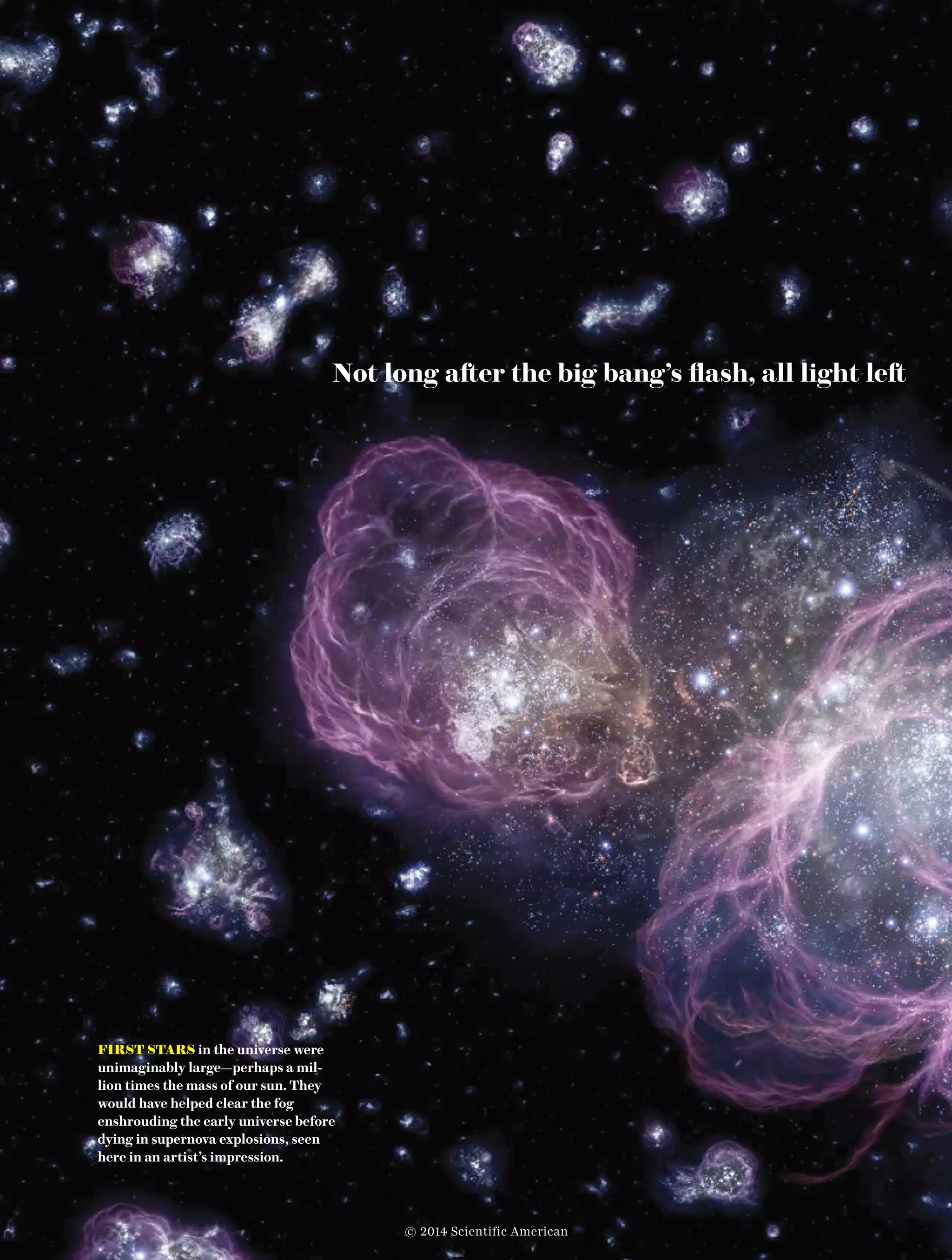
Shortly after the big bang, all was black. Primordial gas
cooled and coalesced for hundreds of millions of years,
enshrouding the universe in darkness.When the giant first
stars eventually did appear, their light was quickly snuffed
out by this fog of gas. Astronomers are only now piecing
together the 13-billion-year-old mystery of how the fog
lifted. Image by Kenn Brown, Mondolithic Studios.
FEATURES
ASTRONOMY
	 38 	 The First Starlight
Not long after the big bang, all light left the cosmos.
How and why did it return? By Michael D. Lemonick
EVOLUTION
	46 	 Rise of the Human Predator
Our ancient ancestors’ penchant for meat could
account for much of who we are today. By Kate Wong
THE FUTURE OF MEDICINE
	 52 	 The RNA Revolution
Long overlooked as a mere cellular housekeeper,
RNA has emerged as a path to a new world of medical
treatment. By Christine Gorman and Dina Fine Maron
MARINE EXPLORATION
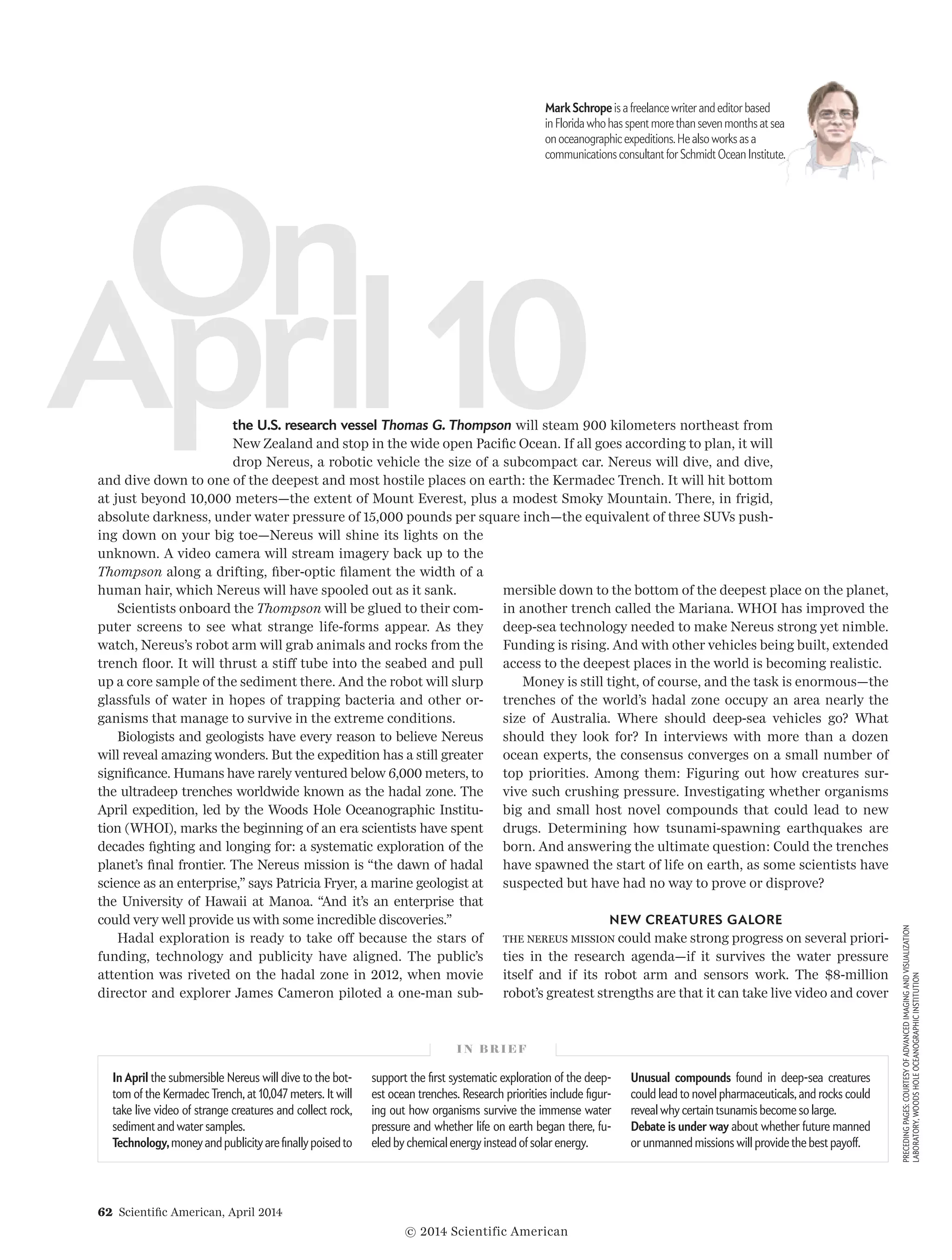
	60 	 Journey to the Bottom of the Sea
High-tech submersibles are poised to explore the ocean’s
deepest trenches and to tackle long-standing questions
about exotic creatures, the source of tsunamis and
the origin of life on earth. By Mark Schrope
NEUROSCIENCE
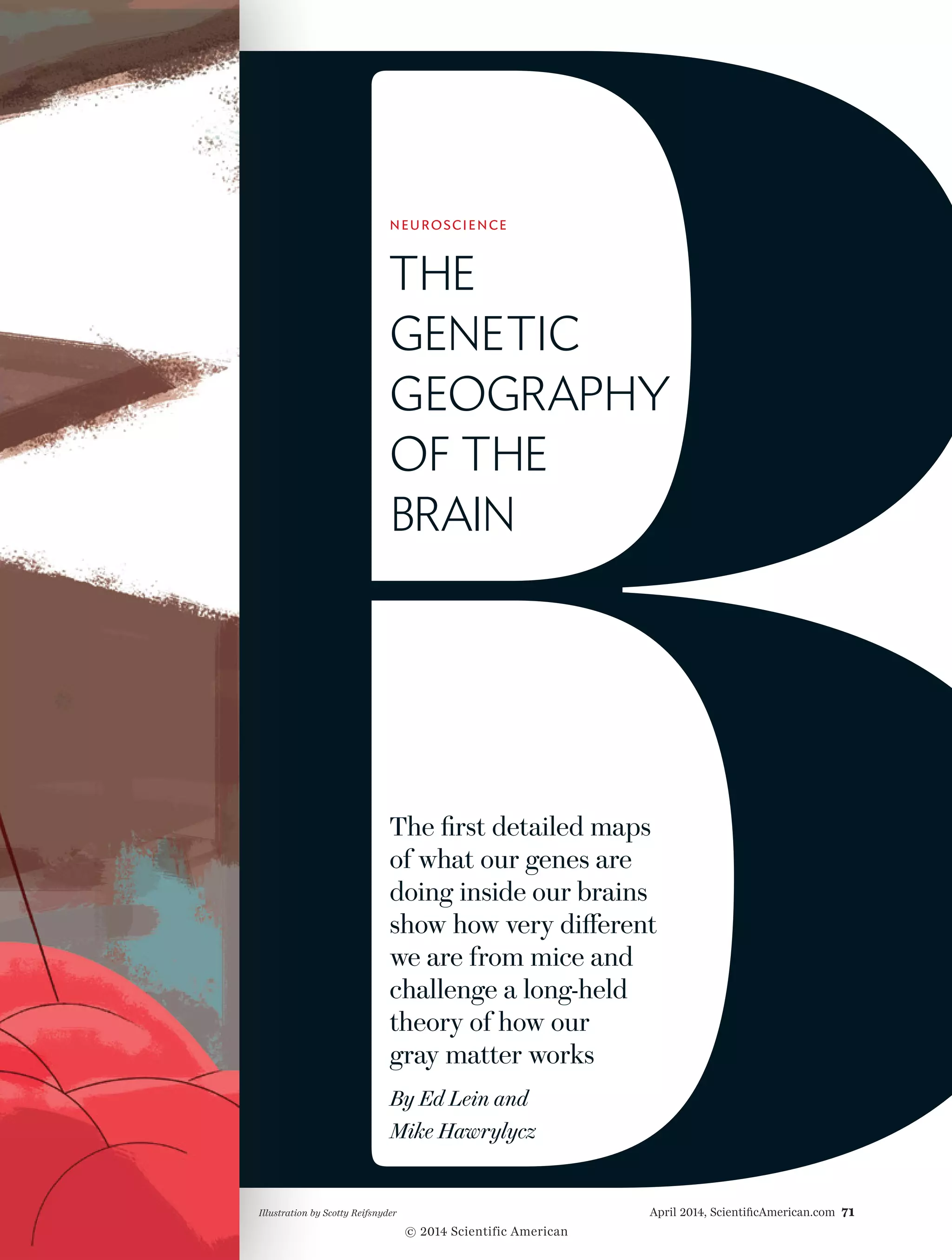
	 70 	 The Genetic Geography of the Brain
The first detailed maps of what our genes are
doing inside our brains show how very different
we are from mice and challenge a long-held
theory of how our gray matter works.
By Ed Lein and Mike Hawrylycz
CLIMATE CHANGE
	 78 	 False Hope
The rate at which global average temperature is
rising has hit a plateau, but a climate crisis still
looms in our future. At best, the “pause” buys the
world a few extra years to cut carbon emissions.
By Michael E. Mann
MATHEMATICS
	82 	 The Secret Spiritual History of Calculus
Archival records reveal a clash over science and
religion in the early history of integral calculus.
By Amir Alexander
82
© 2014 Scientific American
4  Scientific American, April 2014
Scientific American (ISSN 0036-8733), Volume 310, Number 4, April 2014, published monthly by Scientific American, a division of Nature America, Inc., 75 Varick Street, 9th Floor, New York, N.Y. 10013-1917. Periodicals postage paid at
New York, N.Y., and at additional mailing offices. Canada Post International Publications Mail (Canadian Distribution) Sales Agreement No. 40012504. Canadian BN No. 127387652RT; TVQ1218059275 TQ0001. Publication Mail
Agreement #40012504. Return undeliverable mail to Scientific American, P.O. Box 819, Stn Main, Markham, ON L3P 8A2. Individual Subscription rates: 1 year $39.97 (USD), Canada $49.97 (USD), International $61 (USD).
Institutional Subscription rates: Schools and Public Libraries: 1 year $72 (USD), Canada $77 (USD), International $84 (USD). Businesses and Colleges/Universities: 1 year $330 (USD), Canada $335 (USD), International $342 (USD).
Postmaster: Send address changes to Scientific American, Box 3187, Harlan, Iowa 51537. Reprints available: write Reprint Department, Scientific American, 75 Varick Street, 9th Floor, New York, N.Y. 10013-1917;
fax: 646-563-7138; reprints@SciAm.com. Subscription inquiries: U.S. and Canada (800) 333-1199; other (515) 248-7684. Send e-mail to scacustserv@cdsfulfillment.com. Printed in U.S.A.
Copyright © 2014 by Scientific American, a division of Nature America, Inc. All rights reserved.
DEPARTMENTS
	 6 	 From the Editor
	 8 	 Letters
	 12 	 Science Agenda
The Endangered Species Act is the most successful
environmental legislation ever enacted. By the Editors
	 14 	 Forum
Big Data is stalking you. By Kate Crawford
	 16 	 Advances
Stephen Hawking and a black hole mystery. Cholesterol
and breast cancer. Conflict minerals and microprocessors.
Medicine from fungi in sloth hair. Cannibal spiders.
	 34 	 The Science of Health
Anesthesia may have lingering effects on the brain, even
years after an operation. By Carina Storrs
	36 	 TechnoFiles
The great debate about net neutrality. By David Pogue
	86 	 Recommended
The oldest living things in the world. From the compass
to GPS. Rise and fall of the atomic era. How the human
body creates itself. By Clara Moskowitz
	 87 	 Skeptic
The science of lying—why we do it. By Michael Shermer
	88 	 Anti Gravity
When it comes to the baseball stat rage, quantification
doesn’t always make it science. By Steve Mirsky
	90 	 50, 100  150 Years Ago
	92 	 Graphic Science
Americans agree on global warming. By Mark Fischetti
O N T H E W E B
The Path to a Clean Energy Future
The U.S. Advanced Research Projects Agency–Energy is
seeking the next generation of alternative energy technology.
Find out about the progress in biofuels, hybrid solar power
and energy-efficient designs being contemplated and tested.
Go to www.ScientificAmerican.com/apr2014/energy
21
34
86
© 2014 Scientific American
6  Scientific American, April 2014
Mariette DiChristina is editor
in chief of ScientificAmerican. 
Follow her onTwitter @mdichristina
BOARD OFADVISERS
Leslie C.Aiello
President, Wenner-Gren Foundation
for Anthropological Research
Roger Bingham
Co-Founder and Director,
The Science Network
G.Steven Burrill
CEO, Burrill  Company
Arthur Caplan
Director, Division of Medical Ethics,
Department of Population Health,
NYU Langone Medical Center
George M.Church
Director, Center for Computational
Genetics, Harvard Medical School
Rita Colwell
Distinguished University Professor,
University of Maryland College Park
and Johns Hopkins Bloomberg School
of Public Health
Drew Endy
Professor of Bioengineering,
Stanford University
Ed Felten
Director, Center for Information
Technology Policy, Princeton University
KaighamJ.Gabriel
Corporate Vice President,
Motorola Mobility, and Deputy, ATAP
Harold“Skip”Garner
Director, Medical Informatics and
Systems Division, and Professor, Virginia
Bioinformatics Institute, Virginia Tech
Michael S.Gazzaniga
Director,SageCenterfortheStudyofMind,
University of California, Santa Barbara
DavidJ.Gross
Professor of Physics and Permanent
Member, Kavli Institute for Theoretical
Physics,University of California, Santa
Barbara (Nobel Prize in Physics, 2004)
LeneVestergaard Hau
Mallinckrodt Professor of
Physics and of Applied Physics,
Harvard University
Danny Hillis
Co-chairman, Applied Minds, LLC
Daniel M.Kammen
Class of 1935 Distinguished Professor
of Energy, Energy and Resources Group,
and Director, Renewable and Appropriate
Energy Laboratory, University
of California, Berkeley
Vinod Khosla
Partner, Khosla Ventures
Christof Koch
CSO, Allen Institute for Brain Science
Lawrence M.Krauss
Director, Origins Initiative,
Arizona State University
Morten L.Kringelbach
Director, Hedonia: TrygFonden
Research Group, University of Oxford
and University of Aarhus
Steven Kyle
Professor of Applied Economics and
Management, Cornell University
Robert S.Langer
David H. Koch Institute Professor,
Department of Chemical
Engineering, M.I.T.
Lawrence Lessig
Professor, Harvard Law School
John P.Moore
Professor of Microbiology and
Immunology, Weill Medical
College of Cornell University
M.Granger Morgan
Professor and Head of
Engineering and Public Policy,
Carnegie Mellon University
Miguel Nicolelis
Co-director, Center for
Neuroengineering, Duke University
MartinA.Nowak
Director, Program for Evolutionary
Dynamics, and Professor of Biology and
of Mathematics, Harvard University
Robert E.Palazzo
Dean, University of Alabama at
Birmingham College of Arts and Sciences
Carolyn Porco
Leader, Cassini Imaging Science
Team, and Director, CICLOPS,
Space Science Institute
Vilayanur S.Ramachandran
Director, Center for Brain and Cognition,
University of California, San Diego
Lisa Randall
Professor of Physics, Harvard University
Martin Rees
Astronomer Royal and Professor
of Cosmology and Astrophysics,
Institute of Astronomy, University
of Cambridge
John Reganold
Regents Professor of Soil Science
and Agroecology, Washington
State University
Jeffrey D.Sachs
Director, The Earth Institute,
Columbia University
Eugenie C.Scott
Chair, Advisory Council,
National Center for Science Education
Terry Sejnowski
Professor and Laboratory Head
ofComputationalNeurobiologyLaboratory,
Salk Institute for Biological Studies
Michael Shermer
Publisher, Skeptic magazine
Michael Snyder
Professor of Genetics, Stanford
University School of Medicine
Michael E.Webber
Co-director, Clean Energy Incubator,
and Associate Professor,
Department of Mechanical Engineering,
University of Texas at Austin
StevenWeinberg
Director, Theory Research Group,
Department of Physics,
University of Texas at Austin
(Nobel Prize in Physics, 1979)
George M.Whitesides
Professor of Chemistry and
Chemical Biology, Harvard University
NathanWolfe
Director,GlobalViralForecastingInitiative
R.JamesWoolsey
Chairman, Foundation for the Defense
of Democracies, and VenturePartner,
Lux Capital Management
AntonZeilinger
Professor of Quantum Optics,
Quantum Nanophysics, Quantum
Information, University of Vienna
JonathanZittrain
Professor of Law and of Computer
Science, Harvard University
Kenn Brown Mondolithic Studios (glowing cosmos),
Illustration by Nick Higgins (DiChristina)
Out of Darkness
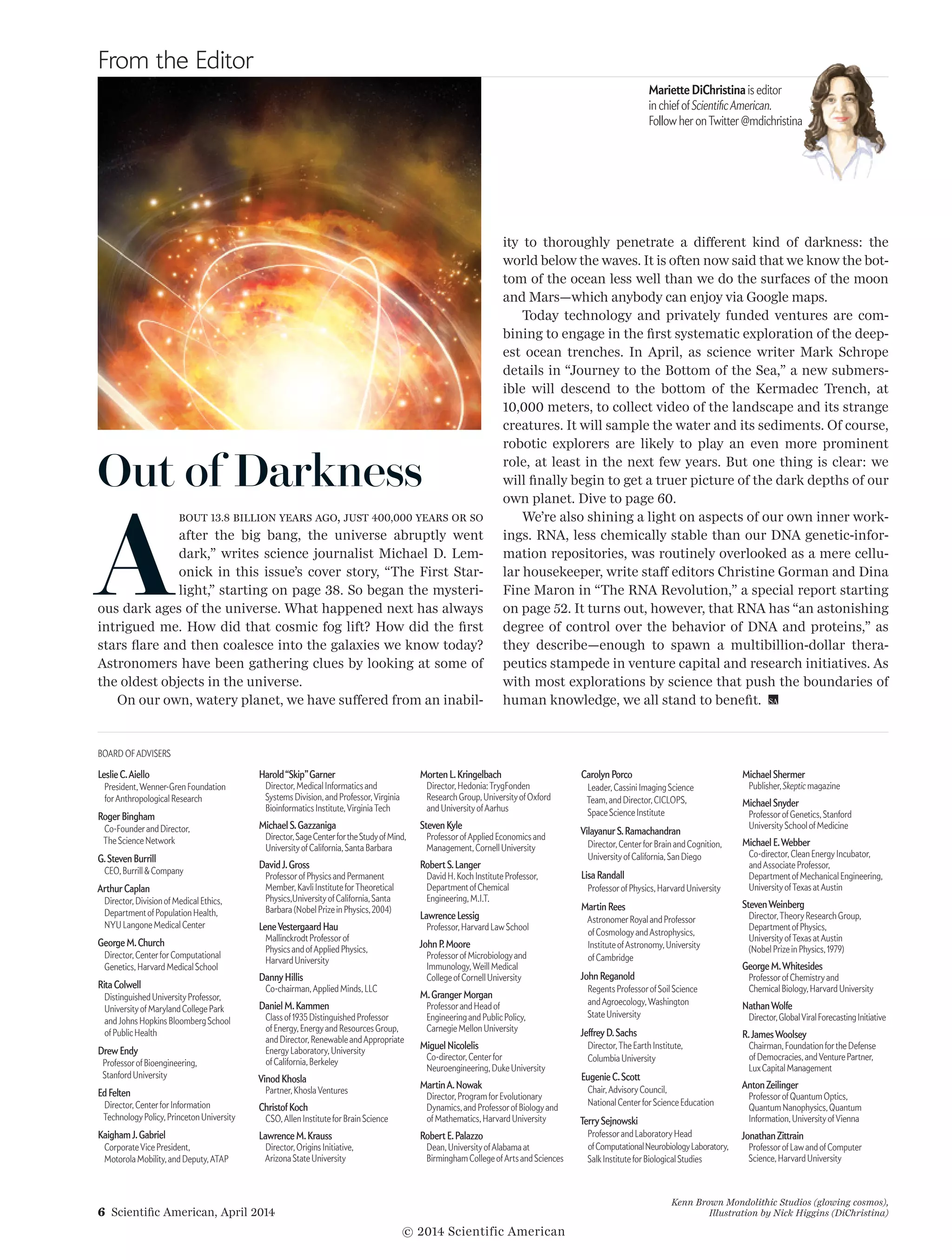
About 13.8 billion years ago, just 400,000 years or so
after the big bang, the universe abruptly went
dark,” writes science journalist Michael D. Lem-
onick in this issue’s cover story, “The First Star-
light,” starting on page 38. So began the mysteri-
ous dark ages of the universe. What happened next has always
intrigued me. How did that cosmic fog lift? How did the first
stars flare and then coalesce into the galaxies we know today?
Astronomers have been gathering clues by looking at some of
the oldest objects in the universe.
On our own, watery planet, we have suffered from an inabil-
ity to thoroughly penetrate a different kind of darkness: the
world below the waves. It is often now said that we know the bot-
tom of the ocean less well than we do the surfaces of the moon
and Mars—which anybody can enjoy via Google maps.
Today technology and privately funded ventures are com-
bining to engage in the first systematic exploration of the deep-
est ocean trenches. In April, as science writer Mark Schrope
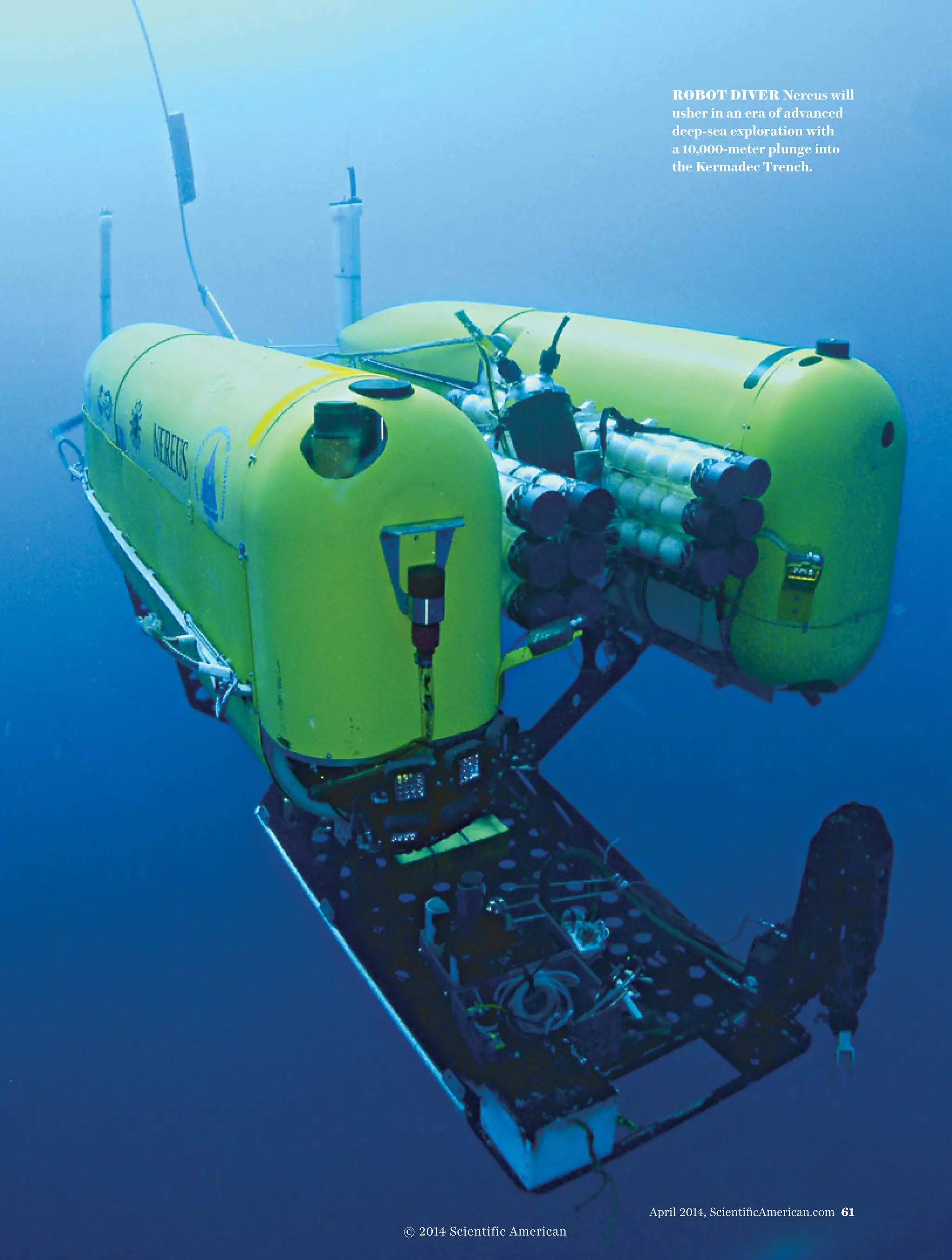
details in “Journey to the Bottom of the Sea,” a new submers-
ible will descend to the bottom of the Kermadec Trench, at
10,000 meters, to collect video of the landscape and its strange
creatures. It will sample the water and its sediments. Of course,
robotic explorers are likely to play an even more prominent
role, at least in the next few years. But one thing is clear: we
will finally begin to get a truer picture of the dark depths of our
own planet. Dive to page 60.
We’re also shining a light on aspects of our own inner work-
ings. RNA, less chemically stable than our DNA genetic-infor-
mation repositories, was routinely overlooked as a mere cellu-
lar housekeeper, write staff editors Christine Gorman and Dina
Fine Maron in “The RNA Revolution,” a special report starting
on page 52. It turns out, however, that RNA has “an astonishing
degree of control over the behavior of DNA and proteins,” as
they describe—enough to spawn a multibillion-dollar thera-
peutics stampede in venture capital and research initiatives. As
with most explorations by science that push the boundaries of
human knowledge, we all stand to benefit. 
From the Editor
© 2014 Scientific American
Letters
editors@sciam.com
8  Scientific American, April 2014
YOUR BRAIN ON GOOGLE
“How Google Is Changing Your Brain,” by
Daniel M. Wegner and Adrian F. Ward,
discusses studies indicating that the In-
ternet has changed the way humans have
traditionally allocated remembering cer-
tain facts to others and our sense of self.
I worry that the Internet-induced high
“cognitive self-esteem”—the sense of being
smart or good at remembering—the au-
thors report might discourage students
from taking the care to patiently learn
about profound concepts. Try looking up
“topological group” or “chord progression.”
Some of the most interesting subjects can’t
be understood with the touch of a button.
Lance Waltner
Colorado Springs, Colo.
Wegner and Ward mention, as evidence of
a profound psychological change created
by the Internet, an experiment in which
subjects remembered facts they typed
into a computer much worse if they were
told that the computer had saved them.
But the same would have happened if sub-
jects had written facts on paper, and then
some were told that the paper had been
filed and others that it had been burned.
Guy Ottewell
Dorset, England
The authors ignored a big difference be-
tween asking friends and family for infor-
mation versus looking it up online: you
don’t usually need to worry that the for-
mer have been paid to deceive you using
sophisticated marketing or propaganda.
R. Allen Gilliam
Winter Park, Fla.
DO CETACEANS SPREAD FUNGI?
In “Fungi on the March,” Jennifer Frazer
discusses the unexpected spread of the air-
borne, lung-infecting fungus Cryptococcus
gattii in Canada and the Pacific North-
west, where it was previously unknown.
C. gattii is described as infecting por-
poises as well as people and other animals.
How better to aerosolize and spread a pul-
monary infection than for a sick and dying
porpoise to spray fungus from its blowhole
just offshore? And if C. gattii infects one ce-
tacean, could it also be infecting others?
Jim Saklad
Baldwin, Md.
FRAZER REPLIES: According to veteri-
nary pathologist Stephen Raverty of the
Animal Health Center at British Colum-
bia’s Ministry of Agriculture, based on ex-
trapolation from terrestrial animals and
from one case involving dolphins, it is un-
likely that C. gattii is spread from one in-
fected animal to another, just as humans
cannot spread the disease to each other. Sci-
entists suspect this may be because “wet”
forms of the yeast in animals may not be
infective. So far C. gattii has been found to
infect Dall’s porpoises, harbor porpoises
and Pacific white-sided dolphins. Samples
taken from killer whales roaming between
northern Vancouver Island in British Co-
lumbia and the Puget Sound have not
shown evidence of C. gattii.
U.S. SCIENCE EDUCATION
In “Brain Exports” [Forum], Harold O.
Levy expresses alarm at the percentage of
graduate and undergraduate degrees in
science and engineering awarded to for-
eign students in the U.S. He states that “the
U.S. public education system ... does not
produce enough high school graduates
who are qualified for college work.”
The number of U.S. students taking Ad-
vanced Placement exams has increased ev-
ery year since their inception, and the ma-
jority of students have been passing them.
Last year more than two million students
took almost four million AP exams. The
pass rate was generally around 60 percent.
It seems that enough students are quali-
fied to pursue higher education in science
and technology but choose not to do so.
George Schuttinger
Mountain View, Calif.
As a chemistry teacher in high school, I
have watched the standards and testing
increase while the breadth of the subjects
narrows because we teach only what is on
the test. Our school district has not even
taught science in elementary schools for
years because it is not tested. The more No
Child Left Behind intruded into the school
system, the less of a priority depth of un-
derstanding became. We need to get these
“reformers,” who have never had a class of
38 students, out of education. 
Furthermore, our students do not un-
derstand that education is a valuable com-
modity. If you want better schools, make
education priority one at the dinner table.
Art Aronsen
Vacaville, Calif.
More Americans don’t get Ph.D.s in engi-
neering because it makes no economic
sense. An engineer with a bachelor’s can
give up, say, one year’s earnings to get a
master’s and expect to make that back in
three to four years from the higher salary.
An engineer giving up three to five years’
earnings from a master’s to get a Ph.D. can
expect to make the lost income back some-
time between 20 years and never.
Richard J. Weader II
via e-mail
INSECT FACIAL RECOGNITION
In “Good with Faces,” Elizabeth A. Tibbetts
and Adrian G. Dyer describe their work
showing that insects such as paper wasps
and honeybees are able to recognize indi-
vidual faces of others in their species.
December 2013
“We need to get
these ‘reformers,’
who have never had
a class of 38 students,
out of education.” 
art aronsen vacaville, calif.
© 2014 Scientific American
10  Scientific American, April 2014
Letters
Scientific American
75 Varick Street, 9th Floor
New York, NY 10013-1917
or editors@sciam.com
Letters may be edited for length and clarity.
We regret that we cannot answer each one.
Post a comment on any article at
ScientificAmerican.com/apr2014
ScientificAmerican is a trademark of
ScientificAmerican,Inc.,used with permission.
Subscriptions
For new subscriptions, renewals, gifts,
payments, and changes of address:
U.S. and Canada, 800-333-1199; outside
North America, 515-248-7684 or
www.ScientificAmerican.com
Submissions
To submit article proposals, follow the
guidelines at www.ScientificAmerican.com.
Click on “Contact Us.” We cannot
return and are not responsible for
materials delivered to our office.
Reprints
To order bulk reprints of articles (minimum
of 1,000 copies): Reprint Department,
Scientific American, 75 Varick Street,
9th Floor, New York, NY 10013-1917;
212-451-8877; reprints@SciAm.com.
Forsinglecopiesofbackissues:800-333-1199.
Permissions
For permission to copy or reuse material:
Permissions Department,
Scientific American, 75 Varick Street,
9th Floor, New York, NY 10013-1917;
randp@SciAm.com;
www.ScientificAmerican.com/permissions.
Pleaseallowthreetosixweeksforprocessing.
Advertising
www.ScientificAmerican.com has
electronic contact information for sales
representatives of Scientific American in
all regions of the U.S. and in other countries.
HOW TO CONTACT US
LETTERS TO THE EDITOR
ESTABLISHED 1845
EXECUTIVE VICE PRESIDENT
Michael Florek
VICE PRESIDENT AND
ASSOCIATE PUBLISHER, MARKETING
AND BUSINESS DEVELOPMENT
Michael Voss
DIRECTOR, INTEGRATED MEDIA SALES
Stan Schmidt
ASSOCIATE VICE PRESIDENT,
BUSINESS DEVELOPMENT
Diane McGarvey
DIRECTOR, GLOBAL MEDIA SOLUTIONS
Jeremy A. Abbate
VICE PRESIDENT, CONSUMER MARKETING
Christian Dorbandt
DIRECTOR, E-COMMERCE
Scott Rademaker
ASSOCIATE CONSUMER
MARKETING DIRECTOR
Catherine Bussey
E-COMMERCE MARKETING MANAGER
Evelyn Veras
SENIOR MARKETING
MANAGER / ACQUISITION
Patricia Elliott
ONLINE MARKETING ASSOCIATE
Alexandra Egan
MARKETING AND CUSTOMER SERVICE
COORDINATOR
Christine Kaelin
SALES DEVELOPMENT MANAGER
David Tirpack
PROMOTION MANAGER
Diane Schube
PROMOTION ART DIRECTOR
Maria Cruz-Lord
MARKETING RESEARCH DIRECTOR
Rick Simone
ONLINE MARKETING PRODUCT MANAGER
Zoya Lysak
CORPORATE PR MANAGER
Rachel Scheer
SALES REPRESENTATIVE
Chantel Arroyo
INTEGRATED MEDIA SALES
Nate Murray
SENIOR ADMINISTRATOR,
EXECUTIVE SERVICES
May Jung
CUSTOM PUBLISHING EDITOR
Lisa Pallatroni
RIGHTS AND PERMISSIONS MANAGER
Karin M. Tucker
PRESIDENT
Steven Inchcoombe
SENIOR EDITORS
Mark Fischetti  ENERGY / ENVIRONMENT 
Seth Fletcher TECHNOLOGY
Christine Gorman  BIOLOGY / MEDICINE
Michael Moyer  SPACE / PHYSICS / SPECIAL PROJECTS
Gary Stix  MIND / BRAIN  Kate Wong  EVOLUTION
ASSOCIATE EDITORS
David Biello  ENERGY / ENVIRONMENT  Larry Greenemeier  TECHNOLOGY  
Ferris Jabr  MIND / BRAIN  Dina Fine Maron  BIOLOGY / MEDICINE 
Clara Moskowitz  SPACE / PHYSICS 
PODCAST EDITOR  Steve Mirsky
VIDEO EDITOR  Eric R. Olson
CONTRIBUTING EDITORS
Davide Castelvecchi, Katherine Harmon Courage, Deborah Franklin,
Anna Kuchment, Maryn McKenna, George Musser,
Christie Nicholson, John Rennie, Sarah Simpson
EDITOR IN CHIEF AND SENIOR VICE PRESIDENT 
Mariette DiChristina
EXECUTIVE EDITOR
Fred Guterl
DESIGN DIRECTOR
Michael Mrak
ART DIRECTOR   Jason Mischka
ART DIRECTOR, INFORMATION GRAPHICS  Jen Christiansen
ART DIRECTOR, ONLINE  Ryan Reid
PHOTOGRAPHY EDITOR  Monica Bradley
PHOTO RESEARCHER  Liz Tormes
ASSOCIATE ART DIRECTOR, IPAD  Jason Arias
ASSISTANT ART DIRECTOR, IPAD  Bernard Lee
MANAGING PRODUCTION EDITOR  Richard Hunt
SENIOR PRODUCTION EDITOR  Michelle Wright
INFORMATION GRAPHICS CONSULTANT  Bryan Christie
ART CONTRIBUTORS  Edward Bell, Lawrence R. Gendron, Nick Higgins
SENIOR EDITORIAL PRODUCT MANAGER  Angela Cesaro
WEB PRODUCTION EDITOR  Kerrissa Lynch
WEB PRODUCTION ASSOCIATE  Nick Weilbacher
SENIOR PRODUCTION MANAGER   Christina Hippeli
ADVERTISING PRODUCTION MANAGER   Carl Cherebin
PREPRESS AND QUALITY MANAGER   Silvia De Santis
CUSTOM PUBLISHING MANAGER   Madelyn Keyes-Milch
PRODUCTION COORDINATOR   Lisa Headley
EDITORIAL ADMINISTRATOR   Avonelle Wing
SENIOR SECRETARY   Maya Harty
COPY DIRECTOR  Maria-Christina Keller
SENIOR COPY EDITOR   Daniel C. Schlenoff
COPY EDITORS   Michael Battaglia, Aaron Shattuck
MANAGING EDITOR
Ricki L. Rusting
MANAGING EDITOR, ONLINE
Philip M. Yam
NEWS EDITOR
Robin Lloyd
Do these insects show a difference be-
tween the sexes in this ability?
Dennis Weber
Kalamazoo, Mich.
TIBBETTS AND DYER REPLY: There are
likely to be sex differences in insect-face
learning, although careful experimenta-
tion will be needed. Insects often vary
within and between species in perceptual-
ly difficult tasks such as color discrimina-
tion. Bees and wasps are particularly
likely to have cognitive differences across
the sexes because the social lives of males
and females are so distinct. We are plan-
ning experiments to address this question.
SECULARISM AND SOCIETY
In “Is God Dying?” [Skeptic], Michael
Shermer’s argument that religion is declin-
ing is short on hard and social science.
Shermer gives one point from a supposed-
ly longitudinal study but asserts time trend
results. Likewise, he surmises that because
religions help the poor, richer nations be-
come less religious, yet he pronounces the
U.S. über-religious. By the way, nonreli-
gious societies have a pretty bad track rec­
ord (Soviets, North Koreans, Nazis, etc.).
J. P. Harrison
Atlanta
SHERMER REPLIES: The U.S. has long
been an outlier in religiosity among devel-
oped democracies, showing substantially
higher rates. Recent surveys show that we
may now be shifting to be more in line
with comparable countries. As for the last
point: National socialism was not an
atheistic regime, and its exterminationist
policies were clearly motivated by hege-
monic politics and racial hygiene, not re-
ligion. The Soviet Union and the North Ko-
rean regime (not to mention the People’s
Republic of China) were and are officially
atheistic, but nothing they did or are do-
ing had or has religious motives.
ERRATA
“The Stuff of Dreams,” by Gerbrand Ceder
and Kristin Persson [World Changing
Ideas], incorrectly spelled the name of Ste-
fano Curtarolo of Duke University.
“Ugly Science Pays Off,” by Rachel Felt-
man [Advances], refers to screwworms as
worms. Screwworms are flies.
© 2014 Scientific American
12  Scientific American, April 2014 Illustration by Ross MacDonald
Preserve the
Endangered
Species Act
The most successful environmental
legislation ever enacted faces
new threats from Congress
A century ago an iconic, keystone species—the gray wolf—all
but vanished from the continental U.S. Its loss was no accident.
Rather it was the result of an eradication campaign mounted by
ranchers and the government to protect livestock. Hunters shot,
trapped or poisoned the wolves and received a bounty for each
kill. Not even the national parks, such as Yellowstone, offered
safe haven. Within decades the apex predator was nearly gone, a
decline that triggered a cascade of changes down the food chain.
Today, however, in the 28,000-square-mile wilderness of the
Greater Yellowstone Ecosystem, 400 gray wolves roam free. The
Yellowstone wolves are among the 6,000 or so gray wolves that
now inhabit the lower 48 states thanks to the Endangered Spe-
cies Act (ESA). The act was signed into law in 1973 to protect
endangered and threatened plants and animals, as well as the
habitats critical to their survival. The ESA has prevented the
extinction of 99 percent of the 2,000 listed species. It is widely
considered the strongest piece of conservation legislation ever
implemented in the U.S. and perhaps the world.
Yet for years the ESA has endured attacks from politicians
who charge that it is economically damaging and ineffectual.
Opponents argue that environmental groups use the legislation
to file frivolous lawsuits aimed at blocking development. More-
over, they contend that the ESA fails to aid species’ recovery. As
evidence, they note that only 1 percent of the species that have
landed on the protected list have recovered to the point where
they could be delisted.
The latest assault comes in the form of the Endangered Spe-
cies Management Self-Determination Act, a bill introduced by
senators Rand Paul of Kentucky and Dean Heller of Nevada and
Representative Mark Amodei of Nevada. The bill would, among
other things, require state and congressional approval to add new
species to the protected list—the U.S. Fish and Wildlife Service
and the National Marine Fisheries Service do this now, based on
the best scientific data available. It would also automatically delist
species after five years and allow governors to decide if and how
their states follow ESA regulations.
Senator Paul and others advocating for reform say that they
want to improve the law to better serve imperiled species and
local people. But their arguments are flawed. The reason why
few species have recovered to the point where they can be delist-
ed is not because the ESA is ineffective but because species take
decades to rebound. In fact, 90 percent of the listed species are
on track to meet their recovery goals.
In addition, lawsuits filed by environmental groups have led
to many of the ESA’s accomplishments. The ESA may require a
development project to make modifications to address concerns
about listed species, but the benefit of the ESA to ecosystems out-
weighs this inconvenience to developers. The changes critics are
lobbying for, while undoubtedly appealing to groups such as
farmers and loggers, would cripple the ESA.
Yet the flaws of this bill do not mean the ESA cannot be im­­
proved on. For example, Congress should help the private land-
owners who choose to act as stewards of their land. According to
the Fish and Wildlife Service, about half of ESA-listed species
have at least 80 percent of their habitat on private lands. Yet land-
owners have few incentives to preserve the habitats of threatened
species. More financial and technical assistance needs to be made
available to landowners who want to help protect the species on
their property, as well as to people such as ranchers whose herds
may be affected by the return of a species like the gray wolf.
Perhaps most important, conservation efforts must be updated
to reflect what scientists now know about climate change and the
threats it poses to wildlife. As temperatures rise, many more spe-
cies will fall on hard times. Policy makers should thus increase
ESA funding to allow more rigorous monitoring of wildlife and to
protect more species.
Against the backdrop of budget cuts, setting aside more mon-
ey to save animals and plants might seem like a luxury. Nothing
could be further from the truth. Healthy ecosystems provide a
wealth of essential services to humans—from purifying water to
supplying food. We must preserve them for our own well-being
and that of future generations. 
SCIENTIFIC AMERICAN ONLINE
Comment on this article at ScientificAmerican.com/apr2014
Science Agenda by the Editors
Opinion and analysis from Scientific American’s Board of Editors
© 2014 Scientific American
14  Scientific American, April 2014
Forum by Kate Crawford
Commentary on science in the news from the experts
Illustration by Skip Sterling
Kate Crawford is a principal researcher
at Microsoft Research,a visiting professor
at the Massachusetts Institute ofTech­­nol­
ogy Center for Civic Media and a senior
­fellow at NewYork University’s Information
Law Institute.
Big Data Stalking
Data brokers cannot be trusted to regulate themselves
Many of us now expect our online activities to be recorded and
analyzed, but we assume that the physical spaces we inhabit
are different. The data-broker industry does not see it that way.
To it, even the act of walking down the street is a legitimate
data set to be captured, catalogued and exploited. This slippage
be­­tween the digital and physical matters not only be­­cause of
privacy concerns—it also raises serious questions about ethics
and power.
The Wall Street Journal recently published an article about
Turnstyle, a company that has placed hundreds of sensors
throughout businesses in downtown Toronto to gather signals
from smartphones as they search for open Wi-Fi networks. The
signals are used to uniquely identify phones as they move from
street to street, café to cinema, work to home. The owner of the
phone need not connect to any Wi-Fi network to be tracked; the
entire process occurs without the knowledge of most phone
users. Turnstyle anonymizes the data and turns them into reports
that it sells back to businesses to help them “understand the cus-
tomer” and better tailor their offers.
Prominent voices in the public and private sectors are cur-
rently promoting boundless data collection as a way of minimiz-
ing threats and maximizing business opportunities. Yet this trend
may have unpleasant consequences. Mike Seay, an OfficeMax cus-
tomer, recently received a letter from the company that had the
words “Daughter Killed in Car Crash” following his name. He had
not shared this information with OfficeMax. The company stated
that it was an error caused by a “mailing list rented through a
third-party provider.”
Clearly, this was a mistake, but it was a revealing one. Why was
OfficeMax harvesting details about the death of someone’s child
in the first place? What limits, if any, will businesses set with our
data if this was deemed fair game? OfficeMax has not explained
why it bought the mailing list or how much personal data it con-
tains, but we know that third-party data brokers sell all manner of
information to businesses—including, as Pam Dixon, executive
director of the World Privacy Forum, testified before the U.S. Sen-
ate last December, “police officers’ home addresses, rape suffer-
ers..., genetic disease sufferers,” as well as suspected alcoholics
and cancer and HIV/AIDS patients.
In the absence of regulation, there have beensome attempts to
generate an industry code of practice for location-technology com-
panies. One proposal would have companies de-identify personal
data, limit the amount of time they are retained, and prevent them
from being used for employment, health care or insurance purpos-
es. But the code would only require opt-out consent—that is, giv-
ing your details to a central Web site to indicate that you do not
want to be tracked—when the information is “not personal.”
The trouble is, almost everything is personal. “Any information
that distinguishes one person from another can be used for re-
identifying anonymous data,” wrote computer scientists Arvind
Narayanan, now at Princeton University, and Vitaly Shmatikov of
the University of Texas at Austin in a 2010 article in Communica-
tions of the ACM. This includes anonymous reviews of products,
search queries, anonymized cell-phone data and commercial
transactions. The opt-out-via-our-Web-site model also compels
customers to volunteer yet more information to marketers. And it
is not clear that self-regulation will ever be sufficient. Most indus-
try models of privacy assume that individuals should act like busi-
nesses, trading their information for the best price in a frictionless
market where everyone understands how the technology works
and the possible ramifications of sharing their data. But these
models do not reflect the reality of the deeply unequal situation
we now face. Those who wield the tools of data tracking and ana-
lytics have far more power than those who do not.
A narrow focus on individual responsibility is not enough: the
problem is systemic. We are now faced with large-scale experi-
ments on city streets in which people are in a state of forced par-
ticipation, without any real ability to negotiate the terms and often
without the knowledge that their data are being collected. 
SCIENTIFIC AMERICAN ONLINE
Comment on this article at ScientificAmerican.com/apr2014
© 2014 Scientific American
16  Scientific American, April 2014 ScientificAmerican.com/apr2014/advancesFURTHER READINGS AND CITATIONS
ADVANCES
Dispatches from the frontiers of science, technology and medicine
COURTESYOFJ.SCHNITTMAN NASAGoddardSpaceFlightCenter,J.KROLIKJohnsHopkinsUniversity
ANDS.NOBLERochesterInstituteofTechnology
THEORETICAL PHYSICS
The New
Black Hole Battle
A decades-old paradox returns
When Stephen Hawking was quoted earlier this year
as saying that“there are no black holes,”he wasn’t really
talking about black holes. At least not about black holes
as you or I imagine them—astrophysical objects that
suck in everything, even light. Those, everyone agrees,
are just as black as ever.
Hawking’s quip instead concerns black holes in
a highly theoretical sense. Like many other theorists,
Hawking has been trying to understand a paradox eating
at the heart of physics. The issue—often referred to as
the black hole firewall paradox—implies that physicists
might have to abandon (or deeply modify) quantum me-
chanics or Einstein’s general theory of relativity, or both.
The firewall problem is related to a paradox that
Hawking first pointed out in the 1970s. It concerns this
question: What happens to information that falls into
a black hole? The rules of quantum mechanics require
that information can never be lost. Even burning a book
doesn’t destroy the information inside—it just scrambles
it up. But black holes do seem to destroy information,
sucking it past the event horizon, a point of no return.
The black hole information paradox stumped physi-
cists for two decades. It appeared to be solved in the late
1990s, when researchers figured out that information
could leak out of a black hole in the form of Hawking radi-
ation.Then, in 2012, physicists at the University of Califor-
nia, Santa Barbara, found flaws in the previous solutions.
They concluded that an event horizon is not, as previously
thought, an ordinary place. Instead it is a wall of fire that
prevents Hawking radiation on the outside from remain-
ing intertwined on a quantum level with material inside.
Hawking’s latest work is an attempt to offer an alter-
native solution. He proposes that a black hole has an“ap-
parent”horizon in addition to its event horizon.The two
are nearly always identical. Information can rise from in-
side the black hole to the apparent horizon. At that point,
quantum effects can blur the boundary between the“ap-
parent”and“event”horizons, sometimes allowing infor-
mation to escape. Hence, black holes would not be strict-
ly black, provided you had hundreds of trillions of years to
watch them. But ultimately, what Hawking’s paper means
is that there is something fundamental about black holes
we still do not understand. —Michael Moyer
© 2014 Scientific American
CECILH.FOX ScienceSource
ADVANCES
MEDICINE
Cancer Culprit?
A common product of cholesterol may fuel breast tumor growth
Scientists have long struggled to under-
stand why women with heart disease
risk factors are more likely to develop
breast cancer. Now research suggests
that high cholesterol may play an impor-
tant role.
Estrogen drives the majority of breast
cancers in women. The hormone binds
to proteins known as receptors inside
the tumor, helping it grow. So when Phil-
ip Shaul, a pediatrician and biologist at
the University of Texas Southwestern
Medical Center, and his colleagues
learned that a common breakdown
product of cholesterol also activates
estrogen receptors, they thought they
might be on to something. Teaming up
with Duke University cancer biologist
Donald McDonnell, they showed in 2008
that the cholesterol product, known as
27HC, spurs tumor growth in human
breast cancer cells.
Building on their work, Shaul and
McDonnell showed, in independent
studies published in November 2013 in
Cell Reports and Science, respectively,
that 27HC drives cancer growth in mice
harboring estrogen receptor–positive
human breast tumors. Using samples
from patients at his hospital, Shaul also
found that 27HC levels were three times
higher in the healthy breast tissue of
women with breast cancer compared
with that of cancer-free women; 27HC
levels were 2.3 times higher still in
tumor cells. Furthermore, cancer
patients who had lower levels of an
enzyme that breaks down 27HC in
tumors were less likely to survive. When
McDonnell’s team fed mice high-choles-
terol or high-fat diets, they were more
likely than animals with normal diets
to develop breast cancer, too. The two
papers “bring 27HC to the ‘limelight’
of breast cancer research,” says Sérgio
Dias, a biologist at the Institute of
Molecular Medicine in Lisbon.
It is still unclear, however, how blood
cholesterol levels might affect breast
cancer risk because Shaul found no con-
sistent link between 27HC levels in hu­­
man tumors and blood cholesterol levels.
“But there may be subsets of women with
high cholesterol at greater risk,” he says.
The findings could have important
treatment implications. They bolster the
idea, backed already by one study, that
cholesterol-lowering statin drugs may
slow the progression of some breast can-
cers. And because between 30 and 65 per-
cent of women with estrogen-fueled breast
cancers do not respond to drugs that
thwart estrogen production, the studies
suggest that in some women “there’s sim-
ply an entirely different driver of the can-
cer,” Shaul says.  —Melinda Wenner Moyer
A compound called
27HC could be linked
to breast cancer.
18  Scientific American, April 2014
© 2014 Scientific American
April 2014, ScientificAmerican.com  21
ADVANCES
ENTOMOLOGY
Cockroach Homecoming
Once thought to be invasive, a bug reveals its American roots
In 1951 scientists thought they had
found a new invader on American soil.
Ectobius, a cockroach found throughout
Europe and Africa, had begun turning
up in homes in Massachusetts. Three
decades later another Ectobius species,
commonly known as the dusky cock­
roach, made an appearance in New
Hampshire and then in Vermont.
Eventually four Ectobius species were
being tallied in the northeastern U.S.
But Ectobius, it turns out, is not real­
ly a stranger to North America at all. It
has just returned home after an absence
of 49 million years.
Entomologists got the mistaken
impression that Ectobius was an Old
World species back in 1856, when they
found the first specimens in 44-million-
year-old Baltic amber. That’s how the
matter sat for more than 150 years. Then,
in 2010, Conrad Labandeira, a research
scientist and curator of fossil arthropods
at the Smithsonian National Museum of
Natural History, invited Peter Vrsansky,
a cock­roach specialist at the Slovak
Academy of Sciences, to examine some
fossils that had been gathering dust for
years in the Smithsonian Institution’s
collection. They had been taken from the
Green River Formation in Colorado. “Lo
and behold, [Vrsansky] said, ‘This is Ecto­
bius!’” Labandeira recalls.
The 21 fossils had revealed four
species of Ectobius dating back to the
Eocene—predating the European spe­
cimens by some five million years. “It’s
amazing,” Labandeira says, “how one
little dis­covery can change the entire
under­standing of the history of this
particular lineage of cock­roaches.”
Most likely, Ectobius went extinct in
North America as a result of increasingly
harsh conditions as the glaciers crept
south. When that extinction occurred,
exactly, is unknown, but before it hap­
pened, Labandeira says, some of the
insects made a break for Europe, either
traveling through Greenland or else
scuttling across the Bering land bridge.
Recently announcing the news in
the Annals of the Entomological Society
of America, Labandeira and Vrsansky
named one of the new cockroaches
Ectobius kohlsi—a hat tip to the fossils’
original discoverer, David Kohls, an
amateur collector in Colorado who has
amassed hundreds of thousands of fossil
insects. The three other new Ectobius
species, though preliminarily identified,
did not possess enough detail for the re­­
searchers to name them.
“There are so many amazing, beau­
tiful fossils, and so few people have had
the chance to work on them,” says Dena
Smith, an associate professor of geo­
logical sciences at the University of
Colorado Boulder. “I think there will be
a lot more of this kind of exciting work
to come.” —Rachel Nuwer
COURTESYOFPETERBARNAANDPETERVRSANSKY(top);COURTESYOFNASA(bottom)
On the frozen plains of central South Dakota, the Missouri River takes a dramatic
turn known as a meander bend, creating the 130-kilometer-long Lake Sharpe.
Meander bends form as fast-moving water erodes the outer bank and deposits
sediment on the more placid inner bank. Eventually the Missouri River will cut
through the skinny peninsula in the lower right of this image, creating a shorter path
to the sea. In time, sediment deposition will sever Lake Sharpe from the river, forming
what is called an oxbow lake—a freestanding, horseshoe-shaped body of water. 
—Annie Sneed
W H AT I S I T ?
© 2014 Scientific American
22  Scientific American, April 2014 ScientificAmerican.com/apr2014COMMENT AT
COURTESYOFRESOLVE(top);SOURCE:NATIONALINSTITUTEOFSTANDARDSANDTECHNOLOGY(bottom)
ADVANCES
TECHNOLOGY
War Funding Inside?
Intel and other tech companies crack down on “conflict minerals”
It is hard to believe that our mundane
social media banter could have an impact
on the civil war that has been raging in
the Democratic Republic of the Congo for
more than a decade. The problem is not
the content of these messages; it is the
devices used to send them. Smartphones,
tablets, PCs and other gadgets often have
electronic components made from so-
called conflict minerals—gold, tantalum,
tin and tungsten—taken from specific
mines in the D.R.C. that give a cut of their
profits to armed groups.
Chipmaker Intel used the Consumer
Electronic Association’s International CES
trade show in January to spotlight this
prob­­­­­lem and declare that its microproces-
sors are now free of conflict minerals. The
company says it has taken steps to have its
suppliers—in particular, the smelters that
extract metals from mined ore—audited by
third-party companies and to certify that
they are not cooperating with extortion
efforts that funnel money to local warlords.
The idea of conflict minerals was rela-
tively obscure four years ago, when the
Enough Project, a Washington, D.C.–
based nongovernmental organization,
brought the issue to Intel’s attention.
Intel’s work has encouraged other compa-
nies to examine the sources of their prod-
ucts’ raw materials, Enough Project senior
policy analyst Sasha Lezhnev said at the
International CES.
Tech companies do not use as much
of these minerals as other industries,
such as jewelry makers. Yet gold, tanta-
lum, tungsten and tin play an
important role in our gadgets.
Like many device manufactur-
ers, Intel relies on highly con-
ductive gold in circuit cards,
connectors and semiconductor
packaging. The company uses
tantalum in some of its capaci-
tors and in the “sputtering”
deposition process used to
make its semiconductors.
Tungsten also plays a limited
role in the semiconductor fab-
rication process. Tin, mean-
while, is a key component in the silver-
tin solder that attaches electronic
components to their circuit boards.
Soon all companies will have to scruti-
nize their supply chains. In August 2012
the Securities and Exchange Commission
began requiring firms to annually disclose
the sources of the gold, tin, tungsten and
tantalum used in their products. The U.S.
Chamber of Commerce and the National
Association of Manufacturers have filed a
lawsuit against the sec in response to its
new rules, but companies will still have
to get their first disclosure reports to the
agency by May 31. —Larry Greenemeier
BY T H E N U M B E R S
5 billionNumber of years the JILA strontium atomic clock,
developed by researchers at the National Institute of Standards
and Technology and the University of Colorado Boulder,
could tick away without gaining or losing one second.
© 2014 Scientific American
April 2014, ScientificAmerican.com  23Illustrations by Thomas Fuchs
DRUGS
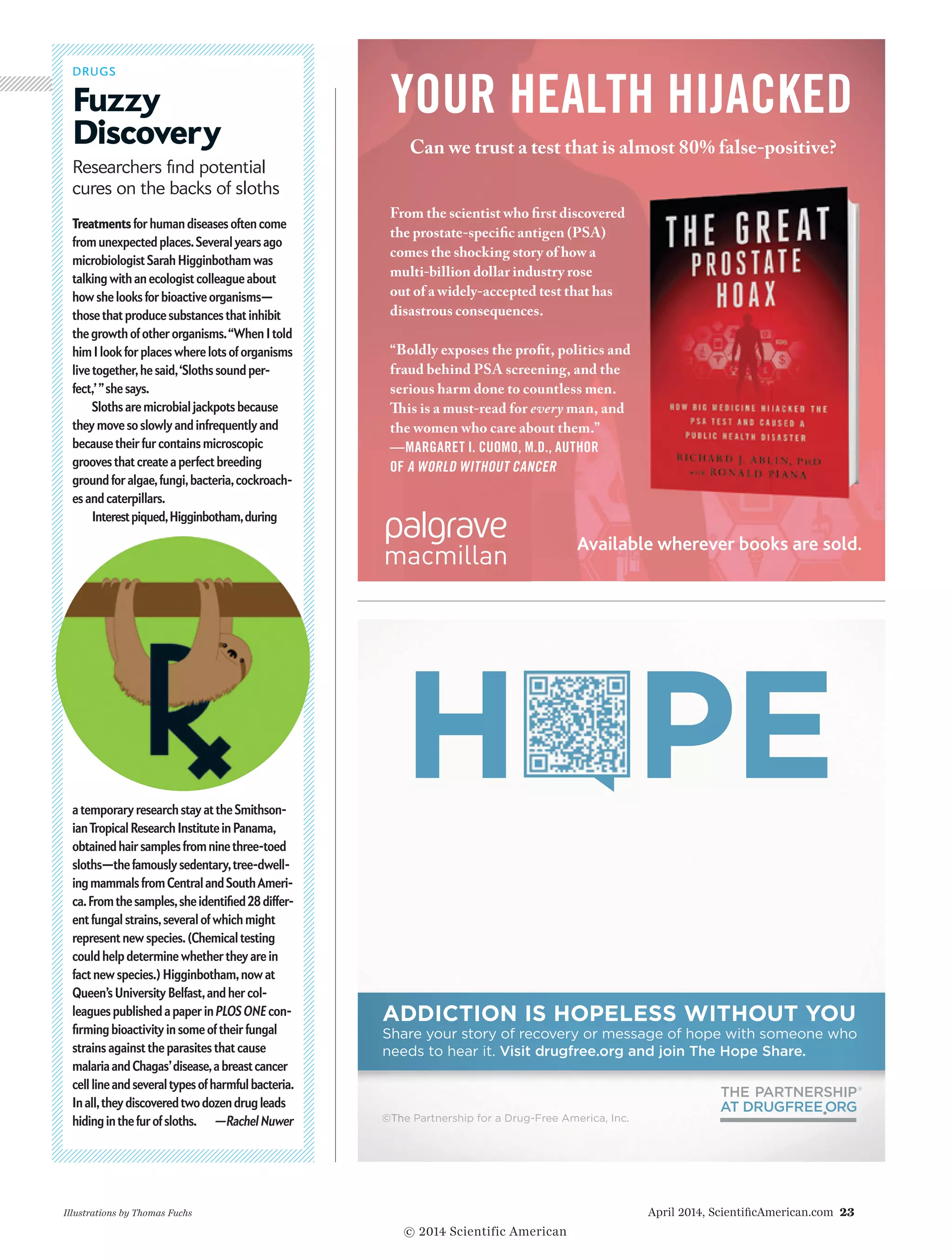
Fuzzy
Discovery
Researchers find potential
cures on the backs of sloths
Treatments for human diseases often come
from unexpected places.Several years ago
microbiologist Sarah Higginbotham was
talking with an ecologist colleague about
how she looks for bioactive organisms—
those that produce substances that inhibit
the growth of other organisms.“When I told
him I look for places where lots of organisms
live together,he said,‘Sloths sound per-
fect,’”she says.
Sloths are microbial jackpots because
they move so slowly and infrequently and
because their fur contains microscopic
grooves that create a perfect breeding
ground for algae,fungi,bacteria,cockroach-
es and caterpillars.
Interestpiqued,Higginbotham,during
a temporary research stay at the Smithson-
ianTropical Research Institute in Panama,
ob­­tained hair samples from nine three-toed
sloths—the famously sedentary,tree-dwell-
ing mammals from Central and SouthAmeri-
ca.From the samples,she identified 28 differ-
ent fungal strains,several of which might
represent new species.(Chemical testing
could help determine whether they are in
fact new species.) Higginbotham,now at
Queen’s University Belfast,and her col-
leagues published a paper in PLOS ONE con-
firming bioactivity in some of their fungal
strains against the parasites that cause
ma­­laria and Chagas’disease,a breast cancer
cell line and several types of harmful bacteria.
In all,they discovered two dozen drug leads
hiding in the fur of sloths. —Rachel Nuwer
© 2014 Scientific American
24  Scientific American, April 2014 ScientificAmerican.com/apr2014COMMENT AT
BIOLOGY
Love Him
or Eat Him?
Some female wolf spiders
prioritize food over sex
Spider courtship is a risky business. In
some species, females routinely decide
that they would rather eat a male than
mate with him, and researchers have
struggled for decades to understand why.
A recent experiment with a type of Span­
ish wolf spider suggests that the reason
may depend on the spider’s personality.
A virgin spider cannot be sure how
many chances she will have to mate.
Every male could be her last, and if she
eats all of them, she will never reproduce.
Why would a spider take this risk? One
possibility is that females are choosy,
holding out for large, healthy males with
good genes and devouring the rest. An­­
other possibility is the aggressive spillover
hypothesis, which suggests that some
females have strong predatory instincts
that spill over into aggression toward
potential mates. These females might eat
males even when they would be better off
mating with them.
To learn more about cannibalistic spi­
ders, researchers at the Experimental Sta­
tion of Arid Zones in Spain and their col­
leagues caught 80 juvenile females of the
species Lycosa hispanica—a type of wolf
spider—and fed them as much as they
wanted while they matured. Some fe­­
males put on weight more quickly than
others. “Since all females had similar prey
availability, we estimated that female
growth rate would be the result of female
voraciousness,” says Rubén Rabaneda-
Bueno, the study’s lead author.
After each female molted to adult­
hood, the researchers placed a male in her
enclosure. Females that ate their suitors
were offered additional chances with new
males. Most of the cannibal females were
choosy. They ate males that were in poor
condition and mated with males that
were of high quality. “But we found that
there were a few females that would con­
sistently get a male and kill it and get
another male and kill it—so they were
really aggressive,” says Jordi Moya-Lara­
ño, the study’s senior author.
The most aggressive females killed
big, healthy males as often as they killed
scrawny ones. The same females also had
the highest growth rates, indicating that
they were the most aggressive toward
prey. “In this study, a female personality
trait—her voracity toward prey—was cor­
related with her aggressiveness toward
males,” Rabaneda-Bueno says. “Our
results provide evidence that different
female personalities can lead to different
outcomes in the interactions between
males and females in a sexual cannibal.”
—Nala Rogers
COURTESYOFEVADEMASCASTROVERDE
ADVANCES
© 2014 Scientific American
26  Scientific American, April 2014 ScientificAmerican.com/apr2014COMMENT AT
ECOLOGY
Where
Farmers and
Birds Agree
Some species adapt well
to no-till fields
As grassland has morphed into
farmland across the American Mid-
west, wildlife diversity and abun-
dance have declined. But for some
birds things might not be so grim.
Some grassland species appear
to have adapted particularly well to
no-till soybean fields, according to
research published in March in the
journal Agriculture, Ecosystems,
and Environment.
Tilling is a process in which
farmers remove weeds and loosen
soil before seeding the ground, but
no-till farming eschews that prac-
tice. Detritus from the previous sea-
son’s harvest is left covering the
ground, where it provides a nice
foundation for nesting birds.
That birds were more likely to
nest in no-till fields than in tilled
ones was not terribly surprising.
Rather it was “the extent that birds
used no-till [fields], the species of
birds we found nesting, and their
nest success relative to what we con-
sider quality habitat,” says Kelly R.
VanBeek, who conducted the study
for a master’s thesis at the Universi-
ty of Illinois at Urbana-Champaign.
James Herkert, director of the
Of­­fi ce of Resource Conservation at
the Illinois Department of Natural
Resources, was also surprised by
the species diversity in no-till fields,
including several “that are of con-
servation interest such as eastern
meadowlark, dickcissel [and] up­­
land sandpiper.” American robin
nests were the most common found
in both field types, which was also
unexpected because robins tend to
prefer nesting in trees and shrubs.
It “shows just how adaptable they
are,” he says.
Nest loss was high in both types
of fields, though. The birds whose
nests were destroyed by machinery
would have been spared if planting
were delayed until June 1. But in the
past 10 years farmers have planted,
on average, 66 percent of soybeans
by May 30, in part because soybeans
have better yields if planted earlier.
The conflicting needs of farmers
and wildlife “make finding win-win
solutions challenging,” Herkert
says. Still, the researchers suggest
that rather than buying small
tracts of land to set aside as wildlife
re­­serves, conservationists should
work with farmers to implement
more ecologically sustainable strat-
egies, such as no-till farming.
—Jason G. Goldman
© 2014 Scientific American
April 2014, ScientificAmerican.com  27
ADVANCES
COURTESYOFFELICEFRANKEL MassachusettsInstituteofTechnology
ENERGY
Solar Times Two
A hybrid approach combines
the benefits of photovoltaic and
solar-thermal technologies into
a device the size of a fingernail
The two most common ways of generating
power from the sun both have their drawbacks.
Photovoltaic cells,which absorb photons from
sunlight and convert them to electricity,operate
with only 20 percent efficiency.That is be­­cause
they can use only photons within a certain
range of wavelengths to excite electrons.Solar-
thermal systems,which turn sunlight into heat
and then into electricity,are more efficient than
photovoltaics—because they can use the entire
solar spectrum,they can reach efficiencies of
30 percent—but they are impossible to scale
down to rooftop size.The usual solar-thermal
setup involves vast mirror arrays that concen-
trate sunlight,heating liquid that eventually
powers an electricity-generating turbine.
To overcome the limitations of the two
approaches,researchers at the Massachusetts
Institute ofTechnology have created a device
that combines elements of both,which they
described in a February study in Nature Nano­
technology. (ScientificAmerican is part of Nature
Publishing Group.)
Their fingernail-size invention is known as a
solar-thermophotovoltaic device.The first thing
it does is produce heat from sunlight.
Carbon nanotubes—extremely effi-
cient absorbers of sunlight,which
convert nearly the entire solar spec-
trum into heat—take care of that step.
The heat then flows into a photonic
crystal,which is composed of layers
of silicon and silicon dioxide.Once the
photonic crystal reaches approximate-
ly 1,000 degrees Celsius,it begins to
glow,emitting mostly photons of a
wavelength well matched to the photo­
voltaic cell below.When those photons
strike the photovoltaic cell,they gen-
erate electricity.
The process of transforming light into heat
and then back into light—and,finally,into elec-
tricity—is not simple.So far the thermophoto-
voltaic device has achieved only 3 percent effi-
ciency.But“this is just a starting point,”says
senior author EvelynWang.The key will be mak-
ing it work on a larger scale.“If we can scale up,
then we can get over 20 percent efficiencies,”
Wang says.—Geoffrey Giller
© 2014 Scientific American
28  Scientific American, April 2014 ScientificAmerican.com/apr2014COMMENT AT
ADVANCES
COURTESYOFADVANCEDTACTICS,INC.(top);SOURCE:NATIONALINSTITUTEOFSTANDARDSANDTECHNOLOGY(bottom)
WARFARE
When Cars Fly
Military “Transformer” vehicles move closer to takeoff
The idea of a car taking off like a helicop­
ter sounds like science fiction. But four
years after the Pentagon funded its vision
for a “Transformer” military flying ma­­
chine, the project has found solid footing.
Two prototype designs, one by aerospace
and defense giant Lockheed Martin and
one by aerospace start-up Advanced Tac­
tics, offer possible paths for the automat­
ed flying car to become a reality on future
battlefields ruled by robots.
A flying car or similar vehicle could be
useful in inserting U.S. Navy SEALs into
enemy territory, evacuating wounded sol­
diers from urban locations inaccessible to
helicopters or resupplying spread-out mil­
itary units. The U.S. Defense Advanced
Research Projects Agency also wanted a
vehicle that an ordinary soldier could
operate without pilot training—a crucial
specification that highlights the need for
an autonomous “brain” similar to those
that may one day operate battlefield
drones and robots.
­darpa recently gave the go-ahead for
Lockheed Martin to build and fly a Trans­
former prototype, now known as the
Aerial Reconfigurable Embedded System
(ARES), by mid-2015. ARES is not, strictly
speaking, a flying car: it is an un­­manned
vertical-takeoff-and-landing drone capa­
ble of picking up a light ground vehicle
such as a dune buggy. This approach
makes it possible for ARES to also carry
cargo and medical evacuation pods, as
well as sensors for battlefield surveillance
and reconnaissance. ARES also comes
with ducted fans rather than a helicop­
ter’s open-rotor design, so it can fly faster
than a helicopter and operate without
exposing soldiers to rotating blades.
A different prototype developed inde­
pendently of the ­darpa effort by Advanced
Tactics, an aerospace start-up in El Segun­
do, Calif., is more of a recognizable flying
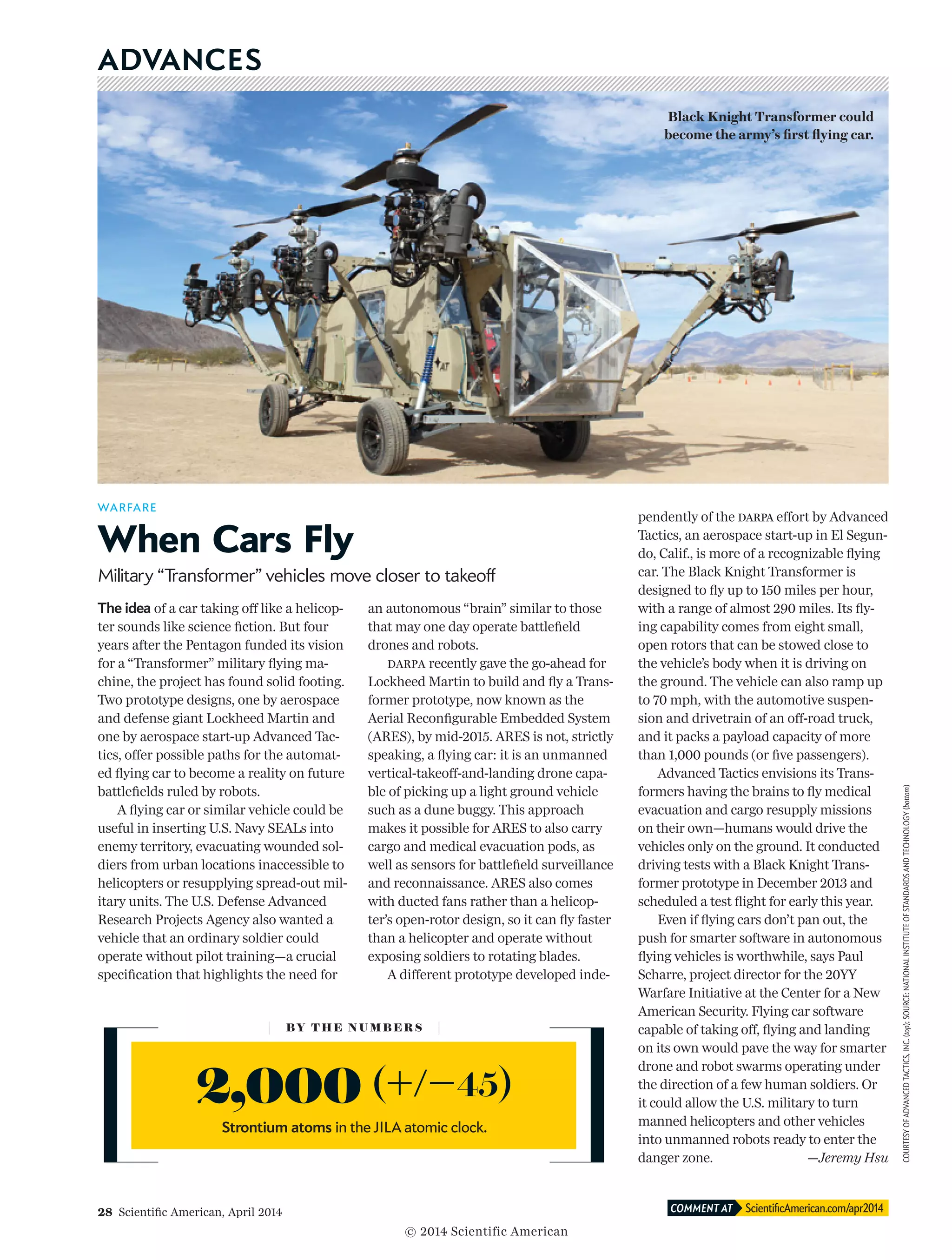
car. The Black Knight Transformer is
designed to fly up to 150 miles per hour,
with a range of almost 290 miles. Its fly­
ing capability comes from eight small,
open rotors that can be stowed close to
the vehicle’s body when it is driving on
the ground. The vehicle can also ramp up
to 70 mph, with the automotive suspen­
sion and drivetrain of an off-road truck,
and it packs a payload capacity of more
than 1,000 pounds (or five passengers).
Advanced Tactics envisions its Trans­
formers having the brains to fly medical
evacuation and cargo resupply missions
on their own—humans would drive the
ve­hicles only on the ground. It conducted
driving tests with a Black Knight Trans­
former prototype in December 2013 and
scheduled a test flight for early this year.
Even if flying cars don’t pan out, the
push for smarter software in autonomous
flying vehicles is worthwhile, says Paul
Scharre, project director for the 20YY
Warfare Initiative at the Center for a New
American Security. Flying car software
capable of taking off, flying and landing
on its own would pave the way for smarter
drone and robot swarms operating under
the direction of a few human soldiers. Or
it could allow the U.S. military to turn
manned helicopters and other vehicles
into unmanned robots ready to enter the
danger zone. —Jeremy Hsu
BY T H E N U M B E R S
Black Knight Transformer could
become the army’s first flying car.
2,000 (+⁄−45)
Strontium atoms in the JILA atomic clock.
© 2014 Scientific American
April 2014, ScientificAmerican.com  31
ACOUSTICS
One-Way
Street for Sound
Engineers achieve the difficult
task of transmitting acoustic
waves in only one direction
One-way mirrors and one-way streets
both permit flow in just one direction, but
it is difficult to create something that per-
mits sound or other waves to ripple in
one direction and not the opposite. This
is because of a fundamental property
known as time-reversal symmetry. It usu-
ally makes no difference from what direc-
tion a sound is created—if you hear, you
can be heard.
In January electrical engineer Andrea
Alù and his colleagues at the University
of Texas at Austin published results on a
device that could make one-way sound
transmission practical. Called an acoustic
circulator, the device is analogous to iso-
lators used in telecommunications and
radar, which restrict the flow of micro-
waves and radio waves to one direction.
In an isolator, electromagnetic waves
pass through a material that has a mag-
netic field applied to it. Traveling
through this magnetically altered
material breaks the time-reversal
symmetry of the wave.
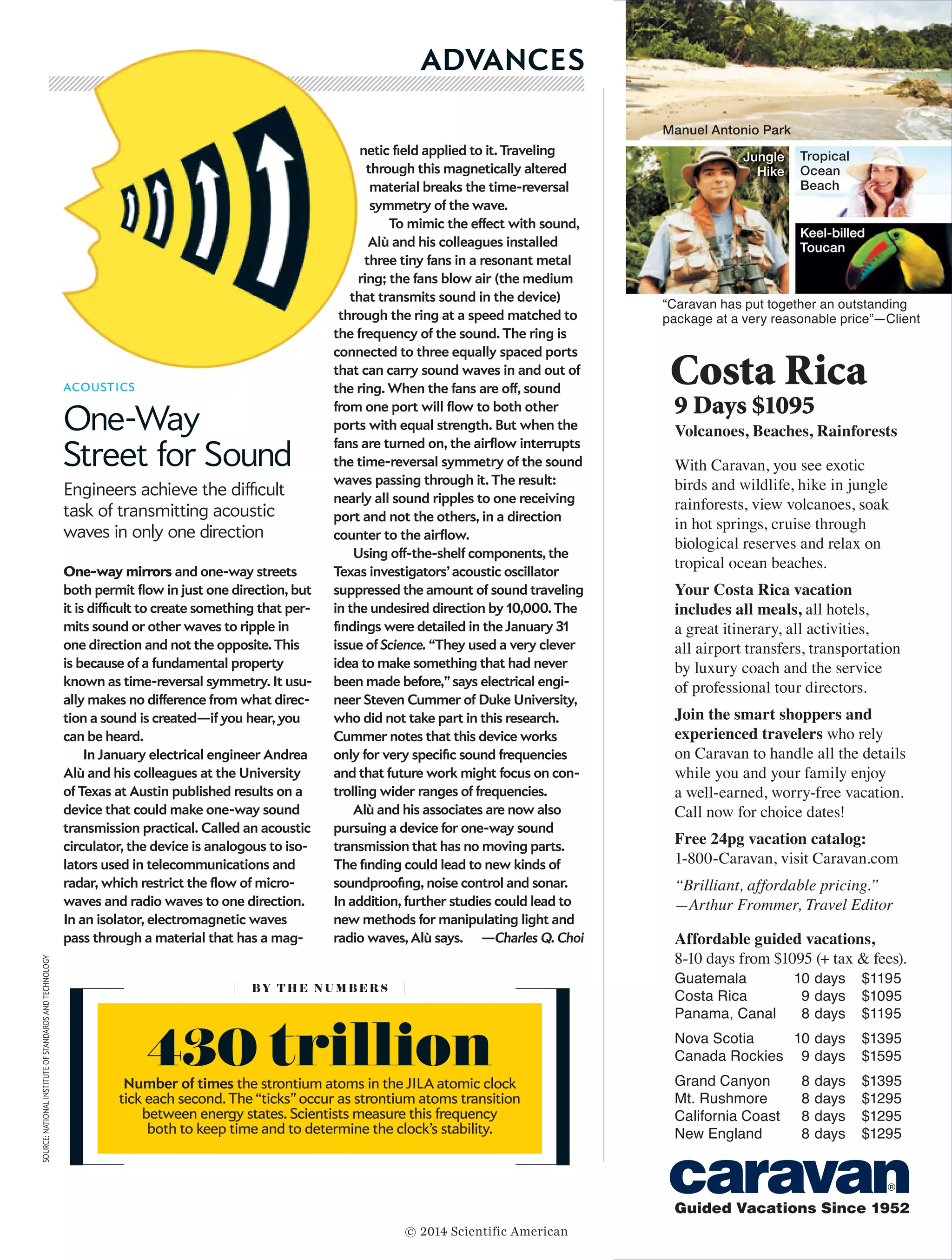
To mimic the effect with sound,
Alù and his colleagues installed
three tiny fans in a resonant metal
ring; the fans blow air (the medium
that transmits sound in the device)
through the ring at a speed matched to
the frequency of the sound. The ring is
connected to three equally spaced ports
that can carry sound waves in and out of
the ring. When the fans are off, sound
from one port will flow to both other
ports with equal strength. But when the
fans are turned on, the airflow interrupts
the time-reversal symmetry of the sound
waves passing through it. The result:
nearly all sound ripples to one receiving
port and not the others, in a direction
counter to the airflow.
Using off-the-shelf components, the
Texas investigators’ acoustic oscillator
suppressed the amount of sound traveling
in the undesired direction by 10,000. The
findings were detailed in the January 31
issue of Science. “They used a very clever
idea to make something that had never
been made before,” says electrical engi-
neer Steven Cummer of Duke University,
who did not take part in this research.
Cummer notes that this device works
only for very specific sound frequencies
and that future work might focus on con-
trolling wider ranges of frequencies.
Alù and his associates are now also
pursuing a device for one-way sound
transmission that has no moving parts.
The finding could lead to new kinds of
soundproofing, noise control and sonar.
In addition, further studies could lead to
new methods for manipulating light and
radio waves, Alù says. —Charles Q. Choi
ADVANCES
BY T H E N U M B E R S
430 trillionNumber of times the strontium atoms in the JILA atomic clock
tick each second. The “ticks” occur as strontium atoms transition
between energy states. Scientists measure this frequency
both to keep time and to determine the clock’s stability.
SOURCE:NATIONALINSTITUTEOFSTANDARDSANDTECHNOLOGY
© 2014 Scientific American
32  Scientific American, April 2014 ScientificAmerican.com/apr2014COMMENT AT
HEALTH
Antibiotic Overkill
A new approach may help curb unnecessary prescriptions
Antibiotics kill bacteria, not the viruses
that cause the common cold and the flu.
Yet doctors frequently overprescribe
them—out of habit or to satisfy patients’
demands—fueling antibiotic resistance.
The U.S. Centers for Disease Control
and Prevention reports that up to 50 per­­
cent of antibiotic prescriptions in the U.S.
are unnecessary or not optimally effective
as prescribed.
One new approach may help curb
the drugs’ overuse. A recent randomized
controlled study reported that having
clinicians sign a letter pledging to “avoid
prescribing antibiotics when they are
likely to do more harm than good” re­­
duced inappropriate antibiotic use
during flu season. Pledged physicians
reduced prescribed antibiotics by about
one third compared with unpledged
ones. The findings appeared online
January 27 in JAMA Internal Medicine.
In the study, seven clinicians—
doc­tors or nurse-practitioners—signed
a poster-size commitment to follow
prescription guidelines. The letter, which
was displayed in exam rooms, also ex­­
plained that antibiotics cannot cure colds
but do cause side effects and contribute
to drug resistance. Seven other clinicians
served as controls and did not sign a
letter or alter their normal practices.
Providers who signed the commit­
ment letter reduced unnecessary pre­
scrip­tions by about one fifth during the
intervention period, whereas those who
did not sign a poster increased their in­­
appropriate prescribing rates by about
one fifth. Still, even the poster-signing
clinicians appear to have provided anti­
biotics to patients who did not need them
roughly one third of the time.
Previous studies have looked at the
effects of posting guideline reminders, but
they did not include signed commit­ment
letters and did not report the same level
of success. “Our hypothesis is that this
commitment device is a key differ­ence
between our intervention and past work,”
asserts lead author Daniella Meeker, a
scientist at Rand Corp­oration who fo­­cuses
on health and behavioral economics.
The study does not settle the matter.
The findings need to be replicated with
a larger group of physicians. Yet if the ap­­
proach triggers similar responses in other
settings, the authors say it could theore­
tically eliminate 2.6 million unne­cessary
prescriptions and save $70.4 mil­lion in
drug costs nationwide. —Dina Fine Maron
GETTYIMAGES
ADVANCES
© 2014 Scientific American
April 2014, ScientificAmerican.com  33
BIOLOGY
Evolution’s
Little Helper
A protein may have eased a fish’s
transition from rivers to caves
Intheclassicview ofevolution,organismsundergo
randomgeneticmutations,andnatureselectsfor
themostbeneficialones.Arecentstudyin Science
addsatwisttothattheory:variabilityalreadypres-
entinapopulation’sgenomemayremainhiddenin
timesofplentybutcomeunmaskedinstressfulsitu-
ations,readytohelpwithadaptation.
Atthetheory’scoreisaproteincalledHSP90.
Itbindstootherproteinstokeepthemproperly
folded.WorkoverthepastfewdecadesbySusan
Lindquist,aprofessorofbiologyattheMassachu-
settsInstituteofTechnologyandaco-authorofthe
Science paper,hasestablishedthatwhenHSP90is
distractedfromthattask,asmightoccurinastress-
fulnewenvironment,traitsthatwereonceuniform
suddenlyshowlotsofvariation.
ThethoughtisthatwhenHSP90holdsproteins
inacertainshape,itcompensatesforminutevaria-
tionsthathavecreptintothemovergenerations.
WhenstressdivertsHSP90,theproteins’alterna-
tiveformsarereleased,triggeringthewidervariety
intraits.Naturalselectioncanthenactonthose
newtraits,spurringadaptation.
Thestudy’sleadauthor,HarvardMedical
School’sNicolasRohner,testedtheideaontheMex-
icantetra,ariver-dwellingfish.Inthedistantpast,
populationsofMexicantetraendedupinunderwa-
tercaves,anewenvironmenttowhichthefish
adaptedbylosingtheireyesight.
Rohnerandhiscolleaguesraisedsurfacefishin
watertreatedwithanHSP90blocker.Thosefish,
theyfound,hadgreatervariationsineyeandeye-
socketsizes.Stressingsurfacefishwithwaterchem-
icallysimilartocavewateralsoyieldedoffspring
withagreaterthannormalvarietyofeyesizes.
AlthoughthefindingsdonotprovethatHSP90-
maskedvariationhelpedthefishchangetheireyes,
theylendtheideaplausibility.Exactlyhowstresson
HSP90inducesvariationisstillmysterious,butitis
atopicofactiveresearch. —VeroniqueGreenwood
© 2014 Scientific American
34  Scientific American, April 2014 Illustration by Ashley Mackenzie
Hidden Dangers of Going Under
Anesthesia may have lingering side effects on the brain, even years after an operation
Two and a half years ago Susan Baker spent three hours under
general anesthesia as surgeons fused several vertebrae in her
spine. Everything went smoothly, and for the first six hours
after her operation, Baker, then an 81-year-old professor at the
Johns Hopkins Bloomberg School of Public Health, was recov-
ering well. That night, however, she hallucinated a fire raging
through the hospital toward her room. Petrified, she repeatedly
buzzed the nurses’ station, pleading for help. The next day she
was back to her usual self. “It was the most terrifying experi-
ence I have ever had,” she says.
Baker’s waking nightmare was a symptom of postoperative
delirium, a state of serious confusion and memory loss that
sometimes follows anesthesia. In addition to hallucinations,
delirious patients may forget why they are in the hospital, have
trouble responding to questions and speak in nonsensical sen-
tences. Such bewilderment—which is far more severe than the
temporary mental fog one might expect after any major opera-
tion that requires general anesthesia—usually resolves after a
day or two.
Although physicians have known about the possibility of
such confusion since at least the 1980s, they had decided, based
on the then available evidence, that the drugs used to anesthe-
tize a patient in the first place were unlikely to be responsible.
Instead, they concluded, the condition occurred more often
because of the stress of surgery, which might in turn unmask an
underlying brain defect or the early stages of dementia. Studies
in the past four years have cast doubt on that assumption, how-
ever, and suggest that a high enough dose of anesthesia can in
fact raise the risk of delirium after surgery. Recent studies also
indicate that the condition may be more pernicious than previ-
ously realized: even if the confusion dissipates, attention and
memory can languish for months and, in some cases, years.
IN TOO DEEP
anesthesia comes in three main types. Local anesthesia, the mild-
est form, merely numbs a very small area, such as a single tooth.
Regional anesthesia desensitizes a large section of someone’s body
by injecting drugs into the spine that block nerve signals to the
brain. Often a patient getting regional anesthesia also takes a rela-
tively small dose of a powerful sedative drug, such as propofol—
not enough to put them under but enough to alter brain activity in
a way that makes the person less aware and responsive.
General anesthesia relies on a cocktail of drugs that renders
patients completely unconscious, prevents them from moving
and blocks any memories of the surgery. Although anesthetic
drugs have been around since 1846, many questions remain as to
how exactly they work. To date, the strongest evidence suggests
that the drugs are effective in part because they bind to and inca-
pacitate several different proteins on the surface of neurons that
are essential for regulating sleep, attention, learning and memo-
ry. In addition, it seems that interrupting the usual activity of
neurons may disrupt communication between far-flung regions
of the brain, which somehow triggers unconsciousness.
When postoperative delirium was first recognized, research-
ers wondered whether certain anesthetic drugs—but not oth-
ers—deserved the blame. Yet studies comparing specific drugs
and rates of delirium in patients after surgery have always been
scant and inconclusive. “No particular anesthetic has been exon-
erated in patients,” says Roderic G. Eckenhoff, a professor of
anesthesiology at the University of Pennsylvania. But “we can’t
say yet that there is an anesthetic that patients should not get.”
One reason scientists struggled to say whether sedative drugs
were at fault was the difficulty of separating them from other
major hospital stresses, such as surgery itself. Indeed, many of
the things that make being hospitalized so unpleasant—poor
sleep, restricted movement and a regimen of medicines—can
also cause confusion, forgetfulness and even delusions.
In spite of these difficulties, researchers hit on two other
factors that increased the chances a patient would be­­come dra-
The Science of Health by Carina Storrs
Carina Storrs is a freelance science and health writer
whose work has appeared in Popular Science,The
Scientist and Health.com,among other publications.
© 2014 Scientific American
April 2014, ScientificAmerican.com 35
matically confused after an operation: being older than about
70 and having preexisting mental deficits, such as regularly for-
getting appointments or severe dementia. Delirium is also more
common after major surgeries—which can last at least a few
hours and require patients to stay one night or longer in the hos-
pital. Among patients above age 60 about 50 percent become
seriously disoriented after heart bypass or valve replacement
surgery, according to one study, yet the same is true for only 15
percent or so of patients in the same age range who have elective
hip joint surgery—a shorter and less risky procedure.
Research over the past several years has revived anesthesia as
a potential culprit in delirium: instead of focusing on the type of
anesthetic drug, scientists are now concerned about the amount
of overall anesthesia. Researchers suspect that the more anes-
thesia someone receives—and, consequently, the deeper some-
one slips into unconsciousness—the greater the risk of de­­lirium.
In one study, for example, Frederick E. Sieber of the Johns
Hopkins University School of Medicine and his colleagues gave
57 elderly hip surgery patients enough propofol to achieve re­­
gional anesthesia and another 57 patients enough propofol to in­­
duce general anesthesia. Eleven of the lightly anesthetized pa­­
tients became delirious after the operation, compared with 23 of
the patients under general anesthesia.
A related study offers a clue as to why previous research failed
to see a difference in rates of delirium between patients receiving
general and regional anesthesia. Sieber tracked 15 patients aged
65 years and older who were all undergoing surgery to repair
fractured hips. The team gave the patients regional anesthesia
consisting of propofol and an anesthetic that disabled nerves in
the spinal cord. Based on standard practice, the team monitored
blood pressure and heart rate as a proxy for depth of anesthesia
to determine the appropriate dose. Meanwhile a computer,
which the team could not see, also determined the depth of anes-
thesia based on a more direct but less commonly used measure-
ment: electrical activity in the patients’ brain, as gauged by elec-
trodes attached to their forehead. The fewer electrical impulses
crackling through their brains, the deeper the anesthesia. Eighty-
seven percent of patients’ brain activity dipped low enough to
qualify as general anesthesia during at least part of the surgery.
“I was flabbergasted,” Sieber says. Because of this study and
similar findings, he suspects that it is common for patients get-
ting regional anesthesia to receive so much sedative drug that
they are actually in a state of general anesthesia.
LASTING EFFECTS
Deep anesthesia has also been linked to subtler but longer-last-
ing cognitive problems. In a 2013 study, doctors at a Hong Kong
hospital monitored the brain activity of 462 patients undergo-
ing major surgery, keeping the electrical activity as high as pos-
sible while still inducing general anesthesia. For another 459
patients receiving general anesthesia, the doctors monitored
only blood pressure and heart rate. Patients received either
propofol or one of several anesthetic gases. The morning after
surgery, 16 percent of patients who had received light anesthe-
sia displayed confusion, compared with 24 percent of the rou-
tine care group. Likewise, 15 percent of patients who received
typical anesthesia had postoperative mental setbacks that lin-
gered for at least three months—they performed poorly on
word-recall tests, for example—but only 10 percent of those in
the light anesthesia group had such difficulties.
In some cases, these mental handicaps persist longer than a
few months. Jane Saczynski, an assistant professor of medicine
at the University of Massachusetts Medical School, and her col-
leagues tracked the mental abilities of patients 60 years and
older in the Boston area for up to one year after heart bypass or
valve surgery. Based on tests of memory and attention in which
patients repeated phrases and named everyday objects, those
who did not develop any delirium generally regained their pre-
surgery mental capabilities within a month, whereas patients
with postoperative delirium took between six months and a full
year to recuperate. Patients whose mental fog lasted more than
three days after surgery had still not regained their full acumen
a year after the operation.
Although researchers remain uncertain about how anes-
thetic drugs might usher in a state of postoperative delirium,
they have some ideas. The drugs may have an easier time over-
whelming neurons in older adults because the proteins that
anesthetic drugs are thought to target on the surface of neu-
rons become less abundant with age. Some experts have sug-
gested that in elderly patients, the brain may also have a harder
time refashioning the connections between different regions
that could break down during anesthesia.
PRELIMINARY PROTECTIONS
As researchers continue to look for more precise answers about
postoperative delirium, clinicians are adopting a number of
strategies to minimize risk. Doctors at John Hopkins and other
hospital settings now constantly talk with elderly patients dur-
ing regional anesthesia, making sure they can respond to their
name. Sieber thinks this practice could be at least as effective a
gauge of the depth of anesthesia as brain activity and could be
superior to blood pressure and heart rate measurements.
Other precautions include making sure patients are well
hydrated and nourished before surgery, which likely improves
blood flow to the brain. After surgery, experts recommend ori-
enting patients to their hospital stay by encouraging family and
friends to visit, getting them up and out of bed during the day,
encouraging a good night’s sleep, and discontinuing any medica-
tions that could further alter brain activity. Although it remains
unclear exactly how these interventions help, physical and men-
tal activities stimulate communication between nerve cells,
which could reestablish vital connections between brain regions.
For her part, Susan Baker has always made an effort to be as
active as possible and to spend time with loved ones following
the various surgeries in her life, just because it has seemed like
a good way to spur recovery. But when she had to have another
procedure after her delirious episode, she took a couple of extra
precautions—asking her son to stay in her hospital room that
night, for example. And before her operation, she made a spe-
cial request: to keep the anesthesia as light as possible. 
SCIENTIFIC AMERICAN ONLINE
Comment on this article at ScientificAmerican.com/apr2014
© 2014 Scientific American
TechnoFiles by David Pogue
36  Scientific American, April 2014
David Pogue is the anchor columnist forYahooTech
and host of several NOVA miniseries on PBS.
Illustration by Scott Brundage
The Great Net Debate
Who gets to control what’s passing through those pipes?
Good evening, ladies and gentlemen, and welcome to “Intracta-
ble Tech Battles!” Today—net neutrality! Yes, net neutrality: it’s
in the news, it’s just been in the courts and, sooner or later, it will
affect you! It’s my pleasure to introduce Pro, who’s in favor of net
neutrality, and Con, who’s against it.
Pogue: Now, Pro, whose side do you represent?
Pro: Why, nearly every proconsumer organization on earth,
in­­cluding the Consumers Union and Common Cause. Also, the
creators of the Internet (including Vinton Cerf) and the Web
(in­­cluding Tim Berners-Lee). And every true believer in free
speech, innovation and the American way.
Pogue: And you, Con?
Con: I represent the companies that bring America its Internet,
including Verizon, Comcast, ATT and Time Warner.
Pogue: Okay, Pro, let’s start simple: What is this “network
neutrality”?
Pro: It’s the idea that all Internet data should be equal. That
the Comcasts and Verizons of the world can provide the pipes
but should have no say in what passes through them. The Inter-
net providers shouldn’t be allowed to charge different compa-
nies more or less for their data or to slow down, or block, access
to Web sites and services they don’t like.
Pogue: Isn’t that the way the Internet has always been?
Pro: Yes. Neutrality has been a core democratizing principle of
the Internet since the day it was born. Internet service should
be like phone service: the phone company can’t make the con-
nection worse if they don’t approve of the person you’re calling.
Con: But times have changed. Today Netflix and YouTube vid-
eos clog our pipes with enormous amounts of data. Or consider
the BitTorrent crowd, which uses our lines to download insane
exabytes of software, movies and music—illegally. Or how
about Google and Skype? They’ve created services that let peo-
ple make phone calls—for free—on networks that we spent bil-
lions to build. Why should­n’t all those services pay their share?
Pro: Because net neutrality protects innovation. If big compa-
nies such as Netflix and Google could pay to get special treat-
ment—faster speeds, more bandwidth—little start-ups would
be at a disadvantage.
Con: Net neutrality is stifling innovation! If we could charge
higher fees to the biggest bandwidth hogs, we could afford to
build advanced fiber networks that permit all kinds of new
Internet services.
Pro: But what about freedom of speech? Without net neutrality,
Comcast could give priority to video from TV networks it
owns—such as NBC—and slow down the signals from its rivals.
Con: We wouldn’t do that. Pinky swear. Verizon said that giving
“unblocked access to lawful Web sites ... will not change.”
Pro: Oh no? Then why was Verizon the company that led the
charge to strike down net neutrality in court?
Con: Ah, you mean the District of Columbia Circuit Court of
Appeals decision in January. Yes, the court already struck down
the Federal Communications Commission’s 2010 net neutrality
rules—proving that I’ve been right all along.
Pro: You were never right. The fcc lost that one on a technicali-
ty. And the American public will ultimately be the losers.
Con: You call that a technicality? It was the fcc itself that origi-
nally classified us Internet providers as an “information ser-
vice,” which isn’t susceptible to much regulation, instead of
a “telecommunications service,” which is. It’s the fcc’s fault.
Pro: On that point, you are correct. The fcc chair who voted for
that initial misclassification is now the chief lobbyist for the
telecom companies. It was a fox-in-the-henhouse situation—
one that the current chair, if he has any backbone, will quickly
reverse, despite his own background lobbying for big telecoms.
Pogue: And I’m afraid that’s all the time we have. Join us next
time! If your Internet provider allows it. 
SCIENTIFIC AMERICAN ONLINE
Battle history of the net neutrality war: ScientificAmerican.com/apr2014/pogue
© 2014 Scientific American
Photograph by Tktk Tktk38  Scientific American, April 2014
Not long after the big bang’s flash, all light left 	
FIRST STARS in the universe were
unimaginably large—perhaps a mil-
lion times the mass of our sun. They
would have helped clear the fog
enshrouding the early universe before
dying in supernova explosions, seen
here in an artist’s impression.
© 2014 Scientific American
Illustration by Artist Name
the cosmos. Astronomers are now solving the mystery of its return
By Michael D. Lemonick
the first
starlight
ASTRONOMY
April 2014, ScientificAmerican.com 39
© 2014 Scientific American
40  Scientific American, April 2014
PRECEDINGPAGES:COURTESYOFADOLFSCHALLERANDNASA
And dark they were. For even when the first stars started to
ignite, their light shone brightest in the ultraviolet portion of the
spectrum—just the kind of light that the newly formed hydrogen
gas tends to absorb. The universe traded its primordial hot,
bright fog for one that was cool and dark.
Eventually this fog would lift, but how it did so is a question
that has long baffled astronomers. Maybe it was accomplished
by the first stars, whose intense light gradually but relentlessly
broke the hydrogen apart in a process called reionization. Per­
haps instead the energy for reionization came from the radia­
tion that is generated by hot gas spiraling into giant black holes.
The key to figuring out how and when reionization took
place, unsurprisingly, is finding the oldest objects in the uni­
verse and trying to tease out their nature and their origins.
When did the first stars turn on, and what were they like? How
did individual stars assemble themselves into galaxies, and how
did those galaxies form the supermassive
black holes that lie at the core of nearly all of
them? At what point in this progression
from stars to galaxies to black holes did re­­
ionization take place? And was the process
gradual or abrupt?
Astrophysicists have been asking many of
these questions since the 1960s. Only re­­
cently, however, have telescopes and comput­
er models gotten powerful enough to of­­fer
some an­­swers: the latter by simulating the
emergence and evolution of the first stars in
the universe, and the former by gathering
telltale glimmers of light from less than half a
billion years after the big bang—a time when
the first galaxies were in their infancy.
SUPERSTARS
A decade or so ago astronomers believed that
they had a good handle on how the first gen­
eration of stars came to be. Immediately af­ter
recombination, the hydrogen atoms that filled
the cosmos were spread uniformly through
space. In contrast, dark matter, which physicists believe to be
made of invisible particles that have not yet been identified, had
already begun clumping together in clouds known as halos, aver­
aging somewhere between 100,000 and one million solar mass­
es. Gravity from these halos sucked in the hydrogen. As the gas
became increasingly concentrated and heated up, it flared into
light, creating the first stars in the universe.
In principle, this first generation of giant stars, known to
astronomers as Population III stars, could have broken up the
veil of hydrogen gas and reionized the universe. But much
I N B R I E F
The universe’s very first stars and galaxies were not
like the objects we see today.Astronomers are reach-
ing back in time to probe how the first objects in the
universe came to be.
They are particularly interested in what caused the
so-called reionization of the universe, when the neu-
tral hydrogen atoms pervading the cosmos were bro-
ken up by light.
Observations and computer simulations  suggest
that the objects driving reionization could be million-
solar-mass stars or the gaseous belches of enormous
black holes.
ABOUT 13.8 BILLION YEARS AGO, just 400,000 years
or so after the big bang, the universe abruptly went dark.
Before that time, the entire visible universe was a hot,
seething, roiling plasma—a dense cloud of protons, neu­
trons and electrons. If anyone had been there to see it, the
universe would have looked like a pea soup fog, but blin­
dingly bright.
Around the 400,000-year mark, however, the expand­
ing universe cooled enough for hydrogen atoms to form
at last—an event known as recombination. The fog lifted,
the universe continued to cool and everything quickly
faded to black. After the unimaginable brilliance of the
big bang and its immediate aftermath, the cosmos entered
what astronomers call the dark ages of the universe.
Michael D.Lemonick is a writer at Climate Central,
a nonprofit news site,and author of Mirror Earth:The Search
for Our Planet’sTwin (Walker Books,2012).For 21 years
he was a science writer for Time magazine.
© 2014 Scientific American
April 2014, ScientificAmerican.com 41
depends on the exact characteristics of these stars. If they were
not bright enough or did not live long enough, they would not
be capable of finishing the job.
The characteristics of these stars depend strongly on their
size. As of a decade ago, astronomers believed that they would
be uniformly gigantic, each with roughly 100 times the mass of
the sun [see box on next page]. The reason: As a clump of gas
tries to collapse under gravity, it heats up. The heat creates so-
called radiation pressure that opposes gravity; unless the star
can shed some of this heat, the collapse will stall.
The first stars were made mostly of hydrogen, which is rela­
tively terrible at shedding heat. (Stars like our sun also have
small but critical traces of elements such as oxygen and carbon,
which help them to cool.) As a result, a protostar in the early
universe would continue to accumulate hydrogen gas, but the
high pressure would prevent it from forming a dense core that
would burst into a fusion reaction—one that drives much of the
surrounding gas back out into space. The star would just gorge
itself on more and more gas until it built a massive, diffuse core.
Now, however, says Thomas Greif, a Harvard University post­
doctoral fellow who creates some of the most sophisticated sim­
ulations of early star formation, “things look a bit more compli­
cated.” These newest simulations include not just gravity but
also equations describing the feedbacks generated by increas­
ingly pressurized hydrogen as the gas collapses. It turns out that
the collapse of a hydrogen cloud can play out in many different
ways. In some cases, the first stars could have been up to a
­million  times as massive as the sun. In others, the collapsing
cloud would have fragmented, creating several stars of just a few
tens of solar masses.
These size differences imply huge variations in the possible
lifetimes of the first stars—and therefore in when reionization
might have occurred. Giant stars of 100 solar masses or more
are the rock ’n’ rollers of astronomy: they live fast and die young.
Smaller stars would churn through their nuclear fuel more
slowly, implying that if stars were responsible for reionization,
the process would have been a long-drawn-out one, spanning
many hundreds of millions of years.
Illustrations by Moonrunner Design
The First Billion Years
Just 380,000 years after the big bang—a blink on cosmic scales—
the universe cooled to the point where hydrogen atoms could form,
and all went dark. By about one billion years later, the universe was
fully “reionized”—radiation had blown the atoms apart, clearing the
way for light to shine again. But which objects powered the
reionization—were they stars or galaxies or the
black holes at the centers of quasars?
C O S M I C H I ST O RY
Epoch of Reionization
The first stars in the universe shone brightest in the
ultraviolet portion of the spectrum.But the neutral
hydrogen gas that pervaded the cosmos absorbed UV
light.Eventually the light would have broken apart the
hydrogen.When that happened,how long it took and
what caused it have been open questions for decades.
Inflation
Big bang
Particles form
Early galaxies
(about 500 million years)
Early stars
(about 100 million years)
Quasars
(about 700 million years)
Dark ages
Recombination
(380,000 years
after the big bang)
Bubbles of ionized
gas (blue)
© 2014 Scientific American
42  Scientific American, April 2014
BLACK LIGHTS
However large they were, all these stars would have ended their
existence in fiery supernovae before collapsing into black holes.
And these black holes—perhaps more than the stars from which
they came—may have fueled the engine of reionization.
Black holes swallow nearby gas voraciously, and as the gas
falls in, it is compressed and heated to temperatures of millions
of degrees. It is so hot that while most of the gas eventually dis­
appears into the black hole, some spews back out into space in
the form of jets, which shine so brightly that the light can be
seen halfway across the cosmos. We call these beacons quasars.
From the 1960s through the 1990s, quasars were really the
only way to probe the early universe. At first, astronomers had
no clue what they were. Quasars looked like nearby stars but
had huge redshifts—a reddening of their light caused by the
expansion of the universe. The impressive redshifts indicated
that quasars were vastly farther away than any stand-alone star
could possibly be and were thus vastly brighter as well. The first
one ever found, 3C 273, had a redshift of 0.16, indicating that its
light had begun traveling about two billion years ago.
“Then, very quickly,” says Princeton University astrophysicist
Michael A. Strauss, “people found quasars up to redshift 2”—a
look-back time of more than 10 billion years. By 1991 Maarten
Schmidt, James E. Gunn and Donald P. Schneider, working to­­
gether at Palomar Observatory in California, had found a quasar
with a redshift of 4.9, dating to 12.5 billion years before the pres­
ent, or just a billion years and change after the big bang.
Yet analyses of the redshift 4.9 quasar found no evidence
that its light was being absorbed by neutral hydrogen. Appar­
ently the universe had already been reionized by the time the
light from this quasar had begun its journey to Earth.
For most of the 1990s, no one was able to find a quasar any
Young Giants of the Universe
Why were the first stars so large? All stars execute a cosmic balancing act—gravity attempts to squeeze them as tight as possible,
but the gas pressure inside the star fights against gravity and keeps the star inflated. By comparing star formation in the modern
universe with star formation in the early universe, we can begin to understand why the universe’s first stars were so massive.
STA R F O R M AT I O N
Star Formation Now
Modern galaxies are littered with ingredients such as carbon,oxygen and dust.These materials help gases to cool.Cool
clouds have lower pressures.Lower pressure means a collapsing cloud of dust can contract until its core is extremely
dense—dense enough to get the hydrogen in its center to undergo thermonuclear fusion.After fusion begins,the
sudden burst of energy blows away the outermost layers of the collapsing cloud,leaving a relatively small star behind.
Star Formation Then
The early universe did not have any carbon,oxygen or dust—only hydrogen,with a smattering of helium and lithium.
Hydrogen does not cool very efficiently.As gas clouds began to collapse,the hot hydrogen kept the density in early
protostars low.Without enough density to initiate fusion,the gas clouds continued to accumulate more and more
gas—anywhere from 100 to one million suns’worth.Only then would they get hot and dense enough to initiate fusion.
Gas contractsMaterial accumulates Fusion begins Outer layers are blown away
Gas contractsMaterial accumulates Material continues to accumulate Fusion begins
© 2014 Scientific American
April 2014, ScientificAmerican.com 43
farther away than this one. The failure was not for a lack of pow­
erful instruments—both the Hubble Space Telescope and the
Keck telescopes at Mauna Kea in Hawaii came online in the ear­
ly 1990s, significantly increasing astronomers’ ability to see
deep into the universe—but because quasars are rare to begin
with. They erupt only from the most massive of supermassive
black holes. And from our perspective, they do not shine unless
their jets of gas happen to be aimed directly at us.
Moreover, those jets blast into existence only when a black
hole is actively swallowing gas. For most black holes, that kind
of activity peaked between a redshift of 2 and 3, when galaxies
were more gas-rich, on average, than they are today. If you look
further out than that sweet spot in cosmic time, the number of
quasars drops off rapidly.
It was not until 2000, when the Sloan Digital Sky Survey began
methodically searching across an enormous swath of sky with the
largest digital detectors ever built until that point, that the record
was shattered in earnest (the detectors were designed by the same
Gunn). “The Sloan was just fabulously successful in finding dis­
tant quasars,” says California Institute of Technology astronomer
Richard Ellis. “They found something like 40 or 50 quasars beyond
a redshift of 5.5.”
But the survey could not reach back much further than a
handful of quasars that it found between redshift 6 and 6.4, and
even at that distance there was no sign of neutral hydrogen. It
was only with the discovery of a quasar at redshift 7.085, by the
UKIRT Infrared Deep Sky Survey at Mauna Kea, that astrono­
mers found small but significant amounts of ultraviolet-absorb­
ing hydrogen obscuring the object’s light. This quasar, known as
ULAS J1120+0641, shining about 770 million years after the big
bang, finally let astrophysicists dip a toe into the era of cosmic
reionization—but just a toe because even this close to the big
bang, most of the neutral hydrogen had already been destroyed.
Or maybe not. It’s possible that this quasar sits in an unusual­
ly sparse region of leftover neutral hydrogen and that most other
quasars at this distance would have been more completely
shrouded. It is equally possible that ULAS J1120+0641 is in an
especially dense region; maybe reionization was already com­
plete pretty much everywhere else. Without more examples, as­­
tronomers cannot be sure, and the prospects of finding enough
quasars at this distance to do a robust statistical study are slim.
ULAS J1120+0641 has plenty to tell astronomers anyway. For
one thing, Ellis says, “the number of quasars is falling so steeply
with distance that it’s inconceivable that massive black holes are
a major source of radiation that reionizes the universe.” For
another, the black hole that powers this particular quasar must
have a billion suns’ worth of mass in order to generate the amount
of energy that makes it visible from so far away. “It’s almost im­­
possible to understand how it could have formed in the limited
time that the universe had up to that point,” Ellis says.
Yet form it did. Abraham Loeb, chair of Harvard’s astronomy
department, points out that if a first-generation star with 100
solar masses collapsed into a black hole a couple of hundred mil­
lion years after the big bang, it could conceivably have grown to
quasar proportions in the available time if conditions were just
right. “But you would need to feed the black hole continuously,”
he says, and it is hard to imagine how you could do that. “They
shine so brightly, they produce so much energy, that they expel
the gas out of their vicinity.” Without a nearby supply of gas, the
quasar goes temporarily dark, allowing gas to accumulate again
until it can flare back into life—and blow away its fuel supply once
more. “So there is always the notion of a duty cycle,” Loeb says.
“The black hole is able to grow only for a fraction of the time.”
Yet, he says, black holes can also grow by merging with one
another, which would accelerate their growth process. In addi­
tion, the recent work on star sizes implies that those first black
holes may have formed not from stars that were 100 solar mass­
es, but one million solar masses, a suggestion Loeb first put
forth in a 2003 paper that he co-authored. “This has become a
popular idea,” he says, buttressed by simulations such as Greif’s.
“And because these stars would shine as brightly as the entire
Milky Way, you could, in principle, see them with the James
Webb Space Telescope,” the massive successor to the Hubble
telescope that is currently scheduled to launch in 2018.
GALAXY QUEST
Even as the hunt for distant quasars has more or less petered
out, the search for galaxies closer and closer to the big bang has
taken off. Perhaps the most important triggering event was an
image called the Hubble Deep Field. It was made in 1995, when
Robert Williams, then director of the Space Telescope Science
Institute, used a perk of the office known as “director’s discre­
tionary time” to aim Hubble at an evidently blank patch of sky
and let it stare for a cumulative 30 hours or so to pick up what­
ever faint objects might be there. “Some very serious astrono­
mers told him it was a waste of time,” recalls current director
Matt Mountain, “that he wouldn’t see anything.”
In fact, the telescope picked up several thousand small, faint
galaxies, many of which turned out to be among the most distant
ever seen. Follow-up Deep Field images—made with Hubble’s new,
infrared-sensitive Wide Field Camera 3, which was installed dur­
ing a 2009 servicing mission and is some 35 times more effective
than its predecessor—have found even more. “We’ve gone from
four or five galaxies with a redshift of 7 or more,” says University
of Arizona observer Daniel Stark, Ellis’s longtime collaborator,
“to more than 100.” One of these, described by Ellis, Stark and
several co-authors in a 2012 paper, appears to be at a redshift of
no less than 11.9, fewer than 400 million years after the big bang.
Like the record-holding quasar, these young galaxies can tell
astronomers plenty about the distribution of intergalactic
hydrogen at the time. When observers look at their output of
ultraviolet light, a significant fraction of what they would expect
to see is missing, absorbed by neutral hydrogen that surrounds
them. That fraction drops gradually as they look at galaxies that
are further from the big bang—until, at about a billion years
after the universe was born, the cosmos is fully transparent.
In short, not only did galaxies exist to provide a source for the
ionizing radiation, they also reveal how the universe made the
transition from neutral to fully ionized. Astronomical detectives
have a smoking gun, and they have a victim. There is a catch,
however. If you take the 100-odd galaxies found so far above a
redshift of 7 and extrapolate across the entire sky, you do not
have enough total ultraviolet radiation to ionize all the neutral
hydrogen. The gun does not seem to be powerful enough to do
the job. The required energy cannot come from black holes,
either, given how hard it is to make enough supermassive black
holes quickly enough to do so.
Yet the answer may be relatively straightforward. Faint as they
© 2014 Scientific American
seem to us, the galaxies we are able to see at the very edge of Hub­
ble’s vision are presumably the brightest of their epoch. There
must be many more galaxies at that distance that are simply too
dim to see with any existing telescope. If you make that reason­
able assumption, Ellis says, “I think most people now believe that
galaxies do most of the work in reionizing the universe.”
THE EINSTEIN CARD
As for what truly newborn galaxies look like and when they
first turned on, “we’re not there yet,” Stark admits. “The galaxies
we do see are fairly small, and they look much younger than gal­
axies that have been studied in detail one billion to two billion
years later.” But they already have as many as 100 million stars,
and the mix of their colors (after you correct for the fact that
their light is redshifted) suggests their stars are on average red­
der than you would expect in a very young galaxy. “These
objects,” Stark says, “look like they’ve been forming stars for at
least 100 million years already. Hubble has taken us close to the
precipice, to where we’ll see the first generation of stars, but it
will take the James Webb Space Telescope to get us there.”
Hubble has not exhausted its options, however. The telescope
itself can see only to a certain faintness limit without taking
absurdly long exposures. Yet the universe has supplied its own
natural lenses that can boost Hubble’s power. These so-called grav­
itational lenses take advantage of the fact that massive objects—in
this case, clusters of galaxies—warp the space around them, dis­
torting and sometimes magnifying the objects that lie far beyond.
In particular, says observer Marc Postman of the Space Tele­
scope Science Institute, “we get a big amplification of any very
distant galaxies that lie behind those clusters. They can be 10 or
20 times brighter than comparable unlensed galaxies.” Postman
is principal investigator for the Cluster Lensing and Supernova
Survey with Hubble, a program that has used the technique to
identify some 250 additional galaxies between redshift 6 and 8
and a handful more that may go up to redshift 11. From what
they have seen so far, the results are consistent with those com­
ing out of the various Deep Field surveys.
Now Hubble is going deeper still: Mountain has devoted
some of his own director’s discretionary time to a new project
called Frontier Fields, in which observers will look for magni­
fied images of faint, distant galaxies that lie behind six especial­
ly massive and powerful clusters. Over the next three years, says
Jennifer Lotz, the project’s lead observer, “we’re going to look at
each of them for something like 140 orbits of Hubble [each orbit
is about 45 minutes’ worth of observing time], which will let us
probe deeper into the universe than anything we’ve ever seen.”
BURST SEARCH
Yet another kind of cosmic beacon, meanwhile, could ultimately
prove to be an even better probe of the early universe. When first
discovered in the 1960s, gamma-ray bursts—short blasts of high-
frequency radiation that pop up in random directions—were an
utter mystery. Nowadays astronomers believe that many of them
come from the deaths of very massive stars: as the stars collapse
to form black holes, they spew jets of gamma rays out into space.
When the jets slam into the surrounding clouds of gas, they trig­
ger a secondary, bright afterglow of visible and infrared light
that can be seen by conventional telescopes.
Here is how the observations work: When the orbiting Swift
Gamma-Ray Burst observatory detects a gamma-ray flash, it
swivels to point its onboard telescopes at the spot. At the same
time, it beams the location’s coordinates to ground-based observ­
ers. If their telescopes get there before the flash fades, astrono­
mers can measure the afterglow’s redshift and thus the red­
shift—and age—of the galaxy where the burst went off.
What makes the technique so valuable is that gamma-ray
bursts make other cosmic objects look positive­
ly feeble. “For the first few hours,” says Edo
Berger, a Harvard astrophysicist who specializ­
es in the bursts, “they probably outshine galax­
ies by a factor of a million, and they’re 10 to 100
times brighter than quasars.” You do not need a
long exposure with Hubble to see them. In 2009
a telescope on Mauna Kea reliably measured the
redshift of one burst at 8.2, putting it at 600 mil­
lion years after the big bang.
The flash was so bright, Berger says, that it
could have been seen out to a redshift of 15 or
even 20, which would be less than 200 million
years after the big bang, close to the time the
very first stars may have been shining. And it is
entirely plausible, he says, that those very mas­
sive stars would be exactly the kind to produce gamma-ray
bursts as they die. In fact, Berger says, there is reason to think
these first-generation stars would create such energetic gamma-
ray bursts that they would appear brighter than the ones discov­
ered so far, even though they would be farther away.
Unlike quasars, moreover, which occur only in galaxies with
supermassive black holes, and unlike the galaxies Hubble can
see, which are the brightest tips of a grand galactic iceberg,
gamma-ray bursts are just as powerful in tiny galaxies as they
are in big ones. They provide, in other words, a much more rep­
resentative sample of the universe at any given time.
The downside, Berger says: 99 percent of gamma-ray bursts
are pointed away from Earth, and of the remaining one per day
or so that are detected by satellites, only a minuscule fraction
are at a high redshift. Gathering a representative sample of
extremely high redshift bursts would therefore take a decade or
more, and “Swift is probably not going to last” that long, Berger
says. Ideally, he notes, someone should launch a successor satel­
lite that could feed burst coordinates to the James Webb tele­
scope or to the three 30-meter-class ground-based instruments
It’s almost impossible to
understand how the black hole
could have grown so large
in the limited time that the
universe had up to that point.
Yet form it did.
Watch a video showing how the first galaxies formed at ScientificAmerican.com/apr2014/first-starlightSCIENTIFIC AMERICAN ONLINE 	
© 2014 Scientific American
April 2014, ScientificAmerican.com 45
SOURCE:GEORGEDJORGOVSKICaliforniaInstituteofTechnology ANDABRAHAMLOEBHarvardUniversity
that are expected to be operating within the next decade. Pro­
posals to do so have so far failed to get the go-ahead from either
nasa or the European Space Agency.
In any case, once the James Webb telescope and the next
generation of gigantic ground-based telescopes begin observa­
tions, quasar hunters, galaxy surveyors and those who search
for the telltale afterglows of gamma-ray bursts in other electro­
magnetic wavelengths will be able to catalogue much older and
fainter objects than they can today. Their work will help to nail
down exactly what was going on in the very early universe.
Radio astronomers, meanwhile, will be looking to instru­
ments such as the Murchison Widefield Array in Australia, the
Precision Array for Probing the Epoch of Reionization in South
Africa, the Square Kilometer Array, split between those two coun­
tries, and the Low Frequency Array (LOFAR), with antennas
located in several European countries, to try mapping out slowly
disappearing clouds of neutral hydrogen during the first billion
years of cosmic history. The hydrogen itself emits radio waves, so
in principle, astronomers will be able to look at those emissions
at different epochs—each redshifted by a different amount,
depending on how far away they are—and take snapshots of the
hydrogen as it is gradually eaten away by high-energy radiation
as the images come forward in time. And finally, astronomers
will be using the Atacama Large Millimeter/submillimeter Array
in the high Chilean desert to search for carbon monoxide and
other molecules that mark the interstellar clouds where the sec­
ond generation of stars was born.
When cosmologists first detected the leftover electromagnetic
radiation from the big bang in 1965, it galvanized them to try and
understand the life history of the universe from its birth right
through to the present. They are not quite there yet. But there is
every reason to believe that by 2025, the 60th anniversary of that
discovery, the last remaining blanks will finally be filled in. 
MORE TO EXPLORE
The DarkAge of the Universe. Jordi Miralda-Escudé in Science, Vol. 300,
pages 1904–1909; June 20, 2003. http://arxiv.org/abs/astro-ph/0307396
The First Stars. Volker Bromm and Richard B. Larson in Annual Review of Astronomy
and Astrophysics, Vol. 42,pages 79–118; May 19, 2004.
The First Stars in the Universe and Cosmic Reionization. Rennan Barkana
in Science, Vol. 313, pages 931–934; August 18, 2006. http://arxiv.org/abs/
astro-ph/0608450
James Webb Space Telescope: http://jwst.nasa.gov/science.html
FROM OUR ARCHIVES
The First Stars in the Universe. Richard B.Larson andVolker Bromm; December 2001.
The DarkAges of the Universe. Abraham Loeb; November 2006.
High
Low
Intensity
Our sight line, back
toward distant quasar
Quasar Hydrogen gas
absorbs the light
Bubbles of ionized gas
allow light to pass
Reionization complete
Wavelength of Light
Quasar Quest
Quasars are among the brightest objects in the early universe,
beacons that astronomers can spot from more than 10 billion
light-years away.As light from the quasar travels through the
universe toward our telescopes, two things happen: First, its light
gets stretched along the way by the expansion of the universe. In
addition, any atomic hydrogen gas will absorb some of the light.
Astronomers can therefore plot the absorption of light by wave-
length to see how the prevalence of hydrogen gas has changed
over time.They have found that isolated bubbles of ionized gas
grew larger and more frequent as the universe evolved.
C O S M I C P R O B E S
© 2014 Scientific American
Rise
EVOLUTION
Human
the
of
For decades anthropologists have debated when
and how our ancestors became skilled hunters.
Recent discoveries have yielded surprising new insights
By Kate Wong
© 2014 Scientific American
April 2014, ScientificAmerican.com 47
HOMO ERGASTER,
as represented here
by the 1.6-million-year-
old Turkana Boy from
Kenya, was probably
a capable hunter.
© 2014 Scientific American
48  Scientific American, April 2014
on a ridge overlooking a vast lake in central
Ethiopia’s Rift Valley, hunters painstakingly
shaped chunks of greenish black volcanic glass into small, sharp points. After chipping the
brittle material to create cutting edges, they attached each point to a shaft of wood, producing
a sort of javelin. It might sound like a modest feat of engineering by today’s standards. But the
technology was nothing less than revolutionary. With it, members of the human lineage had
at their disposal a weapon that would allow them to kill much more effectively from afar than
a simple wooden spear could. Not only would that development enable our predecessors to
hunt a broader range of animals, but it also upped their odds of emerging from the hunt
unscathed by putting a safe distance between them and large, dangerous prey, perhaps includ-
ing the hippos that would have lurked in and around the nearby lake.
As far as technological inventions go, this stone-tipped throw­
ing spear was arguably humanity’s crowning achievement at
the time. But perhaps more remarkable than the hunting gains
it afforded is the fact that the conceptualization, manufacture
and use of this seemingly simple device were made possible
only through the piecemeal acquisition, over tens of thousands
of generations, of traits that helped our forebears acquire meat.
In our era of supermarkets and fast food, it is easy to forget
that we humans are natural-born hunters. We certainly don’t
look the part. We are slow, we are weak, and we lack the killer
teeth and claws that other carnivores wield against their quar-
ry. Indeed, compared with other carnivores—from crocodiles to
cheetahs—humans appear decidedly ill suited to procuring prey.
Yet we are the most lethal predators on earth—a distinction
earned long before the advent of vehicles to carry us to our tar-
gets and guns to dispatch them.
Over the course of millions of years evolution transformed our
mostly vegetarian ancestors (creatures like the famous Australo-
pithecus afarensis individual known as Lucy) into a singularly
deadly primate. In fact, many of the characteristics that set us
apart from our closest living relatives, the great apes—from our
ability to run long distances to our oversize brains—may have
arisen at least in part as adaptations to hunting. Recent discover-
ies have illuminated some previously murky phases of this meta-
morphosis, documenting among other things the debut of our
throwing arm and the earliest known evidence of big game hunt-
ing. With these new insights, researchers now have the most
detailed picture yet of the emergence of the traits that honed our
hunting prowess—and in so doing made us human.
BRAVE NEW WORLD
To understand how important a role hunting played in our evo-
lution, we must page back some three million years to a time
when early hominins (creatures more closely related to us than
to our closest living relatives, the chimpanzees and bonobos)
were headed to­­ward a cross­­roads. The climate was changing,
and across Africa the forests and wood­­lands where our fore-
bears had long foraged for fruit and leaves were giving way to
more open grasslands, where such foods were harder to come
by. The hominins would have to adapt or die. Some, namely the
so-called robust australopithecines, seem to have coped with
this environmental change by evolving massive jaws and teeth
that could grind up grasses and other tough plant foods. The
lineage that in­­cludes our genus, Homo, took a radically differ-
ent tack, expanding its diet to include increasing amounts of
animal protein and fat. Both approaches stood our predeces-
sors in good stead for a long time. But eventually, around a mil-
lion years ago, the robust australopithecines went extinct.
Some
years ago,
279,000
I N B R I E F
For decades researchers have been locked in debate
over how and when human hunting began and how
big a role it played in human evolution.
Recent analyses of human anatomy, stone tools and
animal bones are helping to fill in the details of this
game-changing shift in subsistence strategy.
This evidence indicates that hunting evolved far earli-
er than some scholars had envisioned—and profound-
ly impacted subsequent human evolution.
PRECEDINGPAGE:KENNETHGARRETTAlamy
© 2014 Scientific American
April 2014, ScientificAmerican.com 49Illustration by Brownbird Design
Scientists may never learn exactly why
the robusts died out. Perhaps they had
become so specialized that when environ-
mental conditions changed again, they
could not shift gears and effectively exploit
other menu options. Or maybe Homo out-
competed them. What is abundantly clear,
however, is that in turning to animals for
sustenance, the Homo  lineage hit on a
winning strategy, one that would help fuel
its rise to world domination.
Numerous changes to the anatomy of
our hominin ancestors conspired to make
them formidable competitors on the
savanna, where sabertooth cats and other
large-bodied carnivores had long reigned
unchallenged. One important suite of char-
acteristics compensated for our lack of
speed. Although, to this day, we humans,
with our bipedal form of locomotion, are
lousy sprinters compared with quadru-
peds, we excel at long-distance run­­ning.
No other living primate even comes close
to this level of running ability. Daniel
Lieberman of Harvard University and
Dennis Bramble of the University of Utah
have proposed that this capability evolved
to help hominins hunt, allowing them to
pursue their prey until it slowed or col-
lapsed from exhaustion. Judging from the
relevant traits that are preserved in the
fossil record—such as enlarged hindlimb
joints and short toes, among many other
characteristics that improved running per-
formance—endurance running originated
in Homo by around two million years ago.
Physiological changes accompanied
these anatomical shifts. With higher activ-
ity levels compared with those of their
predecessors, hominins needed a way to
avoiding overheating. As Nina Jablonski
of Pennsylvania State University has the-
orized, the loss of fur and the gain of spe-
cial glands in the skin that promote sweat-
ing helped our ancestors keep cool while
in hot pursuit. With this built-in cooling
system, the evolution of which Jablonski estimates was well
under way by the time of Homo ergaster 1.6 million years ago,
hu­­mans can outrun a horse in a marathon.
Catching up to fleet-footed prey was only half the battle, how-
ever. To close the deal, the hunters needed to be able to deliver
the deathblow, preferably with a heavy or sharp object lobbed
from a safe distance. Could early Homo manage this feat? Mod-
ern humans shine at throwing with speed and accuracy. Chim-
panzees, in contrast, perform this task dismally. Recently Neil T.
Roach of George Washington University and his colleagues set
out to determine why we humans are so much better at throwing
than chimps are and when this ability evolved. The key to our
throwing skills, it turns out, lies in the elastic energy in our shoul-
der muscles. Studying college baseball players, Roach and his co-
workers identified three features present in modern humans but
not in chimps that greatly enhance our upper body’s range of
motion and thus its ability to store and release this energy: a flex-
ible waist, a less twisted upper arm bone and a shoulder socket
that faces out to the side rather than upward as it does in apes.
Turning to the fossil record, Roach’s team was able to identi-
fy when these traits that permitted high-speed throwing evolved.
They did not emerge in lockstep but rather in mosaic fashion. The
longer waist and straighter upper arm bone appeared early on, in
the australopithecines; the shift in shoulder-socket orientation,
for its part,debuted some two million years ago in Homo erectus.
It is admittedly difficult to establish with certainty that natu-
Anatomy of a Hunter
Unlike most predators, we humans are slow, weak and lacking in lethal fangs and claws.
But our ancestors evolved a suite of other traits (representatives of which are shown below)
that more than make up for those shortcomings.
F I N D I N G S
Runner’s Build
Narrow waist,long legs,
enlarged gluteus
maximus muscle,
enlarged hind-limb joints
and short toes facilitated
long-distance running,
which would have
allowed our ancestors
to chase down prey.
Clever Hands
Long thumb and strong
wrist provided the
dexterity and powerful
grip required for tool
manufacture and use.
Throwing Arm
Flexible waist,less twisted
upper arm bone and
sideways-facing shoulder
joint allow us to throw
with great speed and
ac­­­curacy—abilities that
enabled hunting with
projectile weapons.
Creative Mind
Large brain dreamed up
ingenious technologies
for killing and defleshing
animals for food.
© 2014 Scientific American
ral selection favored any given trait for
a particular purpose, such as endur-
ance running or throwing as a means
to hunt. In some cases, selection might
have initially promoted the trait for a
different reason altogether—only to
subsequently see it co-opted for an­­
other activity. Our tall waist, for exam-
ple, seems to have originated as part of
a package of traits that facilitated up­­
right walking. But later, with the ad­­
dition of other, complementary fea-
tures, it took on a new role, helping our
ancestors increase their torque pro-
duction so as to hurl an object at a tar-
get with greater force.
Nevertheless, Roach suspects that selection for throwing
was driving the shoulder changes that emerged around two mil-
lion years ago. He thinks so in part because those changes were
making our ancestors worse at another important activity:
climbing trees, which had long furnished hominins with food
and safe haven from ground-dwelling predators. “When you
give up go­­ing up into trees easily, you need to be getting some-
thing else,” Roach remarks. A better throwing arm would have
afforded Homo improved access to animal foods rich in calories
while al­­lowing hominins to drive off predators that tried to at­­
tack them or steal their kills.
BUTCHERED BONES
Although the fossil record indicates that hominins had evolved
a suite of anatomical features well suited to hunting by two mil-
lion years ago, it does not establish that they were in fact system-
atically killing animals for food at that time. To do that, scientists
must find telltale traces of hunting in the archaeological record—
no easy task. Stone tools and cut-marked bones show that early
humans started butchering animals by 2.6 million years ago. But
did our ancestors kill the prey themselves, or did they let big cats
and other carnivores do the heavy lifting?
For decades experts have debated whether early Homo hunt-
ed or scavenged. The earliest unequivocal evidence of hunting—
wooden spears and animal remains from the German site of
Schöningen—was just 400,000 years old. But over the past few
years compelling evidence of much earlier hunting has emerged
from studies of large assemblages of butchered animal remains
from sites in East Africa that date to the time of early Homo.
One of these assemblages comes from a site in Tanzania’s
famed Olduvai Gorge known as FLK Zinj. Some 1.8 million years
ago hominins transported carcass after carcass of wildebeest
and other large mammals there to carve up and eat. British
paleoanthropologist Mary Leakey excavated most of the bones in
the 1960s, and scholars have been arguing ever since about
whether the animals there were hunted or scavenged. Henry T.
Bunn of the University of Wisconsin–Madison was thinking
about the problem of distinguishing hunted animals from scav-
enged ones when it dawned on him that the tactics should leave
different signatures in what is called the mortality profile of the
bones. For instance, when it comes to hunting large game, such
as waterbuck, lions tend to pick off a disproportionately high
number of old individuals relative to their frequency in a typical
living herd. Thus, if early humans were scavenging kills by lions
or other large carnivores at FLK Zinj, the assemblage should
show a similar overrepresentation of old individuals. Instead
Bunn and his colleagues found, the butchered large mammal
remains at the site skew much more heavily to individuals in
their prime than to old or juvenile animals, exhibiting the pat-
tern one would expect to see if humans were selecting the ani-
mals they wanted and killing them themselves.
In fact, the FLK Zinj pattern closely resembles that of prey
hunted nowadays by the Hadza hunter-gatherers in Tanzania
and the San in Botswana using bows and arrows. So far as is
known, Homo had yet to invent long-range projectile weapons
such as the bow and arrow at this point. But Bunn thinks that
the hominins may have engaged in ambush hunting by parking
themselves in trees near water sources and launching sharpened
wooden spears at unsuspecting animals at close range as they
passed below en route to drink.
Even older traces of hunting have come from western Kenya, at
a site called Kanjera South on the shores of Lake Victoria, where
Joseph Ferraro of Baylor University, Thomas W. Plummer of
Queens College, C.U.N.Y., and their collaborators have unearthed
thousands of stone tools and animal bones that were stripped
of their flesh and marrow. Most of the bones, which date to about
two million years ago, come from small, young an­­telopes and
show little carnivore damage, which supports the idea that homi-
nins hunted the prey rather than acquiring carnivore leavings.
Moreover, Plummer says, the antelopes were small enough that if
large carnivores had killed them, they would have completely con-
sumed the carcasses rather than leaving any tissue behind.
The Kanjera remains are “the oldest solid evidence for hunting
so far,” Plummer asserts. Most important, the hominins at this
site clearly did not merely prepare an experimental steak dinner
only to return to a vegan lifestyle. The bones hail from sediment
layers representing hundreds or perhaps thousands of years of
EARLIEST SIGNS of hunting are two-million-year-old
cutting tools (1) and cut-marked animal bones (2) from the
site of Kanjera South in Kenya. Over time our ancestors
invented deadlier hunting weapons, including 500,000-year-
old stone-tipped spears from Kathu Pan in South Africa,
reconstructed here (3), and 71,000-year-old arrowheads or
dart points from Pinnacle Point in South Africa (4).
1 2
COURTESYOFTHOMASW.PLUMMER(1);COURTESYOFJOSEPHFERRARO(2);
COURTESYOFJAYNEWILKINS(3);COURTESYOFTOVËRUTHSMITHANDSIMENOESTMO(4)
Learn more about the evolution of hunting at ScientificAmerican.com/apr2014/huntingSCIENTIFIC AMERICAN ONLINE 	
© 2014 Scientific American
April 2014, ScientificAmerican.com 51
what the team calls “persistent hominin carnivory.” These individ-
uals had committed to routine consumption of substantial
amounts of animal tissue. It is not the only thing they ate—analy-
ses of the tools from the site show that they were also processing
plants, including tubers—but it formed a mainstay of their diet.
DEEP IMPACT
It is hard to overstate the impact of Homo’s shift to a meaty diet.
Trends evident in the fossil and archaeological records indicate
that it established a feedback loop in which access to calorie-
packed food fueled brain growth, which led to the invention of
technologies that permitted our ancestors to obtain even more
meat (as well as high-quality plant foods), which in turn pow-
ered further expansion of gray matter. As a result, between two
million and 200,000 years ago brain size swelled from roughly
600 cubic centimeters on average in the earliest representatives
of Homo to around 1,300 cubic centimeters in Homo sapiens.
Carnivory also would have radically changed the social dynam-
ics among our ancestors, particularly once they began hunting
larger prey that could be shared with other members of the group.
Travis Pickering of the University of Wisconsin–Madison explains
that this development ultimately led to greater social organization
in early Homo, including a division of labor whereby men hunted
large game and women gathered plant foods and both groups
returned to a central meeting place at the end of the day to eat. By
the time our ancestors were hunting large game such as the wilde-
beest at FLK Zinj, he thinks, they were organizing themselves in
this way. And although today it might sound like an antiquated
arrangement, that divvying up of responsibilities between the
sexes proved to be a remarkably successful hominin adaptation.
Pickering furthermore suspects that the shift toward meat
eating fostered self-control in our forebears. Although conven-
tional wisdom holds that hunting promoted aggression in hu­­
mans—a view based on observations of chimps hunting ag­­gres­
sively—he believes it cultivated level-headedness. Unlike chimps,
which have brute strength and lethal teeth, early hu­­mans could
not merely overpower their quarry with an aggressive attack.
Instead, Pickering argues, “they gained emotional control” and
acquired prey using brains not brawn. In his view, the advent of
tools that enabled hominins to kill from a distance helped them
decouple aggressive emotions from hunting.
Support for this hypothesis comes from Iowa State University
primatologist Jill Pruetz’s studies of an unusual population of
grassland-dwelling chimpanzees in Senegal. Unlike their forest-
dwelling counterparts, which hunt large, dangerous monkeys
with their bare hands, the Senegalese chimps mostly target tiny
nocturnal primates known as bush babies using sharpened sticks
that they jab into tree hollows where the tiny primates sleep dur-
ing the day. Pickering notes that the Senegalese chimps go about
their hunting in a far more subdued manner than the forest
chimps, which subject their prey to frenzied beatings. Perhaps
the “spears” used by these chimps help them keep their cool.
Hunting also made us human in another respect. H. sapiens
is unique among primates in having colonized every corner of
the globe. For the first five million years of hominin evolution,
our predecessors remained within the bounds of Africa. But
sometime after two million years ago, Homo began to expand its
reach into other parts of the Old World. Why the sudden wan-
derlust? Theories abound, but it may well be that hunting led
hominins out of the motherland. Back then, much of Eurasia
was covered by savanna grasslands similar to those in which
Homo was accustomed to foraging in Africa. Thus, hominins
might have been pursuing game when they took those first fate-
ful steps out of Africa.
Many more hominin migrations ensued in the millennia that
followed, each driven by its own unique circumstances. And al­­
though our predecessors may not have always been tracking game
on these trailblazing journeys, their ability to colonize far-flung
places and thrive under wholly new ecological conditions hinged
on the physical and behavioral traits that helped Homo become the
least likely, most successful predator the world has ever known. 
Kate Wong is a senior editor at Scientific American.
MORE TO EXPLORE
EarliestArchaeological Evidence of Persistent Hominin Carnivory. Joseph V.
Ferraro et al. in PLOS ONE, Vol. 8, No. 4,Article No. e62174; April 25, 2013.
Elastic Energy Storage in the Shoulder and the Evolution of High-SpeedThrow-
ing in Homo. Neil T. Roach et al. in Nature, Vol. 498, pages 483–487; June 27, 2013.
Prey Mortality Profiles IndicateThat Early Pleistocene Homo at OlduvaiWas an
Am­­­bush Predator.  Henry T. Bunn and Alia N. Gurtov in Quaternary International,
Vols. 322–323, pages 44–53; February 16, 2014.
FROM OUR ARCHIVES
Food forThought. William R. Leonard; December 2002.
3 4
© 2014 Scientific American
52  Scientific American, April 2014 Photograph by Tktk Tktk
© 2014 Scientific American
April 2014, ScientificAmerican.com 53Illustrations by Anna Parini
Long overlooked as a mere cellular
housekeeper, RNA has emerged as a path to
a new world of
medical treatment
By Christine Gorman and Dina Fine Maron
RNAREVOLUTION
THE
FUTURE OF
MEDICINE
2014
© 2014 Scientific American
54  Scientific American, April 2014
Although scientists have long known that RNA is intricately
involved at some point in almost every cellular process, for
most of the biomedical revolution they assigned it a supporting
role, in the shadow of DNA and proteins. In the 1950s and
1960s biologists thought of RNA as a kind of Cinderella mole-
cule, ferrying messages, coordinating supplies and generally
keeping cells tidy. For decades this view stuck.
But that was before a few fairy godmothers (and godfathers)
gave RNA a stunning makeover. A series of discoveries in the late
20th century revealed new forms of RNA that were nothing like
humble housekeepers. On the contrary, these RNA molecules
exerted an astonishing degree of control over the behavior of
DNA and proteins—targeting specific molecules to increase or
decrease their activity. By manipulating this RNA, scientists
could potentially develop new treatments for cancer, infectious
diseases and a wide range of chronic illnesses.
In the past decade or so investigators have raced to exploit
this insight. The pace of discovery has accelerated, dozens of
start-ups have formed to capitalize on new findings and now
some promising treatments are in the offing.
Meanwhile an early trickle of financial interest has grown
into a multibillion-dollar torrent. Among recent ventures, Edi-
tas Medicine received $43 million in venture capital for its
launch at the end of 2013; the company is concentrating its
the double-helical structure of
DNA in 1953, the story of molecular
biology has featured more characters than a Russian novel.
Biologists have identified tens of thousands of molecules
that direct and shape the organized chaos within the body’s
cells, and they have exploited those findings with thousands
of drugs and treatments.
For decades the stars of the drama came from two
camps: DNA, or deoxyribonucleic acid, which acts as a near
permanent repository of genetic information, and proteins,
which do the genes’ handiwork. Protein discoveries have
led to such medical advances as synthetic insulin, interferon
and next-generation anticancer drugs. And gene therapy,
using modified bits of DNA, has made headway against
hemophilia, hereditary blindness and other previously
intractable diseases.
Overlooked in this march of medical progress was a
third type of biomolecule: RNA, or ribonucleic acid. Like its
more famous sister, RNA contains genetic information, but
it is less chemically stable than DNA and is often degraded
by enzymes in the turbulent environment of the cytoplasm.
I N B R I E F
Three of the most important complex molecules in
living organisms are DNA, RNA and protein. For de-
cades biologists ascribed the most active roles in the
cell to DNA and proteins; RNA was clearly important
but rendered more supportive services.
A series of discoveries in the late 20th century re-
vealed several previously unknown forms of RNA
that play active, regulatory roles in the cells—deter-
mining which proteins are manufactured and in what
amounts or even silencing some genes altogether.
These latest insights are allowing scientists to create
a new world of experimental medications against
bacteria, viruses, cancer and various chronic condi-
tions that should work more effectively and precisely
than many currently available drugs.
Starting with
© 2014 Scientific American
April 2014, ScientificAmerican.com 55
THE FUTURE
OF MEDICINE
efforts on the hottest new RNA technology, known as CRISPR.
A slightly older company, Alnylam Pharmaceuticals, founded
in 2002, received $700 million this past January to develop,
among other things, its pipeline of RNA medications for devas-
tating blood conditions, liver diseases and immune disorders.
The funding has come “in waves,” says Robert MacLeod, vice
president of oncology and exploratory discovery at Isis Pharma-
ceuticals, which has raised nearly $3.8 billion since it was
founded in 1989. Its lead product, Kynamro, received approval
from the U.S. Food and Drug Administration in 2013 as an RNA
medicine for people with a rare genetic disorder that signifi-
cantly interferes with their ability to process cholesterol, put-
ting them at an exceptionally high risk of heart attack and stroke.
As with any rapidly expanding field, there have been a few
bumps and detours along the way, and not every discovery will
likely stand the test of time. Yet medical researchers are practi-
cally giddy with excitement—as if they had found a new conti-
nent to explore in search of potential breakthroughs.
SUPPORTING ROLE
It is easy to see why molecular biologists would assign starring
roles to DNA or proteins rather than RNA. DNA’s main sub-
units—adenine, thymine, cytosine and guanine, or A, T, C and
G—constitute the basic instruction manual for growing just
Illustration by Josy Conklin
Theso-calledCRISPRsystemgainedprominenceas
ageneticengineeringtoolin2012.Scientistscreatea
guidestrandmadeupofRNAthatcomplementsthe
exactgeneticsequenceintheDNAthattheywantto
modify.Thentheyattachtheguidestrandtoa
proteinthatcutsDNAintwo.ThecombinedRNA-
proteincomplexsearchesoutthetargetedDNA
sequenceandpermanentlydisruptsit.
SmallbitsofcorrectiveDNAcanalso
beaddedatthesamelocation,
inaseparateprocess.
RNA Shines
in New Roles
Scientists have known for decades
about RNA’s basic housekeeping
duties in the cell. Research over
the past few years, however,
has uncovered new forms of
RNA with surprising functions
that could one day lead to
more precisely targeted
medical treatments.
B R E A KO U T P E R F O R M A N C E
The Basic Plot
Cellsstarttheprocessofmanufacturingproteinsby
copying,ortranscribing,thegeneticcodefoundin
DNAintolongcom­plementarysequencesof
messengerRNA,ormRNA(shownonleftof
diagram).ThemRNAthentravelsoutside
thenucleus,whereribosomes,which
areinlargepartmadeofribosomal
RNA,orrRNA,translatethemes-
sageintoagrowingprotein
moleculebylinkingspecific
aminoacidstogether(shown
onright).So-calledtransfer
RNA,ortRNA,molecules
findandslottheamino
acidsinplace.
New Twists
Recently discovered types of RNAcan direct
specialized proteins to block certain cellular
processes from happening or even silence
them entirely.Researchers are adapting these
pathways to develop new,more precise
medical treatments.
tRNA
rRNA
TRANSLATION
mRNA
DNA
Nucleus
Nascent protein
Ribosome
InvestigatorscreatesmallinterferingRNA(siRNA)
moleculesthatcomplementthesectionofames-
sengerRNAtheywanttodisrupt.ThesiRNAis
thentakenupbyacomplexofproteins
thatcutthesingled-outmRNA
atthespotindicatedby
thesiRNA.
Protein
complex
siRNA
mRNA
Researchers hope to manipulate microRNA,which
gives cells the ability to change the production of
specific proteins,to treat a range of diseases.
Because the RNAof the microRNAdoes not have
to be a perfect match for the mRNAwhose
translation is being affected,a small num-
ber of microRNAs can temporarily
alter production of many differ-
ent kinds of proteins.
microRNA
Protein
complex
Ribosome
mRNA
Incomplete protein
Protein complex
RNA
DNA
TRANSCRIPTION
© 2014 Scientific American
about every living thing on the planet. And
one of the most important processes that
DNA provides directions (or codes) for is the
creation of proteins.
Proteins, for their part, give cells their
three-dimensional structure and allow them
to perform many jobs; they provide the
skin’s youthful spring and the heart’s life-
long strength. They also turn DNA on and
off in response to environmental cues, de­­
termine how well cells use sugar and regu-
late the ability of neurons to relay signals to
one another in the brain. The vast majority
of today’s medicines—from aspirin to Zo­­
loft—work by manipulating proteins, either
by blocking their function or by altering the
amount that is produced.
Just because most medications affect pro-
teins, however, does not mean that investiga-
tors have been able to develop drugs that act
on all the proteins they would like to target.
The most common pharmaceutical remedies
consist of small molecules that can survive
being swallowed and passed through the
acidic interior of the stomach. Once absorbed
from the digestive system, they must fit into
the active locations on their target proteins
the way a key fits a lock. But there are certain
groups of proteins for which this traditional
approach will not work. The proteins bury
their active sites too far inside narrow chan-
nels, or they do not even contain an active
site because they make up part of the cell’s
internal skeleton, which renders them “un­­
druggable,” MacLeod says.
This roadblock is what the new RNA medi-
cines are designed to overcome—though how
they could do so has not been obvious until
recently. As biologists have long known, RNA
serves as a talented go-between, copying, or
transcribing, DNA’s instructions into a com-
plementary sequence (matching a C for every
G, for example) and then translating that code
into three-dimensional proteins. So-called
messenger RNA (mRNA), which is generated
in the nucleus, travels to the cytoplasm, where
structures called ribosomes and transfer RNA
(tRNA) work together to read the message and
connect amino acids (nitrogen-containing
compounds) into long chains that become
proteins. But RNA can do much more.
A STAR IS BORN
The groundwork for RNA’s breakout performance was laid in
1993, with the identification of the first microRNAs. These unchar-
acteristically short stretches of RNA attach themselves to strands
of mRNA, preventing ribosomes from making any progress in as­­
sembling a protein [see box on preceding page]. Cells apparently
use microRNAs to coordinate the production schedule of many
proteins—particularly early in an organism’s development. Five
years later researchers made another breakthrough when they
demonstrated that different short RNA molecules effectively si­­
lenced the translation of a gene into protein by cutting up mRNA.
That landmark discovery later netted a Nobel Prize, in 2006.
By this point, everyone—not just RNA specialists—was seem-
ingly interested in using the once overlooked molecule to influ-
Twenty-five years ago no one had
even heard of the hepatitis C virus.
Today it is a leading cause of liver
cancer and a major reason why peo­
ple get liver transplants. Globally it
kills about 350,000 people a year; in
the U.S., more people now die of hep­
atitis C than of AIDS.
A NEW SHOT
AGAINST
HEPATITIS C
Targeting a microRNA in liver cells
could disable a silent killer
By Christine Gorman
56  Scientific American, April 2014
© 2014 Scientific American
April 2014, ScientificAmerican.com 57
THE FUTURE
OF MEDICINE
ence how proteins were formed. The disruption of mRNA by
short RNA molecules was coined RNAi, for RNA interference,
and the latter molecules were given such names as ­siRNA, for
small interfering RNA. Meanwhile a wide range of scientists
realized that they might be able to deal with undruggable class-
es of proteins by moving the action further upstream, at the
RNA level of the protein-manufacturing process.
To date, more than 200 experimental stud-
ies of either microRNAs or ­siRNAs have been
registered through the U.S. government’s
database of clinical trials for the diagnosis or
treatment of everything from autism to skin
cancer. Among the most promising are treat-
ments for Ebola virus, an extremely deadly
pathogen that terrorism experts fear could be
turned into a bioweapon, and hepatitis C,
which has triggered long-lasting infections in
about 150 million people around the world
and is a major cause of liver cancer [see box
at left and box on next page].
WHAT’S NEXT?
Whereas medications containing microRNA
or siRNA are furthest along in the race to
the clinic, another generation of aspiring
starlets is now waiting in the wings. These
potential medications would work even fur-
ther upstream, on the DNA molecule itself.
One of the approaches is based on CRISPR
sequences found in the DNA of many single-
celled organisms and was enthusiastically
described in Science as the “CRISPR Craze.”
The other, which depends on the existence
of molecules known as long noncoding
RNAs, or lncRNAs, still faces some skepti-
cism about its utility.
CRISPR stands for clustered regularly in­
terspaced short palindromic repeats, which
are oddly repetitive stretches of DNA found
in bacteria and archaea (bacterialike organ-
isms). These quirky sequences, in turn, inter-
act with proteins known as CRISPR-associat-
ed, or Cas, proteins. Together CRISPR and
various Cas proteins form a microbial de­­
fense system against viruses.
The proteins have one job—to cut DNA
in two. They are guided to specific stretches
of viral DNA by complementary strands of
RNA. Where does the RNA come from? In a
microscopic version of jujitsu, cells grab the
RNA from the invading virus, turning it into
a double agent that guides the Cas proteins
to the exact spot where they need to cut.
Although CRISPR elements were first ob­­
served in bacteria in 1987, scientists started
adapting the system to a wide range of ani-
mal, including human, tissue only in 2012. By
creating their own guide strands of RNA,
investigators could direct the Cas proteins to
cut DNA molecules in the nucleus at very precise locations. In
essence, they had turned the bacterial defense mechanism into a
precision gene-editing tool.
Such exquisitely targeted technology could potentially revo-
lutionize gene therapy—perhaps sooner rather than later.
Currently clinical investigators are only able to inject cor-
rective DNA into patients with defective genes in a scattershot
The infection can be cured—albeit
with debilitating side effects. Stan­
dard treatment with interferon and
ribavirin causes fever, headaches,
fatigue, depression and anemia.
Such therapy may last as long as
11 months and clears the infection in
50 to 70 percent of cases. The recent
addition of protease inhibitors, a class
of medications that was first used
against HIV, has improved cure rates
and lessened treatment time. Unfor­
tunately, the newer drugs work only
against the type of hepatitis C most
common in North America, Europe
and Japan, so they are not equally
effective around the world.
RNA medications may better
that outlook. In 2013 researchers
showed that targeting a particular
microRNA in liver cells with an exper­
imental drug called miravirsen dra­
matically decreased the amount of
hepatitis C virus in most patients
receiving treatment, in some cases to
undetectable levels. The experimental
medication consists of a short se­­
quence of DNA whose “letters” are
exactly complementary to the RNA
letters found on the microRNA,
allowing the drug to home in on its
objective precisely.
The microRNA in question, known
as miR-122, plays a key role in the pro­­­
duction of many proteins in the liver.
It seems to enhance their manufac­
ture, however, rather than suppress­
ing it as so many microRNAs do.
Once the hepatitis C virus gains entry
to a cell, it attaches itself to miR-122,
ensuring that multiple viral copies
are made. Blocking miR-122 ends up
blocking virus replication as well.
The main side effect of miravirsen
therapy was redness at the injection
site, which eventually disappeared.
Because the treatment aims at some­
thing in the host cells—as opposed
to one of the viral proteins (which is
how the protease inhibitors work)—
it should be effective against all
strains of hepatitis C.
Although the intervention was
designed to last just four weeks (the
infection eventually returned in all the
treated patients), there is reason to
believe that longer treatment with
miravirsen will prove more effective.
“The thought is that if you block the
viral replication long enough, you can
cure the disease,” says Harry L. A.
Janssen, a senior scientist at the
Toronto General Research Institute
and a co-author of the miravirsen
study, which was published in the
New England Journal of Medicine.
Further tests are ongoing.
Christine Gorman writes about health
and medicine topics.
At least 30%
of people with hepatitis C are not cured
after their first round of standard treatment
© 2014 Scientific American
Watch an animation of short RNAs at work in the cell at ScientificAmerican.com/apr2014/rnaSCIENTIFIC AMERICAN ONLINE
DEFEATING
NATURE’S
TERRORISTS
An RNA-based treatment may stop
the Ebola virus in its tracks
By Ferris Jabr
At first, people infected with
the Ebola virus appear to have
the flu—fever, chills, muscle
aches.Then the bleeding
begins.As the virus hijacks
cells throughout the body to
make copies of itself, it over­
whelms and damages the liver,
lungs, spleen and blood ves­
sels.Within days organs begin
to fail and many patients fall
into a coma. Some outbreaks,
primarily in Central and West
Africa, have killed up to 90 per­
cent of infected individuals.
That terrifying prognosis
may be about to change.
Using so-called small interfer­
ing RNA, or ­siRNA,Thomas
W. Geisbert, now at the Uni­
versity of Texas Medical
Branch at Galveston, and his
many collaborators have
devised a highly promising
treatment that has saved the
lives of six monkeys infected
with the virus.As reported
this past January, the treat­
ment has also passed its first
safety test in an uninfected
human volunteer. One of
Geisbert’s collaborators,
Ian Maclachlan of Burnaby,
British Columbia–based Tek­
mira Pharmaceuticals, and
his team have re­­ceived a
$140-million grant from the
U.S. Department of Defense to
develop the therapy further.
Working together, the sci­
entists engineered an ­siRNA
to prevent the Ebola virus
from making a particular pro­
tein, without which it cannot
replicate itself.“If you knock
out that one, in theory you
knock out everything,” Geis­
bert says. The researchers
also designed another ­­siRNA
to thwart manufacture of a
second protein that the virus
uses to weaken an infected
individual’s immune system.
There is no danger of the
­siRNAs interfering with typi­
cal cellular duties because the
targeted viral proteins do not
exist in the cells of humans or
other mammals.
Maclachlan and his col­
leagues encapsulated the lab-
made ­siRNAs in little bubbles
of fat that cells would readily
transport across their mem­
branes. Then they injected the
preparation into several rhe­
sus macaques, which had
been infected with Ebola virus
less than an hour earlier. In
one study, two of three mon­
keys given a total of four dos­
es of the treatment in the first
week after exposure survived.
In a second study designed to
test the effectiveness of a
higher dose, all four monkeys
that received seven ­­siRNA
injections lived. Tests revealed
that the treated monkeys had
far fewer virus molecules in
their blood than is typical for
an infected animal. The ma­­
caques tolerated the ­­siRNA
injections well, and those that
survived were still healthy
30 days later.
The study was a “mile­
stone,” says Gary Kobinger
of the University of Manitoba,
who is working on a different
Ebola treatment based on
antibodies. He believes Geis­
bert and his team “are leading
the effort toward clinical
development.”
Ferris Jabr is an associate edi-
tor at Scientific American.
Outbreaks,primarily in Central
andWestAfrica,have killed
up to 90% of
infectedindividuals
© 2014 Scientific American
April 2014, ScientificAmerican.com 59
THE FUTURE
OF MEDICINE
manner, hoping that at least some genetic material manages to
start working in the right place. Fully developed CRISPR/Cas
technology could change that by allowing researchers to choose
precisely where a patient’s DNA should be modified. “We’re
going to be seeing quite a few gene therapy trials using CRISPR
in the next year,” says George M. Church, a professor of genet-
ics at Harvard Medical School, co-founder of Editas and scien-
tific adviser to Scientific American. “It basically
works right out of the box,” he adds. “You can take
it out of bacteria with minimal changes. Almost
every guide RNA you’d want to make goes to a
place that works. It’s fast, and it’s permanent.”
Church expects that Editas will proceed to clini-
cal trials quickly after first completing animal stud-
ies. Other recently launched CRISPR-centric com-
panies include Caribou Biosciences and Egenesis.
Finally, the most controversial of the latest RNA
discoveries concerns lncRNAs. First described in
2002, these unusually lengthy stretches of RNA
originate in the nucleus and look, at first glance, as
though they might be mRNAs except that they lack
certain sequences of letters required to initiate the
translation process.
What could the cell possibly want with all these
extra RNA molecules? Some of them undoubtedly
result from the transcription of earlier versions of
genes that are now broken and no longer function-
al. (One of the more surprising discoveries of the
genetic revolution is that almost all DNA found in
the nucleus is transcribed, not just the parts that
code for proteins.) Others are probably echoes of
long-ago attacks by certain kinds of viruses that can incorporate
their genetic material into a cell’s DNA, allowing it to be passed
on through subsequent generations.
Yet what if some of the lncRNAs represent a previously un­­
suspected way of regulating the expression of genes—one that
does not require potentially dangerous mutations in the DNA
or that does not depend on proteins to play the starring role?
Think of the DNA as being folded like origami, says RNA re­­
searcher John Rinn of Harvard University. With two identical
pieces of paper, you could make a plane or a crane, and lncRNA
somehow pushes the DNA to make sure the steps occur in the
right order. Just as a mistake in origami folding could render
the paper crane wingless, too much noncoding RNA, for exam-
ple, might trigger the growth of a tumor without a single muta-
tion ever having had to occur in the genes of the cell.
Another possibility under investigation is that lncRNA mol-
ecules may attach themselves to different parts of a DNA mole-
cule, changing the latter’s three-dimensional shape and there-
fore exposing it to, or hiding it from, further activity.
An entire host of other noncoding RNAs have been proposed
and are in various stages of being confirmed as important genet-
ic regulators or dismissed as genetic ghosts. One of the difficul-
ties of studying noncoding RNAs is precisely the fact that they do
not give rise to proteins—which makes it harder to prove that
they are doing something important. “I think it’s just the early
days yet,” says John Mattick, a leader in research into noncoding
RNA and director of the Garvan Institute of Medical Research in
Australia. “There’s a whole new world emerging here.”
Meanwhile considering the broad range of RNA compounds
that are being designed and tested brings up what may be the
molecule’s most appealing feature—its simplicity. Unlike pro-
teins, whose three-dimensional structure must typically be char-
acterized before drug developers can create effective medications,
RNA basically consists of a two-dimensional sequence (leaving
aside, for the moment, some of the shapes into which RNA mole-
cules can fold). “It’s reducing a three-dimensional problem, where
the small molecule has to fit perfectly into the protein in a lock-
and-key-type fit, to a two-dimensional, linear problem,” Isis’s
MacLeod says. Thanks to the Human Genome Project, research-
ers already know the most important sequences in the genome.
All they need to do is synthesize the complementary RNA strand,
and they have created the bull’s-eye for their efforts.
Figuring out how to put theory into practice is still a strug-
gle, of course. But for now, at least, the magical glass slipper
appears to fit. 
Christine Gorman is a senior editor and Dina Fine Maron is an associate
editor at Scientific American.
MORE TO EXPLORE
Small Silencing RNAs:An Expanding Universe. Megha Ghildiyal and Phillip D.
Zamore in Nature Reviews Genetics, Vol. 10, pages 94–108; February 2009.
www.ncbi.nlm.nih.gov/pmc/articles/PMC2724769
Developing MicroRNATherapeutics. Eva van Rooij et al. in Circulation Research, 
Vol. 110, No. 3, pages 496–507; February 3, 2012. http://circres.ahajournals.org/
content/110/3/496.long
Control of Gene Expression by CRISPR-Cas Systems. David Bikard and Luciano A.
Marraffini in F1000 Prime Reports, Vol. 5,Article No. 47; November 1, 2013.
http://f1000.com/prime/reports/b/5/47
FROM OUR ARCHIVES
Journey to the Genetic Interior. Stephen S. Hall; October 2012.
An early trickle of financial
interest has turned into a
multibillion-dollar torrent.
One start-up recently
received $43 million, and a
slightly older company scored
$700 million to develop its
pipeline of RNA medicines.
© 2014 Scientific American
60  Scientific American, April 2014 Photograph by Tktk Tktk
High-tech
submersibles
are poised to
systematically
explore the ocean’s
deepest trenches,
answering long-
standing questions
about exotic
creatures, the
source of tsunamis
and the origin
of life on earth
By Mark Schrope
x
the
toJourney
of
MARINE
EXPLORATION
Bottomthe
x
© 2014 Scientific American
April 2014, ScientificAmerican.com 61Illustration by Artist Name
ROBOT DIVER Nereus will
usher in an era of advanced
deep-sea exploration with
a 10,000-meter plunge into
the Kermadec Trench.
April 2014, ScientificAmerican.com 61
© 2014 Scientific American
62  Scientific American, April 2014
PRECEDINGPAGES:COURTESYOFADVANCEDIMAGINGANDVISUALIZATION
LABORATORY,WOODSHOLEOCEANOGRAPHICINSTITUTION
ing down on your big toe—Nereus will shine its lights on the
unknown. A video camera will stream imagery back up to the
Thompson along a drifting, fiber-optic filament the width of a
human hair, which Nereus will have spooled out as it sank.
Scientists onboard the Thompson will be glued to their com-
puter screens to see what strange life-forms appear. As they
watch, Nereus’s robot arm will grab animals and rocks from the
trench floor. It will thrust a stiff tube into the seabed and pull
up a core sample of the sediment there. And the robot will slurp
glassfuls of water in hopes of trapping bacteria and other or­­
ganisms that manage to survive in the extreme conditions.
Biologists and geologists have every reason to believe Nereus
will reveal amazing wonders. But the expedition has a still greater
significance. Humans have rarely ventured below 6,000 meters, to
the ultra­deep trenches worldwide known as the hadal zone. The
April expedition, led by the Woods Hole Oceanographic Institu-
tion (WHOI), marks the beginning of an era scientists have spent
decades fighting and longing for: a systematic exploration of the
planet’s final frontier. The Nereus mission is “the dawn of hadal
science as an enterprise,” says Patricia Fryer, a marine geologist at
the University of Hawaii at Manoa. “And it’s an enterprise that
could very well provide us with some incredible discoveries.”
Hadal exploration is ready to take off because the stars of
funding, technology and publicity have aligned. The public’s
attention was riveted on the hadal zone in 2012, when movie
director and explorer James Cameron piloted a one-man sub-
Aprıl10
On
the U.S. research vessel Thomas G. Thompson will steam 900 kilometers northeast from
New Zealand and stop in the wide open Pacific Ocean. If all goes according to plan, it will
drop Nereus, a robotic vehicle the size of a subcompact car. Nereus will dive, and dive,
mersible down to the bottom of the deepest place on the planet,
in another trench called the Mariana. WHOI has improved the
deep-sea technology needed to make Nereus strong yet nimble.
Funding is rising. And with other vehicles being built, extended
access to the deepest places in the world is becoming realistic.
Money is still tight, of course, and the task is enormous—the
trenches of the world’s hadal zone occupy an area nearly the
size of Australia. Where should deep-sea vehicles go? What
should they look for? In interviews with more than a dozen
ocean experts, the consensus converges on a small number of
top priorities. Among them: Figuring out how creatures sur-
vive such crushing pressure. Investigating whether organisms
big and small host novel compounds that could lead to new
drugs. Determining how tsunami-spawning earthquakes are
born. And answering the ultimate question: Could the trenches
have spawned the start of life on earth, as some scientists have
suspected but have had no way to prove or disprove?
NEW CREATURES GALORE
The Nereus mission could make strong progress on several priori-
ties in the research agenda—if it survives the water pressure
itself and if its robot arm and sensors work. The $8-million
robot’s greatest strengths are that it can take live video and cover
I N B R I E F
In April the submersible Nereus will dive to the bot-
tom of the Kermadec Trench, at 10,047 meters. It will
take live video of strange creatures and collect rock,
sediment and water samples.
Technology, money and publicity are finally poised to
support the first systematic exploration of the deep-
est ocean trenches. Research priorities include figur-
ing out how organisms survive the immense water
pressure and whether life on earth began there, fu-
eled by chemical energy instead of solar energy.
Unusual compounds found in deep-sea creatures
could lead to novel pharmaceuticals, and rocks could
reveal why certain tsunamis become so large.
Debate is under way about whether future manned
or unmanned missions will provide the best payoff.
and dive down to one of the deepest and most hostile places on earth: the Kermadec Trench. It will hit bottom
at just beyond 10,000 meters—the extent of Mount Everest, plus a modest Smoky Mountain. There, in frigid,
absolute darkness, under water pressure of 15,000 pounds per square inch—the equivalent of three SUVs push-
Mark Schrope is a freelance writer and editor based
in Florida who has spent more than seven months at sea
on oceanographic expeditions.He also works as a
communications consultant for Schmidt Ocean Institute. 
© 2014 Scientific American
April 2014, ScientificAmerican.com 63
far more ground and collect more rock, sediment and water sam-
ples than the many “landers” that researchers have dropped off
ships in the past—the small pods that sink to one spot on the bot-
tom, providing useful but limited information. Nereus can also
stay submerged for up to 12 hours, and even if the tether breaks
it can return to the ship on its own.
Those capabilities mean Nereus may be well suited for survey-
ing bizarre life-forms—the first order of business on the agenda.
Until now, scientists have been searching in isolated places. Nere-
us will take them on an extended virtual trip through the Ker-
madec Trench, collecting all kinds of biological samples as it goes.
“I think we’ll be surprised,” says Timothy Shank, a WHOI deep-sea
biologist and chief scientist for the April mission. “It’ll be things
we haven’t thought about, even though we think we’ve thought
about everything. That’s what’s driving me.”
A visitor to the laboratory where Shank stores preserved
samples of brittle stars, shrimp, tube worms and other deep-
ocean dwellers, will see shelves marked with names of intrigu-
ing locations around the globe, such as the Galápagos Rift or
the Mid-Atlantic Ridge. But not a single shelf sports the name
of a hadal trench because so few samples have been collected.
With rare exceptions, manned and unmanned vehicles have
been designed to plunge only a little past the top of the hadal
zone, the 6,000-meter level. Intense pressure and other factors
make operating deeper much more complicated and expensive.
The full hadal depths remain virtually unexplored.
Only four vehicles have made it to the deepest spot on the
planet—the 10,989-meter depression called Challenger Deep in
the Mariana Trench, near Guam. Don Walsh, a U.S. Navy officer,
and Swiss ocean engineer Jacques Piccard made the first trip in
1960 in Trieste,  a massively fortified, blimp-shaped bathy-
scaphe. Nobody saw the spot again until 1995, when the Japan
WORKHORSE: The Nereus robot is a proving ground for technology. The vehicle is lowered from a support ship (left). Hollow
ceramic flotation spheres (top) with walls only 0.127 centimeter thick can withstand 16,500 pounds of pressure per square inch.
Underwater video is monitored from the ship (middle). On one 10,000-meter dive, Nereus nabbed a leathery sea cucumber (bottom).
COURTESYOFCHRISR.GERMANWHOI(Nereus);COURTESYOFADVANCEDIMAGINGANDVISUALIZATIONLABORATORY,WHOI(flotationpackages);
COURTESYOFWHOI(observationroom);COURTESYOFTIMOTHYSHANK WHOIANDNATIONALSCIENCEFOUNDATION(animalspecimen)
© 2014 Scientific American
Sund
a (Java) Trench
PhilippineTrench
Aleutian Trench
Sirena Deep
New
Zealand
P A C I F I C
I N D I A N
O C E A N
Shinkai (2013) 10,800
Nereus (April 2014) 10,000
to deploy a lander system
Kermadec Trench
Tonga Trench
Mariana Trench
Challenger Deep 10,989
Trieste (1960)
Kaiko (1995)
Abismo (2008) 10,257
Nereus (2009)
Nereus (December 2014) 10,000
Virgin Oceanic 10,800
Kuril-Kamchatka Trench
Japan Trench
Izu-Bonin Trench
Kaiko (1998) 7,330
Abismo (2007) 9,707
Nautile (1985) 5,800
Nautile (1985) 6,000
Kaiko (1996)
Kaiko (1998)
Shinkai (1995) 6,437
Sund
a (Java) Trench
PhilippineTrench
Aleutian Trench
Kermadec Trench
Tonga Trench
Kuril-Kamchatka Trench
Japan Trench
Izu-Bonin Trench
Mariana Trench
Challenger Deep 10,989
Sirena Deep
New
Zealand
AUSTRALIA
ASIA
NORTH
AMERICA
ANTARCTICA
P A C I F I C
A R C T I C O C E A N
I N D I A N
O C E A N
Trieste (1960)
with a lander system
Kaiko (1995)
Abismo (2008) 10,257
Nereus (2009)
Nereus (April 2014) 10,000
Nereus (December 2014) 10,000
Virgin Oceanic 10,800
Shinkai (October 2014) 10,000
with a lander system
Kaiko (1996)
Kaiko (1998)
Kaiko (1998) 7,330
Abismo (2007) 9,707
Nautile (1985) 5,800
Nautile (1985) 6,000
Shinkai (1995) 6,437
Major Hadal
Trenches
Exploration Missions
Past mission
Future mission, scheduled
Future mission, planned
Submersible (manned)
Remotely operated vehicle (tethered)
Hybrid vehicle (can be operated
remotely or function autonomously
with no tether)
Mariana
Tonga
Kuril-Kamchatka
Philippine
Kermadec
Izu-Bonin (Izu-Ogasawara)
South Sandwich
Japan
Puerto Rico
Peru-Chile (Atacama)
Aleutian
Sunda (Java)
Cayman
Middle America
................................. 10,989
..................................... 10,800
.................. 10,542
.............................. 10,540
.............................. 10,047
... 9,810
..................... 8,428
........................................ 8,412
............................. 8,385
............ 8,055
................................... 7,820
............................ 7,450
.................................... 7,093
...................... 6,662
maximum depth
in meters
DEEPSEA CHALLENGER (2012)
(vehicle name, year, depth)
Shinkai (2013) 10,800
Challenger Deep
The Challenger Deep is a depression at the bottom of
the incredibly deep MarianaTrench.Sloping sides lead
down to a fairly flat floor that is about 11 kilometers
long and less than two kilometers wide—the deepest
place in all the world’s oceans.Two unmanned vehicles
and twomanned subs (symbols) have reached this
nether­world.Their readings and those from sonar
instruments on ships put the maximum depth at
10,989 meters,plus or minus about 40 meters.
Kermadec Trench
Researchers think the Kermadec
Trench,at 10,047 meters,could be
a hotspot for strange life-forms
because the waters above are
teaming with creatures big and
small—organisms that become
food when they die and sink toward
the denizens below.The U.S.will
send the first robot vehicle (Nereus)
there thisApril,and in Octo­­­ber,
Japan will deploy a manned sub
(Shinkai) two thirds of the way
down,which will drop lander pods
onto the bottom.
SOURCES: WHOI AND “HADAL TRENCHES: THE ECOLOGY OF THE DEEPEST PLACES ON EARTH,” BY ALAN J. JAMIESON ET AL., IN TRENDS IN ECOLOGY  EVOLUTION, VOL. 25, NO. 3; MARCH 2010
© 2014 Scientific American
Middle America Trench
South San
dwich
Trenc
h
O C E A N
AT L A N T I C
O C E A N
Archimède (1964) 8,385
Cayman Trench
Puerto Rico Trench
Peru-ChileTrench
Middle America Trench
Cayman Trench
Peru-ChileTrench
South San
dwich
Trenc
h
Puerto Rico Trench
SOUTH
AMERICA
O C E A N
AT L A N T I C
O C E A N
Archimède (1964) 8,385
April 2014, ScientificAmerican.com 65Map by XNR Productions
Exploring the World’s
Deepest Ocean Trenches
The most remote, mysterious places on the planet are the incredibly
deep and long ocean trenches. Most of the 14 major trenches are
in the Pacific Ocean (list at far left). They are generally only a
few kilometers across at the bottom, but they can be up
to 2,000 kilometers long and together make up the
hadal zone (below), which is nearly the size of
Australia. They are almost entirely unexplored,
however. Scientists on ships have dropped
dozens of small “lander” pods that hit
bottom and take video or collect limited
samples, but only a few robotic
vehicles (triangles) and manned
sub­mersibles (squares) have made
the trip. Researchers are angling
for more of these missions, in
hopes of finding the world’s
most bizarre creatures as
well as the true origin
of life on earth.
T H E F I NA L F R O N T I E R
Oceans Apart
Three quarters of the deep ocean
trenches are in the Pacific because
tectonic plates there often con­­­verge,
one diving down underneath the
other.Fewer plates lie below
theAtlantic,and many of them
diverge—they spread apart from
one another,forming new seafloor.
The deepest trenches are depicted
here; another 20 or so shallower
ones are not shown.
Hadal Zone
Line up dozens of Mount Everests,
turn them upside down,jam them
all the way into the seafloor,then
pull them back out.The phenomenal
gash that would remain approximates
an ocean trench (below),which forms
when two massive tectonic plates butt
together and one slides down under the
other into oblivion.Exploration of these hadal
zones (deeper than 6,000 meters) has been
limited but could pick up (map above left).
Challenger Deep
Hadal
Zone
Abyssal Zone
Mount Everest
Sea level
6,000 m
8,850 m
10,989 m
© 2014 Scientific American
66  Scientific American, April 2014
Agency for Marine-Earth Science and Technology (JAMSTEC)
sent down a remotely operated vehicle named Kaiko. The Nere-
us came next, reaching Challenger Deep in 2009. Three years
later Cameron did it in person in his private DEEPSEA CHAL-
LENGER submersible.
Most of the dives collected scientific samples, but the trips
were primarily engineering tests—prove you can make it there,
and you can make it anywhere. Kaiko offered great promise for
long-term science, but after limited work in hadal regions it
was lost at sea during a massive storm in 2003. Its main re­­
placement can dive to only 7,000 meters. Another vehicle, Abis-
mo, can go to 10,000 meters but has dramatically reduced capa-
bilities and has seen little action.
Shank is hoping Nereus will soon fill a shelf marked Ker-
madec. The expedition is part of the Hadal Ecosystems Studies
program, or HADES, funded by the National Science Founda-
tion—the umbrella under which scientists from the U.S., U.K.,
New Zealand and Japan will begin tackling the hadal agenda.
Earlier expeditions focused on the flat center of the Chal-
lenger Deep, a sediment plain, because of its superlative depth,
but that is not the most interesting spot scientifically. The most
intriguing parts of trenches are the rocky outcrops and slopes
along the sidewalls.
Researchers chose the walls of Kermadec as their first target
because the waters above harbor lots of life, which in turn can
mean more food drifting down toward life at the bottom. (In con-
trast, the Mariana Trench lies underneath a relatively unproduc-
tive sea.) Because Nereus can run for hours, investigators hope it
will not only see but snare creatures for genetic analyses—as long
as the animal is not too large or too quick a swimmer.
Kermadec “is meant to be a landmark for the first systemat-
ic exploration and a benchmark for future studies,” Shank says.
“Then we’ll go into other trenches for comparison.” And he is
confident they will get that chance: “Momentum is so strong.”
Each trench could have its own unique set of life-forms, but
HADES leaders are cautious about this proposition. Researchers
once thought seamounts (underwater mountains) each harbored
unique species, but further work revealed that that assumption
was wrong, mostly because exploration had been too limited.
THRIVING UNDER PRESSURE
The second biological priority is almost as basic as the first:
figuring out how cells in critters big and small can function
under such immense pressure. Understanding the mechanisms
could lead to new kinds of medical compounds for people.
The mystery goes back to Walsh and Piccard’s 1960 dive. They
spent 20 minutes on the bottom and reported seeing a flatfish, but
they had no cameras. Biologists now question that observation.
“There’s no way they saw a flatfish, absolutely no way,” says
Jeffrey C. Drazen, a deep-sea fish specialist and a HADES lead-
er. Work suggests fish simply cannot withstand such pressure.
The deepest fish ever definitively observed were seen on video
at about 7,700 meters. Walsh acknowledges he is not an ichthy-
ologist but defends his sighting. “All I can say is I think I’ve
seen a few fish. But they keep telling me I didn’t see one.”
In the 1990s Paul Yancey, a biologist at Whitman College,
discovered that as depth increases, fish cells have increasingly
higher concentrations of trimethylamine N-oxide (TMAO)—the
same chemical that makes fish stink. That pattern has held
down to about 7,000 meters—the deepest Yancey and Drazen,
now a collaborator, have samples for.
Exactly how TMAO might stabilize proteins against pressure is
not clear, and its effectiveness may have limits. In the fish blood-
stream, TMAO functions something like salt, helping to maintain
the osmotic pressure that determines whether water will diffuse
in or out. At about 8,000 meters, a fish’s saltiness should roughly
match seawater. According to the hypothesis, if a fish went much
deeper, so much water would diffuse into its cells that it would not
survive. Scientists cannot prove a negative outcome, but if they do
not find fish at deeper hadal depths they would have a pretty
strong case against fish in those regions.
That said, Yancey says he would be happy if Nereus proves him
wrong. “I’d love to have that fish, to figure out what’s going on.”
Based on the little information available, other creatures such
as crabs and shrimp also seem limited to about 8,000 meters. But
on the few past missions researchers have seen organisms such as
sea cucumbers as well as crustaceans called amphipods. Microbes
have been ubiquitous. Yancey thinks these life-forms could have
additional protein-stabilizing chemicals, or piezolytes, which he
found in amphipods that Cameron’s team collected.
Biomedical researchers were already studying another com-
pound that Yancey turned up, scyllo-inositol, as a potential
treatment for Alzheimer’s disease, which is one of several that
involve protein-folding problems. That relevance has biologists
excited about discovering potentially useful protein stabilizers
in organisms that survive in the trenches.
Doug Bartlett, a microbiologist at the Scripps Institution of
Oceanography, has also done initial work with hadal bacteria
collected by landers and with sediment Cameron was able to
grab. Bartlett will be studying bacteria in water, sediment and
animal samples Nereus collects, and he hopes to eventually get
samples in containers that maintain hadal pressures, so he can
observe how cells survive in real time.
CARBON AND TSUNAMIS
Because so little hadal work has been done, a single data set
from Nereus or another mission could help address top priori-
ties in multiple disciplines. That is the case with the critical
question of how much carbon is raining down or sliding down
into the trenches.
For ocean organisms, carbon-based molecules are food. The
cascade includes all kinds of pleasantries, such as dead algae
and fish as well as poop from shallower residents. Levels can
decrease with depth because much of what sinks gets con-
sumed on its way to the bottom. But trenches could also be act-
ing like funnels that concentrate organic matter from above
and from sediment that slumps down the walls. Knowing
where carbon concentrates might tell biologists where to find
the greatest diversity of animals, and ample food could mean
more and larger animals than expected.
Geochemists are fixated on that same carbon because the
oceans absorb roughly 40 to 50 percent of the carbon dioxide that
humans and nature emit into the atmosphere, slowing the green-
house effect. Researchers think a lot of the carbon may get bur-
ied on the seafloor, but they cannot say even within a factor of
10 how much carbon is in the trenches.
Nereus will collect sediment that the HADES team will ana-
lyze for carbon. They will also measure oxygen to assess biolog-
© 2014 Scientific American
April 2014, ScientificAmerican.com 67
COURTESYOFWHOI
ical activity there. “I’ve got the world’s deepest oxygen sensors
that I’m dying to actually get into the trench,” Drazen says.
Geologists are interested in another aspect of the trench
floor that could hit the public much closer to home, literally.
The magnitude 9 Tohoku earthquake that caused the devas-
tating 2011 tsunami and Fukushima nuclear reactor meltdown
in Japan occurred in the Japan Trench. Many scientists were
shocked that a quake so large was possible there, says Hiroshi
Kitazato of JAMSTEC. Researchers have drilled sediment cores
there from surface ships and have a few rock samples from a
robot that can go to 7,000 meters.
But the trench is 1,500 meters deeper, and the epicenter was
well below the seafloor. Experts are not even sure how to sur-
vey such areas appropriately, says Gerard Fryer, a geophysicist
at the Pacific Tsunami Warning Center in Honolulu. “A huge
amount will be learned if we can get some eyes down there.”
Deeper rock samples could improve understanding of how
stress progresses in fault zones, and more sediment samples
could help researchers assess evidence that the types of sedi-
ment in trenches could affect the magnitude of quakes.
The other process that comes up when geologists make their
hadal wish list is serpentinization. It is key to understanding
the long-term balance between how tectonic plates are built
and destroyed. The destruction occurs where trenches form,
when two plates butt up against each other and one slides
down underneath. Much of the material melts, and serpentini-
zation, which involves water reacting with certain rocks, is key
to maintaining this part of the balance.
Anatomy of Nereus
Nereus is the world’s most capable unmanned deep-sea diver.This month the remotely operated vehicle will descend 10,000 meters
to the bottom of the Kermadec Trench, tethered to a ship at the surface. Since Nereus’s last deep dive, to the Mariana Trench in 2009,
the Woods Hole Oceanographic Institution has upgraded its flotation, cameras and lighting (details below). If the craft’s basket and robot
arm are removed, it can also operate as a free-swimming autonomous underwater vehicle, giving researchers a tour of the seafloor.
I N S I D E L O O K
led lighting
Lights are
mounted under
the nose of each
hull and above
the cameras.
ceramic flotation spheres
Nereus weighs 2,800 kilo-
grams (6,200 pounds). About
1,500 hollow, softball-size
ceramic spheres housed in
upper parts of the vehicle
keep it upright and buoyant.
batteries
More than 4,000 rechargeable
lithium-ion batteries provide
power for 20 hours.
manipulator arm
A metal arm controlled by a human
pilot on a surface ship collects samples
of rocks, sediment or marine life.
imaging systems
Two high-definition cameras take
video and photographs of trench
walls, floor and marine life. Rotary
actuators allow one of the cameras
to pan and tilt.
microfiber tether
A hair-thin optical fiber,
up to 40 kilometers long,
transmits high-quality
video to a support ship
and allows operators to
send commands.
sampling basket
An aluminum sled carries up to 25 kilograms of samples.
It also has a suction unit that collects fauna (including fish)
and sediments through a hose into a collection chamber.
vertical thrusters
Several thrusters are mounted
between the hulls and on the
back of the vehicle.
© 2014 Scientific American
COURTESYOFMARKTHIESSEN NationalGeographic
Q  A
Deep Thoughts,
from James
Cameron
The filmmaker discusses
the need for more aquatic
exploration and why, when it
comes to the ocean’s deepest
abysses, there’s nothing like
being there in person
James Cameron is the only solo diver to ever
reach the deepest spot on the planet—the
Challenger Deep, nearly 11,000 meters down
in the Mariana Trench, southwest of Guam. An
upcoming documentary film will commemo-
rate his feat, which the movie director (Avatar,
Titanic) and explorer achieved on March 26,
2012. Cameron gained respect among scien-
tists by going to great lengths to ensure the
dive included significant research goals. He
has since donated his DEEPSEA CHAL-
LENGER submersible to the Woods Hole
Oceanographic Institution, which was sched-
uled to hold a major robotic expedition this
April [see accompanying article].
Scientific American sat down with Cameron
during a trip to Woods Hole, where his own
team was working with the organization’s engi-
neers. Edited excerpts follow.
What was it like to finally sit on the
bottom of the Challenger Deep?
There was a tremendous sense of accom-
plishment and pride in the team, knowing
the obstacles everybody had to overcome.
Certainly there was no sense of jeopardy.
That wasn’t in my mind at all. I trusted the
engineering. There was a sense of privi-
lege getting to look at something no
human eyes had seen before. But at the
same time I was wondering if that was a
xenophyophore [large single-celled organ-
ism] outside my window. My initial
impression was that it was very lunar and
desolate. It turned out that was deceptive.
There were all sorts of little critters, but I
could see only a few. Others we saw on
the high-definition video when researchers
went through it. There’s only so much you
can learn on a given dive. Thirty feet to the
left or right of me could be the discovery
of the century. It whets the appetite and
makes you want to do more.
Why hasn’t there been more focus
in recent years on human-occupied
vehicles for deep-sea research?
Human-occupied vehicles still have a critical-
ly important role to play,but they are inher-
ently larger than ROVs [remotely operated
vehicles] andAUVs [autonomous underwa-
ter vehicles],and operations are more expen-
sive.Given the current climate for deep-
ocean science funding,which is,well,
abysmal, many researchers’only chance for
access to extreme depths is with simple
robotic landers,AUVs or ROVs.But it’s a self-
fulfilling prophecy to say that human-occu-
pied vehicles won’t yield the science return if
all you ever build are unmanned vehicles.
This is why disruptive projects like DEEPSEA
CHALLENGER are important—they shake up
ossified belief systems.
What’s your take on the state of gov­
ernment-funded ocean exploration?
It’s a failed paradigm at this point. If the
government doesn’t support exploration,
it’s going to have to be done using private
sources or commercial sources, and that’s
where we are right now.
What aspects of deep-trench re­
search do you find most intriguing?
Finding evidence to support the hypothesis
that the emergence of life might have been
powered by chemical reactions driven by
subduction [the tectonic process that forms
trenches] could be a really fruitful area.We
know tectonics has been going on pretty
much since the earth’s formation, and here
we’ve got a nice, constant, long-duration
energy source.With that hypothesis in
mind, when I was on the bottom I felt like
I was looking at the cradle of life itself.
What do you want to do next?
We haven’t made a decision. I’d like to see
hybrid AUV/ROV systems built to explore
the hadal depths [below 6,000 me­­ters]
and would support such a project if some-
one else were driving it. But I can’t run
such a project myself for a few years—my
day job will be the Avatar sequels. I will
come back to it. We’ve barely scratched
the bottom. We’ve thrown just a handful
of darts at the board.  —Mark Schrope
INTO THE ABYSS: James Cameron hopes his solo journey to the bottom of the
world’s greatest ocean trench will inspire additional exploration and discovery.
For a first-person account of DonWalsh’s historic 1960 dive,see ScientificAmerican.com/apr2014/schropeSCIENTIFIC AMERICAN ONLINE
“If the government
doesn’t support
exploration, it’s going
to have to be done
using private sources
or commercial sources,
and that’s where we
are right now.”
© 2014 Scientific American
April 2014, ScientificAmerican.com 69
Or so scientists think. Rock and sediment samples from
trenches, along with detailed views of surrounding areas, could
go a long way to proving or disproving theories, says Daniel
Lizarralde, a geologist at WHOI. Nereus could bring that infor-
mation from Kermadec or its mission to Mariana later this
year. “This would be the first confirmation that processes that
seem logical actually take place in reality,” Patricia Fryer says.
CRADLE OF LIFE
Serpentinization may also hold part of the answer to the ulti-
mate question of whether life on earth emerged from the deep-
est sea. The process releases heat, hydrogen, methane and min-
erals—a recipe for chemical-based, or chemosynthetic, life. In
some deep-sea locations, chemical reactions supply the energy
that living organisms run on, not photosynthetic energy from
the sun. Some scientists reason that life might have begun at
hydrothermal vents—holes in the seafloor where seawater that
has cycled into the rock below reemerges, heated and loaded
with chemicals and minerals. Most of us have seen the images
of huge tube worms that have been found at these places.
Vents tend to be ephemeral, however, so some scientists
now question whether they could have really spawned life. A
newer hypothesis proposes that serpentinization in trenches
could have more readily fueled the first life because it occurs
across much larger areas and is sustained for much longer in
geologic time. Cameron says this idea is what most compelled
him during his visit to the Challenger Deep: “I felt like I was
looking at the cradle of life itself.”
In fact, during Cameron’s test dives before the full descent,
his team dropped an instrumented lander into the Sirena Deep,
a location close to Challenger Deep and only slightly shallower.
The fiberglass box, about the size of a refrigerator, had water
samplers, a baited trap, a video camera and other devices. On
one deployment it happened to land in front of what appeared
to be a stringy, white microbial mat. “It was like playing darts
blindfolded and throwing a bull’s-eye,” Cameron says.
Kevin Hand, a planetary scientist and astrobiologist at the
nasa Jet Propulsion Laboratory who worked on the expedition,
made the discovery while reviewing video footage. When the
lander hit bottom, it must have kicked up some microbes,
which were captured by a sampler. Early results suggest that
the bacteria have genes that would enable them to use com-
pounds released by serpentinization to create energy.
Of course, there is no reason hydrothermal vents could not
also exist in the deepest trenches. The species seen at shallow
vents are odd enough; add the daunting pressure of a trench,
and there is no telling what kind of strange life might be found.
UNDERWATER SPACE RACE
The agenda for hadal scientists is exciting but for now will
be difficult to accomplish, with only one primary vehicle, Nere-
us, at their disposal. Cameron has given WHOI rights to the
technologies developed for his sub, as well as the sub itself, but
the institute has no plans yet to dive with it, in part because
of insurance issues.
The options could increase by the end of 2015. The Schmidt
Ocean Institute, founded by Google executive chairman Eric
Schmidt and his wife, Wendy Schmidt, is working with WHOI to
build a Nereus successor called N11K. It will have a greater pay-
load for samples and two robot arms instead of one so it can
grab hold of the seafloor with one arm and really dig into it with
the other. [Disclosure: I am a consultant for Schmidt on media
communications.]
Manned vehicles are not likely to play a major role, at least
for the next few years. As in the U.S. space program, debate is
under way over the relative merits of human-occupied vehicles.
Shank and Patricia Fryer say video cannot replace a person’s 3-D
visual ability to make sense of what is seen at deep, dark depths.
Cameron adds that manned missions provide inspiration [see
box on opposite page]. Indeed, Virgin Group founder Richard
Branson and partner Chris Welsh, an entrepreneur, intend to pilot
a one-person submersible to the deepest spot in each of the plan-
et’s five loosely defined oceans. Problems with their prototype
vehicle’s clear dome have slowed the project.
Triton Submarines in Vero Beach, Fla., has designed a three-
person sub that would reach the deepest trenches but has not
acquired the funding needed to build it. China, which recently
christened a 7,000-meter manned vehicle, is designing one to
reach full hadal depth, as is Japan, but both projects are years
from completion.
At JPL, Hand is designing a small autonomous vehicle that
could be launched in groups over the side of a small vessel. He
says the cost target is about $10,000 a pod, so fleets would be
possible and losing one would not be catastrophic. He, along
with engineers from JPL and from Cameron’s group, is seeking
nasa funding. “We want to take some capabilities and lessons
learned from robotic exploration of worlds like Mars and
beyond and bring that capability and the talent to bear on the
exploration of our ocean,” Hand says.
As exploration technology and money expand, researchers
will face the welcome challenge of deciding which trenches and
troughs to plumb next. Very different creatures might live in the
remote conditions of the 8,428-meter-deep South Sandwich
Trench just above Antarctica. The Puerto Rico Trench could of­­
fer valuable information about connections between trenches.
And there are a few open seafloor plains in the hadal zone that
researchers would love to compare against trenches.
Patricia Fryer is trying to secure funding for a workshop
that would bring together deep-sea scientists from around the
world to discuss priorities and the best ways to move forward.
Prior research was piecemeal, and as in outer space, coordinat-
ed international work could most efficiently exploit funding
and expertise, rather than a competitive race to the bottom
among nations. “I think the community of marine scientists is
ready” to complete a systematic hadal agenda, Fryer says. Dra-
zen agrees: “We have the technology now to explore these plac-
es. And people are champing at the bit, ready to go.” 
MORE TO EXPLORE
HadalTrenches:The Ecology of the Deepest Places on Earth. Alan J.Jamieson
et al. in Trends in Ecology  Evolution, Vol. 25, No. 3, pages 190–197; March 2010.
Nereus mission site: www.whoi.edu/main/nereus
FROM OUR ARCHIVES
Threatening Ocean Life from the Inside Out. Marah J. Hardt and Carl Safina;
August 2010.
The Blue Food Revolution. Sarah Simpson; February 2011.
© 2014 Scientific American
70  Scientific American, April 2014
© 2014 Scientific American
NEUROSCIENCE
THE
GENETIC
GEOGRAPHY
OF THE
BRAIN
The first detailed maps
of what our genes are
doing inside our brains
show how very different
we are from mice and
challenge a long-held
theory of how our
gray matter works
By Ed Lein and
Mike Hawrylycz
April 2014, ScientificAmerican.com 71Illustration by Scotty Reifsnyder
© 2014 Scientific American
72  Scientific American, April 2014
Ed Lein isaneurobiologistand
Mike Hawrylyczisanapplied
mathematician at theAllen Institute
for Brain Science in Seattle.Together
they have played leading roles in the
design and analysis of the brain atlas
projects for the mouse,rhesus
macaque and human brains.
As you read these words, your eyes scan the page, picking up patterns
to which your mind assigns meaning. Meanwhile your heart con-
tracts and relaxes, your diaphragm rises and drops to control your
breathing, your back muscles tense to maintain your posture, and
a thousand other basic tasks of conscious and subconscious life
proceed, all under the coordinated control of roughly 86 billion
neurons and an equal number of supporting cells inside your skull.
To neuroscientists like us, even the simple act of reading a magazine is a wondrous feat—as
well as an example of perhaps the hardest problem in science today: in truth, we cannot yet ful-
ly explain how the human brain thinks and why the brain of a monkey cannot reason as we do.
Neuroscientists have intensely studied the human brain for
more than a century, yet we sometimes still feel like explorers
who have landed on the shores of a newly discovered continent.
The first to arrive plotted the overall boundaries and contours.
In the early 1900s German scientist Korbinian Brodmann
sliced up human brains and placed them under his microscope
to examine the cerebral cortex—the exterior layers of gray mat-
ter that handle most perception, thought and memory. He par-
celed this cortex into several dozen regions based on the topol-
ogy of the organ and how the cells in each area appear when
labeled with various stains.
A view gradually took hold that each region, each cluster of
cells of a particular kind, handles a specific set of functions.
Some neuroscientists challenged this theory that function is
parceled by location. But the parcellation model has returned to
vogue with the emergence of new tools, most prominently func-
tional magnetic resonance imaging (MRI), which records what
parts of the brain “light up” (consume oxygen) as people read,
dream or even tell lies. Researchers have been exploiting this
technology to construct “maps” that relate what they see using
these tools to real-world human behavior.
A newer school of thought, however, postulates that the
brain is more like an informal social network than one having a
rigid division of labor. In this view, the connections that a neu-
ron has made with other brain cells determine its behavior
more than its position does, and the behavior of any given
region is influenced strongly by its past experience and current
situation. If this idea is correct, we can expect to see overlapping
activity among the particular locations that handle the brain’s
responsibilities. Testing this hypothesis will be tricky; brain cir-
cuits are hard to trace, and the billions of neurons in a human
brain connect at perhaps 100 trillion links, or synapses. But
projects are under way to develop the new tools needed for the
job [see box on opposite page].
In 2003, as the Human Genome Project published the
sequence of code letters in human DNA, we and our colleagues
I N B R I E F
A mammoth effort to create a genetic “atlas” of the
human brain has succeeded in mapping the activity
of all genes throughout the entirety of six typical
adult brains.
The new atlas reveals profound differences between
mice and human brains that raise questions about
the widespread use of mice as experimental proxies
for people.
The atlas, along with other projects under way to
map the detailed structure of the brain, will serve as
landmark references in the search for the causes and
cures of neurological disease.
© 2014 Scientific American
April 2014, ScientificAmerican.com 73
at the Allen Institute for Brain Science in Seattle saw an oppor-
tunity to use the new catalogue of 20,000 or so human genes
and rapidly improving gene-scanning systems to look at the
human brain from a new perspective—one that might inform
this debate. We realized that by combining the tools of genetics
with those of classic neuroscience, we could plunge deep into
the jungle of the uncharted continent: we could actually map
which parts of the genome are active, and which are dormant,
throughout the entire volume of the brain. We expected that
this map would show a very different set of genes turned on in,
say, the part of the brain that handles hearing from those parts
that control touch, movement or reasoning.
Our goal, which ultimately took nearly a decade to achieve,
was to produce three-dimensional atlases plotting where indi-
vidual genes operate in the brains of healthy humans and, for
comparison, mice. (We are now working to add monkeys as
well.) Such molecular maps provide invaluable benchmarks for
what is “normal”—or at least typical—in much the same way
that the reference DNA sequence produced by the Human
Genome Project does. We expect these atlases to accelerate
progress in neuroscience and drug discovery while allowing
investigators to explore their fundamental curiosity about the
structure of the human mind.
Already these new views of the inner working of human and
rodent brains have produced some surprises. One big one:
although every person is unique, the patterns of gene activity
COURTESYOFIBMRESEARCH(SyNAPSE);COURTESYOFZACHWISEAND NEWYORKTIMES (HumanConnectomeProject);
COURTESYOFEPFLANDBLUEBRAINPROJECT(BlueBrainProjectandHumanBrainProject)
O T H E R B R A I N P R O J E C T S
Big Science at Work
Several well-funded, multiyear projects are under way in the U.S. and Europe to disentangle the daunting complexity of the brain.
Some are tracing neural connections within brains. Others are making ultrahigh-resolution three-dimensional models of the human
brain or mapping gene “expression,” or activity, in the brains of other animals.
➔
SyNAPSE is a darpa program that aims to
create digital analogues of the brain from neuro-
synaptic chips that include 10 billion electronic
neurons joined by 100 trillion synapses.In 2012
a group at IBM reported that a proof-of-concept
super­computer simulation at Lawrence Livermore
National Laboratory had simulated half a second of
activity among 530 billion highly simplified neu-
rons connected at almost 137 trillion synapses.
http://research.ibm.com/cognitive-
computing/neurosynaptic-chips.shtml
Mouse Brain Connectivity Atlas
project at theAllen Institute for Brain Science
in Seattle infects neurons with viruses that make
fluorescent proteins as they work their way down
the cells.The glowing viruses trace the extended,
branching arms of the nerve cells,which link up
in complex,extended circuits.
http://connectivity.brain-map.org
Non-Human Primate Brain Atlas
project is mapping gene expression in the brains
of rhesus macaque monkeys as they develop
from an early prenatal stage to four years old.
The nih-funded project is now under way
at theAllen Institute.
http://blueprintnhpatlas.org
BigBrain project, a collaboration of scientists
in Germany and Canada,has produced a 3-D
model of a human brain from a 65-year-old
woman at a resolution of 20 mi­­crons,which is
nearly sharp enough to make out single cells.
https://bigbrain.loris.ca
➔
Human Connectome Project, 
which was launched in 2010 by the nih
and a consortium of universities,is recruiting
1,200 healthy adults—including hundreds
of pairs of twins and their non­twin siblings—
to gather detailed brain images,genetic
sequences and behavioral profiles for
a reference database.
http://humanconnectome.org
EyeWire, developed at the Massa­chusetts
Institute ofTechnology,lets members of
the public do some of the work involved
in mapping the paths of brain neurons.
http://eyewire.org
➔
Blue Brain Project, a joint effort started in
2005 by IBM Research and the Swiss Federal In­­
stitute ofTechnology in Lausanne,has been using
a supercomputer to build a virtual brain in software.
The project has simulated a pinhead-size column
of about 10,000 layered neurons from a rat’s cortex.
http://bluebrain.epfl.ch
➔
Human Brain Project, a successor to
the Blue Brain Project,was launched in October
2013 by the European Union.The 10-year project
has a budget of $1.6 billion and aims to create
a“CERN for brain research,”with high-powered
computing capabilities comparable to those used
by the particle physics center outside Geneva
that runs the Large Hadron Collider.
http://humanbrainproject.eu
© 2014 Scientific American
Cerebralcortex
Visualcortex
Hippocampus
Somatosensory
Cerebellum
Striatum
Thalamus
M
idbrain
Hypothalamus
M
edulla
Cerebellarnuclei
Pons
Cerebellarnuclei
Surprising Patterns in Mice and Humans
The authors and their colleagues have found that the brain-wide pattern of gene “expression,”
or activity, in mice (below) differs notably from the pattern in human adults (opposite page),
which is remarkably consistent across men and women of different races and ages.
The grids plot activity differences among more than 100 locations within each
brain. [For details, see “How to Read This Graphic” at bottom of page.]
Genetic Geography of the Mouse Brain
About 90 percent of the protein-coding genes in human DNA
also appear in mice in some form.But when the authors looked
at about 1,000 of these common genes to see how they are
actually used in the brains of mice,they discovered differences
in activity for about a third of the shared genes.Aquick look at
the graphics here reveals,for instance,that the overall gene
activity pattern outside of the cerebral cortex differs
noticeably between mice and humans.Scientists often
study mice as proxies for humans in drug trials and
neuroscience research; this finding adds weight
to concerns that the practice might produce
misleading results in some cases.
N EW F I N D I N G S
How to Read This Graphic
Like the table in a road atlas that lists the mileage between pairs of
cities,this chart plots the“genetic distance”between pairs of locations
in the brain—or more precisely,the number of genes that differ markedly
in their activity level (that is,in how much protein they generate) from one
place to another.Each physical location,such as this spot in the mouse thalamus,
appears as both a row and a column.(Only the cerebellar nuclei columns are
labeled here.)At each point in this row,the size and color of the dot represent the
activity difference between this particular locale in the thalamus and the sample site in a
part of the brain represented by the column it intersects.The first few dots in the row,for
example,indicate that relatively few genes get expressed very differently in the mouse
thalamus than they do in the cerebellar nuclei.
74  Scientific American, April 2014
Very little difference in genetic activity Big difference in genetic activity
Cerebral cortex
Midbrain
Cerebellum
© 2014 Scientific American
Cerebellarnuclei
Visualcortex
Hippocampus
Striatum
AmygdalaThalamus
M
idbrain
Hypothalamus
M
edulla
Pons
Cerebellarnuclei
Cerebellum
Cerebralcortex
Graphic by Jan Willem Tulp, Illustration by Jen Christiansen (brains)
Genetic Geography of the Human Brain
Another surprise surfaced when researchers examined the
detailed pattern of gene activity in human brains.Throughout
the cerebral cortex—the part of our brain that evolved most
recently and is most involved in highly complex functions that
are unique to humans,such as reading,talking and high-level
reasoning—genetic activity is remarkably consistent (indicated
by the relatively plain,light-colored patches).The same is
true of the cerebellum,a center of motor control.But most
of the other regions of the brain show much more
internal variation in gene expression levels.These
include structures—such as the hippocampus,
pons and medulla—that humans share with
birds and other very distantly related
vertebrates and that handle simpler
functions such as breathing,
hunger and sleep.
SOURCE:MIKEHAWRYLYCZ
Cerebral cortex
Cerebellum Pons
Medulla
Hippocampus
Amygdala
© 2014 Scientific American
are remarkably similar from one human brain to the next.
Despite our differences, people share a common genetic geog-
raphy in their brains. Moreover, within each individual, we
unexpectedly found no major differences in gene actions
between the left brain and right brain. And although mice are
used as proxies for humans in most neuroscience research and
early drug trials, it is clear from these new results that, at a
genetic level, humans are not simply large mice. This discovery
calls into question the use of mice as models for understanding
the neurobiology of our own species.
FROM MOUSE TO HUMAN
No one had ever made a complete genetic map of a mammal’s
brain before. To work out the many details, we started small,
with a mouse brain. Mice have about as many genes as humans
do, but their brains are a mere 3,000th the mass of ours.
Within three years we had processed more than a million
slices of mouse brain, dousing each one with visible markers
that stick wherever a particular gene is expressed—meaning
that the gene is used; it is copied from the DNA into a short
piece of RNA called a transcript. RNA transcripts are interme-
diate steps en route to the final product encoded by a gene,
which is usually a protein that does work in the cell, such as
carrying out an enzymatic reaction or serving as some piece of
cellular machinery. Some RNA transcripts do useful work
directly without ever being translated into protein form, and
we were able to look for about a thousand kinds of such non-
coding RNAs in addition to all the protein-coding genes.
Beyond honing our techniques, the mouse project handed
us one of our first surprises. Of course, as in a human, almost
every cell in a mouse contains a complete set of chromosomes
and thus at least one copy of every gene in the animal’s genome.
In mature cells, a sizable fraction of these genes are silent at
any given moment—no RNA is being made from them. Yet
when we completed the mouse atlas in 2006, we saw that many
genes—more than four out of every five—possessed by mice
were functioning somewhere in the animals’ brains at the time
they died. (Neurobiologists know that, for the most part, pat-
terns of genetic activity shift during life on a timescale of hours
and persist for many hours after death.) As we began to make
plans to create a human brain atlas, we wondered whether hu­­
man brains would show a similarly high level of genetic activi-
ty—and more important, whether the specific patterns of activ-
ity would closely resemble those that we observed in mice.
We received our first human brain in the summer of 2009,
from a 24-year-old African-American man whose brain had
been donated by his family, scanned by MRI to make a virtual
3-D model of the intact organ, and then frozen solid, all within
23 hours of his accidental death—fast enough to lock in the
normal RNA patterns. Aside from asthma, he had been healthy.
To deal with the 3,000-fold increase in size from the mouse
brain project, we switched to a different method to measure
gene expression. The frozen brain was cut into thin slices,
which were stained and photographed in high detail. Anato-
mists then used lasers to snip microscopic samples from about
900 structures that we had preselected at positions throughout
the brain. Molecular biologists tested each sample using a DNA
microarray, a mass-produced gadget that simultaneously mea-
sures the amount of RNA present from every individual pro-
tein-coding gene in the human genome.
After we had collected data in this way
from the first brain, we put all the results
together into a computer database. We could
select any gene and see how much of its cor-
responding RNA was present in each of the
900 sampled structures and thus how active-
ly that gene was being expressed in the
hours before the donor died. As we chose
one gene after another, it was a thrill to see
very different patterns emerge. Now the real
exploration could begin.
SHADES OF GRAY MATTER
Early on, as we analyzed the data on the
first brain thoroughly, we saw unexpected-
ly that gene expression patterns in the left
hemisphere were mirrored, almost exactly,
in the right hemisphere. The idea that the
left side of the brain is specialized for cer-
tain functions, such as math and language,
and that the right side contributes more to
artistic and creative thought may be well established in popu-
lar culture, but we saw no evidence of such differences in the
genetic patterns within this brain. We confirmed that finding
with the second brain we examined. The results were so con-
clusive that we have studied just one hemisphere on each of the
four brains we have processed since; this discovery accelerated
the construction of the atlas by a year or more.
As we had seen in mice, the great majority of genes—84 per-
cent of the different kinds of RNA transcripts we looked for—
were active somewhere within the six human brains. The organ
performs an uncommonly wide span of jobs, and the atlas
revealed that distinct collections of genes are at work in each
major region, contributing to its particular functions.
The donors of the brains we studied included both men and
women, young and old, black, white and Hispanic. Some of them
had big brains; others were smaller. Despite these differences,
See a slide show of brain images at ScientificAmerican.com/apr2014/allenSCIENTIFIC AMERICAN ONLINE 	
The fundamental similarity
of genetic activity in human
and monkey brains points
to the wiring among the
neurons, rather than the
genetic activity within
the cells, as the likely source
of our distinctiveness.
© 2014 Scientific American
April 2014, ScientificAmerican.com 77
all six brains had highly consistent patterns of gene activity.
More than 97 percent of the time, when we saw lots of RNA
being made from a gene in a section of one brain, the same was
happening in a majority of the others.
We began examining the sets of genes active in various parts
of the brain. For example, we compared the genes being used
most heavily in the ancient midbrain, which humans share with
reptiles, against those highly active in the cerebral cortex. Neu-
rologists have long known that cells in the more primitive parts
of the brain—structures such as the hypothalamus, the hip­
pocampus and the pons (responsible for managing body tem-
perature, hunger, spatial memory and sleep)—cluster into dis-
tinct nuclei that behave rather differently from one another. We
found that many of these nuclei express distinct sets of genes.
Within these primal structures is a cacophony of genetic voices
clamoring at once.
The cortex, on the other hand, is different in both its cellular
structure and its genetic activity. The cortex consists of a wide
variety of cell types arranged into a sheet with six layers of gray
matter. It evolved relatively recently and expanded to become
proportionally much more prominent in humans than in other
animals; the gray matter is what gives rise to the unique com-
plexity of human behavior and individual personality. We natu-
rally wondered: In this most human part of the brain, does the
complexity of function arise from huge differences among the
genes being expressed in one part of the cortex versus another?
Brodmann divided the cortex into dozens of well-defined par-
cels, after all, and we expected that the different roles each par-
cel plays in human behavior arise from cor­­­respondingly differ-
ent suites of genes being put to use.
But the atlas suggests that the answer is no: gene activity in
the cortex for any given cell type is remarkably homogeneous
within the gray matter, all the way from the forehead to the
back of the skull.
We did find that each cortical cell type has a distinct genetic
signature. But remarkably few sharp boundaries show up in
the genetic geography—with the notable exception of the visual
cortex at the back of the brain, which processes input from the
eyes. The cerebellum, which sits at the base of the brain and is
another structure that expanded in humans recently, is similar-
ly a sea of homogeneity.
These results are hard to reconcile with the Brodmann-
inspired idea that the cortex divides neatly into parcels devoted
to particular functions whose behavior is governed by the genes
at work inside them. The atlas instead supports an alternative
theory: genes define each of the various cell types, as well as the
basic blueprint for a small column of cortex that arranges cells of
those different kinds in a predefined way from the surface of the
brain to the bottom of the cortex. But the cortex as a whole con-
sists of many copies of that canonical column. How the cortex
behaves overall appears to depend much more on the specific
ways that neurons are wired into circuits—and the history of
stimuli hitting those circuits—than it does on shifts in genetic
activity from one Brodmann region to another.
MORE LIKE MONKEYS
When we compared roughly 1,000 genes active in the cortex of
both mouse and human, we were amazed to find that nearly a
third of them are being expressed quite differently. Some genes
are silent in one species but not the other, for instance, where-
as many others are used at much different rates.
The degree of similarity between mouse and human matters
because almost all neurological experiments and drug trials are
performed first on mice. Rodents are cheap, grow quickly, and
are easy to control and examine. Yet therapies that succeed in
mice rarely translate directly to effective treatments in people.
The variance in gene expression between the two species could
help explain why that is.
In striking contrast, the data we have analyzed so far on rhesus
macaque monkeys suggests that fewer than 5 percent of genes are
expressed in their brains in a significantly different way than in
ours. Our consortium’s work on a brain atlas for monkeys is still
under way, so that number may change as we gather more data.
Nevertheless, the observation that genetic activity in human and
monkey brains is so fundamentally similar again points to the wir-
ing among the neurons of our brains, rather than the genetic activ-
ity within the cells, as the likely source of our distinctiveness as a
species. Moreover, it is clear that we need to put more detailed in­­
formation about the human brain in the hands of researchers and
pharmaceutical companies to help them distinguish those drug
targets that can be modeled in mice from those that should be
studied in animals more closely related to humans.
Since we released the brain atlas for the mouse in 2007, it has
been used in more than 1,000 scientific studies. For the human
brain atlas, which was opened to public view with the first two
brains in 2010, the next logical steps are to improve the resolu-
tion and scope of the map. We have learned that we will not ulti-
mately understand the role that gene activity plays in brain
function until we measure gene expression patterns in individu-
al brain cells. Doing that is truly a grand challenge for an organ
as large and complex as the human brain. But new technologies
are emerging that allow neurogeneticists to measure protein-
coding RNA from single cells. These tools also enable detection
of all transcribed pieces of RNA, which could clarify whether
RNAs that do not give rise to proteins—the so-called dark mat-
ter of the genome—play important roles in the brain.
To make it easy for scientists who are researching disorders of
the brain, such as autism, Alzheimer’s disease and Parkinson’s
disease, to use the atlas, the Allen Institute has made all our
data—as well as a point-and-click viewer called Brain Explorer—
freely available online. We hope these early attempts to under-
stand human brain function through its genetic map will pave
the way for others to build on it in unforeseen ways. 
MORE TO EXPLORE
TranscriptionalArchitecture of the Primate Neocortex. Amy Bernard et al.
in Neuron, Vol. 73, No. 6, pages 1083–1099; March 22,2012.
AnAnatomically ComprehensiveAtlas of theAdult Human BrainTranscriptome.
Michael J. Hawrylycz et al. in Nature, Vol. 489, pages 391–399; September 20, 2012.
The Brain Explorer application and Allen Brain Atlas data are available online at
http://human.brain-map.org/static/brainexplorer
FROM OUR ARCHIVES
Mapping the Mind. Allan R.Jones and Caroline C. Overly; ScientificAmerican Mind,
September/October 2010.
The Human Brain Project. Henry Markram; June 2012.
The New Century of the Brain. RafaelYuste and George M. Church; March 2014.
© 2014 Scientific American
Historical Mean Annual Temperature (white)
0
1
2
3
4
5
SurfaceTemperatureChange(°C)
18751850 1900 1925 1950 1975
Preindustrial Temperature
CLIMATE CHANGE
FalseHopeThe rate of global temperature rise may
have hit a plateau, but a climate crisis
still looms in the near future
By Michael E. Mann
“Temperatures have been flat for 15 years—nobody can properly explain it,” the
Wall Street Journal says. “Global warming ‘pause’ may last for 20 more years, and
Arctic sea ice has already started to recover,” the Daily Mail says. Such reassur-
ing claims about climate abound in the popular media, but they are misleading
at best. Global warming continues unabated, and it remains an urgent problem.
The misunderstanding stems from data showing that
during the past decade there was a slowing in the rate at
which the earth’s average surface temperature had been
increasing. The event is commonly referred to as “the
pause,” but that is a misnomer: temperatures still rose,
just not as fast as during the prior decade. The important
question is, What does the short-term slowdown portend
for how the world may warm in the future?
The Intergovernmental Panel on Climate Change
(IPCC) is charged with answering such questions. In re­­
sponse to the data, the IPCC in its September 2013 re­­port
lowered one aspect of its prediction for future warming.
Its forecasts, released every five to seven years, drive cli-
mate policy worldwide, so even the small change raised
debate over how fast the planet is warming and how
much time we have to stop it. The IPCC has not yet
weighed in on the impacts of the warming or how to mit-
igate it, which it will do in reports that were due this
March and April. Yet I have done some calculations that I
think can answer those questions now: If the world keeps
burning fossil fuels at the current rate, it will cross a
threshold into environmental ruin by 2036. The “faux
pause” could buy the planet a few extra years beyond that
date to reduce greenhouse gas emissions and avoid the
crossover—but only a few.
A SENSITIVE DEBATE
The dramatic nature of global warming captured world
attention in 2001, when the IPCC published a graph that
my co-authors and I devised, which became known as
the “hockey stick.” The shaft of the stick, horizontal and
sloping gently downward from left to right, indicated
only modest changes in Northern Hemisphere tempera-
ture for almost 1,000 years—as far back as our data went.
Detailed information on the energy balance model simulation is available at ScientificAmerican.com/apr2014/mannSCIENTIFIC AMERICAN ONLINE 	
© 2014 Scientific American
April 2014, ScientificAmerican.com 79
CO² level of 450 ppm (ECS 3.0)
CO² level held at 405 ppm
Current level of
aerosols persists
Level of aerosols drops
CO² level of 450 ppm (ECS 2.5)
Faux Pause
Equilibrium Climate
Sensitivity 4.5
Equilibrium Climate
Sensitivity 3.0
Equilibrium Climate
Sensitivity 2.5
Equilibrium Climate
Sensitivity 2.0
Equilibrium Climate
Sensitivity 1.5
2 °C Danger Threshold
2000 2013 2025 2050
2013 2036 2046
2075 2100
SOURCE:MICHAELE.MANN
Graphic by Pitch Interactive
Danger Zone in 22 Years
If the Northern Hemisphere’s surface temperatures rise more than
two degrees Celsius above preindustrial levels (baseline), human
civilization will suffer dangerous harm, scientists say. When will that
occur if the world keeps burning fossil fuels at current rates? The
answer comes from entering estimates for equilibrium climate
sensitivity (ECS)—how sensitive the atmosphere is to the heating
effect of greenhouse gases (five solid curves)—into a so-called energy
balance model of climate. The estimate that best agrees with recorded
data reflecting the sensitivity of the earth’s climate (white) indicates
that the world will cross the two degrees C threshold in 2036, only
22 years from now (orange). If the reported recent slowdown in
the rate of temperature rise, sometimes inappropriately called
“the pause,”proves to be part of a more persistent pattern, then
a different estimate (gold) best fits the past 15 years or so, and
it gives the world until 2046 to cross the danger line.
April 2014, ScientificAmerican.com 79
Where to Hold the Line
Scientists and policy makers commonly say that the world has to keep
atmospheric CO2 levels below 450 ppm to avoid two degrees C of
warming (the level briefly hit 400 ppm in 2013). Yet if the atmosphere’s
climate sensitivity is three degrees C (orange), warming can be limited to
that amount only if we keep emitting polluting aerosols (particles in the
atmosphere that partly block the sun’s heat) at current rates (dashed
orange). Ironically, the reduction in coal burning needed to lower CO2
emissions also lessens aerosols, sending temperatures across the danger
line (dotted orange). The same is true if the sensitivity is 2.5 degrees C
(gold). These data therefore indicate that to reliably avoid two degrees C
of warming, CO2 levels should be held to 405 ppm (blue)—barely above
the 393 to 400 ppm levels observed in the past year.
© 2014 Scientific American
80  Scientific American, April 2014
The upturned blade of the stick, at the right, indicated an abrupt
and unprecedented rise since the mid-1800s. The graph became
a lightning rod in the climate change debate, and I, as a result,
reluctantly became a public figure. In its September 2013 report,
the IPCC extended the stick back in time, concluding that the
recent warming was likely unprecedented for at least 1,400 years.
Although the earth has experienced exceptional warming
over the past century, to estimate how much more will occur
we need to know how temperature will respond to the ongoing
human-caused rise in atmospheric greenhouse gases, primarily
carbon dioxide. Scientists call this responsiveness “equilibrium
climate sensitivity” (ECS). ECS is a common measure of the
heating effect of greenhouse gases. It represents the warming
at the earth’s surface that is expected after the concentration of
CO2 in the atmosphere doubles and the climate subsequently
stabilizes (reaches equilibrium).
The preindustrial level of CO2 was about 280 parts per mil-
lion (ppm), so double is roughly 560 ppm. Scientists expect this
doubling to occur later this century if nations continue to burn
fossil fuels as they do now—the “business as usual” scenario—
instead of curtailing fossil-fuel use. The more sensitive the atmo-
sphere is to a rise in CO2, the higher the ECS, and the faster the
temperature will rise. ECS is shorthand for the amount of warm-
ing expected, given a particular fossil-fuel emissions scenario.
It is difficult to determine an exact value of ECS because
warming is affected by feedback mechanisms, including clouds,
ice and other factors. Different modeling groups come to differ-
ent conclusions on what the precise effects of these feedbacks
may be. Clouds could be the most significant. They can have
both a cooling effect, by blocking out incoming sunlight, and a
warming effect, by absorbing some of the heat energy that the
earth sends out toward space. Which of these effects dominates
depends on the type, distribution and altitude of the clouds—
difficult for climate models to predict. Other feedback factors
relate to how much water vapor there will be in a warmer atmo-
sphere and how fast sea ice and continental ice sheets will melt.
Because the nature of these feedback factors is uncertain, the
IPCC provides a range for ECS, rather than a single number. In
the September report—the IPCC’s fifth major assessment—the
panel settled on a range of 1.5 to 4.5 degrees Celsius (roughly
three to eight degrees Fahrenheit). The IPCC had lowered the
bottom end of the range, down from the two degrees C it had set
in its Fourth Assessment Report, issued in 2007. The IPCC based
the lowered bound on one narrow line of evidence: the slowing
of surface warming during the past decade—yes, the faux pause.
Many climate scientists—myself included—think that a single
decade is too brief to accurately measure global warming and
that the IPCC was unduly influenced by this one, short-term
number. Furthermore, other explanations for the speed bump do
not contradict the preponderance of evidence that suggests that
temperatures will continue to rise. For example, the accumulat-
ed effect of volcanic eruptions during the past decade, including
the Icelandic volcano with the impossible name, Eyjafjallajökull,
may have had a greater cooling effect on the earth’s surface than
has been accounted for in most climate model simulations.
There was also a slight but measurable decrease in the sun’s out-
put that was not taken into account in the IPCC’s simulations.
Natural variability in the amount of heat the oceans absorb
may have played a role. In the latter half of the decade, La Niña
conditions persisted in the eastern and central tropical Pacific,
keeping global surface temperatures about 0.1 degree C colder
than average—a small effect compared with long-term global
warming but a substantial one over a decade. Finally, one recent
study suggests that incomplete sampling of Arctic temperatures
led to underestimation of how much the globe actually warmed.
None of these plausible explanations would imply that ­climate
is less sensitive to greenhouse gases. Other measurements also
do not support the IPCC’s revised lower bound of 1.5 degrees C.
When all the forms of evidence are combined, they point to a
most likely value for ECS that is close to three de­grees C. And as it
turns out, the climate models the IPCC actually used in its Fifth
Assessment Report imply an even higher value of 3.2 degrees C.
The IPCC’s lower bound for ECS, in other words, probably does
not have much significance for future world climate—and nei-
ther does the faux pause.
For argument’s sake, however, let us take the pause at face val-
ue. What would it mean if the actual ECS were half a degree low-
er than previously thought? Would it change the risks presented
by business-as-usual fossil-fuel burning? How quickly would the
earth cross the critical threshold?
A DATE WITH DESTINY: 2036
Most scientists concur that two degrees C of warming above the
temperature during preindustrial time would harm all sectors of
civilization—food, water, health, land, national security, energy
and economic prosperity. ECS is a guide to when that will happen
if we continue emitting CO2 at our business-as-usual pace.
I recently calculated hypothetical future temperatures by plug-
ging different ECS values into a so-called energy balance model,
which scientists use to investigate possible climate scenarios. The
computer model determines how the average surface tempera-
ture responds to changing natural factors, such as volcanoes and
the sun, and human factors—greenhouse gases, aerosol pollut-
ants, and so on. (Although climate models have critics, they reflect
our best ability to describe how the climate system works, based
on physics, chemistry and biology. And they have a proved track
I N B R I E F
Therate atwhichtheearth’stemperaturehasbeenris-
ingeasedslightlyinthepastdecade,buttemperatureis
stillincreasing;callingtheslowdowna“pause”isfalse.
New calculations by the author indicate that if the
world continues to burn fossil fuels at the current rate,
globalwarmingwillrisetotwodegreesCelsiusby2036,
crossing a threshold that will harm human civilization.
To avoid the threshold, nations will have to keep car-
bon dioxide levels below 405 parts per million.
Michael E.Mann is Distinguished Professor of Meteorology
at Pennsylvania State University and contributed to the
International Panel on Climate Change work that received the
2007 Nobel Peace Prize.His book TheHockeyStickandtheClimate
Wars:Dispatchesfrom the Front Lines (Columbia University Press,
2012) is in paperback,with a foreword by Bill Nye the Science Guy.
© 2014 Scientific American
SOURCE:“THEEQUILIBRIUMSENSITIVITYOFTHEEARTH’STEMPERATURETORADIATIONCHANGES,”
BYRETOKNUTTIANDGABRIELEC.HEGERL,INNATUREGEOSCIENCE,VOL.1;NOVEMBER2008
record: for example, the actual warming in recent years was accu-
rately predicted by the models decades ago.)
I then instructed the model to project forward under the
assumption of business-as-usual greenhouse gas emissions. I ran
the model again and again, for ECS values ranging from the
IPCC’s lower bound (1.5 degrees C) to its upper bound (4.5 degrees
C). The curves for an ECS of 2.5 degrees and three degrees C fit
the instrument readings most closely. The curves for a substan-
tially lower (1.5 degrees C) and higher (4.5 degrees C) ECS did not
fit the recent instrumental record at all, reinforcing the notion
that they are not realistic.
To my wonder, I found that for an ECS of three degrees C,
our planet would cross the dangerous warming threshold of
two degrees C in 2036, only 22 years from now. When I consid-
ered the lower ECS value of 2.5 degrees C, the world would cross
the threshold in 2046, just 10 years later [see graph on pages 78
and 79].
So even if we accept a lower ECS value, it hardly signals the
end of global warming or even a pause. Instead it simply buys us a
little bit of time—potentially valuable time—to prevent our planet
from crossing the threshold.
CAUTIOUS OPTIMISM
These findings have implications for what we all must do to pre-
vent disaster. An ECS of three degrees C means that if we are to
limit global warming to below two degrees C forever, we need to
keep CO2 concentrations far below twice preindustrial levels,
closer to 450 ppm. Ironically, if the world burns significantly less
coal, that would lessen CO2 emissions but also reduce aerosols in
the atmosphere that block the sun (such as sulfate particulates),
so we would have to limit CO2 to below roughly 405 ppm.
We are well on our way to surpassing these limits. In 2013
atmospheric CO2 briefly reached 400 ppm for the first time in
recorded history—and perhaps for the first time in millions of
years, according to geologic evidence. To avoid breaching the 405-
ppm threshold, fossil-fuel burning would essentially have to cease
immediately. To avoid the 450-ppm threshold, global carbon emis-
sions could rise only for a few more years and then would have to
ramp down by several percent a year. That is a tall task. If the ECS
is indeed 2.5 degrees C, it will make that goal a bit easier.
Even so, there is considerable reason for concern. The conclu-
sion that limiting CO2 below 450 ppm will prevent warming
beyond two degrees C is based on a conservative definition of cli-
mate sensitivity that considers only the so-called fast feedbacks
in the climate system, such as changes in clouds, water vapor
and melting sea ice. Some climate scientists, including James E.
Hansen, former head of the nasa Goddard Institute for Space
Studies, say we must also consider slower feedbacks such as
changes in the continental ice sheets. When these are taken into
account, Hansen and others maintain, we need to get back down
to the lower level of CO2 that existed during the mid-20th centu-
ry—about 350 ppm. That would require widespread deployment
of expensive “air capture” technology that actively removes CO2
from the atmosphere.
Furthermore, the notion that two degrees C of warming is a
“safe” limit is subjective. It is based on when most of the globe
will be exposed to potentially irreversible climate changes. Yet
destructive change has already arrived in some regions. In the
Arctic, loss of sea ice and thawing permafrost are wreaking hav-
oc on indigenous peoples and ecosystems. In low-lying island
nations, land and freshwater are disappearing because of rising
sea levels and erosion. For these regions, current warming, and
the further warming (at least 0.5 degreeC) guaranteed by CO2 al­­
ready emitted, constitutes damaging climate change today.
Let us hope that a lower climate sensitivity of 2.5 degrees C
turns out to be correct. If so, it offers cautious optimism. It pro-
vides encouragement that we can avert irreparable harm to our
planet. That is, if—and only if—we accept the urgency of making a
transition away from our reliance on fossil fuels for energy. 
P R E D I C T I N G T H E F U T U R E
A Solid Line of Evidence
Determining when the planet’s atmosphere will cross the
dangerous warming threshold of two degrees C [see graph on
pages 78 and 79] depends on how sensitive the atmosphere is
to rising CO2 levels. The most likely value for this equilibrium
climate sensitivity (horizontal axis) is just below three degrees C.
Why? Because many independent calculations of temperature
in the distant past, as well as many climate models, place the
number very close to this value (various color bars). The product
of all the lines of evidence appears at the bottom (gray bar).
MORE TO EXPLORE
Defining DangerousAnthropogenic Interference. Michael E. Mann in Proceedings
of the NationalAcademy of Sciences USA, Vol. 106, No. 11, pages 4065–4066; March
17, 2009.
Separating Forced from Chaotic ClimateVariability over the Past Millennium.
Andrew P. Schurer et al. in Journal of Climate, Vol. 26, No. 18, pages 6954–6973;
September 2013.
FROM OUR ARCHIVES
GlobalWarming: FasterThan Expected? John Carey; November 2012.
April 2014, ScientificAmerican.com 81
Equilibrium Climate Sensitivity (°C)
Climate today
General circulation models
Estimates from last millennium
Volcanic eruptions
Last glacial maximum, sediment data
Last glacial maximum, models
Sediment data for past million years
Estimates from experts
Combination of all evidence above
4 5 6 7 8 9 10210 3
Likely value Very likely
Most likely
Actual measurements,
1850 to present
Statistical outliers
(dashed lines)
© 2014 Scientific American
82  Scientific American, April 2014
Paul Guldin’s critique of Bonaventura Cavalieri’s indivisibles is contained in the fourth book of
his De Centro Gravitatis (also called Centrobaryca), published in 1641. Cavalieri’s proofs, Guldin
argued, were not constructive proofs, of the kind that classical mathematicians would approve of.
This was undoubtedly true: in the conventional Euclidean approach, geometric figures are con-
structed step-by-step, from the simple to the complex, with the aid of only a straight edge and a
compass, for the construction of lines and circles, respectively. Every step in a proof must involve
such a construction, followed by a deduction of the logical implications for the resulting figure.
Cavalieri, however, proceeded the other way around: he began
with ready-made geometric figures such as parabolas, spirals, and
so on, and then divided them up into an infinite number of parts.
Such a procedure might be called “deconstruction” rather than
“construction,” and its purpose was not to erect a coherent geo-
metric figure but to decipher the inner structure of an existing one.
MATHEMATICS
THE SECRET SPIRITUAL
HISTORY OF CALCULUS
Integral calculus originated in a 17th-century debate
that was as religious as it was scientific
By Amir Alexander
Adapted from Infinitesimal: How a Dangerous Mathematical Theory Shaped the Modern World, by Amir Alexander, by arrangement with
Scientific American/Farrar, Straus and Giroux, LLC, and Zahar (Brazil). Copyright © 2014 by Amir Alexander. All rights reserved.
PREVIEW FROM THE SCIENTIFIC AMERIC AN BOOKS IMPRINT
EDITORS’ NOTE: Countless students learn integral calculus—
the branch of mathematics concerned with finding the length,
area or volume of an object by slicing it into small pieces and
adding them up. What few realize is that their calculus home-
work originated, in part, in a debate between two 17th-century
scholars. In 1635 Italian mathematician Bonaventura Cavalieri
declared that any plane is composed of an infinite number of paral-
lel lines and that any solid is made of an infinite number of planes.
His “method of indivisibles” became a forerunner of integral cal-
culus—but not before surviving attacks from Swiss mathematician
Paul Guldin, ostensibly for empirical reasons. Amir Alexander of
the University of California, Los Angeles, has found far more per-
sonal motives for the dispute. In this adaptation of a chapter from
his forthcoming book, he explains that Guldin and Cavalieri be­­
longed to different Catholic orders and, consequently, disagreed
about how to use mathematics to understand the nature of reality. 
© 2014 Scientific American
April 2014, ScientificAmerican.com 83Photograph by Plamen Petkov 
© 2014 Scientific American
Guldin next went after the foundation of Cavalieri’s meth-
od: the notion that a plane is composed of an infinitude of lines
or a solid of an infinitude of planes. The entire idea, Guldin
insisted, was nonsense: “No geometer will grant him that the sur-
face is, and could in geometrical language be called, ‘all the lines
of such a figure.’”
In other words, because lines have no width, no number of
them placed side by side would cover even the smallest plane.
Cavalieri’s attempt to calculate the area of a plane from the
dimensions of “all its lines” was therefore absurd. This then led
Guldin to his final point: Cavalieri’s method was based on
establishing a ratio between all the lines of one figure and all
the lines of another. But, Guldin maintained, both sets of lines
are infinite, and the ratio of one infinity to another is meaning-
less. No matter how many times one might multiply an infinite
number of indivisibles, they would never exceed a different
infinite set of indivisibles.
When taken as a whole, Guldin’s critique of Cavalieri’s meth-
od embodied the core principles of Jesuit mathematics. Chris-
topher Clavius, the founder of the Jesuit mathematical tradi-
tion, and his descendants in the order believed that mathemat-
ics must proceed systematically and deductively, from simple
postulates to ever more complex theorems, describing univer-
sal relations between figures. Constructive proofs were the
embodiment of precisely this ideal. The approach produced a
rigorous and hierarchical mathematical logic, which, for the
Jesuits, was the main reason why the field should be studied at
all: it demonstrated how abstract principles, through systemat-
ic deduction, constructed a fixed and rational world whose
truths were universal and unchallengeable. In this, Clavius
pointed out, Euclidean geometry came closer to the Jesuit ideal
of certainty, hierarchy and order than any other science. It fol-
lows that Guldin’s insistence on constructive proofs was not a
matter of pedantry or narrow-mindedness, as Cavalieri and his
friends thought, but an expression of the deeply held convic-
tions of his order.
The same was true of Guldin’s criticism of the division of
planes and solids into “all the lines” and “all the planes.” Not
only must mathematics be hierarchical and constructive, but it
must also be perfectly rational and free of contradiction. Yet
Cavalieri’s indivisibles, as Guldin pointed out, were incoherent
at their very core because the notion that the continuum was
composed of indivisibles simply did not stand the test of reason.
“Things that do not exist, nor could they exist, cannot be com-
pared,” he thundered, and it is therefore no wonder that they
lead to paradoxes and contradiction and, ultimately, to error.”
To the Jesuits, such mathematics was far worse than no
mathematics at all. The purpose of mathematics, after all, was
to bring proper order and stability to the world, whereas the
method of indivisibles brought only confusion and chaos. If this
flawed system was accepted, then mathematics could no longer
be the basis of an eternal rational order. The Jesuit dream, of a
strict universal hierarchy as unchallengeable as the truths of
geometry, would be doomed.
In his writings, Guldin did not explain the deeper philosoph-
ical reasons for his rejection of indivisibles, nor did Jesuit math-
ematicians Mario Bettini and Andrea Tacquet, who also attacked
Cavalieri’s method. At one point, Guldin came close to admit-
ting that there were greater issues at stake than the strictly
mathematical ones, writing cryptically, “I do not think that the
method [of indivisibles] should be rejected for reasons that
must be suppressed by never inopportune silence.” But he gave
no explanation of what those “reasons that must be suppressed”
could be. As mathematicians, the three had the job of attacking
the indivisibles on mathematical, not philosophical or religious,
grounds. Their mathematical credibility would only suffer if
they announced that they were motivated by theological or phil-
osophical considerations.
Those involved in the fight over indivisibles knew, of course,
what was truly at stake, as Stefano degli Angeli, a Jesuat mathe-
matician hinted when he wrote facetiously that he did not know
“what spirit” moved the Jesuit mathematicians. With very few
exceptions, the debate remained mathematical, a controversy
be­tween highly trained professionals over which procedures
could be accepted in mathematics.
When Cavalieri first encountered Guldin’s criticism in 1642,
he immediately began work on a detailed refutation. Initially he
intended to respond in the form of a dialogue between friends, of
the type favored by his mentor, Galileo Galilei. But when he
showed a short draft to Giannantonio Rocca, a friend and fellow
mathematician, Rocca counseled against it. It was safer, Rocca
AmirAlexander is a historian of mathematics at
the University of California,LosAngeles,and author
of Geometrical Landscapes:TheVoyages of Discovery
and theTransformation of Mathematical Practice 
(Stanford University Press,2002) and Duel at Dawn:
Heroes,Martyrs,and the Rise of Modern Mathematics
(Harvard University Press,2010).
I N B R I E F
In the 17th century Italian mathemati­
cian Bonaventura Cavalieri proposed
that every plane is composed of an in­­
finite number of lines and every solid
of an infinite number of planes. One
could use these “indivisibles,” he said,
to calculate length, area and volume—
an important step on the way to mod­
ern integral calculus.
Swiss mathematician Paul Guldin,
Cavalieri’s contemporary, vehemently
disagreed, criticizing indivisibles as
illogical. But the men argued for more
than purely mathematical reasons.
They were members of two religious
orders with similar spellings but very
different philosophies: Guldin was a
JesuitandCavalieriaJesuat.Theformer
believed in using mathematics to im­­
pose a rigid logical structure on a cha­
otic universe, whereas the latter was
more interested in following his intu­
itions to understand the world in all its
complexity.
Learn how so-called infinitesimals evolved through history at ScientificAmerican.com/apr2014/infinitesimalsSCIENTIFIC AMERICAN ONLINE 	
PRECEDINGPAGE:FOODSTYLINGBYKARENEVANS
© 2014 Scientific American
April 2014, ScientificAmerican.com 85
warned, to stay away from the inflammatory dialogue format,
with its witticisms and one-upmanship, which were likely to
enrage powerful opponents. Much better, Rocca advised, to write
a straightforward response to Guldin’s charges, focusing on
strictly mathematical issues and refraining from Galilean provo-
cations. What Rocca left unsaid was that Cavalieri, in all his writ-
ings, showed not a trace of Galileo’s genius as a writer, nor of his
ability to present complex issues in a witty and entertaining
manner. It is probably for the best that Cavalieri took his friend’s
advice, sparing us a “dialogue” in his signature ponderous and
near indecipherable prose. Instead Ca­­valieri’s response to Guld-
in was included as the third “Exercise” of
his last book on indivisibles, Exercitatio-
nes Geometricae Sex, published in 1647,
and was entitled, plainly enough, “In
Guldinum” (“On Guldin”).
Cavalieri did not appear overly trou-
bled by Guldin’s critique. He denies that
he posited that the continuum is com-
posed of an infinite number of indivisible
parts, arguing that his method did not
depend on this assumption. If one be­­
lieved that the continuum is composed of
indivisibles, then, yes, “all the lines” to­­
gether do indeed add up to a surface and
“all the planes” to a volume, but if one did
not accept that the lines compose a sur-
face, then there is undoubtedly some-
thing there—in addition to the lines—that
makes up the surface and something in
addition to the planes that makes up the
volume. None of this, he contended, had any bearing on the
method of indivisibles, which compares all the lines or all the
planes of one figure with those of another, regardless of whether
they actually compose the figure.
Cavalieri’s argument here may have been technically accept-
able, but it was also disingenuous. Anyone reading his 1635
book Geometria Indivisibilibus or Exercitationes could have no
doubt that they were based on the fundamental intuition that
the continuum is composed of indivisibles. Guldin was perfectly
correct to hold Cavalieri to account for his views on the continu-
um, and the Jesuat’s defense seems like a rather thin excuse.
Cavalieri’s response to Guldin’s insistence that “an infinite has
no proportion or ratio to another infinite” was hardly more per-
suasive. He distinguished between two types of infinity, claiming
that “absolute infinity” indeed has no ratio to another “absolute
infinity,” but all the lines and all the planes have not an absolute
but a “relative infinity.” This type of infinity, he then argued, can
and does have a ratio to another relative infinity. As before, Cava-
lieri seemed to be defending his method on abstruse technical
grounds, which may or may not have been acceptable to fellow
mathematicians. Either way, his argument bore no relation to the
true motivation behind the method of indivisibles.
That motivation came to light in Cavalieri’s response to Guld-
in’s charge that he did not properly “construct” his figures. Here
Cavalieri’s patience was at an end, and he let his true colors show.
Guldin had claimed that every figure, angle and line in a geomet-
ric proof must be carefully constructed from first principles; Cav-
alieri flatly denied this. “For a proof to be true,” he wrote, “it is
not necessary to describe actually these analogous figures, but it
is sufficient to assume that they have been described mentally.”
And here is the true difference between Guldin and Cavalieri,
between the Jesuits and the indivisiblists. For the Jesuits, the
purpose of mathematics was to construct the world as a fixed
and eternally unchanging place, in which order and hierarchy
could never be challenged. That is why each item in the world
had to be carefully and rationally constructed and why any hint
of contradictions and paradoxes could never be allowed to stand.
It was a “top-down” mathematics, whose
purpose was to bring rationality and or­­
der to an otherwise chaotic world.
For Cavalieri and his fellow indivisi­
blists, it was the exact reverse: mathe-
matics begins with a material intuition
of the world—that plane figures are
made up of lines and volumes of planes,
just as a cloth is woven of thread and a
book compiled of pages. One did not
need to rationally construct such figures,
be­­cause we all know that they already
exist in the world. All that was needed
was to assume them and then to investi-
gate their inner structure. If we encoun-
ter seeming paradoxes and contradic-
tions, they are bound to be superficial,
resulting from our limited understand-
ing, and can either be explained away or
used as a tool of investigation. But they
should never stop us from investigating the inner structure of
geometric figures and the hidden relations between them.
For classical mathematicians such as Guldin, the notion that
you could base mathematics on a vague and paradoxical intu-
ition was absurd. “Who will be the judge” of the truth of a geo-
metric construction, Guldin mockingly asked Cavalieri, “the
hand, the eye or the intellect?” Cavalieri thought Guldin’s insis-
tence on avoiding paradoxes was pointless pedantry: everyone
knew that the figures did exist and it made no sense to argue that
they should not. Such nitpicking, it seemed to Cavalieri, could
have grave consequences. If Guldin prevailed, a powerful meth-
od would be lost, and mathematics itself would be betrayed. 
MORE TO EXPLORE
The Discovery of Infinitesimal Calculus. H.W.Turnbull in Nature, Vol. 167, pages
1048­–1050; June 30, 1951.
Exploration Mathematics:The Rhetoric of Discovery and the Rise of Infinitesimal
Methods. Amir R.Alexander in Configurations, Vol.9,No.1,pages 1–36;Winter 2001.
The Skeleton in the Closet: Should Historians of Science Care about the History of
Mathematics? AmirAlexander in Isis, Vol.102,No.3,pages 475–480; September 2011.
FROM OUR ARCHIVES
Leibniz. Frederick C. Kreiling; May 1968.
New Models of the Real-Number Line. Lynn Arthur Steen; August 1971.
Resolving Zeno’s Paradoxes. William I. McLaughlin; November 1994.
For the Jesuits,
the purpose
of mathematics
was to construct
the world
as eternally
unchanging.
For Cavalieri, it
was the reverse.
© 2014 Scientific American
86  Scientific American, April 2014
COPYRIGHT©BYRACHELSUSSMAN
You Are Here:
From the Compass to GPS,
the History and Future
of How We Find Ourselves
by Hiawatha Bray.
Basic Books, 2014 ($27.99)
Around 300 years
ago ship captains
had no way of know­
ing their precise
longi­tude at sea.
Now many people
carry in their
pockets the technology to pinpoint
their exact geographic coordinates
from nearly anywhere on the earth.
“Few tech­no­logical marvels have been
as marvelous as humanity’s victory
over the mysteries of location,” writes
journalist Bray. In this history of navi­
gation, he tells the story of how we
learned to find our way around the
planet ever more accurately and
ex­plores the impli­cations of our
“locational transparency.” After all,
Bray says, “we can find any­place with
ease, but others can also find us.”
The Age of Radiance:
The Epic Rise and Dramatic
Fall of the Atomic Era
by Craig Nelson.
Scribner, 2014 ($29.99)
“Your family is
radioactive; your
friends are radio­
active; your pets are
radioactive; and the
earth itself throws
off a gaseous froth
of radon,” writes journalist Nelson in
this history of the atomic age. The
book begins with the 1890s discovery
of the first known radioactive elements
and traces human­kind’s manipulation
of radiation through to the 2011 nuclear
disaster in Fuku­shima, Japan. Along
the way, Nelson explains the science
behind nuclear power, radiotherapy
and the atomic bomb and brings to life
the historical figures, such as Marie
and Pierre Curie, Albert Einstein and
J. Robert Oppen­heimer, who defined
the era. Ultimately Nelson argues that
the atomic age is in its twilight and
that eventually both nuclear power
and nuclear weapons will be nearly
eradicated.
Life Unfolding:
How the Human Body
Creates Itself
by Jamie A. Davies. Oxford University
Press, 2014 ($29.95)
Children are not 
the only ones who
wonder where babies
come from. Scien­
tists, too, are still
trying to answer this
question on its most basic levels. Human
bodies, after all, are not built like
bridges by external engineers—they
build themselves. University of
Edinburgh biologist Davies describes
what we know and what we do not
know about how tiny indi­vidual com­
ponents come together to create the
complexity of life, laying out the major
insights that have been gleaned over the
past decade. “The story that is being
unearthed ... is an aston­ishing one,”
Davies writes. “It is the story of some­
thing every one of us has done, and it is
therefore a story that belongs to us all.”
SCIENTIFIC AMERICAN ONLINE
For more recommendations, go to 
Scientific­American.com/apr2014/recommended
The Oldest Living Things in the World
by Rachel Sussman. University of Chicago Press, 2014 ($45)
A colony of 80,000-year-old aspen trees in Utah,
400,000-year-old bacteria living in the Siberian perma­
frost and a shrub that has been self-propagating in
Tasmania for 43,000 years are among the millennia-old
organisms that photographer and writer Sussman
traveled to seven continents to see. Her oversize book
includes photographs, travel stories and interviews
with scientists who study these impressive organisms.
YARETA, a flowering shrub,
2,000-plus years old, in Chile
Recommended by Clara Moskowitz
© 2014 Scientific American
Michael Shermer is publisher of Skeptic
magazine (www.skeptic.com).His next book
is The MoralArc of Science. Follow him on
Twitter @michaelshermer
Skeptic by Michael Shermer
Viewing the world with a rational eye
April 2014, ScientificAmerican.com  87Illustration by Izhar Cohen
The Science
of Lying
When are we most
(and least) likely to lie?
“Could switching to Geico really save you 15
percent or more on car insurance? Was Abe
Lincoln honest?” So intones the Geico com-
mercial spokesperson, followed by faux vin-
tage film footage of Mary Lincoln asking her
husband, “Does this dress make my backside
look big?” Honest Abe squirms and shifts, then
hesitates and, while holding his thumb and
forefinger an inch apart, finally mutters, “Per-
haps a bit,” causing his wife to spin on her
heels and exit in a huff.
The humor works because we recognize the question as a dis-
guised request for a compliment or as a test of our love and loy-
alty. According to neuroscientist Sam Harris in his 2013 book
Lying (Four Elephants Press), however, even in such a scenario
we should always tell the truth: “By lying, we deny our friends
access to reality—and their resulting ignorance often harms
them in ways we did not anticipate. Our friends may act on our
falsehoods, or fail to solve problems that could have been solved
only on the basis of good information.” Maybe Mary’s dressmak-
er is incompetent, or maybe Mary actually could stand to lose
some weight, which would make her healthier and happier.
Moreover, Harris says, little white lies often lead to big black
lies: “Very soon, you may find yourself behaving as most people
do quite effortlessly: shading the truth, or even lying outright,
without thinking about it. The price is too high.” A practical
solution is to think of a way to tell the truth with tact. As Harris
notes, research shows that “all forms of lying—including white
lies meant to spare the feelings of others—are as­­­sociated with
poorer-quality relationships.”
Most of us are not Hitlerian in our lies, but nearly all of us
shade the truth just enough to make ourselves or others feel bet-
ter. By how much do we lie? About 10 percent, says behavioral
economist Dan Ariely in his 2012 book The Honest Truth about
Dishonesty (Harper). In an experiment in which subjects solve
as many number matrices as possible in a limited time and get
paid for each correct answer, those who turned in their results to
the experimenter in the room averaged four out of 20. In a sec-
ond condition in which subjects count up their correct answers,
shred their answer sheet and tell the experimenter in another
room how many they got right, they averaged six out of 20—a 10
percent increase. And the effect held even when the amount
paid per correct answer was increased from 25 to 50 cents to $1,
$2 and even $5. Tellingly, at $10 per correct answer the amount
of lying went slightly down. Lying, Ariely says, is not the result of
a cost-benefit analysis. Instead it is a form of self-deception in
which small lies allow us to dial up our self-image and still retain
the perception of being an honest person. Big lies do not.
Psychologists Shaul Shalvi, Ori Eldar and Yoella Bereby-Mey-
er tested the hypothesis that people are more likely to lie when
they can justify the deception to themselves in a 2013 paper enti-
tled “Honesty Requires Time (and Lack of Justifications),” pub-
lished in Psychological Science. Subjects rolled a die three times
in a setup that blocked the experimenter’s view of the outcome
and were instructed to report the number that came up in the
first roll. (The higher the number, the more money they were
paid.) Seeing the outcomes of the second and third rolls gave the
participants an opportunity to justify reporting the highest
number of the three; because that number had actually come
up, it was a justified lie.
Some subjects had to report their answer within 20 seconds,
whereas others had an unlimited amount of time. Although both
groups lied, those who were given less time were more likely to do
so. In a second experiment subjects rolled the die once and report-
ed the outcome. Those who were pressed for time lied; those who
had time to think told the truth. The two experiments suggest that
people are more likely to lie when time is short, but when time is
not a factor they lie only when they have justification to do so.
Perhaps Mary should not have given Abe so much time to
ponder his response. 
SCIENTIFIC AMERICAN ONLINE
Comment on this article at ScientificAmerican.com/apr2014
© 2014 Scientific American
Anti Gravity by Steve Mirsky
The ongoing search for fundamental farces
Illustration by Matt Collins
Steve Mirsky has been writing theAnti Gravity
column since DerekJeter had a total of 12 base
hits in the major leagues.He also hosts the
ScientificAmerican podcast ScienceTalk.
Numbers Game
To paraphrase Inigo Montoya, this baseball stat—“I do not think
it means what you think it means”
The lush green expanse of the outfield. The pop of horsehide
ball hitting cowhide mitt. The search for hastily discarded syring-
es. Yes, baseball is back.
On the sacred day when I first discovered the game, the holy
trinity of stats was AVG (batting average), HR (home runs) and
RBI (runs batted in). Today we have OBP, OPS, UZR and WAR—
and plenty more alphabet soup.
To become more nimble with these numbers, back in January
I headed to a little collectible store on East 11th Street in Manhat-
tan called Bergino Baseball Clubhouse to hear a talk by Smith
College economics professor Andrew Zimbalist, co-author with
former New York Mets number cruncher and current Smith visit-
ing math prof Benjamin Baumer of The Sabermetric Revolution:
Assessing the Growth of Analytics in Baseball. (That’s right—they
analyze the analyses. Who watches the watchmen? These guys.)
First, what on turf is sabermetrics? Legendary stat man Bill
James coined the term, adding “metrics” to a slightly revised ac­­
ronym for the Society for American Baseball Research, “SABR.”
“Sabermetrics,” Zimbalist explained, “refers to the use of statis-
tical analysis to understand and evaluate player performance,
team strategy and front-office strategy.” Sadly, it does not refer
to exactly how far down onto his sword a general manager has
to fall if his team underperforms.
Sabermetrics got a big boost among the general public from
the 2003 book, and later 2011 movie, Moneyball, a story of the
surprisingly good 2002 Oak­land Athletics. The team’s key was
deep stats that found low-priced and underappreciated players.
And its big stat was OBP, “on-base percentage” (more or less
hits plus walks divided by plate appearances), because, as the
old baseball adage goes, “A walk is as good as a hit.”
In reality, a walk is clearly not as good as a hit when the hit is a
home run, even though the homer counts the same as a hit in cal-
culating batting average. Which is why one of the most popular
ways to measure hitting now is OPS, “on-base plus slugging per-
centage,” which weights for power. Hence, Lou Gehrig’s insane
1928 World Series OPS of 2.433 against the St. Louis Cardinals,
off a paltry .545 batting average.
Zimbalist took issue with some of Moneyball’s claims. For
example, the focus on on-base percentage doesn’t explain how
the A’s team OBP dropped from .360 in 2000, to .345 in 2001,
to .339 in its annus mirabilis. But his most salient comments
were for those of us who cite Albert Einstein at least as often as
Theo Epstein.
Zimbalist and Baumer write in The Sabermetric Revolution
that “beyond the rags-to-riches theme, [the book Moneyball]
echoes another well-worn refrain in modern culture—the per-
ception that quantification is scientific.” If all you do is count,
you could tally up a million apples falling off apple trees with-
out coming up with a theory of gravity.
At his talk, Zimbalist also criticized two of the newer stats.
UZR, for “ultimate zone rating,” alleges to measure notoriously
difficult-to-quantify defense. “When Derek Jeter is in the bot-
tom 10 percent of UZR one year and the next year he’s in the
top 10 percent, you have to question, What is UZR measuring?”
A stat that rated the degree of facial symmetry of the models
Jeter dates would undoubtedly have a higher correlation from
one year to the next.
Finally, there’s “wins above replacement,” or WAR, which
purports to figure the number of wins a player adds to his team
total over a standard-issue substitute. The obvious and neces-
sary follow-up question becomes, WAR: What is it good for?
Perhaps not absolutely nothing but less than it may appear.
“These are now proprietary metrics,” Zimbalist said. “The
people who generate these are selling their metrics to teams....
The numbers they’re using to feed into their algorithms ... and
how they weight all these different numbers—they don’t tell
us.... And as long as it’s a black box, it doesn’t make a heck of a
lot of sense.”
Zimbalist pointed to David Wright, third baseman for the Mets,
who received virtually identical WAR values from three different
organizations. But the internal aspects of the total stat we do know
about were all over the place. So the convergence on a similar val-
ue is reminiscent of the four statisticians who went duck hunting.
All four missed the duck, but because the average of their shots
was where the duck was, they announced, “We got him!” Yeah,
about as much as the Cards’ pitching staff got out Lou Gehrig. 
HearAndrew Zimbalist’s conversation on the ScienceTalk podcast at ScientificAmerican.com/apr2014/sabermetricsSCIENTIFIC AMERICAN ONLINE 	
© 2014 Scientific American
90  Scientific American, April 2014
50, 100  150 Years Ago compiled by Daniel C. Schlenoff
Innovation and discovery as chronicled in Scientific American
SCIENTIFICAMERICAN, VOL.X,NO.14;APRIL2,1864
April 1964
LSD and
Psilocybin
“The hallucinogens are
currently a subject of
intense debate and
concern in medical and psychological cir­
cles. At issue is the degree of danger they
present to the psychological health of the
person who uses them. This has become
an important question because of a rapid­
ly increasing interest in the drugs among
laymen. The recent controversy at Har­
vard University, stemming at first from
methodological disagreements among in­
vestigators but subsequently involving the
issue of protection of the mental health of
the student body, indicated the scope of
popular interest in taking the drugs and
the consequent public concern over their
possible misuse.”
Dyson Review
“James R. Newman’s review of Interstellar
Communication in your February issue is
written with his usual mixture of wit and
wisdom. All of us who think seriously about
the detection of extraterrestrial intelligence
know that we suffer from one basic limita­
tion. Our imagined detectors detect tech­
nology rather than intelligence. And we
have no idea whether or not a truly intelli­
gent society would retain over millions of
years an interest in or a need for advanced
technology. Under these circumstances it
is best to admit frankly that we are search­
ing for evidence of technology rather than
of intelligence. —Freeman J. Dyson”
April 1914
Age of the Sun,
Revisited
“Adopting the well-
known hypothesis
of [Hermann von]
Helmholtz, which attributes the produc­
tion of the heat emitted by the sun to its
contraction, an idea can be formed of
the sun’s duration. If one gives to the
sun a coefficient of expansion intermedi­
ate between that of mercury and that of
gas, one arrives at the conclusion that
it has taken one to three millions of
years for the sun to contract to its
present radius. Finally, the sun will take
200 millions of years to contract from
its present radius to half that radius,
and even then its temperature at the
surface will be 3,000 degrees.”
Reading Is Obsolete
“The schools have been remiss in that
they have not with sufficient alacrity
adapted themselves to the changing con­
ditions of social and economic life. Nearly
three fourths of the children who leave
MECHANICAL HELP:
Horse-powered harvesting
machine, 1864
See more ingenious devices from 1864 at ScientificAmerican.com/apr2014/great-gizmos-1864SCIENTIFIC AMERICAN ONLINE 	
© 2014 Scientific American
April 2014, ScientificAmerican.com  91
school when the law allows, do so not
because of direct economic pressure in
the home, but because the school has
lost its grip upon the children. This is to
be explained by the fact that the schools
continue to give to all the children just
that particular pabulum which was sat­
isfactory a generation or two ago to a
small fraction—a selected fraction—of
the children. But the mass of the chil­
dren are different from that selected
fraction in just this, that they are thing-
minded, motor-minded, not word- or
symbol-minded, like their teachers.”
April 1864
Mechanical
Muscle
“The labor of load­
ing hay in the field
is very fatiguing on
a hot summer’s day,
and on large farms, where heavy crops
are grown, the labor is very severe. It is
desirable that this work should be done
by machinery, not only to exempt the
farmer from hard work, but to facilitate
the operation, and thus greatly lessen
the cost of production. By the use of the
self-loading arrangement, herewith il­
lustrated (opposite page), the farmer or
his assistants can ride from one end of
the field to the other, as the machine is
operated by the progress of the team.”
Vultures Everywhere
“One of the most alarming signs of the
times in which we live is the extraordi­
nary and villainous speculations now
rife in Wall street, in the shape of gold
and other mining operations. Bogus
companies are forming every day,
whose foundations are as the ‘baseless
fabric of a vision.’ We warn the people
to beware of these swindlers—they
should shun them as they would the
gambling-hells of the city. These vile
schemes are incubated and hatched in
the region of the Stock Exchange, and
are designed to entrap the innocent and
unwary. Every one of them ought to be
indicted by the Grand Jury, and the
guilty swindlers sent to Sing Sing.”
© 2014 Scientific American
Graphic Science
92  Scientific American, April 2014
0% 25% 50% 75% 100%
... who believe the world’s temperature has been going up
... who believe past global warming has been caused by humans or about as equally by humans and natural causes
... who believe global warming will pose a very or somewhat serious problem for the U.S.
... who believe the world’s temperature will probably rise if nothing is done to prevent it
... who believe the U.S. government should do more to confront global warming
... who believe government should limit greenhouse gas emissions from U.S. businesses
... who believe government should reduce greenhouse gas emissions
from power plants (by law or through tax breaks)
... who support tax breaks to produce renewable energy as a way to reduce emissions from power plants
... who favor a cap-and-trade system to reduce the amount of greenhouse gases that businesses release
... who believe the U.S. should take action on global warming
regardless of what other major industrial countries do
... who consider the issue of global warming
to be“extremely important”personally*
... who consider themselves“highly knowledgeable”
about global warming
Percent of Americans (by state) ...
Utah
Idaho
Oklahoma
Rhode Island
New York
Vermont
Rising Temperatures and What to Do about Them
Graphic by Jen Christiansen
From what politicians and commentators say in the media, the
U.S. would seem torn asunder over the matter of climate change.
Not so, according to an assessment of 21 surveys encompassing
almost 20,000 people in 46 states, which found ample agreement
about global warming and what to do about it. In each state, a
majority of those polled believe that temperatures are rising and
that hu­­man actions are part of the cause (first two questions
above)—and this consensus holds for residents of states that vot-
ed strongly Republican in the 2012 presidential election (red).
More than 60 percent of Americans in every state favor govern-
ment-imposed limits on greenhouse gas emissions from busi-
nesses and power plants. “A huge percentage of the public sup-
ports legislation that politicians have yet to pass,” says Jon Kros-
nick, a senior fellow at Stanford University who led the analysis.
People also agree on another point: fewer than half the resi-
dents in states nationwide indicate that global warming is “ex­­
treme­ly im­­portant” to them personally. —Mark Fischetti
SCIENTIFIC AMERICAN ONLINE
For more on how concerned Americans are about climate change,
see Scientific­American.com/apr2014/graphic-science
SOURCES:STANFORDUNIVERSITY(surveypercentages);FEDERALELECTIONCOMMISSION(politicalaffiliations)
Data drawn from all U.S. states but four. Each state
is represented by a red or blue line, according to
2012 U.S. presidential election votes; labeled states
leaned Republican (red) or Democratic (blue) by
28 percentage points or more.Vertical lines of the
same color may overlap.
*Respondents had to choose from“extremely,”“very,”
“somewhat,”“not too”or“not at all”important.
On Climate, the People Agree
U.S. public opinion varies over a surprisingly narrow range
© 2014 Scientific American
Sci am 04.2014
Sci am 04.2014

Sci am 04.2014

  • 1.
    NEUROSCIENCE The Brain’s Genetic Geography EVOLUTION TheHuman Predator EXPLORATION Journey to the Bottom of the Sea ScientificAmerican.com How the first stars ended the dark ages of the universe Cosmic Dawn APRIL 2014 S P E C IA L R E P O R T M edicine’sRN A Revolution © 2014 Scientific American
  • 4.
    April 2014 Volume310, Number 4 ON THE COVER 2  Scientific American, April 2014 FOODSTYLINGBYKARENEVANS Photograph by Plamen Petkov  Shortly after the big bang, all was black. Primordial gas cooled and coalesced for hundreds of millions of years, enshrouding the universe in darkness.When the giant first stars eventually did appear, their light was quickly snuffed out by this fog of gas. Astronomers are only now piecing together the 13-billion-year-old mystery of how the fog lifted. Image by Kenn Brown, Mondolithic Studios. FEATURES ASTRONOMY 38 The First Starlight Not long after the big bang, all light left the cosmos. How and why did it return? By Michael D. Lemonick EVOLUTION 46 Rise of the Human Predator Our ancient ancestors’ penchant for meat could account for much of who we are today. By Kate Wong THE FUTURE OF MEDICINE 52 The RNA Revolution Long overlooked as a mere cellular housekeeper, RNA has emerged as a path to a new world of medical treatment. By Christine Gorman and Dina Fine Maron MARINE EXPLORATION 60 Journey to the Bottom of the Sea High-tech submersibles are poised to explore the ocean’s deepest trenches and to tackle long-standing questions about exotic creatures, the source of tsunamis and the origin of life on earth. By Mark Schrope NEUROSCIENCE 70 The Genetic Geography of the Brain The first detailed maps of what our genes are doing inside our brains show how very different we are from mice and challenge a long-held theory of how our gray matter works. By Ed Lein and Mike Hawrylycz CLIMATE CHANGE 78 False Hope The rate at which global average temperature is rising has hit a plateau, but a climate crisis still looms in our future. At best, the “pause” buys the world a few extra years to cut carbon emissions. By Michael E. Mann MATHEMATICS 82 The Secret Spiritual History of Calculus Archival records reveal a clash over science and religion in the early history of integral calculus. By Amir Alexander 82 © 2014 Scientific American
  • 6.
    4  Scientific American,April 2014 Scientific American (ISSN 0036-8733), Volume 310, Number 4, April 2014, published monthly by Scientific American, a division of Nature America, Inc., 75 Varick Street, 9th Floor, New York, N.Y. 10013-1917. Periodicals postage paid at New York, N.Y., and at additional mailing offices. Canada Post International Publications Mail (Canadian Distribution) Sales Agreement No. 40012504. Canadian BN No. 127387652RT; TVQ1218059275 TQ0001. Publication Mail Agreement #40012504. Return undeliverable mail to Scientific American, P.O. Box 819, Stn Main, Markham, ON L3P 8A2. Individual Subscription rates: 1 year $39.97 (USD), Canada $49.97 (USD), International $61 (USD). Institutional Subscription rates: Schools and Public Libraries: 1 year $72 (USD), Canada $77 (USD), International $84 (USD). Businesses and Colleges/Universities: 1 year $330 (USD), Canada $335 (USD), International $342 (USD). Postmaster: Send address changes to Scientific American, Box 3187, Harlan, Iowa 51537. Reprints available: write Reprint Department, Scientific American, 75 Varick Street, 9th Floor, New York, N.Y. 10013-1917; fax: 646-563-7138; reprints@SciAm.com. Subscription inquiries: U.S. and Canada (800) 333-1199; other (515) 248-7684. Send e-mail to scacustserv@cdsfulfillment.com. Printed in U.S.A. Copyright © 2014 by Scientific American, a division of Nature America, Inc. All rights reserved. DEPARTMENTS 6 From the Editor 8 Letters 12 Science Agenda The Endangered Species Act is the most successful environmental legislation ever enacted. By the Editors 14 Forum Big Data is stalking you. By Kate Crawford 16 Advances Stephen Hawking and a black hole mystery. Cholesterol and breast cancer. Conflict minerals and microprocessors. Medicine from fungi in sloth hair. Cannibal spiders. 34 The Science of Health Anesthesia may have lingering effects on the brain, even years after an operation. By Carina Storrs 36 TechnoFiles The great debate about net neutrality. By David Pogue 86 Recommended The oldest living things in the world. From the compass to GPS. Rise and fall of the atomic era. How the human body creates itself. By Clara Moskowitz 87 Skeptic The science of lying—why we do it. By Michael Shermer 88 Anti Gravity When it comes to the baseball stat rage, quantification doesn’t always make it science. By Steve Mirsky 90 50, 100 150 Years Ago 92 Graphic Science Americans agree on global warming. By Mark Fischetti O N T H E W E B The Path to a Clean Energy Future The U.S. Advanced Research Projects Agency–Energy is seeking the next generation of alternative energy technology. Find out about the progress in biofuels, hybrid solar power and energy-efficient designs being contemplated and tested. Go to www.ScientificAmerican.com/apr2014/energy 21 34 86 © 2014 Scientific American
  • 8.
    6  Scientific American,April 2014 Mariette DiChristina is editor in chief of ScientificAmerican. Follow her onTwitter @mdichristina BOARD OFADVISERS Leslie C.Aiello President, Wenner-Gren Foundation for Anthropological Research Roger Bingham Co-Founder and Director, The Science Network G.Steven Burrill CEO, Burrill Company Arthur Caplan Director, Division of Medical Ethics, Department of Population Health, NYU Langone Medical Center George M.Church Director, Center for Computational Genetics, Harvard Medical School Rita Colwell Distinguished University Professor, University of Maryland College Park and Johns Hopkins Bloomberg School of Public Health Drew Endy Professor of Bioengineering, Stanford University Ed Felten Director, Center for Information Technology Policy, Princeton University KaighamJ.Gabriel Corporate Vice President, Motorola Mobility, and Deputy, ATAP Harold“Skip”Garner Director, Medical Informatics and Systems Division, and Professor, Virginia Bioinformatics Institute, Virginia Tech Michael S.Gazzaniga Director,SageCenterfortheStudyofMind, University of California, Santa Barbara DavidJ.Gross Professor of Physics and Permanent Member, Kavli Institute for Theoretical Physics,University of California, Santa Barbara (Nobel Prize in Physics, 2004) LeneVestergaard Hau Mallinckrodt Professor of Physics and of Applied Physics, Harvard University Danny Hillis Co-chairman, Applied Minds, LLC Daniel M.Kammen Class of 1935 Distinguished Professor of Energy, Energy and Resources Group, and Director, Renewable and Appropriate Energy Laboratory, University of California, Berkeley Vinod Khosla Partner, Khosla Ventures Christof Koch CSO, Allen Institute for Brain Science Lawrence M.Krauss Director, Origins Initiative, Arizona State University Morten L.Kringelbach Director, Hedonia: TrygFonden Research Group, University of Oxford and University of Aarhus Steven Kyle Professor of Applied Economics and Management, Cornell University Robert S.Langer David H. Koch Institute Professor, Department of Chemical Engineering, M.I.T. Lawrence Lessig Professor, Harvard Law School John P.Moore Professor of Microbiology and Immunology, Weill Medical College of Cornell University M.Granger Morgan Professor and Head of Engineering and Public Policy, Carnegie Mellon University Miguel Nicolelis Co-director, Center for Neuroengineering, Duke University MartinA.Nowak Director, Program for Evolutionary Dynamics, and Professor of Biology and of Mathematics, Harvard University Robert E.Palazzo Dean, University of Alabama at Birmingham College of Arts and Sciences Carolyn Porco Leader, Cassini Imaging Science Team, and Director, CICLOPS, Space Science Institute Vilayanur S.Ramachandran Director, Center for Brain and Cognition, University of California, San Diego Lisa Randall Professor of Physics, Harvard University Martin Rees Astronomer Royal and Professor of Cosmology and Astrophysics, Institute of Astronomy, University of Cambridge John Reganold Regents Professor of Soil Science and Agroecology, Washington State University Jeffrey D.Sachs Director, The Earth Institute, Columbia University Eugenie C.Scott Chair, Advisory Council, National Center for Science Education Terry Sejnowski Professor and Laboratory Head ofComputationalNeurobiologyLaboratory, Salk Institute for Biological Studies Michael Shermer Publisher, Skeptic magazine Michael Snyder Professor of Genetics, Stanford University School of Medicine Michael E.Webber Co-director, Clean Energy Incubator, and Associate Professor, Department of Mechanical Engineering, University of Texas at Austin StevenWeinberg Director, Theory Research Group, Department of Physics, University of Texas at Austin (Nobel Prize in Physics, 1979) George M.Whitesides Professor of Chemistry and Chemical Biology, Harvard University NathanWolfe Director,GlobalViralForecastingInitiative R.JamesWoolsey Chairman, Foundation for the Defense of Democracies, and VenturePartner, Lux Capital Management AntonZeilinger Professor of Quantum Optics, Quantum Nanophysics, Quantum Information, University of Vienna JonathanZittrain Professor of Law and of Computer Science, Harvard University Kenn Brown Mondolithic Studios (glowing cosmos), Illustration by Nick Higgins (DiChristina) Out of Darkness About 13.8 billion years ago, just 400,000 years or so after the big bang, the universe abruptly went dark,” writes science journalist Michael D. Lem- onick in this issue’s cover story, “The First Star- light,” starting on page 38. So began the mysteri- ous dark ages of the universe. What happened next has always intrigued me. How did that cosmic fog lift? How did the first stars flare and then coalesce into the galaxies we know today? Astronomers have been gathering clues by looking at some of the oldest objects in the universe. On our own, watery planet, we have suffered from an inabil- ity to thoroughly penetrate a different kind of darkness: the world below the waves. It is often now said that we know the bot- tom of the ocean less well than we do the surfaces of the moon and Mars—which anybody can enjoy via Google maps. Today technology and privately funded ventures are com- bining to engage in the first systematic exploration of the deep- est ocean trenches. In April, as science writer Mark Schrope details in “Journey to the Bottom of the Sea,” a new submers- ible will descend to the bottom of the Kermadec Trench, at 10,000 meters, to collect video of the landscape and its strange creatures. It will sample the water and its sediments. Of course, robotic explorers are likely to play an even more prominent role, at least in the next few years. But one thing is clear: we will finally begin to get a truer picture of the dark depths of our own planet. Dive to page 60. We’re also shining a light on aspects of our own inner work- ings. RNA, less chemically stable than our DNA genetic-infor- mation repositories, was routinely overlooked as a mere cellu- lar housekeeper, write staff editors Christine Gorman and Dina Fine Maron in “The RNA Revolution,” a special report starting on page 52. It turns out, however, that RNA has “an astonishing degree of control over the behavior of DNA and proteins,” as they describe—enough to spawn a multibillion-dollar thera- peutics stampede in venture capital and research initiatives. As with most explorations by science that push the boundaries of human knowledge, we all stand to benefit.  From the Editor © 2014 Scientific American
  • 10.
    Letters editors@sciam.com 8  Scientific American,April 2014 YOUR BRAIN ON GOOGLE “How Google Is Changing Your Brain,” by Daniel M. Wegner and Adrian F. Ward, discusses studies indicating that the In- ternet has changed the way humans have traditionally allocated remembering cer- tain facts to others and our sense of self. I worry that the Internet-induced high “cognitive self-esteem”—the sense of being smart or good at remembering—the au- thors report might discourage students from taking the care to patiently learn about profound concepts. Try looking up “topological group” or “chord progression.” Some of the most interesting subjects can’t be understood with the touch of a button. Lance Waltner Colorado Springs, Colo. Wegner and Ward mention, as evidence of a profound psychological change created by the Internet, an experiment in which subjects remembered facts they typed into a computer much worse if they were told that the computer had saved them. But the same would have happened if sub- jects had written facts on paper, and then some were told that the paper had been filed and others that it had been burned. Guy Ottewell Dorset, England The authors ignored a big difference be- tween asking friends and family for infor- mation versus looking it up online: you don’t usually need to worry that the for- mer have been paid to deceive you using sophisticated marketing or propaganda. R. Allen Gilliam Winter Park, Fla. DO CETACEANS SPREAD FUNGI? In “Fungi on the March,” Jennifer Frazer discusses the unexpected spread of the air- borne, lung-infecting fungus Cryptococcus gattii in Canada and the Pacific North- west, where it was previously unknown. C. gattii is described as infecting por- poises as well as people and other animals. How better to aerosolize and spread a pul- monary infection than for a sick and dying porpoise to spray fungus from its blowhole just offshore? And if C. gattii infects one ce- tacean, could it also be infecting others? Jim Saklad Baldwin, Md. FRAZER REPLIES: According to veteri- nary pathologist Stephen Raverty of the Animal Health Center at British Colum- bia’s Ministry of Agriculture, based on ex- trapolation from terrestrial animals and from one case involving dolphins, it is un- likely that C. gattii is spread from one in- fected animal to another, just as humans cannot spread the disease to each other. Sci- entists suspect this may be because “wet” forms of the yeast in animals may not be infective. So far C. gattii has been found to infect Dall’s porpoises, harbor porpoises and Pacific white-sided dolphins. Samples taken from killer whales roaming between northern Vancouver Island in British Co- lumbia and the Puget Sound have not shown evidence of C. gattii. U.S. SCIENCE EDUCATION In “Brain Exports” [Forum], Harold O. Levy expresses alarm at the percentage of graduate and undergraduate degrees in science and engineering awarded to for- eign students in the U.S. He states that “the U.S. public education system ... does not produce enough high school graduates who are qualified for college work.” The number of U.S. students taking Ad- vanced Placement exams has increased ev- ery year since their inception, and the ma- jority of students have been passing them. Last year more than two million students took almost four million AP exams. The pass rate was generally around 60 percent. It seems that enough students are quali- fied to pursue higher education in science and technology but choose not to do so. George Schuttinger Mountain View, Calif. As a chemistry teacher in high school, I have watched the standards and testing increase while the breadth of the subjects narrows because we teach only what is on the test. Our school district has not even taught science in elementary schools for years because it is not tested. The more No Child Left Behind intruded into the school system, the less of a priority depth of un- derstanding became. We need to get these “reformers,” who have never had a class of 38 students, out of education.  Furthermore, our students do not un- derstand that education is a valuable com- modity. If you want better schools, make education priority one at the dinner table. Art Aronsen Vacaville, Calif. More Americans don’t get Ph.D.s in engi- neering because it makes no economic sense. An engineer with a bachelor’s can give up, say, one year’s earnings to get a master’s and expect to make that back in three to four years from the higher salary. An engineer giving up three to five years’ earnings from a master’s to get a Ph.D. can expect to make the lost income back some- time between 20 years and never. Richard J. Weader II via e-mail INSECT FACIAL RECOGNITION In “Good with Faces,” Elizabeth A. Tibbetts and Adrian G. Dyer describe their work showing that insects such as paper wasps and honeybees are able to recognize indi- vidual faces of others in their species. December 2013 “We need to get these ‘reformers,’ who have never had a class of 38 students, out of education.”  art aronsen vacaville, calif. © 2014 Scientific American
  • 12.
    10  Scientific American,April 2014 Letters Scientific American 75 Varick Street, 9th Floor New York, NY 10013-1917 or editors@sciam.com Letters may be edited for length and clarity. We regret that we cannot answer each one. Post a comment on any article at ScientificAmerican.com/apr2014 ScientificAmerican is a trademark of ScientificAmerican,Inc.,used with permission. Subscriptions For new subscriptions, renewals, gifts, payments, and changes of address: U.S. and Canada, 800-333-1199; outside North America, 515-248-7684 or www.ScientificAmerican.com Submissions To submit article proposals, follow the guidelines at www.ScientificAmerican.com. Click on “Contact Us.” We cannot return and are not responsible for materials delivered to our office. Reprints To order bulk reprints of articles (minimum of 1,000 copies): Reprint Department, Scientific American, 75 Varick Street, 9th Floor, New York, NY 10013-1917; 212-451-8877; reprints@SciAm.com. Forsinglecopiesofbackissues:800-333-1199. Permissions For permission to copy or reuse material: Permissions Department, Scientific American, 75 Varick Street, 9th Floor, New York, NY 10013-1917; randp@SciAm.com; www.ScientificAmerican.com/permissions. Pleaseallowthreetosixweeksforprocessing. Advertising www.ScientificAmerican.com has electronic contact information for sales representatives of Scientific American in all regions of the U.S. and in other countries. HOW TO CONTACT US LETTERS TO THE EDITOR ESTABLISHED 1845 EXECUTIVE VICE PRESIDENT Michael Florek VICE PRESIDENT AND ASSOCIATE PUBLISHER, MARKETING AND BUSINESS DEVELOPMENT Michael Voss DIRECTOR, INTEGRATED MEDIA SALES Stan Schmidt ASSOCIATE VICE PRESIDENT, BUSINESS DEVELOPMENT Diane McGarvey DIRECTOR, GLOBAL MEDIA SOLUTIONS Jeremy A. Abbate VICE PRESIDENT, CONSUMER MARKETING Christian Dorbandt DIRECTOR, E-COMMERCE Scott Rademaker ASSOCIATE CONSUMER MARKETING DIRECTOR Catherine Bussey E-COMMERCE MARKETING MANAGER Evelyn Veras SENIOR MARKETING MANAGER / ACQUISITION Patricia Elliott ONLINE MARKETING ASSOCIATE Alexandra Egan MARKETING AND CUSTOMER SERVICE COORDINATOR Christine Kaelin SALES DEVELOPMENT MANAGER David Tirpack PROMOTION MANAGER Diane Schube PROMOTION ART DIRECTOR Maria Cruz-Lord MARKETING RESEARCH DIRECTOR Rick Simone ONLINE MARKETING PRODUCT MANAGER Zoya Lysak CORPORATE PR MANAGER Rachel Scheer SALES REPRESENTATIVE Chantel Arroyo INTEGRATED MEDIA SALES Nate Murray SENIOR ADMINISTRATOR, EXECUTIVE SERVICES May Jung CUSTOM PUBLISHING EDITOR Lisa Pallatroni RIGHTS AND PERMISSIONS MANAGER Karin M. Tucker PRESIDENT Steven Inchcoombe SENIOR EDITORS Mark Fischetti  ENERGY / ENVIRONMENT Seth Fletcher TECHNOLOGY Christine Gorman  BIOLOGY / MEDICINE Michael Moyer  SPACE / PHYSICS / SPECIAL PROJECTS Gary Stix  MIND / BRAIN  Kate Wong  EVOLUTION ASSOCIATE EDITORS David Biello  ENERGY / ENVIRONMENT  Larry Greenemeier  TECHNOLOGY   Ferris Jabr  MIND / BRAIN  Dina Fine Maron  BIOLOGY / MEDICINE  Clara Moskowitz  SPACE / PHYSICS  PODCAST EDITOR  Steve Mirsky VIDEO EDITOR  Eric R. Olson CONTRIBUTING EDITORS Davide Castelvecchi, Katherine Harmon Courage, Deborah Franklin, Anna Kuchment, Maryn McKenna, George Musser, Christie Nicholson, John Rennie, Sarah Simpson EDITOR IN CHIEF AND SENIOR VICE PRESIDENT  Mariette DiChristina EXECUTIVE EDITOR Fred Guterl DESIGN DIRECTOR Michael Mrak ART DIRECTOR   Jason Mischka ART DIRECTOR, INFORMATION GRAPHICS  Jen Christiansen ART DIRECTOR, ONLINE  Ryan Reid PHOTOGRAPHY EDITOR  Monica Bradley PHOTO RESEARCHER  Liz Tormes ASSOCIATE ART DIRECTOR, IPAD  Jason Arias ASSISTANT ART DIRECTOR, IPAD  Bernard Lee MANAGING PRODUCTION EDITOR  Richard Hunt SENIOR PRODUCTION EDITOR  Michelle Wright INFORMATION GRAPHICS CONSULTANT  Bryan Christie ART CONTRIBUTORS  Edward Bell, Lawrence R. Gendron, Nick Higgins SENIOR EDITORIAL PRODUCT MANAGER  Angela Cesaro WEB PRODUCTION EDITOR  Kerrissa Lynch WEB PRODUCTION ASSOCIATE  Nick Weilbacher SENIOR PRODUCTION MANAGER   Christina Hippeli ADVERTISING PRODUCTION MANAGER   Carl Cherebin PREPRESS AND QUALITY MANAGER   Silvia De Santis CUSTOM PUBLISHING MANAGER   Madelyn Keyes-Milch PRODUCTION COORDINATOR   Lisa Headley EDITORIAL ADMINISTRATOR   Avonelle Wing SENIOR SECRETARY   Maya Harty COPY DIRECTOR  Maria-Christina Keller SENIOR COPY EDITOR   Daniel C. Schlenoff COPY EDITORS   Michael Battaglia, Aaron Shattuck MANAGING EDITOR Ricki L. Rusting MANAGING EDITOR, ONLINE Philip M. Yam NEWS EDITOR Robin Lloyd Do these insects show a difference be- tween the sexes in this ability? Dennis Weber Kalamazoo, Mich. TIBBETTS AND DYER REPLY: There are likely to be sex differences in insect-face learning, although careful experimenta- tion will be needed. Insects often vary within and between species in perceptual- ly difficult tasks such as color discrimina- tion. Bees and wasps are particularly likely to have cognitive differences across the sexes because the social lives of males and females are so distinct. We are plan- ning experiments to address this question. SECULARISM AND SOCIETY In “Is God Dying?” [Skeptic], Michael Shermer’s argument that religion is declin- ing is short on hard and social science. Shermer gives one point from a supposed- ly longitudinal study but asserts time trend results. Likewise, he surmises that because religions help the poor, richer nations be- come less religious, yet he pronounces the U.S. über-religious. By the way, nonreli- gious societies have a pretty bad track rec­ ord (Soviets, North Koreans, Nazis, etc.). J. P. Harrison Atlanta SHERMER REPLIES: The U.S. has long been an outlier in religiosity among devel- oped democracies, showing substantially higher rates. Recent surveys show that we may now be shifting to be more in line with comparable countries. As for the last point: National socialism was not an atheistic regime, and its exterminationist policies were clearly motivated by hege- monic politics and racial hygiene, not re- ligion. The Soviet Union and the North Ko- rean regime (not to mention the People’s Republic of China) were and are officially atheistic, but nothing they did or are do- ing had or has religious motives. ERRATA “The Stuff of Dreams,” by Gerbrand Ceder and Kristin Persson [World Changing Ideas], incorrectly spelled the name of Ste- fano Curtarolo of Duke University. “Ugly Science Pays Off,” by Rachel Felt- man [Advances], refers to screwworms as worms. Screwworms are flies. © 2014 Scientific American
  • 14.
    12  Scientific American,April 2014 Illustration by Ross MacDonald Preserve the Endangered Species Act The most successful environmental legislation ever enacted faces new threats from Congress A century ago an iconic, keystone species—the gray wolf—all but vanished from the continental U.S. Its loss was no accident. Rather it was the result of an eradication campaign mounted by ranchers and the government to protect livestock. Hunters shot, trapped or poisoned the wolves and received a bounty for each kill. Not even the national parks, such as Yellowstone, offered safe haven. Within decades the apex predator was nearly gone, a decline that triggered a cascade of changes down the food chain. Today, however, in the 28,000-square-mile wilderness of the Greater Yellowstone Ecosystem, 400 gray wolves roam free. The Yellowstone wolves are among the 6,000 or so gray wolves that now inhabit the lower 48 states thanks to the Endangered Spe- cies Act (ESA). The act was signed into law in 1973 to protect endangered and threatened plants and animals, as well as the habitats critical to their survival. The ESA has prevented the extinction of 99 percent of the 2,000 listed species. It is widely considered the strongest piece of conservation legislation ever implemented in the U.S. and perhaps the world. Yet for years the ESA has endured attacks from politicians who charge that it is economically damaging and ineffectual. Opponents argue that environmental groups use the legislation to file frivolous lawsuits aimed at blocking development. More- over, they contend that the ESA fails to aid species’ recovery. As evidence, they note that only 1 percent of the species that have landed on the protected list have recovered to the point where they could be delisted. The latest assault comes in the form of the Endangered Spe- cies Management Self-Determination Act, a bill introduced by senators Rand Paul of Kentucky and Dean Heller of Nevada and Representative Mark Amodei of Nevada. The bill would, among other things, require state and congressional approval to add new species to the protected list—the U.S. Fish and Wildlife Service and the National Marine Fisheries Service do this now, based on the best scientific data available. It would also automatically delist species after five years and allow governors to decide if and how their states follow ESA regulations. Senator Paul and others advocating for reform say that they want to improve the law to better serve imperiled species and local people. But their arguments are flawed. The reason why few species have recovered to the point where they can be delist- ed is not because the ESA is ineffective but because species take decades to rebound. In fact, 90 percent of the listed species are on track to meet their recovery goals. In addition, lawsuits filed by environmental groups have led to many of the ESA’s accomplishments. The ESA may require a development project to make modifications to address concerns about listed species, but the benefit of the ESA to ecosystems out- weighs this inconvenience to developers. The changes critics are lobbying for, while undoubtedly appealing to groups such as farmers and loggers, would cripple the ESA. Yet the flaws of this bill do not mean the ESA cannot be im­­ proved on. For example, Congress should help the private land- owners who choose to act as stewards of their land. According to the Fish and Wildlife Service, about half of ESA-listed species have at least 80 percent of their habitat on private lands. Yet land- owners have few incentives to preserve the habitats of threatened species. More financial and technical assistance needs to be made available to landowners who want to help protect the species on their property, as well as to people such as ranchers whose herds may be affected by the return of a species like the gray wolf. Perhaps most important, conservation efforts must be updated to reflect what scientists now know about climate change and the threats it poses to wildlife. As temperatures rise, many more spe- cies will fall on hard times. Policy makers should thus increase ESA funding to allow more rigorous monitoring of wildlife and to protect more species. Against the backdrop of budget cuts, setting aside more mon- ey to save animals and plants might seem like a luxury. Nothing could be further from the truth. Healthy ecosystems provide a wealth of essential services to humans—from purifying water to supplying food. We must preserve them for our own well-being and that of future generations.  SCIENTIFIC AMERICAN ONLINE Comment on this article at ScientificAmerican.com/apr2014 Science Agenda by the Editors Opinion and analysis from Scientific American’s Board of Editors © 2014 Scientific American
  • 16.
    14  Scientific American,April 2014 Forum by Kate Crawford Commentary on science in the news from the experts Illustration by Skip Sterling Kate Crawford is a principal researcher at Microsoft Research,a visiting professor at the Massachusetts Institute ofTech­­nol­ ogy Center for Civic Media and a senior ­fellow at NewYork University’s Information Law Institute. Big Data Stalking Data brokers cannot be trusted to regulate themselves Many of us now expect our online activities to be recorded and analyzed, but we assume that the physical spaces we inhabit are different. The data-broker industry does not see it that way. To it, even the act of walking down the street is a legitimate data set to be captured, catalogued and exploited. This slippage be­­tween the digital and physical matters not only be­­cause of privacy concerns—it also raises serious questions about ethics and power. The Wall Street Journal recently published an article about Turnstyle, a company that has placed hundreds of sensors throughout businesses in downtown Toronto to gather signals from smartphones as they search for open Wi-Fi networks. The signals are used to uniquely identify phones as they move from street to street, café to cinema, work to home. The owner of the phone need not connect to any Wi-Fi network to be tracked; the entire process occurs without the knowledge of most phone users. Turnstyle anonymizes the data and turns them into reports that it sells back to businesses to help them “understand the cus- tomer” and better tailor their offers. Prominent voices in the public and private sectors are cur- rently promoting boundless data collection as a way of minimiz- ing threats and maximizing business opportunities. Yet this trend may have unpleasant consequences. Mike Seay, an OfficeMax cus- tomer, recently received a letter from the company that had the words “Daughter Killed in Car Crash” following his name. He had not shared this information with OfficeMax. The company stated that it was an error caused by a “mailing list rented through a third-party provider.” Clearly, this was a mistake, but it was a revealing one. Why was OfficeMax harvesting details about the death of someone’s child in the first place? What limits, if any, will businesses set with our data if this was deemed fair game? OfficeMax has not explained why it bought the mailing list or how much personal data it con- tains, but we know that third-party data brokers sell all manner of information to businesses—including, as Pam Dixon, executive director of the World Privacy Forum, testified before the U.S. Sen- ate last December, “police officers’ home addresses, rape suffer- ers..., genetic disease sufferers,” as well as suspected alcoholics and cancer and HIV/AIDS patients. In the absence of regulation, there have beensome attempts to generate an industry code of practice for location-technology com- panies. One proposal would have companies de-identify personal data, limit the amount of time they are retained, and prevent them from being used for employment, health care or insurance purpos- es. But the code would only require opt-out consent—that is, giv- ing your details to a central Web site to indicate that you do not want to be tracked—when the information is “not personal.” The trouble is, almost everything is personal. “Any information that distinguishes one person from another can be used for re- identifying anonymous data,” wrote computer scientists Arvind Narayanan, now at Princeton University, and Vitaly Shmatikov of the University of Texas at Austin in a 2010 article in Communica- tions of the ACM. This includes anonymous reviews of products, search queries, anonymized cell-phone data and commercial transactions. The opt-out-via-our-Web-site model also compels customers to volunteer yet more information to marketers. And it is not clear that self-regulation will ever be sufficient. Most indus- try models of privacy assume that individuals should act like busi- nesses, trading their information for the best price in a frictionless market where everyone understands how the technology works and the possible ramifications of sharing their data. But these models do not reflect the reality of the deeply unequal situation we now face. Those who wield the tools of data tracking and ana- lytics have far more power than those who do not. A narrow focus on individual responsibility is not enough: the problem is systemic. We are now faced with large-scale experi- ments on city streets in which people are in a state of forced par- ticipation, without any real ability to negotiate the terms and often without the knowledge that their data are being collected.  SCIENTIFIC AMERICAN ONLINE Comment on this article at ScientificAmerican.com/apr2014 © 2014 Scientific American
  • 18.
    16  Scientific American,April 2014 ScientificAmerican.com/apr2014/advancesFURTHER READINGS AND CITATIONS ADVANCES Dispatches from the frontiers of science, technology and medicine COURTESYOFJ.SCHNITTMAN NASAGoddardSpaceFlightCenter,J.KROLIKJohnsHopkinsUniversity ANDS.NOBLERochesterInstituteofTechnology THEORETICAL PHYSICS The New Black Hole Battle A decades-old paradox returns When Stephen Hawking was quoted earlier this year as saying that“there are no black holes,”he wasn’t really talking about black holes. At least not about black holes as you or I imagine them—astrophysical objects that suck in everything, even light. Those, everyone agrees, are just as black as ever. Hawking’s quip instead concerns black holes in a highly theoretical sense. Like many other theorists, Hawking has been trying to understand a paradox eating at the heart of physics. The issue—often referred to as the black hole firewall paradox—implies that physicists might have to abandon (or deeply modify) quantum me- chanics or Einstein’s general theory of relativity, or both. The firewall problem is related to a paradox that Hawking first pointed out in the 1970s. It concerns this question: What happens to information that falls into a black hole? The rules of quantum mechanics require that information can never be lost. Even burning a book doesn’t destroy the information inside—it just scrambles it up. But black holes do seem to destroy information, sucking it past the event horizon, a point of no return. The black hole information paradox stumped physi- cists for two decades. It appeared to be solved in the late 1990s, when researchers figured out that information could leak out of a black hole in the form of Hawking radi- ation.Then, in 2012, physicists at the University of Califor- nia, Santa Barbara, found flaws in the previous solutions. They concluded that an event horizon is not, as previously thought, an ordinary place. Instead it is a wall of fire that prevents Hawking radiation on the outside from remain- ing intertwined on a quantum level with material inside. Hawking’s latest work is an attempt to offer an alter- native solution. He proposes that a black hole has an“ap- parent”horizon in addition to its event horizon.The two are nearly always identical. Information can rise from in- side the black hole to the apparent horizon. At that point, quantum effects can blur the boundary between the“ap- parent”and“event”horizons, sometimes allowing infor- mation to escape. Hence, black holes would not be strict- ly black, provided you had hundreds of trillions of years to watch them. But ultimately, what Hawking’s paper means is that there is something fundamental about black holes we still do not understand. —Michael Moyer © 2014 Scientific American
  • 20.
    CECILH.FOX ScienceSource ADVANCES MEDICINE Cancer Culprit? Acommon product of cholesterol may fuel breast tumor growth Scientists have long struggled to under- stand why women with heart disease risk factors are more likely to develop breast cancer. Now research suggests that high cholesterol may play an impor- tant role. Estrogen drives the majority of breast cancers in women. The hormone binds to proteins known as receptors inside the tumor, helping it grow. So when Phil- ip Shaul, a pediatrician and biologist at the University of Texas Southwestern Medical Center, and his colleagues learned that a common breakdown product of cholesterol also activates estrogen receptors, they thought they might be on to something. Teaming up with Duke University cancer biologist Donald McDonnell, they showed in 2008 that the cholesterol product, known as 27HC, spurs tumor growth in human breast cancer cells. Building on their work, Shaul and McDonnell showed, in independent studies published in November 2013 in Cell Reports and Science, respectively, that 27HC drives cancer growth in mice harboring estrogen receptor–positive human breast tumors. Using samples from patients at his hospital, Shaul also found that 27HC levels were three times higher in the healthy breast tissue of women with breast cancer compared with that of cancer-free women; 27HC levels were 2.3 times higher still in tumor cells. Furthermore, cancer patients who had lower levels of an enzyme that breaks down 27HC in tumors were less likely to survive. When McDonnell’s team fed mice high-choles- terol or high-fat diets, they were more likely than animals with normal diets to develop breast cancer, too. The two papers “bring 27HC to the ‘limelight’ of breast cancer research,” says Sérgio Dias, a biologist at the Institute of Molecular Medicine in Lisbon. It is still unclear, however, how blood cholesterol levels might affect breast cancer risk because Shaul found no con- sistent link between 27HC levels in hu­­ man tumors and blood cholesterol levels. “But there may be subsets of women with high cholesterol at greater risk,” he says. The findings could have important treatment implications. They bolster the idea, backed already by one study, that cholesterol-lowering statin drugs may slow the progression of some breast can- cers. And because between 30 and 65 per- cent of women with estrogen-fueled breast cancers do not respond to drugs that thwart estrogen production, the studies suggest that in some women “there’s sim- ply an entirely different driver of the can- cer,” Shaul says. —Melinda Wenner Moyer A compound called 27HC could be linked to breast cancer. 18  Scientific American, April 2014 © 2014 Scientific American
  • 23.
    April 2014, ScientificAmerican.com 21 ADVANCES ENTOMOLOGY Cockroach Homecoming Once thought to be invasive, a bug reveals its American roots In 1951 scientists thought they had found a new invader on American soil. Ectobius, a cockroach found throughout Europe and Africa, had begun turning up in homes in Massachusetts. Three decades later another Ectobius species, commonly known as the dusky cock­ roach, made an appearance in New Hampshire and then in Vermont. Eventually four Ectobius species were being tallied in the northeastern U.S. But Ectobius, it turns out, is not real­ ly a stranger to North America at all. It has just returned home after an absence of 49 million years. Entomologists got the mistaken impression that Ectobius was an Old World species back in 1856, when they found the first specimens in 44-million- year-old Baltic amber. That’s how the matter sat for more than 150 years. Then, in 2010, Conrad Labandeira, a research scientist and curator of fossil arthropods at the Smithsonian National Museum of Natural History, invited Peter Vrsansky, a cock­roach specialist at the Slovak Academy of Sciences, to examine some fossils that had been gathering dust for years in the Smithsonian Institution’s collection. They had been taken from the Green River Formation in Colorado. “Lo and behold, [Vrsansky] said, ‘This is Ecto­ bius!’” Labandeira recalls. The 21 fossils had revealed four species of Ectobius dating back to the Eocene—predating the European spe­ cimens by some five million years. “It’s amazing,” Labandeira says, “how one little dis­covery can change the entire under­standing of the history of this particular lineage of cock­roaches.” Most likely, Ectobius went extinct in North America as a result of increasingly harsh conditions as the glaciers crept south. When that extinction occurred, exactly, is unknown, but before it hap­ pened, Labandeira says, some of the insects made a break for Europe, either traveling through Greenland or else scuttling across the Bering land bridge. Recently announcing the news in the Annals of the Entomological Society of America, Labandeira and Vrsansky named one of the new cockroaches Ectobius kohlsi—a hat tip to the fossils’ original discoverer, David Kohls, an amateur collector in Colorado who has amassed hundreds of thousands of fossil insects. The three other new Ectobius species, though preliminarily identified, did not possess enough detail for the re­­ searchers to name them. “There are so many amazing, beau­ tiful fossils, and so few people have had the chance to work on them,” says Dena Smith, an associate professor of geo­ logical sciences at the University of Colorado Boulder. “I think there will be a lot more of this kind of exciting work to come.” —Rachel Nuwer COURTESYOFPETERBARNAANDPETERVRSANSKY(top);COURTESYOFNASA(bottom) On the frozen plains of central South Dakota, the Missouri River takes a dramatic turn known as a meander bend, creating the 130-kilometer-long Lake Sharpe. Meander bends form as fast-moving water erodes the outer bank and deposits sediment on the more placid inner bank. Eventually the Missouri River will cut through the skinny peninsula in the lower right of this image, creating a shorter path to the sea. In time, sediment deposition will sever Lake Sharpe from the river, forming what is called an oxbow lake—a freestanding, horseshoe-shaped body of water.  —Annie Sneed W H AT I S I T ? © 2014 Scientific American
  • 24.
    22  Scientific American,April 2014 ScientificAmerican.com/apr2014COMMENT AT COURTESYOFRESOLVE(top);SOURCE:NATIONALINSTITUTEOFSTANDARDSANDTECHNOLOGY(bottom) ADVANCES TECHNOLOGY War Funding Inside? Intel and other tech companies crack down on “conflict minerals” It is hard to believe that our mundane social media banter could have an impact on the civil war that has been raging in the Democratic Republic of the Congo for more than a decade. The problem is not the content of these messages; it is the devices used to send them. Smartphones, tablets, PCs and other gadgets often have electronic components made from so- called conflict minerals—gold, tantalum, tin and tungsten—taken from specific mines in the D.R.C. that give a cut of their profits to armed groups. Chipmaker Intel used the Consumer Electronic Association’s International CES trade show in January to spotlight this prob­­­­­lem and declare that its microproces- sors are now free of conflict minerals. The company says it has taken steps to have its suppliers—in particular, the smelters that extract metals from mined ore—audited by third-party companies and to certify that they are not cooperating with extortion efforts that funnel money to local warlords. The idea of conflict minerals was rela- tively obscure four years ago, when the Enough Project, a Washington, D.C.– based nongovernmental organization, brought the issue to Intel’s attention. Intel’s work has encouraged other compa- nies to examine the sources of their prod- ucts’ raw materials, Enough Project senior policy analyst Sasha Lezhnev said at the International CES. Tech companies do not use as much of these minerals as other industries, such as jewelry makers. Yet gold, tanta- lum, tungsten and tin play an important role in our gadgets. Like many device manufactur- ers, Intel relies on highly con- ductive gold in circuit cards, connectors and semiconductor packaging. The company uses tantalum in some of its capaci- tors and in the “sputtering” deposition process used to make its semiconductors. Tungsten also plays a limited role in the semiconductor fab- rication process. Tin, mean- while, is a key component in the silver- tin solder that attaches electronic components to their circuit boards. Soon all companies will have to scruti- nize their supply chains. In August 2012 the Securities and Exchange Commission began requiring firms to annually disclose the sources of the gold, tin, tungsten and tantalum used in their products. The U.S. Chamber of Commerce and the National Association of Manufacturers have filed a lawsuit against the sec in response to its new rules, but companies will still have to get their first disclosure reports to the agency by May 31. —Larry Greenemeier BY T H E N U M B E R S 5 billionNumber of years the JILA strontium atomic clock, developed by researchers at the National Institute of Standards and Technology and the University of Colorado Boulder, could tick away without gaining or losing one second. © 2014 Scientific American
  • 25.
    April 2014, ScientificAmerican.com 23Illustrations by Thomas Fuchs DRUGS Fuzzy Discovery Researchers find potential cures on the backs of sloths Treatments for human diseases often come from unexpected places.Several years ago microbiologist Sarah Higginbotham was talking with an ecologist colleague about how she looks for bioactive organisms— those that produce substances that inhibit the growth of other organisms.“When I told him I look for places where lots of organisms live together,he said,‘Sloths sound per- fect,’”she says. Sloths are microbial jackpots because they move so slowly and infrequently and because their fur contains microscopic grooves that create a perfect breeding ground for algae,fungi,bacteria,cockroach- es and caterpillars. Interestpiqued,Higginbotham,during a temporary research stay at the Smithson- ianTropical Research Institute in Panama, ob­­tained hair samples from nine three-toed sloths—the famously sedentary,tree-dwell- ing mammals from Central and SouthAmeri- ca.From the samples,she identified 28 differ- ent fungal strains,several of which might represent new species.(Chemical testing could help determine whether they are in fact new species.) Higginbotham,now at Queen’s University Belfast,and her col- leagues published a paper in PLOS ONE con- firming bioactivity in some of their fungal strains against the parasites that cause ma­­laria and Chagas’disease,a breast cancer cell line and several types of harmful bacteria. In all,they discovered two dozen drug leads hiding in the fur of sloths. —Rachel Nuwer © 2014 Scientific American
  • 26.
    24  Scientific American,April 2014 ScientificAmerican.com/apr2014COMMENT AT BIOLOGY Love Him or Eat Him? Some female wolf spiders prioritize food over sex Spider courtship is a risky business. In some species, females routinely decide that they would rather eat a male than mate with him, and researchers have struggled for decades to understand why. A recent experiment with a type of Span­ ish wolf spider suggests that the reason may depend on the spider’s personality. A virgin spider cannot be sure how many chances she will have to mate. Every male could be her last, and if she eats all of them, she will never reproduce. Why would a spider take this risk? One possibility is that females are choosy, holding out for large, healthy males with good genes and devouring the rest. An­­ other possibility is the aggressive spillover hypothesis, which suggests that some females have strong predatory instincts that spill over into aggression toward potential mates. These females might eat males even when they would be better off mating with them. To learn more about cannibalistic spi­ ders, researchers at the Experimental Sta­ tion of Arid Zones in Spain and their col­ leagues caught 80 juvenile females of the species Lycosa hispanica—a type of wolf spider—and fed them as much as they wanted while they matured. Some fe­­ males put on weight more quickly than others. “Since all females had similar prey availability, we estimated that female growth rate would be the result of female voraciousness,” says Rubén Rabaneda- Bueno, the study’s lead author. After each female molted to adult­ hood, the researchers placed a male in her enclosure. Females that ate their suitors were offered additional chances with new males. Most of the cannibal females were choosy. They ate males that were in poor condition and mated with males that were of high quality. “But we found that there were a few females that would con­ sistently get a male and kill it and get another male and kill it—so they were really aggressive,” says Jordi Moya-Lara­ ño, the study’s senior author. The most aggressive females killed big, healthy males as often as they killed scrawny ones. The same females also had the highest growth rates, indicating that they were the most aggressive toward prey. “In this study, a female personality trait—her voracity toward prey—was cor­ related with her aggressiveness toward males,” Rabaneda-Bueno says. “Our results provide evidence that different female personalities can lead to different outcomes in the interactions between males and females in a sexual cannibal.” —Nala Rogers COURTESYOFEVADEMASCASTROVERDE ADVANCES © 2014 Scientific American
  • 28.
    26  Scientific American,April 2014 ScientificAmerican.com/apr2014COMMENT AT ECOLOGY Where Farmers and Birds Agree Some species adapt well to no-till fields As grassland has morphed into farmland across the American Mid- west, wildlife diversity and abun- dance have declined. But for some birds things might not be so grim. Some grassland species appear to have adapted particularly well to no-till soybean fields, according to research published in March in the journal Agriculture, Ecosystems, and Environment. Tilling is a process in which farmers remove weeds and loosen soil before seeding the ground, but no-till farming eschews that prac- tice. Detritus from the previous sea- son’s harvest is left covering the ground, where it provides a nice foundation for nesting birds. That birds were more likely to nest in no-till fields than in tilled ones was not terribly surprising. Rather it was “the extent that birds used no-till [fields], the species of birds we found nesting, and their nest success relative to what we con- sider quality habitat,” says Kelly R. VanBeek, who conducted the study for a master’s thesis at the Universi- ty of Illinois at Urbana-Champaign. James Herkert, director of the Of­­fi ce of Resource Conservation at the Illinois Department of Natural Resources, was also surprised by the species diversity in no-till fields, including several “that are of con- servation interest such as eastern meadowlark, dickcissel [and] up­­ land sandpiper.” American robin nests were the most common found in both field types, which was also unexpected because robins tend to prefer nesting in trees and shrubs. It “shows just how adaptable they are,” he says. Nest loss was high in both types of fields, though. The birds whose nests were destroyed by machinery would have been spared if planting were delayed until June 1. But in the past 10 years farmers have planted, on average, 66 percent of soybeans by May 30, in part because soybeans have better yields if planted earlier. The conflicting needs of farmers and wildlife “make finding win-win solutions challenging,” Herkert says. Still, the researchers suggest that rather than buying small tracts of land to set aside as wildlife re­­serves, conservationists should work with farmers to implement more ecologically sustainable strat- egies, such as no-till farming. —Jason G. Goldman © 2014 Scientific American
  • 29.
    April 2014, ScientificAmerican.com 27 ADVANCES COURTESYOFFELICEFRANKEL MassachusettsInstituteofTechnology ENERGY Solar Times Two A hybrid approach combines the benefits of photovoltaic and solar-thermal technologies into a device the size of a fingernail The two most common ways of generating power from the sun both have their drawbacks. Photovoltaic cells,which absorb photons from sunlight and convert them to electricity,operate with only 20 percent efficiency.That is be­­cause they can use only photons within a certain range of wavelengths to excite electrons.Solar- thermal systems,which turn sunlight into heat and then into electricity,are more efficient than photovoltaics—because they can use the entire solar spectrum,they can reach efficiencies of 30 percent—but they are impossible to scale down to rooftop size.The usual solar-thermal setup involves vast mirror arrays that concen- trate sunlight,heating liquid that eventually powers an electricity-generating turbine. To overcome the limitations of the two approaches,researchers at the Massachusetts Institute ofTechnology have created a device that combines elements of both,which they described in a February study in Nature Nano­ technology. (ScientificAmerican is part of Nature Publishing Group.) Their fingernail-size invention is known as a solar-thermophotovoltaic device.The first thing it does is produce heat from sunlight. Carbon nanotubes—extremely effi- cient absorbers of sunlight,which convert nearly the entire solar spec- trum into heat—take care of that step. The heat then flows into a photonic crystal,which is composed of layers of silicon and silicon dioxide.Once the photonic crystal reaches approximate- ly 1,000 degrees Celsius,it begins to glow,emitting mostly photons of a wavelength well matched to the photo­ voltaic cell below.When those photons strike the photovoltaic cell,they gen- erate electricity. The process of transforming light into heat and then back into light—and,finally,into elec- tricity—is not simple.So far the thermophoto- voltaic device has achieved only 3 percent effi- ciency.But“this is just a starting point,”says senior author EvelynWang.The key will be mak- ing it work on a larger scale.“If we can scale up, then we can get over 20 percent efficiencies,” Wang says.—Geoffrey Giller © 2014 Scientific American
  • 30.
    28  Scientific American,April 2014 ScientificAmerican.com/apr2014COMMENT AT ADVANCES COURTESYOFADVANCEDTACTICS,INC.(top);SOURCE:NATIONALINSTITUTEOFSTANDARDSANDTECHNOLOGY(bottom) WARFARE When Cars Fly Military “Transformer” vehicles move closer to takeoff The idea of a car taking off like a helicop­ ter sounds like science fiction. But four years after the Pentagon funded its vision for a “Transformer” military flying ma­­ chine, the project has found solid footing. Two prototype designs, one by aerospace and defense giant Lockheed Martin and one by aerospace start-up Advanced Tac­ tics, offer possible paths for the automat­ ed flying car to become a reality on future battlefields ruled by robots. A flying car or similar vehicle could be useful in inserting U.S. Navy SEALs into enemy territory, evacuating wounded sol­ diers from urban locations inaccessible to helicopters or resupplying spread-out mil­ itary units. The U.S. Defense Advanced Research Projects Agency also wanted a vehicle that an ordinary soldier could operate without pilot training—a crucial specification that highlights the need for an autonomous “brain” similar to those that may one day operate battlefield drones and robots. ­darpa recently gave the go-ahead for Lockheed Martin to build and fly a Trans­ former prototype, now known as the Aerial Reconfigurable Embedded System (ARES), by mid-2015. ARES is not, strictly speaking, a flying car: it is an un­­manned vertical-takeoff-and-landing drone capa­ ble of picking up a light ground vehicle such as a dune buggy. This approach makes it possible for ARES to also carry cargo and medical evacuation pods, as well as sensors for battlefield surveillance and reconnaissance. ARES also comes with ducted fans rather than a helicop­ ter’s open-rotor design, so it can fly faster than a helicopter and operate without exposing soldiers to rotating blades. A different prototype developed inde­ pendently of the ­darpa effort by Advanced Tactics, an aerospace start-up in El Segun­ do, Calif., is more of a recognizable flying car. The Black Knight Transformer is designed to fly up to 150 miles per hour, with a range of almost 290 miles. Its fly­ ing capability comes from eight small, open rotors that can be stowed close to the vehicle’s body when it is driving on the ground. The vehicle can also ramp up to 70 mph, with the automotive suspen­ sion and drivetrain of an off-road truck, and it packs a payload capacity of more than 1,000 pounds (or five passengers). Advanced Tactics envisions its Trans­ formers having the brains to fly medical evacuation and cargo resupply missions on their own—humans would drive the ve­hicles only on the ground. It conducted driving tests with a Black Knight Trans­ former prototype in December 2013 and scheduled a test flight for early this year. Even if flying cars don’t pan out, the push for smarter software in autonomous flying vehicles is worthwhile, says Paul Scharre, project director for the 20YY Warfare Initiative at the Center for a New American Security. Flying car software capable of taking off, flying and landing on its own would pave the way for smarter drone and robot swarms operating under the direction of a few human soldiers. Or it could allow the U.S. military to turn manned helicopters and other vehicles into unmanned robots ready to enter the danger zone. —Jeremy Hsu BY T H E N U M B E R S Black Knight Transformer could become the army’s first flying car. 2,000 (+⁄−45) Strontium atoms in the JILA atomic clock. © 2014 Scientific American
  • 33.
    April 2014, ScientificAmerican.com 31 ACOUSTICS One-Way Street for Sound Engineers achieve the difficult task of transmitting acoustic waves in only one direction One-way mirrors and one-way streets both permit flow in just one direction, but it is difficult to create something that per- mits sound or other waves to ripple in one direction and not the opposite. This is because of a fundamental property known as time-reversal symmetry. It usu- ally makes no difference from what direc- tion a sound is created—if you hear, you can be heard. In January electrical engineer Andrea Alù and his colleagues at the University of Texas at Austin published results on a device that could make one-way sound transmission practical. Called an acoustic circulator, the device is analogous to iso- lators used in telecommunications and radar, which restrict the flow of micro- waves and radio waves to one direction. In an isolator, electromagnetic waves pass through a material that has a mag- netic field applied to it. Traveling through this magnetically altered material breaks the time-reversal symmetry of the wave. To mimic the effect with sound, Alù and his colleagues installed three tiny fans in a resonant metal ring; the fans blow air (the medium that transmits sound in the device) through the ring at a speed matched to the frequency of the sound. The ring is connected to three equally spaced ports that can carry sound waves in and out of the ring. When the fans are off, sound from one port will flow to both other ports with equal strength. But when the fans are turned on, the airflow interrupts the time-reversal symmetry of the sound waves passing through it. The result: nearly all sound ripples to one receiving port and not the others, in a direction counter to the airflow. Using off-the-shelf components, the Texas investigators’ acoustic oscillator suppressed the amount of sound traveling in the undesired direction by 10,000. The findings were detailed in the January 31 issue of Science. “They used a very clever idea to make something that had never been made before,” says electrical engi- neer Steven Cummer of Duke University, who did not take part in this research. Cummer notes that this device works only for very specific sound frequencies and that future work might focus on con- trolling wider ranges of frequencies. Alù and his associates are now also pursuing a device for one-way sound transmission that has no moving parts. The finding could lead to new kinds of soundproofing, noise control and sonar. In addition, further studies could lead to new methods for manipulating light and radio waves, Alù says. —Charles Q. Choi ADVANCES BY T H E N U M B E R S 430 trillionNumber of times the strontium atoms in the JILA atomic clock tick each second. The “ticks” occur as strontium atoms transition between energy states. Scientists measure this frequency both to keep time and to determine the clock’s stability. SOURCE:NATIONALINSTITUTEOFSTANDARDSANDTECHNOLOGY © 2014 Scientific American
  • 34.
    32  Scientific American,April 2014 ScientificAmerican.com/apr2014COMMENT AT HEALTH Antibiotic Overkill A new approach may help curb unnecessary prescriptions Antibiotics kill bacteria, not the viruses that cause the common cold and the flu. Yet doctors frequently overprescribe them—out of habit or to satisfy patients’ demands—fueling antibiotic resistance. The U.S. Centers for Disease Control and Prevention reports that up to 50 per­­ cent of antibiotic prescriptions in the U.S. are unnecessary or not optimally effective as prescribed. One new approach may help curb the drugs’ overuse. A recent randomized controlled study reported that having clinicians sign a letter pledging to “avoid prescribing antibiotics when they are likely to do more harm than good” re­­ duced inappropriate antibiotic use during flu season. Pledged physicians reduced prescribed antibiotics by about one third compared with unpledged ones. The findings appeared online January 27 in JAMA Internal Medicine. In the study, seven clinicians— doc­tors or nurse-practitioners—signed a poster-size commitment to follow prescription guidelines. The letter, which was displayed in exam rooms, also ex­­ plained that antibiotics cannot cure colds but do cause side effects and contribute to drug resistance. Seven other clinicians served as controls and did not sign a letter or alter their normal practices. Providers who signed the commit­ ment letter reduced unnecessary pre­ scrip­tions by about one fifth during the intervention period, whereas those who did not sign a poster increased their in­­ appropriate prescribing rates by about one fifth. Still, even the poster-signing clinicians appear to have provided anti­ biotics to patients who did not need them roughly one third of the time. Previous studies have looked at the effects of posting guideline reminders, but they did not include signed commit­ment letters and did not report the same level of success. “Our hypothesis is that this commitment device is a key differ­ence between our intervention and past work,” asserts lead author Daniella Meeker, a scientist at Rand Corp­oration who fo­­cuses on health and behavioral economics. The study does not settle the matter. The findings need to be replicated with a larger group of physicians. Yet if the ap­­ proach triggers similar responses in other settings, the authors say it could theore­ tically eliminate 2.6 million unne­cessary prescriptions and save $70.4 mil­lion in drug costs nationwide. —Dina Fine Maron GETTYIMAGES ADVANCES © 2014 Scientific American
  • 35.
    April 2014, ScientificAmerican.com 33 BIOLOGY Evolution’s Little Helper A protein may have eased a fish’s transition from rivers to caves Intheclassicview ofevolution,organismsundergo randomgeneticmutations,andnatureselectsfor themostbeneficialones.Arecentstudyin Science addsatwisttothattheory:variabilityalreadypres- entinapopulation’sgenomemayremainhiddenin timesofplentybutcomeunmaskedinstressfulsitu- ations,readytohelpwithadaptation. Atthetheory’scoreisaproteincalledHSP90. Itbindstootherproteinstokeepthemproperly folded.WorkoverthepastfewdecadesbySusan Lindquist,aprofessorofbiologyattheMassachu- settsInstituteofTechnologyandaco-authorofthe Science paper,hasestablishedthatwhenHSP90is distractedfromthattask,asmightoccurinastress- fulnewenvironment,traitsthatwereonceuniform suddenlyshowlotsofvariation. ThethoughtisthatwhenHSP90holdsproteins inacertainshape,itcompensatesforminutevaria- tionsthathavecreptintothemovergenerations. WhenstressdivertsHSP90,theproteins’alterna- tiveformsarereleased,triggeringthewidervariety intraits.Naturalselectioncanthenactonthose newtraits,spurringadaptation. Thestudy’sleadauthor,HarvardMedical School’sNicolasRohner,testedtheideaontheMex- icantetra,ariver-dwellingfish.Inthedistantpast, populationsofMexicantetraendedupinunderwa- tercaves,anewenvironmenttowhichthefish adaptedbylosingtheireyesight. Rohnerandhiscolleaguesraisedsurfacefishin watertreatedwithanHSP90blocker.Thosefish, theyfound,hadgreatervariationsineyeandeye- socketsizes.Stressingsurfacefishwithwaterchem- icallysimilartocavewateralsoyieldedoffspring withagreaterthannormalvarietyofeyesizes. AlthoughthefindingsdonotprovethatHSP90- maskedvariationhelpedthefishchangetheireyes, theylendtheideaplausibility.Exactlyhowstresson HSP90inducesvariationisstillmysterious,butitis atopicofactiveresearch. —VeroniqueGreenwood © 2014 Scientific American
  • 36.
    34  Scientific American,April 2014 Illustration by Ashley Mackenzie Hidden Dangers of Going Under Anesthesia may have lingering side effects on the brain, even years after an operation Two and a half years ago Susan Baker spent three hours under general anesthesia as surgeons fused several vertebrae in her spine. Everything went smoothly, and for the first six hours after her operation, Baker, then an 81-year-old professor at the Johns Hopkins Bloomberg School of Public Health, was recov- ering well. That night, however, she hallucinated a fire raging through the hospital toward her room. Petrified, she repeatedly buzzed the nurses’ station, pleading for help. The next day she was back to her usual self. “It was the most terrifying experi- ence I have ever had,” she says. Baker’s waking nightmare was a symptom of postoperative delirium, a state of serious confusion and memory loss that sometimes follows anesthesia. In addition to hallucinations, delirious patients may forget why they are in the hospital, have trouble responding to questions and speak in nonsensical sen- tences. Such bewilderment—which is far more severe than the temporary mental fog one might expect after any major opera- tion that requires general anesthesia—usually resolves after a day or two. Although physicians have known about the possibility of such confusion since at least the 1980s, they had decided, based on the then available evidence, that the drugs used to anesthe- tize a patient in the first place were unlikely to be responsible. Instead, they concluded, the condition occurred more often because of the stress of surgery, which might in turn unmask an underlying brain defect or the early stages of dementia. Studies in the past four years have cast doubt on that assumption, how- ever, and suggest that a high enough dose of anesthesia can in fact raise the risk of delirium after surgery. Recent studies also indicate that the condition may be more pernicious than previ- ously realized: even if the confusion dissipates, attention and memory can languish for months and, in some cases, years. IN TOO DEEP anesthesia comes in three main types. Local anesthesia, the mild- est form, merely numbs a very small area, such as a single tooth. Regional anesthesia desensitizes a large section of someone’s body by injecting drugs into the spine that block nerve signals to the brain. Often a patient getting regional anesthesia also takes a rela- tively small dose of a powerful sedative drug, such as propofol— not enough to put them under but enough to alter brain activity in a way that makes the person less aware and responsive. General anesthesia relies on a cocktail of drugs that renders patients completely unconscious, prevents them from moving and blocks any memories of the surgery. Although anesthetic drugs have been around since 1846, many questions remain as to how exactly they work. To date, the strongest evidence suggests that the drugs are effective in part because they bind to and inca- pacitate several different proteins on the surface of neurons that are essential for regulating sleep, attention, learning and memo- ry. In addition, it seems that interrupting the usual activity of neurons may disrupt communication between far-flung regions of the brain, which somehow triggers unconsciousness. When postoperative delirium was first recognized, research- ers wondered whether certain anesthetic drugs—but not oth- ers—deserved the blame. Yet studies comparing specific drugs and rates of delirium in patients after surgery have always been scant and inconclusive. “No particular anesthetic has been exon- erated in patients,” says Roderic G. Eckenhoff, a professor of anesthesiology at the University of Pennsylvania. But “we can’t say yet that there is an anesthetic that patients should not get.” One reason scientists struggled to say whether sedative drugs were at fault was the difficulty of separating them from other major hospital stresses, such as surgery itself. Indeed, many of the things that make being hospitalized so unpleasant—poor sleep, restricted movement and a regimen of medicines—can also cause confusion, forgetfulness and even delusions. In spite of these difficulties, researchers hit on two other factors that increased the chances a patient would be­­come dra- The Science of Health by Carina Storrs Carina Storrs is a freelance science and health writer whose work has appeared in Popular Science,The Scientist and Health.com,among other publications. © 2014 Scientific American
  • 37.
    April 2014, ScientificAmerican.com 35 maticallyconfused after an operation: being older than about 70 and having preexisting mental deficits, such as regularly for- getting appointments or severe dementia. Delirium is also more common after major surgeries—which can last at least a few hours and require patients to stay one night or longer in the hos- pital. Among patients above age 60 about 50 percent become seriously disoriented after heart bypass or valve replacement surgery, according to one study, yet the same is true for only 15 percent or so of patients in the same age range who have elective hip joint surgery—a shorter and less risky procedure. Research over the past several years has revived anesthesia as a potential culprit in delirium: instead of focusing on the type of anesthetic drug, scientists are now concerned about the amount of overall anesthesia. Researchers suspect that the more anes- thesia someone receives—and, consequently, the deeper some- one slips into unconsciousness—the greater the risk of de­­lirium. In one study, for example, Frederick E. Sieber of the Johns Hopkins University School of Medicine and his colleagues gave 57 elderly hip surgery patients enough propofol to achieve re­­ gional anesthesia and another 57 patients enough propofol to in­­ duce general anesthesia. Eleven of the lightly anesthetized pa­­ tients became delirious after the operation, compared with 23 of the patients under general anesthesia. A related study offers a clue as to why previous research failed to see a difference in rates of delirium between patients receiving general and regional anesthesia. Sieber tracked 15 patients aged 65 years and older who were all undergoing surgery to repair fractured hips. The team gave the patients regional anesthesia consisting of propofol and an anesthetic that disabled nerves in the spinal cord. Based on standard practice, the team monitored blood pressure and heart rate as a proxy for depth of anesthesia to determine the appropriate dose. Meanwhile a computer, which the team could not see, also determined the depth of anes- thesia based on a more direct but less commonly used measure- ment: electrical activity in the patients’ brain, as gauged by elec- trodes attached to their forehead. The fewer electrical impulses crackling through their brains, the deeper the anesthesia. Eighty- seven percent of patients’ brain activity dipped low enough to qualify as general anesthesia during at least part of the surgery. “I was flabbergasted,” Sieber says. Because of this study and similar findings, he suspects that it is common for patients get- ting regional anesthesia to receive so much sedative drug that they are actually in a state of general anesthesia. LASTING EFFECTS Deep anesthesia has also been linked to subtler but longer-last- ing cognitive problems. In a 2013 study, doctors at a Hong Kong hospital monitored the brain activity of 462 patients undergo- ing major surgery, keeping the electrical activity as high as pos- sible while still inducing general anesthesia. For another 459 patients receiving general anesthesia, the doctors monitored only blood pressure and heart rate. Patients received either propofol or one of several anesthetic gases. The morning after surgery, 16 percent of patients who had received light anesthe- sia displayed confusion, compared with 24 percent of the rou- tine care group. Likewise, 15 percent of patients who received typical anesthesia had postoperative mental setbacks that lin- gered for at least three months—they performed poorly on word-recall tests, for example—but only 10 percent of those in the light anesthesia group had such difficulties. In some cases, these mental handicaps persist longer than a few months. Jane Saczynski, an assistant professor of medicine at the University of Massachusetts Medical School, and her col- leagues tracked the mental abilities of patients 60 years and older in the Boston area for up to one year after heart bypass or valve surgery. Based on tests of memory and attention in which patients repeated phrases and named everyday objects, those who did not develop any delirium generally regained their pre- surgery mental capabilities within a month, whereas patients with postoperative delirium took between six months and a full year to recuperate. Patients whose mental fog lasted more than three days after surgery had still not regained their full acumen a year after the operation. Although researchers remain uncertain about how anes- thetic drugs might usher in a state of postoperative delirium, they have some ideas. The drugs may have an easier time over- whelming neurons in older adults because the proteins that anesthetic drugs are thought to target on the surface of neu- rons become less abundant with age. Some experts have sug- gested that in elderly patients, the brain may also have a harder time refashioning the connections between different regions that could break down during anesthesia. PRELIMINARY PROTECTIONS As researchers continue to look for more precise answers about postoperative delirium, clinicians are adopting a number of strategies to minimize risk. Doctors at John Hopkins and other hospital settings now constantly talk with elderly patients dur- ing regional anesthesia, making sure they can respond to their name. Sieber thinks this practice could be at least as effective a gauge of the depth of anesthesia as brain activity and could be superior to blood pressure and heart rate measurements. Other precautions include making sure patients are well hydrated and nourished before surgery, which likely improves blood flow to the brain. After surgery, experts recommend ori- enting patients to their hospital stay by encouraging family and friends to visit, getting them up and out of bed during the day, encouraging a good night’s sleep, and discontinuing any medica- tions that could further alter brain activity. Although it remains unclear exactly how these interventions help, physical and men- tal activities stimulate communication between nerve cells, which could reestablish vital connections between brain regions. For her part, Susan Baker has always made an effort to be as active as possible and to spend time with loved ones following the various surgeries in her life, just because it has seemed like a good way to spur recovery. But when she had to have another procedure after her delirious episode, she took a couple of extra precautions—asking her son to stay in her hospital room that night, for example. And before her operation, she made a spe- cial request: to keep the anesthesia as light as possible.  SCIENTIFIC AMERICAN ONLINE Comment on this article at ScientificAmerican.com/apr2014 © 2014 Scientific American
  • 38.
    TechnoFiles by DavidPogue 36  Scientific American, April 2014 David Pogue is the anchor columnist forYahooTech and host of several NOVA miniseries on PBS. Illustration by Scott Brundage The Great Net Debate Who gets to control what’s passing through those pipes? Good evening, ladies and gentlemen, and welcome to “Intracta- ble Tech Battles!” Today—net neutrality! Yes, net neutrality: it’s in the news, it’s just been in the courts and, sooner or later, it will affect you! It’s my pleasure to introduce Pro, who’s in favor of net neutrality, and Con, who’s against it. Pogue: Now, Pro, whose side do you represent? Pro: Why, nearly every proconsumer organization on earth, in­­cluding the Consumers Union and Common Cause. Also, the creators of the Internet (including Vinton Cerf) and the Web (in­­cluding Tim Berners-Lee). And every true believer in free speech, innovation and the American way. Pogue: And you, Con? Con: I represent the companies that bring America its Internet, including Verizon, Comcast, ATT and Time Warner. Pogue: Okay, Pro, let’s start simple: What is this “network neutrality”? Pro: It’s the idea that all Internet data should be equal. That the Comcasts and Verizons of the world can provide the pipes but should have no say in what passes through them. The Inter- net providers shouldn’t be allowed to charge different compa- nies more or less for their data or to slow down, or block, access to Web sites and services they don’t like. Pogue: Isn’t that the way the Internet has always been? Pro: Yes. Neutrality has been a core democratizing principle of the Internet since the day it was born. Internet service should be like phone service: the phone company can’t make the con- nection worse if they don’t approve of the person you’re calling. Con: But times have changed. Today Netflix and YouTube vid- eos clog our pipes with enormous amounts of data. Or consider the BitTorrent crowd, which uses our lines to download insane exabytes of software, movies and music—illegally. Or how about Google and Skype? They’ve created services that let peo- ple make phone calls—for free—on networks that we spent bil- lions to build. Why should­n’t all those services pay their share? Pro: Because net neutrality protects innovation. If big compa- nies such as Netflix and Google could pay to get special treat- ment—faster speeds, more bandwidth—little start-ups would be at a disadvantage. Con: Net neutrality is stifling innovation! If we could charge higher fees to the biggest bandwidth hogs, we could afford to build advanced fiber networks that permit all kinds of new Internet services. Pro: But what about freedom of speech? Without net neutrality, Comcast could give priority to video from TV networks it owns—such as NBC—and slow down the signals from its rivals. Con: We wouldn’t do that. Pinky swear. Verizon said that giving “unblocked access to lawful Web sites ... will not change.” Pro: Oh no? Then why was Verizon the company that led the charge to strike down net neutrality in court? Con: Ah, you mean the District of Columbia Circuit Court of Appeals decision in January. Yes, the court already struck down the Federal Communications Commission’s 2010 net neutrality rules—proving that I’ve been right all along. Pro: You were never right. The fcc lost that one on a technicali- ty. And the American public will ultimately be the losers. Con: You call that a technicality? It was the fcc itself that origi- nally classified us Internet providers as an “information ser- vice,” which isn’t susceptible to much regulation, instead of a “telecommunications service,” which is. It’s the fcc’s fault. Pro: On that point, you are correct. The fcc chair who voted for that initial misclassification is now the chief lobbyist for the telecom companies. It was a fox-in-the-henhouse situation— one that the current chair, if he has any backbone, will quickly reverse, despite his own background lobbying for big telecoms. Pogue: And I’m afraid that’s all the time we have. Join us next time! If your Internet provider allows it.  SCIENTIFIC AMERICAN ONLINE Battle history of the net neutrality war: ScientificAmerican.com/apr2014/pogue © 2014 Scientific American
  • 40.
    Photograph by TktkTktk38  Scientific American, April 2014 Not long after the big bang’s flash, all light left FIRST STARS in the universe were unimaginably large—perhaps a mil- lion times the mass of our sun. They would have helped clear the fog enshrouding the early universe before dying in supernova explosions, seen here in an artist’s impression. © 2014 Scientific American
  • 41.
    Illustration by ArtistName the cosmos. Astronomers are now solving the mystery of its return By Michael D. Lemonick the first starlight ASTRONOMY April 2014, ScientificAmerican.com 39 © 2014 Scientific American
  • 42.
    40  Scientific American,April 2014 PRECEDINGPAGES:COURTESYOFADOLFSCHALLERANDNASA And dark they were. For even when the first stars started to ignite, their light shone brightest in the ultraviolet portion of the spectrum—just the kind of light that the newly formed hydrogen gas tends to absorb. The universe traded its primordial hot, bright fog for one that was cool and dark. Eventually this fog would lift, but how it did so is a question that has long baffled astronomers. Maybe it was accomplished by the first stars, whose intense light gradually but relentlessly broke the hydrogen apart in a process called reionization. Per­ haps instead the energy for reionization came from the radia­ tion that is generated by hot gas spiraling into giant black holes. The key to figuring out how and when reionization took place, unsurprisingly, is finding the oldest objects in the uni­ verse and trying to tease out their nature and their origins. When did the first stars turn on, and what were they like? How did individual stars assemble themselves into galaxies, and how did those galaxies form the supermassive black holes that lie at the core of nearly all of them? At what point in this progression from stars to galaxies to black holes did re­­ ionization take place? And was the process gradual or abrupt? Astrophysicists have been asking many of these questions since the 1960s. Only re­­ cently, however, have telescopes and comput­ er models gotten powerful enough to of­­fer some an­­swers: the latter by simulating the emergence and evolution of the first stars in the universe, and the former by gathering telltale glimmers of light from less than half a billion years after the big bang—a time when the first galaxies were in their infancy. SUPERSTARS A decade or so ago astronomers believed that they had a good handle on how the first gen­ eration of stars came to be. Immediately af­ter recombination, the hydrogen atoms that filled the cosmos were spread uniformly through space. In contrast, dark matter, which physicists believe to be made of invisible particles that have not yet been identified, had already begun clumping together in clouds known as halos, aver­ aging somewhere between 100,000 and one million solar mass­ es. Gravity from these halos sucked in the hydrogen. As the gas became increasingly concentrated and heated up, it flared into light, creating the first stars in the universe. In principle, this first generation of giant stars, known to astronomers as Population III stars, could have broken up the veil of hydrogen gas and reionized the universe. But much I N B R I E F The universe’s very first stars and galaxies were not like the objects we see today.Astronomers are reach- ing back in time to probe how the first objects in the universe came to be. They are particularly interested in what caused the so-called reionization of the universe, when the neu- tral hydrogen atoms pervading the cosmos were bro- ken up by light. Observations and computer simulations suggest that the objects driving reionization could be million- solar-mass stars or the gaseous belches of enormous black holes. ABOUT 13.8 BILLION YEARS AGO, just 400,000 years or so after the big bang, the universe abruptly went dark. Before that time, the entire visible universe was a hot, seething, roiling plasma—a dense cloud of protons, neu­ trons and electrons. If anyone had been there to see it, the universe would have looked like a pea soup fog, but blin­ dingly bright. Around the 400,000-year mark, however, the expand­ ing universe cooled enough for hydrogen atoms to form at last—an event known as recombination. The fog lifted, the universe continued to cool and everything quickly faded to black. After the unimaginable brilliance of the big bang and its immediate aftermath, the cosmos entered what astronomers call the dark ages of the universe. Michael D.Lemonick is a writer at Climate Central, a nonprofit news site,and author of Mirror Earth:The Search for Our Planet’sTwin (Walker Books,2012).For 21 years he was a science writer for Time magazine. © 2014 Scientific American
  • 43.
    April 2014, ScientificAmerican.com 41 dependson the exact characteristics of these stars. If they were not bright enough or did not live long enough, they would not be capable of finishing the job. The characteristics of these stars depend strongly on their size. As of a decade ago, astronomers believed that they would be uniformly gigantic, each with roughly 100 times the mass of the sun [see box on next page]. The reason: As a clump of gas tries to collapse under gravity, it heats up. The heat creates so- called radiation pressure that opposes gravity; unless the star can shed some of this heat, the collapse will stall. The first stars were made mostly of hydrogen, which is rela­ tively terrible at shedding heat. (Stars like our sun also have small but critical traces of elements such as oxygen and carbon, which help them to cool.) As a result, a protostar in the early universe would continue to accumulate hydrogen gas, but the high pressure would prevent it from forming a dense core that would burst into a fusion reaction—one that drives much of the surrounding gas back out into space. The star would just gorge itself on more and more gas until it built a massive, diffuse core. Now, however, says Thomas Greif, a Harvard University post­ doctoral fellow who creates some of the most sophisticated sim­ ulations of early star formation, “things look a bit more compli­ cated.” These newest simulations include not just gravity but also equations describing the feedbacks generated by increas­ ingly pressurized hydrogen as the gas collapses. It turns out that the collapse of a hydrogen cloud can play out in many different ways. In some cases, the first stars could have been up to a ­million times as massive as the sun. In others, the collapsing cloud would have fragmented, creating several stars of just a few tens of solar masses. These size differences imply huge variations in the possible lifetimes of the first stars—and therefore in when reionization might have occurred. Giant stars of 100 solar masses or more are the rock ’n’ rollers of astronomy: they live fast and die young. Smaller stars would churn through their nuclear fuel more slowly, implying that if stars were responsible for reionization, the process would have been a long-drawn-out one, spanning many hundreds of millions of years. Illustrations by Moonrunner Design The First Billion Years Just 380,000 years after the big bang—a blink on cosmic scales— the universe cooled to the point where hydrogen atoms could form, and all went dark. By about one billion years later, the universe was fully “reionized”—radiation had blown the atoms apart, clearing the way for light to shine again. But which objects powered the reionization—were they stars or galaxies or the black holes at the centers of quasars? C O S M I C H I ST O RY Epoch of Reionization The first stars in the universe shone brightest in the ultraviolet portion of the spectrum.But the neutral hydrogen gas that pervaded the cosmos absorbed UV light.Eventually the light would have broken apart the hydrogen.When that happened,how long it took and what caused it have been open questions for decades. Inflation Big bang Particles form Early galaxies (about 500 million years) Early stars (about 100 million years) Quasars (about 700 million years) Dark ages Recombination (380,000 years after the big bang) Bubbles of ionized gas (blue) © 2014 Scientific American
  • 44.
    42  Scientific American,April 2014 BLACK LIGHTS However large they were, all these stars would have ended their existence in fiery supernovae before collapsing into black holes. And these black holes—perhaps more than the stars from which they came—may have fueled the engine of reionization. Black holes swallow nearby gas voraciously, and as the gas falls in, it is compressed and heated to temperatures of millions of degrees. It is so hot that while most of the gas eventually dis­ appears into the black hole, some spews back out into space in the form of jets, which shine so brightly that the light can be seen halfway across the cosmos. We call these beacons quasars. From the 1960s through the 1990s, quasars were really the only way to probe the early universe. At first, astronomers had no clue what they were. Quasars looked like nearby stars but had huge redshifts—a reddening of their light caused by the expansion of the universe. The impressive redshifts indicated that quasars were vastly farther away than any stand-alone star could possibly be and were thus vastly brighter as well. The first one ever found, 3C 273, had a redshift of 0.16, indicating that its light had begun traveling about two billion years ago. “Then, very quickly,” says Princeton University astrophysicist Michael A. Strauss, “people found quasars up to redshift 2”—a look-back time of more than 10 billion years. By 1991 Maarten Schmidt, James E. Gunn and Donald P. Schneider, working to­­ gether at Palomar Observatory in California, had found a quasar with a redshift of 4.9, dating to 12.5 billion years before the pres­ ent, or just a billion years and change after the big bang. Yet analyses of the redshift 4.9 quasar found no evidence that its light was being absorbed by neutral hydrogen. Appar­ ently the universe had already been reionized by the time the light from this quasar had begun its journey to Earth. For most of the 1990s, no one was able to find a quasar any Young Giants of the Universe Why were the first stars so large? All stars execute a cosmic balancing act—gravity attempts to squeeze them as tight as possible, but the gas pressure inside the star fights against gravity and keeps the star inflated. By comparing star formation in the modern universe with star formation in the early universe, we can begin to understand why the universe’s first stars were so massive. STA R F O R M AT I O N Star Formation Now Modern galaxies are littered with ingredients such as carbon,oxygen and dust.These materials help gases to cool.Cool clouds have lower pressures.Lower pressure means a collapsing cloud of dust can contract until its core is extremely dense—dense enough to get the hydrogen in its center to undergo thermonuclear fusion.After fusion begins,the sudden burst of energy blows away the outermost layers of the collapsing cloud,leaving a relatively small star behind. Star Formation Then The early universe did not have any carbon,oxygen or dust—only hydrogen,with a smattering of helium and lithium. Hydrogen does not cool very efficiently.As gas clouds began to collapse,the hot hydrogen kept the density in early protostars low.Without enough density to initiate fusion,the gas clouds continued to accumulate more and more gas—anywhere from 100 to one million suns’worth.Only then would they get hot and dense enough to initiate fusion. Gas contractsMaterial accumulates Fusion begins Outer layers are blown away Gas contractsMaterial accumulates Material continues to accumulate Fusion begins © 2014 Scientific American
  • 45.
    April 2014, ScientificAmerican.com 43 fartheraway than this one. The failure was not for a lack of pow­ erful instruments—both the Hubble Space Telescope and the Keck telescopes at Mauna Kea in Hawaii came online in the ear­ ly 1990s, significantly increasing astronomers’ ability to see deep into the universe—but because quasars are rare to begin with. They erupt only from the most massive of supermassive black holes. And from our perspective, they do not shine unless their jets of gas happen to be aimed directly at us. Moreover, those jets blast into existence only when a black hole is actively swallowing gas. For most black holes, that kind of activity peaked between a redshift of 2 and 3, when galaxies were more gas-rich, on average, than they are today. If you look further out than that sweet spot in cosmic time, the number of quasars drops off rapidly. It was not until 2000, when the Sloan Digital Sky Survey began methodically searching across an enormous swath of sky with the largest digital detectors ever built until that point, that the record was shattered in earnest (the detectors were designed by the same Gunn). “The Sloan was just fabulously successful in finding dis­ tant quasars,” says California Institute of Technology astronomer Richard Ellis. “They found something like 40 or 50 quasars beyond a redshift of 5.5.” But the survey could not reach back much further than a handful of quasars that it found between redshift 6 and 6.4, and even at that distance there was no sign of neutral hydrogen. It was only with the discovery of a quasar at redshift 7.085, by the UKIRT Infrared Deep Sky Survey at Mauna Kea, that astrono­ mers found small but significant amounts of ultraviolet-absorb­ ing hydrogen obscuring the object’s light. This quasar, known as ULAS J1120+0641, shining about 770 million years after the big bang, finally let astrophysicists dip a toe into the era of cosmic reionization—but just a toe because even this close to the big bang, most of the neutral hydrogen had already been destroyed. Or maybe not. It’s possible that this quasar sits in an unusual­ ly sparse region of leftover neutral hydrogen and that most other quasars at this distance would have been more completely shrouded. It is equally possible that ULAS J1120+0641 is in an especially dense region; maybe reionization was already com­ plete pretty much everywhere else. Without more examples, as­­ tronomers cannot be sure, and the prospects of finding enough quasars at this distance to do a robust statistical study are slim. ULAS J1120+0641 has plenty to tell astronomers anyway. For one thing, Ellis says, “the number of quasars is falling so steeply with distance that it’s inconceivable that massive black holes are a major source of radiation that reionizes the universe.” For another, the black hole that powers this particular quasar must have a billion suns’ worth of mass in order to generate the amount of energy that makes it visible from so far away. “It’s almost im­­ possible to understand how it could have formed in the limited time that the universe had up to that point,” Ellis says. Yet form it did. Abraham Loeb, chair of Harvard’s astronomy department, points out that if a first-generation star with 100 solar masses collapsed into a black hole a couple of hundred mil­ lion years after the big bang, it could conceivably have grown to quasar proportions in the available time if conditions were just right. “But you would need to feed the black hole continuously,” he says, and it is hard to imagine how you could do that. “They shine so brightly, they produce so much energy, that they expel the gas out of their vicinity.” Without a nearby supply of gas, the quasar goes temporarily dark, allowing gas to accumulate again until it can flare back into life—and blow away its fuel supply once more. “So there is always the notion of a duty cycle,” Loeb says. “The black hole is able to grow only for a fraction of the time.” Yet, he says, black holes can also grow by merging with one another, which would accelerate their growth process. In addi­ tion, the recent work on star sizes implies that those first black holes may have formed not from stars that were 100 solar mass­ es, but one million solar masses, a suggestion Loeb first put forth in a 2003 paper that he co-authored. “This has become a popular idea,” he says, buttressed by simulations such as Greif’s. “And because these stars would shine as brightly as the entire Milky Way, you could, in principle, see them with the James Webb Space Telescope,” the massive successor to the Hubble telescope that is currently scheduled to launch in 2018. GALAXY QUEST Even as the hunt for distant quasars has more or less petered out, the search for galaxies closer and closer to the big bang has taken off. Perhaps the most important triggering event was an image called the Hubble Deep Field. It was made in 1995, when Robert Williams, then director of the Space Telescope Science Institute, used a perk of the office known as “director’s discre­ tionary time” to aim Hubble at an evidently blank patch of sky and let it stare for a cumulative 30 hours or so to pick up what­ ever faint objects might be there. “Some very serious astrono­ mers told him it was a waste of time,” recalls current director Matt Mountain, “that he wouldn’t see anything.” In fact, the telescope picked up several thousand small, faint galaxies, many of which turned out to be among the most distant ever seen. Follow-up Deep Field images—made with Hubble’s new, infrared-sensitive Wide Field Camera 3, which was installed dur­ ing a 2009 servicing mission and is some 35 times more effective than its predecessor—have found even more. “We’ve gone from four or five galaxies with a redshift of 7 or more,” says University of Arizona observer Daniel Stark, Ellis’s longtime collaborator, “to more than 100.” One of these, described by Ellis, Stark and several co-authors in a 2012 paper, appears to be at a redshift of no less than 11.9, fewer than 400 million years after the big bang. Like the record-holding quasar, these young galaxies can tell astronomers plenty about the distribution of intergalactic hydrogen at the time. When observers look at their output of ultraviolet light, a significant fraction of what they would expect to see is missing, absorbed by neutral hydrogen that surrounds them. That fraction drops gradually as they look at galaxies that are further from the big bang—until, at about a billion years after the universe was born, the cosmos is fully transparent. In short, not only did galaxies exist to provide a source for the ionizing radiation, they also reveal how the universe made the transition from neutral to fully ionized. Astronomical detectives have a smoking gun, and they have a victim. There is a catch, however. If you take the 100-odd galaxies found so far above a redshift of 7 and extrapolate across the entire sky, you do not have enough total ultraviolet radiation to ionize all the neutral hydrogen. The gun does not seem to be powerful enough to do the job. The required energy cannot come from black holes, either, given how hard it is to make enough supermassive black holes quickly enough to do so. Yet the answer may be relatively straightforward. Faint as they © 2014 Scientific American
  • 46.
    seem to us,the galaxies we are able to see at the very edge of Hub­ ble’s vision are presumably the brightest of their epoch. There must be many more galaxies at that distance that are simply too dim to see with any existing telescope. If you make that reason­ able assumption, Ellis says, “I think most people now believe that galaxies do most of the work in reionizing the universe.” THE EINSTEIN CARD As for what truly newborn galaxies look like and when they first turned on, “we’re not there yet,” Stark admits. “The galaxies we do see are fairly small, and they look much younger than gal­ axies that have been studied in detail one billion to two billion years later.” But they already have as many as 100 million stars, and the mix of their colors (after you correct for the fact that their light is redshifted) suggests their stars are on average red­ der than you would expect in a very young galaxy. “These objects,” Stark says, “look like they’ve been forming stars for at least 100 million years already. Hubble has taken us close to the precipice, to where we’ll see the first generation of stars, but it will take the James Webb Space Telescope to get us there.” Hubble has not exhausted its options, however. The telescope itself can see only to a certain faintness limit without taking absurdly long exposures. Yet the universe has supplied its own natural lenses that can boost Hubble’s power. These so-called grav­ itational lenses take advantage of the fact that massive objects—in this case, clusters of galaxies—warp the space around them, dis­ torting and sometimes magnifying the objects that lie far beyond. In particular, says observer Marc Postman of the Space Tele­ scope Science Institute, “we get a big amplification of any very distant galaxies that lie behind those clusters. They can be 10 or 20 times brighter than comparable unlensed galaxies.” Postman is principal investigator for the Cluster Lensing and Supernova Survey with Hubble, a program that has used the technique to identify some 250 additional galaxies between redshift 6 and 8 and a handful more that may go up to redshift 11. From what they have seen so far, the results are consistent with those com­ ing out of the various Deep Field surveys. Now Hubble is going deeper still: Mountain has devoted some of his own director’s discretionary time to a new project called Frontier Fields, in which observers will look for magni­ fied images of faint, distant galaxies that lie behind six especial­ ly massive and powerful clusters. Over the next three years, says Jennifer Lotz, the project’s lead observer, “we’re going to look at each of them for something like 140 orbits of Hubble [each orbit is about 45 minutes’ worth of observing time], which will let us probe deeper into the universe than anything we’ve ever seen.” BURST SEARCH Yet another kind of cosmic beacon, meanwhile, could ultimately prove to be an even better probe of the early universe. When first discovered in the 1960s, gamma-ray bursts—short blasts of high- frequency radiation that pop up in random directions—were an utter mystery. Nowadays astronomers believe that many of them come from the deaths of very massive stars: as the stars collapse to form black holes, they spew jets of gamma rays out into space. When the jets slam into the surrounding clouds of gas, they trig­ ger a secondary, bright afterglow of visible and infrared light that can be seen by conventional telescopes. Here is how the observations work: When the orbiting Swift Gamma-Ray Burst observatory detects a gamma-ray flash, it swivels to point its onboard telescopes at the spot. At the same time, it beams the location’s coordinates to ground-based observ­ ers. If their telescopes get there before the flash fades, astrono­ mers can measure the afterglow’s redshift and thus the red­ shift—and age—of the galaxy where the burst went off. What makes the technique so valuable is that gamma-ray bursts make other cosmic objects look positive­ ly feeble. “For the first few hours,” says Edo Berger, a Harvard astrophysicist who specializ­ es in the bursts, “they probably outshine galax­ ies by a factor of a million, and they’re 10 to 100 times brighter than quasars.” You do not need a long exposure with Hubble to see them. In 2009 a telescope on Mauna Kea reliably measured the redshift of one burst at 8.2, putting it at 600 mil­ lion years after the big bang. The flash was so bright, Berger says, that it could have been seen out to a redshift of 15 or even 20, which would be less than 200 million years after the big bang, close to the time the very first stars may have been shining. And it is entirely plausible, he says, that those very mas­ sive stars would be exactly the kind to produce gamma-ray bursts as they die. In fact, Berger says, there is reason to think these first-generation stars would create such energetic gamma- ray bursts that they would appear brighter than the ones discov­ ered so far, even though they would be farther away. Unlike quasars, moreover, which occur only in galaxies with supermassive black holes, and unlike the galaxies Hubble can see, which are the brightest tips of a grand galactic iceberg, gamma-ray bursts are just as powerful in tiny galaxies as they are in big ones. They provide, in other words, a much more rep­ resentative sample of the universe at any given time. The downside, Berger says: 99 percent of gamma-ray bursts are pointed away from Earth, and of the remaining one per day or so that are detected by satellites, only a minuscule fraction are at a high redshift. Gathering a representative sample of extremely high redshift bursts would therefore take a decade or more, and “Swift is probably not going to last” that long, Berger says. Ideally, he notes, someone should launch a successor satel­ lite that could feed burst coordinates to the James Webb tele­ scope or to the three 30-meter-class ground-based instruments It’s almost impossible to understand how the black hole could have grown so large in the limited time that the universe had up to that point. Yet form it did. Watch a video showing how the first galaxies formed at ScientificAmerican.com/apr2014/first-starlightSCIENTIFIC AMERICAN ONLINE © 2014 Scientific American
  • 47.
    April 2014, ScientificAmerican.com 45 SOURCE:GEORGEDJORGOVSKICaliforniaInstituteofTechnologyANDABRAHAMLOEBHarvardUniversity that are expected to be operating within the next decade. Pro­ posals to do so have so far failed to get the go-ahead from either nasa or the European Space Agency. In any case, once the James Webb telescope and the next generation of gigantic ground-based telescopes begin observa­ tions, quasar hunters, galaxy surveyors and those who search for the telltale afterglows of gamma-ray bursts in other electro­ magnetic wavelengths will be able to catalogue much older and fainter objects than they can today. Their work will help to nail down exactly what was going on in the very early universe. Radio astronomers, meanwhile, will be looking to instru­ ments such as the Murchison Widefield Array in Australia, the Precision Array for Probing the Epoch of Reionization in South Africa, the Square Kilometer Array, split between those two coun­ tries, and the Low Frequency Array (LOFAR), with antennas located in several European countries, to try mapping out slowly disappearing clouds of neutral hydrogen during the first billion years of cosmic history. The hydrogen itself emits radio waves, so in principle, astronomers will be able to look at those emissions at different epochs—each redshifted by a different amount, depending on how far away they are—and take snapshots of the hydrogen as it is gradually eaten away by high-energy radiation as the images come forward in time. And finally, astronomers will be using the Atacama Large Millimeter/submillimeter Array in the high Chilean desert to search for carbon monoxide and other molecules that mark the interstellar clouds where the sec­ ond generation of stars was born. When cosmologists first detected the leftover electromagnetic radiation from the big bang in 1965, it galvanized them to try and understand the life history of the universe from its birth right through to the present. They are not quite there yet. But there is every reason to believe that by 2025, the 60th anniversary of that discovery, the last remaining blanks will finally be filled in.  MORE TO EXPLORE The DarkAge of the Universe. Jordi Miralda-Escudé in Science, Vol. 300, pages 1904–1909; June 20, 2003. http://arxiv.org/abs/astro-ph/0307396 The First Stars. Volker Bromm and Richard B. Larson in Annual Review of Astronomy and Astrophysics, Vol. 42,pages 79–118; May 19, 2004. The First Stars in the Universe and Cosmic Reionization. Rennan Barkana in Science, Vol. 313, pages 931–934; August 18, 2006. http://arxiv.org/abs/ astro-ph/0608450 James Webb Space Telescope: http://jwst.nasa.gov/science.html FROM OUR ARCHIVES The First Stars in the Universe. Richard B.Larson andVolker Bromm; December 2001. The DarkAges of the Universe. Abraham Loeb; November 2006. High Low Intensity Our sight line, back toward distant quasar Quasar Hydrogen gas absorbs the light Bubbles of ionized gas allow light to pass Reionization complete Wavelength of Light Quasar Quest Quasars are among the brightest objects in the early universe, beacons that astronomers can spot from more than 10 billion light-years away.As light from the quasar travels through the universe toward our telescopes, two things happen: First, its light gets stretched along the way by the expansion of the universe. In addition, any atomic hydrogen gas will absorb some of the light. Astronomers can therefore plot the absorption of light by wave- length to see how the prevalence of hydrogen gas has changed over time.They have found that isolated bubbles of ionized gas grew larger and more frequent as the universe evolved. C O S M I C P R O B E S © 2014 Scientific American
  • 48.
    Rise EVOLUTION Human the of For decades anthropologistshave debated when and how our ancestors became skilled hunters. Recent discoveries have yielded surprising new insights By Kate Wong © 2014 Scientific American
  • 49.
    April 2014, ScientificAmerican.com 47 HOMOERGASTER, as represented here by the 1.6-million-year- old Turkana Boy from Kenya, was probably a capable hunter. © 2014 Scientific American
  • 50.
    48  Scientific American,April 2014 on a ridge overlooking a vast lake in central Ethiopia’s Rift Valley, hunters painstakingly shaped chunks of greenish black volcanic glass into small, sharp points. After chipping the brittle material to create cutting edges, they attached each point to a shaft of wood, producing a sort of javelin. It might sound like a modest feat of engineering by today’s standards. But the technology was nothing less than revolutionary. With it, members of the human lineage had at their disposal a weapon that would allow them to kill much more effectively from afar than a simple wooden spear could. Not only would that development enable our predecessors to hunt a broader range of animals, but it also upped their odds of emerging from the hunt unscathed by putting a safe distance between them and large, dangerous prey, perhaps includ- ing the hippos that would have lurked in and around the nearby lake. As far as technological inventions go, this stone-tipped throw­ ing spear was arguably humanity’s crowning achievement at the time. But perhaps more remarkable than the hunting gains it afforded is the fact that the conceptualization, manufacture and use of this seemingly simple device were made possible only through the piecemeal acquisition, over tens of thousands of generations, of traits that helped our forebears acquire meat. In our era of supermarkets and fast food, it is easy to forget that we humans are natural-born hunters. We certainly don’t look the part. We are slow, we are weak, and we lack the killer teeth and claws that other carnivores wield against their quar- ry. Indeed, compared with other carnivores—from crocodiles to cheetahs—humans appear decidedly ill suited to procuring prey. Yet we are the most lethal predators on earth—a distinction earned long before the advent of vehicles to carry us to our tar- gets and guns to dispatch them. Over the course of millions of years evolution transformed our mostly vegetarian ancestors (creatures like the famous Australo- pithecus afarensis individual known as Lucy) into a singularly deadly primate. In fact, many of the characteristics that set us apart from our closest living relatives, the great apes—from our ability to run long distances to our oversize brains—may have arisen at least in part as adaptations to hunting. Recent discover- ies have illuminated some previously murky phases of this meta- morphosis, documenting among other things the debut of our throwing arm and the earliest known evidence of big game hunt- ing. With these new insights, researchers now have the most detailed picture yet of the emergence of the traits that honed our hunting prowess—and in so doing made us human. BRAVE NEW WORLD To understand how important a role hunting played in our evo- lution, we must page back some three million years to a time when early hominins (creatures more closely related to us than to our closest living relatives, the chimpanzees and bonobos) were headed to­­ward a cross­­roads. The climate was changing, and across Africa the forests and wood­­lands where our fore- bears had long foraged for fruit and leaves were giving way to more open grasslands, where such foods were harder to come by. The hominins would have to adapt or die. Some, namely the so-called robust australopithecines, seem to have coped with this environmental change by evolving massive jaws and teeth that could grind up grasses and other tough plant foods. The lineage that in­­cludes our genus, Homo, took a radically differ- ent tack, expanding its diet to include increasing amounts of animal protein and fat. Both approaches stood our predeces- sors in good stead for a long time. But eventually, around a mil- lion years ago, the robust australopithecines went extinct. Some years ago, 279,000 I N B R I E F For decades researchers have been locked in debate over how and when human hunting began and how big a role it played in human evolution. Recent analyses of human anatomy, stone tools and animal bones are helping to fill in the details of this game-changing shift in subsistence strategy. This evidence indicates that hunting evolved far earli- er than some scholars had envisioned—and profound- ly impacted subsequent human evolution. PRECEDINGPAGE:KENNETHGARRETTAlamy © 2014 Scientific American
  • 51.
    April 2014, ScientificAmerican.com 49Illustrationby Brownbird Design Scientists may never learn exactly why the robusts died out. Perhaps they had become so specialized that when environ- mental conditions changed again, they could not shift gears and effectively exploit other menu options. Or maybe Homo out- competed them. What is abundantly clear, however, is that in turning to animals for sustenance, the Homo lineage hit on a winning strategy, one that would help fuel its rise to world domination. Numerous changes to the anatomy of our hominin ancestors conspired to make them formidable competitors on the savanna, where sabertooth cats and other large-bodied carnivores had long reigned unchallenged. One important suite of char- acteristics compensated for our lack of speed. Although, to this day, we humans, with our bipedal form of locomotion, are lousy sprinters compared with quadru- peds, we excel at long-distance run­­ning. No other living primate even comes close to this level of running ability. Daniel Lieberman of Harvard University and Dennis Bramble of the University of Utah have proposed that this capability evolved to help hominins hunt, allowing them to pursue their prey until it slowed or col- lapsed from exhaustion. Judging from the relevant traits that are preserved in the fossil record—such as enlarged hindlimb joints and short toes, among many other characteristics that improved running per- formance—endurance running originated in Homo by around two million years ago. Physiological changes accompanied these anatomical shifts. With higher activ- ity levels compared with those of their predecessors, hominins needed a way to avoiding overheating. As Nina Jablonski of Pennsylvania State University has the- orized, the loss of fur and the gain of spe- cial glands in the skin that promote sweat- ing helped our ancestors keep cool while in hot pursuit. With this built-in cooling system, the evolution of which Jablonski estimates was well under way by the time of Homo ergaster 1.6 million years ago, hu­­mans can outrun a horse in a marathon. Catching up to fleet-footed prey was only half the battle, how- ever. To close the deal, the hunters needed to be able to deliver the deathblow, preferably with a heavy or sharp object lobbed from a safe distance. Could early Homo manage this feat? Mod- ern humans shine at throwing with speed and accuracy. Chim- panzees, in contrast, perform this task dismally. Recently Neil T. Roach of George Washington University and his colleagues set out to determine why we humans are so much better at throwing than chimps are and when this ability evolved. The key to our throwing skills, it turns out, lies in the elastic energy in our shoul- der muscles. Studying college baseball players, Roach and his co- workers identified three features present in modern humans but not in chimps that greatly enhance our upper body’s range of motion and thus its ability to store and release this energy: a flex- ible waist, a less twisted upper arm bone and a shoulder socket that faces out to the side rather than upward as it does in apes. Turning to the fossil record, Roach’s team was able to identi- fy when these traits that permitted high-speed throwing evolved. They did not emerge in lockstep but rather in mosaic fashion. The longer waist and straighter upper arm bone appeared early on, in the australopithecines; the shift in shoulder-socket orientation, for its part,debuted some two million years ago in Homo erectus. It is admittedly difficult to establish with certainty that natu- Anatomy of a Hunter Unlike most predators, we humans are slow, weak and lacking in lethal fangs and claws. But our ancestors evolved a suite of other traits (representatives of which are shown below) that more than make up for those shortcomings. F I N D I N G S Runner’s Build Narrow waist,long legs, enlarged gluteus maximus muscle, enlarged hind-limb joints and short toes facilitated long-distance running, which would have allowed our ancestors to chase down prey. Clever Hands Long thumb and strong wrist provided the dexterity and powerful grip required for tool manufacture and use. Throwing Arm Flexible waist,less twisted upper arm bone and sideways-facing shoulder joint allow us to throw with great speed and ac­­­curacy—abilities that enabled hunting with projectile weapons. Creative Mind Large brain dreamed up ingenious technologies for killing and defleshing animals for food. © 2014 Scientific American
  • 52.
    ral selection favoredany given trait for a particular purpose, such as endur- ance running or throwing as a means to hunt. In some cases, selection might have initially promoted the trait for a different reason altogether—only to subsequently see it co-opted for an­­ other activity. Our tall waist, for exam- ple, seems to have originated as part of a package of traits that facilitated up­­ right walking. But later, with the ad­­ dition of other, complementary fea- tures, it took on a new role, helping our ancestors increase their torque pro- duction so as to hurl an object at a tar- get with greater force. Nevertheless, Roach suspects that selection for throwing was driving the shoulder changes that emerged around two mil- lion years ago. He thinks so in part because those changes were making our ancestors worse at another important activity: climbing trees, which had long furnished hominins with food and safe haven from ground-dwelling predators. “When you give up go­­ing up into trees easily, you need to be getting some- thing else,” Roach remarks. A better throwing arm would have afforded Homo improved access to animal foods rich in calories while al­­lowing hominins to drive off predators that tried to at­­ tack them or steal their kills. BUTCHERED BONES Although the fossil record indicates that hominins had evolved a suite of anatomical features well suited to hunting by two mil- lion years ago, it does not establish that they were in fact system- atically killing animals for food at that time. To do that, scientists must find telltale traces of hunting in the archaeological record— no easy task. Stone tools and cut-marked bones show that early humans started butchering animals by 2.6 million years ago. But did our ancestors kill the prey themselves, or did they let big cats and other carnivores do the heavy lifting? For decades experts have debated whether early Homo hunt- ed or scavenged. The earliest unequivocal evidence of hunting— wooden spears and animal remains from the German site of Schöningen—was just 400,000 years old. But over the past few years compelling evidence of much earlier hunting has emerged from studies of large assemblages of butchered animal remains from sites in East Africa that date to the time of early Homo. One of these assemblages comes from a site in Tanzania’s famed Olduvai Gorge known as FLK Zinj. Some 1.8 million years ago hominins transported carcass after carcass of wildebeest and other large mammals there to carve up and eat. British paleoanthropologist Mary Leakey excavated most of the bones in the 1960s, and scholars have been arguing ever since about whether the animals there were hunted or scavenged. Henry T. Bunn of the University of Wisconsin–Madison was thinking about the problem of distinguishing hunted animals from scav- enged ones when it dawned on him that the tactics should leave different signatures in what is called the mortality profile of the bones. For instance, when it comes to hunting large game, such as waterbuck, lions tend to pick off a disproportionately high number of old individuals relative to their frequency in a typical living herd. Thus, if early humans were scavenging kills by lions or other large carnivores at FLK Zinj, the assemblage should show a similar overrepresentation of old individuals. Instead Bunn and his colleagues found, the butchered large mammal remains at the site skew much more heavily to individuals in their prime than to old or juvenile animals, exhibiting the pat- tern one would expect to see if humans were selecting the ani- mals they wanted and killing them themselves. In fact, the FLK Zinj pattern closely resembles that of prey hunted nowadays by the Hadza hunter-gatherers in Tanzania and the San in Botswana using bows and arrows. So far as is known, Homo had yet to invent long-range projectile weapons such as the bow and arrow at this point. But Bunn thinks that the hominins may have engaged in ambush hunting by parking themselves in trees near water sources and launching sharpened wooden spears at unsuspecting animals at close range as they passed below en route to drink. Even older traces of hunting have come from western Kenya, at a site called Kanjera South on the shores of Lake Victoria, where Joseph Ferraro of Baylor University, Thomas W. Plummer of Queens College, C.U.N.Y., and their collaborators have unearthed thousands of stone tools and animal bones that were stripped of their flesh and marrow. Most of the bones, which date to about two million years ago, come from small, young an­­telopes and show little carnivore damage, which supports the idea that homi- nins hunted the prey rather than acquiring carnivore leavings. Moreover, Plummer says, the antelopes were small enough that if large carnivores had killed them, they would have completely con- sumed the carcasses rather than leaving any tissue behind. The Kanjera remains are “the oldest solid evidence for hunting so far,” Plummer asserts. Most important, the hominins at this site clearly did not merely prepare an experimental steak dinner only to return to a vegan lifestyle. The bones hail from sediment layers representing hundreds or perhaps thousands of years of EARLIEST SIGNS of hunting are two-million-year-old cutting tools (1) and cut-marked animal bones (2) from the site of Kanjera South in Kenya. Over time our ancestors invented deadlier hunting weapons, including 500,000-year- old stone-tipped spears from Kathu Pan in South Africa, reconstructed here (3), and 71,000-year-old arrowheads or dart points from Pinnacle Point in South Africa (4). 1 2 COURTESYOFTHOMASW.PLUMMER(1);COURTESYOFJOSEPHFERRARO(2); COURTESYOFJAYNEWILKINS(3);COURTESYOFTOVËRUTHSMITHANDSIMENOESTMO(4) Learn more about the evolution of hunting at ScientificAmerican.com/apr2014/huntingSCIENTIFIC AMERICAN ONLINE © 2014 Scientific American
  • 53.
    April 2014, ScientificAmerican.com 51 whatthe team calls “persistent hominin carnivory.” These individ- uals had committed to routine consumption of substantial amounts of animal tissue. It is not the only thing they ate—analy- ses of the tools from the site show that they were also processing plants, including tubers—but it formed a mainstay of their diet. DEEP IMPACT It is hard to overstate the impact of Homo’s shift to a meaty diet. Trends evident in the fossil and archaeological records indicate that it established a feedback loop in which access to calorie- packed food fueled brain growth, which led to the invention of technologies that permitted our ancestors to obtain even more meat (as well as high-quality plant foods), which in turn pow- ered further expansion of gray matter. As a result, between two million and 200,000 years ago brain size swelled from roughly 600 cubic centimeters on average in the earliest representatives of Homo to around 1,300 cubic centimeters in Homo sapiens. Carnivory also would have radically changed the social dynam- ics among our ancestors, particularly once they began hunting larger prey that could be shared with other members of the group. Travis Pickering of the University of Wisconsin–Madison explains that this development ultimately led to greater social organization in early Homo, including a division of labor whereby men hunted large game and women gathered plant foods and both groups returned to a central meeting place at the end of the day to eat. By the time our ancestors were hunting large game such as the wilde- beest at FLK Zinj, he thinks, they were organizing themselves in this way. And although today it might sound like an antiquated arrangement, that divvying up of responsibilities between the sexes proved to be a remarkably successful hominin adaptation. Pickering furthermore suspects that the shift toward meat eating fostered self-control in our forebears. Although conven- tional wisdom holds that hunting promoted aggression in hu­­ mans—a view based on observations of chimps hunting ag­­gres­ sively—he believes it cultivated level-headedness. Unlike chimps, which have brute strength and lethal teeth, early hu­­mans could not merely overpower their quarry with an aggressive attack. Instead, Pickering argues, “they gained emotional control” and acquired prey using brains not brawn. In his view, the advent of tools that enabled hominins to kill from a distance helped them decouple aggressive emotions from hunting. Support for this hypothesis comes from Iowa State University primatologist Jill Pruetz’s studies of an unusual population of grassland-dwelling chimpanzees in Senegal. Unlike their forest- dwelling counterparts, which hunt large, dangerous monkeys with their bare hands, the Senegalese chimps mostly target tiny nocturnal primates known as bush babies using sharpened sticks that they jab into tree hollows where the tiny primates sleep dur- ing the day. Pickering notes that the Senegalese chimps go about their hunting in a far more subdued manner than the forest chimps, which subject their prey to frenzied beatings. Perhaps the “spears” used by these chimps help them keep their cool. Hunting also made us human in another respect. H. sapiens is unique among primates in having colonized every corner of the globe. For the first five million years of hominin evolution, our predecessors remained within the bounds of Africa. But sometime after two million years ago, Homo began to expand its reach into other parts of the Old World. Why the sudden wan- derlust? Theories abound, but it may well be that hunting led hominins out of the motherland. Back then, much of Eurasia was covered by savanna grasslands similar to those in which Homo was accustomed to foraging in Africa. Thus, hominins might have been pursuing game when they took those first fate- ful steps out of Africa. Many more hominin migrations ensued in the millennia that followed, each driven by its own unique circumstances. And al­­ though our predecessors may not have always been tracking game on these trailblazing journeys, their ability to colonize far-flung places and thrive under wholly new ecological conditions hinged on the physical and behavioral traits that helped Homo become the least likely, most successful predator the world has ever known.  Kate Wong is a senior editor at Scientific American. MORE TO EXPLORE EarliestArchaeological Evidence of Persistent Hominin Carnivory. Joseph V. Ferraro et al. in PLOS ONE, Vol. 8, No. 4,Article No. e62174; April 25, 2013. Elastic Energy Storage in the Shoulder and the Evolution of High-SpeedThrow- ing in Homo. Neil T. Roach et al. in Nature, Vol. 498, pages 483–487; June 27, 2013. Prey Mortality Profiles IndicateThat Early Pleistocene Homo at OlduvaiWas an Am­­­bush Predator. Henry T. Bunn and Alia N. Gurtov in Quaternary International, Vols. 322–323, pages 44–53; February 16, 2014. FROM OUR ARCHIVES Food forThought. William R. Leonard; December 2002. 3 4 © 2014 Scientific American
  • 54.
    52  Scientific American,April 2014 Photograph by Tktk Tktk © 2014 Scientific American
  • 55.
    April 2014, ScientificAmerican.com 53Illustrationsby Anna Parini Long overlooked as a mere cellular housekeeper, RNA has emerged as a path to a new world of medical treatment By Christine Gorman and Dina Fine Maron RNAREVOLUTION THE FUTURE OF MEDICINE 2014 © 2014 Scientific American
  • 56.
    54  Scientific American,April 2014 Although scientists have long known that RNA is intricately involved at some point in almost every cellular process, for most of the biomedical revolution they assigned it a supporting role, in the shadow of DNA and proteins. In the 1950s and 1960s biologists thought of RNA as a kind of Cinderella mole- cule, ferrying messages, coordinating supplies and generally keeping cells tidy. For decades this view stuck. But that was before a few fairy godmothers (and godfathers) gave RNA a stunning makeover. A series of discoveries in the late 20th century revealed new forms of RNA that were nothing like humble housekeepers. On the contrary, these RNA molecules exerted an astonishing degree of control over the behavior of DNA and proteins—targeting specific molecules to increase or decrease their activity. By manipulating this RNA, scientists could potentially develop new treatments for cancer, infectious diseases and a wide range of chronic illnesses. In the past decade or so investigators have raced to exploit this insight. The pace of discovery has accelerated, dozens of start-ups have formed to capitalize on new findings and now some promising treatments are in the offing. Meanwhile an early trickle of financial interest has grown into a multibillion-dollar torrent. Among recent ventures, Edi- tas Medicine received $43 million in venture capital for its launch at the end of 2013; the company is concentrating its the double-helical structure of DNA in 1953, the story of molecular biology has featured more characters than a Russian novel. Biologists have identified tens of thousands of molecules that direct and shape the organized chaos within the body’s cells, and they have exploited those findings with thousands of drugs and treatments. For decades the stars of the drama came from two camps: DNA, or deoxyribonucleic acid, which acts as a near permanent repository of genetic information, and proteins, which do the genes’ handiwork. Protein discoveries have led to such medical advances as synthetic insulin, interferon and next-generation anticancer drugs. And gene therapy, using modified bits of DNA, has made headway against hemophilia, hereditary blindness and other previously intractable diseases. Overlooked in this march of medical progress was a third type of biomolecule: RNA, or ribonucleic acid. Like its more famous sister, RNA contains genetic information, but it is less chemically stable than DNA and is often degraded by enzymes in the turbulent environment of the cytoplasm. I N B R I E F Three of the most important complex molecules in living organisms are DNA, RNA and protein. For de- cades biologists ascribed the most active roles in the cell to DNA and proteins; RNA was clearly important but rendered more supportive services. A series of discoveries in the late 20th century re- vealed several previously unknown forms of RNA that play active, regulatory roles in the cells—deter- mining which proteins are manufactured and in what amounts or even silencing some genes altogether. These latest insights are allowing scientists to create a new world of experimental medications against bacteria, viruses, cancer and various chronic condi- tions that should work more effectively and precisely than many currently available drugs. Starting with © 2014 Scientific American
  • 57.
    April 2014, ScientificAmerican.com 55 THEFUTURE OF MEDICINE efforts on the hottest new RNA technology, known as CRISPR. A slightly older company, Alnylam Pharmaceuticals, founded in 2002, received $700 million this past January to develop, among other things, its pipeline of RNA medications for devas- tating blood conditions, liver diseases and immune disorders. The funding has come “in waves,” says Robert MacLeod, vice president of oncology and exploratory discovery at Isis Pharma- ceuticals, which has raised nearly $3.8 billion since it was founded in 1989. Its lead product, Kynamro, received approval from the U.S. Food and Drug Administration in 2013 as an RNA medicine for people with a rare genetic disorder that signifi- cantly interferes with their ability to process cholesterol, put- ting them at an exceptionally high risk of heart attack and stroke. As with any rapidly expanding field, there have been a few bumps and detours along the way, and not every discovery will likely stand the test of time. Yet medical researchers are practi- cally giddy with excitement—as if they had found a new conti- nent to explore in search of potential breakthroughs. SUPPORTING ROLE It is easy to see why molecular biologists would assign starring roles to DNA or proteins rather than RNA. DNA’s main sub- units—adenine, thymine, cytosine and guanine, or A, T, C and G—constitute the basic instruction manual for growing just Illustration by Josy Conklin Theso-calledCRISPRsystemgainedprominenceas ageneticengineeringtoolin2012.Scientistscreatea guidestrandmadeupofRNAthatcomplementsthe exactgeneticsequenceintheDNAthattheywantto modify.Thentheyattachtheguidestrandtoa proteinthatcutsDNAintwo.ThecombinedRNA- proteincomplexsearchesoutthetargetedDNA sequenceandpermanentlydisruptsit. SmallbitsofcorrectiveDNAcanalso beaddedatthesamelocation, inaseparateprocess. RNA Shines in New Roles Scientists have known for decades about RNA’s basic housekeeping duties in the cell. Research over the past few years, however, has uncovered new forms of RNA with surprising functions that could one day lead to more precisely targeted medical treatments. B R E A KO U T P E R F O R M A N C E The Basic Plot Cellsstarttheprocessofmanufacturingproteinsby copying,ortranscribing,thegeneticcodefoundin DNAintolongcom­plementarysequencesof messengerRNA,ormRNA(shownonleftof diagram).ThemRNAthentravelsoutside thenucleus,whereribosomes,which areinlargepartmadeofribosomal RNA,orrRNA,translatethemes- sageintoagrowingprotein moleculebylinkingspecific aminoacidstogether(shown onright).So-calledtransfer RNA,ortRNA,molecules findandslottheamino acidsinplace. New Twists Recently discovered types of RNAcan direct specialized proteins to block certain cellular processes from happening or even silence them entirely.Researchers are adapting these pathways to develop new,more precise medical treatments. tRNA rRNA TRANSLATION mRNA DNA Nucleus Nascent protein Ribosome InvestigatorscreatesmallinterferingRNA(siRNA) moleculesthatcomplementthesectionofames- sengerRNAtheywanttodisrupt.ThesiRNAis thentakenupbyacomplexofproteins thatcutthesingled-outmRNA atthespotindicatedby thesiRNA. Protein complex siRNA mRNA Researchers hope to manipulate microRNA,which gives cells the ability to change the production of specific proteins,to treat a range of diseases. Because the RNAof the microRNAdoes not have to be a perfect match for the mRNAwhose translation is being affected,a small num- ber of microRNAs can temporarily alter production of many differ- ent kinds of proteins. microRNA Protein complex Ribosome mRNA Incomplete protein Protein complex RNA DNA TRANSCRIPTION © 2014 Scientific American
  • 58.
    about every livingthing on the planet. And one of the most important processes that DNA provides directions (or codes) for is the creation of proteins. Proteins, for their part, give cells their three-dimensional structure and allow them to perform many jobs; they provide the skin’s youthful spring and the heart’s life- long strength. They also turn DNA on and off in response to environmental cues, de­­ termine how well cells use sugar and regu- late the ability of neurons to relay signals to one another in the brain. The vast majority of today’s medicines—from aspirin to Zo­­ loft—work by manipulating proteins, either by blocking their function or by altering the amount that is produced. Just because most medications affect pro- teins, however, does not mean that investiga- tors have been able to develop drugs that act on all the proteins they would like to target. The most common pharmaceutical remedies consist of small molecules that can survive being swallowed and passed through the acidic interior of the stomach. Once absorbed from the digestive system, they must fit into the active locations on their target proteins the way a key fits a lock. But there are certain groups of proteins for which this traditional approach will not work. The proteins bury their active sites too far inside narrow chan- nels, or they do not even contain an active site because they make up part of the cell’s internal skeleton, which renders them “un­­ druggable,” MacLeod says. This roadblock is what the new RNA medi- cines are designed to overcome—though how they could do so has not been obvious until recently. As biologists have long known, RNA serves as a talented go-between, copying, or transcribing, DNA’s instructions into a com- plementary sequence (matching a C for every G, for example) and then translating that code into three-dimensional proteins. So-called messenger RNA (mRNA), which is generated in the nucleus, travels to the cytoplasm, where structures called ribosomes and transfer RNA (tRNA) work together to read the message and connect amino acids (nitrogen-containing compounds) into long chains that become proteins. But RNA can do much more. A STAR IS BORN The groundwork for RNA’s breakout performance was laid in 1993, with the identification of the first microRNAs. These unchar- acteristically short stretches of RNA attach themselves to strands of mRNA, preventing ribosomes from making any progress in as­­ sembling a protein [see box on preceding page]. Cells apparently use microRNAs to coordinate the production schedule of many proteins—particularly early in an organism’s development. Five years later researchers made another breakthrough when they demonstrated that different short RNA molecules effectively si­­ lenced the translation of a gene into protein by cutting up mRNA. That landmark discovery later netted a Nobel Prize, in 2006. By this point, everyone—not just RNA specialists—was seem- ingly interested in using the once overlooked molecule to influ- Twenty-five years ago no one had even heard of the hepatitis C virus. Today it is a leading cause of liver cancer and a major reason why peo­ ple get liver transplants. Globally it kills about 350,000 people a year; in the U.S., more people now die of hep­ atitis C than of AIDS. A NEW SHOT AGAINST HEPATITIS C Targeting a microRNA in liver cells could disable a silent killer By Christine Gorman 56  Scientific American, April 2014 © 2014 Scientific American
  • 59.
    April 2014, ScientificAmerican.com 57 THEFUTURE OF MEDICINE ence how proteins were formed. The disruption of mRNA by short RNA molecules was coined RNAi, for RNA interference, and the latter molecules were given such names as ­siRNA, for small interfering RNA. Meanwhile a wide range of scientists realized that they might be able to deal with undruggable class- es of proteins by moving the action further upstream, at the RNA level of the protein-manufacturing process. To date, more than 200 experimental stud- ies of either microRNAs or ­siRNAs have been registered through the U.S. government’s database of clinical trials for the diagnosis or treatment of everything from autism to skin cancer. Among the most promising are treat- ments for Ebola virus, an extremely deadly pathogen that terrorism experts fear could be turned into a bioweapon, and hepatitis C, which has triggered long-lasting infections in about 150 million people around the world and is a major cause of liver cancer [see box at left and box on next page]. WHAT’S NEXT? Whereas medications containing microRNA or siRNA are furthest along in the race to the clinic, another generation of aspiring starlets is now waiting in the wings. These potential medications would work even fur- ther upstream, on the DNA molecule itself. One of the approaches is based on CRISPR sequences found in the DNA of many single- celled organisms and was enthusiastically described in Science as the “CRISPR Craze.” The other, which depends on the existence of molecules known as long noncoding RNAs, or lncRNAs, still faces some skepti- cism about its utility. CRISPR stands for clustered regularly in­ terspaced short palindromic repeats, which are oddly repetitive stretches of DNA found in bacteria and archaea (bacterialike organ- isms). These quirky sequences, in turn, inter- act with proteins known as CRISPR-associat- ed, or Cas, proteins. Together CRISPR and various Cas proteins form a microbial de­­ fense system against viruses. The proteins have one job—to cut DNA in two. They are guided to specific stretches of viral DNA by complementary strands of RNA. Where does the RNA come from? In a microscopic version of jujitsu, cells grab the RNA from the invading virus, turning it into a double agent that guides the Cas proteins to the exact spot where they need to cut. Although CRISPR elements were first ob­­ served in bacteria in 1987, scientists started adapting the system to a wide range of ani- mal, including human, tissue only in 2012. By creating their own guide strands of RNA, investigators could direct the Cas proteins to cut DNA molecules in the nucleus at very precise locations. In essence, they had turned the bacterial defense mechanism into a precision gene-editing tool. Such exquisitely targeted technology could potentially revo- lutionize gene therapy—perhaps sooner rather than later. Currently clinical investigators are only able to inject cor- rective DNA into patients with defective genes in a scattershot The infection can be cured—albeit with debilitating side effects. Stan­ dard treatment with interferon and ribavirin causes fever, headaches, fatigue, depression and anemia. Such therapy may last as long as 11 months and clears the infection in 50 to 70 percent of cases. The recent addition of protease inhibitors, a class of medications that was first used against HIV, has improved cure rates and lessened treatment time. Unfor­ tunately, the newer drugs work only against the type of hepatitis C most common in North America, Europe and Japan, so they are not equally effective around the world. RNA medications may better that outlook. In 2013 researchers showed that targeting a particular microRNA in liver cells with an exper­ imental drug called miravirsen dra­ matically decreased the amount of hepatitis C virus in most patients receiving treatment, in some cases to undetectable levels. The experimental medication consists of a short se­­ quence of DNA whose “letters” are exactly complementary to the RNA letters found on the microRNA, allowing the drug to home in on its objective precisely. The microRNA in question, known as miR-122, plays a key role in the pro­­­ duction of many proteins in the liver. It seems to enhance their manufac­ ture, however, rather than suppress­ ing it as so many microRNAs do. Once the hepatitis C virus gains entry to a cell, it attaches itself to miR-122, ensuring that multiple viral copies are made. Blocking miR-122 ends up blocking virus replication as well. The main side effect of miravirsen therapy was redness at the injection site, which eventually disappeared. Because the treatment aims at some­ thing in the host cells—as opposed to one of the viral proteins (which is how the protease inhibitors work)— it should be effective against all strains of hepatitis C. Although the intervention was designed to last just four weeks (the infection eventually returned in all the treated patients), there is reason to believe that longer treatment with miravirsen will prove more effective. “The thought is that if you block the viral replication long enough, you can cure the disease,” says Harry L. A. Janssen, a senior scientist at the Toronto General Research Institute and a co-author of the miravirsen study, which was published in the New England Journal of Medicine. Further tests are ongoing. Christine Gorman writes about health and medicine topics. At least 30% of people with hepatitis C are not cured after their first round of standard treatment © 2014 Scientific American
  • 60.
    Watch an animationof short RNAs at work in the cell at ScientificAmerican.com/apr2014/rnaSCIENTIFIC AMERICAN ONLINE DEFEATING NATURE’S TERRORISTS An RNA-based treatment may stop the Ebola virus in its tracks By Ferris Jabr At first, people infected with the Ebola virus appear to have the flu—fever, chills, muscle aches.Then the bleeding begins.As the virus hijacks cells throughout the body to make copies of itself, it over­ whelms and damages the liver, lungs, spleen and blood ves­ sels.Within days organs begin to fail and many patients fall into a coma. Some outbreaks, primarily in Central and West Africa, have killed up to 90 per­ cent of infected individuals. That terrifying prognosis may be about to change. Using so-called small interfer­ ing RNA, or ­siRNA,Thomas W. Geisbert, now at the Uni­ versity of Texas Medical Branch at Galveston, and his many collaborators have devised a highly promising treatment that has saved the lives of six monkeys infected with the virus.As reported this past January, the treat­ ment has also passed its first safety test in an uninfected human volunteer. One of Geisbert’s collaborators, Ian Maclachlan of Burnaby, British Columbia–based Tek­ mira Pharmaceuticals, and his team have re­­ceived a $140-million grant from the U.S. Department of Defense to develop the therapy further. Working together, the sci­ entists engineered an ­siRNA to prevent the Ebola virus from making a particular pro­ tein, without which it cannot replicate itself.“If you knock out that one, in theory you knock out everything,” Geis­ bert says. The researchers also designed another ­­siRNA to thwart manufacture of a second protein that the virus uses to weaken an infected individual’s immune system. There is no danger of the ­siRNAs interfering with typi­ cal cellular duties because the targeted viral proteins do not exist in the cells of humans or other mammals. Maclachlan and his col­ leagues encapsulated the lab- made ­siRNAs in little bubbles of fat that cells would readily transport across their mem­ branes. Then they injected the preparation into several rhe­ sus macaques, which had been infected with Ebola virus less than an hour earlier. In one study, two of three mon­ keys given a total of four dos­ es of the treatment in the first week after exposure survived. In a second study designed to test the effectiveness of a higher dose, all four monkeys that received seven ­­siRNA injections lived. Tests revealed that the treated monkeys had far fewer virus molecules in their blood than is typical for an infected animal. The ma­­ caques tolerated the ­­siRNA injections well, and those that survived were still healthy 30 days later. The study was a “mile­ stone,” says Gary Kobinger of the University of Manitoba, who is working on a different Ebola treatment based on antibodies. He believes Geis­ bert and his team “are leading the effort toward clinical development.” Ferris Jabr is an associate edi- tor at Scientific American. Outbreaks,primarily in Central andWestAfrica,have killed up to 90% of infectedindividuals © 2014 Scientific American
  • 61.
    April 2014, ScientificAmerican.com 59 THEFUTURE OF MEDICINE manner, hoping that at least some genetic material manages to start working in the right place. Fully developed CRISPR/Cas technology could change that by allowing researchers to choose precisely where a patient’s DNA should be modified. “We’re going to be seeing quite a few gene therapy trials using CRISPR in the next year,” says George M. Church, a professor of genet- ics at Harvard Medical School, co-founder of Editas and scien- tific adviser to Scientific American. “It basically works right out of the box,” he adds. “You can take it out of bacteria with minimal changes. Almost every guide RNA you’d want to make goes to a place that works. It’s fast, and it’s permanent.” Church expects that Editas will proceed to clini- cal trials quickly after first completing animal stud- ies. Other recently launched CRISPR-centric com- panies include Caribou Biosciences and Egenesis. Finally, the most controversial of the latest RNA discoveries concerns lncRNAs. First described in 2002, these unusually lengthy stretches of RNA originate in the nucleus and look, at first glance, as though they might be mRNAs except that they lack certain sequences of letters required to initiate the translation process. What could the cell possibly want with all these extra RNA molecules? Some of them undoubtedly result from the transcription of earlier versions of genes that are now broken and no longer function- al. (One of the more surprising discoveries of the genetic revolution is that almost all DNA found in the nucleus is transcribed, not just the parts that code for proteins.) Others are probably echoes of long-ago attacks by certain kinds of viruses that can incorporate their genetic material into a cell’s DNA, allowing it to be passed on through subsequent generations. Yet what if some of the lncRNAs represent a previously un­­ suspected way of regulating the expression of genes—one that does not require potentially dangerous mutations in the DNA or that does not depend on proteins to play the starring role? Think of the DNA as being folded like origami, says RNA re­­ searcher John Rinn of Harvard University. With two identical pieces of paper, you could make a plane or a crane, and lncRNA somehow pushes the DNA to make sure the steps occur in the right order. Just as a mistake in origami folding could render the paper crane wingless, too much noncoding RNA, for exam- ple, might trigger the growth of a tumor without a single muta- tion ever having had to occur in the genes of the cell. Another possibility under investigation is that lncRNA mol- ecules may attach themselves to different parts of a DNA mole- cule, changing the latter’s three-dimensional shape and there- fore exposing it to, or hiding it from, further activity. An entire host of other noncoding RNAs have been proposed and are in various stages of being confirmed as important genet- ic regulators or dismissed as genetic ghosts. One of the difficul- ties of studying noncoding RNAs is precisely the fact that they do not give rise to proteins—which makes it harder to prove that they are doing something important. “I think it’s just the early days yet,” says John Mattick, a leader in research into noncoding RNA and director of the Garvan Institute of Medical Research in Australia. “There’s a whole new world emerging here.” Meanwhile considering the broad range of RNA compounds that are being designed and tested brings up what may be the molecule’s most appealing feature—its simplicity. Unlike pro- teins, whose three-dimensional structure must typically be char- acterized before drug developers can create effective medications, RNA basically consists of a two-dimensional sequence (leaving aside, for the moment, some of the shapes into which RNA mole- cules can fold). “It’s reducing a three-dimensional problem, where the small molecule has to fit perfectly into the protein in a lock- and-key-type fit, to a two-dimensional, linear problem,” Isis’s MacLeod says. Thanks to the Human Genome Project, research- ers already know the most important sequences in the genome. All they need to do is synthesize the complementary RNA strand, and they have created the bull’s-eye for their efforts. Figuring out how to put theory into practice is still a strug- gle, of course. But for now, at least, the magical glass slipper appears to fit.  Christine Gorman is a senior editor and Dina Fine Maron is an associate editor at Scientific American. MORE TO EXPLORE Small Silencing RNAs:An Expanding Universe. Megha Ghildiyal and Phillip D. Zamore in Nature Reviews Genetics, Vol. 10, pages 94–108; February 2009. www.ncbi.nlm.nih.gov/pmc/articles/PMC2724769 Developing MicroRNATherapeutics. Eva van Rooij et al. in Circulation Research, Vol. 110, No. 3, pages 496–507; February 3, 2012. http://circres.ahajournals.org/ content/110/3/496.long Control of Gene Expression by CRISPR-Cas Systems. David Bikard and Luciano A. Marraffini in F1000 Prime Reports, Vol. 5,Article No. 47; November 1, 2013. http://f1000.com/prime/reports/b/5/47 FROM OUR ARCHIVES Journey to the Genetic Interior. Stephen S. Hall; October 2012. An early trickle of financial interest has turned into a multibillion-dollar torrent. One start-up recently received $43 million, and a slightly older company scored $700 million to develop its pipeline of RNA medicines. © 2014 Scientific American
  • 62.
    60  Scientific American,April 2014 Photograph by Tktk Tktk High-tech submersibles are poised to systematically explore the ocean’s deepest trenches, answering long- standing questions about exotic creatures, the source of tsunamis and the origin of life on earth By Mark Schrope x the toJourney of MARINE EXPLORATION Bottomthe x © 2014 Scientific American
  • 63.
    April 2014, ScientificAmerican.com 61Illustrationby Artist Name ROBOT DIVER Nereus will usher in an era of advanced deep-sea exploration with a 10,000-meter plunge into the Kermadec Trench. April 2014, ScientificAmerican.com 61 © 2014 Scientific American
  • 64.
    62  Scientific American,April 2014 PRECEDINGPAGES:COURTESYOFADVANCEDIMAGINGANDVISUALIZATION LABORATORY,WOODSHOLEOCEANOGRAPHICINSTITUTION ing down on your big toe—Nereus will shine its lights on the unknown. A video camera will stream imagery back up to the Thompson along a drifting, fiber-optic filament the width of a human hair, which Nereus will have spooled out as it sank. Scientists onboard the Thompson will be glued to their com- puter screens to see what strange life-forms appear. As they watch, Nereus’s robot arm will grab animals and rocks from the trench floor. It will thrust a stiff tube into the seabed and pull up a core sample of the sediment there. And the robot will slurp glassfuls of water in hopes of trapping bacteria and other or­­ ganisms that manage to survive in the extreme conditions. Biologists and geologists have every reason to believe Nereus will reveal amazing wonders. But the expedition has a still greater significance. Humans have rarely ventured below 6,000 meters, to the ultra­deep trenches worldwide known as the hadal zone. The April expedition, led by the Woods Hole Oceanographic Institu- tion (WHOI), marks the beginning of an era scientists have spent decades fighting and longing for: a systematic exploration of the planet’s final frontier. The Nereus mission is “the dawn of hadal science as an enterprise,” says Patricia Fryer, a marine geologist at the University of Hawaii at Manoa. “And it’s an enterprise that could very well provide us with some incredible discoveries.” Hadal exploration is ready to take off because the stars of funding, technology and publicity have aligned. The public’s attention was riveted on the hadal zone in 2012, when movie director and explorer James Cameron piloted a one-man sub- Aprıl10 On the U.S. research vessel Thomas G. Thompson will steam 900 kilometers northeast from New Zealand and stop in the wide open Pacific Ocean. If all goes according to plan, it will drop Nereus, a robotic vehicle the size of a subcompact car. Nereus will dive, and dive, mersible down to the bottom of the deepest place on the planet, in another trench called the Mariana. WHOI has improved the deep-sea technology needed to make Nereus strong yet nimble. Funding is rising. And with other vehicles being built, extended access to the deepest places in the world is becoming realistic. Money is still tight, of course, and the task is enormous—the trenches of the world’s hadal zone occupy an area nearly the size of Australia. Where should deep-sea vehicles go? What should they look for? In interviews with more than a dozen ocean experts, the consensus converges on a small number of top priorities. Among them: Figuring out how creatures sur- vive such crushing pressure. Investigating whether organisms big and small host novel compounds that could lead to new drugs. Determining how tsunami-spawning earthquakes are born. And answering the ultimate question: Could the trenches have spawned the start of life on earth, as some scientists have suspected but have had no way to prove or disprove? NEW CREATURES GALORE The Nereus mission could make strong progress on several priori- ties in the research agenda—if it survives the water pressure itself and if its robot arm and sensors work. The $8-million robot’s greatest strengths are that it can take live video and cover I N B R I E F In April the submersible Nereus will dive to the bot- tom of the Kermadec Trench, at 10,047 meters. It will take live video of strange creatures and collect rock, sediment and water samples. Technology, money and publicity are finally poised to support the first systematic exploration of the deep- est ocean trenches. Research priorities include figur- ing out how organisms survive the immense water pressure and whether life on earth began there, fu- eled by chemical energy instead of solar energy. Unusual compounds found in deep-sea creatures could lead to novel pharmaceuticals, and rocks could reveal why certain tsunamis become so large. Debate is under way about whether future manned or unmanned missions will provide the best payoff. and dive down to one of the deepest and most hostile places on earth: the Kermadec Trench. It will hit bottom at just beyond 10,000 meters—the extent of Mount Everest, plus a modest Smoky Mountain. There, in frigid, absolute darkness, under water pressure of 15,000 pounds per square inch—the equivalent of three SUVs push- Mark Schrope is a freelance writer and editor based in Florida who has spent more than seven months at sea on oceanographic expeditions.He also works as a communications consultant for Schmidt Ocean Institute.  © 2014 Scientific American
  • 65.
    April 2014, ScientificAmerican.com 63 farmore ground and collect more rock, sediment and water sam- ples than the many “landers” that researchers have dropped off ships in the past—the small pods that sink to one spot on the bot- tom, providing useful but limited information. Nereus can also stay submerged for up to 12 hours, and even if the tether breaks it can return to the ship on its own. Those capabilities mean Nereus may be well suited for survey- ing bizarre life-forms—the first order of business on the agenda. Until now, scientists have been searching in isolated places. Nere- us will take them on an extended virtual trip through the Ker- madec Trench, collecting all kinds of biological samples as it goes. “I think we’ll be surprised,” says Timothy Shank, a WHOI deep-sea biologist and chief scientist for the April mission. “It’ll be things we haven’t thought about, even though we think we’ve thought about everything. That’s what’s driving me.” A visitor to the laboratory where Shank stores preserved samples of brittle stars, shrimp, tube worms and other deep- ocean dwellers, will see shelves marked with names of intrigu- ing locations around the globe, such as the Galápagos Rift or the Mid-Atlantic Ridge. But not a single shelf sports the name of a hadal trench because so few samples have been collected. With rare exceptions, manned and unmanned vehicles have been designed to plunge only a little past the top of the hadal zone, the 6,000-meter level. Intense pressure and other factors make operating deeper much more complicated and expensive. The full hadal depths remain virtually unexplored. Only four vehicles have made it to the deepest spot on the planet—the 10,989-meter depression called Challenger Deep in the Mariana Trench, near Guam. Don Walsh, a U.S. Navy officer, and Swiss ocean engineer Jacques Piccard made the first trip in 1960 in Trieste, a massively fortified, blimp-shaped bathy- scaphe. Nobody saw the spot again until 1995, when the Japan WORKHORSE: The Nereus robot is a proving ground for technology. The vehicle is lowered from a support ship (left). Hollow ceramic flotation spheres (top) with walls only 0.127 centimeter thick can withstand 16,500 pounds of pressure per square inch. Underwater video is monitored from the ship (middle). On one 10,000-meter dive, Nereus nabbed a leathery sea cucumber (bottom). COURTESYOFCHRISR.GERMANWHOI(Nereus);COURTESYOFADVANCEDIMAGINGANDVISUALIZATIONLABORATORY,WHOI(flotationpackages); COURTESYOFWHOI(observationroom);COURTESYOFTIMOTHYSHANK WHOIANDNATIONALSCIENCEFOUNDATION(animalspecimen) © 2014 Scientific American
  • 66.
    Sund a (Java) Trench PhilippineTrench AleutianTrench Sirena Deep New Zealand P A C I F I C I N D I A N O C E A N Shinkai (2013) 10,800 Nereus (April 2014) 10,000 to deploy a lander system Kermadec Trench Tonga Trench Mariana Trench Challenger Deep 10,989 Trieste (1960) Kaiko (1995) Abismo (2008) 10,257 Nereus (2009) Nereus (December 2014) 10,000 Virgin Oceanic 10,800 Kuril-Kamchatka Trench Japan Trench Izu-Bonin Trench Kaiko (1998) 7,330 Abismo (2007) 9,707 Nautile (1985) 5,800 Nautile (1985) 6,000 Kaiko (1996) Kaiko (1998) Shinkai (1995) 6,437 Sund a (Java) Trench PhilippineTrench Aleutian Trench Kermadec Trench Tonga Trench Kuril-Kamchatka Trench Japan Trench Izu-Bonin Trench Mariana Trench Challenger Deep 10,989 Sirena Deep New Zealand AUSTRALIA ASIA NORTH AMERICA ANTARCTICA P A C I F I C A R C T I C O C E A N I N D I A N O C E A N Trieste (1960) with a lander system Kaiko (1995) Abismo (2008) 10,257 Nereus (2009) Nereus (April 2014) 10,000 Nereus (December 2014) 10,000 Virgin Oceanic 10,800 Shinkai (October 2014) 10,000 with a lander system Kaiko (1996) Kaiko (1998) Kaiko (1998) 7,330 Abismo (2007) 9,707 Nautile (1985) 5,800 Nautile (1985) 6,000 Shinkai (1995) 6,437 Major Hadal Trenches Exploration Missions Past mission Future mission, scheduled Future mission, planned Submersible (manned) Remotely operated vehicle (tethered) Hybrid vehicle (can be operated remotely or function autonomously with no tether) Mariana Tonga Kuril-Kamchatka Philippine Kermadec Izu-Bonin (Izu-Ogasawara) South Sandwich Japan Puerto Rico Peru-Chile (Atacama) Aleutian Sunda (Java) Cayman Middle America ................................. 10,989 ..................................... 10,800 .................. 10,542 .............................. 10,540 .............................. 10,047 ... 9,810 ..................... 8,428 ........................................ 8,412 ............................. 8,385 ............ 8,055 ................................... 7,820 ............................ 7,450 .................................... 7,093 ...................... 6,662 maximum depth in meters DEEPSEA CHALLENGER (2012) (vehicle name, year, depth) Shinkai (2013) 10,800 Challenger Deep The Challenger Deep is a depression at the bottom of the incredibly deep MarianaTrench.Sloping sides lead down to a fairly flat floor that is about 11 kilometers long and less than two kilometers wide—the deepest place in all the world’s oceans.Two unmanned vehicles and twomanned subs (symbols) have reached this nether­world.Their readings and those from sonar instruments on ships put the maximum depth at 10,989 meters,plus or minus about 40 meters. Kermadec Trench Researchers think the Kermadec Trench,at 10,047 meters,could be a hotspot for strange life-forms because the waters above are teaming with creatures big and small—organisms that become food when they die and sink toward the denizens below.The U.S.will send the first robot vehicle (Nereus) there thisApril,and in Octo­­­ber, Japan will deploy a manned sub (Shinkai) two thirds of the way down,which will drop lander pods onto the bottom. SOURCES: WHOI AND “HADAL TRENCHES: THE ECOLOGY OF THE DEEPEST PLACES ON EARTH,” BY ALAN J. JAMIESON ET AL., IN TRENDS IN ECOLOGY EVOLUTION, VOL. 25, NO. 3; MARCH 2010 © 2014 Scientific American
  • 67.
    Middle America Trench SouthSan dwich Trenc h O C E A N AT L A N T I C O C E A N Archimède (1964) 8,385 Cayman Trench Puerto Rico Trench Peru-ChileTrench Middle America Trench Cayman Trench Peru-ChileTrench South San dwich Trenc h Puerto Rico Trench SOUTH AMERICA O C E A N AT L A N T I C O C E A N Archimède (1964) 8,385 April 2014, ScientificAmerican.com 65Map by XNR Productions Exploring the World’s Deepest Ocean Trenches The most remote, mysterious places on the planet are the incredibly deep and long ocean trenches. Most of the 14 major trenches are in the Pacific Ocean (list at far left). They are generally only a few kilometers across at the bottom, but they can be up to 2,000 kilometers long and together make up the hadal zone (below), which is nearly the size of Australia. They are almost entirely unexplored, however. Scientists on ships have dropped dozens of small “lander” pods that hit bottom and take video or collect limited samples, but only a few robotic vehicles (triangles) and manned sub­mersibles (squares) have made the trip. Researchers are angling for more of these missions, in hopes of finding the world’s most bizarre creatures as well as the true origin of life on earth. T H E F I NA L F R O N T I E R Oceans Apart Three quarters of the deep ocean trenches are in the Pacific because tectonic plates there often con­­­verge, one diving down underneath the other.Fewer plates lie below theAtlantic,and many of them diverge—they spread apart from one another,forming new seafloor. The deepest trenches are depicted here; another 20 or so shallower ones are not shown. Hadal Zone Line up dozens of Mount Everests, turn them upside down,jam them all the way into the seafloor,then pull them back out.The phenomenal gash that would remain approximates an ocean trench (below),which forms when two massive tectonic plates butt together and one slides down under the other into oblivion.Exploration of these hadal zones (deeper than 6,000 meters) has been limited but could pick up (map above left). Challenger Deep Hadal Zone Abyssal Zone Mount Everest Sea level 6,000 m 8,850 m 10,989 m © 2014 Scientific American
  • 68.
    66  Scientific American,April 2014 Agency for Marine-Earth Science and Technology (JAMSTEC) sent down a remotely operated vehicle named Kaiko. The Nere- us came next, reaching Challenger Deep in 2009. Three years later Cameron did it in person in his private DEEPSEA CHAL- LENGER submersible. Most of the dives collected scientific samples, but the trips were primarily engineering tests—prove you can make it there, and you can make it anywhere. Kaiko offered great promise for long-term science, but after limited work in hadal regions it was lost at sea during a massive storm in 2003. Its main re­­ placement can dive to only 7,000 meters. Another vehicle, Abis- mo, can go to 10,000 meters but has dramatically reduced capa- bilities and has seen little action. Shank is hoping Nereus will soon fill a shelf marked Ker- madec. The expedition is part of the Hadal Ecosystems Studies program, or HADES, funded by the National Science Founda- tion—the umbrella under which scientists from the U.S., U.K., New Zealand and Japan will begin tackling the hadal agenda. Earlier expeditions focused on the flat center of the Chal- lenger Deep, a sediment plain, because of its superlative depth, but that is not the most interesting spot scientifically. The most intriguing parts of trenches are the rocky outcrops and slopes along the sidewalls. Researchers chose the walls of Kermadec as their first target because the waters above harbor lots of life, which in turn can mean more food drifting down toward life at the bottom. (In con- trast, the Mariana Trench lies underneath a relatively unproduc- tive sea.) Because Nereus can run for hours, investigators hope it will not only see but snare creatures for genetic analyses—as long as the animal is not too large or too quick a swimmer. Kermadec “is meant to be a landmark for the first systemat- ic exploration and a benchmark for future studies,” Shank says. “Then we’ll go into other trenches for comparison.” And he is confident they will get that chance: “Momentum is so strong.” Each trench could have its own unique set of life-forms, but HADES leaders are cautious about this proposition. Researchers once thought seamounts (underwater mountains) each harbored unique species, but further work revealed that that assumption was wrong, mostly because exploration had been too limited. THRIVING UNDER PRESSURE The second biological priority is almost as basic as the first: figuring out how cells in critters big and small can function under such immense pressure. Understanding the mechanisms could lead to new kinds of medical compounds for people. The mystery goes back to Walsh and Piccard’s 1960 dive. They spent 20 minutes on the bottom and reported seeing a flatfish, but they had no cameras. Biologists now question that observation. “There’s no way they saw a flatfish, absolutely no way,” says Jeffrey C. Drazen, a deep-sea fish specialist and a HADES lead- er. Work suggests fish simply cannot withstand such pressure. The deepest fish ever definitively observed were seen on video at about 7,700 meters. Walsh acknowledges he is not an ichthy- ologist but defends his sighting. “All I can say is I think I’ve seen a few fish. But they keep telling me I didn’t see one.” In the 1990s Paul Yancey, a biologist at Whitman College, discovered that as depth increases, fish cells have increasingly higher concentrations of trimethylamine N-oxide (TMAO)—the same chemical that makes fish stink. That pattern has held down to about 7,000 meters—the deepest Yancey and Drazen, now a collaborator, have samples for. Exactly how TMAO might stabilize proteins against pressure is not clear, and its effectiveness may have limits. In the fish blood- stream, TMAO functions something like salt, helping to maintain the osmotic pressure that determines whether water will diffuse in or out. At about 8,000 meters, a fish’s saltiness should roughly match seawater. According to the hypothesis, if a fish went much deeper, so much water would diffuse into its cells that it would not survive. Scientists cannot prove a negative outcome, but if they do not find fish at deeper hadal depths they would have a pretty strong case against fish in those regions. That said, Yancey says he would be happy if Nereus proves him wrong. “I’d love to have that fish, to figure out what’s going on.” Based on the little information available, other creatures such as crabs and shrimp also seem limited to about 8,000 meters. But on the few past missions researchers have seen organisms such as sea cucumbers as well as crustaceans called amphipods. Microbes have been ubiquitous. Yancey thinks these life-forms could have additional protein-stabilizing chemicals, or piezolytes, which he found in amphipods that Cameron’s team collected. Biomedical researchers were already studying another com- pound that Yancey turned up, scyllo-inositol, as a potential treatment for Alzheimer’s disease, which is one of several that involve protein-folding problems. That relevance has biologists excited about discovering potentially useful protein stabilizers in organisms that survive in the trenches. Doug Bartlett, a microbiologist at the Scripps Institution of Oceanography, has also done initial work with hadal bacteria collected by landers and with sediment Cameron was able to grab. Bartlett will be studying bacteria in water, sediment and animal samples Nereus collects, and he hopes to eventually get samples in containers that maintain hadal pressures, so he can observe how cells survive in real time. CARBON AND TSUNAMIS Because so little hadal work has been done, a single data set from Nereus or another mission could help address top priori- ties in multiple disciplines. That is the case with the critical question of how much carbon is raining down or sliding down into the trenches. For ocean organisms, carbon-based molecules are food. The cascade includes all kinds of pleasantries, such as dead algae and fish as well as poop from shallower residents. Levels can decrease with depth because much of what sinks gets con- sumed on its way to the bottom. But trenches could also be act- ing like funnels that concentrate organic matter from above and from sediment that slumps down the walls. Knowing where carbon concentrates might tell biologists where to find the greatest diversity of animals, and ample food could mean more and larger animals than expected. Geochemists are fixated on that same carbon because the oceans absorb roughly 40 to 50 percent of the carbon dioxide that humans and nature emit into the atmosphere, slowing the green- house effect. Researchers think a lot of the carbon may get bur- ied on the seafloor, but they cannot say even within a factor of 10 how much carbon is in the trenches. Nereus will collect sediment that the HADES team will ana- lyze for carbon. They will also measure oxygen to assess biolog- © 2014 Scientific American
  • 69.
    April 2014, ScientificAmerican.com 67 COURTESYOFWHOI icalactivity there. “I’ve got the world’s deepest oxygen sensors that I’m dying to actually get into the trench,” Drazen says. Geologists are interested in another aspect of the trench floor that could hit the public much closer to home, literally. The magnitude 9 Tohoku earthquake that caused the devas- tating 2011 tsunami and Fukushima nuclear reactor meltdown in Japan occurred in the Japan Trench. Many scientists were shocked that a quake so large was possible there, says Hiroshi Kitazato of JAMSTEC. Researchers have drilled sediment cores there from surface ships and have a few rock samples from a robot that can go to 7,000 meters. But the trench is 1,500 meters deeper, and the epicenter was well below the seafloor. Experts are not even sure how to sur- vey such areas appropriately, says Gerard Fryer, a geophysicist at the Pacific Tsunami Warning Center in Honolulu. “A huge amount will be learned if we can get some eyes down there.” Deeper rock samples could improve understanding of how stress progresses in fault zones, and more sediment samples could help researchers assess evidence that the types of sedi- ment in trenches could affect the magnitude of quakes. The other process that comes up when geologists make their hadal wish list is serpentinization. It is key to understanding the long-term balance between how tectonic plates are built and destroyed. The destruction occurs where trenches form, when two plates butt up against each other and one slides down underneath. Much of the material melts, and serpentini- zation, which involves water reacting with certain rocks, is key to maintaining this part of the balance. Anatomy of Nereus Nereus is the world’s most capable unmanned deep-sea diver.This month the remotely operated vehicle will descend 10,000 meters to the bottom of the Kermadec Trench, tethered to a ship at the surface. Since Nereus’s last deep dive, to the Mariana Trench in 2009, the Woods Hole Oceanographic Institution has upgraded its flotation, cameras and lighting (details below). If the craft’s basket and robot arm are removed, it can also operate as a free-swimming autonomous underwater vehicle, giving researchers a tour of the seafloor. I N S I D E L O O K led lighting Lights are mounted under the nose of each hull and above the cameras. ceramic flotation spheres Nereus weighs 2,800 kilo- grams (6,200 pounds). About 1,500 hollow, softball-size ceramic spheres housed in upper parts of the vehicle keep it upright and buoyant. batteries More than 4,000 rechargeable lithium-ion batteries provide power for 20 hours. manipulator arm A metal arm controlled by a human pilot on a surface ship collects samples of rocks, sediment or marine life. imaging systems Two high-definition cameras take video and photographs of trench walls, floor and marine life. Rotary actuators allow one of the cameras to pan and tilt. microfiber tether A hair-thin optical fiber, up to 40 kilometers long, transmits high-quality video to a support ship and allows operators to send commands. sampling basket An aluminum sled carries up to 25 kilograms of samples. It also has a suction unit that collects fauna (including fish) and sediments through a hose into a collection chamber. vertical thrusters Several thrusters are mounted between the hulls and on the back of the vehicle. © 2014 Scientific American
  • 70.
    COURTESYOFMARKTHIESSEN NationalGeographic Q A Deep Thoughts, from James Cameron The filmmaker discusses the need for more aquatic exploration and why, when it comes to the ocean’s deepest abysses, there’s nothing like being there in person James Cameron is the only solo diver to ever reach the deepest spot on the planet—the Challenger Deep, nearly 11,000 meters down in the Mariana Trench, southwest of Guam. An upcoming documentary film will commemo- rate his feat, which the movie director (Avatar, Titanic) and explorer achieved on March 26, 2012. Cameron gained respect among scien- tists by going to great lengths to ensure the dive included significant research goals. He has since donated his DEEPSEA CHAL- LENGER submersible to the Woods Hole Oceanographic Institution, which was sched- uled to hold a major robotic expedition this April [see accompanying article]. Scientific American sat down with Cameron during a trip to Woods Hole, where his own team was working with the organization’s engi- neers. Edited excerpts follow. What was it like to finally sit on the bottom of the Challenger Deep? There was a tremendous sense of accom- plishment and pride in the team, knowing the obstacles everybody had to overcome. Certainly there was no sense of jeopardy. That wasn’t in my mind at all. I trusted the engineering. There was a sense of privi- lege getting to look at something no human eyes had seen before. But at the same time I was wondering if that was a xenophyophore [large single-celled organ- ism] outside my window. My initial impression was that it was very lunar and desolate. It turned out that was deceptive. There were all sorts of little critters, but I could see only a few. Others we saw on the high-definition video when researchers went through it. There’s only so much you can learn on a given dive. Thirty feet to the left or right of me could be the discovery of the century. It whets the appetite and makes you want to do more. Why hasn’t there been more focus in recent years on human-occupied vehicles for deep-sea research? Human-occupied vehicles still have a critical- ly important role to play,but they are inher- ently larger than ROVs [remotely operated vehicles] andAUVs [autonomous underwa- ter vehicles],and operations are more expen- sive.Given the current climate for deep- ocean science funding,which is,well, abysmal, many researchers’only chance for access to extreme depths is with simple robotic landers,AUVs or ROVs.But it’s a self- fulfilling prophecy to say that human-occu- pied vehicles won’t yield the science return if all you ever build are unmanned vehicles. This is why disruptive projects like DEEPSEA CHALLENGER are important—they shake up ossified belief systems. What’s your take on the state of gov­ ernment-funded ocean exploration? It’s a failed paradigm at this point. If the government doesn’t support exploration, it’s going to have to be done using private sources or commercial sources, and that’s where we are right now. What aspects of deep-trench re­ search do you find most intriguing? Finding evidence to support the hypothesis that the emergence of life might have been powered by chemical reactions driven by subduction [the tectonic process that forms trenches] could be a really fruitful area.We know tectonics has been going on pretty much since the earth’s formation, and here we’ve got a nice, constant, long-duration energy source.With that hypothesis in mind, when I was on the bottom I felt like I was looking at the cradle of life itself. What do you want to do next? We haven’t made a decision. I’d like to see hybrid AUV/ROV systems built to explore the hadal depths [below 6,000 me­­ters] and would support such a project if some- one else were driving it. But I can’t run such a project myself for a few years—my day job will be the Avatar sequels. I will come back to it. We’ve barely scratched the bottom. We’ve thrown just a handful of darts at the board. —Mark Schrope INTO THE ABYSS: James Cameron hopes his solo journey to the bottom of the world’s greatest ocean trench will inspire additional exploration and discovery. For a first-person account of DonWalsh’s historic 1960 dive,see ScientificAmerican.com/apr2014/schropeSCIENTIFIC AMERICAN ONLINE “If the government doesn’t support exploration, it’s going to have to be done using private sources or commercial sources, and that’s where we are right now.” © 2014 Scientific American
  • 71.
    April 2014, ScientificAmerican.com 69 Orso scientists think. Rock and sediment samples from trenches, along with detailed views of surrounding areas, could go a long way to proving or disproving theories, says Daniel Lizarralde, a geologist at WHOI. Nereus could bring that infor- mation from Kermadec or its mission to Mariana later this year. “This would be the first confirmation that processes that seem logical actually take place in reality,” Patricia Fryer says. CRADLE OF LIFE Serpentinization may also hold part of the answer to the ulti- mate question of whether life on earth emerged from the deep- est sea. The process releases heat, hydrogen, methane and min- erals—a recipe for chemical-based, or chemosynthetic, life. In some deep-sea locations, chemical reactions supply the energy that living organisms run on, not photosynthetic energy from the sun. Some scientists reason that life might have begun at hydrothermal vents—holes in the seafloor where seawater that has cycled into the rock below reemerges, heated and loaded with chemicals and minerals. Most of us have seen the images of huge tube worms that have been found at these places. Vents tend to be ephemeral, however, so some scientists now question whether they could have really spawned life. A newer hypothesis proposes that serpentinization in trenches could have more readily fueled the first life because it occurs across much larger areas and is sustained for much longer in geologic time. Cameron says this idea is what most compelled him during his visit to the Challenger Deep: “I felt like I was looking at the cradle of life itself.” In fact, during Cameron’s test dives before the full descent, his team dropped an instrumented lander into the Sirena Deep, a location close to Challenger Deep and only slightly shallower. The fiberglass box, about the size of a refrigerator, had water samplers, a baited trap, a video camera and other devices. On one deployment it happened to land in front of what appeared to be a stringy, white microbial mat. “It was like playing darts blindfolded and throwing a bull’s-eye,” Cameron says. Kevin Hand, a planetary scientist and astrobiologist at the nasa Jet Propulsion Laboratory who worked on the expedition, made the discovery while reviewing video footage. When the lander hit bottom, it must have kicked up some microbes, which were captured by a sampler. Early results suggest that the bacteria have genes that would enable them to use com- pounds released by serpentinization to create energy. Of course, there is no reason hydrothermal vents could not also exist in the deepest trenches. The species seen at shallow vents are odd enough; add the daunting pressure of a trench, and there is no telling what kind of strange life might be found. UNDERWATER SPACE RACE The agenda for hadal scientists is exciting but for now will be difficult to accomplish, with only one primary vehicle, Nere- us, at their disposal. Cameron has given WHOI rights to the technologies developed for his sub, as well as the sub itself, but the institute has no plans yet to dive with it, in part because of insurance issues. The options could increase by the end of 2015. The Schmidt Ocean Institute, founded by Google executive chairman Eric Schmidt and his wife, Wendy Schmidt, is working with WHOI to build a Nereus successor called N11K. It will have a greater pay- load for samples and two robot arms instead of one so it can grab hold of the seafloor with one arm and really dig into it with the other. [Disclosure: I am a consultant for Schmidt on media communications.] Manned vehicles are not likely to play a major role, at least for the next few years. As in the U.S. space program, debate is under way over the relative merits of human-occupied vehicles. Shank and Patricia Fryer say video cannot replace a person’s 3-D visual ability to make sense of what is seen at deep, dark depths. Cameron adds that manned missions provide inspiration [see box on opposite page]. Indeed, Virgin Group founder Richard Branson and partner Chris Welsh, an entrepreneur, intend to pilot a one-person submersible to the deepest spot in each of the plan- et’s five loosely defined oceans. Problems with their prototype vehicle’s clear dome have slowed the project. Triton Submarines in Vero Beach, Fla., has designed a three- person sub that would reach the deepest trenches but has not acquired the funding needed to build it. China, which recently christened a 7,000-meter manned vehicle, is designing one to reach full hadal depth, as is Japan, but both projects are years from completion. At JPL, Hand is designing a small autonomous vehicle that could be launched in groups over the side of a small vessel. He says the cost target is about $10,000 a pod, so fleets would be possible and losing one would not be catastrophic. He, along with engineers from JPL and from Cameron’s group, is seeking nasa funding. “We want to take some capabilities and lessons learned from robotic exploration of worlds like Mars and beyond and bring that capability and the talent to bear on the exploration of our ocean,” Hand says. As exploration technology and money expand, researchers will face the welcome challenge of deciding which trenches and troughs to plumb next. Very different creatures might live in the remote conditions of the 8,428-meter-deep South Sandwich Trench just above Antarctica. The Puerto Rico Trench could of­­ fer valuable information about connections between trenches. And there are a few open seafloor plains in the hadal zone that researchers would love to compare against trenches. Patricia Fryer is trying to secure funding for a workshop that would bring together deep-sea scientists from around the world to discuss priorities and the best ways to move forward. Prior research was piecemeal, and as in outer space, coordinat- ed international work could most efficiently exploit funding and expertise, rather than a competitive race to the bottom among nations. “I think the community of marine scientists is ready” to complete a systematic hadal agenda, Fryer says. Dra- zen agrees: “We have the technology now to explore these plac- es. And people are champing at the bit, ready to go.”  MORE TO EXPLORE HadalTrenches:The Ecology of the Deepest Places on Earth. Alan J.Jamieson et al. in Trends in Ecology Evolution, Vol. 25, No. 3, pages 190–197; March 2010. Nereus mission site: www.whoi.edu/main/nereus FROM OUR ARCHIVES Threatening Ocean Life from the Inside Out. Marah J. Hardt and Carl Safina; August 2010. The Blue Food Revolution. Sarah Simpson; February 2011. © 2014 Scientific American
  • 72.
    70  Scientific American,April 2014 © 2014 Scientific American
  • 73.
    NEUROSCIENCE THE GENETIC GEOGRAPHY OF THE BRAIN The firstdetailed maps of what our genes are doing inside our brains show how very different we are from mice and challenge a long-held theory of how our gray matter works By Ed Lein and Mike Hawrylycz April 2014, ScientificAmerican.com 71Illustration by Scotty Reifsnyder © 2014 Scientific American
  • 74.
    72  Scientific American,April 2014 Ed Lein isaneurobiologistand Mike Hawrylyczisanapplied mathematician at theAllen Institute for Brain Science in Seattle.Together they have played leading roles in the design and analysis of the brain atlas projects for the mouse,rhesus macaque and human brains. As you read these words, your eyes scan the page, picking up patterns to which your mind assigns meaning. Meanwhile your heart con- tracts and relaxes, your diaphragm rises and drops to control your breathing, your back muscles tense to maintain your posture, and a thousand other basic tasks of conscious and subconscious life proceed, all under the coordinated control of roughly 86 billion neurons and an equal number of supporting cells inside your skull. To neuroscientists like us, even the simple act of reading a magazine is a wondrous feat—as well as an example of perhaps the hardest problem in science today: in truth, we cannot yet ful- ly explain how the human brain thinks and why the brain of a monkey cannot reason as we do. Neuroscientists have intensely studied the human brain for more than a century, yet we sometimes still feel like explorers who have landed on the shores of a newly discovered continent. The first to arrive plotted the overall boundaries and contours. In the early 1900s German scientist Korbinian Brodmann sliced up human brains and placed them under his microscope to examine the cerebral cortex—the exterior layers of gray mat- ter that handle most perception, thought and memory. He par- celed this cortex into several dozen regions based on the topol- ogy of the organ and how the cells in each area appear when labeled with various stains. A view gradually took hold that each region, each cluster of cells of a particular kind, handles a specific set of functions. Some neuroscientists challenged this theory that function is parceled by location. But the parcellation model has returned to vogue with the emergence of new tools, most prominently func- tional magnetic resonance imaging (MRI), which records what parts of the brain “light up” (consume oxygen) as people read, dream or even tell lies. Researchers have been exploiting this technology to construct “maps” that relate what they see using these tools to real-world human behavior. A newer school of thought, however, postulates that the brain is more like an informal social network than one having a rigid division of labor. In this view, the connections that a neu- ron has made with other brain cells determine its behavior more than its position does, and the behavior of any given region is influenced strongly by its past experience and current situation. If this idea is correct, we can expect to see overlapping activity among the particular locations that handle the brain’s responsibilities. Testing this hypothesis will be tricky; brain cir- cuits are hard to trace, and the billions of neurons in a human brain connect at perhaps 100 trillion links, or synapses. But projects are under way to develop the new tools needed for the job [see box on opposite page]. In 2003, as the Human Genome Project published the sequence of code letters in human DNA, we and our colleagues I N B R I E F A mammoth effort to create a genetic “atlas” of the human brain has succeeded in mapping the activity of all genes throughout the entirety of six typical adult brains. The new atlas reveals profound differences between mice and human brains that raise questions about the widespread use of mice as experimental proxies for people. The atlas, along with other projects under way to map the detailed structure of the brain, will serve as landmark references in the search for the causes and cures of neurological disease. © 2014 Scientific American
  • 75.
    April 2014, ScientificAmerican.com 73 atthe Allen Institute for Brain Science in Seattle saw an oppor- tunity to use the new catalogue of 20,000 or so human genes and rapidly improving gene-scanning systems to look at the human brain from a new perspective—one that might inform this debate. We realized that by combining the tools of genetics with those of classic neuroscience, we could plunge deep into the jungle of the uncharted continent: we could actually map which parts of the genome are active, and which are dormant, throughout the entire volume of the brain. We expected that this map would show a very different set of genes turned on in, say, the part of the brain that handles hearing from those parts that control touch, movement or reasoning. Our goal, which ultimately took nearly a decade to achieve, was to produce three-dimensional atlases plotting where indi- vidual genes operate in the brains of healthy humans and, for comparison, mice. (We are now working to add monkeys as well.) Such molecular maps provide invaluable benchmarks for what is “normal”—or at least typical—in much the same way that the reference DNA sequence produced by the Human Genome Project does. We expect these atlases to accelerate progress in neuroscience and drug discovery while allowing investigators to explore their fundamental curiosity about the structure of the human mind. Already these new views of the inner working of human and rodent brains have produced some surprises. One big one: although every person is unique, the patterns of gene activity COURTESYOFIBMRESEARCH(SyNAPSE);COURTESYOFZACHWISEAND NEWYORKTIMES (HumanConnectomeProject); COURTESYOFEPFLANDBLUEBRAINPROJECT(BlueBrainProjectandHumanBrainProject) O T H E R B R A I N P R O J E C T S Big Science at Work Several well-funded, multiyear projects are under way in the U.S. and Europe to disentangle the daunting complexity of the brain. Some are tracing neural connections within brains. Others are making ultrahigh-resolution three-dimensional models of the human brain or mapping gene “expression,” or activity, in the brains of other animals. ➔ SyNAPSE is a darpa program that aims to create digital analogues of the brain from neuro- synaptic chips that include 10 billion electronic neurons joined by 100 trillion synapses.In 2012 a group at IBM reported that a proof-of-concept super­computer simulation at Lawrence Livermore National Laboratory had simulated half a second of activity among 530 billion highly simplified neu- rons connected at almost 137 trillion synapses. http://research.ibm.com/cognitive- computing/neurosynaptic-chips.shtml Mouse Brain Connectivity Atlas project at theAllen Institute for Brain Science in Seattle infects neurons with viruses that make fluorescent proteins as they work their way down the cells.The glowing viruses trace the extended, branching arms of the nerve cells,which link up in complex,extended circuits. http://connectivity.brain-map.org Non-Human Primate Brain Atlas project is mapping gene expression in the brains of rhesus macaque monkeys as they develop from an early prenatal stage to four years old. The nih-funded project is now under way at theAllen Institute. http://blueprintnhpatlas.org BigBrain project, a collaboration of scientists in Germany and Canada,has produced a 3-D model of a human brain from a 65-year-old woman at a resolution of 20 mi­­crons,which is nearly sharp enough to make out single cells. https://bigbrain.loris.ca ➔ Human Connectome Project, which was launched in 2010 by the nih and a consortium of universities,is recruiting 1,200 healthy adults—including hundreds of pairs of twins and their non­twin siblings— to gather detailed brain images,genetic sequences and behavioral profiles for a reference database. http://humanconnectome.org EyeWire, developed at the Massa­chusetts Institute ofTechnology,lets members of the public do some of the work involved in mapping the paths of brain neurons. http://eyewire.org ➔ Blue Brain Project, a joint effort started in 2005 by IBM Research and the Swiss Federal In­­ stitute ofTechnology in Lausanne,has been using a supercomputer to build a virtual brain in software. The project has simulated a pinhead-size column of about 10,000 layered neurons from a rat’s cortex. http://bluebrain.epfl.ch ➔ Human Brain Project, a successor to the Blue Brain Project,was launched in October 2013 by the European Union.The 10-year project has a budget of $1.6 billion and aims to create a“CERN for brain research,”with high-powered computing capabilities comparable to those used by the particle physics center outside Geneva that runs the Large Hadron Collider. http://humanbrainproject.eu © 2014 Scientific American
  • 76.
    Cerebralcortex Visualcortex Hippocampus Somatosensory Cerebellum Striatum Thalamus M idbrain Hypothalamus M edulla Cerebellarnuclei Pons Cerebellarnuclei Surprising Patterns inMice and Humans The authors and their colleagues have found that the brain-wide pattern of gene “expression,” or activity, in mice (below) differs notably from the pattern in human adults (opposite page), which is remarkably consistent across men and women of different races and ages. The grids plot activity differences among more than 100 locations within each brain. [For details, see “How to Read This Graphic” at bottom of page.] Genetic Geography of the Mouse Brain About 90 percent of the protein-coding genes in human DNA also appear in mice in some form.But when the authors looked at about 1,000 of these common genes to see how they are actually used in the brains of mice,they discovered differences in activity for about a third of the shared genes.Aquick look at the graphics here reveals,for instance,that the overall gene activity pattern outside of the cerebral cortex differs noticeably between mice and humans.Scientists often study mice as proxies for humans in drug trials and neuroscience research; this finding adds weight to concerns that the practice might produce misleading results in some cases. N EW F I N D I N G S How to Read This Graphic Like the table in a road atlas that lists the mileage between pairs of cities,this chart plots the“genetic distance”between pairs of locations in the brain—or more precisely,the number of genes that differ markedly in their activity level (that is,in how much protein they generate) from one place to another.Each physical location,such as this spot in the mouse thalamus, appears as both a row and a column.(Only the cerebellar nuclei columns are labeled here.)At each point in this row,the size and color of the dot represent the activity difference between this particular locale in the thalamus and the sample site in a part of the brain represented by the column it intersects.The first few dots in the row,for example,indicate that relatively few genes get expressed very differently in the mouse thalamus than they do in the cerebellar nuclei. 74  Scientific American, April 2014 Very little difference in genetic activity Big difference in genetic activity Cerebral cortex Midbrain Cerebellum © 2014 Scientific American
  • 77.
    Cerebellarnuclei Visualcortex Hippocampus Striatum AmygdalaThalamus M idbrain Hypothalamus M edulla Pons Cerebellarnuclei Cerebellum Cerebralcortex Graphic by JanWillem Tulp, Illustration by Jen Christiansen (brains) Genetic Geography of the Human Brain Another surprise surfaced when researchers examined the detailed pattern of gene activity in human brains.Throughout the cerebral cortex—the part of our brain that evolved most recently and is most involved in highly complex functions that are unique to humans,such as reading,talking and high-level reasoning—genetic activity is remarkably consistent (indicated by the relatively plain,light-colored patches).The same is true of the cerebellum,a center of motor control.But most of the other regions of the brain show much more internal variation in gene expression levels.These include structures—such as the hippocampus, pons and medulla—that humans share with birds and other very distantly related vertebrates and that handle simpler functions such as breathing, hunger and sleep. SOURCE:MIKEHAWRYLYCZ Cerebral cortex Cerebellum Pons Medulla Hippocampus Amygdala © 2014 Scientific American
  • 78.
    are remarkably similarfrom one human brain to the next. Despite our differences, people share a common genetic geog- raphy in their brains. Moreover, within each individual, we unexpectedly found no major differences in gene actions between the left brain and right brain. And although mice are used as proxies for humans in most neuroscience research and early drug trials, it is clear from these new results that, at a genetic level, humans are not simply large mice. This discovery calls into question the use of mice as models for understanding the neurobiology of our own species. FROM MOUSE TO HUMAN No one had ever made a complete genetic map of a mammal’s brain before. To work out the many details, we started small, with a mouse brain. Mice have about as many genes as humans do, but their brains are a mere 3,000th the mass of ours. Within three years we had processed more than a million slices of mouse brain, dousing each one with visible markers that stick wherever a particular gene is expressed—meaning that the gene is used; it is copied from the DNA into a short piece of RNA called a transcript. RNA transcripts are interme- diate steps en route to the final product encoded by a gene, which is usually a protein that does work in the cell, such as carrying out an enzymatic reaction or serving as some piece of cellular machinery. Some RNA transcripts do useful work directly without ever being translated into protein form, and we were able to look for about a thousand kinds of such non- coding RNAs in addition to all the protein-coding genes. Beyond honing our techniques, the mouse project handed us one of our first surprises. Of course, as in a human, almost every cell in a mouse contains a complete set of chromosomes and thus at least one copy of every gene in the animal’s genome. In mature cells, a sizable fraction of these genes are silent at any given moment—no RNA is being made from them. Yet when we completed the mouse atlas in 2006, we saw that many genes—more than four out of every five—possessed by mice were functioning somewhere in the animals’ brains at the time they died. (Neurobiologists know that, for the most part, pat- terns of genetic activity shift during life on a timescale of hours and persist for many hours after death.) As we began to make plans to create a human brain atlas, we wondered whether hu­­ man brains would show a similarly high level of genetic activi- ty—and more important, whether the specific patterns of activ- ity would closely resemble those that we observed in mice. We received our first human brain in the summer of 2009, from a 24-year-old African-American man whose brain had been donated by his family, scanned by MRI to make a virtual 3-D model of the intact organ, and then frozen solid, all within 23 hours of his accidental death—fast enough to lock in the normal RNA patterns. Aside from asthma, he had been healthy. To deal with the 3,000-fold increase in size from the mouse brain project, we switched to a different method to measure gene expression. The frozen brain was cut into thin slices, which were stained and photographed in high detail. Anato- mists then used lasers to snip microscopic samples from about 900 structures that we had preselected at positions throughout the brain. Molecular biologists tested each sample using a DNA microarray, a mass-produced gadget that simultaneously mea- sures the amount of RNA present from every individual pro- tein-coding gene in the human genome. After we had collected data in this way from the first brain, we put all the results together into a computer database. We could select any gene and see how much of its cor- responding RNA was present in each of the 900 sampled structures and thus how active- ly that gene was being expressed in the hours before the donor died. As we chose one gene after another, it was a thrill to see very different patterns emerge. Now the real exploration could begin. SHADES OF GRAY MATTER Early on, as we analyzed the data on the first brain thoroughly, we saw unexpected- ly that gene expression patterns in the left hemisphere were mirrored, almost exactly, in the right hemisphere. The idea that the left side of the brain is specialized for cer- tain functions, such as math and language, and that the right side contributes more to artistic and creative thought may be well established in popu- lar culture, but we saw no evidence of such differences in the genetic patterns within this brain. We confirmed that finding with the second brain we examined. The results were so con- clusive that we have studied just one hemisphere on each of the four brains we have processed since; this discovery accelerated the construction of the atlas by a year or more. As we had seen in mice, the great majority of genes—84 per- cent of the different kinds of RNA transcripts we looked for— were active somewhere within the six human brains. The organ performs an uncommonly wide span of jobs, and the atlas revealed that distinct collections of genes are at work in each major region, contributing to its particular functions. The donors of the brains we studied included both men and women, young and old, black, white and Hispanic. Some of them had big brains; others were smaller. Despite these differences, See a slide show of brain images at ScientificAmerican.com/apr2014/allenSCIENTIFIC AMERICAN ONLINE The fundamental similarity of genetic activity in human and monkey brains points to the wiring among the neurons, rather than the genetic activity within the cells, as the likely source of our distinctiveness. © 2014 Scientific American
  • 79.
    April 2014, ScientificAmerican.com 77 allsix brains had highly consistent patterns of gene activity. More than 97 percent of the time, when we saw lots of RNA being made from a gene in a section of one brain, the same was happening in a majority of the others. We began examining the sets of genes active in various parts of the brain. For example, we compared the genes being used most heavily in the ancient midbrain, which humans share with reptiles, against those highly active in the cerebral cortex. Neu- rologists have long known that cells in the more primitive parts of the brain—structures such as the hypothalamus, the hip­ pocampus and the pons (responsible for managing body tem- perature, hunger, spatial memory and sleep)—cluster into dis- tinct nuclei that behave rather differently from one another. We found that many of these nuclei express distinct sets of genes. Within these primal structures is a cacophony of genetic voices clamoring at once. The cortex, on the other hand, is different in both its cellular structure and its genetic activity. The cortex consists of a wide variety of cell types arranged into a sheet with six layers of gray matter. It evolved relatively recently and expanded to become proportionally much more prominent in humans than in other animals; the gray matter is what gives rise to the unique com- plexity of human behavior and individual personality. We natu- rally wondered: In this most human part of the brain, does the complexity of function arise from huge differences among the genes being expressed in one part of the cortex versus another? Brodmann divided the cortex into dozens of well-defined par- cels, after all, and we expected that the different roles each par- cel plays in human behavior arise from cor­­­respondingly differ- ent suites of genes being put to use. But the atlas suggests that the answer is no: gene activity in the cortex for any given cell type is remarkably homogeneous within the gray matter, all the way from the forehead to the back of the skull. We did find that each cortical cell type has a distinct genetic signature. But remarkably few sharp boundaries show up in the genetic geography—with the notable exception of the visual cortex at the back of the brain, which processes input from the eyes. The cerebellum, which sits at the base of the brain and is another structure that expanded in humans recently, is similar- ly a sea of homogeneity. These results are hard to reconcile with the Brodmann- inspired idea that the cortex divides neatly into parcels devoted to particular functions whose behavior is governed by the genes at work inside them. The atlas instead supports an alternative theory: genes define each of the various cell types, as well as the basic blueprint for a small column of cortex that arranges cells of those different kinds in a predefined way from the surface of the brain to the bottom of the cortex. But the cortex as a whole con- sists of many copies of that canonical column. How the cortex behaves overall appears to depend much more on the specific ways that neurons are wired into circuits—and the history of stimuli hitting those circuits—than it does on shifts in genetic activity from one Brodmann region to another. MORE LIKE MONKEYS When we compared roughly 1,000 genes active in the cortex of both mouse and human, we were amazed to find that nearly a third of them are being expressed quite differently. Some genes are silent in one species but not the other, for instance, where- as many others are used at much different rates. The degree of similarity between mouse and human matters because almost all neurological experiments and drug trials are performed first on mice. Rodents are cheap, grow quickly, and are easy to control and examine. Yet therapies that succeed in mice rarely translate directly to effective treatments in people. The variance in gene expression between the two species could help explain why that is. In striking contrast, the data we have analyzed so far on rhesus macaque monkeys suggests that fewer than 5 percent of genes are expressed in their brains in a significantly different way than in ours. Our consortium’s work on a brain atlas for monkeys is still under way, so that number may change as we gather more data. Nevertheless, the observation that genetic activity in human and monkey brains is so fundamentally similar again points to the wir- ing among the neurons of our brains, rather than the genetic activ- ity within the cells, as the likely source of our distinctiveness as a species. Moreover, it is clear that we need to put more detailed in­­ formation about the human brain in the hands of researchers and pharmaceutical companies to help them distinguish those drug targets that can be modeled in mice from those that should be studied in animals more closely related to humans. Since we released the brain atlas for the mouse in 2007, it has been used in more than 1,000 scientific studies. For the human brain atlas, which was opened to public view with the first two brains in 2010, the next logical steps are to improve the resolu- tion and scope of the map. We have learned that we will not ulti- mately understand the role that gene activity plays in brain function until we measure gene expression patterns in individu- al brain cells. Doing that is truly a grand challenge for an organ as large and complex as the human brain. But new technologies are emerging that allow neurogeneticists to measure protein- coding RNA from single cells. These tools also enable detection of all transcribed pieces of RNA, which could clarify whether RNAs that do not give rise to proteins—the so-called dark mat- ter of the genome—play important roles in the brain. To make it easy for scientists who are researching disorders of the brain, such as autism, Alzheimer’s disease and Parkinson’s disease, to use the atlas, the Allen Institute has made all our data—as well as a point-and-click viewer called Brain Explorer— freely available online. We hope these early attempts to under- stand human brain function through its genetic map will pave the way for others to build on it in unforeseen ways.  MORE TO EXPLORE TranscriptionalArchitecture of the Primate Neocortex. Amy Bernard et al. in Neuron, Vol. 73, No. 6, pages 1083–1099; March 22,2012. AnAnatomically ComprehensiveAtlas of theAdult Human BrainTranscriptome. Michael J. Hawrylycz et al. in Nature, Vol. 489, pages 391–399; September 20, 2012. The Brain Explorer application and Allen Brain Atlas data are available online at http://human.brain-map.org/static/brainexplorer FROM OUR ARCHIVES Mapping the Mind. Allan R.Jones and Caroline C. Overly; ScientificAmerican Mind, September/October 2010. The Human Brain Project. Henry Markram; June 2012. The New Century of the Brain. RafaelYuste and George M. Church; March 2014. © 2014 Scientific American
  • 80.
    Historical Mean AnnualTemperature (white) 0 1 2 3 4 5 SurfaceTemperatureChange(°C) 18751850 1900 1925 1950 1975 Preindustrial Temperature CLIMATE CHANGE FalseHopeThe rate of global temperature rise may have hit a plateau, but a climate crisis still looms in the near future By Michael E. Mann “Temperatures have been flat for 15 years—nobody can properly explain it,” the Wall Street Journal says. “Global warming ‘pause’ may last for 20 more years, and Arctic sea ice has already started to recover,” the Daily Mail says. Such reassur- ing claims about climate abound in the popular media, but they are misleading at best. Global warming continues unabated, and it remains an urgent problem. The misunderstanding stems from data showing that during the past decade there was a slowing in the rate at which the earth’s average surface temperature had been increasing. The event is commonly referred to as “the pause,” but that is a misnomer: temperatures still rose, just not as fast as during the prior decade. The important question is, What does the short-term slowdown portend for how the world may warm in the future? The Intergovernmental Panel on Climate Change (IPCC) is charged with answering such questions. In re­­ sponse to the data, the IPCC in its September 2013 re­­port lowered one aspect of its prediction for future warming. Its forecasts, released every five to seven years, drive cli- mate policy worldwide, so even the small change raised debate over how fast the planet is warming and how much time we have to stop it. The IPCC has not yet weighed in on the impacts of the warming or how to mit- igate it, which it will do in reports that were due this March and April. Yet I have done some calculations that I think can answer those questions now: If the world keeps burning fossil fuels at the current rate, it will cross a threshold into environmental ruin by 2036. The “faux pause” could buy the planet a few extra years beyond that date to reduce greenhouse gas emissions and avoid the crossover—but only a few. A SENSITIVE DEBATE The dramatic nature of global warming captured world attention in 2001, when the IPCC published a graph that my co-authors and I devised, which became known as the “hockey stick.” The shaft of the stick, horizontal and sloping gently downward from left to right, indicated only modest changes in Northern Hemisphere tempera- ture for almost 1,000 years—as far back as our data went. Detailed information on the energy balance model simulation is available at ScientificAmerican.com/apr2014/mannSCIENTIFIC AMERICAN ONLINE © 2014 Scientific American
  • 81.
    April 2014, ScientificAmerican.com 79 CO²level of 450 ppm (ECS 3.0) CO² level held at 405 ppm Current level of aerosols persists Level of aerosols drops CO² level of 450 ppm (ECS 2.5) Faux Pause Equilibrium Climate Sensitivity 4.5 Equilibrium Climate Sensitivity 3.0 Equilibrium Climate Sensitivity 2.5 Equilibrium Climate Sensitivity 2.0 Equilibrium Climate Sensitivity 1.5 2 °C Danger Threshold 2000 2013 2025 2050 2013 2036 2046 2075 2100 SOURCE:MICHAELE.MANN Graphic by Pitch Interactive Danger Zone in 22 Years If the Northern Hemisphere’s surface temperatures rise more than two degrees Celsius above preindustrial levels (baseline), human civilization will suffer dangerous harm, scientists say. When will that occur if the world keeps burning fossil fuels at current rates? The answer comes from entering estimates for equilibrium climate sensitivity (ECS)—how sensitive the atmosphere is to the heating effect of greenhouse gases (five solid curves)—into a so-called energy balance model of climate. The estimate that best agrees with recorded data reflecting the sensitivity of the earth’s climate (white) indicates that the world will cross the two degrees C threshold in 2036, only 22 years from now (orange). If the reported recent slowdown in the rate of temperature rise, sometimes inappropriately called “the pause,”proves to be part of a more persistent pattern, then a different estimate (gold) best fits the past 15 years or so, and it gives the world until 2046 to cross the danger line. April 2014, ScientificAmerican.com 79 Where to Hold the Line Scientists and policy makers commonly say that the world has to keep atmospheric CO2 levels below 450 ppm to avoid two degrees C of warming (the level briefly hit 400 ppm in 2013). Yet if the atmosphere’s climate sensitivity is three degrees C (orange), warming can be limited to that amount only if we keep emitting polluting aerosols (particles in the atmosphere that partly block the sun’s heat) at current rates (dashed orange). Ironically, the reduction in coal burning needed to lower CO2 emissions also lessens aerosols, sending temperatures across the danger line (dotted orange). The same is true if the sensitivity is 2.5 degrees C (gold). These data therefore indicate that to reliably avoid two degrees C of warming, CO2 levels should be held to 405 ppm (blue)—barely above the 393 to 400 ppm levels observed in the past year. © 2014 Scientific American
  • 82.
    80  Scientific American,April 2014 The upturned blade of the stick, at the right, indicated an abrupt and unprecedented rise since the mid-1800s. The graph became a lightning rod in the climate change debate, and I, as a result, reluctantly became a public figure. In its September 2013 report, the IPCC extended the stick back in time, concluding that the recent warming was likely unprecedented for at least 1,400 years. Although the earth has experienced exceptional warming over the past century, to estimate how much more will occur we need to know how temperature will respond to the ongoing human-caused rise in atmospheric greenhouse gases, primarily carbon dioxide. Scientists call this responsiveness “equilibrium climate sensitivity” (ECS). ECS is a common measure of the heating effect of greenhouse gases. It represents the warming at the earth’s surface that is expected after the concentration of CO2 in the atmosphere doubles and the climate subsequently stabilizes (reaches equilibrium). The preindustrial level of CO2 was about 280 parts per mil- lion (ppm), so double is roughly 560 ppm. Scientists expect this doubling to occur later this century if nations continue to burn fossil fuels as they do now—the “business as usual” scenario— instead of curtailing fossil-fuel use. The more sensitive the atmo- sphere is to a rise in CO2, the higher the ECS, and the faster the temperature will rise. ECS is shorthand for the amount of warm- ing expected, given a particular fossil-fuel emissions scenario. It is difficult to determine an exact value of ECS because warming is affected by feedback mechanisms, including clouds, ice and other factors. Different modeling groups come to differ- ent conclusions on what the precise effects of these feedbacks may be. Clouds could be the most significant. They can have both a cooling effect, by blocking out incoming sunlight, and a warming effect, by absorbing some of the heat energy that the earth sends out toward space. Which of these effects dominates depends on the type, distribution and altitude of the clouds— difficult for climate models to predict. Other feedback factors relate to how much water vapor there will be in a warmer atmo- sphere and how fast sea ice and continental ice sheets will melt. Because the nature of these feedback factors is uncertain, the IPCC provides a range for ECS, rather than a single number. In the September report—the IPCC’s fifth major assessment—the panel settled on a range of 1.5 to 4.5 degrees Celsius (roughly three to eight degrees Fahrenheit). The IPCC had lowered the bottom end of the range, down from the two degrees C it had set in its Fourth Assessment Report, issued in 2007. The IPCC based the lowered bound on one narrow line of evidence: the slowing of surface warming during the past decade—yes, the faux pause. Many climate scientists—myself included—think that a single decade is too brief to accurately measure global warming and that the IPCC was unduly influenced by this one, short-term number. Furthermore, other explanations for the speed bump do not contradict the preponderance of evidence that suggests that temperatures will continue to rise. For example, the accumulat- ed effect of volcanic eruptions during the past decade, including the Icelandic volcano with the impossible name, Eyjafjallajökull, may have had a greater cooling effect on the earth’s surface than has been accounted for in most climate model simulations. There was also a slight but measurable decrease in the sun’s out- put that was not taken into account in the IPCC’s simulations. Natural variability in the amount of heat the oceans absorb may have played a role. In the latter half of the decade, La Niña conditions persisted in the eastern and central tropical Pacific, keeping global surface temperatures about 0.1 degree C colder than average—a small effect compared with long-term global warming but a substantial one over a decade. Finally, one recent study suggests that incomplete sampling of Arctic temperatures led to underestimation of how much the globe actually warmed. None of these plausible explanations would imply that ­climate is less sensitive to greenhouse gases. Other measurements also do not support the IPCC’s revised lower bound of 1.5 degrees C. When all the forms of evidence are combined, they point to a most likely value for ECS that is close to three de­grees C. And as it turns out, the climate models the IPCC actually used in its Fifth Assessment Report imply an even higher value of 3.2 degrees C. The IPCC’s lower bound for ECS, in other words, probably does not have much significance for future world climate—and nei- ther does the faux pause. For argument’s sake, however, let us take the pause at face val- ue. What would it mean if the actual ECS were half a degree low- er than previously thought? Would it change the risks presented by business-as-usual fossil-fuel burning? How quickly would the earth cross the critical threshold? A DATE WITH DESTINY: 2036 Most scientists concur that two degrees C of warming above the temperature during preindustrial time would harm all sectors of civilization—food, water, health, land, national security, energy and economic prosperity. ECS is a guide to when that will happen if we continue emitting CO2 at our business-as-usual pace. I recently calculated hypothetical future temperatures by plug- ging different ECS values into a so-called energy balance model, which scientists use to investigate possible climate scenarios. The computer model determines how the average surface tempera- ture responds to changing natural factors, such as volcanoes and the sun, and human factors—greenhouse gases, aerosol pollut- ants, and so on. (Although climate models have critics, they reflect our best ability to describe how the climate system works, based on physics, chemistry and biology. And they have a proved track I N B R I E F Therate atwhichtheearth’stemperaturehasbeenris- ingeasedslightlyinthepastdecade,buttemperatureis stillincreasing;callingtheslowdowna“pause”isfalse. New calculations by the author indicate that if the world continues to burn fossil fuels at the current rate, globalwarmingwillrisetotwodegreesCelsiusby2036, crossing a threshold that will harm human civilization. To avoid the threshold, nations will have to keep car- bon dioxide levels below 405 parts per million. Michael E.Mann is Distinguished Professor of Meteorology at Pennsylvania State University and contributed to the International Panel on Climate Change work that received the 2007 Nobel Peace Prize.His book TheHockeyStickandtheClimate Wars:Dispatchesfrom the Front Lines (Columbia University Press, 2012) is in paperback,with a foreword by Bill Nye the Science Guy. © 2014 Scientific American
  • 83.
    SOURCE:“THEEQUILIBRIUMSENSITIVITYOFTHEEARTH’STEMPERATURETORADIATIONCHANGES,” BYRETOKNUTTIANDGABRIELEC.HEGERL,INNATUREGEOSCIENCE,VOL.1;NOVEMBER2008 record: for example,the actual warming in recent years was accu- rately predicted by the models decades ago.) I then instructed the model to project forward under the assumption of business-as-usual greenhouse gas emissions. I ran the model again and again, for ECS values ranging from the IPCC’s lower bound (1.5 degrees C) to its upper bound (4.5 degrees C). The curves for an ECS of 2.5 degrees and three degrees C fit the instrument readings most closely. The curves for a substan- tially lower (1.5 degrees C) and higher (4.5 degrees C) ECS did not fit the recent instrumental record at all, reinforcing the notion that they are not realistic. To my wonder, I found that for an ECS of three degrees C, our planet would cross the dangerous warming threshold of two degrees C in 2036, only 22 years from now. When I consid- ered the lower ECS value of 2.5 degrees C, the world would cross the threshold in 2046, just 10 years later [see graph on pages 78 and 79]. So even if we accept a lower ECS value, it hardly signals the end of global warming or even a pause. Instead it simply buys us a little bit of time—potentially valuable time—to prevent our planet from crossing the threshold. CAUTIOUS OPTIMISM These findings have implications for what we all must do to pre- vent disaster. An ECS of three degrees C means that if we are to limit global warming to below two degrees C forever, we need to keep CO2 concentrations far below twice preindustrial levels, closer to 450 ppm. Ironically, if the world burns significantly less coal, that would lessen CO2 emissions but also reduce aerosols in the atmosphere that block the sun (such as sulfate particulates), so we would have to limit CO2 to below roughly 405 ppm. We are well on our way to surpassing these limits. In 2013 atmospheric CO2 briefly reached 400 ppm for the first time in recorded history—and perhaps for the first time in millions of years, according to geologic evidence. To avoid breaching the 405- ppm threshold, fossil-fuel burning would essentially have to cease immediately. To avoid the 450-ppm threshold, global carbon emis- sions could rise only for a few more years and then would have to ramp down by several percent a year. That is a tall task. If the ECS is indeed 2.5 degrees C, it will make that goal a bit easier. Even so, there is considerable reason for concern. The conclu- sion that limiting CO2 below 450 ppm will prevent warming beyond two degrees C is based on a conservative definition of cli- mate sensitivity that considers only the so-called fast feedbacks in the climate system, such as changes in clouds, water vapor and melting sea ice. Some climate scientists, including James E. Hansen, former head of the nasa Goddard Institute for Space Studies, say we must also consider slower feedbacks such as changes in the continental ice sheets. When these are taken into account, Hansen and others maintain, we need to get back down to the lower level of CO2 that existed during the mid-20th centu- ry—about 350 ppm. That would require widespread deployment of expensive “air capture” technology that actively removes CO2 from the atmosphere. Furthermore, the notion that two degrees C of warming is a “safe” limit is subjective. It is based on when most of the globe will be exposed to potentially irreversible climate changes. Yet destructive change has already arrived in some regions. In the Arctic, loss of sea ice and thawing permafrost are wreaking hav- oc on indigenous peoples and ecosystems. In low-lying island nations, land and freshwater are disappearing because of rising sea levels and erosion. For these regions, current warming, and the further warming (at least 0.5 degreeC) guaranteed by CO2 al­­ ready emitted, constitutes damaging climate change today. Let us hope that a lower climate sensitivity of 2.5 degrees C turns out to be correct. If so, it offers cautious optimism. It pro- vides encouragement that we can avert irreparable harm to our planet. That is, if—and only if—we accept the urgency of making a transition away from our reliance on fossil fuels for energy.  P R E D I C T I N G T H E F U T U R E A Solid Line of Evidence Determining when the planet’s atmosphere will cross the dangerous warming threshold of two degrees C [see graph on pages 78 and 79] depends on how sensitive the atmosphere is to rising CO2 levels. The most likely value for this equilibrium climate sensitivity (horizontal axis) is just below three degrees C. Why? Because many independent calculations of temperature in the distant past, as well as many climate models, place the number very close to this value (various color bars). The product of all the lines of evidence appears at the bottom (gray bar). MORE TO EXPLORE Defining DangerousAnthropogenic Interference. Michael E. Mann in Proceedings of the NationalAcademy of Sciences USA, Vol. 106, No. 11, pages 4065–4066; March 17, 2009. Separating Forced from Chaotic ClimateVariability over the Past Millennium. Andrew P. Schurer et al. in Journal of Climate, Vol. 26, No. 18, pages 6954–6973; September 2013. FROM OUR ARCHIVES GlobalWarming: FasterThan Expected? John Carey; November 2012. April 2014, ScientificAmerican.com 81 Equilibrium Climate Sensitivity (°C) Climate today General circulation models Estimates from last millennium Volcanic eruptions Last glacial maximum, sediment data Last glacial maximum, models Sediment data for past million years Estimates from experts Combination of all evidence above 4 5 6 7 8 9 10210 3 Likely value Very likely Most likely Actual measurements, 1850 to present Statistical outliers (dashed lines) © 2014 Scientific American
  • 84.
    82  Scientific American,April 2014 Paul Guldin’s critique of Bonaventura Cavalieri’s indivisibles is contained in the fourth book of his De Centro Gravitatis (also called Centrobaryca), published in 1641. Cavalieri’s proofs, Guldin argued, were not constructive proofs, of the kind that classical mathematicians would approve of. This was undoubtedly true: in the conventional Euclidean approach, geometric figures are con- structed step-by-step, from the simple to the complex, with the aid of only a straight edge and a compass, for the construction of lines and circles, respectively. Every step in a proof must involve such a construction, followed by a deduction of the logical implications for the resulting figure. Cavalieri, however, proceeded the other way around: he began with ready-made geometric figures such as parabolas, spirals, and so on, and then divided them up into an infinite number of parts. Such a procedure might be called “deconstruction” rather than “construction,” and its purpose was not to erect a coherent geo- metric figure but to decipher the inner structure of an existing one. MATHEMATICS THE SECRET SPIRITUAL HISTORY OF CALCULUS Integral calculus originated in a 17th-century debate that was as religious as it was scientific By Amir Alexander Adapted from Infinitesimal: How a Dangerous Mathematical Theory Shaped the Modern World, by Amir Alexander, by arrangement with Scientific American/Farrar, Straus and Giroux, LLC, and Zahar (Brazil). Copyright © 2014 by Amir Alexander. All rights reserved. PREVIEW FROM THE SCIENTIFIC AMERIC AN BOOKS IMPRINT EDITORS’ NOTE: Countless students learn integral calculus— the branch of mathematics concerned with finding the length, area or volume of an object by slicing it into small pieces and adding them up. What few realize is that their calculus home- work originated, in part, in a debate between two 17th-century scholars. In 1635 Italian mathematician Bonaventura Cavalieri declared that any plane is composed of an infinite number of paral- lel lines and that any solid is made of an infinite number of planes. His “method of indivisibles” became a forerunner of integral cal- culus—but not before surviving attacks from Swiss mathematician Paul Guldin, ostensibly for empirical reasons. Amir Alexander of the University of California, Los Angeles, has found far more per- sonal motives for the dispute. In this adaptation of a chapter from his forthcoming book, he explains that Guldin and Cavalieri be­­ longed to different Catholic orders and, consequently, disagreed about how to use mathematics to understand the nature of reality. © 2014 Scientific American
  • 85.
    April 2014, ScientificAmerican.com 83Photographby Plamen Petkov  © 2014 Scientific American
  • 86.
    Guldin next wentafter the foundation of Cavalieri’s meth- od: the notion that a plane is composed of an infinitude of lines or a solid of an infinitude of planes. The entire idea, Guldin insisted, was nonsense: “No geometer will grant him that the sur- face is, and could in geometrical language be called, ‘all the lines of such a figure.’” In other words, because lines have no width, no number of them placed side by side would cover even the smallest plane. Cavalieri’s attempt to calculate the area of a plane from the dimensions of “all its lines” was therefore absurd. This then led Guldin to his final point: Cavalieri’s method was based on establishing a ratio between all the lines of one figure and all the lines of another. But, Guldin maintained, both sets of lines are infinite, and the ratio of one infinity to another is meaning- less. No matter how many times one might multiply an infinite number of indivisibles, they would never exceed a different infinite set of indivisibles. When taken as a whole, Guldin’s critique of Cavalieri’s meth- od embodied the core principles of Jesuit mathematics. Chris- topher Clavius, the founder of the Jesuit mathematical tradi- tion, and his descendants in the order believed that mathemat- ics must proceed systematically and deductively, from simple postulates to ever more complex theorems, describing univer- sal relations between figures. Constructive proofs were the embodiment of precisely this ideal. The approach produced a rigorous and hierarchical mathematical logic, which, for the Jesuits, was the main reason why the field should be studied at all: it demonstrated how abstract principles, through systemat- ic deduction, constructed a fixed and rational world whose truths were universal and unchallengeable. In this, Clavius pointed out, Euclidean geometry came closer to the Jesuit ideal of certainty, hierarchy and order than any other science. It fol- lows that Guldin’s insistence on constructive proofs was not a matter of pedantry or narrow-mindedness, as Cavalieri and his friends thought, but an expression of the deeply held convic- tions of his order. The same was true of Guldin’s criticism of the division of planes and solids into “all the lines” and “all the planes.” Not only must mathematics be hierarchical and constructive, but it must also be perfectly rational and free of contradiction. Yet Cavalieri’s indivisibles, as Guldin pointed out, were incoherent at their very core because the notion that the continuum was composed of indivisibles simply did not stand the test of reason. “Things that do not exist, nor could they exist, cannot be com- pared,” he thundered, and it is therefore no wonder that they lead to paradoxes and contradiction and, ultimately, to error.” To the Jesuits, such mathematics was far worse than no mathematics at all. The purpose of mathematics, after all, was to bring proper order and stability to the world, whereas the method of indivisibles brought only confusion and chaos. If this flawed system was accepted, then mathematics could no longer be the basis of an eternal rational order. The Jesuit dream, of a strict universal hierarchy as unchallengeable as the truths of geometry, would be doomed. In his writings, Guldin did not explain the deeper philosoph- ical reasons for his rejection of indivisibles, nor did Jesuit math- ematicians Mario Bettini and Andrea Tacquet, who also attacked Cavalieri’s method. At one point, Guldin came close to admit- ting that there were greater issues at stake than the strictly mathematical ones, writing cryptically, “I do not think that the method [of indivisibles] should be rejected for reasons that must be suppressed by never inopportune silence.” But he gave no explanation of what those “reasons that must be suppressed” could be. As mathematicians, the three had the job of attacking the indivisibles on mathematical, not philosophical or religious, grounds. Their mathematical credibility would only suffer if they announced that they were motivated by theological or phil- osophical considerations. Those involved in the fight over indivisibles knew, of course, what was truly at stake, as Stefano degli Angeli, a Jesuat mathe- matician hinted when he wrote facetiously that he did not know “what spirit” moved the Jesuit mathematicians. With very few exceptions, the debate remained mathematical, a controversy be­tween highly trained professionals over which procedures could be accepted in mathematics. When Cavalieri first encountered Guldin’s criticism in 1642, he immediately began work on a detailed refutation. Initially he intended to respond in the form of a dialogue between friends, of the type favored by his mentor, Galileo Galilei. But when he showed a short draft to Giannantonio Rocca, a friend and fellow mathematician, Rocca counseled against it. It was safer, Rocca AmirAlexander is a historian of mathematics at the University of California,LosAngeles,and author of Geometrical Landscapes:TheVoyages of Discovery and theTransformation of Mathematical Practice (Stanford University Press,2002) and Duel at Dawn: Heroes,Martyrs,and the Rise of Modern Mathematics (Harvard University Press,2010). I N B R I E F In the 17th century Italian mathemati­ cian Bonaventura Cavalieri proposed that every plane is composed of an in­­ finite number of lines and every solid of an infinite number of planes. One could use these “indivisibles,” he said, to calculate length, area and volume— an important step on the way to mod­ ern integral calculus. Swiss mathematician Paul Guldin, Cavalieri’s contemporary, vehemently disagreed, criticizing indivisibles as illogical. But the men argued for more than purely mathematical reasons. They were members of two religious orders with similar spellings but very different philosophies: Guldin was a JesuitandCavalieriaJesuat.Theformer believed in using mathematics to im­­ pose a rigid logical structure on a cha­ otic universe, whereas the latter was more interested in following his intu­ itions to understand the world in all its complexity. Learn how so-called infinitesimals evolved through history at ScientificAmerican.com/apr2014/infinitesimalsSCIENTIFIC AMERICAN ONLINE PRECEDINGPAGE:FOODSTYLINGBYKARENEVANS © 2014 Scientific American
  • 87.
    April 2014, ScientificAmerican.com 85 warned,to stay away from the inflammatory dialogue format, with its witticisms and one-upmanship, which were likely to enrage powerful opponents. Much better, Rocca advised, to write a straightforward response to Guldin’s charges, focusing on strictly mathematical issues and refraining from Galilean provo- cations. What Rocca left unsaid was that Cavalieri, in all his writ- ings, showed not a trace of Galileo’s genius as a writer, nor of his ability to present complex issues in a witty and entertaining manner. It is probably for the best that Cavalieri took his friend’s advice, sparing us a “dialogue” in his signature ponderous and near indecipherable prose. Instead Ca­­valieri’s response to Guld- in was included as the third “Exercise” of his last book on indivisibles, Exercitatio- nes Geometricae Sex, published in 1647, and was entitled, plainly enough, “In Guldinum” (“On Guldin”). Cavalieri did not appear overly trou- bled by Guldin’s critique. He denies that he posited that the continuum is com- posed of an infinite number of indivisible parts, arguing that his method did not depend on this assumption. If one be­­ lieved that the continuum is composed of indivisibles, then, yes, “all the lines” to­­ gether do indeed add up to a surface and “all the planes” to a volume, but if one did not accept that the lines compose a sur- face, then there is undoubtedly some- thing there—in addition to the lines—that makes up the surface and something in addition to the planes that makes up the volume. None of this, he contended, had any bearing on the method of indivisibles, which compares all the lines or all the planes of one figure with those of another, regardless of whether they actually compose the figure. Cavalieri’s argument here may have been technically accept- able, but it was also disingenuous. Anyone reading his 1635 book Geometria Indivisibilibus or Exercitationes could have no doubt that they were based on the fundamental intuition that the continuum is composed of indivisibles. Guldin was perfectly correct to hold Cavalieri to account for his views on the continu- um, and the Jesuat’s defense seems like a rather thin excuse. Cavalieri’s response to Guldin’s insistence that “an infinite has no proportion or ratio to another infinite” was hardly more per- suasive. He distinguished between two types of infinity, claiming that “absolute infinity” indeed has no ratio to another “absolute infinity,” but all the lines and all the planes have not an absolute but a “relative infinity.” This type of infinity, he then argued, can and does have a ratio to another relative infinity. As before, Cava- lieri seemed to be defending his method on abstruse technical grounds, which may or may not have been acceptable to fellow mathematicians. Either way, his argument bore no relation to the true motivation behind the method of indivisibles. That motivation came to light in Cavalieri’s response to Guld- in’s charge that he did not properly “construct” his figures. Here Cavalieri’s patience was at an end, and he let his true colors show. Guldin had claimed that every figure, angle and line in a geomet- ric proof must be carefully constructed from first principles; Cav- alieri flatly denied this. “For a proof to be true,” he wrote, “it is not necessary to describe actually these analogous figures, but it is sufficient to assume that they have been described mentally.” And here is the true difference between Guldin and Cavalieri, between the Jesuits and the indivisiblists. For the Jesuits, the purpose of mathematics was to construct the world as a fixed and eternally unchanging place, in which order and hierarchy could never be challenged. That is why each item in the world had to be carefully and rationally constructed and why any hint of contradictions and paradoxes could never be allowed to stand. It was a “top-down” mathematics, whose purpose was to bring rationality and or­­ der to an otherwise chaotic world. For Cavalieri and his fellow indivisi­ blists, it was the exact reverse: mathe- matics begins with a material intuition of the world—that plane figures are made up of lines and volumes of planes, just as a cloth is woven of thread and a book compiled of pages. One did not need to rationally construct such figures, be­­cause we all know that they already exist in the world. All that was needed was to assume them and then to investi- gate their inner structure. If we encoun- ter seeming paradoxes and contradic- tions, they are bound to be superficial, resulting from our limited understand- ing, and can either be explained away or used as a tool of investigation. But they should never stop us from investigating the inner structure of geometric figures and the hidden relations between them. For classical mathematicians such as Guldin, the notion that you could base mathematics on a vague and paradoxical intu- ition was absurd. “Who will be the judge” of the truth of a geo- metric construction, Guldin mockingly asked Cavalieri, “the hand, the eye or the intellect?” Cavalieri thought Guldin’s insis- tence on avoiding paradoxes was pointless pedantry: everyone knew that the figures did exist and it made no sense to argue that they should not. Such nitpicking, it seemed to Cavalieri, could have grave consequences. If Guldin prevailed, a powerful meth- od would be lost, and mathematics itself would be betrayed.  MORE TO EXPLORE The Discovery of Infinitesimal Calculus. H.W.Turnbull in Nature, Vol. 167, pages 1048­–1050; June 30, 1951. Exploration Mathematics:The Rhetoric of Discovery and the Rise of Infinitesimal Methods. Amir R.Alexander in Configurations, Vol.9,No.1,pages 1–36;Winter 2001. The Skeleton in the Closet: Should Historians of Science Care about the History of Mathematics? AmirAlexander in Isis, Vol.102,No.3,pages 475–480; September 2011. FROM OUR ARCHIVES Leibniz. Frederick C. Kreiling; May 1968. New Models of the Real-Number Line. Lynn Arthur Steen; August 1971. Resolving Zeno’s Paradoxes. William I. McLaughlin; November 1994. For the Jesuits, the purpose of mathematics was to construct the world as eternally unchanging. For Cavalieri, it was the reverse. © 2014 Scientific American
  • 88.
    86  Scientific American,April 2014 COPYRIGHT©BYRACHELSUSSMAN You Are Here: From the Compass to GPS, the History and Future of How We Find Ourselves by Hiawatha Bray. Basic Books, 2014 ($27.99) Around 300 years ago ship captains had no way of know­ ing their precise longi­tude at sea. Now many people carry in their pockets the technology to pinpoint their exact geographic coordinates from nearly anywhere on the earth. “Few tech­no­logical marvels have been as marvelous as humanity’s victory over the mysteries of location,” writes journalist Bray. In this history of navi­ gation, he tells the story of how we learned to find our way around the planet ever more accurately and ex­plores the impli­cations of our “locational transparency.” After all, Bray says, “we can find any­place with ease, but others can also find us.” The Age of Radiance: The Epic Rise and Dramatic Fall of the Atomic Era by Craig Nelson. Scribner, 2014 ($29.99) “Your family is radioactive; your friends are radio­ active; your pets are radioactive; and the earth itself throws off a gaseous froth of radon,” writes journalist Nelson in this history of the atomic age. The book begins with the 1890s discovery of the first known radioactive elements and traces human­kind’s manipulation of radiation through to the 2011 nuclear disaster in Fuku­shima, Japan. Along the way, Nelson explains the science behind nuclear power, radiotherapy and the atomic bomb and brings to life the historical figures, such as Marie and Pierre Curie, Albert Einstein and J. Robert Oppen­heimer, who defined the era. Ultimately Nelson argues that the atomic age is in its twilight and that eventually both nuclear power and nuclear weapons will be nearly eradicated. Life Unfolding: How the Human Body Creates Itself by Jamie A. Davies. Oxford University Press, 2014 ($29.95) Children are not the only ones who wonder where babies come from. Scien­ tists, too, are still trying to answer this question on its most basic levels. Human bodies, after all, are not built like bridges by external engineers—they build themselves. University of Edinburgh biologist Davies describes what we know and what we do not know about how tiny indi­vidual com­ ponents come together to create the complexity of life, laying out the major insights that have been gleaned over the past decade. “The story that is being unearthed ... is an aston­ishing one,” Davies writes. “It is the story of some­ thing every one of us has done, and it is therefore a story that belongs to us all.” SCIENTIFIC AMERICAN ONLINE For more recommendations, go to Scientific­American.com/apr2014/recommended The Oldest Living Things in the World by Rachel Sussman. University of Chicago Press, 2014 ($45) A colony of 80,000-year-old aspen trees in Utah, 400,000-year-old bacteria living in the Siberian perma­ frost and a shrub that has been self-propagating in Tasmania for 43,000 years are among the millennia-old organisms that photographer and writer Sussman traveled to seven continents to see. Her oversize book includes photographs, travel stories and interviews with scientists who study these impressive organisms. YARETA, a flowering shrub, 2,000-plus years old, in Chile Recommended by Clara Moskowitz © 2014 Scientific American
  • 89.
    Michael Shermer ispublisher of Skeptic magazine (www.skeptic.com).His next book is The MoralArc of Science. Follow him on Twitter @michaelshermer Skeptic by Michael Shermer Viewing the world with a rational eye April 2014, ScientificAmerican.com  87Illustration by Izhar Cohen The Science of Lying When are we most (and least) likely to lie? “Could switching to Geico really save you 15 percent or more on car insurance? Was Abe Lincoln honest?” So intones the Geico com- mercial spokesperson, followed by faux vin- tage film footage of Mary Lincoln asking her husband, “Does this dress make my backside look big?” Honest Abe squirms and shifts, then hesitates and, while holding his thumb and forefinger an inch apart, finally mutters, “Per- haps a bit,” causing his wife to spin on her heels and exit in a huff. The humor works because we recognize the question as a dis- guised request for a compliment or as a test of our love and loy- alty. According to neuroscientist Sam Harris in his 2013 book Lying (Four Elephants Press), however, even in such a scenario we should always tell the truth: “By lying, we deny our friends access to reality—and their resulting ignorance often harms them in ways we did not anticipate. Our friends may act on our falsehoods, or fail to solve problems that could have been solved only on the basis of good information.” Maybe Mary’s dressmak- er is incompetent, or maybe Mary actually could stand to lose some weight, which would make her healthier and happier. Moreover, Harris says, little white lies often lead to big black lies: “Very soon, you may find yourself behaving as most people do quite effortlessly: shading the truth, or even lying outright, without thinking about it. The price is too high.” A practical solution is to think of a way to tell the truth with tact. As Harris notes, research shows that “all forms of lying—including white lies meant to spare the feelings of others—are as­­­sociated with poorer-quality relationships.” Most of us are not Hitlerian in our lies, but nearly all of us shade the truth just enough to make ourselves or others feel bet- ter. By how much do we lie? About 10 percent, says behavioral economist Dan Ariely in his 2012 book The Honest Truth about Dishonesty (Harper). In an experiment in which subjects solve as many number matrices as possible in a limited time and get paid for each correct answer, those who turned in their results to the experimenter in the room averaged four out of 20. In a sec- ond condition in which subjects count up their correct answers, shred their answer sheet and tell the experimenter in another room how many they got right, they averaged six out of 20—a 10 percent increase. And the effect held even when the amount paid per correct answer was increased from 25 to 50 cents to $1, $2 and even $5. Tellingly, at $10 per correct answer the amount of lying went slightly down. Lying, Ariely says, is not the result of a cost-benefit analysis. Instead it is a form of self-deception in which small lies allow us to dial up our self-image and still retain the perception of being an honest person. Big lies do not. Psychologists Shaul Shalvi, Ori Eldar and Yoella Bereby-Mey- er tested the hypothesis that people are more likely to lie when they can justify the deception to themselves in a 2013 paper enti- tled “Honesty Requires Time (and Lack of Justifications),” pub- lished in Psychological Science. Subjects rolled a die three times in a setup that blocked the experimenter’s view of the outcome and were instructed to report the number that came up in the first roll. (The higher the number, the more money they were paid.) Seeing the outcomes of the second and third rolls gave the participants an opportunity to justify reporting the highest number of the three; because that number had actually come up, it was a justified lie. Some subjects had to report their answer within 20 seconds, whereas others had an unlimited amount of time. Although both groups lied, those who were given less time were more likely to do so. In a second experiment subjects rolled the die once and report- ed the outcome. Those who were pressed for time lied; those who had time to think told the truth. The two experiments suggest that people are more likely to lie when time is short, but when time is not a factor they lie only when they have justification to do so. Perhaps Mary should not have given Abe so much time to ponder his response.  SCIENTIFIC AMERICAN ONLINE Comment on this article at ScientificAmerican.com/apr2014 © 2014 Scientific American
  • 90.
    Anti Gravity bySteve Mirsky The ongoing search for fundamental farces Illustration by Matt Collins Steve Mirsky has been writing theAnti Gravity column since DerekJeter had a total of 12 base hits in the major leagues.He also hosts the ScientificAmerican podcast ScienceTalk. Numbers Game To paraphrase Inigo Montoya, this baseball stat—“I do not think it means what you think it means” The lush green expanse of the outfield. The pop of horsehide ball hitting cowhide mitt. The search for hastily discarded syring- es. Yes, baseball is back. On the sacred day when I first discovered the game, the holy trinity of stats was AVG (batting average), HR (home runs) and RBI (runs batted in). Today we have OBP, OPS, UZR and WAR— and plenty more alphabet soup. To become more nimble with these numbers, back in January I headed to a little collectible store on East 11th Street in Manhat- tan called Bergino Baseball Clubhouse to hear a talk by Smith College economics professor Andrew Zimbalist, co-author with former New York Mets number cruncher and current Smith visit- ing math prof Benjamin Baumer of The Sabermetric Revolution: Assessing the Growth of Analytics in Baseball. (That’s right—they analyze the analyses. Who watches the watchmen? These guys.) First, what on turf is sabermetrics? Legendary stat man Bill James coined the term, adding “metrics” to a slightly revised ac­­ ronym for the Society for American Baseball Research, “SABR.” “Sabermetrics,” Zimbalist explained, “refers to the use of statis- tical analysis to understand and evaluate player performance, team strategy and front-office strategy.” Sadly, it does not refer to exactly how far down onto his sword a general manager has to fall if his team underperforms. Sabermetrics got a big boost among the general public from the 2003 book, and later 2011 movie, Moneyball, a story of the surprisingly good 2002 Oak­land Athletics. The team’s key was deep stats that found low-priced and underappreciated players. And its big stat was OBP, “on-base percentage” (more or less hits plus walks divided by plate appearances), because, as the old baseball adage goes, “A walk is as good as a hit.” In reality, a walk is clearly not as good as a hit when the hit is a home run, even though the homer counts the same as a hit in cal- culating batting average. Which is why one of the most popular ways to measure hitting now is OPS, “on-base plus slugging per- centage,” which weights for power. Hence, Lou Gehrig’s insane 1928 World Series OPS of 2.433 against the St. Louis Cardinals, off a paltry .545 batting average. Zimbalist took issue with some of Moneyball’s claims. For example, the focus on on-base percentage doesn’t explain how the A’s team OBP dropped from .360 in 2000, to .345 in 2001, to .339 in its annus mirabilis. But his most salient comments were for those of us who cite Albert Einstein at least as often as Theo Epstein. Zimbalist and Baumer write in The Sabermetric Revolution that “beyond the rags-to-riches theme, [the book Moneyball] echoes another well-worn refrain in modern culture—the per- ception that quantification is scientific.” If all you do is count, you could tally up a million apples falling off apple trees with- out coming up with a theory of gravity. At his talk, Zimbalist also criticized two of the newer stats. UZR, for “ultimate zone rating,” alleges to measure notoriously difficult-to-quantify defense. “When Derek Jeter is in the bot- tom 10 percent of UZR one year and the next year he’s in the top 10 percent, you have to question, What is UZR measuring?” A stat that rated the degree of facial symmetry of the models Jeter dates would undoubtedly have a higher correlation from one year to the next. Finally, there’s “wins above replacement,” or WAR, which purports to figure the number of wins a player adds to his team total over a standard-issue substitute. The obvious and neces- sary follow-up question becomes, WAR: What is it good for? Perhaps not absolutely nothing but less than it may appear. “These are now proprietary metrics,” Zimbalist said. “The people who generate these are selling their metrics to teams.... The numbers they’re using to feed into their algorithms ... and how they weight all these different numbers—they don’t tell us.... And as long as it’s a black box, it doesn’t make a heck of a lot of sense.” Zimbalist pointed to David Wright, third baseman for the Mets, who received virtually identical WAR values from three different organizations. But the internal aspects of the total stat we do know about were all over the place. So the convergence on a similar val- ue is reminiscent of the four statisticians who went duck hunting. All four missed the duck, but because the average of their shots was where the duck was, they announced, “We got him!” Yeah, about as much as the Cards’ pitching staff got out Lou Gehrig.  HearAndrew Zimbalist’s conversation on the ScienceTalk podcast at ScientificAmerican.com/apr2014/sabermetricsSCIENTIFIC AMERICAN ONLINE © 2014 Scientific American
  • 92.
    90  Scientific American,April 2014 50, 100 150 Years Ago compiled by Daniel C. Schlenoff Innovation and discovery as chronicled in Scientific American SCIENTIFICAMERICAN, VOL.X,NO.14;APRIL2,1864 April 1964 LSD and Psilocybin “The hallucinogens are currently a subject of intense debate and concern in medical and psychological cir­ cles. At issue is the degree of danger they present to the psychological health of the person who uses them. This has become an important question because of a rapid­ ly increasing interest in the drugs among laymen. The recent controversy at Har­ vard University, stemming at first from methodological disagreements among in­ vestigators but subsequently involving the issue of protection of the mental health of the student body, indicated the scope of popular interest in taking the drugs and the consequent public concern over their possible misuse.” Dyson Review “James R. Newman’s review of Interstellar Communication in your February issue is written with his usual mixture of wit and wisdom. All of us who think seriously about the detection of extraterrestrial intelligence know that we suffer from one basic limita­ tion. Our imagined detectors detect tech­ nology rather than intelligence. And we have no idea whether or not a truly intelli­ gent society would retain over millions of years an interest in or a need for advanced technology. Under these circumstances it is best to admit frankly that we are search­ ing for evidence of technology rather than of intelligence. —Freeman J. Dyson” April 1914 Age of the Sun, Revisited “Adopting the well- known hypothesis of [Hermann von] Helmholtz, which attributes the produc­ tion of the heat emitted by the sun to its contraction, an idea can be formed of the sun’s duration. If one gives to the sun a coefficient of expansion intermedi­ ate between that of mercury and that of gas, one arrives at the conclusion that it has taken one to three millions of years for the sun to contract to its present radius. Finally, the sun will take 200 millions of years to contract from its present radius to half that radius, and even then its temperature at the surface will be 3,000 degrees.” Reading Is Obsolete “The schools have been remiss in that they have not with sufficient alacrity adapted themselves to the changing con­ ditions of social and economic life. Nearly three fourths of the children who leave MECHANICAL HELP: Horse-powered harvesting machine, 1864 See more ingenious devices from 1864 at ScientificAmerican.com/apr2014/great-gizmos-1864SCIENTIFIC AMERICAN ONLINE © 2014 Scientific American
  • 93.
    April 2014, ScientificAmerican.com 91 school when the law allows, do so not because of direct economic pressure in the home, but because the school has lost its grip upon the children. This is to be explained by the fact that the schools continue to give to all the children just that particular pabulum which was sat­ isfactory a generation or two ago to a small fraction—a selected fraction—of the children. But the mass of the chil­ dren are different from that selected fraction in just this, that they are thing- minded, motor-minded, not word- or symbol-minded, like their teachers.” April 1864 Mechanical Muscle “The labor of load­ ing hay in the field is very fatiguing on a hot summer’s day, and on large farms, where heavy crops are grown, the labor is very severe. It is desirable that this work should be done by machinery, not only to exempt the farmer from hard work, but to facilitate the operation, and thus greatly lessen the cost of production. By the use of the self-loading arrangement, herewith il­ lustrated (opposite page), the farmer or his assistants can ride from one end of the field to the other, as the machine is operated by the progress of the team.” Vultures Everywhere “One of the most alarming signs of the times in which we live is the extraordi­ nary and villainous speculations now rife in Wall street, in the shape of gold and other mining operations. Bogus companies are forming every day, whose foundations are as the ‘baseless fabric of a vision.’ We warn the people to beware of these swindlers—they should shun them as they would the gambling-hells of the city. These vile schemes are incubated and hatched in the region of the Stock Exchange, and are designed to entrap the innocent and unwary. Every one of them ought to be indicted by the Grand Jury, and the guilty swindlers sent to Sing Sing.” © 2014 Scientific American
  • 94.
    Graphic Science 92  ScientificAmerican, April 2014 0% 25% 50% 75% 100% ... who believe the world’s temperature has been going up ... who believe past global warming has been caused by humans or about as equally by humans and natural causes ... who believe global warming will pose a very or somewhat serious problem for the U.S. ... who believe the world’s temperature will probably rise if nothing is done to prevent it ... who believe the U.S. government should do more to confront global warming ... who believe government should limit greenhouse gas emissions from U.S. businesses ... who believe government should reduce greenhouse gas emissions from power plants (by law or through tax breaks) ... who support tax breaks to produce renewable energy as a way to reduce emissions from power plants ... who favor a cap-and-trade system to reduce the amount of greenhouse gases that businesses release ... who believe the U.S. should take action on global warming regardless of what other major industrial countries do ... who consider the issue of global warming to be“extremely important”personally* ... who consider themselves“highly knowledgeable” about global warming Percent of Americans (by state) ... Utah Idaho Oklahoma Rhode Island New York Vermont Rising Temperatures and What to Do about Them Graphic by Jen Christiansen From what politicians and commentators say in the media, the U.S. would seem torn asunder over the matter of climate change. Not so, according to an assessment of 21 surveys encompassing almost 20,000 people in 46 states, which found ample agreement about global warming and what to do about it. In each state, a majority of those polled believe that temperatures are rising and that hu­­man actions are part of the cause (first two questions above)—and this consensus holds for residents of states that vot- ed strongly Republican in the 2012 presidential election (red). More than 60 percent of Americans in every state favor govern- ment-imposed limits on greenhouse gas emissions from busi- nesses and power plants. “A huge percentage of the public sup- ports legislation that politicians have yet to pass,” says Jon Kros- nick, a senior fellow at Stanford University who led the analysis. People also agree on another point: fewer than half the resi- dents in states nationwide indicate that global warming is “ex­­ treme­ly im­­portant” to them personally. —Mark Fischetti SCIENTIFIC AMERICAN ONLINE For more on how concerned Americans are about climate change, see Scientific­American.com/apr2014/graphic-science SOURCES:STANFORDUNIVERSITY(surveypercentages);FEDERALELECTIONCOMMISSION(politicalaffiliations) Data drawn from all U.S. states but four. Each state is represented by a red or blue line, according to 2012 U.S. presidential election votes; labeled states leaned Republican (red) or Democratic (blue) by 28 percentage points or more.Vertical lines of the same color may overlap. *Respondents had to choose from“extremely,”“very,” “somewhat,”“not too”or“not at all”important. On Climate, the People Agree U.S. public opinion varies over a surprisingly narrow range © 2014 Scientific American