Planning for Regional Resilience
National Regional Transportation Conference
June 28, 2017
Today’s Presentations
• Rob Pressly, Resiliency Program Coordinator, Colorado
Resilience and Recovery Office
• Laura Blomquist Rodriguez, Senior Manager - Strategy
& Analytics, Global Business Development, Colorado
Office of Economic Development and International Trade
• Justin Fazzari, Economic Development Integrator, US
Economic Development Administration – Denver Regional
Office
• Brett Schwartz, Program Manager, NADO Research
Foundation
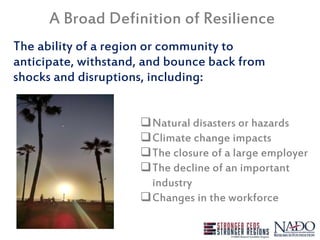
A Broad Definition of Resilience
The ability of a region or community to
anticipate, withstand, and bounce back from
shocks and disruptions, including:
3
Natural disasters or hazards
Climate change impacts
The closure of a large employer
The decline of an important
industry
Changes in the workforce
Photo credit: Flickr
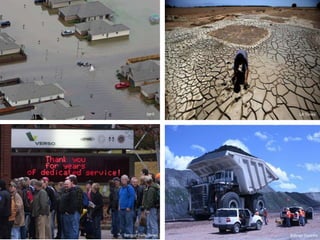
Billings GazetteBangor Daily News
LA TimesNPR
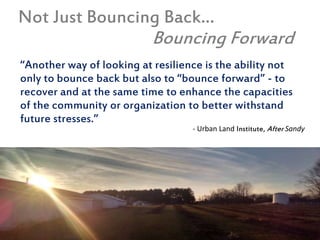
Not Just Bouncing Back…
Bouncing Forward
“Another way of looking at resilience is the ability not
only to bounce back but also to “bounce forward” - to
recover and at the same time to enhance the capacities
of the community or organization to better withstand
future stresses.”
- Urban Land Institute, After Sandy
Why Regional Resilience?
• Nearby communities often share similar risks/hazards
• Disaster impacts cross jurisdictional boundaries
• Communities are interdependent
• Vulnerabilities in one community could impact another.
• Mitigation investments in one community could impact
another (positively or negatively).
• Economies are regional in nature
• Communities can accomplish more when they work together
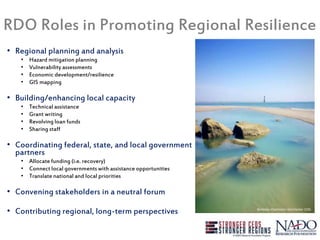
RDO Roles in Promoting Regional Resilience
• Regional planning and analysis
• Hazard mitigation planning
• Vulnerability assessments
• Economic development/resilience
• GIS mapping
• Building/enhancing local capacity
• Technical assistance
• Grant writing
• Revolving loan funds
• Sharing staff
• Coordinating federal, state, and local government
partners
• Allocate funding (i.e. recovery)
• Connect local governments with assistance opportunities
• Translate national and local priorities
• Convening stakeholders in a neutral forum
• Contributing regional, long-term perspectives
Photo credit: USDOC
Berkeley-Charleston-Dorchester COG
Resilience Resources Available at the CEDS
Resource Library on www.nado.org
• Stronger CEDS, Stronger Regions Training
•Lessons from the Storm: Case Studies on Economic Resilience and Recovery
•Resilient Regions: Integrating Economic Development Strategies, Sustainability
Principles, and Hazard Mitigation Planning
•Regional Resilience: Research and Policy Brief
•Building Economic Resilience in the Kerr Tar Region: Recommendations for
Linking Comprehensive Economic Development Strategies and Hazard Mitigation
Plans
•Lessons Learned from Irene: Vermont RPCs Address Transportation System
Recovery
•[Webinar]: Innovation and Opportunity: A Closer Look at the New CEDS Content
Guidelines
•[Webinar]: Building Economic Resilience in Your Community: Linking Economic
Development and Hazard Mitigation Planning
•[Webinar]: The Regional Development Organization’s Role in Disaster Recovery
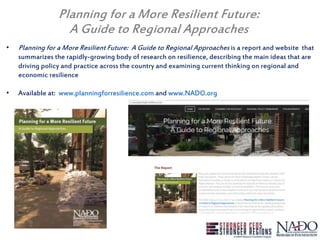
Planning for a More Resilient Future:
A Guide to Regional Approaches
• Planning for a More Resilient Future: A Guide to Regional Approaches is a report and website that
summarizes the rapidly-growing body of research on resilience, describing the main ideas that are
driving policy and practice across the country and examining current thinking on regional and
economic resilience
• Available at: www.planningforresilience.com and www.NADO.org
Brett Schwartz
Program Manager
NADO Research Foundation
bschwartz@nado.org

Schwartz planning for regional resilience

  • 1.
    Planning for RegionalResilience National Regional Transportation Conference June 28, 2017
  • 2.
    Today’s Presentations • RobPressly, Resiliency Program Coordinator, Colorado Resilience and Recovery Office • Laura Blomquist Rodriguez, Senior Manager - Strategy & Analytics, Global Business Development, Colorado Office of Economic Development and International Trade • Justin Fazzari, Economic Development Integrator, US Economic Development Administration – Denver Regional Office • Brett Schwartz, Program Manager, NADO Research Foundation
  • 3.
    A Broad Definitionof Resilience The ability of a region or community to anticipate, withstand, and bounce back from shocks and disruptions, including: 3 Natural disasters or hazards Climate change impacts The closure of a large employer The decline of an important industry Changes in the workforce Photo credit: Flickr
  • 4.
  • 6.
    Not Just BouncingBack… Bouncing Forward “Another way of looking at resilience is the ability not only to bounce back but also to “bounce forward” - to recover and at the same time to enhance the capacities of the community or organization to better withstand future stresses.” - Urban Land Institute, After Sandy
  • 7.
    Why Regional Resilience? •Nearby communities often share similar risks/hazards • Disaster impacts cross jurisdictional boundaries • Communities are interdependent • Vulnerabilities in one community could impact another. • Mitigation investments in one community could impact another (positively or negatively). • Economies are regional in nature • Communities can accomplish more when they work together
  • 8.
    RDO Roles inPromoting Regional Resilience • Regional planning and analysis • Hazard mitigation planning • Vulnerability assessments • Economic development/resilience • GIS mapping • Building/enhancing local capacity • Technical assistance • Grant writing • Revolving loan funds • Sharing staff • Coordinating federal, state, and local government partners • Allocate funding (i.e. recovery) • Connect local governments with assistance opportunities • Translate national and local priorities • Convening stakeholders in a neutral forum • Contributing regional, long-term perspectives Photo credit: USDOC Berkeley-Charleston-Dorchester COG
  • 9.
    Resilience Resources Availableat the CEDS Resource Library on www.nado.org • Stronger CEDS, Stronger Regions Training •Lessons from the Storm: Case Studies on Economic Resilience and Recovery •Resilient Regions: Integrating Economic Development Strategies, Sustainability Principles, and Hazard Mitigation Planning •Regional Resilience: Research and Policy Brief •Building Economic Resilience in the Kerr Tar Region: Recommendations for Linking Comprehensive Economic Development Strategies and Hazard Mitigation Plans •Lessons Learned from Irene: Vermont RPCs Address Transportation System Recovery •[Webinar]: Innovation and Opportunity: A Closer Look at the New CEDS Content Guidelines •[Webinar]: Building Economic Resilience in Your Community: Linking Economic Development and Hazard Mitigation Planning •[Webinar]: The Regional Development Organization’s Role in Disaster Recovery
  • 10.
    Planning for aMore Resilient Future: A Guide to Regional Approaches • Planning for a More Resilient Future: A Guide to Regional Approaches is a report and website that summarizes the rapidly-growing body of research on resilience, describing the main ideas that are driving policy and practice across the country and examining current thinking on regional and economic resilience • Available at: www.planningforresilience.com and www.NADO.org
  • 11.
    Brett Schwartz Program Manager NADOResearch Foundation bschwartz@nado.org