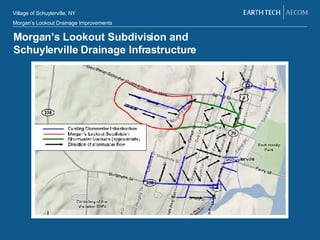
Morgan’s Lookout Subdivision and  Schuylerville Drainage Infrastructure
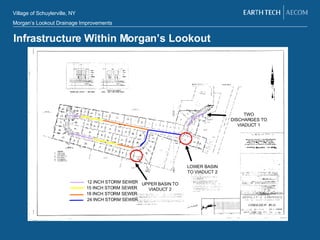
Infrastructure Within Morgan’s Lookout UPPER BASIN TO VIADUCT 2 TWO DISCHARGES TO VIADUCT 1 12 INCH STORM SEWER 15 INCH STORM SEWER  18 INCH STORM SEWER  24 INCH STORM SEWER LOWER BASIN TO VIADUCT 2
Existing Drainage Concerns and Approach Two viaducts are responsible for conveying much of flow from Morgan’s Lookout. The existing retention basins (Upper and Lower) are not effective at slowing down and retaining stormwater. Implement as many simple design improvements as possible. Design corrective actions to be compatible with future infrastructure projects.
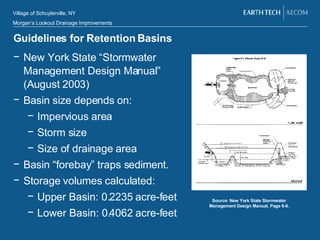
Guidelines for Retention Basins New York State “Stormwater Management Design Manual” (August 2003) Basin size depends on: Impervious area Storm size Size of drainage area Basin “forebay” traps sediment. Storage volumes calculated: Upper Basin: 0.2235 acre-feet Lower Basin: 0.4062 acre-feet Source: New York State Stormwater Management Design Manual, Page 6-8.
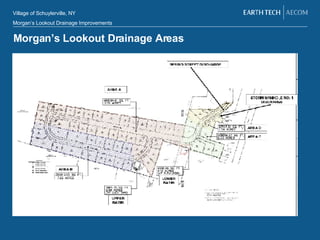
Morgan’s Lookout Drainage Areas
NY State Stormwater Design Manual Goals More than just moving the water.  Six Performance Goals: 1.  Feasibility:  Identify site considerations that may restrict the use of a practice. 2. Conveyance:  Don’t erode stream; encourage groundwater infiltration. 3. Pretreatment:  Trap sediments in the basin’s forebay.  4. Treatment Geometry:  Provide water quality treatment and storage. 5. Environmental/Landscaping:  Don’t degrade environment, use landscaping and vegetation as a tool. 6. Maintenance:  Regular maintenance increases basin life.
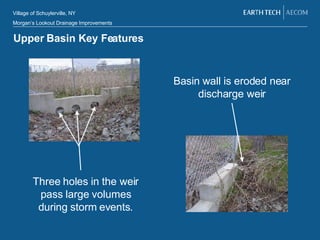
Upper Basin Key Features Three holes in the weir pass large volumes during storm events. Basin wall is eroded near discharge weir
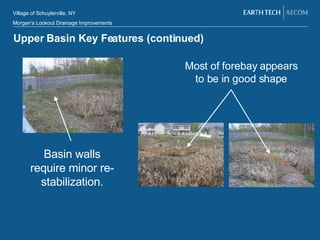
Upper Basin Key Features (continued) Basin walls require minor re-stabilization. Most of forebay appears to be in good shape
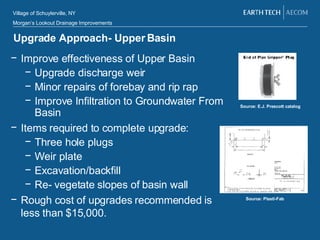
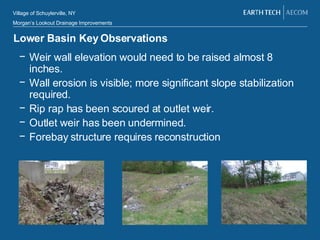
Upgrade Approach- Upper Basin Improve effectiveness of Upper Basin Upgrade discharge weir Minor repairs of forebay and rip rap Improve Infiltration to Groundwater From Basin Items required to complete upgrade: Three hole plugs Weir plate Excavation/backfill Re- vegetate slopes of basin wall Rough cost of upgrades recommended is less than $15,000. Source: E.J. Prescott catalog Source: Plasti-Fab
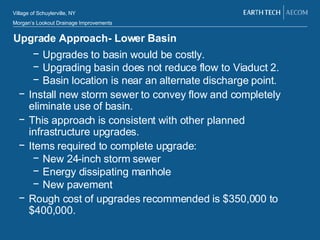
Lower Basin Key Observations Weir wall elevation would need to be raised almost 8 inches. Wall erosion is visible; more significant slope stabilization required. Rip rap has been scoured at outlet weir. Outlet weir has been undermined. Forebay structure requires reconstruction
Upgrade Approach- Lower Basin Upgrades to basin would be costly. Upgrading basin does not reduce flow to Viaduct 2. Basin location is near an alternate discharge point.  Install new storm sewer to convey flow and completely eliminate use of basin. This approach is consistent with other planned infrastructure upgrades.  Items required to complete upgrade: New 24-inch storm sewer Energy dissipating manhole New pavement Rough cost of upgrades recommended is $350,000 to $400,000.

Schuylerville Storm Water 2

  • 1.
    Morgan’s Lookout Subdivisionand Schuylerville Drainage Infrastructure
  • 2.
    Infrastructure Within Morgan’sLookout UPPER BASIN TO VIADUCT 2 TWO DISCHARGES TO VIADUCT 1 12 INCH STORM SEWER 15 INCH STORM SEWER 18 INCH STORM SEWER 24 INCH STORM SEWER LOWER BASIN TO VIADUCT 2
  • 3.
    Existing Drainage Concernsand Approach Two viaducts are responsible for conveying much of flow from Morgan’s Lookout. The existing retention basins (Upper and Lower) are not effective at slowing down and retaining stormwater. Implement as many simple design improvements as possible. Design corrective actions to be compatible with future infrastructure projects.
  • 4.
    Guidelines for RetentionBasins New York State “Stormwater Management Design Manual” (August 2003) Basin size depends on: Impervious area Storm size Size of drainage area Basin “forebay” traps sediment. Storage volumes calculated: Upper Basin: 0.2235 acre-feet Lower Basin: 0.4062 acre-feet Source: New York State Stormwater Management Design Manual, Page 6-8.
  • 5.
  • 6.
    NY State StormwaterDesign Manual Goals More than just moving the water. Six Performance Goals: 1. Feasibility: Identify site considerations that may restrict the use of a practice. 2. Conveyance: Don’t erode stream; encourage groundwater infiltration. 3. Pretreatment: Trap sediments in the basin’s forebay. 4. Treatment Geometry: Provide water quality treatment and storage. 5. Environmental/Landscaping: Don’t degrade environment, use landscaping and vegetation as a tool. 6. Maintenance: Regular maintenance increases basin life.
  • 7.
    Upper Basin KeyFeatures Three holes in the weir pass large volumes during storm events. Basin wall is eroded near discharge weir
  • 8.
    Upper Basin KeyFeatures (continued) Basin walls require minor re-stabilization. Most of forebay appears to be in good shape
  • 9.
    Upgrade Approach- UpperBasin Improve effectiveness of Upper Basin Upgrade discharge weir Minor repairs of forebay and rip rap Improve Infiltration to Groundwater From Basin Items required to complete upgrade: Three hole plugs Weir plate Excavation/backfill Re- vegetate slopes of basin wall Rough cost of upgrades recommended is less than $15,000. Source: E.J. Prescott catalog Source: Plasti-Fab
  • 10.
    Lower Basin KeyObservations Weir wall elevation would need to be raised almost 8 inches. Wall erosion is visible; more significant slope stabilization required. Rip rap has been scoured at outlet weir. Outlet weir has been undermined. Forebay structure requires reconstruction
  • 11.
    Upgrade Approach- LowerBasin Upgrades to basin would be costly. Upgrading basin does not reduce flow to Viaduct 2. Basin location is near an alternate discharge point. Install new storm sewer to convey flow and completely eliminate use of basin. This approach is consistent with other planned infrastructure upgrades. Items required to complete upgrade: New 24-inch storm sewer Energy dissipating manhole New pavement Rough cost of upgrades recommended is $350,000 to $400,000.