School of Leadership and
Management
Categorical Marking Criteria
For implementation by all markers
Dave Harris
School of Leadership and Management
Assessment Principles
Marking conducted using the Categorical Marking Scheme
Marking conducted to a rubric, that is transparent to all staff and
students
Authentic assessment that is relevant and meaningful
Proportionate workload expectations
Adaptable to assessment equivalence for inclusion or choice needs
Able to provide consistency in supportive formative feedback
Rethink the way that you mark
and provide feedback...
Is this piece of work...?
Outstanding Excellent Very
good
Good Satisfactory Marginal
fail
Unsatisfactory
90 72 68 55 35
e.g.
How to judge...
 Work from a position of the overall quality of this single piece of work
 Use the rubric to identify the bracket in which the work sits and to what extent it is met
 Remember Outstanding/Excellent/Very good/Good/Satisfactory/Unsatisfactory
 The student will have seen the same rubric – the measure is transparent and clear, for markers,
students and to the learning outcomes required
Once the overall bracket has been identified across the work and criteria, is the piece of work sitting
within that bracket at a “low”, “middle” or “high” level?
Does the student only just tip into the bracket e.g. #2
Does the student only need to do a small amount to lift into the bracket above e.g. #8
Are they are sitting firmly in the correct bracket e.g. #5
*Do not think “I would have previously given it about a 64” and then work backwards to round up to 65
or down to 62*
Greater than 80%...
The categorical marks change above 80%
This is to ensure the categories of marks are still meaningful and the clarity and
delineation to be achieved from categorical marking is still present
 The likelihood of getting > 80% is much less
 Markers are often nervous to give very high marks
 How to justify if something is 82 or 85 or 88 becomes more tricky and so the steps are
set further apart to offer more space to defend the difference
85 / 90 / 95 / 100
Unsatisfactory...
The marginal fail marks indicate if a student has a small amount to do to get over the pass line
32 / 35 / 38 (in line with the passing categorical marks and in line with opportunity for compensation
with other module passes)
The categorical marks change below 30%
This is to ensure the choice of mark is still meaningful and the clarity and delineation to be achieved
from categorical marking is still present
Getting < 30% indicates a lack of engagement, understanding and/or skills
Below 30 the spaces increase to offer a more meaningful indication of the work required to pass
0 / 5 / 15 / 20 / 25
Feedback
This marking scheme provides the opportunity, time and space for all feedback to be personal, respecting
the efforts and learning the student has attempted to demonstrate.
*This is really important*
The rubrics outline the grade choice and rubric content should not be repeated in written feedback.
The written feedback should be used to identify exactly why this individual student did not get a higher mark
and provide constructive support to improve.
There should be more comments on what they could have done to enhance their grade than “well done” and
“this is good”...
Even for strong marks, the student should be told what was lacking to stop them getting 100%.
*Do not give marks for sections, criteria, or different areas in feedback...
Assign one single grade for the overall whole piece of work*
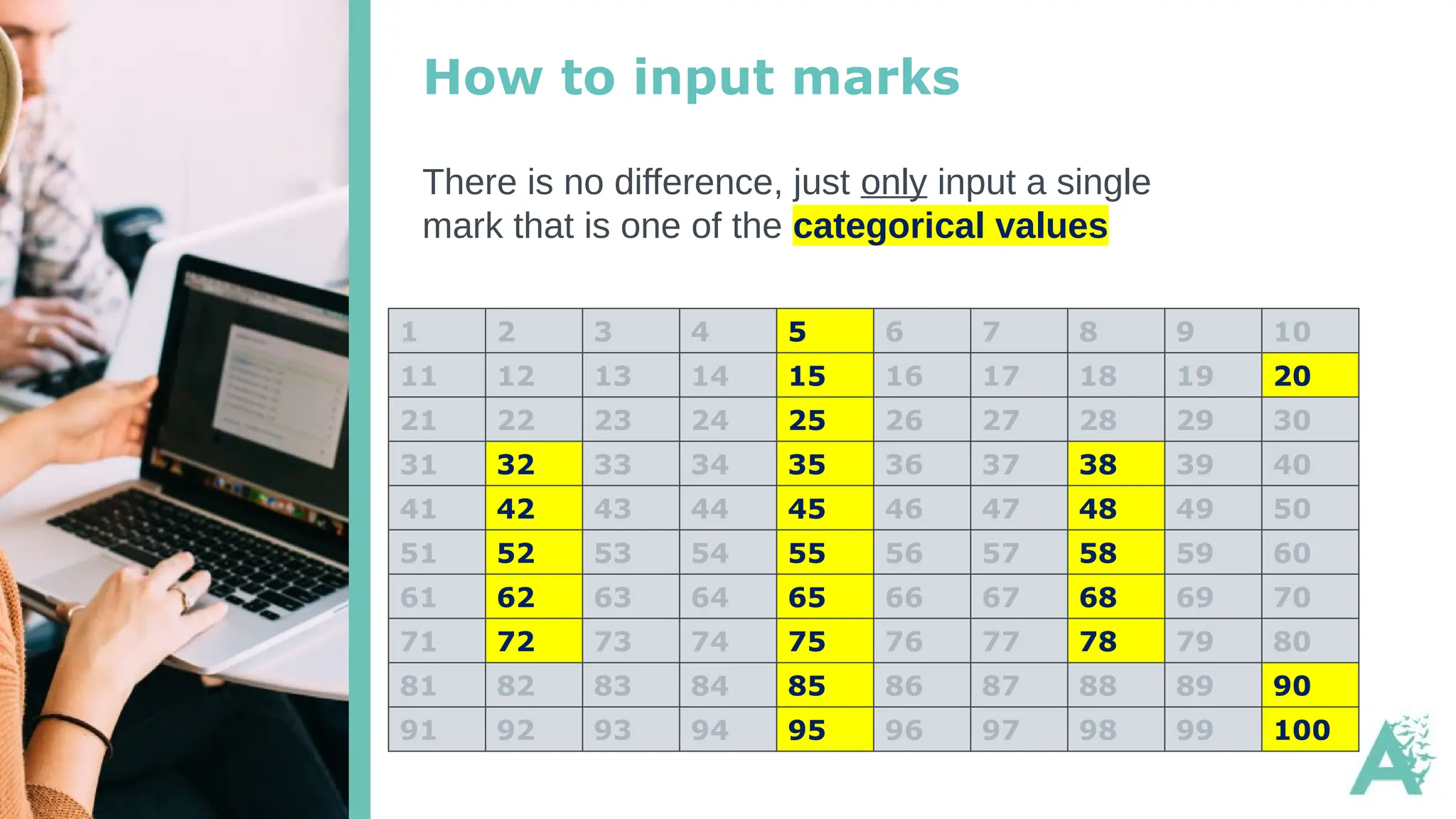
There is no difference, just only input a single
mark that is one of the categorical values
How to input marks
1 2 3 4 5 6 7 8 9 10
11 12 13 14 15 16 17 18 19 20
21 22 23 24 25 26 27 28 29 30
31 32 33 34 35 36 37 38 39 40
41 42 43 44 45 46 47 48 49 50
51 52 53 54 55 56 57 58 59 60
61 62 63 64 65 66 67 68 69 70
71 72 73 74 75 76 77 78 79 80
81 82 83 84 85 86 87 88 89 90
91 92 93 94 95 96 97 98 99 100
- Improved fairness and consistency between different markers
- Less disparity between students
- Better ability to justify marks given
- Simpler marking workload for academics, allowing them to focus
on providing better individualised, focussed written feedback
- Easier use of marking rubrics
Key Benefits
Please Note:
Modules where assessment involves calculations, MCQs, a need for
defined marking, etc. do not utilise categorical marking.
Modules that involves more than one element of assessment, the
categorical marks are to be used for individual pieces of work.
The overall module grade will not be categorical; rounded up; rounded
down; or averaged out of categorical marks. The overall module grade will
be calculated from the inputted values within our systems, and to the ratio
as validated for the module.
Categorical marking happens at the point of marking and by the marker
Thanks for attending today
Any Questions Please?
(Please Note: You only have
to attend one of the four
identical training sessions!)

School Categorical Marking Criteria.pptx

  • 1.
    School of Leadershipand Management Categorical Marking Criteria For implementation by all markers Dave Harris
  • 2.
    School of Leadershipand Management Assessment Principles Marking conducted using the Categorical Marking Scheme Marking conducted to a rubric, that is transparent to all staff and students Authentic assessment that is relevant and meaningful Proportionate workload expectations Adaptable to assessment equivalence for inclusion or choice needs Able to provide consistency in supportive formative feedback
  • 3.
    Rethink the waythat you mark and provide feedback...
  • 4.
    Is this pieceof work...? Outstanding Excellent Very good Good Satisfactory Marginal fail Unsatisfactory 90 72 68 55 35 e.g.
  • 5.
    How to judge... Work from a position of the overall quality of this single piece of work  Use the rubric to identify the bracket in which the work sits and to what extent it is met  Remember Outstanding/Excellent/Very good/Good/Satisfactory/Unsatisfactory  The student will have seen the same rubric – the measure is transparent and clear, for markers, students and to the learning outcomes required Once the overall bracket has been identified across the work and criteria, is the piece of work sitting within that bracket at a “low”, “middle” or “high” level? Does the student only just tip into the bracket e.g. #2 Does the student only need to do a small amount to lift into the bracket above e.g. #8 Are they are sitting firmly in the correct bracket e.g. #5 *Do not think “I would have previously given it about a 64” and then work backwards to round up to 65 or down to 62*
  • 6.
    Greater than 80%... Thecategorical marks change above 80% This is to ensure the categories of marks are still meaningful and the clarity and delineation to be achieved from categorical marking is still present  The likelihood of getting > 80% is much less  Markers are often nervous to give very high marks  How to justify if something is 82 or 85 or 88 becomes more tricky and so the steps are set further apart to offer more space to defend the difference 85 / 90 / 95 / 100
  • 7.
    Unsatisfactory... The marginal failmarks indicate if a student has a small amount to do to get over the pass line 32 / 35 / 38 (in line with the passing categorical marks and in line with opportunity for compensation with other module passes) The categorical marks change below 30% This is to ensure the choice of mark is still meaningful and the clarity and delineation to be achieved from categorical marking is still present Getting < 30% indicates a lack of engagement, understanding and/or skills Below 30 the spaces increase to offer a more meaningful indication of the work required to pass 0 / 5 / 15 / 20 / 25
  • 8.
    Feedback This marking schemeprovides the opportunity, time and space for all feedback to be personal, respecting the efforts and learning the student has attempted to demonstrate. *This is really important* The rubrics outline the grade choice and rubric content should not be repeated in written feedback. The written feedback should be used to identify exactly why this individual student did not get a higher mark and provide constructive support to improve. There should be more comments on what they could have done to enhance their grade than “well done” and “this is good”... Even for strong marks, the student should be told what was lacking to stop them getting 100%. *Do not give marks for sections, criteria, or different areas in feedback... Assign one single grade for the overall whole piece of work*
  • 9.
    There is nodifference, just only input a single mark that is one of the categorical values How to input marks 1 2 3 4 5 6 7 8 9 10 11 12 13 14 15 16 17 18 19 20 21 22 23 24 25 26 27 28 29 30 31 32 33 34 35 36 37 38 39 40 41 42 43 44 45 46 47 48 49 50 51 52 53 54 55 56 57 58 59 60 61 62 63 64 65 66 67 68 69 70 71 72 73 74 75 76 77 78 79 80 81 82 83 84 85 86 87 88 89 90 91 92 93 94 95 96 97 98 99 100
  • 10.
    - Improved fairnessand consistency between different markers - Less disparity between students - Better ability to justify marks given - Simpler marking workload for academics, allowing them to focus on providing better individualised, focussed written feedback - Easier use of marking rubrics Key Benefits
  • 11.
    Please Note: Modules whereassessment involves calculations, MCQs, a need for defined marking, etc. do not utilise categorical marking. Modules that involves more than one element of assessment, the categorical marks are to be used for individual pieces of work. The overall module grade will not be categorical; rounded up; rounded down; or averaged out of categorical marks. The overall module grade will be calculated from the inputted values within our systems, and to the ratio as validated for the module. Categorical marking happens at the point of marking and by the marker
  • 12.
    Thanks for attendingtoday Any Questions Please? (Please Note: You only have to attend one of the four identical training sessions!)