Stress corrosion cracking 
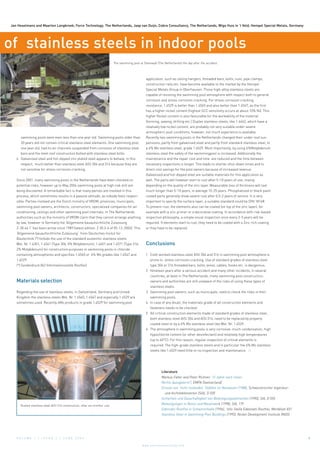
In the morning of 9 June 2001, the staff of a nine-year-old swimming pool in Steenwijk, 
The Netherlands, opened the doors as usual and got the surprise of their life. The entire ceiling and 
the air channels were lying in the water and round the edges. It took some seconds 
for them to realise that they and their visitors had escaped a human tragedy. It was fortunate 
that the event had occurred at night, after closing hours. A similar accident, with far 
worse consequences, had already occurred in Uster (Switzerland) on 9 May 1985, when the entire 
concrete roof of a swimming pool collapsed, causing 12 fatalities and many injuries. 
Soon after the accident in The Netherlands, its cause became clear. Air 
channels above the ceiling, weighing hundreds of kilograms, had fallen onto 
the ceiling, which could not bear the weight of this shock and consequently 
collapsed as well. The air channels were suspended from stainless steel type 304 
threaded bars which appeared to contain many stress corrosion cracks. The 
conclusion was that stress corrosion cracking of the stainless steel bars had 
caused the accident. Also in Uster the accident was caused by stress corrosion 
cracking in AISI 304 stainless steel bars supporting the roof. 
From 1985 untill today many incidents with stainless steel elements in swimming 
pools have occurred, most of them unreported. In many cases, the broken 
elements were replaced by new elements, again made from stainless steel AISI 
304 or 316. Why have we not learned from Uster and the other incidents, not at 
least in the Netherlands, where new swimming pools are still being built with 
stainless steel 304 or 316 bolts, bars, fasteners, etc.? 
4 S T A I N L E S S B U I L D I N G B U L L E T I N 
www. s t a i n less b u i l d i n g . com 
Application 
Stainless Steels are well established as corrosion resistant, low maintenance, 
construction materials in and around swimming pools. They are found in the pool 
water as ladders, stairs and components of wave machines, around the pools, for 
example as diving boards and as parts of the building like air conditioning 
systems, doors and windows. The widespread use is due to the good corrosion 
resistance, the attractive appearance, the good workability and an acceptable 
price. The formation of a thin but extremely dense oxide layer on the surface of 
stainless steels, the passive layer, protects the steel from corrosion. 
Because of their corrosion resistance stainless steels are also used in structural 
applications in swimming pool buildings such as for hangers and fasteners of 
components such as suspended ceilings, wall panels or water piping and air 
ducts. 
While the standard grades stainless steel like Type 304 and the 2% molybdenum 
containing Type 316 perform well in swimming pools below water level, or above 
water level, if rinsed regularly, they should not be used for safety-critical, load 
bearing applications. Only the highly corrosion resistant 6% molybdenum-type 
stainless steel can resist stress corrosion cracking in the aggressive environment 
that can build in spaces where maintenance cleaning is difficult or impossible. 
Failure mechanism 
The maximum estimated temperature above a swimming pool ceiling is 40 °C, 
lower than the 50–60 °C which general corrosion literature states as the 
minimum temperature at which stress corrosion cracking can occur. 
Not many corrosion specialists know that the atmosphere in swimming pools, 
containing the strong oxidator hypochlorite, can cause stress corrosion cracking 
at much lower temperatures, such as 25–30 °C. For example in Germany and 
Switzerland, the use of standard grades stainless steel of type 304 or 316 as a 
construction element for safety-critical load bearing applications in swimming 
pools has already been forbidden and all swimming pools have been checked on 
the use of stainless steel in critical applications such as threaded bars, cables, 
wires and bolts. At this moment many swimming pools in The Netherlands are 
being checked and repaired where necessary 
Situation in The Netherlands 
Since July 2001 Force Technology Netherlands and Cobra Consultancy have 
inspected 65 swimming pools in The Netherlands (totally more than 900 public 
and a few thousand of private indoor swimming pools) and have come to these 
astonishing conclusions: 
1 Fourteen swimming pools were at immediate risk. The air channels were 
suspended from corroded stainless steel threaded bars. Some of those 
swimming pools were closed for repair; in the case of the other ones, 
temporary measures (support of the channels) were adopted to reduce the risk 
until further repair was done. 
2 Eighteen other swimming pools were not at immediate risk, but elements such 
as stainless steel bolts in the roof construction, wire hooks on which the ceiling 
was hanging, and other stainless steel construction elements needed to be 
replaced as soon as possible. 
3 In the atmosphere, not under water, most standard grades stainless steel 
corroded. Both AISI 304 (A2) and AISI 316 (A4) elements corroded, not much 
difference being notified between each of them. 
4 Cold-worked stainless steels, such as fasteners, bolts, elements in ceiling 
hooks, etc., were often found to have stress corrosion cracks under the 
corroded spots. 
5 Most of the problems occurred in new swimming pools; two of these 
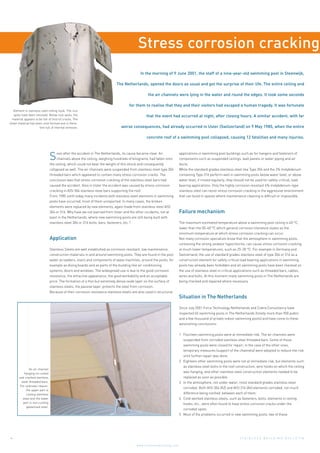
Element in stainless steel ceiling hook. The rust 
spots have been removed. Below rust spots, the 
material appears to be full of (micro) cracks. The 
sheet material has been cold-formed and is there-fore 
full of internal stresses. 
An air channel 
hanging on rusted 
and cracked stainless 
steel threaded bars. 
For unknown reason, 
the upper part is 
rusting stainless 
steel and the lower 
part is non-rusting 
galvanised steel.
Jan Heselmans and Maarten Langbroek, Force Technology, The Netherlands, Jaap van Duijn, Cobra Consultancy, The Netherlands, Wigo Huis in ’t Veld, Hempel Special Metals, Germany 
of stainless steels in indoor pools 
The swimming pool at Steenwijk (The Netherlands) the day after the accident. 
V O L U M E 1 | I S S U E 2 | J U N E 2 0 0 4 5 
www. s t a i n less b u i l d i n g . com 
swimming pools were even less than one year old. Swimming pools older than 
20 years did not contain critical stainless steel elements. One swimming pool, 
one year old, had its air channels suspended from corrosion of stainless steel 
bars and the steel roof construction bolted with stainless steel bolts. 
6 Galvanised steel and hot-dipped zinc plated steel appears to behave, in this 
respect, much better than stainless steel AISI 304 and 316 because they are 
not sensitive for stress corrosion cracking. 
Since 2001, many swimming pools in the Netherlands have been checked on 
potential risks, however up to May 2004 swimming pools at high risk still are 
being discovered. A remarkable fact is that many parties are involved in this 
process, which sometimes results in a passive attitude, as nobody feels respon-sible. 
Parties involved are the Dutch ministry of VROM, provinces, municipals, 
swimming pool owners, architects, constructors, specialised companies for air 
conditioning, ceilings and other swimming pool internals. In The Netherlands 
authorities such as the ministry of VROM claim that they cannot arrange anything 
by law, however in Germany the ‘Allgemeine bauaufsichtliche Zulassung 
Z-30.44.1’ has been active since 1989 (latest edition: Z 30.3-6 of 05-12-2003). This 
‘Allgemeine bauaufsichtliche Zulassung’ from Deutsches Insitut für 
Bautechnik’(*) forbids the use of the standard austenitic stainless steels 
Wst. Nr. 1.4301, 1.4541 (Type 304, 0% Molybdenum), 1.4401 and 1.4571 (Type 316, 
2% Molybdenum) for construction purposes in swimming pools in chloride 
containing atmospheres and specifies 1.4565 or 6% Mo grades like 1.4547 and 
1.4529. 
(*) Sonderdruck 862 Informationsstelle Rostfrei) 
Materials selection 
Regarding the use of stainless steels, in Switzerland, Germany and United 
Kingdom the stainless steels Wst. Nr. 1.4565, 1.4547 and especially 1.4529 are 
sometimes used. Recently 6Mo products in grade 1.4529 for swimming pool 
application, such as ceiling hangers, threaded bars, bolts, nuts, pipe clamps, 
construction rails etc. have become available to the market by the Hempel 
Special Metals Group in Oberhausen. Those high-alloy stainless steels are 
capable of resisting the swimming pool atmosphere with respect both to general 
corrosion and stress corrosion cracking. For stress corrosion cracking 
resistance, 1.4529 is better than 1.4565 and also better than 1.4547, as the first 
has a higher nickel content (highest SCC sensitivity occurs at about 10% Ni). This 
higher Nickel content is also favourable for the workability of the material 
(forming, sawing, drilling etc.) Duplex stainless steels, like 1.4462, which have a 
relatively low nickel content, are probably not very suitable under severe 
atmospheric pool conditions; however, not much experience is available. 
Recently two swimming pools in the Netherlands changed their under roof sus-pensions, 
partly from galvanised steel and partly from standard stainless steel, to 
a 6% Mo stainless steel, grade 1.4529. Most importantly, by using 6%Molybdenum 
stainless steel the safety of the swimmingpool is increased. Additionally the 
maintenance and the repair cost and time are reduced and the time between 
necessary inspections is longer. This leads to shorter shut-down times and to 
direct cost savings for the pool owners because of increased revenue. 
Galvanised and hot-dipped steel are suitable materials for this application as 
well. The parts will however start to rust after 5–10 years of use, mainly 
depending on the quality of the zinc layer. Measurable loss of thickness will last 
much longer than 5-10 years, in average 15-25 years. Phosphatised or black paint 
coated parts generally show severe rust after 0,5-2 years of service. It is very 
important to specify the surface layer, a suitable standard could be DIN 18168. 
To prevent rust, the elements also can be coated (on top of the zinc layer), for 
example with a zinc primer or a decorative coating. In accordance with risk-based 
inspection philosophy, a simple visual inspection once every 3-5 years will be 
required. If elements start to rust, they need to be coated with a Zinc rich coating 
or they have to be replaced. 
Conclusions 
1 Cold-worked stainless steel AISI 304 and 316 in swimming pool atmosphere is 
prone to stress corrosion cracking. Use of standard grades of stainless steel 
type 304 or 316 threaded bars, bolts, wires, cables, hooks etc. is dangerous. 
2 Nineteen years after a serious accident and many other incidents, in several 
countries, at least in The Netherlands, many swimming pool constructors, 
owners and authorities are still unaware of the risks of using these types of 
stainless steels. 
3 Swimming pool owners, such as municipals, need to check the risks in their 
swimming pools. 
4 In case of any doubt, the materials grade of all construction elements and 
fasteners needs to be checked. 
5 All critical construction elements made of standard grades of stainless steel, 
both stainless steel AISI 304 and AISI 316, need to be replaced by properly 
coated steel or by a 6% Mo stainless steel like Wst. Nr. 1.4529. 
6 The atmosphere in swimming pools is very corrosive: much condensation, high 
hypochlorite content (or other desinfectant) and relatively high temperatures 
(up to 40°C). For this reason, regular inspection of critical elements is 
required. The high-grade stainless steels and in particular the 6% Mo stainless 
steels like 1.4529 need little or no inspection and maintenance.  
Literature 
Markus Faller and Peter Richner: 15 Jahre nach Uster: 
Nichts dazugelernt?, EMPA (Switzerland) 
Einsatz von ‘nicht rostenden’ Stählen im Bauwesen (1988), Schweizerischer Ingenieur-und 
Architektenverein (SIA), D 030 
Sicherheit und Dauerhaftigkeit von Befestigungselementen (1990), SIA, D 055 
Befestigungen in Beton und Mauerwerk (1998), SIA, 179 
Edelstahl Rostfrei in Schwimmhalle (1996), Info-Stelle Edelstahl Rostfrei, Merkblatt 831 
Stainless Steel in Swimming Pool Buildings (1995), Nickel Development Institute (NIDI) 
Rusted stainless steel AISI 316 construction, after six months’ use.

Scc falla en natatorio

  • 1.
    Stress corrosion cracking In the morning of 9 June 2001, the staff of a nine-year-old swimming pool in Steenwijk, The Netherlands, opened the doors as usual and got the surprise of their life. The entire ceiling and the air channels were lying in the water and round the edges. It took some seconds for them to realise that they and their visitors had escaped a human tragedy. It was fortunate that the event had occurred at night, after closing hours. A similar accident, with far worse consequences, had already occurred in Uster (Switzerland) on 9 May 1985, when the entire concrete roof of a swimming pool collapsed, causing 12 fatalities and many injuries. Soon after the accident in The Netherlands, its cause became clear. Air channels above the ceiling, weighing hundreds of kilograms, had fallen onto the ceiling, which could not bear the weight of this shock and consequently collapsed as well. The air channels were suspended from stainless steel type 304 threaded bars which appeared to contain many stress corrosion cracks. The conclusion was that stress corrosion cracking of the stainless steel bars had caused the accident. Also in Uster the accident was caused by stress corrosion cracking in AISI 304 stainless steel bars supporting the roof. From 1985 untill today many incidents with stainless steel elements in swimming pools have occurred, most of them unreported. In many cases, the broken elements were replaced by new elements, again made from stainless steel AISI 304 or 316. Why have we not learned from Uster and the other incidents, not at least in the Netherlands, where new swimming pools are still being built with stainless steel 304 or 316 bolts, bars, fasteners, etc.? 4 S T A I N L E S S B U I L D I N G B U L L E T I N www. s t a i n less b u i l d i n g . com Application Stainless Steels are well established as corrosion resistant, low maintenance, construction materials in and around swimming pools. They are found in the pool water as ladders, stairs and components of wave machines, around the pools, for example as diving boards and as parts of the building like air conditioning systems, doors and windows. The widespread use is due to the good corrosion resistance, the attractive appearance, the good workability and an acceptable price. The formation of a thin but extremely dense oxide layer on the surface of stainless steels, the passive layer, protects the steel from corrosion. Because of their corrosion resistance stainless steels are also used in structural applications in swimming pool buildings such as for hangers and fasteners of components such as suspended ceilings, wall panels or water piping and air ducts. While the standard grades stainless steel like Type 304 and the 2% molybdenum containing Type 316 perform well in swimming pools below water level, or above water level, if rinsed regularly, they should not be used for safety-critical, load bearing applications. Only the highly corrosion resistant 6% molybdenum-type stainless steel can resist stress corrosion cracking in the aggressive environment that can build in spaces where maintenance cleaning is difficult or impossible. Failure mechanism The maximum estimated temperature above a swimming pool ceiling is 40 °C, lower than the 50–60 °C which general corrosion literature states as the minimum temperature at which stress corrosion cracking can occur. Not many corrosion specialists know that the atmosphere in swimming pools, containing the strong oxidator hypochlorite, can cause stress corrosion cracking at much lower temperatures, such as 25–30 °C. For example in Germany and Switzerland, the use of standard grades stainless steel of type 304 or 316 as a construction element for safety-critical load bearing applications in swimming pools has already been forbidden and all swimming pools have been checked on the use of stainless steel in critical applications such as threaded bars, cables, wires and bolts. At this moment many swimming pools in The Netherlands are being checked and repaired where necessary Situation in The Netherlands Since July 2001 Force Technology Netherlands and Cobra Consultancy have inspected 65 swimming pools in The Netherlands (totally more than 900 public and a few thousand of private indoor swimming pools) and have come to these astonishing conclusions: 1 Fourteen swimming pools were at immediate risk. The air channels were suspended from corroded stainless steel threaded bars. Some of those swimming pools were closed for repair; in the case of the other ones, temporary measures (support of the channels) were adopted to reduce the risk until further repair was done. 2 Eighteen other swimming pools were not at immediate risk, but elements such as stainless steel bolts in the roof construction, wire hooks on which the ceiling was hanging, and other stainless steel construction elements needed to be replaced as soon as possible. 3 In the atmosphere, not under water, most standard grades stainless steel corroded. Both AISI 304 (A2) and AISI 316 (A4) elements corroded, not much difference being notified between each of them. 4 Cold-worked stainless steels, such as fasteners, bolts, elements in ceiling hooks, etc., were often found to have stress corrosion cracks under the corroded spots. 5 Most of the problems occurred in new swimming pools; two of these Element in stainless steel ceiling hook. The rust spots have been removed. Below rust spots, the material appears to be full of (micro) cracks. The sheet material has been cold-formed and is there-fore full of internal stresses. An air channel hanging on rusted and cracked stainless steel threaded bars. For unknown reason, the upper part is rusting stainless steel and the lower part is non-rusting galvanised steel.
  • 2.
    Jan Heselmans andMaarten Langbroek, Force Technology, The Netherlands, Jaap van Duijn, Cobra Consultancy, The Netherlands, Wigo Huis in ’t Veld, Hempel Special Metals, Germany of stainless steels in indoor pools The swimming pool at Steenwijk (The Netherlands) the day after the accident. V O L U M E 1 | I S S U E 2 | J U N E 2 0 0 4 5 www. s t a i n less b u i l d i n g . com swimming pools were even less than one year old. Swimming pools older than 20 years did not contain critical stainless steel elements. One swimming pool, one year old, had its air channels suspended from corrosion of stainless steel bars and the steel roof construction bolted with stainless steel bolts. 6 Galvanised steel and hot-dipped zinc plated steel appears to behave, in this respect, much better than stainless steel AISI 304 and 316 because they are not sensitive for stress corrosion cracking. Since 2001, many swimming pools in the Netherlands have been checked on potential risks, however up to May 2004 swimming pools at high risk still are being discovered. A remarkable fact is that many parties are involved in this process, which sometimes results in a passive attitude, as nobody feels respon-sible. Parties involved are the Dutch ministry of VROM, provinces, municipals, swimming pool owners, architects, constructors, specialised companies for air conditioning, ceilings and other swimming pool internals. In The Netherlands authorities such as the ministry of VROM claim that they cannot arrange anything by law, however in Germany the ‘Allgemeine bauaufsichtliche Zulassung Z-30.44.1’ has been active since 1989 (latest edition: Z 30.3-6 of 05-12-2003). This ‘Allgemeine bauaufsichtliche Zulassung’ from Deutsches Insitut für Bautechnik’(*) forbids the use of the standard austenitic stainless steels Wst. Nr. 1.4301, 1.4541 (Type 304, 0% Molybdenum), 1.4401 and 1.4571 (Type 316, 2% Molybdenum) for construction purposes in swimming pools in chloride containing atmospheres and specifies 1.4565 or 6% Mo grades like 1.4547 and 1.4529. (*) Sonderdruck 862 Informationsstelle Rostfrei) Materials selection Regarding the use of stainless steels, in Switzerland, Germany and United Kingdom the stainless steels Wst. Nr. 1.4565, 1.4547 and especially 1.4529 are sometimes used. Recently 6Mo products in grade 1.4529 for swimming pool application, such as ceiling hangers, threaded bars, bolts, nuts, pipe clamps, construction rails etc. have become available to the market by the Hempel Special Metals Group in Oberhausen. Those high-alloy stainless steels are capable of resisting the swimming pool atmosphere with respect both to general corrosion and stress corrosion cracking. For stress corrosion cracking resistance, 1.4529 is better than 1.4565 and also better than 1.4547, as the first has a higher nickel content (highest SCC sensitivity occurs at about 10% Ni). This higher Nickel content is also favourable for the workability of the material (forming, sawing, drilling etc.) Duplex stainless steels, like 1.4462, which have a relatively low nickel content, are probably not very suitable under severe atmospheric pool conditions; however, not much experience is available. Recently two swimming pools in the Netherlands changed their under roof sus-pensions, partly from galvanised steel and partly from standard stainless steel, to a 6% Mo stainless steel, grade 1.4529. Most importantly, by using 6%Molybdenum stainless steel the safety of the swimmingpool is increased. Additionally the maintenance and the repair cost and time are reduced and the time between necessary inspections is longer. This leads to shorter shut-down times and to direct cost savings for the pool owners because of increased revenue. Galvanised and hot-dipped steel are suitable materials for this application as well. The parts will however start to rust after 5–10 years of use, mainly depending on the quality of the zinc layer. Measurable loss of thickness will last much longer than 5-10 years, in average 15-25 years. Phosphatised or black paint coated parts generally show severe rust after 0,5-2 years of service. It is very important to specify the surface layer, a suitable standard could be DIN 18168. To prevent rust, the elements also can be coated (on top of the zinc layer), for example with a zinc primer or a decorative coating. In accordance with risk-based inspection philosophy, a simple visual inspection once every 3-5 years will be required. If elements start to rust, they need to be coated with a Zinc rich coating or they have to be replaced. Conclusions 1 Cold-worked stainless steel AISI 304 and 316 in swimming pool atmosphere is prone to stress corrosion cracking. Use of standard grades of stainless steel type 304 or 316 threaded bars, bolts, wires, cables, hooks etc. is dangerous. 2 Nineteen years after a serious accident and many other incidents, in several countries, at least in The Netherlands, many swimming pool constructors, owners and authorities are still unaware of the risks of using these types of stainless steels. 3 Swimming pool owners, such as municipals, need to check the risks in their swimming pools. 4 In case of any doubt, the materials grade of all construction elements and fasteners needs to be checked. 5 All critical construction elements made of standard grades of stainless steel, both stainless steel AISI 304 and AISI 316, need to be replaced by properly coated steel or by a 6% Mo stainless steel like Wst. Nr. 1.4529. 6 The atmosphere in swimming pools is very corrosive: much condensation, high hypochlorite content (or other desinfectant) and relatively high temperatures (up to 40°C). For this reason, regular inspection of critical elements is required. The high-grade stainless steels and in particular the 6% Mo stainless steels like 1.4529 need little or no inspection and maintenance. Literature Markus Faller and Peter Richner: 15 Jahre nach Uster: Nichts dazugelernt?, EMPA (Switzerland) Einsatz von ‘nicht rostenden’ Stählen im Bauwesen (1988), Schweizerischer Ingenieur-und Architektenverein (SIA), D 030 Sicherheit und Dauerhaftigkeit von Befestigungselementen (1990), SIA, D 055 Befestigungen in Beton und Mauerwerk (1998), SIA, 179 Edelstahl Rostfrei in Schwimmhalle (1996), Info-Stelle Edelstahl Rostfrei, Merkblatt 831 Stainless Steel in Swimming Pool Buildings (1995), Nickel Development Institute (NIDI) Rusted stainless steel AISI 316 construction, after six months’ use.