SCALP
Dr.H.Budhichandra
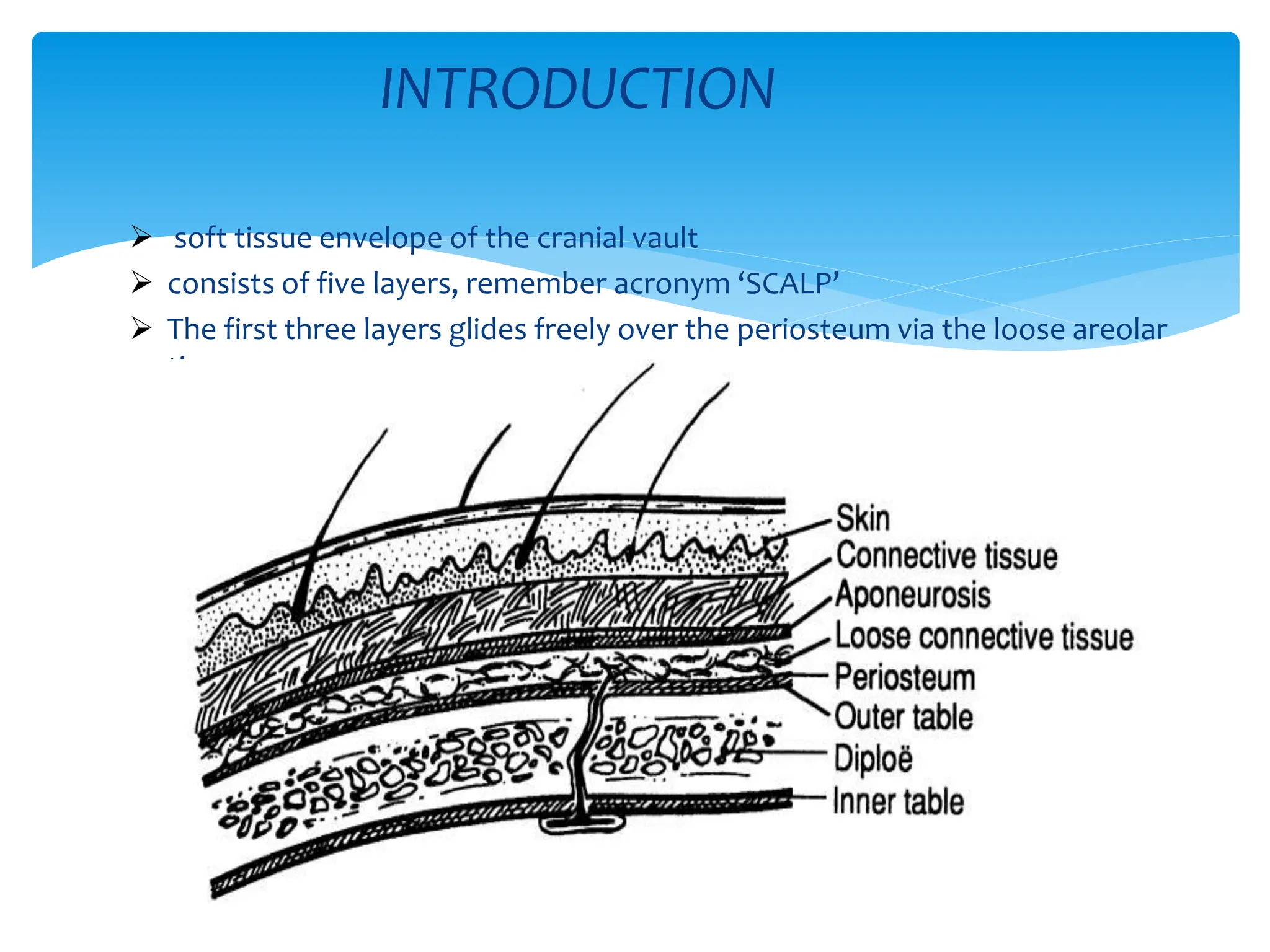
 soft tissue envelope of the cranial vault
 consists of five layers, remember acronym ‘SCALP’
 The first three layers glides freely over the periosteum via the loose areolar
tissue
INTRODUCTION
Layers (‘SCALP’)
Skin
 Thickest layer
 Contains the hair follicles, sebaceous glands
Connective tissue (subcutaneous)
 Houses the arteries, veins, nerves, and lymphatics of the scalp within
tough fibrous septa (so dense connective tissue)
 It holds the vessels firmly in place and prevents them from retracting
causing profuse bleeding
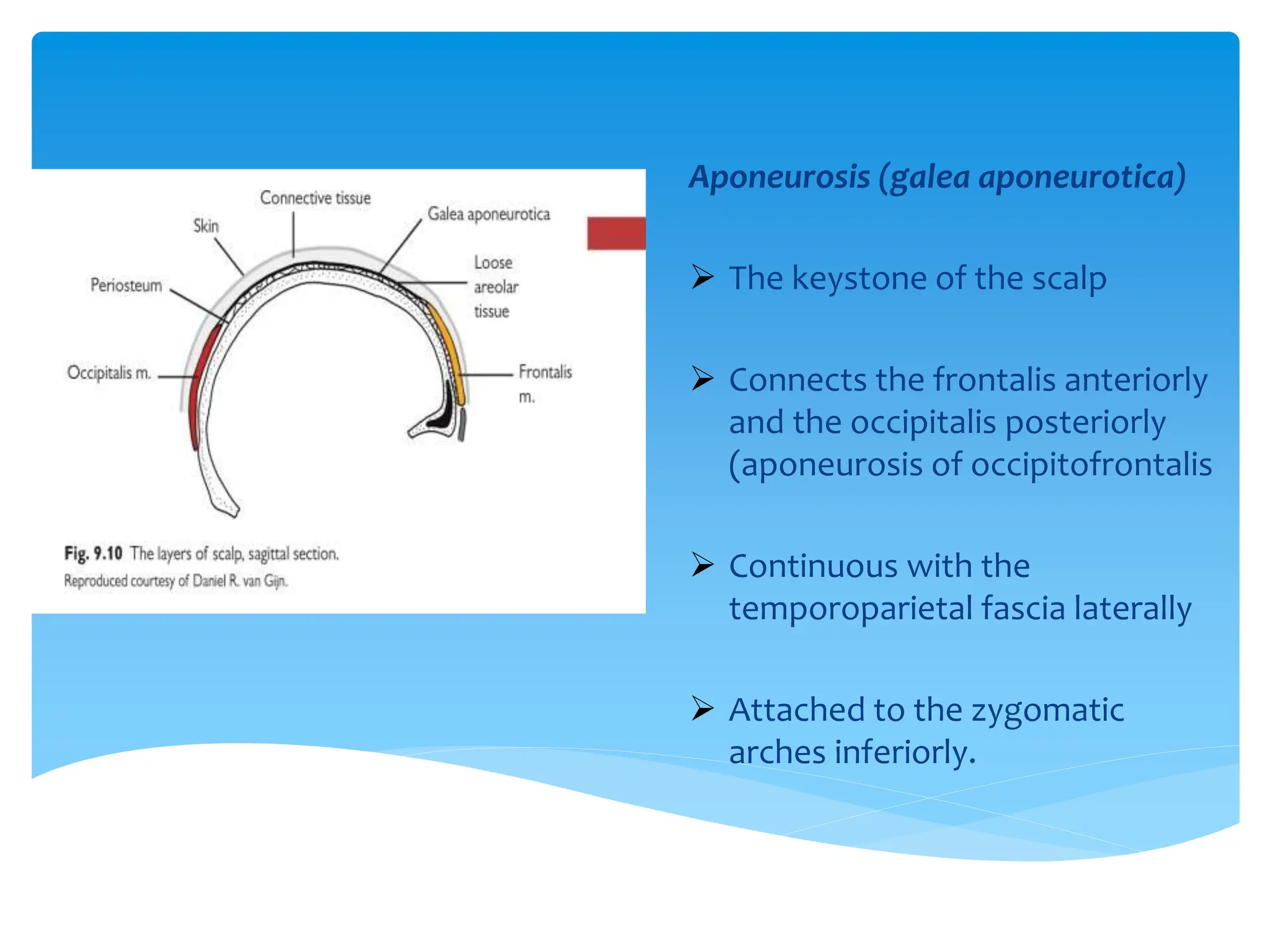
Aponeurosis (galea aponeurotica)
 The keystone of the scalp
 Connects the frontalis anteriorly
and the occipitalis posteriorly
(aponeurosis of occipitofrontalis
 Continuous with the
temporoparietal fascia laterally
 Attached to the zygomatic
arches inferiorly.
 Loose areolar tissue
 Potential (danger) space between the epicranial muscles
superiorly and underlying periosteum.
 Traversed by numerous emissary veins which communicate with
the intracranial venous sinuses.
Applied anatomy
 Accumulation of blood and pus in the subgaleal plane restrained
by the attachments of occipitalis posteriorly temporalis muscle
fascia at the zygomatic arches laterally
 Will gravitate anteriorly into the orbit and upper and lower lids
anteriorly due to the lack of any bony attachment for frontalis
 E.g. Black eye
 Pericranium
 The pericranium (periosteum) refers to the outer or external
periosteum of the skull
 Loosely attached to the surface of the skull bones except at the
suture lines and over the temporal fossae
 Collections of fluid beneath the pericranium can easily strip it but
cannot pass beyond the suture line e.g. Cephalhaematoma
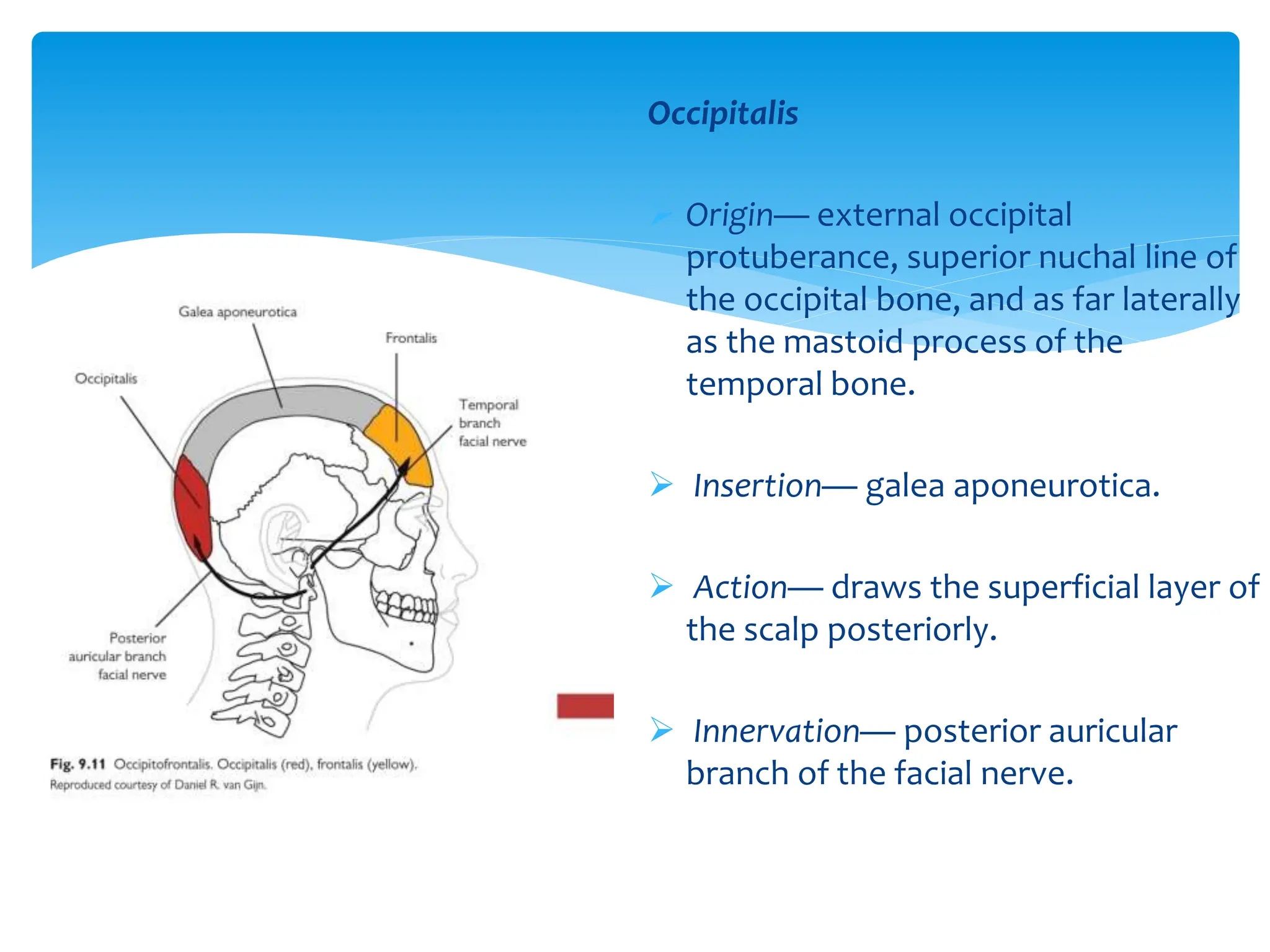
 It is the muscle of the scalp, consisting of occipitalis and frontalis
 two pairs of quadrilateral muscles at the occipital and frontal
aspects of the skull, respectively that are connected by the galea
aponeurotica.
 Laterally the aponeurosis blends with the fascia covering the
temporalis muscle superior to the zygomatic arch.
 The epicranial muscle belongs to the muscles of expression
Occipitofrontalis
Occipitalis
 Origin— external occipital
protuberance, superior nuchal line of
the occipital bone, and as far laterally
as the mastoid process of the
temporal bone.
 Insertion— galea aponeurotica.
 Action— draws the superficial layer of
the scalp posteriorly.
 Innervation— posterior auricular
branch of the facial nerve.
 Frontalis
Origin— anterior aspect of the galea aponeurotica, anterior to the
coronal suture.
Insertion—skin and the subcutaneous
tissues of the eyebrows and the root of the nose, where it blends
with the orbicularis oculi
Action— raises the eyebrows and wrinkles the skin of the
forehead.
Innervation— temporal branches of the facial nerve.
 Within the subcutaneous connective tissue layer
 Rich blood supply, derived from branches of the ECA and
indirectly from branches of the ICA, with rich anastomoses
between these branches.
 There are five pairs of arteries that supply the scalp
Blood supply to the scalp
Preauricular vessels
• Supratrochlear artery— terminal branch of ophthalmic artery, from
the ICA.
• Supraorbital artery— branch of the ophthalmic artery, from the ICA.
• Superficial temporal artery— one of the two terminal branches of
the ECA.
Postauricular vessels
• Posterior auricular— from the ECA.
The arteries and veins travel together in a longitudinal fashion.
Arterial supply
 The veins of the scalp run parallel with the arteries.
Supratrochlear and supraorbital veins
 Form the angular vein in the region of the medial canthus and
run obliquely across the face to form the facial vein which makes
an important communication with the superior ophthalmic.
 They receive many of the emissary veins of the cranium and
through these communicate with the underlying cranial venous
sinuses
Venous drainage of the scalp.
Superficial temporal vein
 Enters the parotid gland, joins the maxillaryvein to form the
retromandibular vein (RMV).The anterior division of the RMV
joins the facial vein to become the common facial vein which
ultimately drains into the IJV
Posterior auricular vein
 Joins the posterior division of theretromandibular vein to form
the EJV (which ultimately drains into the subclavian vein)
Occipital vein
 Terminates in the suboccipital venous plexus
Nuerovascular supply of scalp
 Ten pairs of nerves supply the scalp
Preauricular nerves (from anterior to posterior)
 Supratrochlear— ophthalmic division of the trigeminal nerve (V1).
 Supraorbital— ophthalmic division of the trigeminal nerve (V1).
 Zygomaticotemporal— maxillary division of the trigeminal nerve (V2).
 Temporal branch of the facial nerve (motor).
 Auriculotemporal— mandibular division of the trigeminal nerve (V3).
Nerve supply
Postauricular nerves
 Posterior branch of the great auricular nerve— C2, C3 (cervical plexus).
 Posterior auricular branch of the facial nerve.
 Lesser occipital nerve— C2, C3 (cervical plexus).
 Greater occipital nerve— dorsal ramus, C2.
 Third occipital nerve— dorsal ramus, C3.
 The lymphatic network of the scalp is located just above the
aponeurosis (between the connective tissue and aponeurosis)
 The lymph vessels of the scalp and the face drain downward
 from the occipital region to the occipital nodes
 from the parietal and the temporal regions to the preauricular
and the postauricular nodes,
 from the frontal region to the submandibular nodes.
Lymphatic Drainage
 The emissary veins connect the dural venous sinuses in the skull with
the veins of the scalp.
 Emissary veins are valveless so blood can flow in either directions (so
also infections )
 The double direction of blood flow equalizes the venous pressure in the
sinuses and the superficial veins
 The loose connective tissue layer is the dangerous area since the
emissary veins are located here and it is in these plane that pus or blood
may spread.
 Haemorrhage into the layer of loose areolar tissue due to rupture of
emissary veins can spread widely beneath the scalp down as far as the
zygomatic arch and into the upper eyelids.
Emissary veins
Emissary veins
THANK YOU

Scalp the anatomy and its applied aspects.pptx

  • 1.
  • 2.
     soft tissueenvelope of the cranial vault  consists of five layers, remember acronym ‘SCALP’  The first three layers glides freely over the periosteum via the loose areolar tissue INTRODUCTION
  • 3.
    Layers (‘SCALP’) Skin  Thickestlayer  Contains the hair follicles, sebaceous glands Connective tissue (subcutaneous)  Houses the arteries, veins, nerves, and lymphatics of the scalp within tough fibrous septa (so dense connective tissue)  It holds the vessels firmly in place and prevents them from retracting causing profuse bleeding
  • 4.
    Aponeurosis (galea aponeurotica) The keystone of the scalp  Connects the frontalis anteriorly and the occipitalis posteriorly (aponeurosis of occipitofrontalis  Continuous with the temporoparietal fascia laterally  Attached to the zygomatic arches inferiorly.
  • 5.
     Loose areolartissue  Potential (danger) space between the epicranial muscles superiorly and underlying periosteum.  Traversed by numerous emissary veins which communicate with the intracranial venous sinuses. Applied anatomy  Accumulation of blood and pus in the subgaleal plane restrained by the attachments of occipitalis posteriorly temporalis muscle fascia at the zygomatic arches laterally  Will gravitate anteriorly into the orbit and upper and lower lids anteriorly due to the lack of any bony attachment for frontalis  E.g. Black eye
  • 6.
     Pericranium  Thepericranium (periosteum) refers to the outer or external periosteum of the skull  Loosely attached to the surface of the skull bones except at the suture lines and over the temporal fossae  Collections of fluid beneath the pericranium can easily strip it but cannot pass beyond the suture line e.g. Cephalhaematoma
  • 7.
     It isthe muscle of the scalp, consisting of occipitalis and frontalis  two pairs of quadrilateral muscles at the occipital and frontal aspects of the skull, respectively that are connected by the galea aponeurotica.  Laterally the aponeurosis blends with the fascia covering the temporalis muscle superior to the zygomatic arch.  The epicranial muscle belongs to the muscles of expression Occipitofrontalis
  • 8.
    Occipitalis  Origin— externaloccipital protuberance, superior nuchal line of the occipital bone, and as far laterally as the mastoid process of the temporal bone.  Insertion— galea aponeurotica.  Action— draws the superficial layer of the scalp posteriorly.  Innervation— posterior auricular branch of the facial nerve.
  • 9.
     Frontalis Origin— anterioraspect of the galea aponeurotica, anterior to the coronal suture. Insertion—skin and the subcutaneous tissues of the eyebrows and the root of the nose, where it blends with the orbicularis oculi Action— raises the eyebrows and wrinkles the skin of the forehead. Innervation— temporal branches of the facial nerve.
  • 10.
     Within thesubcutaneous connective tissue layer  Rich blood supply, derived from branches of the ECA and indirectly from branches of the ICA, with rich anastomoses between these branches.  There are five pairs of arteries that supply the scalp Blood supply to the scalp
  • 11.
    Preauricular vessels • Supratrochlearartery— terminal branch of ophthalmic artery, from the ICA. • Supraorbital artery— branch of the ophthalmic artery, from the ICA. • Superficial temporal artery— one of the two terminal branches of the ECA. Postauricular vessels • Posterior auricular— from the ECA. The arteries and veins travel together in a longitudinal fashion. Arterial supply
  • 12.
     The veinsof the scalp run parallel with the arteries. Supratrochlear and supraorbital veins  Form the angular vein in the region of the medial canthus and run obliquely across the face to form the facial vein which makes an important communication with the superior ophthalmic.  They receive many of the emissary veins of the cranium and through these communicate with the underlying cranial venous sinuses Venous drainage of the scalp.
  • 13.
    Superficial temporal vein Enters the parotid gland, joins the maxillaryvein to form the retromandibular vein (RMV).The anterior division of the RMV joins the facial vein to become the common facial vein which ultimately drains into the IJV Posterior auricular vein  Joins the posterior division of theretromandibular vein to form the EJV (which ultimately drains into the subclavian vein) Occipital vein  Terminates in the suboccipital venous plexus
  • 14.
  • 15.
     Ten pairsof nerves supply the scalp Preauricular nerves (from anterior to posterior)  Supratrochlear— ophthalmic division of the trigeminal nerve (V1).  Supraorbital— ophthalmic division of the trigeminal nerve (V1).  Zygomaticotemporal— maxillary division of the trigeminal nerve (V2).  Temporal branch of the facial nerve (motor).  Auriculotemporal— mandibular division of the trigeminal nerve (V3). Nerve supply
  • 16.
    Postauricular nerves  Posteriorbranch of the great auricular nerve— C2, C3 (cervical plexus).  Posterior auricular branch of the facial nerve.  Lesser occipital nerve— C2, C3 (cervical plexus).  Greater occipital nerve— dorsal ramus, C2.  Third occipital nerve— dorsal ramus, C3.
  • 17.
     The lymphaticnetwork of the scalp is located just above the aponeurosis (between the connective tissue and aponeurosis)  The lymph vessels of the scalp and the face drain downward  from the occipital region to the occipital nodes  from the parietal and the temporal regions to the preauricular and the postauricular nodes,  from the frontal region to the submandibular nodes. Lymphatic Drainage
  • 18.
     The emissaryveins connect the dural venous sinuses in the skull with the veins of the scalp.  Emissary veins are valveless so blood can flow in either directions (so also infections )  The double direction of blood flow equalizes the venous pressure in the sinuses and the superficial veins  The loose connective tissue layer is the dangerous area since the emissary veins are located here and it is in these plane that pus or blood may spread.  Haemorrhage into the layer of loose areolar tissue due to rupture of emissary veins can spread widely beneath the scalp down as far as the zygomatic arch and into the upper eyelids. Emissary veins
  • 19.
  • 20.