SCALP
prof. Makarem 2
DEFINITION
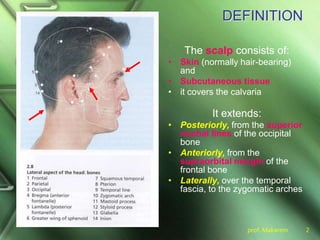
The scalp consists of:
• Skin (normally hair-bearing)
and
• Subcutaneous tissue
• it covers the calvaria
It extends:
• Posteriorly, from the superior
nuchal lines of the occipital
bone
• Anteriorly, from the
supraorbital margin of the
frontal bone
• Laterally, over the temporal
fascia, to the zygomatic arches
prof. Makarem 3
STRUCTURE
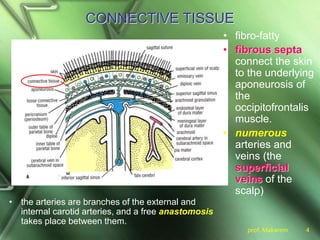
The SCALP consists of five layers:
• Skin
• Connective tissue
• Aponeurosis
• Loose areolar tissue
• Pericranium
prof. Makarem 4
CONNECTIVE TISSUE
• the arteries are branches of the external and
internal carotid arteries, and a free anastomosis
takes place between them.
• fibro-fatty
• fibrous septa
connect the skin
to the underlying
aponeurosis of
the
occipitofrontalis
muscle.
• numerous
arteries and
veins (the
superficial
veins of the
scalp)
prof. Makarem 5
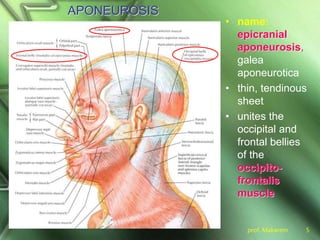
APONEUROSIS
• name:
epicranial
aponeurosis,
galea
aponeurotica
• thin, tendinous
sheet
• unites the
occipital and
frontal bellies
of the
occipito-
frontalis
muscle
prof. Makarem 6
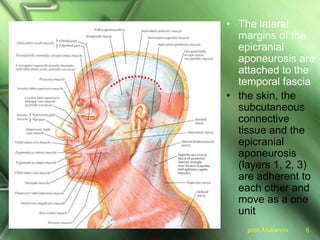
• The lateral
margins of the
epicranial
aponeurosis are
attached to the
temporal fascia
• the skin, the
subcutaneous
connective
tissue and the
epicranial
aponeurosis
(layers 1, 2, 3)
are adherent to
each other and
move as a one
unit
prof. Makarem 7
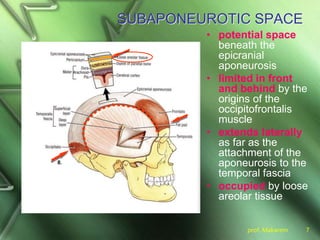
SUBAPONEUROTIC SPACE
• potential space
beneath the
epicranial
aponeurosis
• limited in front
and behind by the
origins of the
occipitofrontalis
muscle
• extends laterally
as far as the
attachment of the
aponeurosis to the
temporal fascia
• occupied by loose
areolar tissue
prof. Makarem 8
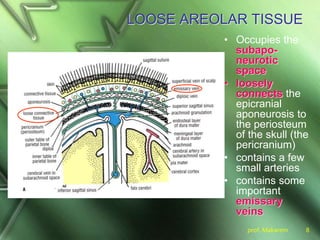
LOOSE AREOLAR TISSUE
• Occupies the
subapo-
neurotic
space
• loosely
connects the
epicranial
aponeurosis to
the periosteum
of the skull (the
pericranium)
• contains a few
small arteries
• contains some
important
emissary
veins
prof. Makarem 9
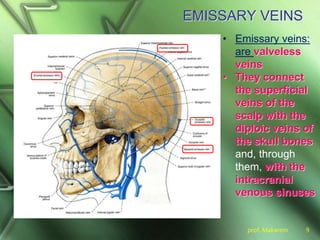
EMISSARY VEINS
• Emissary veins:
are valveless
veins
• They connect
the superficial
veins of the
scalp with the
diploic veins of
the skull bones
and, through
them, with the
intracranial
venous sinuses
prof. Makarem 10
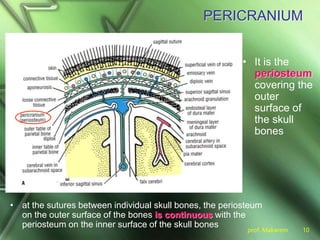
PERICRANIUM
• at the sutures between individual skull bones, the periosteum
on the outer surface of the bones is continuous with the
periosteum on the inner surface of the skull bones
• It is the
periosteum
covering the
outer
surface of
the skull
bones
prof. Makarem 11
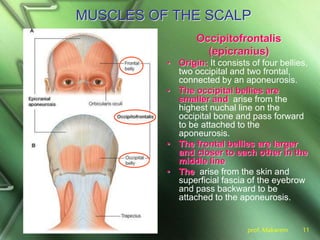
MUSCLES OF THE SCALP
Occipitofrontalis
(epicranius)
• Origin: It consists of four bellies,
two occipital and two frontal,
connected by an aponeurosis.
• The occipital bellies are
smaller and arise from the
highest nuchal line on the
occipital bone and pass forward
to be attached to the
aponeurosis.
• The frontal bellies are larger
and closer to each other in the
middle line
• The arise from the skin and
superficial fascia of the eyebrow
and pass backward to be
attached to the aponeurosis.
prof. Makarem 12
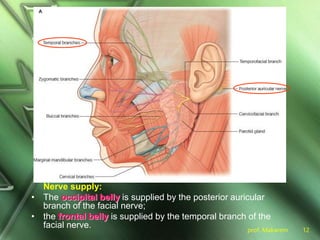
Nerve supply:
• The occipital belly is supplied by the posterior auricular
branch of the facial nerve;
• the frontal belly is supplied by the temporal branch of the
facial nerve.
prof. Makarem 13
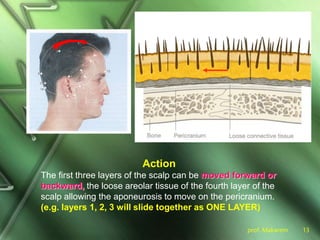
Action
The first three layers of the scalp can be moved forward or
backward, the loose areolar tissue of the fourth layer of the
scalp allowing the aponeurosis to move on the pericranium.
(e.g. layers 1, 2, 3 will slide together as ONE LAYER)
prof. Makarem 14
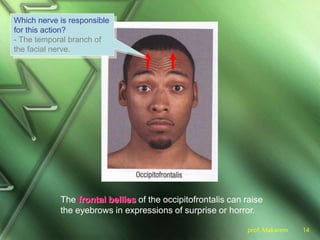
The frontal bellies of the occipitofrontalis can raise
the eyebrows in expressions of surprise or horror.
Which nerve is responsible
for this action?
- The temporal branch of
the facial nerve.
prof. Makarem 15
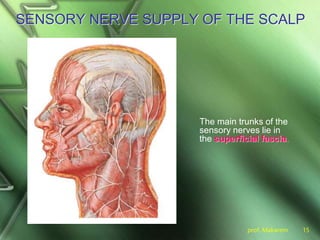
SENSORY NERVE SUPPLY OF THE SCALP
The main trunks of the
sensory nerves lie in
the superficial fascia.
prof. Makarem 16
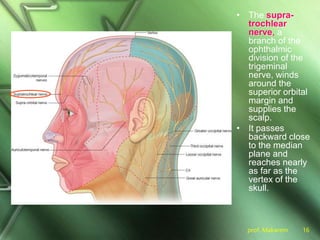
• The supra-
trochlear
nerve, a
branch of the
ophthalmic
division of the
trigeminal
nerve, winds
around the
superior orbital
margin and
supplies the
scalp.
• It passes
backward close
to the median
plane and
reaches nearly
as far as the
vertex of the
skull.
prof. Makarem 17
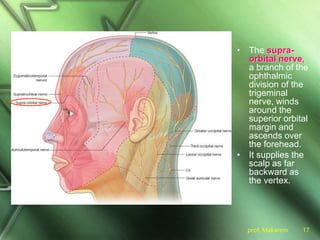
• The supra-
orbital nerve,
a branch of the
ophthalmic
division of the
trigeminal
nerve, winds
around the
superior orbital
margin and
ascends over
the forehead.
• It supplies the
scalp as far
backward as
the vertex.
prof. Makarem 18
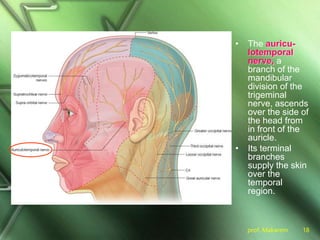
• The auricu-
lotemporal
nerve, a
branch of the
mandibular
division of the
trigeminal
nerve, ascends
over the side of
the head from
in front of the
auricle.
• Its terminal
branches
supply the skin
over the
temporal
region.
prof. Makarem 19
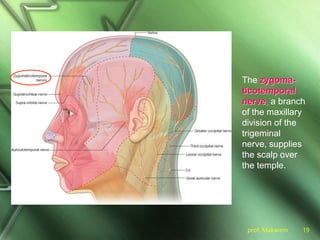
The zygoma-
ticotemporal
nerve, a branch
of the maxillary
division of the
trigeminal
nerve, supplies
the scalp over
the temple.
prof. Makarem 20
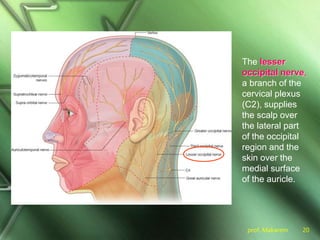
The lesser
occipital nerve,
a branch of the
cervical plexus
(C2), supplies
the scalp over
the lateral part
of the occipital
region and the
skin over the
medial surface
of the auricle.
prof. Makarem 21
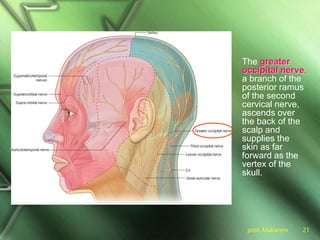
The greater
occipital nerve,
a branch of the
posterior ramus
of the second
cervical nerve,
ascends over
the back of the
scalp and
supplies the
skin as far
forward as the
vertex of the
skull.
prof. Makarem 22
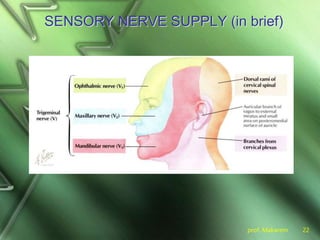
SENSORY NERVE SUPPLY (in brief)
prof. Makarem 23
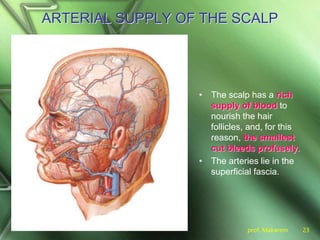
ARTERIAL SUPPLY OF THE SCALP
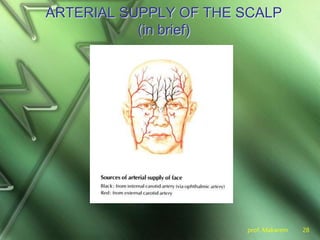
• The scalp has a rich
supply of blood to
nourish the hair
follicles, and, for this
reason, the smallest
cut bleeds profusely.
• The arteries lie in the
superficial fascia.
prof. Makarem 24
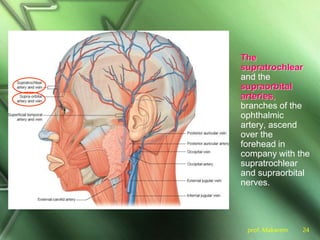
The
supratrochlear
and the
supraorbital
arteries,
branches of the
ophthalmic
artery, ascend
over the
forehead in
company with the
supratrochlear
and supraorbital
nerves.
prof. Makarem 25
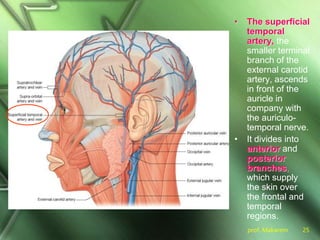
• The superficial
temporal
artery, the
smaller terminal
branch of the
external carotid
artery, ascends
in front of the
auricle in
company with
the auriculo-
temporal nerve.
• It divides into
anterior and
posterior
branches,
which supply
the skin over
the frontal and
temporal
regions.
prof. Makarem 26
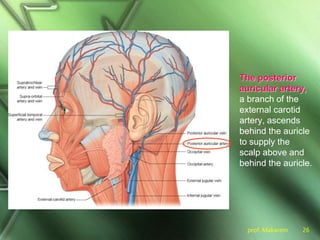
The posterior
auricular artery,
a branch of the
external carotid
artery, ascends
behind the auricle
to supply the
scalp above and
behind the auricle.
prof. Makarem 27
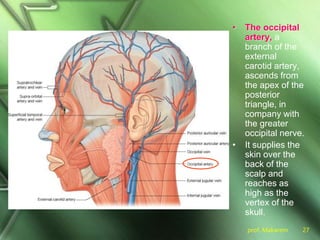
• The occipital
artery, a
branch of the
external
carotid artery,
ascends from
the apex of the
posterior
triangle, in
company with
the greater
occipital nerve.
• It supplies the
skin over the
back of the
scalp and
reaches as
high as the
vertex of the
skull.
prof. Makarem 28
ARTERIAL SUPPLY OF THE SCALP
(in brief)
prof. Makarem 29
VENOUS DRAINAGE OF THE SCALP
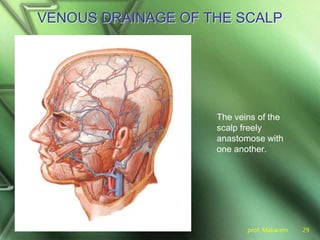
The veins of the
scalp freely
anastomose with
one another.
prof. Makarem 30
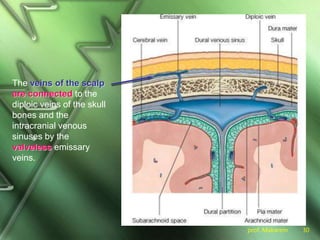
The veins of the scalp
are connected to the
diploic veins of the skull
bones and the
intracranial venous
sinuses by the
valveless emissary
veins.
prof. Makarem 31
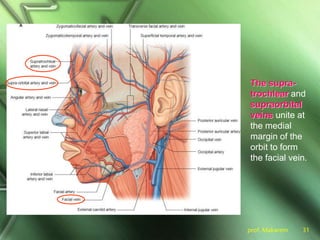
The supra-
trochlear and
supraorbital
veins unite at
the medial
margin of the
orbit to form
the facial vein.
prof. Makarem 32
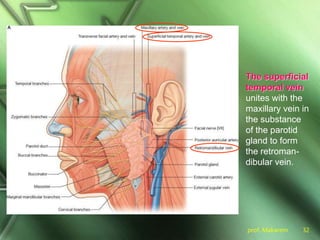
The superficial
temporal vein
unites with the
maxillary vein in
the substance
of the parotid
gland to form
the retroman-
dibular vein.
prof. Makarem 33
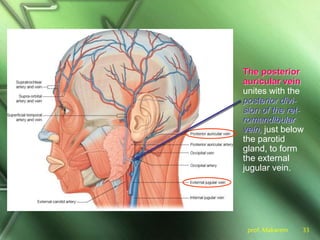
The posterior
auricular vein
unites with the
posterior divi-
sion of the ret-
romandibular
vein, just below
the parotid
gland, to form
the external
jugular vein.
prof. Makarem 34
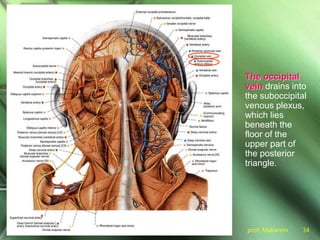
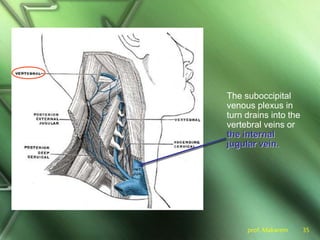
The occipital
vein drains into
the suboccipital
venous plexus,
which lies
beneath the
floor of the
upper part of
the posterior
triangle.
prof. Makarem 35
The suboccipital
venous plexus in
turn drains into the
vertebral veins or
the internal
jugular vein.
prof. Makarem 36
LYMPH DRAINAGE OF THE SCALP
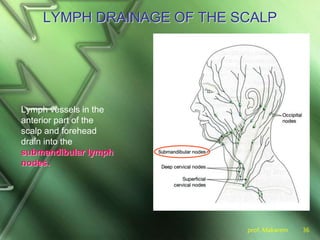
Lymph vessels in the
anterior part of the
scalp and forehead
drain into the
submandibular lymph
nodes.
prof. Makarem 37
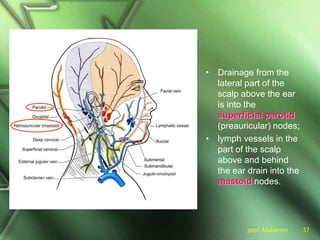
• Drainage from the
lateral part of the
scalp above the ear
is into the
superficial parotid
(preauricular) nodes;
• lymph vessels in the
part of the scalp
above and behind
the ear drain into the
mastoid nodes.
prof. Makarem 38
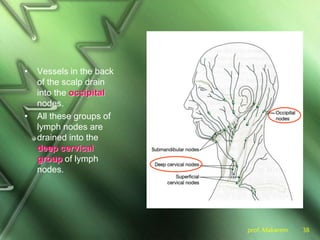
• Vessels in the back
of the scalp drain
into the occipital
nodes.
• All these groups of
lymph nodes are
drained into the
deep cervical
group of lymph
nodes.
01-Scسسسسسسسسسسسسسسسسسسسسسسسسسسسسسسalp.ppt

  • 1.
  • 2.
    prof. Makarem 2 DEFINITION Thescalp consists of: • Skin (normally hair-bearing) and • Subcutaneous tissue • it covers the calvaria It extends: • Posteriorly, from the superior nuchal lines of the occipital bone • Anteriorly, from the supraorbital margin of the frontal bone • Laterally, over the temporal fascia, to the zygomatic arches
  • 3.
    prof. Makarem 3 STRUCTURE TheSCALP consists of five layers: • Skin • Connective tissue • Aponeurosis • Loose areolar tissue • Pericranium
  • 4.
    prof. Makarem 4 CONNECTIVETISSUE • the arteries are branches of the external and internal carotid arteries, and a free anastomosis takes place between them. • fibro-fatty • fibrous septa connect the skin to the underlying aponeurosis of the occipitofrontalis muscle. • numerous arteries and veins (the superficial veins of the scalp)
  • 5.
    prof. Makarem 5 APONEUROSIS •name: epicranial aponeurosis, galea aponeurotica • thin, tendinous sheet • unites the occipital and frontal bellies of the occipito- frontalis muscle
  • 6.
    prof. Makarem 6 •The lateral margins of the epicranial aponeurosis are attached to the temporal fascia • the skin, the subcutaneous connective tissue and the epicranial aponeurosis (layers 1, 2, 3) are adherent to each other and move as a one unit
  • 7.
    prof. Makarem 7 SUBAPONEUROTICSPACE • potential space beneath the epicranial aponeurosis • limited in front and behind by the origins of the occipitofrontalis muscle • extends laterally as far as the attachment of the aponeurosis to the temporal fascia • occupied by loose areolar tissue
  • 8.
    prof. Makarem 8 LOOSEAREOLAR TISSUE • Occupies the subapo- neurotic space • loosely connects the epicranial aponeurosis to the periosteum of the skull (the pericranium) • contains a few small arteries • contains some important emissary veins
  • 9.
    prof. Makarem 9 EMISSARYVEINS • Emissary veins: are valveless veins • They connect the superficial veins of the scalp with the diploic veins of the skull bones and, through them, with the intracranial venous sinuses
  • 10.
    prof. Makarem 10 PERICRANIUM •at the sutures between individual skull bones, the periosteum on the outer surface of the bones is continuous with the periosteum on the inner surface of the skull bones • It is the periosteum covering the outer surface of the skull bones
  • 11.
    prof. Makarem 11 MUSCLESOF THE SCALP Occipitofrontalis (epicranius) • Origin: It consists of four bellies, two occipital and two frontal, connected by an aponeurosis. • The occipital bellies are smaller and arise from the highest nuchal line on the occipital bone and pass forward to be attached to the aponeurosis. • The frontal bellies are larger and closer to each other in the middle line • The arise from the skin and superficial fascia of the eyebrow and pass backward to be attached to the aponeurosis.
  • 12.
    prof. Makarem 12 Nervesupply: • The occipital belly is supplied by the posterior auricular branch of the facial nerve; • the frontal belly is supplied by the temporal branch of the facial nerve.
  • 13.
    prof. Makarem 13 Action Thefirst three layers of the scalp can be moved forward or backward, the loose areolar tissue of the fourth layer of the scalp allowing the aponeurosis to move on the pericranium. (e.g. layers 1, 2, 3 will slide together as ONE LAYER)
  • 14.
    prof. Makarem 14 Thefrontal bellies of the occipitofrontalis can raise the eyebrows in expressions of surprise or horror. Which nerve is responsible for this action? - The temporal branch of the facial nerve.
  • 15.
    prof. Makarem 15 SENSORYNERVE SUPPLY OF THE SCALP The main trunks of the sensory nerves lie in the superficial fascia.
  • 16.
    prof. Makarem 16 •The supra- trochlear nerve, a branch of the ophthalmic division of the trigeminal nerve, winds around the superior orbital margin and supplies the scalp. • It passes backward close to the median plane and reaches nearly as far as the vertex of the skull.
  • 17.
    prof. Makarem 17 •The supra- orbital nerve, a branch of the ophthalmic division of the trigeminal nerve, winds around the superior orbital margin and ascends over the forehead. • It supplies the scalp as far backward as the vertex.
  • 18.
    prof. Makarem 18 •The auricu- lotemporal nerve, a branch of the mandibular division of the trigeminal nerve, ascends over the side of the head from in front of the auricle. • Its terminal branches supply the skin over the temporal region.
  • 19.
    prof. Makarem 19 Thezygoma- ticotemporal nerve, a branch of the maxillary division of the trigeminal nerve, supplies the scalp over the temple.
  • 20.
    prof. Makarem 20 Thelesser occipital nerve, a branch of the cervical plexus (C2), supplies the scalp over the lateral part of the occipital region and the skin over the medial surface of the auricle.
  • 21.
    prof. Makarem 21 Thegreater occipital nerve, a branch of the posterior ramus of the second cervical nerve, ascends over the back of the scalp and supplies the skin as far forward as the vertex of the skull.
  • 22.
    prof. Makarem 22 SENSORYNERVE SUPPLY (in brief)
  • 23.
    prof. Makarem 23 ARTERIALSUPPLY OF THE SCALP • The scalp has a rich supply of blood to nourish the hair follicles, and, for this reason, the smallest cut bleeds profusely. • The arteries lie in the superficial fascia.
  • 24.
    prof. Makarem 24 The supratrochlear andthe supraorbital arteries, branches of the ophthalmic artery, ascend over the forehead in company with the supratrochlear and supraorbital nerves.
  • 25.
    prof. Makarem 25 •The superficial temporal artery, the smaller terminal branch of the external carotid artery, ascends in front of the auricle in company with the auriculo- temporal nerve. • It divides into anterior and posterior branches, which supply the skin over the frontal and temporal regions.
  • 26.
    prof. Makarem 26 Theposterior auricular artery, a branch of the external carotid artery, ascends behind the auricle to supply the scalp above and behind the auricle.
  • 27.
    prof. Makarem 27 •The occipital artery, a branch of the external carotid artery, ascends from the apex of the posterior triangle, in company with the greater occipital nerve. • It supplies the skin over the back of the scalp and reaches as high as the vertex of the skull.
  • 28.
    prof. Makarem 28 ARTERIALSUPPLY OF THE SCALP (in brief)
  • 29.
    prof. Makarem 29 VENOUSDRAINAGE OF THE SCALP The veins of the scalp freely anastomose with one another.
  • 30.
    prof. Makarem 30 Theveins of the scalp are connected to the diploic veins of the skull bones and the intracranial venous sinuses by the valveless emissary veins.
  • 31.
    prof. Makarem 31 Thesupra- trochlear and supraorbital veins unite at the medial margin of the orbit to form the facial vein.
  • 32.
    prof. Makarem 32 Thesuperficial temporal vein unites with the maxillary vein in the substance of the parotid gland to form the retroman- dibular vein.
  • 33.
    prof. Makarem 33 Theposterior auricular vein unites with the posterior divi- sion of the ret- romandibular vein, just below the parotid gland, to form the external jugular vein.
  • 34.
    prof. Makarem 34 Theoccipital vein drains into the suboccipital venous plexus, which lies beneath the floor of the upper part of the posterior triangle.
  • 35.
    prof. Makarem 35 Thesuboccipital venous plexus in turn drains into the vertebral veins or the internal jugular vein.
  • 36.
    prof. Makarem 36 LYMPHDRAINAGE OF THE SCALP Lymph vessels in the anterior part of the scalp and forehead drain into the submandibular lymph nodes.
  • 37.
    prof. Makarem 37 •Drainage from the lateral part of the scalp above the ear is into the superficial parotid (preauricular) nodes; • lymph vessels in the part of the scalp above and behind the ear drain into the mastoid nodes.
  • 38.
    prof. Makarem 38 •Vessels in the back of the scalp drain into the occipital nodes. • All these groups of lymph nodes are drained into the deep cervical group of lymph nodes.