Scaling up family practice:
progressing towards
universal health coverage
Agenda item 4(a)
63rd Session of the WHO Regional
Committee for the Eastern Mediterranean
36 October 2016
1
Outline
 Characteristics of family practice
 Family practice assessment in the Region
 WHO strategies to increase number of family
physicians
 Framework of action for advancing family
practice
 Conclusion
2
Scaling up family practice: progressing towards universal health coverage
Characteristics of the family
practice approach
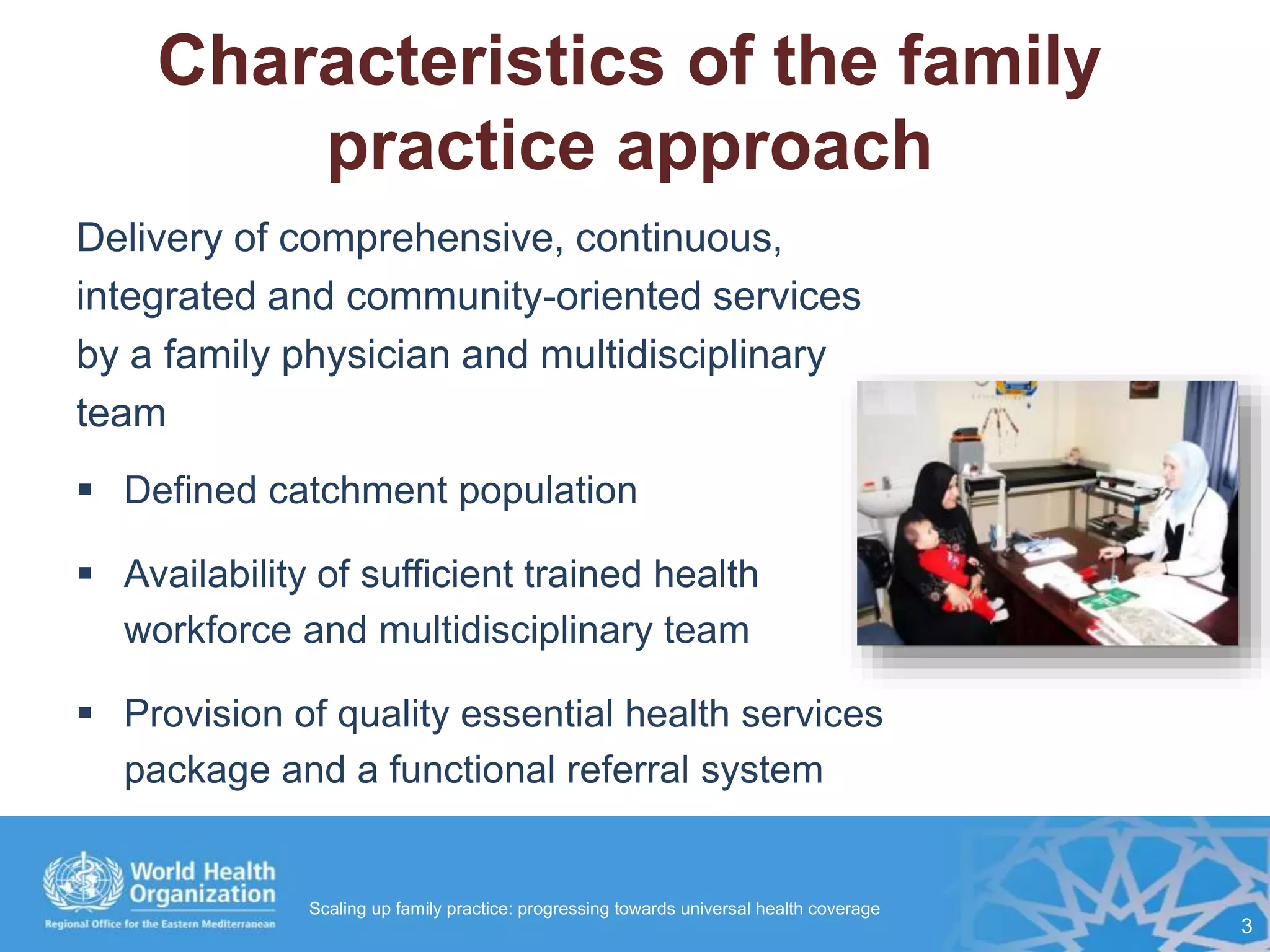
Delivery of comprehensive, continuous,
integrated and community-oriented services
by a family physician and multidisciplinary
team
 Defined catchment population
 Availability of sufficient trained health
workforce and multidisciplinary team
 Provision of quality essential health services
package and a functional referral system
3
Scaling up family practice: progressing towards universal health coverage
Assessment of family practice in the Region
 Family practice in 16 national health policy and plans
 Service delivery based on family practice
Group 1 countries 14100%
Group 2 countries 0 63%
Group 3 countries 014%
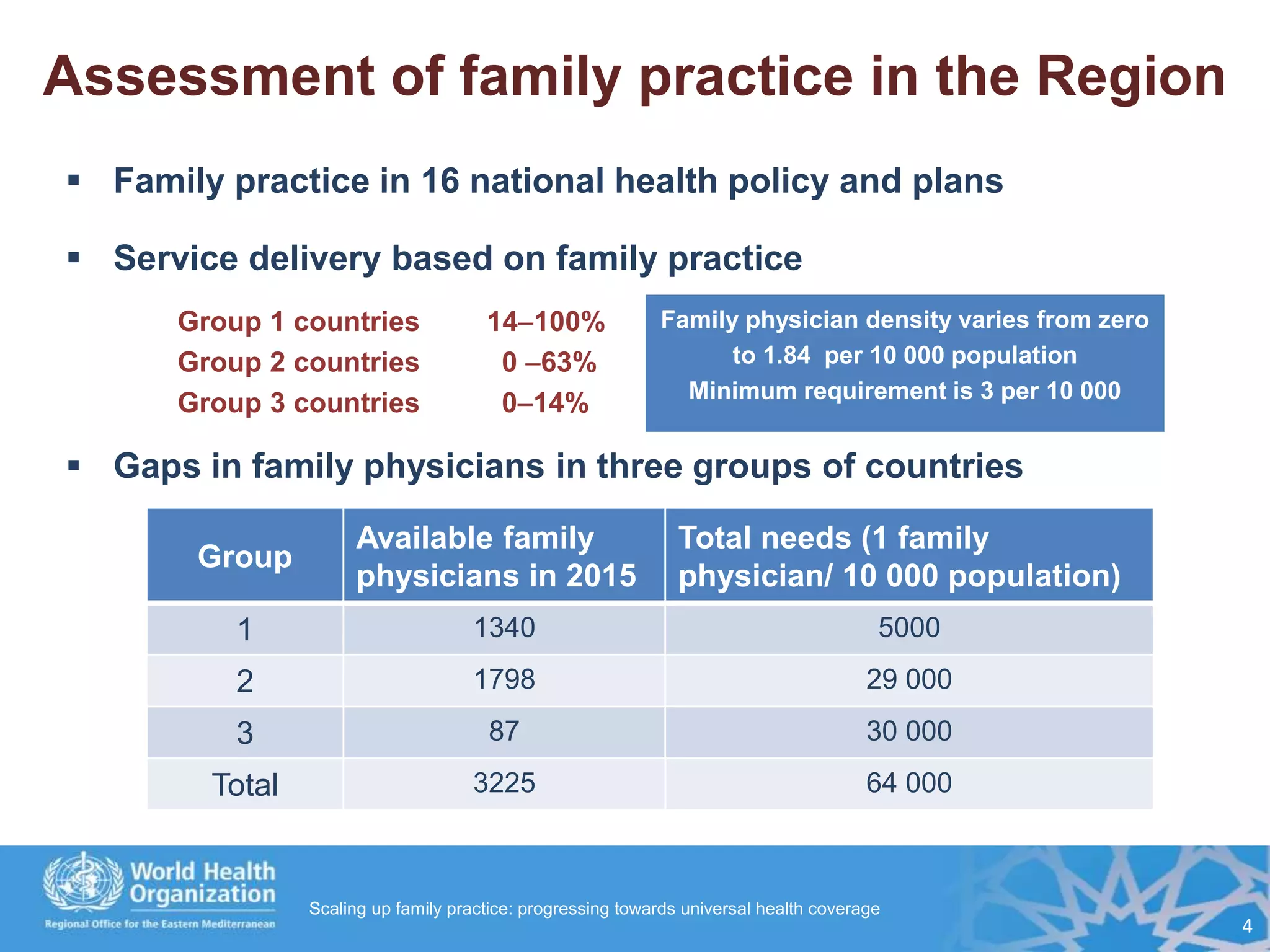
 Gaps in family physicians in three groups of countries
4
Family physician density varies from zero
to 1.84 per 10 000 population
Minimum requirement is 3 per 10 000
Scaling up family practice: progressing towards universal health coverage
Group
Available family
physicians in 2015
Total needs (1 family
physician/ 10 000 population)
1 1340 5000
2 1798 29 000
3 87 30 000
Total 3225 64 000
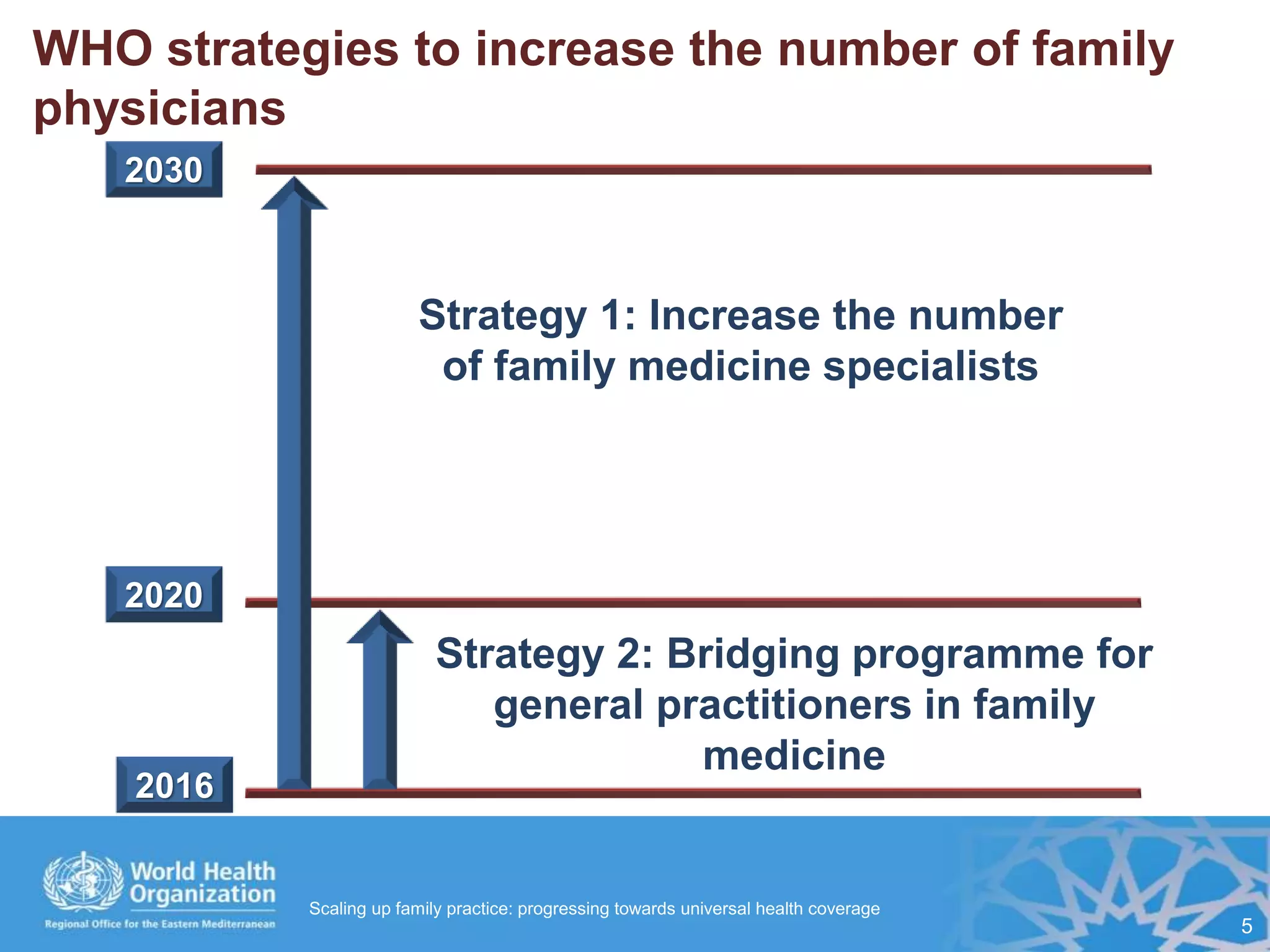
2020
2016
2030
Strategy 2: Bridging programme for
general practitioners in family
medicine
Strategy 1: Increase the number
of family medicine specialists
WHO strategies to increase the number of family
physicians
5
Scaling up family practice: progressing towards universal health coverage
 Increase annual production of
family physicians
 Strengthen family medicine
education/departments
 WHO recommends that
physicians who want to pursue
general practice should be
specialized in family medicine
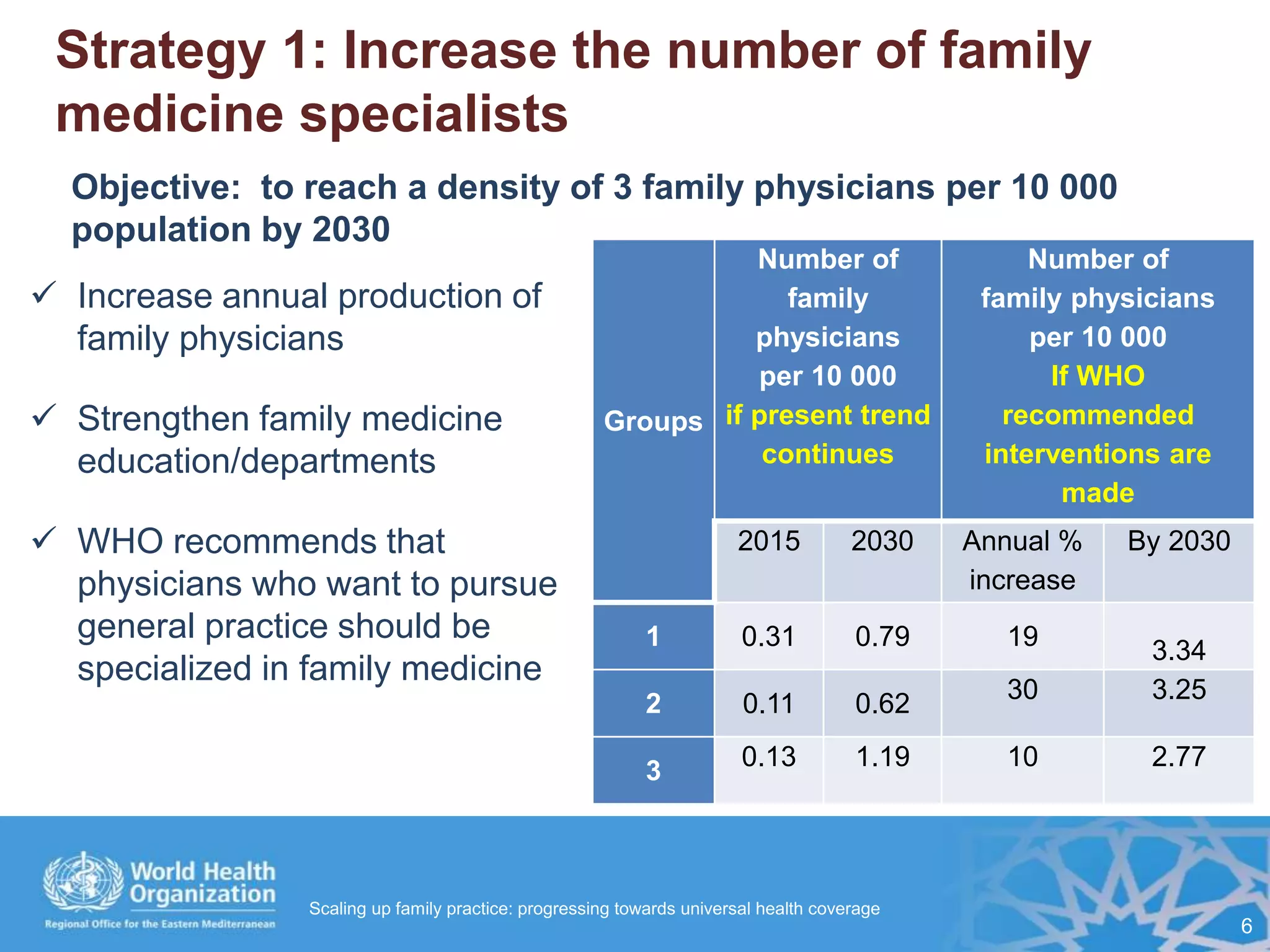
Strategy 1: Increase the number of family
medicine specialists
Objective: to reach a density of 3 family physicians per 10 000
population by 2030
Groups
Number of
family
physicians
per 10 000
if present trend
continues
Number of
family physicians
per 10 000
If WHO
recommended
interventions are
made
2015 2030 Annual %
increase
By 2030
1 0.31 0.79 19
3.34
2 0.11 0.62
30 3.25
3
0.13 1.19 10 2.77
6
Scaling up family practice: progressing towards universal health coverage
Strategy 2: Bridging programme for general
practitioners on family medicine
 Compulsory training
covering all general
practitioners (GPs) working
in public facilities
 Duration (1224 months):
 First 6 months: WHO
bridging programme
“Online course on building
capacities of GPs in family
medicine”
 Each country to decide on
practical training duration
and recognition system
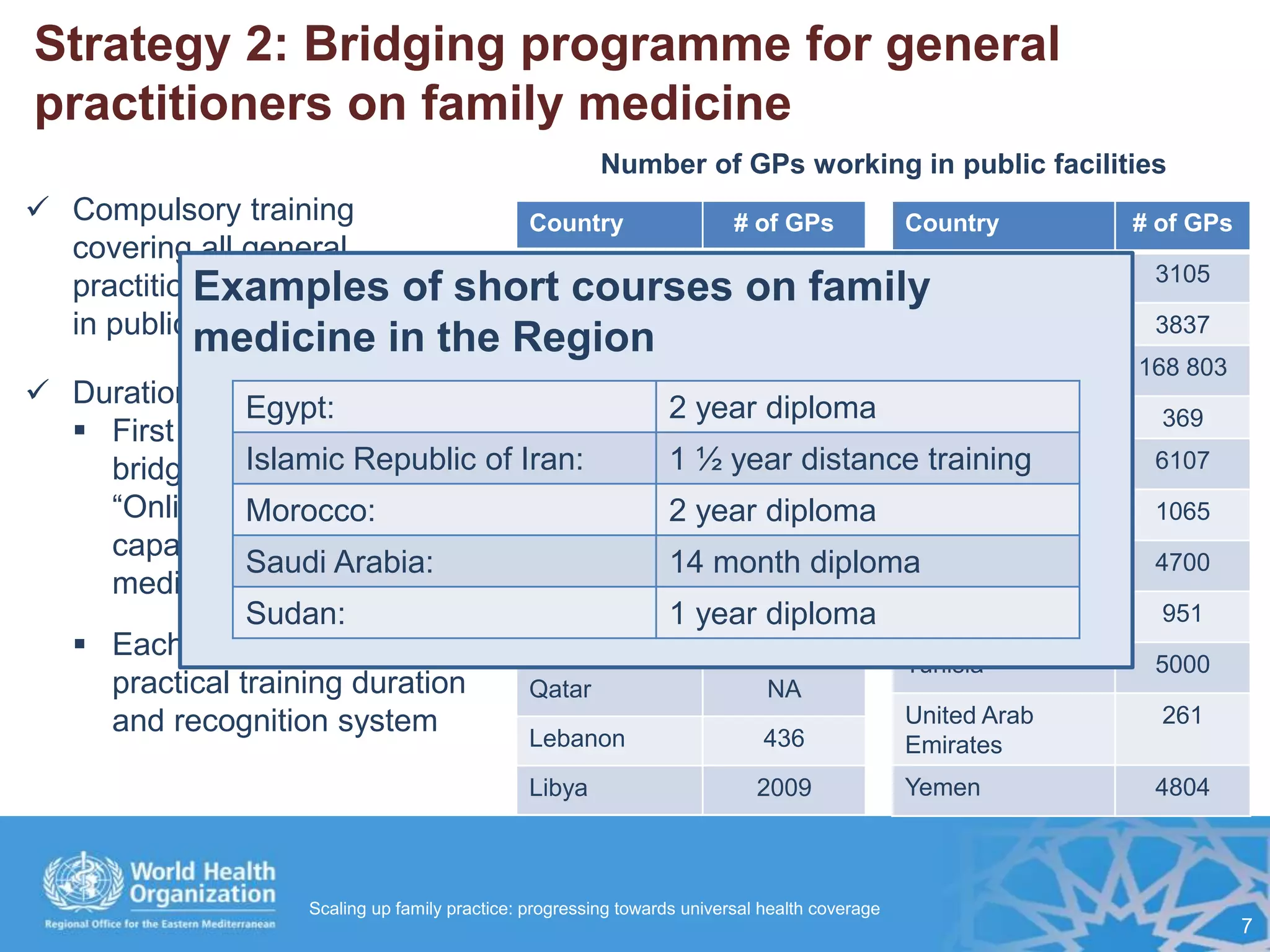
Number of GPs working in public facilities
Country # of GPs
Afghanistan NA
Bahrain 98
Djibouti NA
Egypt 14 973
Iran, Islamic
Republic of
9500
Iraq 8000
Jordan 1645
Kuwait 832
Qatar NA
Lebanon 436
Libya 2009
Country # of GPs
Morocco 3105
Oman 3837
Pakistan 168 803
Palestine 369
Saudi Arabia 6107
Somalia 1065
Sudan 4700
Syria 951
Tunisia 5000
United Arab
Emirates
261
Yemen 4804
Examples of short courses on family
medicine in the Region
7
Egypt: 2 year diploma
Islamic Republic of Iran: 1 ½ year distance training
Morocco: 2 year diploma
Saudi Arabia: 14 month diploma
Sudan: 1 year diploma
Scaling up family practice: progressing towards universal health coverage
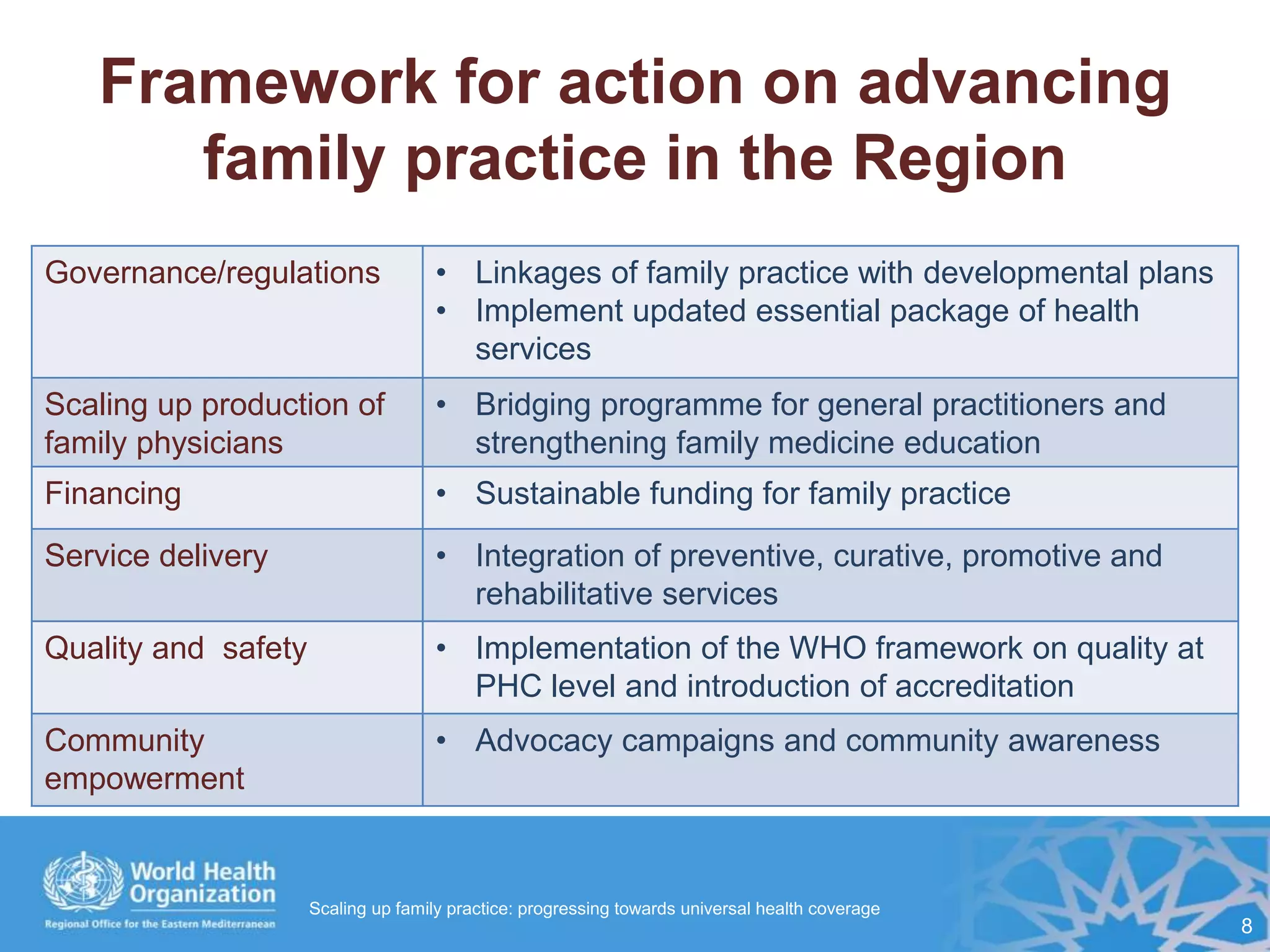
Framework for action on advancing
family practice in the Region
Governance/regulations • Linkages of family practice with developmental plans
• Implement updated essential package of health
services
Scaling up production of
family physicians
• Bridging programme for general practitioners and
strengthening family medicine education
Financing • Sustainable funding for family practice
Service delivery • Integration of preventive, curative, promotive and
rehabilitative services
Quality and safety • Implementation of the WHO framework on quality at
PHC level and introduction of accreditation
Community
empowerment
• Advocacy campaigns and community awareness
8
Scaling up family practice: progressing towards universal health coverage
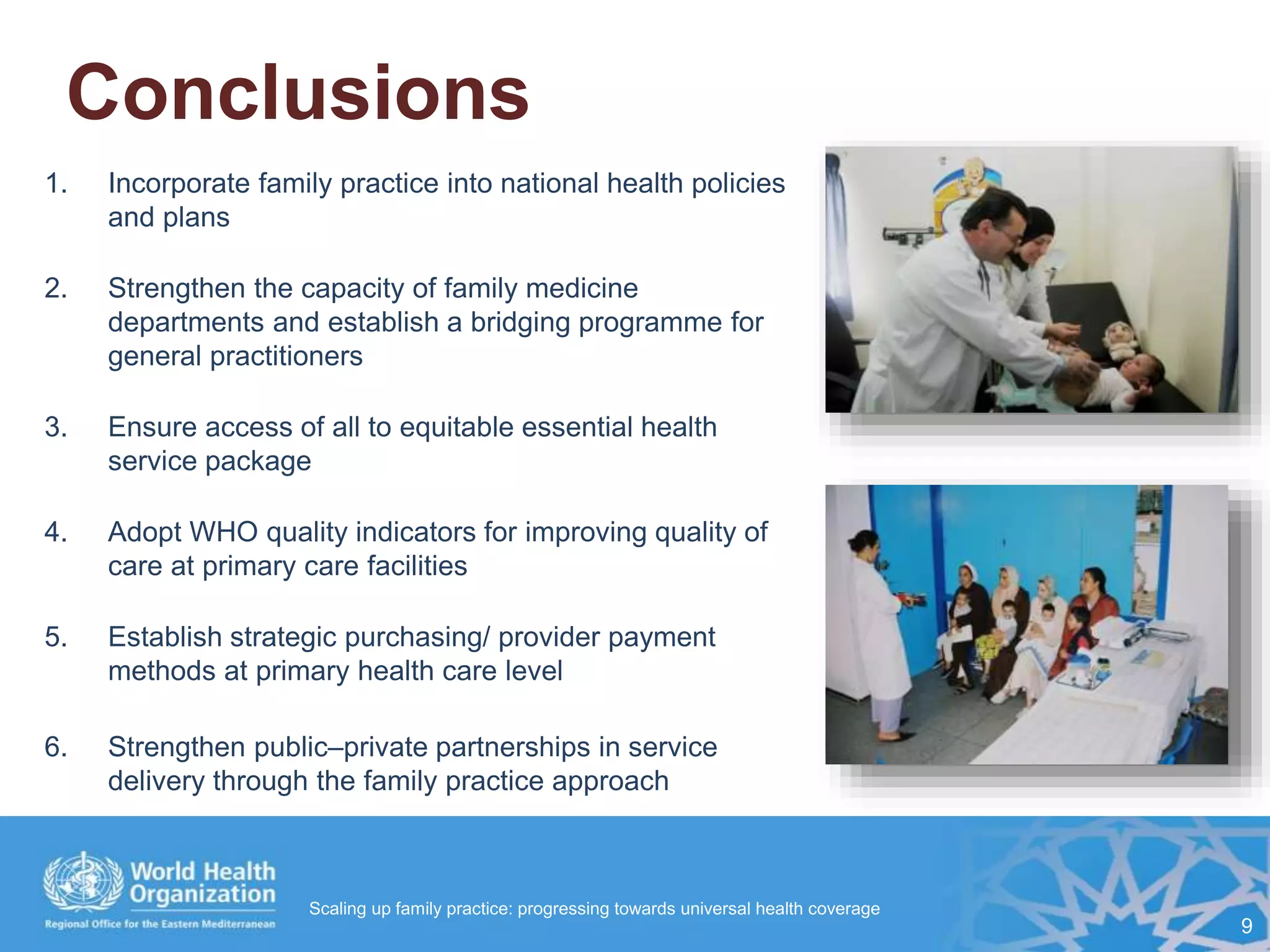
Conclusions
1. Incorporate family practice into national health policies
and plans
2. Strengthen the capacity of family medicine
departments and establish a bridging programme for
general practitioners
3. Ensure access of all to equitable essential health
service package
4. Adopt WHO quality indicators for improving quality of
care at primary care facilities
5. Establish strategic purchasing/ provider payment
methods at primary health care level
6. Strengthen public–private partnerships in service
delivery through the family practice approach
9
Scaling up family practice: progressing towards universal health coverage
Thank you
10

Scaling up family practice: progressing towards universal health coverage

  • 1.
    Scaling up familypractice: progressing towards universal health coverage Agenda item 4(a) 63rd Session of the WHO Regional Committee for the Eastern Mediterranean 36 October 2016 1
  • 2.
    Outline  Characteristics offamily practice  Family practice assessment in the Region  WHO strategies to increase number of family physicians  Framework of action for advancing family practice  Conclusion 2 Scaling up family practice: progressing towards universal health coverage
  • 3.
    Characteristics of thefamily practice approach Delivery of comprehensive, continuous, integrated and community-oriented services by a family physician and multidisciplinary team  Defined catchment population  Availability of sufficient trained health workforce and multidisciplinary team  Provision of quality essential health services package and a functional referral system 3 Scaling up family practice: progressing towards universal health coverage
  • 4.
    Assessment of familypractice in the Region  Family practice in 16 national health policy and plans  Service delivery based on family practice Group 1 countries 14100% Group 2 countries 0 63% Group 3 countries 014%  Gaps in family physicians in three groups of countries 4 Family physician density varies from zero to 1.84 per 10 000 population Minimum requirement is 3 per 10 000 Scaling up family practice: progressing towards universal health coverage Group Available family physicians in 2015 Total needs (1 family physician/ 10 000 population) 1 1340 5000 2 1798 29 000 3 87 30 000 Total 3225 64 000
  • 5.
    2020 2016 2030 Strategy 2: Bridgingprogramme for general practitioners in family medicine Strategy 1: Increase the number of family medicine specialists WHO strategies to increase the number of family physicians 5 Scaling up family practice: progressing towards universal health coverage
  • 6.
     Increase annualproduction of family physicians  Strengthen family medicine education/departments  WHO recommends that physicians who want to pursue general practice should be specialized in family medicine Strategy 1: Increase the number of family medicine specialists Objective: to reach a density of 3 family physicians per 10 000 population by 2030 Groups Number of family physicians per 10 000 if present trend continues Number of family physicians per 10 000 If WHO recommended interventions are made 2015 2030 Annual % increase By 2030 1 0.31 0.79 19 3.34 2 0.11 0.62 30 3.25 3 0.13 1.19 10 2.77 6 Scaling up family practice: progressing towards universal health coverage
  • 7.
    Strategy 2: Bridgingprogramme for general practitioners on family medicine  Compulsory training covering all general practitioners (GPs) working in public facilities  Duration (1224 months):  First 6 months: WHO bridging programme “Online course on building capacities of GPs in family medicine”  Each country to decide on practical training duration and recognition system Number of GPs working in public facilities Country # of GPs Afghanistan NA Bahrain 98 Djibouti NA Egypt 14 973 Iran, Islamic Republic of 9500 Iraq 8000 Jordan 1645 Kuwait 832 Qatar NA Lebanon 436 Libya 2009 Country # of GPs Morocco 3105 Oman 3837 Pakistan 168 803 Palestine 369 Saudi Arabia 6107 Somalia 1065 Sudan 4700 Syria 951 Tunisia 5000 United Arab Emirates 261 Yemen 4804 Examples of short courses on family medicine in the Region 7 Egypt: 2 year diploma Islamic Republic of Iran: 1 ½ year distance training Morocco: 2 year diploma Saudi Arabia: 14 month diploma Sudan: 1 year diploma Scaling up family practice: progressing towards universal health coverage
  • 8.
    Framework for actionon advancing family practice in the Region Governance/regulations • Linkages of family practice with developmental plans • Implement updated essential package of health services Scaling up production of family physicians • Bridging programme for general practitioners and strengthening family medicine education Financing • Sustainable funding for family practice Service delivery • Integration of preventive, curative, promotive and rehabilitative services Quality and safety • Implementation of the WHO framework on quality at PHC level and introduction of accreditation Community empowerment • Advocacy campaigns and community awareness 8 Scaling up family practice: progressing towards universal health coverage
  • 9.
    Conclusions 1. Incorporate familypractice into national health policies and plans 2. Strengthen the capacity of family medicine departments and establish a bridging programme for general practitioners 3. Ensure access of all to equitable essential health service package 4. Adopt WHO quality indicators for improving quality of care at primary care facilities 5. Establish strategic purchasing/ provider payment methods at primary health care level 6. Strengthen public–private partnerships in service delivery through the family practice approach 9 Scaling up family practice: progressing towards universal health coverage
  • 10.

Editor's Notes

  • #7  In case the Group 1 countries continue with the same annual production of Family Physicians they will reach to 0.79 Family Physician per 10 000 by the year 2030 However, to reach the international number of family physician per 10 000 WHO recommend certain % increase based on population projection. In the Group 1 countries it is expected to reach 3.34/ 10 000 population. In case the Group 2 countries continue with the same annual production of Family Physicians they will reach to 0.62 Family Physician per 10 000 by the year 2030 However, to reach the international number of family physician per 10 000 WHO recommend certain % increase based on population projection. In the Group 2 countries it is expected to reach 3.25/ 10 000 population. In case the Group 3 countries the situation is different with limited training capacity except Sudan with 10% increase in production of family physician will reach to 2.77 /10 000 population by the year 2030