Scales
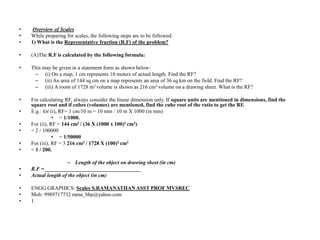
• Overview of Scales
• While preparing for scales, the following steps are to be followed:
• 1) What is the Representative fraction (R.F) of the problem?
• (A)The R.F is calculated by the following formula:
• This may be given in a statement form as shown below:
– (i) On a map, 1 cm represents 10 meters of actual length. Find the RF?
– (ii) An area of 144 sq cm on a map represents an area of 36 sq km on the field. Find the RF?
– (iii) A room of 1728 m3 volume is shown as 216 cm3 volume on a drawing sheet. What is the RF?
• For calculating RF, always consider the linear dimension only. If square units are mentioned in dimensions, find the
square root and if cubes (volumes) are mentioned, find the cube root of the ratio to get the RF.
• E.g.: for (i), RF= 1 cm/10 m = 10 mm / 10 m X 1000 (in mm)
• = 1/1000.
• For (ii), RF = 144 cm2 / (36 X (1000 x 100)2 cm2)
• = 2 / 100000
• = 1/50000
• For (iii), RF = 3 216 cm3 / 1728 X (100)3 cm3
• = 1 / 200.
– Length of the object on drawing sheet (in cm)
• R.F = ____________________________________
• Actual length of the object (in cm)
• ENGG GRAPHICS: Scales S.RAMANATHAN ASST PROF MVSREC
• Mob: 9989717732 rama_bhp@yahoo.com
• 1
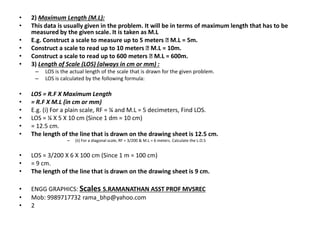
• 2) Maximum Length (M.L):
• This data is usually given in the problem. It will be in terms of maximum length that has to be
measured by the given scale. It is taken as M.L
• E.g. Construct a scale to measure up to 5 meters 􀃎 M.L = 5m.
• Construct a scale to read up to 10 meters 􀃎 M.L = 10m.
• Construct a scale to read up to 600 meters 􀃎 M.L = 600m.
• 3) Length of Scale (LOS) (always in cm or mm) :
– LOS is the actual length of the scale that is drawn for the given problem.
– LOS is calculated by the following formula:
• LOS = R.F X Maximum Length
• = R.F X M.L (in cm or mm)
• E.g. (i) For a plain scale, RF = ¼ and M.L = 5 decimeters, Find LOS.
• LOS = ¼ X 5 X 10 cm (Since 1 dm = 10 cm)
• = 12.5 cm.
• The length of the line that is drawn on the drawing sheet is 12.5 cm.
– (ii) For a diagonal scale, RF = 3/200 & M.L = 6 meters. Calculate the L.O.S
• LOS = 3/200 X 6 X 100 cm (Since 1 m = 100 cm)
• = 9 cm.
• The length of the line that is drawn on the drawing sheet is 9 cm.
• ENGG GRAPHICS: Scales S.RAMANATHAN ASST PROF MVSREC
• Mob: 9989717732 rama_bhp@yahoo.com
• 2
• 4) Division of LOS into n equal parts ( n is Maximum Length ML)
• After drawing a line of length equal to LOS, the next step is to divide the line into a certain no. of equal parts. This
is found by checking the Maximum Length.
• 􀃆 Case 1: When ML < 10:
– E.g. If LOS = 12.5 cm and ML = 5 dm, then Divide LOS into 5 equal parts so that each part represents 1 dm.
– If LOS = 15 cm and ML = 800 meters, divide LOS into 8 equal parts so that each part represents 100 meters (by line division
method)
• 􀃆 Case 2: When ML > 10:
• If ML in the given problem is greater than 10, then we have to take the factors of the ML and divide the LOS.
• Eg1. If ML = 25m, then we can’t divide the LOS into 25 parts. Hence take the factors of 25, i.e. 5 x 5. Hence divide
the LOS into 5 equal parts so that each part represents 5m.
• Thus, If factors of ML are m x n, then divide ML into m equal parts of n units each.
– Eg 2. If LOS = 21 cm and ML = 42 meters ( 7 x 6), divide LOS into 7 equal parts so that each part represents 6 meters or divide
LOS into 6 equal parts so that each part represents 7 meters.
• Sometimes, the ML will be given in terms of a non related scale units. Then, we need to convert the ML into the
units used in the scale and then divide LOS into ML no.of parts.
• Eg 3: Draw a plain scale to show decimeters & centimeters and to measure upto 1m.
• Sol: Here, we know that a plain scale relates only a main unit and its immediate sub unit. Thus, after dm, cm is its
sub unit. So, meter is a unit not required in the scale. But ML is given in meters. So it has to be converted into dm
since dm is the main scale.
• Thus, ML = 1 m = 10 dm. Hence, the LOS can be divided into 10 equal parts.
• Eg 4: Draw a diagonal scale to show meters and measure upto 1 km.
• Sol: 1 km = 1000 mts (10 x 100). Hence ML is divided into 10 equal parts of 100 m each.
• ENGG GRAPHICS: Scales S.RAMANATHAN ASST PROF MVSREC
• Mob: 9989717732 rama_bhp@yahoo.com
• 3
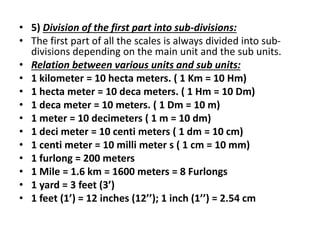
• 5) Division of the first part into sub-divisions:
• The first part of all the scales is always divided into sub-
divisions depending on the main unit and the sub units.
• Relation between various units and sub units:
• 1 kilometer = 10 hecta meters. ( 1 Km = 10 Hm)
• 1 hecta meter = 10 deca meters. ( 1 Hm = 10 Dm)
• 1 deca meter = 10 meters. ( 1 Dm = 10 m)
• 1 meter = 10 decimeters ( 1 m = 10 dm)
• 1 deci meter = 10 centi meters ( 1 dm = 10 cm)
• 1 centi meter = 10 milli meter s ( 1 cm = 10 mm)
• 1 furlong = 200 meters
• 1 Mile = 1.6 km = 1600 meters = 8 Furlongs
• 1 yard = 3 feet (3’)
• 1 feet (1’) = 12 inches (12’’); 1 inch (1’’) = 2.54 cm
• Plain Scales
• Plain scales are used for measurement in two units or a unit and its sub unit. It
consists of a line (LOS) divided into suitable no. of equal parts (based on Max
Length, ML) & the first part is sub-divided into equal parts.
• The zero is placed at the end of 1st main division. Labeling of 0 in main scale is after
the first unit.
• Steps involved in Plain Scales:
• 1) Find RF.
• 2) Find Maximum Length (ML).
• 3) Find Length of Scale (LOS) by using the formula. (LOS= RF X ML).
• 4) Draw the line of length = LOS & divide it into n equal parts based on ML. Draw
a rectangle on LOS of height 5 mm.
• 5) Divide the first division also into some equal parts based on the unit and its
sub-unit given in the problem.
• 6) Give numbering to main scale as 0,1,2,3,…after the first division to the right
side & 0,1,2,3…to the left of 0 in 1st sub division.
• 7) Mark the given value of dimension based on problem.
• Problems on Plain Scales:
• As solved examples are explained well in the text book (ND Bhat), only
exercise problems are presented in this notes.
• Page 65:-
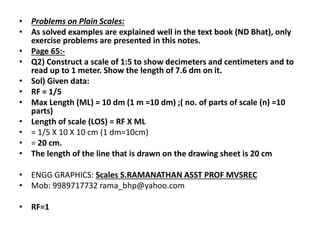
• Q2) Construct a scale of 1:5 to show decimeters and centimeters and to
read up to 1 meter. Show the length of 7.6 dm on it.
• Sol) Given data:
• RF = 1/5
• Max Length (ML) = 10 dm (1 m =10 dm) ;( no. of parts of scale (n) =10
parts)
• Length of scale (LOS) = RF X ML
• = 1/5 X 10 X 10 cm (1 dm=10cm)
• = 20 cm.
• The length of the line that is drawn on the drawing sheet is 20 cm
• ENGG GRAPHICS: Scales S.RAMANATHAN ASST PROF MVSREC
• Mob: 9989717732 rama_bhp@yahoo.com
• RF=1
• Page 65:-
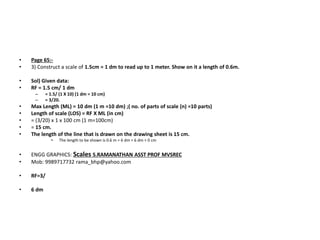
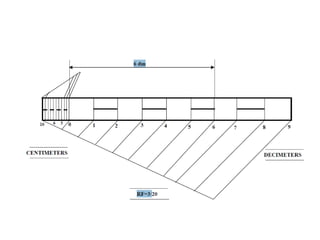
• 3) Construct a scale of 1.5cm = 1 dm to read up to 1 meter. Show on it a length of 0.6m.
• Sol) Given data:
• RF = 1.5 cm/ 1 dm
– = 1.5/ (1 X 10) (1 dm = 10 cm)
– = 3/20.
• Max Length (ML) = 10 dm (1 m =10 dm) ;( no. of parts of scale (n) =10 parts)
• Length of scale (LOS) = RF X ML (in cm)
• = (3/20) x 1 x 100 cm (1 m=100cm)
• = 15 cm.
• The length of the line that is drawn on the drawing sheet is 15 cm.
• The length to be shown is 0.6 m = 6 dm = 6 dm + 0 cm
• ENGG GRAPHICS: Scales S.RAMANATHAN ASST PROF MVSREC
• Mob: 9989717732 rama_bhp@yahoo.com
• RF=3/
• 6 dm
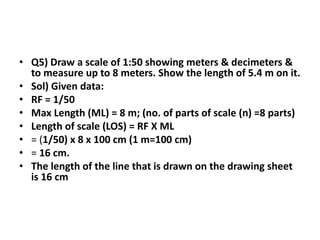
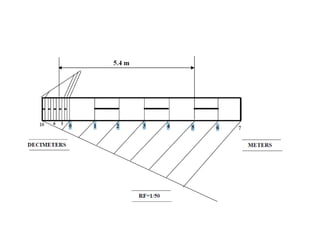
• Q5) Draw a scale of 1:50 showing meters & decimeters &
to measure up to 8 meters. Show the length of 5.4 m on it.
• Sol) Given data:
• RF = 1/50
• Max Length (ML) = 8 m; (no. of parts of scale (n) =8 parts)
• Length of scale (LOS) = RF X ML
• = (1/50) x 8 x 100 cm (1 m=100 cm)
• = 16 cm.
• The length of the line that is drawn on the drawing sheet
is 16 cm
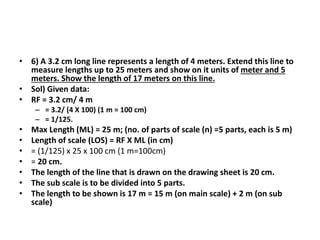
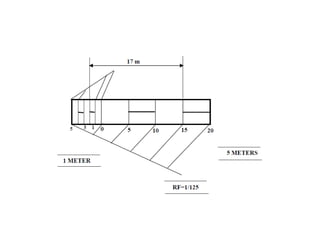
• 6) A 3.2 cm long line represents a length of 4 meters. Extend this line to
measure lengths up to 25 meters and show on it units of meter and 5
meters. Show the length of 17 meters on this line.
• Sol) Given data:
• RF = 3.2 cm/ 4 m
– = 3.2/ (4 X 100) (1 m = 100 cm)
– = 1/125.
• Max Length (ML) = 25 m; (no. of parts of scale (n) =5 parts, each is 5 m)
• Length of scale (LOS) = RF X ML (in cm)
• = (1/125) x 25 x 100 cm (1 m=100cm)
• = 20 cm.
• The length of the line that is drawn on the drawing sheet is 20 cm.
• The sub scale is to be divided into 5 parts.
• The length to be shown is 17 m = 15 m (on main scale) + 2 m (on sub
scale)
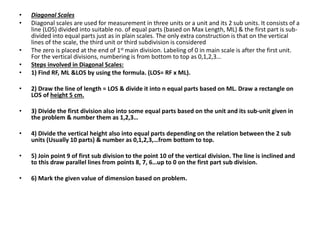
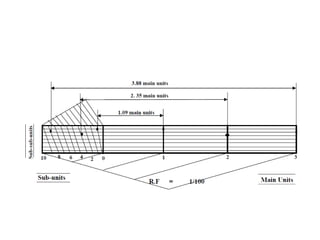
• Diagonal Scales
• Diagonal scales are used for measurement in three units or a unit and its 2 sub units. It consists of a
line (LOS) divided into suitable no. of equal parts (based on Max Length, ML) & the first part is sub-
divided into equal parts just as in plain scales. The only extra construction is that on the vertical
lines of the scale, the third unit or third subdivision is considered
• The zero is placed at the end of 1st main division. Labeling of 0 in main scale is after the first unit.
For the vertical divisions, numbering is from bottom to top as 0,1,2,3…
• Steps involved in Diagonal Scales:
• 1) Find RF, ML &LOS by using the formula. (LOS= RF x ML).
• 2) Draw the line of length = LOS & divide it into n equal parts based on ML. Draw a rectangle on
LOS of height 5 cm.
• 3) Divide the first division also into some equal parts based on the unit and its sub-unit given in
the problem & number them as 1,2,3…
• 4) Divide the vertical height also into equal parts depending on the relation between the 2 sub
units (Usually 10 parts) & number as 0,1,2,3,…from bottom to top.
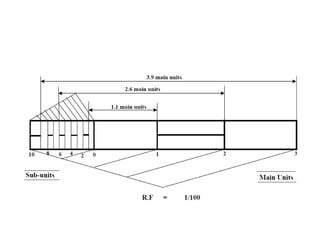
• 5) Join point 9 of first sub division to the point 10 of the vertical division. The line is inclined and
to this draw parallel lines from points 8, 7, 6…up to 0 on the first part sub division.
• 6) Mark the given value of dimension based on problem.
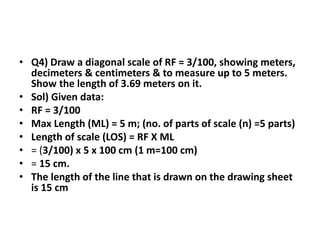
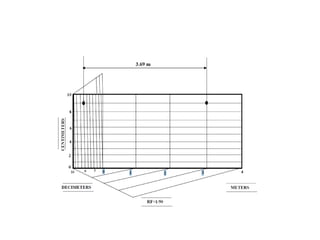
• Q4) Draw a diagonal scale of RF = 3/100, showing meters,
decimeters & centimeters & to measure up to 5 meters.
Show the length of 3.69 meters on it.
• Sol) Given data:
• RF = 3/100
• Max Length (ML) = 5 m; (no. of parts of scale (n) =5 parts)
• Length of scale (LOS) = RF X ML
• = (3/100) x 5 x 100 cm (1 m=100 cm)
• = 15 cm.
• The length of the line that is drawn on the drawing sheet
is 15 cm
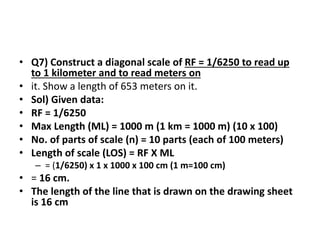
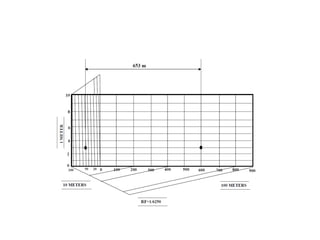
• Q7) Construct a diagonal scale of RF = 1/6250 to read up
to 1 kilometer and to read meters on
• it. Show a length of 653 meters on it.
• Sol) Given data:
• RF = 1/6250
• Max Length (ML) = 1000 m (1 km = 1000 m) (10 x 100)
• No. of parts of scale (n) = 10 parts (each of 100 meters)
• Length of scale (LOS) = RF X ML
– = (1/6250) x 1 x 1000 x 100 cm (1 m=100 cm)
• = 16 cm.
• The length of the line that is drawn on the drawing sheet
is 16 cm
Scales +problems

Scales +problems

  • 1.
  • 2.
    • Overview ofScales • While preparing for scales, the following steps are to be followed: • 1) What is the Representative fraction (R.F) of the problem? • (A)The R.F is calculated by the following formula: • This may be given in a statement form as shown below: – (i) On a map, 1 cm represents 10 meters of actual length. Find the RF? – (ii) An area of 144 sq cm on a map represents an area of 36 sq km on the field. Find the RF? – (iii) A room of 1728 m3 volume is shown as 216 cm3 volume on a drawing sheet. What is the RF? • For calculating RF, always consider the linear dimension only. If square units are mentioned in dimensions, find the square root and if cubes (volumes) are mentioned, find the cube root of the ratio to get the RF. • E.g.: for (i), RF= 1 cm/10 m = 10 mm / 10 m X 1000 (in mm) • = 1/1000. • For (ii), RF = 144 cm2 / (36 X (1000 x 100)2 cm2) • = 2 / 100000 • = 1/50000 • For (iii), RF = 3 216 cm3 / 1728 X (100)3 cm3 • = 1 / 200. – Length of the object on drawing sheet (in cm) • R.F = ____________________________________ • Actual length of the object (in cm) • ENGG GRAPHICS: Scales S.RAMANATHAN ASST PROF MVSREC • Mob: 9989717732 rama_bhp@yahoo.com • 1
  • 3.
    • 2) MaximumLength (M.L): • This data is usually given in the problem. It will be in terms of maximum length that has to be measured by the given scale. It is taken as M.L • E.g. Construct a scale to measure up to 5 meters 􀃎 M.L = 5m. • Construct a scale to read up to 10 meters 􀃎 M.L = 10m. • Construct a scale to read up to 600 meters 􀃎 M.L = 600m. • 3) Length of Scale (LOS) (always in cm or mm) : – LOS is the actual length of the scale that is drawn for the given problem. – LOS is calculated by the following formula: • LOS = R.F X Maximum Length • = R.F X M.L (in cm or mm) • E.g. (i) For a plain scale, RF = ¼ and M.L = 5 decimeters, Find LOS. • LOS = ¼ X 5 X 10 cm (Since 1 dm = 10 cm) • = 12.5 cm. • The length of the line that is drawn on the drawing sheet is 12.5 cm. – (ii) For a diagonal scale, RF = 3/200 & M.L = 6 meters. Calculate the L.O.S • LOS = 3/200 X 6 X 100 cm (Since 1 m = 100 cm) • = 9 cm. • The length of the line that is drawn on the drawing sheet is 9 cm. • ENGG GRAPHICS: Scales S.RAMANATHAN ASST PROF MVSREC • Mob: 9989717732 rama_bhp@yahoo.com • 2
  • 4.
    • 4) Divisionof LOS into n equal parts ( n is Maximum Length ML) • After drawing a line of length equal to LOS, the next step is to divide the line into a certain no. of equal parts. This is found by checking the Maximum Length. • 􀃆 Case 1: When ML < 10: – E.g. If LOS = 12.5 cm and ML = 5 dm, then Divide LOS into 5 equal parts so that each part represents 1 dm. – If LOS = 15 cm and ML = 800 meters, divide LOS into 8 equal parts so that each part represents 100 meters (by line division method) • 􀃆 Case 2: When ML > 10: • If ML in the given problem is greater than 10, then we have to take the factors of the ML and divide the LOS. • Eg1. If ML = 25m, then we can’t divide the LOS into 25 parts. Hence take the factors of 25, i.e. 5 x 5. Hence divide the LOS into 5 equal parts so that each part represents 5m. • Thus, If factors of ML are m x n, then divide ML into m equal parts of n units each. – Eg 2. If LOS = 21 cm and ML = 42 meters ( 7 x 6), divide LOS into 7 equal parts so that each part represents 6 meters or divide LOS into 6 equal parts so that each part represents 7 meters. • Sometimes, the ML will be given in terms of a non related scale units. Then, we need to convert the ML into the units used in the scale and then divide LOS into ML no.of parts. • Eg 3: Draw a plain scale to show decimeters & centimeters and to measure upto 1m. • Sol: Here, we know that a plain scale relates only a main unit and its immediate sub unit. Thus, after dm, cm is its sub unit. So, meter is a unit not required in the scale. But ML is given in meters. So it has to be converted into dm since dm is the main scale. • Thus, ML = 1 m = 10 dm. Hence, the LOS can be divided into 10 equal parts. • Eg 4: Draw a diagonal scale to show meters and measure upto 1 km. • Sol: 1 km = 1000 mts (10 x 100). Hence ML is divided into 10 equal parts of 100 m each. • ENGG GRAPHICS: Scales S.RAMANATHAN ASST PROF MVSREC • Mob: 9989717732 rama_bhp@yahoo.com • 3
  • 5.
    • 5) Divisionof the first part into sub-divisions: • The first part of all the scales is always divided into sub- divisions depending on the main unit and the sub units. • Relation between various units and sub units: • 1 kilometer = 10 hecta meters. ( 1 Km = 10 Hm) • 1 hecta meter = 10 deca meters. ( 1 Hm = 10 Dm) • 1 deca meter = 10 meters. ( 1 Dm = 10 m) • 1 meter = 10 decimeters ( 1 m = 10 dm) • 1 deci meter = 10 centi meters ( 1 dm = 10 cm) • 1 centi meter = 10 milli meter s ( 1 cm = 10 mm) • 1 furlong = 200 meters • 1 Mile = 1.6 km = 1600 meters = 8 Furlongs • 1 yard = 3 feet (3’) • 1 feet (1’) = 12 inches (12’’); 1 inch (1’’) = 2.54 cm
  • 6.
    • Plain Scales •Plain scales are used for measurement in two units or a unit and its sub unit. It consists of a line (LOS) divided into suitable no. of equal parts (based on Max Length, ML) & the first part is sub-divided into equal parts. • The zero is placed at the end of 1st main division. Labeling of 0 in main scale is after the first unit. • Steps involved in Plain Scales: • 1) Find RF. • 2) Find Maximum Length (ML). • 3) Find Length of Scale (LOS) by using the formula. (LOS= RF X ML). • 4) Draw the line of length = LOS & divide it into n equal parts based on ML. Draw a rectangle on LOS of height 5 mm. • 5) Divide the first division also into some equal parts based on the unit and its sub-unit given in the problem. • 6) Give numbering to main scale as 0,1,2,3,…after the first division to the right side & 0,1,2,3…to the left of 0 in 1st sub division. • 7) Mark the given value of dimension based on problem.
  • 8.
    • Problems onPlain Scales: • As solved examples are explained well in the text book (ND Bhat), only exercise problems are presented in this notes. • Page 65:- • Q2) Construct a scale of 1:5 to show decimeters and centimeters and to read up to 1 meter. Show the length of 7.6 dm on it. • Sol) Given data: • RF = 1/5 • Max Length (ML) = 10 dm (1 m =10 dm) ;( no. of parts of scale (n) =10 parts) • Length of scale (LOS) = RF X ML • = 1/5 X 10 X 10 cm (1 dm=10cm) • = 20 cm. • The length of the line that is drawn on the drawing sheet is 20 cm • ENGG GRAPHICS: Scales S.RAMANATHAN ASST PROF MVSREC • Mob: 9989717732 rama_bhp@yahoo.com • RF=1
  • 10.
    • Page 65:- •3) Construct a scale of 1.5cm = 1 dm to read up to 1 meter. Show on it a length of 0.6m. • Sol) Given data: • RF = 1.5 cm/ 1 dm – = 1.5/ (1 X 10) (1 dm = 10 cm) – = 3/20. • Max Length (ML) = 10 dm (1 m =10 dm) ;( no. of parts of scale (n) =10 parts) • Length of scale (LOS) = RF X ML (in cm) • = (3/20) x 1 x 100 cm (1 m=100cm) • = 15 cm. • The length of the line that is drawn on the drawing sheet is 15 cm. • The length to be shown is 0.6 m = 6 dm = 6 dm + 0 cm • ENGG GRAPHICS: Scales S.RAMANATHAN ASST PROF MVSREC • Mob: 9989717732 rama_bhp@yahoo.com • RF=3/ • 6 dm
  • 12.
    • Q5) Drawa scale of 1:50 showing meters & decimeters & to measure up to 8 meters. Show the length of 5.4 m on it. • Sol) Given data: • RF = 1/50 • Max Length (ML) = 8 m; (no. of parts of scale (n) =8 parts) • Length of scale (LOS) = RF X ML • = (1/50) x 8 x 100 cm (1 m=100 cm) • = 16 cm. • The length of the line that is drawn on the drawing sheet is 16 cm
  • 14.
    • 6) A3.2 cm long line represents a length of 4 meters. Extend this line to measure lengths up to 25 meters and show on it units of meter and 5 meters. Show the length of 17 meters on this line. • Sol) Given data: • RF = 3.2 cm/ 4 m – = 3.2/ (4 X 100) (1 m = 100 cm) – = 1/125. • Max Length (ML) = 25 m; (no. of parts of scale (n) =5 parts, each is 5 m) • Length of scale (LOS) = RF X ML (in cm) • = (1/125) x 25 x 100 cm (1 m=100cm) • = 20 cm. • The length of the line that is drawn on the drawing sheet is 20 cm. • The sub scale is to be divided into 5 parts. • The length to be shown is 17 m = 15 m (on main scale) + 2 m (on sub scale)
  • 16.
    • Diagonal Scales •Diagonal scales are used for measurement in three units or a unit and its 2 sub units. It consists of a line (LOS) divided into suitable no. of equal parts (based on Max Length, ML) & the first part is sub- divided into equal parts just as in plain scales. The only extra construction is that on the vertical lines of the scale, the third unit or third subdivision is considered • The zero is placed at the end of 1st main division. Labeling of 0 in main scale is after the first unit. For the vertical divisions, numbering is from bottom to top as 0,1,2,3… • Steps involved in Diagonal Scales: • 1) Find RF, ML &LOS by using the formula. (LOS= RF x ML). • 2) Draw the line of length = LOS & divide it into n equal parts based on ML. Draw a rectangle on LOS of height 5 cm. • 3) Divide the first division also into some equal parts based on the unit and its sub-unit given in the problem & number them as 1,2,3… • 4) Divide the vertical height also into equal parts depending on the relation between the 2 sub units (Usually 10 parts) & number as 0,1,2,3,…from bottom to top. • 5) Join point 9 of first sub division to the point 10 of the vertical division. The line is inclined and to this draw parallel lines from points 8, 7, 6…up to 0 on the first part sub division. • 6) Mark the given value of dimension based on problem.
  • 18.
    • Q4) Drawa diagonal scale of RF = 3/100, showing meters, decimeters & centimeters & to measure up to 5 meters. Show the length of 3.69 meters on it. • Sol) Given data: • RF = 3/100 • Max Length (ML) = 5 m; (no. of parts of scale (n) =5 parts) • Length of scale (LOS) = RF X ML • = (3/100) x 5 x 100 cm (1 m=100 cm) • = 15 cm. • The length of the line that is drawn on the drawing sheet is 15 cm
  • 20.
    • Q7) Constructa diagonal scale of RF = 1/6250 to read up to 1 kilometer and to read meters on • it. Show a length of 653 meters on it. • Sol) Given data: • RF = 1/6250 • Max Length (ML) = 1000 m (1 km = 1000 m) (10 x 100) • No. of parts of scale (n) = 10 parts (each of 100 meters) • Length of scale (LOS) = RF X ML – = (1/6250) x 1 x 1000 x 100 cm (1 m=100 cm) • = 16 cm. • The length of the line that is drawn on the drawing sheet is 16 cm