The Scaled Agile Framework®
Overview
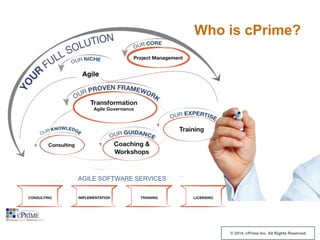
Who is cPrime?

AGILE SOFTWARE SERVICES

© 2014, cPrime Inc. All Rights Reserved
Today’s Presenter
Sri Parthasarathy
•
•
•
•
•
•
•
•

Agile Coach and Trainer with more than 25+ years of technology experience.
Since his first days as a developer, always had a passion for the people & process
side of product & team development.
Created and managed software process that was instrumental in taking a Silicon
Valley startup to a mid-size enterprise with 30,000 customers.
Spent 10+ years managing Software Services and DevOps teams.
10+ years in Release Management and Program Management
Early adopter of Kanban for operations teams.
One of the first coaches to certify and start to train Leading SAFe across the country
B.S. Computer Science, SUNY Buffalo

© 2014, cPrime Inc. All Rights Reserved
Poll #1
What level of interaction do you have with the Scaled
Agile Framework®?
• This is my first time hearing about it
• I have spent time researching it
• I am certified in SAFe

© 2014, cPrime Inc. All Rights Reserved
Poll #2
What level of the Scaled Agile Framework is most
relevant to you?
• Team Level
• Program Level
• Portfolio Level

© 2014, cPrime Inc. All Rights Reserved
Poll #3
What does the majority of your projects look like?
• Agile
• Waterfall
• Hybrid

© 2014, cPrime Inc. All Rights Reserved
After the webinar…
• We will send directions to collect the PDU you will earn
from attending this webinar
• We will also send a links to the recorded webinar and
presentation slides once they are posted online

For more information, visit www.cprime.com
Keeping Pace
Our methods must keep pace with an increasingly complex world

• Our modern world runs on software. What doesn't
now, likely will soon
• We’ve had Moore’s Law for hardware, and Moore’s
Law+ for envisioning what software could do
• But our prior development practices – waterfall, RAD,
iterative and incremental – haven’t kept pace
• Agile shows the greatest promise, but was developed
for small team environments
• We need a new approach – one that harnesses the
power of Agile and Lean – but applies to the needs of
the largest software enterprises

© 2008 - 2013 Scaled Agile, Inc. and Leffingwell, LLC. All rights reserved.
®
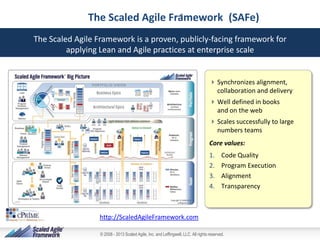
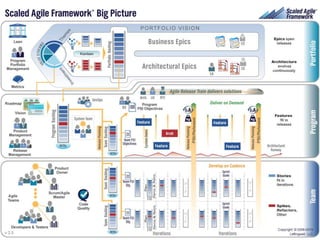
The Scaled Agile Framework (SAFe)

The Scaled Agile Framework is a proven, publicly-facing framework for
applying Lean and Agile practices at enterprise scale

 Synchronizes alignment,
collaboration and delivery
 Well defined in books
and on the web

 Scales successfully to large
numbers teams
Core values:
1.
2.
3.
4.

Code Quality
Program Execution
Alignment
Transparency

http://ScaledAgileFramework.com
© 2008 - 2013 Scaled Agile, Inc. and Leffingwell, LLC. All rights reserved.
Agile Teams
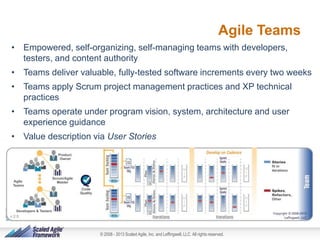
• Empowered, self-organizing, self-managing teams with developers,
testers, and content authority
• Teams deliver valuable, fully-tested software increments every two weeks
• Teams apply Scrum project management practices and XP technical
practices
• Teams operate under program vision, system, architecture and user
experience guidance
• Value description via User Stories

© 2008 - 2013 Scaled Agile, Inc. and Leffingwell, LLC. All rights reserved.
#1 – Code Quality
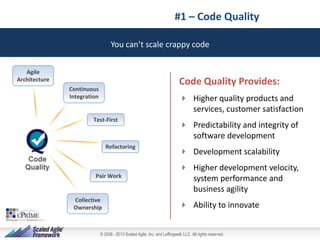
You can’t scale crappy code
Agile
Architecture

Code Quality Provides:

Continuous
Integration

 Higher quality products and
services, customer satisfaction

Test-First

Refactoring

Pair Work

Collective
Ownership

 Predictability and integrity of
software development
 Development scalability
 Higher development velocity,
system performance and
business agility
 Ability to innovate

© 2008 - 2013 Scaled Agile, Inc. and Leffingwell, LLC. All rights reserved.
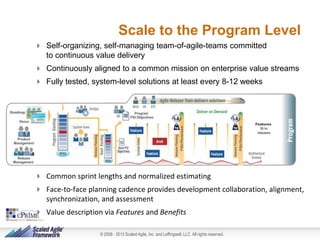
Scale to the Program Level
 Self-organizing, self-managing team-of-agile-teams committed
to continuous value delivery
 Continuously aligned to a common mission on enterprise value streams
 Fully tested, system-level solutions at least every 8-12 weeks

 Common sprint lengths and normalized estimating
 Face-to-face planning cadence provides development collaboration, alignment,
synchronization, and assessment
 Value description via Features and Benefits
© 2008 - 2013 Scaled Agile, Inc. and Leffingwell, LLC. All rights reserved.
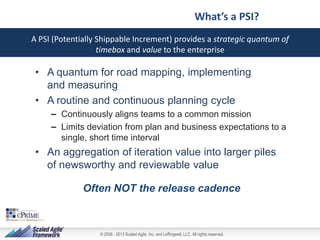
What’s a PSI?
A PSI (Potentially Shippable Increment) provides a strategic quantum of
timebox and value to the enterprise

• A quantum for road mapping, implementing
and measuring
• A routine and continuous planning cycle
– Continuously aligns teams to a common mission
– Limits deviation from plan and business expectations to a
single, short time interval

• An aggregation of iteration value into larger piles
of newsworthy and reviewable value
Often NOT the release cadence

© 2008 - 2013 Scaled Agile, Inc. and Leffingwell, LLC. All rights reserved.
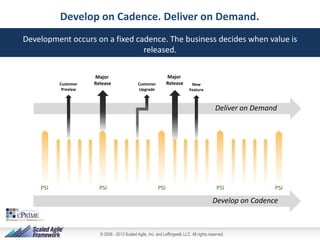
Develop on Cadence. Deliver on Demand.
Development occurs on a fixed cadence. The business decides when value is
released.

Customer
Preview

Major
Release

Major
Release

Customer
Upgrade

New
Feature

Deliver on Demand

PSI

PSI

PSI

PSI

PSI

Develop on Cadence

© 2008 - 2013 Scaled Agile, Inc. and Leffingwell, LLC. All rights reserved.
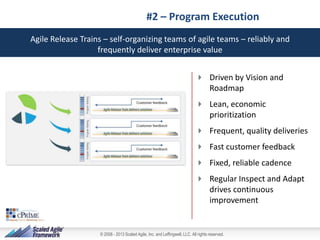
#2 – Program Execution
Agile Release Trains – self-organizing teams of agile teams – reliably and
frequently deliver enterprise value

 Driven by Vision and
Roadmap
 Lean, economic
prioritization

 Frequent, quality deliveries
 Fast customer feedback
 Fixed, reliable cadence
 Regular Inspect and Adapt
drives continuous
improvement

© 2008 - 2013 Scaled Agile, Inc. and Leffingwell, LLC. All rights reserved.
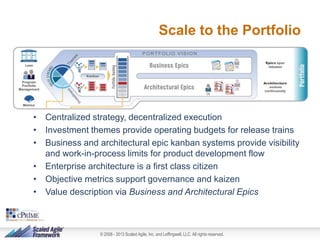
Scale to the Portfolio

• Centralized strategy, decentralized execution
• Investment themes provide operating budgets for release trains
• Business and architectural epic kanban systems provide visibility
and work-in-process limits for product development flow
• Enterprise architecture is a first class citizen
• Objective metrics support governance and kaizen
• Value description via Business and Architectural Epics

© 2008 - 2013 Scaled Agile, Inc. and Leffingwell, LLC. All rights reserved.
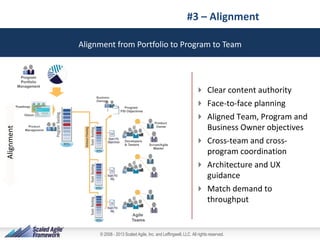
#3 – Alignment
Alignment from Portfolio to Program to Team

Alignment

Business
Owners

 Clear content authority
 Face-to-face planning
 Aligned Team, Program and
Business Owner objectives
 Cross-team and crossprogram coordination
 Architecture and UX
guidance
 Match demand to
throughput

© 2008 - 2013 Scaled Agile, Inc. and Leffingwell, LLC. All rights reserved.
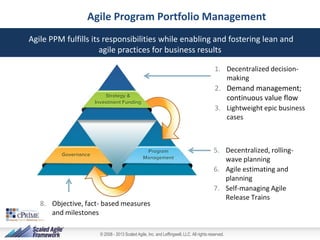
Agile Program Portfolio Management
Agile PPM fulfills its responsibilities while enabling and fostering lean and
agile practices for business results
1. Decentralized decisionmaking

2. Demand management;
continuous value flow
3. Lightweight epic business
cases

8. Objective, fact- based measures
and milestones

5. Decentralized, rollingwave planning
6. Agile estimating and
planning
7. Self-managing Agile
Release Trains

© 2008 - 2013 Scaled Agile, Inc. and Leffingwell, LLC. All rights reserved.
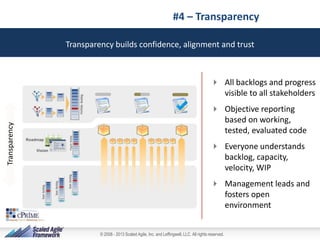
#4 – Transparency
Transparency builds confidence, alignment and trust

Transparency

 All backlogs and progress
visible to all stakeholders
 Objective reporting
based on working,
tested, evaluated code
 Everyone understands
backlog, capacity,
velocity, WIP

 Management leads and
fosters open
environment
© 2008 - 2013 Scaled Agile, Inc. and Leffingwell, LLC. All rights reserved.
Scaled Agile Framework® Overview

Scaled Agile Framework® Overview

  • 1.
    The Scaled AgileFramework® Overview
  • 2.
    Who is cPrime? AGILESOFTWARE SERVICES © 2014, cPrime Inc. All Rights Reserved
  • 3.
    Today’s Presenter Sri Parthasarathy • • • • • • • • AgileCoach and Trainer with more than 25+ years of technology experience. Since his first days as a developer, always had a passion for the people & process side of product & team development. Created and managed software process that was instrumental in taking a Silicon Valley startup to a mid-size enterprise with 30,000 customers. Spent 10+ years managing Software Services and DevOps teams. 10+ years in Release Management and Program Management Early adopter of Kanban for operations teams. One of the first coaches to certify and start to train Leading SAFe across the country B.S. Computer Science, SUNY Buffalo © 2014, cPrime Inc. All Rights Reserved
  • 4.
    Poll #1 What levelof interaction do you have with the Scaled Agile Framework®? • This is my first time hearing about it • I have spent time researching it • I am certified in SAFe © 2014, cPrime Inc. All Rights Reserved
  • 5.
    Poll #2 What levelof the Scaled Agile Framework is most relevant to you? • Team Level • Program Level • Portfolio Level © 2014, cPrime Inc. All Rights Reserved
  • 6.
    Poll #3 What doesthe majority of your projects look like? • Agile • Waterfall • Hybrid © 2014, cPrime Inc. All Rights Reserved
  • 7.
    After the webinar… •We will send directions to collect the PDU you will earn from attending this webinar • We will also send a links to the recorded webinar and presentation slides once they are posted online For more information, visit www.cprime.com
  • 8.
    Keeping Pace Our methodsmust keep pace with an increasingly complex world • Our modern world runs on software. What doesn't now, likely will soon • We’ve had Moore’s Law for hardware, and Moore’s Law+ for envisioning what software could do • But our prior development practices – waterfall, RAD, iterative and incremental – haven’t kept pace • Agile shows the greatest promise, but was developed for small team environments • We need a new approach – one that harnesses the power of Agile and Lean – but applies to the needs of the largest software enterprises © 2008 - 2013 Scaled Agile, Inc. and Leffingwell, LLC. All rights reserved.
  • 9.
    ® The Scaled AgileFramework (SAFe) The Scaled Agile Framework is a proven, publicly-facing framework for applying Lean and Agile practices at enterprise scale  Synchronizes alignment, collaboration and delivery  Well defined in books and on the web  Scales successfully to large numbers teams Core values: 1. 2. 3. 4. Code Quality Program Execution Alignment Transparency http://ScaledAgileFramework.com © 2008 - 2013 Scaled Agile, Inc. and Leffingwell, LLC. All rights reserved.
  • 10.
    Agile Teams • Empowered,self-organizing, self-managing teams with developers, testers, and content authority • Teams deliver valuable, fully-tested software increments every two weeks • Teams apply Scrum project management practices and XP technical practices • Teams operate under program vision, system, architecture and user experience guidance • Value description via User Stories © 2008 - 2013 Scaled Agile, Inc. and Leffingwell, LLC. All rights reserved.
  • 11.
    #1 – CodeQuality You can’t scale crappy code Agile Architecture Code Quality Provides: Continuous Integration  Higher quality products and services, customer satisfaction Test-First Refactoring Pair Work Collective Ownership  Predictability and integrity of software development  Development scalability  Higher development velocity, system performance and business agility  Ability to innovate © 2008 - 2013 Scaled Agile, Inc. and Leffingwell, LLC. All rights reserved.
  • 12.
    Scale to theProgram Level  Self-organizing, self-managing team-of-agile-teams committed to continuous value delivery  Continuously aligned to a common mission on enterprise value streams  Fully tested, system-level solutions at least every 8-12 weeks  Common sprint lengths and normalized estimating  Face-to-face planning cadence provides development collaboration, alignment, synchronization, and assessment  Value description via Features and Benefits © 2008 - 2013 Scaled Agile, Inc. and Leffingwell, LLC. All rights reserved.
  • 13.
    What’s a PSI? APSI (Potentially Shippable Increment) provides a strategic quantum of timebox and value to the enterprise • A quantum for road mapping, implementing and measuring • A routine and continuous planning cycle – Continuously aligns teams to a common mission – Limits deviation from plan and business expectations to a single, short time interval • An aggregation of iteration value into larger piles of newsworthy and reviewable value Often NOT the release cadence © 2008 - 2013 Scaled Agile, Inc. and Leffingwell, LLC. All rights reserved.
  • 14.
    Develop on Cadence.Deliver on Demand. Development occurs on a fixed cadence. The business decides when value is released. Customer Preview Major Release Major Release Customer Upgrade New Feature Deliver on Demand PSI PSI PSI PSI PSI Develop on Cadence © 2008 - 2013 Scaled Agile, Inc. and Leffingwell, LLC. All rights reserved.
  • 15.
    #2 – ProgramExecution Agile Release Trains – self-organizing teams of agile teams – reliably and frequently deliver enterprise value  Driven by Vision and Roadmap  Lean, economic prioritization  Frequent, quality deliveries  Fast customer feedback  Fixed, reliable cadence  Regular Inspect and Adapt drives continuous improvement © 2008 - 2013 Scaled Agile, Inc. and Leffingwell, LLC. All rights reserved.
  • 16.
    Scale to thePortfolio • Centralized strategy, decentralized execution • Investment themes provide operating budgets for release trains • Business and architectural epic kanban systems provide visibility and work-in-process limits for product development flow • Enterprise architecture is a first class citizen • Objective metrics support governance and kaizen • Value description via Business and Architectural Epics © 2008 - 2013 Scaled Agile, Inc. and Leffingwell, LLC. All rights reserved.
  • 17.
    #3 – Alignment Alignmentfrom Portfolio to Program to Team Alignment Business Owners  Clear content authority  Face-to-face planning  Aligned Team, Program and Business Owner objectives  Cross-team and crossprogram coordination  Architecture and UX guidance  Match demand to throughput © 2008 - 2013 Scaled Agile, Inc. and Leffingwell, LLC. All rights reserved.
  • 18.
    Agile Program PortfolioManagement Agile PPM fulfills its responsibilities while enabling and fostering lean and agile practices for business results 1. Decentralized decisionmaking 2. Demand management; continuous value flow 3. Lightweight epic business cases 8. Objective, fact- based measures and milestones 5. Decentralized, rollingwave planning 6. Agile estimating and planning 7. Self-managing Agile Release Trains © 2008 - 2013 Scaled Agile, Inc. and Leffingwell, LLC. All rights reserved.
  • 19.
    #4 – Transparency Transparencybuilds confidence, alignment and trust Transparency  All backlogs and progress visible to all stakeholders  Objective reporting based on working, tested, evaluated code  Everyone understands backlog, capacity, velocity, WIP  Management leads and fosters open environment © 2008 - 2013 Scaled Agile, Inc. and Leffingwell, LLC. All rights reserved.

Editor's Notes

  • #9 Our modern world runs on software. In order to keep pace, we must build increasingly complex and sophisticated software systems. Doing so requires larger teams and continuously rethinking the methods and practices – part art, science, engineering, mathematics, social science – that we use to organize and manage these important activities. Our traditional methods of waterfall development and iterative and incremental development are not keeping pace with these increasing demands.The increasing use of agile development is helping the industry address some of these challenges. However, team level agility does not provide the global alignment needed to optimize outcomes and extend the benefits of agile to the largest enterprises. For that, we need more advanced thinking.The Scaled Agile Framework represents one such set of advances. It is offered in public facing form, so that every practitioner, team, program and enterprise can enjoy the benefits of delivering ever better software at an ever faster pace. Your users will surely appreciate the benefits, too, because better software makes the world a better place
  • #11 Self organizing, technically excellent Agile teams delivering incremental value described in User Stories following the governance of vision and technical guidelines.
  • #13 When you have multiple teams working on a larger solution, then need to scale that self organized Agile goodness across multiple teams. Program layer receives governance guidelines as well as producing them.FEATURESLet’s read the slide.
  • #15 Plan on cadence. Develop on CadenceDeliver on Demand
  • #16 That combination of teams and some people at the program layer (and maybe a few others as well) form the Agile Release Train.
  • #17 Let’s kick it up a notch to the highest level – Portfolio – where programs are funded and aligned to the business strategy.EPICS