Scaffolding Problem Based Learning
(PBL) with Module Length Problems
Prof Derek Raine and Dr Sarah Gretton
Centre for Interdisciplinary Science
University of Leicester,
U.K.

www.le.ac.uk/iscience
Interdisciplinary Science Programme:
• Interdisciplinary Science programme started in 2004- response to
IOP enquiry
• 3 year undergraduate programme (BSc)

• Natural Sciences content (biology, chemistry, physics and earth
sciences)
• Innovative in two respects:
– Modules are interdisciplinary in nature
– e.g. Astrobiology, Forensic Science, Biophysics
– Core subject content taught entirely by PBL
– each module is based around a problem e.g. “What limits the
speed at which a human can run?”

www.le.ac.uk/iscience
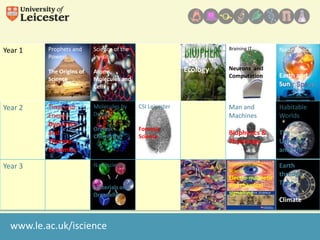
Braining IT

Year 2

Year 3

Prophets and
Powers

Science of the
Invisible

The Origins of
Science

Year 1

Atoms,
Molecules and
Cells

Time and
Energy
Dynamics
and
Thermodynamics

Molecules by
Design

CSI Leicester

Organic
Chemistry

Forensic
Science

Ecology

www.le.ac.uk/iscience

Earth and
Sun

Man and
Machines

Habitable
Worlds

Biophysics &
Physiology

The
Universe
and Life

Communication
Science

Nanoscience

Materials and
Organelles

Neurons and
Computation

Near Space

Evolution

Earth
through
Electro-magnetic
Time
and chemical
signalling

Climate
Problem Based Learning
• PBL is
– ‘a student-centred method of teaching in which
students learn by investigating real-world
problems and, working in groups, seek out the
tools necessary to solve them’

• “Pure” versus “Scaffolded” (supported) PBL
Raine D. and Symons S. (2012) Problem-based learning: undergraduate physics by research,
Contemporary Physics, 53(1), pp39–51

www.le.ac.uk/iscience
Delivery
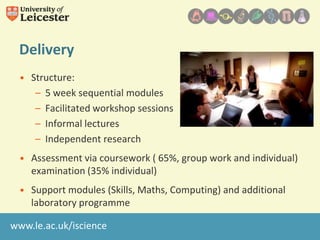
• Structure:
– 5 week sequential modules
– Facilitated workshop sessions
– Informal lectures
– Independent research
• Assessment via coursework ( 65%, group work and individual)
examination (35% individual)
• Support modules (Skills, Maths, Computing) and additional
laboratory programme
www.le.ac.uk/iscience
Our Challenges with PBL delivery:
• satisfaction with first “googled” search term
• lack of research in between sessions

• inappropriate division of learning within groups
• Resulting in :
– Lack of engagement
– Surface learning (lack of detailed subject knowledge)
– Lack of coverage of all the curriculum
– poor exam results
• Documented by others ( Wiznia et al. 2012)
Wiznia, D., Korom, R., Marzuf, P., Safdieh J., and Grafstein, B., (2012) PBL.2.0: enhancing problembased learning through increased student participation; Med Educ Online 2012, 17:17375

www.le.ac.uk/iscience
Interventions
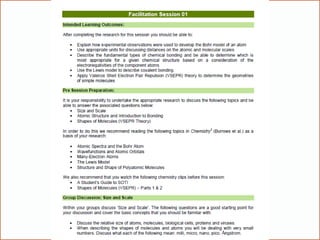
• Pre-session preparation:
– Recommended textbooks and reading topics
– Suggested questions to guide workshop
preparation and discussion
– Increased detail in intended learning outcomes

• Tutorial session dedicated to feedback on weekly
question sets
• Workshop sessions facilitated by subject based
teaching fellows (one per subject)
www.le.ac.uk/iscience
Data
• Students who entered the programme in 2009/10
experienced less scaffolded PBL in year 1 and
interventions in year 2 (and beyond)
• Small cohort (13 students)

www.le.ac.uk/iscience
Changes in Core Module Marks
•

Year 1 vs Year 2 Marks
70

65
60
55
Year 2
50
marks (%)
45
40
35
30
30

35

40

45

50

55

Year 1 marks (%)

www.le.ac.uk/iscience

60

65

70

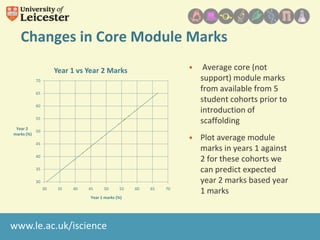
Average core (not
support) module marks
from available from 5
student cohorts prior to
introduction of
scaffolding

• Plot average module
marks in years 1 against
2 for these cohorts we
can predict expected
year 2 marks based year
1 marks
Quantitative data from students suggests
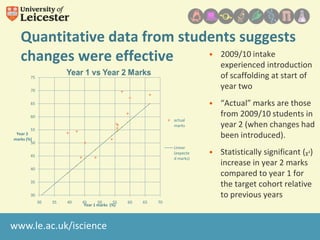
• 2009/10 intake
changes were effective
experienced introduction
of scaffolding at start of
year two

75
70
65
60

actual
marks

55
Year 2
marks (%)
50

Linear
(expecte
d marks)

45
40
35
30
30

35

40

45
50
55
Year 1 marks (%)

www.le.ac.uk/iscience

60

65

70

• “Actual” marks are those
from 2009/10 students in
year 2 (when changes had
been introduced).

• Statistically significant ( 2)
increase in year 2 marks
compared to year 1 for
the target cohort relative
to previous years
Qualitative data:
• Which of the changes were significant in this
change?

• Majority of cohort took part in semi-structured focus
group discussing their views on the interventions

www.le.ac.uk/iscience
Student focus groups indicated:
• On the introduction of pre-session preparation:
– often deviated from the suggested reading and recognised
that material is available from a wide range of sources
– source their own reading materials based on similar titles
– found the suggested discussion questions useful for
focussing their reading
– made use of the ‘Intended Learning Outcomes’ as a
revision checklist.

www.le.ac.uk/iscience
Student focus groups indicated:
• On the introduction of feedback sessions for weekly question
sets :
– The students were happy with the tutorial sessions found
useful for revision purposes
– Some students would like all questions to be covered not
just the “major difficulties”
– Other students would like to see these sessions become
optional for students who score above a certain mark.

www.le.ac.uk/iscience
Student focus groups indicated:
• On the use of teaching fellows:
– All students agreed this was a positive change
– Liked having one teaching fellow per subject - know who
to approach if they need to
– Felt more supported in the PBL process
“There's been a change since the first year where the PhD
students that were there were just there to make sure
we'd do the work rather than assisting and
facilitating, whereas now they [teaching fellows] will
prompt you towards an answer if you're not quite
getting it.”
www.le.ac.uk/iscience
Conclusions
• Limitations:
– Small cohort
– Research bias
• Quantitative data suggests changes were effective - appears
to benefit those with either strong or weak first year averages
most.
• Generally positive about the changes introduced- particularly
used discussion questions and intended learning outcomes
and liked the introduction of subject based teaching fellows
www.le.ac.uk/iscience
Final thoughts
• How much well trained are PBL facilitators in tertiary education?
• Our findings correspond with Gibbs (2011) in studies on effect of
extensive use of graduate students and ancillary casual
engagement in the U.S.
• PBL doesn’t work for all undergraduates – not all students engage
– in particular for students who maximise their social activities
during term and their studies during vacations (Edmonds
et, 2009).
Gibbs G (2011) Dimensions of Quality, HEA publication
Edmonds (2009) Review of the Student Learning Experience in Physics, 2008, HEA Physical Sciences
Subject Centre

www.le.ac.uk/iscience
Acknowledgements:
• Students and colleagues at the
Centre for Interdisciplinary Science
• Higher Education Funding Council
for England (HEFCE)
• Institute of Physics
• HE STEM

email:
www.le.ac.uk/iscience

sng8@le.ac.uk

Scaffolding Problem Based Learning

  • 1.
    Scaffolding Problem BasedLearning (PBL) with Module Length Problems Prof Derek Raine and Dr Sarah Gretton Centre for Interdisciplinary Science University of Leicester, U.K. www.le.ac.uk/iscience
  • 2.
    Interdisciplinary Science Programme: •Interdisciplinary Science programme started in 2004- response to IOP enquiry • 3 year undergraduate programme (BSc) • Natural Sciences content (biology, chemistry, physics and earth sciences) • Innovative in two respects: – Modules are interdisciplinary in nature – e.g. Astrobiology, Forensic Science, Biophysics – Core subject content taught entirely by PBL – each module is based around a problem e.g. “What limits the speed at which a human can run?” www.le.ac.uk/iscience
  • 3.
    Braining IT Year 2 Year3 Prophets and Powers Science of the Invisible The Origins of Science Year 1 Atoms, Molecules and Cells Time and Energy Dynamics and Thermodynamics Molecules by Design CSI Leicester Organic Chemistry Forensic Science Ecology www.le.ac.uk/iscience Earth and Sun Man and Machines Habitable Worlds Biophysics & Physiology The Universe and Life Communication Science Nanoscience Materials and Organelles Neurons and Computation Near Space Evolution Earth through Electro-magnetic Time and chemical signalling Climate
  • 4.
    Problem Based Learning •PBL is – ‘a student-centred method of teaching in which students learn by investigating real-world problems and, working in groups, seek out the tools necessary to solve them’ • “Pure” versus “Scaffolded” (supported) PBL Raine D. and Symons S. (2012) Problem-based learning: undergraduate physics by research, Contemporary Physics, 53(1), pp39–51 www.le.ac.uk/iscience
  • 5.
    Delivery • Structure: – 5week sequential modules – Facilitated workshop sessions – Informal lectures – Independent research • Assessment via coursework ( 65%, group work and individual) examination (35% individual) • Support modules (Skills, Maths, Computing) and additional laboratory programme www.le.ac.uk/iscience
  • 6.
    Our Challenges withPBL delivery: • satisfaction with first “googled” search term • lack of research in between sessions • inappropriate division of learning within groups • Resulting in : – Lack of engagement – Surface learning (lack of detailed subject knowledge) – Lack of coverage of all the curriculum – poor exam results • Documented by others ( Wiznia et al. 2012) Wiznia, D., Korom, R., Marzuf, P., Safdieh J., and Grafstein, B., (2012) PBL.2.0: enhancing problembased learning through increased student participation; Med Educ Online 2012, 17:17375 www.le.ac.uk/iscience
  • 7.
    Interventions • Pre-session preparation: –Recommended textbooks and reading topics – Suggested questions to guide workshop preparation and discussion – Increased detail in intended learning outcomes • Tutorial session dedicated to feedback on weekly question sets • Workshop sessions facilitated by subject based teaching fellows (one per subject) www.le.ac.uk/iscience
  • 8.
  • 9.
    Data • Students whoentered the programme in 2009/10 experienced less scaffolded PBL in year 1 and interventions in year 2 (and beyond) • Small cohort (13 students) www.le.ac.uk/iscience
  • 10.
    Changes in CoreModule Marks • Year 1 vs Year 2 Marks 70 65 60 55 Year 2 50 marks (%) 45 40 35 30 30 35 40 45 50 55 Year 1 marks (%) www.le.ac.uk/iscience 60 65 70 Average core (not support) module marks from available from 5 student cohorts prior to introduction of scaffolding • Plot average module marks in years 1 against 2 for these cohorts we can predict expected year 2 marks based year 1 marks
  • 11.
    Quantitative data fromstudents suggests • 2009/10 intake changes were effective experienced introduction of scaffolding at start of year two 75 70 65 60 actual marks 55 Year 2 marks (%) 50 Linear (expecte d marks) 45 40 35 30 30 35 40 45 50 55 Year 1 marks (%) www.le.ac.uk/iscience 60 65 70 • “Actual” marks are those from 2009/10 students in year 2 (when changes had been introduced). • Statistically significant ( 2) increase in year 2 marks compared to year 1 for the target cohort relative to previous years
  • 12.
    Qualitative data: • Whichof the changes were significant in this change? • Majority of cohort took part in semi-structured focus group discussing their views on the interventions www.le.ac.uk/iscience
  • 13.
    Student focus groupsindicated: • On the introduction of pre-session preparation: – often deviated from the suggested reading and recognised that material is available from a wide range of sources – source their own reading materials based on similar titles – found the suggested discussion questions useful for focussing their reading – made use of the ‘Intended Learning Outcomes’ as a revision checklist. www.le.ac.uk/iscience
  • 14.
    Student focus groupsindicated: • On the introduction of feedback sessions for weekly question sets : – The students were happy with the tutorial sessions found useful for revision purposes – Some students would like all questions to be covered not just the “major difficulties” – Other students would like to see these sessions become optional for students who score above a certain mark. www.le.ac.uk/iscience
  • 15.
    Student focus groupsindicated: • On the use of teaching fellows: – All students agreed this was a positive change – Liked having one teaching fellow per subject - know who to approach if they need to – Felt more supported in the PBL process “There's been a change since the first year where the PhD students that were there were just there to make sure we'd do the work rather than assisting and facilitating, whereas now they [teaching fellows] will prompt you towards an answer if you're not quite getting it.” www.le.ac.uk/iscience
  • 16.
    Conclusions • Limitations: – Smallcohort – Research bias • Quantitative data suggests changes were effective - appears to benefit those with either strong or weak first year averages most. • Generally positive about the changes introduced- particularly used discussion questions and intended learning outcomes and liked the introduction of subject based teaching fellows www.le.ac.uk/iscience
  • 17.
    Final thoughts • Howmuch well trained are PBL facilitators in tertiary education? • Our findings correspond with Gibbs (2011) in studies on effect of extensive use of graduate students and ancillary casual engagement in the U.S. • PBL doesn’t work for all undergraduates – not all students engage – in particular for students who maximise their social activities during term and their studies during vacations (Edmonds et, 2009). Gibbs G (2011) Dimensions of Quality, HEA publication Edmonds (2009) Review of the Student Learning Experience in Physics, 2008, HEA Physical Sciences Subject Centre www.le.ac.uk/iscience
  • 18.
    Acknowledgements: • Students andcolleagues at the Centre for Interdisciplinary Science • Higher Education Funding Council for England (HEFCE) • Institute of Physics • HE STEM email: www.le.ac.uk/iscience sng8@le.ac.uk

Editor's Notes

  • #3 National initiative Institute of PhysicsProgramme developed from scThe concept of an Interdisciplinary Science (or Integrated Sciences) first degree programme arose from the coming together of three strands:(i) An Institute of Physics enquiry (The New Degrees Committee) into the potential for alternative degrees involving but not exclusively devoted to Physics, thereby both providing a potential route to Physics for students with limited backgrounds in physics at school, and to illustrate the way in which physics underpins much of modern science and technology. The findings of the market research commissioned by the enquiry provided strong support for a fully interdisciplinary approach and little support for “Physics lite” degrees(ii) The strong emphasis placed at the time by the University on widening participation and the need to provide a suitable science programme to include physics, which would not be merely a diluted physics degree inappropriate to the Department’s standing and mission (iii) The development of problem-based learning in Physics, which had attracted external funding and by means of which the ab initio development of a new full degree programme could be resourced and implemented. ratch
  • #5 No defined syllabus why do we need scaffolding?http://en.wikipedia.org/wiki/Instructional_scaffolding#Scaffolding_and_problem-based_learning_in_the_educational_setting
  • #11 Caution based on small numbers
  • #12 Caution based on small numbers – however Excel gives the probability that is as high as my calculated value (11.3 for 12 df) by chance as 0.5. I interpret that as a meaning it is highly unlikely that the departure of Yr 2 from the expected performance is random (and the direction is obviously better than expected).