














All pictures are taken from
Dr StrangeLove movie
 Group of security researchers focused on ICS/SCADA
to save Humanity from industrial disaster and to
keep Purity Of Essence
Sergey Gordeychik Gleb Gritsai Denis Baranov
Roman Ilin Ilya Karpov Sergey Bobrov
Artem Chaykin Yuriy Dyachenko Sergey Drozdov
Dmitry Efanov Yuri Goltsev Vladimir Kochetkov
Andrey Medov Sergey Scherbel Timur Yunusov
Alexander Zaitsev Dmitry Serebryannikov Dmitry Nagibin
Dmitry Sklyarov Alexander Timorin Vyacheslav Egoshin
Roman Ilin Alexander Tlyapov
 Goals
to automate security assessment of ICS
platforms and environment
 Objectives
to understand system
to assess built-in security features
to create security audit/hardening guides
to automate process
Vulnerabilities – waste production
 Goal
to create PoC of Stuxnet-style attack
 Initial conditions
common ICS components and configuration
common ICS security tools
only ICS components weakness
vulnerabilities by SCADA StrangeLove team
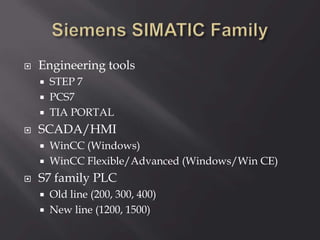
 Engineering tools
 STEP 7
 PCS7
 TIA PORTAL
 SCADA/HMI
 WinCC (Windows)
 WinCC Flexible/Advanced (Windows/Win CE)
 S7 family PLC
 Old line (200, 300, 400)
 New line (1200, 1500)
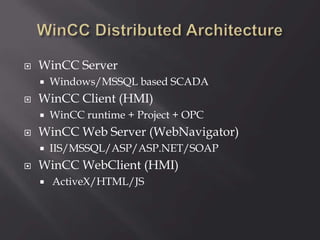
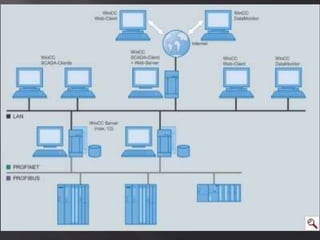
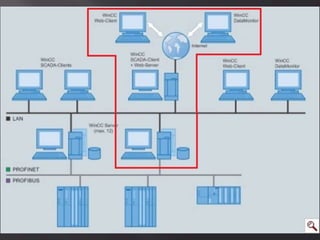
 WinCC Server
 Windows/MSSQL based SCADA
 WinCC Client (HMI)
 WinCC runtime + Project + OPC
 WinCC Web Server (WebNavigator)
 IIS/MSSQL/ASP/ASP.NET/SOAP
 WinCC WebClient (HMI)
 ActiveX/HTML/JS
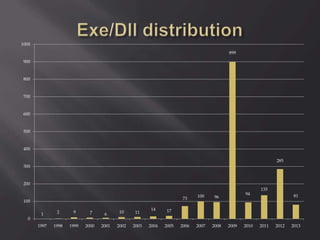
1 2 9 7 6
10 11
14 17
73
100 96
899
94
135
285
81
0
100
200
300
400
500
600
700
800
900
1000
1997 1998 1999 2000 2001 2002 2003 2004 2005 2006 2007 2008 2009 2010 2011 2012 2013
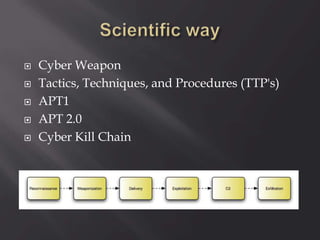
 Cyber Weapon
 Tactics, Techniques, and Procedures (TTP's)
 APT1
 APT 2.0
 Cyber Kill Chain
 ChinJa (R) (tm)
 Breaking through
 Harvesting
 Creeping death
 Chaos
That is a question!
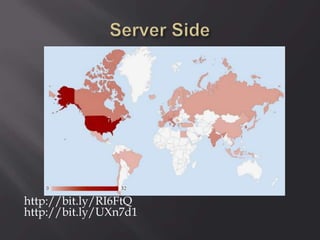
http://bit.ly/RI6FtQ
http://bit.ly/UXn7d1
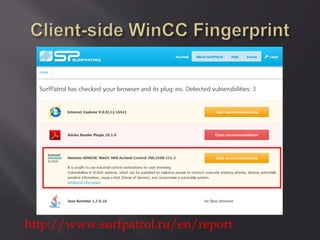
http://www.surfpatrol.ru/en/report
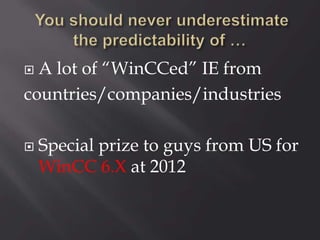
 A lot of “WinCCed” IE from
countries/companies/industries
 Special prize to guys from US for
WinCC 6.X at 2012
 XPath Injection (CVE-2012-2596)
 Path Traversal (CVE-2012-2597)
 XSS ~ 20 Instances (CVE-2012-2595)
Fixed in Update 2 for WinCC V7.0 SP3
http://support.automation.siemens.com/WW/view/en/60984587
 Lot of XSS and CSRF
 CVE-2012-3031
 CVE-2012-3028
 Lot of arbitrary file reading
 CVE-2012-3030
 SQL injection over SOAP
 CVE-2012-3032
 Username and password disclosure via ActiveX
abuse
 CVE-2012-3034
Fixed in Update 3 for WinCC V7.0 SP3
http://support.automation.siemens.com/WW/view/en/63472422
 Path Traversal
 CVE-2013-0679
 Buffer overflow in ActiveX
 CVE-2013-0674
 XXE OOB
 CVE-2013-0677
 Missing encryption of sensitive data
 CVE-2013-0678
 Improper authorization
 CVE-2013-0676f
Fixed in WinCC 7.2/SIMATIC PCS7 V8.0 SP 1
http://www.siemens.com/corporate-
technology/pool/de/forschungsfelder/siemens_security_advisory_ssa-
714398.pdf
 Network-level
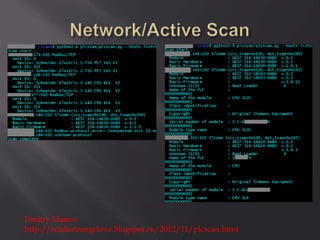
 Active scan
 S7, Modbus, MSSQL (WinCC Instance), HTTP(S)
 SNMP (public/private hardcoded for PLC and HMI
Panels)
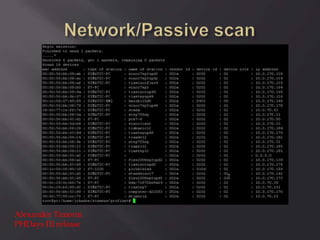
 Passive scan
 Profinet
 Host-level
 WinCC forensic
Dmitry Efanov
http://scadastrangelove.blogspot.ru/2012/11/plcscan.html
Alexander Timorin
PHDays III release
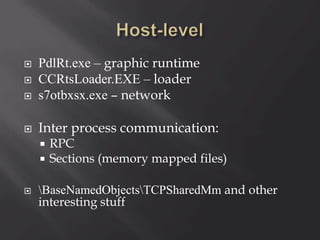
 PdlRt.exe – graphic runtime
 CCRtsLoader.EXE – loader
 s7otbxsx.exe – network
 Inter process communication:
 RPC
 Sections (memory mapped files)
 BaseNamedObjectsTCPSharedMm and other
interesting stuff
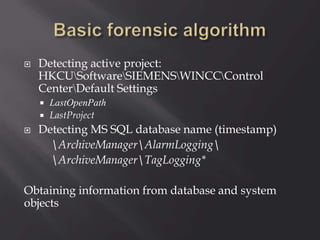
 Detecting active project:
HKCUSoftwareSIEMENSWINCCControl
CenterDefault Settings
 LastOpenPath
 LastProject
 Detecting MS SQL database name (timestamp)
ArchiveManagerAlarmLogging
ArchiveManagerTagLogging*
Obtaining information from database and system
objects
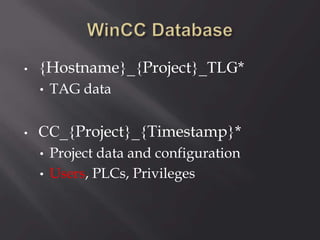
• {Hostname}_{Project}_TLG*
• TAG data
• СС_{Project}_{Timestamp}*
• Project data and configuration
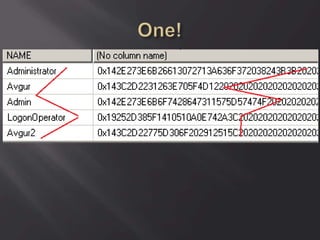
• Users, PLCs, Privileges
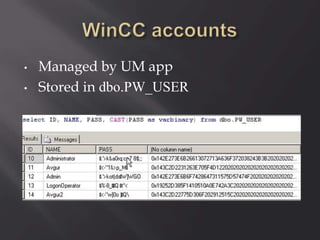
• Managed by UM app
• Stored in dbo.PW_USER
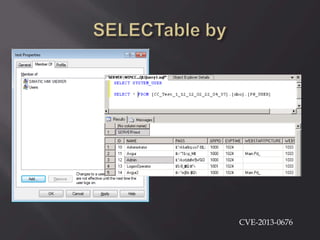
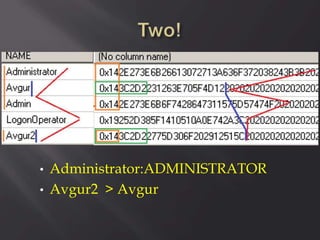
CVE-2013-0676
• Administrator:ADMINISTRATOR
• Avgur2 > Avgur
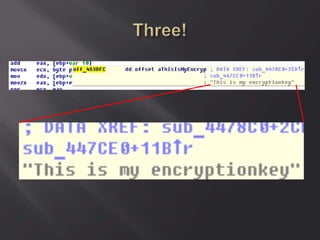
This is my
encryptionkey
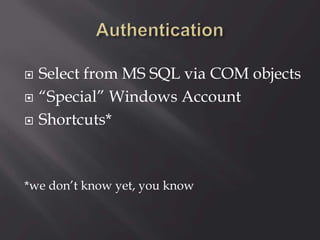
 Select from MS SQL via COM objects
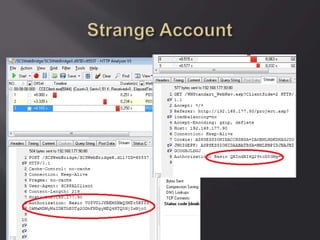
 “Special” Windows Account
 Shortcuts*
*we don’t know yet, you know
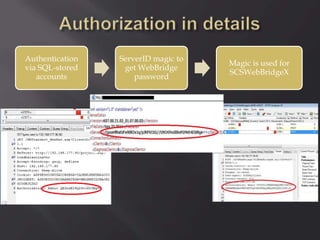
Authentication
via SQL-stored
accounts
ServerID magic to
get WebBridge
password
Magic is used for
SCSWebBridgeX
Too hard for me…
Oh! En/c(r)ypt[10]n!
ServerID = Base64(RC2(pass, key)), were key
= MD5(dll hardcode)
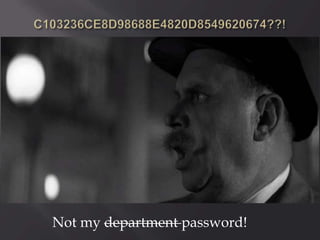
Not my department password!
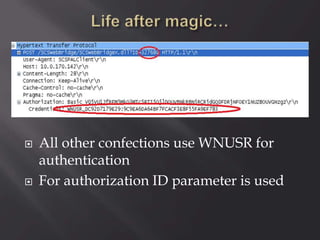
 All other confections use WNUSR for
authentication
 For authorization ID parameter is used
Not yet…
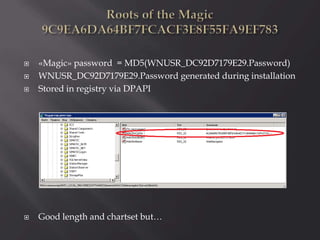
 «Magic» password = MD5(WNUSR_DC92D7179E29.Password)
 WNUSR_DC92D7179E29.Password generated during installation
 Stored in registry via DPAPI
 Good length and chartset but…
 WinCC clients use hardcoded account to
communicate with OPC Web bridge
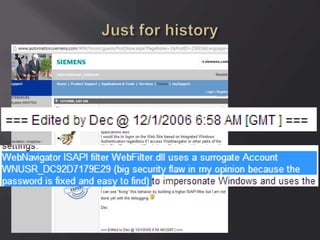
 Password for WNUSR_DC92D7179E29 generated
during installation and probably strong
 MD5(WNUSR_.Password) stored with DPAPI
protection
 “Encrypted” password for WNUSR_DC* can be
obtained by request to WinCCWebBridge.dll
 WNUSR_DC92D7179E29 is only account used for
work with Windows/Database
…responsible disclosure
 What is Project?
 Collection of ActiveX/COM/.NET objects
 Event Handlers and other code (C/VB)
 Configuration files, XML and other
 Can Project be trusted?
 Ways to spread malware with Project?
 NO!
 Project itself is dynamic code
 It’s easy to patch it “on the fly”
 Vulnerabilities in data handlers
(CVE-2013-0677)
 How to abuse?
 Simplest way – to patch event
handlers
 Hardcoded SNMP community string (unfixed)
 Hardcoded S7 PLC CA certificate (Dmitry Sklarov)
http://scadastrangelove.blogspot.com/2012/09/all-your-plc-
belong-to-us.html
 Multiple vulnerabilities in S7 1200 PLC Web
interface (Dmitriy Serebryannikov, Artem Chaikin, Yury
Goltsev, Timur Yunusov)
http://www.siemens.com/corporatetechnology/pool/de/fors
chungsfelder/siemens_security_advisory_ssa-279823.pdf
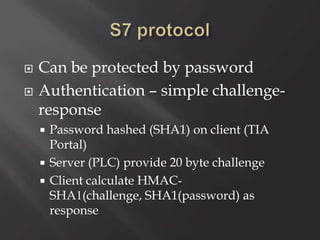
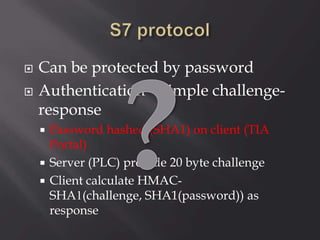
 Can be protected by password
 Authentication – simple challenge-
response
 Password hashed (SHA1) on client (TIA
Portal)
 Server (PLC) provide 20 byte challenge
 Client calculate HMAC-
SHA1(challenge, SHA1(password) as
response
 Can be protected by password
 Authentication – simple challenge-
response
 Password hashed (SHA1) on client (TIA
Portal)
 Server (PLC) provide 20 byte challenge
 Client calculate HMAC-
SHA1(challenge, SHA1(password)) as
response
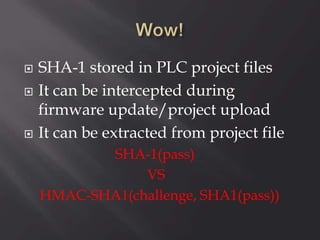
 SHA-1 stored in PLC project files
 It can be intercepted during
firmware update/project upload
 It can be extracted from project file
SHA-1(pass)
VS
HMAC-SHA1(challenge, SHA1(pass))
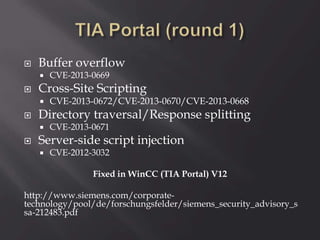
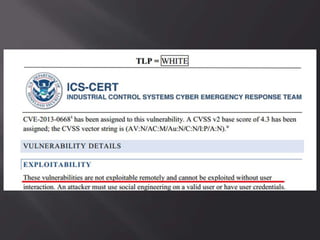
 Buffer overflow
 CVE-2013-0669
 Cross-Site Scripting
 CVE-2013-0672/CVE-2013-0670/CVE-2013-0668
 Directory traversal/Response splitting
 CVE-2013-0671
 Server-side script injection
 CVE-2012-3032
Fixed in WinCC (TIA Portal) V12
http://www.siemens.com/corporate-
technology/pool/de/forschungsfelder/siemens_security_advisory_s
sa-212483.pdf
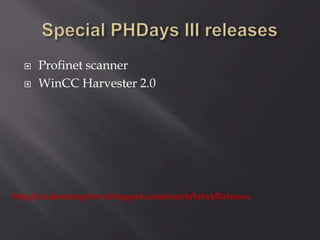
 Profinet scanner
 WinCC Harvester 2.0
http://scadastrangelove.blogspot.com/search/label/Releases
 TIA portal Security Hardening Guide
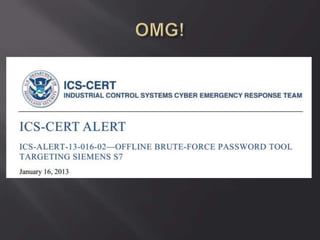
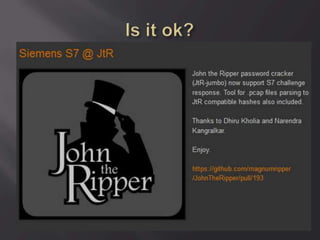
 S7 protocol password brute force tool and JtR
 Simatic WinCC Security Hardening Guide
 PLCScan tool
 ICS/SCADA/PLC Google/Shodan Cheat
Sheet
 SCADA Safety in Numbers
http://scadastrangelove.blogspot.com/search/label/Releases
All pictures are taken from
Dr StrangeLove movie

Scada strange love.

  • 1.
    All pictures aretaken from Dr StrangeLove movie
  • 2.
     Group ofsecurity researchers focused on ICS/SCADA to save Humanity from industrial disaster and to keep Purity Of Essence Sergey Gordeychik Gleb Gritsai Denis Baranov Roman Ilin Ilya Karpov Sergey Bobrov Artem Chaykin Yuriy Dyachenko Sergey Drozdov Dmitry Efanov Yuri Goltsev Vladimir Kochetkov Andrey Medov Sergey Scherbel Timur Yunusov Alexander Zaitsev Dmitry Serebryannikov Dmitry Nagibin Dmitry Sklyarov Alexander Timorin Vyacheslav Egoshin Roman Ilin Alexander Tlyapov
  • 4.
     Goals to automatesecurity assessment of ICS platforms and environment  Objectives to understand system to assess built-in security features to create security audit/hardening guides to automate process Vulnerabilities – waste production
  • 5.
     Goal to createPoC of Stuxnet-style attack  Initial conditions common ICS components and configuration common ICS security tools only ICS components weakness vulnerabilities by SCADA StrangeLove team
  • 12.
     Engineering tools STEP 7  PCS7  TIA PORTAL  SCADA/HMI  WinCC (Windows)  WinCC Flexible/Advanced (Windows/Win CE)  S7 family PLC  Old line (200, 300, 400)  New line (1200, 1500)
  • 13.
     WinCC Server Windows/MSSQL based SCADA  WinCC Client (HMI)  WinCC runtime + Project + OPC  WinCC Web Server (WebNavigator)  IIS/MSSQL/ASP/ASP.NET/SOAP  WinCC WebClient (HMI)  ActiveX/HTML/JS
  • 16.
    1 2 97 6 10 11 14 17 73 100 96 899 94 135 285 81 0 100 200 300 400 500 600 700 800 900 1000 1997 1998 1999 2000 2001 2002 2003 2004 2005 2006 2007 2008 2009 2010 2011 2012 2013
  • 18.
     Cyber Weapon Tactics, Techniques, and Procedures (TTP's)  APT1  APT 2.0  Cyber Kill Chain
  • 19.
     ChinJa (R)(tm)  Breaking through  Harvesting  Creeping death  Chaos
  • 21.
    That is aquestion!
  • 22.
  • 23.
  • 24.
     A lotof “WinCCed” IE from countries/companies/industries  Special prize to guys from US for WinCC 6.X at 2012
  • 27.
     XPath Injection(CVE-2012-2596)  Path Traversal (CVE-2012-2597)  XSS ~ 20 Instances (CVE-2012-2595) Fixed in Update 2 for WinCC V7.0 SP3 http://support.automation.siemens.com/WW/view/en/60984587
  • 28.
     Lot ofXSS and CSRF  CVE-2012-3031  CVE-2012-3028  Lot of arbitrary file reading  CVE-2012-3030  SQL injection over SOAP  CVE-2012-3032  Username and password disclosure via ActiveX abuse  CVE-2012-3034 Fixed in Update 3 for WinCC V7.0 SP3 http://support.automation.siemens.com/WW/view/en/63472422
  • 29.
     Path Traversal CVE-2013-0679  Buffer overflow in ActiveX  CVE-2013-0674  XXE OOB  CVE-2013-0677  Missing encryption of sensitive data  CVE-2013-0678  Improper authorization  CVE-2013-0676f Fixed in WinCC 7.2/SIMATIC PCS7 V8.0 SP 1 http://www.siemens.com/corporate- technology/pool/de/forschungsfelder/siemens_security_advisory_ssa- 714398.pdf
  • 32.
     Network-level  Activescan  S7, Modbus, MSSQL (WinCC Instance), HTTP(S)  SNMP (public/private hardcoded for PLC and HMI Panels)  Passive scan  Profinet  Host-level  WinCC forensic
  • 33.
  • 34.
  • 36.
     PdlRt.exe –graphic runtime  CCRtsLoader.EXE – loader  s7otbxsx.exe – network  Inter process communication:  RPC  Sections (memory mapped files)  BaseNamedObjectsTCPSharedMm and other interesting stuff
  • 37.
     Detecting activeproject: HKCUSoftwareSIEMENSWINCCControl CenterDefault Settings  LastOpenPath  LastProject  Detecting MS SQL database name (timestamp) ArchiveManagerAlarmLogging ArchiveManagerTagLogging* Obtaining information from database and system objects
  • 38.
    • {Hostname}_{Project}_TLG* • TAGdata • СС_{Project}_{Timestamp}* • Project data and configuration • Users, PLCs, Privileges
  • 39.
    • Managed byUM app • Stored in dbo.PW_USER
  • 40.
  • 42.
  • 46.
  • 50.
     Select fromMS SQL via COM objects  “Special” Windows Account  Shortcuts* *we don’t know yet, you know
  • 52.
    Authentication via SQL-stored accounts ServerID magicto get WebBridge password Magic is used for SCSWebBridgeX
  • 53.
  • 54.
    Oh! En/c(r)ypt[10]n! ServerID =Base64(RC2(pass, key)), were key = MD5(dll hardcode)
  • 55.
  • 56.
     All otherconfections use WNUSR for authentication  For authorization ID parameter is used
  • 57.
  • 58.
     «Magic» password= MD5(WNUSR_DC92D7179E29.Password)  WNUSR_DC92D7179E29.Password generated during installation  Stored in registry via DPAPI  Good length and chartset but…
  • 60.
     WinCC clientsuse hardcoded account to communicate with OPC Web bridge  Password for WNUSR_DC92D7179E29 generated during installation and probably strong  MD5(WNUSR_.Password) stored with DPAPI protection  “Encrypted” password for WNUSR_DC* can be obtained by request to WinCCWebBridge.dll  WNUSR_DC92D7179E29 is only account used for work with Windows/Database
  • 62.
  • 63.
     What isProject?  Collection of ActiveX/COM/.NET objects  Event Handlers and other code (C/VB)  Configuration files, XML and other  Can Project be trusted?  Ways to spread malware with Project?
  • 64.
     NO!  Projectitself is dynamic code  It’s easy to patch it “on the fly”  Vulnerabilities in data handlers (CVE-2013-0677)  How to abuse?  Simplest way – to patch event handlers
  • 66.
     Hardcoded SNMPcommunity string (unfixed)  Hardcoded S7 PLC CA certificate (Dmitry Sklarov) http://scadastrangelove.blogspot.com/2012/09/all-your-plc- belong-to-us.html  Multiple vulnerabilities in S7 1200 PLC Web interface (Dmitriy Serebryannikov, Artem Chaikin, Yury Goltsev, Timur Yunusov) http://www.siemens.com/corporatetechnology/pool/de/fors chungsfelder/siemens_security_advisory_ssa-279823.pdf
  • 67.
     Can beprotected by password  Authentication – simple challenge- response  Password hashed (SHA1) on client (TIA Portal)  Server (PLC) provide 20 byte challenge  Client calculate HMAC- SHA1(challenge, SHA1(password) as response
  • 70.
     Can beprotected by password  Authentication – simple challenge- response  Password hashed (SHA1) on client (TIA Portal)  Server (PLC) provide 20 byte challenge  Client calculate HMAC- SHA1(challenge, SHA1(password)) as response
  • 71.
     SHA-1 storedin PLC project files  It can be intercepted during firmware update/project upload  It can be extracted from project file SHA-1(pass) VS HMAC-SHA1(challenge, SHA1(pass))
  • 76.
     Buffer overflow CVE-2013-0669  Cross-Site Scripting  CVE-2013-0672/CVE-2013-0670/CVE-2013-0668  Directory traversal/Response splitting  CVE-2013-0671  Server-side script injection  CVE-2012-3032 Fixed in WinCC (TIA Portal) V12 http://www.siemens.com/corporate- technology/pool/de/forschungsfelder/siemens_security_advisory_s sa-212483.pdf
  • 80.
     Profinet scanner WinCC Harvester 2.0 http://scadastrangelove.blogspot.com/search/label/Releases
  • 81.
     TIA portalSecurity Hardening Guide  S7 protocol password brute force tool and JtR  Simatic WinCC Security Hardening Guide  PLCScan tool  ICS/SCADA/PLC Google/Shodan Cheat Sheet  SCADA Safety in Numbers http://scadastrangelove.blogspot.com/search/label/Releases
  • 82.
    All pictures aretaken from Dr StrangeLove movie