Noon Conference
Kristen Beck
© 2016 Virginia Mason Medical Center
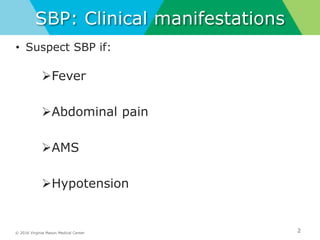
SBP: Clinical manifestations
• Suspect SBP if:
Fever
Abdominal pain
AMS
Hypotension
2
© 2016 Virginia Mason Medical Center
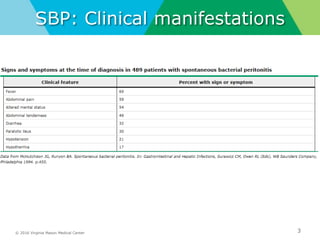
SBP: Clinical manifestations
3
© 2016 Virginia Mason Medical Center
SBP: Diagnosis
4
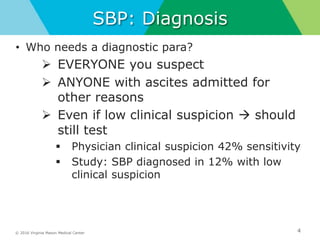
• Who needs a diagnostic para?
 EVERYONE you suspect
 ANYONE with ascites admitted for
other reasons
 Even if low clinical suspicion  should
still test
 Physician clinical suspicion 42% sensitivity
 Study: SBP diagnosed in 12% with low
clinical suspicion
© 2016 Virginia Mason Medical Center
SBP: Diagnosis
5
• Who needs a diagnostic para?
 EVERYONE you suspect
 ANYONE with ascites admitted for
other reasons
 Even if low clinical suspicion  should
still test
 Physician clinical suspicion 42% sensitivity
 Study: SBP diagnosed in 12% with low
clinical suspicion
© 2016 Virginia Mason Medical Center
Importance of paracentesis
6
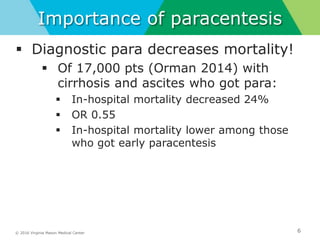
 Diagnostic para decreases mortality!
 Of 17,000 pts (Orman 2014) with
cirrhosis and ascites who got para:
 In-hospital mortality decreased 24%
 OR 0.55
 In-hospital mortality lower among those
who got early paracentesis
© 2016 Virginia Mason Medical Center
SBP: Diagnosis
7
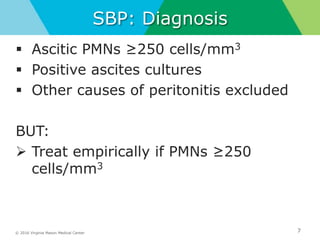
 Ascitic PMNs ≥250 cells/mm3
 Positive ascites cultures
 Other causes of peritonitis excluded
BUT:
 Treat empirically if PMNs ≥250
cells/mm3
© 2016 Virginia Mason Medical Center
Spontaneous vs secondary
bacterial peritonitis
8
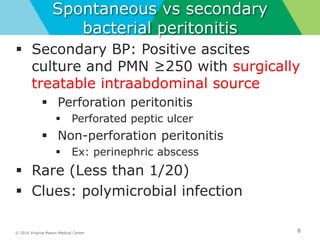
 Secondary BP: Positive ascites
culture and PMN ≥250 with surgically
treatable intraabdominal source
 Perforation peritonitis
 Perforated peptic ulcer
 Non-perforation peritonitis
 Ex: perinephric abscess
 Rare (Less than 1/20)
 Clues: polymicrobial infection
© 2016 Virginia Mason Medical Center
Secondary bacterial peritonitis
9
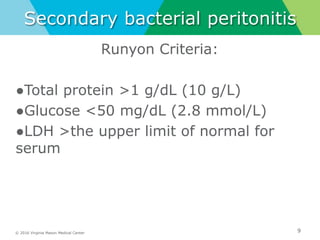
Runyon Criteria:
●Total protein >1 g/dL (10 g/L)
●Glucose <50 mg/dL (2.8 mmol/L)
●LDH >the upper limit of normal for
serum
© 2016 Virginia Mason Medical Center
Secondary bacterial peritonitis
10
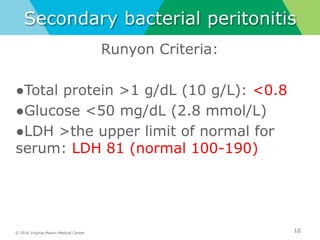
Runyon Criteria:
●Total protein >1 g/dL (10 g/L): <0.8
●Glucose <50 mg/dL (2.8 mmol/L)
●LDH >the upper limit of normal for
serum: LDH 81 (normal 100-190)
© 2016 Virginia Mason Medical Center
Spontaneous vs secondary
bacterial peritonitis
11
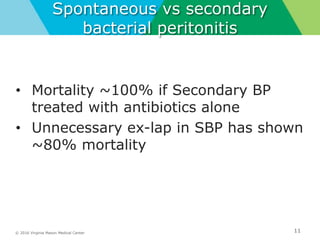
• Mortality ~100% if Secondary BP
treated with antibiotics alone
• Unnecessary ex-lap in SBP has shown
~80% mortality
© 2016 Virginia Mason Medical Center
SBP: Treatment
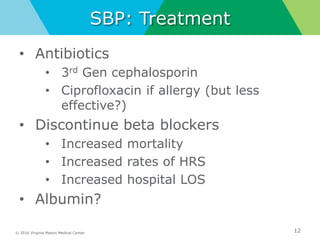
• Antibiotics
• 3rd Gen cephalosporin
• Ciprofloxacin if allergy (but less
effective?)
• Discontinue beta blockers
• Increased mortality
• Increased rates of HRS
• Increased hospital LOS
• Albumin?
12
© 2016 Virginia Mason Medical Center
SBP: Treatment
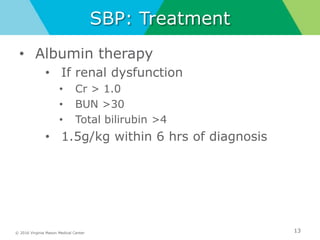
• Albumin therapy
• If renal dysfunction
• Cr > 1.0
• BUN >30
• Total bilirubin >4
• 1.5g/kg within 6 hrs of diagnosis
13
© 2016 Virginia Mason Medical Center
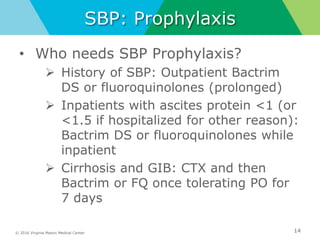
SBP: Prophylaxis
• Who needs SBP Prophylaxis?
 History of SBP: Outpatient Bactrim
DS or fluoroquinolones (prolonged)
 Inpatients with ascites protein <1 (or
<1.5 if hospitalized for other reason):
Bactrim DS or fluoroquinolones while
inpatient
 Cirrhosis and GIB: CTX and then
Bactrim or FQ once tolerating PO for
7 days
14
© 2016 Virginia Mason Medical Center
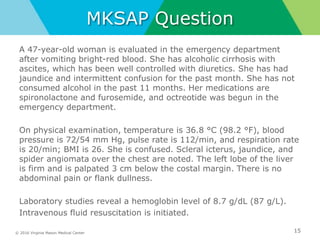
MKSAP Question
A 47-year-old woman is evaluated in the emergency department
after vomiting bright-red blood. She has alcoholic cirrhosis with
ascites, which has been well controlled with diuretics. She has had
jaundice and intermittent confusion for the past month. She has not
consumed alcohol in the past 11 months. Her medications are
spironolactone and furosemide, and octreotide was begun in the
emergency department.
On physical examination, temperature is 36.8 °C (98.2 °F), blood
pressure is 72/54 mm Hg, pulse rate is 112/min, and respiration rate
is 20/min; BMI is 26. She is confused. Scleral icterus, jaundice, and
spider angiomata over the chest are noted. The left lobe of the liver
is firm and is palpated 3 cm below the costal margin. There is no
abdominal pain or flank dullness.
Laboratory studies reveal a hemoglobin level of 8.7 g/dL (87 g/L).
Intravenous fluid resuscitation is initiated.
15
© 2016 Virginia Mason Medical Center
MKSAP Question
Which of the following is the most appropriate next
step in management?
a. Antibiotics
b.Non-selective β-blocker
c. Transjugular intrahepatic portosystemic shunt
placement
d.Upper endoscopy
16
© 2016 Virginia Mason Medical Center
MKSAP Question
Which of the following is the most appropriate next
step in management?
a. Antibiotics
b.Non-selective β-blocker
c. Transjugular intrahepatic portosystemic shunt
placement
d.Upper endoscopy
17
© 2016 Virginia Mason Medical Center
Summary
• Get a diagnostic para on patients
with ascites
• Treat SBP empirically if PMN ≥250
• Albumin if renal dysfunction
• Rule out need for surgical
management
• SBP prophylaxis on patients with
history of SBP, ascites protein <1, or
GIB
18

Sbp noon conf

  • 1.
  • 2.
    © 2016 VirginiaMason Medical Center SBP: Clinical manifestations • Suspect SBP if: Fever Abdominal pain AMS Hypotension 2
  • 3.
    © 2016 VirginiaMason Medical Center SBP: Clinical manifestations 3
  • 4.
    © 2016 VirginiaMason Medical Center SBP: Diagnosis 4 • Who needs a diagnostic para?  EVERYONE you suspect  ANYONE with ascites admitted for other reasons  Even if low clinical suspicion  should still test  Physician clinical suspicion 42% sensitivity  Study: SBP diagnosed in 12% with low clinical suspicion
  • 5.
    © 2016 VirginiaMason Medical Center SBP: Diagnosis 5 • Who needs a diagnostic para?  EVERYONE you suspect  ANYONE with ascites admitted for other reasons  Even if low clinical suspicion  should still test  Physician clinical suspicion 42% sensitivity  Study: SBP diagnosed in 12% with low clinical suspicion
  • 6.
    © 2016 VirginiaMason Medical Center Importance of paracentesis 6  Diagnostic para decreases mortality!  Of 17,000 pts (Orman 2014) with cirrhosis and ascites who got para:  In-hospital mortality decreased 24%  OR 0.55  In-hospital mortality lower among those who got early paracentesis
  • 7.
    © 2016 VirginiaMason Medical Center SBP: Diagnosis 7  Ascitic PMNs ≥250 cells/mm3  Positive ascites cultures  Other causes of peritonitis excluded BUT:  Treat empirically if PMNs ≥250 cells/mm3
  • 8.
    © 2016 VirginiaMason Medical Center Spontaneous vs secondary bacterial peritonitis 8  Secondary BP: Positive ascites culture and PMN ≥250 with surgically treatable intraabdominal source  Perforation peritonitis  Perforated peptic ulcer  Non-perforation peritonitis  Ex: perinephric abscess  Rare (Less than 1/20)  Clues: polymicrobial infection
  • 9.
    © 2016 VirginiaMason Medical Center Secondary bacterial peritonitis 9 Runyon Criteria: ●Total protein >1 g/dL (10 g/L) ●Glucose <50 mg/dL (2.8 mmol/L) ●LDH >the upper limit of normal for serum
  • 10.
    © 2016 VirginiaMason Medical Center Secondary bacterial peritonitis 10 Runyon Criteria: ●Total protein >1 g/dL (10 g/L): <0.8 ●Glucose <50 mg/dL (2.8 mmol/L) ●LDH >the upper limit of normal for serum: LDH 81 (normal 100-190)
  • 11.
    © 2016 VirginiaMason Medical Center Spontaneous vs secondary bacterial peritonitis 11 • Mortality ~100% if Secondary BP treated with antibiotics alone • Unnecessary ex-lap in SBP has shown ~80% mortality
  • 12.
    © 2016 VirginiaMason Medical Center SBP: Treatment • Antibiotics • 3rd Gen cephalosporin • Ciprofloxacin if allergy (but less effective?) • Discontinue beta blockers • Increased mortality • Increased rates of HRS • Increased hospital LOS • Albumin? 12
  • 13.
    © 2016 VirginiaMason Medical Center SBP: Treatment • Albumin therapy • If renal dysfunction • Cr > 1.0 • BUN >30 • Total bilirubin >4 • 1.5g/kg within 6 hrs of diagnosis 13
  • 14.
    © 2016 VirginiaMason Medical Center SBP: Prophylaxis • Who needs SBP Prophylaxis?  History of SBP: Outpatient Bactrim DS or fluoroquinolones (prolonged)  Inpatients with ascites protein <1 (or <1.5 if hospitalized for other reason): Bactrim DS or fluoroquinolones while inpatient  Cirrhosis and GIB: CTX and then Bactrim or FQ once tolerating PO for 7 days 14
  • 15.
    © 2016 VirginiaMason Medical Center MKSAP Question A 47-year-old woman is evaluated in the emergency department after vomiting bright-red blood. She has alcoholic cirrhosis with ascites, which has been well controlled with diuretics. She has had jaundice and intermittent confusion for the past month. She has not consumed alcohol in the past 11 months. Her medications are spironolactone and furosemide, and octreotide was begun in the emergency department. On physical examination, temperature is 36.8 °C (98.2 °F), blood pressure is 72/54 mm Hg, pulse rate is 112/min, and respiration rate is 20/min; BMI is 26. She is confused. Scleral icterus, jaundice, and spider angiomata over the chest are noted. The left lobe of the liver is firm and is palpated 3 cm below the costal margin. There is no abdominal pain or flank dullness. Laboratory studies reveal a hemoglobin level of 8.7 g/dL (87 g/L). Intravenous fluid resuscitation is initiated. 15
  • 16.
    © 2016 VirginiaMason Medical Center MKSAP Question Which of the following is the most appropriate next step in management? a. Antibiotics b.Non-selective β-blocker c. Transjugular intrahepatic portosystemic shunt placement d.Upper endoscopy 16
  • 17.
    © 2016 VirginiaMason Medical Center MKSAP Question Which of the following is the most appropriate next step in management? a. Antibiotics b.Non-selective β-blocker c. Transjugular intrahepatic portosystemic shunt placement d.Upper endoscopy 17
  • 18.
    © 2016 VirginiaMason Medical Center Summary • Get a diagnostic para on patients with ascites • Treat SBP empirically if PMN ≥250 • Albumin if renal dysfunction • Rule out need for surgical management • SBP prophylaxis on patients with history of SBP, ascites protein <1, or GIB 18