On a Wellness EconomyJules PeckAbundancy Partners
Flourishing EnterpriseLife, liberty and the pursuit of happiness - the business implications and innovation opportunities of a ‘yes we can’ wellbeing perspectiveJules Peck SB’112
Section 1  CONTEXT - PLANET AND WELLBEING MELTDOWN
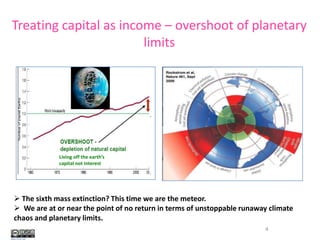
Treating capital as income – overshoot of planetary limitsLiving off the earth’s capital not interest The sixth mass extinction? This time we are the meteor.
  We are at or near the point of no return in terms of unstoppable runaway climate chaos and planetary limits.4
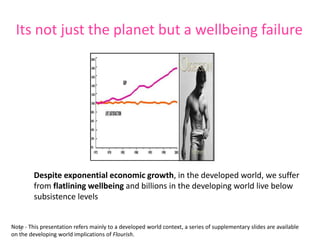
Its not just the planet but a wellbeing failure Despite exponential economic growth, in the developed world, we suffer from flatlining wellbeing and billions in the developing world live below subsistence levels5Note - This presentation refers mainly to a developed world context, a series of supplementary slides are available on the developing world implications of Flourish.
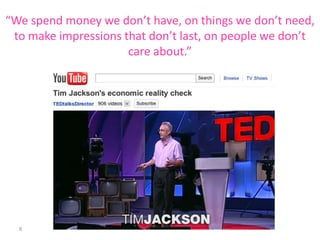
“We spend money we don’t have, on things we don’t need, to make impressions that don’t last, on people we don’t care about.”6
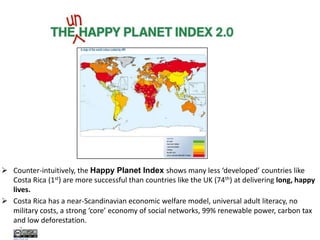
Counter-intuitively, the Happy Planet Index shows many less ‘developed’ countries like Costa Rica (1st) are more successful than countries like the UK (74th) at delivering long, happy lives.
Costa Rica has a near-Scandinavian economic welfare model, universal adult literacy, no military costs, a strong ‘core’ economy of social networks, 99% renewable power, carbon tax and low deforestation.   7
Section 2 CONTEXT  - RISING CONSENSUS OF THE LIMITS TO GROWTH
Political perspectives on limits to growth“Decoupling is a myth and as the economy is currently organized, we are simply destroying the planet. Energy and resource efficiency is seen as the solution. But it is like with all the productivity increases, the result will be more economic growth which will result in increased demand for resources.” Anders Wijkman, Vice-Chairman of Sweden’s Tällberg Foundation and a former MEP.“The traditional definition of growth, which measures prosperity solely in terms of the increase in the gross domestic product, is a dead-end solution. We can see where it's taking us. This global economic model is hurting our planet.” Winfried Kretschmann, German State Governor of Baden-Württemberg
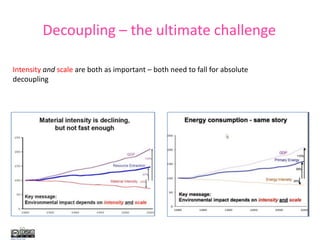
Decoupling – the ultimate challengeIntensityand scale are both as important – both need to fall for absolute decoupling 10
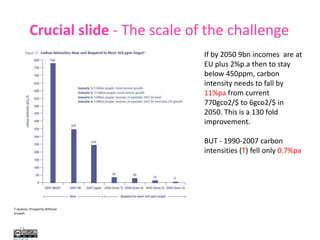
Crucial slide - The scale of the challengeIf by 2050 9bn incomes are at EU plus 2%p.a then to stay below 450ppm, carbon intensity needs to fall by 11%pafrom current 770gco2/$ to 6gco2/$ in 2050. This is a 130 fold improvement.  BUT - 1990-2007 carbon intensities (T) fell only 0.7%pa 11T.Jackson, Prosperity Without Growth
“what if the crisis of 2008 represents something much more fundamental than a deep recession? What if it’s telling us that the whole growth model we created over the last 50 years is simply unsustainable economically and ecologically and that 2008 was when we hit the wall — when Mother Nature and the market both said - No more!” New York Times' Thomas Friedman“We should . . . dethrone the idea that maximising the growth in measured prosperity, GDP per capita, should be an explicit objective of economic and social policy.” FSA Chair Lord Adair Turner“Jackson's book [Prosperity Without Growth] simply resets the agenda for Western society.” Bernie Bulkin, former Chief Scientist of BP 77% of 176 business leaders think government should rethink the growth imperative according to Cambridge Programme for Sustainable Leadership.
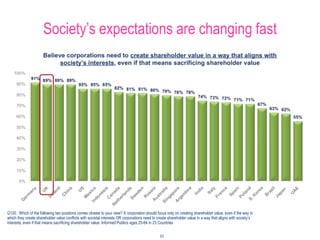
75% of the public in 10 countries agreed according to Globescan. ABBC poll found that 81% of the public want Government to focus on ‘the greatest happiness’ not ‘the greatest wealth’.There is a rising questioning of growth
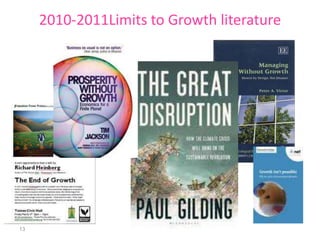
2010-2011Limits to Growth literature13
Section 3 UNECONOMIC GROWTH - THE END OF GROWTH IS IN ANY CASE IMMINENT
Was 2008 the end of growth?Many suggest that we have now seen the end of absolute growth at a macro level due to:
The depletion of crucial resources such as fossil fuels, water, food, metals and minerals;
The proliferation of environmental impacts arising from both the extraction and use of resources leading to snowballing costs from both these impacts themselves and from efforts to avert them and clean them up;
Financial disruptions due to the inability of our existing monetary, banking, and investment systems to adjust to both resource scarcity and soaring environmental costs—and their inability (in the context of a shrinking economy) to service the enormous piles of government and private debt that have been generated over the past couple of decades.
Deepwater Horizon is one good Black Swan example of the confluence of all three of these coming together. Oil depletion pushed BP into areas that are just not sensible (and are very expensive) for drilling. The knock-on effect of rising insurance costs and premiums and BP’s shares falling has had serious effects on already delicate UK pensions.   15
The end of growth - resource depletionEnergy;
“Conventional oil production peaked in 2006” (IEA Chief Economist).
Water;
“by 2025, about 1.8 billion people will be living in countries or regions with absolute water scarcity, and two-thirds of the world population could be under conditions of water stress—the threshold for meeting the water requirements for agriculture, industry, domestic purposes, energy and the environment. . . .” UN’s Global Environment Outlook 4 (2007).
In the U.S., the Colorado River—which supplies water to cities such as Phoenix, Tucson, Los Angeles, Las Vegas, and San Diego, as well as providing most of the irrigation water for the Southwest—could be functionally dry within the decade if current trends continue.
Food;
“Food prices are not only rising, but they are also volatile and will continue this way into the future,” Ngozi Okonjo-Iweala. World Bank MD.
“The evidence does, in fact, suggest that what we’re getting now is a first taste of the disruption, economic and political, that we’ll face in a warming world. And given our failure to act on greenhouse gases, there will be much more, and much worse, to come.” Nobel winner Paul Krugman on rising food prices in 2011.
World grain production per capita peaked in 1984 at 342 kg annually. For many years production has not met demand, so the gap has been filled by dipping into carryover stocks; currently, less than two months’ supply remains as a buffer. (Wall Street Journal Oct 2010.)
Metals;
“Virgin stocks of several metals appear inadequate to sustain the modern ‘developed world’ quality of life for all of Earth’s people under contemporary technology.” Tom Graedel at Yale University.16
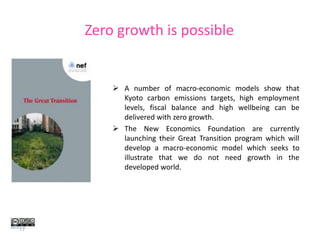
Zero growth is possibleA number of macro-economic models show that Kyoto carbon emissions targets, high employment levels, fiscal balance and high wellbeing can be delivered with zero growth.

SB11 - Abundancy Partners - Jules Peck

  • 1.
    On a WellnessEconomyJules PeckAbundancy Partners
  • 2.
    Flourishing EnterpriseLife, libertyand the pursuit of happiness - the business implications and innovation opportunities of a ‘yes we can’ wellbeing perspectiveJules Peck SB’112
  • 3.
    Section 1 CONTEXT - PLANET AND WELLBEING MELTDOWN
  • 4.
    Treating capital asincome – overshoot of planetary limitsLiving off the earth’s capital not interest The sixth mass extinction? This time we are the meteor.
  • 5.
    Weare at or near the point of no return in terms of unstoppable runaway climate chaos and planetary limits.4
  • 6.
    Its not justthe planet but a wellbeing failure Despite exponential economic growth, in the developed world, we suffer from flatlining wellbeing and billions in the developing world live below subsistence levels5Note - This presentation refers mainly to a developed world context, a series of supplementary slides are available on the developing world implications of Flourish.
  • 7.
    “We spend moneywe don’t have, on things we don’t need, to make impressions that don’t last, on people we don’t care about.”6
  • 8.
    Counter-intuitively, the HappyPlanet Index shows many less ‘developed’ countries like Costa Rica (1st) are more successful than countries like the UK (74th) at delivering long, happy lives.
  • 9.
    Costa Rica hasa near-Scandinavian economic welfare model, universal adult literacy, no military costs, a strong ‘core’ economy of social networks, 99% renewable power, carbon tax and low deforestation. 7
  • 10.
    Section 2 CONTEXT - RISING CONSENSUS OF THE LIMITS TO GROWTH
  • 11.
    Political perspectives onlimits to growth“Decoupling is a myth and as the economy is currently organized, we are simply destroying the planet. Energy and resource efficiency is seen as the solution. But it is like with all the productivity increases, the result will be more economic growth which will result in increased demand for resources.” Anders Wijkman, Vice-Chairman of Sweden’s Tällberg Foundation and a former MEP.“The traditional definition of growth, which measures prosperity solely in terms of the increase in the gross domestic product, is a dead-end solution. We can see where it's taking us. This global economic model is hurting our planet.” Winfried Kretschmann, German State Governor of Baden-Württemberg
  • 12.
    Decoupling – theultimate challengeIntensityand scale are both as important – both need to fall for absolute decoupling 10
  • 13.
    Crucial slide -The scale of the challengeIf by 2050 9bn incomes are at EU plus 2%p.a then to stay below 450ppm, carbon intensity needs to fall by 11%pafrom current 770gco2/$ to 6gco2/$ in 2050. This is a 130 fold improvement. BUT - 1990-2007 carbon intensities (T) fell only 0.7%pa 11T.Jackson, Prosperity Without Growth
  • 14.
    “what if thecrisis of 2008 represents something much more fundamental than a deep recession? What if it’s telling us that the whole growth model we created over the last 50 years is simply unsustainable economically and ecologically and that 2008 was when we hit the wall — when Mother Nature and the market both said - No more!” New York Times' Thomas Friedman“We should . . . dethrone the idea that maximising the growth in measured prosperity, GDP per capita, should be an explicit objective of economic and social policy.” FSA Chair Lord Adair Turner“Jackson's book [Prosperity Without Growth] simply resets the agenda for Western society.” Bernie Bulkin, former Chief Scientist of BP 77% of 176 business leaders think government should rethink the growth imperative according to Cambridge Programme for Sustainable Leadership.
  • 15.
    75% of thepublic in 10 countries agreed according to Globescan. ABBC poll found that 81% of the public want Government to focus on ‘the greatest happiness’ not ‘the greatest wealth’.There is a rising questioning of growth
  • 16.
  • 17.
    Section 3 UNECONOMICGROWTH - THE END OF GROWTH IS IN ANY CASE IMMINENT
  • 18.
    Was 2008 theend of growth?Many suggest that we have now seen the end of absolute growth at a macro level due to:
  • 19.
    The depletion ofcrucial resources such as fossil fuels, water, food, metals and minerals;
  • 20.
    The proliferation ofenvironmental impacts arising from both the extraction and use of resources leading to snowballing costs from both these impacts themselves and from efforts to avert them and clean them up;
  • 21.
    Financial disruptions dueto the inability of our existing monetary, banking, and investment systems to adjust to both resource scarcity and soaring environmental costs—and their inability (in the context of a shrinking economy) to service the enormous piles of government and private debt that have been generated over the past couple of decades.
  • 22.
    Deepwater Horizon isone good Black Swan example of the confluence of all three of these coming together. Oil depletion pushed BP into areas that are just not sensible (and are very expensive) for drilling. The knock-on effect of rising insurance costs and premiums and BP’s shares falling has had serious effects on already delicate UK pensions. 15
  • 23.
    The end ofgrowth - resource depletionEnergy;
  • 24.
    “Conventional oil productionpeaked in 2006” (IEA Chief Economist).
  • 25.
  • 26.
    “by 2025, about1.8 billion people will be living in countries or regions with absolute water scarcity, and two-thirds of the world population could be under conditions of water stress—the threshold for meeting the water requirements for agriculture, industry, domestic purposes, energy and the environment. . . .” UN’s Global Environment Outlook 4 (2007).
  • 27.
    In the U.S.,the Colorado River—which supplies water to cities such as Phoenix, Tucson, Los Angeles, Las Vegas, and San Diego, as well as providing most of the irrigation water for the Southwest—could be functionally dry within the decade if current trends continue.
  • 28.
  • 29.
    “Food prices arenot only rising, but they are also volatile and will continue this way into the future,” Ngozi Okonjo-Iweala. World Bank MD.
  • 30.
    “The evidence does,in fact, suggest that what we’re getting now is a first taste of the disruption, economic and political, that we’ll face in a warming world. And given our failure to act on greenhouse gases, there will be much more, and much worse, to come.” Nobel winner Paul Krugman on rising food prices in 2011.
  • 31.
    World grain productionper capita peaked in 1984 at 342 kg annually. For many years production has not met demand, so the gap has been filled by dipping into carryover stocks; currently, less than two months’ supply remains as a buffer. (Wall Street Journal Oct 2010.)
  • 32.
  • 33.
    “Virgin stocks ofseveral metals appear inadequate to sustain the modern ‘developed world’ quality of life for all of Earth’s people under contemporary technology.” Tom Graedel at Yale University.16
  • 34.
    Zero growth ispossibleA number of macro-economic models show that Kyoto carbon emissions targets, high employment levels, fiscal balance and high wellbeing can be delivered with zero growth.