Managing without Growth Slower by Design, not Disaster Dr. Peter A. Victor 24 September 2010
Summary Economy: a subsystem of the biosphere Excessive burden of the economy on the biosphere Technology helpful but not sufficient Must address scale and intensity Many questioning growth Extreme global inequalities - rich countries should go first Managing without growth: Low/no growth scenario Degrowth scenario  Can we adapt?
 
 
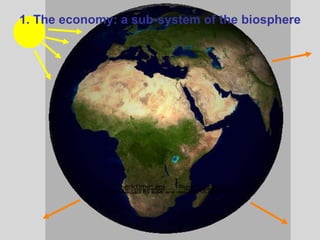
Firms Households Goods and Services Land, Labour, Capital $$$$$$$$$$$$$$$$$$$ $$$$$$$$$$$$$$$$$$$ Natural Inputs  (flows of materials & energy from SOURCES and  Environmental SERVICES ) Waste Outputs (SINKS) Bio-physical Cycles Economic Cycle 1. The economy: a sub-system of the biosphere
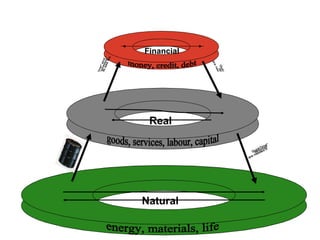
Financial Real Natural money, credit, debt goods, services, labour, capital energy, materials, life
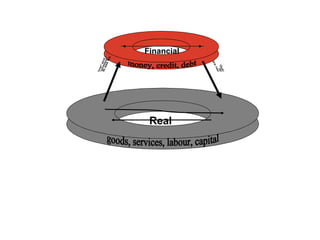
Financial Real money, credit, debt goods, services, labour, capital
OECD Founded in 1960
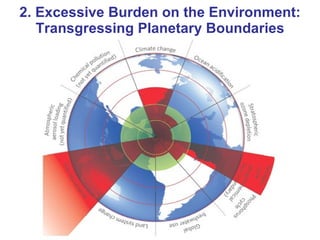
2. Excessive Burden on the Environment: Transgressing Planetary Boundaries
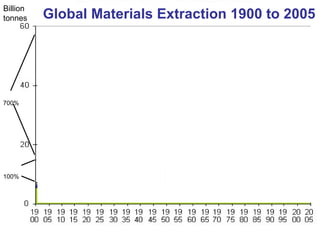
Billion tonnes Global Materials Extraction 1900 to 2005 100% 700%
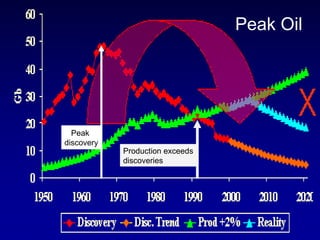
  Peak oil Production exceeds discoveries Peak Oil Peak  discovery
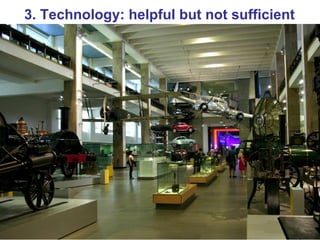
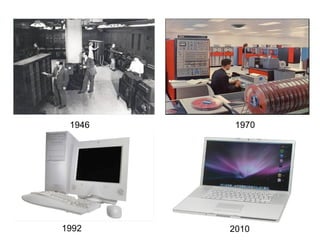
3. Technology: helpful but not sufficient
1946 1970 1992 2010


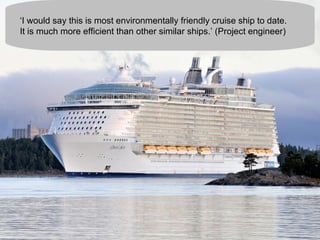
‘ I would say this is most environmentally friendly cruise ship to date.  It is much more efficient than other similar ships.’ (Project engineer)
 
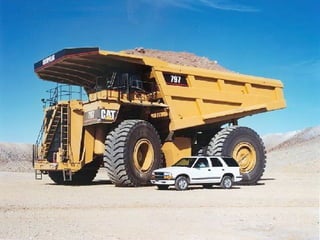
Energy intensity is declining but not fast enough  59% Key message: Environmental impact depends on  i ntensity   and   scale 110% 24% GDP Primary Energy Energy Intensity 4. Must address scale as well as intensity
Material intensity: same story   47% 110% 29% Key message: Environmental impact depends on  intensity   and   scale GDP Resource Extraction Material Intensity
5. Many questioning growth
 
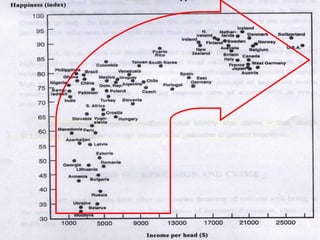
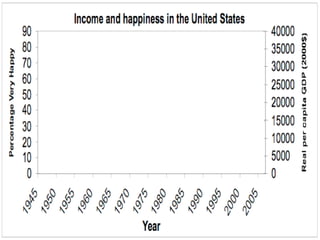
Real Income per person Percentage very happy
 
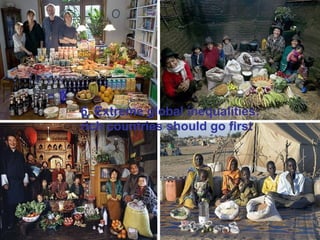
6. Extreme global inequalities:  rich countries should go first
LowGrow Canada Can we have full employment, no poverty, fiscal balance,  reduced GHG emissions without relying on economic growth?
LowGrow Canada You bet!
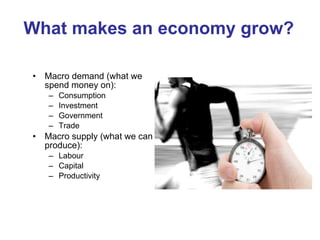
What makes an economy grow? Macro demand (what we spend money on): Consumption Investment Government Trade Macro supply (what we can produce): Labour Capital Productivity
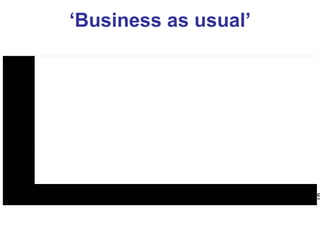
‘ Business as usual’ GDP per Capita GHG Emissions Poverty Unemployment Debt to GDP Ratio
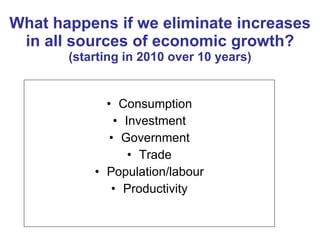
What happens if we eliminate increases in all sources of economic growth? (starting in 2010 over 10 years) Consumption Investment Government Trade Population/labour Productivity
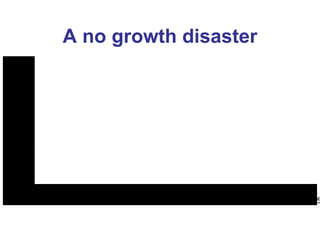
A no growth disaster GDP per Capita GHG Emissions Poverty Unemployment Debt to GDP Ratio
‘ The real issue is whether it is possible to challenge the “growth-at-any-cost model” and come up with an alternative that is environmentally benign, economically robust and politically feasible.’  Larry Elliot (economics editor) The Guardian Weekly 29th August 2008
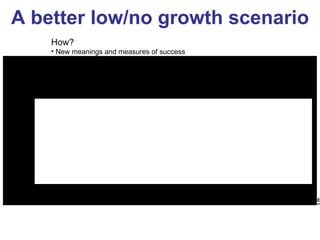
A better low/no growth scenario How?   New meanings and measures of success Limits on materials, energy, wastes and land use Carbon price - more informative prices Stable population and labour force More efficient capital stock Shorter work year More generous anti-poverty programs Fewer status goods More informative advertising  Education for life not just work GDP per Capita GHG Emissions Unemployment Poverty Debt to GDP Ratio
Generating a Canadian degrowth scenario (in US$2000) Maximum sustainable global GDP GDP when ecological footprint = biocapacity: 1980  ($17.6 trillion) With 40% reduction in carbon:  1999 ($30.5 trillion) Maximum sustainable average GDP/capita Divide by 8 billion ($3,815) Canadian sustainable GDP/capita Equal to world average ($3,815) Equal to multiple of world average ($15,260) (Canadian GDP/capita in 1976) LowGrow simulation for Canada
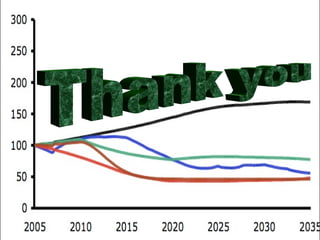
Poverty Unemployment GHG Emissions Debt to GDP Ratio GDP per Capita A Canadian degrowth scenario
 
 
The scenarios compared: growth drivers
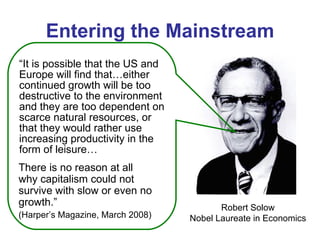
Entering the Mainstream “ It is possible that the US and Europe will find that…either continued growth will be too destructive to the environment and they are too dependent on scarce natural resources, or that they would rather use increasing productivity in the form of leisure… Robert Solow Nobel Laureate in Economics There is no reason at all why capitalism could not survive with slow or even no growth.”  (Harper’s Magazine, March 2008)
8. Can we adapt?
 
 
Thank you

Peter Victor: Managing without Growth - Slower by Design, not Disaster

  • 1.
    Managing without GrowthSlower by Design, not Disaster Dr. Peter A. Victor 24 September 2010
  • 2.
    Summary Economy: asubsystem of the biosphere Excessive burden of the economy on the biosphere Technology helpful but not sufficient Must address scale and intensity Many questioning growth Extreme global inequalities - rich countries should go first Managing without growth: Low/no growth scenario Degrowth scenario Can we adapt?
  • 3.
  • 4.
  • 5.
    Firms Households Goodsand Services Land, Labour, Capital $$$$$$$$$$$$$$$$$$$ $$$$$$$$$$$$$$$$$$$ Natural Inputs (flows of materials & energy from SOURCES and Environmental SERVICES ) Waste Outputs (SINKS) Bio-physical Cycles Economic Cycle 1. The economy: a sub-system of the biosphere
  • 6.
    Financial Real Naturalmoney, credit, debt goods, services, labour, capital energy, materials, life
  • 7.
    Financial Real money,credit, debt goods, services, labour, capital
  • 8.
  • 9.
    2. Excessive Burdenon the Environment: Transgressing Planetary Boundaries
  • 10.
    Billion tonnes GlobalMaterials Extraction 1900 to 2005 100% 700%
  • 11.
    Peakoil Production exceeds discoveries Peak Oil Peak discovery
  • 12.
    3. Technology: helpfulbut not sufficient
  • 13.
  • 14.
  • 15.
  • 16.
  • 17.
    ‘ I wouldsay this is most environmentally friendly cruise ship to date. It is much more efficient than other similar ships.’ (Project engineer)
  • 18.
  • 19.
    Energy intensity isdeclining but not fast enough 59% Key message: Environmental impact depends on i ntensity and scale 110% 24% GDP Primary Energy Energy Intensity 4. Must address scale as well as intensity
  • 20.
    Material intensity: samestory 47% 110% 29% Key message: Environmental impact depends on intensity and scale GDP Resource Extraction Material Intensity
  • 21.
  • 22.
  • 23.
    Real Income perperson Percentage very happy
  • 24.
  • 25.
    6. Extreme globalinequalities: rich countries should go first
  • 26.
    LowGrow Canada Canwe have full employment, no poverty, fiscal balance, reduced GHG emissions without relying on economic growth?
  • 27.
  • 28.
    What makes aneconomy grow? Macro demand (what we spend money on): Consumption Investment Government Trade Macro supply (what we can produce): Labour Capital Productivity
  • 29.
    ‘ Business asusual’ GDP per Capita GHG Emissions Poverty Unemployment Debt to GDP Ratio
  • 30.
    What happens ifwe eliminate increases in all sources of economic growth? (starting in 2010 over 10 years) Consumption Investment Government Trade Population/labour Productivity
  • 31.
    A no growthdisaster GDP per Capita GHG Emissions Poverty Unemployment Debt to GDP Ratio
  • 32.
    ‘ The realissue is whether it is possible to challenge the “growth-at-any-cost model” and come up with an alternative that is environmentally benign, economically robust and politically feasible.’ Larry Elliot (economics editor) The Guardian Weekly 29th August 2008
  • 33.
    A better low/nogrowth scenario How? New meanings and measures of success Limits on materials, energy, wastes and land use Carbon price - more informative prices Stable population and labour force More efficient capital stock Shorter work year More generous anti-poverty programs Fewer status goods More informative advertising Education for life not just work GDP per Capita GHG Emissions Unemployment Poverty Debt to GDP Ratio
  • 34.
    Generating a Canadiandegrowth scenario (in US$2000) Maximum sustainable global GDP GDP when ecological footprint = biocapacity: 1980 ($17.6 trillion) With 40% reduction in carbon: 1999 ($30.5 trillion) Maximum sustainable average GDP/capita Divide by 8 billion ($3,815) Canadian sustainable GDP/capita Equal to world average ($3,815) Equal to multiple of world average ($15,260) (Canadian GDP/capita in 1976) LowGrow simulation for Canada
  • 35.
    Poverty Unemployment GHGEmissions Debt to GDP Ratio GDP per Capita A Canadian degrowth scenario
  • 36.
  • 37.
  • 38.
  • 39.
    Entering the Mainstream“ It is possible that the US and Europe will find that…either continued growth will be too destructive to the environment and they are too dependent on scarce natural resources, or that they would rather use increasing productivity in the form of leisure… Robert Solow Nobel Laureate in Economics There is no reason at all why capitalism could not survive with slow or even no growth.” (Harper’s Magazine, March 2008)
  • 40.
    8. Can weadapt?
  • 41.
  • 42.
  • 43.

Editor's Notes

  • #5 Sea-viewing Wide Field-of-View Sensor (SeaWiFS) data on marine and terrestrial plant productivity Biosphere: marine and terrestrial plant productivity
  • #9 “… hardly a trace of interest in economic growth as a policy objective in the official or professional literature of western countries before 1950” (Arndt, 1978) Article 1a) The aims of the OECD shall be to promote policies designed: to achieve the highest sustainable economic growth and employment and a rising standard of living in Member countries, while maintaining financial stability, and thus to contribute to the development of the world economy; Paris 14th December 1960 Founding Convention of the OECD
  • #10 Source: Nature, October 2009 Stockholm Resilience Centre
  • #11 Krausmann, F., Gingrich, S., Eisenmenger, N., Erb, K.H., Haberl, H., Fischer-Kowalski, M. Growth in global materials use, GDP and population during the 20th century. Ecological Economics 2009
  • #12 Colin Campbell http://www.hubbertpeak.com/de/lecture.html
  • #18 Oasis of the Seas http://www.stxeurope.com/upload/ships/hires/oasis_of_the_seas_setrial_oct1_300dpi.jpg Largest cruise ship - 3,600 passengers - launched in October2009. ‘ I would say this is most environmentally friendly cruise ship to date’ Mikko Ilus, project engineer. ‘It is much more efficient than other similar ships’. …it ’dumps no sewage into the sea, reuses its waste water and consumes 25 percent less power than similar, but smaller, cruise liners.’ Associated Press reported in the Toronto Star October 31 2009. According to the company: “14-25% energy and carbon footrprint improvement per passenger…compared to predecessors” this is 25% less
  • #19 http://www.ukerc.ac.uk/Downloads/PDF/07/0710ReboundEffect/0710LaunchPresentation.pdf
  • #21 Must address scale as well as intensity
  • #23 R. Layard, Happiness, p. 32, Allen Lane, 2005 Happiness measured as the average of the percentage happy and the percentage satisfied with their life. Over $15,000/capita, the level of happiness in a country is independent of income per head
  • #26 Extreme global inequalities - rich countries should go first http://images.google.com/imgres?imgurl=http://www.theglitteringeye.com/images/germanfamily.jpeg&imgrefurl=http://theglitteringeye.com/%3Fcat%3D11&h=404&w=611&sz=292&hl=en&start=16&um=1&usg=__IOz0zGRF6jE1ljbGf4oAHD16ioM=&tbnid=vfXC6w_KMiZD8M:&tbnh=90&tbnw=136&prev=/images%3Fq%3Dfood%2Bin%2Bdifferent%2Bcountries%26um%3D1%26hl%3Den%26safe%3Doff%26client%3Dsafari%26rls%3Den-us%26sa%3DN Germany $500/week Equador $32/week Bhutan $5/week Chad $1.23/week
  • #35 Equation 1 is estimated using regression from data from the ecological footprint and world GDP. The values for world GDP in the slide differ slightly from the reported values ($17.78tr and $32.0tr) GDP s = 1.76 + 3.23r (1) GDP s = sustainable GDP (10trillion US$2000) r = percent reduction in GHG emissions B = GDP s /P (2) B = stable GDP per capita P = stable global population D = mB (3) D = Canadian GDP/capita m = ratio of Canadian GDP/capita to average average stable GDP per capita By substitution: D = m (1.76 + 3.23r)/P (4)
  • #41 Instead of trying to dominate nature, we must learn to live within its limits. To do so will require changes in our most cherished institutions and beliefs.