
Saying No to Native Apps
Brian Donohue
UX Masterclass, Copenhagen, April 2011
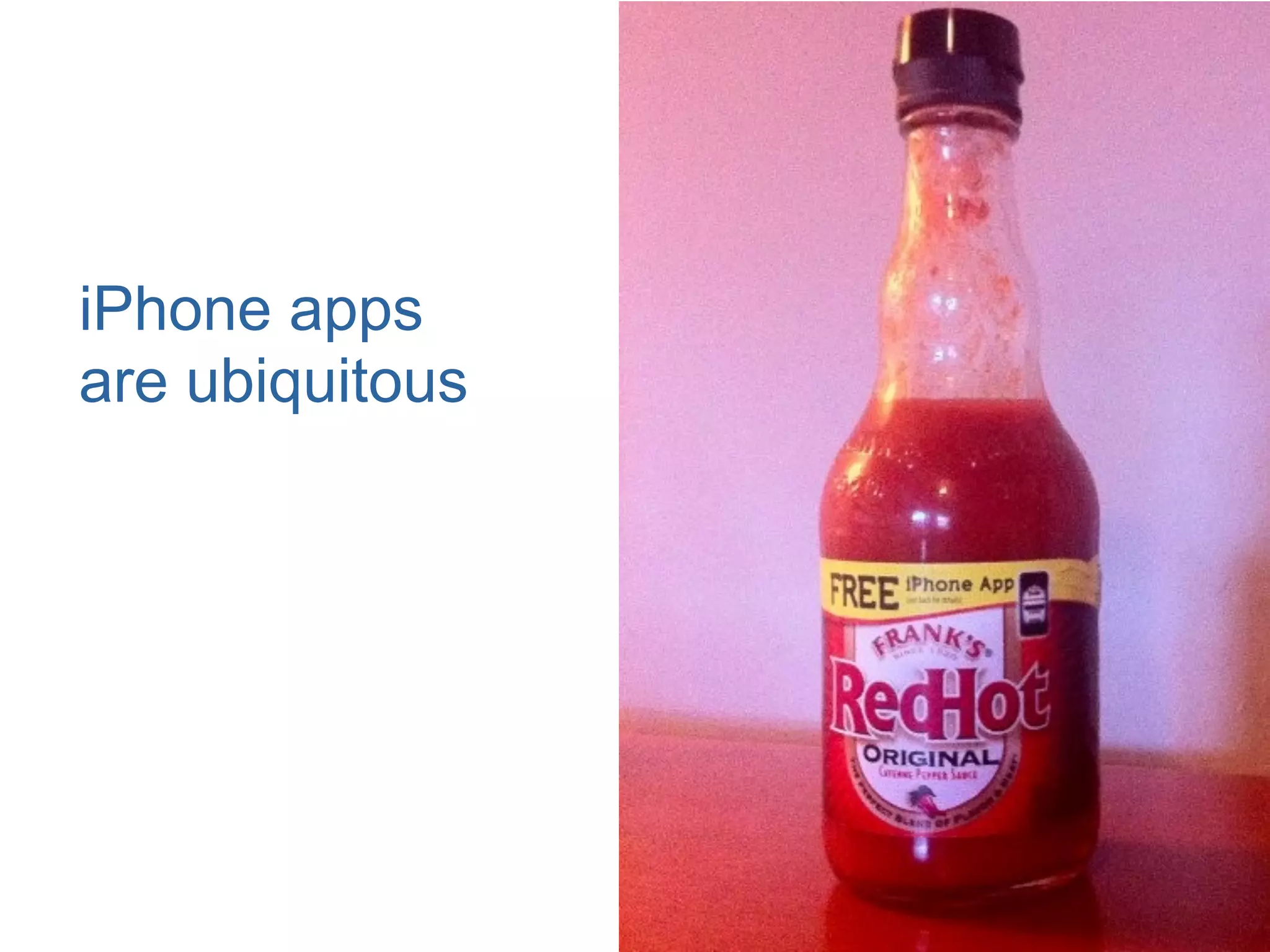
iPhone apps
are ubiquitous
iPhone apps
are ubiquitous
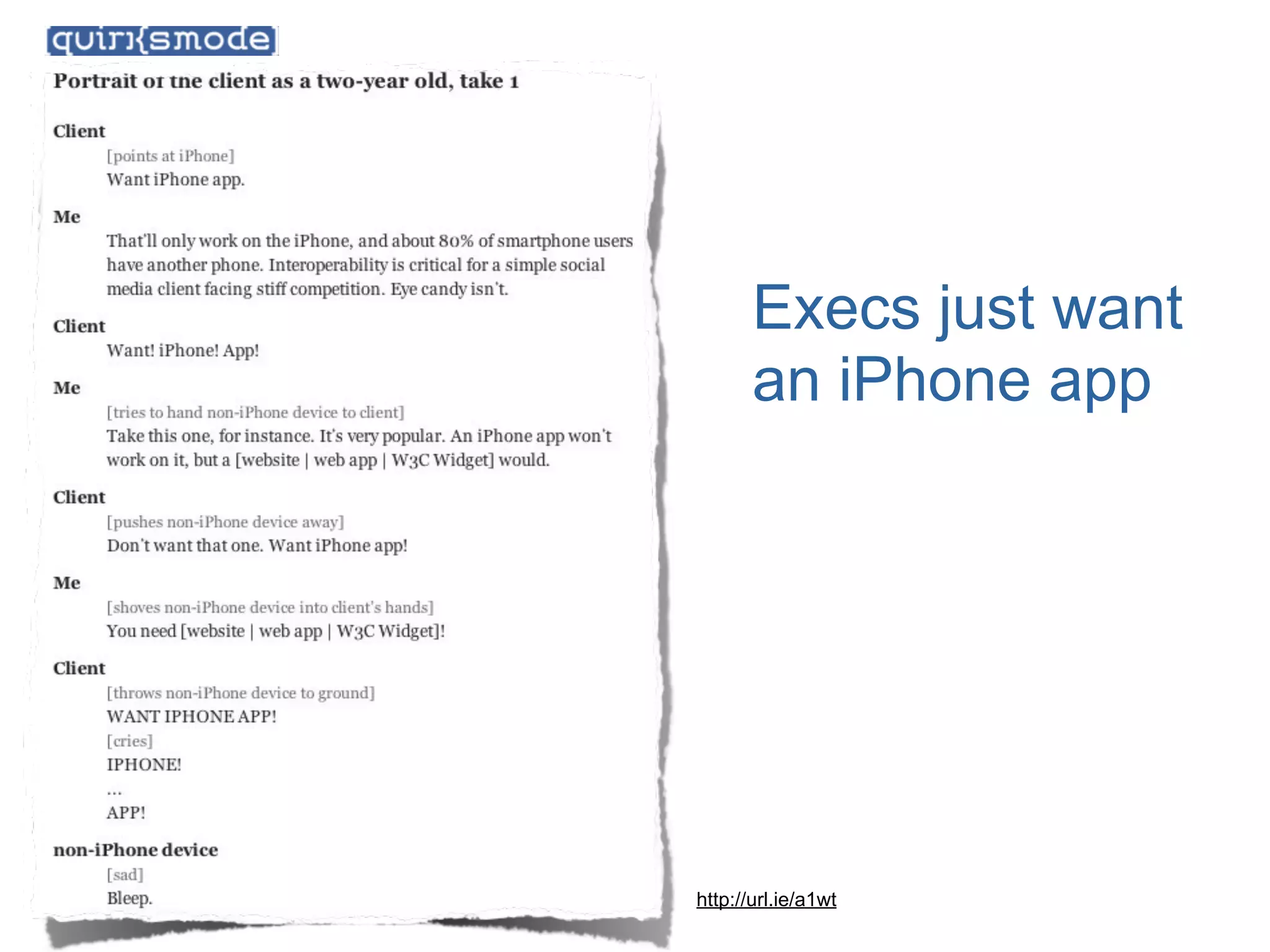
Execs just want
       an iPhone app


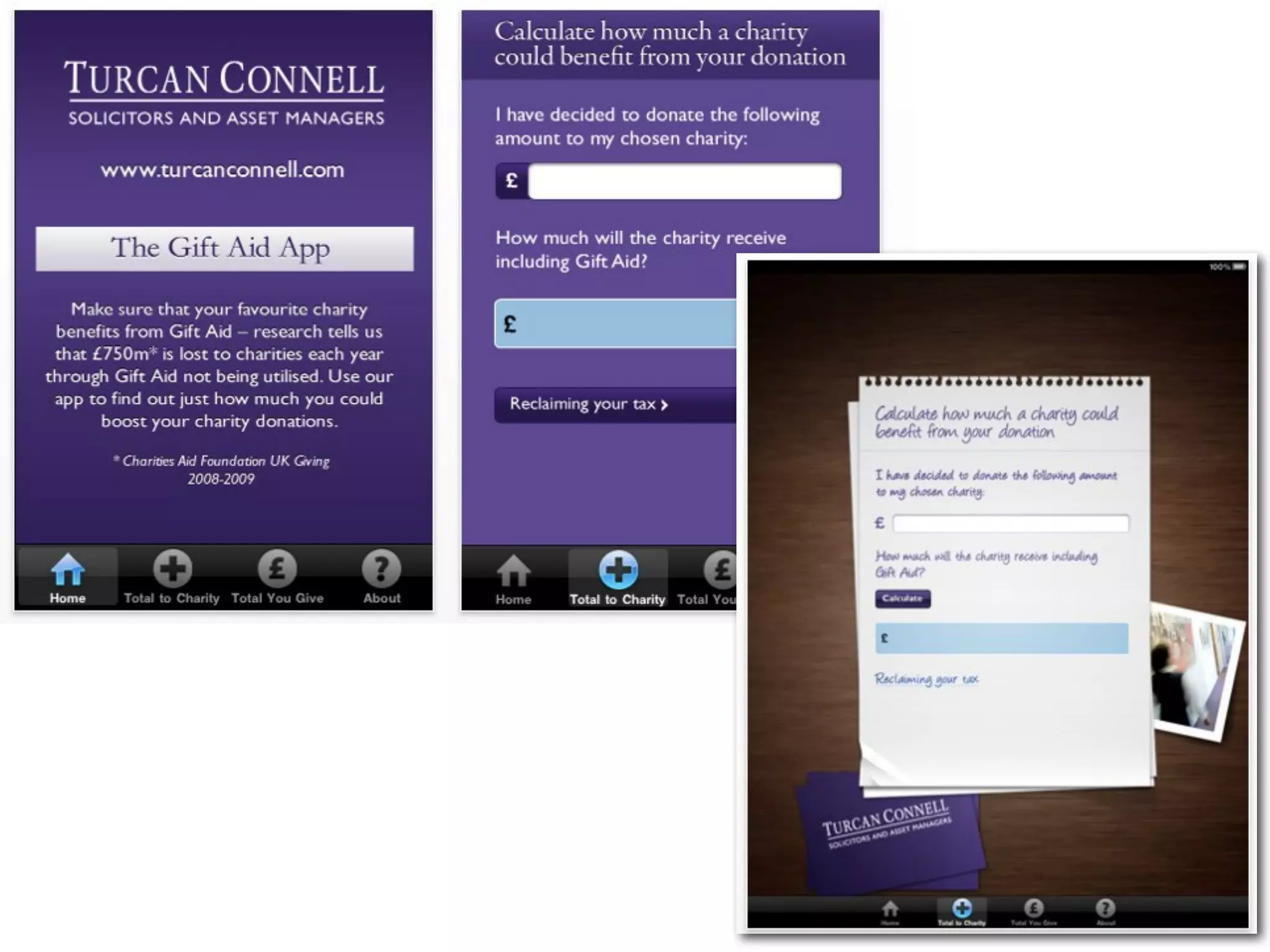
http://url.ie/a1wt
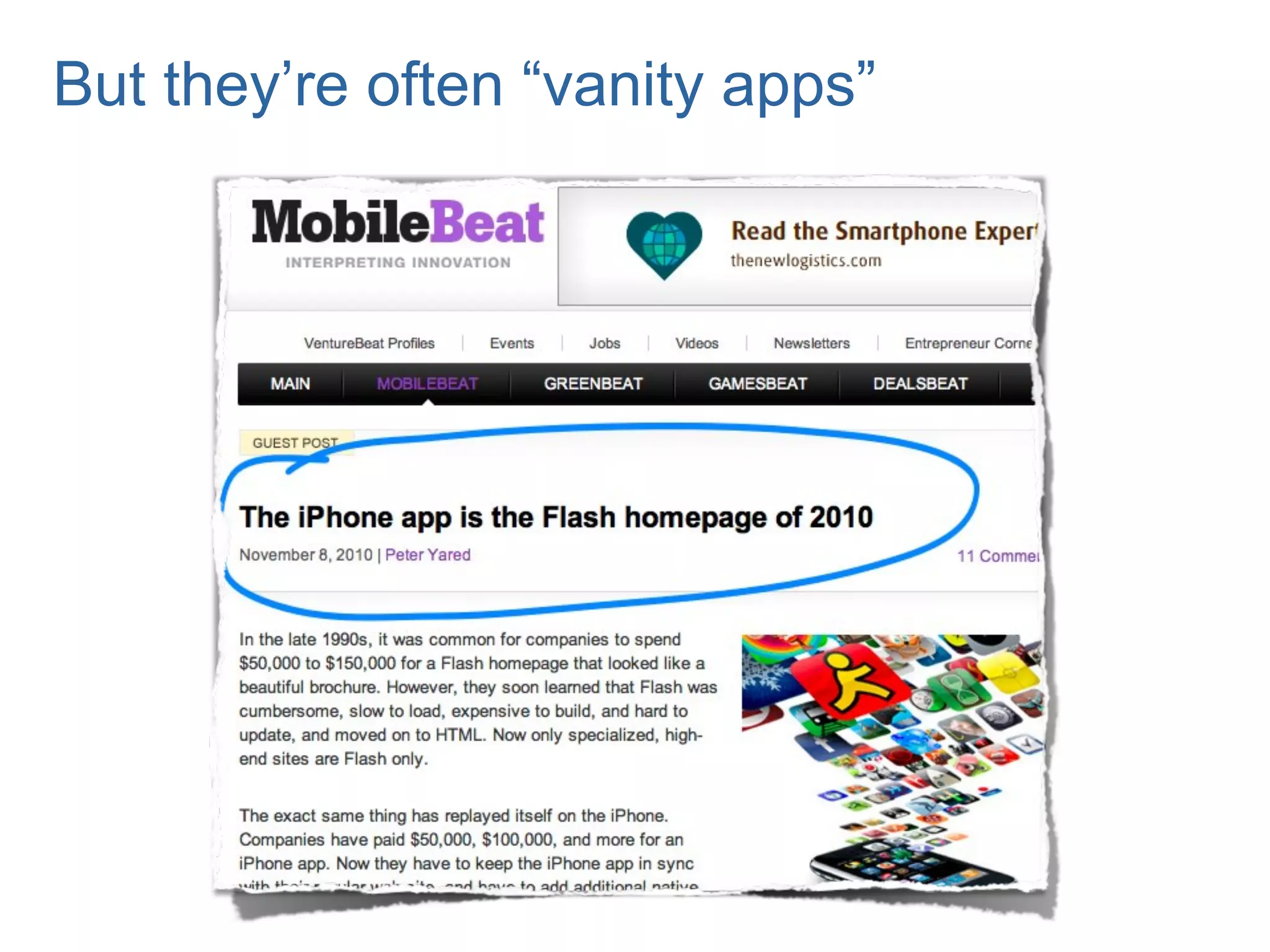
But they’re often “vanity apps”
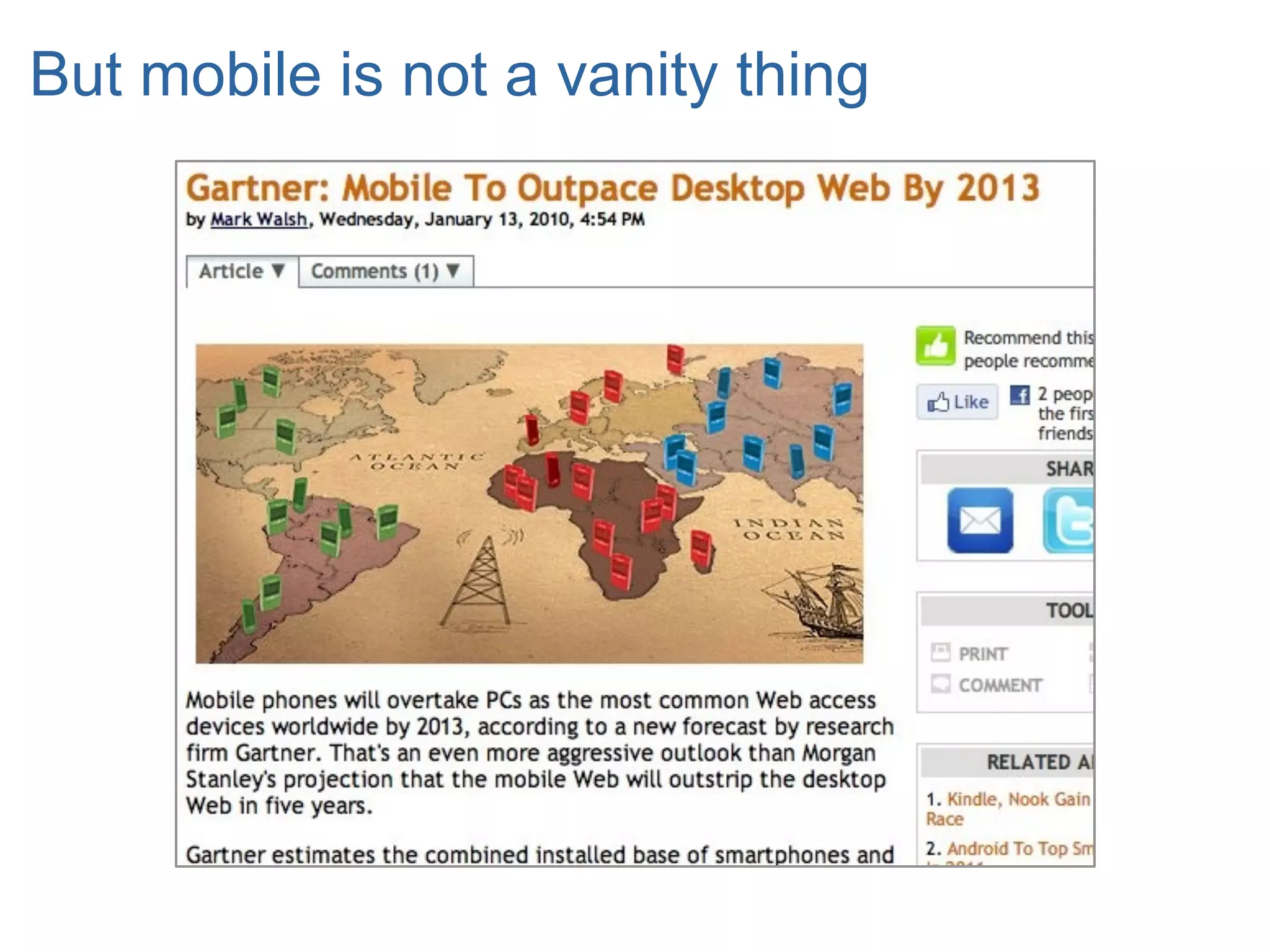
But mobile is not a vanity thing
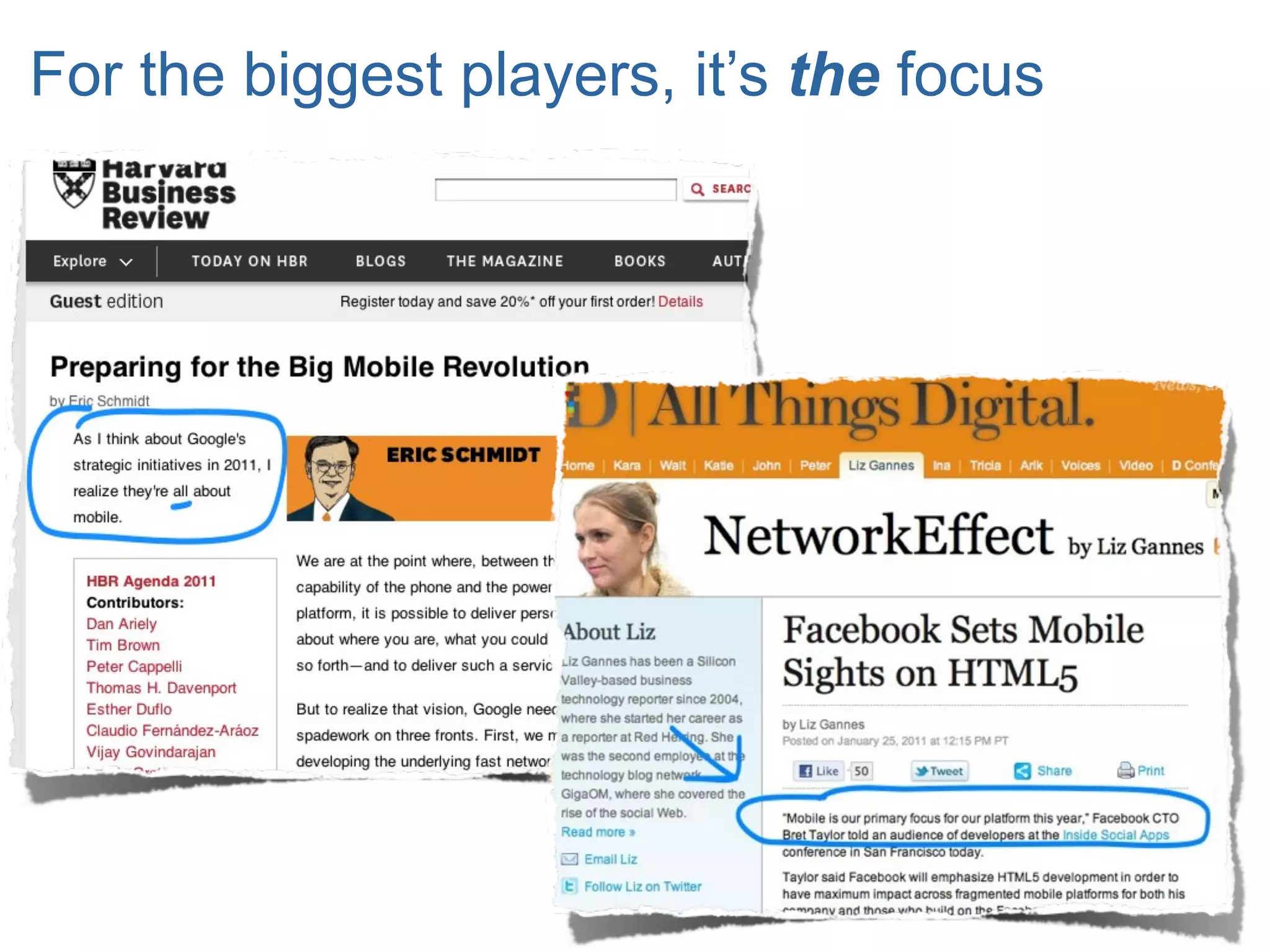
For the biggest players, it’s the focus
“Throwaway” user test question

Me:                               “So have you ever tried to
(almost embarrassed asking it)    access utility client’s website on
                                  your phone?”


Participant:
(tradesman, not computer savvy)
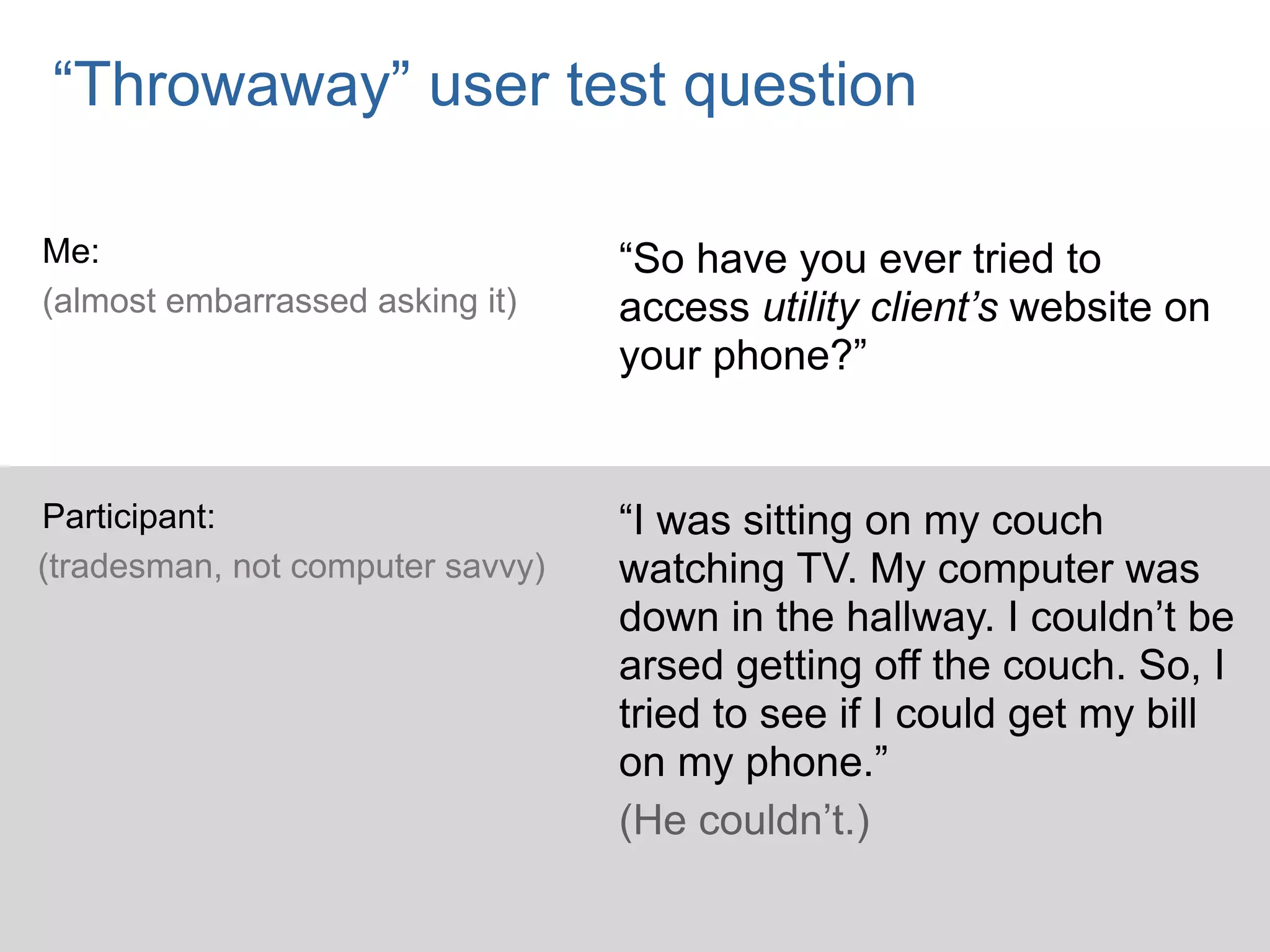
“Throwaway” user test question

Me:                               “So have you ever tried to
(almost embarrassed asking it)    access utility client’s website on
                                  your phone?”


Participant:                      “I was sitting on my couch
(tradesman, not computer savvy)   watching TV. My computer was
                                  down in the hallway. I couldn’t be
                                  arsed getting off the couch. So, I
                                  tried to see if I could get my bill
                                  on my phone.”
                                  (He couldn’t.)
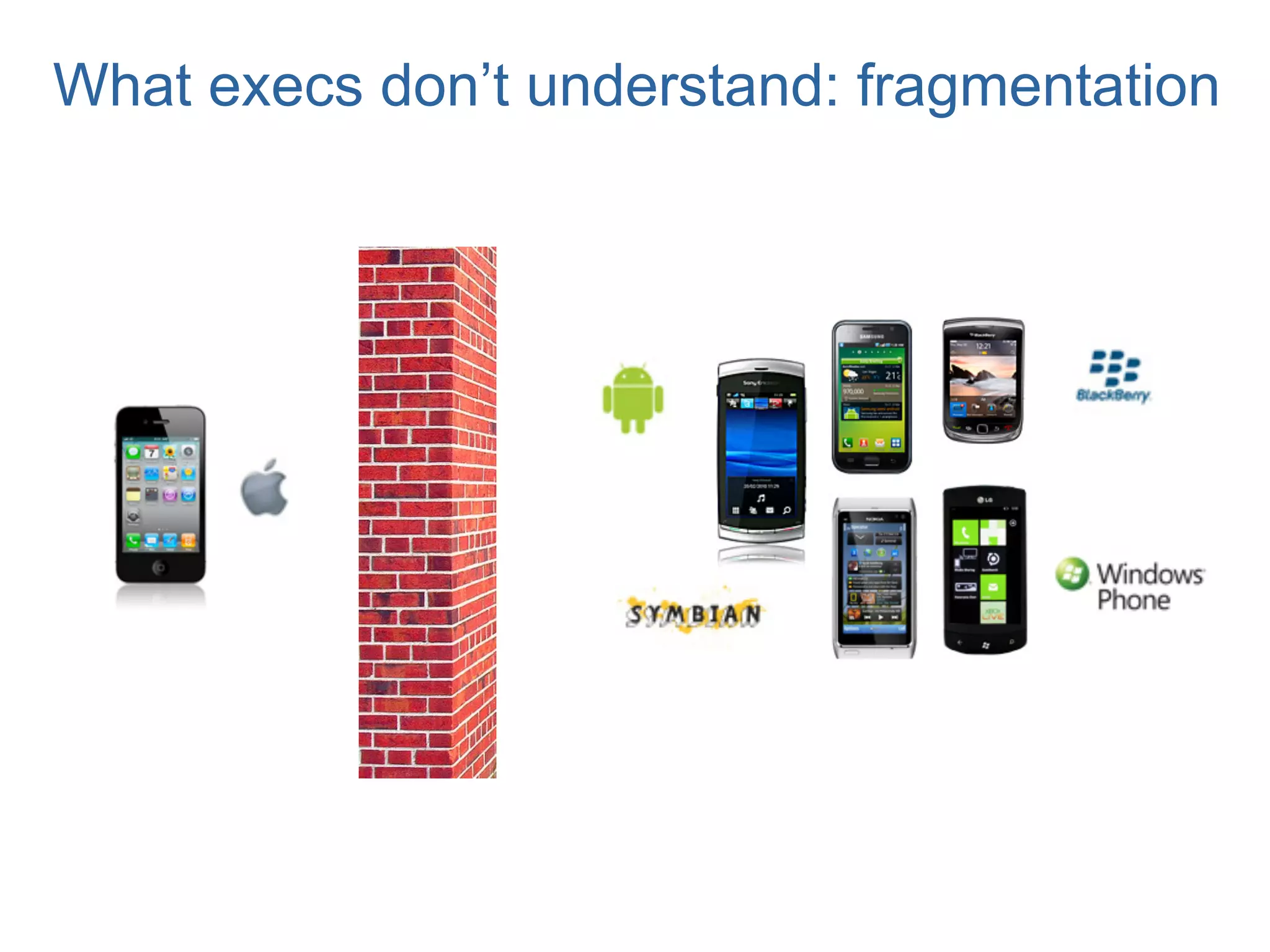
What execs don’t understand: fragmentation
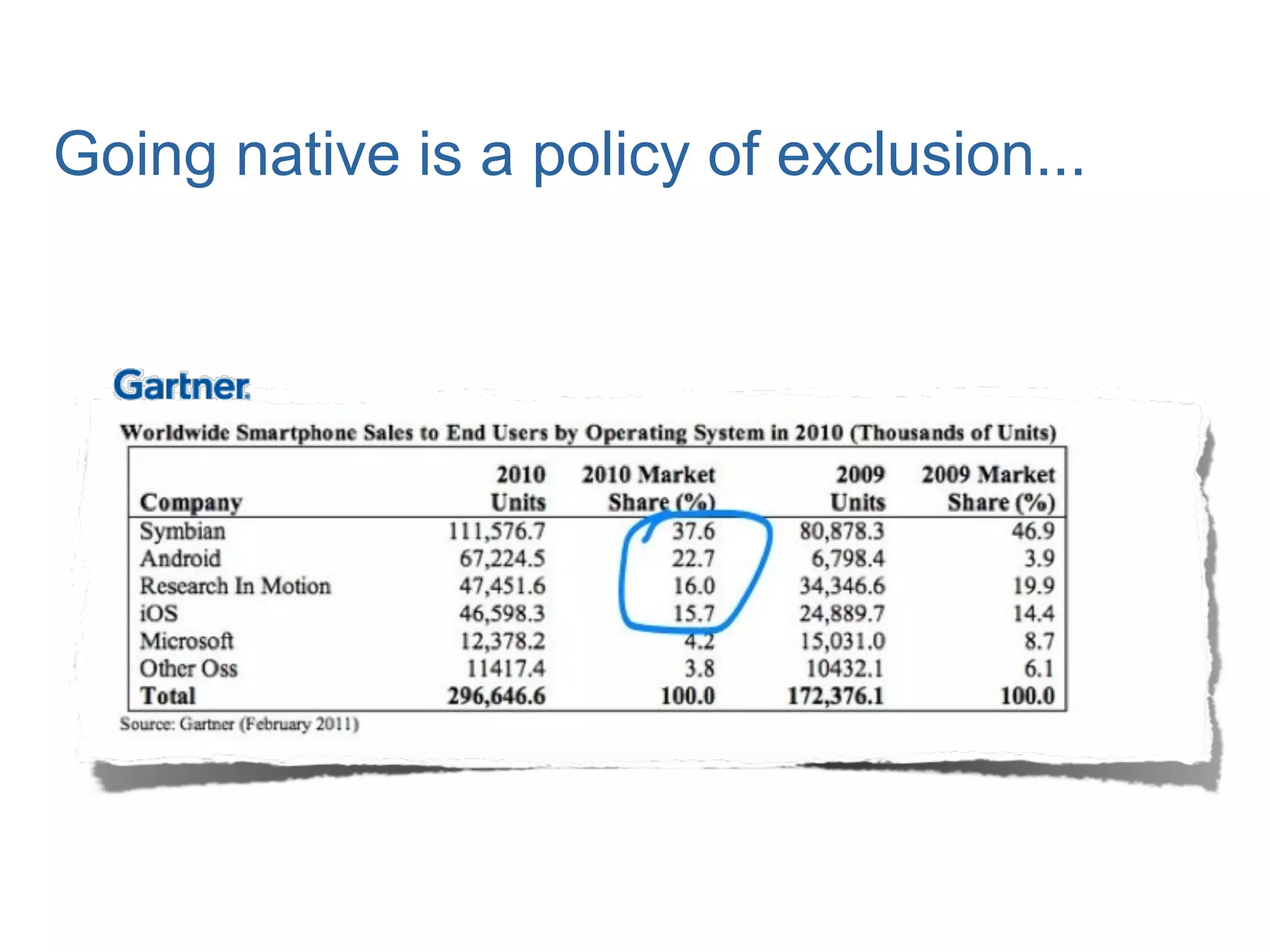
Going native is a policy of exclusion...
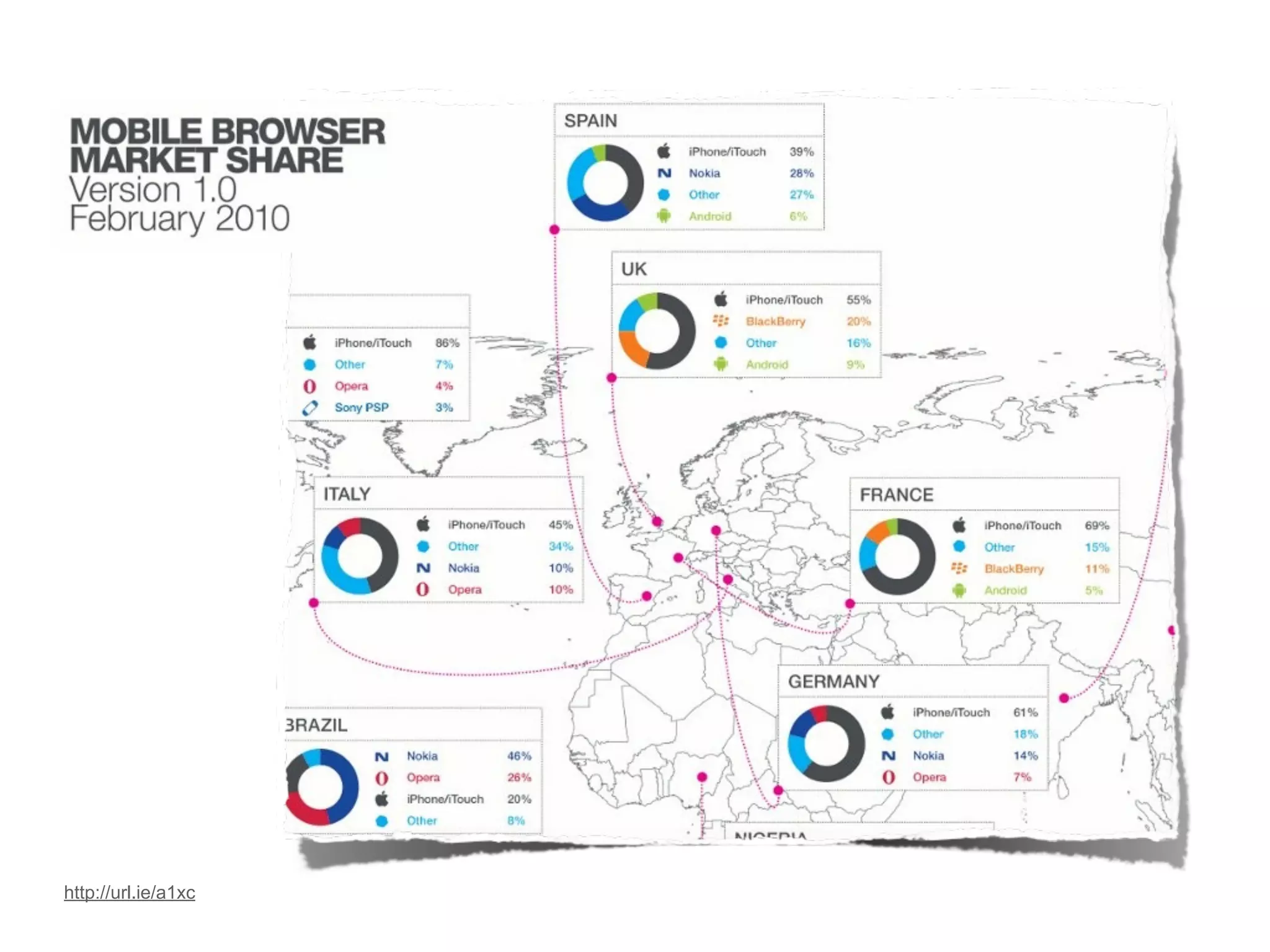
http://url.ie/a1xc
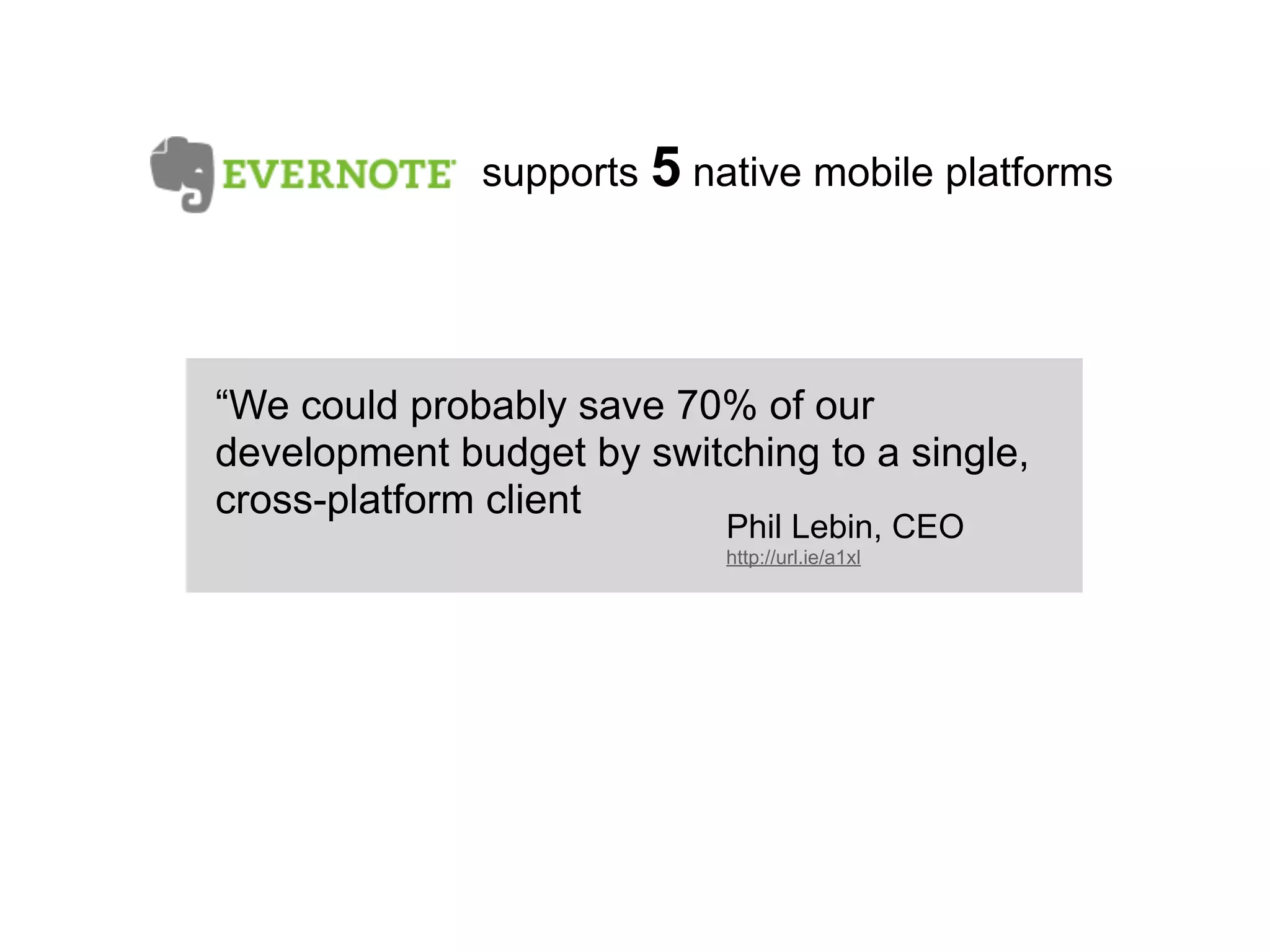
supports 5 native mobile platforms


“We could probably save 70% of our
development budget by switching to a single,
cross-platform client
                           Phil Lebin, CEO
                           http://url.ie/a1xl
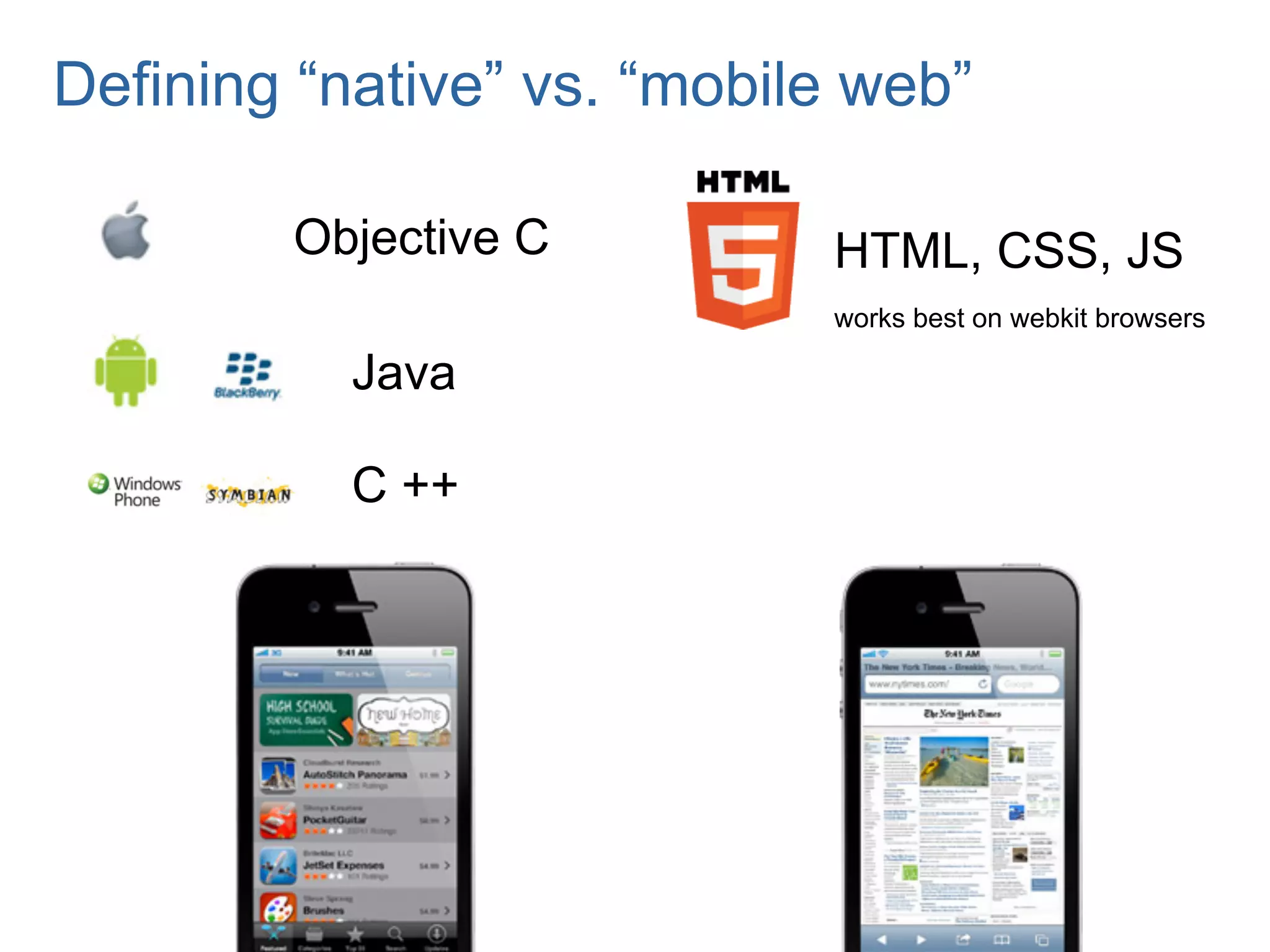
Defining “native” vs. “mobile web”

        Objective C         HTML, CSS, JS
                            works best on webkit browsers

           Java

           C ++
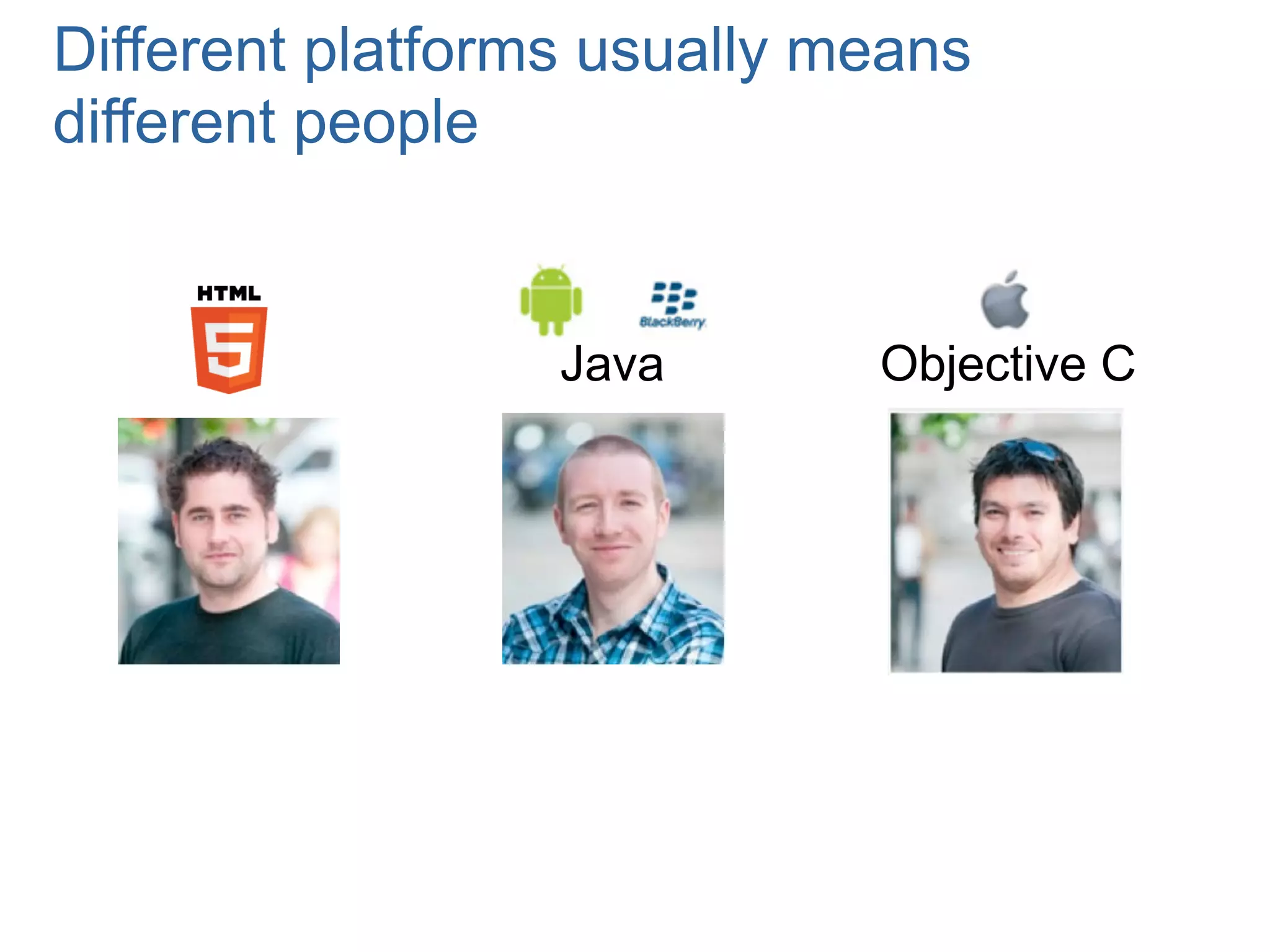
Different platforms usually means
different people


                  Java       Objective C
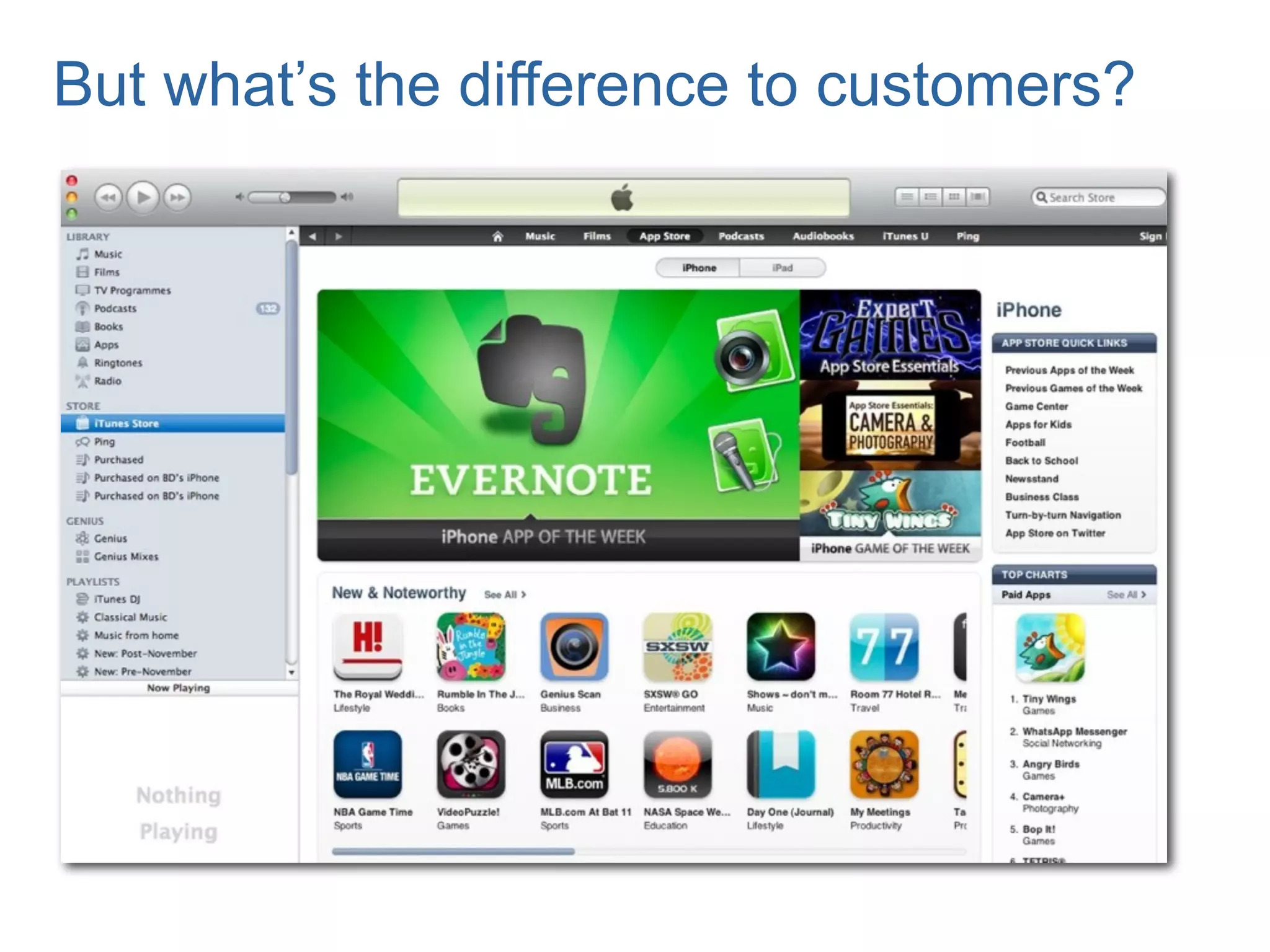
But what’s the difference to customers?
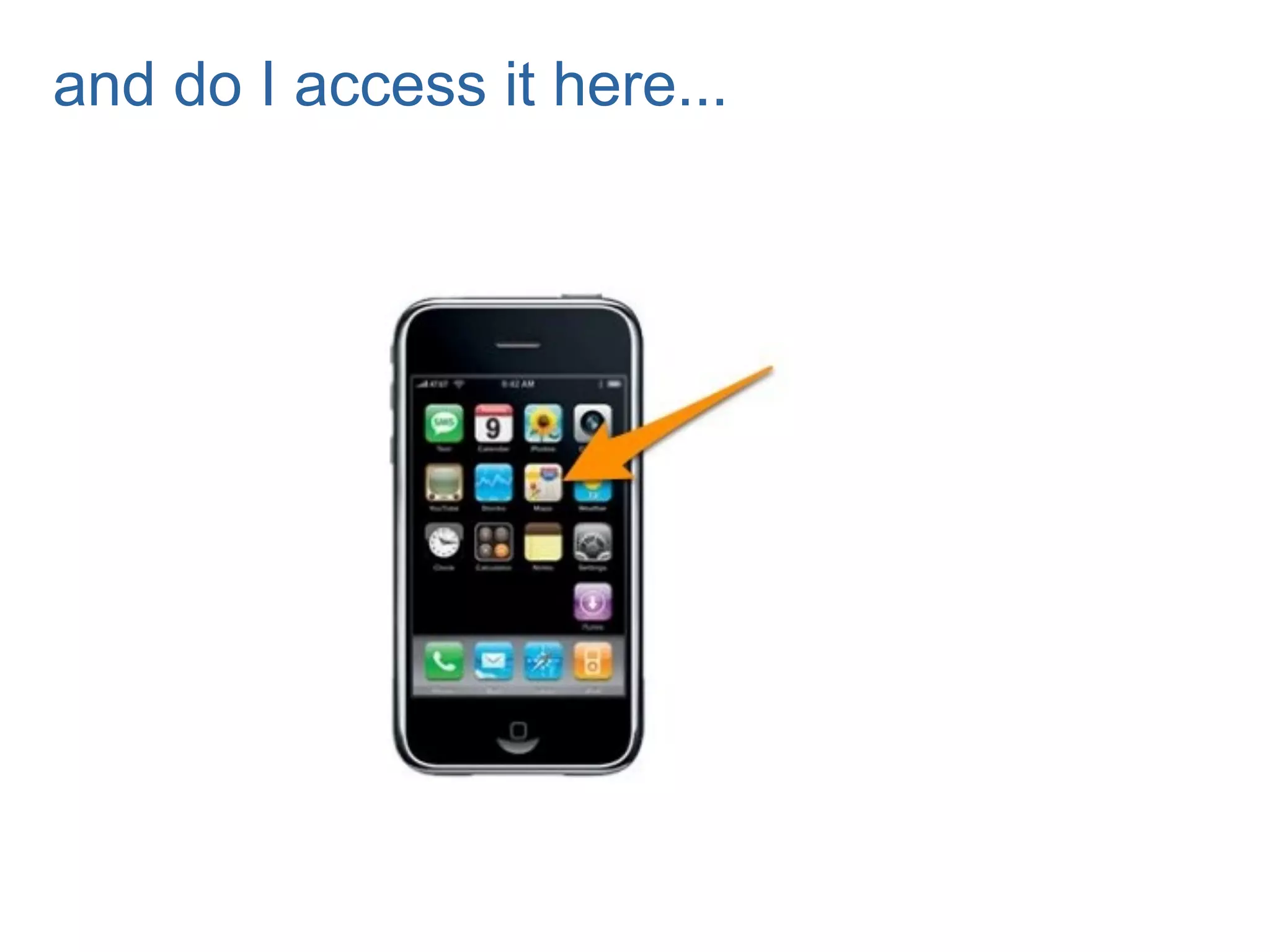
and do I access it here...
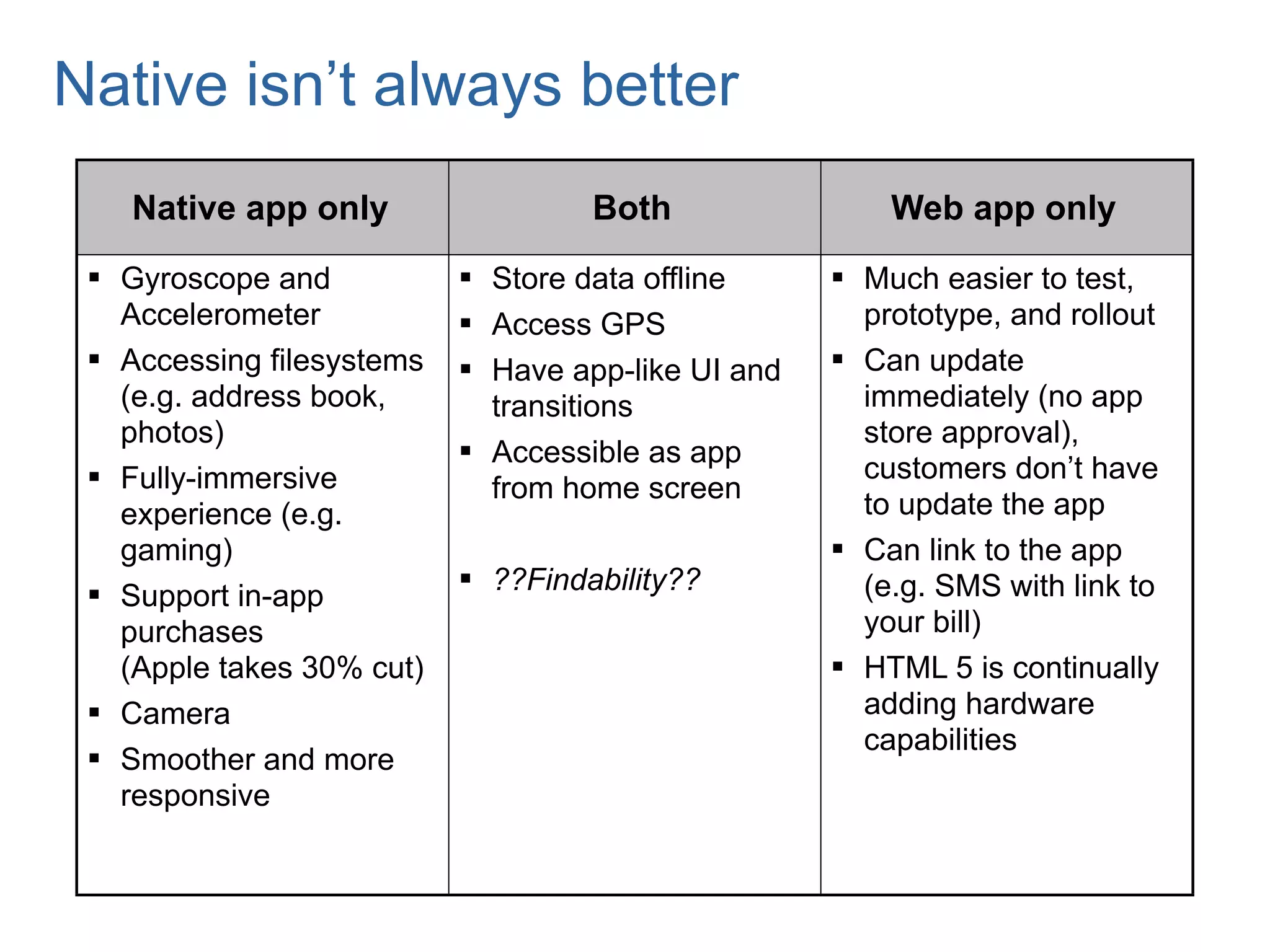
Native isn’t always better
    Native app only                 Both                Web app only
  Gyroscope and            Store data offline      Much easier to test,
   Accelerometer            Access GPS               prototype, and rollout
  Accessing filesystems    Have app-like UI and    Can update
   (e.g. address book,       transitions              immediately (no app
   photos)                                            store approval),
                            Accessible as app
  Fully-immersive                                    customers don’t have
                             from home screen
   experience (e.g.                                   to update the app
   gaming)                                           Can link to the app
                            ??Findability??          (e.g. SMS with link to
  Support in-app
   purchases                                          your bill)
   (Apple takes 30% cut)                             HTML 5 is continually
  Camera                                             adding hardware
                                                      capabilities
  Smoother and more
   responsive
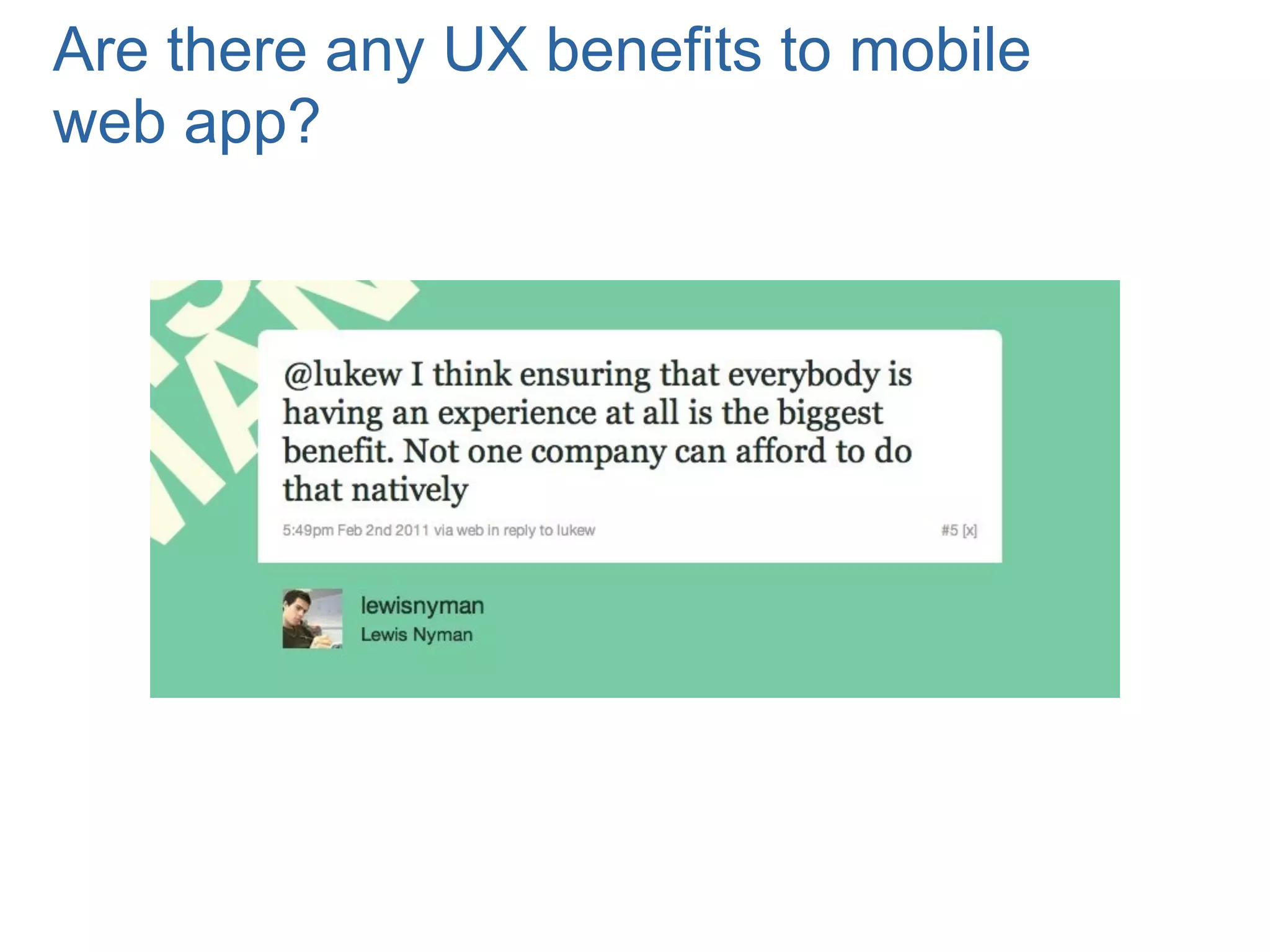
Are there any UX benefits to mobile
web app?
Are there any UX benefits to mobile
web app?
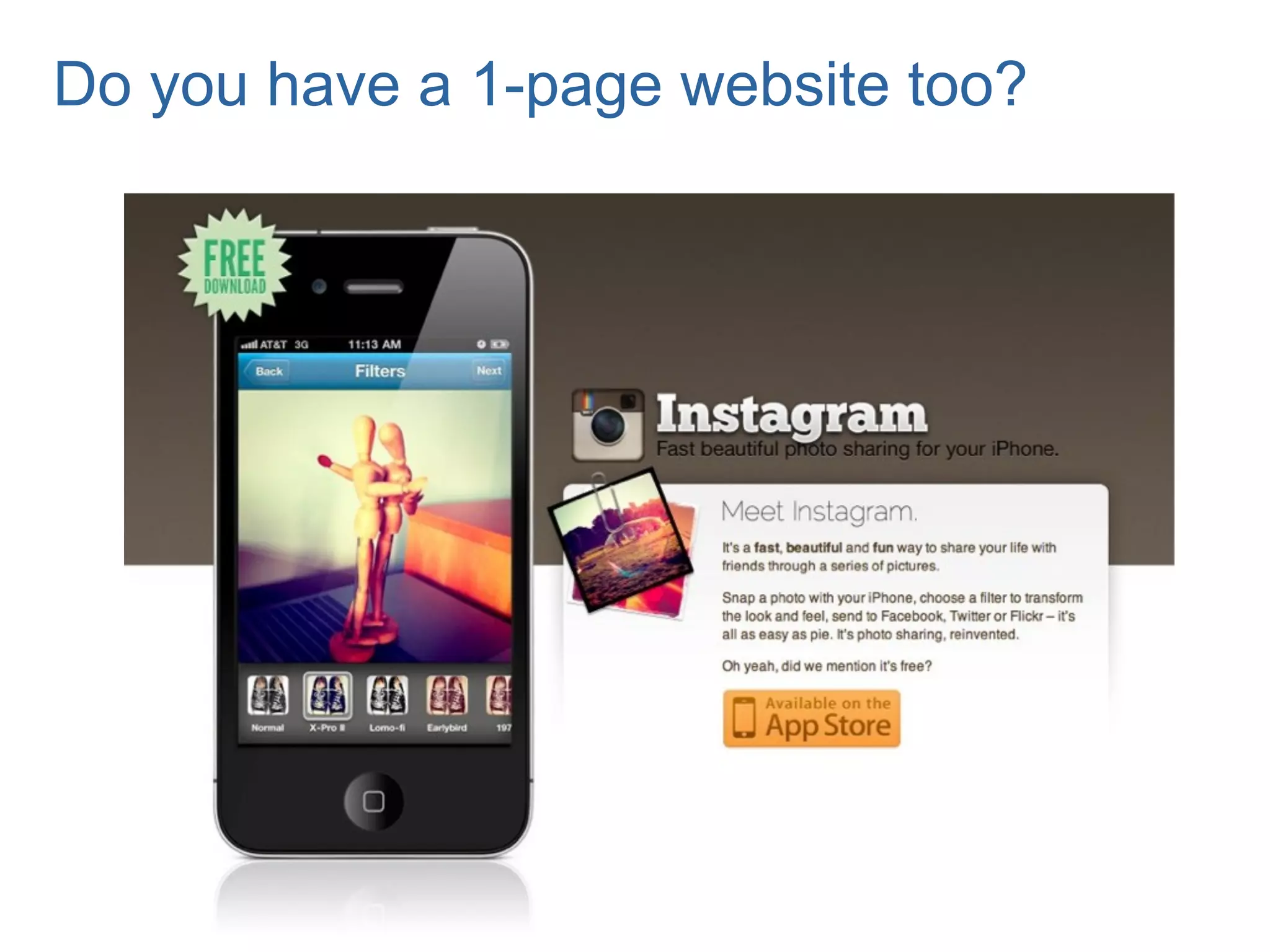
Do you have a 1-page website too?
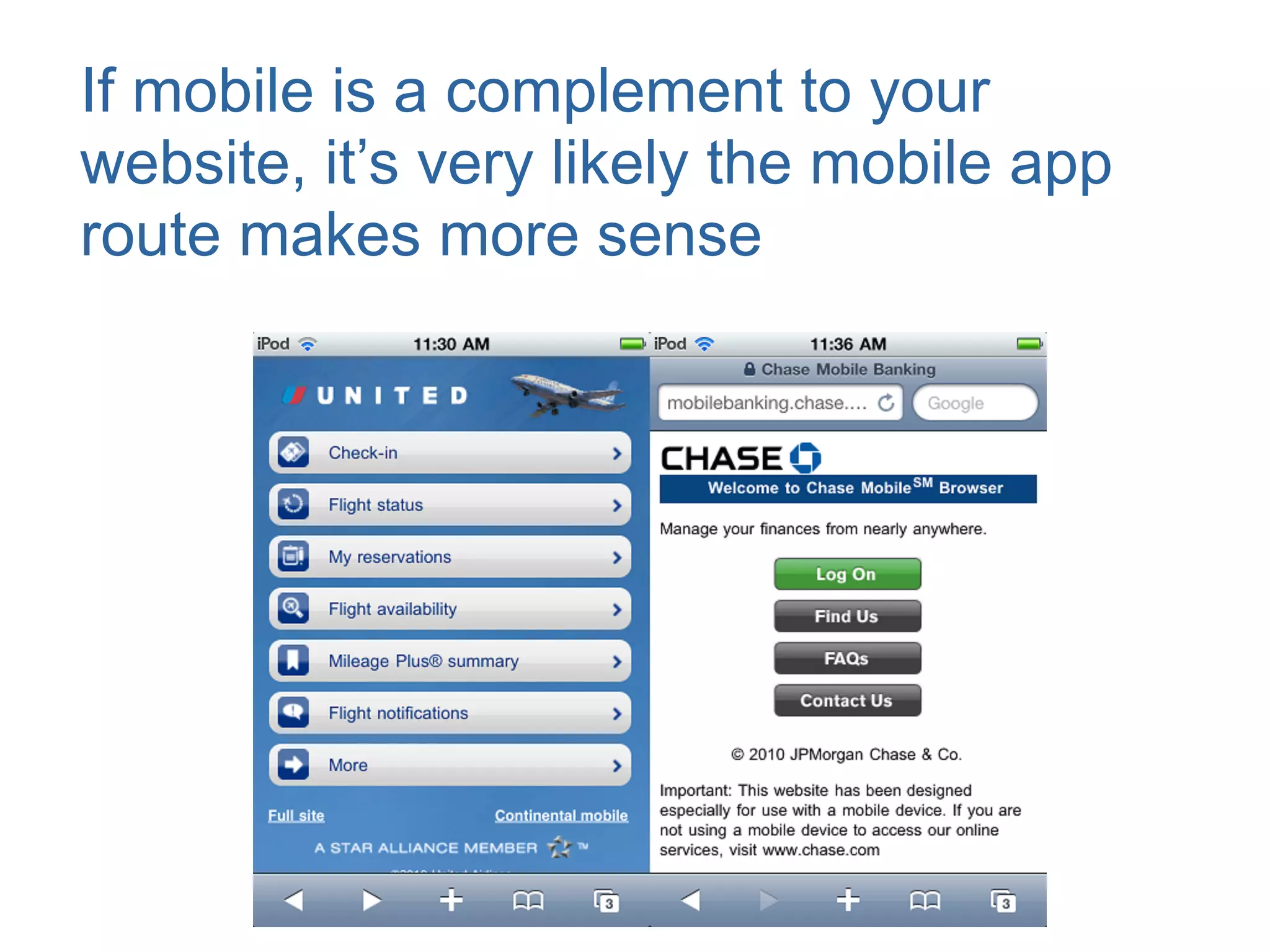
If mobile is a complement to your
website, it’s very likely the mobile app
route makes more sense
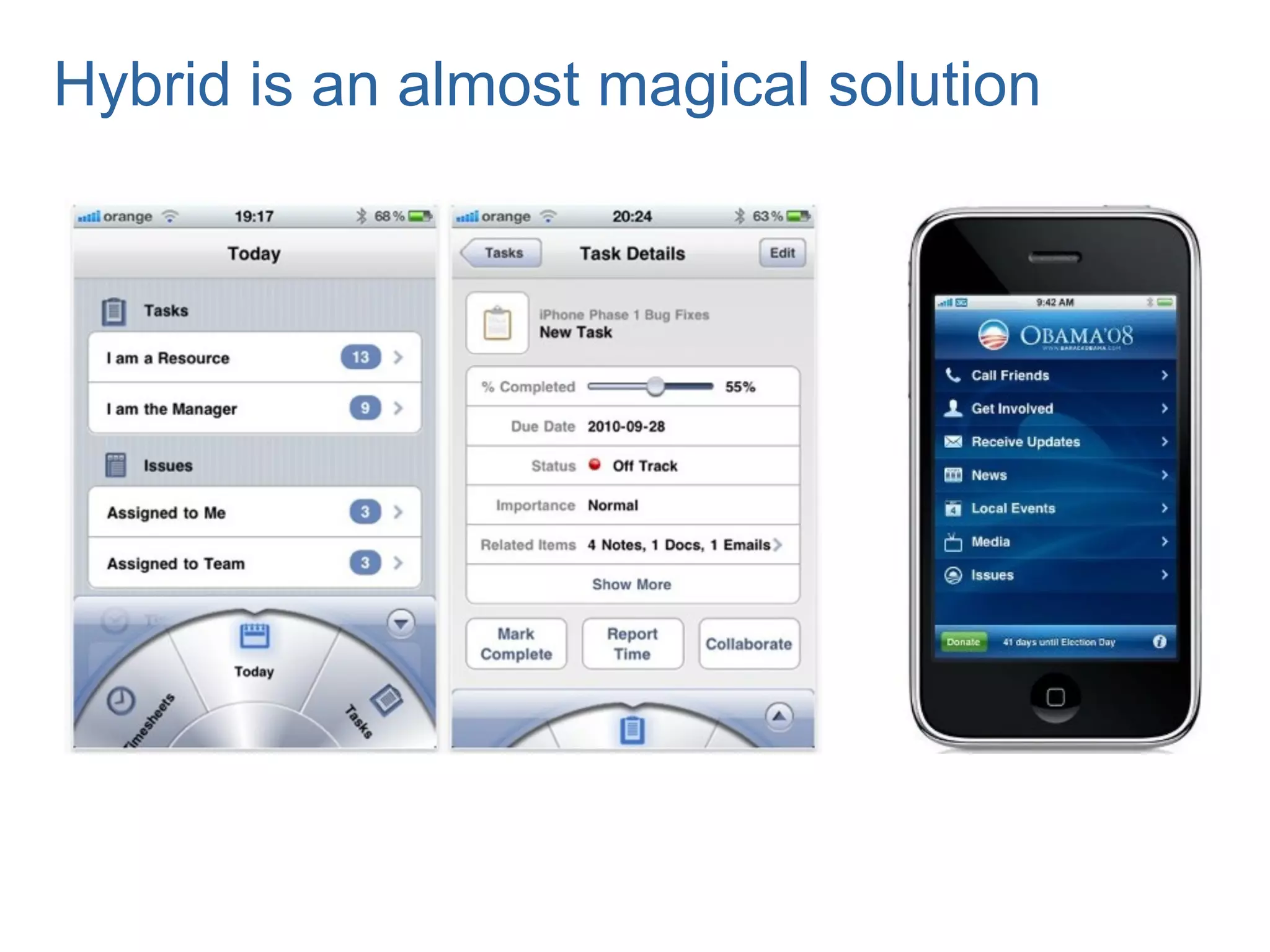
Hybrid is an almost magical solution
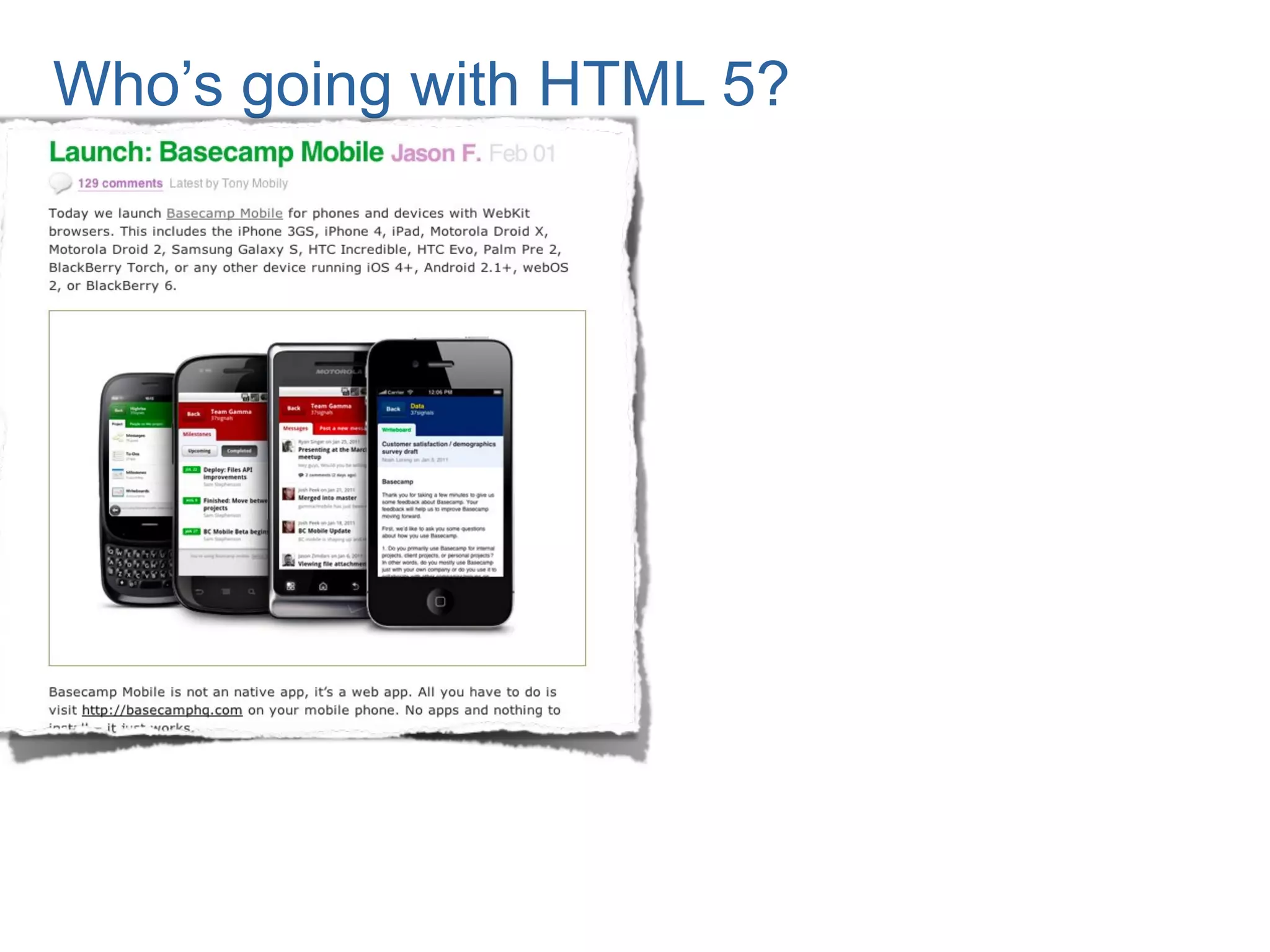
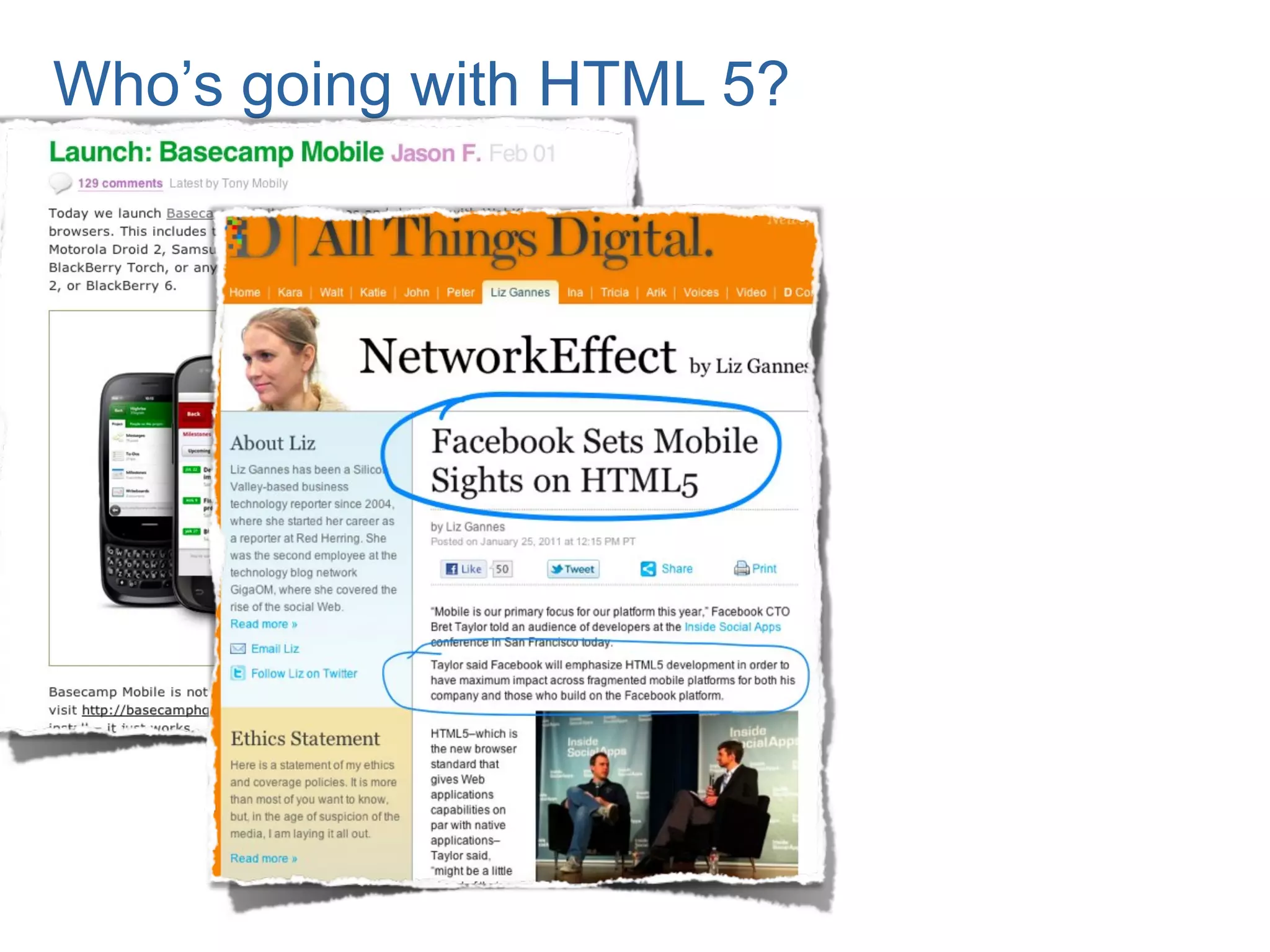
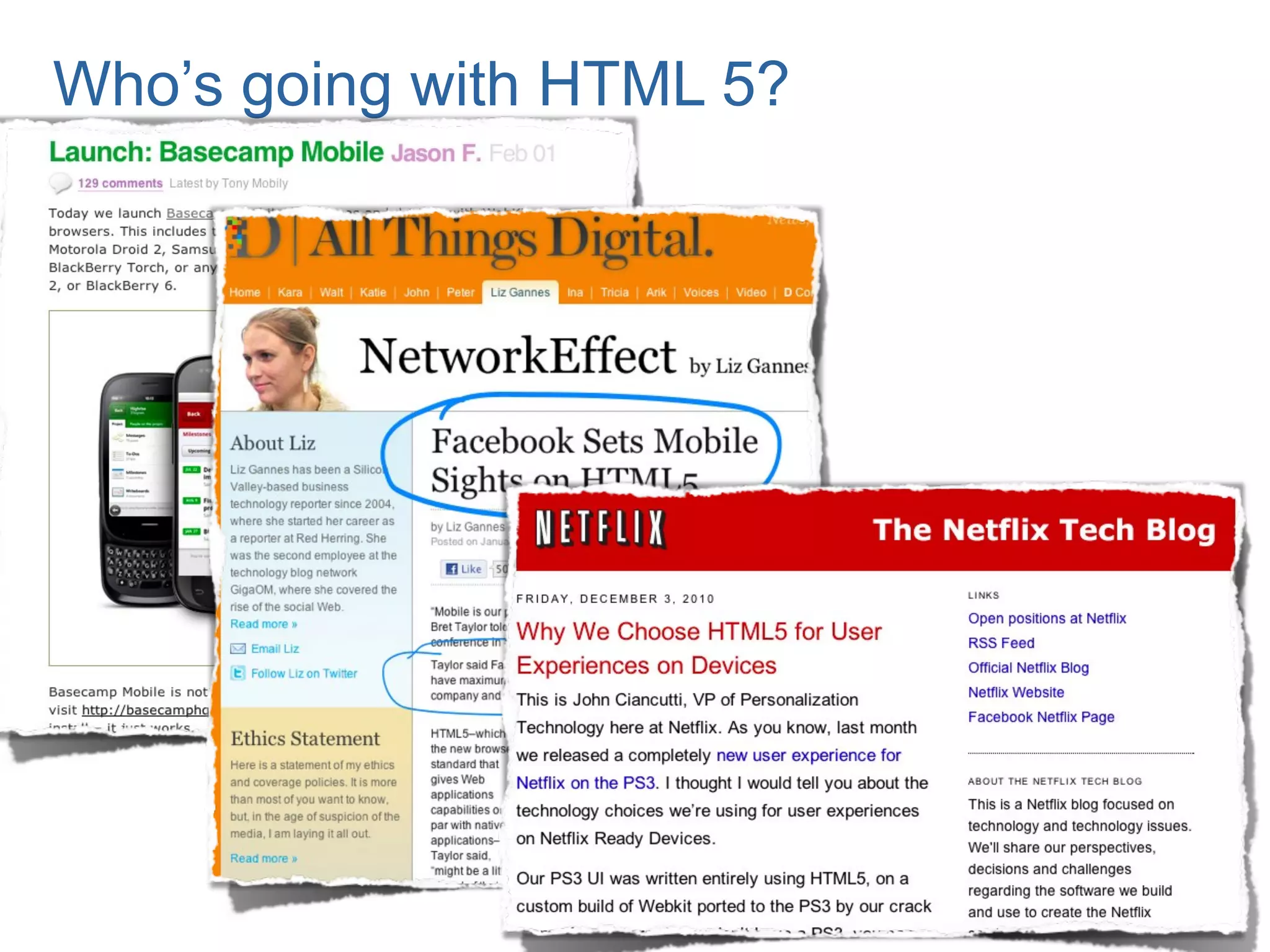
Who’s going with HTML 5?
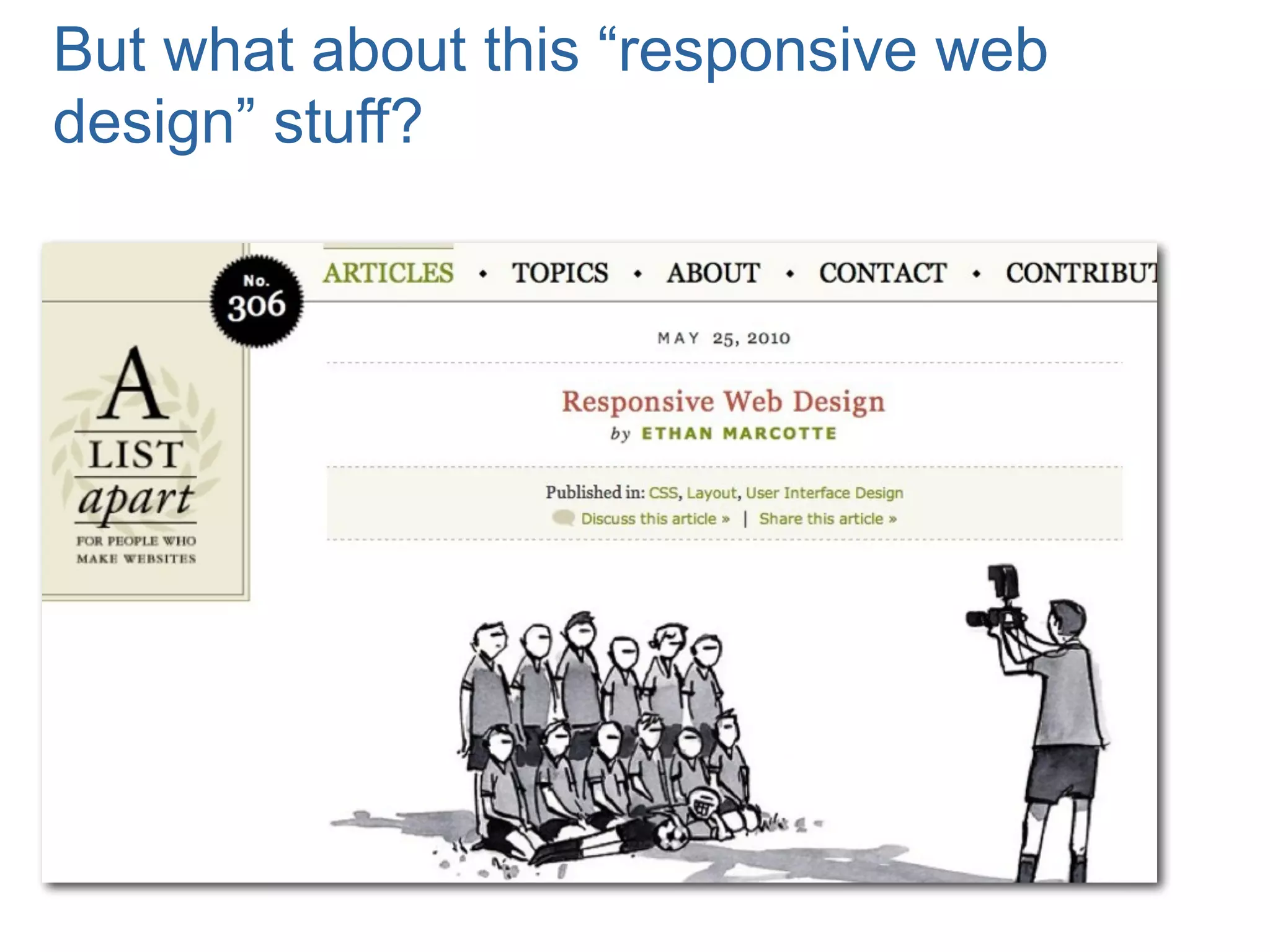
But what about this “responsive web
design” stuff?
Be wary -- this stuff changes fast
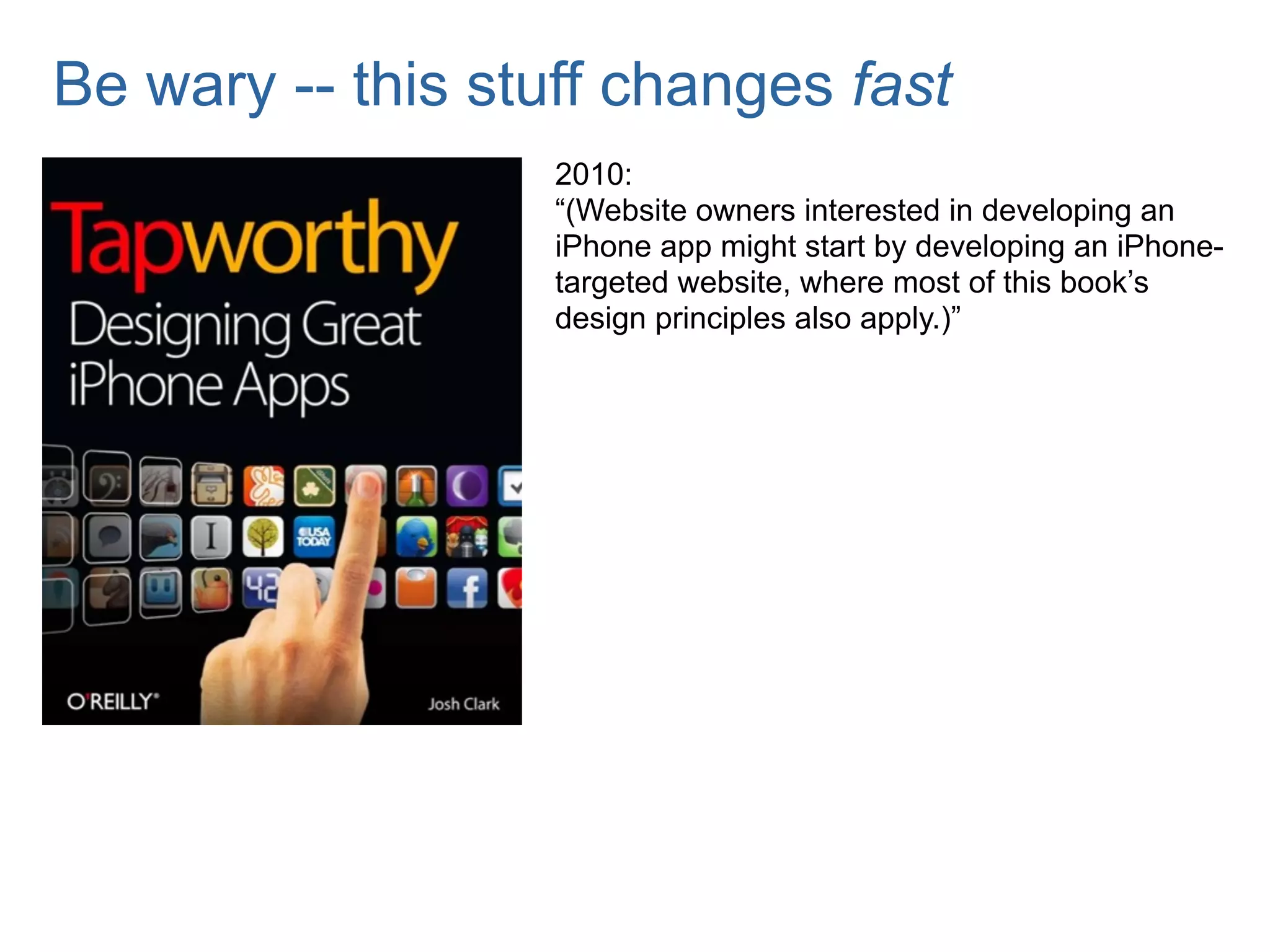
                   2010:
                   “(Website owners interested in developing an
                   iPhone app might start by developing an iPhone-
                   targeted website, where most of this book’s
                   design principles also apply.)”
Be wary -- this stuff changes fast
                   2010:
                   “(Website owners interested in developing an
                   iPhone app might start by developing an iPhone-
                   targeted website, where most of this book’s
                   design principles also apply.)”


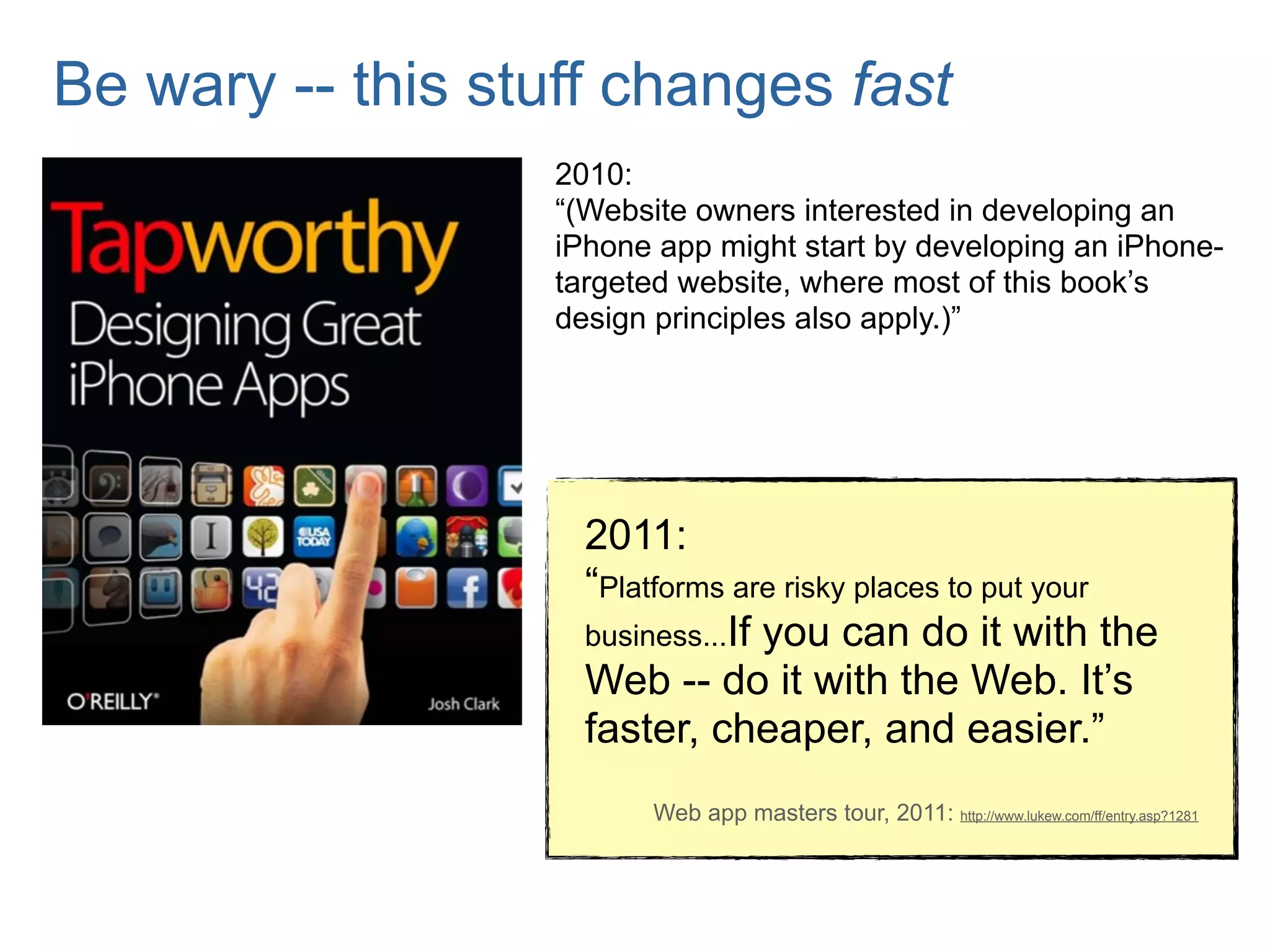
                     2011:
                     “Platforms are risky places to put your
                     business...If you can do it with the
                     Web -- do it with the Web. It’s
                     faster, cheaper, and easier.”
                         Web app masters tour, 2011: http://www.lukew.com/ff/entry.asp?1281
The takeaway:
start by saying no to native
The takeaway:
 start by saying no to native
It’s not that native apps are the wrong
approach. But your starting point for
your mobile strategy should be a web
app. Force yourself to justify the native
decision.

         Stand up to your CEO.
Saying no to native apps - UX Masterclass Copenhagen

Saying no to native apps - UX Masterclass Copenhagen

  • 1.
    Saying No toNative Apps Brian Donohue UX Masterclass, Copenhagen, April 2011
  • 2.
  • 3.
  • 4.
    Execs just want an iPhone app http://url.ie/a1wt
  • 6.
    But they’re often“vanity apps”
  • 7.
    But mobile isnot a vanity thing
  • 8.
    For the biggestplayers, it’s the focus
  • 9.
    “Throwaway” user testquestion Me: “So have you ever tried to (almost embarrassed asking it) access utility client’s website on your phone?” Participant: (tradesman, not computer savvy)
  • 10.
    “Throwaway” user testquestion Me: “So have you ever tried to (almost embarrassed asking it) access utility client’s website on your phone?” Participant: “I was sitting on my couch (tradesman, not computer savvy) watching TV. My computer was down in the hallway. I couldn’t be arsed getting off the couch. So, I tried to see if I could get my bill on my phone.” (He couldn’t.)
  • 11.
    What execs don’tunderstand: fragmentation
  • 12.
    Going native isa policy of exclusion...
  • 13.
    Going native isa policy of exclusion...
  • 14.
  • 15.
    supports 5 nativemobile platforms
  • 16.
    supports 5 nativemobile platforms “We could probably save 70% of our development budget by switching to a single, cross-platform client Phil Lebin, CEO http://url.ie/a1xl
  • 17.
    Defining “native” vs.“mobile web” Objective C HTML, CSS, JS works best on webkit browsers Java C ++
  • 18.
    Different platforms usuallymeans different people Java Objective C
  • 21.
    But what’s thedifference to customers?
  • 22.
    and do Iaccess it here...
  • 23.
    Native isn’t alwaysbetter Native app only Both Web app only  Gyroscope and  Store data offline  Much easier to test, Accelerometer  Access GPS prototype, and rollout  Accessing filesystems  Have app-like UI and  Can update (e.g. address book, transitions immediately (no app photos) store approval),  Accessible as app  Fully-immersive customers don’t have from home screen experience (e.g. to update the app gaming)  Can link to the app  ??Findability?? (e.g. SMS with link to  Support in-app purchases your bill) (Apple takes 30% cut)  HTML 5 is continually  Camera adding hardware capabilities  Smoother and more responsive
  • 24.
    Are there anyUX benefits to mobile web app?
  • 25.
    Are there anyUX benefits to mobile web app?
  • 26.
    Do you havea 1-page website too?
  • 27.
    If mobile isa complement to your website, it’s very likely the mobile app route makes more sense
  • 28.
    Hybrid is analmost magical solution
  • 29.
  • 30.
  • 31.
  • 32.
    But what aboutthis “responsive web design” stuff?
  • 33.
    Be wary --this stuff changes fast 2010: “(Website owners interested in developing an iPhone app might start by developing an iPhone- targeted website, where most of this book’s design principles also apply.)”
  • 34.
    Be wary --this stuff changes fast 2010: “(Website owners interested in developing an iPhone app might start by developing an iPhone- targeted website, where most of this book’s design principles also apply.)” 2011: “Platforms are risky places to put your business...If you can do it with the Web -- do it with the Web. It’s faster, cheaper, and easier.” Web app masters tour, 2011: http://www.lukew.com/ff/entry.asp?1281
  • 35.
    The takeaway: start bysaying no to native
  • 36.
    The takeaway: startby saying no to native It’s not that native apps are the wrong approach. But your starting point for your mobile strategy should be a web app. Force yourself to justify the native decision. Stand up to your CEO.

Editor's Notes

  • #2 How many people have completed or in the process of working on mobile apps?\nHow many people built those apps specifically for iphone or android?\nHow many people built them as web apps?\nWho’s not sure what the difference is?\n
  • #3 They’re everywhere, on everything\n
  • #4 Peter-Paul Koch is a mobile platform strategist, consultant, and trainer in Amsterdam, the Netherlands.\n
  • #5 An app who’s sole purpose is to make a single calculation. These guys just wanted to have something in the app store.\n
  • #6 \n
  • #7 It’s an imperative\n
  • #8 It’s an imperative\n
  • #9 It was a blackberry phone\n
  • #10 It’s great if you only care about your customers with iPhones, but, then you have to do it all over again, from scratch, for each platform\nBuild (in different languages), test, maintain – all independently – you’re quadrupling your efforts and costs.\n\nEvernote was making different argument -- but they develop for 5 native platforms!!!\n\n
  • #11 \n
  • #12 This is more local, and based on people actually using the web on their phones\n
  • #13 The context of this quote is he was defending the need to go native\n
  • #14 Need to get programming language for Blackberry, Windows...\n
  • #15 \n
  • #16 \n
  • #17 \n
  • #18 Basically what they know is if they download it in the the app store\n
  • #19 \n
  • #20 http://www.quora.com/Why-choose-HTML5-over-native-code-for-a-mobile-app?q=native+app\n
  • #21 \n
  • #22 Instagram is a massive hit. But it’s a project that’s conceived of as an app. They have a one-page website. This has nothing to do with your business.\n\nThey have no customers, so they start with one platform. This makes sense for them. You or your clients probably have a lot of customers already -- this approach makes much less sense. It’s not that you’re cutting off potential customers -- you’re cutting off actual customers.\n
  • #23 \n
  • #24 http://www.quora.com/What-are-the-best-hybrid-mobile-apps-html5-embedded-in-native-app-for-added-functionality\n\nThis basically eliminates the distinction between native and mobile web app\n
  • #25 \n
  • #26 \n
  • #27 Hold on a second, what about all this talk about this talk about responsive web design?\n
  • #28 Book is from 2010 -- entirely focused on iphone apps. He puts this point in brackets.\n\n“For the foreseeable future, I believe the best way forward is a common-denominator mobile website—with graceful degradation so that a majority of mobile users are served—paired with one or three audience-appropriate native apps.”\n
  • #29 \n
  • #30 \n