Solar PV Power Policy and Business Opportunities
in Saudi Arabia
Prepared By
SHAIK AMANULLA
CONTENTS
INTRODUCTION
SOLAR PV TECHNOLOGY
SOLAR PV EQUIPMENT
SOLAR PV PLANT SCHEMATIC DIAGRAM
SOLAR BUSINESS MODELS
SOLAR IRRADIATION MAP IN SAUDI ARABIA
KSA SMALL-SCALE SOLAR PV SYSTEM REGULATION
CONCLUSION
INTRODUCTION
Solar energy is most abundant available renewable energy source in the
world.
The energy from the sun is virtually an inexhaustible source of energy,
which offers eco-friendly viable alternative power source than fossil fuel-fed
world.
Though the non-renewable fossil fuels like coal, gas and oil, which have
been sustaining the world industrial-urban-infrastructure of the contemporary
civilization so far, and it is also been causing immense pollution of the earth
atmosphere by emission of Co2 and green house gases.
Secondly the stock of the fossil fuel is dwindling as there are no renewable
unlike the solar energy, which is inexhaustible.
Solar energy is an important part of life and has been utilized since
beginning of the time. Increasingly, man is learning how to harness this
important resource and use it to replace the traditional energy sources.
 Since the Solar PV equipment prices are falling year by year, Developing
countries are also adopting this technology widely.
SOLAR PV TECHNOLOGY
• Solar Photo-Voltaic Technology is one of the type of solar energy.
• By using the solar PV Technology, we will convert the sunlight into
electricity directly.
• Solar cells are the main components in the Solar PV technology,
Which will convert the sunlight into electricity.
• Solar cells are connected in series and parallel to increase the power
the PV module. PV modules are available from 3Wp to 400Wp.
• Solar Inverters are converting the DC power coming from the Solar
PV Modules to AC power, which is useful for our daily electrical
appliances. Solar Inverters are available in the market from 1KW to
2MW.
• AC power will be sent to the grid after the self consumption of the
prosumer.
SOLAR PV EQUIPMENT
• Solar PV Modules: Solar PV modules are converting sunlight into
electricity. The selection of PV modules are vital, which will work for 25
years long.
• Solar PV Junction Box: Solar arrays are connected to Junction box with
protection equipment and disconnected switches under maintenance.
• Solar PV Inverter: Solar inverter will change the DC power coming
from the PV modules to AC power.
• Solar PV Structure: Solar structure is supporting the PV modules on the
ground and roof.
• DC & AC cables: Till PV inverter, we will use DC cables for wiring
between the PV modules and AC cables are used after the Inverter.
• Bi-Directional Meter: It is used in Grid-Connected Solar Power plants,
where import and export of energy are taking place.
• Data Monitoring System: It will show you the weekly, monthly, yearly
generation data and monitor the Solar plant continuously.
SOLAR PV PLANT SCHEMATIC DIAGRAM
SOLAR BUSINESS MODELS
Third party ownership & Operation
Business models driven by third parties
which develop projects and own PV
systems, resulting in:
-Reduction of hassle & complexity for
end‐user
-Better access to financing
-Leveraging of current incentives structure
(especially for commercial building
applications)
Utility gradually takes on a facilitation
role as PV market share grows
Full Integration
Business models allow PV to become an
integral part of the electricity supply and
distribution infrastructure
Business models emerge with variation of
system:
– Ownership
– Operation
– Control
Utility becomes more deeply involved, as PV
becomes major consideration
PV Business Models in India
TYPES OF BUSINESS PLAYERS IN PV SECTOR
Power Developer: Solar Power developers are investing their equity of 30%
and will take the loan of 70% from the Financial Institutions by entering into a Power
Purchase Agreement (PPA) with the client.
 Project is viable, If Equity IRR is greater than the interest rate, which you will get from the
Financial Institutions. DSCR should be greater than 1.5.
EPC: Engineering, Procurement & Commissioning. These companies are developing
the Turn-key project from initial to final execution of the solar project. They quote the
Project cost to developers by adding their margin of 8%-13%.
System Integrator: System Integrators are assembling the PV equipment after
the procurement of the PV equipment by the Customer. They will charge the price
depending upon the Solar system capacity
Solar PV Material Suppliers: Solar PV Material Suppliers will procure the
PV Equipment and sold to the customers, EPC & Power Developers by adding their
margin. Usually, they procure the Tier-1 PV modules & Inverters and BoS (Balance of
System) components like DC&AC Cables, Junction Boxes, Transformers etc.
Contractor/Consultant
Saudi Electricity Company
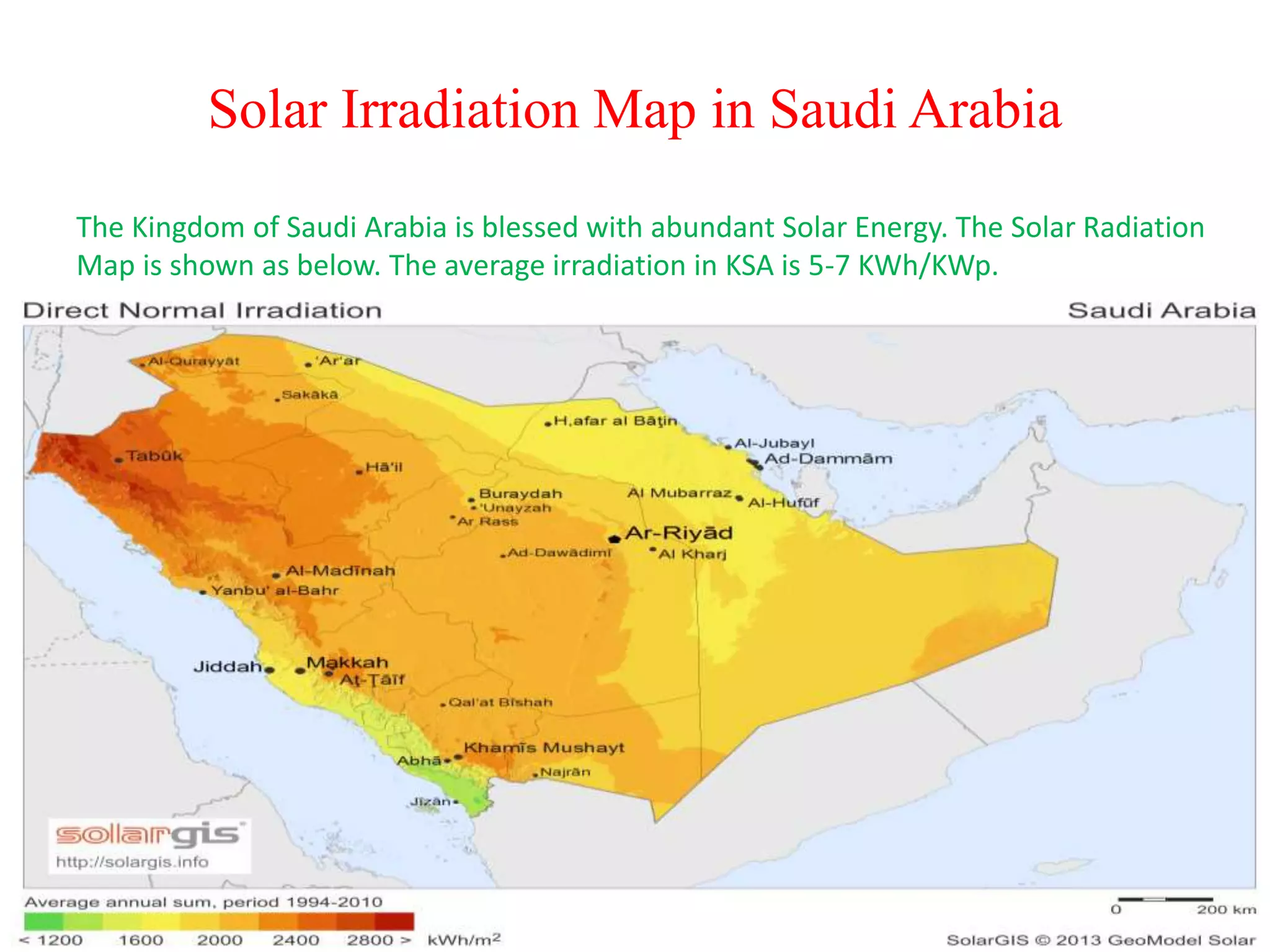
Solar Irradiation Map in Saudi Arabia
The Kingdom of Saudi Arabia is blessed with abundant Solar Energy. The Solar Radiation
Map is shown as below. The average irradiation in KSA is 5-7 KWh/KWp.
KSA Small-Scale Solar PV Systems Regulation
These Regulations shall come into force on 01/07/2018. (Visit
www.se.com.sa) from 1KW to 2MW capacity of Solar PV
Systems.
These regulations set out the regulatory framework for the
connection of a Small-Scale Solar PV Systems to the
Distribution System.
The Regulations aim to achieve the following:
1. To promote the Distribution System connected Small-Scale
Solar PV systems in Kingdom of Saudi Arabia.
2. To establish a framework for Net metering arrangements of
surplus energy exported to the distribution system.
3. To ensure the efficient and safe construction, maintenance and
operation of Small-Scale Solar PV system in all premises in
KSA.
Scope and Application of the Regulation
These regulations shall apply to DSP(Distribution Service
Provider), Eligible consumer, certified Contactor/ Consultant, and
any other persons involved in the connection of Small-Scale Solar
PV Systems to the Distribution System and/or entering into a Net
Metering arrangements with DSP.
These Regulations do not apply to Solar PV systems greater than
2MW capacity or smaller than 1kW capacity or to system that do
not operate in parallel with Distribution System (Saudi Electricity
Company).
These Regulations do not preclude the right of the investors to
undertake Solar PV projects of more than 2MW capacity where
there are alternative mechanisms prepared by the principle Buyer of
such projects.
These Regulations may be amended by ECRA (Electricity &
Cogeneration Regulatory Authority) at any time.
Small-Scale Solar PV System connection process
This section outlines the different steps leading to the connection
of Small-Scale Solar PV System to either MV or LV Distribution
System. The process is similar to both cases, so the main steps
described hereinafter apply for both.
The overall process is divided into 4 steps, namely:
1. Selection of PV Contractor/Consultant (An entity that is
registered with the DSP to carry out design and Electrical
installation work specified to Solar PV System).
2. Solar PV initial Enquiry by the Eligible Consumer.
3. Design Approval by DSP.
4. Inspection and Energization by DSP.
Certifications and Qualifications
Certification of Solar PV Contractors/Consultants:
In coordination with King Abdullah City for Atomic and
Renewable, the DSP shall be responsible for certification of Solar
PV Consultants/Contractors inline with a designated registration
scheme.
A register of certified Solar PV Consultants/Contractors shall be
kept up-to-date by the DSP, published on its website, and provided
upon request to any person.
Certifications of Solar PV Components:
The DSP shall liaise with Saudi standards, Metrology and Quality
Organization (SASO) to ensure certification of Small-Scale Solar
PV components where applicable.
The DSP and SASO shall make available to Eligible Consumer and
up-to-date list of certified solar PV components and their suppliers.
CONCLUSION
The Kingdom of Saudi Arabia is blessed with an abundant Solar Energy.
Since the KSA government come up with a good solar policy, we have
the opportunities, which are mentioned as below.
In the Business point of view, Individual who want to enter into this
Small-Scale Solar PV system can be a Consultant, Contractor, System
Integrator and Material Supplier.
Power Developers, Consultants, Contractors and Eligible Consumers can
install a Small-Scale Solar PV Systems with a capacity of 1kW to
maximum of 2MW with various consumer sectors like Residential,
Commercial and Industrial
Eligible Consumers can benefit from the Small-Scale Solar PV System
with more savings.
Government is encouraging to use the pollution free technologies like
Solar PV.
This is the right time for Consumers, Consultants, Contractors and
Material Suppliers benefit from this Solar policy and contribute to the
growth of the nation by adopting solar PV energy utilization.

Saudi Arabia-Solar power business plans

  • 1.
    Solar PV PowerPolicy and Business Opportunities in Saudi Arabia Prepared By SHAIK AMANULLA
  • 2.
    CONTENTS INTRODUCTION SOLAR PV TECHNOLOGY SOLARPV EQUIPMENT SOLAR PV PLANT SCHEMATIC DIAGRAM SOLAR BUSINESS MODELS SOLAR IRRADIATION MAP IN SAUDI ARABIA KSA SMALL-SCALE SOLAR PV SYSTEM REGULATION CONCLUSION
  • 3.
    INTRODUCTION Solar energy ismost abundant available renewable energy source in the world. The energy from the sun is virtually an inexhaustible source of energy, which offers eco-friendly viable alternative power source than fossil fuel-fed world. Though the non-renewable fossil fuels like coal, gas and oil, which have been sustaining the world industrial-urban-infrastructure of the contemporary civilization so far, and it is also been causing immense pollution of the earth atmosphere by emission of Co2 and green house gases. Secondly the stock of the fossil fuel is dwindling as there are no renewable unlike the solar energy, which is inexhaustible. Solar energy is an important part of life and has been utilized since beginning of the time. Increasingly, man is learning how to harness this important resource and use it to replace the traditional energy sources.  Since the Solar PV equipment prices are falling year by year, Developing countries are also adopting this technology widely.
  • 4.
    SOLAR PV TECHNOLOGY •Solar Photo-Voltaic Technology is one of the type of solar energy. • By using the solar PV Technology, we will convert the sunlight into electricity directly. • Solar cells are the main components in the Solar PV technology, Which will convert the sunlight into electricity. • Solar cells are connected in series and parallel to increase the power the PV module. PV modules are available from 3Wp to 400Wp. • Solar Inverters are converting the DC power coming from the Solar PV Modules to AC power, which is useful for our daily electrical appliances. Solar Inverters are available in the market from 1KW to 2MW. • AC power will be sent to the grid after the self consumption of the prosumer.
  • 5.
    SOLAR PV EQUIPMENT •Solar PV Modules: Solar PV modules are converting sunlight into electricity. The selection of PV modules are vital, which will work for 25 years long. • Solar PV Junction Box: Solar arrays are connected to Junction box with protection equipment and disconnected switches under maintenance. • Solar PV Inverter: Solar inverter will change the DC power coming from the PV modules to AC power. • Solar PV Structure: Solar structure is supporting the PV modules on the ground and roof. • DC & AC cables: Till PV inverter, we will use DC cables for wiring between the PV modules and AC cables are used after the Inverter. • Bi-Directional Meter: It is used in Grid-Connected Solar Power plants, where import and export of energy are taking place. • Data Monitoring System: It will show you the weekly, monthly, yearly generation data and monitor the Solar plant continuously.
  • 7.
    SOLAR PV PLANTSCHEMATIC DIAGRAM
  • 8.
    SOLAR BUSINESS MODELS Thirdparty ownership & Operation Business models driven by third parties which develop projects and own PV systems, resulting in: -Reduction of hassle & complexity for end‐user -Better access to financing -Leveraging of current incentives structure (especially for commercial building applications) Utility gradually takes on a facilitation role as PV market share grows Full Integration Business models allow PV to become an integral part of the electricity supply and distribution infrastructure Business models emerge with variation of system: – Ownership – Operation – Control Utility becomes more deeply involved, as PV becomes major consideration
  • 10.
  • 11.
    TYPES OF BUSINESSPLAYERS IN PV SECTOR Power Developer: Solar Power developers are investing their equity of 30% and will take the loan of 70% from the Financial Institutions by entering into a Power Purchase Agreement (PPA) with the client.  Project is viable, If Equity IRR is greater than the interest rate, which you will get from the Financial Institutions. DSCR should be greater than 1.5. EPC: Engineering, Procurement & Commissioning. These companies are developing the Turn-key project from initial to final execution of the solar project. They quote the Project cost to developers by adding their margin of 8%-13%. System Integrator: System Integrators are assembling the PV equipment after the procurement of the PV equipment by the Customer. They will charge the price depending upon the Solar system capacity Solar PV Material Suppliers: Solar PV Material Suppliers will procure the PV Equipment and sold to the customers, EPC & Power Developers by adding their margin. Usually, they procure the Tier-1 PV modules & Inverters and BoS (Balance of System) components like DC&AC Cables, Junction Boxes, Transformers etc.
  • 12.
  • 13.
    Solar Irradiation Mapin Saudi Arabia The Kingdom of Saudi Arabia is blessed with abundant Solar Energy. The Solar Radiation Map is shown as below. The average irradiation in KSA is 5-7 KWh/KWp.
  • 14.
    KSA Small-Scale SolarPV Systems Regulation These Regulations shall come into force on 01/07/2018. (Visit www.se.com.sa) from 1KW to 2MW capacity of Solar PV Systems. These regulations set out the regulatory framework for the connection of a Small-Scale Solar PV Systems to the Distribution System. The Regulations aim to achieve the following: 1. To promote the Distribution System connected Small-Scale Solar PV systems in Kingdom of Saudi Arabia. 2. To establish a framework for Net metering arrangements of surplus energy exported to the distribution system. 3. To ensure the efficient and safe construction, maintenance and operation of Small-Scale Solar PV system in all premises in KSA.
  • 15.
    Scope and Applicationof the Regulation These regulations shall apply to DSP(Distribution Service Provider), Eligible consumer, certified Contactor/ Consultant, and any other persons involved in the connection of Small-Scale Solar PV Systems to the Distribution System and/or entering into a Net Metering arrangements with DSP. These Regulations do not apply to Solar PV systems greater than 2MW capacity or smaller than 1kW capacity or to system that do not operate in parallel with Distribution System (Saudi Electricity Company). These Regulations do not preclude the right of the investors to undertake Solar PV projects of more than 2MW capacity where there are alternative mechanisms prepared by the principle Buyer of such projects. These Regulations may be amended by ECRA (Electricity & Cogeneration Regulatory Authority) at any time.
  • 16.
    Small-Scale Solar PVSystem connection process This section outlines the different steps leading to the connection of Small-Scale Solar PV System to either MV or LV Distribution System. The process is similar to both cases, so the main steps described hereinafter apply for both. The overall process is divided into 4 steps, namely: 1. Selection of PV Contractor/Consultant (An entity that is registered with the DSP to carry out design and Electrical installation work specified to Solar PV System). 2. Solar PV initial Enquiry by the Eligible Consumer. 3. Design Approval by DSP. 4. Inspection and Energization by DSP.
  • 17.
    Certifications and Qualifications Certificationof Solar PV Contractors/Consultants: In coordination with King Abdullah City for Atomic and Renewable, the DSP shall be responsible for certification of Solar PV Consultants/Contractors inline with a designated registration scheme. A register of certified Solar PV Consultants/Contractors shall be kept up-to-date by the DSP, published on its website, and provided upon request to any person. Certifications of Solar PV Components: The DSP shall liaise with Saudi standards, Metrology and Quality Organization (SASO) to ensure certification of Small-Scale Solar PV components where applicable. The DSP and SASO shall make available to Eligible Consumer and up-to-date list of certified solar PV components and their suppliers.
  • 18.
    CONCLUSION The Kingdom ofSaudi Arabia is blessed with an abundant Solar Energy. Since the KSA government come up with a good solar policy, we have the opportunities, which are mentioned as below. In the Business point of view, Individual who want to enter into this Small-Scale Solar PV system can be a Consultant, Contractor, System Integrator and Material Supplier. Power Developers, Consultants, Contractors and Eligible Consumers can install a Small-Scale Solar PV Systems with a capacity of 1kW to maximum of 2MW with various consumer sectors like Residential, Commercial and Industrial Eligible Consumers can benefit from the Small-Scale Solar PV System with more savings. Government is encouraging to use the pollution free technologies like Solar PV. This is the right time for Consumers, Consultants, Contractors and Material Suppliers benefit from this Solar policy and contribute to the growth of the nation by adopting solar PV energy utilization.