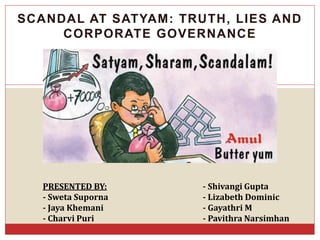
SCANDAL AT SATYAM: TRUTH, LIES AND
CORPORATE GOVERNANCE
PRESENTED BY: - Shivangi Gupta
- Sweta Suporna - Lizabeth Dominic
- Jaya Khemani - Gayathri M
- Charvi Puri - Pavithra Narsimhan
OUR AGENDA
• Brief History
• What Went Wrong With Satyam?
• Why did Mr. Raju Confessed “Suddenly”?
• Modus Operandi
• Insider Trading
• Audit Failure : Role of External Auditors
• Audit Failure : Role of Internal Auditors
• Consequence of Inefficient Corporate Governance
• Challenges
• Desired Policy Actions
• Corrective Measures
• Satyam Today
BRIEF HISTORY
• Satyam Company Cervices Ltd. was incorporated on June 24,
1987
• A leading global consulting and IT services company
• Ranked as India’s fourth largest software exporter
• Nearly 55,00 employees
• Business is spread over 55 countries
• Serves over 558 global companies, including over 185 fortune
and 500 corporations
• Satyam Infoway is the first Indian internet company to be listed
on NASDAQ, USA- 1999.
• Company was listed in Bombay stock exchange in 1992
• Listed on New York Stock Exchange- 2001
WHAT WENT WRONG WITH SATYAM?
• The promoters decided to inflate the revenue and profit figures of
Satyam. In the event, the company had a huge hole in its balance sheet
• So to fill up this gap…….. Company announced Acquisition of 51% stake
in Maytas Infra and 100% stake in Maytas Properties on 16th Dec 2008
but The deal was not profitable for investors.
• Investors dumped Satyam’s stock and threatened action against the
management.
• On 7 January 2009 Ramalinga Raju confessed to massive fraud leading
to the company’s stock crashing .
• Board of Directors were not aware of the fraud
• MAYTAS acquisition deal was aborted as the last attempt to fill the
fictitious assets with real ones .
• Every attempt made to eliminate the gap failed. It was like riding a
Tiger, not knowing how to get off without being eaten.
WHY DID MR. RAJU CONFESS TO THE CRIME
SUDDENLY? … INTRIGUING!
• Confessed in early January 2009 in an emotionally-charged four-
and-a-half page letter of startling revelations.
• WHISTLE-BLOWER:
An ex-insider, claiming to be a former senior executive in
Satyam acted as the whistle-blower. His e-mail to a Satyam board
member triggered a chain of events that ended in Raju’s decision to
confess to the financial crime.
• Also devised a plan to hide the colossal fraud.
• The scope of the falsification of accounts, which was around INR
2.34 billion in 2001–02, skyrocketed to INR 54.22 billion by
2007–08 and INR 73.33 billion by late-September 2008. But
after the unearthing of several hidden records, the CBI, pegged
the figure at more than double the amount.
MODUS OPERANDI
 The company created false invoices to show inflated
sales.
 Investigations revealed the use of fabricated invoices
to artificially hike sales and the amounts shown as
receivables in the books of accounts, thereby,
inflating the company’s revenues.
 7561 invoices worth INR 51.17 billion were found
hidden.
 The re-routing of funds was done through European
nations and was shown as investments in nearly 300
fictitious companies.
INSIDER TRADING
 Investigations have evidenced Insider Trading by the top
management of Satyam.
 CID established that the promoters indulged in nastiest kind of
insider trading of the company’s shares to raise money for building a
large land bank.
 In 2001, Raju had nearly 23 per cent shares, by 2008 Raju's share
was just 8.27 per cent.
 Nearly 3.9 crores shares were sold by the promoters of Satyam and
their family members, collecting Rs 3029.67 crores and posed a
healthy financial statement in the market.
Sell shares -> Raise money -> Healthy financial Statement -> Brand building
INSIDER TRADING
 Satyam’s senior executives’ en-cashed employee stock options
(Esops) shares in the December quarter when the stock was trading
at Rs 264-150, ruling far below its May peak of Rs 500.
 This proves he had an inkling that the bubble could burst and hence
sold off his ESOP holdings in a hurry.
 Soon after Raju’s confession, the price fell to an all-time low of Rs
6.30.44. Although the positions of chairman and CEO/CFO in
Satyam were separated but the findings reveals that the chairman
and the CFO were working in secret cooperation to defraud the
stakeholders for their personal gain.
 The findings of the investigations make it clear that Vadlamani was
not only aware of the happenings in the company but was an equal
partner in perpetrating the fraud.
ROLE OF INDEPENDENT DIRECTORS
• Who are they?
• SEBI regulation
• Six of the nine directors on Satyam’s Board were
independent directors including US academician Mangalam
Srinivasan , Vinod K. Dham (famously known as father of
the Pentium, Rammohan Rao (Dean of Indian School of
Business), US Raju (former director of IIT Delhi).They were
men of standing & reputation.
• whether these directors were ‘independent’ is questionable
AUDIT FAILURE : ROLE OF EXTERNAL AUDITORS
 The choice of PwC as auditors for Satyam
 Involvement of S. Gopalakrishnan and Talluri
Srinivas
 Process Failure?
 Auditors used Satyam’s investigative tools
 Wilfully withheld information from shareholders
 Invoices not checked
 Bank balances not verified
 The strange audit fee
 Coverage of audit not commensurate with size of
business
 The auditor did not do beginning to end transactions
verification
 Cash and bank balances were not verified
 Fake invoices were ignored
 The matter was not reported to Audit Committee
 The audit plans were prepared on the basis of the
approval of the promoters
 Serious findings of the auditing team were ignored by
the audit team leader
AUDIT FAILURE : ROLE OF INTERNAL AUDITORS
 Satyam had a reputation of excellent CG (Council
for Corporate Governance awarded Satyam its
Golden Peacock Award for Corporate Governance in
2008).
 Indian Corporate Governance Securities and
Exchange Board of India in 1992.
 India 7th place in terms of corporate governance
score in Asia Pacific region.
SATYAM FIASCO –A CONSEQUENCE OF
INEFFICIENT CORPORATE GOVERNANCE (CG)??
 Unsophisticated equity market vulnerable to
manipulation and with rudimentary, traditional
analyst activity.
 Dominations and monopoly of family firms
 High level of corruption, become visible only after
a revelation of big financial scam.
 Weak and non-transparent monitoring system.
 Lack of respect for shareholders and low financial
disclosure
CHALLENGES TO EFFECTIVE
CORPORATE GOVERNANCE
DESIRED POLICY ACTIONS TO PREVENT
ANOTHER SATYAM
 SEBI should follow two distinct approaches-
preventive and palliative.
 Preventive measures are more important as they are
more likely to be effective in the long run.
 Corrective action is long overdue if corporations are
not to cheat stakeholders and the public.
CORRECTIVE MEASURES
• Setting up a Board of Audit, that cannot continue for
more than 3 years.
• Appoint an independent regulatory body on the lines of
Public Company Accounting Oversight Board of USA
(PCAOB) of USA.
• Rotation of external auditors in non-financial
institutions
• Split offices of Chairman and CEO
• Exempt independent directors from vicarious liability
• Install whistleblower system
• Enhance criminal and civil penalties
SATYAM TODAY
 Tech Mahindra acquired Satyam, renamed it as
Mahindra Satyam and replaced its executive board and
directors.
 Swift government action saved Satyam ultimately.
 However, the scale and magnitude of the Satyam fiasco is
unparalleled in the corporate history of India.
 It led to the questioning of accounting practices of
statutory auditors and corporate governance norms in
India.
 Corporate governance failures in the West led to the
enactment of Sarbanes- Oxley Act, 2002. Similar kind of
corporate governance reforms in India.
 Harsh policy measures are needed.
• Although corporate governance mechanisms
cannot prevent unethical activity by top
management completely, they can at least act as
means for detecting such activity before it’s too
late.
• “ When an apple is rotten, there is no cure but at
least the rotten apple can be removed before the
infection spreads and infects the whole basket”.
This is what corporate governance is all
about.

Satyam scam

  • 1.
    SCANDAL AT SATYAM:TRUTH, LIES AND CORPORATE GOVERNANCE PRESENTED BY: - Shivangi Gupta - Sweta Suporna - Lizabeth Dominic - Jaya Khemani - Gayathri M - Charvi Puri - Pavithra Narsimhan
  • 2.
    OUR AGENDA • BriefHistory • What Went Wrong With Satyam? • Why did Mr. Raju Confessed “Suddenly”? • Modus Operandi • Insider Trading • Audit Failure : Role of External Auditors • Audit Failure : Role of Internal Auditors • Consequence of Inefficient Corporate Governance • Challenges • Desired Policy Actions • Corrective Measures • Satyam Today
  • 3.
    BRIEF HISTORY • SatyamCompany Cervices Ltd. was incorporated on June 24, 1987 • A leading global consulting and IT services company • Ranked as India’s fourth largest software exporter • Nearly 55,00 employees • Business is spread over 55 countries • Serves over 558 global companies, including over 185 fortune and 500 corporations • Satyam Infoway is the first Indian internet company to be listed on NASDAQ, USA- 1999. • Company was listed in Bombay stock exchange in 1992 • Listed on New York Stock Exchange- 2001
  • 4.
    WHAT WENT WRONGWITH SATYAM? • The promoters decided to inflate the revenue and profit figures of Satyam. In the event, the company had a huge hole in its balance sheet • So to fill up this gap…….. Company announced Acquisition of 51% stake in Maytas Infra and 100% stake in Maytas Properties on 16th Dec 2008 but The deal was not profitable for investors. • Investors dumped Satyam’s stock and threatened action against the management. • On 7 January 2009 Ramalinga Raju confessed to massive fraud leading to the company’s stock crashing . • Board of Directors were not aware of the fraud • MAYTAS acquisition deal was aborted as the last attempt to fill the fictitious assets with real ones . • Every attempt made to eliminate the gap failed. It was like riding a Tiger, not knowing how to get off without being eaten.
  • 5.
    WHY DID MR.RAJU CONFESS TO THE CRIME SUDDENLY? … INTRIGUING! • Confessed in early January 2009 in an emotionally-charged four- and-a-half page letter of startling revelations. • WHISTLE-BLOWER: An ex-insider, claiming to be a former senior executive in Satyam acted as the whistle-blower. His e-mail to a Satyam board member triggered a chain of events that ended in Raju’s decision to confess to the financial crime. • Also devised a plan to hide the colossal fraud. • The scope of the falsification of accounts, which was around INR 2.34 billion in 2001–02, skyrocketed to INR 54.22 billion by 2007–08 and INR 73.33 billion by late-September 2008. But after the unearthing of several hidden records, the CBI, pegged the figure at more than double the amount.
  • 6.
    MODUS OPERANDI  Thecompany created false invoices to show inflated sales.  Investigations revealed the use of fabricated invoices to artificially hike sales and the amounts shown as receivables in the books of accounts, thereby, inflating the company’s revenues.  7561 invoices worth INR 51.17 billion were found hidden.  The re-routing of funds was done through European nations and was shown as investments in nearly 300 fictitious companies.
  • 7.
    INSIDER TRADING  Investigationshave evidenced Insider Trading by the top management of Satyam.  CID established that the promoters indulged in nastiest kind of insider trading of the company’s shares to raise money for building a large land bank.  In 2001, Raju had nearly 23 per cent shares, by 2008 Raju's share was just 8.27 per cent.  Nearly 3.9 crores shares were sold by the promoters of Satyam and their family members, collecting Rs 3029.67 crores and posed a healthy financial statement in the market. Sell shares -> Raise money -> Healthy financial Statement -> Brand building
  • 8.
    INSIDER TRADING  Satyam’ssenior executives’ en-cashed employee stock options (Esops) shares in the December quarter when the stock was trading at Rs 264-150, ruling far below its May peak of Rs 500.  This proves he had an inkling that the bubble could burst and hence sold off his ESOP holdings in a hurry.  Soon after Raju’s confession, the price fell to an all-time low of Rs 6.30.44. Although the positions of chairman and CEO/CFO in Satyam were separated but the findings reveals that the chairman and the CFO were working in secret cooperation to defraud the stakeholders for their personal gain.  The findings of the investigations make it clear that Vadlamani was not only aware of the happenings in the company but was an equal partner in perpetrating the fraud.
  • 9.
    ROLE OF INDEPENDENTDIRECTORS • Who are they? • SEBI regulation • Six of the nine directors on Satyam’s Board were independent directors including US academician Mangalam Srinivasan , Vinod K. Dham (famously known as father of the Pentium, Rammohan Rao (Dean of Indian School of Business), US Raju (former director of IIT Delhi).They were men of standing & reputation. • whether these directors were ‘independent’ is questionable
  • 10.
    AUDIT FAILURE :ROLE OF EXTERNAL AUDITORS  The choice of PwC as auditors for Satyam  Involvement of S. Gopalakrishnan and Talluri Srinivas  Process Failure?  Auditors used Satyam’s investigative tools  Wilfully withheld information from shareholders  Invoices not checked  Bank balances not verified  The strange audit fee
  • 11.
     Coverage ofaudit not commensurate with size of business  The auditor did not do beginning to end transactions verification  Cash and bank balances were not verified  Fake invoices were ignored  The matter was not reported to Audit Committee  The audit plans were prepared on the basis of the approval of the promoters  Serious findings of the auditing team were ignored by the audit team leader AUDIT FAILURE : ROLE OF INTERNAL AUDITORS
  • 12.
     Satyam hada reputation of excellent CG (Council for Corporate Governance awarded Satyam its Golden Peacock Award for Corporate Governance in 2008).  Indian Corporate Governance Securities and Exchange Board of India in 1992.  India 7th place in terms of corporate governance score in Asia Pacific region. SATYAM FIASCO –A CONSEQUENCE OF INEFFICIENT CORPORATE GOVERNANCE (CG)??
  • 13.
     Unsophisticated equitymarket vulnerable to manipulation and with rudimentary, traditional analyst activity.  Dominations and monopoly of family firms  High level of corruption, become visible only after a revelation of big financial scam.  Weak and non-transparent monitoring system.  Lack of respect for shareholders and low financial disclosure CHALLENGES TO EFFECTIVE CORPORATE GOVERNANCE
  • 14.
    DESIRED POLICY ACTIONSTO PREVENT ANOTHER SATYAM  SEBI should follow two distinct approaches- preventive and palliative.  Preventive measures are more important as they are more likely to be effective in the long run.  Corrective action is long overdue if corporations are not to cheat stakeholders and the public.
  • 15.
    CORRECTIVE MEASURES • Settingup a Board of Audit, that cannot continue for more than 3 years. • Appoint an independent regulatory body on the lines of Public Company Accounting Oversight Board of USA (PCAOB) of USA. • Rotation of external auditors in non-financial institutions • Split offices of Chairman and CEO • Exempt independent directors from vicarious liability • Install whistleblower system • Enhance criminal and civil penalties
  • 16.
    SATYAM TODAY  TechMahindra acquired Satyam, renamed it as Mahindra Satyam and replaced its executive board and directors.  Swift government action saved Satyam ultimately.  However, the scale and magnitude of the Satyam fiasco is unparalleled in the corporate history of India.  It led to the questioning of accounting practices of statutory auditors and corporate governance norms in India.  Corporate governance failures in the West led to the enactment of Sarbanes- Oxley Act, 2002. Similar kind of corporate governance reforms in India.  Harsh policy measures are needed.
  • 17.
    • Although corporategovernance mechanisms cannot prevent unethical activity by top management completely, they can at least act as means for detecting such activity before it’s too late. • “ When an apple is rotten, there is no cure but at least the rotten apple can be removed before the infection spreads and infects the whole basket”. This is what corporate governance is all about.

Editor's Notes

  • #8 The funds collected by the former chairman B. Ramalinga Raju, his brother Rama Raju and their relatives were used to purchase lands in the names of 330 companies and about 30 individuals. All of them had equity participation in these entities, of which 327 were linked to the family. They have been charged to use money earned by offloading their shares in Satyam to purchase lands. 2. As the brand built strong amongst the peers, the share price started shooting up. During this course of time, the promoters kept their objective straight of offloading their shares at frequent intervals. Thus, the promoters not only manipulated share prices to make personal gains but also cheated the other shareholders and investors
  • #9 1. During this course, the founder ex-chairman Ramalinga Raju sold 98 lakh shares collecting in Rs 773.42 crores, whereas, his brother Rama Raju, sold 1.1 crore shares pocketing Rs 894.32 crores. 2. Now potentially liable to be charged for insider trading amongst other things, Vadlamani had become enormously rich in his long tenure at the company. The findings of the investigations make it clear that Vadlamani was not only aware of the happenings in the company but was an equal partner in perpetrating the fraud. 3. Incidentally Ram Mynampati, the new interim CEO (prior to company being taken over by Tech Mahindra) also sold off shares of Satyam during that time.