Zinc
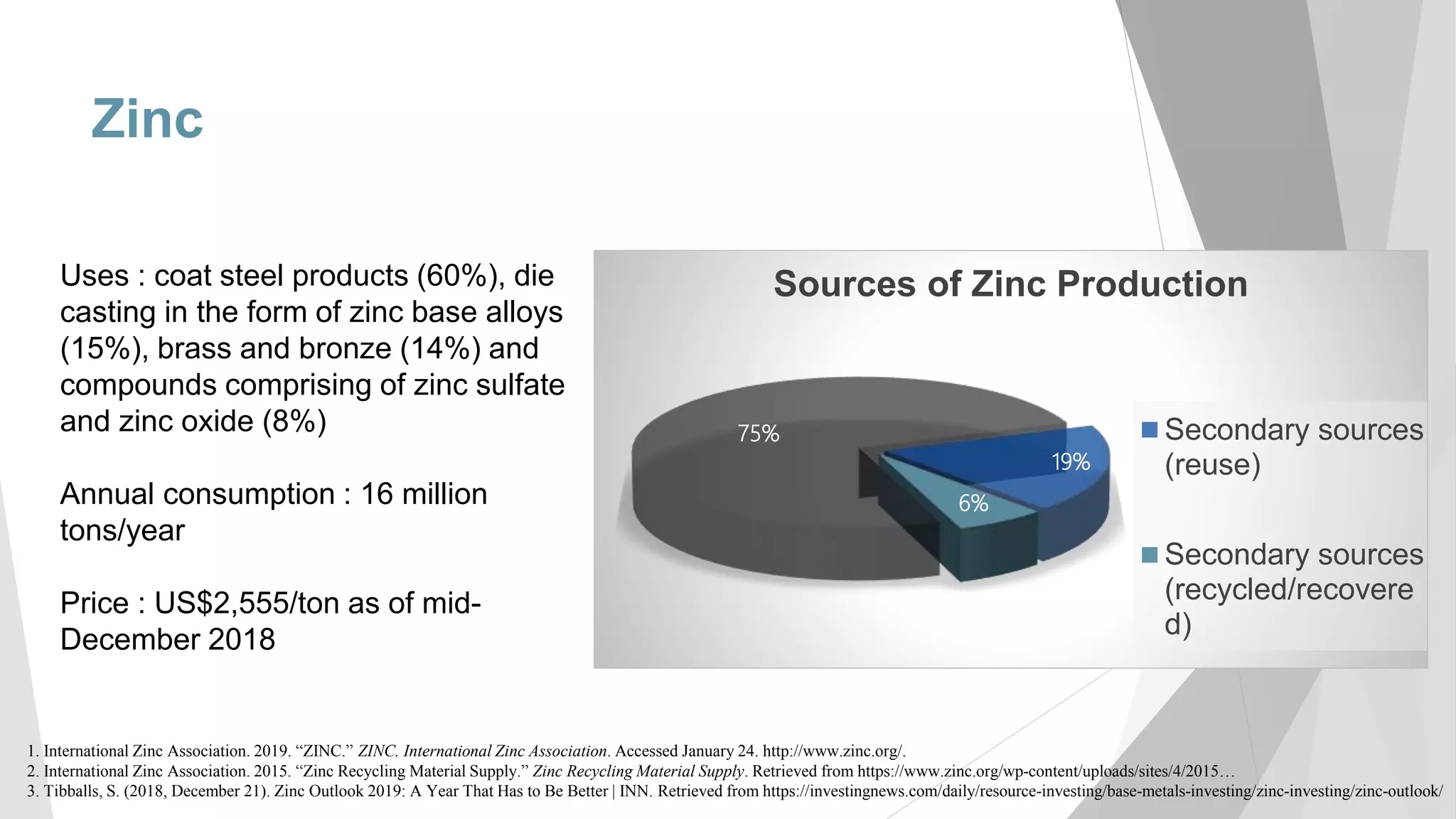
19%
6%
75%
Sources of Zinc Production
Secondary sources
(reuse)
Secondary sources
(recycled/recovere
d)
Uses : coat steel products (60%), die
casting in the form of zinc base alloys
(15%), brass and bronze (14%) and
compounds comprising of zinc sulfate
and zinc oxide (8%)
Annual consumption : 16 million
tons/year
Price : US$2,555/ton as of mid-
December 2018
1. International Zinc Association. 2019. “ZINC.” ZINC. International Zinc Association. Accessed January 24. http://www.zinc.org/.
2. International Zinc Association. 2015. “Zinc Recycling Material Supply.” Zinc Recycling Material Supply. Retrieved from https://www.zinc.org/wp-content/uploads/sites/4/2015…
3. Tibballs, S. (2018, December 21). Zinc Outlook 2019: A Year That Has to Be Better | INN. Retrieved from https://investingnews.com/daily/resource-investing/base-metals-investing/zinc-investing/zinc-outlook/
Recovery of zinc from metal-plating industrial
wastewaters by liquid-liquid extraction
Suthapat Sathityatiwat(a), Jorge Daniel Dias Carlier(a), Maria Clara
Costa(a)
a) Centre of Marine Sciences and Department of Chemistry and Pharmacy of Faculty of Science and Technology,
University of Algarve, Campus de Gambelas, P-8005-139 Faro, Portugal
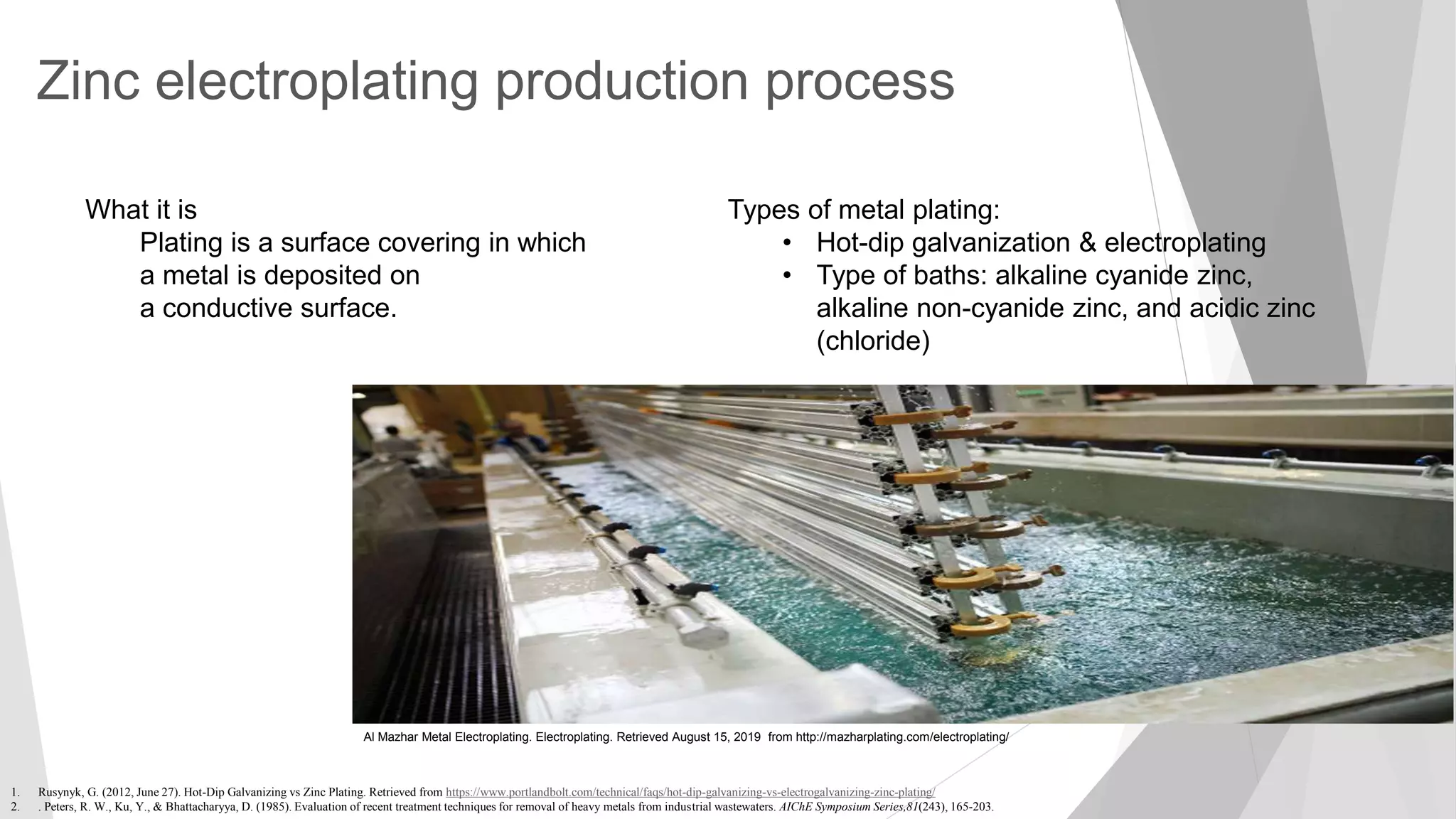
Zinc electroplating production process
1. Rusynyk, G. (2012, June 27). Hot-Dip Galvanizing vs Zinc Plating. Retrieved from https://www.portlandbolt.com/technical/faqs/hot-dip-galvanizing-vs-electrogalvanizing-zinc-plating/
2. . Peters, R. W., Ku, Y., & Bhattacharyya, D. (1985). Evaluation of recent treatment techniques for removal of heavy metals from industrial wastewaters. AIChE Symposium Series,81(243), 165-203.
What it is
Plating is a surface covering in which
a metal is deposited on
a conductive surface.
Types of metal plating:
• Hot-dip galvanization & electroplating
• Type of baths: alkaline cyanide zinc,
alkaline non-cyanide zinc, and acidic zinc
(chloride)
Al Mazhar Metal Electroplating. Electroplating. Retrieved August 15, 2019 from http://mazharplating.com/electroplating/
Zinc electroplating effluent
1 . Midwest Metal Products. (2019). Zinc Coatings. Retrieved from http://anglerings.com/Value-Added/Zinc-Coatings
2. Kobya, M., Demirbas, E., Ozyonar, F., Sirtbas, G., & Gengec, E. (2017). Treatments of alkaline non-cyanide, alkaline cyanide and acidic zinc electroplating wastewaters by electrocoagulation. Process Safety and Environmental Protection,105, 373-385. doi:10.1016/j.psep.2016.11.020
European standards for neutralized industrial
wastewaters:
• Fe ≤ 10 mg/L
• Zn ≤ 2 mg/L
• Cl- ≤ 1 g/L
• pH 6-9
Zinc electroplating effluent being tested
• Industrial Goñabe, Valladolid, Spain
• Electroplating
• Type of baths: acidic zinc (chloride)
Initial characterization of zinc-plating effluent
Metal
Sample
Concentration
(mg/L)
pH
(Sorensen
scale)
SO4
2-
(mg/L)
Eh
(mV)
Cl-
(mg/L;
media)
Zn 360 ± 8
2.0 ± 0.2 49 501 1036
Fe 124 ± 8
Cu 2.66 ± 0.03
Cr 2.12 ± 0.06
Mn 1.59 ± 0.02
*The main iron specie was Fe(III), determined using AccuVac® Ampuls
(Method 8146).
Hotdegrease
Hotrinse
Hotrinse
Pickling
Coldrinse
Coldrinse
Zn
electroplating
Coldrinse
Coldrinse
Crpassivation
Coldrinse
Coldrinse
Material flow
Water flow
Zinc-plating
wastewater
Traditional zinc recovery techniques for
zinc electroplating wastewaters
 Approximately 75% uses
carbonates, hydroxides, sulfides
or combination of these
treatments to precipitate Fe and
also Cd.
 Recover Zn be eletrowinning.
 Disadvantages:
 silt is formed as by-product
 Possible loss of certain amount
of target metal
 Not ideal for lower
concentrations of Zn
1. Peters, R. W., Ku, Y., & Bhattacharyya, D. (1985). Evaluation of recent treatment techniques for removal of heavy metals from industrial wastewaters. AIChE Symposium Series,81(243), 165-203.
2. Ríos, A. P., Hernández-Fernández, F. J., Lozano, L. J., Sánchez, S., Moreno, J. I., & Godínez, C. (2010). Removal of Metal Ions from Aqueous Solutions by Extraction with Ionic Liquids†. Journal of Chemical & Engineering Data,
55(2), 605-608. doi:10.1021/je9005008
3. VITO. (2015). energie- en milieu-informatiesysteem voor het Vlaamse Gewest. Retrieved from https://emis.vito.be/en/techniekfiche/chemical-precipitation
Cleaneat. (2017, May 5). Sewage, Wastewater treatment and pipe cleaning Services in Lagos. Retrieved from https://cleaneat.com.ng/sewage-wastewater-
treatment/
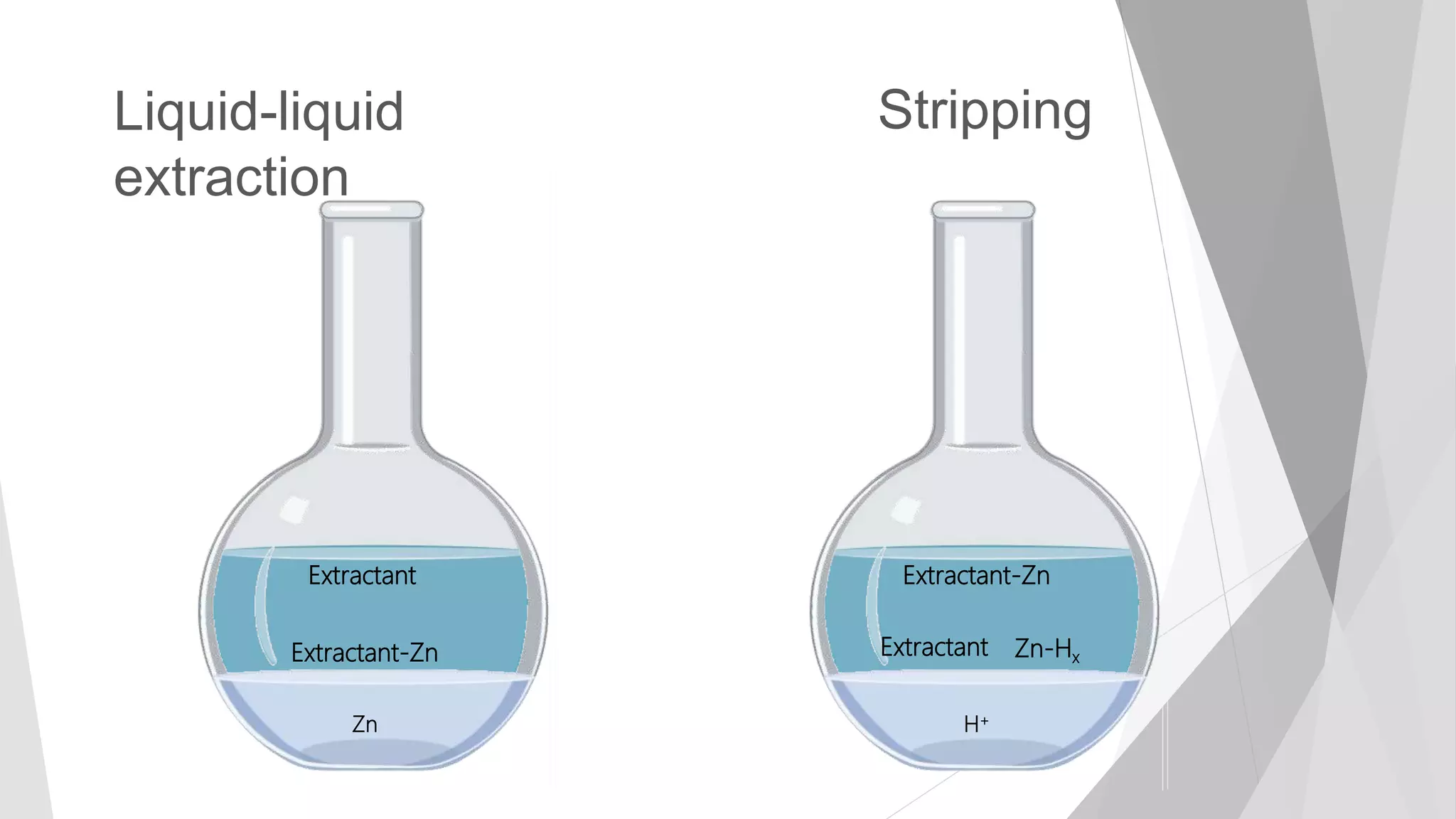
Liquid-liquid
extraction
Extractant
Extractant-Zn
Zn
Extractant-Zn
Zn-Hx
H+
Extractant
Stripping
Challenges in liquid-liquid extraction of metals
Co-extraction
 Caused be low selectivity of extractant towards
target metal
 Can be resolved by:
- Selective stripping
- Scrubbing
- Removal of the metal from the effluent by pretreatment
(ie. pH-adjustment)
Third-phase formation
 Caused by polymerization of extractant-metal
complexes
 Can be resolved by:
- Removal of the metal from the effluent by pretreatment
(ie. pH-adjustment)
https://patents.google.com/patent/US4235713A/en)
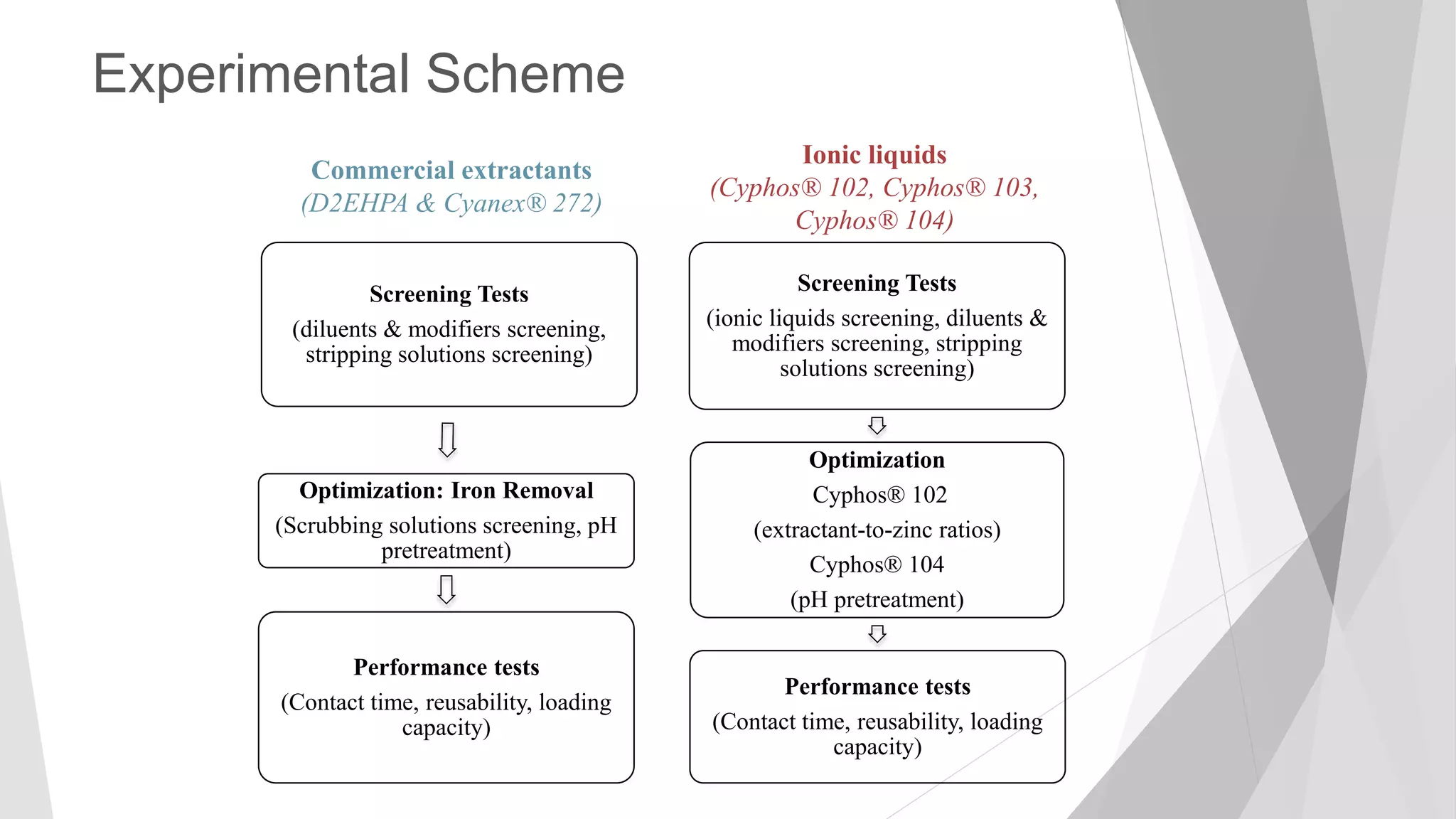
Experimental Scheme
Screening Tests
(diluents & modifiers screening,
stripping solutions screening)
Optimization: Iron Removal
(Scrubbing solutions screening, pH
pretreatment)
Performance tests
(Contact time, reusability, loading
capacity)
Screening Tests
(ionic liquids screening, diluents &
modifiers screening, stripping
solutions screening)
Optimization
Cyphos® 102
(extractant-to-zinc ratios)
Cyphos® 104
(pH pretreatment)
Performance tests
(Contact time, reusability, loading
capacity)
Commercial extractants
(D2EHPA & Cyanex® 272)
Ionic liquids
(Cyphos® 102, Cyphos® 103,
Cyphos® 104)
Commercial extractants
(D2EHPA & Cyanex 272)
D2EHPA (bis(2-ethylhexyl)phosphate)
20% (w/w)
Screening Tests
(diluents & modifiers screening, stripping solutions
screening)
Optimization: Iron Removal
(Scrubbing solutions screening, pH pretreatment)
Performance tests
(Contact time, reusability, loading capacity)
Experimental scheme
0%
10%
20%
30%
40%
50%
60%
70%
80%
90%
100%
6%(v/v)Dodecanol*✢
3%(v/v)TBP*
5%(v/v)TBP**
3%(v/v)Octanol***
5%(v/v)Octanol***
20%(v/v)Octanol
Nomodifier
3%(v/v)TBP**
5%(v/v)TBP**
7%(v/v)TBP**
3%(v/v)Decanol**
7%(v/v)Decanol**
Nomodifier
3%(v/v)TBP**
5%(v/v)TBP**
7%(v/v)TBP**
3%(v/v)Decanol**
7%(v/v)Decanol**
Kerosene SHELLSOL D70 SHELL GTL
ExtractionEfficiency(%)
Diluent and modifier
Zn
Fe
Effect of diluents and modifiers on solvent extraction efficiency of Zn and Fe from
zinc-plating effluent with 20% (w/w) D2EHPA (A/O: 1:1, 21 ± 2℃, 1 h, no replicates)
*Thin layer of third phase observed. **Moderate layer of third phase observed.
***Large layer of third phase observed.
✢Modifier solidified at 21  2C.
Diluents & modifiers screening
Highest selectivity
Lowest third phase formation
D2EHPA (bis(2-ethylhexyl)phosphate)
Screening Tests
(diluents & modifiers screening, stripping solutions
screening)
Optimization: Iron Removal
(Scrubbing solutions screening, pH pretreatment)
Performance tests
(Contact time, reusability, loading capacity)
Experimental scheme
0%
10%
20%
30%
40%
50%
60%
70%
80%
90%
100%
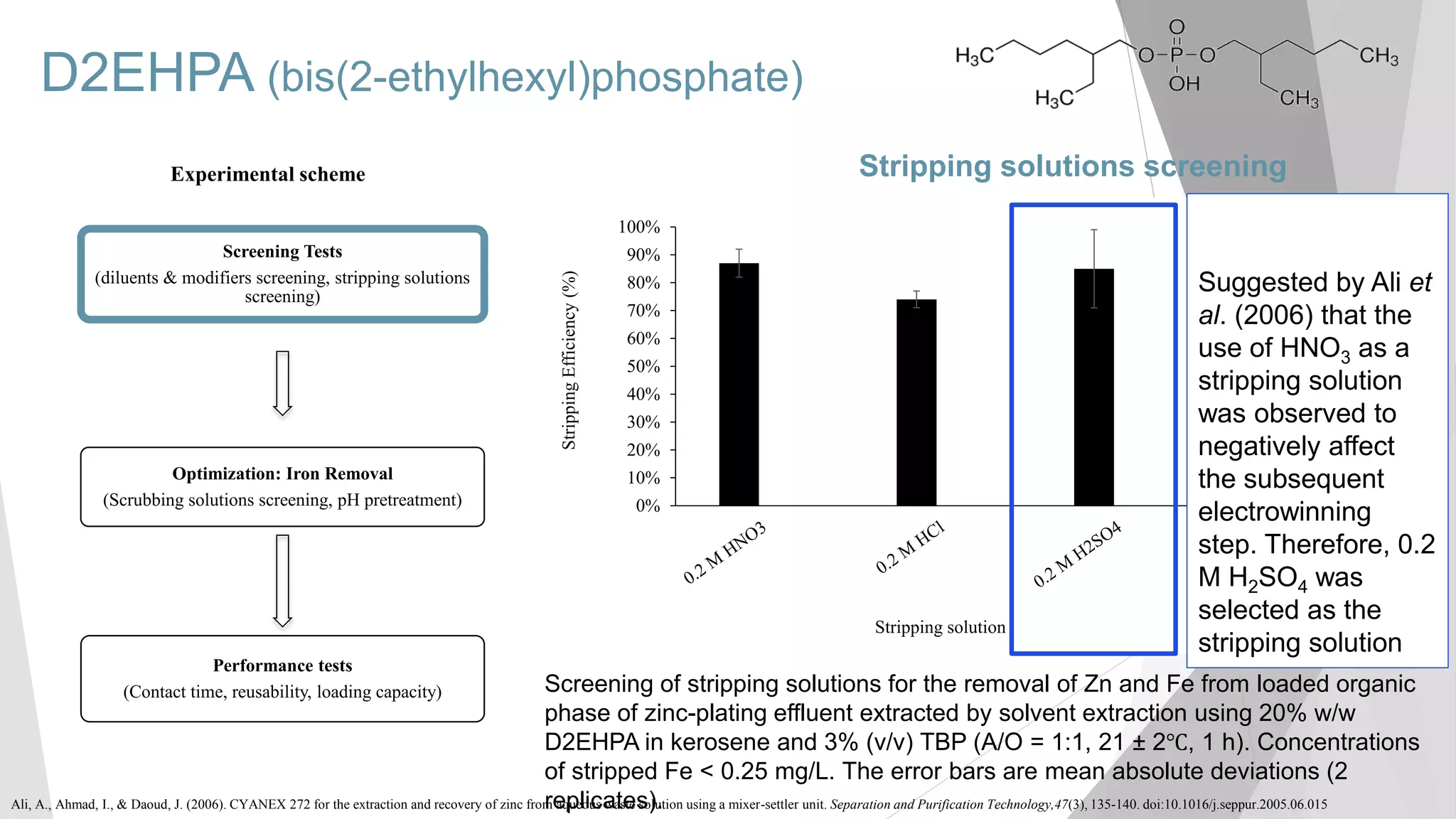
StrippingEfficiency(%)
Stripping solution
Zn
Fe
Screening of stripping solutions for the removal of Zn and Fe from loaded organic
phase of zinc-plating effluent extracted by solvent extraction using 20% w/w
D2EHPA in kerosene and 3% (v/v) TBP (A/O = 1:1, 21 ± 2℃, 1 h). Concentrations
of stripped Fe < 0.25 mg/L. The error bars are mean absolute deviations (2
replicates).
Stripping solutions screening
Suggested by Ali et
al. (2006) that the
use of HNO3 as a
stripping solution
was observed to
negatively affect
the subsequent
electrowinning
step. Therefore, 0.2
M H2SO4 was
selected as the
stripping solution
Ali, A., Ahmad, I., & Daoud, J. (2006). CYANEX 272 for the extraction and recovery of zinc from aqueous waste solution using a mixer-settler unit. Separation and Purification Technology,47(3), 135-140. doi:10.1016/j.seppur.2005.06.015
Cyanex 272 (bis(2,4,4-trimethylpentyl)phosphinic acid )
20% (w/w) active compound
Screening Tests
(diluents & modifiers screening, stripping solutions
screening)
Optimization: Iron Removal
(Scrubbing solutions screening, pH pretreatment)
Performance tests
(Contact time, reusability, loading capacity)
Experimental scheme
Diluents & modifiers screening
0%
10%
20%
30%
40%
50%
60%
70%
80%
90%
100%
nomodifier****
3%(v/v)TBP***
7%(v/v)TBP***
nomodifier***
3%(v/v)TBP**
7%(v/v)TBP**
nomodifier***
Escaid 102 SHELLSOL D70 SHELL GTL
ExtractionEfficiency(%)
Diluent (and modifier)
Zn Fe
Effect of diluents and modifiers on solvent extraction efficiency of Zn and Fe from zinc-
plating effluent with 0.55 M Cyanex® 272 (A/O: 1:1, 21 ± 2℃, 1 h). All liquid-liquid
extractions performed with no modifier were carried out in 2 replicates. In such cases, the
error bars depicted mean absolute deviations. *Thin layer of third phase **Moderate layer
of third phase ***Large layer of third phase
Extract more iron (Fe(III))
Cyanex 272 (bis(2,4,4-trimethylpentyl)phosphinic acid )
Screening Tests
(diluents & modifiers screening, stripping solutions
screening)
Optimization: Iron Removal
(Scrubbing solutions screening, pH pretreatment)
Performance tests
(Contact time, reusability, loading capacity)
Experimental scheme
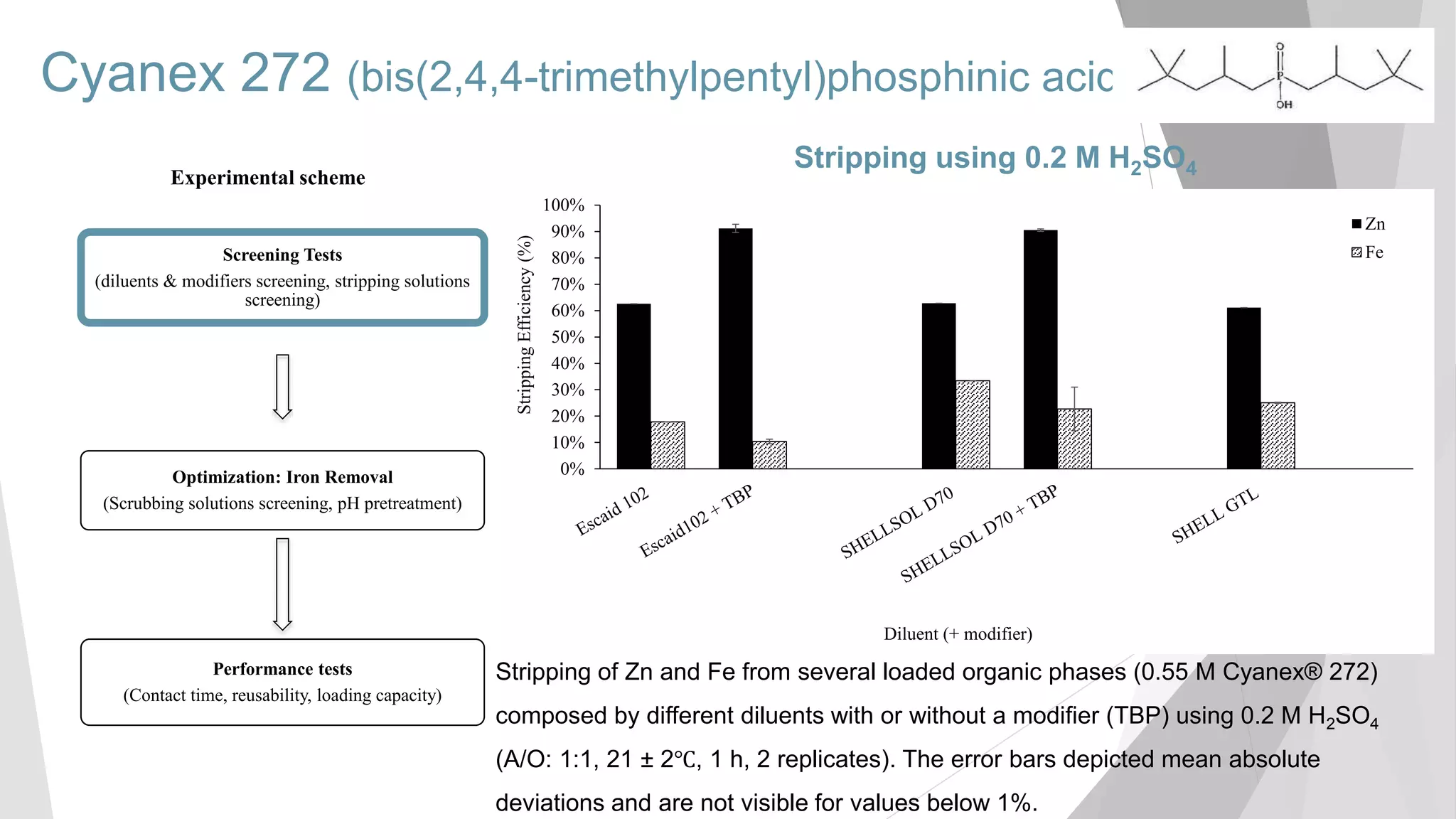
Stripping using 0.2 M H2SO4
0%
10%
20%
30%
40%
50%
60%
70%
80%
90%
100%
StrippingEfficiency(%)
Diluent (+ modifier)
Zn
Fe
Stripping of Zn and Fe from several loaded organic phases (0.55 M Cyanex® 272)
composed by different diluents with or without a modifier (TBP) using 0.2 M H2SO4
(A/O: 1:1, 21 ± 2℃, 1 h, 2 replicates). The error bars depicted mean absolute
deviations and are not visible for values below 1%.
Optimization : D2EHPA
D2EHPA (bis(2-ethylhexyl)phosphate)
Screening Tests
(diluents & modifiers screening, stripping solutions
screening)
Optimization: Iron Removal
(Scrubbing solutions screening, pH pretreatment)
Performance tests
(Contact time, reusability, loading capacity)
Experimental scheme Scrubbing solutions screening
0%
10%
20%
30%
40%
50%
60%
70%
80%
90%
100%
6 M HCl Sea water 1.3 M oxalic acid 1.3 M (NH₄)₂SO₄
ScrubbingEfficiency(%) Scrubbing Solution
Screening of scrubbing solutions for the removal of Fe from zinc stripped
loaded organic phase resulting from zinc-plating effluent extracted using 20%
(w/w) D2EHPA in kerosene and 3% (v/v) TBP (A/O = 1:1, 21 ± 2℃, 1 h, 2
replicates). The error bars depicted mean absolute deviations and are not
69%
Still relatively
low and will
require multiple
scrubbing steps
D2EHPA (bis(2-ethylhexyl)phosphate)
Screening Tests
(diluents & modifiers screening, stripping solutions
screening)
Optimization: Iron Removal
(Scrubbing solutions screening, pH pretreatment)
Performance tests
(Contact time, reusability, loading capacity)
Experimental scheme pH pretreatment
0
20
40
60
80
100
120
140
0
50
100
150
200
250
300
350
400
2 3 4 5 5.5 6 7 8 9 10 11
FeConcentration(mg/L)
ZnConcentration(mg/L)
pH
Zn
Fe
Effect of pH adjustment with 5 M NaOH on Zn and Fe concentrations in zinc-plating
effluent. Error bars are standard deviations (3 replicates) and in some cases are
smaller than the symbols, thus not visible.
D2EHPA (bis(2-ethylhexyl)phosphate)
Screening Tests
(diluents & modifiers screening, stripping solutions
screening)
Optimization: Iron Removal
(Scrubbing solutions screening, pH pretreatment)
Performance tests
(Contact time, reusability, loading capacity)
Experimental scheme pH pretreatment
0%
10%
20%
30%
40%
50%
60%
70%
80%
90%
100%
2 3 4 5 5.5 6
ExtractionEfficiency(%)
pH
Effect of pH adjustment with 5 M NaOH on solvent extraction of Zn using 20%
(w/w) D2EHPA in kerosene with 3% (v/v) TBP (21 ± 2℃, 1 h, 2 replicates). The
error bars depict mean absolute deviations (with values below 0.2%; thus, might
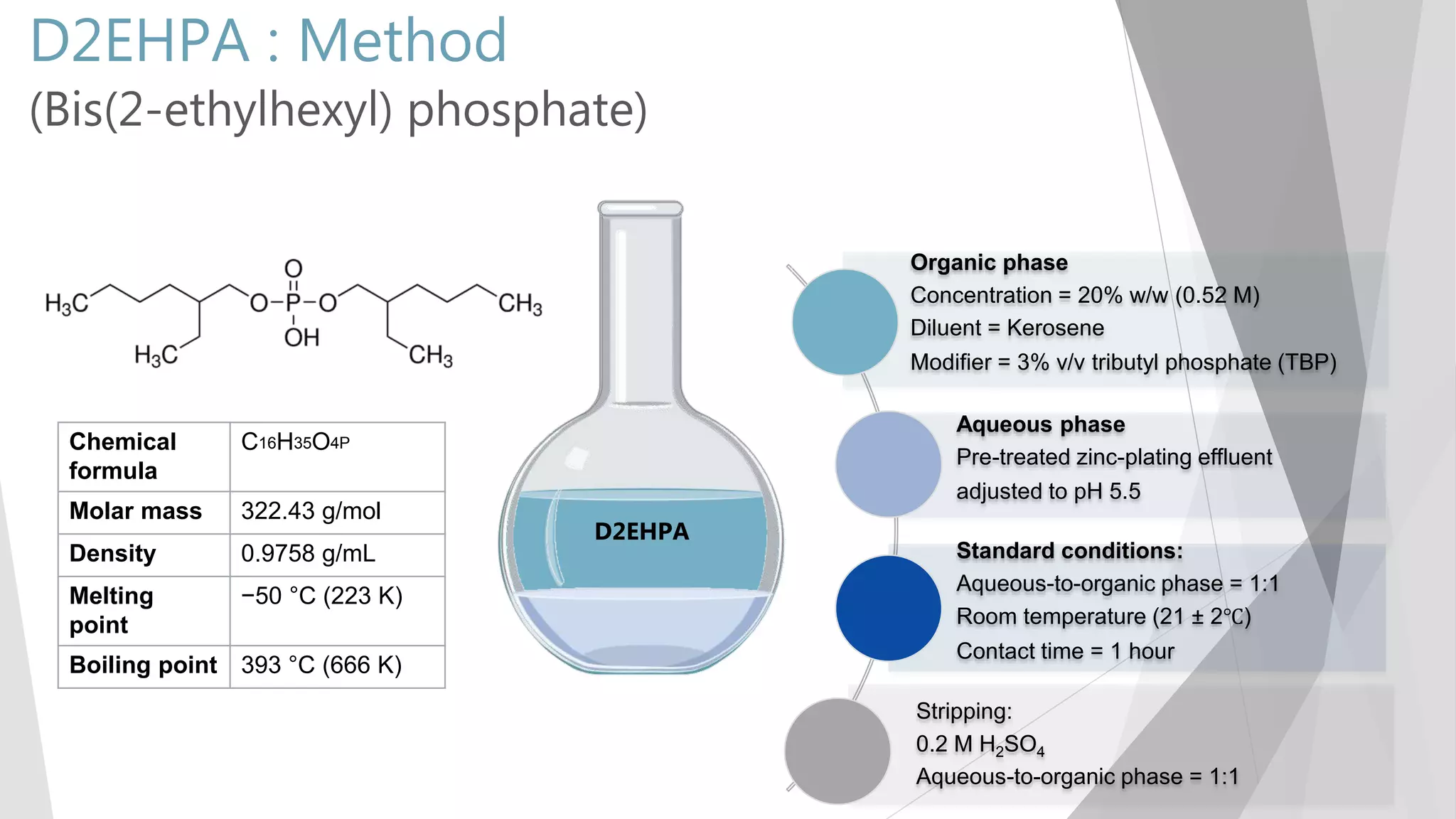
Organic phase
Concentration = 20% w/w (0.52 M)
Diluent = Kerosene
Modifier = 3% v/v tributyl phosphate (TBP)
Aqueous phase
Pre-treated zinc-plating effluent
adjusted to pH 5.5
Standard conditions:
Aqueous-to-organic phase = 1:1
Room temperature (21 ± 2℃)
Contact time = 1 hour
Stripping:
0.2 M H2SO4
Aqueous-to-organic phase = 1:1
D2EHPA
D2EHPA : Method
(Bis(2-ethylhexyl) phosphate)
Chemical
formula
C16H35O4P
Molar mass 322.43 g/mol
Density 0.9758 g/mL
Melting
point
−50 °C (223 K)
Boiling point 393 °C (666 K)
Performance tests : D2EHPA
0%
10%
20%
30%
40%
50%
60%
70%
80%
90%
100%
0 5 15 30 45 60
ExtractionEfficiency(%)
Contact time (minutes)
Fe
Zn
Contact time
D2EHPA
D2EHPA : Results
(Bis(2-ethylhexyl) phosphate)
Maximum extraction:
• 5 minutes
• 98% Zn (352 ± 8
mg/L)
• 71% Fe (10 ± 9
mg/L)
Effect of contact time on extraction efficiency of solvent extraction of Zn and Fe from pretreated zinc-
plating effluent (pH adjusted to 5.5) using 20% (w/w) D2EHPA in kerosene and 3% TBP (A/O: 1:1,
21 ± 2℃, 1 h, 2 replicates). The error bars depict mean absolute deviations (with values below 0.2%;
Reusability
D2EHPA
D2EHPA : Results
(Bis(2-ethylhexyl) phosphate)
Extraction (A) Stripping (B)
0%
10%
20%
30%
40%
50%
60%
70%
80%
90%
100%
1 2 3
ExtractionEfficiency(%)
Cycle
Zn
Fe
0%
10%
20%
30%
40%
50%
60%
70%
80%
90%
100%
1 2 3
StrippingEfficiency(%)
Cycle
Zn
Fe
(A) Extraction efficiency of liquid-liquid extraction of pH-
pretreated (pH 5.5) zinc-plating effluent with 20% w/w
D2EHPA in kerosene and 3% v/v TBP (A/O = 1:1, 21 ±
2℃, 5 min., 3 replicates). Error bars depict standard
Stripping efficiency of zinc with 0.6 M H2SO4 (A/O =
1:1, 21 ± 2℃, 1 h, 3 replicates) in 3 consecutive
cycles. The error bars depict standard deviations.
0
1000
2000
3000
4000
5000
6000
7000
0 7 25 52 71 103 106 107 117
[Zn](mg/L)inorganicphase
[Zn] (mg/L) in aqueous phase
Loading Capacity
D2EHPA
D2EHPA : Results
(Bis(2-ethylhexyl) phosphate)
Maximum loading capacity not
reached even after A/O ratio of
35:1 (loading capacity of 6,024 
7 mg/L)
Equilibrium isotherm (loading capacity) of Zn extraction of pretreated zinc-plating effluent (pH 5.5)
at 21±2°C using 20% (w/w) D2EHPA in kerosene with 3% (v/v) TBP as modifier (21 ± 2℃, 5 min.,
2 replicates). The error bars depict mean absolute deviations (smaller than the symbols in most
Ionic Liquids
(Cyphos® 102, 103 & 104)
Liquid-liquid extraction of Zn and Fe from zinc-plating effluent with 0.04 M and 0.08
M Cyphos® 102, 0.04 M Cyphos® 103 and 0.04 M Cyphos® 104 liquids diluted in
toluene (A/O: 1:1, 25 ± 2℃, 30 min. 2 replicates). Concentration of Fe in loaded
organic phase from liquid-liquid extraction with 0.08 M Cyphos® 102 < 0.5 mg/L.
The error bars depict mean absolute deviations.
0%
10%
20%
30%
40%
50%
60%
70%
80%
90%
100%
ExtractionEfficiency(%)
Ionic liquid
Zn Fe
Ionic liquids : extractant screening
Selectivity towards Zn over Fe
Chemical
formula
C32H68BrP
Molar mass 563.76 g/mol
Density 0.96 g/mL at 20oC
Screening Tests
(ionic liquids screening diluents & modifiers screening,
stripping solutions screening)
Optimization
(extractant-to-zinc ratios)
Performance tests
(Contact time, reusability, loading capacity)
Experimental Scheme
Ionic liquids screening
Effect of diluents on solvent extraction efficiency of Zn and Fe from zinc-plating
effluent with 0.08 M Cyphos® 102 (A/O = 1:1, 25 ± 2 ℃, 30 min. 3 replicates).
Concentrations of Fe in loaded organic phase < 0.5 mg/L. The error bars are
standard deviations.
0%
10%
20%
30%
40%
50%
60%
70%
80%
90%
100%
Toluene Kerosene
ExtractionEfficiency(%)
Diluent
Zn
Fe
Cyphos® 102 (Trihexyl(tetradecyl)phosphinium bromide)
Screening Tests
(ionic liquids screening diluents & modifiers screening,
stripping solutions screening)
Optimization
Cyphos®102
(extractant-to-zinc ratios)
Performance tests
(Contact time, reusability, loading capacity)
Experimental Scheme
Diluents screening
83%.
But extractant was not completely
soluble in the diluent.
Selected for further tests
Effect of modifiers on solvent extraction efficiency of Zn and Fe from zinc-plating
effluent with 0.08 M Cyphos® 102 diluted in kerosene (25 ± 2 ℃, Contact time =
30 min.). Concentrations of Fe in loaded organic phase < 0.5 mg/L. The error bars
depict standard deviations for liquid-liquid extractions performed with no modifier
carried out in 3 replicates. Liquid-liquid extractions performed with modifiers were
carried out just with 1 replicate.
✥Ionic liquid not soluble in the tested diluent (and modifier).
0%
10%
20%
30%
40%
50%
60%
70%
80%
90%
100%
No modifier✥ 3% TBP✥ 3% octanol 3% decanol
ExtractionEfficiency(%)
Modifier
Zn
Fe
Screening Tests
(ionic liquids screening diluents & modifiers screening,
stripping solutions screening)
Optimization
Cyphos®102
(extractant-to-zinc ratios)
Performance tests
(Contact time, reusability, loading capacity)
Experimental Scheme
Modifier screening
Ionic liquid not soluble in
kerosene and TBP.
40%.
Selected for
further tests
Cyphos® 102 (Trihexyl(tetradecyl)phosphinium
bromide)
Screening Tests
(ionic liquids screening diluents & modifiers screening,
stripping solutions screening)
Optimization
Cyphos®102
(extractant-to-zinc ratios)
Performance tests
(Contact time, reusability, loading capacity)
Experimental Scheme Stripping solution screening
Cyphos® 102 (Trihexyl(tetradecyl)phosphinium
bromide)
0%
10%
20%
30%
40%
50%
60%
70%
80%
90%
100%
StrippingEfficiency(%)
Stripping solution (A/O = 1:1)
Screening of stripping solutions for the removal of Zn from loaded organic
phase of raw zinc-plating effluent extracted by liquid-liquid extraction with
0.08 M Cyphos® 102 in kerosene with no modifier (A/O = 1:1, 25 ± 2℃, 30
min., 1 replicate).
Screening Tests
(ionic liquids screening diluents & modifiers screening,
stripping solutions screening)
Optimization
Cyphos®104
(pH pretreatment)
Performance tests
(Contact time, reusability, loading capacity)
Experimental Scheme Diluents screening
Cyphos® 104
(Trihexyltetradecylphosphonium bis(2,4,4-
trimethylpentyl)phosphinate )
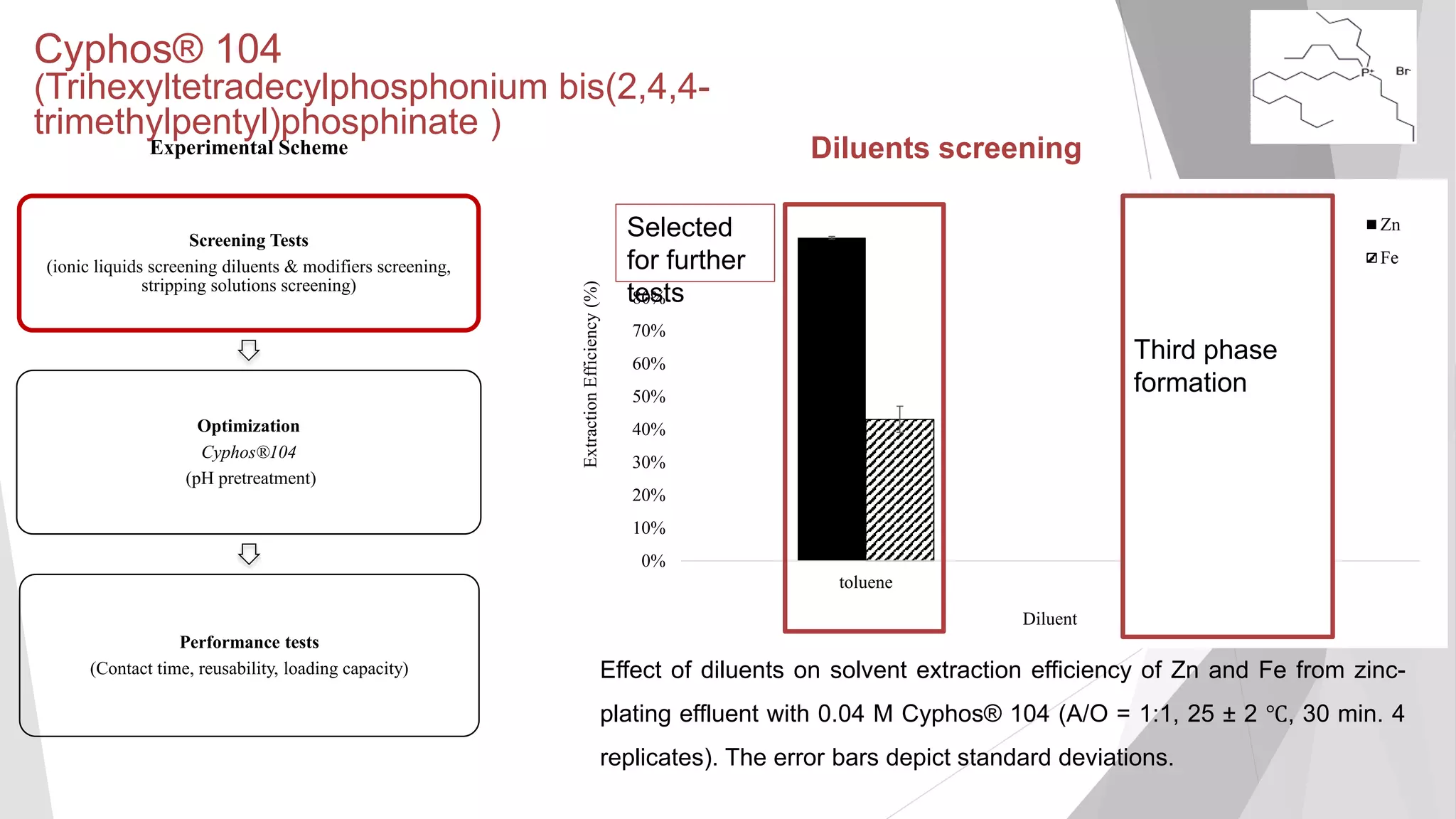
Effect of diluents on solvent extraction efficiency of Zn and Fe from zinc-
plating effluent with 0.04 M Cyphos® 104 (A/O = 1:1, 25 ± 2 ℃, 30 min. 4
replicates). The error bars depict standard deviations.
0%
10%
20%
30%
40%
50%
60%
70%
80%
90%
100%
toluene keroseneExtractionEfficiency(%)
Diluent
Zn
Fe
Third phase
formation
Selected
for further
tests
Screening Tests
(ionic liquids screening diluents & modifiers screening,
stripping solutions screening)
Optimization
Cyphos®104
(pH pretreatment)
Performance tests
(Contact time, reusability, loading capacity)
Experimental Scheme Stripping solution screening
Cyphos® 104
(Trihexyltetradecylphosphonium bis(2,4,4-
trimethylpentyl)phosphinate )
0%
10%
20%
30%
40%
50%
60%
70%
80%
90%
100%
StrippingEfficiency(%)
Stripping solution
Zn
Fe
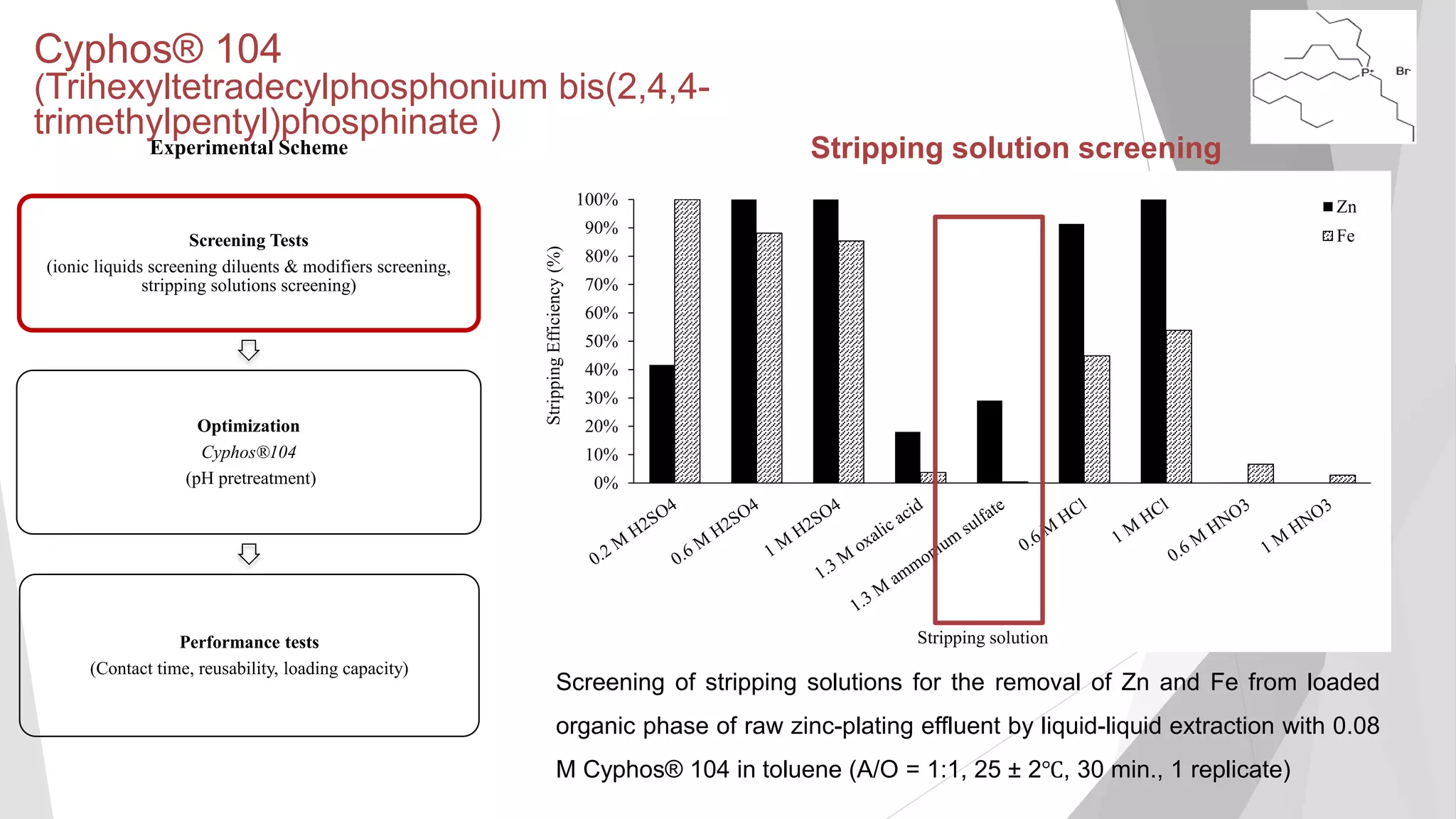
Screening of stripping solutions for the removal of Zn and Fe from loaded
organic phase of raw zinc-plating effluent by liquid-liquid extraction with 0.08
M Cyphos® 104 in toluene (A/O = 1:1, 25 ± 2℃, 30 min., 1 replicate)
Optimization : Cyphos® 102 & Cyphos®
104
Screening Tests
(ionic liquids screening diluents & modifiers screening,
stripping solutions screening)
Optimization
Cyphos®102
(extractant-to-zinc ratios)
Performance tests
(Contact time, reusability, loading capacity)
Experimental Scheme
Cyphos® 102 (Trihexyl(tetradecyl)phosphinium
bromide)
Aqueous-to-organic phase
ratio
Extractant concentration
Screening Tests
(ionic liquids screening diluents & modifiers screening,
stripping solutions screening)
Optimization
Cyphos®102
(extractant-to-zinc ratios)
Performance tests
(Contact time, reusability, loading capacity)
Experimental Scheme
Cyphos® 102 (Trihexyl(tetradecyl)phosphinium
bromide) Aqueous-to-organic phase
ratio
0%
10%
20%
30%
40%
50%
60%
70%
80%
90%
100%
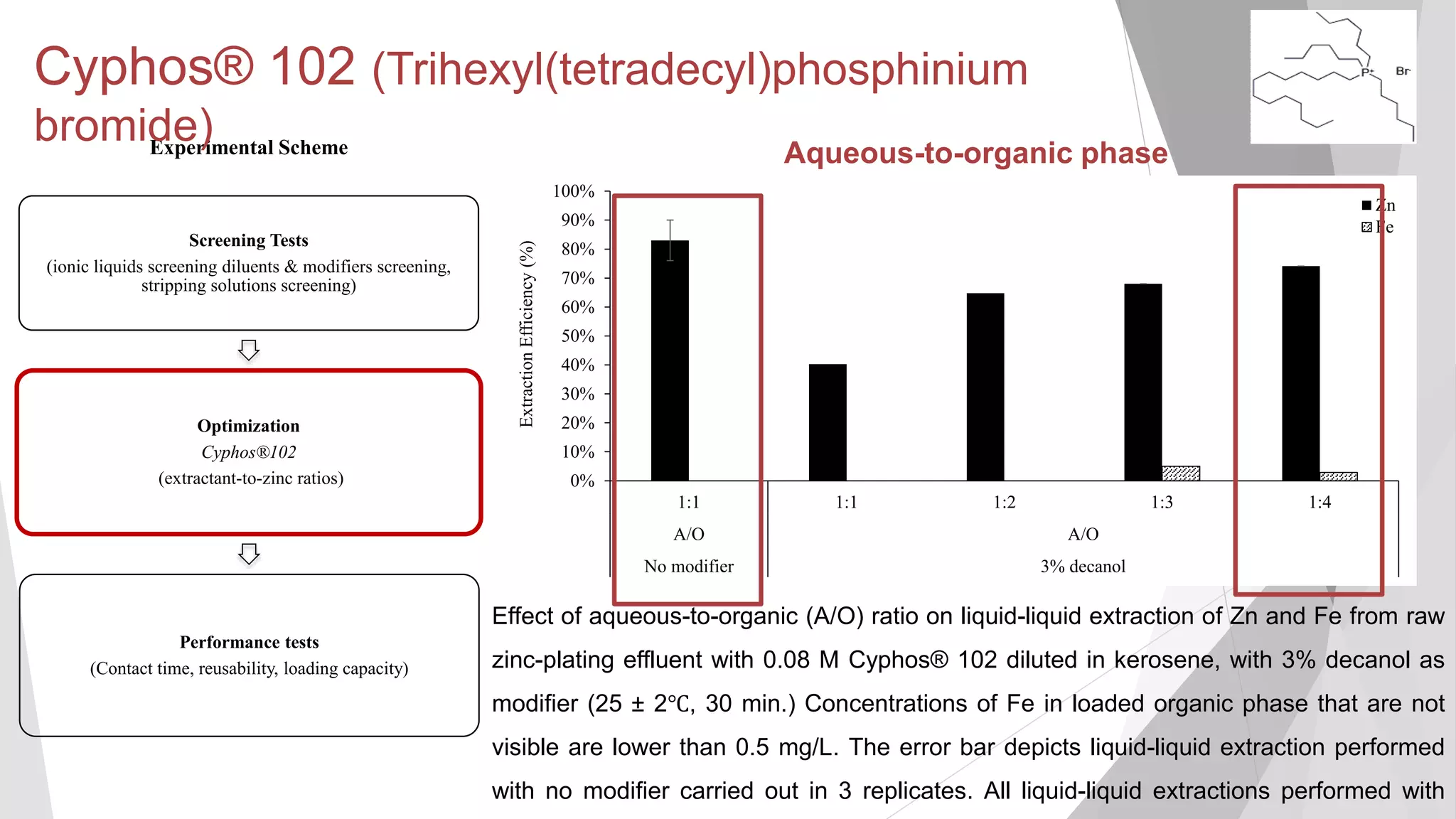
1:1 1:1 1:2 1:3 1:4
A/O A/O
No modifier 3% decanol
ExtractionEfficiency(%)
Zn
Fe
Effect of aqueous-to-organic (A/O) ratio on liquid-liquid extraction of Zn and Fe from raw
zinc-plating effluent with 0.08 M Cyphos® 102 diluted in kerosene, with 3% decanol as
modifier (25 ± 2℃, 30 min.) Concentrations of Fe in loaded organic phase that are not
visible are lower than 0.5 mg/L. The error bar depicts liquid-liquid extraction performed
with no modifier carried out in 3 replicates. All liquid-liquid extractions performed with
Screening Tests
(ionic liquids screening diluents & modifiers screening,
stripping solutions screening)
Optimization
Cyphos®102
(extractant-to-zinc ratios)
Performance tests
(Contact time, reusability, loading capacity)
Experimental Scheme
Cyphos® 102 (Trihexyl(tetradecyl)phosphinium
bromide) Extractant concentration
(extraction)
0%
10%
20%
30%
40%
50%
60%
70%
80%
90%
100%
0.16 M 0.24 M
ExtractionEfficiency(%)
Cyphos®102 concentration (M)
Zn
Fe
Effect of extractant concentration (0.16 M and 0.24 M) of Cyphos® 102
in kerosene and 3% decanol (A/O = 1:1, 25 ± 2℃, 30 min.) on the
extraction efficiency of Zn and Fe from raw zinc-plating effluent
95% extraction
efficiency for Zn.
High selectivitySeparated into 2 layers.
Separate stripping shows:
• 25 ± 7% of Zn in the top layer
• 75% ± 7% Zn in the bottom layer
The reusability study should
provide more conclusive result.
Screening Tests
(ionic liquids screening diluents & modifiers screening,
stripping solutions screening)
Optimization
Cyphos®104
(pH pretreatment)
Performance tests
(Contact time, reusability, loading capacity)
Experimental Scheme pH pretreatment
(extraction)
Cyphos® 104
(Trihexyltetradecylphosphonium bis(2,4,4-
trimethylpentyl)phosphinate )
0%
10%
20%
30%
40%
50%
60%
70%
80%
90%
100%
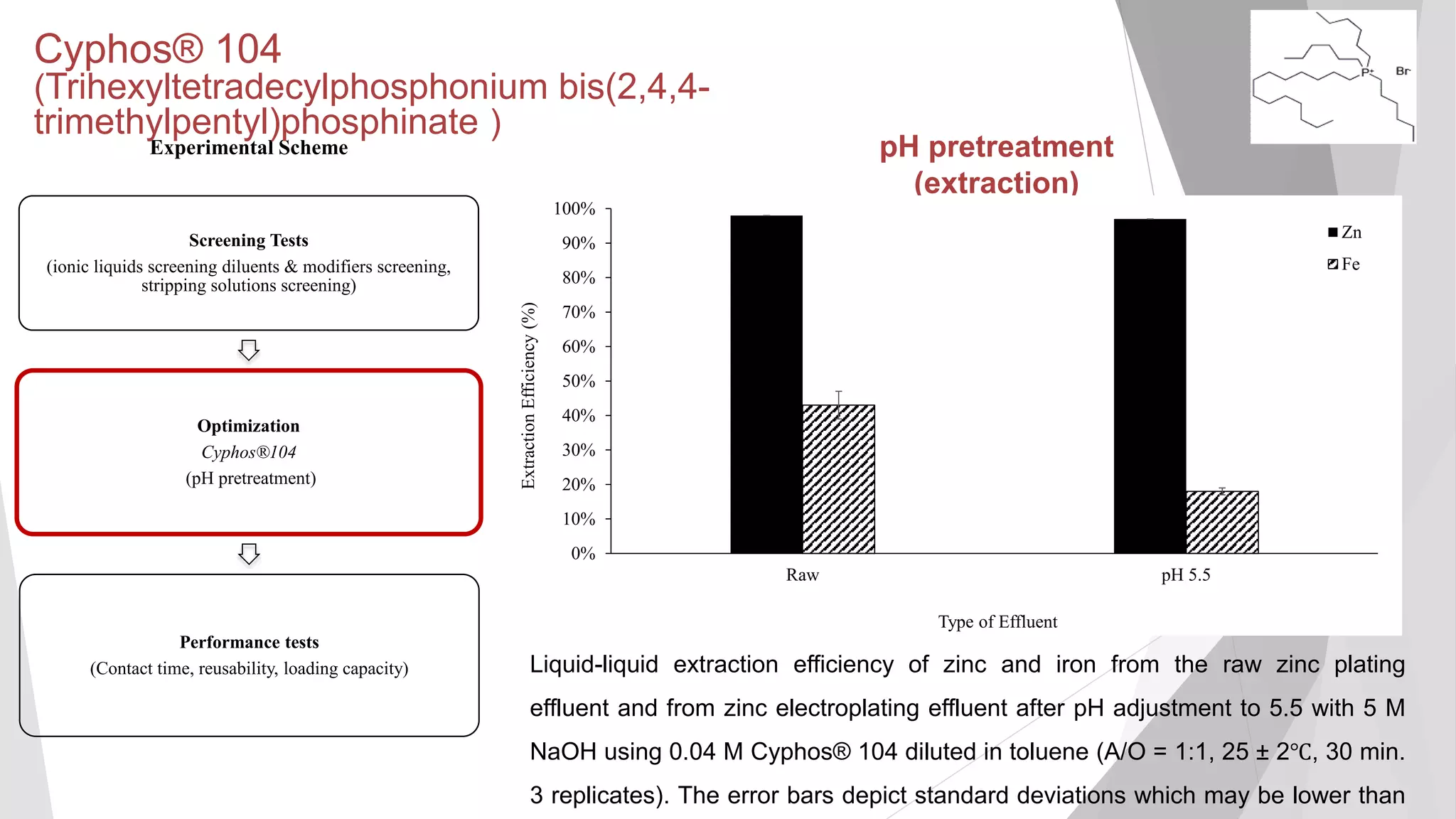
Raw pH 5.5
ExtractionEfficiency(%)
Type of Effluent
Zn
Fe
Liquid-liquid extraction efficiency of zinc and iron from the raw zinc plating
effluent and from zinc electroplating effluent after pH adjustment to 5.5 with 5 M
NaOH using 0.04 M Cyphos® 104 diluted in toluene (A/O = 1:1, 25 ± 2℃, 30 min.
3 replicates). The error bars depict standard deviations which may be lower than
Screening Tests
(ionic liquids screening diluents & modifiers screening,
stripping solutions screening)
Optimization
Cyphos®104
(pH pretreatment)
Performance tests
(Contact time, reusability, loading capacity)
Experimental Scheme pH pretreatment
(stripping)
Cyphos® 104
(Trihexyltetradecylphosphonium bis(2,4,4-
trimethylpentyl)phosphinate )
Screening of stripping solutions for the removal of Zn and Fe from loaded organic
phase of pretreated (pH 5.5) zinc-plating effluent by liquid-liquid extraction with 0.08
M Cyphos® 104 in toluene (A/O = 1:1, 25 ± 2℃, 30 min., 1 replicate). The error
bars depict standard deviations which may be lower than 1% and thus may not be
visible.
0%
10%
20%
30%
40%
50%
60%
70%
80%
90%
100%
StrippingEfficiency(%)
Stripping Solution
Zn
Fe
Organic phase
Concentration = 0.24 M
Diluent = kerosene
Modifier = 3% (v/v) decanol
Aqueous phase
Raw zinc-plating effluent
Standard conditions:
Aqueous-to-organic phase =
1:1
Room temperature (25 ± 2℃)
Contact time = 30 minutes
Stripping
Stripping solution = 2M HNO3
Aqueous-to-organic phase = 1:1
CYPHOS®102 : Method
(Trihexyl(tetradecyl)phosphinium bromide)
Performance tests : Cyphos® 102
CYPHOS®102 : Results
(Trihexyl(tetradecyl)phosphinium bromide)
0%
10%
20%
30%
40%
50%
60%
70%
80%
90%
100%
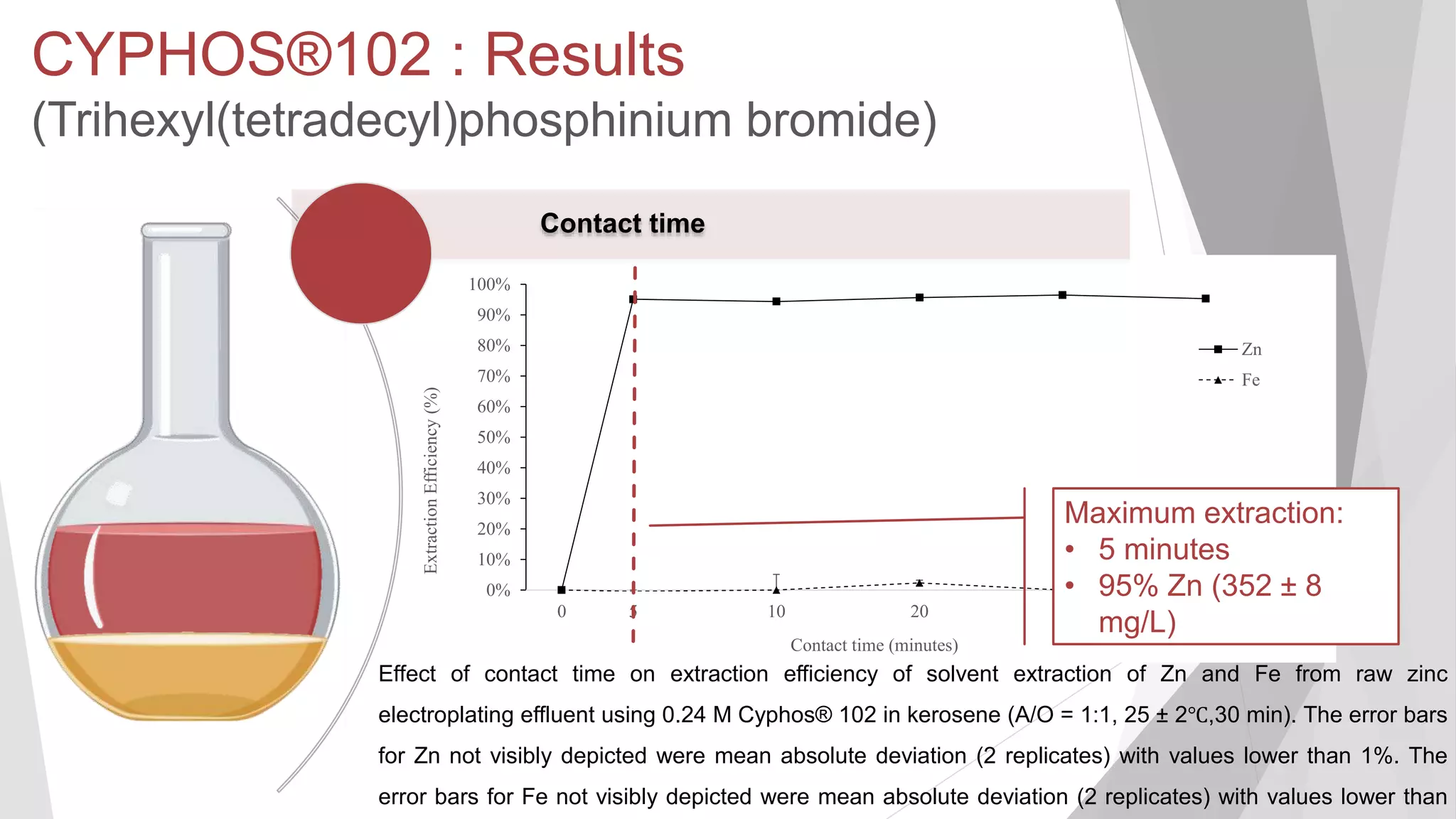
0 5 10 20 30 40
ExtractionEfficiency(%)
Contact time (minutes)
Zn
Fe
Effect of contact time on extraction efficiency of solvent extraction of Zn and Fe from raw zinc
electroplating effluent using 0.24 M Cyphos® 102 in kerosene (A/O = 1:1, 25 ± 2℃,30 min). The error bars
for Zn not visibly depicted were mean absolute deviation (2 replicates) with values lower than 1%. The
error bars for Fe not visibly depicted were mean absolute deviation (2 replicates) with values lower than
Contact time
Maximum extraction:
• 5 minutes
• 95% Zn (352 ± 8
mg/L)
Reusability
CYPHOS®102 : Results
(Trihexyl(tetradecyl)phosphinium bromide)
0%
10%
20%
30%
40%
50%
60%
70%
80%
90%
100%
1 2
ExtractionEfficiency(%)
Cycle
Zn Fe
Extraction efficiency of liquid-liquid extraction of
Zn and Fe from raw zinc-plating effluent with
0.24 M Cyphos® 102 diluted in kerosene in 2
consecutive cycles (A/O = 1:1, 25 ± 2℃, 30
min.) The error bars not visibly depicted were
mean absolute deviations (2 replicates) with
0%
10%
20%
30%
40%
50%
60%
70%
80%
90%
100%
1 2
StrippingEfficiency(%)
Cycle
Stripping efficiency of Zn from raw zinc-plating
effluent with 2 M HNO3 in 2 consecutive cycles
(A/O = 1:1, 25 ± 2℃,1 h). Concentrations of Fe
not visible < 0.9 mg/L. The error bars not visibly
depicted were mean absolute deviations (2
replicates) with values lower than 1%.
54%
95%
99%
5%
Loading capacity
CYPHOS®102 : Results
(Trihexyl(tetradecyl)phosphinium bromide)
0
400
800
1200
1600
2000
0 16 50 62 88 158
[Zn](mg/L)inorganicphase
[Zn] (mg/L) in aqueous phase
Equilibrium isotherm of Zn extraction of raw zinc-plating effluent at 25±2°C using 0.24
M Cyphos® 102 in kerosene with 3% (v/v) decanol as modifier (25 ± 2℃, 130 min.).
The error bars not visibly depicted were mean absolute deviation (2 replicates) of less
Maximum loading capacity not
reached even after A/O ratio of
10:1 (loading capacity of 1,617 
2 mg/L)
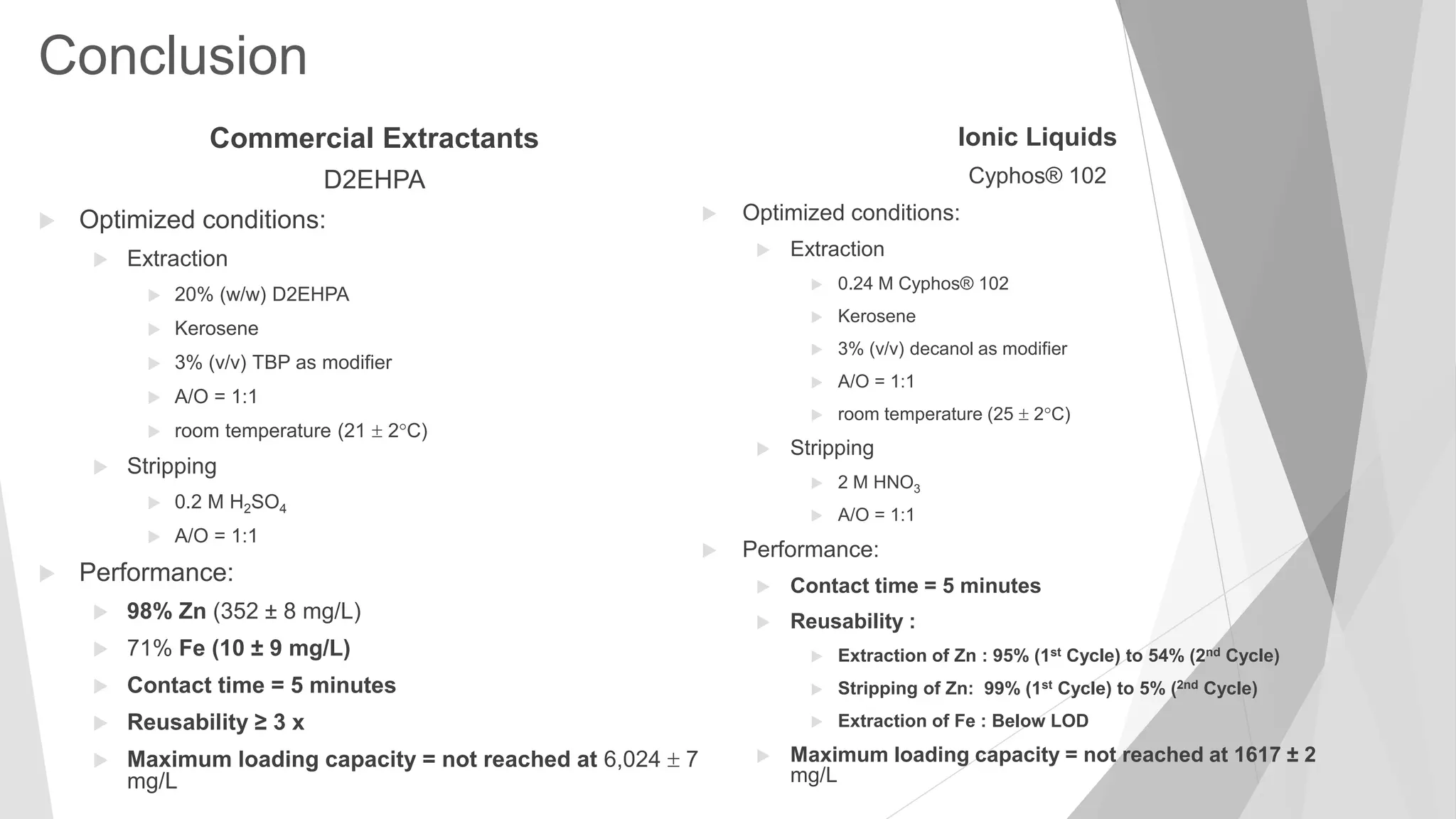
Conclusion
Commercial Extractants
D2EHPA
 Optimized conditions:
 Extraction
 20% (w/w) D2EHPA
 Kerosene
 3% (v/v) TBP as modifier
 A/O = 1:1
 room temperature (21  2C)
 Stripping
 0.2 M H2SO4
 A/O = 1:1
 Performance:
 98% Zn (352 ± 8 mg/L)
 71% Fe (10 ± 9 mg/L)
 Contact time = 5 minutes
 Reusability ≥ 3 x
 Maximum loading capacity = not reached at 6,024  7
mg/L
Ionic Liquids
Cyphos® 102
 Optimized conditions:
 Extraction
 0.24 M Cyphos® 102
 Kerosene
 3% (v/v) decanol as modifier
 A/O = 1:1
 room temperature (25  2C)
 Stripping
 2 M HNO3
 A/O = 1:1
 Performance:
 Contact time = 5 minutes
 Reusability :
 Extraction of Zn : 95% (1st Cycle) to 54% (2nd Cycle)
 Stripping of Zn: 99% (1st Cycle) to 5% (2nd Cycle)
 Extraction of Fe : Below LOD
 Maximum loading capacity = not reached at 1617 ± 2
mg/L
Conclusion
Commercial Extractants
D2EHPA
 Optimized conditions:
 Extraction
 20% (w/w) D2EHPA
 Kerosene
 3% (v/v) TBP as modifier
 A/O = 1:1
 room temperature (21  2C)
 Stripping
 0.2 M H2SO4
 A/O = 1:1
 Performance:
 98% Zn (352 ± 8 mg/L)
 71% Fe (10 ± 9 mg/L)
 Contact time = 5 minutes
 Reusability ≥ 3 x
 Maximum loading capacity = not reached at 6,024  7
mg/L
Ionic Liquids
Cyphos® 102
 Optimized conditions:
 Extraction
 0.24 M Cyphos® 102
 Kerosene
 3% (v/v) decanol as modifier
 A/O = 1:1
 room temperature (25  2C)
 Stripping
 2 M HNO3
 A/O = 1:1
 Performance:
 Contact time = 5 minutes
 Reusability :
 Extraction of Zn : 95% (1st Cycle) to 54% (2nd Cycle)
 Stripping of Zn: 99% (1st Cycle) to 5% (2nd Cycle)
 Extraction of Fe : Below LOD
 Maximum loading capacity = not reached at 1617 ± 2
mg/L
Requires further optimization to increase the reusability
of the organic phase requiring the least amount of ionic
liquid
Test the organic phases with a new effluent containing higher concentrations of Zn
Acknowledgements
 This study was performed in the framework of project METALCHEMBIO (no.
29251) financed by national funds through the FCT – Foundation for Science
and Technology and co- financed by the Algarve ́s Regional Operational
Program (CRESC Algarve 2020), through Portugal 2020 and European Regional
Development Fund (FEDER).
 Furthermore, I would like to express my gratitude for everyone involved in the
management and administration of the Erasmus Mundus Master’s in Chemical
Innovations and Regulations program who made it possible for non-European
students like myself to experience academic life in Europe and all the doors this
opportunity opens for each and everyone of us. Special thanks goes to Jorge
Carlier, PhD, for allowing me to learn through trial-and-error while also being
readily available to give me any advice I need along the way. Lastly, I would like
to extend my gratitude to Professor Maria Clara Costa for giving me the
opportunity to be a part of this team.

Sathityatiwat ChIR thesis defense

  • 1.
    Zinc 19% 6% 75% Sources of ZincProduction Secondary sources (reuse) Secondary sources (recycled/recovere d) Uses : coat steel products (60%), die casting in the form of zinc base alloys (15%), brass and bronze (14%) and compounds comprising of zinc sulfate and zinc oxide (8%) Annual consumption : 16 million tons/year Price : US$2,555/ton as of mid- December 2018 1. International Zinc Association. 2019. “ZINC.” ZINC. International Zinc Association. Accessed January 24. http://www.zinc.org/. 2. International Zinc Association. 2015. “Zinc Recycling Material Supply.” Zinc Recycling Material Supply. Retrieved from https://www.zinc.org/wp-content/uploads/sites/4/2015… 3. Tibballs, S. (2018, December 21). Zinc Outlook 2019: A Year That Has to Be Better | INN. Retrieved from https://investingnews.com/daily/resource-investing/base-metals-investing/zinc-investing/zinc-outlook/
  • 2.
    Recovery of zincfrom metal-plating industrial wastewaters by liquid-liquid extraction Suthapat Sathityatiwat(a), Jorge Daniel Dias Carlier(a), Maria Clara Costa(a) a) Centre of Marine Sciences and Department of Chemistry and Pharmacy of Faculty of Science and Technology, University of Algarve, Campus de Gambelas, P-8005-139 Faro, Portugal
  • 3.
    Zinc electroplating productionprocess 1. Rusynyk, G. (2012, June 27). Hot-Dip Galvanizing vs Zinc Plating. Retrieved from https://www.portlandbolt.com/technical/faqs/hot-dip-galvanizing-vs-electrogalvanizing-zinc-plating/ 2. . Peters, R. W., Ku, Y., & Bhattacharyya, D. (1985). Evaluation of recent treatment techniques for removal of heavy metals from industrial wastewaters. AIChE Symposium Series,81(243), 165-203. What it is Plating is a surface covering in which a metal is deposited on a conductive surface. Types of metal plating: • Hot-dip galvanization & electroplating • Type of baths: alkaline cyanide zinc, alkaline non-cyanide zinc, and acidic zinc (chloride) Al Mazhar Metal Electroplating. Electroplating. Retrieved August 15, 2019 from http://mazharplating.com/electroplating/
  • 4.
    Zinc electroplating effluent 1. Midwest Metal Products. (2019). Zinc Coatings. Retrieved from http://anglerings.com/Value-Added/Zinc-Coatings 2. Kobya, M., Demirbas, E., Ozyonar, F., Sirtbas, G., & Gengec, E. (2017). Treatments of alkaline non-cyanide, alkaline cyanide and acidic zinc electroplating wastewaters by electrocoagulation. Process Safety and Environmental Protection,105, 373-385. doi:10.1016/j.psep.2016.11.020 European standards for neutralized industrial wastewaters: • Fe ≤ 10 mg/L • Zn ≤ 2 mg/L • Cl- ≤ 1 g/L • pH 6-9 Zinc electroplating effluent being tested • Industrial Goñabe, Valladolid, Spain • Electroplating • Type of baths: acidic zinc (chloride) Initial characterization of zinc-plating effluent Metal Sample Concentration (mg/L) pH (Sorensen scale) SO4 2- (mg/L) Eh (mV) Cl- (mg/L; media) Zn 360 ± 8 2.0 ± 0.2 49 501 1036 Fe 124 ± 8 Cu 2.66 ± 0.03 Cr 2.12 ± 0.06 Mn 1.59 ± 0.02 *The main iron specie was Fe(III), determined using AccuVac® Ampuls (Method 8146). Hotdegrease Hotrinse Hotrinse Pickling Coldrinse Coldrinse Zn electroplating Coldrinse Coldrinse Crpassivation Coldrinse Coldrinse Material flow Water flow Zinc-plating wastewater
  • 5.
    Traditional zinc recoverytechniques for zinc electroplating wastewaters  Approximately 75% uses carbonates, hydroxides, sulfides or combination of these treatments to precipitate Fe and also Cd.  Recover Zn be eletrowinning.  Disadvantages:  silt is formed as by-product  Possible loss of certain amount of target metal  Not ideal for lower concentrations of Zn 1. Peters, R. W., Ku, Y., & Bhattacharyya, D. (1985). Evaluation of recent treatment techniques for removal of heavy metals from industrial wastewaters. AIChE Symposium Series,81(243), 165-203. 2. Ríos, A. P., Hernández-Fernández, F. J., Lozano, L. J., Sánchez, S., Moreno, J. I., & Godínez, C. (2010). Removal of Metal Ions from Aqueous Solutions by Extraction with Ionic Liquids†. Journal of Chemical & Engineering Data, 55(2), 605-608. doi:10.1021/je9005008 3. VITO. (2015). energie- en milieu-informatiesysteem voor het Vlaamse Gewest. Retrieved from https://emis.vito.be/en/techniekfiche/chemical-precipitation Cleaneat. (2017, May 5). Sewage, Wastewater treatment and pipe cleaning Services in Lagos. Retrieved from https://cleaneat.com.ng/sewage-wastewater- treatment/
  • 6.
  • 7.
    Challenges in liquid-liquidextraction of metals Co-extraction  Caused be low selectivity of extractant towards target metal  Can be resolved by: - Selective stripping - Scrubbing - Removal of the metal from the effluent by pretreatment (ie. pH-adjustment) Third-phase formation  Caused by polymerization of extractant-metal complexes  Can be resolved by: - Removal of the metal from the effluent by pretreatment (ie. pH-adjustment) https://patents.google.com/patent/US4235713A/en)
  • 8.
    Experimental Scheme Screening Tests (diluents& modifiers screening, stripping solutions screening) Optimization: Iron Removal (Scrubbing solutions screening, pH pretreatment) Performance tests (Contact time, reusability, loading capacity) Screening Tests (ionic liquids screening, diluents & modifiers screening, stripping solutions screening) Optimization Cyphos® 102 (extractant-to-zinc ratios) Cyphos® 104 (pH pretreatment) Performance tests (Contact time, reusability, loading capacity) Commercial extractants (D2EHPA & Cyanex® 272) Ionic liquids (Cyphos® 102, Cyphos® 103, Cyphos® 104)
  • 9.
  • 10.
    D2EHPA (bis(2-ethylhexyl)phosphate) 20% (w/w) ScreeningTests (diluents & modifiers screening, stripping solutions screening) Optimization: Iron Removal (Scrubbing solutions screening, pH pretreatment) Performance tests (Contact time, reusability, loading capacity) Experimental scheme 0% 10% 20% 30% 40% 50% 60% 70% 80% 90% 100% 6%(v/v)Dodecanol*✢ 3%(v/v)TBP* 5%(v/v)TBP** 3%(v/v)Octanol*** 5%(v/v)Octanol*** 20%(v/v)Octanol Nomodifier 3%(v/v)TBP** 5%(v/v)TBP** 7%(v/v)TBP** 3%(v/v)Decanol** 7%(v/v)Decanol** Nomodifier 3%(v/v)TBP** 5%(v/v)TBP** 7%(v/v)TBP** 3%(v/v)Decanol** 7%(v/v)Decanol** Kerosene SHELLSOL D70 SHELL GTL ExtractionEfficiency(%) Diluent and modifier Zn Fe Effect of diluents and modifiers on solvent extraction efficiency of Zn and Fe from zinc-plating effluent with 20% (w/w) D2EHPA (A/O: 1:1, 21 ± 2℃, 1 h, no replicates) *Thin layer of third phase observed. **Moderate layer of third phase observed. ***Large layer of third phase observed. ✢Modifier solidified at 21  2C. Diluents & modifiers screening Highest selectivity Lowest third phase formation
  • 11.
    D2EHPA (bis(2-ethylhexyl)phosphate) Screening Tests (diluents& modifiers screening, stripping solutions screening) Optimization: Iron Removal (Scrubbing solutions screening, pH pretreatment) Performance tests (Contact time, reusability, loading capacity) Experimental scheme 0% 10% 20% 30% 40% 50% 60% 70% 80% 90% 100% StrippingEfficiency(%) Stripping solution Zn Fe Screening of stripping solutions for the removal of Zn and Fe from loaded organic phase of zinc-plating effluent extracted by solvent extraction using 20% w/w D2EHPA in kerosene and 3% (v/v) TBP (A/O = 1:1, 21 ± 2℃, 1 h). Concentrations of stripped Fe < 0.25 mg/L. The error bars are mean absolute deviations (2 replicates). Stripping solutions screening Suggested by Ali et al. (2006) that the use of HNO3 as a stripping solution was observed to negatively affect the subsequent electrowinning step. Therefore, 0.2 M H2SO4 was selected as the stripping solution Ali, A., Ahmad, I., & Daoud, J. (2006). CYANEX 272 for the extraction and recovery of zinc from aqueous waste solution using a mixer-settler unit. Separation and Purification Technology,47(3), 135-140. doi:10.1016/j.seppur.2005.06.015
  • 12.
    Cyanex 272 (bis(2,4,4-trimethylpentyl)phosphinicacid ) 20% (w/w) active compound Screening Tests (diluents & modifiers screening, stripping solutions screening) Optimization: Iron Removal (Scrubbing solutions screening, pH pretreatment) Performance tests (Contact time, reusability, loading capacity) Experimental scheme Diluents & modifiers screening 0% 10% 20% 30% 40% 50% 60% 70% 80% 90% 100% nomodifier**** 3%(v/v)TBP*** 7%(v/v)TBP*** nomodifier*** 3%(v/v)TBP** 7%(v/v)TBP** nomodifier*** Escaid 102 SHELLSOL D70 SHELL GTL ExtractionEfficiency(%) Diluent (and modifier) Zn Fe Effect of diluents and modifiers on solvent extraction efficiency of Zn and Fe from zinc- plating effluent with 0.55 M Cyanex® 272 (A/O: 1:1, 21 ± 2℃, 1 h). All liquid-liquid extractions performed with no modifier were carried out in 2 replicates. In such cases, the error bars depicted mean absolute deviations. *Thin layer of third phase **Moderate layer of third phase ***Large layer of third phase Extract more iron (Fe(III))
  • 13.
    Cyanex 272 (bis(2,4,4-trimethylpentyl)phosphinicacid ) Screening Tests (diluents & modifiers screening, stripping solutions screening) Optimization: Iron Removal (Scrubbing solutions screening, pH pretreatment) Performance tests (Contact time, reusability, loading capacity) Experimental scheme Stripping using 0.2 M H2SO4 0% 10% 20% 30% 40% 50% 60% 70% 80% 90% 100% StrippingEfficiency(%) Diluent (+ modifier) Zn Fe Stripping of Zn and Fe from several loaded organic phases (0.55 M Cyanex® 272) composed by different diluents with or without a modifier (TBP) using 0.2 M H2SO4 (A/O: 1:1, 21 ± 2℃, 1 h, 2 replicates). The error bars depicted mean absolute deviations and are not visible for values below 1%.
  • 14.
  • 15.
    D2EHPA (bis(2-ethylhexyl)phosphate) Screening Tests (diluents& modifiers screening, stripping solutions screening) Optimization: Iron Removal (Scrubbing solutions screening, pH pretreatment) Performance tests (Contact time, reusability, loading capacity) Experimental scheme Scrubbing solutions screening 0% 10% 20% 30% 40% 50% 60% 70% 80% 90% 100% 6 M HCl Sea water 1.3 M oxalic acid 1.3 M (NH₄)₂SO₄ ScrubbingEfficiency(%) Scrubbing Solution Screening of scrubbing solutions for the removal of Fe from zinc stripped loaded organic phase resulting from zinc-plating effluent extracted using 20% (w/w) D2EHPA in kerosene and 3% (v/v) TBP (A/O = 1:1, 21 ± 2℃, 1 h, 2 replicates). The error bars depicted mean absolute deviations and are not 69% Still relatively low and will require multiple scrubbing steps
  • 16.
    D2EHPA (bis(2-ethylhexyl)phosphate) Screening Tests (diluents& modifiers screening, stripping solutions screening) Optimization: Iron Removal (Scrubbing solutions screening, pH pretreatment) Performance tests (Contact time, reusability, loading capacity) Experimental scheme pH pretreatment 0 20 40 60 80 100 120 140 0 50 100 150 200 250 300 350 400 2 3 4 5 5.5 6 7 8 9 10 11 FeConcentration(mg/L) ZnConcentration(mg/L) pH Zn Fe Effect of pH adjustment with 5 M NaOH on Zn and Fe concentrations in zinc-plating effluent. Error bars are standard deviations (3 replicates) and in some cases are smaller than the symbols, thus not visible.
  • 17.
    D2EHPA (bis(2-ethylhexyl)phosphate) Screening Tests (diluents& modifiers screening, stripping solutions screening) Optimization: Iron Removal (Scrubbing solutions screening, pH pretreatment) Performance tests (Contact time, reusability, loading capacity) Experimental scheme pH pretreatment 0% 10% 20% 30% 40% 50% 60% 70% 80% 90% 100% 2 3 4 5 5.5 6 ExtractionEfficiency(%) pH Effect of pH adjustment with 5 M NaOH on solvent extraction of Zn using 20% (w/w) D2EHPA in kerosene with 3% (v/v) TBP (21 ± 2℃, 1 h, 2 replicates). The error bars depict mean absolute deviations (with values below 0.2%; thus, might
  • 18.
    Organic phase Concentration =20% w/w (0.52 M) Diluent = Kerosene Modifier = 3% v/v tributyl phosphate (TBP) Aqueous phase Pre-treated zinc-plating effluent adjusted to pH 5.5 Standard conditions: Aqueous-to-organic phase = 1:1 Room temperature (21 ± 2℃) Contact time = 1 hour Stripping: 0.2 M H2SO4 Aqueous-to-organic phase = 1:1 D2EHPA D2EHPA : Method (Bis(2-ethylhexyl) phosphate) Chemical formula C16H35O4P Molar mass 322.43 g/mol Density 0.9758 g/mL Melting point −50 °C (223 K) Boiling point 393 °C (666 K)
  • 19.
  • 20.
    0% 10% 20% 30% 40% 50% 60% 70% 80% 90% 100% 0 5 1530 45 60 ExtractionEfficiency(%) Contact time (minutes) Fe Zn Contact time D2EHPA D2EHPA : Results (Bis(2-ethylhexyl) phosphate) Maximum extraction: • 5 minutes • 98% Zn (352 ± 8 mg/L) • 71% Fe (10 ± 9 mg/L) Effect of contact time on extraction efficiency of solvent extraction of Zn and Fe from pretreated zinc- plating effluent (pH adjusted to 5.5) using 20% (w/w) D2EHPA in kerosene and 3% TBP (A/O: 1:1, 21 ± 2℃, 1 h, 2 replicates). The error bars depict mean absolute deviations (with values below 0.2%;
  • 21.
    Reusability D2EHPA D2EHPA : Results (Bis(2-ethylhexyl)phosphate) Extraction (A) Stripping (B) 0% 10% 20% 30% 40% 50% 60% 70% 80% 90% 100% 1 2 3 ExtractionEfficiency(%) Cycle Zn Fe 0% 10% 20% 30% 40% 50% 60% 70% 80% 90% 100% 1 2 3 StrippingEfficiency(%) Cycle Zn Fe (A) Extraction efficiency of liquid-liquid extraction of pH- pretreated (pH 5.5) zinc-plating effluent with 20% w/w D2EHPA in kerosene and 3% v/v TBP (A/O = 1:1, 21 ± 2℃, 5 min., 3 replicates). Error bars depict standard Stripping efficiency of zinc with 0.6 M H2SO4 (A/O = 1:1, 21 ± 2℃, 1 h, 3 replicates) in 3 consecutive cycles. The error bars depict standard deviations.
  • 22.
    0 1000 2000 3000 4000 5000 6000 7000 0 7 2552 71 103 106 107 117 [Zn](mg/L)inorganicphase [Zn] (mg/L) in aqueous phase Loading Capacity D2EHPA D2EHPA : Results (Bis(2-ethylhexyl) phosphate) Maximum loading capacity not reached even after A/O ratio of 35:1 (loading capacity of 6,024  7 mg/L) Equilibrium isotherm (loading capacity) of Zn extraction of pretreated zinc-plating effluent (pH 5.5) at 21±2°C using 20% (w/w) D2EHPA in kerosene with 3% (v/v) TBP as modifier (21 ± 2℃, 5 min., 2 replicates). The error bars depict mean absolute deviations (smaller than the symbols in most
  • 23.
  • 24.
    Liquid-liquid extraction ofZn and Fe from zinc-plating effluent with 0.04 M and 0.08 M Cyphos® 102, 0.04 M Cyphos® 103 and 0.04 M Cyphos® 104 liquids diluted in toluene (A/O: 1:1, 25 ± 2℃, 30 min. 2 replicates). Concentration of Fe in loaded organic phase from liquid-liquid extraction with 0.08 M Cyphos® 102 < 0.5 mg/L. The error bars depict mean absolute deviations. 0% 10% 20% 30% 40% 50% 60% 70% 80% 90% 100% ExtractionEfficiency(%) Ionic liquid Zn Fe Ionic liquids : extractant screening Selectivity towards Zn over Fe Chemical formula C32H68BrP Molar mass 563.76 g/mol Density 0.96 g/mL at 20oC Screening Tests (ionic liquids screening diluents & modifiers screening, stripping solutions screening) Optimization (extractant-to-zinc ratios) Performance tests (Contact time, reusability, loading capacity) Experimental Scheme Ionic liquids screening
  • 25.
    Effect of diluentson solvent extraction efficiency of Zn and Fe from zinc-plating effluent with 0.08 M Cyphos® 102 (A/O = 1:1, 25 ± 2 ℃, 30 min. 3 replicates). Concentrations of Fe in loaded organic phase < 0.5 mg/L. The error bars are standard deviations. 0% 10% 20% 30% 40% 50% 60% 70% 80% 90% 100% Toluene Kerosene ExtractionEfficiency(%) Diluent Zn Fe Cyphos® 102 (Trihexyl(tetradecyl)phosphinium bromide) Screening Tests (ionic liquids screening diluents & modifiers screening, stripping solutions screening) Optimization Cyphos®102 (extractant-to-zinc ratios) Performance tests (Contact time, reusability, loading capacity) Experimental Scheme Diluents screening 83%. But extractant was not completely soluble in the diluent. Selected for further tests
  • 26.
    Effect of modifierson solvent extraction efficiency of Zn and Fe from zinc-plating effluent with 0.08 M Cyphos® 102 diluted in kerosene (25 ± 2 ℃, Contact time = 30 min.). Concentrations of Fe in loaded organic phase < 0.5 mg/L. The error bars depict standard deviations for liquid-liquid extractions performed with no modifier carried out in 3 replicates. Liquid-liquid extractions performed with modifiers were carried out just with 1 replicate. ✥Ionic liquid not soluble in the tested diluent (and modifier). 0% 10% 20% 30% 40% 50% 60% 70% 80% 90% 100% No modifier✥ 3% TBP✥ 3% octanol 3% decanol ExtractionEfficiency(%) Modifier Zn Fe Screening Tests (ionic liquids screening diluents & modifiers screening, stripping solutions screening) Optimization Cyphos®102 (extractant-to-zinc ratios) Performance tests (Contact time, reusability, loading capacity) Experimental Scheme Modifier screening Ionic liquid not soluble in kerosene and TBP. 40%. Selected for further tests Cyphos® 102 (Trihexyl(tetradecyl)phosphinium bromide)
  • 27.
    Screening Tests (ionic liquidsscreening diluents & modifiers screening, stripping solutions screening) Optimization Cyphos®102 (extractant-to-zinc ratios) Performance tests (Contact time, reusability, loading capacity) Experimental Scheme Stripping solution screening Cyphos® 102 (Trihexyl(tetradecyl)phosphinium bromide) 0% 10% 20% 30% 40% 50% 60% 70% 80% 90% 100% StrippingEfficiency(%) Stripping solution (A/O = 1:1) Screening of stripping solutions for the removal of Zn from loaded organic phase of raw zinc-plating effluent extracted by liquid-liquid extraction with 0.08 M Cyphos® 102 in kerosene with no modifier (A/O = 1:1, 25 ± 2℃, 30 min., 1 replicate).
  • 28.
    Screening Tests (ionic liquidsscreening diluents & modifiers screening, stripping solutions screening) Optimization Cyphos®104 (pH pretreatment) Performance tests (Contact time, reusability, loading capacity) Experimental Scheme Diluents screening Cyphos® 104 (Trihexyltetradecylphosphonium bis(2,4,4- trimethylpentyl)phosphinate ) Effect of diluents on solvent extraction efficiency of Zn and Fe from zinc- plating effluent with 0.04 M Cyphos® 104 (A/O = 1:1, 25 ± 2 ℃, 30 min. 4 replicates). The error bars depict standard deviations. 0% 10% 20% 30% 40% 50% 60% 70% 80% 90% 100% toluene keroseneExtractionEfficiency(%) Diluent Zn Fe Third phase formation Selected for further tests
  • 29.
    Screening Tests (ionic liquidsscreening diluents & modifiers screening, stripping solutions screening) Optimization Cyphos®104 (pH pretreatment) Performance tests (Contact time, reusability, loading capacity) Experimental Scheme Stripping solution screening Cyphos® 104 (Trihexyltetradecylphosphonium bis(2,4,4- trimethylpentyl)phosphinate ) 0% 10% 20% 30% 40% 50% 60% 70% 80% 90% 100% StrippingEfficiency(%) Stripping solution Zn Fe Screening of stripping solutions for the removal of Zn and Fe from loaded organic phase of raw zinc-plating effluent by liquid-liquid extraction with 0.08 M Cyphos® 104 in toluene (A/O = 1:1, 25 ± 2℃, 30 min., 1 replicate)
  • 30.
    Optimization : Cyphos®102 & Cyphos® 104
  • 31.
    Screening Tests (ionic liquidsscreening diluents & modifiers screening, stripping solutions screening) Optimization Cyphos®102 (extractant-to-zinc ratios) Performance tests (Contact time, reusability, loading capacity) Experimental Scheme Cyphos® 102 (Trihexyl(tetradecyl)phosphinium bromide) Aqueous-to-organic phase ratio Extractant concentration
  • 32.
    Screening Tests (ionic liquidsscreening diluents & modifiers screening, stripping solutions screening) Optimization Cyphos®102 (extractant-to-zinc ratios) Performance tests (Contact time, reusability, loading capacity) Experimental Scheme Cyphos® 102 (Trihexyl(tetradecyl)phosphinium bromide) Aqueous-to-organic phase ratio 0% 10% 20% 30% 40% 50% 60% 70% 80% 90% 100% 1:1 1:1 1:2 1:3 1:4 A/O A/O No modifier 3% decanol ExtractionEfficiency(%) Zn Fe Effect of aqueous-to-organic (A/O) ratio on liquid-liquid extraction of Zn and Fe from raw zinc-plating effluent with 0.08 M Cyphos® 102 diluted in kerosene, with 3% decanol as modifier (25 ± 2℃, 30 min.) Concentrations of Fe in loaded organic phase that are not visible are lower than 0.5 mg/L. The error bar depicts liquid-liquid extraction performed with no modifier carried out in 3 replicates. All liquid-liquid extractions performed with
  • 33.
    Screening Tests (ionic liquidsscreening diluents & modifiers screening, stripping solutions screening) Optimization Cyphos®102 (extractant-to-zinc ratios) Performance tests (Contact time, reusability, loading capacity) Experimental Scheme Cyphos® 102 (Trihexyl(tetradecyl)phosphinium bromide) Extractant concentration (extraction) 0% 10% 20% 30% 40% 50% 60% 70% 80% 90% 100% 0.16 M 0.24 M ExtractionEfficiency(%) Cyphos®102 concentration (M) Zn Fe Effect of extractant concentration (0.16 M and 0.24 M) of Cyphos® 102 in kerosene and 3% decanol (A/O = 1:1, 25 ± 2℃, 30 min.) on the extraction efficiency of Zn and Fe from raw zinc-plating effluent 95% extraction efficiency for Zn. High selectivitySeparated into 2 layers. Separate stripping shows: • 25 ± 7% of Zn in the top layer • 75% ± 7% Zn in the bottom layer The reusability study should provide more conclusive result.
  • 34.
    Screening Tests (ionic liquidsscreening diluents & modifiers screening, stripping solutions screening) Optimization Cyphos®104 (pH pretreatment) Performance tests (Contact time, reusability, loading capacity) Experimental Scheme pH pretreatment (extraction) Cyphos® 104 (Trihexyltetradecylphosphonium bis(2,4,4- trimethylpentyl)phosphinate ) 0% 10% 20% 30% 40% 50% 60% 70% 80% 90% 100% Raw pH 5.5 ExtractionEfficiency(%) Type of Effluent Zn Fe Liquid-liquid extraction efficiency of zinc and iron from the raw zinc plating effluent and from zinc electroplating effluent after pH adjustment to 5.5 with 5 M NaOH using 0.04 M Cyphos® 104 diluted in toluene (A/O = 1:1, 25 ± 2℃, 30 min. 3 replicates). The error bars depict standard deviations which may be lower than
  • 35.
    Screening Tests (ionic liquidsscreening diluents & modifiers screening, stripping solutions screening) Optimization Cyphos®104 (pH pretreatment) Performance tests (Contact time, reusability, loading capacity) Experimental Scheme pH pretreatment (stripping) Cyphos® 104 (Trihexyltetradecylphosphonium bis(2,4,4- trimethylpentyl)phosphinate ) Screening of stripping solutions for the removal of Zn and Fe from loaded organic phase of pretreated (pH 5.5) zinc-plating effluent by liquid-liquid extraction with 0.08 M Cyphos® 104 in toluene (A/O = 1:1, 25 ± 2℃, 30 min., 1 replicate). The error bars depict standard deviations which may be lower than 1% and thus may not be visible. 0% 10% 20% 30% 40% 50% 60% 70% 80% 90% 100% StrippingEfficiency(%) Stripping Solution Zn Fe
  • 36.
    Organic phase Concentration =0.24 M Diluent = kerosene Modifier = 3% (v/v) decanol Aqueous phase Raw zinc-plating effluent Standard conditions: Aqueous-to-organic phase = 1:1 Room temperature (25 ± 2℃) Contact time = 30 minutes Stripping Stripping solution = 2M HNO3 Aqueous-to-organic phase = 1:1 CYPHOS®102 : Method (Trihexyl(tetradecyl)phosphinium bromide)
  • 37.
    Performance tests :Cyphos® 102
  • 38.
    CYPHOS®102 : Results (Trihexyl(tetradecyl)phosphiniumbromide) 0% 10% 20% 30% 40% 50% 60% 70% 80% 90% 100% 0 5 10 20 30 40 ExtractionEfficiency(%) Contact time (minutes) Zn Fe Effect of contact time on extraction efficiency of solvent extraction of Zn and Fe from raw zinc electroplating effluent using 0.24 M Cyphos® 102 in kerosene (A/O = 1:1, 25 ± 2℃,30 min). The error bars for Zn not visibly depicted were mean absolute deviation (2 replicates) with values lower than 1%. The error bars for Fe not visibly depicted were mean absolute deviation (2 replicates) with values lower than Contact time Maximum extraction: • 5 minutes • 95% Zn (352 ± 8 mg/L)
  • 39.
    Reusability CYPHOS®102 : Results (Trihexyl(tetradecyl)phosphiniumbromide) 0% 10% 20% 30% 40% 50% 60% 70% 80% 90% 100% 1 2 ExtractionEfficiency(%) Cycle Zn Fe Extraction efficiency of liquid-liquid extraction of Zn and Fe from raw zinc-plating effluent with 0.24 M Cyphos® 102 diluted in kerosene in 2 consecutive cycles (A/O = 1:1, 25 ± 2℃, 30 min.) The error bars not visibly depicted were mean absolute deviations (2 replicates) with 0% 10% 20% 30% 40% 50% 60% 70% 80% 90% 100% 1 2 StrippingEfficiency(%) Cycle Stripping efficiency of Zn from raw zinc-plating effluent with 2 M HNO3 in 2 consecutive cycles (A/O = 1:1, 25 ± 2℃,1 h). Concentrations of Fe not visible < 0.9 mg/L. The error bars not visibly depicted were mean absolute deviations (2 replicates) with values lower than 1%. 54% 95% 99% 5%
  • 40.
    Loading capacity CYPHOS®102 :Results (Trihexyl(tetradecyl)phosphinium bromide) 0 400 800 1200 1600 2000 0 16 50 62 88 158 [Zn](mg/L)inorganicphase [Zn] (mg/L) in aqueous phase Equilibrium isotherm of Zn extraction of raw zinc-plating effluent at 25±2°C using 0.24 M Cyphos® 102 in kerosene with 3% (v/v) decanol as modifier (25 ± 2℃, 130 min.). The error bars not visibly depicted were mean absolute deviation (2 replicates) of less Maximum loading capacity not reached even after A/O ratio of 10:1 (loading capacity of 1,617  2 mg/L)
  • 41.
    Conclusion Commercial Extractants D2EHPA  Optimizedconditions:  Extraction  20% (w/w) D2EHPA  Kerosene  3% (v/v) TBP as modifier  A/O = 1:1  room temperature (21  2C)  Stripping  0.2 M H2SO4  A/O = 1:1  Performance:  98% Zn (352 ± 8 mg/L)  71% Fe (10 ± 9 mg/L)  Contact time = 5 minutes  Reusability ≥ 3 x  Maximum loading capacity = not reached at 6,024  7 mg/L Ionic Liquids Cyphos® 102  Optimized conditions:  Extraction  0.24 M Cyphos® 102  Kerosene  3% (v/v) decanol as modifier  A/O = 1:1  room temperature (25  2C)  Stripping  2 M HNO3  A/O = 1:1  Performance:  Contact time = 5 minutes  Reusability :  Extraction of Zn : 95% (1st Cycle) to 54% (2nd Cycle)  Stripping of Zn: 99% (1st Cycle) to 5% (2nd Cycle)  Extraction of Fe : Below LOD  Maximum loading capacity = not reached at 1617 ± 2 mg/L
  • 42.
    Conclusion Commercial Extractants D2EHPA  Optimizedconditions:  Extraction  20% (w/w) D2EHPA  Kerosene  3% (v/v) TBP as modifier  A/O = 1:1  room temperature (21  2C)  Stripping  0.2 M H2SO4  A/O = 1:1  Performance:  98% Zn (352 ± 8 mg/L)  71% Fe (10 ± 9 mg/L)  Contact time = 5 minutes  Reusability ≥ 3 x  Maximum loading capacity = not reached at 6,024  7 mg/L Ionic Liquids Cyphos® 102  Optimized conditions:  Extraction  0.24 M Cyphos® 102  Kerosene  3% (v/v) decanol as modifier  A/O = 1:1  room temperature (25  2C)  Stripping  2 M HNO3  A/O = 1:1  Performance:  Contact time = 5 minutes  Reusability :  Extraction of Zn : 95% (1st Cycle) to 54% (2nd Cycle)  Stripping of Zn: 99% (1st Cycle) to 5% (2nd Cycle)  Extraction of Fe : Below LOD  Maximum loading capacity = not reached at 1617 ± 2 mg/L Requires further optimization to increase the reusability of the organic phase requiring the least amount of ionic liquid Test the organic phases with a new effluent containing higher concentrations of Zn
  • 43.
    Acknowledgements  This studywas performed in the framework of project METALCHEMBIO (no. 29251) financed by national funds through the FCT – Foundation for Science and Technology and co- financed by the Algarve ́s Regional Operational Program (CRESC Algarve 2020), through Portugal 2020 and European Regional Development Fund (FEDER).  Furthermore, I would like to express my gratitude for everyone involved in the management and administration of the Erasmus Mundus Master’s in Chemical Innovations and Regulations program who made it possible for non-European students like myself to experience academic life in Europe and all the doors this opportunity opens for each and everyone of us. Special thanks goes to Jorge Carlier, PhD, for allowing me to learn through trial-and-error while also being readily available to give me any advice I need along the way. Lastly, I would like to extend my gratitude to Professor Maria Clara Costa for giving me the opportunity to be a part of this team.