The Road to College and Career Success
Presented by Shannon Soto:
Office of Precollegiate Student Services
University of Missouri-St. Louis
It always helps to have some inspiration…
“Education is the most powerful weapon which you can choose
to change the world” – Nelson Mandela
“You have brains in your head.
You have feet in your shoes.
You can steer yourself any direction you choose” – Dr. Seuss
“If opportunity doesn’t knock, build a door” – Milton Berle
“The biggest failure you can have in life is making the mistake of
never trying at all” - unknown
What inspires YOU?
Where will that lead you?
Step 1: Choose a Career
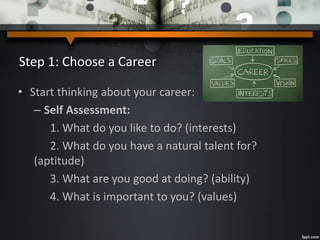
• Start thinking about your career:
– Self Assessment:
1. What do you like to do? (interests)
2. What do you have a natural talent for?
(aptitude)
3. What are you good at doing? (ability)
4. What is important to you? (values)
• Once you have determined what career(s) you
may be interested in, take the time to learn as
much about it as possible.
1. Research Information:
– Occupational Outlook Handbook:
http://www.bls.gov/ooh/
– ACT “World of Work”:
http://www.actstudent.org/career/
2. Connect with individuals in your field(s) of
interest.
– Ask specific questions
– Ask about job shadowing opportunities
Step 2: Investigate your Career Choices
Career Investigating Continued
3. Experience a Career firsthand
• Take a course
• Career Specific programs
• Part-time work experience
• Volunteer experience
Step 3: Find a Career Match
Take some time to find careers that might be a good match for you.
Helpful hints in searching for your career:
• Careers by academic subject area
• Careers by specific occupation
• Careers by job industries
Step 4: Evaluate your Educational Options
• After completing high school, there are 6
educational options to choose from:
1. Community College
2. Career and Trade/Technical Schools
3. 4-year College or University
4. The Military
5. Apprenticeship
6. On-the-Job Training
Types of Colleges:
• Liberal Arts Colleges: Broad base of courses, small class sizes,
personal attention is usually available, receive a Bachelor’s
degree
• Universities: Bigger than a college, offers more majors,
resources, and research facilities, receive a Bachelor’s degree
• Community/Junior Colleges: Receive an Associate’s degree
after the completion of 2 years of full-time study. Prepares
you for immediate entry into the job market or transferring to
a four-year university/college to complete a Bachelor’s
degree.
• Agricultural, Technical, and Specialized Colleges: Preparation
for specific careers. Examples include Art/Music, Biblical
Studies, Seminary, Health Science, Physical Therapy, Technical
(medical, welding, etc).
Making your Educational Choice:
• Usually your career choice will help you determine which choice is best for you.
Look for schools that offer programs that best fit your goals.
• In evaluating your options, consider the following:
1. Ask for help: talk to your parents and counselors
2. Make a list of colleges: consider career and goals
3. Research your options: class sizes, campus size, cost of tuition, financial
aid, public vs. private, etc.
4. Find out: admissions requirements, deadlines, financial aid, and
scholarship information
5. Visit colleges of interest: Take a tour of campus and ask valuable
questions that will help you make a decision. See which place feels like the
right fit for you.
Public vs. Private
Public Schools
• Usually less expensive as
they get money from the
government
• Usually large schools,
classes sometimes
auditorium style and taught
by graduate assistants
• Bigger focus on athletics
Private Schools
• Rely on scholarships,
donations, and
endowments
• Usually smaller and offer
more personalized attention
• Usually smaller class sizes
Some schools are Special Interest Based, Single Sex, Historically Black
Colleges, Hispanic-Serving Institutions
What is the right school for you?
The Large School: Pros and Cons
• Wide variety of majors and
courses
• Well-stocked libraries
• Variety of housing opportunities
• Well-funded sports programs
• Wide range of academic and
social opportunities
• Distinguished or famous faculty
• Large class sizes
• Many courses taught by teaching
assistants, not professors
• Professors focused on their own
research and graduate thesis projects—
little student-teacher interaction
• Pressure on students to take initiative; to
be go-getters
• More rules and procedures related to
enrolling in and designing course study—
red tape
• Potential of getting lost in the crowd
Pros Cons
What is the right school for you?
Pros
• Small class sizes
• Hands-on learning opportunities
• Individually-designed majors
• Strong advising system; advisors
know students very well
• Strong sense of community
• Professors, not graduate students,
teach most courses
• Opportunity to get to know
professors well
• Can be easier to get involved in
campus activities/clubs
Cons
• Limited housing options
• Fewer majors to choose from
• Fewer physical resources
• Smaller libraries
• Fewer entertainment and social
opportunities
• Less emphasis on sports programs
The Small School: Pros and Cons
Types of Degrees
• Certificate or Diploma
Length of time varies upon program
• Associate Degree
2-3 years
• Bachelors or Baccalaureate Degree
4-5 years
• Advanced/Professional Degrees: Master’s Degree
2-4 years
• Doctorate Degree
3-5 years
How Much Will You Earn?
A Few More Thoughts:
• College graduates are half as likely to be unemployed versus
high school graduates.
• You may earn back as much as $30 for every dollar invested in
higher education.
• College graduates experienced an employment increase of 1.8
million jobs in the past decade versus a loss of almost 700,000
jobs for those with a high school diploma only.
What are the Fastest Growing Careers?
A Few Things to Remember:
• Be patient with yourself - planning for your future is a
continual process. It will not happen overnight.
• You may have a plan and then discover that your plan
isn’t really what you want. That’s OK! That will help
direct you to what is the best fit for you.
• Continue to grow and learn no matter what career
path you find yourself on.
“Learning never exhausts the mind” – Leonardo da Vinci
Thank You!
University of Missouri-St. Louis
Office of Precollegiate Programs
One University Boulevard
St. Louis, MO 63121
Main Office: 314.516.5196
Office Fax: 314.516.4611
Email: precollegiate@umsl.edu
Website: www.umsl.edu/~precollegiate

Road to College Presentation

  • 1.
    The Road toCollege and Career Success Presented by Shannon Soto: Office of Precollegiate Student Services University of Missouri-St. Louis
  • 2.
    It always helpsto have some inspiration… “Education is the most powerful weapon which you can choose to change the world” – Nelson Mandela “You have brains in your head. You have feet in your shoes. You can steer yourself any direction you choose” – Dr. Seuss “If opportunity doesn’t knock, build a door” – Milton Berle “The biggest failure you can have in life is making the mistake of never trying at all” - unknown
  • 3.
    What inspires YOU? Wherewill that lead you?
  • 4.
    Step 1: Choosea Career • Start thinking about your career: – Self Assessment: 1. What do you like to do? (interests) 2. What do you have a natural talent for? (aptitude) 3. What are you good at doing? (ability) 4. What is important to you? (values)
  • 5.
    • Once youhave determined what career(s) you may be interested in, take the time to learn as much about it as possible. 1. Research Information: – Occupational Outlook Handbook: http://www.bls.gov/ooh/ – ACT “World of Work”: http://www.actstudent.org/career/ 2. Connect with individuals in your field(s) of interest. – Ask specific questions – Ask about job shadowing opportunities Step 2: Investigate your Career Choices
  • 6.
    Career Investigating Continued 3.Experience a Career firsthand • Take a course • Career Specific programs • Part-time work experience • Volunteer experience
  • 7.
    Step 3: Finda Career Match Take some time to find careers that might be a good match for you. Helpful hints in searching for your career: • Careers by academic subject area • Careers by specific occupation • Careers by job industries
  • 8.
    Step 4: Evaluateyour Educational Options • After completing high school, there are 6 educational options to choose from: 1. Community College 2. Career and Trade/Technical Schools 3. 4-year College or University 4. The Military 5. Apprenticeship 6. On-the-Job Training
  • 9.
    Types of Colleges: •Liberal Arts Colleges: Broad base of courses, small class sizes, personal attention is usually available, receive a Bachelor’s degree • Universities: Bigger than a college, offers more majors, resources, and research facilities, receive a Bachelor’s degree • Community/Junior Colleges: Receive an Associate’s degree after the completion of 2 years of full-time study. Prepares you for immediate entry into the job market or transferring to a four-year university/college to complete a Bachelor’s degree. • Agricultural, Technical, and Specialized Colleges: Preparation for specific careers. Examples include Art/Music, Biblical Studies, Seminary, Health Science, Physical Therapy, Technical (medical, welding, etc).
  • 10.
    Making your EducationalChoice: • Usually your career choice will help you determine which choice is best for you. Look for schools that offer programs that best fit your goals. • In evaluating your options, consider the following: 1. Ask for help: talk to your parents and counselors 2. Make a list of colleges: consider career and goals 3. Research your options: class sizes, campus size, cost of tuition, financial aid, public vs. private, etc. 4. Find out: admissions requirements, deadlines, financial aid, and scholarship information 5. Visit colleges of interest: Take a tour of campus and ask valuable questions that will help you make a decision. See which place feels like the right fit for you.
  • 11.
    Public vs. Private PublicSchools • Usually less expensive as they get money from the government • Usually large schools, classes sometimes auditorium style and taught by graduate assistants • Bigger focus on athletics Private Schools • Rely on scholarships, donations, and endowments • Usually smaller and offer more personalized attention • Usually smaller class sizes Some schools are Special Interest Based, Single Sex, Historically Black Colleges, Hispanic-Serving Institutions
  • 12.
    What is theright school for you? The Large School: Pros and Cons • Wide variety of majors and courses • Well-stocked libraries • Variety of housing opportunities • Well-funded sports programs • Wide range of academic and social opportunities • Distinguished or famous faculty • Large class sizes • Many courses taught by teaching assistants, not professors • Professors focused on their own research and graduate thesis projects— little student-teacher interaction • Pressure on students to take initiative; to be go-getters • More rules and procedures related to enrolling in and designing course study— red tape • Potential of getting lost in the crowd Pros Cons
  • 13.
    What is theright school for you? Pros • Small class sizes • Hands-on learning opportunities • Individually-designed majors • Strong advising system; advisors know students very well • Strong sense of community • Professors, not graduate students, teach most courses • Opportunity to get to know professors well • Can be easier to get involved in campus activities/clubs Cons • Limited housing options • Fewer majors to choose from • Fewer physical resources • Smaller libraries • Fewer entertainment and social opportunities • Less emphasis on sports programs The Small School: Pros and Cons
  • 14.
    Types of Degrees •Certificate or Diploma Length of time varies upon program • Associate Degree 2-3 years • Bachelors or Baccalaureate Degree 4-5 years • Advanced/Professional Degrees: Master’s Degree 2-4 years • Doctorate Degree 3-5 years
  • 15.
    How Much WillYou Earn?
  • 16.
    A Few MoreThoughts: • College graduates are half as likely to be unemployed versus high school graduates. • You may earn back as much as $30 for every dollar invested in higher education. • College graduates experienced an employment increase of 1.8 million jobs in the past decade versus a loss of almost 700,000 jobs for those with a high school diploma only.
  • 17.
    What are theFastest Growing Careers?
  • 18.
    A Few Thingsto Remember: • Be patient with yourself - planning for your future is a continual process. It will not happen overnight. • You may have a plan and then discover that your plan isn’t really what you want. That’s OK! That will help direct you to what is the best fit for you. • Continue to grow and learn no matter what career path you find yourself on. “Learning never exhausts the mind” – Leonardo da Vinci
  • 19.
    Thank You! University ofMissouri-St. Louis Office of Precollegiate Programs One University Boulevard St. Louis, MO 63121 Main Office: 314.516.5196 Office Fax: 314.516.4611 Email: precollegiate@umsl.edu Website: www.umsl.edu/~precollegiate

Editor's Notes

  • #8 If anyone would like to take a career assessment test, ask me afterwards and I will get your I email so I can send you UMSL’s FOCUS test.