An Overview of SAS
Why SAS? “ Their theory…holds that is all education stakeholders focus without vacillation on six components (clear standards, curriculum frameworks, materials and resources, instruction, fair assessments, and interventions) in all trainings, professional development, resources, and technical assistance, then student achievement will improve rapidly.  These six components comprise Pennsylvania’s Standards Aligned System (SAS).” “ Singing Out of the Same Songbook: The Standards Aligned System in Pennsylvania” – Adam Tanney, 2010 – p.4 Copyright ©2010 Commonwealth of Pennsylvania
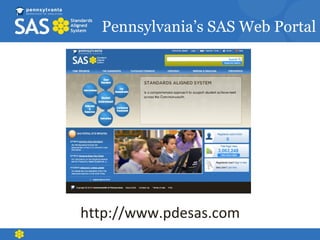
Pennsylvania’s SAS Web Portal http://www.pdesas.com
SAS Portal Overview There are two environments to SAS: Public Non-registered Information and resources about the six elements are available to the public Registered Users All public information available as well as the Teacher Tools Copyright ©2010 Commonwealth of Pennsylvania
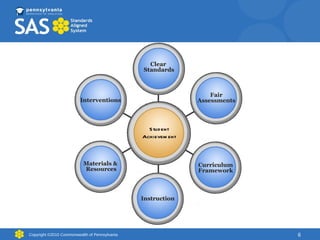
The Six Elements of the Pennsylvania  Standards Aligned System Users can access information about the Standards Aligned System by hovering on a circle  or  by clicking on one of the tabs under the SAS logo (when on the SAS portal). Copyright ©2010 Commonwealth of Pennsylvania
Copyright ©2010 Commonwealth of Pennsylvania Clear  Standards Fair Assessments Curriculum Framework Instruction Materials &  Resources Interventions Student Achievement
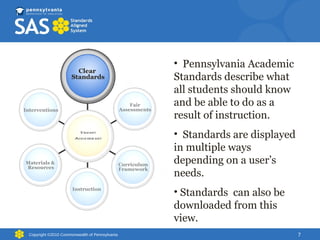
Copyright ©2010 Commonwealth of Pennsylvania Pennsylvania Academic Standards describe what all students should know and be able to do as a result of instruction. Standards are displayed in multiple ways depending on a user’s needs.  Standards  can also be downloaded from this view. Clear  Standards Fair Assessments Instruction Materials &  Resources Interventions Student Achievement Curriculum Framework
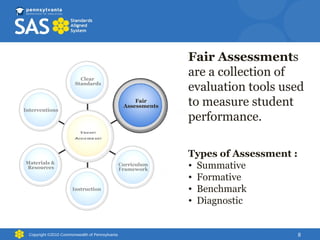
Copyright ©2010 Commonwealth of Pennsylvania Fair Assessment s are a collection of evaluation tools used to measure student performance. Types of Assessment : Summative Formative Benchmark Diagnostic Clear  Standards Fair Assessments Instruction Materials &  Resources Interventions Student Achievement Curriculum Framework
Copyright ©2010 Commonwealth of Pennsylvania Drawn from the Academic Standards, the Curriculum Framework is a set of teaching topics by subject and grade level.  Incorporated are : Big Ideas Concepts Competencies Essential Questions  The Curriculum Framework is aligned to Standards and, where appropriate, Eligible Content. Clear  Standards Curriculum Framework Instruction Materials &  Resources Interventions Student Achievement Fair Assessments
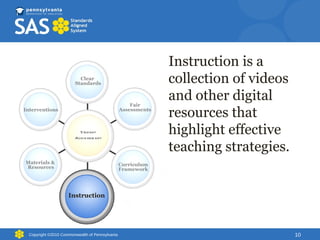
Copyright ©2010 Commonwealth of Pennsylvania Instruction is a collection of videos and other digital resources that highlight effective teaching strategies. Student Achievement Clear  Standards Instruction Materials &  Resources Interventions Fair Assessments Curriculum Framework
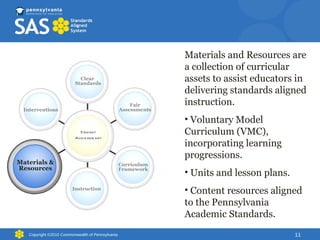
Copyright ©2010 Commonwealth of Pennsylvania Student Achievement Clear  Standards Materials & Resources Instruction Interventions Fair Assessments Curriculum Framework Materials and Resources are a collection of curricular assets to assist educators in delivering standards aligned instruction. Voluntary Model Curriculum (VMC), incorporating learning progressions.  Units and lesson plans. Content resources aligned to the Pennsylvania Academic Standards.
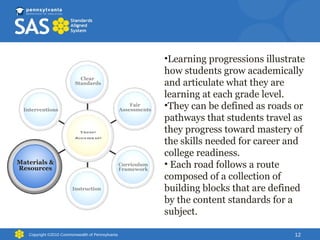
Copyright ©2010 Commonwealth of Pennsylvania Student Achievement Clear  Standards Materials & Resources Instruction Interventions Fair Assessments Curriculum Framework Learning progressions illustrate how students grow academically and articulate what they are learning at each grade level. They can be defined as roads or pathways that students travel as they progress toward mastery of the skills needed for career and college readiness. Each road follows a route composed of a collection of building blocks that are defined by the content standards for a subject.
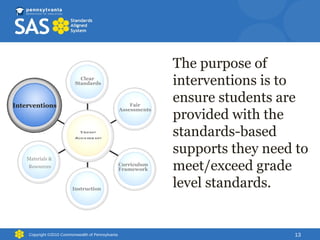
Copyright ©2010 Commonwealth of Pennsylvania Student Achievement Clear  Standards Instruction Fair Assessments Curriculum Framework Materials &  Resources Interventions The purpose of interventions is to ensure students are provided with the standards-based supports they need to meet/exceed grade level standards.
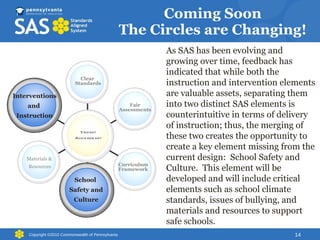
Coming Soon The Circles are Changing! Copyright ©2010 Commonwealth of Pennsylvania Student Achievement Clear  Standards Instruction Fair Assessments Curriculum Framework Materials &  Resources Interventions and  Instruction As SAS has been evolving and growing over time, feedback has indicated that while both the instruction and intervention elements are valuable assets, separating them into two distinct SAS elements is counterintuitive in terms of delivery of instruction; thus, the merging of these two creates the opportunity to create a key element missing from the current design:  School Safety and Culture.  This element will be developed and will include critical elements such as school climate standards, issues of bullying, and materials and resources to support safe schools. School  Safety and Culture
Other Features RSS Feed - RSS stands for Really Simple Syndication Retrieves the latest content from websites you are interested in Notifies you of changes or updated content Users who subscribe to the RSS Feed will receive an email notifying them of updates Copyright ©2010 Commonwealth of Pennsylvania
Informational Items Provides statistics about SAS usage. Teacher Tools Allows registered users access to compile a personal portfolio of resources, create standards based assessments, and to share those resources with other through a website.  Also, the PD Center provides a platform to allow teachers across Pennsylvania to take online Professional Development to meet Act 48 requirements for certification.  Copyright ©2010 Commonwealth of Pennsylvania
For Help… Click on  Help  in the upper right-hand corner of any page in the portal The  SAS Portal Help Desk  website contains: Help Desk Information and Hours System Requirements FAQs Training Materials About SAS Glossary of terms   Copyright ©2010 Commonwealth of Pennsylvania
Copyright ©2010 Commonwealth of Pennsylvania

Sas overview

  • 1.
  • 2.
    Why SAS? “Their theory…holds that is all education stakeholders focus without vacillation on six components (clear standards, curriculum frameworks, materials and resources, instruction, fair assessments, and interventions) in all trainings, professional development, resources, and technical assistance, then student achievement will improve rapidly. These six components comprise Pennsylvania’s Standards Aligned System (SAS).” “ Singing Out of the Same Songbook: The Standards Aligned System in Pennsylvania” – Adam Tanney, 2010 – p.4 Copyright ©2010 Commonwealth of Pennsylvania
  • 3.
    Pennsylvania’s SAS WebPortal http://www.pdesas.com
  • 4.
    SAS Portal OverviewThere are two environments to SAS: Public Non-registered Information and resources about the six elements are available to the public Registered Users All public information available as well as the Teacher Tools Copyright ©2010 Commonwealth of Pennsylvania
  • 5.
    The Six Elementsof the Pennsylvania Standards Aligned System Users can access information about the Standards Aligned System by hovering on a circle or by clicking on one of the tabs under the SAS logo (when on the SAS portal). Copyright ©2010 Commonwealth of Pennsylvania
  • 6.
    Copyright ©2010 Commonwealthof Pennsylvania Clear Standards Fair Assessments Curriculum Framework Instruction Materials & Resources Interventions Student Achievement
  • 7.
    Copyright ©2010 Commonwealthof Pennsylvania Pennsylvania Academic Standards describe what all students should know and be able to do as a result of instruction. Standards are displayed in multiple ways depending on a user’s needs. Standards can also be downloaded from this view. Clear Standards Fair Assessments Instruction Materials & Resources Interventions Student Achievement Curriculum Framework
  • 8.
    Copyright ©2010 Commonwealthof Pennsylvania Fair Assessment s are a collection of evaluation tools used to measure student performance. Types of Assessment : Summative Formative Benchmark Diagnostic Clear Standards Fair Assessments Instruction Materials & Resources Interventions Student Achievement Curriculum Framework
  • 9.
    Copyright ©2010 Commonwealthof Pennsylvania Drawn from the Academic Standards, the Curriculum Framework is a set of teaching topics by subject and grade level. Incorporated are : Big Ideas Concepts Competencies Essential Questions The Curriculum Framework is aligned to Standards and, where appropriate, Eligible Content. Clear Standards Curriculum Framework Instruction Materials & Resources Interventions Student Achievement Fair Assessments
  • 10.
    Copyright ©2010 Commonwealthof Pennsylvania Instruction is a collection of videos and other digital resources that highlight effective teaching strategies. Student Achievement Clear Standards Instruction Materials & Resources Interventions Fair Assessments Curriculum Framework
  • 11.
    Copyright ©2010 Commonwealthof Pennsylvania Student Achievement Clear Standards Materials & Resources Instruction Interventions Fair Assessments Curriculum Framework Materials and Resources are a collection of curricular assets to assist educators in delivering standards aligned instruction. Voluntary Model Curriculum (VMC), incorporating learning progressions. Units and lesson plans. Content resources aligned to the Pennsylvania Academic Standards.
  • 12.
    Copyright ©2010 Commonwealthof Pennsylvania Student Achievement Clear Standards Materials & Resources Instruction Interventions Fair Assessments Curriculum Framework Learning progressions illustrate how students grow academically and articulate what they are learning at each grade level. They can be defined as roads or pathways that students travel as they progress toward mastery of the skills needed for career and college readiness. Each road follows a route composed of a collection of building blocks that are defined by the content standards for a subject.
  • 13.
    Copyright ©2010 Commonwealthof Pennsylvania Student Achievement Clear Standards Instruction Fair Assessments Curriculum Framework Materials & Resources Interventions The purpose of interventions is to ensure students are provided with the standards-based supports they need to meet/exceed grade level standards.
  • 14.
    Coming Soon TheCircles are Changing! Copyright ©2010 Commonwealth of Pennsylvania Student Achievement Clear Standards Instruction Fair Assessments Curriculum Framework Materials & Resources Interventions and Instruction As SAS has been evolving and growing over time, feedback has indicated that while both the instruction and intervention elements are valuable assets, separating them into two distinct SAS elements is counterintuitive in terms of delivery of instruction; thus, the merging of these two creates the opportunity to create a key element missing from the current design: School Safety and Culture. This element will be developed and will include critical elements such as school climate standards, issues of bullying, and materials and resources to support safe schools. School Safety and Culture
  • 15.
    Other Features RSSFeed - RSS stands for Really Simple Syndication Retrieves the latest content from websites you are interested in Notifies you of changes or updated content Users who subscribe to the RSS Feed will receive an email notifying them of updates Copyright ©2010 Commonwealth of Pennsylvania
  • 16.
    Informational Items Providesstatistics about SAS usage. Teacher Tools Allows registered users access to compile a personal portfolio of resources, create standards based assessments, and to share those resources with other through a website. Also, the PD Center provides a platform to allow teachers across Pennsylvania to take online Professional Development to meet Act 48 requirements for certification. Copyright ©2010 Commonwealth of Pennsylvania
  • 17.
    For Help… Clickon Help in the upper right-hand corner of any page in the portal The SAS Portal Help Desk website contains: Help Desk Information and Hours System Requirements FAQs Training Materials About SAS Glossary of terms   Copyright ©2010 Commonwealth of Pennsylvania
  • 18.

Editor's Notes

  • #7 A brief overview of the 6 elements, will go into detail in module 2