Pennsylvania’s
Student Learning Objective
Process
Module 2: SLO Template - Sections 1 & 2
Presented by Deborah B. McKay, Ed.D.
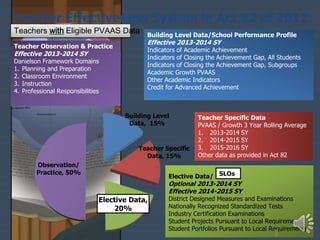
Building Level
Data, 15%
Teacher Specific
Data, 15%
Elective Data,
20%
Observation/
Practice, 50%
Teacher Observation & Practice
Effective 2013-2014 SY
Danielson Framework Domains
1. Planning and Preparation
2. Classroom Environment
3. Instruction
4. Professional Responsibilities
Building Level Data/School Performance Profile
Effective 2013-2014 SY
Indicators of Academic Achievement
Indicators of Closing the Achievement Gap, All Students
Indicators of Closing the Achievement Gap, Subgroups
Academic Growth PVAAS
Other Academic Indicators
Credit for Advanced Achievement
Teacher Specific Data
PVAAS / Growth 3 Year Rolling Average
1. 2013-2014 SY
2. 2014-2015 SY
3. 2015-2016 SY
Other data as provided in Act 82
Elective Data/
Optional 2013-2014 SY
Effective 2014-2015 SY
District Designed Measures and Examinations
Nationally Recognized Standardized Tests
Industry Certification Examinations
Student Projects Pursuant to Local Requirements
Student Portfolios Pursuant to Local Requirements
Teacher Effectiveness System in Act 82 of 2012
Teachers with Eligible PVAAS Data
SLOs
2
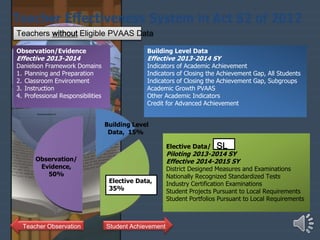
Building Level
Data, 15%
Observation/
Evidence,
50%
Observation/Evidence
Effective 2013-2014
Danielson Framework Domains
1. Planning and Preparation
2. Classroom Environment
3. Instruction
4. Professional Responsibilities
Building Level Data
Effective 2013-2014 SY
Indicators of Academic Achievement
Indicators of Closing the Achievement Gap, All Students
Indicators of Closing the Achievement Gap, Subgroups
Academic Growth PVAAS
Other Academic Indicators
Credit for Advanced Achievement
Elective Data/
Piloting 2013-2014 SY
Effective 2014-2015 SY
District Designed Measures and Examinations
Nationally Recognized Standardized Tests
Industry Certification Examinations
Student Projects Pursuant to Local Requirements
Student Portfolios Pursuant to Local Requirements
Elective Data,
35%
Teacher Observation Student Achievement
SL
Teachers without Eligible PVAAS Data
SLO Template 10.0
Process
A tool used to identify
goals, indicators, and
performance measures for
use in the greater Teacher
Effectiveness System
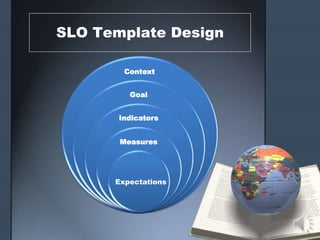
SLO Template Design
Context
Goal
Indicators
Measures
Expectations
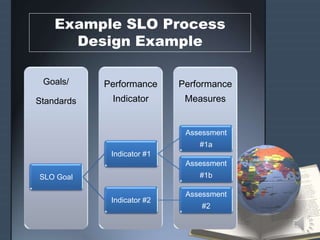
Example SLO Process
Design Example
Performance
Measures
Performance
Indicator
Goals/
Standards
SLO Goal
Indicator #1
Assessment
#1a
Assessment
#1b
Indicator #2
Assessment
#2
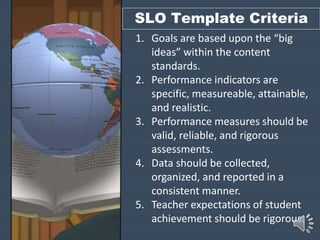
1. Goals are based upon the “big
ideas” within the content
standards.
2. Performance indicators are
specific, measureable, attainable,
and realistic.
3. Performance measures should be
valid, reliable, and rigorous
assessments.
4. Data should be collected,
organized, and reported in a
consistent manner.
5. Teacher expectations of student
achievement should be rigorous.
SLO Template Criteria
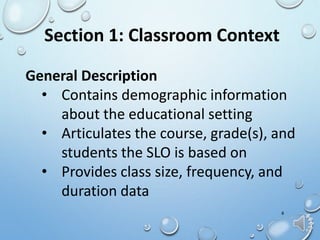
General Description
• Contains demographic information
about the educational setting
• Articulates the course, grade(s), and
students the SLO is based on
• Provides class size, frequency, and
duration data
8
Section 1: Classroom Context
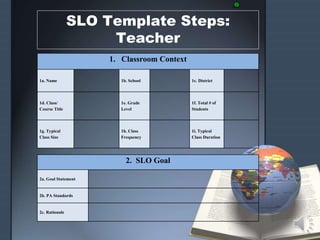
SLO Template Steps:
Teacher
1. Classroom Context
1a. Name 1b. School 1c. District
1d. Class/
Course Title
1e. Grade
Level
1f. Total # of
Students
1g. Typical
Class Size
1h. Class
Frequency
1i. Typical
Class Duration
2. SLO Goal
2a. Goal Statement
2b. PA Standards
2c. Rationale
10
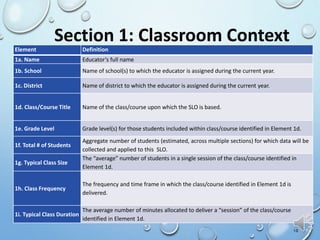
Section 1: Classroom Context
Element Definition
1a. Name Educator’s full name
1b. School Name of school(s) to which the educator is assigned during the current year.
1c. District Name of district to which the educator is assigned during the current year.
1d. Class/Course Title Name of the class/course upon which the SLO is based.
1e. Grade Level Grade level(s) for those students included within class/course identified in Element 1d.
1f. Total # of Students
Aggregate number of students (estimated, across multiple sections) for which data will be
collected and applied to this SLO.
1g. Typical Class Size
The “average” number of students in a single session of the class/course identified in
Element 1d.
1h. Class Frequency
The frequency and time frame in which the class/course identified in Element 1d is
delivered.
1i. Typical Class Duration
The average number of minutes allocated to deliver a “session” of the class/course
identified in Element 1d.
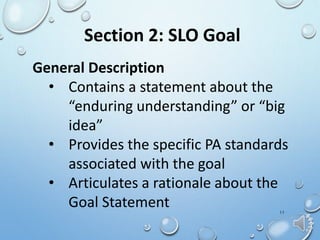
General Description
• Contains a statement about the
“enduring understanding” or “big
idea”
• Provides the specific PA standards
associated with the goal
• Articulates a rationale about the
Goal Statement 11
Section 2: SLO Goal
12
Section 2: SLO Goal
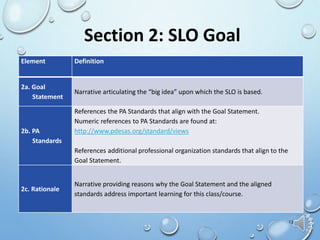
Element Definition
2a. Goal
Statement
Narrative articulating the “big idea” upon which the SLO is based.
2b. PA
Standards
References the PA Standards that align with the Goal Statement.
Numeric references to PA Standards are found at:
http://www.pdesas.org/standard/views
References additional professional organization standards that align to the
Goal Statement.
2c. Rationale
Narrative providing reasons why the Goal Statement and the aligned
standards address important learning for this class/course.
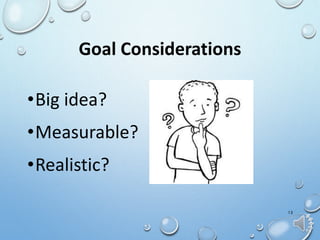
Goal Considerations
•Big idea?
•Measurable?
•Realistic?
13
14
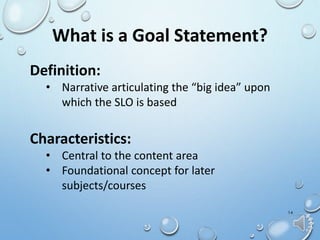
What is a Goal Statement?
Definition:
• Narrative articulating the “big idea” upon
which the SLO is based
Characteristics:
• Central to the content area
• Foundational concept for later
subjects/courses
15
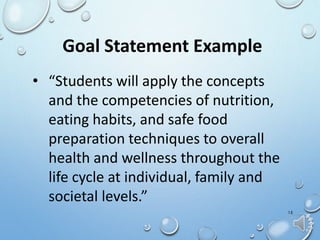
Goal Statement Example
• “Students will apply the concepts
and the competencies of nutrition,
eating habits, and safe food
preparation techniques to overall
health and wellness throughout the
life cycle at individual, family and
societal levels.”
16
Goal Statements
Typically addresses:
• WHAT the “big idea” is in the standards
• HOW the skills and knowledge support future
learning
• WHY the “big idea” is a central, enduring
concept (rationale statement)
PDE’s SAS portal has identified “big ideas” for most
content areas.
17
Quality Assurance
Checklist
• Statement is clear and concise; free of technical
jargon.
• Statement identifies what the performance
measure is designed to measure; grade-
level/subject area/course.
• Statement provides insight about what the
scores mean.
STANDARDS ALIGNED SYSTEMS
• TEACHERS SHOULD GO TO THE SAS PORTAL AND REVIEW THE
CURRICULUM FRAMEWORK. TEACHERS WHO HAVE A CURRICULUM
FRAMEWORK CREATED AS A RESULT OF THE CURRICULUM
DEVELOPMENT PROCESS SHOULD REFER TO THESE DOCUMENTS
INSTEAD OF GOING TO THE SAS PORTAL.
• REVIEW CONTENT STANDARDS IN YOUR AREA OF CERTIFICATION.
• DETERMINE “BIG IDEA” IN THE STANDARD.
• VISIT THE SAS PORTAL AS NEEDED AS YOU CONTINUE TO WORK
THROUGH THESE MODULES.
• THE NEXT SLIDE PROVIDES FURTHER DETAILS, INCLUDING THE LINK TO
SAS PORTAL.
18
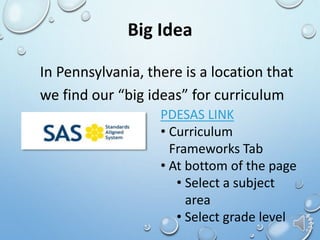
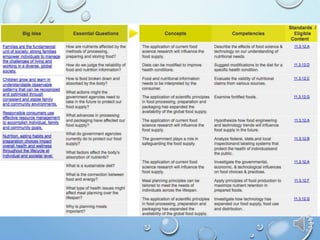
Big Idea
In Pennsylvania, there is a location that
we find our “big ideas” for curriculum
PDESAS LINK
• Curriculum
Frameworks Tab
• At bottom of the page
• Select a subject
area
• Select grade level
20
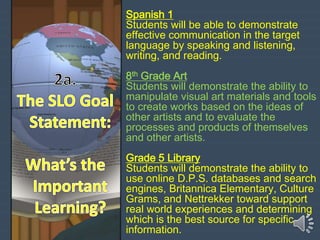
Spanish 1
Students will be able to demonstrate
effective communication in the target
language by speaking and listening,
writing, and reading.
8th Grade Art
Students will demonstrate the ability to
manipulate visual art materials and tools
to create works based on the ideas of
other artists and to evaluate the
processes and products of themselves
and other artists.
Grade 5 Library
Students will demonstrate the ability to
use online D.P.S. databases and search
engines, Britannica Elementary, Culture
Grams, and Nettrekker toward support
real world experiences and determining
which is the best source for specific
information.
22
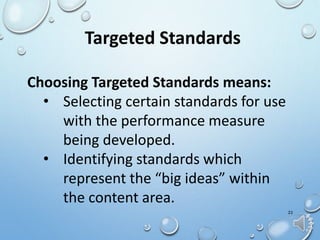
Targeted Standards
Choosing Targeted Standards means:
• Selecting certain standards for use
with the performance measure
being developed.
• Identifying standards which
represent the “big ideas” within
the content area.
23
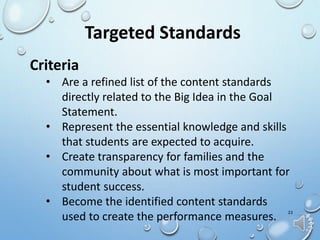
Targeted Standards
Criteria
• Are a refined list of the content standards
directly related to the Big Idea in the Goal
Statement.
• Represent the essential knowledge and skills
that students are expected to acquire.
• Create transparency for families and the
community about what is most important for
student success.
• Become the identified content standards
used to create the performance measures.
24
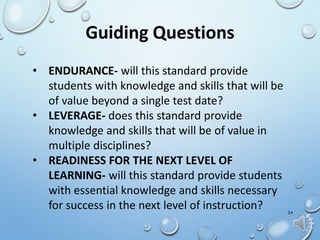
Guiding Questions
• ENDURANCE- will this standard provide
students with knowledge and skills that will be
of value beyond a single test date?
• LEVERAGE- does this standard provide
knowledge and skills that will be of value in
multiple disciplines?
• READINESS FOR THE NEXT LEVEL OF
LEARNING- will this standard provide students
with essential knowledge and skills necessary
for success in the next level of instruction?
25
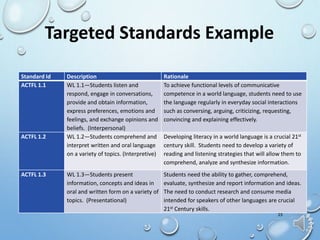
Standard Id Description Rationale
ACTFL 1.1 WL 1.1—Students listen and
respond, engage in conversations,
provide and obtain information,
express preferences, emotions and
feelings, and exchange opinions and
beliefs. (Interpersonal)
To achieve functional levels of communicative
competence in a world language, students need to use
the language regularly in everyday social interactions
such as conversing, arguing, criticizing, requesting,
convincing and explaining effectively.
ACTFL 1.2 WL 1.2—Students comprehend and
interpret written and oral language
on a variety of topics. (Interpretive)
Developing literacy in a world language is a crucial 21st
century skill. Students need to develop a variety of
reading and listening strategies that will allow them to
comprehend, analyze and synthesize information.
ACTFL 1.3 WL 1.3—Students present
information, concepts and ideas in
oral and written form on a variety of
topics. (Presentational)
Students need the ability to gather, comprehend,
evaluate, synthesize and report information and ideas.
The need to conduct research and consume media
intended for speakers of other languages are crucial
21st Century skills.
Targeted Standards Example
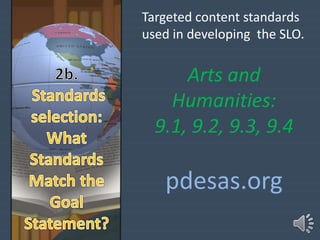
Targeted content standards
used in developing the SLO.
Arts and
Humanities:
9.1, 9.2, 9.3, 9.4
pdesas.org
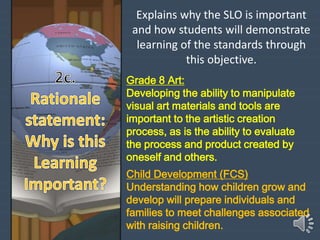
Explains why the SLO is important
and how students will demonstrate
learning of the standards through
this objective.
Grade 8 Art:
Developing the ability to manipulate
visual art materials and tools are
important to the artistic creation
process, as is the ability to evaluate
the process and product created by
oneself and others.
Child Development (FCS)
Understanding how children grow and
develop will prepare individuals and
families to meet challenges associated
with raising children.
SLO Template Design
• The below link will take you to the SLO Template.
• To access this document, click on the below link,
press ESC key. The Word document will be
displayed on the tool bar at the bottom of the screen.
SLO Template

SLO Module

  • 1.
    Pennsylvania’s Student Learning Objective Process Module2: SLO Template - Sections 1 & 2 Presented by Deborah B. McKay, Ed.D.
  • 2.
    Building Level Data, 15% TeacherSpecific Data, 15% Elective Data, 20% Observation/ Practice, 50% Teacher Observation & Practice Effective 2013-2014 SY Danielson Framework Domains 1. Planning and Preparation 2. Classroom Environment 3. Instruction 4. Professional Responsibilities Building Level Data/School Performance Profile Effective 2013-2014 SY Indicators of Academic Achievement Indicators of Closing the Achievement Gap, All Students Indicators of Closing the Achievement Gap, Subgroups Academic Growth PVAAS Other Academic Indicators Credit for Advanced Achievement Teacher Specific Data PVAAS / Growth 3 Year Rolling Average 1. 2013-2014 SY 2. 2014-2015 SY 3. 2015-2016 SY Other data as provided in Act 82 Elective Data/ Optional 2013-2014 SY Effective 2014-2015 SY District Designed Measures and Examinations Nationally Recognized Standardized Tests Industry Certification Examinations Student Projects Pursuant to Local Requirements Student Portfolios Pursuant to Local Requirements Teacher Effectiveness System in Act 82 of 2012 Teachers with Eligible PVAAS Data SLOs 2
  • 3.
    Building Level Data, 15% Observation/ Evidence, 50% Observation/Evidence Effective2013-2014 Danielson Framework Domains 1. Planning and Preparation 2. Classroom Environment 3. Instruction 4. Professional Responsibilities Building Level Data Effective 2013-2014 SY Indicators of Academic Achievement Indicators of Closing the Achievement Gap, All Students Indicators of Closing the Achievement Gap, Subgroups Academic Growth PVAAS Other Academic Indicators Credit for Advanced Achievement Elective Data/ Piloting 2013-2014 SY Effective 2014-2015 SY District Designed Measures and Examinations Nationally Recognized Standardized Tests Industry Certification Examinations Student Projects Pursuant to Local Requirements Student Portfolios Pursuant to Local Requirements Elective Data, 35% Teacher Observation Student Achievement SL Teachers without Eligible PVAAS Data
  • 4.
    SLO Template 10.0 Process Atool used to identify goals, indicators, and performance measures for use in the greater Teacher Effectiveness System
  • 5.
  • 6.
    Example SLO Process DesignExample Performance Measures Performance Indicator Goals/ Standards SLO Goal Indicator #1 Assessment #1a Assessment #1b Indicator #2 Assessment #2
  • 7.
    1. Goals arebased upon the “big ideas” within the content standards. 2. Performance indicators are specific, measureable, attainable, and realistic. 3. Performance measures should be valid, reliable, and rigorous assessments. 4. Data should be collected, organized, and reported in a consistent manner. 5. Teacher expectations of student achievement should be rigorous. SLO Template Criteria
  • 8.
    General Description • Containsdemographic information about the educational setting • Articulates the course, grade(s), and students the SLO is based on • Provides class size, frequency, and duration data 8 Section 1: Classroom Context
  • 9.
    SLO Template Steps: Teacher 1.Classroom Context 1a. Name 1b. School 1c. District 1d. Class/ Course Title 1e. Grade Level 1f. Total # of Students 1g. Typical Class Size 1h. Class Frequency 1i. Typical Class Duration 2. SLO Goal 2a. Goal Statement 2b. PA Standards 2c. Rationale
  • 10.
    10 Section 1: ClassroomContext Element Definition 1a. Name Educator’s full name 1b. School Name of school(s) to which the educator is assigned during the current year. 1c. District Name of district to which the educator is assigned during the current year. 1d. Class/Course Title Name of the class/course upon which the SLO is based. 1e. Grade Level Grade level(s) for those students included within class/course identified in Element 1d. 1f. Total # of Students Aggregate number of students (estimated, across multiple sections) for which data will be collected and applied to this SLO. 1g. Typical Class Size The “average” number of students in a single session of the class/course identified in Element 1d. 1h. Class Frequency The frequency and time frame in which the class/course identified in Element 1d is delivered. 1i. Typical Class Duration The average number of minutes allocated to deliver a “session” of the class/course identified in Element 1d.
  • 11.
    General Description • Containsa statement about the “enduring understanding” or “big idea” • Provides the specific PA standards associated with the goal • Articulates a rationale about the Goal Statement 11 Section 2: SLO Goal
  • 12.
    12 Section 2: SLOGoal Element Definition 2a. Goal Statement Narrative articulating the “big idea” upon which the SLO is based. 2b. PA Standards References the PA Standards that align with the Goal Statement. Numeric references to PA Standards are found at: http://www.pdesas.org/standard/views References additional professional organization standards that align to the Goal Statement. 2c. Rationale Narrative providing reasons why the Goal Statement and the aligned standards address important learning for this class/course.
  • 13.
  • 14.
    14 What is aGoal Statement? Definition: • Narrative articulating the “big idea” upon which the SLO is based Characteristics: • Central to the content area • Foundational concept for later subjects/courses
  • 15.
    15 Goal Statement Example •“Students will apply the concepts and the competencies of nutrition, eating habits, and safe food preparation techniques to overall health and wellness throughout the life cycle at individual, family and societal levels.”
  • 16.
    16 Goal Statements Typically addresses: •WHAT the “big idea” is in the standards • HOW the skills and knowledge support future learning • WHY the “big idea” is a central, enduring concept (rationale statement) PDE’s SAS portal has identified “big ideas” for most content areas.
  • 17.
    17 Quality Assurance Checklist • Statementis clear and concise; free of technical jargon. • Statement identifies what the performance measure is designed to measure; grade- level/subject area/course. • Statement provides insight about what the scores mean.
  • 18.
    STANDARDS ALIGNED SYSTEMS •TEACHERS SHOULD GO TO THE SAS PORTAL AND REVIEW THE CURRICULUM FRAMEWORK. TEACHERS WHO HAVE A CURRICULUM FRAMEWORK CREATED AS A RESULT OF THE CURRICULUM DEVELOPMENT PROCESS SHOULD REFER TO THESE DOCUMENTS INSTEAD OF GOING TO THE SAS PORTAL. • REVIEW CONTENT STANDARDS IN YOUR AREA OF CERTIFICATION. • DETERMINE “BIG IDEA” IN THE STANDARD. • VISIT THE SAS PORTAL AS NEEDED AS YOU CONTINUE TO WORK THROUGH THESE MODULES. • THE NEXT SLIDE PROVIDES FURTHER DETAILS, INCLUDING THE LINK TO SAS PORTAL. 18
  • 19.
    Big Idea In Pennsylvania,there is a location that we find our “big ideas” for curriculum PDESAS LINK • Curriculum Frameworks Tab • At bottom of the page • Select a subject area • Select grade level
  • 20.
  • 21.
    Spanish 1 Students willbe able to demonstrate effective communication in the target language by speaking and listening, writing, and reading. 8th Grade Art Students will demonstrate the ability to manipulate visual art materials and tools to create works based on the ideas of other artists and to evaluate the processes and products of themselves and other artists. Grade 5 Library Students will demonstrate the ability to use online D.P.S. databases and search engines, Britannica Elementary, Culture Grams, and Nettrekker toward support real world experiences and determining which is the best source for specific information.
  • 22.
    22 Targeted Standards Choosing TargetedStandards means: • Selecting certain standards for use with the performance measure being developed. • Identifying standards which represent the “big ideas” within the content area.
  • 23.
    23 Targeted Standards Criteria • Area refined list of the content standards directly related to the Big Idea in the Goal Statement. • Represent the essential knowledge and skills that students are expected to acquire. • Create transparency for families and the community about what is most important for student success. • Become the identified content standards used to create the performance measures.
  • 24.
    24 Guiding Questions • ENDURANCE-will this standard provide students with knowledge and skills that will be of value beyond a single test date? • LEVERAGE- does this standard provide knowledge and skills that will be of value in multiple disciplines? • READINESS FOR THE NEXT LEVEL OF LEARNING- will this standard provide students with essential knowledge and skills necessary for success in the next level of instruction?
  • 25.
    25 Standard Id DescriptionRationale ACTFL 1.1 WL 1.1—Students listen and respond, engage in conversations, provide and obtain information, express preferences, emotions and feelings, and exchange opinions and beliefs. (Interpersonal) To achieve functional levels of communicative competence in a world language, students need to use the language regularly in everyday social interactions such as conversing, arguing, criticizing, requesting, convincing and explaining effectively. ACTFL 1.2 WL 1.2—Students comprehend and interpret written and oral language on a variety of topics. (Interpretive) Developing literacy in a world language is a crucial 21st century skill. Students need to develop a variety of reading and listening strategies that will allow them to comprehend, analyze and synthesize information. ACTFL 1.3 WL 1.3—Students present information, concepts and ideas in oral and written form on a variety of topics. (Presentational) Students need the ability to gather, comprehend, evaluate, synthesize and report information and ideas. The need to conduct research and consume media intended for speakers of other languages are crucial 21st Century skills. Targeted Standards Example
  • 26.
    Targeted content standards usedin developing the SLO. Arts and Humanities: 9.1, 9.2, 9.3, 9.4 pdesas.org
  • 27.
    Explains why theSLO is important and how students will demonstrate learning of the standards through this objective. Grade 8 Art: Developing the ability to manipulate visual art materials and tools are important to the artistic creation process, as is the ability to evaluate the process and product created by oneself and others. Child Development (FCS) Understanding how children grow and develop will prepare individuals and families to meet challenges associated with raising children.
  • 28.
    SLO Template Design •The below link will take you to the SLO Template. • To access this document, click on the below link, press ESC key. The Word document will be displayed on the tool bar at the bottom of the screen. SLO Template