SAPERE: Self‐aware Pervasive 
    Service Ecosystems
            Franco Zambonelli
   Università di Modena e Reggio Emilia

           STREP – 3 years
         www.sapere‐project.eu
         www sapere‐project eu
           AWARE Meeting ‐ December 14, 2010   1
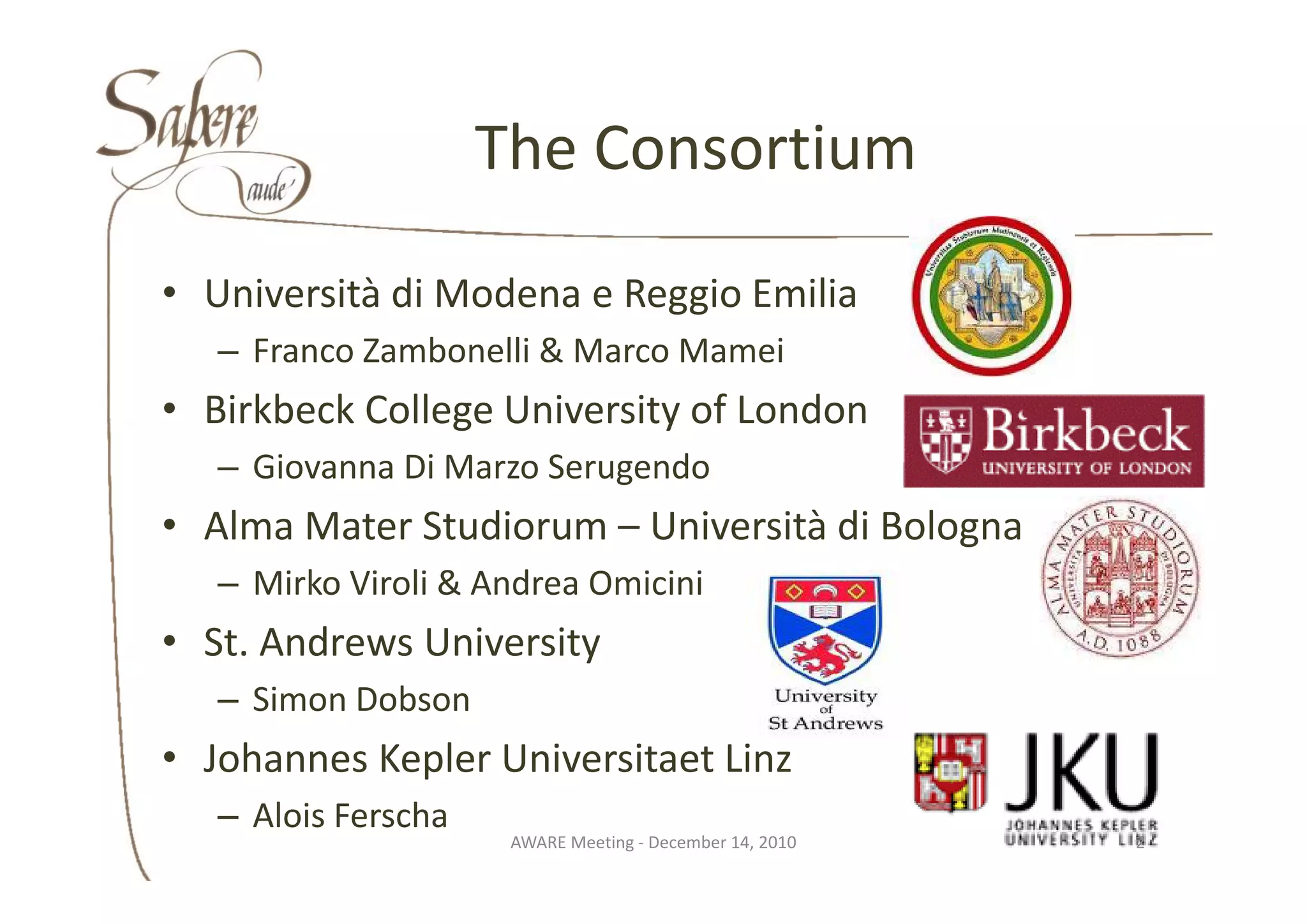
The Consortium
                     The Consortium

• Università di Modena e Reggio Emilia
   – Franco Zambonelli & Marco Mamei
     Franco Zambonelli & Marco Mamei
• Birkbeck College University of London
   – Giovanna Di Marzo Serugendo
     Giovanna Di Marzo
• Alma Mater Studiorum – Università di Bologna
   – Mirko Viroli & Andrea Omicini
• St. Andrews University
   – Simon Dobson
• Johannes Kepler Universitaet Linz
             p
   – Alois Ferscha
                      AWARE Meeting ‐ December 14, 2010   2
The Scenario
                        The Scenario
• Pervasive computing
   –   Sensor rich and always connected smart phones 
   –   Sensor networks and information tags
   –   Localization and activity recognition
   –   Internet of things and the real‐time Web
       Internet of things and the real time Web
• Innovative pervasive services arising
   – Situation‐aware adaptation
     Situation aware adaptation 
   – Interactive reality 
   – Pervasive collective intelligence and pervasive participation
• Open co‐production scenario, very dynamic, diverse 
  needs and diverse services, continuously evolving

                     AWARE Meeting ‐ December 14, 2010         3
The Overall Objective
                The Overall Objective
• Develop and demonstrate a highly‐innovative 
  theoretical and practical framework for pervasive 
  service ecosystems
  service ecosystems
   – Adaptivity and self‐management as inherent properties of 
     the ecosystem
              y
   – Systemic self‐awareness as an observable property of the 
     overall system
   – Long lasting (eternal) adaptivity
     Long‐lasting (eternal) adaptivity
   – Bio‐chemical inspiration
• Foundational re‐thinking of
  Foundational re thinking of
   – Service architectures and associated middleware
   – Self‐* algorithms and contextual knowledge management

                   AWARE Meeting ‐ December 14, 2010        4
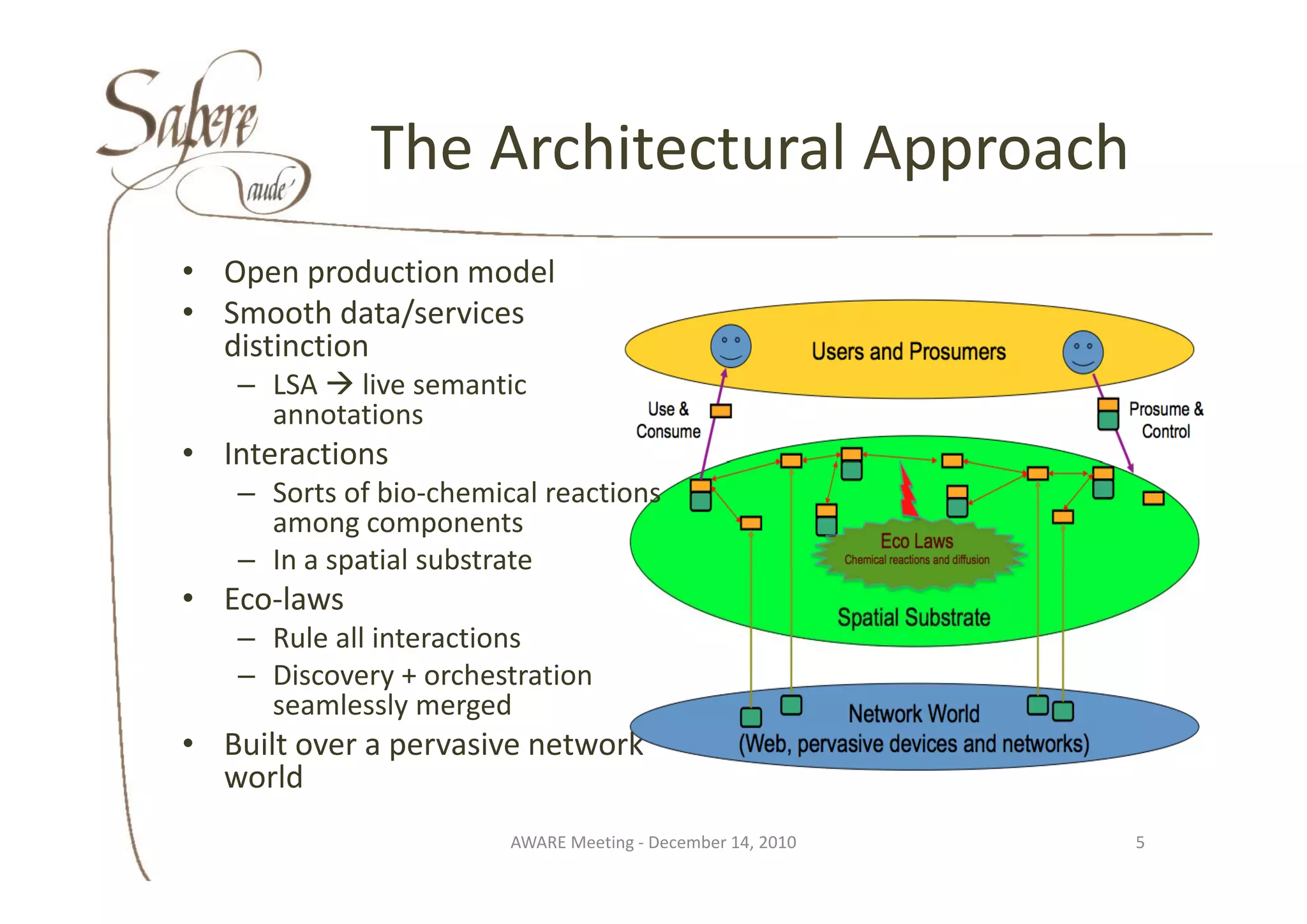
The Architectural Approach
               The Architectural Approach
• Open production model
• Smooth data/services 
  distinction
    – LSA  live semantic 
      annotations
• Interactions
  Interactions  
    – Sorts of bio‐chemical reactions 
      among components
    – In a spatial substrate
      In a spatial substrate
• Eco‐laws 
    – Rule all interactions
    – Discovery + orchestration
                  + orchestration 
      seamlessly merged
• Built over a pervasive network 
  world
                          AWARE Meeting ‐ December 14, 2010   5
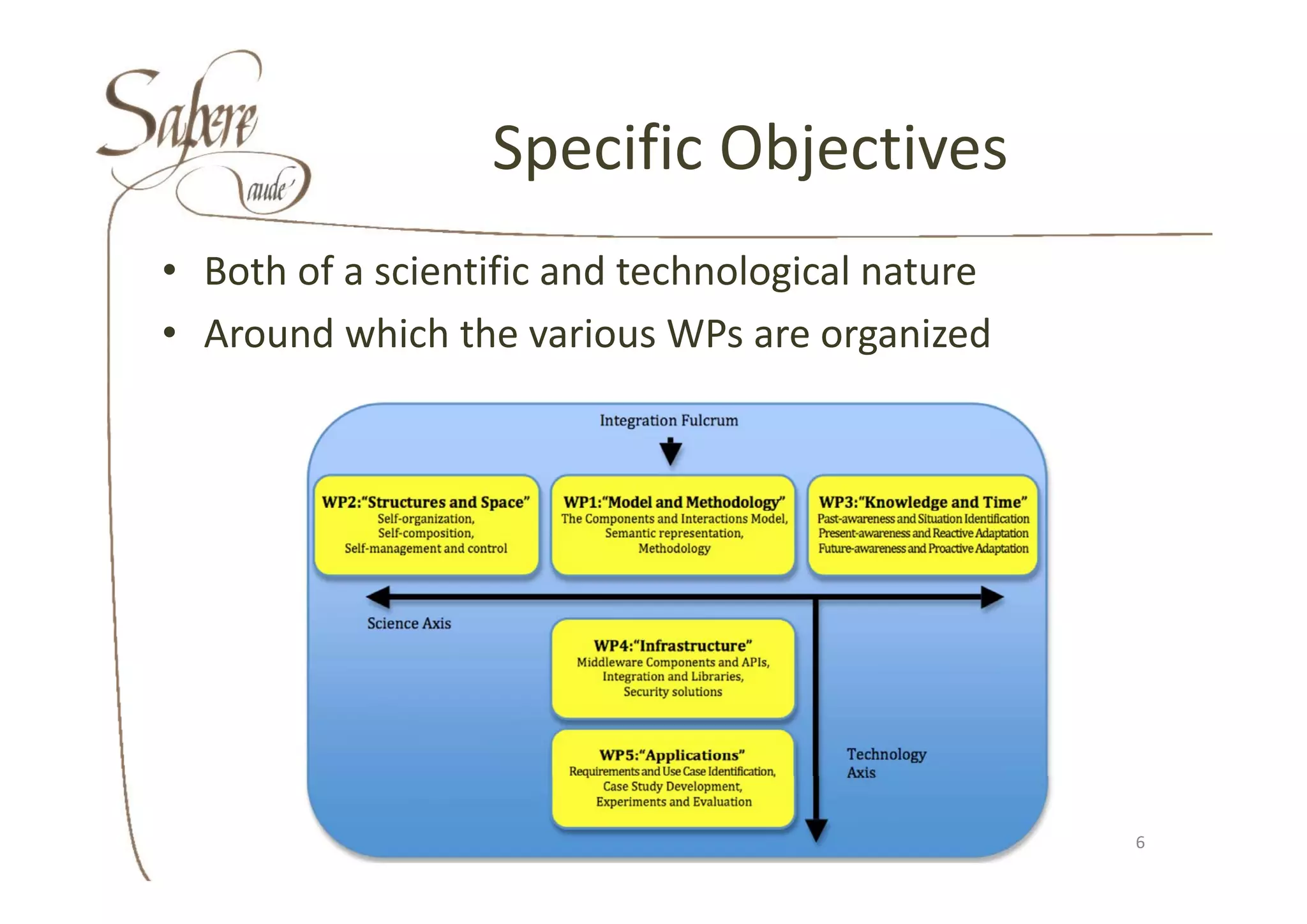
Specific Objectives
                  Specific Objectives
• Both of a scientific and technological nature
• Around which the various WPs are organized


                   AWARE Meeting ‐ December 14, 2010   6
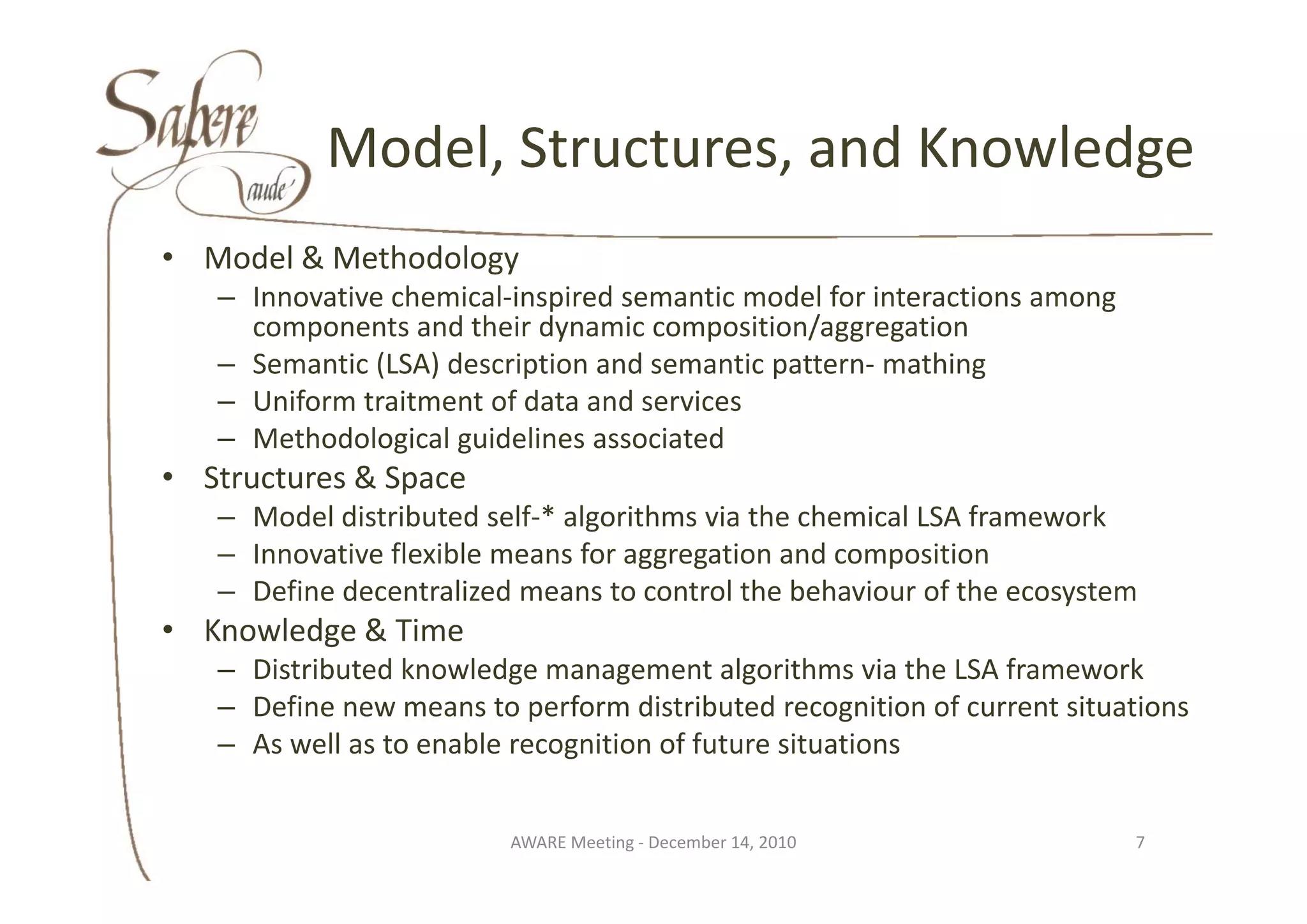
Model, Structures, and Knowledge
           Model Structures and Knowledge
• M d l & M th d l
  Model & Methodology
   – Innovative chemical‐inspired semantic model for interactions among 
     components and their dynamic composition/aggregation
   – S
     Semantic (LSA) description and semantic pattern‐ mathing
           ti (LSA) d    i ti     d       ti   tt        thi
   – Uniform traitment of data and services
   – Methodological guidelines associated
• Structures & Space
   – Model distributed self‐* algorithms via the chemical LSA framework
   – Innovative flexible means for aggregation and composition
                                    gg g               p
   – Define decentralized means to control the behaviour of the ecosystem
• Knowledge & Time
   – Distributed knowledge management algorithms via the LSA framework
     Distributed knowledge management algorithms via the LSA framework
   – Define new means to perform distributed recognition of current situations
   – As well as to enable recognition of future situations


                         AWARE Meeting ‐ December 14, 2010                 7
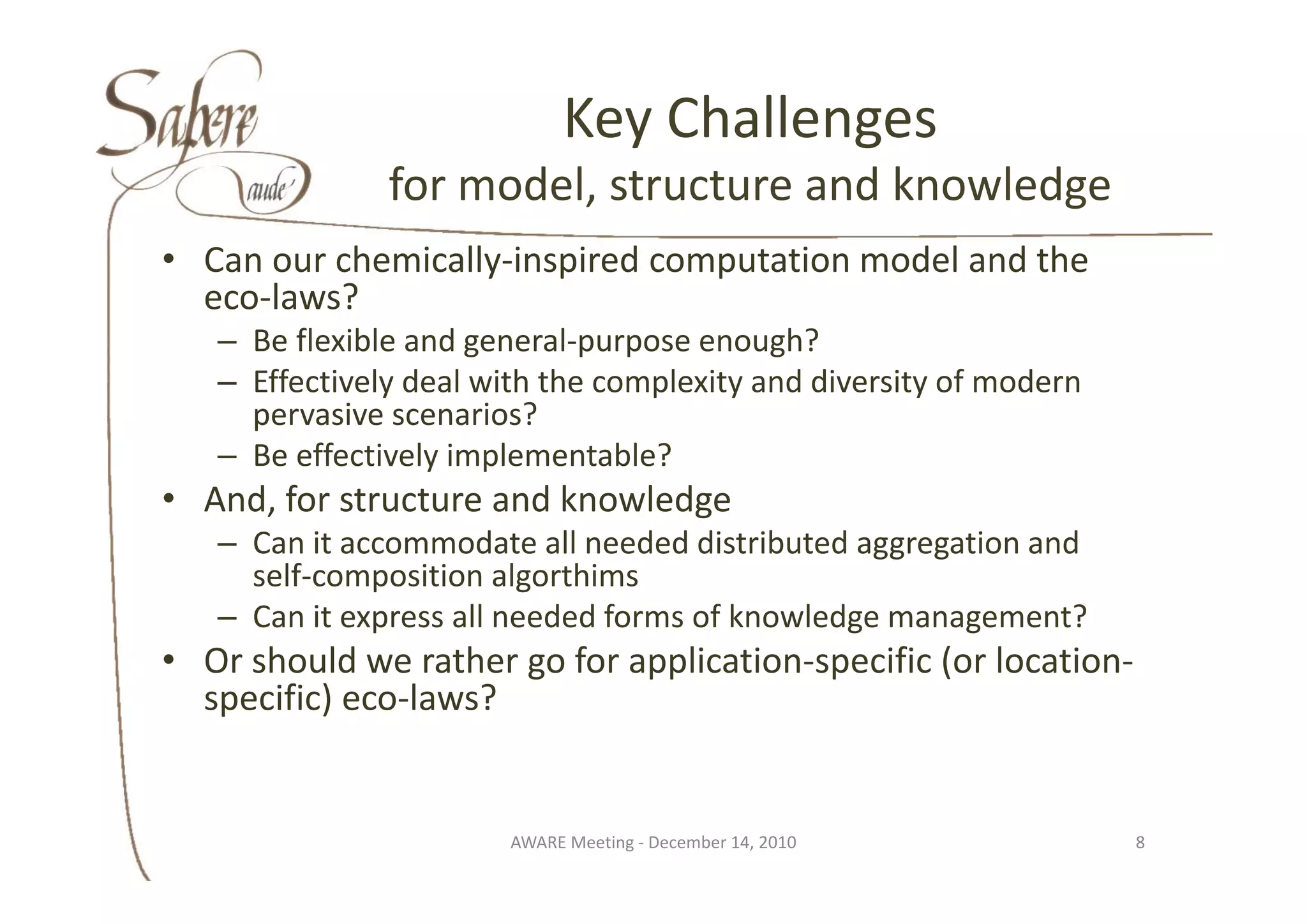
Key Challenges
                                y        g
               for model, structure and knowledge
• C
  Can our chemically‐inspired computation model and the 
           h i ll i i d            t ti     d l d th
  eco‐laws?
   – Be flexible and general‐purpose enough?
                     g        p p          g
   – Effectively deal with the complexity and diversity of modern
     pervasive scenarios?
   – Be effectively implementable?
     Be effectively
• And, for structure and knowledge
   – Can it accommodate all needed distributed aggregation and 
     self‐composition algorthims
       lf        iti     l thi
   – Can it express all needed forms of knowledge management?
• Or should we rather go for application‐specific (or location‐
  Or should           go for application specific (or location
  specific) eco‐laws?


                        AWARE Meeting ‐ December 14, 2010           8
Infrastructure and Applications
                Infrastructure and Applications
• I f t t
  Infrastructure
   – A very lightweight infrastructure
   – Ruling all interactions (from discovery to data exchange and 
     synchronization) by embedding the concept of eco‐laws
         h i ti ) b           b ddi th            t f     l
   – To most extent, acting as a recommendation and planning engine
   – Possibly inspired by tuple space coordination models
   – Yet made it more “fluid” and suitable for a pervasive computing 
     continuum substrate  not a network but a continuum of tuple spaces

• Applications
   –   The “Ecosystem of Display” as a general and impactful testbed
   –   To put at work and demonstrate the SAPERE findings
          p                                                 g
   –   Active and dynamic information sharing in urban scenarios
   –   Active participation of citizens to the working of the urban infrastructure


                            AWARE Meeting ‐ December 14, 2010                  9
Key Tangible Results
                         y    g
                                       (hopefully)
• A novel model and methodology to support the development 
  of complex service systems in open and dynamic pervasive 
  scenarios
• A uniform set of:
   – Self‐* algorithms for service/data composition and aggregation (in 
     the form of libraries)
     th f       f lib i )
   – Algorithms and tools for distributed management of contextual‐
     knowledge, to enforce present‐ and future‐awareness in the 
     ecosystem
• A novel middleware for pervasive computing scenarios (Open 
  Source)
        )
   – Integrating the stated algorithms in the form of libraries
• A set of released innovative application showcased on the 
  Ecosystem of Displays testbed 
  E      t     f Di l    t tb d
                        AWARE Meeting ‐ December 14, 2010           10

Sapere project-introduction-dec-2010

  • 1.
    SAPERE: Self‐aware Pervasive  Service Ecosystems Franco Zambonelli Università di Modena e Reggio Emilia STREP – 3 years www.sapere‐project.eu www sapere‐project eu AWARE Meeting ‐ December 14, 2010 1
  • 2.
    The Consortium The Consortium • Università di Modena e Reggio Emilia – Franco Zambonelli & Marco Mamei Franco Zambonelli & Marco Mamei • Birkbeck College University of London – Giovanna Di Marzo Serugendo Giovanna Di Marzo • Alma Mater Studiorum – Università di Bologna – Mirko Viroli & Andrea Omicini • St. Andrews University – Simon Dobson • Johannes Kepler Universitaet Linz p – Alois Ferscha AWARE Meeting ‐ December 14, 2010 2
  • 3.
    The Scenario The Scenario • Pervasive computing – Sensor rich and always connected smart phones  – Sensor networks and information tags – Localization and activity recognition – Internet of things and the real‐time Web Internet of things and the real time Web • Innovative pervasive services arising – Situation‐aware adaptation Situation aware adaptation  – Interactive reality  – Pervasive collective intelligence and pervasive participation • Open co‐production scenario, very dynamic, diverse  needs and diverse services, continuously evolving AWARE Meeting ‐ December 14, 2010 3
  • 4.
    The Overall Objective The Overall Objective • Develop and demonstrate a highly‐innovative  theoretical and practical framework for pervasive  service ecosystems service ecosystems – Adaptivity and self‐management as inherent properties of  the ecosystem y – Systemic self‐awareness as an observable property of the  overall system – Long lasting (eternal) adaptivity Long‐lasting (eternal) adaptivity – Bio‐chemical inspiration • Foundational re‐thinking of Foundational re thinking of – Service architectures and associated middleware – Self‐* algorithms and contextual knowledge management AWARE Meeting ‐ December 14, 2010 4
  • 5.
    The Architectural Approach The Architectural Approach • Open production model • Smooth data/services  distinction – LSA  live semantic  annotations • Interactions Interactions   – Sorts of bio‐chemical reactions  among components – In a spatial substrate In a spatial substrate • Eco‐laws  – Rule all interactions – Discovery + orchestration + orchestration  seamlessly merged • Built over a pervasive network  world AWARE Meeting ‐ December 14, 2010 5
  • 6.
    Specific Objectives Specific Objectives • Both of a scientific and technological nature • Around which the various WPs are organized AWARE Meeting ‐ December 14, 2010 6
  • 7.
    Model, Structures, and Knowledge Model Structures and Knowledge • M d l & M th d l Model & Methodology – Innovative chemical‐inspired semantic model for interactions among  components and their dynamic composition/aggregation – S Semantic (LSA) description and semantic pattern‐ mathing ti (LSA) d i ti d ti tt thi – Uniform traitment of data and services – Methodological guidelines associated • Structures & Space – Model distributed self‐* algorithms via the chemical LSA framework – Innovative flexible means for aggregation and composition gg g p – Define decentralized means to control the behaviour of the ecosystem • Knowledge & Time – Distributed knowledge management algorithms via the LSA framework Distributed knowledge management algorithms via the LSA framework – Define new means to perform distributed recognition of current situations – As well as to enable recognition of future situations AWARE Meeting ‐ December 14, 2010 7
  • 8.
    Key Challenges y g for model, structure and knowledge • C Can our chemically‐inspired computation model and the  h i ll i i d t ti d l d th eco‐laws? – Be flexible and general‐purpose enough? g p p g – Effectively deal with the complexity and diversity of modern pervasive scenarios? – Be effectively implementable? Be effectively • And, for structure and knowledge – Can it accommodate all needed distributed aggregation and  self‐composition algorthims lf iti l thi – Can it express all needed forms of knowledge management? • Or should we rather go for application‐specific (or location‐ Or should go for application specific (or location specific) eco‐laws? AWARE Meeting ‐ December 14, 2010 8
  • 9.
    Infrastructure and Applications Infrastructure and Applications • I f t t Infrastructure – A very lightweight infrastructure – Ruling all interactions (from discovery to data exchange and  synchronization) by embedding the concept of eco‐laws h i ti ) b b ddi th t f l – To most extent, acting as a recommendation and planning engine – Possibly inspired by tuple space coordination models – Yet made it more “fluid” and suitable for a pervasive computing  continuum substrate  not a network but a continuum of tuple spaces • Applications – The “Ecosystem of Display” as a general and impactful testbed – To put at work and demonstrate the SAPERE findings p g – Active and dynamic information sharing in urban scenarios – Active participation of citizens to the working of the urban infrastructure AWARE Meeting ‐ December 14, 2010 9
  • 10.
    Key Tangible Results y g (hopefully) • A novel model and methodology to support the development  of complex service systems in open and dynamic pervasive  scenarios • A uniform set of: – Self‐* algorithms for service/data composition and aggregation (in  the form of libraries) th f f lib i ) – Algorithms and tools for distributed management of contextual‐ knowledge, to enforce present‐ and future‐awareness in the  ecosystem • A novel middleware for pervasive computing scenarios (Open  Source) ) – Integrating the stated algorithms in the form of libraries • A set of released innovative application showcased on the  Ecosystem of Displays testbed  E t f Di l t tb d AWARE Meeting ‐ December 14, 2010 10