
Applications of and Challenges in
Self-Awareness
All participants of the Slides Factory
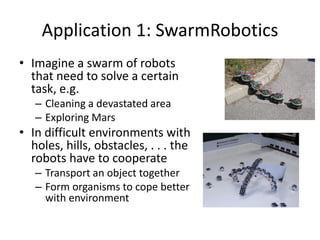
Application 1: SwarmRobotics
• Imagine a swarm of robots
that need to solve a certain
task, e.g.
– Cleaning a devastated area
– Exploring Mars
• In difficult environments with
holes, hills, obstacles, . . . the
robots have to cooperate
– Transport an object together
– Form organisms to cope better
with environment
Application 1: SwarmRobotics
• Robots are aware of the task they are
supposed to perform and monitor their
performance in the environment
• Robots should be able to adapt to maximize
their performance
• Adaptations take place on an individual level
as well as on a collective level:
– Individuals adjust their behavior
– Collective behavior emerges (e.g. organisms are
formed by multiple robots)
Example project – SYMBRION (1)
Symbiotic Evolutionary Robot Organisms
• Hundreds of small cubic robots are built and deployed in an
environment
• Robots sense each other and the environment and are capable of
aggregating into “multi-cellular” organisms
• Aggregation and disaggregation is self-driven, depending on the
circumstances: different environments, different tasks
• Questions addressed:
– Can we build such robots and program the basic behaviors needed for
appropriate (dis)aggregation?
– Can we provide adaptive mechanisms that enable newly “born” organisms
learn to operate (sense, move, act, …)?
Example project – SYMBRION (2)
Scenario movie
http://www.youtube.com/watch?v=SkvpEfAPXn4
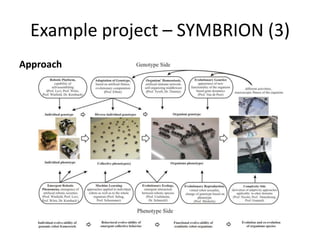
Example project – SYMBRION (3)
Approach
Example project – SYMBRION (4)
Current Results
• Different controllers have been developed for robots
• Evolutionary approaches are able to adapt the controllers
based upon fitness
• Different organisms are formed as required by the
environment
• Some initial versions of hardware have been developed and
are currently being deployed
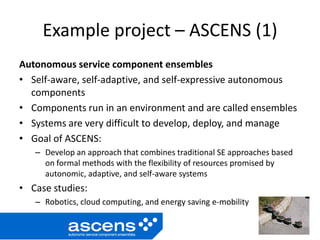
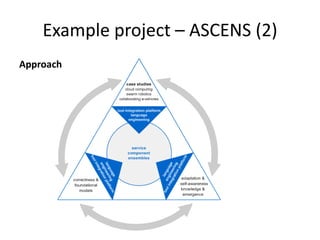
Example project – ASCENS (1)
Autonomous service component ensembles
• Self-aware, self-adaptive, and self-expressive autonomous
components
• Components run in an environment and are called ensembles
• Systems are very difficult to develop, deploy, and manage
• Goal of ASCENS:
– Develop an approach that combines traditional SE approaches based
on formal methods with the flexibility of resources promised by
autonomic, adaptive, and self-aware systems
• Case studies:
– Robotics, cloud computing, and energy saving e-mobility
Example project – ASCENS (2)
Approach
Example project – CoCoRo (1)
Collective Cognitive Robotics
• Aims at creating an autonomous swarm of interacting,
cognitive underwater vehicles
• Tasks to be performed by the swarm:
– Ecological monitoring
– Searching
– Maintaining
– Exploring
– Harvesting resources
Example project – CoCoRo (2)
Scenario movie
http://www.youtube.com/watch?v=OStLml7pHZY
Example project – CoCoRo (3)
Approach
• Draw inspiration from nature to generate behavior:
– Cognition generating algorithms:
• Social insect trophallaxis
• Social insect communication
• Slime mold
• ANN
– Collective movement:
• Bird movement
• Fish school behavior
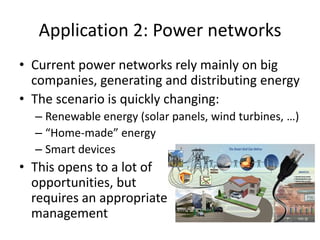
Application 2: Power networks
• Current power networks rely mainly on big
companies, generating and distributing energy
• The scenario is quickly changing:
– Renewable energy (solar panels, wind turbines, …)
– “Home-made” energy
– Smart devices
• This opens to a lot of
opportunities, but
requires an appropriate
management
A new scenario
• People can produce their own energy
• People can sell energy they do not use
– To their neighbors in a peer-to-peer fashion
• Renewable energy impacts positively on the
environment
• Smart devices can help in controlling the
energy consumption and in providing us with
information
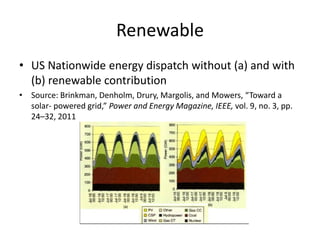
Renewable
• US Nationwide energy dispatch without (a) and with
(b) renewable contribution
• Source: Brinkman, Denholm, Drury, Margolis, and Mowers, “Toward a
solar- powered grid,” Power and Energy Magazine, IEEE, vol. 9, no. 3, pp.
24–32, 2011
The new scenario’s issues
• The new scenario introduces some peculiarities
– The production is “distributed” among a possibly large
number of producers (or “prosumers” if they consume
energy)
– The production is subject to external conditions (e.g.,
weather)
– Smart devices are better than old ones but must be
coordinated
• In general, we have a more dynamic and
unpredictable scenario
Power network control
• But how this situation can be controlled?
• A human control
– Is difficult (many parameters, autonomous
entities, …)
– Can be not impartial (big companies are self-
interested)
• Can a power network control itself?
What is needed?
• In both cases, for networks’ self
management/organization we need:
– Mechanisms, which can enable the network to act
on itself
– Policies or goals, which leads the networks in
taking decisions
Example project - PowerTAC
• Represent each house by means of an agent
• Agents are aware of their current and
expected future energy expenditure
• Agents act based upon this knowledge
• Can either sell or buy energy
• PowerTAC: competition to develop
appropriate mechanisms and agents for selling
and buying energy
Application 3: Data management
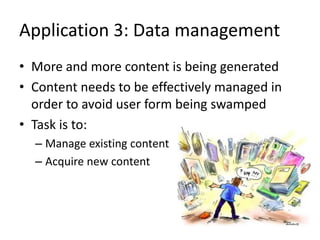
• More and more content is being generated
• Content needs to be effectively managed in
order to avoid user form being swamped
• Task is to:
– Manage existing content
– Acquire new content
Example project - SAPERE
Self-aware Pervasive Service Ecosystems
• Computers for handling data and providing services are
integrated into an “ecosystem”
• System is extended with
– methods for data and situation identification
– decentralized algorithms for spatial self-organization, self-
composition, and self-management
• Thus, we obtain automated deployment and execution of
services and for the management of contextual data items
Scenario
• Pervasive computing
– Sensor rich and always connected smart phones
– Sensor networks and information tags
– Localization and activity recognition
– Internet of things and the real‐time Web
• Innovative pervasive services arising
– Situation‐aware adaptation
– Interactive reality
– Pervasive collective intelligence and pervasive participation
• Open co‐production scenario, very dynamic, diverse
needs and diverse services, continuously evolving
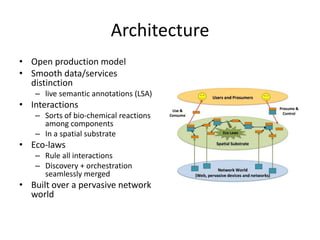
Architecture
• Open production model
• Smooth data/services
distinction
– live semantic annotations (LSA)
• Interactions
– Sorts of bio‐chemical reactions
among components
– In a spatial substrate
• Eco‐laws
– Rule all interactions
– Discovery + orchestration
seamlessly merged
• Built over a pervasive network
world
Infrastructure and applications
• Infrastructure
– A very lightweight infrastructure
– Ruling all interactions (from discovery to data exchange and
synchronization) by embedding the concept of eco‐laws
– To most extent, acting as a recommendation and planning engine
– Possibly inspired by tuple space coordination models
– Yet made it more “fluid” and suitable for a pervasive computing
continuum substrate not a network but a continuum of tuple spaces
• Applications
– The “Ecosystem of Display” as a general and impactfultestbed
– To put at work and demonstrate the SAPERE findings
– Active and dynamic information sharing in urban scenarios
– Active participation of citizens to the working of the urban
infrastructure
Example project - RECOGNITION
Relevance and Cognition for Self‐Awareness in a Content‐Centric
Internet
• Project draws inspiration from human cognitive processes to
achieve self-awareness
• Try to replicate core cognitive processes in computer systems:
– e.g. inference, beliefs, similarity, and trust
– embed them in ICT
• Application domain: internet content
– Manage and acquire content in an effective manner by means of
self-aware computing systems
Motivation: Technological Trends
• Participatory generation of content
– Prosumers, diversity, expanding edges
– Long tail, swamping, scale!
• Content in the environment
– Linkage of the physical and virtual worlds
– Embedding content and knowledge
• Acquiring knowledge through social mechanisms
– Blogging, social networking, recommendation, RSS
feeds…
• How content reaches users will continue to
change…
Self-awareness to support
technological trends
• Intention: Paradigm to support ICT functions
– Enabling content centricity
• Better fitting of users to content and vice-versa
– Synchronize content with human activity and
needs
• Place, time, situation, relevance, context, social search
– Autonomic management
• Of content, its acquisition and resource utilization
Approach: Human Awareness
Behaviour
• Capture & exploit key behaviours of the most
intelligent living species
– Human capability is phenomenal in navigating
complex & diverse stimuli
– Filter & suppress information in “noisy” situations
with ambient stimuli
– Extract knowledge in presence of uncertainty
– Exercise rapid value judgment for prioritisation
– Engage a and multi‐scale social context multi
learning
Application 4: Cooperative E-Vehicles
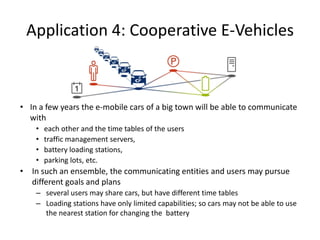
• In a few years the e-mobile cars of a big town will be able to communicate
with
• each other and the time tables of the users
• traffic management servers,
• battery loading stations,
• parking lots, etc.
• In such an ensemble, the communicating entities and users may pursue
different goals and plans
– several users may share cars, but have different time tables
– Loading stations have only limited capabilities; so cars may not be able to use
the nearest station for changing the battery
Application 4: Cooperative E-Vehicles
• Communication and cooperation between the entities of the ensemble
leads to better Quality of Service w.r.t.
– reliability
• e.g. transport/delivery reliability, adherence to schedules, guarantee to reach
the goal, recharging-in-time assurance
– adaptability to changes
• e.g. traffic flow, daily personal schedule of the driver
– predictability of plans
• confidence in reaching a desired location at a preferred time
Application 5: Science Cloud
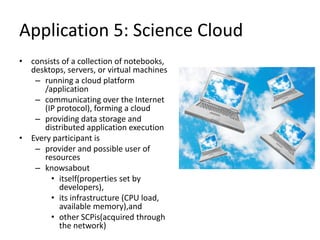
• consists of a collection of notebooks,
desktops, servers, or virtual machines
– running a cloud platform
/application
– communicating over the Internet
(IP protocol), forming a cloud
– providing data storage and
distributed application execution
• Every participant is
– provider and possible user of
resources
– knowsabout
• itself(properties set by
developers),
• its infrastructure (CPU load,
available memory),and
• other SCPis(acquired through
the network)
Application 5: Science Cloud
• The science cloud
– is dynamically changing
• Participants may dynamically join or leave the cloud or just
disappear from the cloud
– is fail-safe
• Continues working if one or several nodes fail
– provides load balancing
• By parallelly executing applications if the load is high, but
not before that.
– aims at energy conservation
• virtual machines are shut down or are taken out of the
configuration if not required
Current research questions and
challenges
• Dilemma of wishing to make our designed artefacts autonomous but not too much
(safety).
• To have a metrics to measure properties related to awareness, autonomy.
• We do not know how to engineer self-organization and emergence.
• We do not know how to cope with autonomy and variability. Dilemma of system stability
and reliability incorporating randomness and variability.
• How to design and implement self-aware systems?
• What kind of tools and methodology can we use here?
• Is it ethical to build self-aware systems?
• Can we build autonomic self-aware systems that behave in an ethical way? Related: legally
correct behaviour, behaviour compliant with some set of rules and regulations.
• What makes known natural systems self-aware?
• Describing the scope of the future behaviour of a self-aware system.
Current research questions and
challenges
• Predicting the behaviour of autonomic systems and their interactions with the
environment.
• How to ensure safety and security of autonomic self-aware systems? How to differentiate
malicious from benign behaviour?
• What does the system theory of autonomic self-aware systems look like?
• How to build an autonomic self-aware system that would last 100 years?
• To what extent can Big Data be treated as an autonomic self-aware system?
• Can you separate an autonomic self-aware system from its environment?
• In what sense is human and machine self-awareness different? What implications do these
differences have on developing them?
• How can we draw inspiration from human self-awareness for designing machine self-
awareness?
• How to do the second order design needed in autonomic self-aware systems?
• Will autonomic self-aware systems develop their own medical science?
• Goal: build an autonomic self-aware energy production system.
• Goal: build a smart city / computer network / communication network.
References
• Sapere
– http://www.sapere-project.eu/
– C. Villalba and F. Zambonelli, "Towards Nature-
Inspired Pervasive Service Ecosystems: Concepts and
Simulation Experiences", Journal of Network
Computers and Applications, vol. 34(2), pp.589-602
– F. Zambonelli, "Pervasive Urban Crowsourcing: Visions
and Challenges", The 7th IEEE Workshop on PervasivE
Learning, Life, and Leisure (PerEl 2011), pp.578-583,
21-25 March 2011

Academic Course: 13 Applications of and Challenges in Self-Awareness

  • 1.
    Applications of andChallenges in Self-Awareness All participants of the Slides Factory
  • 2.
    Application 1: SwarmRobotics •Imagine a swarm of robots that need to solve a certain task, e.g. – Cleaning a devastated area – Exploring Mars • In difficult environments with holes, hills, obstacles, . . . the robots have to cooperate – Transport an object together – Form organisms to cope better with environment
  • 3.
    Application 1: SwarmRobotics •Robots are aware of the task they are supposed to perform and monitor their performance in the environment • Robots should be able to adapt to maximize their performance • Adaptations take place on an individual level as well as on a collective level: – Individuals adjust their behavior – Collective behavior emerges (e.g. organisms are formed by multiple robots)
  • 4.
    Example project –SYMBRION (1) Symbiotic Evolutionary Robot Organisms • Hundreds of small cubic robots are built and deployed in an environment • Robots sense each other and the environment and are capable of aggregating into “multi-cellular” organisms • Aggregation and disaggregation is self-driven, depending on the circumstances: different environments, different tasks • Questions addressed: – Can we build such robots and program the basic behaviors needed for appropriate (dis)aggregation? – Can we provide adaptive mechanisms that enable newly “born” organisms learn to operate (sense, move, act, …)?
  • 5.
    Example project –SYMBRION (2) Scenario movie http://www.youtube.com/watch?v=SkvpEfAPXn4
  • 6.
    Example project –SYMBRION (3) Approach
  • 7.
    Example project –SYMBRION (4) Current Results • Different controllers have been developed for robots • Evolutionary approaches are able to adapt the controllers based upon fitness • Different organisms are formed as required by the environment • Some initial versions of hardware have been developed and are currently being deployed
  • 8.
    Example project –ASCENS (1) Autonomous service component ensembles • Self-aware, self-adaptive, and self-expressive autonomous components • Components run in an environment and are called ensembles • Systems are very difficult to develop, deploy, and manage • Goal of ASCENS: – Develop an approach that combines traditional SE approaches based on formal methods with the flexibility of resources promised by autonomic, adaptive, and self-aware systems • Case studies: – Robotics, cloud computing, and energy saving e-mobility
  • 9.
    Example project –ASCENS (2) Approach
  • 10.
    Example project –CoCoRo (1) Collective Cognitive Robotics • Aims at creating an autonomous swarm of interacting, cognitive underwater vehicles • Tasks to be performed by the swarm: – Ecological monitoring – Searching – Maintaining – Exploring – Harvesting resources
  • 11.
    Example project –CoCoRo (2) Scenario movie http://www.youtube.com/watch?v=OStLml7pHZY
  • 12.
    Example project –CoCoRo (3) Approach • Draw inspiration from nature to generate behavior: – Cognition generating algorithms: • Social insect trophallaxis • Social insect communication • Slime mold • ANN – Collective movement: • Bird movement • Fish school behavior
  • 13.
    Application 2: Powernetworks • Current power networks rely mainly on big companies, generating and distributing energy • The scenario is quickly changing: – Renewable energy (solar panels, wind turbines, …) – “Home-made” energy – Smart devices • This opens to a lot of opportunities, but requires an appropriate management
  • 14.
    A new scenario •People can produce their own energy • People can sell energy they do not use – To their neighbors in a peer-to-peer fashion • Renewable energy impacts positively on the environment • Smart devices can help in controlling the energy consumption and in providing us with information
  • 15.
    Renewable • US Nationwideenergy dispatch without (a) and with (b) renewable contribution • Source: Brinkman, Denholm, Drury, Margolis, and Mowers, “Toward a solar- powered grid,” Power and Energy Magazine, IEEE, vol. 9, no. 3, pp. 24–32, 2011
  • 16.
    The new scenario’sissues • The new scenario introduces some peculiarities – The production is “distributed” among a possibly large number of producers (or “prosumers” if they consume energy) – The production is subject to external conditions (e.g., weather) – Smart devices are better than old ones but must be coordinated • In general, we have a more dynamic and unpredictable scenario
  • 17.
    Power network control •But how this situation can be controlled? • A human control – Is difficult (many parameters, autonomous entities, …) – Can be not impartial (big companies are self- interested) • Can a power network control itself?
  • 18.
    What is needed? •In both cases, for networks’ self management/organization we need: – Mechanisms, which can enable the network to act on itself – Policies or goals, which leads the networks in taking decisions
  • 19.
    Example project -PowerTAC • Represent each house by means of an agent • Agents are aware of their current and expected future energy expenditure • Agents act based upon this knowledge • Can either sell or buy energy • PowerTAC: competition to develop appropriate mechanisms and agents for selling and buying energy
  • 20.
    Application 3: Datamanagement • More and more content is being generated • Content needs to be effectively managed in order to avoid user form being swamped • Task is to: – Manage existing content – Acquire new content
  • 22.
    Example project -SAPERE Self-aware Pervasive Service Ecosystems • Computers for handling data and providing services are integrated into an “ecosystem” • System is extended with – methods for data and situation identification – decentralized algorithms for spatial self-organization, self- composition, and self-management • Thus, we obtain automated deployment and execution of services and for the management of contextual data items
  • 23.
    Scenario • Pervasive computing –Sensor rich and always connected smart phones – Sensor networks and information tags – Localization and activity recognition – Internet of things and the real‐time Web • Innovative pervasive services arising – Situation‐aware adaptation – Interactive reality – Pervasive collective intelligence and pervasive participation • Open co‐production scenario, very dynamic, diverse needs and diverse services, continuously evolving
  • 24.
    Architecture • Open productionmodel • Smooth data/services distinction – live semantic annotations (LSA) • Interactions – Sorts of bio‐chemical reactions among components – In a spatial substrate • Eco‐laws – Rule all interactions – Discovery + orchestration seamlessly merged • Built over a pervasive network world
  • 25.
    Infrastructure and applications •Infrastructure – A very lightweight infrastructure – Ruling all interactions (from discovery to data exchange and synchronization) by embedding the concept of eco‐laws – To most extent, acting as a recommendation and planning engine – Possibly inspired by tuple space coordination models – Yet made it more “fluid” and suitable for a pervasive computing continuum substrate not a network but a continuum of tuple spaces • Applications – The “Ecosystem of Display” as a general and impactfultestbed – To put at work and demonstrate the SAPERE findings – Active and dynamic information sharing in urban scenarios – Active participation of citizens to the working of the urban infrastructure
  • 26.
    Example project -RECOGNITION Relevance and Cognition for Self‐Awareness in a Content‐Centric Internet • Project draws inspiration from human cognitive processes to achieve self-awareness • Try to replicate core cognitive processes in computer systems: – e.g. inference, beliefs, similarity, and trust – embed them in ICT • Application domain: internet content – Manage and acquire content in an effective manner by means of self-aware computing systems
  • 27.
    Motivation: Technological Trends •Participatory generation of content – Prosumers, diversity, expanding edges – Long tail, swamping, scale! • Content in the environment – Linkage of the physical and virtual worlds – Embedding content and knowledge • Acquiring knowledge through social mechanisms – Blogging, social networking, recommendation, RSS feeds… • How content reaches users will continue to change…
  • 28.
    Self-awareness to support technologicaltrends • Intention: Paradigm to support ICT functions – Enabling content centricity • Better fitting of users to content and vice-versa – Synchronize content with human activity and needs • Place, time, situation, relevance, context, social search – Autonomic management • Of content, its acquisition and resource utilization
  • 29.
    Approach: Human Awareness Behaviour •Capture & exploit key behaviours of the most intelligent living species – Human capability is phenomenal in navigating complex & diverse stimuli – Filter & suppress information in “noisy” situations with ambient stimuli – Extract knowledge in presence of uncertainty – Exercise rapid value judgment for prioritisation – Engage a and multi‐scale social context multi learning
  • 30.
    Application 4: CooperativeE-Vehicles • In a few years the e-mobile cars of a big town will be able to communicate with • each other and the time tables of the users • traffic management servers, • battery loading stations, • parking lots, etc. • In such an ensemble, the communicating entities and users may pursue different goals and plans – several users may share cars, but have different time tables – Loading stations have only limited capabilities; so cars may not be able to use the nearest station for changing the battery
  • 31.
    Application 4: CooperativeE-Vehicles • Communication and cooperation between the entities of the ensemble leads to better Quality of Service w.r.t. – reliability • e.g. transport/delivery reliability, adherence to schedules, guarantee to reach the goal, recharging-in-time assurance – adaptability to changes • e.g. traffic flow, daily personal schedule of the driver – predictability of plans • confidence in reaching a desired location at a preferred time
  • 32.
    Application 5: ScienceCloud • consists of a collection of notebooks, desktops, servers, or virtual machines – running a cloud platform /application – communicating over the Internet (IP protocol), forming a cloud – providing data storage and distributed application execution • Every participant is – provider and possible user of resources – knowsabout • itself(properties set by developers), • its infrastructure (CPU load, available memory),and • other SCPis(acquired through the network)
  • 33.
    Application 5: ScienceCloud • The science cloud – is dynamically changing • Participants may dynamically join or leave the cloud or just disappear from the cloud – is fail-safe • Continues working if one or several nodes fail – provides load balancing • By parallelly executing applications if the load is high, but not before that. – aims at energy conservation • virtual machines are shut down or are taken out of the configuration if not required
  • 34.
    Current research questionsand challenges • Dilemma of wishing to make our designed artefacts autonomous but not too much (safety). • To have a metrics to measure properties related to awareness, autonomy. • We do not know how to engineer self-organization and emergence. • We do not know how to cope with autonomy and variability. Dilemma of system stability and reliability incorporating randomness and variability. • How to design and implement self-aware systems? • What kind of tools and methodology can we use here? • Is it ethical to build self-aware systems? • Can we build autonomic self-aware systems that behave in an ethical way? Related: legally correct behaviour, behaviour compliant with some set of rules and regulations. • What makes known natural systems self-aware? • Describing the scope of the future behaviour of a self-aware system.
  • 35.
    Current research questionsand challenges • Predicting the behaviour of autonomic systems and their interactions with the environment. • How to ensure safety and security of autonomic self-aware systems? How to differentiate malicious from benign behaviour? • What does the system theory of autonomic self-aware systems look like? • How to build an autonomic self-aware system that would last 100 years? • To what extent can Big Data be treated as an autonomic self-aware system? • Can you separate an autonomic self-aware system from its environment? • In what sense is human and machine self-awareness different? What implications do these differences have on developing them? • How can we draw inspiration from human self-awareness for designing machine self- awareness? • How to do the second order design needed in autonomic self-aware systems? • Will autonomic self-aware systems develop their own medical science? • Goal: build an autonomic self-aware energy production system. • Goal: build a smart city / computer network / communication network.
  • 36.
    References • Sapere – http://www.sapere-project.eu/ –C. Villalba and F. Zambonelli, "Towards Nature- Inspired Pervasive Service Ecosystems: Concepts and Simulation Experiences", Journal of Network Computers and Applications, vol. 34(2), pp.589-602 – F. Zambonelli, "Pervasive Urban Crowsourcing: Visions and Challenges", The 7th IEEE Workshop on PervasivE Learning, Life, and Leisure (PerEl 2011), pp.578-583, 21-25 March 2011