SANGATH: AN EMBLEM OF DOSHI’S PHILOSOPHY
SANGATH: ARCHITECT’S STUDIO
• Sangath means “moving together through participation” in
Sanskrit.
• The studio is located on the edge of the countryside to the
west of Ahmedabad – features a series of sunken vaults
sheathed in china mosaic as well as a small grassy terraced
amphitheater and flowing water details.
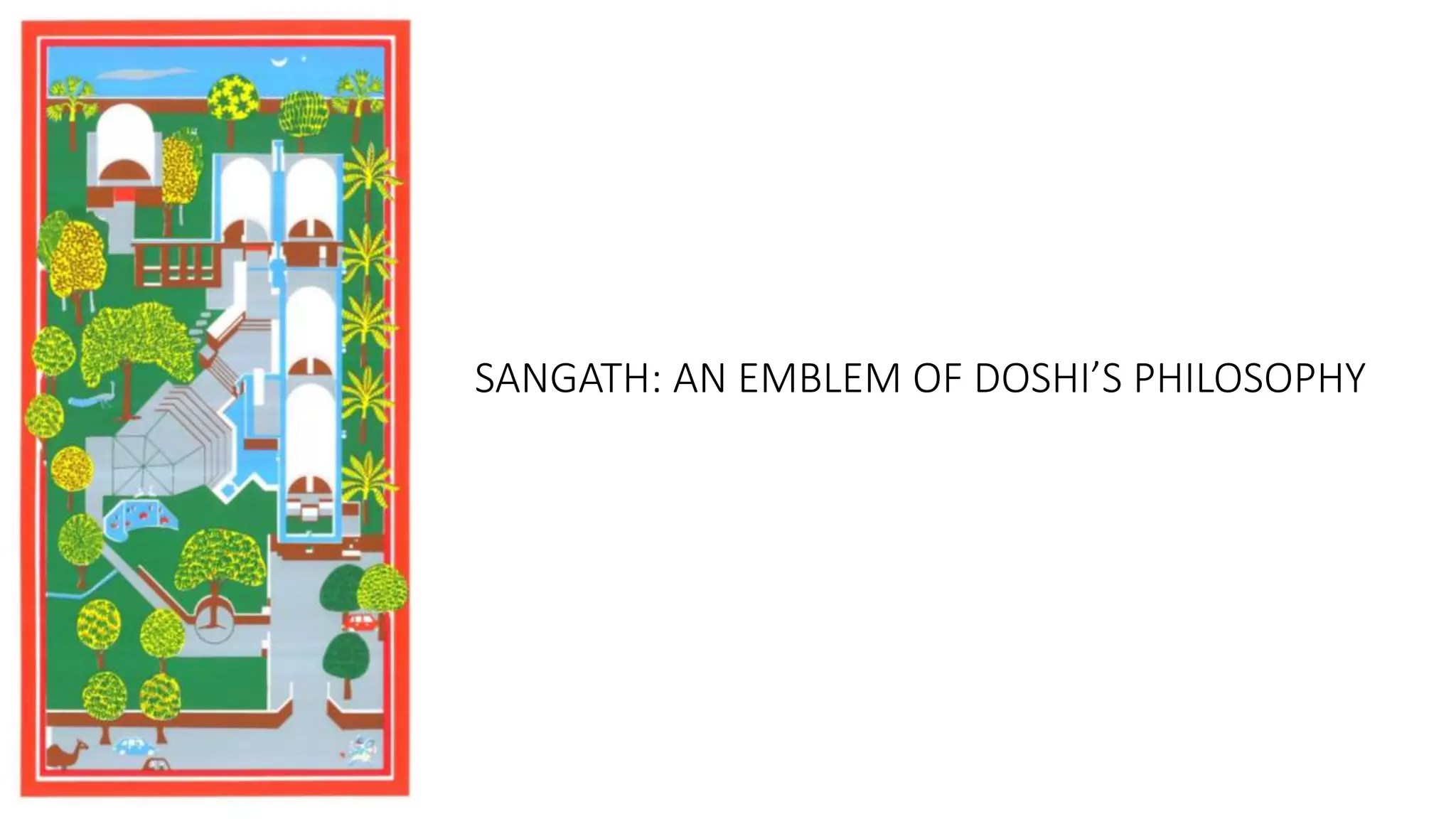
• The site is a quadrangle looking south over a road towards
open country with camels and tribal villagers going in one
direction diesel trucks and new suburbanites passing in the
other.
• Doshi decided to sink the main studio partly below ground to
protect it from the fierce heat, to maintain a low silhouette
and to accommodate a middle level terrace at an easy
distance and height from the garden.
• A lateral section shows how internal levels are interlocked
beneath the vaults to make a 20th century version of a
primeval dwelling.
• A longitudinal section hints at the way that a single,
double and triple height spaces flow into each other.
• Sangath is a complete combination of Doshi's
architectural themes from his previous work including:
• Upon entering the complex, one immediately sees the
silhouette of a vault at an uncertain distance lingering
behind and above an exterior wall.
• A small rectangular opening in this wall gives a glimpse of
the shaded interiors.
• Doshi had began with a rustic address and the theme
intensified by a sequence of stepping ponds reflecting the
building in their still surface.
Vaults on walls, platforms and terraces
Maze like interiors
Ambiguous edges
Dynamic sequences of structure
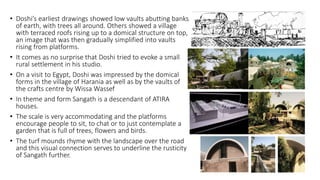
• Doshi’s earliest drawings showed low vaults abutting banks
of earth, with trees all around. Others showed a village
with terraced roofs rising up to a domical structure on top,
an image that was then gradually simplified into vaults
rising from platforms.
• It comes as no surprise that Doshi tried to evoke a small
rural settlement in his studio.
• On a visit to Egypt, Doshi was impressed by the domical
forms in the village of Harania as well as by the vaults of
the crafts centre by Wissa Wassef
• In theme and form Sangath is a descendant of ATIRA
houses.
• The scale is very accommodating and the platforms
encourage people to sit, to chat or to just contemplate a
garden that is full of trees, flowers and birds.
• The turf mounds rhyme with the landscape over the road
and this visual connection serves to underline the rusticity
of Sangath further.
• The form and interior organisation of Sangath express the
response to climate directly. The building dramatizes the natural
elements of land, sky, sun and rain.
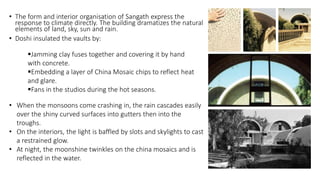
• Doshi insulated the vaults by:
Jamming clay fuses together and covering it by hand
with concrete.
Embedding a layer of China Mosaic chips to reflect heat
and glare.
Fans in the studios during the hot seasons.
• When the monsoons come crashing in, the rain cascades easily
over the shiny curved surfaces into gutters then into the
troughs.
• On the interiors, the light is baffled by slots and skylights to cast
a restrained glow.
• At night, the moonshine twinkles on the china mosaics and is
reflected in the water.
• Sangath articulates Doshi’s private dream of harmony between:
individual ,community and nature.
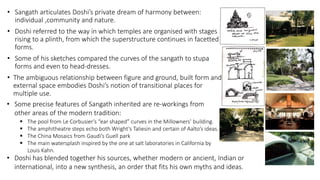
• Doshi referred to the way in which temples are organised with stages
rising to a plinth, from which the superstructure continues in facetted
forms.
• Some of his sketches compared the curves of the sangath to stupa
forms and even to head-dresses.
• The ambiguous relationship between figure and ground, built form and
external space embodies Doshi’s notion of transitional places for
multiple use.
• Some precise features of Sangath inherited are re-workings from
other areas of the modern tradition:
 The pool from Le Corbusier’s “ear shaped” curves in the Millowners’ building.
 The amphitheatre steps echo both Wright’s Taliesin and certain of Aalto’s ideas.
 The China Mosaics from Gaudi’s Guell park
 The main watersplash inspired by the one at salt laboratories in California by
Louis Kahn.
• Doshi has blended together his sources, whether modern or ancient, Indian or
international, into a new synthesis, an order that fits his own myths and ideas.

Sangath

  • 1.
    SANGATH: AN EMBLEMOF DOSHI’S PHILOSOPHY
  • 2.
    SANGATH: ARCHITECT’S STUDIO •Sangath means “moving together through participation” in Sanskrit. • The studio is located on the edge of the countryside to the west of Ahmedabad – features a series of sunken vaults sheathed in china mosaic as well as a small grassy terraced amphitheater and flowing water details. • The site is a quadrangle looking south over a road towards open country with camels and tribal villagers going in one direction diesel trucks and new suburbanites passing in the other. • Doshi decided to sink the main studio partly below ground to protect it from the fierce heat, to maintain a low silhouette and to accommodate a middle level terrace at an easy distance and height from the garden.
  • 3.
    • A lateralsection shows how internal levels are interlocked beneath the vaults to make a 20th century version of a primeval dwelling. • A longitudinal section hints at the way that a single, double and triple height spaces flow into each other. • Sangath is a complete combination of Doshi's architectural themes from his previous work including: • Upon entering the complex, one immediately sees the silhouette of a vault at an uncertain distance lingering behind and above an exterior wall. • A small rectangular opening in this wall gives a glimpse of the shaded interiors. • Doshi had began with a rustic address and the theme intensified by a sequence of stepping ponds reflecting the building in their still surface. Vaults on walls, platforms and terraces Maze like interiors Ambiguous edges Dynamic sequences of structure
  • 4.
    • Doshi’s earliestdrawings showed low vaults abutting banks of earth, with trees all around. Others showed a village with terraced roofs rising up to a domical structure on top, an image that was then gradually simplified into vaults rising from platforms. • It comes as no surprise that Doshi tried to evoke a small rural settlement in his studio. • On a visit to Egypt, Doshi was impressed by the domical forms in the village of Harania as well as by the vaults of the crafts centre by Wissa Wassef • In theme and form Sangath is a descendant of ATIRA houses. • The scale is very accommodating and the platforms encourage people to sit, to chat or to just contemplate a garden that is full of trees, flowers and birds. • The turf mounds rhyme with the landscape over the road and this visual connection serves to underline the rusticity of Sangath further.
  • 5.
    • The formand interior organisation of Sangath express the response to climate directly. The building dramatizes the natural elements of land, sky, sun and rain. • Doshi insulated the vaults by: Jamming clay fuses together and covering it by hand with concrete. Embedding a layer of China Mosaic chips to reflect heat and glare. Fans in the studios during the hot seasons. • When the monsoons come crashing in, the rain cascades easily over the shiny curved surfaces into gutters then into the troughs. • On the interiors, the light is baffled by slots and skylights to cast a restrained glow. • At night, the moonshine twinkles on the china mosaics and is reflected in the water.
  • 6.
    • Sangath articulatesDoshi’s private dream of harmony between: individual ,community and nature. • Doshi referred to the way in which temples are organised with stages rising to a plinth, from which the superstructure continues in facetted forms. • Some of his sketches compared the curves of the sangath to stupa forms and even to head-dresses. • The ambiguous relationship between figure and ground, built form and external space embodies Doshi’s notion of transitional places for multiple use. • Some precise features of Sangath inherited are re-workings from other areas of the modern tradition:  The pool from Le Corbusier’s “ear shaped” curves in the Millowners’ building.  The amphitheatre steps echo both Wright’s Taliesin and certain of Aalto’s ideas.  The China Mosaics from Gaudi’s Guell park  The main watersplash inspired by the one at salt laboratories in California by Louis Kahn. • Doshi has blended together his sources, whether modern or ancient, Indian or international, into a new synthesis, an order that fits his own myths and ideas.